


Introduction: The Rising Tide of AI in Amazon Ads
Amazon advertising is becoming harder to manage by instinct alone. As competition intensifies in the advertising auction in 2025, sellers must make faster, more precise decisions about bids, keywords, placements, budgets, and Listing quality. A small delay in responding to changing performance can affect impressions, CTR, CVR, ACoS, and ultimately the profitability of a campaign.
That pressure is driving more sellers toward AI-assisted tools such as DeepBI. Unlike a static reporting dashboard, an AI-driven workflow can connect advertising signals with the commercial decisions that follow. Impressions, clicks, conversions, CTR, CVR, TACoS, and ACoS can help reveal where a funnel is losing momentum. Weak CTR may point to a need for stronger visual communication, while weak CVR may indicate that the Listing is not presenting its value clearly enough after the click.
Acrylic paint provides a useful example of why this distinction matters. One seller initially believed that insufficient reviews were the main reason advertising performance was difficult to improve. The target 1L heavy-body acrylic paint had 4.4 stars and 108 reviews, while its benchmark competitor had 4.6 stars and 581 reviews. The team therefore considered coupons, giveaways, and additional advertising to help close the review gap.
However, DeepBI’s Listing scoring showed that the page was not simply being defeated by reviews. Its overall score was 78 compared with the benchmark’s 80, and several content areas were already competitive: the title scored 15 versus 13, bullet points were tied at 8, and the A+ or detail-page score was 21 versus 20. The more concentrated weaknesses were the main-image set and the way trust was formed early in the shopping journey. The main-image score trailed at 24 versus 26, while the page’s flat lighting, weakly visible heavy-body texture, and difficult-to-read technical information limited both click formation and first-impression confidence.
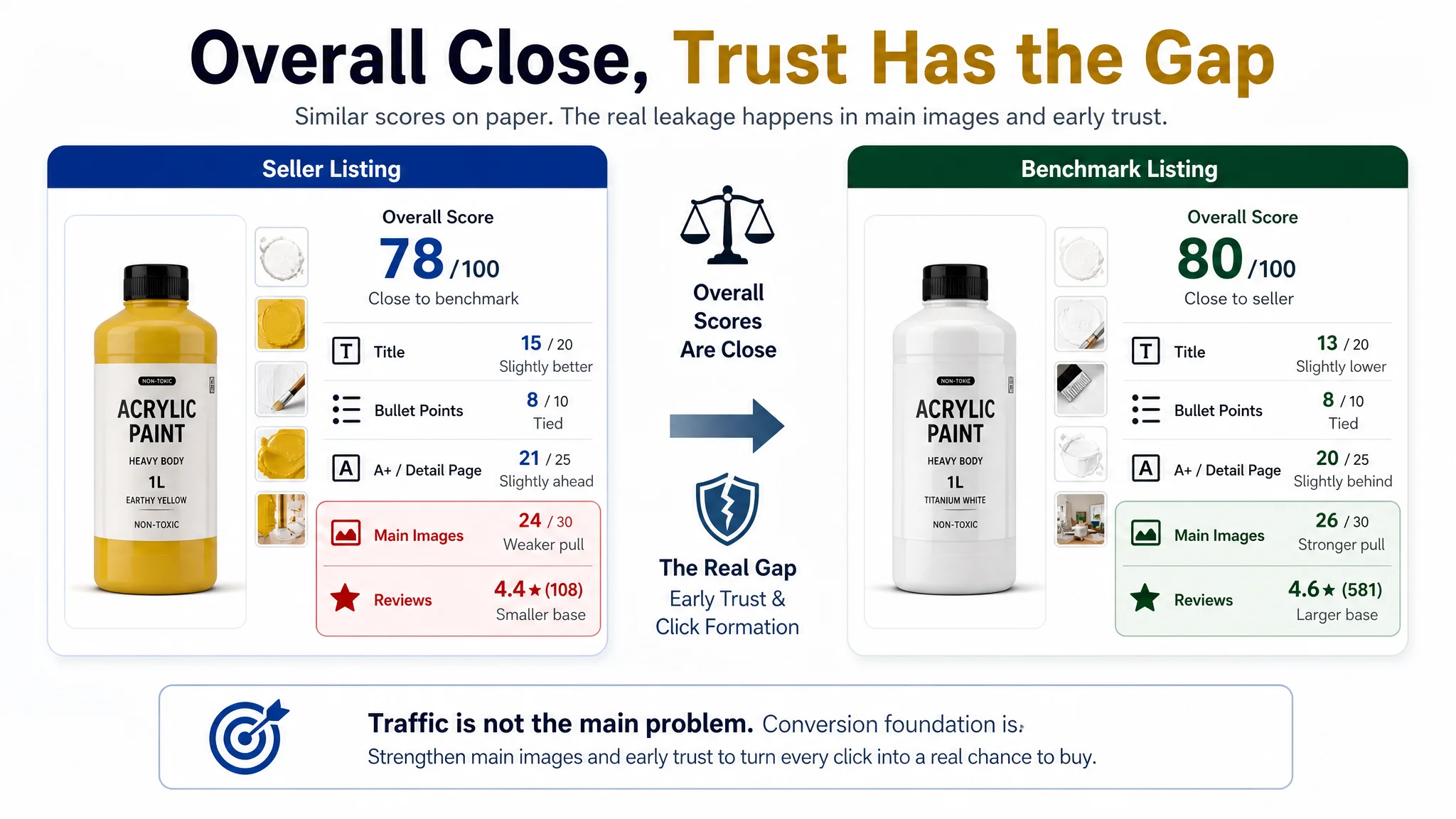
The advertising problem was therefore connected to the Listing’s conversion capacity. The page was not fundamentally broken, but it was not fully prepared to monetize each incremental click. This is why advertising data should not be interpreted in isolation: a seller may believe that reviews, keywords, or bids are the primary constraint while the real leakage is occurring between the search result, the product page, and the purchase decision.
Amazon advertising remains valuable because it can place products in front of shoppers actively searching for solutions or evaluating products, often at a stage of meaningful purchase intent. The challenge is turning that access into profitable growth rather than paying for traffic that does not convert.
This article explains how AI can improve Amazon ad ROI by linking campaign data, Listing decisions, and performance feedback. It also examines how DeepBI applies this principle through a workflow that moves from quantitative diagnosis to strategic recommendations, AI-assisted content production, and deployment through SP-API. The objective is not to promise automatic gains, but to show how better-connected data and decisions can create a more disciplined path toward stronger CTR, CVR, and advertising efficiency.
1. The Fundamentals of AI-Driven Amazon Advertising
AI-driven advertising replaces static campaign routines with decisions that respond to auction conditions, shopper intent, and performance data. Its value is practical: faster adjustments can help sellers manage CTR, CVR, and ACoS across more campaigns than manual review typically allows.
At the same time, advertising optimization is most effective when it is connected to the Listing that receives the traffic. A campaign can generate impressions and clicks, but it cannot independently repair a weak visual proposition, unclear product value, or missing trust signals on the product page. This means AI-driven advertising should help sellers determine not only where to place bids, but also whether the destination Listing is ready for more traffic.
Dynamic Bidding: The Engine of Real-Time Optimization
Auction pressure changes by keyword, time, placement, and competing demand. Dynamic bidding adjusts bids according to signals such as expected conversion potential and recent campaign performance rather than relying on one fixed amount. A stronger bid may be appropriate when a search term is producing qualified traffic; a lower bid may protect ACoS when clicks are accumulating without conversions. The system does not guarantee better returns, but it can react faster to changing conditions and reduce the lag between performance data and bid decisions.
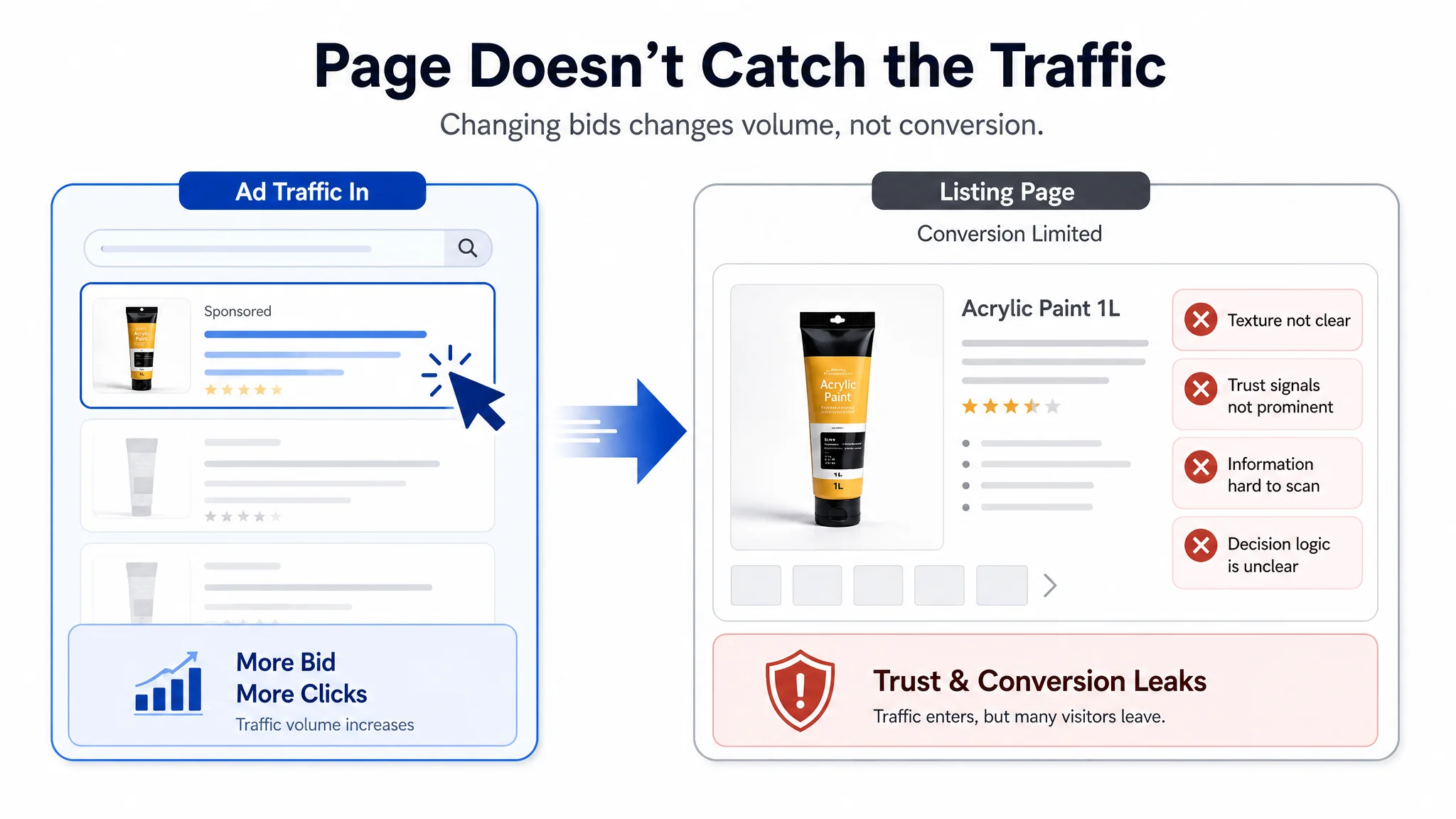
Yet a low-conversion campaign should not automatically be treated as a bidding problem. In the acrylic paint example, the seller’s first instinct was to adjust bids and keywords on the assumption that the Listing was already “good enough” and that the review gap was the main obstacle. DeepBI’s diagnosis pointed to a broader issue: the main image did not communicate the product’s heavy-body texture strongly enough, and the early-page content was more technical than persuasive. Lowering or raising bids could change traffic volume, but it would not remove the uncertainty experienced by shoppers who could not immediately see the product’s texture, professionalism, or practical value.
Dynamic bidding is therefore most useful when it is interpreted alongside conversion context. If traffic is relevant but the Listing fails to establish trust, changing the bid may only change the amount of traffic exposed to the same conversion constraint. The bid decision and the page diagnosis should remain connected.
Audience Segmentation: Precision Targeting at Scale
Not every shopper has the same purchase intent. Some are exploring a category, while others are comparing products or searching with a highly specific need. Audience segmentation groups shoppers according to relevant behaviors or intent signals, allowing campaigns and messages to focus on more suitable prospects. Better alignment can reduce wasted impressions and make CTR and CVR data more meaningful. At scale, this approach helps sellers distinguish traffic that creates engagement from traffic that is unlikely to convert.
The Listing must still speak to the different reasons those audiences are shopping. For the acrylic paint product, professionals, art teachers, beginners, parents, and hobbyists may all care about different aspects of the same product. A professional may look for heavy-body texture, pigment behavior, and lightfastness. A beginner may need reassurance about safety, ease of use, and compatibility with different surfaces. A family shopper may respond to clear non-toxic positioning and practical usage scenarios.
The original bullet points contained much of this information, but they read more like a specification sheet: volume and packaging, professional quality, color mixing, safety, durability, and broad application. DeepBI’s analysis suggested reorganizing the information into a buying path that connected a feature to a concern and then to a reason for trust. Audience segmentation is more valuable when the Listing gives each relevant shopper a clear reason to continue toward purchase.
Ad Placement Optimization: Turning Data into Impressions
An impression is valuable only when its placement supports efficient engagement and conversion. AI can compare performance across available placements and prioritize those associated with stronger CTR, CVR, or more defensible ACoS. Instead of distributing spend evenly, sellers can use placement-level evidence to guide allocation. New results then feed a continuous learning loop: advertising data reveals where performance is weakening or improving, and subsequent bidding, targeting, and placement decisions can be refined accordingly.
The same principle applies to the relationship between the search result and the product page. A well-placed impression may create a click, but the click still depends on the product’s visual presentation. In the acrylic paint case, the main image used a clean white background, yet its flat lighting and limited sense of texture weakened the product’s perceived value at thumbnail size. The product was present in the impression, but the image did not make its central benefit—thick, heavy-body paint with visible texture—immediately clear.
This creates two possible leaks. The first occurs before the click, when the visual does not provide a strong enough reason to enter the Listing. The second occurs after the click, when the page does not resolve the shopper’s doubts. Placement optimization can help identify where traffic performs better, but the page still needs to convert the attention that placement generates.
2. Comparing Ad Placement Strategies: Manual vs. AI-Optimized
Manual Placement: Limits of the Human Hand
Manual placement management often becomes reactive. Sellers review impressions, clicks, conversions, CTR, CVR, and ACoS, then adjust bids or placement settings after performance has already shifted. Repeating this process across multiple campaigns consumes operating time and makes it difficult to respond consistently to changing signals.
Human judgment remains valuable for setting commercial priorities and constraints, but manual review alone does not scale well when decisions must be made frequently. Delayed adjustments can leave budget concentrated in weaker placements or prevent high-potential traffic from receiving sufficient support.
There is another limitation: manual review often encourages teams to focus on the most visible metric or explanation. In the acrylic paint situation, the review gap was easy to see. The competitor had more than five times the review volume, a slightly higher star rating, and roughly twice the first-page negative-review exposure for the seller’s Listing. It was understandable that the team treated reviews as the central problem. But that interpretation made it easier to overlook the fact that the main-image set was also weaker and that the bullets were not building a clear decision sequence.
A manual process can therefore be slow in two ways: slow to respond to campaign changes and slow to challenge the first diagnosis. If the team assumes that the Listing is finished, repeated bid and keyword adjustments may continue while the more important conversion constraint remains untouched.
AI-Powered Placement: Speed, Scale, and Continuous Learning
AI optimization can evaluate structured advertising signals across campaigns and make placement or bid decisions at a speed beyond practical manual capacity. When real-time bid optimization responds to impressions, clicks, and conversion patterns, budget can be directed toward placements showing stronger potential while weaker opportunities are controlled more quickly.
DeepBI’s documented workflow connects advertising data, including impressions, clicks, conversions, TACoS, and ACoS, with ongoing analysis. Stable ad signals can inform optimization, while continued data feedback allows scoring and strategy models to evolve rather than relying on one-time decisions. Better-timed placement decisions may improve the probability of converting relevant traffic, supporting stronger CVR and more disciplined ACoS.
The broader benefit is that AI can help separate symptoms from constraints. A traffic source may appear inefficient because its placement or bid is wrong, but it may also be directing shoppers to a page with weak trust formation. In the acrylic paint diagnosis, the A+ page was structurally stronger than the benchmark’s, with multiple application scenes, texture demonstrations, and comparison modules. Yet those advantages were not being fully used because the main image and initial bullets were not doing enough to bring visitors into the deeper page content.
This distinction matters for placement decisions. AI can improve the speed and scale of traffic allocation, while Listing analysis can determine whether the product page is capable of benefiting from that allocation. Continuous learning should therefore include not only campaign performance, but also the relationship between traffic quality and the page elements that receive it.
A Side-by-Side Look
- Response speed: Manual placement management: Adjustments follow periodic human review, AI-optimized placement: Decisions can respond to incoming performance signals more quickly
- Operating scale: Manual placement management: Limited by staff time and campaign count, AI-optimized placement: Can process signals across campaigns at greater scale
- Decision pattern: Manual placement management: Often reactive to visible performance changes, AI-optimized placement: Continuously evaluates patterns and reallocates attention
- KPI focus: Manual placement management: CTR, CVR, and ACoS reviewed after changes, AI-optimized placement: Bid and placement decisions can be aligned with these signals in the optimization loop
- Page context: Manual placement management: Often reviewed separately from campaign performance, AI-optimized placement: Can be connected with Listing quality and conversion signals
- Human role: Manual placement management: Sets strategy and performs repeated execution, AI-optimized placement: Defines constraints, reviews strategy, and oversees exceptions
3. How DeepBI Powers AI-Driven Ad Optimization
DeepBI’s Ads Quant module connects Amazon advertising data with decisions sellers can act on. Instead of reviewing impressions, clicks, conversions, ACoS, and TACoS as isolated reports, the workflow uses these signals to identify performance changes and recommend campaign responses. The objective is not automation for its own sake: each adjustment should have a clear path toward stronger CTR, CVR, controlled ACoS, or more efficient budget use.
That path also requires a diagnosis of the Listing itself. The acrylic paint example illustrates why an AI workflow should not stop at campaign metrics. The seller initially framed the problem as insufficient reviews and considered using promotions or more advertising to close the gap. DeepBI’s Listing comparison showed a more specific pattern: the overall page score was close to the benchmark, the A+ structure was slightly stronger, but the main-image set and early trust signals were weaker. The page did not need to be described as “bad” for it to be unable to fully monetize cold traffic.
Real-Time Data and Adaptive Algorithms
Real-time processing helps Ads Quant respond as campaign conditions change rather than relying only on delayed, static reviews. Adaptive algorithms can evaluate new performance signals, detect movement in conversion or cost patterns, and update recommendations accordingly. When a keyword begins generating clicks without corresponding conversions, for example, a timely response can limit inefficient spend before it puts further pressure on ACoS. When conversion quality strengthens, the system can identify the signal for a more appropriate investment decision.
The meaning of those signals still depends on the stage of the funnel. Repeated clicks without orders may indicate poor targeting, but it may also indicate that the product page is not answering the shopper’s questions. In the acrylic paint case, the main image did not make the heavy-body texture easy to perceive, while technical parameters such as lightfastness and opacity were difficult to read on mobile. The bullets provided information but did not clearly explain why the paint felt different, how it addressed practical concerns, or why the shopper should trust the brand.
A timely advertising response can control inefficient spend, but it cannot by itself make heavy-body texture visible or turn technical details into a persuasive buying path. Adaptive algorithms are therefore most useful when campaign signals are combined with Listing-level evidence. The result is a more accurate question: is the campaign bringing the wrong shoppers, or are relevant shoppers arriving at a page that does not complete the decision?
Automated Campaign Management
Hourly bid adjustments align bids more closely with changing performance, reducing the risk of paying aggressively for weak traffic or underfunding valuable opportunities. Automated budget allocation directs spend toward campaigns and terms showing stronger conversion potential. Better distribution can improve the share of budget producing sales while supporting ACoS control. Keyword harvesting turns useful search and conversion signals into expansion opportunities. Adding relevant, proven terms can broaden qualified traffic and support CTR and CVR without depending only on the original keyword set.
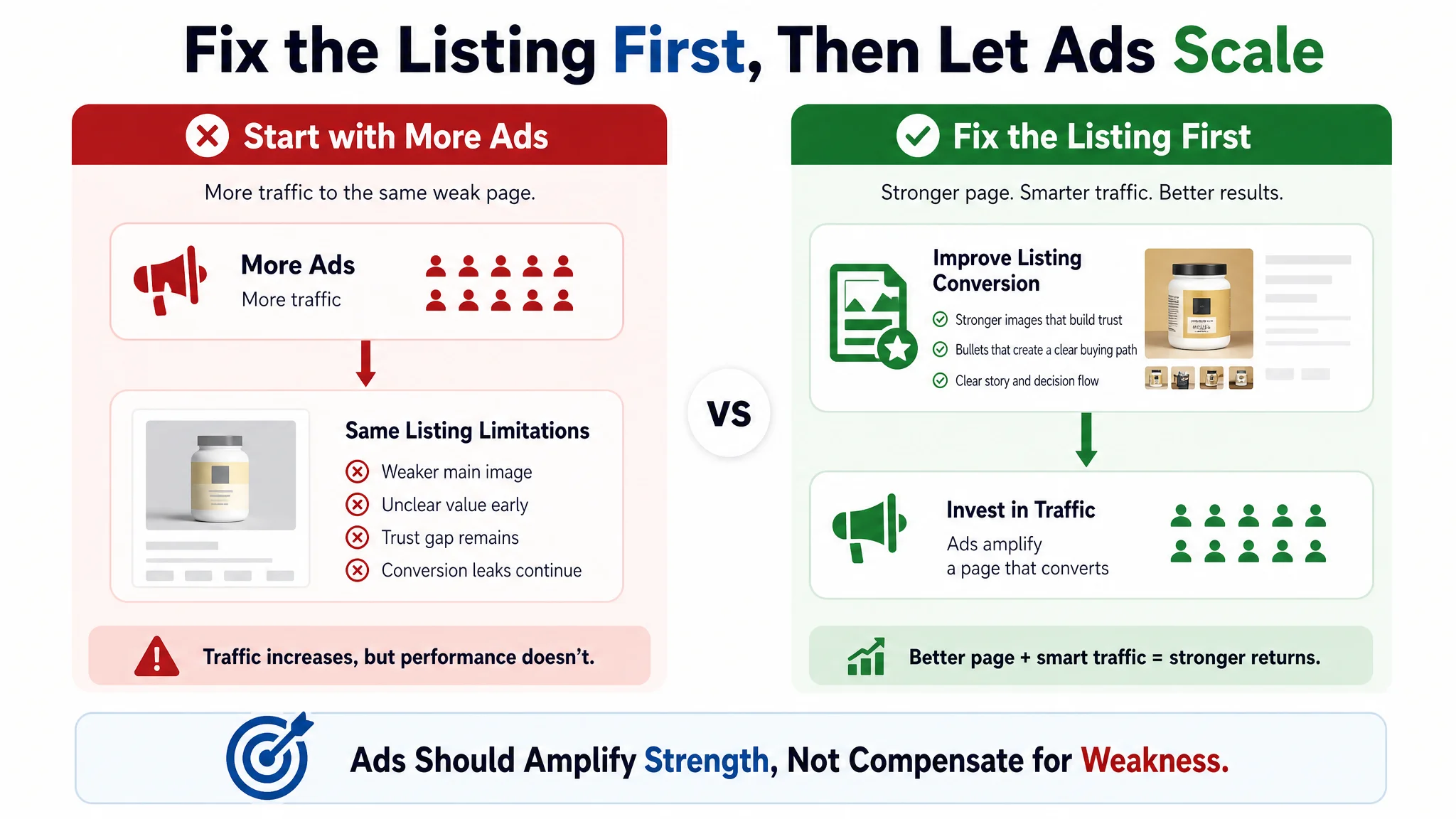
However, automated management should not be used to justify scaling traffic into an unresolved Listing. In the acrylic paint example, the team had been considering new keyword combinations, bid tuning, and campaign restructuring. DeepBI instead recommended repairing the Listing’s conversion logic first. The proposed changes focused on making the heavy-body benefit visually evident, improving perceived professionalism and safety at the hero-image level, and restructuring the bullets around pain point, solution, and trust.
This sequence does not make automated advertising less important. It gives the automation a stronger commercial foundation. Once the page can better explain the product, later ad data becomes easier to interpret: a weak result is less likely to be confused with a basic failure of visual communication, and a stronger result is more likely to reflect qualified traffic meeting a page that is prepared to convert it.
Cross-Campaign Learning and Insights
Cross-campaign learning compares patterns across campaigns, helping identify which bidding, budget, or keyword signals are associated with stronger outcomes. Applying those insights to related campaigns reduces repeated manual analysis and can improve decision consistency. Sellers can then prioritize changes based on shared evidence rather than treating every campaign as an isolated case.
The same learning logic can be applied across Listing elements. A weak CTR pattern may point toward a visual communication problem, while a weak CVR pattern may require analysis of reviews, bullets, A+, pricing, or product-page trust. In the acrylic paint comparison, the title was structurally strong and even scored above the benchmark, while the A+ structure was also slightly ahead. The main-image set, however, trailed the benchmark, and the bullets did not turn the product’s technical advantages into a clear buying narrative.
This type of cross-functional comparison prevents optimization from stopping at the strongest-looking module. A fuller A+ page does not automatically compensate for a weak hero image, just as a technically complete title does not guarantee a strong click-through rate. Shared evidence helps sellers identify which elements are actually limiting the advertising funnel.
4. Proven Benefits of DeepBI's AI Advertising Tool
Increased ROI
ROI improves when ad spend reaches more relevant shoppers and listing content converts that traffic more effectively. DeepBI connects impressions, clicks, conversions, CTR, CVR, ACoS, and TACoS with Listing optimization, helping sellers identify whether weak performance comes from targeting, communication, or execution. A generic before-and-after pattern might show low CTR and CVR alongside high ACoS, followed by more relevant traffic, stronger conversion signals, and more disciplined spending. These are potential outcomes, not guaranteed results.
The acrylic paint diagnosis shows why this connection matters. The seller was tempted to treat the review gap as the main explanation for constrained returns and to use additional advertising or promotions to compensate. Yet the analysis found that the product page had a more immediate problem: shoppers were not receiving a strong enough visual and narrative reason to trust the product. A clean but flat main image did not communicate the thickness and texture of the paint, while the bullet points presented specifications without creating a persuasive sequence.
If advertising spend is increased before this kind of constraint is addressed, the seller may simply purchase more exposure to the same weakness. ROI analysis should therefore ask whether low returns are caused by inefficient traffic, weak page communication, or both. The purpose of connecting ad metrics with Listing signals is to make that distinction visible before budget is scaled.
Improved Conversion Rates
DeepBI uses advertising signals, semantic analysis, and high-converting search terms to align titles and images with the product’s audience, use case, and positioning. Clearer relevance can improve CTR by attracting better-matched clicks and can support CVR by setting more accurate expectations before purchase. After a visual update is applied, DeepBI marks a visual iteration event in ad reports, allowing sellers to compare the ASIN’s CTR trend over the following 7–14 days.
The paint Listing demonstrates how a product can contain the right information without converting that information into confidence. The seller’s title included the product type, color, size, surfaces, audience, and qualifiers such as “Non-Toxic” and “Heavy Body.” Its A+ page included texture demonstrations, dry-versus-wet comparisons, application scenarios, and packaging comparisons. These were useful assets, but the main image and early bullets did not surface the strongest reasons to buy quickly enough.
DeepBI’s recommendations therefore emphasized the first 35 characters of the title, clearer “heavy body” and color recognition, a hero image with stronger lighting and perceived value, and a macro image that made the paint’s ridges and thickness visible. The goal was not to add information indiscriminately. It was to improve the sequence from recognition to interest to trust. This supports the broader principle that CVR depends not only on bringing a shopper to the page, but also on whether the page resolves the shopper’s most important questions in the order they arise.
Cost Efficiency and Time Savings
Better-converting traffic can reduce wasted spend and may contribute to lower ACoS or TACoS over time. Budget decisions can also become more efficient when sellers prioritize campaigns, terms, and assets connected to stronger conversion data rather than spreading spend evenly. DeepBI’s workflow reduces manual handling: a product-document example describes shortening an image-upload task from about 30 minutes to seconds through API-based application. Teams may also save substantial operating time on competitor analysis, diagnosis, and image production, although no fixed weekly saving is established.
The cost issue is not limited to the price of each click. When a page has a weak conversion frame, sellers may spend additional time and budget trying to compensate through keyword changes, bid adjustments, coupons, or traffic expansion. The acrylic paint team’s initial focus on reviews created precisely this risk. Reviews were a real disadvantage, but the diagnosis showed that more reviews alone would not remove the weaknesses in the main-image set and bullet-point logic.
Improving cost efficiency therefore begins with reducing avoidable leakage. If the page cannot explain the product’s value, advertising teams may continue to adjust campaigns without a clear indication of whether the traffic or the Listing is responsible for the result. A connected workflow can help direct time toward the bottleneck rather than repeatedly optimizing the most accessible variable.
Enhanced Customer Experiences
More relevant, accurate advertising can help customers understand a product before clicking or purchasing. Preserving verified attributes and physical structure may reduce mismatch risk and support trust. Customer satisfaction is not automatic, but clearer targeting and product communication can create a more consistent path from ad impression to purchase.
The same principle applies to the information presented after the click. For the acrylic paint product, shoppers could reasonably want to know whether “heavy body” meant visibly thick texture, whether the paint would remain attractive after drying, how it performed across materials, and whether the packaging was practical for repeated use. A page that only lists technical details may leave those questions unresolved even when the information is technically present.
The recommended image and A+ structure addressed these concerns through visible texture, dry-versus-wet comparison, multi-material scenes, water-resistance information, and a step-by-step opening guide. These changes were not merely decorative. They were intended to reduce ambiguity and align expectations with the actual product. Clearer communication can support both advertising efficiency and a more reliable customer experience.
5. Getting Started: A Step-by-Step Guide to DeepBI AI Ads
Defining Goals and KPIs
Start with the business objective, not the automation setting. Decide whether the priority is increasing conversions, controlling ACoS, improving ROI, or supporting profitable growth. Record a baseline for impressions, clicks, CTR, CVR, spend, conversions, ACoS, and ROI. This gives every later campaign change a measurable reference point.
The baseline should also include a Listing assessment where possible. A seller may see a high review gap, weak CVR, or rising ACoS and immediately choose an advertising explanation. The acrylic paint case shows why that can be incomplete: the review difference was visible, but the page also had a weaker main-image score and less effective early-page trust communication. Recording those elements helps distinguish a social-proof gap from a broader conversion gap.
A useful diagnostic question is: if the next increment of relevant traffic arrived today, would the Listing be ready to convert it? This does not mean reviews are unimportant. It means sellers should evaluate whether images, title, bullets, A+, and trust signals are working together before assigning the entire problem to advertising.
Creating an AI-Optimized Campaign
Use the available product, audience, search-term, and conversion data to structure the campaign. Clarify the product’s priority selling points and identify the funnel weakness first: low CTR may point to an ineffective Listing or creative, while low CVR may indicate that the product page is not converting traffic effectively. Keep campaign decisions connected to these observable signals rather than subjective preferences.
The priority selling point must be visible in the Listing as well as in the campaign strategy. For the acrylic paint product, “heavy body” was not just a keyword or technical descriptor. It was the central reason a shopper might choose the product, because it implied thick, butter-like consistency, visible texture, and stand-up effects. DeepBI therefore recommended showing the texture in an open-container macro image and in actual artwork rather than relying on the phrase alone.
The same approach applies across categories. If the campaign targets a specific use case, the title, main image, bullets, and A+ should help the shopper recognize that use case and understand the product’s advantage. Campaign relevance and page relevance should reinforce one another instead of creating a disconnect between the promise in the ad and the experience after the click.
Enabling and Monitoring AI Features
After the baseline and campaign structure are clear, activate the relevant DeepBI AI optimization capability within the confirmed workflow. Monitor what changes, when it changes, and which campaigns or targets are affected. An hour-by-hour adjustment could, illustratively, reduce wasted spend by responding faster to changing performance, but treat this as a possible operating benefit—not a guaranteed DeepBI capability or result. Review spend and conversions alongside CTR, CVR, ACoS, and ROI.
Monitoring should also track Listing changes as separate events. If the main image, title, bullets, or A+ content is updated at the same time as a campaign change, later results can be difficult to interpret. DeepBI’s workflow allows a visual iteration event to be marked in ad reports so sellers can compare the ASIN’s CTR trend over the following 7–14 days. This does not prove causation by itself, but it creates a clearer reference point for review.
In the acrylic paint situation, the key monitoring question would not be only whether bids changed efficiently. It would also be whether the revised page made the product’s value easier to recognize: did the hero image communicate professionalism, did the texture become visible at a glance, and did the bullets answer concerns in a more persuasive order? Monitoring both sides of the funnel prevents a seller from declaring success or failure based on campaign adjustments alone.
Analysing Performance and Iterating
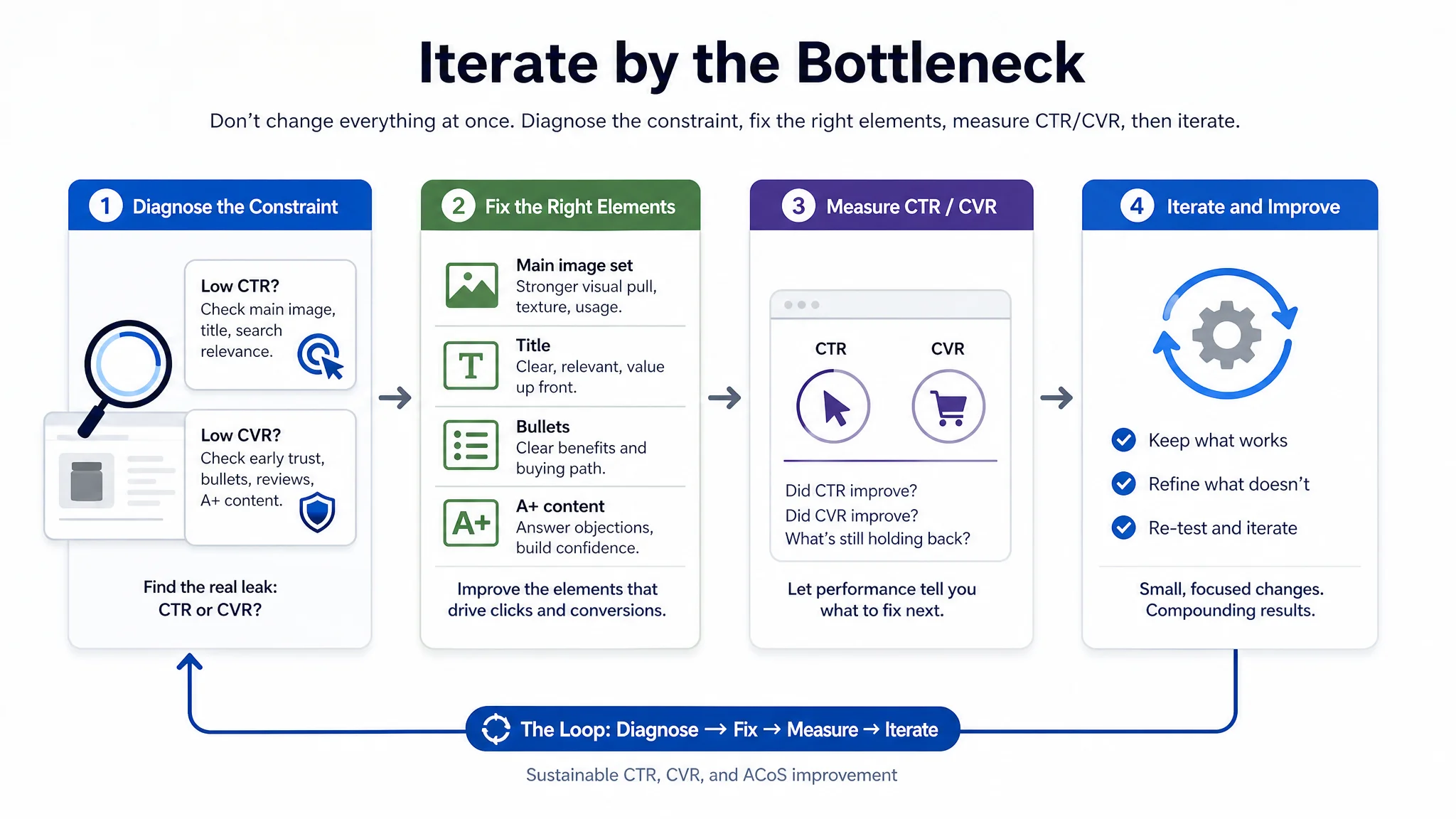
Compare post-change results with the original baseline instead of judging a single day in isolation. Mark each major optimization event and observe the subsequent performance pattern, including CTR and CVR movement over an appropriate review period. If ACoS rises without profitable conversion growth, reassess targeting, creative, or budget decisions. Feed the findings back into the next optimization cycle. DeepBI’s value lies in connecting diagnosis, planning, production, and delivery into a repeated data-informed loop—not in configuring a campaign once and leaving it unattended.
Iteration should follow the diagnosed constraint. If CTR remains weak, review the main image, title recognition, search relevance, and placement context. If clicks are present but CVR remains weak, review the early-page trust structure, bullets, reviews, product expectations, and A+ communication. If both are weak, avoid assuming that one campaign adjustment will solve the entire funnel.
The acrylic paint case makes this sequence concrete. The title was broadly sound and the A+ structure was already strong, so the highest-priority work was not to rebuild every module. It was to improve the main-image set, turn technical information into clearer visual signals, and reshape the bullets into a buying path. This is a more disciplined form of iteration than changing every variable at once. It focuses effort where the diagnosis indicates the largest constraint.
6. Challenges and Limitations of AI Advertising
AI can improve Amazon advertising decisions, but its performance is limited by the inputs available to it. Incomplete Listing information, inconsistent product attributes, weak competitor data, or unreliable advertising reports can distort recommendations. DeepBI connects signals such as impressions, clicks, conversions, CTR, CVR, ACoS, and TACoS to diagnose funnel problems, yet those signals remain useful only when the underlying data is accurate and sufficiently complete.
The acrylic paint comparison illustrates the importance of specific, rather than superficial, diagnosis. The competitor had more reviews, but the seller’s overall Listing score was close. The title and A+ page were not obvious weaknesses, while the main-image score and early trust formation were more constrained. An AI system that reduced the analysis to “more reviews are needed” would miss the structural differences that affected the click and conversion path. AI can organize evidence, but the evidence still has to be interpreted in relation to how shoppers make decisions.
There is also a learning curve. Sellers must learn how to interpret AI recommendations, distinguish a low-CTR creative problem from a low-CVR detail-page problem, and assess whether a proposed change fits the product and business strategy. A recommendation should support a decision, not replace the reasoning behind it.
For example, a low CVR may be caused by irrelevant traffic, but it may also be connected to a main image that fails to establish trust, bullets that do not answer objections, or an A+ page whose strongest information appears too late. In the acrylic paint case, the A+ page contained substantial content, but its value was under-leveraged because the top of the page did not create enough confidence for visitors to continue exploring. The conclusion was not that A+ was unimportant. It was that page elements must work in sequence.
AI outputs also require validation. General-purpose generation can alter product details and create an image-product mismatch, increasing the risk of negative reviews, refunds, and wasted Listing cycle time. DeepBI addresses this risk by using Product DNA as a constraint and checking generated assets against the product’s defined characteristics. Amazon compliance requirements, including image specifications and title limits, must still be respected.
This constraint is particularly relevant when visual optimization is used to address a conversion problem. The acrylic paint recommendations called for visible heavy-body texture, stronger professional lighting, technical parameter panels, and application scenes. Those assets must still represent the actual product accurately. Making the paint look thicker, larger, safer, or more versatile than the product can support would replace one trust problem with another.
Human oversight remains essential. Sellers provide commercial context, judge brand positioning, apply creativity, and retain final selection authority rather than accepting every recommendation. Advertising results should be treated as feedback for further review, not guaranteed outcomes. Amazon can also change how advertising algorithms evaluate and distribute campaigns, affecting CTR, CVR, ACoS, or BSR. Regular monitoring and adjustment are therefore necessary. The strongest operating model combines AI’s structured analysis and execution speed with human judgment, product knowledge, and ongoing business review.
7. The Future of AI in Amazon Advertising - and DeepBI's Role
- DeepBI Listing Product Documentation, Consolidated Edition — Describes a broader AI workflow connecting diagnosis, strategy, creative production, delivery, and performance feedback. This direction could help sellers move from isolated campaign decisions toward coordinated planning, faster creative iteration, and more responsive Listing adjustments.
The value of this connection becomes clearer when the main constraint is not simply a bid or keyword. In the acrylic paint situation, diagnosis moved from the visible review gap to the less obvious weakness in click formation and early trust. A workflow that can connect campaign performance with Listing scoring may help sellers identify when advertising is exposing a page problem rather than creating one.
- DeepBI Listing Product Documentation, Consolidated Edition — Identifies deeper use of Listing advertising reports and keyword weighting to prioritize visual and content optimization. With sufficient performance data, similar workflows may support more relevant personalization around search signals, audience needs, and product attributes, while keeping potential effects on CTR and CVR measurable rather than assumed.
For a product whose core value is difficult to communicate through words alone, this could support stronger alignment between search intent and visual content. In the acrylic paint example, the product’s heavy-body texture, color, size, and use cases needed to become more quickly recognizable. Keyword and advertising signals can help identify the demand, but visual and written assets still need to express the product truthfully.
- DeepBI Listing Product Documentation, Consolidated Edition — Documents an evaluation layer involving CTR prediction, information-density checks, and Product DNA consistency. Predictive analytics may eventually help sellers compare creative options before deployment and shorten the Listing cycle time, but predicted outcomes should not be treated as guaranteed improvements in CTR, CVR, ACoS, or BSR.
Information density should not be confused with information effectiveness. The acrylic paint Listing already contained multiple A+ modules and detailed technical content, yet the benchmark’s simpler page could still communicate its value more directly in certain areas. Future evaluation systems should therefore consider whether an asset helps a shopper make a decision, not only how much information it contains.
- DeepBI Listing Product Documentation, Consolidated Edition — Presents the future return of clicks, conversions, and conversion distributions into scoring and generation strategies as a roadmap direction. This suggests a possible closed feedback loop for campaign responsiveness, not a confirmed fully automated advertising feature.
Such a loop could help sellers test whether a change to the main image, title, or bullets is associated with movement in CTR or CVR. It should still be interpreted carefully, because reviews, pricing, competition, seasonality, placement, and traffic mix may affect the same metrics.
- DeepBI Listing Product Documentation, Consolidated Edition — Establishes Product DNA as a boundary for AI-assisted generation: optimization must not invent features, alter physical structure, fabricate specifications, or copy competitor designs. Any future generative creative workflow should preserve this compliance constraint.
In the acrylic paint example, visualizing texture and usage scenarios was useful only because those elements represented the product’s actual heavy-body characteristics and intended applications. AI-assisted optimization should make real value easier to understand, not manufacture a value proposition that the product cannot deliver.
- Amazon Seller Central official documentation — Amazon’s AI and advertising requirements may continue to evolve. Policy references should be treated as current as of the writing year; advertisers should verify the latest official Seller Central documentation before deploying AI-generated creative or changing campaign workflows.
- DeepBI Listing Product Documentation, Consolidated Edition — Supports a cautious roadmap position: deeper integration may give sellers more sophisticated ways to connect advertising signals with creative and operational decisions, without promising specific future DeepBI capabilities.
Conclusion: Unlocking Full Ad Potential with DeepBI AI
With Amazon’s ad auction growing more crowded every quarter, relying on manual review alone can leave CTR opportunities, CVR signals, and budget decisions unexplored. AI can help sellers analyze campaign data faster, adjust bids as conditions change, identify stronger placement opportunities, and direct spend toward areas with clearer commercial potential. The objective is not to chase activity; it is to improve the relationship between ad cost, conversion, sales, and ROI.
The acrylic paint example shows why that relationship must include Listing quality. The seller initially believed that a smaller review base and slightly lower rating were the primary reasons advertising returns were difficult to improve. DeepBI’s analysis found a more specific combination: the review gap was real, but the main-image set was weaker, the heavy-body texture was not visually clear, and the bullet points provided information without creating a strong buying path. The A+ page was already structurally competitive, but its value was not being fully reached because trust was not being established early enough.
DeepBI adds value by connecting Amazon advertising signals with Listing optimization. Its workflow uses measurable inputs such as impressions, clicks, conversions, CTR, CVR, ACoS, and TACoS to identify weaknesses, prioritize actions, and review performance after changes are applied. That makes Amazon Ads Quant more than a reporting exercise: it becomes a structured process for turning data into decisions. Visual changes can also be tied to a publication event so sellers can compare later advertising results with the timing of the update.
The practical lesson is straightforward: advertising should amplify a Listing that is ready to convert, not compensate indefinitely for one that is not. Before increasing bids, adding keywords, or expanding budget, sellers should ask whether the page communicates its core value quickly, builds trust at the top, answers key objections, and gives every incremental click a strong reason to continue toward purchase.
The strongest results still require verified data, clear objectives, and human judgment. DeepBI does not replace strategic oversight, and it should not be treated as a guarantee of lower ACoS or higher ROI. Use it to evaluate your goals, data quality, and active campaigns, then identify where AI-assisted optimization can improve CTR, CVR, placement, budget use, and Listing cycle time. [6] [11] [current writing year] [...]