


On This Page (Table of Contents)
- Why AI Compliance Matters for Amazon Sellers — Understand how unmanaged AI use can create risks involving listing accuracy, customer trust, account security, and policy compliance.
- Amazon’s AI Usage and Responsible AI Requirements — Review the core expectations around permitted AI use, opt-out handling, data protection, and human oversight.
- DeepBI’s Compliance-First AI Operating Model — See how structured workflows and defined service boundaries support safer Amazon optimization.
- Product Entity Consistency: Preventing Image-Product Mismatch — Learn how Product DNA constrains visual generation so optimization does not alter a product’s material, color, or industrial design.
- How DeepBI Controls AI Hallucinations and Unsupported Claims — Explore the safeguards against invented product parameters, features, or visual details that could increase negative-review risk.
- DeepBI’s Four-Module Optimization Workflow — Follow the connection between Scoring, Suggestions, Image Generation, and Application across the listing improvement process.
- Structured Optimization for Amazon Listings and A+ Content — See how titles, bullet points, A+ pages, and main images can be improved through a controlled, business-focused process.
- Human Oversight, Data Handling, and Secure Execution — Understand where review, approval, and standardized operations remain essential for compliant implementation.
Learn About: DeepBI and Amazon's AI Policy Landscape
Amazon sellers using AI face more than a technology decision. They must manage four connected policy dimensions: AI services opt-out requirements, Responsible AI prohibitions, internal tracking expectations, and data governance. Sellers need to understand where Amazon or connected services may use data, avoid misleading or unauthorized AI-generated content, maintain an internal record of AI-assisted decisions, and limit access to information according to business need.
DeepBI is designed to make these responsibilities part of the optimization workflow rather than a separate compliance exercise. Its recommendations are grounded in visible product attributes and confirmed specifications. Product DNA remains the highest constraint, preventing generation from inventing materials, measurements, functions, or product structures that could create product-image mismatch, refunds, or negative reviews. Competitor assets may inform visual direction, but they are not treated as content to copy.
This distinction becomes especially important when a listing appears to be performing poorly for an obvious reason, but the real constraint is less visible. In one case involving a UK seller of silicone laundry dosing cups, the team initially believed that traffic and minor title weakness were the main issues. The listing’s overall score was close to a benchmark competitor’s, at 54 versus 56, while its main-image score was actually higher, at 24 versus 22. The team therefore interpreted the page as broadly competitive and considered increasing advertising investment.
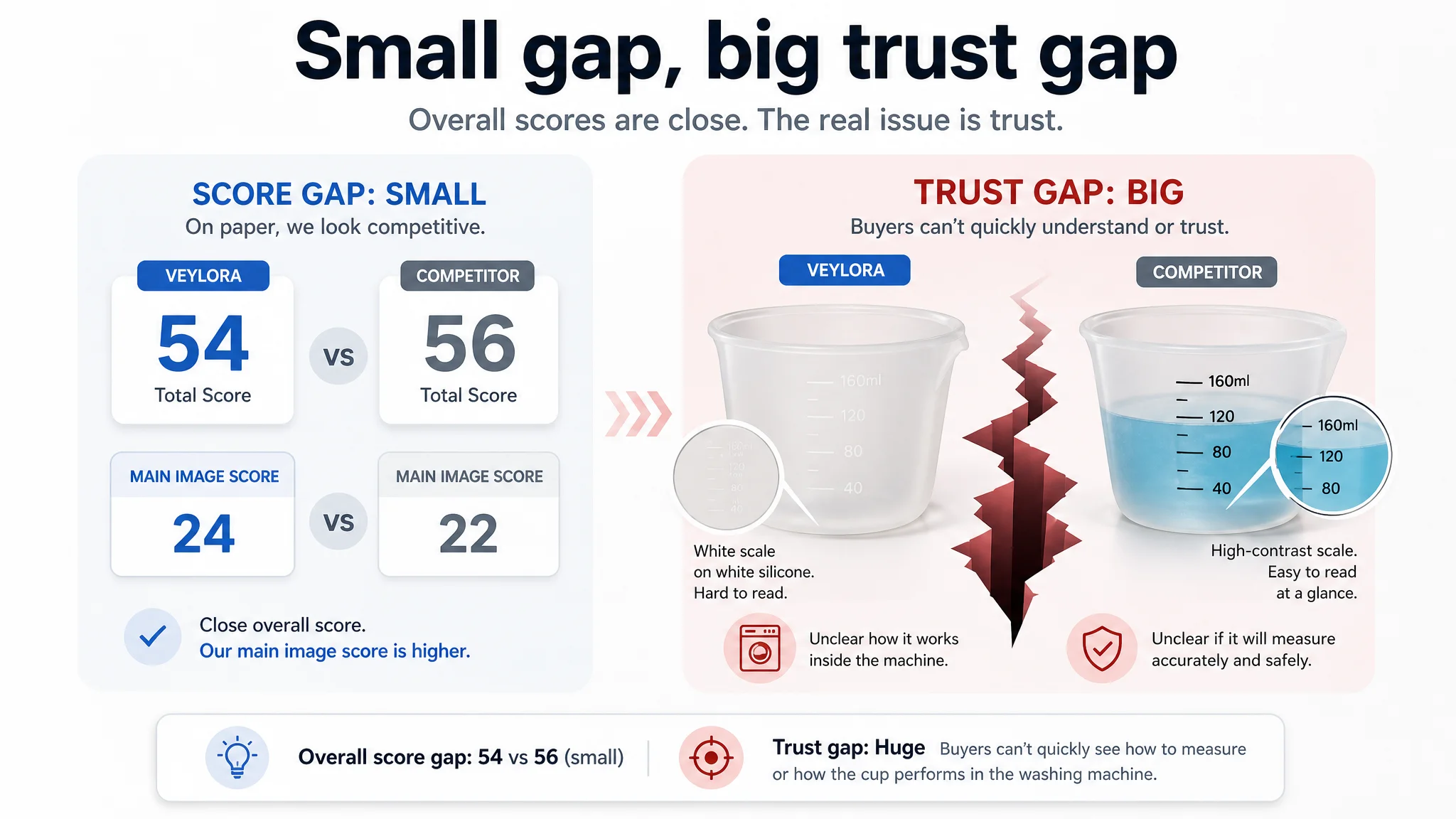
A deeper comparison showed that the apparent visual advantage was largely aesthetic rather than functional. The product’s measurement scales were difficult to read because white markings were placed on white silicone and were supported by a low-contrast magnifier graphic. The page also failed to explain clearly how the cup should be used inside a washing machine. The problem was not simply that the images were unattractive or that the page lacked traffic. The listing did not make measurement accuracy and machine-use safety sufficiently easy to understand.
The system also supports controlled execution. Account connection follows a minimum-permission principle focused on image-asset management, while original and proposed assets can be reviewed before a seller selects an API replacement. Unique report IDs and token logs provide operational traceability, and Amazon image requirements are checked before delivery.
Compliance can therefore protect CTR and CVR gains from being erased by higher refund risk, rework, or account-operation exposure. By converting strategy into parameterized, reviewable design instructions and tracking performance against metrics such as CTR, CVR, ACoS, and TACoS, DeepBI positions policy awareness as a competitive advantage: safer optimization with a more repeatable listing cycle.
Topics Covered
- Policy mechanics: How Amazon AI service opt-out settings distinguish between historical content retained for service improvement and operational copies required to deliver the service. The discussion includes the practical deletion scenario documented by AWS, rather than treating opt-out as a blanket removal of all operational data. [input source: AWS OA doc]
- DeepBI’s Listing-first approach: Why optimization begins with Listing diagnosis, competitor benchmarking, Product DNA validation, and structured recommendations before content generation or delivery. The workflow covers titles, bullet points, A+ content, images, and controlled application. [tag: Listing]
- Practical compliance considerations: How seller review, authenticity controls, Amazon image requirements, limited API permissions, and final user confirmation reduce risks such as invented attributes, product mismatch, and uncontrolled Listing changes.
- The Ads and Organic bridge: How impressions, clicks, CTR, CVR, ACoS, and TACoS can provide feedback after a Listing or visual change. Publication creates a traceable event point for evaluating subsequent advertising signals and considering potential effects on organic ranking and BSR.
- Next steps: How to introduce the workflow in stages: validate Product DNA, generate and evaluate recommendations, apply selected changes through Amazon’s official SP-API connection, and use market and advertising data to guide later optimization.
The Core of Amazon's AI Services Opt-Out Policies
Amazon’s AI services opt-out mechanism is a targeted data-handling control, not a switch that disables the underlying service. Sellers can continue using an AI service while limiting whether content from their requests is retained for service improvement.
The practical distinction is between two data purposes:
- Improvement data: Historical content that Amazon may store to evaluate or improve an AI service. After an account or service is opted out, AWS documentation explains that eligible content retained for this purpose can be deleted.
- Operational data: Copies or records required to process a request, deliver the requested output, maintain the service, or meet necessary operational requirements. Opting out does not mean that every operational copy is immediately erased.
For example, if a seller submits an image or document to an AWS AI service for analysis, a copy may be retained under the service’s improvement process. If the seller later enables the applicable opt-out control, AWS may remove that historically stored improvement copy. The service can still retain the data needed to complete or support the original service operation. The key point is that deletion applies to the improvement-use pathway, not automatically to every instance of the content held for service delivery.
This distinction matters for Amazon compliance reviews. Sellers should document which AI services they use, confirm the applicable opt-out scope, and avoid describing opt-out as complete data deletion. The control reduces one category of secondary use while preserving the service’s ability to operate.
It also reinforces a broader operating principle: compliance controls should be connected to the actual optimization workflow. A seller may use AI to compare images, evaluate Listing structure, or generate recommendations, but the system should still distinguish between what is necessary to perform the requested operation and what may be used for broader improvement. Clear data boundaries make it easier to review both the technology and the resulting customer-facing content.
Considerations When Using AI Services Opt-Out Policies in DeepBI
DeepBI’s Listing module uses AI to support the creation and refinement of titles, bullet points, and A+ content. Its workflow can begin with diagnostic scoring across key Listing assets, then combine the findings with product constraints to produce structured optimization instructions. The system can also deconstruct A+ content into logical modules, such as introductions, selling points, pain-point solutions, trust elements, and calls to action.
For sellers, an AI-services opt-out must be understood as a data-handling control, not as a requirement to abandon Listing optimization. AWS distinguishes between content retained or processed to deliver a requested service and content that may be stored for broader service improvement. Opting out can affect the latter category. It does not automatically remove every input or output required to provide the Listing workflow itself.
DeepBI’s compliant design addresses this separation directly. When an opt-out is active, content stored for service improvement is deleted in accordance with the applicable deletion requirement, while the core Listing functions remain available for diagnosis, optimization planning, generation, evaluation, and user-controlled application. Sellers can therefore continue working with AI-generated titles, bullet points, and A+ content without treating improvement-use retention as a prerequisite for service delivery.
The optimization boundary remains important. Product DNA and verified product information constrain generation: the system must not alter inherent attributes, fabricate specifications, or invent unsupported functions. In our observed tests, any discussion of improvement should therefore remain conditional rather than promise a particular content-quality outcome. The practical control is governance: use the opt-out where required, maintain accurate product inputs, review generated assets before application, and track resulting effects through Listing KPIs such as CTR, CVR, ACoS, BSR, and listing cycle time.
A real listing diagnosis illustrates why this separation between analysis and execution matters. The silicone dosing-cup seller’s team did not initially need more automated content simply because the listing had a small overall score gap. They needed a more accurate interpretation of what the existing content was failing to communicate. DeepBI’s scoring connected each Listing element to a specific buyer question: what the product is, how it works, whether it solves the customer’s problem, and where it differs from the benchmark.
That analysis revealed that the page had several product claims already present, including machine washability, soft silicone, durability, and measurement markings. The problem was that these claims were not arranged or shown in a way that made them easy to verify. The scales were technically represented but visually difficult to read, while machine use was mentioned without a clear sequence from measuring detergent to placing the cup in the drum. The diagnosis therefore led to structured recommendations before generation or publication. This is the practical value of a Listing-first process: AI is used to make the constraint visible before it is used to produce more assets.
DeepBI's Responsible AI Alignment: No Gray Zones
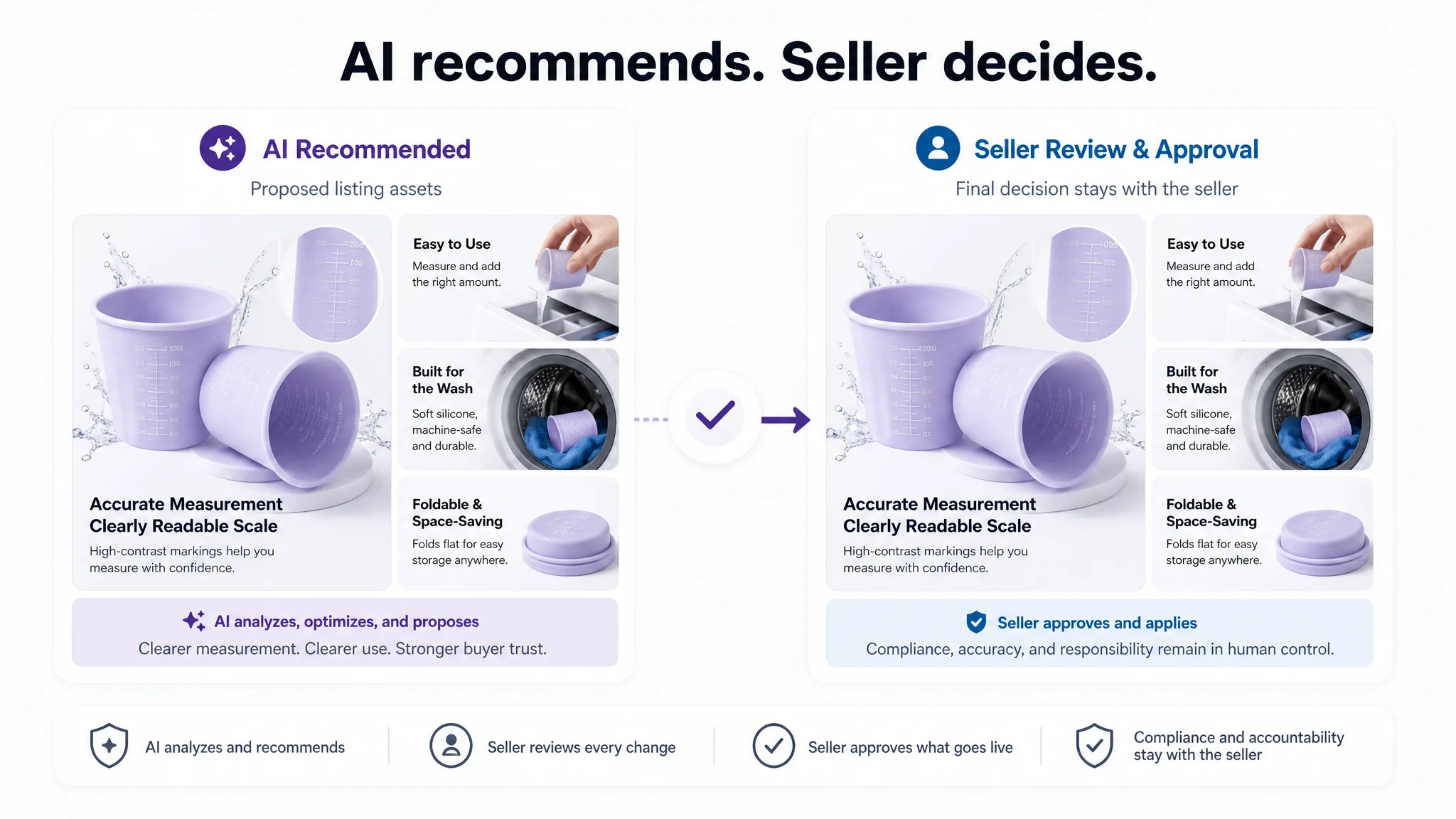
Responsible AI starts with a clear boundary: AI may analyze and recommend, but it should not quietly assume the seller’s legal or commercial authority. DeepBI’s Listing workflow follows that boundary. Its scores diagnose gaps across titles, images, bullet points, A+ content, and reviews; its optimization plans convert those gaps into structured instructions for review and execution. These outputs are recommendations, not autonomous high-risk decisions.
That distinction matters under AWS Responsible AI principles, particularly around automated decisions that can materially affect people and illegal discrimination. DeepBI’s documented Listing use case is commercial content diagnosis, asset generation, and synchronization. It does not make automated medical, judicial, employment, credit, housing, or other high-impact eligibility decisions. Its recommendations are limited to observable product attributes and confirmed specifications, rather than sensitive personal characteristics or eligibility judgments.
The workflow also protects product truth. DeepBI prohibits changing inherent attributes such as material, color, physical structure, industrial design, or aspect ratio, and it rejects Listing content that fails defined Amazon requirements, including image and title standards. This reduces the risk that optimization introduces misleading claims while pursuing stronger CTR, CVR, or listing cycle time.
The dosing-cup diagnosis shows why product truth alone is not enough; product truth must also be communicated clearly. The seller’s images did not necessarily invent the product’s material or function. Instead, they presented a genuine functional benefit—the readable measuring scale—in a way that was visually weak. White scales on white silicone made the central proof difficult to see, while several images repeated similar ideas without explaining the product’s operating logic.
The corrective direction was not to add unsupported claims. It was to make existing, relevant product information more legible and better ordered: show the two sizes, make the scale high contrast, demonstrate the silicone’s flexibility, and explain the machine-use path. This is a responsible form of optimization because it improves customer understanding without changing what the product is or promising a function that has not been confirmed.
Control remains with the seller. Before implementation, the One-Click Apply process requires confirmation, displays existing and proposed images side by side, and allows individual asset selection. Sellers must review factual claims, confirm Amazon policy compliance, and decide whether to publish. They retain final decision-making and compliance responsibility.
This human-control model is also the safer way to interpret the EU AI Act in an Amazon workflow: regulatory relevance depends on the use case, risk category, and human oversight, not on labeling a tool “AI.” DeepBI supports accountable optimization; it does not replace the accountable seller.
How DeepBI's Listing Optimization Respects Data Boundaries
DeepBI treats Listing optimization as a controlled workflow, not unrestricted data processing. Its smart scoring audits the main image, title, bullet points, A+ content, and customer feedback, then identifies gaps against a similarity-filtered benchmark ASIN. Competitor benchmarking is constrained by product form, function, price band, audience, and market context, helping sellers pursue stronger CTR and CVR without copying irrelevant listings.
The workflow then converts score reports and competitor observations into structured instructions through a multi-agent generation process. Suggestions can refine composition, lighting, background, scene, or viewing angle, but cannot alter confirmed product attributes such as material, color, structure, or proportions. Vague directions such as “improve the image” become precise, execution-ready guidance with defined visual parameters.
The dosing-cup comparison demonstrates why the quality of benchmarking depends on more than an overall score. The two listings appeared close at the top level: the total scores were 54 and 56, and the seller’s main-image score was higher. Yet the competitor communicated several category-critical points more effectively: the scale was easier to read, the foldable or space-saving concept was clearer, and the product was shown in an active washing-machine context.
The seller’s page invested more heavily in premium styling, soft backgrounds, clean silicone textures, and an emotional family scene. Those choices were not automatically noncompliant, but they did not answer the most important functional doubts. Aesthetic strength was therefore masking a trust deficit. DeepBI’s comparison treated each asset as part of a buyer decision path rather than as an isolated design object.

Data used for improvement remains subject to applicable seller opt-out controls. DeepBI’s Amazon SP-API connection also operates within account-level settings and explicit authorization. The documented integration requests image-asset-management permissions and does not access prices, inventory, or orders without authorization.
One-click sync preserves seller control rather than bypassing it. DeepBI maps approved assets to the relevant Listing placements, shows old and new versions for comparison, allows individual asset selection, and reports whether Amazon accepted, is processing, or rejected a submission. Pre-upload checks block noncompliant images, while human approval remains the final gate. This bounded approach supports faster listing cycle time while protecting account permissions, product accuracy, and compliance.
Bridging Compliance with Growth: Ads and Organic Traffic
Compliance does not require separating responsible AI use from Amazon growth. It requires clear data boundaries, authentic product information, and human control over decisions that affect the account. Those principles can extend from Listing optimization into advertising and organic ranking without weakening the Listing-first workflow.
DeepBI’s Ads Quant module uses a four-layer funnel to connect advertising signals with account-specific actions. Dynamic bidding can adjust campaign decisions within the applicable Amazon advertising rules and the seller’s approved operating boundaries, while Listing data remains grounded in verifiable product attributes. For example, if advertising data shows weak CTR, the seller can investigate whether the main image or value proposition needs improvement rather than compensating with unsupported claims. The relevant KPIs remain visible: CTR and CVR indicate customer response, while ACoS helps evaluate the commercial cost of that response.
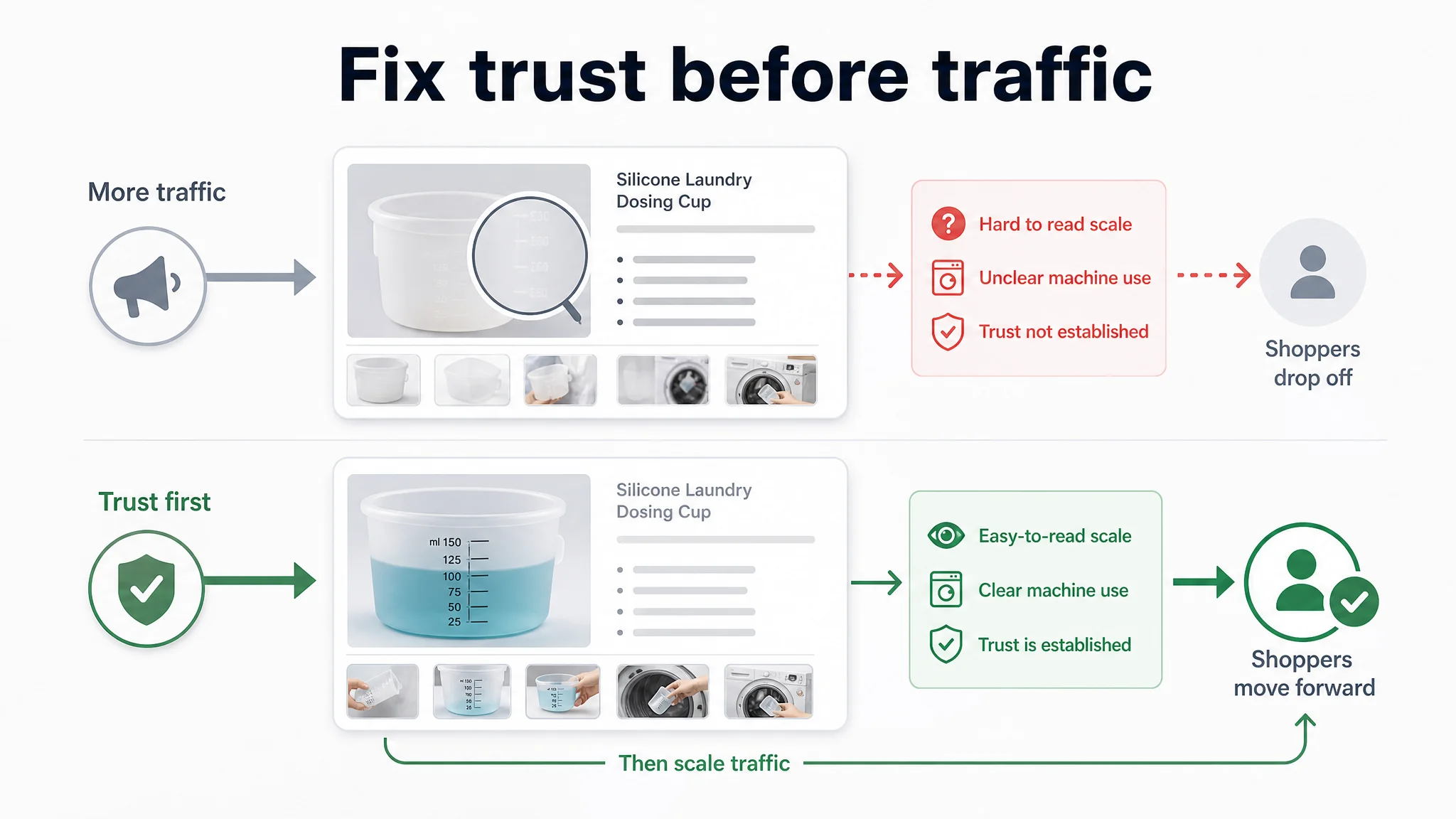
The dosing-cup case shows why this investigation should not stop at the advertising dashboard. The seller’s working theory was that ads were becoming more expensive and that additional traffic might help the listing regain ground. However, the page was not clearly communicating measurement accuracy or machine-use behavior. If more shoppers were sent to the same page, the underlying trust gap would remain. The listing could receive more opportunities while still failing to answer the questions that determine whether a high-intent shopper continues toward purchase.
This does not mean that advertising data is irrelevant. It means that advertising signals should be interpreted alongside Listing evidence. A weak CTR may indicate a problem with the main image or title, while weak CVR after the click may point toward unclear measurement, missing usage logic, or insufficient proof. In the dosing-cup example, the recommended sequence was to rebuild image-based trust, align the bullets with the same decision logic, and then refine the title and reconsider traffic allocation.
The Organic Traffic module extends the workflow to a fifth-layer natural-ranking objective. It supports policy-aware optimization of the language and Listing signals that help Amazon understand product relevance, without changing the product’s inherent attributes, brand identity, or required content standards. A seller might use keyword-weighted conversion signals to clarify a genuine selling point, then monitor its relationship with CVR and BSR rather than inserting misleading terms.
Advertising and organic data are used for account-specific optimization. They are not fed into improvement models without the seller’s consent. Opt-out controls therefore limit secondary data use without disabling the core functions needed to manage advertising decisions, Listing quality, or natural-ranking work. Sellers retain a compliant path to improve Amazon performance while preserving data governance, human oversight, and product consistency.
Practical Considerations for Sellers: Balancing Innovation and Policy
AI can shorten listing cycle time and accelerate experiments intended to improve CTR, CVR, ACoS, or BSR. The compliance challenge is that speed cannot replace control. Sellers still need to respect Amazon’s opt-out choices, Responsible AI expectations, data-handling requirements, and the need for human oversight when AI-generated recommendations affect customer-facing content.
Goodhart’s Law is a useful warning: when a measure becomes the target, it can stop being a reliable measure of the underlying business objective. A team that optimizes only for CTR, for example, may produce a more attention-grabbing image without improving CVR, customer understanding, or post-click trust. The Business Insider internal report’s acknowledgment of measurement pitfalls reinforces the need to question internal metrics rather than treat them as automatically reliable. Its spokesperson’s emphasis on training also points to a practical control: people must understand how AI outputs are produced, evaluated, and limited before approving them.
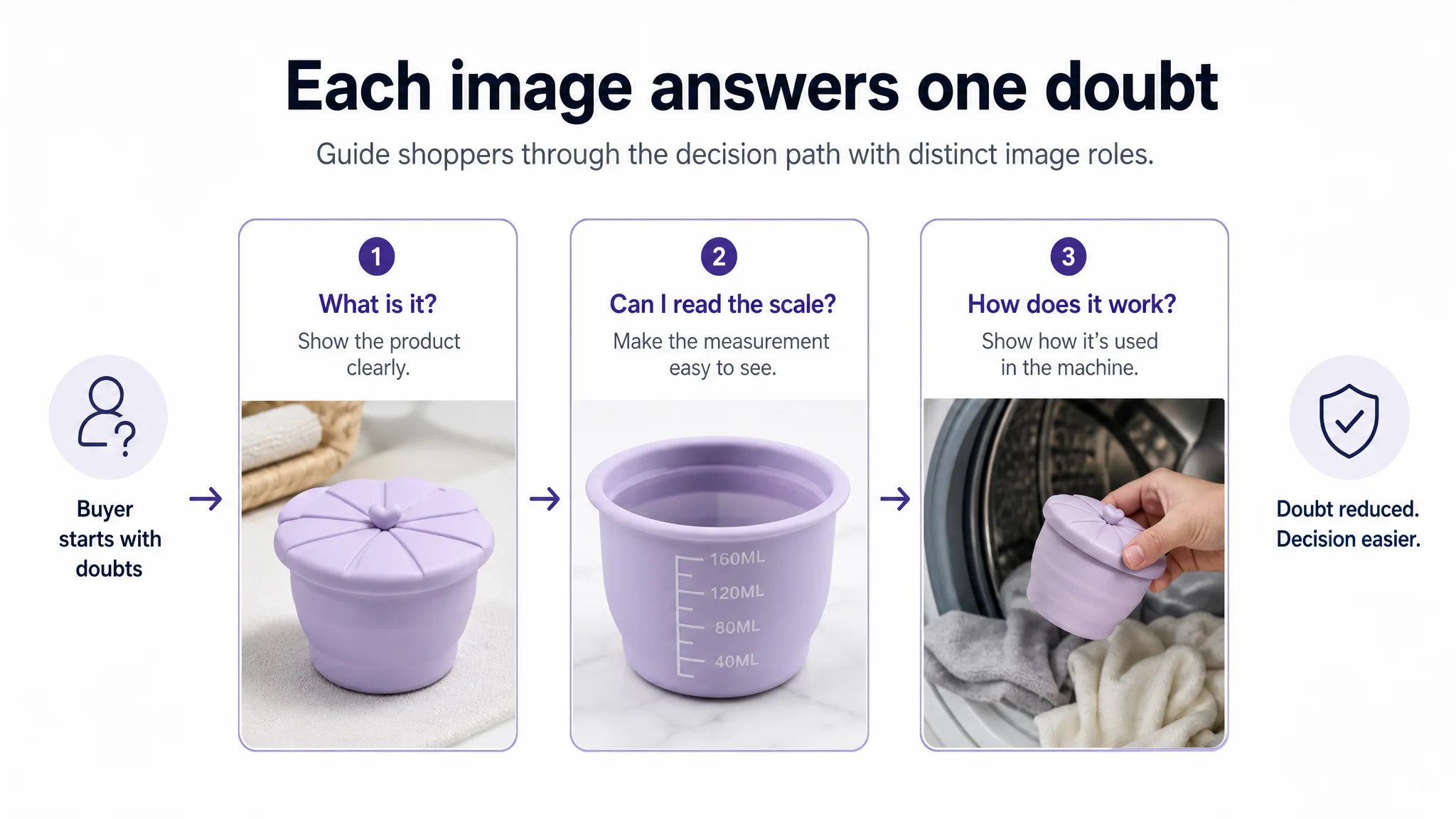
The dosing-cup seller’s experience shows how this problem can appear inside a Listing scorecard. The seller had a higher main-image score than the benchmark, but the image set still made the central measurement promise difficult to verify. A score advantage based on styling could therefore be mistaken for a conversion advantage. The relevant question was not simply whether the images looked polished, but whether each image reduced a specific buyer doubt.
DeepBI’s diagnosis divided those doubts into a clearer sequence:
- What is the product, and what sizes are included?
- Can the measurement scale be read quickly?
- How does the silicone behave?
- Can the cup safely remain in the washing machine?
- How does using it help with detergent distribution and cleaning?
- How should it be stored and used across different detergent forms?
This sequence led to a more controlled image plan. The first image would show both sizes as a clear product hero rather than making the shopper decode a small object inside a washing-machine scene. A later image would use high-contrast scale markings. Other images would demonstrate flexibility, machine use, and the value of the two-piece set. The objective was not to make the page more decorative; it was to assign every image a distinct role in the decision process.
DeepBI supports this balance through a human-in-the-loop workflow. Sellers or upstream analysis define the business goal and comparison target; DeepBI translates that direction into structured optimization instructions and executes the designated workflow. Its scoring process can cross-check exposure, clicks, orders, CTR, and CVR against listing evaluations, helping identify gaps without claiming that any single metric proves causation. After an image is applied, the change is marked in advertising reports so sellers can observe subsequent CTR movement within a traceable timeline.
Human review remains essential. Sellers can compare old and new visual options and choose which assets to apply. Product consistency and brand rules also constrain execution: the system must not alter product materials, color, structure, proportions, logos, fonts, or established brand styling. With accurate inputs, explicit goals, and final seller approval, automation can accelerate optimization while keeping interpretation and compliance decisions under accountable human control.
On This Page: Quick Reference
Use this recap to return to the practical parts of an AI-compliance workflow for Amazon:
- AI usage and policy boundaries: Keep optimization within Amazon’s mandatory standards, including image background, aspect ratio, pixel dimensions, and title-length requirements. Content that fails these requirements is blocked rather than pushed into production.
- Product and brand consistency: Preserve the product’s material, color, structure, design, aspect ratio, logo, fonts, and established color system. Optimization should improve listing communication without changing the product entity or brand identity.
- Hallucination prevention: Avoid generated accessories, exaggerated dimensions, or instructions that could create inaccurate listing assets.
- Data access and permissions: Apply least-privilege authorization. DeepBI’s SP-API connection is limited to image asset management and does not access pricing, inventory, or order data.
- Input and review controls: Validate the upstream Score_Report.json and Product_DNA.json inputs, confirm the product’s physical constraints, and retain human review before applying changes.
- DeepBI’s optimization workflow: Move from listing scoring and competitor benchmarking to optimization recommendations, AI image generation, and one-click listing application or publishing.
- Decision-path validation: Check whether each title, bullet, image, and A+ module answers a concrete buyer question. A higher aesthetic or aggregate score does not necessarily prove that the page communicates the product’s most important functional benefit.
- Ads and Listing interpretation: Use CTR, CVR, ACoS, TACoS, BSR, and related signals alongside Listing diagnosis. More traffic cannot correct a page that does not establish product trust or explain how the product works.
- Next topic—Building an AI-Ready Compliance Framework: Audit your AI usage settings, enable opt-out if desired, and consult DeepBI’s setup guides before scaling compliant optimization across your catalog. Always review the resulting assets and listing changes against Amazon’s requirements rather than treating automation as a substitute for oversight.
Next Topic: Building an AI-Ready Compliance Framework
AI-powered Amazon optimization should begin with a compliance audit, not a bulk publishing action. Review which AI features are enabled, confirm whether an opt-out option is available for the use case, and enable opt-out when you do not want a particular AI function applied. Sellers should also verify their DeepBI setup guides and authorization settings before expanding the workflow.
A practical routine is built around four controls:
- Limit permissions: Use only the SP-API scope required for the task. DeepBI’s documented workflow is limited to image-asset management and does not access pricing, inventory, or order data without explicit authorization.
- Keep human approval in the loop: Treat the generation module as an executor, not an independent decision-maker. Review the original and proposed assets side by side, select replacements individually, and apply only approved changes.
- Protect product and brand accuracy: Product DNA remains the highest constraint. The workflow must not invent accessories, features, materials, dimensions, or physical structures, and it must preserve the established brand identity.
- Check before and after publishing: Reject assets that fail Amazon’s required image standards, then track processing status and review subsequent Listing and advertising data before making another change.
- Validate the functional decision path: Confirm that the page makes the product’s key use, measurement, safety, or performance claims understandable. In the dosing-cup example, the main issue was not the absence of product information, but the failure to make measurement readability and machine-use logic sufficiently clear.
- Sequence changes according to the constraint: Rebuild the part of the Listing that limits customer trust before increasing traffic or relying on secondary copy changes. Title, bullets, images, A+ content, and advertising should reinforce one another rather than operate as disconnected tasks.
This structure lets sellers pursue gains in CTR, CVR, ACoS, BSR, and listing cycle time without treating automation as a substitute for accountability. Audit your AI usage settings and permissions now, confirm your opt-out choices, consult the relevant DeepBI setup guidance, and adopt a repeatable cycle of diagnosis, generation, human approval, compliance validation, deployment, and monitoring. The most useful optimization target is not always the easiest asset to change or the metric that looks weakest at first glance. It is the constraint that prevents the buyer from understanding, trusting, and choosing the product.