


Why Structure Is the Single Highest-Leverage Decision
Campaign structure is the first optimisation decision because it establishes the operating boundaries for every decision that follows. Before changing a bid, sellers have already determined which products share a budget pool, which targets compete for that budget, and which performance data will be assessed together.
A well-organised structure gives each campaign a clear role. Product groupings, targeting types, and budget allocation can then be assessed against relevant metrics such as CTR, CVR, and ACoS. When a campaign underperforms, the cause is easier to isolate and the corrective action can be more precise.
A disorganised structure creates the opposite problem. Consider an auditable example in which $13,000 was spent across 63 products in a single ad group. Performance ranged from 15% to more than 100% ACoS. One blended result could not reveal which products justified additional spend, which required bid reductions, or which were consuming budget without contributing efficiently.
The underlying issue is not simply poor bidding. Mis-grouped products distort the data used to assess targeting and product performance. Once unrelated products share the same container, rule-based automation receives unreliable signals. A rule designed to reduce spend at a high ACoS may also restrict a stronger product because both are being assessed through the same campaign structure.
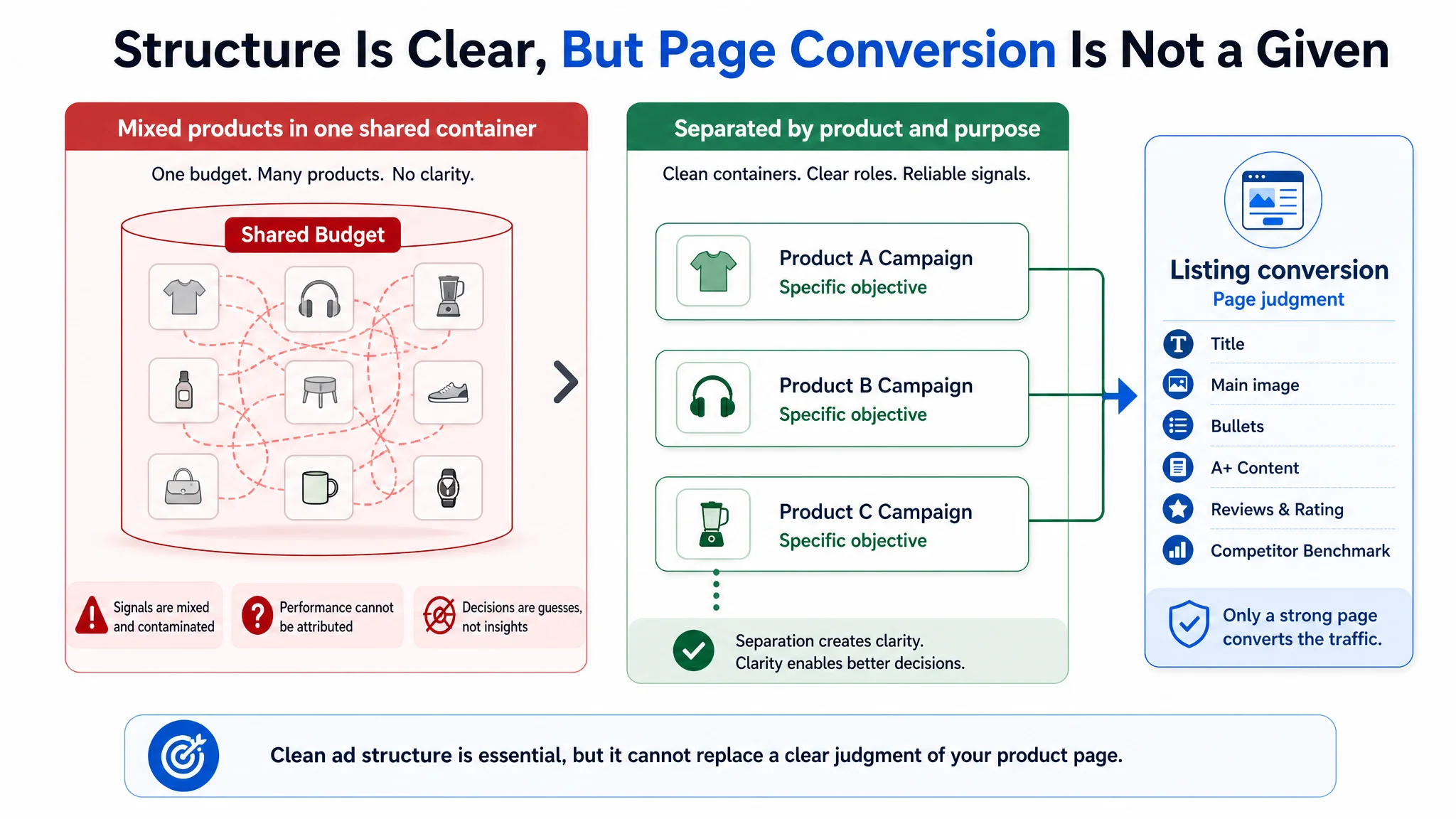
There is another form of structural uncertainty that can make campaign data difficult to interpret: the product page itself may never have been diagnosed. One US marketplace seller approached DeepBI convinced that rising ad costs and unstable orders were evidence of poor advertising. The team had already been adjusting bids, budgets, match types, and campaign allocations. However, when the Listing was reviewed, the core diagnostic fields were all marked “N/A”—including the total Listing score, title, main image, bullet points, A+ content, reviews, and competitor scores.
That did not prove that the ads were ineffective, nor did it prove that the page was weak. It showed that the team had no structured evidence for deciding between those explanations. They were using advertising activity to test a product page whose conversion capacity had never been objectively compared with a relevant benchmark. In that situation, campaign structure may be clean while the broader decision structure remains incomplete: sellers can separate campaigns precisely but still lack clarity about whether the destination page deserves more traffic.
The practical step is to separate products and targeting boundaries before tuning bids, while also confirming that the Listing can be evaluated as part of the same conversion system. Build campaign containers around a defined optimisation purpose, then use the resulting data to make controlled changes to budgets, bids, and targets. Structure is not administrative setup; it is the foundation of measurable Sponsored Products optimisation—but meaningful optimisation also requires knowing what happens after the click.
The Account-Type Gateway - Choosing Between Individual and Professional Seller Plans
Your seller plan determines whether your Sponsored Products architecture can scale beyond basic product availability. The Individual plan charges $0.99 per item sold, while the Professional plan costs $39.99 per month. At roughly 40 units per month, the subscription becomes the practical break-even point for sellers building a repeatable advertising and operations system rather than testing occasional sales.
The decision is not simply about listing convenience. Individual sellers can upload inventory files, so the limitation is not that every listing must be created one at a time. The more important distinction is access to growth infrastructure. Professional accounts unlock Sponsored Products advertising, Brand Registry, advanced bulk listing tools, and analytics that support structured decisions around CTR, CVR, ACoS, BSR, and listing cycle time.
A Professional account can launch Sponsored Products campaigns, although campaign review timing is informed by seller type. The upgrade is therefore a prerequisite for the campaign structure planned in this guide, not an optional administrative refinement.
Use the 40-unit threshold as a decision rule:
- Below 40 monthly units, the Individual plan may preserve flexibility while demand is being validated.
- At 40 units or more, compare the $39.99 subscription with recurring per-sale fees and the value of advertising access.
- Once several products require coordinated campaigns, bulk updates, and performance analysis, the Professional plan provides the operating foundation for scalable optimization.
The account upgrade, however, should not be mistaken for proof that the advertising system is ready to scale. Access to campaigns creates the ability to buy traffic; it does not establish whether the product page can convert that traffic. In the US marketplace case reviewed by DeepBI, the seller had already reached the point where advertising costs felt increasingly difficult to control, yet the Listing had no measurable title, image, bullet, A+, review, or competitor assessment. The issue was therefore not access to advertising infrastructure. It was the absence of a reliable judgment layer connecting advertising spend to page-level conversion capacity.
A Professional account provides the operating foundation, but the seller still needs a sequence for deciding whether to increase traffic, repair the Listing, or do both. Without that sequence, additional tools can simply make uncertain decisions faster.
Foundational Principles - Campaigns, Ad Groups, and Products as a Three-Layer Model
A scalable Sponsored Products account separates control settings, targeting logic, and performance evidence into three distinct layers. When these responsibilities are mixed, budget decisions become harder to interpret, and product-level optimisation becomes less accurate.
- Campaigns control investment and delivery. Set the daily budget, bidding strategy, and placement bid adjustments at this level. A campaign budget is a shared pool, so every product assigned to the campaign draws from the same spending limit.
- Ad groups control targeting. Keyword targeting, product targeting, and negative targeting belong here. Keeping targeting decisions together makes it easier to understand which search terms or competing products are driving clicks, conversions, and wasted spend.
- Products provide the performance evidence. Each ASIN contributes its actual sales, conversion rate, and ACoS data. Advertising reports can also be evaluated at the ASIN or variant level, helping identify which products generate stronger CVR or require tighter spend control.
The shared-budget principle is especially important when multiple product lines sit in one campaign. A strong seller may capture most of the available budget while a slower seller receives too little exposure to gather useful data or convert. The result is not only uneven spend but also less reliable product-level analysis.
The same logic applies beyond the campaign container. Advertising metrics describe what happened at the traffic stage, but they do not independently explain whether a Listing created enough reason to click or enough confidence to buy. In the DeepBI case, the seller interpreted unstable orders and uncomfortable advertising costs as an ads problem. Yet there was no Listing score, no module-level breakdown, and no competitor benchmark to determine whether the main image, title, bullets, A+ content, or reviews were limiting performance.
That missing evidence matters because a low CTR, if present, could reflect the search term, the title, or the main image. A low CVR, if present, could reflect traffic quality, weak page clarity, insufficient trust, underdeveloped A+ content, or weak social proof. When the page has not been assessed, changing a campaign may alter the symptom without identifying the cause.
Divide campaigns when product lines require different budgets, bidding strategies, placement priorities, or optimisation decisions. Keep ad groups focused on targeting, and use ASIN-level results to guide allocation. At the same time, treat the Listing as a separate conversion layer that must be diagnosed before advertising conclusions are made. This hierarchy preserves clearer links between spend, CTR, CVR, and ACoS while reducing budget competition between products and reducing the risk of blaming ads for a page-level problem.
The Granularity Spectrum - Mapping MPAGs, SPAGs, Single-Product Campaigns, and Single-Keyword Campaigns
Sponsored Products structures sit on a granularity spectrum: the more tightly you isolate products, budgets, and keywords, the clearer your performance data becomes, but the greater the management workload.
- Multiple-Product Ad Groups (MPAGs): These are inexpensive and quick to build, but they provide the weakest performance insight. When several products share one ad group, impressions, clicks, conversions, CTR, CVR, and ACoS cannot be attributed cleanly to each ASIN. Use MPAGs only for a very small catalogue of near-identical products.
- Single-Product Ad Groups (SPAGs): These are the practical default for roughly 80%–90% of accounts. Each product receives its own performance view without creating an unmanageable campaign structure. This supports clearer bid decisions and more reliable diagnosis of product-level CTR, CVR, and ACoS.
- Single-Product Campaigns: Use this structure when a product requires its own budget cap or spend guardrail. It is particularly workable when managing fewer than approximately 50 products, but it creates more campaign-level administration than SPAGs.
- Single-Keyword Campaigns: These offer the tightest control for high-value search terms, but should be reserved for priority keywords rather than used as the default architecture.
Granularity is valuable because it narrows the question being asked. A campaign containing one product and one defined targeting role makes it easier to ask whether a specific product-target combination is earning its budget. But granularity does not automatically answer why a product is failing after the click.
The DeepBI case illustrates this boundary. The seller believed that more refined advertising work—new bids, revised budgets, different match types, and campaign shifts—would resolve unstable orders. The Listing review showed that the page had never been judged against a true benchmark. With every major Listing field marked “N/A,” the team could not connect a potential advertising symptom to a specific page module. More granular campaigns might have produced cleaner traffic data, but they would not by themselves reveal whether the page could convert that traffic.
This is why product-level advertising analysis and Listing-level diagnosis should work together. SPAGs or single-product campaigns can isolate the advertising question, while a module-level Listing review isolates the conversion question. The two layers prevent sellers from treating every low-order outcome as a keyword or bid problem.
Well-defined ad containers also produce more dependable keyword signals for organic-keyword prioritisation. DeepBI’s four-layer funnel—Explore, Screen, Precision, and Scale—works best when each ad group isolates one product, allowing product-level bid adjustments against seven-day performance windows without cross-contamination. The result is a structure that balances data clarity with manageable listing cycle time and ongoing optimisation effort. It also gives sellers a better basis for deciding whether the next action belongs in the campaign, on the product page, or in both places.
Campaign Naming Conventions - The Map That Prevents Budget Mayhem
A large Sponsored Products portfolio becomes difficult to manage when campaign names describe only the product or rely on inconsistent shorthand. Without a shared naming system, teams spend time opening campaigns simply to identify their purpose, while automation has fewer reliable identifiers for sorting, reporting, and workflow execution.
Treat every campaign name as a searchable operating map. Each name should encode four elements:
- A brand or non-brand tag
- A product identifier
- The match type, or an auto/manual designation
- The campaign objective
Use this generator formula:
[BrandFlag] – [ProductID] – [MatchType] – [CampaignObjective]
The brand flag is particularly important. Keep branded and non-branded campaigns separate rather than combining them within the same structure. Branded terms can inflate non-brand metrics, making CTR, CVR, and ACoS comparisons less reliable. This can lead to poor bid decisions because performance from existing brand demand is assessed alongside demand-generation activity.
Apply the same sequence, spelling, separators, and capitalisation across the account. A consistent format allows team members to understand a campaign without opening it and gives automated processes dependable fields for filtering and grouping.
Naming does not replace diagnosis, but it helps preserve the evidence chain once diagnosis begins. In the empty Listing report reviewed by DeepBI, the difficulty was not merely that a field had been omitted from a dashboard. The team lacked a stable way to relate advertising activity to a defined product-page question: whether the Listing was competitive in its category and which module might be limiting conversion. Clear campaign identifiers make traffic easier to segment; clear Listing benchmarks make page quality easier to assess. Both are needed if a seller wants to know what a change actually influenced.
DeepBI can generate campaign names from a seller-defined template while enforcing the brand/non-brand split. The practical step is to define the naming formula before launching the next campaign, then treat any deviation as a setup error rather than a harmless variation. The same discipline should apply to the broader operating process: identify the traffic source, identify the product, and identify the page-level conversion conditions before interpreting the result.
Match Types as Your Targeting Dial - Discovery vs. Precision
Match types are not a binary choice between “more traffic” and “less traffic.” They function as a targeting dial: begin with wider discovery when evidence is limited, then narrow reach as search-term performance becomes clearer.
Auto campaigns provide four distinct discovery paths:
- Close match: Reaches searches closely related to the product, making it useful for identifying high-intent queries.
- Loose match: Expands into more broadly related searches, offering additional reach but requiring closer ACoS and CVR monitoring.
- Substitutes: Targets shoppers considering products similar to yours, which can reveal competitive opportunities but may produce less consistent conversion.
- Complements: Reaches products or searches related to items commonly used alongside yours, supporting broader exploration with weaker direct relevance.
Manual targeting offers progressively greater control. Broad match captures a wide range of related search terms. Phrase match narrows the query around the specified word order or phrase. Exact match provides the tightest alignment between the keyword and the shopper’s search, making it the clearest option for precision bidding.
A practical structure is to use auto campaigns for discovery and manual campaigns to scale validated terms. When a search term achieves strong CTR, CVR, or acceptable ACoS, move it into the appropriate manual match type and adjust the bid according to its value.
However, a targeting dial should not be used as a substitute for a product-page diagnosis. The seller reviewed by DeepBI had been changing match types and keyword lists because the initial conclusion was that the ads were not optimised enough. Yet the available Listing report could not establish whether the product page was ready to receive additional traffic. No benchmark had been locked, and no module-level gap had been identified across the title, main image, bullets, A+, or reviews.
That distinction is important during discovery. A broad or auto campaign may reveal that a query can attract attention, but it cannot by itself establish that the page is persuasive, trustworthy, or competitive against the products shown alongside it. If the main image and title do not create a compelling reason to click, CTR may be constrained at the search-result stage. If the page does not resolve buyer concerns, CVR may remain weak after the click. Match types control the traffic experiment; they do not repair the destination.
Separate broad, phrase, and exact match types into different campaigns only when distinct bid control, budget allocation, or reporting clarity justifies the added complexity. For a smaller portfolio, grouped structures may be easier to manage; for high-volume accounts, separation can protect precision terms from broader traffic and strengthen optimisation discipline. In every case, interpret targeting results alongside the Listing’s conversion readiness rather than assuming that a new match type will solve an undiagnosed page problem.
Keyword Harvesting and Negative Management - The Bulking and Cutting Cycle
Treat optimisation as a controlled cycle: begin with bulk discovery to collect market signals, then cut waste without removing the campaign’s ability to find new demand. Optimisation detached from real market benchmarks risks wasting spend and weakening CTR, CVR, and ACoS performance.
- Harvest candidate keywords from search-term reports, competitor ASIN insights, and DeepBI’s automated keyword exploration; compare clicks, orders, CVR, ACoS, and relevance before promoting a term.
- Move proven winners into dedicated exact-match targets so bids and budgets can be controlled more precisely, while retaining broad, phrase, or exploratory activity to uncover new opportunities.
- Avoid over-harvesting: fewer keywords do not automatically create more impressions. Removing discovery terms can reduce reach, limit learning, and weaken the campaign’s ability to identify future winners.
- Apply this three-step negative-keyword checklist before blocking a term: confirm the lookback window, assess its funnel role and contribution to total orders or organic lift, then check whether the loss is persistent and commercially material.
- Do not negate a keyword solely because its ACoS is high. If it assists total conversions, supports organic lift, or introduces valuable discovery signals, adjust the bid or placement before blocking it.
- Do not automatically negate high-spend, zero-sale terms. First determine whether they are testing new demand, serving an upper-funnel role, or simply suffering from an incomplete attribution window.
- Use N-gram analysis to find recurring waste patterns across search terms, then negate a phrase or component only when the pattern is consistently irrelevant or unprofitable.
- Configure rules with an appropriate lookback window and review pause or negation decisions against sustained results, not a single reporting period.
- Use DeepBI’s Explore layer to ring-fence budget for discovery and its Precision layer to identify high-converting targets. When negative lists are context-aware, DeepBI can raise bids by up to 100% for likely conversions.
The same caution applies before interpreting a weak search term as the complete explanation for unstable orders. In the DeepBI case, the seller’s initial response was to adjust bids, budgets, match types, and keyword lists. Those actions may be appropriate when the evidence identifies a targeting problem, but here the Listing report provided no evidence about page quality at all. The central question was not simply which terms to harvest or negate. It was whether the traffic being generated was arriving at a page whose conversion capacity had been measured.
A search-term report can show that a query receives clicks without orders. It cannot independently explain whether the cause is irrelevant intent, a weak offer, an unconvincing main image, incomplete bullets, insufficient A+ content, or a trust deficit reflected in reviews. Before cutting a term, therefore, separate traffic evidence from page evidence. Otherwise, sellers may remove potentially useful demand because the Listing was never given a fair chance to convert it.
Keyword harvesting should expand what the market is telling you, while Listing diagnosis explains whether the product page is equipped to respond. The bulking-and-cutting cycle is more reliable when both sides of that relationship are visible.
The Complete Weekly Playbook - From Launch to Optimisation
A well-organised campaign structure provides control, but a repeatable operating rhythm converts that control into stronger CTR, CVR, ACoS, and BSR performance. Treat each product launch as a bulking phase: gather search-term and conversion data aggressively before deciding what deserves investment.
Launch three Sponsored Products campaigns:
- Auto-discovery: uncover relevant queries and shopper behavior.
- Manual broad or phrase: expand controlled coverage around validated themes.
- Exact-match scaling: concentrate spend on terms that demonstrate conversion potential.
Before scaling those campaigns, add a Listing-readiness checkpoint. It does not require treating the product page as a separate project; it requires confirming that the page has been judged against a relevant benchmark. Review the title, main image, bullet points, A+ content, and reviews at the same time that the traffic plan is defined. If the Listing data is unavailable or every diagnostic field is “N/A,” record that as an unresolved decision risk rather than assuming the page is ready.
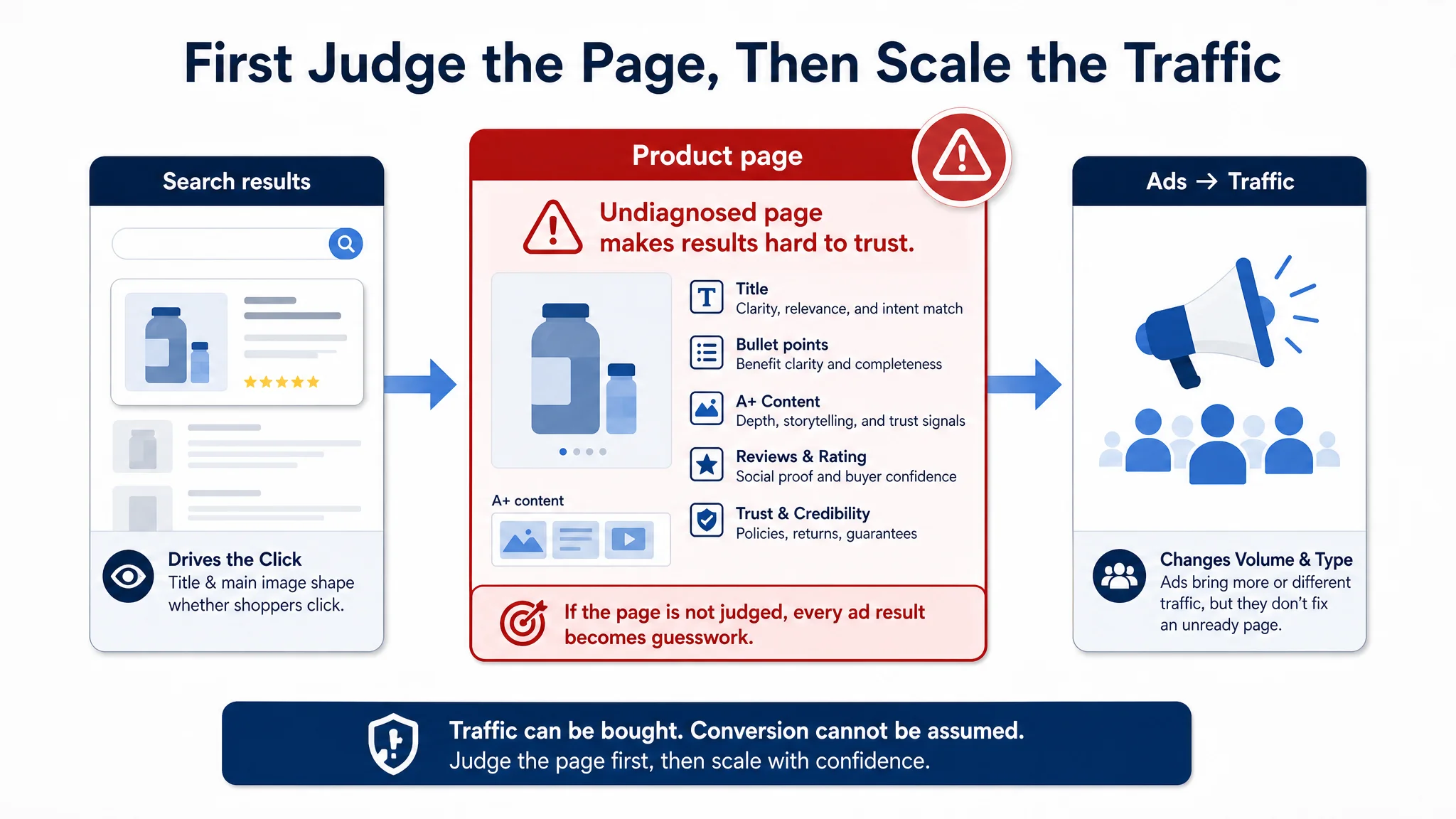
This checkpoint matters because advertising only changes the amount and type of traffic entering the funnel. The search-results page uses the main image and title to influence CTR. The product page uses the title, bullets, images, A+ content, and reviews to influence CVR. If those layers have not been assessed, the launch is testing traffic and page quality at the same time, making the outcome harder to interpret.
Then run the account on a Monday-to-Friday cycle:
- Monday — Search-term audit: review impressions, clicks, orders, and ACoS to identify useful signals and wasted traffic.
- Tuesday — Bid and budget adjustments: increase support for productive terms and reduce exposure where spend is not producing efficient results.
- Wednesday — Negative-keyword review: block irrelevant or persistently inefficient queries before they consume more budget.
- Thursday — Harvesting and promotion: move proven search terms from discovery campaigns into the exact-match scaling campaign.
- Friday — Reporting: record campaign-level CTR, CVR, spend, sales, and ACoS, then set priorities for the next week.
The cycle should also include a page-level interpretation of the signals:
- If CTR is weak, examine the search-term relevance together with the title and main image.
- If clicks are arriving but orders are unstable, examine the product page before assuming that bids or keywords are the only problem.
- If CVR is weak, compare bullets, A+, images, and reviews with a true category benchmark.
- If ACoS is high, determine whether the issue is expensive or poorly matched traffic, insufficient page persuasion, or both.
This is not a claim that every advertising problem originates on the Listing. It is a way to prevent sellers from making a conclusion that the available evidence cannot support. In the DeepBI case, the seller had already been cycling through campaign adjustments, but the Listing file contained no score or comparison capable of showing whether the page could convert the traffic. The correct next step was therefore not another round of ad changes based on intuition; it was to establish the missing diagnostic base.
This is the cutting phase: trim waste without stopping discovery entirely. DeepBI can automate daily bid and budget adjustments using trailing seven-day Click, Spend, and ACoS data, while the seller sets the strategy through an ACoS target or growth preference. The system executes the operating rules; the seller retains authority over direction, priorities, and exceptions. Optimisation detached from real market benchmarks simply reallocates waste, so every automated change should remain tied to observed advertising signals and a clear understanding of the page receiving the traffic.
Timeless Principles for an Ever-Changing Ad Console
Amazon’s advertising console will continue to change: settings may move, campaign options may expand, and automation controls may be renamed or redesigned. The durable advantage does not come from mastering one interface. It comes from building containers with a defined purpose and connecting those containers to a measurable conversion path.
A focused ad group is the basic unit of reliable decision-making. When unrelated products, match types, or search-intent patterns are mixed together, performance data becomes difficult to interpret. Rules engines then act on blurred signals, making spend control less precise and optimisation decisions harder to trust. Separating meaningful units creates clearer inputs for bid, budget, and targeting decisions.
Yet even perfectly separated advertising units cannot compensate for a product page that has never been evaluated. The DeepBI case began with an “empty” Listing report: no total score, no title or main-image assessment, no bullet or A+ breakdown, no review context, and no competitor scores. The seller’s advertising activity was real, but the judgment connecting that activity to page performance was missing. The risk was not merely a poorly configured campaign. It was the possibility of using ads to amplify a page defect without knowing that the defect existed.
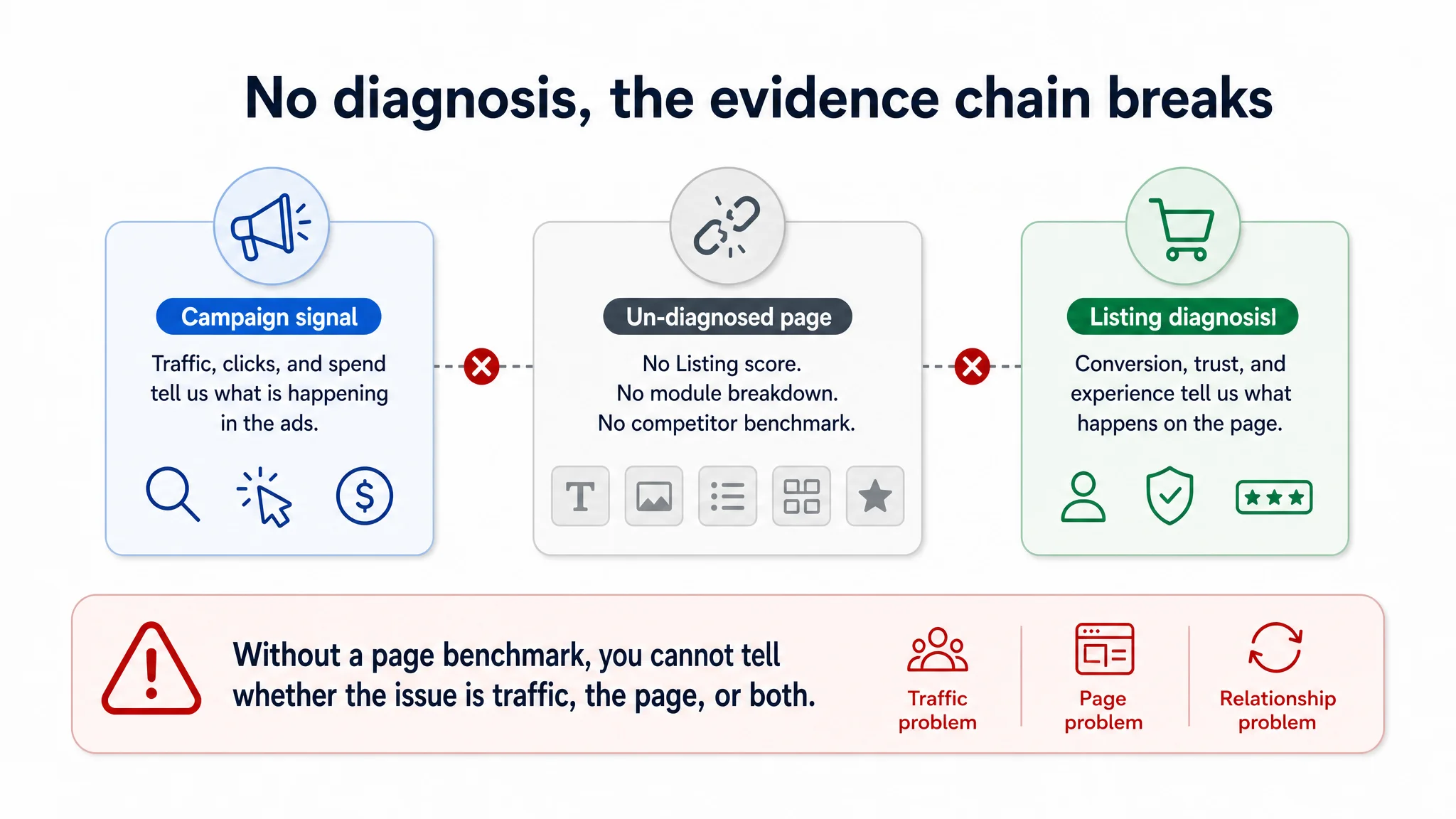
The structure should therefore reflect the business questions you need to answer:
- Which targets deserve more spend?
- Which products are consuming budget without supporting acceptable ACoS?
- Which search terms are producing stronger CTR or CVR?
- Where is performance changing because of the product, target, or bidding approach?
- Is weak performance coming from the traffic source, the product page, or the relationship between them?
- Which Listing module—title, main image, bullets, A+, or reviews—requires attention before more traffic is purchased?
The console’s default settings may be convenient, but convenience is not architecture. Build around spend-control needs and data clarity first, then configure the available tools around that structure. Purpose-built containers remain useful even when the interface changes because their logic is tied to optimisation objectives rather than menu locations.
The guiding rule is simple: “Containers define your optimisation surface – small, clean containers; big, predictable outcomes.” A clear structure will not guarantee a lower ACoS or higher CVR, but it gives every optimisation action a more defined scope, a more reliable signal, and a stronger basis for repeatable growth.
The broader lesson is equally important: advertising structure should make uncertainty smaller, not hide it inside cleaner reports. If the campaign is well organised but the Listing has not been benchmarked, the account may still be optimising around an unanswered question. Before increasing spend, sellers should be able to explain not only which target is receiving the budget, but also whether the product page is capable of converting the resulting traffic.
A scalable Sponsored Products architecture therefore has two connected disciplines:
1. Separate campaigns, ad groups, products, and targets so advertising signals remain interpretable.
2. Diagnose the product page so CTR and CVR signals can be connected to the correct conversion-stage problem.
When both conditions are met, bids, budgets, match types, and negative management become more than isolated adjustments. They become controlled decisions within a system that can distinguish a traffic problem from a Listing problem—and avoid treating every unstable result as “just the ads.”