


Why Compliance Must Be at the Core of AI Tool Selection
AI can handle substantial seller work, including listing analysis, content recommendations, visual generation, and asset delivery. Yet efficiency has no business value if the output violates Amazon requirements. A faster workflow can distribute an inaccurate claim, unsupported product attribute, or misleading image at greater speed and scale, creating risks to listing eligibility, customer trust, reviews, refunds, and account health.
Compliance is also inseparable from conversion performance. A page may technically contain all the expected modules and still fail to answer the questions that determine whether a customer buys. In one foam clay listing diagnosis, the seller had a 4.7-star rating, clean product photos, bullet points, and A+ content. The initial assumption was that conversion problems were mainly caused by insufficient traffic or ineffective advertising. However, the deeper review showed that parents, teachers, and serious hobbyists were still missing important information about safety, usage, drying behavior, storage, and possible results.
That distinction matters because compliance-related information can also be part of the trust path. Safety certifications, material information, product limitations, and usage guidance must be accurate and supportable. Adding them simply because they may improve conversion creates a different risk if the seller cannot verify them. The objective is not to add more claims, but to make sure every relevant claim is both useful to the customer and supported by reliable product information.
This risk grows as Amazon’s policies and content standards evolve. Sellers should use Amazon’s official generative-AI and listing-content guidance as the authoritative reference as of the writing date, then verify the latest official documentation before relying on any policy interpretation. No AI tool should be treated as an autonomous replacement for compliance judgment.
Relying entirely on manual work is also a competitive liability. Downloading, checking, renaming, and uploading assets one by one increases listing cycle time and leaves more room for inconsistent reviews or operational errors. Those delays can affect the speed at which sellers improve CTR, CVR, ACoS, and BSR. The answer is not unrestricted automation, but automation with guardrails.
The foam clay diagnosis illustrates why those guardrails should cover more than policy violations. The target listing’s overall score was 74/100 compared with 83/100 for a category-leading competitor. The gap was concentrated in the title, A+ content, and review volume rather than in a complete absence of images or basic listing information. The seller’s page looked acceptable at a glance, but its content did not provide enough trust and decision clarity for the audiences most likely to buy.
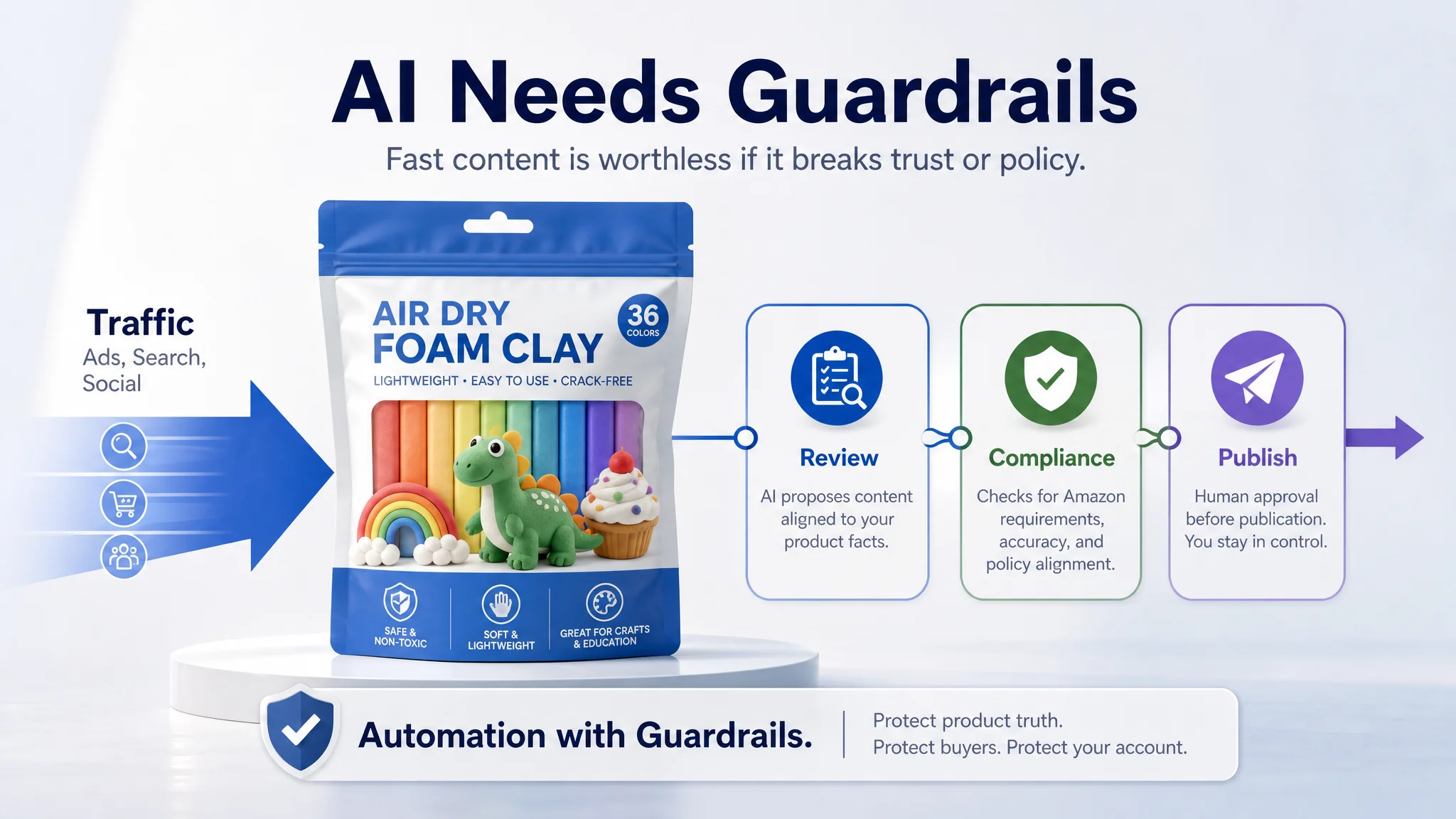
When selecting an AI tool, prioritize product-authenticity constraints, compliance checks, human approval, reviewable workflows, and the ability to block or revise rejected outputs. Product facts, structure, branding, materials, and functional attributes must remain unchanged unless confirmed by reliable source information. A tool’s feature list is irrelevant if it generates policy-violating content or optimizes the wrong business constraint. The correct standard is controlled execution: AI performs defined tasks, while sellers retain approval and accountability.
How We Selected AI Tools for This Guide: Methodology and Compliance Criteria
A tool was not selected because it offered the longest feature list. We evaluated whether it addressed a defined seller problem, reduced operational risk, and preserved human control over Amazon-facing decisions. Each criterion was assessed against available product documentation, workflow evidence, and stated limitations.
- Amazon policy alignment: We looked for documented controls covering relevant requirements, such as image formats, white backgrounds, color modes, dimensions, and checks before submission. These controls can reduce preventable upload violations, but they do not prove compliance with every Amazon rule involving claims, intellectual property, reviews, or account practices.
- Data privacy and track record: We assessed whether the provider clearly explains data collection, storage, retention, third-party sharing, and account-access practices. Where independent privacy evidence or specific retention details were unavailable, we treated privacy as requiring further seller verification rather than assuming the tool was safe.
- Human review and approval: Preference went to workflows that show proposed changes beside existing content and require users to select or approve changes before publication. This lowers the risk of inaccurate product attributes, unsupported claims, or unintended listing edits.
- Model transparency and limitations: Tools should explain their inputs, outputs, decision boundaries, and known failure modes. Explicit restrictions against inventing features, changing product structure, or fabricating specifications help reviewers identify content requiring additional scrutiny.
- Clear business value: We prioritized tools that connect diagnosis to an executable action and a measurable Amazon KPI, such as CTR, CVR, ACoS, BSR, or listing cycle time, rather than merely adding dashboards. Traceable reports, status records, and review points further support accountability when evaluating results.
The last criterion is particularly important because the most visible problem is not always the primary constraint. In the foam clay case, the seller’s internal narrative was that the listing had acceptable reviews and images, so additional traffic or advertising adjustments should solve the problem. A structured benchmark showed otherwise. The main image and bullet-point dimensions were slightly ahead of the competitor, while A+ content was eight points behind and the title was three points behind. The diagnosis therefore shifted away from “more traffic” and toward “better conversion capacity.”
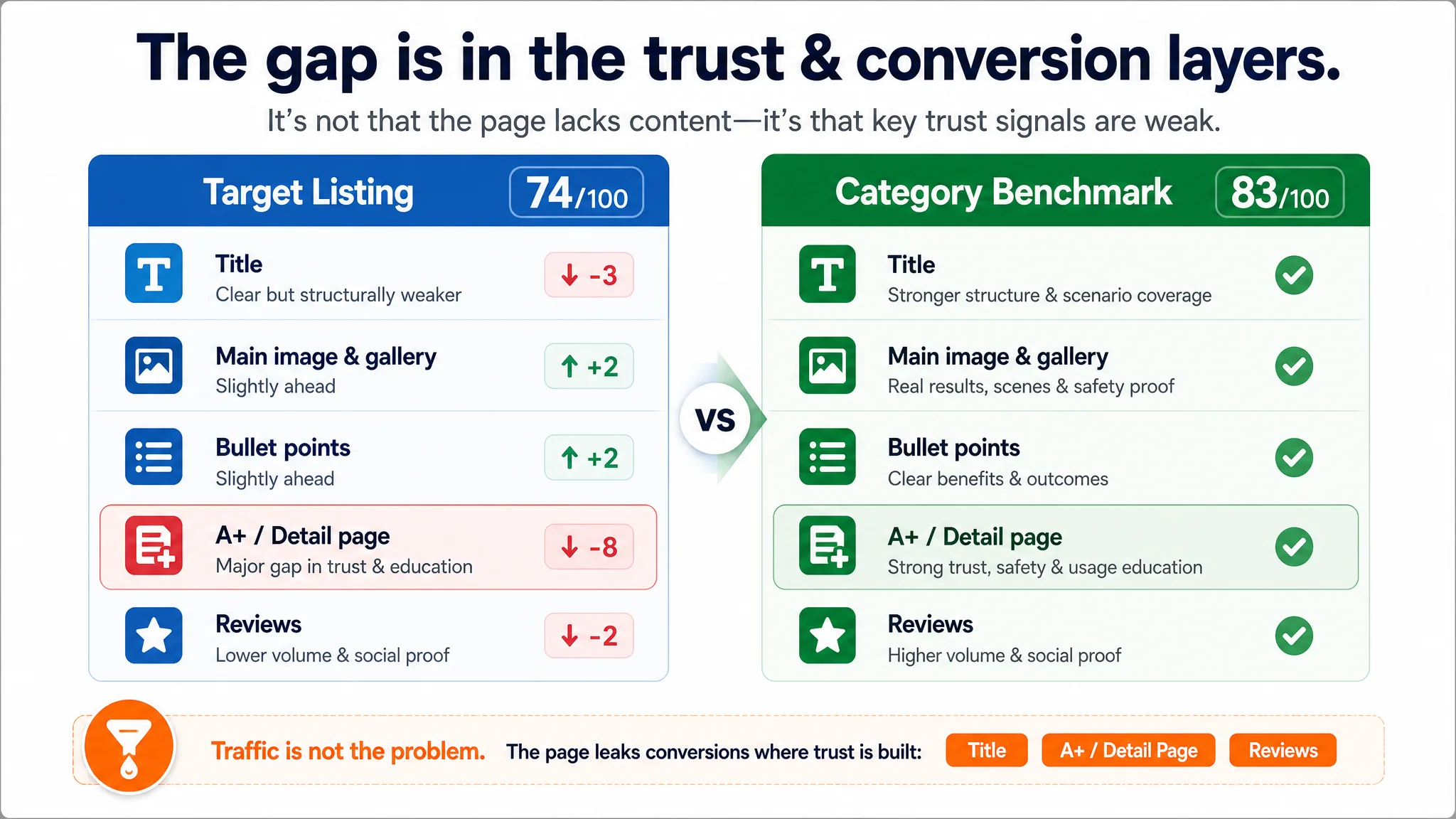
This is a useful standard for evaluating AI tools. A platform that reports more keywords, images, or dashboard indicators is not necessarily helping the seller make a better decision. The tool should help distinguish between an acquisition problem and a trust, content, or conversion problem. Otherwise, automation may simply make it easier to invest in the wrong area.
Best AI Tools for Amazon Sellers at a Glance: Categories and Compliance Snapshots
Tool selection should match the workflow and its specific account-health risks. The following overview separates practical use from the compliance check that should accompany it.
- Listing creation and optimization: Typical AI use: Draft titles, bullets, descriptions, and visual concepts, Compliance snapshot: Avoid prohibited, exaggerated, or unsupported claims; require manual review before publishing
- Advertising: Typical AI use: Refine targeting, assess search terms, and flag potential negative keywords, Compliance snapshot: Check keyword relevance, trademark risks, and campaign changes before launch; monitor CTR, CVR, and ACoS
- Product research: Typical AI use: Compare demand, competition, reviews, and category opportunities, Compliance snapshot: Verify restricted-category requirements, intellectual-property risks, and review-based product concerns
- Repricing: Typical AI use: Adjust prices in response to market conditions, Compliance snapshot: Review minimum-price rules, margin limits, and potential price-policy concerns
- Inventory: Typical AI use: Forecast demand and support replenishment decisions, Compliance snapshot: Validate forecast assumptions, supplier information, and inventory commitments before action
- Customer service: Typical AI use: Organize and draft responses across support workflows, Compliance snapshot: Protect customer data, follow communication rules, and require human approval for sensitive cases
For listing work, Claude may assist with early drafting or restructuring, but individual results vary and every claim still requires seller verification. Some sellers also use Amazon-focused compliance-assist layers, such as DeepBI, to scan existing bullet points and descriptions for prohibited language and to diagnose structural weaknesses across listing modules. Direct Seller Central policy review remains necessary.
A compliance-assist tool can be useful when it connects policy review with customer decision logic. In the foam clay diagnosis, the issue was not that the listing had no content. It had product shots, usage scenes, texture closeups, packaging details, bullet points, and A+ modules. The issue was that those elements did not form a coherent trust-and-education path. The competitor’s page addressed usage, safety, expected results, storage, and practical concerns more systematically.
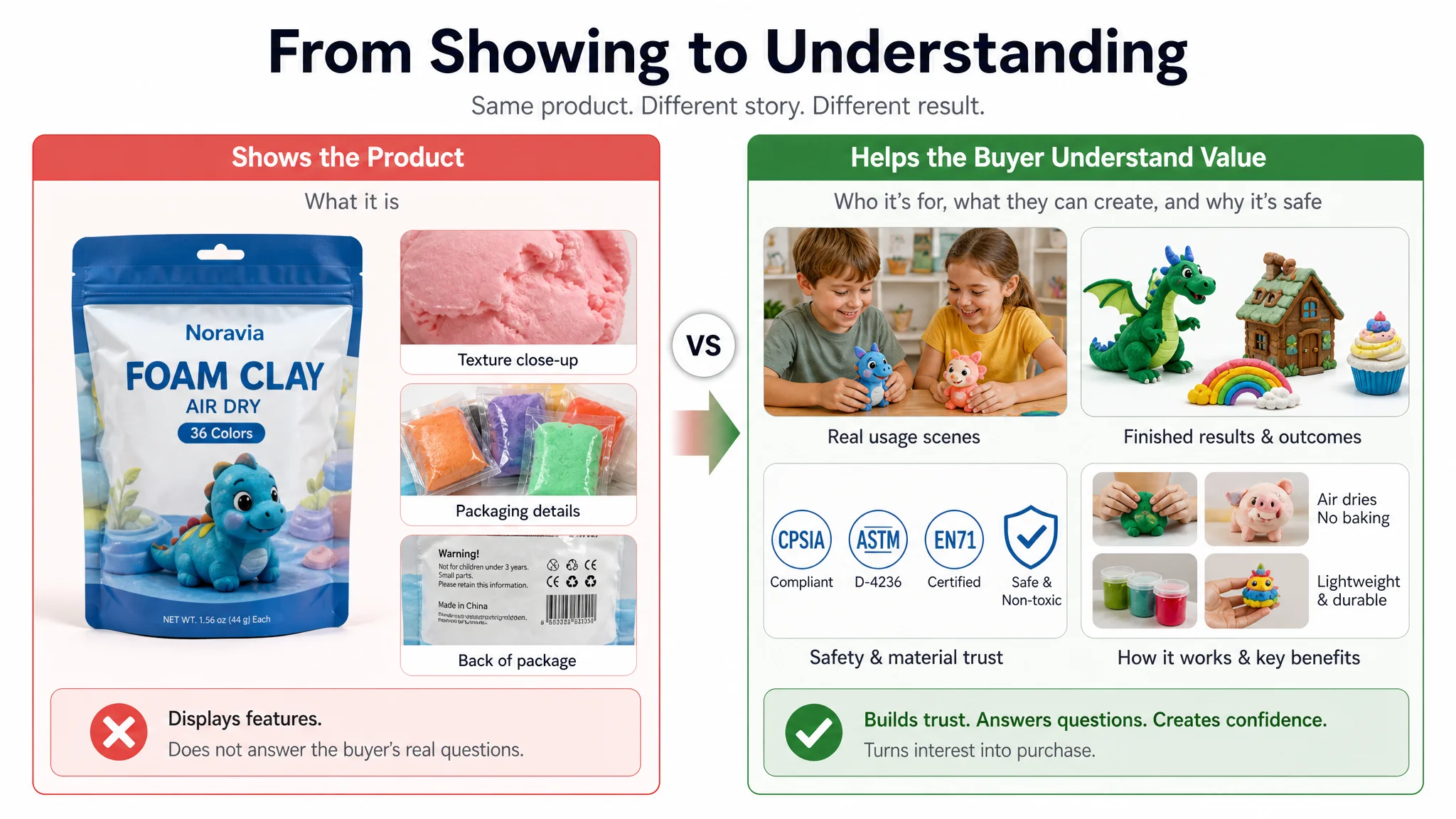
That distinction should shape tool evaluation. A tool that only flags prohibited terms may reduce compliance risk but fail to identify why a page is not converting. A tool that recommends new copy without checking product evidence may improve apparent relevance while introducing unsupported claims. The strongest workflow combines both functions: diagnose the commercial problem, then verify that every proposed solution remains factually and policy compliant.
eDesk can support workflows across a wide range of marketplaces and channels; confirm channel coverage, permissions, privacy controls, and retention practices before deployment. Pricing also varies by provider and plan, so verify any stated monthly fee directly rather than relying on outdated comparisons. No tool guarantees compliance: treat AI as an assistant, not autopilot.
What AI Can and Cannot Do for Amazon Sellers—and the Compliance Implications
AI can shorten the path from raw marketplace data to a workable optimization plan. Depending on the tool and its inputs, it may help optimize keyword placement, generate initial titles and bullet points, analyze review patterns and sentiment signals, and flag potential negative keywords. It may also identify weaknesses that could affect CTR, CVR, ACoS, BSR, or listing cycle time.
These capabilities remain conditional. AI can organize evidence and accelerate drafting, but it cannot guarantee policy-compliant output or replace verification against current official Amazon documentation. Generated content may introduce unsupported functions, specifications, materials, accessories, or performance claims unless the seller checks every statement against reliable product data.
AI also cannot decide automatically which layer of the business is causing weak performance. In the foam clay case, the seller initially interpreted the problem as an advertising or traffic-volume issue. The page had a reasonable rating and acceptable-looking images, so the team considered expanding keyword coverage, adjusting bids, and testing more creative variations. The diagnosis instead found that the page was losing decision confidence in the title and, more substantially, in the A+ and detail-page experience.
The competitor’s title communicated the brand, product type, key attributes, and broader use cases more directly. Its gallery showed finished creations, real crafting environments, and safety-related information. Its A+ content explained how to use the product, what results to expect, and how to address practical concerns. The target listing showed the product clearly but left customers to infer too much for themselves.
This is where AI can support analysis but cannot replace judgment. It may identify that a page has an A+ gap or that a competitor includes more educational content. A human reviewer still needs to determine whether the proposed safety language, drying-time statement, material description, or visual claim is accurate and supported.
Nuance is a particular risk. A comparative or superiority claim may appear commercially persuasive while implying evidence the seller does not possess. Similarly, an AI-generated image may alter a product’s color, material, or structure, creating a product-image mismatch that could contribute to negative reviews, refunds, and weaker conversion. Visual optimization should preserve the product’s actual identity rather than modify inherent attributes.
A controlled workflow therefore treats AI as an assistant, not an autopilot:
- Use AI for diagnosis, drafting, classification, and prioritization.
- Review claims, comparisons, images, and keyword decisions against source data.
- Confirm final assets and compliance before publication or replacement.
- Protect customer, product, advertising, and account data throughout the workflow.
- Distinguish between a traffic problem, a page-quality problem, and a trust problem before changing campaigns.
Integrating security and privacy controls across AI use is widely regarded as a best practice and can significantly reduce operational and data risks, although it cannot guarantee business success. The seller remains accountable for the final decision.
Best AI Product Research Tools for Amazon Sellers with Built-In Compliance Checks
Product research tools can narrow a large catalog of possibilities, but their outputs are screening evidence—not approval to sell. Opportunity Explorer can help assess search demand and niche context. Review the category and product type it surfaces against Amazon’s restricted-products and approval requirements before investing in inventory. A high-demand niche may still require documentation or be unsuitable for a specific account.
Helium 10’s Black Box can filter product opportunities using market and listing criteria. Sellers can use those results to flag categories, claims, or product designs that require deeper review. For example, a filtered opportunity involving a health-related product should be checked against applicable category, claims, and documentation policies rather than treated as a low-risk finding.
Jungle Scout’s product and market research functions can help compare demand, competition, pricing, and customer feedback. Review sentiment is particularly useful: repeated complaints about misleading dimensions, missing functions, or unsafe use may expose customer-expectation and detail-page risks. Those concerns should be compared with verified specifications before a listing is created.
The same principle applies after a product is already on the market. Reviews can look positive while still failing to provide enough trust to compete with a more established listing. In the foam clay comparison, both the target and competitor had a 4.7-star rating. The target had 76 reviews, while the competitor had 3,237. The similar star score made the seller feel that review quality was sufficient, but the competitor’s much larger volume and broader user-generated proof created a stronger adoption signal.
That evidence did not mean the target listing needed to imitate the competitor or make unsupported popularity claims. It meant the page had less room for content gaps. Where the competitor benefited from thousands of reviews and photo or video proof, the target needed especially clear, accurate information about safety, usage, drying behavior, storage, and expected results. Product research and review analysis can reveal this type of trust deficit, but the seller still has to decide how to address it within verified evidence.
Across all three tools, recurring brand names, distinctive product features, or closely similar competitor designs may signal intellectual-property risk. They are prompts for independent trademark, copyright, patent, and product-origin review—not proof of infringement. Likewise, a tool may show attractive BSR or demand while overlooking detail-page image, claim, certification, or category restrictions.
Use each result to build a review checklist, then cross-reference current official Amazon policy and verified product facts before sourcing, publishing, or scaling. No research feature replaces seller responsibility for policy verification.
How These Tools Support a Wider Launch Workflow While Keeping You Compliant
Treat compliance as a control point throughout the launch cycle, not a final inspection. Automate monitoring and alerts, but keep approvals, strategy, and policy judgments with human reviewers.
- Research: Use research tools to validate category eligibility, identify relevant restrictions, and flag products or claims requiring specialist review before sourcing begins.
- Sourcing: Check supplier documents, product specifications, materials, dimensions, and certifications against the intended offer; do not allow AI to fill gaps or alter the verified product identity.
- Listing creation: Have listing AI draft titles, bullets, descriptions, and attributes, then apply a human Policy Review checklist covering prohibited claims, comparison statements, unsupported benefits, promotional wording, and required attributes.
- Listing validation: Confirm that every proposed statement matches the physical product and approved evidence. Send uncertain specifications to a reviewer rather than permitting the system to infer them.
- Inventory planning: Use inventory AI to forecast demand and potential stock requirements, but review the assumptions manually and avoid unsupported promises about availability, delivery, or replenishment.
- Advertising: Use PPC AI to flag budget risks, unusual spend, or potential ACoS pressure. Keep bids and budgets within approved limits, and require human authorization before activation or material changes.
- Output approval: Review every AI-generated recommendation, draft, forecast, alert, or asset before submission or activation. A tool can identify risk or prepare an option; it should not make an unsupervised compliance decision.
- Ongoing monitoring: Automate status tracking and performance alerts, then connect changes to CTR, CVR, ACoS, BSR, and listing cycle time. Keep positioning, launch timing, budget allocation, and policy interpretation manual.
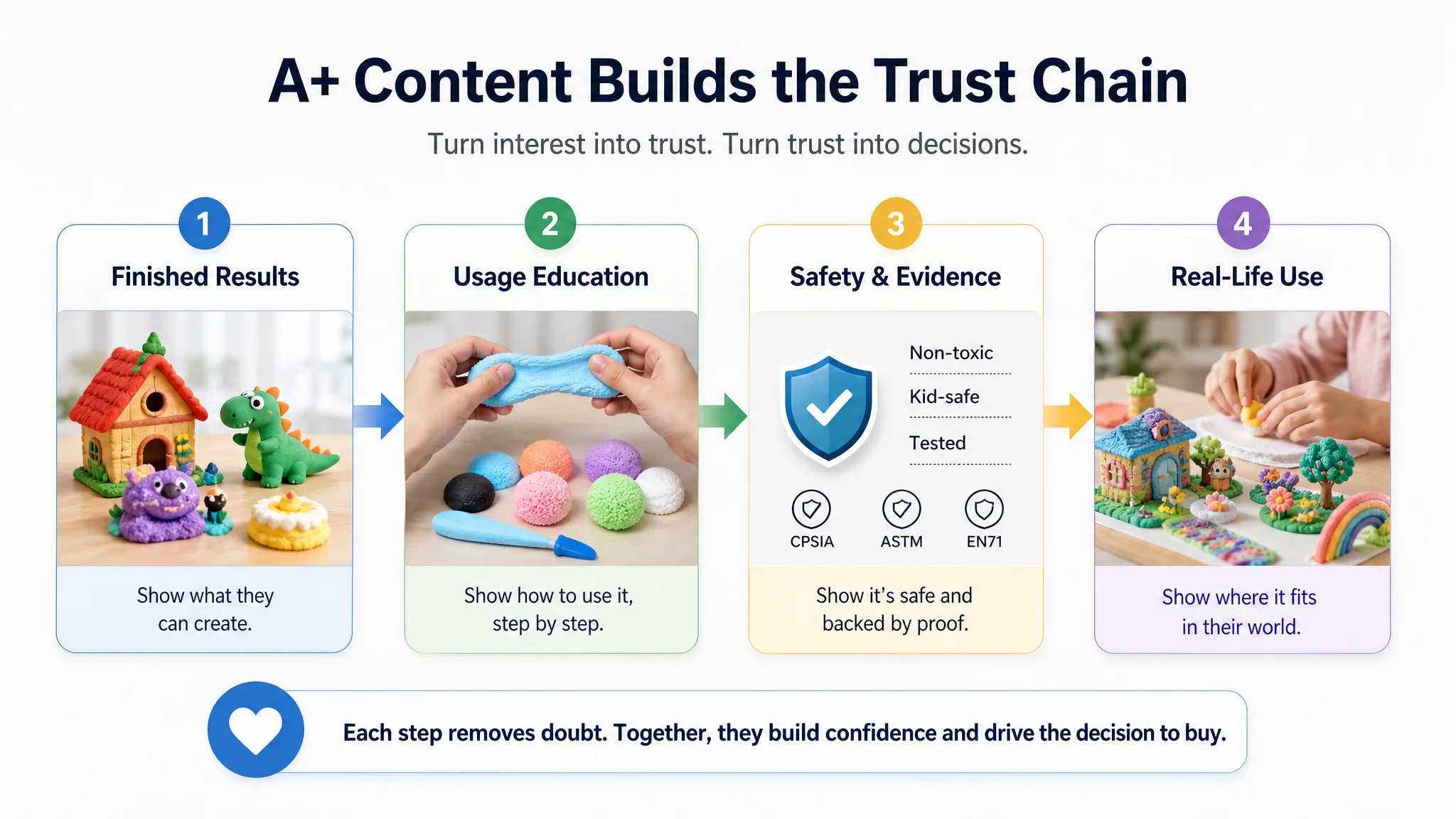
A listing diagnosis should be part of this workflow before advertising is scaled. In the foam clay case, the seller’s instinct was to adjust keywords, bids, and budgets because traffic appeared to be the most obvious variable. The benchmark instead showed that the main constraint was the page’s ability to turn attention into confidence. The title did not communicate the core product and use cases as clearly as the competitor. The A+ content lacked visible safety and ingredient positioning, step-by-step education, and a strong demonstration of finished outcomes.
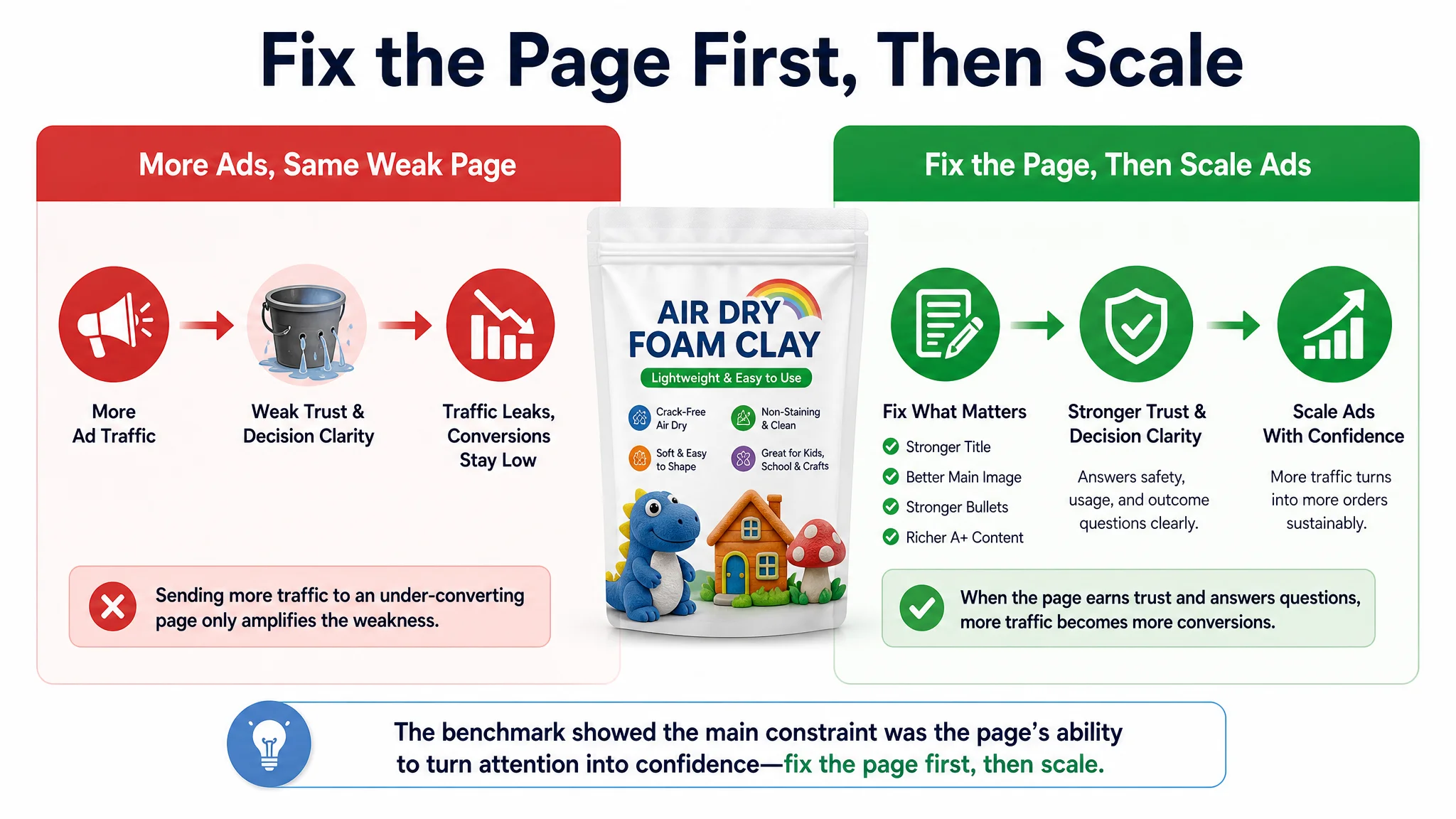
That did not make advertising irrelevant. It changed the order of operations. Sending more traffic to an under-converting page would have amplified the existing weakness. Listing diagnosis therefore became a control point before further ad optimization: verify whether the page accurately communicates the product, answers key customer questions, and provides enough evidence for the intended audience to make a decision.
Critical Compliance Risks: Listing, Claims, and Automation Pitfalls to Avoid
AI can improve listing cycle time, but a polished output is not proof of compliance. Before publishing or activating automation, use this checklist against Amazon’s current product detail page rules, intellectual-property policy, advertising requirements, and pricing guidance as of the writing date.
- Do remove unsupported superlatives: Review titles, bullets, and descriptions for terms such as “best” and “premium quality,” and avoid guarantee language unless the claim is permitted and fully substantiated.
- Do verify every factual claim: Confirm dimensions, materials, certifications, capabilities, comparisons, performance statements, and included accessories against approved product documentation; never allow the model to guess.
- Do protect product consistency: Check that AI-generated images do not alter the product’s material, color, structure, proportions, logo, or included components. Image-product mismatch can increase refunds, negative reviews, and customer disputes.
- Do check intellectual-property boundaries: Review competitor references, logos, fonts, product designs, and branded elements against Amazon’s intellectual-property policy. Similar composition or lighting is not permission to copy identifying features.
- Do review automated negative-keyword changes: Confirm that injected negatives do not block relevant searches, distort targeting, or create misleading advertising conclusions that could affect CTR, CVR, or ACoS.
- Do set repricing limits: Use approved floors, ceilings, and authorization scopes; overly aggressive price changes can weaken perceived brand value and disrupt conversion or BSR performance.
- Avoid trusting a polished scenario: A seller may receive copy that quietly adds a performance promise, visuals that change a material, or a branded element resembling a competitor. Human review must test copy, visuals, targeting, price, destination, and reversibility before activation.
- Do preserve final approval: Compare proposed changes with approved assets, verify the target listing and placement, and reject any automated action whose factual, policy, or commercial basis is unclear.
The risk of a “polished scenario” is not limited to obvious policy violations. A page can look professional while still failing to answer the questions that affect customer confidence. The foam clay listing had clean photos and existing A+ modules, but its content was organized more around product presence than buyer education. The competitor’s page showed finished creations, usage environments, safety information, and practical guidance in a connected sequence.
For a children-oriented craft product, adding a safety badge, allergen statement, or certification reference without source verification would create a compliance problem. Omitting all such information, however, may leave a meaningful trust gap if the product has valid documentation that could be communicated accurately. The correct process is neither automatic embellishment nor automatic omission. It is evidence-based review: identify the customer question, verify the supporting fact, and present it without exceeding what the evidence allows.
Building a Human-Review Workflow for AI-Generated Content
AI output should enter Amazon only after a defined approval sequence. Better input generally produces better output, so provide verified product information, approved optimization instructions, and complete listing data rather than relying on vague prompts.
- Prepare the source pack: Confirm the product’s identity, physical attributes, measurements, materials, functionality, brand assets, and approved optimization objective before generating content.
- Review against the source: Compare every generated title, bullet, description, image, or field with verified product documentation; revise or reject anything that invents features, accessories, specifications, or performance results.
- Check the proposed change: Confirm that each edit follows the approved optimization plan and does not alter product structure, proportions, functionality, logo placement, brand colors, or other established identity elements.
- Use visual highlights as navigation aids: Identify every yellow-highlighted field, inspect the underlying text or image, compare it with source evidence, and record a human decision: approve, revise, or reject.
- Run the manual checklist: Inspect issue or compliance filters; remove prohibited, exaggerated, or unsupported claims; verify facts and required fields; and confirm image specifications before submission.
- Perform a final comparison: Review old and new assets side by side and selectively approve replacements rather than applying every generated output automatically.
- Recheck official requirements: Before submission, consult the latest official Amazon policy pages and current Seller Central documentation for prohibited claims, image standards, required fields, and interface behavior. Any interface details are accurate only as of the writing date.
- Audit after submission: Record whether Amazon accepted the content, left it processing, or blocked it; confirm the intended placement; save the application time as a test-event marker; and compare subsequent CTR, CVR, ACoS, or BSR data with the pre-change baseline. Review CTR over the following 7–14 days as an observation period, not proof of causation.
Human review should also test whether the assets work together as one decision path. In the foam clay diagnosis, the recommended title placed the core product and color earlier, then clarified attributes and use cases. The bullets were reorganized around practical questions: how the clay feels, what users can make, whether it is suitable for children or students, how it dries, and how it is stored.
The proposed visual direction followed the same logic. The main image and gallery were intended to clarify capacity, drying behavior, storage, safety-related information, and possible outcomes. A+ content was structured to move from finished creations to usage education, trust information, classroom and hobbyist scenarios, packaging usability, and stable results after drying.
These recommendations still require evidence checks. A proposed “24–48h air dry” statement, a claim that the product does not crack or shrink, a certification reference, or a statement about ingredients cannot be approved merely because it addresses a customer concern. Each must be compared with reliable product documentation. Likewise, an image showing a particular finished model or use environment must not imply product capabilities that the actual material cannot support.
The purpose of human review is therefore broader than proofreading. It is a structured decision about whether the proposed content is:
1. Factually accurate.
2. Consistent with the physical product.
3. Supported by available evidence.
4. Appropriate for Amazon’s content and advertising requirements.
5. Relevant to the intended customer’s decision.
6. Safe to publish, replace, and measure.
Frequently Asked Questions
Can I trust AI to fully automate my listings?
No. AI can execute authorized listing work, but it should not independently decide what product claims, attributes, images, or selling points to add. Generated content may contain unsupported details, and automated application does not remove the seller’s responsibility. Review every proposed title, bullet, image, and backend element before publication, checking its effect on listing quality, CVR, ACoS, and account health.
A strong rating or acceptable-looking page does not change this requirement. In the foam clay case, the seller had a 4.7-star rating and visually serviceable content, but the page still lacked enough trust and education to compete with the category leader. AI could help identify the missing layers, but a human had to determine which safety, usage, drying, storage, and outcome statements were accurate and supportable.
How do I know if a tool is compliant?
Do not rely on marketing claims. Inspect the tool’s actual controls and workflow. Confirm that it:
- Uses verifiable product data and preserves the product’s real specifications, structure, branding, and physical attributes.
- Applies relevant Amazon formatting and image requirements.
- Provides quality checks, comparison views, selective approval, and a clear review step before changes are applied.
- Respects permission limits and makes its inputs, outputs, and decision boundaries understandable.
- Helps distinguish traffic, content, trust, and conversion problems rather than automatically recommending more advertising activity.
Then verify the proposed workflow against the latest official Amazon documentation and current Seller Central documents. A tool’s safeguards support review; they do not prove that every output is policy-compliant.
What should I do if an AI tool adds a claim I’m unsure about?
Pause the workflow. Do not publish, approve, or apply the claim until you can verify it from reliable product information. Remove or correct unsupported language, and check the underlying specifications, materials, dimensions, functions, accessories, and usage effects. If the detail cannot be confirmed, leave it out rather than allowing AI to fill the gap. Complete a human review against the latest official Amazon guidance and current Seller Central documents before proceeding.
The same principle applies to visual claims. If an AI-generated image makes a product look safer, larger, more flexible, more durable, or more capable than the actual item, reject or revise it even if the image appears attractive. Conversion-focused content must clarify the real product rather than create expectations the product cannot meet.
Should I optimize ads or the listing first?
Start by diagnosing the constraint rather than following a fixed rule. If traffic is clearly irrelevant, campaign and keyword work may be necessary. If traffic is reaching the page but customers are not progressing toward purchase, review the listing’s conversion capacity before scaling spend.
In the foam clay case, the seller initially believed that more traffic, better bids, or broader keyword coverage might solve the problem. The benchmark found that the page was losing trust and decision clarity, especially in A+ content. The recommended direction was therefore to improve the title, bullets, gallery, and A+ story before treating additional advertising as the primary solution.
A useful question is: does the page genuinely deserve more traffic? If it does not clearly communicate the product, intended users, use cases, safety information, and expected outcomes, advertising may simply send more visitors into an unresolved decision problem.
Conclusion: Your AI Toolkit, Compliant and Effective
AI should function as an execution assistant, not an autopilot. Use it to carry out structured instructions, while keeping product truth, Amazon requirements, and seller judgment in control.
- Select tools through a compliance-first lens: confirm that outputs preserve the product’s materials, color, structure, branding, functional logic, and supported claims.
- Reject tools or workflows that invent features, accessories, specifications, selling points, or visual elements not present in the product.
- Check whether the tool supports Amazon requirements, including content and image standards, without treating its internal checks as a substitute for independent verification.
- As of the writing date, compare every relevant output and workflow with the latest official Amazon Seller Central documentation, then verify the current requirements before publication or implementation.
- Keep a human approval step before applying changes: compare the existing and proposed assets, review factual accuracy and policy alignment, and select only what is supported.
- Diagnose the real business constraint before changing campaigns. A listing with traffic, acceptable reviews, and decent images may still lack the trust and education needed to convert.
- Make the title, main image, bullets, and A+ content tell one coherent and evidence-based story. Each element should help the buyer understand what the product is, who it is for, how it works, and why it can be trusted.
- Pick one tool category, apply the compliance lens, and build your own review checklist today. Include factual accuracy, product consistency, platform requirements, customer decision questions, and final human approval so AI supports CTR, CVR, ACoS, BSR, and listing cycle time without transferring accountability away from the seller.
The foam clay diagnosis makes the broader lesson clear: good reviews and acceptable images do not automatically create a high-converting page. Advertising can bring attention, but it cannot independently supply missing trust, usage education, or decision clarity. AI is most valuable when it helps sellers identify that gap, structure a compliant response, and keep the final judgment with the people responsible for the listing.