


Key Takeaways
- Amazon sellers now operate under a dual compliance layer: Amazon’s platform rules govern how automation interacts with seller accounts, while government-level requirements govern how AI-generated commercial content is presented to consumers.
- Amazon’s March 2026 AI agent policy introduces enforceable limits on automated activity. Sellers should review agent workflows, permissions, and approval steps rather than assuming that automation is acceptable simply because it improves listing cycle time or ad operations.
- State-level AI disclosure laws require transparency for AI-generated advertising content under the applicable rules. Requirements may vary by jurisdiction and content type, so sellers should verify the latest available guidance before publishing AI-assisted advertising assets.
- Non-compliance can create account-level risk, including possible restrictions on automated activity or account operations. No single workflow should be treated as a guaranteed compliance solution; seller review and legal assessment remain necessary where requirements are unclear.
- DeepBI supports disciplined execution within defined policy boundaries. Its structured workflow can connect listing diagnosis, optimization planning, controlled asset generation, evaluation, and delivery. Product DNA and product-entity consistency constraints help prevent AI visuals from changing a product’s material, color, structure, or design, reducing the risk of image-product mismatch.
- For operations, DeepBI can use official SP-API-based delivery with user confirmation and selective replacement, while linking visual iteration events to advertising signals such as CTR. This gives sellers a more controlled way to manage listing quality and ad operations without promising automatic compliance or replacing required human oversight.
The New Landscape - Why International AI Regulations Matter for Amazon Sellers
Amazon sellers now operate under two connected layers of oversight. The first is platform-level control: Amazon’s policies and permissions govern how automated systems can modify listings, upload assets, or perform other marketplace actions. The second is government-level regulation. Enacted U.S. state laws increasingly address the use of AI in consumer-facing content, including advertising and representations made to shoppers. Other jurisdictions may introduce additional requirements, while frameworks such as the EU AI Act should be treated as potential future developments rather than assumed direct obligations for every Amazon seller.
The practical tension is clear. Automation can shorten listing cycle time, support faster localization, and improve the speed at which teams optimize assets for CTR, CVR, and ACoS. Yet the same automation can create consumer-protection and fair-shopping risks when it operates on incomplete or unverified inputs. An image generator that exaggerates product dimensions, adds nonexistent accessories, or changes materials can cause goods-not-as-described complaints, refunds, and negative reviews. Automated placement or advertising-linked content can also distort product presentation if visual prominence is optimized without preserving accurate, consistent information.
In one mobile-photography accessories listing, the seller initially believed that weak orders were caused by Amazon advertising performance. Traffic had begun to arrive, but orders lagged, so the team continued adjusting bids, keywords, and budgets. A deeper Listing comparison showed a different constraint: the page scored 47/100 against a tightly matched benchmark listing scoring 84/100, with the largest gaps in A+ or detail content and review trust. The advertising was bringing users to the page, but the page did not provide enough structured proof to convert them.
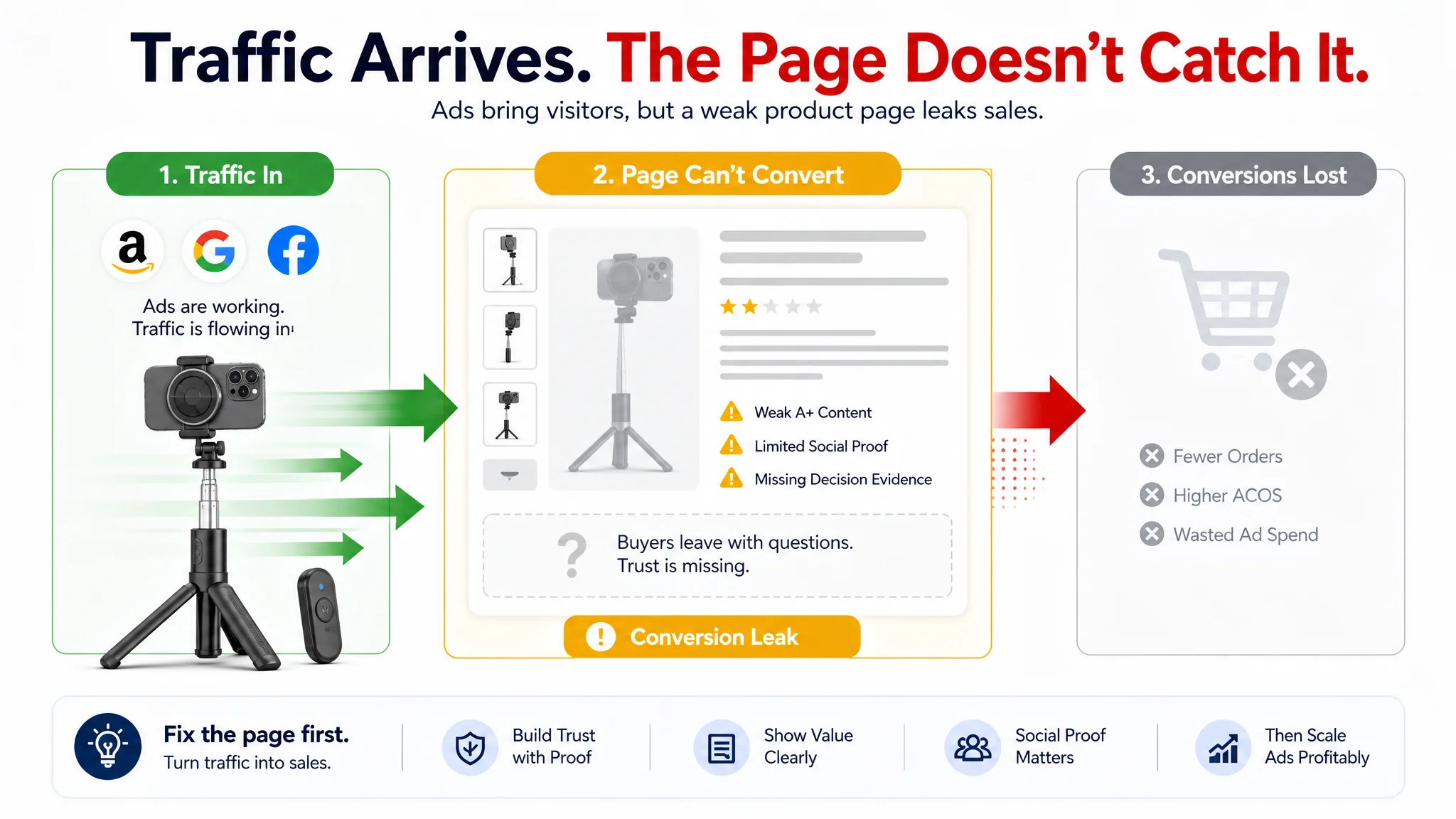
This distinction matters for AI governance because automated optimization can amplify an existing weakness. Generating more images, changing bids, or publishing assets faster does not solve a page that cannot answer the buyer’s core questions. In that case, the missing evidence concerned height, stability, magnetic strength, compatibility, and usage scenarios. The problem was not simply a lack of activity; it was a lack of controlled, accurate information at the point of decision.
Compliance therefore cannot be treated as a legal review performed after publication. Sellers need controls inside the operating workflow: verified product data must take priority over creative assumptions, platform format requirements should be checked before upload, and human confirmation should remain in the approval path for consumer-facing changes. A diagnosis-to-delivery process using Amazon’s approved API permissions can preserve automation efficiency while limiting uncontrolled actions. The objective is not to abandon AI, but to make its speed accountable to truthful presentation, platform rules, and applicable state requirements.
Amazon AI Agent Policy: New Automated Seller Rules 2026
Amazon’s AI agent policy took effect on March 4, 2026. Its central distinction is not between manual work and automation; it is between controlled, registered API automation and unregistered or uncontrolled bot behavior. Sellers can automate approved workflows through Amazon’s Selling Partner API (SP-API), but agents that bypass authorized interfaces or act without appropriate controls fall outside the permitted model.
The policy organizes automated actions into three impact tiers:
- Routine actions: Low-risk operational tasks, such as synchronizing approved listing images or updating other permitted assets through SP-API.
- Moderately impactful actions: Workflows that affect multiple listings or materially change customer-facing content, such as applying a bulk content update across a product range.
- High-impact actions: Actions that can directly affect commercial performance or customer transactions, such as changing prices, inventory-related settings, or order-affecting configurations.
The higher the potential business impact, the stronger the control requirements. Sellers and technology providers must register their agents through SP-API, observe applicable API rate limits, and retain action audit logs for 12 months. High-impact actions also require a human authorization checkpoint rather than unrestricted autonomous execution.
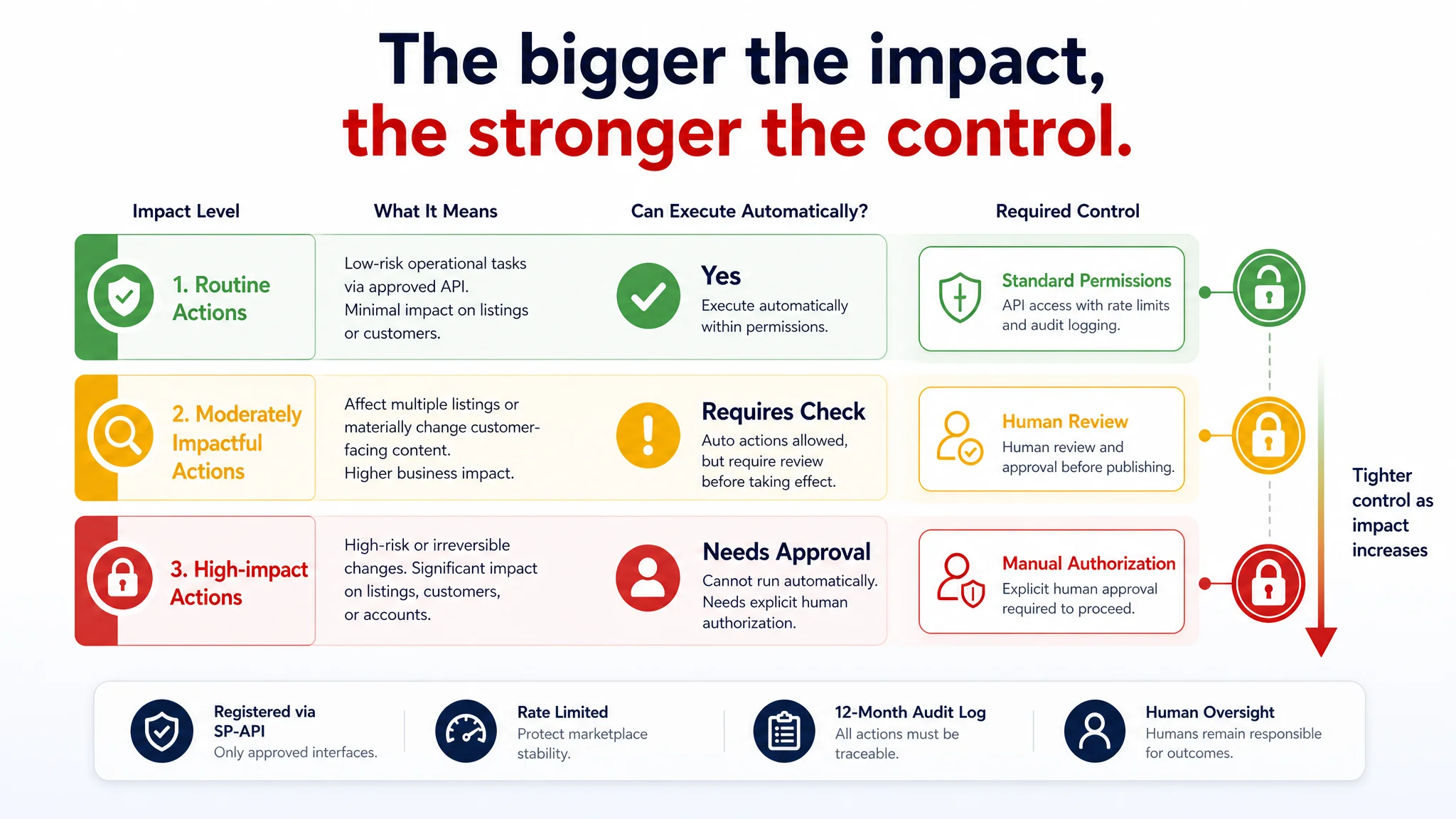
A compliant operating design should therefore minimize permissions, keep actions traceable, and place approval before consequential changes. For example, an image workflow can request only image-asset permissions, present an old-versus-new comparison, and let the seller approve selected assets before submission. That structure supports faster listing cycle time while preserving control over changes that may influence CTR, CVR, or BSR.
The need for selective approval becomes clearer when listing changes are connected to advertising performance. In the magnetic tripod example, the seller’s first instinct was to alter bids and keywords because advertising costs felt too high. A controlled diagnostic workflow instead showed that the more consequential decision was whether the page was ready to receive additional traffic. Rather than allowing an automated system to keep escalating campaign activity, the seller could review the page diagnosis, compare proposed content changes, and authorize only the assets that accurately reflected the product.
Amazon has provided a 90-day transition window, which will end around early June 2026. Sellers should use the remaining period to inventory automated workflows, confirm SP-API registration, verify rate-limit handling, implement 12-month audit retention, and add explicit human approval to high-impact actions. No post-transition enforcement details should be assumed beyond the stated policy requirements.
Automated Pricing Rules in March 2026
Amazon’s pricing policy places a 20% daily cap on automated price changes. The restriction is tied to consumer protection: unchecked price automation can contribute to artificial scarcity or create abrupt price movements that undermine buyer confidence. For sellers, the issue is not simply how quickly a tool can update an offer, but whether each adjustment remains within a controlled and auditable operating boundary.
A compliant repricing workflow should therefore treat the 20% limit as a pricing-specific control. The system should establish the current price, calculate the proposed change, validate that the daily movement remains within the permitted range, and record the authorization and result. Any adjustment that exceeds the limit should be held for review rather than forced through an automated process.
Repricing tools should use Amazon’s official Selling Partner API (SP-API) channel for approved pricing adjustments. SP-API-based integration provides a controlled connection to the seller backend and supports clearer permission management than improvised or unauthorized update methods. The available documentation supports SP-API as the official integration route, while pricing permissions and implementation should remain explicitly authorized for the relevant workflow.
The 20% figure applies to automated price changes. Sellers should not automatically treat it as a limit for inventory, orders, CTR, CVR, ACoS, or BSR; those metrics require separate controls and should be monitored for business impact. In practice, teams should review whether capped repricing affects conversion rate, advertising efficiency, ranking performance, or listing cycle time, while keeping the regulatory check focused on the price movement itself.
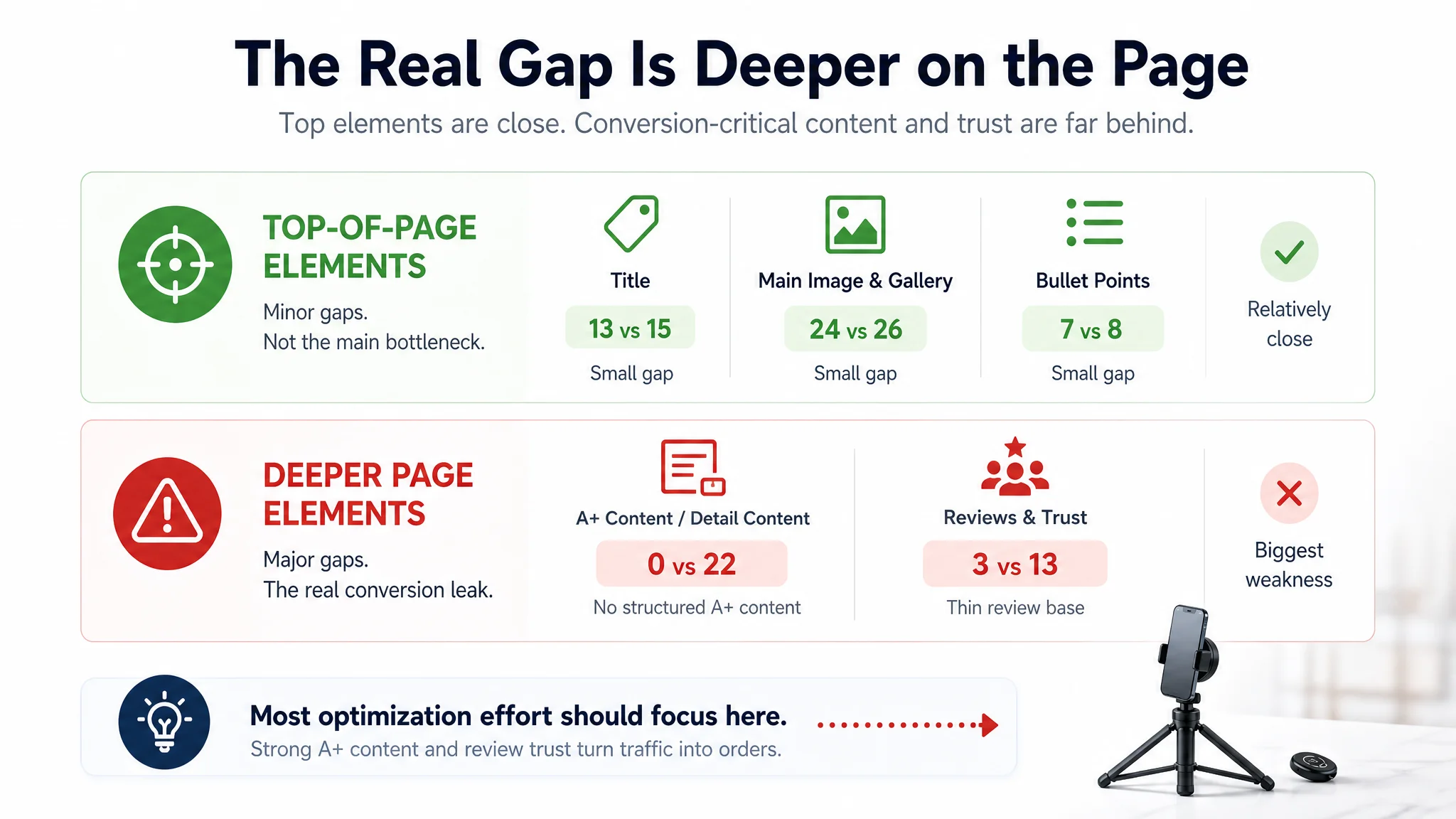
The same separation between policy control and business diagnosis applies beyond pricing. A seller may see high ACoS and assume that more aggressive bids, lower prices, or broader targeting are needed. In the magnetic tripod listing, however, the main issue identified through benchmarking was not a pricing change. The page had passable scores for its title, main image, gallery, and bullet points, but its A+ or detail content scored 0 compared with 22 for the benchmark, while review trust scored 3 compared with 13. Increasing traffic or changing the commercial inputs without repairing those gaps would have made the underlying inefficiency harder to manage.
For this reason, automated pricing and advertising decisions should be evaluated against the correct layer of the business problem. A price-control rule does not determine whether a Listing can convert, and an advertising metric does not by itself prove that advertising is the source of weak performance. Each workflow needs its own controls, records, and diagnostic logic.
State-Level AI Disclosure Laws: Beyond Human Performers
AI disclosure laws are often understood as rules for synthetic human models, presenters, or performers. New York Bill S8420 points to a broader compliance concern. Its text requires clear disclosure for any AI-generated image, video, or audio used in advertising. The relevant question is not whether a human appears in the asset, but whether generative AI created material used to promote a product.
For Amazon sellers, that scope may include more than an AI-generated spokesperson. It can reach product photos, redesigned backgrounds, lifestyle scenes, promotional videos, and other creative assets generated or materially altered by AI. A seller using AI to produce listing visuals could therefore face disclosure risk even when the product itself is the only subject shown.
The commercial exposure is practical as well as legal. If a seller must later revise or annotate a large visual library, rushed changes can disrupt listing cycle time and introduce inconsistencies across main images, secondary images, A+ content, and advertising creative. Poorly reviewed generated visuals can also change product structure, materials, or accessories, creating accuracy issues that may affect CVR, returns, or listing-policy compliance.
A real listing diagnosis illustrates why visual generation requires more than aesthetic review. For the magnetic tripod product, some existing images communicated technical features but did not provide concrete proof of stability or magnetic strength. Another comparison-style image leaned more on emotional contrast than on quantified product advantages. The proposed revision was therefore not simply to make the images more attractive. It was to connect each visual to a specific buyer question: how tall the tripod is, whether it remains stable, how strong the magnet is, how the tilt mechanism works, and which devices are compatible.
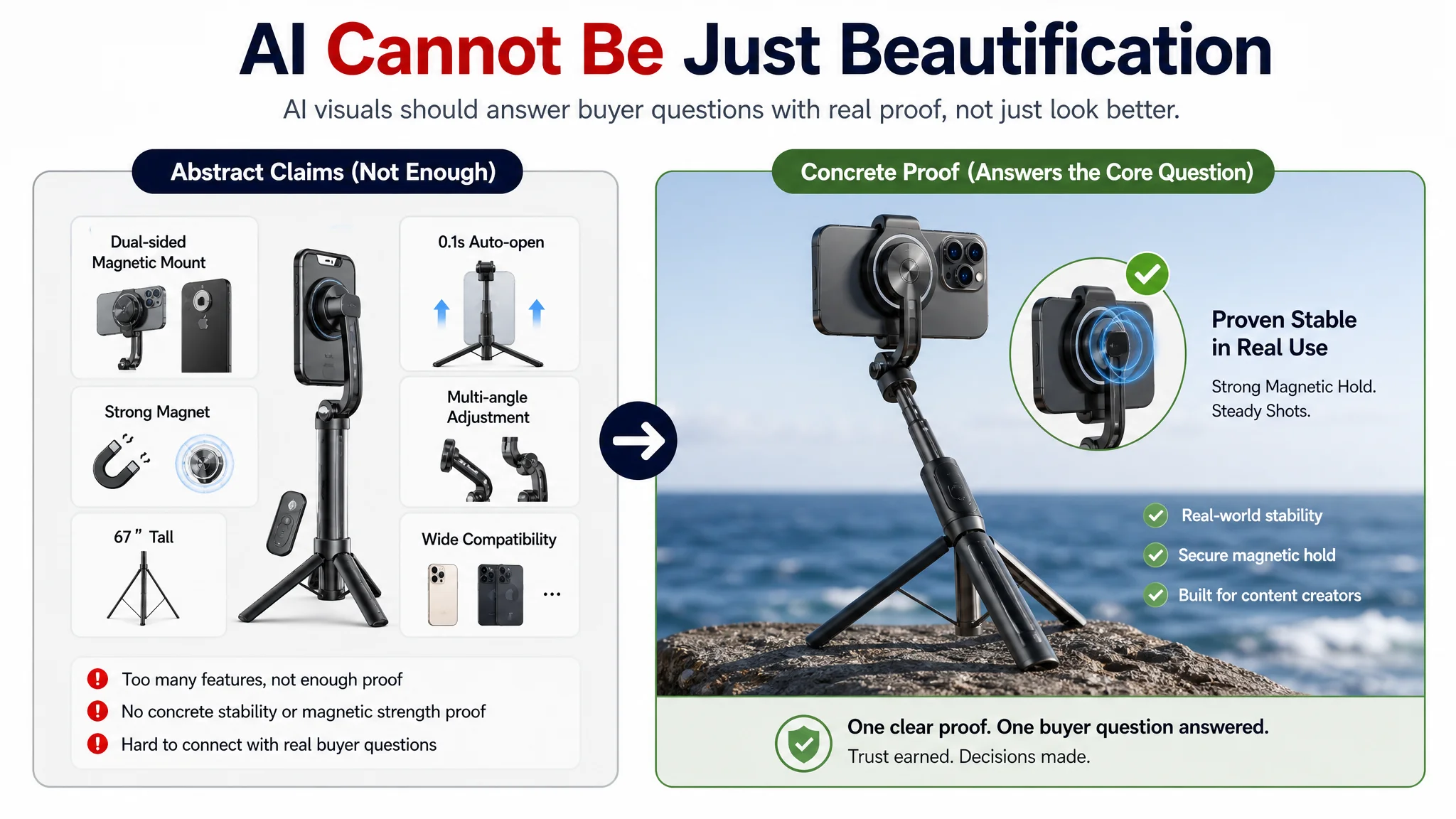
If an AI-generated image changes the product’s physical structure or adds an accessory that is not included, the issue becomes both a disclosure concern and a product-representation problem. A visual may appear polished while still misleading a shopper. Product-identity constraints, source-data validation, and side-by-side human review are therefore necessary before publication.
No official Amazon guidance establishing a universal “AI-generated” label for listing imagery is identified here, and there is no confirmed platform-wide implementation guidance from other major ecommerce or advertising platforms. That absence should be treated as a risk factor, not as permission to ignore the issue.
A prudent operating process should:
- Inventory AI-generated or materially AI-altered images, video, and audio used in advertising.
- Separate assets by marketplace, placement, and campaign so disclosure decisions can be reviewed consistently.
- Consider a clear “AI-generated” indicator where applicable, subject to legal and platform review.
- Keep human approval in the workflow, including side-by-side checks of original and proposed listing images.
- Monitor the bill’s status and obtain qualified legal advice before adopting a disclosure standard across markets.
This approach creates an evidence trail while preserving the ability to update assets when official platform instructions become available. It also helps sellers distinguish between a creative problem and a representation problem: an image that fails to answer a buyer’s question may require better information, while an image that changes the product requires a stricter accuracy review.
How These Regulations Reshape Daily Operations
AI regulation changes more than the wording of a compliance policy. It changes how sellers create, approve, publish, and monitor Listing content. When teams cannot show what changed, which source data supported the change, or who approved it, a routine content update can become difficult to investigate. The operational risk is not limited to enforcement exposure; weak records can also slow corrective action, disrupt the Listing cycle, and obscure the effect of changes on CTR, CVR, ACoS, or BSR.
Listing management therefore needs a stronger audit trail. Each scoring task, optimization decision, generated asset, approval, and delivery result should be connected through identifiable records and structured data rather than informal messages. A practical workflow can preserve the original asset beside the proposed replacement, allow approval of individual images, and record the platform’s processing status. Version histories should show the previous state and the new state, even when a system does not yet provide implemented rollback. This gives operators a defensible basis for reviewing content changes and measuring their performance impact.
A structured record is also important because a weak Listing is not always immediately visible from top-of-page metrics. In the magnetic tripod diagnosis, the title, main image, gallery, and bullet points were relatively close to the benchmark, with only small scoring gaps in several of those dimensions. The much larger weakness appeared deeper in the page: A+ or detail content scored 0 compared with 22, and reviews and ratings scored 3 compared with 13. Without a multi-dimensional comparison, a team focused mainly on impressions, clicks, or the main image could easily continue optimizing the wrong layer.
Advertising production requires a comparable control point. AI-generated images and copy should be reviewed against the actual product, claims, and applicable marketplace or jurisdictional requirements before publication. For images, product-identity controls can help prevent generated content from altering the product’s physical structure. Copy still requires human or designated business review for unsupported specifications, misleading claims, and any disclosure required by the relevant rule or platform policy. Where disclosure is applicable, it should be treated as a defined approval step rather than an afterthought.
This review should also preserve the relationship between page content and buyer decision logic. In the magnetic tripod example, the page was rebuilt around verified information such as N52 magnetic strength, a 0.1-second auto-open mechanism, device compatibility, adjustable height, remote range, and tilt functionality. The purpose was not to fill the page with more claims. It was to provide quantified proof, relevant scenarios, and usage guidance in the places where shoppers needed them.
Pricing workflows also need explicit controls. Automated repricing or pricing recommendations should be governed by authorized inputs, approval thresholds, and records of the decision logic, so policy requirements do not become untraceable price changes.
Finally, automation should operate through approved Amazon SP-API channels with narrowly scoped permissions. Tools should document what data they access, what action they execute, and whether Amazon accepts, processes, or blocks the submission. This architecture connects compliance evidence with daily execution instead of treating oversight as a separate administrative task.
Staying Compliant and Competitive with DeepBI
Maintaining compliant Amazon content is not only a legal or policy concern; it also affects commercial performance. Unclear claims, inaccurate visuals, or inconsistent product information can weaken CTR and CVR, increase customer dissatisfaction, and create avoidable rework during the listing cycle. DeepBI’s Listing module supports a more controlled optimization workflow without presenting itself as a legal compliance solution.
Its Intelligent Scoring & Benchmarking applies multi-dimensional semantic analysis across listing elements and compares quality against relevant top competitors. The analysis can cover the main image, title, bullet points, A+ Content, and customer feedback. By using benchmarks aligned with product form, price range, audience, usage scenario, and function, sellers can identify gaps that may require revision rather than relying on subjective judgment alone. Recommendations focus on specific improvements to visual structure, search terms, selling points, and problem-to-solution bullet logic.
The magnetic tripod diagnosis shows why this broader view matters. The target Listing received an overall score of 47/100 against a directly comparable benchmark at 84/100. The title, main image and gallery, and bullet points were not the primary source of the gap. The most significant difference was in A+ or detail content, where the target scored 0 compared with 22, followed by reviews and ratings, where it scored 3 compared with 13. The seller had initially viewed a 5.0-star rating as evidence that trust was already strong, but the small review base made the product appear unproven when compared with a competitor that had more review volume and richer first-page content.
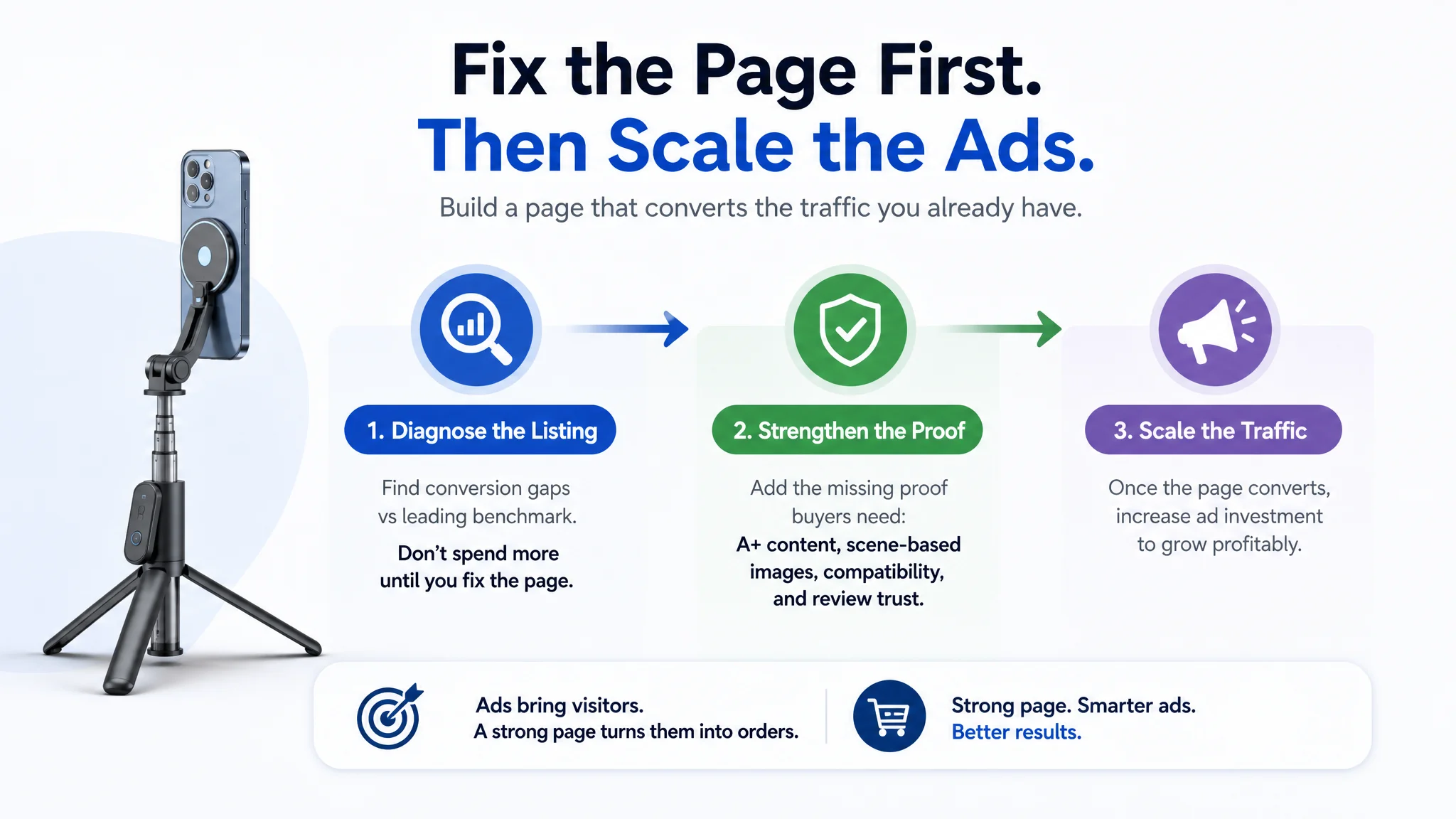
This diagnosis changed the operating sequence. The seller had been adjusting bids, keywords, and budgets because the product was receiving traffic without enough orders. DeepBI’s comparison showed that advertising was not necessarily failing to bring relevant visitors; the page was consuming the traffic because it lacked persuasive scaffolding. That distinction is important for both performance and governance. An automated system that keeps changing campaign inputs without checking page readiness can increase spend while leaving the actual conversion constraint untouched.
DeepBI’s AI Content Generation can produce main images, A+ Content, titles, and bullet points based on Amazon best practices. For visual assets, product information and Product DNA act as constraints on structure, materials, branding, and confirmed features, reducing the risk of AI-generated product mismatches. Text workflows also help remove redundant wording and unsupported or exaggerated claims, lowering the risk of misleading copy. Better content structure can support stronger CTR and CVR, while more systematic iteration can reduce listing cycle time.
The value of controlled generation becomes clearer when the page is organized around decision questions rather than a collection of features. For the magnetic tripod, the proposed content structure connected:
- Magnetic strength with realistic use scenarios and verified product data.
- Material and tripod structure with stability and wobble-related concerns.
- Tilt range with overhead, desktop, and outdoor shooting situations.
- Dual-sided magnetic functionality with compatible accessories.
- Remote connectivity with range, storage, and setup information.
- Device compatibility with iPhone MagSafe, Android, and non-MagSafe use through the included metal ring.
This approach does not mean that every generated claim is automatically valid. Product specifications must still be confirmed against authoritative source information, and visual scenarios must not imply uses or accessories that the product cannot support. The purpose of Product DNA and structured review is to keep the creative process connected to the product’s actual identity.
Publishing is another control point. Instead of downloading, renaming, and uploading assets one by one, sellers can use One-Click SP-API Sync to apply approved content through Amazon’s authorized API channel. Request identifiers, processing status, synchronization results, and change-event markers provide a clearer operational record and reduce placement errors.
DeepBI does not offer a dedicated compliance-check feature and cannot determine whether content is legally compliant. Sellers remain responsible for reviewing final assets against Amazon policies and applicable regulations. Its value is indirect: data-driven benchmarking, structured generation, human approval, and SP-API publishing reduce manual errors while preserving greater workflow transparency.
Future-Proofing Your Ad Operations with DeepBI
For teams that prioritize operational efficiency and account security, DeepBI’s Ads Quant module provides a more structured way to manage Amazon advertising activity. Its Four-Stage Funnel & Dynamic Bidding framework supports automated bid and budget adjustments within the operating boundaries of Amazon’s Selling Partner API (SP-API), rather than relying on uncontrolled scripts or irregular bot behavior. The module uses seven-day performance windows to inform down-to-the-day adjustments, helping sellers connect campaign decisions with measurable indicators such as CTR, CVR, and ACoS. Because campaign actions are organized through an official, authenticated API channel, monitored workflows, and defined inputs, the approach is closer to Amazon’s preference for controlled automation than to erratic automated activity.
However, structured advertising automation should not be confused with automatic diagnosis. A campaign can have impressions and clicks while still sending users to a Listing with insufficient conversion capacity. In the magnetic tripod case, the seller’s repeated bid and keyword adjustments did not address the largest content gaps. The page’s A+ or detail content was effectively missing, compatibility and usage guidance were under-explained, and review depth was limited. The appropriate next step was to repair the Listing’s decision logic before asking advertising to deliver more traffic.
This is why advertising metrics should be connected to Listing diagnosis rather than viewed in isolation. CTR may indicate whether an asset attracts attention, but it does not prove that the page establishes trust. CVR may reveal a conversion problem, but it does not by itself identify whether the cause is product-market fit, pricing, reviews, page structure, or unsupported claims. ACoS may signal inefficiency, but it does not establish that bidding is the first variable to change.
Once the page was reframed around concrete proof—such as height, stability, magnetic strength, compatibility, and usage scenarios—future advertising optimization could operate on a more reliable foundation. The objective was not to make advertising compensate for a weak Listing, but to make the Listing capable of carrying the traffic that advertising generated.
Consistent campaign management can also reduce operational mistakes, such as untracked changes, conflicting instructions, or excessive account actions, which may lower the likelihood of triggering automated policy violations. That benefit should be understood as a risk-reduction advantage, not a compliance guarantee: SP-API access does not exempt a seller from Amazon advertising rules, disclosure requirements, or account-level responsibilities. Sellers still need to review campaign settings, targeting, creative claims, permissions, and policy changes before and during execution. DeepBI can provide the structured operating mechanism; policy accountability remains with the seller and the organization managing the Amazon account.
Conclusion and Next Steps
Compliance is no longer optional, and the window for adjustment may be short as enforcement expectations develop across jurisdictions and Amazon policies. Sellers should treat AI governance as an operating discipline: audit what is already running, control what can be published, and preserve evidence of how changes were approved and delivered.
The same discipline should be applied to performance diagnosis. A seller may believe that advertising is the immediate problem because traffic is expensive or orders are below expectations. But the magnetic tripod Listing showed how that assumption can obscure a deeper page-level constraint: a 47/100 Listing score against an 84/100 benchmark, missing A+ or detail content, and limited review trust. The lesson is not that advertising metrics are unimportant. It is that they should be interpreted alongside the Listing’s ability to answer buyer questions and establish confidence.
- Map every automation tool used for Listing creation, image generation, pricing, advertising, publishing, and reporting; record its inputs, permissions, outputs, approval steps, and failure-handling process.
- Review Listing and advertising assets for AI-generated images, text, claims, specifications, and product representations; remove invented features, unsupported performance statements, altered product structures, and brand elements that do not match approved source information.
- Validate AI outputs against authoritative product data before publication, using approved product specifications, physical constraints, brand rules, and Amazon content requirements as the source of truth.
- Check connected permissions and API scopes, applying least-privilege access so each system can perform only its approved function rather than gaining unnecessary access to pricing, inventory, orders, or other core business data.
- Prefer controlled SP-API workflows for authorized Listing asset synchronization instead of relying on manual downloads, renaming, uploads, and incomplete activity logs.
- Keep human approval in the publishing loop by reviewing original and proposed replacement assets side by side and selecting which changes, if any, should be applied.
- Diagnose the Listing before escalating ad activity, checking whether the title, images, bullets, A+ content, compatibility information, usage guidance, and review depth can support the traffic being purchased.
- Track processing and business signals after publication, including whether assets were accepted, blocked, or still processing, then relate approved changes to CTR, CVR, ACoS, BSR, and Listing cycle time where relevant.
- Explore DeepBI as an Amazon-focused operating system for connected Listing diagnosis, controlled content generation, review, approval, and SP-API execution. Its structured data contracts, traceable workflow records, and permission limits can help align daily operations with an evolving regulatory environment.
- Recheck the operating model regularly against official regulatory guidance, Amazon policy updates, internal brand requirements, and advertising standards; document remediation when a workflow or asset fails review.
No system removes the seller’s responsibility for regulatory, intellectual-property, advertising, or account-level decisions. A practical forward-looking approach is to build transparent controls now, verify requirements through official sources, and adapt workflows as rules become clearer rather than waiting for enforcement to expose operational gaps.
The broader operating principle is equally important: automation should make business judgment more disciplined, not replace it. Advertising can bring qualified visitors, AI can accelerate asset production, and SP-API can make execution more traceable. But none of these systems can compensate for a product page that lacks accurate proof, clear decision logic, or buyer trust. A compliant and competitive workflow connects diagnosis, content, approval, delivery, and measurement so that each automated action remains both accountable and commercially meaningful.