


Introduction - The AI Compliance Blind Spot
AI customer communications are no longer merely a service convenience. When an AI agent makes a promise, describes a policy, or gives guidance about an order, the seller may face consequences for that statement—even if no employee reviewed it before delivery. A chatbot’s wording can influence a consumer’s purchase, refund request, cancellation decision, or expectations about support. Legal responsibility does not automatically disappear because the message was generated by software.
The 2024 Air Canada ruling made this risk difficult to dismiss. In that case, a court held the airline responsible for misleading information provided by its chatbot and rejected the idea that the company could avoid accountability simply because the statement came from an AI system. The practical lesson for Amazon sellers is direct: a customer-facing agent can create obligations that extend beyond the seller’s intended policy.
This creates a new compliance channel that many organizations still monitor less rigorously than product listings, advertising, or account health. AI tools can respond at scale across marketplaces, email, chat, and support workflows, while their outputs may vary with prompts, product data, policy changes, and customer context. A single unsupported statement can therefore become a repeatable operational risk.
Generic assurances that an AI system is “compliant” are not enough. Sellers need demonstrable auditability: approved source information, defined limits, review controls, identifiable records of what the system generated, and a process for investigating disputed statements. The standard must shift from trusting the tool to proving what it said, why it said it, and whether the business authorized that communication.
The same principle applies to other AI-assisted Amazon workflows. In one listing diagnosis, a seller initially believed that poor advertising performance was caused by bids, keywords, and budgets. A closer comparison showed that the product page itself had a score of 47/100 against a directly comparable benchmark listing at 84/100, with the largest gaps in A+ content and review trust. The important lesson was not simply that the page needed improvement. It was that the seller’s initial explanation was not supported by enough operational evidence.

Compliance decisions require the same discipline. Whether the output is a buyer message, a product claim, or an advertising asset, sellers should verify the underlying evidence before deciding where the problem lies.
Why Generic Promises Fall Short
An AI vendor can claim to be “secure,” “compliant,” or “enterprise-ready” without giving sellers a practical way to test those statements. A checkbox-style claim may confirm that a policy exists, but it does not show whether customer messages are governed in operation, whether sensitive information is protected, or whether a specific interaction can be reconstructed later.
Many organisations also face challenges from shadow AI: employees may paste customer messages into unsanctioned tools, use browser-based assistants, or connect applications without formal approval. These activities can create oversight gaps between the approved AI environment and the tools actually handling customer information. A vendor’s general assurance cannot close that gap by itself.
Amazon sellers should evaluate compliance through observable controls and evidence, including:
- Defined input and output rules for customer communications
- Access records showing who used the system and when
- Traceable request or event identifiers
- Retention, deletion, and escalation records
- Evidence that sensitive data is masked, restricted, or excluded
- Testing records showing how the system handles prohibited or high-risk content
- Performance monitoring linked to business impact, such as response quality, CVR, complaint rates, or operational workload
A stronger model connects each policy requirement to a control that can be inspected and a result that can be verified. For example, DeepBI’s documented workflow uses structured reports, traceable task identifiers, product constraints, and pre-publication checks rather than relying only on an attractive score. The principle applies broadly: sellers should ask what the system can prove, not merely what the vendor promises.
A listing diagnosis illustrates why this distinction matters. The seller’s product page appeared to have a technical product and active advertising, so the team initially focused on bids and keywords. The diagnostic process instead compared the page with a tightly matched competitor and broke the result into title, image, bullet, A+, and review dimensions. The resulting profile showed that the most serious gaps were not where the team first expected: A+ or detail content scored 0 versus 22 for the benchmark, while reviews scored 3 versus 13. The score became useful because it was linked to specific observable page elements.
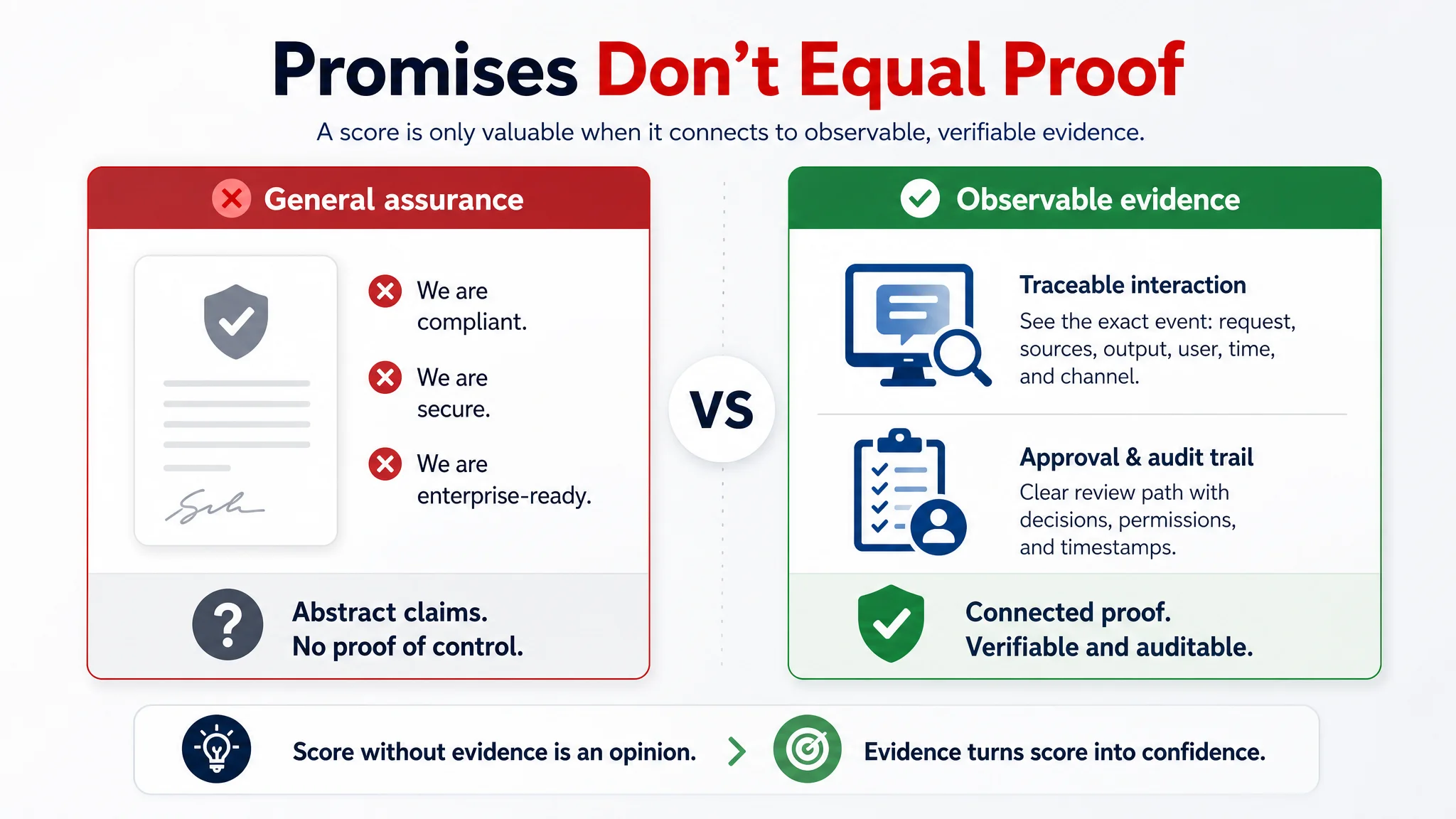
The same standard should apply to AI communication controls. A vendor should be able to show the underlying event, permission, source, output, and approval path—not just provide a general statement that the system is safe.
AI Contact Center Compliance: 8 Must-Have Features in 2026
For Amazon sellers, compliance should be tested through controls, not vendor assurances. Use this checklist to evaluate whether an AI communications system can withstand an account review, customer dispute, privacy inquiry, or internal audit.
3.1. End-to-End Audit Trails with Event-Level Visibility
- Risk: An AI message triggers a customer complaint, but no one can identify the prompt, model output, approval, or delivery event. Check: Require timestamps, user IDs, message versions, model-call records, and channel status; missing evidence can weaken platform and legal responses.
A similar evidence gap can appear in listing operations. When the magnetic tripod seller saw advertising costs rise, the team could have continued changing bids without establishing what was happening on the page. The listing diagnosis created a traceable comparison across specific dimensions instead: title, gallery, bullets, detail content, and review trust. That did not replace human judgment, but it made the judgment inspectable.
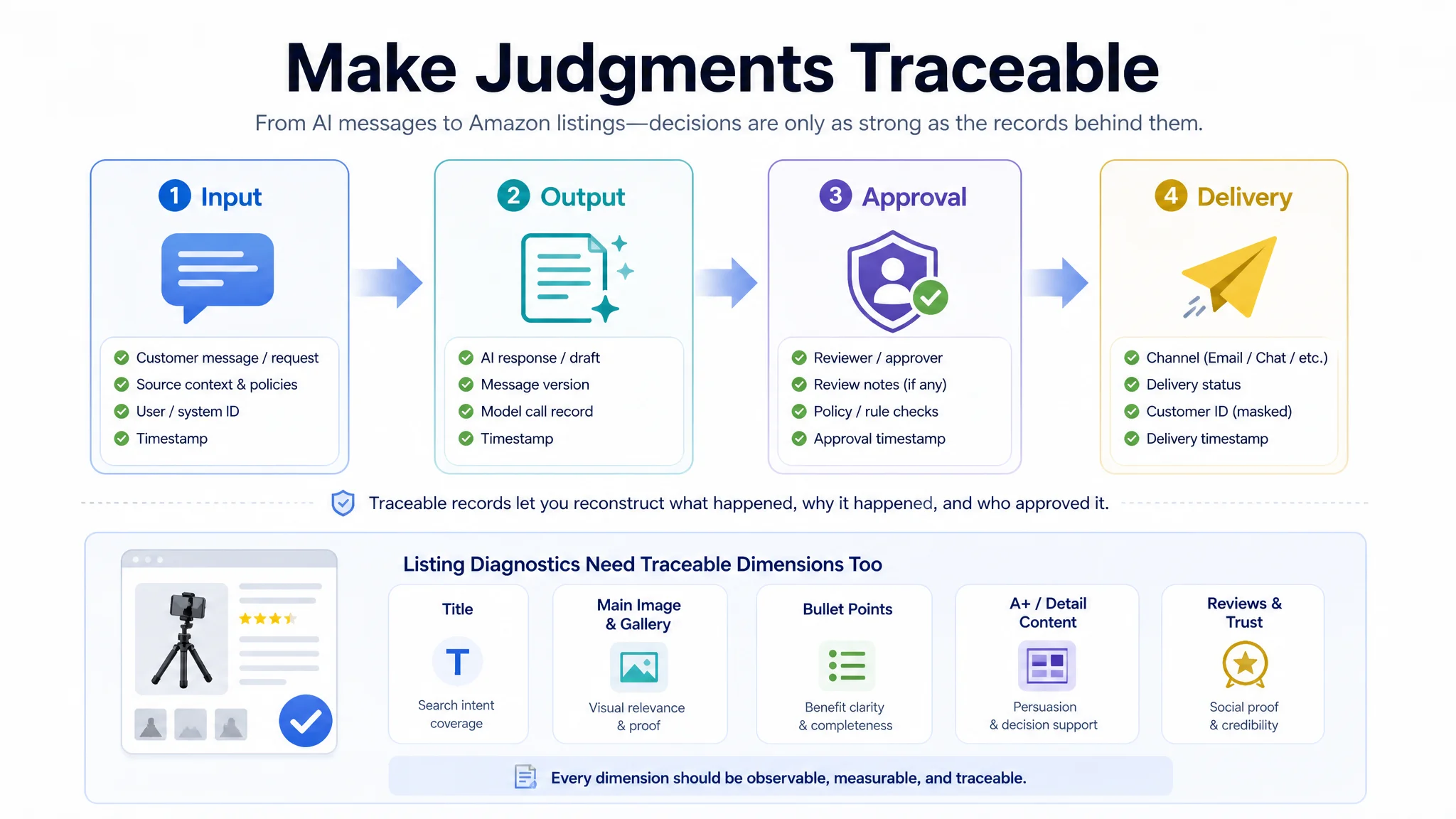
For customer communications, event-level visibility serves the same function. It allows a seller to distinguish between a faulty AI output, an incorrect source instruction, an approval failure, and a delivery problem.
3.2. Consent Management and Automated Opt-Out Controls
- Risk: A buyer opts out but continues receiving automated messages. Check: Verify consent capture, suppression-list enforcement, channel-specific opt-outs, and proof of processing; failures can create complaints and marketplace restrictions.
Consent records should not be treated as a broad system status that cannot be tied to a specific interaction. Sellers need to know what permission existed when the message was generated, what channel was covered, and whether an opt-out was applied before delivery.
3.3. PII Isolation, Masking, and Redaction by Design
- Risk: Personally identifiable information (PII), such as a name or address, enters an unnecessary model workflow. Check: Confirm discovery, masking, redaction, minimization, and isolation controls before processing.
The objective is not simply to have a privacy policy. It is to show how the workflow prevents unnecessary data exposure at the point of processing. This is especially important when multiple tools, integrations, or external model providers are involved.
3.4. Data Residency Controls and Regional Storage Options
- Risk: Customer communications are stored in an undisclosed region. Check: Require documented storage locations, transfer safeguards, and country-level configuration; regional operation alone does not prove compliant data residency.
A seller should be able to identify where communication data is processed and stored, which providers can access it, and what controls apply when information crosses regions. General references to global availability do not answer those questions.
3.5. Forensics-Ready Evidence Retrieval
- Risk: A seller cannot reconstruct a disputed reply quickly. Check: Look for searchable JSON or equivalent records, unique report IDs, linked inputs and outputs, and Amazon processing status.
Forensics-ready retrieval is valuable because disputes rarely involve only the final sentence. The seller may need to establish what information the system received, which instruction it followed, whether a human reviewed it, and when the communication was sent.
The same logic made the listing diagnosis more useful than a generic health score. The magnetic tripod page was not described merely as “weak.” The diagnostic record linked the 47/100 result to identifiable gaps: missing A+ modules, limited quantified proof around magnet strength and stability, under-explained compatibility, and a thin review base. Evidence becomes actionable when it can be traced to the specific element that created the risk.
3.6. Third-Party Risk Visibility and Governance Controls
- Risk: An external model or subcontractor changes handling practices. Check: Review vendor assessments, subprocessors, contractual duties, and access boundaries.
The more external systems participate in a communication workflow, the more important it becomes to document responsibility boundaries. Sellers should know which provider handles the data, which functions are delegated, and how changes are communicated and reviewed.
3.7. Policy-Based Retention, Deletion, and Evidence Preservation
- Risk: Messages are retained indefinitely or deleted before a dispute is resolved. Check: Confirm schedules, automated deletion, legal holds, and preservation workflows.
Retention should balance privacy requirements with the need to investigate disputes. A system that keeps everything without governance creates unnecessary exposure; a system that deletes too quickly may leave the seller unable to demonstrate what happened.
3.8. Role-Based Access Control and Compliance-Grade Permissions
- Risk: A contractor can view customer data or change communications policies. Check: Require RBAC—role-based access control—least privilege, named users, approval separation, and periodic access reviews. For API integrations, verify scopes are limited to necessary functions rather than pricing, inventory, or order data.
Permissions should be tested against actual workflows, not only documented in a configuration guide. A user who can draft messages may not need to approve them, export customer records, change retention settings, or modify policy constraints.
What Amazon's Policies Really Require
AI-generated content does not become the platform’s responsibility simply because a tool produced it. Sellers remain accountable for the accuracy, tone, and handling of every AI-assisted listing, image, and buyer-facing communication.
As of this writing, Amazon requires content—including AI-generated content—to be accurate, not misleading, and respectful of buyer personal information. Amazon’s Generative AI Content Policy and Communication Guidelines should therefore be treated as operating requirements, not optional review references.
A practical compliance framework connects eight controls to those obligations:
- Factuality control: prevent invented features, dimensions, materials, accessories, or performance claims.
- Non-misleading language control: detect exaggerated claims and unsupported promotional wording.
- Listing-accuracy control: verify titles, bullets, images, and specifications against confirmed product information.
- Platform-format control: block assets that fail Amazon requirements before submission.
- Brand-integrity control: preserve approved logos, fonts, colors, and identity standards.
- Privacy control: prevent inappropriate use or disclosure of buyer personal information.
- Communication control: review AI-assisted messages for relevance, respect, and policy alignment.
- Human-governance control: require seller review, approval, and an auditable verification path before publishing or sending.
Product-DNA constraints, evaluation reports, user confirmation, and pre-upload validation can reduce hallucination and submission risk. They do not transfer responsibility away from the seller. Ongoing checks also matter: listing changes and buyer communications should be re-evaluated as inputs, claims, and Amazon requirements change, protecting listing accuracy while supporting stable CTR, CVR, and listing cycle time.
A listing diagnosis shows why factuality and presentation controls need to work together. In the magnetic tripod case, the seller’s page used genuine product differentiators such as a dual-sided magnetic head, a 0.1-second auto-open mechanism, remote control, and compatibility across iPhone MagSafe and Android devices. However, the page did not consistently turn those features into clear, quantified proof. The recommended restructuring paired each benefit with confirmed specifications and a specific use case, such as magnetic strength, Bluetooth range, height, portability, and compatibility instructions.
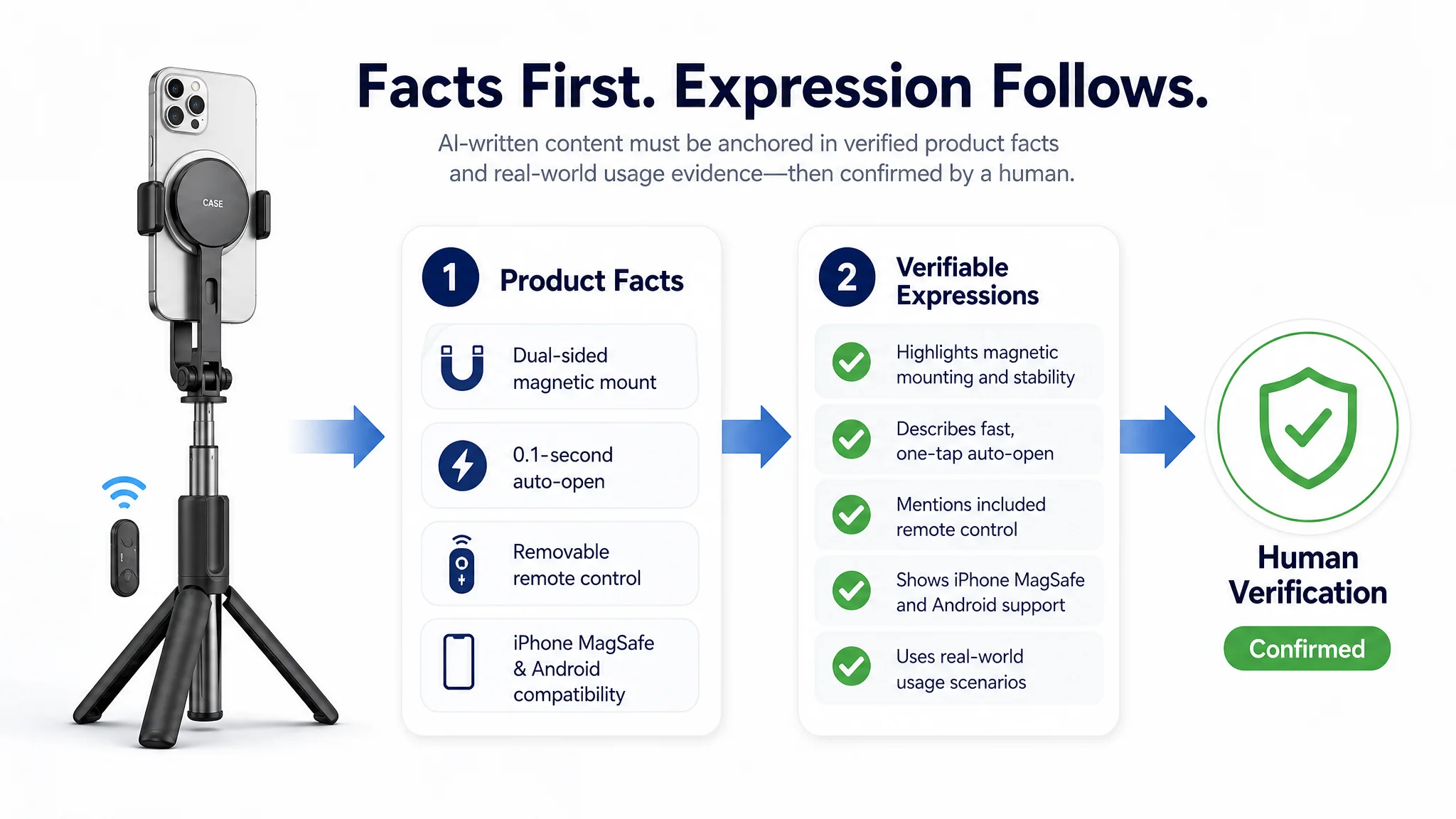
That distinction matters for AI-generated content. A tool should not merely produce persuasive language around a product feature. It should connect the claim to approved product information, identify where the claim will appear, and allow a human to verify that the wording remains accurate and non-misleading.
Verify the latest official Amazon documentation before deploying or expanding any AI workflow, because these policies may change.
A Practical Vendor-Evaluation Framework for Sellers
Generic assurances about “compliant AI” are not enough for customer communications. During vendor demos and procurement reviews, test the platform against the same risk patterns that could expose your Amazon business to consent disputes, payment-data leakage, weak access controls, or incomplete investigations.
Start with live, failure-oriented scenarios:
- Ask, “Show me how your platform handles a customer dispute over consent after recording.” Require the vendor to demonstrate what evidence is captured, who can access it, how consent status is linked to the interaction, and how the record can be retrieved for review.
- Ask, “How does the AI agent redact payment card details mid-call?” Look for a live demonstration of detection, redaction timing, transcript handling, and protection of stored audio or text. Do not accept a policy statement without seeing the workflow.
- Ask the vendor to show audit trails, forensic records, retention settings, deletion execution, and data-residency controls—not merely describe them.
- Test role-based access control by asking which users can view, export, change, or delete communication records.
- Review how the vendor identifies and manages third-party processors, subprocessors, and related risk.
The standard is usable evidence. A certification may support diligence, but it does not prove that the platform can produce complete, attributable records when a dispute occurs. Request verifiable documentation and exported examples showing timestamps, actions, permissions, retention status, and deletion results.
The same failure-oriented approach can prevent sellers from diagnosing the wrong business problem. In the magnetic tripod case, the team’s first operating assumption was that poor ACOS required more ad tuning. A structured comparison challenged that assumption by showing that the page had a 47/100 score against an 84/100 benchmark, with the largest weaknesses in A+ content and review trust. The question was not whether the ads could be adjusted. It was whether the page was ready to receive more traffic.
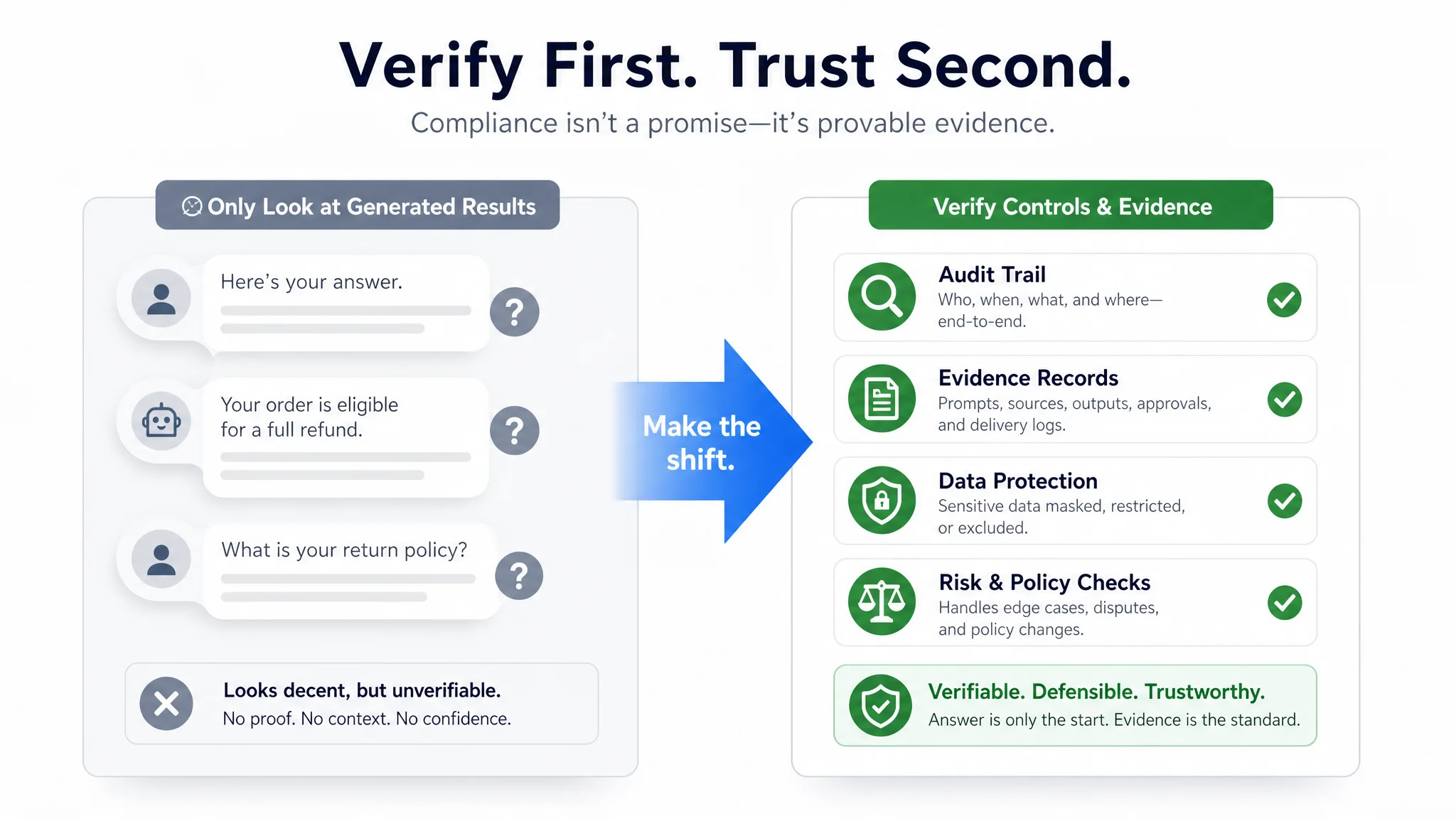
This is a useful model for vendor evaluation: do not ask only whether a system can generate an answer. Ask what happens when the answer is wrong, the source data is incomplete, the user disputes the interaction, or a policy changes. Then require the vendor to demonstrate the control and produce the evidence.
If the vendor cannot reproduce the scenario, explain the control boundary, or provide evidence that procurement and compliance teams can independently review, treat the capability as unverified rather than compliant.
DeepBI: A Compliance-Assist Example for Amazon Sellers
DeepBI is best understood as a limited, Amazon-focused compliance-assist example—not a general compliance platform or a substitute for governance. Its value is turning listing audits into specific review priorities.
Automated analysis can examine Amazon titles, bullet points, images, A+ content, and related listing elements for policy-sensitive language, including exaggerated claims, promotional wording, and unsupported product statements. Rather than returning only a broad score, the workflow can identify which text or visual module is creating the gap and compare observable attributes with relevant benchmark listings. Sellers can then direct human review toward the changes most likely to affect CTR, CVR, trust, or listing cycle time.
The magnetic tripod diagnosis demonstrates this more concrete use of evidence. The seller initially focused on ads because traffic was running but orders and ROAS were lagging. DeepBI’s comparison showed that the title, main image, and bullets were relatively close to the benchmark, while the A+ or detail content scored 0 versus 22 and reviews scored 3 versus 13. The issue was therefore not simply that the page lacked traffic. It lacked enough structured proof and trust to convert the traffic already arriving.
The diagnosis also identified the type of content gap. The benchmark page used modules for magnetic strength, structural stability, tilt and rotation, remote connectivity, and compatibility. The target page lacked comparable decision-support content. The recommended changes did not rely on making unsupported claims; they reorganized confirmed product information into scene-based images, quantified specifications, compatibility guidance, and usage explanations. This is the difference between a score that merely labels a problem and a workflow that creates an auditable review queue.
The same control logic should extend beyond listing audits. Separate ad-copy monitoring can compare advertising language with Amazon’s generative-AI guidelines before campaigns are launched or revised. Organic-content change tracking can record who changed a title, bullet, image, or A+ module and flag edits for review when they may introduce policy-sensitive language. These controls create an evidence trail instead of relying on memory or scattered approvals.
DeepBI’s documented role remains narrower: it supports Amazon listing diagnosis and prioritization. Sellers should not assume it independently monitors advertising copy or organic-content changes. Use its findings alongside human review, documented approval rules, and vendor controls. The practical objective is a ranked compliance queue tied to observable content and Amazon performance signals—not an automated guarantee that every customer-facing change is compliant.
Frequently Asked Questions
What are the most important AI customer communications compliance features to check in 2026?
Start with the article’s eight-feature framework rather than evaluating an AI tool by its writing quality alone. Check permission limits, brand-compliance controls, consent management, audit trails, data residency, human oversight, output validation, and third-party risk controls. Confirm what the system can access, what it can generate, what requires approval, and how each action is documented. A tool that improves response speed but cannot preserve brand rules or limit access creates operational exposure.
Why are audit trails important for AI-generated customer messages?
An audit trail connects the message, the AI action, the data used, the reviewer, and the final approval. Imagine a buyer disputes a chatbot conversation: your team needs a reconstructable record, not an explanation based on memory. Audit trails are therefore one of the eight essential controls, supporting oversight, accountability, brand compliance, and incident review.
The value of reconstruction is not limited to customer messages. In listing operations, a seller may need to determine whether a weak result came from traffic quality, page content, reviews, or a policy-sensitive edit. A structured diagnostic record can prevent the team from repeatedly changing the wrong variable. In both situations, traceability supports better decisions because it connects the observed outcome to the underlying action and evidence.
How does consent management work when a chatbot interacts with a buyer?
Consent management should show when and how the buyer agreed to the interaction, what the chatbot was permitted to do, and how consent status is recorded or withdrawn. Evaluate this alongside permission limits, audit trails, and human oversight in the eight-feature framework. Do not assume that labeling a tool as “AI” proves consent was handled correctly.
What does data residency mean for my AI-powered customer service?
Data residency describes where customer information and message-processing data are stored or handled. Review it as a distinct feature alongside PII controls, permissions, retention settings, and vendor risk. Ask whether the tool clearly documents applicable storage and processing locations before connecting buyer communications.
How can sellers assess third-party risk in AI communication tools?
Assess the provider’s access scope, subprocessors, security documentation, audit support, data handling, and contractual responsibilities. Then map those findings to all eight features, especially permissions, audit trails, data residency, consent, and brand compliance. Treat missing documentation as an evaluation gap requiring resolution before deployment.
Conclusion - Audit Your AI Communications Today
Customer-facing AI should be treated as a controlled business process, not an unchecked shortcut. Compliance is a legal and operational necessity, not an optional enhancement, so sellers should begin with a documented, measurable review.
- Inventory every AI-assisted customer communication across messaging, support workflows, and related seller operations; record the system used, message type, approval owner, and applicable policy or legal requirement.
- Measure control effectiveness by tracking human-review rates, exception rates, prohibited-content incidents, escalation times, correction times, and the audit trail for each approved or rejected communication.
- Keep a human in the loop for sensitive, ambiguous, high-risk, or policy-relevant interactions; AI may execute an approved workflow, but it should not override human decision-making.
- Use tools such as DeepBI carefully within a broader compliance stack. Its documented review checkpoints, report identifiers, activity logs, evaluation steps, and human-confirmation gates can support controlled listing-content deployment, but they do not eliminate human oversight or establish customer-communication compliance by themselves.
- Verify current official Amazon documentation and applicable legal requirements before approving communication workflows, then assign an owner and review date for each control.
- Re-audit whenever AI usage, permissions, workflows, or policies change, preserving evidence of decisions, exceptions, and corrective actions so compliance remains demonstrable rather than assumed.
The magnetic tripod diagnosis offers a broader operational reminder: when performance looks weak, do not automatically optimize the most visible variable. The seller first treated advertising as the constraint, but the evidence pointed to page conversion capacity, missing decision-support content, and limited trust signals. In AI compliance, the equivalent mistake is assuming that a vendor’s general assurance proves the workflow is controlled.
Starting now gives sellers a practical baseline for managing risk while protecting account health, operational consistency, and customer trust.