What product descriptions actually have to do in 2026
An Amazon product description is no longer written for a single reader or ranking system. It must help human shoppers understand the product, provide useful context for AI-assisted shopping, and give autonomous purchasing agents accurate information to evaluate against a buyer’s requirements. At the same time, every claim must comply with Amazon’s content rules and reflect the product’s actual attributes.
The scale of AI-mediated shopping makes this shift commercially important. According to Amazon’s Q4 2025 earnings, Rufus had reached more than 300 million customers. Adobe Analytics also reported a 693.4% year-over-year increase in AI-driven traffic. Together, these figures point to a shopping environment in which product information is increasingly summarized, compared, and interpreted before shoppers make a purchase decision.
Rufus goes beyond simple keyword matching. It evaluates which descriptions, FAQs, and review themes best address a shopper’s actual question. A listing that contains relevant vocabulary but omits compatibility, dimensions, use conditions, or meaningful limitations may therefore fail in both discoverability and decision support. For sellers, the commercial effects can appear in familiar Amazon KPIs: weaker CTR when the value proposition is unclear, lower CVR when shoppers cannot confirm fit, and potential pressure on ACoS or BSR when traffic fails to convert.
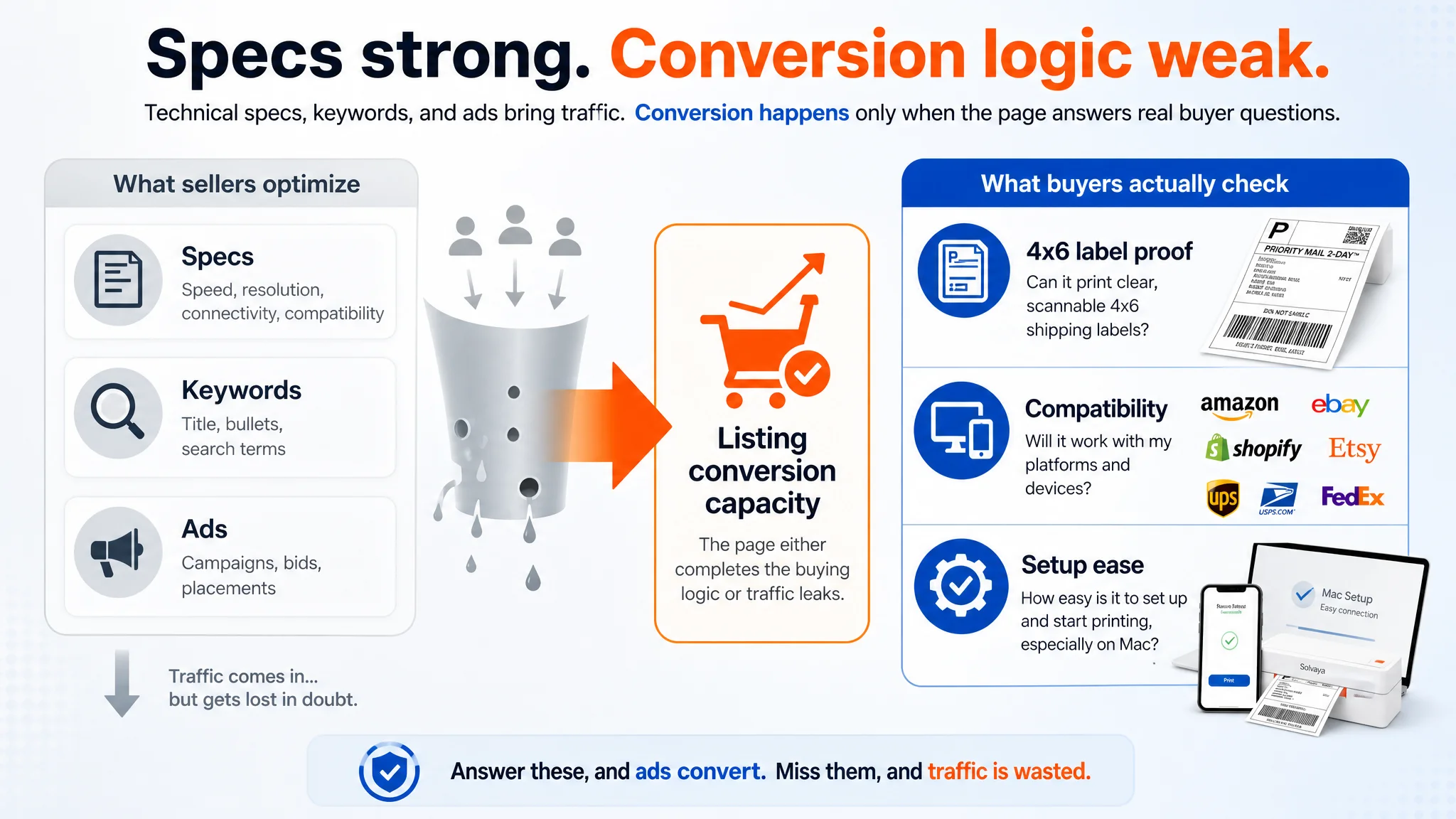
A thermal shipping-label printer listing illustrates why this distinction matters. The seller’s title and bullet points were not obviously weak. Its overall Listing score was 74/100, the title scored higher than a benchmark competitor, the bullets were slightly stronger, and the product had a 4.5-star rating. The team therefore assumed that the main weakness was traffic: more ad tuning, better bids, and more time to accumulate reviews would eventually solve the conversion problem.
DeepBI’s diagnosis found a different constraint. The listing was losing not because it lacked basic product information, but because its images and A+ content did not answer the buyer’s central questions: Would it print clear 4x6 shipping labels? Would it work with the buyer’s platforms and devices? Would setup, particularly on Mac, be manageable? The page looked informative, but it did not complete the buying logic.
This distinction is important for AI-mediated shopping as well as human conversion. A title can include “Bluetooth,” “USB,” “203 dpi,” and “Windows & Mac” while still leaving the practical relationships among those attributes unclear. A shopper, Rufus, or an autonomous agent may still need to know which connection method applies to which operating system, what the printer actually produces, and whether the stated performance addresses a real use case.
Accuracy is not merely an editorial concern. Incomplete or misleading content can misdirect shoppers, confuse AI systems, increase product mismatches, and create negative reviews, refunds, and after-sales risk. It can also expose sellers to compliance and enforcement issues when a listing fabricates parameters, implies an unsupported function, or presents inconsistent product information.
The practical standard is semantic clarity supported by evidence. Titles, bullet points, FAQs, images, A+ content, and customer feedback should reinforce the same product entity and communicate the same functional reality. Every selling point should connect a genuine product attribute to a shopper concern without adding a specification, material, interface, or performance claim the product does not possess.
That standard serves all three audiences simultaneously. Human shoppers receive clearer answers, AI-assisted shoppers receive better context, and purchasing agents receive information they can assess with less ambiguity. The objective is not to accumulate keywords or produce more copy. It is to create a truthful, structured product record that supports shopper understanding, compliant AI interpretation, and stronger listing performance without crossing factual or policy boundaries.
The three audiences reading your descriptions
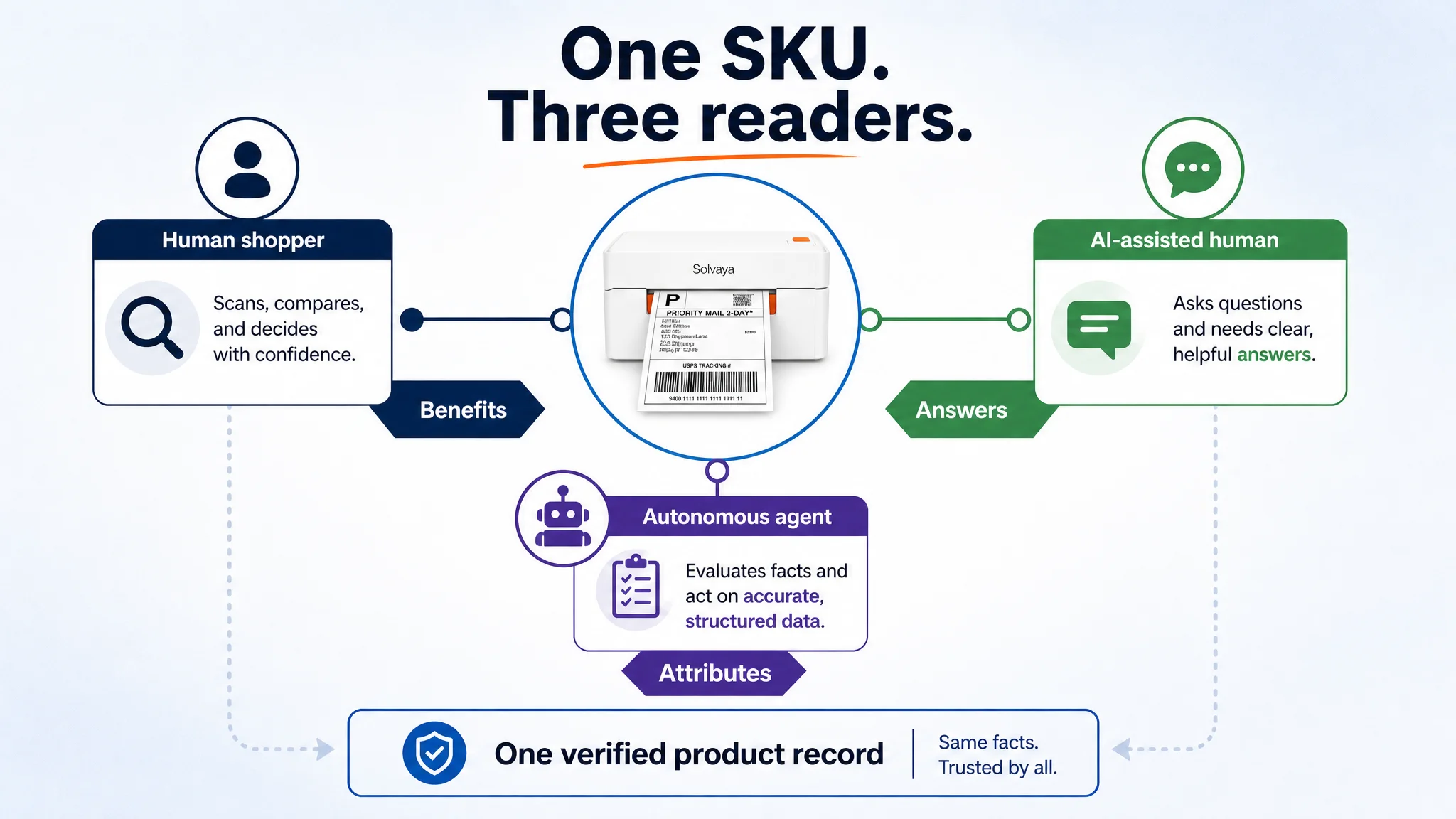
One Amazon listing now has to perform three jobs at once. It must persuade a person, answer questions for an AI-assisted shopper, and provide complete, consistent facts for an autonomous purchasing workflow. These audiences all depend on accurate product information, but they do not read the page in the same way.
Human shopper
A human shopper usually moves from a concern to a possible solution. They may first encounter the product through search results, an advertisement, or a category page, then scan the title, main image, bullets, and product details before deciding whether to continue. Their decision depends on more than keywords. They need to understand the product’s benefits, see how it addresses a relevant pain point, and find enough supporting information to trust the claim.
For people, the listing must make the value proposition easy to understand without exaggeration. Clear, benefit-led language can support CTR by giving shoppers a reason to open the detail page, while organized feature and product information can support CVR by reducing uncertainty. Trust also depends on consistency: the title, bullets, images, and specifications should describe the same product and avoid unsupported claims.
The label-printer case shows how quickly this process can break down. The seller’s page included a printer, phone, manual, USB drive, adapter, and a sample label. Yet the main image did not clearly show a crisp, scannable 4x6 shipping label with a barcode and address. It communicated seller language—“wireless,” “USB,” and “Bluetooth”—more clearly than the buyer outcome: “This will print the shipping labels I actually need.”
A human-facing version would therefore connect the product category to a shopper concern, explain the relevant benefit in plain language, and then provide only the confirmed product information that supports that explanation. The goal is not to make the description sound stronger than the evidence. It is to help the shopper reach a confident, policy-compliant decision.
AI-assisted human
An AI-assisted human begins with a question, comparison, or specific requirement rather than reading every listing element in sequence. Shopping experiences associated with Rufus and Sparky are relevant because shoppers may request product information conversationally and rely on these systems to surface relevant answers, attributes, and selling points from listing content.
The listing therefore needs more than persuasive phrasing. Its title, bullets, functional descriptions, parameters, and other structured elements should state product facts clearly enough to be parsed and matched to a shopper’s question. For a shipping-label printer, that may include the supported label width, whether it handles 4x6 labels, which platforms are supported, which operating systems use Bluetooth or USB, and how the app workflow operates.
The seller’s original content mentioned compatibility, but the page did not make the system and connection relationships sufficiently clear. The diagnosis recommended explicitly naming platforms such as Amazon, eBay, Shopify, Etsy, UPS, USPS, and FedEx, while distinguishing the Bluetooth path for iOS and Android from the USB path for Windows and Mac. This is not simply a copywriting improvement. It is a way to make the product’s functional logic easier for both shoppers and AI systems to retrieve.
Autonomous agent
An autonomous purchasing agent has a narrower tolerance for ambiguity. In a workflow such as Buy for Me, the critical input is complete, consistent structured information. The agent depends on confirmed attributes and stable data fields rather than persuasive interpretation alone.
BrandName Daytime Pain Relief Caplets — structured attributes only
This version should contain only verified product parameters in the required fields. It should not rely on implied benefits, missing values, or inconsistent wording across the title, bullets, images, and product data. Fixed structures and consistent attributes create a dependable machine-readable contract.
The same principle applies to a label printer. “Works with multiple platforms” is less useful than clearly documented platform, operating-system, connection, label-size, and format attributes. If the listing does not distinguish supported and unsupported paths, the shopper may make the wrong selection and the agent may not be able to evaluate the SKU reliably.
The three audiences therefore require one coordinated content system: benefit clarity for people, answer-ready relevance for AI-assisted shoppers, and complete structured facts for autonomous workflows. A listing that serves only one audience can lose clarity, discoverability, or eligibility with the others.
Same SKU, three descriptions - what each audience actually needs
The same SKU can require three presentation layers without becoming three different products. Human shoppers respond to readable benefits and search terms. AI-assisted shoppers need explicit answers that connect attributes, use context, and likely questions. Autonomous purchasing agents need dependable fields they can compare and evaluate without persuasive language. The presentation changes; the verified product facts do not.
A single-audience approach leaves gaps. A keyword-heavy title may support CTR but fail to answer an AI-assisted shopper’s specific question. A benefit-led listing may support CVR while omitting a structured attribute required for an agent’s decision. The control point is one verified product record, such as Product_DNA.json, used as the source of truth for every output.
For human shoppers - keyword-rich, benefit-led
Human-facing copy should make the product identifiable quickly and organize information around shopper priorities. The title can lead with the brand, product name, confirmed form, and verified differentiators. Bullets can then explain the confirmed use, package contents, and relevant restrictions in plain language.
For BrandName Daytime Pain Relief, the writing sequence might be:
- Identify the brand and exact product name.
- State the verified product form and confirmed strength or count, if present in the source record.
- Explain only supported benefits or use information.
- Add confirmed package, storage, eligibility, or usage details where required.
- Avoid medical outcomes, safety assurances, or performance claims that the product record cannot substantiate.
The same logic applies to technical products. In the label-printer case, the original title and bullets already contained strong specifications, including printing speed, resolution, ink-free operation, and system compatibility. DeepBI did not recommend replacing the textual foundation. It recommended translating those specifications into buyer-relevant meaning: explain how speed affects label throughput, how resolution supports barcode readability, which platforms are supported, and which connection path applies to each system.
Human optimization should improve discoverability and comprehension without changing the product entity. This protects listing compliance while supporting CTR and CVR.
BrandName Daytime Pain Relief - 200mg Ibuprofen Caplets, Non-Drowsy Formula, 100 Count
This title illustrates how a human-facing title may combine brand, product, strength, form, formula description, and count. However, each listed attribute should be treated as approved copy only when it is confirmed in the authoritative product record. If a value is missing or uncertain, remove it or replace it with the verified value rather than guessing.
The same rule applies to bullets, images, backend terms, and regulatory fields. Text and visual content should be cross-checked so shoppers do not receive conflicting information. A polished title cannot compensate for inconsistencies elsewhere in the listing.
For AI-assisted humans - Rufus and Sparky
AI-assisted shoppers need more than isolated keywords. They need explicit relationships among the product, its attributes, its intended context, and the questions a shopper may ask. The listing should therefore state confirmed facts directly and consistently across the title, bullets, descriptions, images, and structured data.
For example, the content should make it easy to identify what the product is, which verified attributes distinguish it, what the package includes, and which use constraints or eligibility conditions apply. It should not rely on implied meaning or promotional wording. If an attribute is unconfirmed, the content should not manufacture an answer.
The printer example demonstrates why relationship-based content matters. “Bluetooth and USB” is a list of features. “Print from iOS and Android through the app via Bluetooth; print from Windows and Mac through USB” is a usable answer. “Supports 1-inch to 4.1-inch labels, including 4x6 shipping labels” connects a specification to a practical use case. These explicit relationships are more useful to a shopper asking a question and to a system trying to retrieve the answer.
Optimizing only for human scanning can leave these relationships unclear. Building solely for machine interpretation can produce unnatural copy and weaken shopper comprehension. The practical solution is layered content generated from the same validated data, followed by a final consistency review before publication.
For autonomous agents - Buy for Me and beyond
Autonomous purchasing agents require a narrower output: structured, comparable, verified attributes. Persuasive language, emotional framing, and unsupported benefit claims add noise rather than decision value. Completeness matters because an absent field can prevent comparison, while an inconsistent field can lead to the wrong selection.
BrandName Daytime Pain Relief Caplets - structured attributes only
A structured version should contain only confirmed catalog data, such as:
- Brand: BrandName
- Product name: BrandName Daytime Pain Relief
- Product form: verified source value
- Active ingredient or strength: verified source value, if documented
- Count or package quantity: verified source value
- Formula or feature attributes: verified source values only
- Use, eligibility, or restriction fields: verified source values only
Before publication, every required field should be complete, aligned across systems, and traceable to the source record. This approach preserves product consistency, supports agent-readable selection, and prevents fabricated parameters from undermining compliance, CVR, or listing reliability.
The punchline
Optimizing for one audience and assuming the others will follow is one of the most common—and potentially costliest—mistakes content teams make. A listing written only for human shoppers may sound persuasive while omitting the precise facts an AI assistant needs to answer a product question. A page structured mainly around searchable attributes may improve machine readability while weakening the emotional clarity that supports CTR and CVR. Focusing on a single audience can therefore create gaps in discoverability, comprehension, conversion, and downstream advertising efficiency.
The thermal printer listing exposed this problem in a practical way. Its title and bullets appeared stronger than the benchmark on several measures, and its rating was slightly higher. Yet its overall score remained below the benchmark because the main image set and A+ content did not provide the visual and instructional evidence needed at the point of decision. The issue was not that the page contained no information. It contained the wrong decision logic.
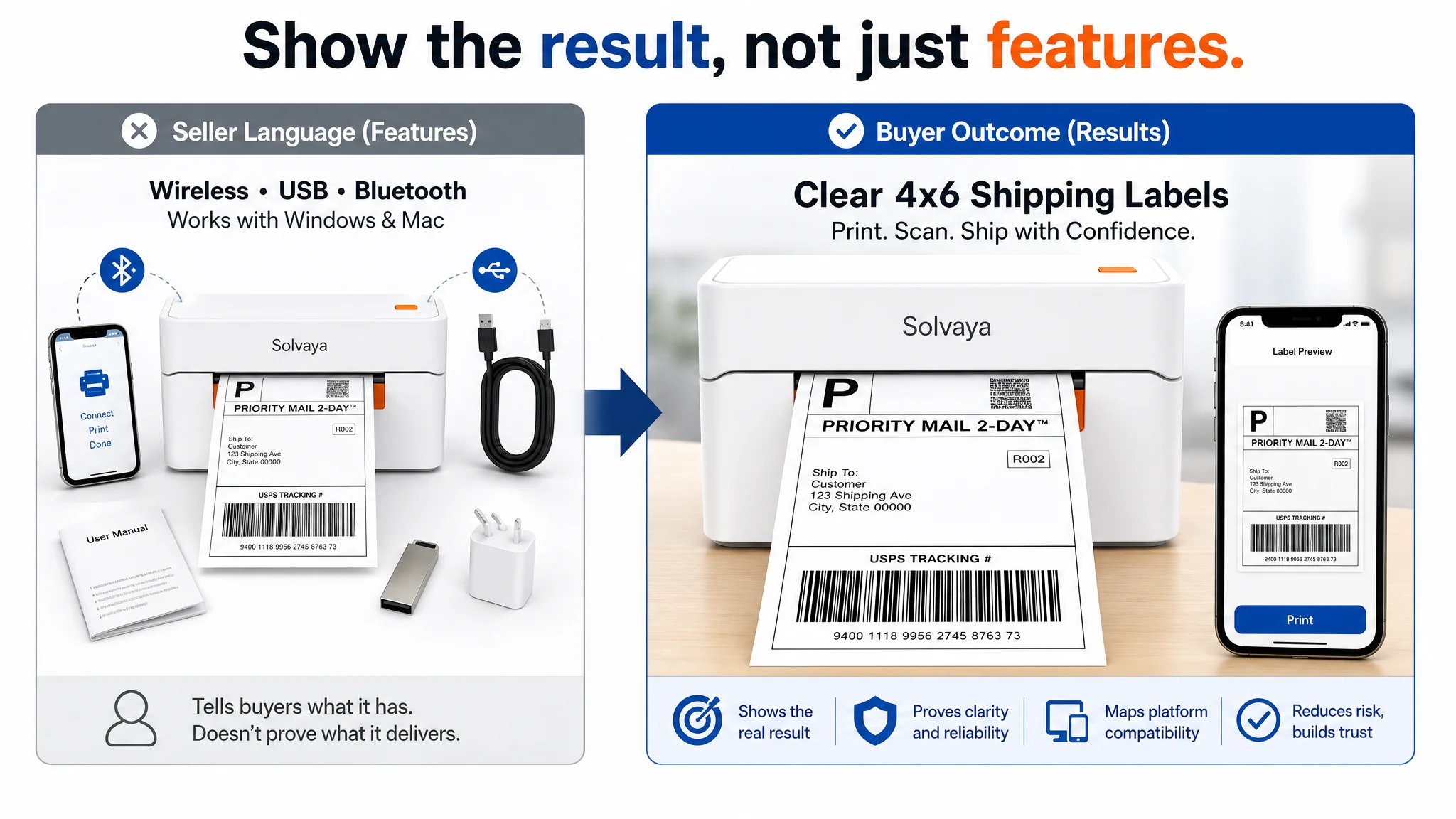
The seller initially treated the problem as an advertising issue. The team focused on campaign structure, bids, placements, keyword coverage, and negative keywords because impressions were arriving but orders were lagging and ACoS was difficult to control. DeepBI’s diagnosis reframed the situation: ads were not failing to bring traffic; the page was consuming the traffic because it did not clearly prove compatibility, print quality, ease of setup, and workflow fit.
Rufus illustrates why this audience shift deserves commercial attention. According to the cited evidence, Rufus contributed nearly $12 billion in incremental sales. That figure does not guarantee a result for every seller, but it demonstrates the scale of shopping activity influenced by AI-assisted product discovery and recommendation. Autonomous purchasing agents are also emerging. Their growing relevance gives sellers another reason to treat complete, reliable, machine-readable product information as a revenue opportunity rather than a formatting exercise.
The safer strategy is not to maintain separate descriptions for separate audiences. It is to build one integrated product description that performs three jobs together:
- Persuades human shoppers with clear benefits, relevant use cases, and credible proof.
- Provides answer-ready information covering specifications, functional benefits, usage scenarios, trust signals, and comparisons.
- Completes the structured attributes and factual product details that systems and agents need to interpret the offer accurately.
This integrated approach also reduces operational risk. When titles, bullets, attributes, images, and supporting data are created in disconnected stages, inconsistencies can weaken CVR, reduce trust, complicate Amazon algorithm compatibility, and lengthen listing cycle time. A connected workflow can diagnose weaknesses, translate strategy into concrete production instructions, validate text against visual and product evidence, and deploy approved improvements through Amazon’s SP-API.
The objective is not to write three versions of a listing. It is to create one coherent, evidence-based product representation that serves shoppers, Rufus, and emerging autonomous agents without sacrificing compliance or clarity. That unified foundation gives teams a stronger basis for improving CTR, CVR, ACoS, BSR, and listing cycle time together.
What each audience evaluates when reading your description
A compliant description must do more than include relevant search terms. Audit it for clarity, factual depth, answer coverage, and consistency across every product detail, image, and structured attribute.
Human shopper evaluation criteria
- Title clarity: Confirm that the title identifies the product type, brand, primary use, and material or format when those details are relevant and verified.
- Immediate comprehension: Check whether a shopper can understand what the product is and who it is for without decoding compressed keyword strings.
- Benefit specificity: Connect each major benefit to a named product feature and a real customer need. A measurable attribute should explain its practical significance rather than appear as an isolated number.
- Readable prioritization: Place the most important customer concerns first, then explain how the product addresses them in clear, scannable language.
- Factual support: Verify every size, count, capacity, ingredient, compatibility statement, and performance description against the product information.
- Visual consistency: Ensure that the title, bullets, description, images, and A+ content describe the same product entity, including its structure, materials, color, and configuration.
For a label printer, visual consistency also means showing the actual job the product performs. A hero image filled with accessories may be factually accurate but still fail to communicate the primary outcome. A clear 4x6 shipping label with readable barcodes and address details can provide stronger decision support than several generic feature callouts.
AI-assisted human evaluation criteria
- Question-and-answer coverage: Review whether the description answers likely questions about use, fit, compatibility, contents, care, limitations, and intended customer persona.
- Persona signals: State the appropriate user, use context, or shopping need when supported, such as daytime use, travel, gifting, or a specific application. Avoid implying suitability for groups or conditions that the product information does not support.
- Contradiction-free claims: Compare the title, bullets, description, images, and attributes for conflicting statements about size, formula, function, quantity, or usage.
- Semantic completeness: Explain relationships between features and benefits so an AI assistant can distinguish the product’s functional role, not merely detect repeated terms.
- Accurate language: Use precise claims and qualify limitations where necessary. Rufus evaluation is semantic evaluation that rewards depth and factual accuracy, not just keyword density.
- Answer retrieval readiness: Organize information with direct, natural wording so an assistant can identify the relevant answer without relying on ambiguous marketing language.
The printer case suggests adding a practical test: can the page answer the buyer’s main compatibility question without requiring interpretation? If the listing says that the product is wireless but does not explain whether Mac uses Bluetooth or USB, the information is technically present but operationally incomplete. If it lists supported platforms without showing how the buyer connects and prints, the page may still leave the core question unresolved.
Autonomous agent evaluation criteria
- Attribute completeness: Fill every applicable and verified attribute, including size, quantity, variant, compatibility, material, format, ingredients, and key technical specifications.
- Structured consistency: Confirm that structured fields match the title, bullets, description, images, and any supporting product data.
- No conflicting specifications: Remove discrepancies such as one pack count in the title and another in the description, or different dimensions across product modules.
- Decision-relevant precision: Present information an agent would need to compare, filter, or select the item, while avoiding unsupported assumptions or estimated values.
- Variant accuracy: Make sure the selected color, size, flavor, count, or configuration corresponds to the actual purchasable variation.
- Compliance traceability: Before publishing, verify each factual claim against an approved source and leave uncertain parameters blank rather than inventing a number.
What an integrated description looks like - concrete examples
A compliant listing does not need separate versions for human shoppers, AI assistants, and autonomous purchasing agents. It needs one consistent product record expressed in clear language. Benefit-led copy helps people understand relevance, answers to common questions reduce uncertainty, and structured specifications give retrieval systems dependable fields. The same verified facts can support CTR and CVR without creating unsupported product claims.
Example 1 - Consumer healthcare: non-drowsy ibuprofen
BrandName Daytime Pain Relief - 200mg Ibuprofen Caplets, Non-Drowsy Formula, 100 Count
The title identifies the product form, active ingredient, strength, stated formula attribute, and quantity. A shopper can scan it quickly, while an AI assistant or purchasing agent can map each element to a specific product field. The title, bullets, detail content, and label data must remain aligned; no additional effect or use should be inferred from the wording.
What it does
BrandName Daytime Pain Relief contains 200mg of ibuprofen per caplet and is labeled for daytime pain relief. Its non-drowsy formula attribute is stated as a product characteristic, not as a promise of improved alertness or suitability for every person. The description should explain the approved indication using the exact verified label language and avoid expanding it into diagnosis, prevention, or unrelated therapeutic claims.
How BrandName Daytime is different
The meaningful distinction is precise identification, not exaggerated superiority. “Daytime” and “non-drowsy formula” describe the listed product positioning; they do not justify claims that it works faster, lasts longer, or is safer than another medicine unless those claims are substantiated and permitted. Clear boundaries protect customer trust and help prevent an AI-generated answer from turning a narrow product attribute into a broader medical promise.
Common questions
- What is the active ingredient? Ibuprofen, 200mg per caplet.
- What form is the product? Caplets.
- How many are included? 100 count.
- Does the listing claim a treatment beyond the approved indication? No. The copy should stay within verified label language and include only supported limitations and usage information.
These direct answers help shoppers decide while giving automated systems discrete, auditable facts to retrieve.
Specifications
- Product: BrandName Daytime Pain Relief
- Active ingredient: Ibuprofen
- Strength: 200mg per caplet
- Form: Caplets
- Formula attribute: Non-drowsy
- Quantity: 100 count
- Compliance requirement: Cross-check every specification against the approved product data and label.
Example 2 - CPG snacking: plant-based protein bar
BrandName Plant-Based Protein Bar - 15g Protein, 5g Sugar, Nut-Free, Lunchbox-Friendly - Chocolate, 12 Pack
Here, the title supplies the category, protein amount, sugar amount, stated allergen-related attribute, use context, flavor, and pack quantity. It gives shoppers an immediate reason to continue reading and provides structured values for an AI assistant or autonomous agent matching dietary or purchasing criteria.
What it delivers
BrandName offers 15g of protein and 5g of sugar per bar, in a chocolate flavor and a 12-pack format. “Plant-based,” “nut-free,” and “lunchbox-friendly” should remain tied to verified product data. The description should not add claims about energy, digestion, weight management, allergen safety beyond the confirmed attribute, or nutritional superiority.
A concise answer set can state: What is the flavor? Chocolate. How many bars are included? 12. How much protein and sugar are listed? 15g of protein and 5g of sugar per bar. These answers support both human comparison and machine retrieval.
How this differs from BrandName's other bars
The listing should distinguish this bar only through confirmed attributes: its plant-based positioning, 15g protein, 5g sugar, nut-free status, chocolate flavor, and 12-pack quantity. It should not introduce comparative performance figures or imply that other BrandName bars lack a benefit unless the comparison is documented. Exact, structured distinctions are more useful than broad claims and keep the listing consistent across every shopping interface.
Why this can't be a one-time copywriting exercise
An Amazon listing is not a finished manuscript that can be uploaded once and left untouched. It is a live commercial asset operating within changing platform rules, shifting shopper expectations, evolving AI interpretation, and active competitive pressure. A description that is accurate and compliant at launch can become less effective—or create new risk—when any of these conditions change.
Amazon’s mandatory standards and quality expectations continue to shape what can be published and how product information should be presented. Some requirements are technical, such as image specifications, title limits, or required attributes. Others concern the clarity, substantiation, and policy sensitivity of shopper-facing language. If content falls outside a mandatory standard, it may be blocked; if it remains technically valid but becomes unclear or incomplete, it may still weaken shopper confidence and reduce CVR.
Competitive content changes the baseline as well. Rival sellers continually revise titles, bullets, descriptions, attributes, and comparison points. A listing that once stood out may become less persuasive when competitors explain use cases more clearly, answer common questions, or provide more complete product details.
The label-printer comparison makes this competitive pressure visible. The seller’s title and bullets performed well against the benchmark, but the benchmark scored higher overall because its main image and A+ content better demonstrated the product’s use case and reduced perceived risk. The stronger page showed the printed result, clarified platform compatibility, mapped connection methods by operating system, and addressed setup friction. This meant that competitive analysis had to examine decision logic, not merely count keywords or compare title quality.
The resulting pressure may appear in weaker CTR, lower CVR, declining BSR, or a longer listing cycle time when teams must make urgent corrections across many SKUs. It can also appear as difficult-to-control ACoS. But ACoS alone does not identify the leak. In the printer case, the team initially treated ad performance as the primary problem. The diagnosis showed that additional traffic would simply expose more shoppers to unresolved questions.
For that reason, compliance and content quality require a recurring review process rather than a one-time copywriting exercise. Teams should regularly inspect:
- Product attributes for missing, inconsistent, or outdated information
- Claims for accuracy, support, and policy-sensitive wording
- Customer questions and feedback for information gaps
- Titles, bullets, and detail-page language for clarity across human and AI-mediated shopping
- Competitor listings for newly established content expectations
- Main images and A+ modules for evidence of the primary use case, compatibility, setup, and risk reduction
The review should also follow a feedback loop: identify a gap, revise the relevant content, monitor the listing and market context, and then reassess whether the change remains appropriate. For large catalogs, manual review alone can be slow and error-prone. DeepBI’s Amazon Listing monitoring can help flag attribute gaps and policy-sensitive language automatically, giving content teams a practical starting point for review and prioritization. It should support the workflow, not replace human judgment or serve as a guarantee of compliance.
A durable Amazon content program therefore treats every listing as a maintained business system. Ongoing monitoring protects accuracy, keeps content aligned with platform expectations, and helps preserve the conditions that support CTR, CVR, and stable marketplace performance.
Where this leaves enterprise content teams
AI-assisted listing work needs an operating system, not a one-time prompt. Enterprise teams should define who reviews each asset, which product facts are authoritative, how approved changes are recorded, and when the listing is audited again. This protects shopper trust while reducing the risk that inaccurate content harms CVR, BSR, or listing cycle time.
Practical compliance checklist for AI-generated listings
Use the following as an internal control point before any AI-assisted listing content is submitted:
- Copy: Verify that every claim is substantiated by approved product information, remove exaggerations, and exclude unsupported benefits or outcomes.
- Attributes: Populate the correct Amazon attributes using verified details for dimensions, materials, functions, accessories, and other product characteristics.
- Questions and FAQs: Confirm that Q&A and FAQ content reflects real customer questions and does not introduce assumptions about product use or performance.
- Forbidden language: Remove policy-sensitive wording, including promises such as “guaranteed results,” unless the language is explicitly permitted and properly supported.
- Images: Check every image against Amazon’s image guidelines, including applicable format, dimensions, color, and background requirements; reject false infographics or invented product details.
- Human review: Require a qualified human to review all generative AI output, including titles, bullets, descriptions, A+ content, answers, and images, before submission.
- Decision-path review: Confirm that the image sequence and A+ modules answer the buyer’s primary use-case, compatibility, performance, and setup questions.
- Version control: Record the approved listing version, the proposed changes, the reviewer, the approval decision, and the date of application so the team can trace what changed.
- Recurring audit: Recheck claims, attributes, copy, images, customer-facing questions, and policy-sensitive language on a defined schedule and after meaningful marketplace feedback.
- Policy reference: Refer to Amazon Seller Central’s AI-generated content policy for full requirements.
See what always-on description optimization looks like (with a light DeepBI bridge)
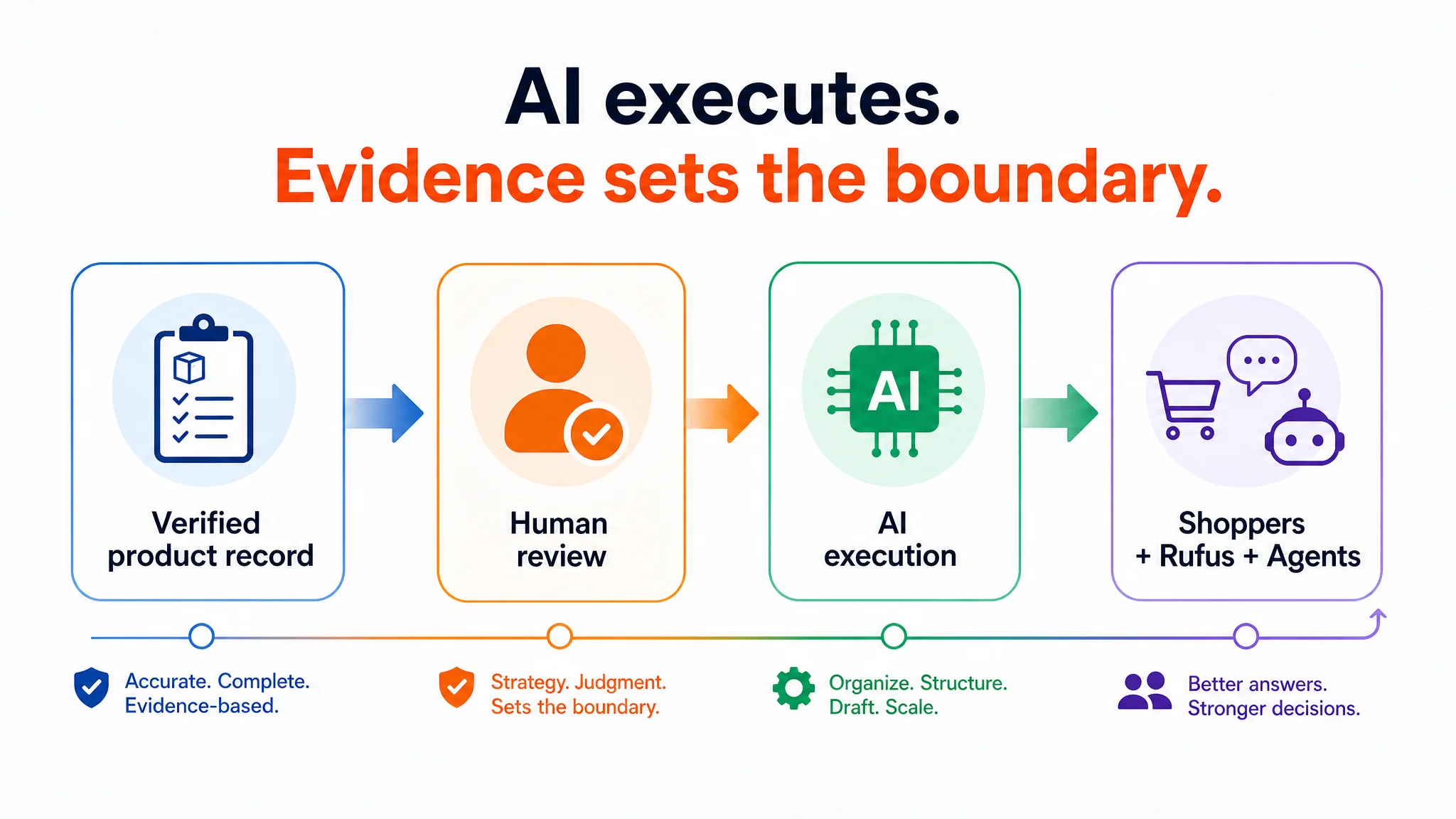
Always-on optimization is a controlled cycle: diagnose the existing listing, convert findings into structured instructions, generate or revise content, evaluate it against product facts and platform requirements, and apply only the approved version. The objective is not to let AI decide what the product should claim. Human strategy and verified source data must set the direction; AI can then serve as an execution layer.
A DeepBI-style workflow illustrates this control model. The team can compare the original asset with the proposed replacement, review factual and policy fit, and approve or reject individual changes before application. For visual content, a Product DNA constraint helps protect product-entity consistency, reducing the risk that a creative system alters physical structure or invents details. The same principle applies to copy: the approved product record remains the boundary.
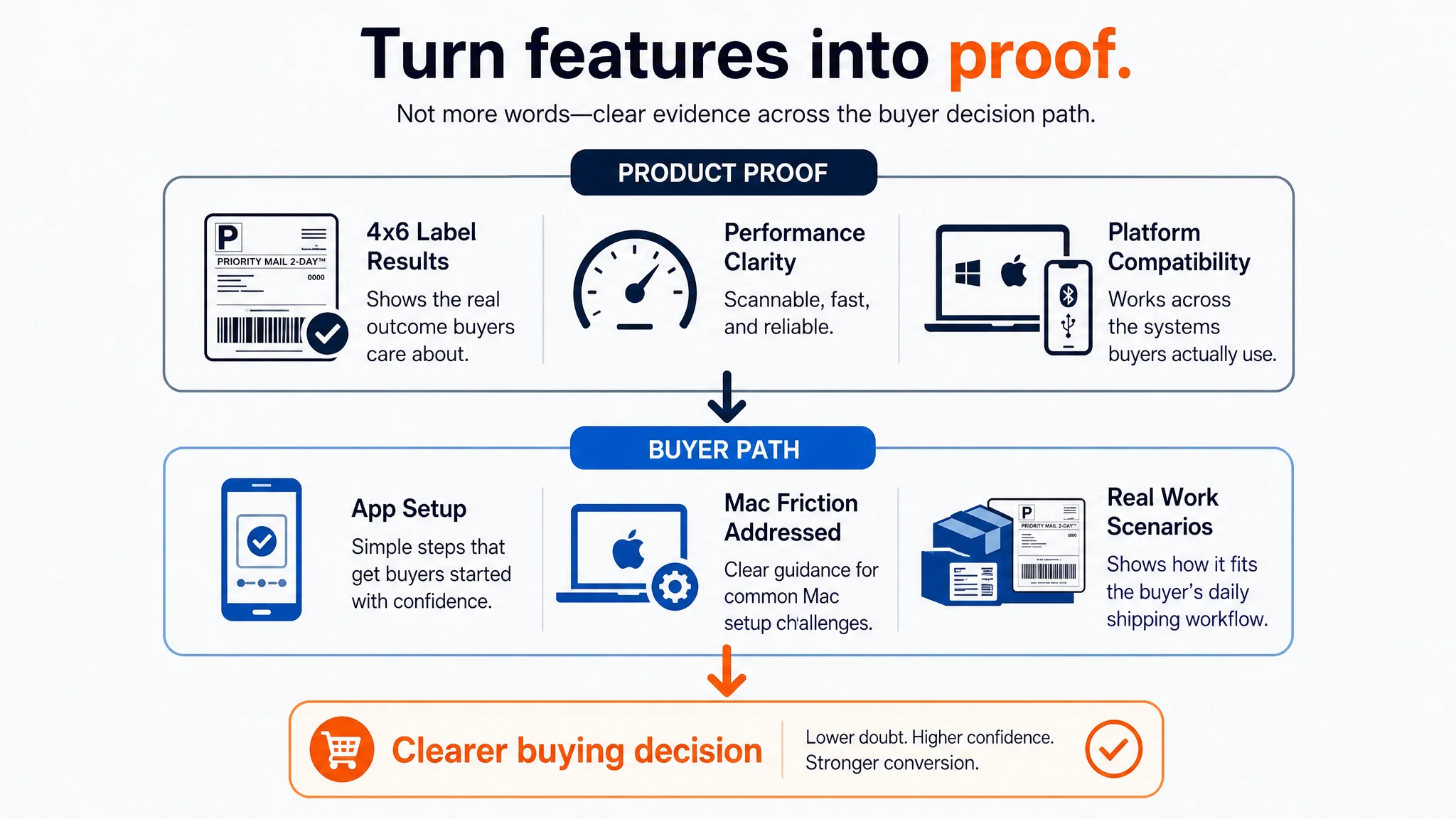
The label-printer diagnosis also shows why the workflow must evaluate conversion logic rather than only textual completeness. The recommended changes did not simply add more words. They reorganized the page around a decision sequence:
1. Show a clearly printed 4x6 shipping label.
2. Demonstrate performance through speed, resolution, barcode clarity, and small-text legibility.
3. Explain label sizes and broader use cases.
4. Map platforms, operating systems, and connection methods.
5. Guide the buyer through app setup.
6. Address Mac-specific friction transparently.
7. Reinforce the product’s role in a real ecommerce or small-business workflow.
This sequence turns a collection of features into an evidence-based buying path. It also reduces the risk that advertising amplifies a page’s existing weaknesses.
After publishing, record the change event and monitor relevant listing signals and feedback. A revision that appears stronger for CTR or CVR still requires documented validation rather than automatic, permanent approval. Maintain the final version and review history, then use future audits to determine whether another controlled revision is justified.
Frequently asked questions
How do I write product descriptions for AI shopping assistants like Rufus?
Write descriptions that answer real shopper questions with clear, verifiable information. Cover the product’s intended use, important benefits, dimensions, materials, compatibility, quantity, included components, and relevant limitations wherever those facts are confirmed. Use natural language, but do not assume a particular matching or evaluation method.
Review every statement against the product’s source information. AI assistance does not justify invented specifications, unsupported claims, or descriptions that conflict with the images, attributes, title, or bullets. Verify Amazon’s current content requirements in Seller Central as of the writing date.
A useful test is whether the listing explains practical relationships, not just isolated features. For example, a technical product should make clear which devices use which connection method, what formats it supports, and what the buyer can expect during setup. The label-printer page initially included compatibility language but did not make these relationships sufficiently clear. The revised approach treated compatibility and setup as answerable buyer questions rather than as keywords to include.
What's the difference between writing for human shoppers and writing for AI assistants?
Human-oriented writing usually leads with a problem, benefit, or use case. It helps shoppers understand why the product may fit their needs and supports purchase confidence, which can influence CTR and CVR.
AI-oriented answerability requires the same benefits to be supported by explicit, structured facts. An assistant may need a clear answer about size, material, compatibility, flavor, pack count, or intended use. The practical solution is not two contradictory descriptions. It is content that combines readable benefit communication with complete, consistent attributes.
What are autonomous agents, and how do I write product descriptions for them?
Autonomous agents are software systems that may help evaluate products or complete purchasing tasks based on a shopper’s requirements. Their exact requirements and decision processes should not be assumed; consult current Amazon guidance before making operational changes.
To make a listing easier to evaluate, provide complete and accurate attributes in the relevant listing fields, then explain the product’s benefits without obscuring those facts. Keep the product identity consistent across the title, bullets, description, images, and structured attributes. Missing or conflicting information can make it harder to determine whether the SKU meets a stated requirement.
Does writing for AI assistants compromise brand voice?
No. Brand voice can coexist with AI optimization when it is applied around a factual information structure rather than used in place of one. Retain approved terminology, tone, and benefit framing while making essential attributes direct and unambiguous.
Brand expression should never alter the product’s inherent characteristics or introduce claims the evidence cannot support. A clear, consistent voice can improve readability for people, while structured, accurate information supports machine-assisted interpretation. Human review remains necessary to confirm that the final copy reflects both brand standards and Amazon requirements.
How long should a product description be in 2026?
There is no universally supported “ideal” length that should govern every listing. Write enough to answer relevant shopper questions and communicate verified benefits, but remove repetition, filler, and claims that do not aid a purchase decision.
The appropriate scope depends on the product, category, available facts, and applicable Amazon requirements. Check Seller Central as of the writing date for current field limits and content rules. Judge the result by its clarity, factual completeness, consistency, and ability to support the listing’s commercial goals without sacrificing compliance.
Should we still write product descriptions manually, or use AI?
Use AI as an execution aid, not as a substitute for seller judgment or policy review. AI can help organize verified inputs, identify missing information, restructure benefits around shopper problems, and produce drafts for comparison. A structured workflow can also make proposed changes easier to trace and review.
Before publishing, a responsible reviewer should confirm every attribute, claim, and brand element against approved source information. Reject any output that invents materials, functions, accessories, usage effects, or other product details. Human approval is especially important when changes could affect product consistency, compliance, CTR, CVR, ACoS, BSR, or listing cycle time.
The most important operational question is not whether AI can produce more listing copy. It is whether the workflow can identify what the page has failed to prove. In the label-printer case, the answer was not another round of generic ad or keyword adjustments. It was a clearer product record and a more complete visual decision path: what the printer produces, where it works, how it connects, and how the buyer gets started.
That is the foundation required for content that serves human shoppers, AI-assisted discovery, and autonomous purchasing agents at the same time.