

Why the Old Debate About A+ Indexing Misses the Point
The recurring question—“Does A+ Content help a product rank for Amazon keywords?”—is narrower than the business decision sellers actually need to make. A+ Content should not be treated as a proven direct A9 ranking mechanism. Amazon has not officially confirmed that A+ body text affects keyword rankings, and external split tests often report minimal direct ranking impact. Optimizing A+ primarily by adding more searchable copy can therefore consume resources without addressing the main commercial opportunity.
The stronger case for A+ Content is behavioral. It gives shoppers more space to understand the product, compare benefits, resolve use-case concerns, and assess the brand’s credibility. When the detail page turns existing traffic into more confident purchase decisions, the most relevant metrics are typically CVR, revenue per visit, and potentially ACoS—not keyword visibility alone.
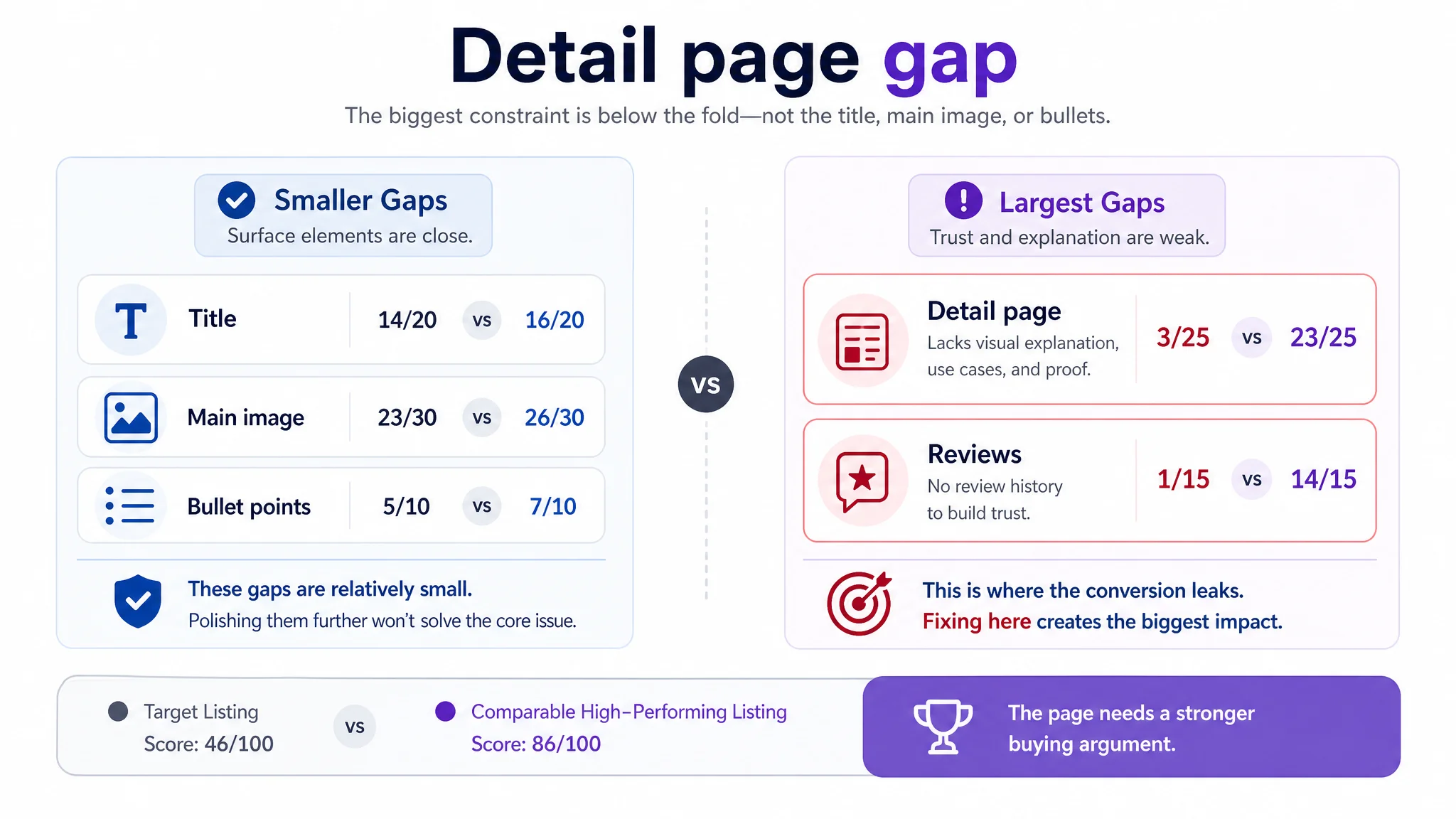
A hair accessory organizer Listing illustrates why this distinction matters. The seller initially focused on the title, main images, and bullet points because those elements appeared to be the most visible weaknesses. The product had a clear use case, but the page was not communicating its value with enough clarity or confidence. DeepBI’s comparison later showed that the title, main image, and bullet-point gaps were relatively limited, while the detail-page score was 3/25 compared with 23/25 for a closely matched high-performing Listing. The larger problem was not simply whether shoppers could find the product. It was whether the page gave them enough evidence to believe the product would solve their storage problem.
Amazon-reported studies have cited conversion lifts of up to 8% for Basic A+ Content and up to 20% for Premium A+ Content. These figures should not be treated as guaranteed outcomes for every ASIN, because results depend on the product, traffic quality, competitive context, and execution quality. They do establish a practical priority: A+ is valuable when it improves the shopper journey and helps more visitors move from consideration to purchase.
The behavioral value may also extend beyond the immediate session. A+ modules can influence what shoppers notice, how long they evaluate an offer, whether they proceed to purchase, and how confidently they choose one product over another. Aggregated behavioral and conversion signals may later contribute to updates in recommendation-system models. That is not the same as claiming that every new conversion trains a recommendation system in real time. Rather, it is a reason to view A+ as part of a broader demand and recommendation ecosystem, not as a hidden keyword field.
A+ body text can still serve two supporting roles. First, well-structured explanations may strengthen Google SEO when the content is accessible to external search engines and aligned with shopper intent. Second, clear claims, usage guidance, comparison logic, and trust cues can reinforce confidence even without producing a measurable change in Amazon rankings. The business test is whether the content helps improve CTR from relevant traffic, CVR after the click, and downstream ACoS or BSR performance.
The operational challenge is measurement. Subjective design reviews cannot reliably show whether an A+ revision has solved a conversion problem. DeepBI’s Listing intelligent scoring system addresses this by diagnosing A+ quality, benchmarking the Listing against similarity-constrained competitors, and cross-checking content scores with exposure, clicks, orders, CTR, and CVR. It can identify gaps such as incomplete modules, weak comparison elements, insufficient authority cues, or shallow use-case explanations instead of returning only a composite score.
In the organizer case, this type of comparison changed the optimization direction. The Listing scored 46/100, while the comparable competitor scored 86/100. The title scored 14/20 versus 16/20, the main image 23/30 versus 26/30, and the bullet points 5/10 versus 7/10. By contrast, the detail page scored 3/25 versus 23/25, and reviews scored 1/15 versus 14/15. The distribution showed that another round of keyword or image polishing would not address the largest commercial constraint. The page needed a stronger buying argument.
After a visual update is published, DeepBI can mark a visual iteration event in ad reports, allowing sellers to observe CTR changes over the following 7–14 days. This connects diagnosis and content execution with KPI-based evaluation. The practical question is no longer whether A+ is indexed, but whether each module improves shopper understanding, trust, and conversion—and whether the data confirms that it has.
Breaking Down the Two Tiers of A+ Content (and Their Real Eligibility)
Basic and Premium A+ Content serve different levels of merchandising complexity. Basic A+ Content is available at no cost to brand-registered sellers, giving eligible brands a way to replace plain product-description space with structured visuals, enhanced copy, and content that addresses shopper objections. For many listings, this is enough to clarify product benefits and support CVR without adding production complexity.
Premium A+ Content is not simply a prestige upgrade. Eligibility should be checked against Amazon’s applicable marketplace and account policies, but the requirements identified for this tier include:
- A published Brand Story
- At least 15 approved A+ Content submissions during the previous 12 months
These requirements should be verified in the relevant Seller Central or Vendor Central account because Amazon may apply conditions differently by marketplace or account. Meeting the requirements also does not establish that Premium will improve a listing’s results. The commercial question is whether the listing has a content gap that Basic modules cannot address efficiently.
The practical distinction lies in module capability. Premium A+ Content can support richer formats such as video, interactive comparison charts, and carousels. These formats can help brands demonstrate product use, compare models, organize multiple benefits, or guide shoppers through a more visual decision process. They are most relevant when the product requires education, has several variants, or faces trust and differentiation problems that standard layouts cannot resolve clearly.
The organizer Listing did not necessarily need Premium capabilities before its basic explanation problem had been solved. Its most important missing information was straightforward: how much it could hold, what was included, where it could be installed, how the snap-clip structure worked, and why the materials supported the intended use. A meaningful Basic A+ page could have established these points through a room-based opening scene, capacity visuals, material close-ups, installation guidance, and use-case modules. The lesson is not that Premium is unnecessary. It is that richer formats cannot compensate for a page that has not yet clarified its basic buying logic.
The decision should begin with performance evidence rather than assumed status. A listing with weak CVR may need stronger proof, clearer use-case explanations, or better comparison logic. A Premium upgrade may be worth evaluating when those needs cannot be communicated effectively through the available Basic modules. However, the upgrade itself should not be treated as a guaranteed improvement in CVR, ACoS, or BSR.
DeepBI’s Listing scoring system can support this decision by quantifying the current content gap. Its audit evaluates five areas—main image, title, bullet points, A+ page, and Voice of the Customer—while its detail-page analysis examines A+ module fullness and coverage of high-value conversion elements such as comparison tables and authoritative proof. Rather than benchmarking against an unrelated bestseller, the workflow uses a semantically similar competitor and measures the distance across listing dimensions.
That benchmark creates a practical upgrade test:
- If the A+ page is materially behind a relevant competitor, identify which content elements are missing.
- If CVR is weak and detail-page or review signals also trail the benchmark, investigate whether the page fails to provide sufficient proof or usage context.
- If the gaps can be solved with Basic modules, improve the existing page before pursuing Premium eligibility.
- If the content requirement is genuinely structural, evaluate Premium against the expected effect on CVR, ACoS, and listing cycle time.
Premium is therefore a capability choice, not an automatic badge of brand maturity. Use eligibility as the starting filter, then let the measurable performance gap determine whether the additional content range is commercially justified.
How to Comply with Amazon's AI-Generated Human Disclosure Rule
AI-generated human imagery can help an A+ Content team produce more visual variations, shorten listing cycle time, and test creative directions before committing production resources. The benefit disappears, however, when disclosure is treated as an afterthought. If an A+ Content module contains an AI-generated image of a human model, the image must carry Amazon’s required AI-generated disclosure label.
The label should be placed on the affected image itself or in an immediately visible position directly associated with that image. It should be easy for shoppers to notice during normal browsing, rather than hidden in metadata, placed on a separate page, or buried in unrelated body copy. Each image covered by the rule should be checked individually. A disclosure attached to one image does not reliably cover other AI-generated human images elsewhere in the same A+ Content experience.
Noncompliance can occur in several straightforward ways:
- Uploading an AI-generated human image without the required disclosure label.
- Placing the label where shoppers are unlikely to see it, such as outside the image area or in distant supporting text.
- Applying a label inaccurately, such as marking an image that does not meet the required disclosure standard while leaving another qualifying image unlabeled.
- Removing or obscuring the label during resizing, module assembly, or final export.
A reliable workflow therefore treats disclosure as a production requirement, not a final copy-editing task. Before generation, define which visual elements may contain human models and identify the required disclosure treatment for each asset. During production, confirm that the label remains legible and correctly associated with the image. Before publication, review the complete A+ layout at the shopper-facing display size and verify that no crop, overlay, or compression has made the disclosure difficult to recognize.
DeepBI’s Listing AI-generated creative assets can include disclosure labels in accordance with Amazon’s policy. This supports a more controlled path from creative planning to delivery: the system can translate optimization decisions into executable design instructions, generate assets from structured inputs, and apply compliance detection during evaluation before the content is used. Its workflow also supports pre-upload validation, helping block images that fail stated platform requirements.
Disclosure compliance should be paired with product authenticity. AI generation must not alter the product’s material, color, or industrial design. DeepBI uses Product DNA as a constraint for visual creation, helping reduce the risk of product-image mismatch that can undermine shopper trust, depress CVR, and contribute to negative post-purchase feedback.
This is especially important when A+ relies on lifestyle scenes. In the organizer case, a nursery, bedroom, college dorm, or organized dressing area could make the use case more immediate than another isolated product shot. But the scene must preserve the actual organizer’s cotton canvas belts, wooden sticks, hook, dimensions, and intended placement. A visually attractive environment is useful only when it helps shoppers understand the real product rather than presenting a different one.
The operating rule is straightforward: disclose AI-generated human imagery clearly, validate label placement before upload, and preserve the product’s physical truth in every creative asset.
Technical Must-Knows: Dimensions, Formats, and Alt-Text Rules
Technical compliance is part of conversion optimization, not an administrative afterthought. An asset that is rejected, distorted, or assigned to the wrong module cannot support CVR, brand trust, or the listing cycle time needed to improve CTR and ACoS.
- Use an accepted file format: Save A+ image assets as .jpg, .bmp, or .png. Confirm the extension after export, especially when design tools generate alternative formats such as .webp or .tiff.
- Set the color mode to RGB: Prepare every image in RGB color mode before upload. Different color profiles can alter product colors after Amazon processing, which may weaken visual consistency and create avoidable review or rendering issues.
- Keep each file below 2 MB: Compress images without making product details unreadable. Large files can slow production, complicate uploads, and increase the risk of submission failure; excessive compression can reduce perceived quality and weaken the visual contribution to CVR.
- Meet the minimum 72 dpi requirement: Export images at no less than 72 dpi, then inspect the final file rather than relying only on the design document settings. Resolution should be checked together with pixel dimensions because dpi alone does not guarantee a suitable display asset.
- Match the asset to the module dimensions: Use approximately 970 × 300 px for a wide header or banner, 970 × 600 px for a large image-led module, and 220 × 220 px for each image in a four-quadrant layout. Treat these as common production references and verify the dimensions shown in Amazon’s current module guidance before publication.
- Build space for text and product visibility: Keep essential claims, logos, and product details away from the edges of a banner or quadrant. A technically correct file can still render poorly when text is cropped, scaled down, or placed where mobile users cannot read it.
- Validate the finished files before submission: Check format, RGB mode, file size, dpi, pixel dimensions, and module assignment in a final preflight review. Amazon may block content that fails mandatory standards, so validation should occur before the asset reaches the publishing workflow rather than after a rejection.
- Write descriptive alt-text without treating it as a guaranteed ranking lever: Describe the subject and useful visual information accurately, such as the product, its use, or the relationship shown in a comparison graphic. Alt-text has historically been associated with search relevance, but its effect on Amazon keyword rankings is not confirmed as a universal policy. Descriptive text remains valuable for accessibility and may also support Google indexing.
- Keep alt-text aligned with the visible asset: Do not insert keyword strings, unsupported claims, or information that does not appear in the image. The text should help a user understand the visual when it cannot be seen, while maintaining the same positioning and product language used elsewhere in the A+ Content.
In the organizer case, this alignment would mean describing what the image actually proves. A loaded organizer can communicate storage function and visible capacity. A close-up can show the cotton canvas belts, wooden sticks, snap clip, or hook. An installation scene can explain placement. Alt-text should support that visible explanation rather than make broader claims about capacity, durability, or use that the image cannot substantiate.
- Use DeepBI to standardize production and delivery: DeepBI’s Listing automated image and text generation system can create A+ modules in required dimensions and formats, structure alt-text, and prepare approved content for one-click SP-API synchronization. Its validation workflow can check and convert assets to Amazon-required standards, identify the appropriate listing placement, and reduce manual downloading, renaming, and re-uploading from minutes to seconds. This shortens listing cycle time and lets sellers return attention to CVR, CTR, and ACoS analysis instead of repetitive file handling.
Step-by-Step Workflow for Creating High-Impact A+ Pages
High-impact A+ Content starts with a business problem, not a template. Before choosing modules or commissioning images, identify the primary outcome: increase CVR, reduce returns caused by unclear expectations, strengthen brand trust, or communicate a differentiated brand story. Secondary goals may include supporting CTR by clarifying the value proposition after shoppers reach the detail page, reducing ACoS through stronger conversion, or improving BSR through better listing performance.
Begin with an objective diagnosis of the ASIN. Review the current title, bullets, main images, A+ Content, customer feedback, CTR, CVR, and relevant competitor gaps. Then translate the diagnosis into a module plan:
- Use an opening module to establish positioning and the central shopper benefit.
- Use core selling-point modules to explain the most important features through benefits.
- Use pain-point sections to show how the product resolves common use-case concerns.
- Use comparison tables when shoppers need help distinguishing models, sizes, or configurations.
- Use credentials, technical explanations, or certification imagery to strengthen trust when evidence is available.
- Use lifestyle scenes and action guidance to help shoppers understand when and how the product fits their routine.
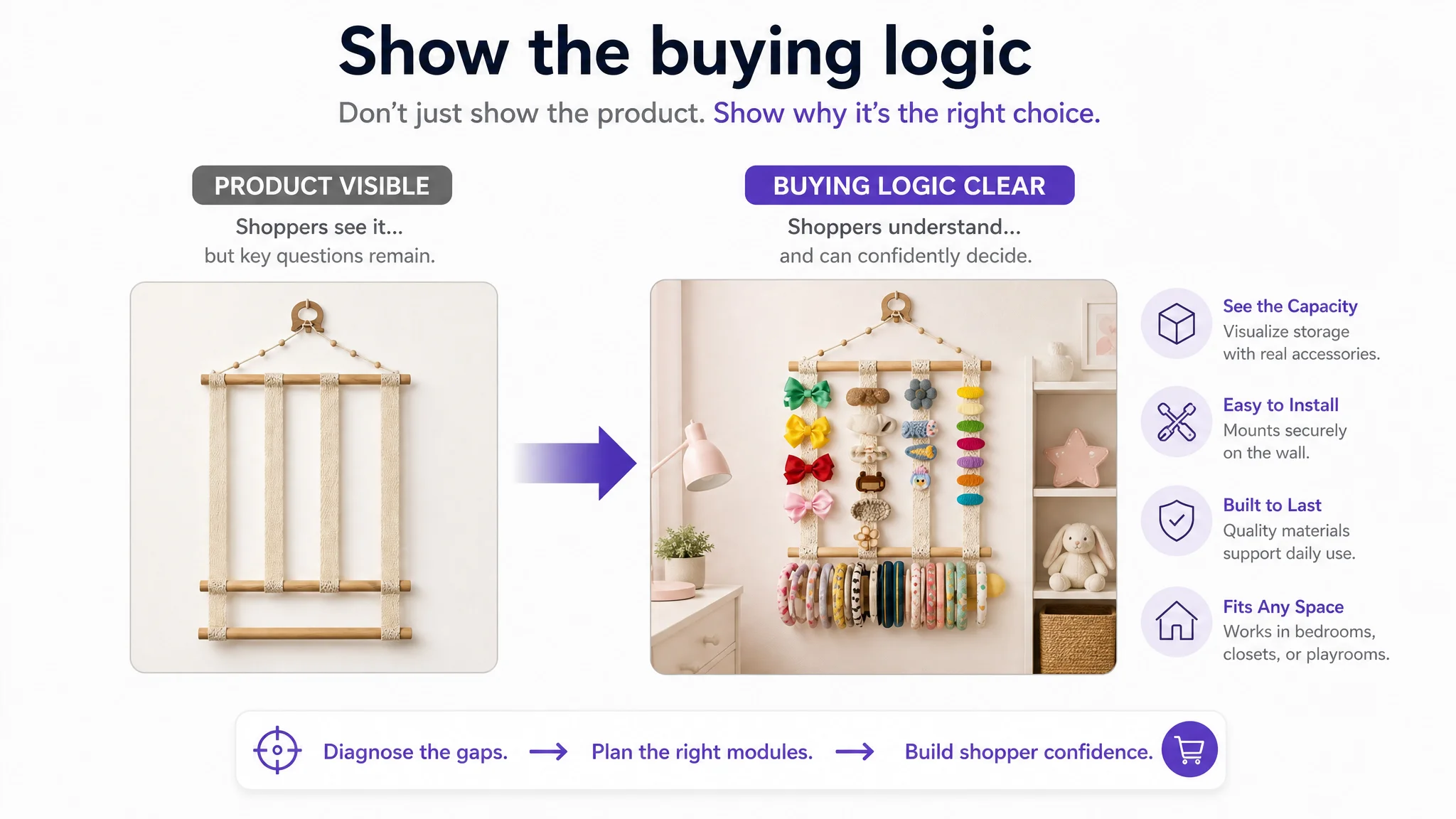
The organizer Listing shows why this diagnosis must precede production. The initial instinct was to improve the title, make the main images more attractive, and rewrite the five bullet points. Those areas did contain real weaknesses, but the comparison revealed that the largest deficit was in the detail page and review-based trust. The page was almost entirely text-based, while the stronger competitor used a room-based hero scene, capacity and feature graphics, structural detail views, material close-ups, installation guidance, multiple home-use scenarios, and buyer-generated content.
The product itself was simple: a hanging organizer made with cotton canvas belts, wooden sticks, and a hook, intended to store bows, headbands, and other accessories. Yet simplicity of product does not guarantee simplicity of purchase. Shoppers still needed to understand how much it could hold, what came in the package, where it could be installed, how it worked, whether the materials appeared dependable, and why it deserved trust over a more established alternative.
This is why A+ planning should begin with the shopper’s unanswered questions rather than with available templates.
The copy should move beyond a product specification sheet. A conversion-oriented message connects a confirmed feature or parameter to a shopper concern and then explains the practical benefit. For example, a capacity specification should be tied to a relevant use case, such as reducing the risk of power loss during travel, rather than displayed as an isolated number. Combine functional proof with an appropriate emotional benefit, such as confidence, convenience, or control. Every claim, comparison, certification, and accessory reference must match the actual product.
For the organizer, the same principle applies to capacity and materials. Four cotton canvas belts, three wooden sticks, one hook, a vertical space-saving structure, beech wood components, a snap-clip design, and wall, door, or cabinet placement are not persuasive merely because they are listed. The page needs to explain what these features allow the shopper to do: organize bows, headbands, clips, and related accessories in a visible and accessible arrangement. The wording must remain within confirmed product information, but the information should be organized around the decision the shopper is trying to make.
Select visuals that address diagnosed information gaps. Lifestyle images should clarify use cases, while infographics can make technical differences easier to scan. Close-ups can show construction or operation, and comparison charts can reduce uncertainty between related products. Avoid treating A+ as one long image; arrange modules according to shopper decision logic, from introduction and value explanation to proof and action guidance.
A useful sequence for the organizer would be:
1. Establish the setting through a nursery, bedroom, dorm, or other relevant room.
2. Show the storage problem and how a vertical organizer helps move accessories out of drawers.
3. Make capacity visible with bows, clips, and headbands loaded onto the organizer.
4. Explain the included components and how the belts, sticks, snap clips, and hook work together.
5. Show where and how the organizer can be hung.
6. Reinforce the material story through accurate close-ups of the cotton canvas and beech wood components.
7. Address long-term use and changing accessory collections without making unsupported durability claims.
DeepBI’s Listing multi-agent strategy generator can support this workflow by analyzing product characteristics, competitor benchmarks, listing performance, and visual gaps. It can prioritize high-impact modules, convert broad directions into executable copy and visual instructions, generate candidate versions, and support comparison before synchronization. Its visual workflow uses a Product DNA map to constrain generated assets, helping prevent product-image mismatch caused by altered structures or unsupported details. Human review remains essential before delivery.
Before submission, check readability, required formats and dimensions, claim accuracy, evidence for certifications or comparisons, and compliance with current Amazon A+ policies. Common rejection risks include policy violations, invalid file specifications, inaccurate claims, unsupported evidence, and content that fails platform standards. Amazon processing times can vary, so confirm the current official review guidance and monitor submission status rather than promising a fixed turnaround. DeepBI’s delivery layer can distinguish successful, processing, and violation-blocked outcomes, while its SP-API connection supports approved-asset synchronization. After publication, record the iteration point and compare subsequent CTR, CVR, and related advertising changes to determine whether the new A+ version merits further refinement.
7 Best Practices to Align A+ Design with Shopper Behavior and Amazon's AI
A+ Content should do more than create a polished brand impression. Its job is to help the right shopper understand the product, resolve objections, and make a confident decision. When presentation attracts shoppers whose needs do not match the product, short-term conversion can come at the cost of refunds, negative reviews, weaker trust, and less useful behavioral signals for future intent matching.
The organizer case demonstrates the difference between showing an object and showing the buying logic. The existing images made the product visible, but they did not make capacity, installation, attachment details, or real-room use immediately clear. The stronger page was not simply more attractive; it gave shoppers more ways to verify whether the product fit their needs.
Use these seven practices to align design with both shopper behavior and Amazon’s recommendation environment.
1. Design for qualified intent, not maximum clicks.
Show the product's actual use cases, limitations, size, compatibility, and ideal customer. A compact travel accessory should emphasize portability and real travel scenarios rather than imply capacity suited to a much larger product.
For a hair accessory organizer, that means showing bows, headbands, and clips in the intended storage arrangement, while making the dimensions and placement clear. A visually appealing room scene should help the shopper recognize the product’s purpose, not make it appear to be a different type of storage furniture.
2. Keep every visual and claim consistent with the product.
Amazon's best practices favor accurate, non-misleading content. Do not add unverified accessories, alter the product's structure, exaggerate performance, or introduce specifications that are not supported by the detail page. General-purpose AI imagery can create product-image mismatch; a controlled production workflow should preserve the product's actual materials, logo, color, functions, and dimensions.
The same rule applies to claims about capacity and durability. The organizer’s beech wood and cotton canvas construction can be explained as part of its structure and storage experience, but the page should not turn those materials into unsupported performance promises. Trust is strengthened when visual proof and written claims describe the same product.
3. Organize modules around the shopper's decision sequence.
Build a progression from product introduction to core benefits, pain-point resolution, trust proof, and action guidance. This structure reduces cognitive effort and helps shoppers find the information needed for their specific purchase question.
In the organizer case, the missing sequence was clear. The page showed product information, but it did not consistently move from “What is this?” to “How much can it hold?” to “How does it work?” to “Where can I install it?” and finally to “Why should I trust it?” A+ should close those decision gaps in that order rather than repeat the same product view across multiple modules.
4. Demonstrate the product in context.
Product demonstrations and context-rich lifestyle videos are usually more useful than generic brand films. Show how the product is handled, installed, used, cleaned, compared, or integrated into a real environment. For technical features, prefer observable demonstrations, functional comparisons, and user interaction over invented internal views or unsupported claims.
A loaded view of the organizer can make its storage role easier to understand. A close-up of the snap clip, wooden stick, hook, and belt structure can reduce uncertainty about interaction. A simple installation sequence can show what arrives in the package, how the components are arranged, how the hook is used, and where the organizer can be hung. These visuals help shoppers form a realistic mental model before purchase.
5. Make the information hierarchy immediately scannable.
Use clear headlines, focused visual panels, readable text, and sufficient information density. A+ should not become a decorative collage. Important parameters, compatibility details, differences between models, and key trust signals should be easy to locate on mobile screens.
The organizer’s original title, images, and bullets each contained useful information, but the overall page made shoppers work too hard to assemble it. Capacity, materials, installation, and use scenarios needed to appear in a clearer hierarchy. Information density is valuable only when it reduces the effort required to understand the product.
6. Use comparison and proof to reduce uncertainty.
A comparison chart can clarify model selection without attacking competitors or copying their product details. Pair verified specifications with certifications, warranty information, testing evidence, or other authorized trust signals. The goal is to help the right shopper choose confidently, not to manufacture urgency or superiority.
Review presence is also part of this trust structure. In the organizer case, the target Listing had no effective review history, while the comparable Listing had a 4.6-star rating, more than 4,800 reviews, and customer images and videos. A+ could not replace that accumulated customer experience. It could, however, compensate within the areas the page controlled by making dimensions, components, installation, materials, capacity, and use scenarios easier to verify.
7. Measure, diagnose, and iterate against business KPIs.
Connect A+ changes to CTR, CVR, ACoS, and listing cycle time rather than judging design only by subjective preference. DeepBI's Listing diagnostic engine can score modules against a dynamically selected competitor benchmark and identify gaps such as missing comparison charts, weak image hierarchy, low information density, insufficient parameter visualization, missing usage scenes, or weak trust proof. Its optimization workflow can translate diagnostic findings and product constraints into executable visual or content instructions.
After publication, sellers can link visual iteration points with advertising reports and observe subsequent CTR movement, while treating the result as evidence for refinement rather than proof that one change guarantees improvement. The organizer case is a useful reminder that the most visible weakness is not always the most commercially important one. A small title gap may be easier to notice than a missing explanation system, but the latter may represent the larger conversion constraint.
- Show verified product benefits in realistic use scenes.: Don't: Use misleading imagery to attract shoppers with a different need.
- Explain differences with accurate comparison charts.: Don't: Copy competitor details, claims, or product design.
- Use readable text and clear module hierarchy.: Don't: Overload panels with tiny text or decorative elements.
- Support claims with authorized proof.: Don't: Invent certifications, specifications, or performance results.
Mismatched conversions may accumulate as poor behavioral signals: shoppers click, purchase, discover a mismatch, and fail to develop engagement patterns associated with genuine satisfaction. Over time, this can contribute to weaker future intent matching or recommendations. Accurate A+ Content protects both immediate CVR quality and the long-term usefulness of the listing’s behavioral feedback.
How to Measure A+ Success and Use Data to Keep Improving
A+ Content should be managed as a conversion program, not treated as a one-time design project. A visually stronger page may attract attention, but its business value depends on whether shoppers move from the detail page to purchase. The central measurement question is therefore simple: did the revised A+ experience help the ASIN convert qualified traffic more effectively?
The organizer case did not include confirmed post-optimization CTR, CVR, ACoS, or organic-order results. That limitation is important. The diagnosis established where the page was constrained, but it did not justify claiming a numerical performance outcome. A disciplined measurement framework should preserve that distinction: identify the conversion hypothesis first, then verify whether the revised page changes business KPIs.
For eligible Basic A+ Content, Amazon’s Manage Your Experiments tool provides a controlled way to compare two content versions. Instead of replacing the original page and relying on a before-and-after comparison, sellers can use an A/B test to expose shoppers to different versions and evaluate the resulting conversion performance. The test should isolate a meaningful content change, such as a clearer use-case explanation, a stronger comparison module, or a more persuasive benefit structure. Changing several unrelated listing elements at once makes the result harder to interpret.
The primary KPI should be conversion rate, supported by a broader set of signals:
- Unit session percentage: Shows whether sessions are producing orders and provides a direct view of detail-page conversion.
- Sales lift: Measures the commercial difference between the tested versions rather than relying only on visual preference.
- CTR: Helps reveal whether traffic quality or the relationship between the listing’s traffic source and its promise is changing.
- Returns and negative reviews: Provide delayed quality signals. If A+ Content clarifies product fit, usage, limitations, or included components, a reduction in avoidable misunderstandings may support stronger customer satisfaction.
- ACoS and BSR: These should be monitored as downstream indicators. Improved CVR can make paid traffic more efficient, while sustained sales velocity may support stronger organic visibility over time.
For a product such as the organizer, possible test hypotheses could include:
- A capacity-led opening module helps shoppers understand the product’s storage role more quickly.
- A clearer installation sequence reduces uncertainty about setup.
- A material and component explanation strengthens trust.
- A room-based use scenario makes the product’s placement and audience easier to recognize.
- A more structured benefit hierarchy improves the transition from feature recognition to purchase consideration.
These hypotheses should not be treated as guaranteed outcomes. They are specific, testable explanations for why the existing page may be losing conversion opportunities.
Do not end an experiment as soon as one version shows a favorable daily result. Allow sufficient traffic and time for the data to stabilize, then look for a statistically significant improvement rather than a temporary fluctuation. The appropriate observation period depends on traffic volume, purchase cycle, and the ASIN’s sales pattern. External factors—including price changes, promotions, review shifts, advertising adjustments, seasonality, and other listing edits—can affect the outcome, so a measured lift should not automatically be attributed to A+ Content alone.
A disciplined workflow records the implementation point, monitors performance after the change, and compares the new trend with the pre-change baseline. DeepBI’s Listing-focused analysis can support this process by cross-validating impressions, clicks, orders, CTR, and CVR, then identifying high-converting search terms associated with stronger listing performance. These “winning terms” can inform the next A+ revision, including image messaging, benefit hierarchy, and use-case explanations. Its Organic module may also help connect confirmed conversion gains with targeted ranking reinforcement, but sellers should treat stronger BSR or organic visibility as longer-term signals, not guaranteed results.
The loop is continuous: diagnose the conversion gap, test one focused revision, verify the evidence, and feed the findings into the next content and traffic decision.
Quick Fixes for Common A+ Rejections and Performance Lags
A rejected A+ submission and a weak-performing A+ page require different diagnoses. Rejection is usually a compliance or eligibility issue; weak CTR or CVR may reflect targeting, message clarity, or insufficient shopper reassurance. Adding more modules before identifying the failure point can lengthen listing cycle time without improving the customer journey.
Start with the submission status. A page marked as processing should not be treated as a violation, while a rejected asset requires a compliance review. For image rejections, check each file against the current Amazon requirements for the relevant module:
- Dimensions and minimum resolution
- File format and color mode
- File size limits
- Required aspect ratio or background treatment
- Prohibited text overlays, logos, promotional language, or unsupported claims
Do not rely on a file that looks acceptable locally. Platform validation can fail because of metadata, pixel dimensions, or a module-specific restriction. For applicable image requirements, technical checks may include RGB color mode, a minimum 1,600-pixel edge, and white-background treatment. These checks can explain or prevent some rejections, but they do not guarantee approval because review and marketplace requirements may change.
If Premium A+ is unavailable or an upgrade is rejected, verify the current eligibility requirements for the specific marketplace, account, and brand status. Avoid assuming that a successful Basic A+ submission automatically qualifies a brand for Premium A+, or that a rejection identifies one universal defect. Confirm the requirements in the relevant Amazon seller or vendor workflow, then distinguish an eligibility limitation from a content-compliance problem before rebuilding the page.
When content is approved but produces little lift, diagnose the relevant funnel stage. Weak CTR may indicate that traffic is poorly matched to the product, the visual hierarchy lacks a clear focal point, or the content does not reinforce the promise implied by the search term. Weak CVR may indicate that shoppers still lack information about the core benefit, use case, product limitations, comparison points, or trust evidence.
A page can therefore have adequate exposure and still fail to convert because it has not answered the shopper’s next question. In the organizer case, the product was visible and the title contained relevant terms, but the page did not clearly demonstrate capacity, installation, materials, or interaction. The initial optimization direction treated title, images, and bullets as the primary bottleneck. The comparison showed that the more serious issue was the page’s limited ability to provide proof below the fold, compounded by the absence of review-based trust.
Generic statements such as “high quality” are rarely sufficient on their own; stronger communication connects a specific benefit with verifiable evidence and a relevant shopper concern.
Use one defined correction for each diagnosis:
- Rejected asset: validate the technical specifications and prohibited elements.
- Weak CTR: review search-term alignment, audience fit, visual focus, and the primary image or opening module.
- Weak CVR: strengthen usage explanations, comparison information, objection handling, and trust proof.
- Vague messaging: replace broad claims with observable product attributes and supportable evidence.
- Incomplete page explanation: connect the title, images, bullets, A+ modules, and reviews into one consistent buying sequence.
- Excessive reliance on advertising: confirm that the detail page can explain and support the traffic before increasing ad pressure.
Treat each change as a hypothesis. Record the publication time and compare subsequent CTR and CVR with the pre-change period. A visual iteration event can support observation over the following 7–14 days, but that interval is for measurement, not a guaranteed outcome. Amazon research has reported an average conversion increase of 5.6% for A+ Content, with reported ceilings of up to 8% for Basic A+ and 20% for Premium A+; these figures should guide expectations rather than serve as promises for every ASIN. Keep ranking, BSR, ACoS, and conversion claims equally cautious: better content may support the shopping experience, but no individual module guarantees a ranking or revenue result.
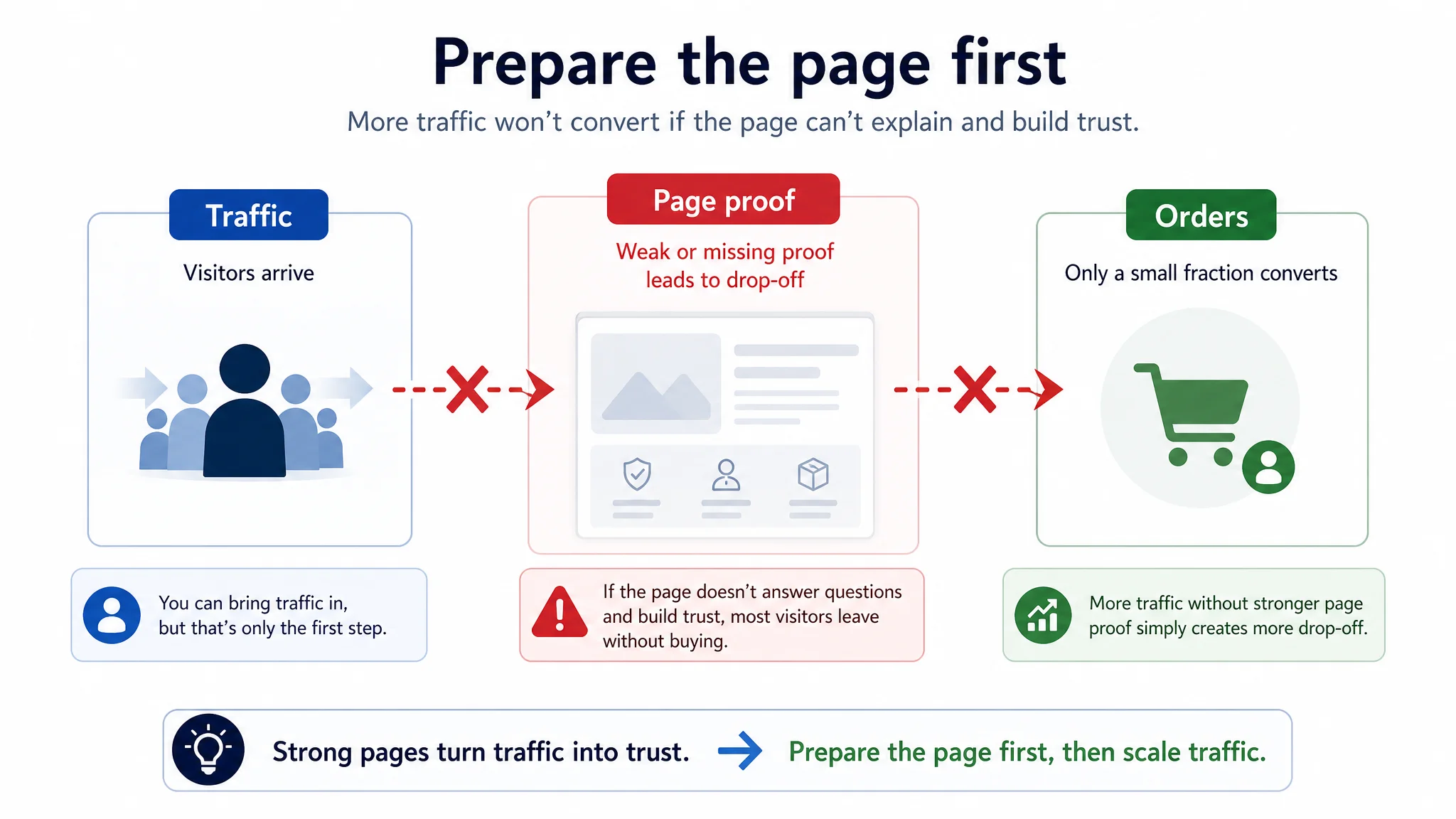
The central lesson is to diagnose the page before increasing pressure on the traffic source. Sending more Amazon traffic to a Listing that lacks enough proof can amplify its weaknesses rather than solve them. A title, main image, bullet points, A+ modules, and reviews do not operate as separate decorations. Together, they form the trust structure that determines whether paid and organic traffic can become orders.