


Why Amazon Is Tightening Rules on AI-Generated Listing Content
AI is now widely used to draft product titles, bullet points, descriptions, A+ content, and listing images. It can shorten listing cycle time and support faster content iteration, but faster production also increases the risk of publishing inaccurate claims, altered product details, or non-compliant visuals at scale.
As of the writing date, Amazon does not ban AI-generated or AI-assisted listing content. Sellers remain responsible for ensuring every asset follows Amazon’s official requirements, including the expectation that A+ content is unique and truthful. Content that fails mandatory standards may be blocked or may contribute to ASIN rejection, affecting a product’s ability to remain available and convert traffic into sales.
Compliance is not separate from conversion quality. A listing can contain attractive images, clear product information, and relevant claims while still failing to give shoppers enough confidence to purchase. In one US yoga and fitness listing review, the product page contained a distinctive vintage design, material information, and several potential use cases, yet scored only 48 out of 100 against a comparable high-performing page that scored 90. The issue was not simply a lack of traffic or missing product facts. The page did not guide shoppers from visual interest to functional confidence and finally to purchase trust.
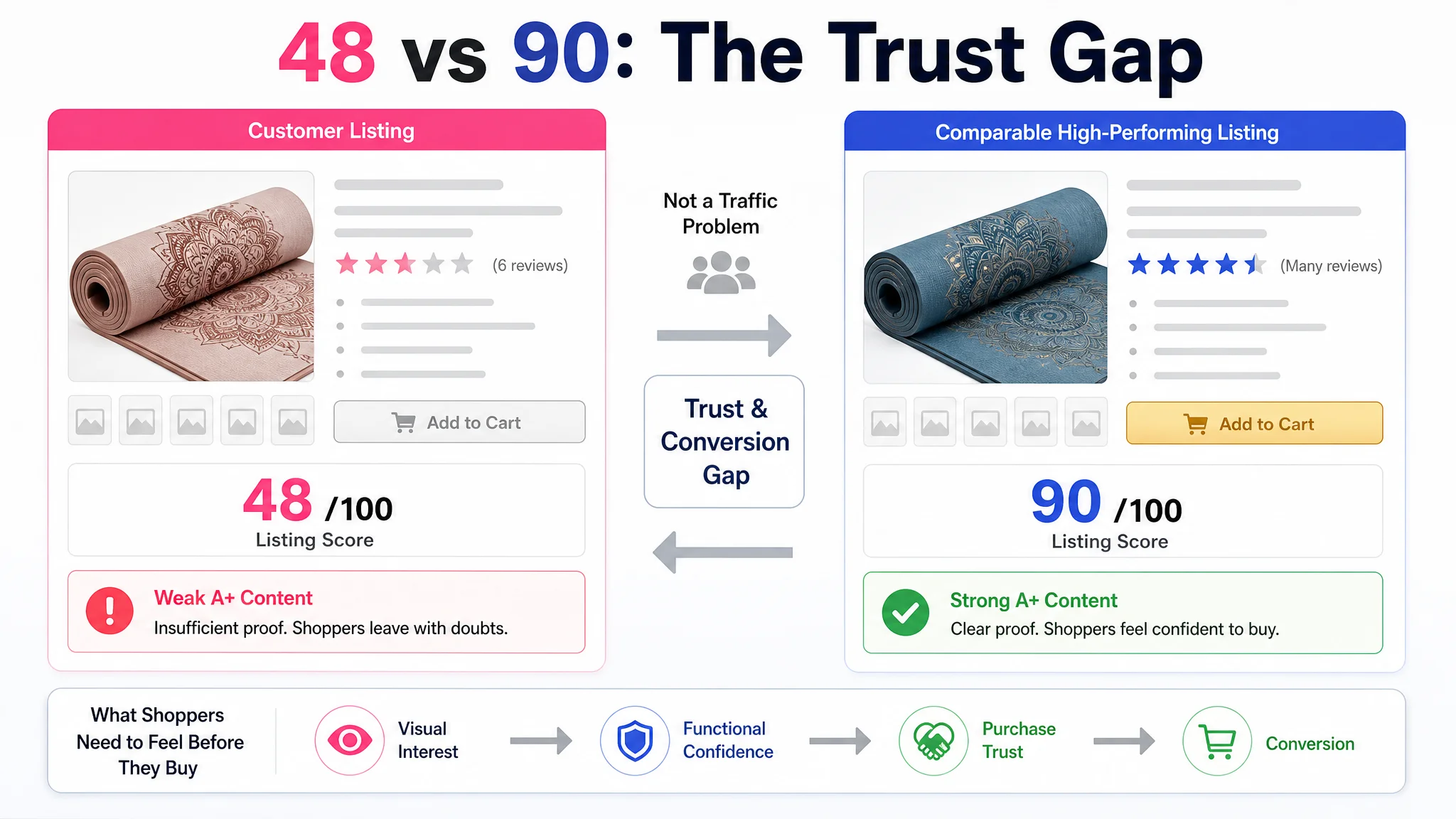
That distinction matters when AI is used to create or expand listing content. AI may produce more wording and more visual variations, but additional content does not automatically create a stronger buying argument. In the yoga mat review, the initial direction focused on improving individual elements: repeat the non-slip benefit, explain the material, make the product look more attractive, and add more details. DeepBI’s diagnosis showed that the deeper issue was the relationship between those elements. The listing was presenting separate facts without clearly explaining how the suede surface, rubber base, portability, cleaning, and use cases addressed the shopper’s practical concerns.
Sellers often overlook policy updates while focusing on CTR, CVR, ACoS, or BSR. Amazon also does not publicly disclose the data behind its enforcement triggers, so sellers cannot reliably predict which specific combination of wording, imagery, or claim structure will prompt action. The practical response is to treat factual accuracy and policy review as release requirements, not optional quality checks. AI should execute from verified product information rather than inventing features, accessories, specifications, proportions, or performance outcomes.
The current 90-day transition window is expected to end in June 2026. After that point, Amazon may move toward direct enforcement without prior warnings for most violation types, but this timing and implementation should not be treated as confirmed. Verify the latest official Amazon documentation before publishing or revising affected ASIN content.
A+ Content Guidelines Every Seller Must Follow
As of the writing date, Amazon’s official A+ Content help page should be the controlling reference for every seller. Requirements can change, so verify the latest documentation before creating or submitting new modules.
Apply the guidelines as an editing system, not as a final formality:
- Make every element additive. A+ images and text must be unique. Do not simply repeat the main image gallery, title, bullet points, or other listing elements. If a module restates an existing claim without adding useful explanation, replace it with a product benefit, usage scenario, comparison, technical explanation, or trust element that is not already covered.
- Highlight genuine differentiators. Focus on unique product features that buyers need help understanding. Base every statement and visual on visible product attributes or confirmed specifications. Do not invent materials, functions, parameters, accessories, or performance outcomes.
- Keep the product representation exact. AI-generated visuals must preserve the product’s actual material, color, structure, and industrial design. Changing these attributes creates an image-product mismatch that can damage buyer trust, increase refund risk, and undermine CVR.
- Remove promotional language. Do not use calls to action or offer language such as “buy now,” “free,” or “discount.” Review headings, overlays, captions, and body copy—not only the main text.
- Compare before publishing. Check each A+ module against the existing listing assets for duplication, unsupported claims, and inconsistent visuals.
The importance of these rules becomes clearer when a listing is already struggling with trust. In the yoga mat review, the customer page’s A+ content scored 3 out of 25, compared with 24 out of 25 for the comparable page. The largest gap was not caused by a missing slogan. The customer page contained basic text about functions, materials, and packaging, but no image-led modules showing how the product worked in practice.
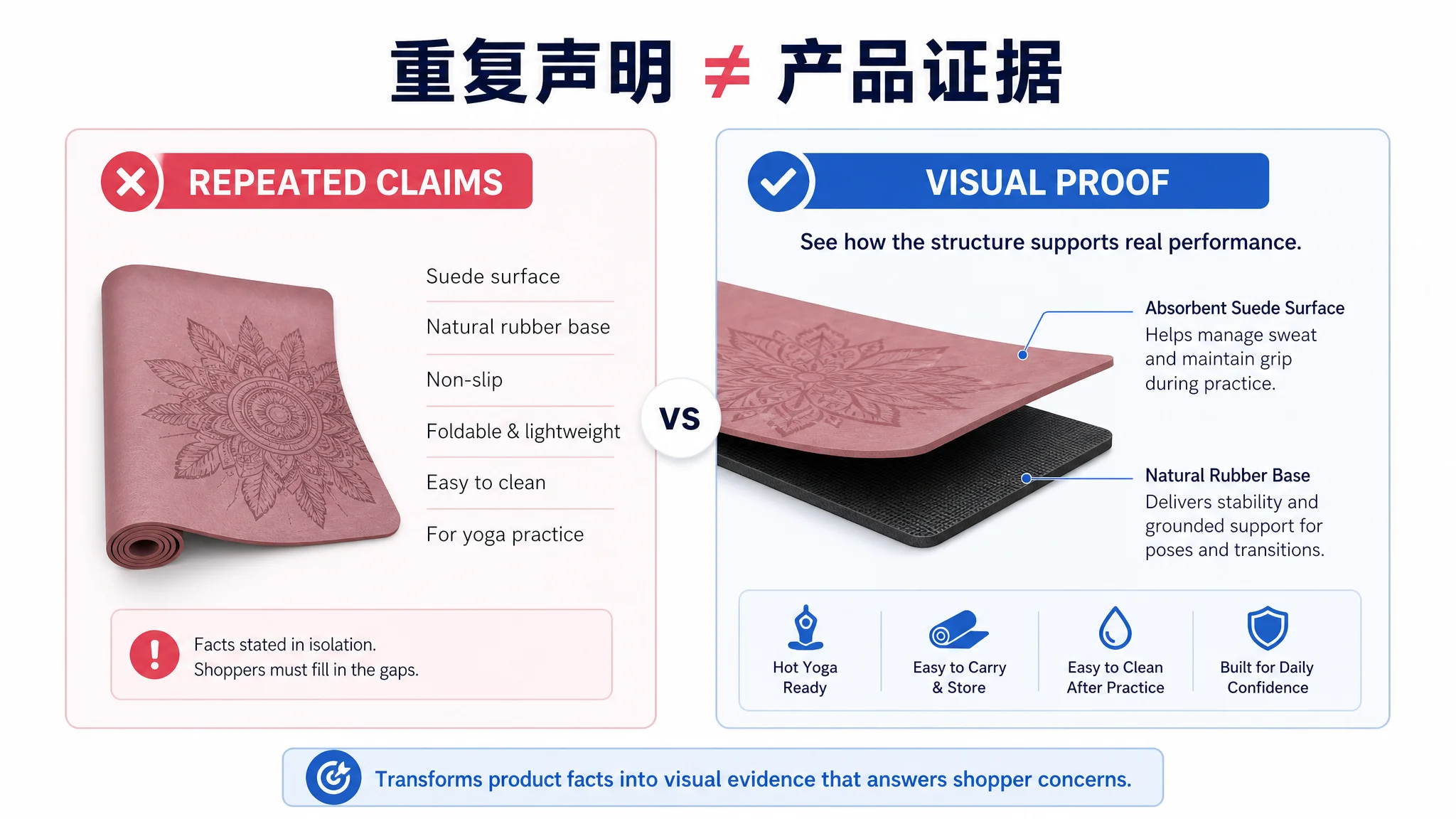
A stronger A+ structure would have added information rather than repeating the listing. It could have explained the relationship between the absorbent suede surface and natural rubber base, shown the product’s suitability for demanding practice scenarios, and clarified portability, storage, and cleaning. Those additions would have supported the existing product information while helping shoppers understand why the features mattered.
At the same time, the product could not be visually improved by changing what it physically was. The yoga mat’s approximately 1 mm construction and 1.9-pound weight supported a portability and foldability position, not an unsupported “extra thick” cushioning claim. The vintage mandala and leaves design could remain a genuine identity asset, but it could not replace functional proof. Compliance and conversion therefore required the same discipline: show the real product, explain its real use, and avoid creating expectations the product cannot satisfy.
Violating these stated A+ rules can cause content rejection and put the ASIN at risk of rejection. Treat compliance review as part of the listing cycle, not a post-submission repair.
Disclosing AI-Generated Photorealistic Persons in Your Images
As of the writing date, sellers should treat a photorealistic AI-generated person in a listing image as a synthetic performer. This designation applies when a person appears realistic but was created or materially generated by artificial intelligence rather than photographed as a real individual.
Disclosure requirements can vary by applicable jurisdiction. The legal discussion surrounding New York law highlights why sellers should not treat synthetic-person disclosure as a purely creative or optional issue. Verify the latest official Amazon documentation and applicable legal guidance before publishing or updating affected images.
For Amazon compliance, use an IPTC-compatible editor and add the exact value “contains-synthetic-performer” to the “dc:subject (XMP) field.” Do not substitute another field, wording, or tag. When the correct metadata is present, Amazon may add an “AI-generated” badge to the image.
This is a narrow but verifiable compliance action. Without the required tag, an otherwise acceptable image may fail Amazon’s disclosure expectations and contribute to image-related ASIN rejection. The risk is particularly easy to overlook when a seller focuses on visual quality, CTR, or conversion potential while treating metadata as an afterthought.
The same problem can appear at the broader listing level: sellers may optimize an image for visual appeal without checking whether it communicates the product accurately. In the yoga mat review, the design was distinctive and the page looked presentable, but the visual direction emphasized the pattern more than the product’s practical performance. The recommended image sequence therefore focused on showing the complete design while also making grip, sweat absorption, material structure, size, portability, and maintenance easier to understand.
A visually attractive asset is not automatically a compliant or effective asset. The image must represent the actual product, avoid unsupported implications, and provide information that helps shoppers evaluate it correctly.
Build the metadata check into the listing image workflow: identify photorealistic synthetic performers, apply the required IPTC value before upload, and retain a review step confirming that the value appears in the correct XMP field. This creates an auditable control without changing the image’s creative content.
Image and Text Formatting Standards You Cannot Ignore
[Purpose: Translate technical specs from “ ” into checklist form.] As of the writing date, apply the following checks before uploading A+ images or text, and verify the latest requirements in Amazon’s official documentation.
- Use only the supported image file types: .jpg, .bmp, or .png.
- Confirm that every image uses the RGB color space; do not upload CMYK files.
- Keep each individual image file at or below the 2 MB maximum.
- Verify that every image meets the minimum resolution of 72 dpi.
- Review text at its intended display size to ensure it is clear and legible.
- Remove promotional language that violates Amazon A+ content rules before submission.
- Check both technical specifications and policy-sensitive wording; passing one review does not compensate for failing the other.
- Complete a pre-upload quality check so noncompliant assets are identified before they reach the Listing backend.
- Treat failed specifications as an operational risk: incorrect files or formatting can cause upload failures or block the asset from being applied.
- Monitor rejected or blocked submissions and correct the underlying specification rather than repeatedly re-uploading the same file.
- Protect listing cycle time by validating assets before application; delays can prevent approved visual content from supporting CTR and CVR improvements.
- Remember that persistent noncompliance may contribute to ASIN rejection, not merely a single failed upload.
Technical compliance is necessary, but it does not ensure that the content will support conversion. The yoga mat page illustrates why a technically correct image set can still leave a major information gap. The main image communicated the product’s appearance, but the broader image sequence did not sufficiently explain how the suede surface, rubber base, foldable structure, and cleaning benefit addressed shopper concerns.
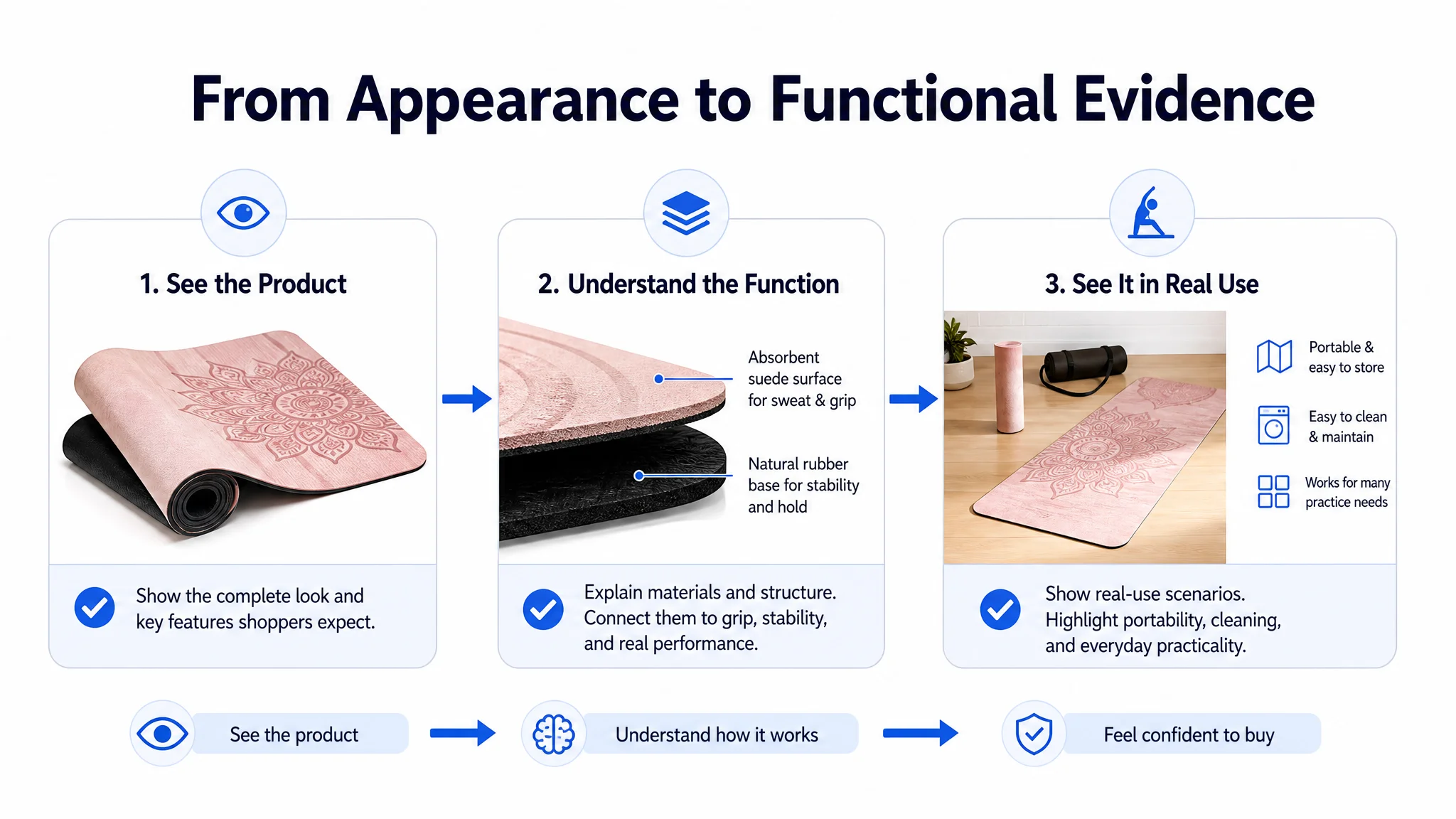
A stronger sequence would have used separate visual roles rather than repeating the same claim:
1. Show the complete product and recognizable design.
2. Explain the material or base-layer structure.
3. Demonstrate the relationship between sweat absorption and grip.
4. Clarify size, thickness, and portability using the actual product specifications.
5. Show cleaning, storage, or practical use information where supported.
This approach improves both reviewability and usefulness. It reduces the temptation to use exaggerated wording to compensate for weak visuals, while ensuring that every image contributes a distinct piece of accurate information.
Making Legitimate Claims and Awards - Without Getting Flagged
Environmental and award claims can strengthen trust, but only when the supporting evidence is ready before the A+ content is published. Words such as “recyclable” and “eco-friendly” are not substitutes for proof. They should match the product’s confirmed material composition and physical attributes, not assumptions generated by an AI tool.
For each environmental claim, prepare documentation that clearly supports what the content says. Where relevant, record:
- The product’s material composition or applicable physical attributes
- The certification body or other qualified source
- The certification year and any relevant validity information
- A copy of the supporting certificate, test result, or documentation
Award claims require the same discipline. Name an award only when the claim can be independently verified and the seller can provide reliable documentation. Do not allow AI to invent an award name, certification, material property, or product parameter to make the listing sound more persuasive.
The yoga mat review shows why this distinction matters. The product had natural rubber and eco-related positioning, but those statements could not simply be expanded into broader environmental promises without checking the underlying evidence. The product’s material information could support a factual explanation of construction, while any broader environmental claim still required documentation.
The same principle applies to performance claims. The suede surface could be connected to sweat absorption and the rubber base to stability, but the content needed to explain those relationships without promising outcomes that had not been established. Likewise, the approximately 1 mm thickness could support a lightweight and foldable positioning, but not an unsupported claim of extra cushioning.
Vague phrases such as “better for the planet,” “quality-made,” or “eco-friendly choice” may function as unsupported marketing puffery when they lack specific evidence. This type of greenwashing language creates compliance risk and can weaken customer trust, while unsupported claims may lead to content rejection.
As of the writing date, sellers should verify the latest official Amazon documentation before relying on policy details. Maintain a claim-evidence file for every environmental or award statement, and review that file before publication. A data-evidence chain protects listing credibility while reducing avoidable content-review risk.
Content Restrictions That Can Derail Your Listing
AI-assisted copy, A+ modules, and images remain subject to Amazon’s broader content guidelines. As of the writing date, sellers should verify the latest official documentation before publishing, especially when content involves adult products, offensive or illegal material, promotional wording, or originality requirements. Unsupported claims, copied competitor details, and exaggerated advantages can also undermine compliance and delay the listing cycle.
Originality does not mean that a seller must avoid learning from competitors. It means using comparison to understand communication gaps without copying another listing’s wording, design, or product details.
In the yoga mat review, the comparable page scored 90 out of 100, while the customer page scored 48. The comparison showed that the stronger page addressed grip, stability, joint comfort, practice space, cleaning, materials, and usage guidance in a more complete order. The appropriate response was not to reproduce that page. It was to use the comparison as a benchmark for communication maturity and then express the customer product’s own genuine assets: its vintage design, foldability, lightweight format, storage bag, suede and natural rubber positioning, machine-washable maintenance benefit, and supported use cases.
This distinction is essential for AI-assisted workflows. A tool can identify missing information or weak sequencing, but sellers must still verify that every proposed statement belongs to their own product and is supported by reliable evidence.
Practical Compliance Checklist and Human-Review Workflow
Use this checklist before upload to reduce the risk of ASIN rejection and protect listing quality that supports CTR, CVR, and ACoS:
- 1. Verify uniqueness: Confirm that all A+ text and creative assets are original, do not copy competitor product details or designs, and contain no prohibited promotional phrases such as unsupported “best-selling” or “free” language.
- 2. Review synthetic people: Inspect every AI-generated photorealistic person and add the required contains-synthetic-performer metadata.
- 3. Confirm image specifications: Check that every image uses RGB color mode, is no larger than 2 MB, and meets the minimum 72 dpi requirement before upload.
- 4. Substantiate claims: Ensure every environmental or award claim is supported by documented evidence, and remove invented product functions, materials, accessories, parameters, or usage effects.
- 5. Cross-check Amazon policies: Confirm that no content violates the specific adult products policy, restrictions on offensive or illegal material, promotional-language rules, or other applicable Amazon content guidelines.
- 6. Complete human review: Require a qualified person to review the final text, images, metadata, and evidence package before submission rather than relying on AI output alone.
The human review should also examine whether the content forms a complete and accurate buying argument. In the yoga mat diagnosis, the listing did not simply have isolated weak assets. Its title delayed the core category and functional value, the bullets described features without following shopper concerns, the images emphasized appearance more than functional verification, and the A+ section lacked a visual explanation of the product’s material and use logic.
A review that checks only spelling, file size, or prohibited phrases would miss that page-level problem. The reviewer should therefore ask:
- Does the title identify the product and its relevant value early enough?
- Do the images explain the product without altering its physical attributes?
- Do the bullets connect features to supported user concerns?
- Does A+ content add useful evidence instead of repeating the listing?
- Are environmental, performance, and award claims properly documented?
- Does the complete page create expectations that the actual product can meet?
Practical Compliance Checklist and Human-Review Workflow
Use this repeatable sequence before final upload. It separates content, metadata, technical, policy, and evidence checks so AI-assisted assets are reviewed as business-critical listing inputs rather than accepted automatically.
- 1. Review all A+ copy for originality: Confirm that every A+ text element is unique, accurately describes the product, and contains no prohibited phrases or unsupported promises.
- 2. Validate product consistency: Compare AI-generated text and visuals with verified product information. Check the product’s structure, materials, colors, proportions, logo placement, and functional details for alterations or invented attributes.
- 3. Inspect synthetic people in images: For every AI-generated photorealistic person, add contains-synthetic-performer metadata to the dc:subject (XMP) field.
- 4. Check image specifications: Confirm that each image uses RGB color space, is no larger than 2 MB, and meets the minimum resolution of 72 dpi before submission.
- 5. Substantiate sensitive claims: Verify that environmental, certification, award, performance, and similar claims are supported by documented evidence. Remove any claim that cannot be tied to reliable source documentation.
- 6. Cross-check Amazon policies: As of the writing date, review the adult products policy and all other relevant official Amazon policies, then verify the latest documentation before uploading.
- 7. Complete a human approval gate: Have a qualified reviewer examine the final text, metadata, images, evidence, and policy checks. Require that person to approve or reject each asset before final upload.
- 8. Record the review outcome: Keep the approved files and supporting evidence together so revisions can be traced and repeated checks do not depend on memory.
This workflow should also distinguish between content accuracy and conversion readiness. In the yoga mat review, the team initially focused on better wording, repeated non-slip claims, and more attractive presentation. Those edits addressed individual attributes but did not answer the larger question of whether the page gave shoppers enough reason to believe the product would work for them.
The review process should therefore test the sequence of information:
Recognition → functional explanation → product proof → use-case confidence → practical reassurance → trust
This does not mean every listing must follow the same creative structure. It means the content should help shoppers understand what the product is, why its features matter, and whether it fits their needs without relying on unsupported claims.
This workflow can reduce known risks that contribute to ASIN rejection, but it cannot guarantee a particular Amazon enforcement or submission outcome.
How DeepBI Helps Sellers Automate Listing Compliance Checks
As of the writing date, Amazon’s requirements can change, so you should verify the latest official Amazon documentation before publishing or revising AI-assisted listing content. DeepBI is an Amazon-only compliance-assist tool: it can automate selected checks, but it cannot guarantee approval or replace your final compliance decision.
- Use DeepBI to scan A+ content for text duplicated from your main image gallery and help assess whether the content meets Amazon’s uniqueness rule.
- Run the content analysis engine before submission to detect prohibited promotional language that could create review or enforcement risk.
- Review flagged claims for supporting evidence, since the system can identify potentially unsubstantiated or exaggerated claims but cannot determine whether every claim is legally or commercially defensible.
- Use the listing audit feature to verify image file specifications, including applicable format, color-mode, and dimension requirements.
- Check audit alerts for missing required image metadata before applying or uploading assets.
- Compare the original and proposed assets yourself, then confirm which changes should be applied; seller selection remains part of the workflow.
- Treat every alert as a review prompt rather than an automatic policy decision. A clean scan does not guarantee Amazon compliance.
- Complete a final human review of wording, claims, images, and supporting documentation before submission.
- Record unresolved issues and policy questions for manual verification against Amazon’s official guidelines, especially when a rule affects listing cycle time, CTR, CVR, ACoS, or BSR.
DeepBI can also help sellers avoid treating a listing problem as an advertising problem before the page is ready to receive traffic. In the yoga mat review, the evidence pointed to a page-level conversion constraint:
- The Listing score was 42 points below the comparable page.
- The A+ score was 21 points lower.
- The review score was 11 points lower.
- The title delayed the core category and key value.
- The bullet points listed attributes without a clear pain-point sequence.
- The image set emphasized appearance more than functional verification.
- The page lacked a visual story that could compensate for weak social proof.
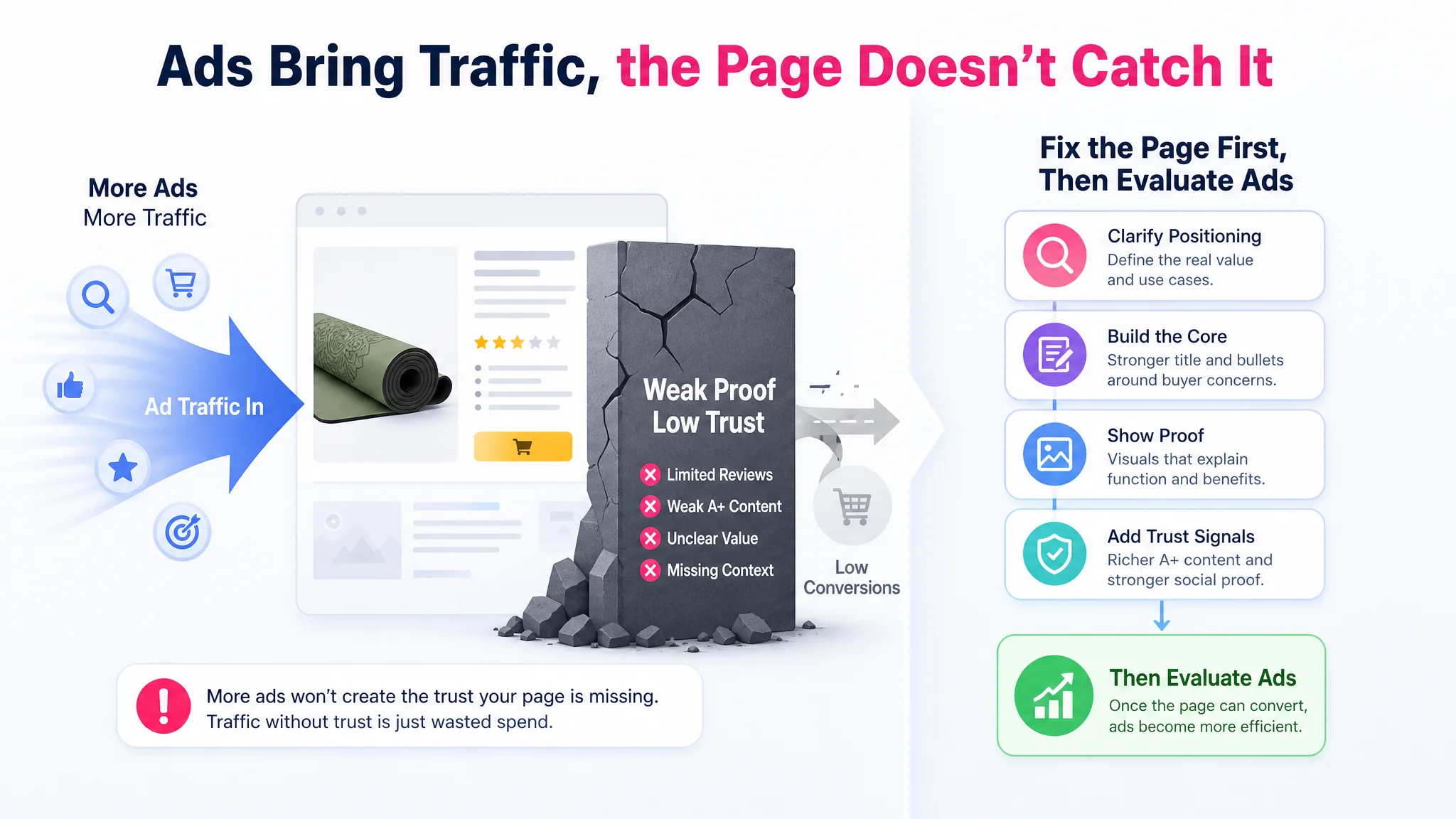
That diagnosis did not produce a guaranteed post-optimization CVR or ACoS result, and no such result should be invented. Its value was identifying the order in which the problem needed to be addressed. More advertising could bring additional shoppers to the page, but it could not manufacture the trust missing from weak proof, limited review coverage, unclear functional positioning, and incomplete A+ content.
The appropriate workflow was to clarify the product’s genuine position, rebuild the title and bullets around supported buyer concerns, replace repeated claims with visual evidence, develop an additive A+ sequence, and only then evaluate whether advertising traffic was converting efficiently.
DeepBI functions as an additional safety net: it helps surface repeatable compliance and listing-quality problems earlier, while you remain accountable for the final interpretation, correction, and submission decision.
The broader lesson is straightforward: AI can accelerate content production, and automated tools can identify potential issues, but neither replaces the seller’s responsibility to verify the product, the claims, the metadata, the technical specifications, and the logic of the complete page. Before Amazon ads can become more efficient, the Listing first has to become accurate, compliant, and believable.