


Amazon listing optimisation is not a cosmetic exercise. The main image, title, bullets, A+ content, and supporting visuals influence whether shoppers click, trust the offer, and convert. Weak optimisation can suppress CTR and CVR, raise ACoS, and extend the time required to move a product from research to a market-ready listing.
AI changes the economics of that process. Instead of spending hours gathering references, drafting copy, and preparing creative assets, sellers can use AI tools to produce an initial listing draft in minutes. The speed advantage is valuable for private-label teams and agencies managing multiple ASINs, but speed alone does not create sustainable growth. Generic outputs may overlook the product’s actual specifications, misread the competitive context, or introduce visual details that create product-image mismatch, negative reviews, and refunds.
DeepBI operationalises AI as a controlled workflow rather than an unconstrained writing or design tool. It connects scoring and competitor benchmarking with actionable recommendations, AI generation, and one-click application. Its structured “Product DNA” constraints help preserve the product’s real form, materials, branding, and confirmed features. Sellers can review new-versus-old assets and approve or replace individual images before synchronisation.
The commercial test remains measurable: changes should be assessed through CTR, CVR, impressions, clicks, conversions, ACoS, TACoS, and related BSR movement. By marking visual iteration events in advertising reports, DeepBI helps connect a published change with subsequent performance data. The practical question is not whether AI can produce content quickly, but whether it can turn evidence into executable improvements while keeping sellers in control.
Why Listing Quality Is the Cornerstone of Amazon Success
Listing quality is not a cosmetic concern; it is the operating foundation of Amazon performance. A complete, relevant listing gives search systems clearer signals about the product while giving shoppers enough information to decide whether the product fits their needs. Titles and bullet points create the primary search entry point, while images, detail-page content, and A+ modules support the path from impression to purchase.
The performance chain is measurable. Weak keyword relevance or incomplete product information can limit discoverability and suppress CTR. A listing that earns clicks but fails to explain benefits, use cases, specifications, or trust signals can produce a low CVR, waste advertising spend, and place upward pressure on ACoS. Over time, inconsistent or unconvincing content can also weaken brand perception and restrict the product’s ability to build BSR momentum.
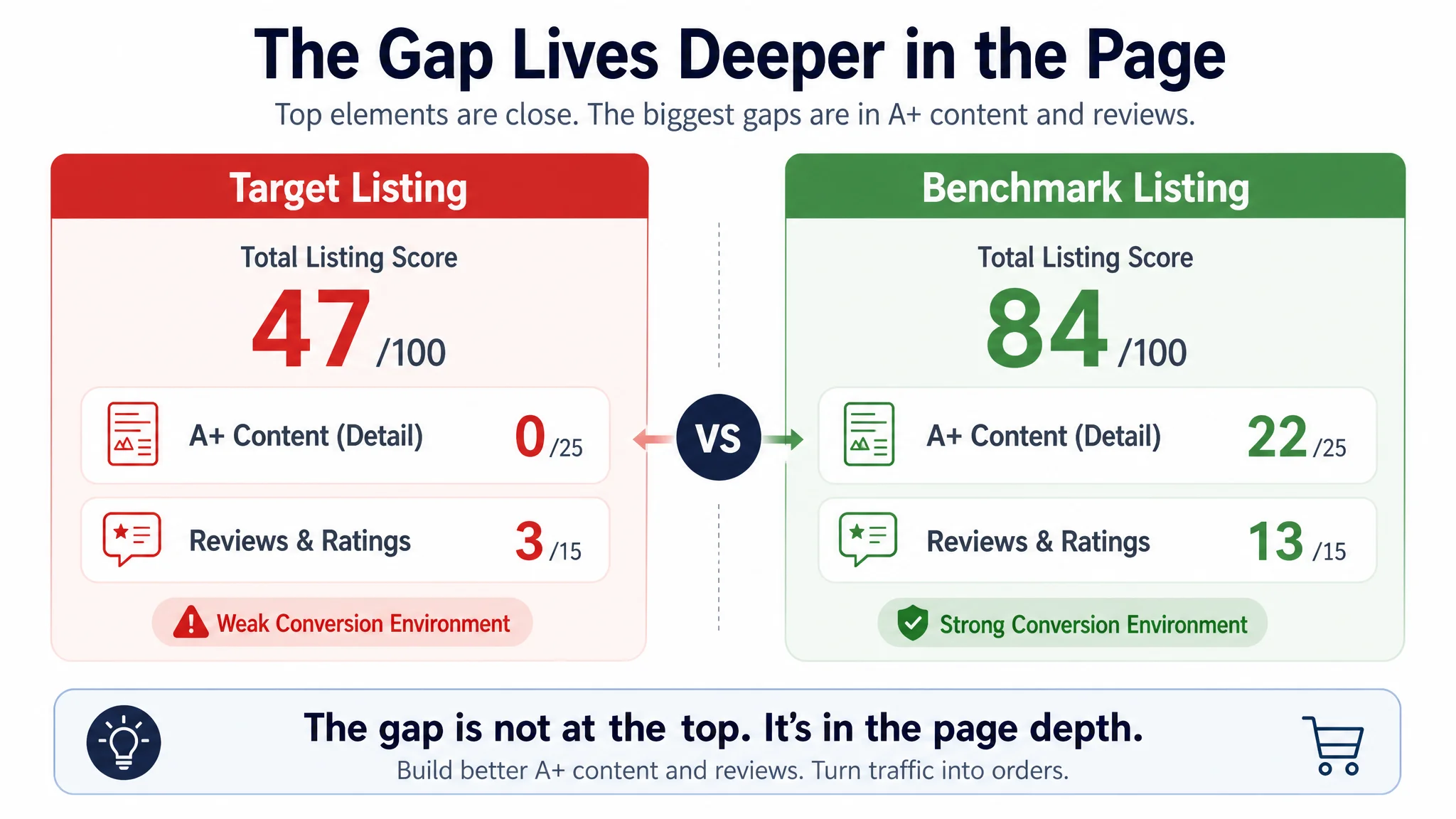
A magnetic selfie-stick tripod listing illustrates why this chain must be evaluated as a whole. The seller initially believed that underperforming orders were caused by weak advertising and continued adjusting bids, keywords, and match types. However, DeepBI’s comparison with a closely matched competitor showed a Listing score of 47/100 versus 84/100. The title, main image, and bullets were relatively close to the benchmark, but Detail/A+ Content scored 0 versus 22, while Reviews & Ratings scored 3 versus 13. The ads were generating traffic; the page lacked the persuasive structure and trust needed to convert it.
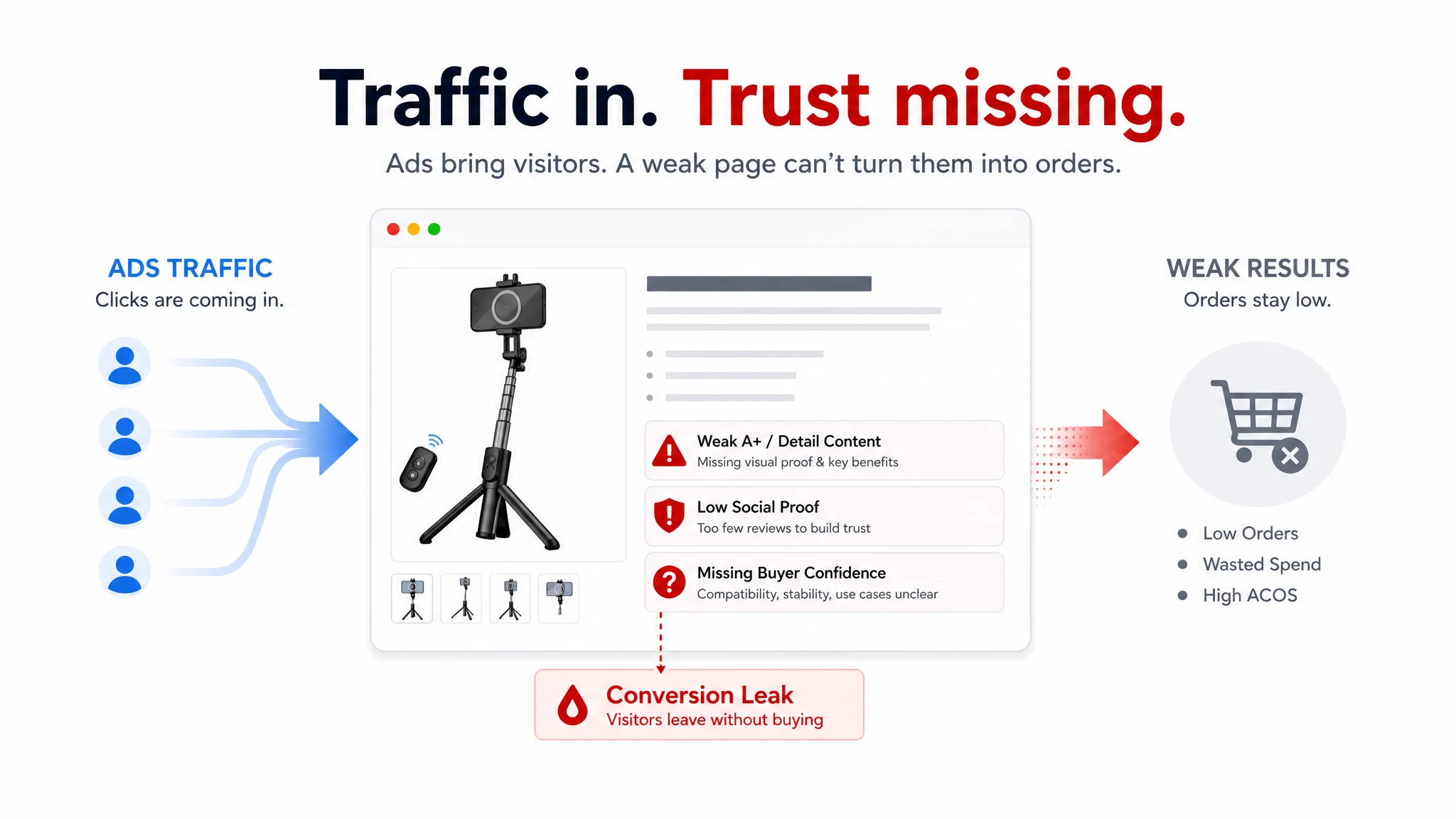
Amazon emphasizes listing completeness and relevance because every content element contributes to the customer decision process. Amazon internal data indicates that Basic A+ Content can increase sales by up to 8%, while Premium A+ Content can increase sales by up to 20%. These figures do not make enhanced content a substitute for product quality or accurate targeting, but they demonstrate the commercial value of presenting information more clearly and persuasively.
In the tripod case, the competing listing used A+ modules to explain magnetic strength, material, stability, tilt range, remote connectivity, and compatibility. The target listing offered little structured proof of these points. This created a gap between what the product claimed to do and what a cold shopper could confidently understand. AI-generated content matters when it strengthens this complete performance system rather than simply accelerating copy production. Effective AI workflows should improve keyword structure, clarify benefits, strengthen visual communication, and connect changes to CTR and CVR feedback while preserving product authenticity.
Breaking Down Traditional Listing Creation: The Pain Points
Traditional listing creation is rarely a single writing task. It is a chain of research, judgment, production, review, and delivery steps, and every step can slow the listing cycle time.
Keyword research alone may require sellers to inspect competitor titles and bullet points, trace recurring search terms, compare keyword placement, and determine whether those terms align with customer pain points and product benefits. Seller teams commonly describe this work as repetitive but difficult to delegate because a weak interpretation can affect discoverability, CTR, and eventually CVR. Manual competitor searches, listing scoring, and weakness identification consume operating time before any copy is produced.
Copywriting adds another layer of effort. A seller must restructure the title and bullets around search relevance while preserving clarity, differentiation, supporting evidence, and conversion logic. Image selection is equally subjective. Designers or brand teams may choose assets that look polished, yet visual appeal alone does not establish that an image will improve clicks or support conversion. The result can be repeated revisions without a clear connection to CTR or CVR.
The tripod listing showed how these tasks can be completed individually while still failing as a system. The original title mentioned the product type and a selfie monitor use case, but it did not make high-intent terms such as “MagSafe” and “Android” sufficiently prominent. The image gallery showed product features and configurations, but several visuals communicated technical claims without concrete proof. The bullets used understandable emotional hooks such as “No More Fumbling” and “No Slip, No Drop,” yet did not consistently connect those claims to specifications, compatibility, or real use scenarios.
The seller’s team therefore had content in place, but not a complete decision path. They responded by focusing on bids and keywords because the visible symptom was weak advertising efficiency. The deeper issue was that the page had not translated product features into evidence that a first-time buyer could evaluate. This is why listing creation should be treated as a coordinated conversion process rather than a collection of separate production tasks.
Testing introduces a separate operational challenge. For a general seller, comparing alternative titles, images, or value propositions requires controlled changes, sufficient traffic, disciplined timing, and reliable interpretation. Without a structured testing process, teams may confuse normal performance fluctuations with the effect of a listing change. They can spend resources testing variations while gaining limited confidence about the impact on CTR, CVR, ACoS, or BSR.
Scale makes the problem more severe. Sellers managing multiple SKUs must maintain consistent brand language, visual standards, keyword logic, and compliance details across every listing. The workflow is often divided among diagnosis, planning, copywriting, design, approval, and upload, creating handoff delays and interpretation errors. For portfolios with hundreds of listings, downloading, renaming, logging in, and uploading assets one by one turns optimization into a batch-operation bottleneck.
The core issue is not simply that manual work is slow. It is fragmented, difficult to standardize, and hard to connect with measurable performance outcomes—creating the need for a more coordinated, AI-assisted workflow.
How AI Fundamentally Changes Listing Content Generation
AI changes listing production by compressing the distance between research, drafting, revision, and deployment. Instead of starting each title or bullet point from a blank page, sellers can provide product attributes, customer pain points, existing copy, competitor signals, and keyword priorities. The system can then turn those inputs into structured drafts, reducing listing cycle time and freeing operators to focus on judgment, compliance, and performance analysis.
Claims such as “10× faster” or reducing creation from several hours to under 15 minutes should be treated as contextual benchmarks, not universal outcomes. The actual gain depends on data quality, listing complexity, approval steps, and how much human editing is required. Even a smaller reduction in cycle time can allow teams to test more products, refresh weak listings sooner, and respond faster when CTR, CVR, ACoS, or BSR indicate a problem.
Keyword integration is another fundamental shift. AI can extract relevant search terms from existing listings and competitor data, remove redundant wording, and place priority terms where they support both search relevance and readability. This is more useful than simple keyword stuffing: a strong workflow connects each term to a meaningful product benefit and buyer intent. Better alignment may support organic visibility and conversion, but keyword insertion alone does not guarantee higher traffic or CVR.
The magnetic tripod case shows why context matters. The seller had been trying to push terms related to “MagSafe tripod” through advertising, but the title did not fully match the way buyers searched for the product. The benchmark competitor led with “Magnetic Tripod for iPhone MagSafe,” identified “67-inch” height, named Android compatibility, and connected the product to vlogging, recording, and content creation. The target title was not completely wrong, but it was not carrying enough of the relevance and use-case burden. AI could help restructure that title, but only after the competitive evidence clarified which search intent and product proof mattered.
AI also makes consistency easier to manage across a larger catalogue. Product constraints, terminology, formatting rules, and approved positioning can be applied repeatedly, helping preserve a recognizable brand style across markets and contributors. That is scalable governance rather than proof of a fully automated brand voice; human review remains necessary to protect accuracy and nuance.
Finally, AI can generate multiple copy directions for review, allowing teams to compare different benefit hierarchies, openings, and keyword emphasis before publishing. The strongest process is not “generate and publish.” It is diagnose, instruct, generate, validate, and refine. AI supplies speed and repeatability, while reliable inputs and experienced oversight determine whether that speed produces stronger CTR, CVR, ACoS, and BSR outcomes.
The Role of Product Research in Fueling AI-Generated Content
AI can produce a polished title, bullet set, image brief, or A+ content draft in minutes. Yet speed does not make an unviable product attractive. Effective listing content begins with evidence that buyers want the product, can find it, and have a reason to choose it.
Product research first validates demand through category sales signals, conversion indicators, and the search terms buyers actually use. It then frames the competitive environment by comparing genuinely comparable products—not simply the category bestseller. Useful comparisons account for function, price range, use case, and target audience. This prevents sellers from treating unrelated products as valid benchmarks and helps reveal realistic differentiation opportunities.
In the magnetic tripod case, the useful comparison was not a generic top seller. DeepBI anchored the analysis to a closely matched listing in the MagSafe, tall-tripod, and vlogging space. That comparison revealed that the target product was not losing primarily because its title or main image was unusable. The larger weakness was deeper in the page: Detail/A+ Content scored 0 against the benchmark’s 22, and reviews scored 3 against 13. The competitive context changed the diagnosis from “we need more advertising pressure” to “we need a stronger conversion environment.”
Keyword analysis adds another layer. By examining competing titles and bullet points, sellers can identify recurring search terms, high-converting attributes, and gaps in how customer needs are addressed. These findings should become a clear positioning brief covering the target audience, verified product advantages, priority selling points, and content gaps.
For the tripod, that brief would need to connect “MagSafe,” Android compatibility, height, magnetic strength, stability, remote usability, and real shooting scenarios. These were not interchangeable claims. Each addressed a different buyer concern: whether the product would fit the phone, remain stable, be easy to use, and support actual content-creation situations.
AI-generated content works best as the execution layer for that brief. Validated market signals can guide which attributes receive greater prominence, how bullets are structured, and which visual claims deserve emphasis. This can support stronger CTR and CVR, more disciplined ACoS management, and a shorter listing cycle time without sacrificing accuracy. The product’s real specifications must remain the source of truth; AI should not invent functions, materials, or benefits.
Product research is therefore a strategic prerequisite, not a standalone DeepBI feature. Tools such as DeepBI may support data-driven market health assessment and content execution, but the commercial decision still depends on demand evidence, competitive context, keyword opportunity, customer fit, and defensible differentiation.
Keyword Exploration: The Foundation of AI-Optimized Listings
AI-generated listing content is only as effective as the search and buyer-intent signals behind it. A seller can produce polished copy quickly, yet still see weak CTR, low CVR, or limited BSR movement if the content is built around assumptions rather than commercially relevant keywords.
High-converting terms can be identified through Amazon Search Term Reports, which reveal the queries associated with advertising traffic and sales. Third-party keyword tools can add market-level context by showing search demand, competitive positioning, and related phrases. Used together, these sources help separate attractive-sounding keywords from terms that reflect genuine shopper intent.
AI should not simply insert every discovered term into a listing. It can interpret the relationship between keywords, product attributes, and customer needs, then assign them to the appropriate content layer:
- Titles can prioritise the core product term, defining attributes, and relevant qualifiers.
- Bullet points can connect secondary keywords to specific buyer problems and product benefits.
- Backend search terms can capture relevant variations that support indexing without making the visible copy difficult to read.
The tripod listing demonstrates the difference between keyword presence and keyword usefulness. Its original title included the product category, but terms such as “MagSafe” and “Android” were not leveraged with the same clarity as the benchmark competitor. The proposed restructuring placed “Magnetic Selfie Stick Tripod,” “for iPhone MagSafe,” and “Metal Ring for Android” closer to the product’s core identity, then connected height, remote use, rotation, vlogging, and content creation to recognisable buyer scenarios.
This semantic approach is stronger than keyword stuffing because it supports both search relevance and customer comprehension. A keyword may contribute to discoverability, but the listing still needs accurate claims, clear structure, persuasive benefits, and supporting visual content to influence CVR and long-term organic performance.
DeepBI’s Organic module can extend this process by identifying winning keywords from advertising data and highlighting terms that support organic-ranking priorities. Those signals can inform listing optimisation and content emphasis, while performance feedback helps teams evaluate effects on CTR, CVR, ACoS, and BSR. Keyword research remains part of a broader optimisation workflow, not a standalone guarantee of ranking or conversion.
Amazon PPC Tools and AI-Driven Listing Performance
Paid campaigns can put a listing in front of more shoppers, but traffic alone does not guarantee profitable growth. If the main image, title, bullets, and detail-page content fail to match the shopper’s intent, impressions may generate clicks without sufficient conversions. The result can be weak CTR, low CVR, rising ACoS, and higher bid requirements.
This was precisely the initial interpretation of the magnetic tripod seller. Impressions were growing, but orders and ROAS lagged expectations. The team repeatedly adjusted bids, keywords, and match types to push terms such as “MagSafe tripod.” The operating assumption was that the auction or targeting structure was the main constraint.
DeepBI’s Listing score provided a different sequence for action. The product scored 47/100 against a comparable benchmark at 84/100. Title, main image, and bullet scores were only slightly behind, but A+ / Detail Content was effectively missing and review trust was weak. The conclusion was not that advertising had no role. It was that advertising was already sending traffic into a page with insufficient conversion capacity.
DeepBI’s AdsQuant module frames PPC management as a four-layer traffic funnel:
- Discovery: Expand visibility across relevant search terms and audience opportunities.
- Filtering: Remove inefficient traffic and identify queries that generate meaningful engagement.
- Precision: Concentrate spend on high-intent keywords, products, and listing messages.
- Scaling: Extend profitable traffic patterns while monitoring CTR, CVR, ACoS, and conversion volume.
The listing and the funnel reinforce one another. Advertising data can show which attributes attract clicks and which fail to convert. Those signals can guide keyword weighting, image direction, title emphasis, and detail-page reconstruction. Optimization instructions should remain specific and grounded in verified product facts—for example, defining composition, lighting, or selling-point emphasis rather than asking for a vague “better” visual.
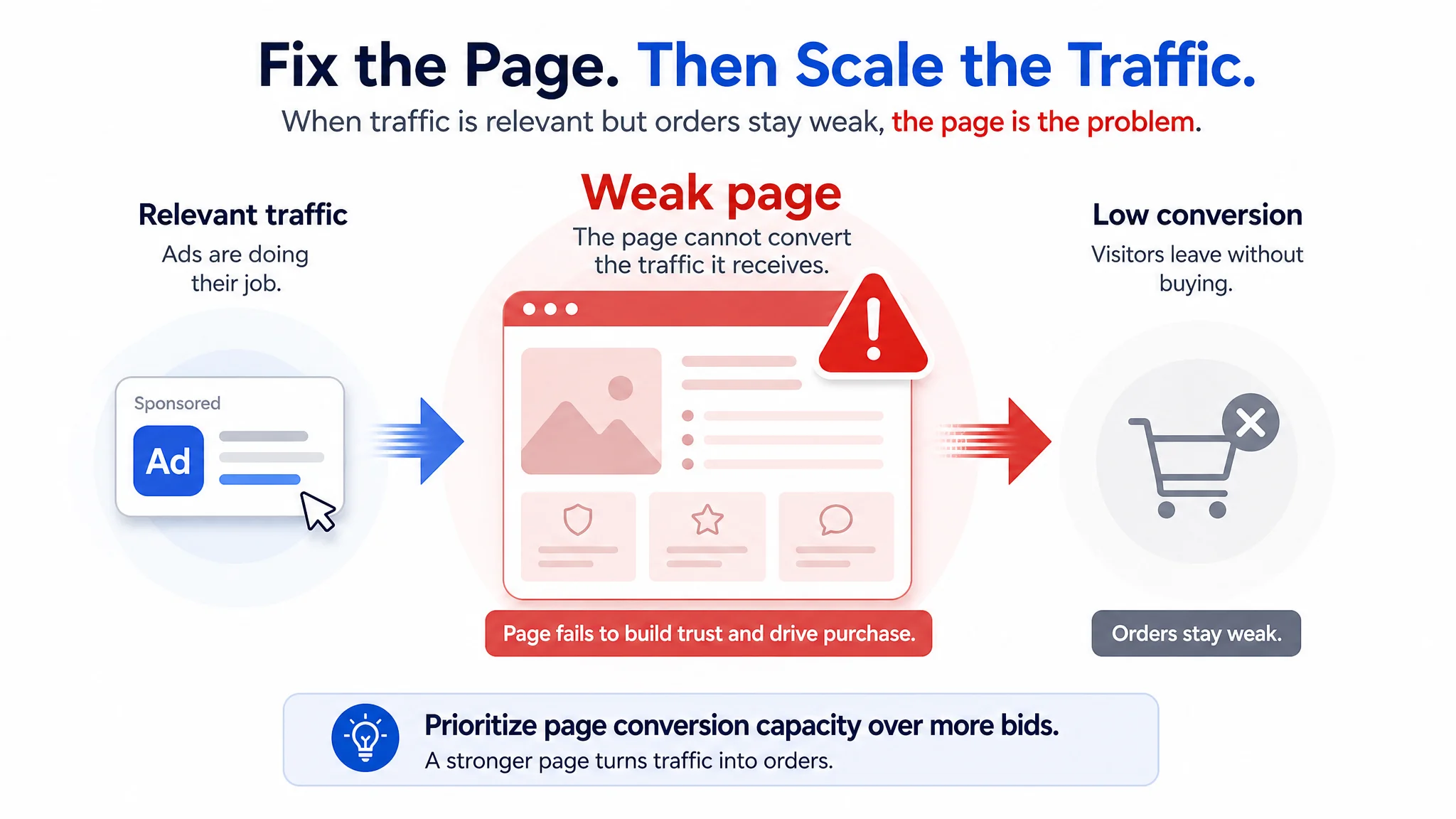
A useful diagnostic rule follows from the case: when ads are producing relevant traffic but orders remain weak, do not assume that more bid adjustments are the next step. Check whether the page explains the product’s value, resolves compatibility questions, demonstrates performance, and provides sufficient trust. Advertising does not only amplify advantages. It can also amplify the defects of an under-built page.
Hypothetical directional example: 14 days after a listing update. A product receives the same approximate advertising exposure, while its main image and key selling-point copy are made more relevant to the targeted search intent. A directional outcome might be a 5%–15% CTR increase and a 3%–10% CVR increase. These are illustrative ranges, not reported DeepBI results. If conversion signals strengthen, the campaign can prioritise the improved traffic segments and test whether bids can be reduced without sacrificing sales volume, potentially supporting lower ACoS.
Next-Gen Ad Automation Enhancing Listing Effectiveness
Advertising automation delivers more value when it operates as part of the listing optimisation process, not as a separate campaign-management task. A listing may attract impressions but lose potential buyers through a weak CTR, or generate clicks while underperforming on CVR because the content does not resolve customer concerns. Treating these signals independently can leave sellers adjusting bids without addressing the commercial weakness behind the result.
DeepBI supports a monitored feedback loop between Amazon advertising data and listing improvements. It dynamically tunes bids and budgets each day, using seven-day performance windows to reduce overreaction to isolated fluctuations. These adjustments should still be reviewed by operators: campaign performance, CTR, CVR, ACoS, and budget deployment require ongoing interpretation rather than a set-and-forget approach.
The magnetic tripod case shows why sequencing is important. The seller wanted to continue improving ads first, but the listing comparison showed missing A+ structure, limited quantified proof, under-explained compatibility, and a review base that offered little social validation. Continuing to increase traffic before addressing those gaps would have placed more spend into a low-trust environment. The more appropriate sequence was to rebuild the page’s decision logic and then reassess advertising performance.
The same performance data can guide the next content cycle. When advertising signals identify attributes or visual features associated with stronger conversion, those insights can inform title, image, A+ content, and broader listing-generation decisions. A full-funnel diagnostic approach makes the workflow more precise:
- Weak CTR can point to a click-generation problem, such as an ineffective main image or unclear value communication.
- Strong traffic but weak CVR can indicate a listing-content or trust gap that prevents shoppers from completing the purchase.
- A content revision can then be evaluated against subsequent advertising performance before the next change is prioritised.
For the tripod page, the proposed visual revisions were tied to concrete doubts rather than general aesthetics: height and stability, magnetic strength, tilt flexibility, compatibility, and real-world use. The A+ structure was designed to show quantified proof, usage scenarios, and onboarding guidance. This is a more useful form of advertising feedback because it translates weak conversion into specific content questions.
This creates a practical operating sequence: identify the funnel bottleneck, refine the relevant listing element, observe the resulting Amazon data, and feed the findings into the next optimisation cycle. Fresh conversion data strengthens the evidence behind content decisions, while improved CVR can give sellers greater confidence when considering additional ad-spend scaling. The decision remains data-supported, not automatic.
Accurate Sales Data Analysis and Predictions with AI
AI-generated listing content should be judged by Amazon performance data, not by how polished the copy appears. Sales trends, CTR, CVR, ACoS, TACoS, and the balance between organic and advertising-driven orders provide a more reliable view of listing health. A sales increase supported only by higher ad spend may indicate traffic expansion, not stronger content. By contrast, improving CVR alongside stable or improving ACoS can suggest that the detail page is converting qualified traffic more effectively.
DeepBI’s Ads and Organic capabilities aggregate Amazon-sourced signals such as impressions, clicks, orders, CTR, CVR, advertising conversions, ACoS, TACoS, and organic sales. These signals can be compared with listing-score findings to identify where the funnel is weakening. Low CTR may justify revisiting the main image or title, while low CVR may point to gaps in product explanation, trust signals, or A+ content. After an update, sellers can anchor the change to its publication date and observe performance trends, including the CTR slope over a subsequent 7–14-day comparison window.
The case provides a practical example of why this interpretation must be layered. The target tripod had a 5.0-star rating, but only three reviews, while the benchmark had a 4.8-star rating and 31 reviews, including detailed text, photos, and videos. Looking only at star rating could lead a seller to conclude that review quality was strong. Looking at review depth and comparative trust produced a different diagnosis: a small perfect rating can appear unproven, while a larger body of slightly imperfect reviews may provide stronger validation.
Predictions are trend-based inferences drawn from recurring sales, conversion, advertising-efficiency, and organic-performance patterns; they are not a separate profit-checking feature. TACoS is particularly useful as a sustainability signal: if organic sales rise while dependence on paid traffic declines, the listing may be building healthier growth and supporting stronger BSR. Neither a lower TACoS nor a higher CVR proves net profitability. The practical action is to use these metrics to prioritise the next listing iteration, then validate that decision through continued Amazon data feedback.
AI-Powered Tools for Powerful Listings: A DeepBI Perspective
Listing optimisation often fails because diagnosis, creative production, and publishing are handled as separate tasks. DeepBI Listing connects them into one workflow: intelligent scoring identifies gaps, benchmarking establishes a relevant performance standard, AI generates improved assets, and authorised SP-API synchronisation moves approved changes into the Amazon catalogue.
The diagnostic layer evaluates titles, images, bullet points, A+ Content, and review or Voice-of-Customer signals. Rather than producing an abstract score, it links the score to specific weaknesses in text logic, visual hierarchy, or shopper communication. Competitive benchmarking adds context by matching the product against relevant ASINs based on factors such as product form, use case, price band, audience, and market validation. A random top seller is not automatically a useful benchmark; the comparison must reflect the product’s actual competitive environment.
The magnetic tripod diagnosis demonstrates the value of this structure. A single overall score of 47 might have encouraged a broad content rewrite, but the dimension-level comparison showed where the commercial problem was concentrated:
- Title: 13 versus 15
- Main image and gallery: 24 versus 26
- Bullet points: 7 versus 8
- Detail/A+ content: 0 versus 22
- Reviews and ratings: 3 versus 13
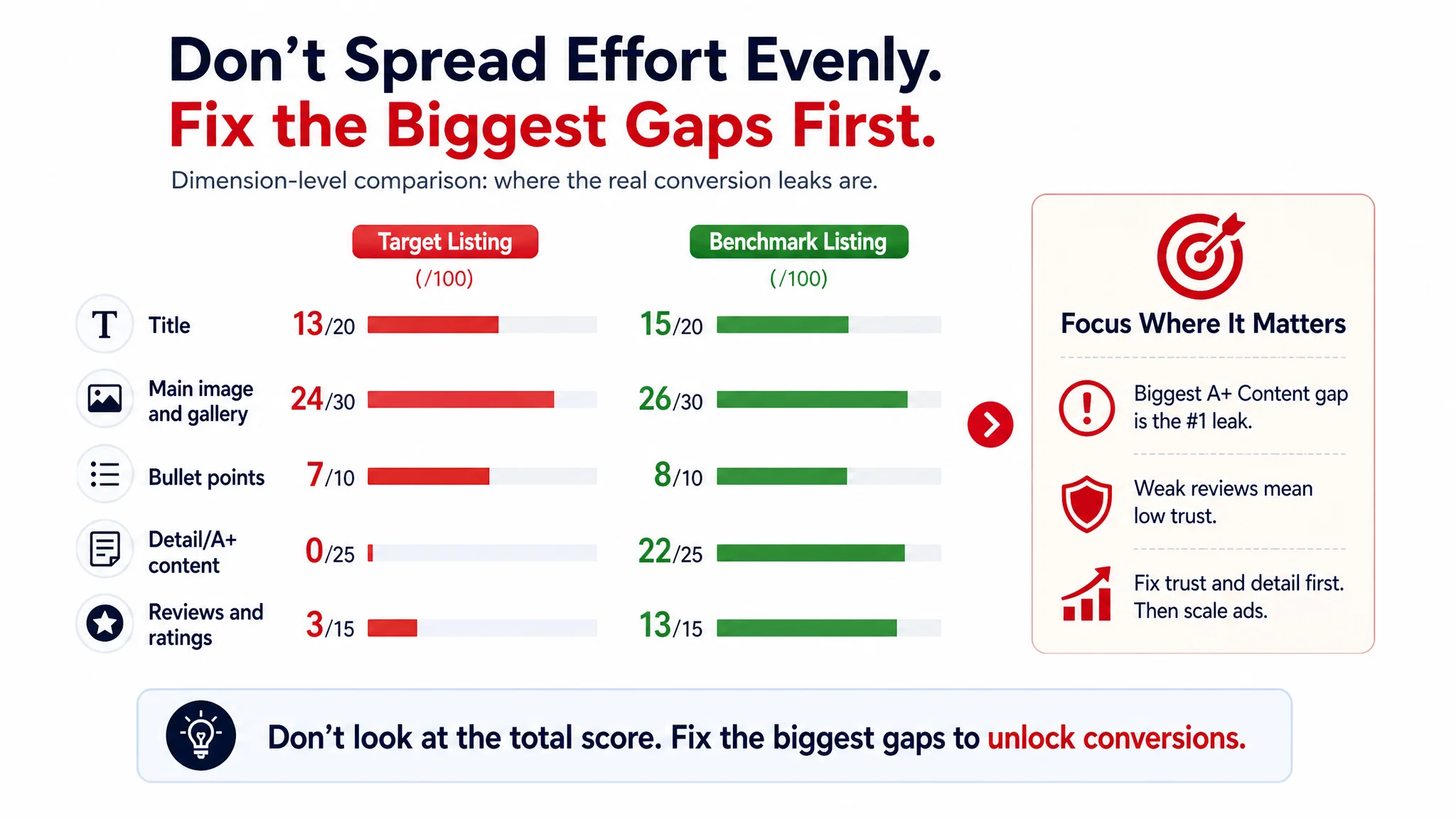
This distribution prevented the seller from treating every part of the listing as equally weak. It showed that the page was not primarily failing because the product was invisible or because the top-of-page assets were unusable. It was failing because the deeper decision and trust layers were largely absent.
DeepBI’s multi-agent workflow then converts these findings into structured instructions for SEO-oriented copy and conversion-focused visuals. Title and bullet recommendations balance search relevance with readability, while image and A+ generation can address composition, lighting, scene structure, and information hierarchy. Product DNA serves as a hard constraint, helping preserve the product’s actual structure, materials, logo, and other immutable attributes rather than allowing a general-purpose AI tool to introduce misleading changes.
For the tripod, AI-assisted generation could turn a feature list into a coordinated visual path: a hero image for product recognition, height and stability scenes, multi-mode use cases, an overhead shooting example, magnetic-strength visualisation, and A+ modules for compatibility, remote use, and setup. The goal is not to make the page more decorative. It is to ensure that each asset answers a question that may otherwise block conversion.
Consider a hypothetical brand whose listing score rises from 60 to above 90 after its content and visual gaps are addressed. If the improved listing communicates the product more clearly to qualified shoppers, a corresponding CVR lift could be observed; the exact outcome would depend on traffic quality, price, reviews, offer strength, and category conditions. Across appropriately supported optimization contexts, brands may observe approximately 15–25% CVR improvement, but this should be treated as a contextual pattern, not a guaranteed result.
Once approved, assets can be applied through one-click SP-API synchronisation instead of downloading, renaming, and uploading files manually. DeepBI also records a visual iteration event that can be compared with subsequent CTR and advertising data, creating a practical feedback loop from diagnosis to measurable execution.
Key Metrics That Prove AI Content Effectiveness
AI-generated listing content should be judged through observable Amazon KPIs, not through claims about speed or writing quality alone. Start with DeepBI’s Listing Score, a 100-point benchmarking metric that compares a listing with a dynamically selected, closely matched Benchmark ASIN. It evaluates major components such as the main image, title, five-point description, A+ content, and customer feedback. Track both the overall score and component-level changes, because a higher total score is more useful when the underlying improvement is clear and comparable.
The tripod assessment shows why component-level tracking matters. The 47 versus 84 total-score gap was not evenly distributed. A+ content and reviews represented the largest differences, while title, main image, and bullets were relatively close. This made the next action more precise: rebuild the missing decision engine and strengthen the evidence supporting the purchase, rather than simply rewriting every visible element.
Next, connect content changes to funnel performance. CTR indicates whether the search-page presentation and main image attract clicks; CVR indicates whether the detail page converts those visits into orders. For example, a low CTR alongside a weak main-image score can point to an ineffective visual hook. A low CVR alongside gaps in A+ content, reviews, or product-detail communication may indicate that the listing is not building sufficient trust. The archive uses CTR below 0.35% and CVR below 7% as diagnostic examples, not universal targets.
Measure operational impact separately. Record the time from approved content to a live listing. A workflow described as taking about 30 minutes versus a seconds-level publishing process can materially reduce listing cycle time, but faster publishing does not prove stronger sales performance.
For performance validation, establish a pre-change baseline and a defined post-publication window. After a new image or other asset goes live, use the publication event as the time anchor and review CTR over 7–14 days while keeping traffic, price, inventory, promotions, and advertising settings as comparable as possible. Track organic ranking or BSR movement separately from paid results using consistent keyword groups.
Finally, monitor ACoS, TACoS, impressions, clicks, conversions, and sales. Attribute sales lift only after a suitable observation period and account for simultaneous changes. Compare before and after by listing type or asset type, then examine whether higher Listing Scores correlate with stronger CVR rather than treating correlation as proof of causation.
Best Practices for Integrating AI into Your Amazon Listing Strategy
Start with competitor benchmarking, not content generation. Select genuinely comparable ASINs based on functional and semantic relevance rather than choosing a bestseller simply because it ranks in the same category. Review the competitor’s main image, title, bullet points, A+ content, and customer feedback to identify measurable gaps in positioning, presentation, and keyword coverage. Without a reliable benchmark, AI can produce polished content that addresses the wrong commercial problem.
The magnetic tripod comparison shows how quickly the wrong benchmark logic can lead to the wrong operating decision. The seller’s initial focus was advertising efficiency, but a closely matched competitor revealed missing A+ modules, weaker proof of stability and compatibility, and a much thinner review base. Benchmarking therefore did more than inspire creative ideas; it changed the order in which the seller should invest time and budget.
Use AI to convert those findings into drafts and recommendations, not final listings. A useful workflow translates diagnosed gaps into specific copy, layout, image, and keyword actions. The seller should then review, customise, or reject each suggestion. AI must remain grounded in verified product attributes and must not invent specifications, materials, accessories, or performance claims. For visual content, product authenticity is equally important: product assets and established product details should take priority over creative variation.
Keep the brand voice under human control. AI drafts should be aligned with approved terminology, positioning, customer promise, and marketplace compliance standards before publication. Seller expertise remains essential for deciding whether a recommendation fits the brand, the product, and the intended customer.
Adopt controlled iteration rather than replacing every asset at once. Generate and compare multiple versions of images or copy, assess them against the current listing, and selectively publish the strongest candidate. After implementation, connect visual or copy changes to advertising data. Impressions, clicks, CTR, CVR, ACoS, and TACoS can reveal whether a revision attracts qualified traffic and supports conversion. Advertising signals can also identify high-converting keywords and product attributes for the next title, bullet, or image revision.
For visual content, start with buyer doubts rather than aesthetic preferences. In the tripod case, the relevant questions were whether the product was tall enough, stable enough, strong enough magnetically, compatible with different phones, flexible enough for different angles, and easy to use. A gallery built around those decision points is more commercially useful than a collection of attractive but disconnected feature images.
Finally, track organic effects alongside paid performance. Monitor changes in ranking, BSR, and qualified traffic after each controlled update, then feed those observations into the next optimisation cycle. The best operating model is collaborative: benchmark, diagnose, draft, edit, test, measure, and refine—with the seller retaining final authority at every publication decision.
Frequently Asked Questions About AI Listing Content
Is AI-generated listing content duplicate?
Not automatically. AI can produce new wording and visual directions, but originality depends on the inputs and review process. Competitor listings may inform composition, lighting, or market positioning; copying their product details, industrial design, patented structures, or distinctive claims creates risk. Sellers should verify that every title, bullet, description, and image reflects their own product and brand. Human review remains essential for originality, accuracy, and brand consistency.
A benchmark should provide decision context, not become a template to copy. In the tripod example, the competitor’s use of magnetic-strength modules, stability explanations, and compatibility guidance revealed missing communication layers. The target listing still needed to express its own verified features, specifications, and product design. Competitive evidence should improve diagnosis without erasing product authenticity.
Does Amazon penalise AI-generated content?
There is no basis for assuming that AI authorship alone guarantees either safety or higher ranking. Amazon requirements still apply to the finished listing, including title limits, image specifications, factual accuracy, and product representation. Content that violates platform standards may be blocked or create performance risks, regardless of how it was produced. AI must not invent materials, dimensions, functions, accessories, or usage effects. Sellers should validate all claims before publication and monitor CTR, CVR, ACoS, and BSR rather than expecting an automatic ranking benefit.
How quickly should sellers expect results?
Updating a listing starts a measurement cycle, not a guaranteed growth event. After a new asset is published, sellers can observe CTR movement over a documented 7–14-day window, while CVR, ACoS, and BSR may require additional context and traffic. Results depend on the quality of the change, audience response, advertising mix, price, reviews, and competitive conditions. Compare the old and new asset against a clear baseline before drawing conclusions.
Is AI listing content suitable for every category?
It can support many categories, but recommendations should not be treated as interchangeable. Product function, price range, audience expectations, category benchmarks, and compliance requirements all affect the appropriate message and visual treatment. Regulated or specification-sensitive products require especially careful fact checking. AI should execute against verified product data, not fill gaps with assumptions.
How can AI content work with A+ Content?
A listing should be evaluated as a complete conversion system, not as a main image alone. If CTR is acceptable but CVR remains weak, review A+ fullness, comparison tables, trust elements, usage scenarios, information density, and core selling points. AI can help structure or refine these assets while keeping the brand identity and product facts unchanged.
The magnetic tripod page is a clear example of why this matters. Its top-of-page assets were not dramatically behind the benchmark, but its A+ / Detail Content scored 0 versus 22. The missing modules could have explained magnetic strength, stability, tilt, remote connectivity, and compatibility through quantified proof and usage scenarios. A+ content should therefore be treated as part of the conversion path, not as optional decoration added after the main listing is complete.
Why is human review still necessary?
Users should compare proposed assets with existing ones, select individual replacements, and approve each change before publication. This final review helps catch hallucinated features, inaccurate specifications, brand inconsistencies, and Amazon compliance issues before they affect the listing.
Human review also determines whether the diagnosis has been translated correctly. A seller may know that a particular material, compatibility condition, or usage limitation requires careful wording. AI can organise the content, but the seller remains responsible for confirming that the final page represents the actual product.
Conclusion: Smarter Listings, Stronger Amazon Business
How does AI-generated listing content improve Amazon performance?
AI can shorten listing cycle time by turning research, drafting, and asset preparation into a more structured workflow. Speed alone, however, is not the measure of success. The stronger test is whether improved content contributes to higher CTR, CVR, better organic visibility, and more efficient advertising performance through metrics such as ACoS and TACOS. Seller judgement remains essential for checking accuracy, compliance, brand fit, and product consistency.
The magnetic tripod case reinforces this distinction. The seller initially treated weak orders as an advertising problem and kept adjusting campaign inputs. Competitive diagnosis showed that the larger constraint was a page with a 47/100 Listing score, missing A+ content, limited proof, and thin review trust. The lesson is not that advertising was irrelevant. It is that advertising could not compensate for a listing that had not yet built enough conversion capacity.
How does DeepBI operationalise listing optimisation?
DeepBI connects diagnosis, recommendations, production, and delivery rather than treating AI copy generation as an isolated task. Its scoring workflow uses inputs such as Score_Report.json alongside Amazon performance signals, including impressions, clicks, orders, CTR, and CVR, to identify where a listing may be underperforming. The system can then translate detected gaps into executable text and visual instructions. Sellers compare proposed assets with existing ones, approve selected changes, and use the go-live point as a reference for measuring subsequent performance.
That structure turns optimisation from guesswork into a repeatable cycle: diagnose, improve, publish, measure, and refine. It also preserves product truth by prohibiting invented specifications, features, materials, or physical attributes.
In the tripod case, this workflow made the operating bottleneck visible. The seller did not need to keep pushing traffic into an unchanged page. They needed to connect search intent, feature proof, use scenarios, A+ content, compatibility guidance, and review trust into one persuasive path. DeepBI’s role was to recenter the decision on conversion fundamentals before further ad scaling.
What should sellers do next?
Start with a selected group of listings, provide accurate product information and authorised SP-API access, and establish a baseline for CTR, CVR, organic ranking, ACoS, TACOS, and listing cycle time. Use AI to accelerate execution, but retain human review before publishing. Amazon’s reported data that more than 400,000 sellers have used AI listing tools indicates that adoption is growing; the practical advantage will belong to sellers who combine that adoption with disciplined measurement and informed oversight.
Before increasing advertising spend, ask whether the listing can carry the traffic it is receiving. Does it show concrete proof of the product’s main benefits? Does it answer compatibility, stability, usage, and trust questions? Do the title, images, bullets, A+ content, and reviews form one coherent decision path?
Advertising should be a lever, not a crutch. AI becomes commercially valuable when it helps sellers diagnose the real bottleneck, produce accurate improvements, publish them under controlled review, and measure what happens next. That is how faster content production can contribute to sustained Amazon growth rather than simply creating more content at higher speed.