


Quick Verdict: Should You Use SellerSprite in 2026?
The short answer depends on what you need to analyze. SellerSprite offers strong value for many private-label sellers planning keyword-driven launches, especially when the priority is deep keyword research, listing data, and product-market validation. It may be less suitable if your main challenge is understanding brand positioning, subcategory competition, or how a listing compares visually and semantically with relevant competitors.
- Keyword-driven private-label launches, product research, and listing analysis: More suitable starting point: SellerSprite
- Brand intelligence, subcategory benchmarking, and listing discovery: More suitable starting point: DeepBI
- Diagnosing why an existing listing receives attention but struggles to convert: More suitable starting point: DeepBI
DeepBI is a credible alternative for sellers and brands that want to connect diagnosis with listing optimization. Its workflow can reverse-analyze titles and bullet points to identify core search terms, locate the product’s leaf category, and discover relevant products within that subcategory. It also evaluates titles, bullets, images, A+ content, and customer feedback against comparable listings.
That broader perspective is useful when the goal extends beyond finding keywords to improving listing differentiation and conversion-focused execution. DeepBI’s scoring service is positioned as an automated market health check system, while its optimization workflow connects findings to structured recommendations, generated listing assets, and optional deployment through Amazon SP-API.
A foldable yoga mat listing illustrates why this distinction matters. The page contained specifications, usage images, and material information, but its overall score was 67 out of 100 compared with 88 for a comparable high-performing listing. The team initially focused on adding or refining product information. A deeper comparison found that the bigger issue was not a lack of content, but the absence of a persuasive path from the foldable design to buyer confidence. The title, main image, bullets, A+ content, and reviews were not working together to answer why the product was worth choosing.
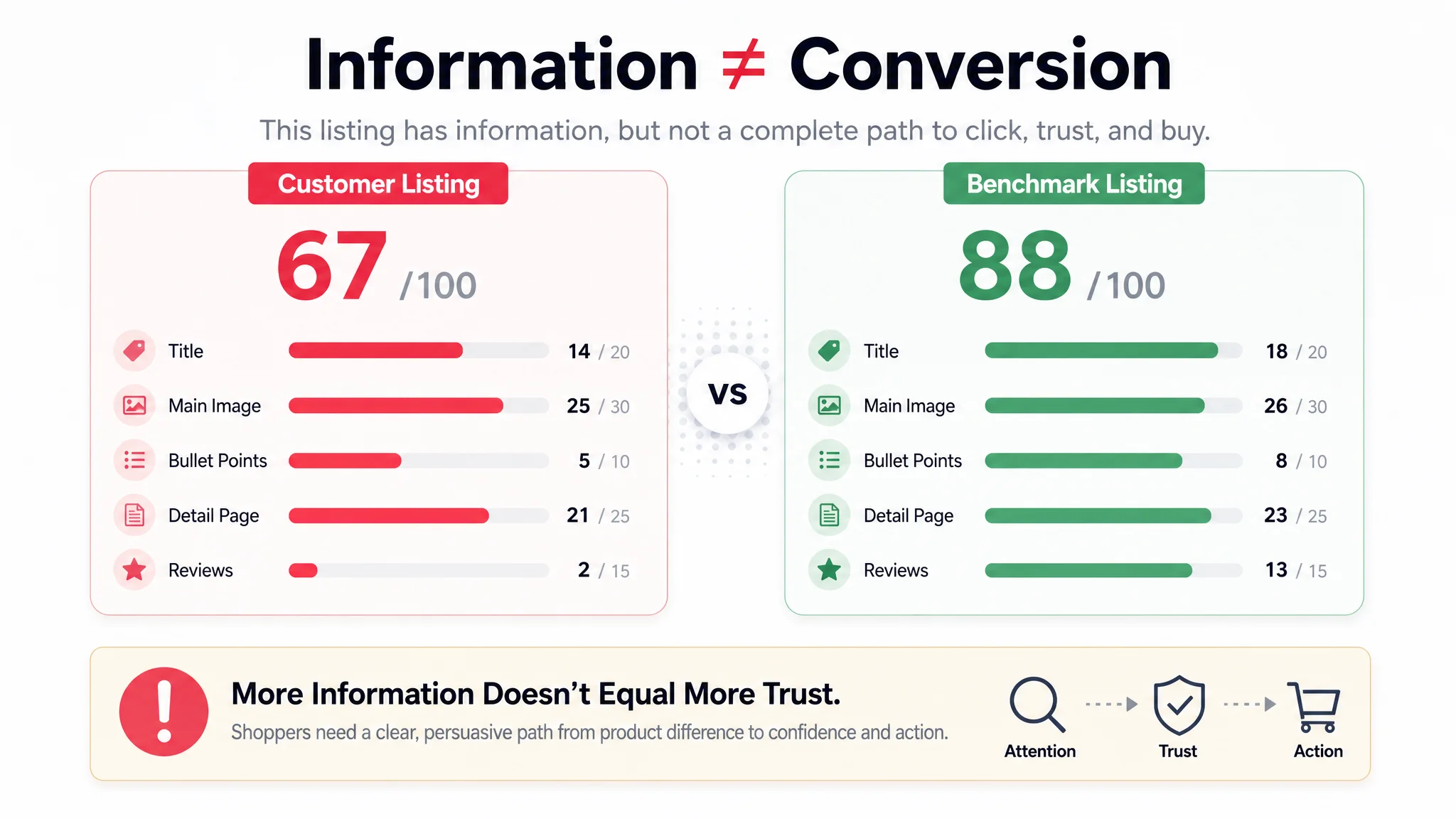
That kind of diagnosis is different from keyword discovery. The page had information, but it did not clearly explain why a shopper should click, trust, and buy. This is why sellers should distinguish between a research bottleneck and a listing-conversion bottleneck before selecting a tool.
Neither tool should be treated as a universal winner. Sellers should compare the workflow against their primary KPI priorities: keyword coverage and listing cycle time on one side, or brand intelligence, competitive differentiation, and potential CTR or CVR improvements on the other.
Who SellerSprite Is Actually Built For
SellerSprite is best suited to private-label sellers with moderate Amazon experience who want to connect product research, keyword discovery, and launch planning in one workflow. It is not positioned primarily as a brand-spotting or wholesale intelligence tool. Its strongest fit is the seller building or refining a product around a searchable customer need and then translating that opportunity into a competitive listing.
This makes it particularly relevant for sellers who prioritize:
- In-depth keyword research to identify demand, search intent, and listing opportunities
- Listing optimization designed to improve CTR and CVR
- Product validation before committing to inventory and launch work
- A unified research process rather than separate tools for every stage of private-label planning
For this user, SellerSprite can function as an all-in-one platform: research begins with the product opportunity, moves through keyword and competitor analysis, and supports the planning required to prepare a listing for launch. The value is less about discovering an established brand to distribute and more about turning market and search data into a private-label decision.
However, sellers should be careful not to treat every weak listing result as a research problem. In the foldable yoga mat example, the product page already contained relevant product information and use cases. The initial direction was to add more specifications, exercise scenarios, and feature descriptions. The diagnostic comparison showed that the page was not primarily failing because the product had not been researched sufficiently. It was failing because the existing differences were not presented in the order shoppers needed.
That distinction is important for private-label operators. SellerSprite can help determine what market demand exists and which terms matter, but it does not automatically establish whether a product page can turn those terms into confidence. If the product receives traffic but shoppers do not understand the value proposition, more keyword research may not address the immediate constraint.
Sellers focused mainly on wholesale brand sourcing, retail arbitrage, or detailed brand monitoring may find that SellerSprite is not aligned with their primary research priorities. Some sellers may supplement SellerSprite with specialized tools when they need capabilities outside its keyword-focused private-label workflow. For a growth-focused private-label operator, however, its positioning is clearest when the main objective is improving research depth, listing relevance, and launch readiness rather than spotting brands.
Where SellerSprite Genuinely Leads
SellerSprite’s strongest case is not universal marketplace breadth. Its advantage is the depth of research and listing work it brings into one seller workflow, helping users move from opportunity discovery to launch decisions with fewer disconnected tools.
Keyword and Listing Depth
For sellers focused on improving CTR, CVR, and organic visibility, SellerSprite offers a detailed keyword-to-listing process. Reverse ASIN analysis helps uncover the terms competing products rank for, while traffic-weight scoring helps separate commercially meaningful keywords from less useful volume. Keyword-mining clusters then organize related terms into workable themes instead of leaving sellers with an unstructured export.
Its listing builder extends that research into execution by helping sellers apply keyword findings to listing content. This connection can reduce listing cycle time and make it easier to align titles, bullets, and other content with the intended search strategy. The value is strongest for private-label and growth-focused sellers who need depth rather than a basic product database.
Still, keyword coverage alone does not guarantee conversion. In the foldable yoga mat diagnosis, the title contained core phrases such as “Foldable Yoga Mat,” but the page still scored below the benchmark because the product’s commercial difference was not precise enough. The title used broad descriptions such as “Extra Width & Thick” and “Anti-Tear,” while the benchmark made material, dimensions, thickness, non-slip use, travel suitability, and the included carrying bag easier to evaluate.
The lesson is not that keywords are unimportant. It is that a keyword-rich title can remain weak if it does not also establish precision and credibility. Research tools are most useful when their outputs help sellers create content that both matches search intent and advances the buying decision.
One Platform for the Full Launch Workflow
SellerSprite can support a launch workflow that connects market evaluation, keyword research, competitor analysis, and listing preparation in one platform. Its 16-dimension market scoring gives sellers a structured way to assess demand, competition, and commercial conditions before committing inventory or advertising budget.
DeepBI remains a credible alternative for sellers prioritizing deep Listing diagnosis, structured optimization, AI image generation, and SP-API-based delivery. Its workflow connects diagnosis, planning, production, and application. The distinction is therefore workflow emphasis, not that one platform makes the other unnecessary.
A listing diagnosis can be especially valuable after product selection, when the question changes from “Is there demand?” to “Can this page convert the demand we attract?” In the yoga mat comparison, the listing received a total score of 67 compared with 88 for the benchmark. The gap was distributed across several decision stages:
- Title: 14 versus 18
- Main image: 25 versus 26
- Bullet points: 5 versus 8
- Detail page: 21 versus 23
- Reviews: 2 versus 13
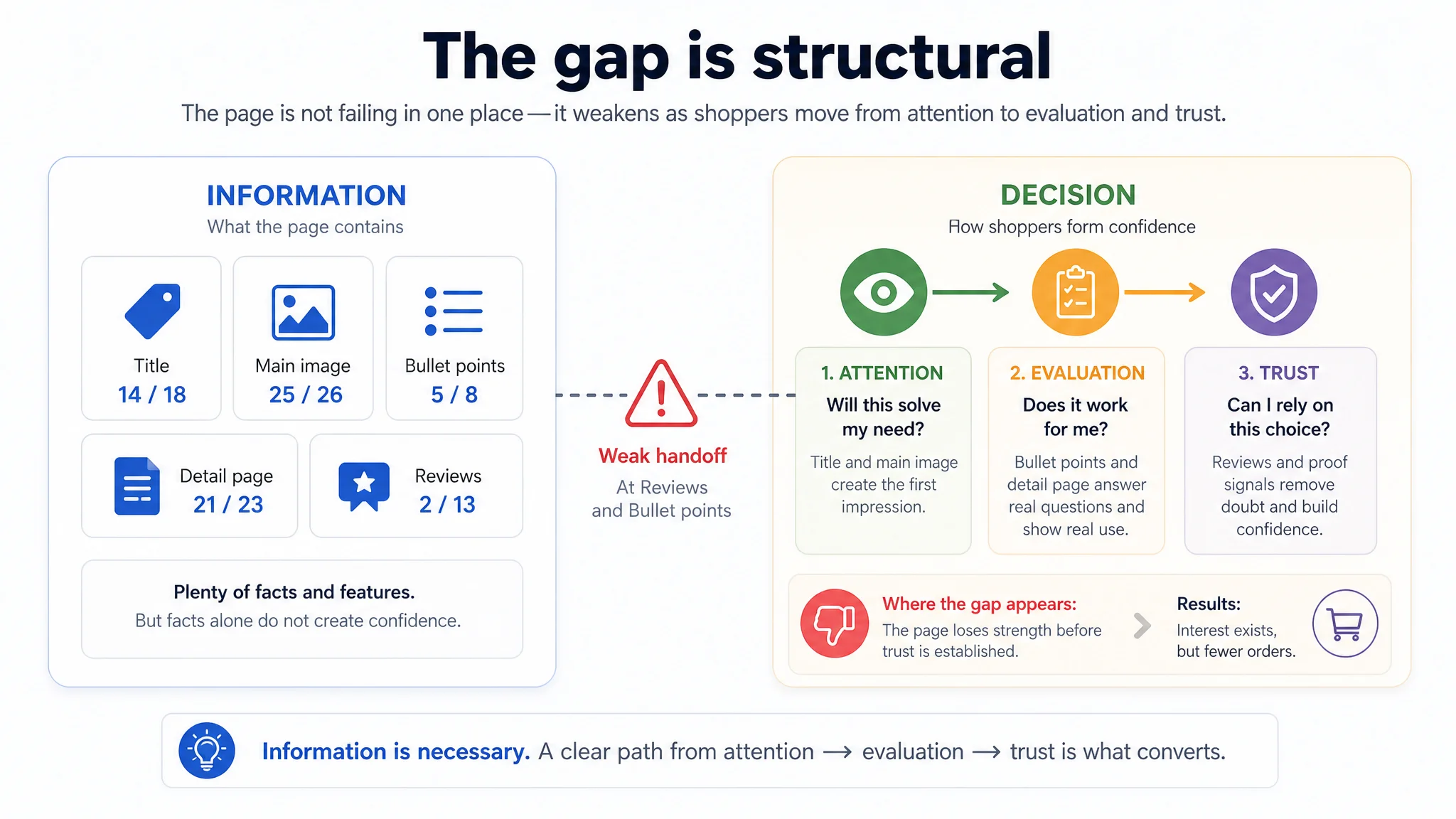
The main-image gap was small, but the bullet-point and review gaps were more consequential. The page was not failing in one obvious location. Its sales logic was weakening as shoppers moved from attention to evaluation and trust. That type of pattern is difficult to identify by looking only at keyword volume or advertising metrics.
Multi-Marketplace Coverage
SellerSprite covers nine major marketplaces, which satisfies many practical needs for sellers operating across established Amazon regions. However, some competitors cover more marketplaces. Sellers with a highly distributed international strategy should compare coverage directly before choosing; marketplace count should be treated as a fit requirement, not an assumed SellerSprite advantage.
Coverage also needs to be evaluated alongside the type of decision the seller is making. A seller validating a new product may care most about demand and keyword data across regions. A seller repairing an existing listing may care more about whether the content, images, reviews, and competitive benchmark are appropriate for the target marketplace.
Where DeepBI Has the Edge (A Balanced Look)
DeepBI’s clearest advantage is not broad market coverage; it is the depth of its Amazon listing diagnostics and similarity-constrained competitor research. For wholesale, brand evaluation, and acquisition research, that distinction matters because a seller needs to understand why a listing trails a comparable ASIN—not simply collect keyword or sales estimates.
The Brand Database
A brand database can be valuable for identifying potential suppliers, acquisition targets, and competitive portfolios. However, the available DeepBI documentation does not substantiate a database of approximately 1.5 million brands. That figure should not be treated as a verified DeepBI capability. Its documented strength is narrower: evaluating a listing against a closely comparable, high-performing ASIN across the main image, title, bullet points, A+ content, and customer feedback.
That benchmark-led approach helps separate a genuine listing weakness from a mismatch between products. In the yoga mat analysis, the comparison was not limited to collecting competitor keywords. It examined how a comparable high-performing listing communicated full-size dimensions, folded dimensions, storage, travel, material, grip, cushioning, usage settings, and customer proof.
This revealed that the customer page was not simply missing more product claims. It was missing connections between those claims. The foldable structure was visible, but the page did not make clear why folding was better than using a conventional rolled mat. A competitor page, by contrast, showed the product in fully unfolded, partially folded, and fully folded states, supported by carrying, storage, and real-use scenes.
The value of this type of analysis is that it explains the competitive gap rather than merely reporting it. A seller can then decide whether the priority is keyword coverage, image sequencing, bullet-point structure, A+ content, or review risk.
The Subcategories Tool
The same caution applies to the often-cited figure of approximately 43,000 subcategories. The available evidence does not establish a standalone DeepBI subcategory-intelligence product or confirm that coverage figure. DeepBI can identify the relevant bottom-level Amazon node and filter comparison products by function, format, price range, and market relevance. This supports more reliable competitor benchmarking without drifting into mismatched products.
The importance of a valid benchmark becomes clear when evaluating conversion. A listing can appear weak against a product that serves a different purpose, price point, or audience. Similarity-constrained comparison reduces that risk and makes it easier to identify which differences are actually relevant to shoppers.
For the yoga mat listing, the relevant comparison focused on practical questions: whether the mat folded into a manageable form, whether it could lie flat, whether the surface provided stable grip, whether the thickness was credible, and whether the product could move between home, studio, outdoor, and travel settings. Those questions were more useful than a generic comparison against unrelated fitness products.
Finding "Orphan" Listings
The available materials do not document orphan-listing discovery as a DeepBI feature. They do support a related diagnostic use case: finding where an ASIN is weak against a valid benchmark in visual presentation, information density, trust content, and review strength. For acquisition or competitor screening, that gap analysis can reveal listing improvement opportunities and potential effects on CTR, CVR, and listing cycle time—while keeping the conclusion within verified evidence.
This distinction also prevents sellers from overstating what listing optimization can solve. The yoga mat page had a review score of 2 out of 15 compared with 13 out of 15 for the benchmark. The customer product had 2.9 stars from 29 reviews, while the benchmark had 4.7 stars from 59 reviews. Better copy and imagery could make the product easier to understand, but they could not manufacture a stronger review history.
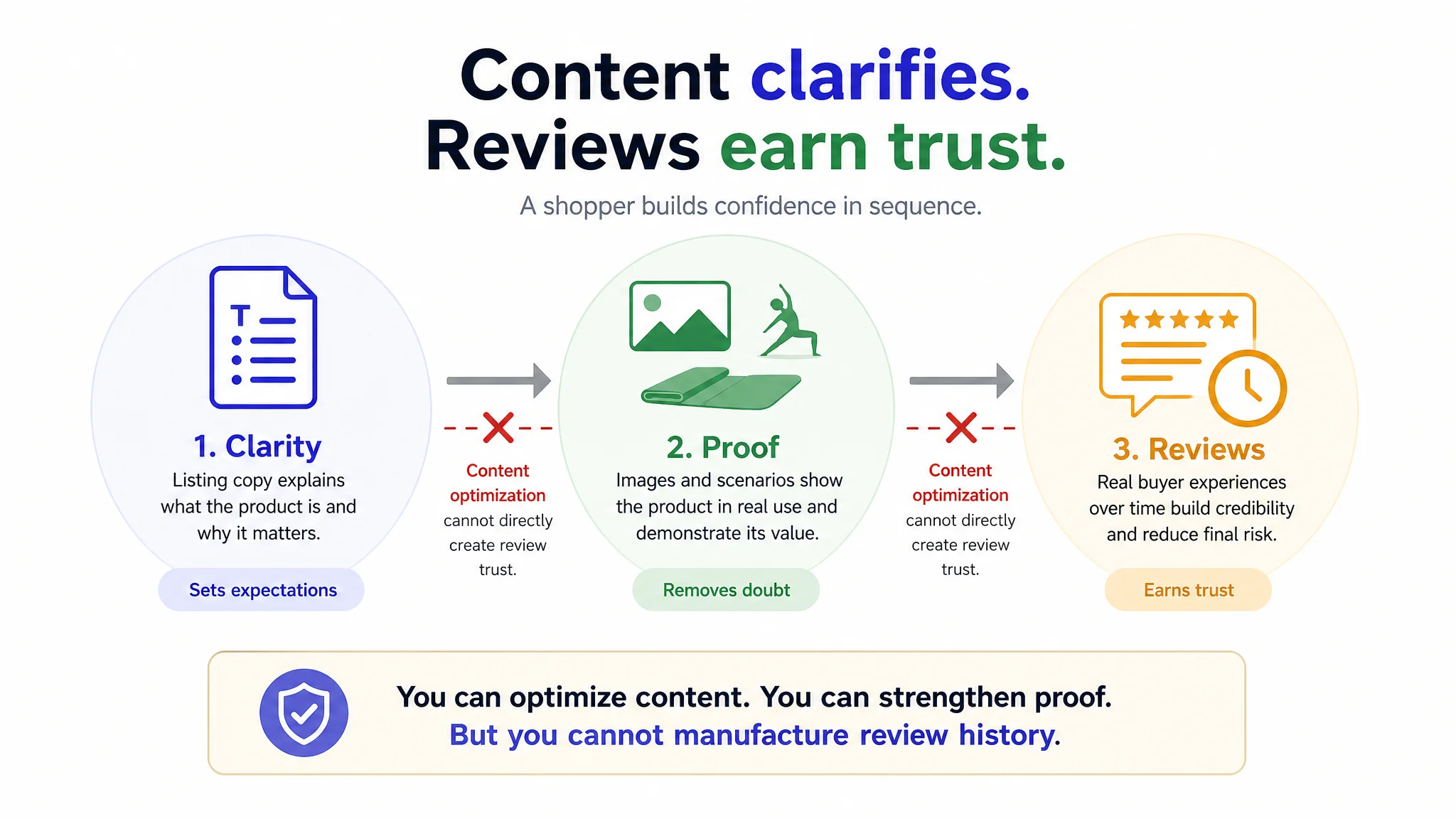
A diagnostic workflow is therefore most useful when it separates controllable content issues from broader trust constraints. Otherwise, a team may spend time rewriting bullets while overlooking the fact that shoppers are reacting to a weak rating profile.
Feature-by-Feature Comparison
SellerSprite is stronger when the workflow begins with keyword discovery and listing construction. DeepBI is more useful when the question is whether a listing is aligned with the right competitive benchmark and market structure. The comparison below separates documented workflow depth from areas where pricing or feature parity should be verified directly.
- Keyword research depth: SellerSprite: Advanced keyword discovery, including traffic-weight scoring to prioritize terms by commercial potential rather than search volume alone., DeepBI: Not documented as a dedicated keyword-research suite.
- Reverse ASIN: SellerSprite: Supports competitor keyword extraction and listing-level reverse research., DeepBI: Not documented.
- Listing builder: SellerSprite: Stronger end-to-end listing workflow for turning keyword research into listing content., DeepBI: Diagnoses the main image, title, bullets, A+ content, and reviews, then converts gaps into optimization instructions and content delivery actions.
- Brand database: SellerSprite: Provides brand-level research for assessing category and competitor positioning., DeepBI: Uses semantic benchmarking to identify a highly similar, high-performing ASIN; this is not documented as a conventional brand database.
- Subcategory tools: SellerSprite: Includes subcategory and market-analysis functions, including 16-dimension market scoring., DeepBI: Focuses on benchmark similarity, product form, price range, audience, and market validation rather than documented subcategory tools.
- Marketplace coverage: SellerSprite: Covers major US, European, and Asian marketplaces, but not as many markets as some broader-coverage competitors., DeepBI: Supports more than 20 country sites, with localized currency, language, time-zone, and configuration support.
- Pricing: SellerSprite: Compare the specific plan against required keyword, Reverse ASIN, and listing limits., DeepBI: Pricing and plan structure are not established in the supplied evidence.
For sellers optimizing CTR, CVR, ACoS, or listing cycle time, SellerSprite offers the deeper research workflow. DeepBI adds stronger benchmark-led diagnosis, helping prevent optimization detached from real market evidence.
That distinction matters when a listing receives traffic but fails to convert. In the yoga mat example, the first instinct was to add more information and potentially continue working on traffic. The comparison instead showed that the page needed a clearer sales sequence: establish the folding benefit, prove the product’s basic usability, connect features to pain points, show realistic environments, and acknowledge the separate review constraint.
Pricing & Value: Is SellerSprite Actually Cheaper?
SellerSprite can be cost-effective, but only when the plans and billing cycles are compared directly. The figures below separate monthly billing from annual billing and apply the SSAM35 code only where the comparison supports it.
- Standard: Monthly price: $79/month, Monthly price with SSAM35: $51.35/month, Annual price: $348/year, Annual price with SSAM35: $226.20/year
- Professional: Monthly price: $49/month equivalent, Monthly price with SSAM35: $31.85/month equivalent, Annual price: $588/year, Annual price with SSAM35: Approximately $382/year
SSAM35 provides 35% off. For the Standard monthly plan, that calculation is $79 × 65% = $51.35, not $55.30. The Professional annual example is approximately $382 per year after the annual discount; sellers should confirm whether the code remains valid for their checkout and region.
That pricing may compare favorably with broader Amazon software suites, but percentage-based savings require equivalent plans and billing cycles. For example, Helium 10’s commonly referenced $99 monthly base price is different from its $129 month-to-month price, so neither should be compared casually with an annual SellerSprite subscription.
A direct SellerSprite-versus-DeepBI savings percentage cannot be calculated from the available information because DeepBI plan prices, limits, and billing cycles are not specified. DeepBI also covers a different workflow, combining listing diagnosis, optimization, and advertising-data integration rather than presenting an identical product-research tier. Evaluate the subscription against the KPIs you need to influence—CTR, CVR, ACoS, BSR, and listing cycle time—rather than price alone.
A practical cost comparison should also account for the cost of solving the wrong problem. If a seller uses a research tool to address a page-level conversion defect, the subscription may not change the immediate bottleneck. In the yoga mat example, the page already had product facts and usage scenarios. The unresolved issue was how those elements persuaded the shopper. That does not make research software ineffective; it means the seller must match the tool to the stage of the operating problem.
Which Tool Wins by Seller Type?
There is no universal winner because the best tool depends on what the seller is trying to build, source, or optimize.
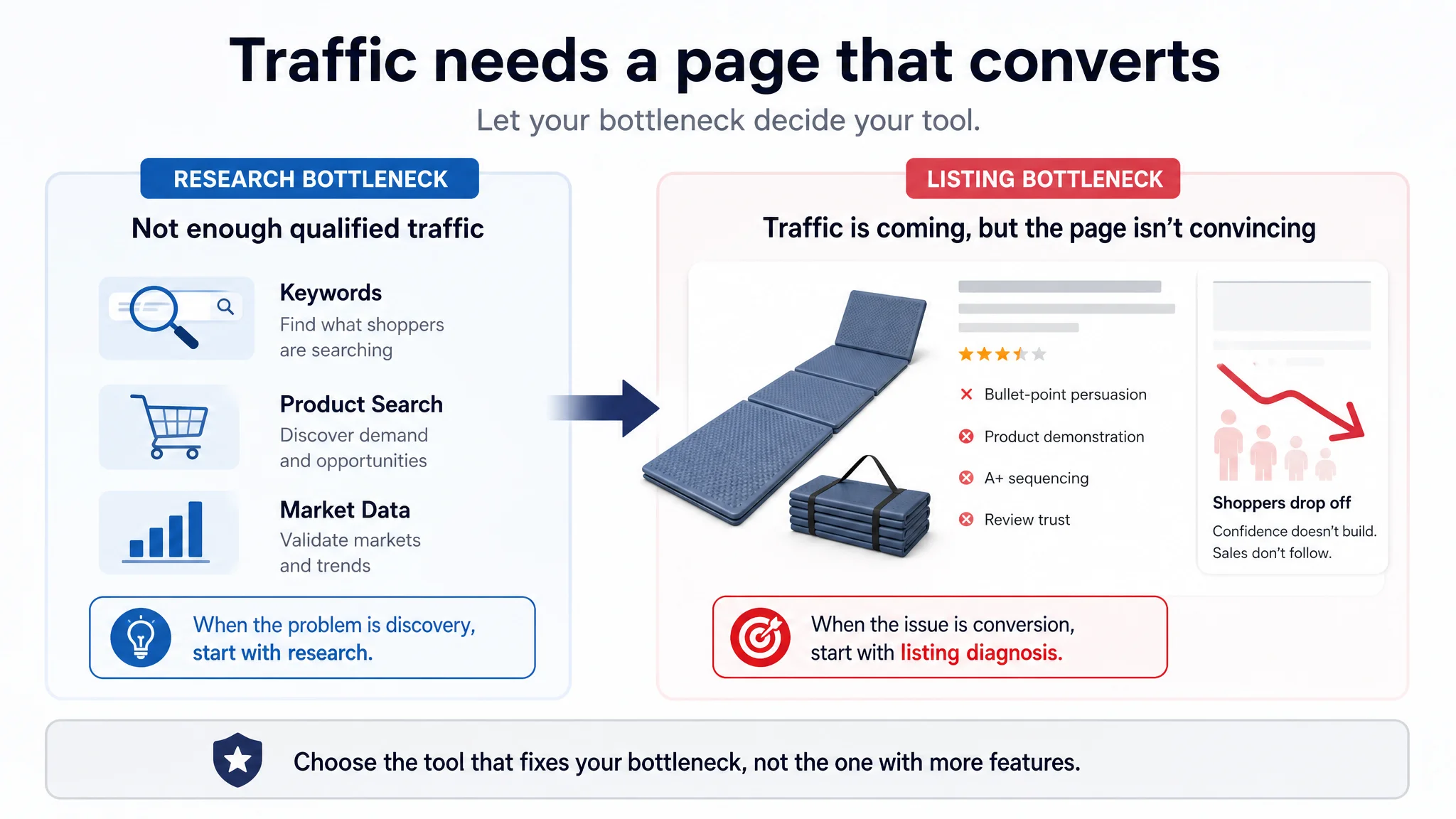
- Private-label sellers launching a new product: SellerSprite is the more practical starting point when the priority is discovering demand, validating keywords, and building a competitive listing. Its keyword and listing depth support research from product selection through launch, while its all-in-one workflow can reduce listing cycle time. For a seller focused on improving keyword coverage, CTR, CVR, and early BSR movement, keeping research and launch planning in one environment may be more valuable than using a specialized brand-analysis system.
- Sellers with an existing listing that receives traffic but struggles to convert: DeepBI may be the more relevant first test when the primary question is why shoppers are not moving from attention to confidence and purchase. The foldable yoga mat page demonstrates this type of problem: the listing contained specifications and images, but the page scored 67 compared with 88 for a comparable benchmark. The most important gaps were not limited to keyword presence. They involved bullet-point persuasion, product demonstration, A+ sequencing, and review trust. A diagnostic workflow can help identify whether the bottleneck is the main image, content structure, competitive differentiation, or a review constraint.
- Wholesale or distributor businesses seeking brand opportunities: DeepBI is the stronger fit when the operating model depends on finding attractive brands and overlooked inventory opportunities. Its brand database, subcategory intelligence, and orphan-listing discovery are aligned with opportunity mapping rather than simply launching one private-label SKU. Once a potential opportunity is identified, its broader market-health and listing-analysis workflow can help teams evaluate listing quality, competitive gaps, and possible CVR improvements through structured data rather than subjective judgment.
- Hybrid or advanced sellers: Using both tools can be reasonable when the business separates product discovery from listing execution. SellerSprite can support keyword and product research, while DeepBI can contribute listing diagnosis, optimization recommendations, AI image generation, and one-click application. The combination only makes sense if each tool has a defined role and the added subscription cost is justified by faster research, shorter listing cycle time, or stronger CTR and CVR opportunities.
Choose based on your revenue model and bottleneck, not on a one-size-fits-all ranking.
Can You Use Both? A Realistic Stacking Strategy
Using SellerSprite and DeepBI together can be practical, but mainly for experienced sellers managing a more complex workflow. Most sellers do not need two overlapping research tools. The case for stacking becomes stronger when product discovery, launch planning, brand control, listing conversion, and advertising analysis are handled by different people or processes.
A realistic workflow could look like this:
- Use SellerSprite for broad product and launch research, then shortlist opportunities and identify keywords with commercial potential.
- Move the selected product into DeepBI for brand-focused listing diagnostics. DeepBI evaluates the main image, title, bullet points, A+ content, and customer feedback against a relevant benchmark, helping identify gaps that may affect CTR or CVR.
- Use those findings to prioritize page improvements. For example, weak CTR may warrant closer review of the main image, while weak CVR can point to content or trust issues further down the listing.
- Feed advertising reports into DeepBI so stable ad signals can weight high-converting keywords or attributes during listing and visual optimization.
The bridge is useful because advertising data and listing content answer different questions. SellerSprite can help identify which terms and opportunities deserve attention. DeepBI can help determine whether the resulting page is capable of persuading the shopper who arrives through those terms.
The foldable yoga mat diagnosis shows why the handoff should happen before aggressive traffic expansion. The page had enough information to support a research conclusion, but it did not yet make the product’s primary difference clear. The recommended order was to clarify the folding benefit, establish factual credibility, build visual and textual proof, expose the product to realistic usage contexts, and only then evaluate how paid traffic responds.
This does not mean ads were irrelevant. Ads could still provide traffic and search signals. The point is that advertising performance should not be used as the sole evidence of targeting quality when the product page has unresolved conversion defects.
This combination is most relevant to private-label teams, wholesale-hybrid operators, and businesses processing product assets at scale. If your operation has a simple catalog and one primary research need, choosing the tool that fits your immediate KPI—such as BSR discovery, listing CVR, or ACoS control—will usually be more efficient than maintaining both.
Final Verdict
SellerSprite offers strong value for data-dense Amazon research in 2026, particularly for private-label sellers validating products, sizing demand, comparing competitors, and planning launches. Its appeal is strongest when the buying decision depends on research depth and repeatable market analysis rather than a single listing-optimization task. For small and medium-sized sellers, that can support more disciplined decisions around product selection, positioning, and launch timing.
The recommendation should still be segmented. Wholesale and hybrid sellers may value SellerSprite when they need broad product and market research, while brand-focused teams should also consider how much importance they place on specialized intelligence. DeepBI remains compelling for users prioritizing brand intelligence, subcategory analysis, and orphan-listing discovery. It is better viewed as a specialized alternative or complement for those use cases, rather than as a universal replacement for every Amazon research workflow.
The listing diagnosis from the foldable yoga mat provides a useful caution against evaluating tools only by their ability to generate more data. The page contained product specifications, use cases, and images, but its 67-point score showed that information alone did not create conversion capacity. The central problem was the relationship between the elements: the title was not precise enough, the bullets listed features without resolving pain points, the A+ content was more descriptive than demonstrative, and the review profile created a separate trust gap.
That does not prove a specific post-optimization improvement, because the supplied case material does not provide verified post-implementation advertising or conversion data. It does show why a benchmark-led diagnosis can change operating priorities. A team may begin by asking what information to add, then discover that the more important question is what the shopper needs to believe first.
The most practical way to evaluate SellerSprite is to test it against your own listing and sourcing process. The 3-day free trial requires no credit card, allowing sellers to assess whether its data, workflow, and research outputs justify continued use. Buyers who decide to subscribe can also use discount code SSAM35 for 35% off.
Overall, SellerSprite is a sensible short-list candidate for private-label research and launches, but the right choice depends on your primary workflow: broad Amazon research, specialized brand intelligence, or a combination of both. If the immediate constraint is an existing listing that attracts attention but does not persuade shoppers, a diagnostic tool may be more relevant than another round of keyword expansion.
Frequently Asked Questions
Is SellerSprite worth using in 2026?
That depends on the job you need the tool to perform. SellerSprite may be worth considering for sellers who want a dedicated Amazon research platform for product discovery, keyword investigation, competitor analysis, and market validation. Those activities can influence product selection, listing direction, and the time required to move from research to launch.
However, the available evidence is input_insufficient for a complete 2026 value judgment. The supplied materials do not establish current SellerSprite performance, the quality of every data set, its recent feature changes, or whether its outputs consistently improve CTR, CVR, ACoS, or BSR.
A practical evaluation should therefore focus on workflow fit rather than brand reputation alone:
- Does the tool answer the research questions your business actually faces?
- Can its data support decisions for your product category and target marketplace?
- Does it reduce research or listing cycle time enough to justify the subscription?
- Will you still need a separate system for listing diagnosis, creative production, or asset deployment?
The foldable yoga mat diagnosis reinforces the need for this distinction. The page already contained specifications, usage images, and material information, but the conversion problem remained because the content did not form a persuasive sequence. A research tool may help identify demand and keywords, while a listing-diagnosis workflow may be needed to determine why an existing page does not turn that demand into confidence.
SellerSprite is more defensible as a research and market-intelligence purchase than as an all-purpose Amazon growth system. Before committing, test it against a real product decision and compare the quality of its output with the manual research process you currently use.
Who is SellerSprite best suited to?
SellerSprite may suit private-label sellers, wholesale operators, hybrid sellers, and small-to-medium businesses that need structured support for product research, keyword analysis, competitor review, or market sizing. Growth-focused entrepreneurs may also find value if the tool helps them screen opportunities faster and prioritize categories before investing in inventory.
The wording matters: some sellers may need a dedicated research tool, while others may already have sufficient data through existing software, supplier knowledge, agency support, or internal analysis. A second subscription is not automatically justified.
SellerSprite is more likely to fit when:
- Product research is still heavily manual.
- The business evaluates multiple product or keyword opportunities each month.
- Decisions need to be shared across founders, sourcing teams, or marketing staff.
- The seller wants a repeatable research process rather than isolated browser searches.
- The cost of a poor product decision is materially higher than the cost of testing the software.
It may be less suitable when the main constraint is not market research but listing execution. For example, a seller with adequate keyword data but weak product images, unclear value communication, or slow asset publishing may gain more from a listing-optimization workflow.
A listing can contain plenty of product information and still underperform. In the foldable yoga mat analysis, the page described material, size, thickness, folding structure, and use cases. Yet the team initially treated the problem as one of adding or refining individual Listing elements. The deeper finding was that shoppers were not being guided from product facts to a reason to trust the product. The available evidence is input_insufficient for a precise SellerSprite customer profile, so users should validate the fit against their own operating bottleneck.
How does SellerSprite compare with DeepBI?
SellerSprite and DeepBI should not be treated as interchangeable tools without a feature-level review. The available materials do not provide a supported, complete comparison of SellerSprite’s functions against DeepBI’s workflow, so any claim that one platform is broadly superior would be input_insufficient.
The clearest distinction is the type of work each documented workflow emphasizes. DeepBI is designed around listing diagnosis and execution. Its process includes:
- Scoring the main image, title, bullet points, A+ content, and customer feedback.
- Benchmarking a listing against a similarity-filtered competitor.
- Identifying gaps in the listing’s competitive presentation.
- Converting findings into specific instructions for composition, camera angle, lighting, scene elements, color, and text structure.
- Generating images while preserving the product’s identity through Product DNA constraints.
- Using Amazon SP-API to synchronize approved assets, match them to listing positions, and support selective replacement after comparing old and new images.
The foldable yoga mat example shows how this workflow differs from simple keyword or product research. The listing received a 67-point score compared with 88 for a comparable benchmark. The main-image score was only one point lower, but the bullet-point score was 5 compared with 8, the detail-page score was 21 compared with 23, and the review score was 2 compared with 13.
The diagnosis was not simply that the page needed more claims. The folding feature needed to be converted into a clear space-saving and travel benefit. The first image needed to show the complete product value, including the mat and carrying accessories. The bullets needed to follow a problem-to-solution structure. The A+ content needed to demonstrate unfolded, partially folded, and fully folded states, as well as realistic environments. The review gap needed to be treated as a separate trust risk.
That workflow is relevant when the business problem is weak listing communication, inconsistent creative production, or excessive manual upload work. Its potential operating impact should be assessed through listing cycle time and downstream movement in CTR, CVR, ACoS, or BSR; the supplied materials do not provide independently verified outcome results.
DeepBI is not established as a replacement for every broader seller-analytics function. Its image-generation process must follow the actual product’s physical constraints and brand identity. It cannot invent accessories, exaggerate product size, alter material or structure, or copy a competitor’s product details. Its recommendations also depend on accurate Score_Report.json, Product_DNA.json, and required SP-API authorization.
A seller may therefore use SellerSprite for research and DeepBI for listing diagnosis and creative execution, but whether that combination is necessary remains input_insufficient and should be decided through workflow testing.
How much does SellerSprite cost, and is the SSAM35 discount accurate?
The cited standard price is $79 per month. With the SSAM35 promotion providing 35% off, the discounted price is $51.35, not $55.30. The calculation is:
- Standard price: $79
- Discount: 35%
- Discounted price: $51.35
The discount should be checked at checkout because promotional eligibility, billing terms, and applicable plans can change. No guarantee should be made about renewal pricing or whether the code applies to every subscription option.
For context, if another research platform is used for comparison, the consistent Helium 10 figures should be kept separate: the base price is $99 per month, while month-to-month pricing is stated as $129 per month. A claim that SellerSprite is automatically 40% to 60% cheaper than Helium 10 is not supported and should not be used as a decision shortcut.
Price alone does not establish value. A $51.35 monthly cost may be reasonable if the tool helps prevent a poor product decision, reduces research hours, or shortens the path from opportunity screening to launch. It may be unnecessary if the seller uses only one feature occasionally or cannot connect the research output to changes in CTR, CVR, ACoS, BSR, or listing cycle time.
The same principle applies to listing-diagnosis tools. If the primary problem is a page that already contains information but fails to persuade, paying for additional research may not address the immediate bottleneck. In the yoga mat analysis, the page’s weakness was not explained by an absence of product facts. It was explained by weak sequencing, unclear value communication, and a large review-trust gap.
The evidence is input_insufficient for a full plan-by-plan pricing comparison, including annual terms, limits, or feature allocation. Confirm the exact plan, billing frequency, renewal terms, and discount conditions before purchasing.
Which marketplaces does SellerSprite cover?
The corrected claim is that SellerSprite covers nine major marketplaces. That is a meaningful level of coverage for sellers operating across several established Amazon regions, and it may be sufficient for a business whose sourcing, expansion, and keyword decisions are concentrated in those markets.
The evidence does not support claiming that SellerSprite has an unmatched or superior marketplace-coverage advantage. The practical question is whether the nine supported markets include the regions where the seller currently operates or plans to expand. Coverage should be checked at the level of:
- Marketplace availability for the specific research feature.
- Keyword and competitor data availability by region.
- Whether product, sales, and ranking metrics are comparable across markets.
- Whether the seller’s account structure and target categories are supported.
- Whether exports or shared reports work across the markets used by the team.
A seller focused on one marketplace may not gain much additional value from broad regional coverage. Conversely, a wholesale or hybrid seller evaluating multiple markets may benefit if the same research process can be applied across those regions.
The marketplace question should also be separated from the page-conversion question. A listing may be well researched across several markets and still fail to persuade if its title, images, bullets, A+ content, and reviews do not work together. The foldable yoga mat diagnosis was based on the quality of the listing’s decision path, not simply on whether the product information existed.
The available materials are input_insufficient for a detailed market-by-market feature matrix or a judgment that the nine-market scope is sufficient for every international expansion plan. Treat the coverage as a useful baseline, then verify the exact marketplace and data type needed before relying on it for inventory or localization decisions.
Does SellerSprite offer a free trial?
The supplied evidence does not confirm the current free-trial length, eligibility rules, feature restrictions, or whether payment details are required. This answer is therefore input_insufficient.
If a free trial is available, use it as a controlled evaluation rather than a general tour. Select one real research task, such as comparing several product opportunities, analyzing a defined keyword group, or reviewing a competitor set. Record:
- Time required to complete the task manually.
- Time required with SellerSprite.
- Whether the results are clear enough to support a decision.
- Which data points require external verification.
- Whether the output changes the product shortlist, keyword priorities, or launch plan.
The trial should also be tested against the seller’s actual marketplace and category. A tool can appear useful in a demonstration but provide less decision value when the category has limited demand, unusual terminology, or weak competitor comparability.
If the seller already has an existing listing problem, the trial can also be evaluated by asking whether the tool answers the correct operational question. For example, a page may contain full product specifications and several lifestyle images but still fail to establish why its primary difference matters. In that situation, the seller needs to know whether the selected tool can diagnose the conversion path, not simply produce more data.
Before the trial ends, confirm whether access converts automatically into a paid subscription, what plan is selected, and how cancellation works. Do not treat a trial as evidence that the software will improve CTR, CVR, ACoS, or BSR; those outcomes require a properly tracked implementation and are not established by the supplied materials.
Should a seller choose SellerSprite or DeepBI first?
Choose based on the immediate business constraint. If the central question is whether to enter a product category, how to assess competing listings, or how to prioritize keywords and opportunities, SellerSprite may be the more relevant first test. The evidence for its current capabilities and results remains input_insufficient, so the seller should validate the tool with a live research task rather than assume broad coverage of every Amazon need.
If the central problem is an existing listing that receives impressions but fails to earn sufficient clicks or conversions, DeepBI may be more directly aligned with the documented workflow. It evaluates the listing’s core content, compares it with a similarity-filtered benchmark, and produces actionable recommendations for text and visual structure. Its creative workflow is designed to preserve product identity and brand compliance, while approved assets can be synchronized through Amazon SP-API.
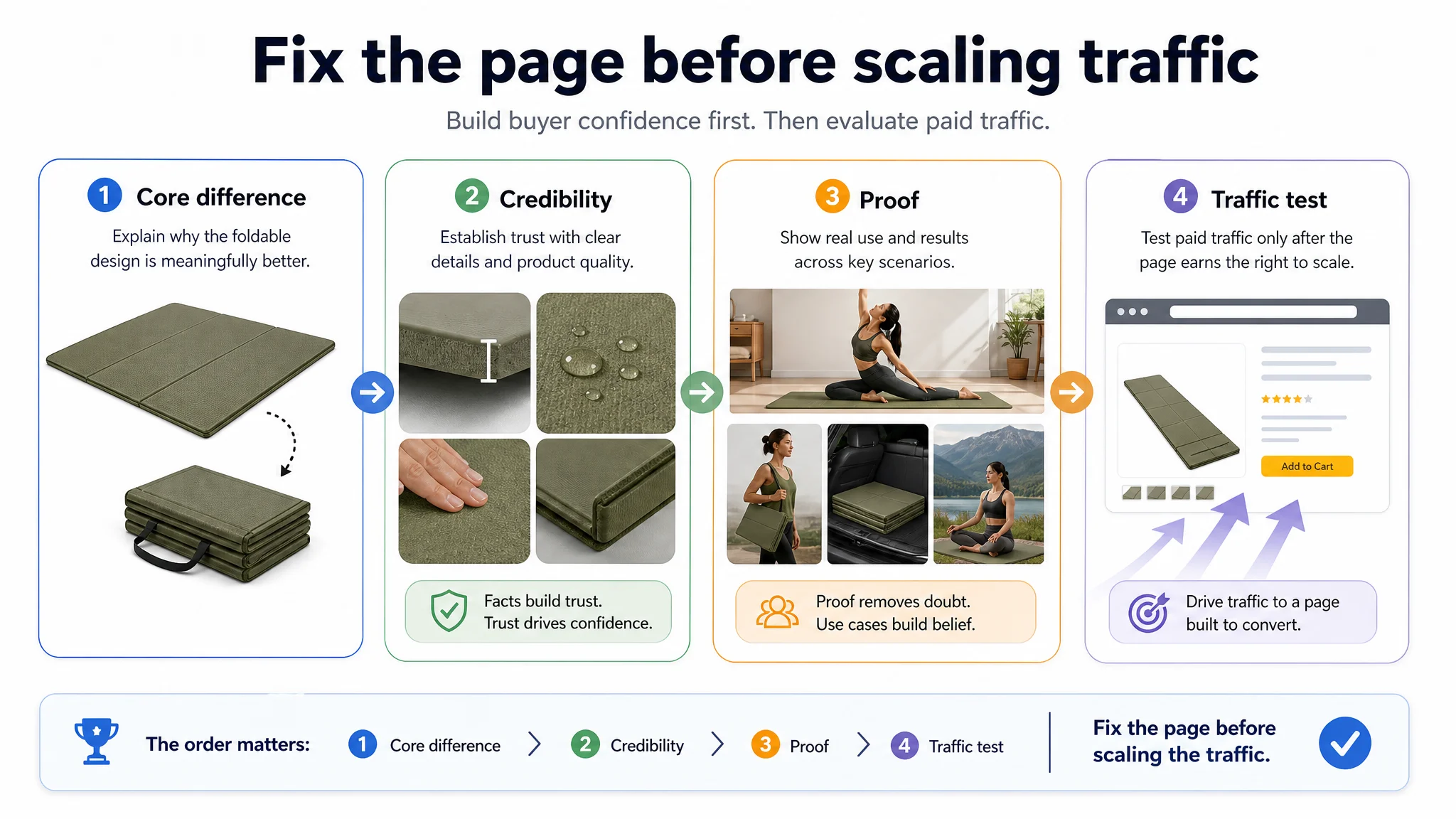
The foldable yoga mat illustrates the difference. The team initially focused on adding or refining information because the page already described folding, thickness, material, portability, and exercise use. The comparison found that the deeper problem was the page’s sales logic: shoppers were not shown clearly enough why a folding mat was better than a rolled mat, whether it would lie flat, how it would support real use, or why the claims deserved trust.
DeepBI also has defined boundaries. Its effectiveness depends on accurate upstream scoring, valid product information, Product DNA constraints, and SP-API authorization. Its historical version rollback capability is still in the planning stage rather than officially launched. The system is not presented as an autonomous strategy-maker, and the archive does not establish independently verified performance gains.
A sensible next step is to map the bottleneck before buying:
- Research bottleneck: test SellerSprite on a real opportunity.
- Listing diagnosis bottleneck: test DeepBI on an existing ASIN.
- Creative production bottleneck: assess DeepBI’s recommendation and image workflow.
- Mixed bottlenecks: compare the cost and handoffs of using both tools.
The segmented verdict is more useful than a universal winner. SellerSprite may support research-led decisions, while DeepBI is documented more clearly as a listing-analysis and creative-execution layer. The right choice is the one that addresses the constraint currently limiting CTR, CVR, ACoS, BSR, or listing cycle time.