

Understanding Amazon's Core Bidding Mechanics
Amazon advertising is not simply a keyword auction in which the highest bidder always wins. It is a customer-matching system: Amazon evaluates the shopper, placement, search context, product relevance, and estimated likelihood of conversion before deciding whether an ad should appear and how aggressively to compete.
That evaluation takes place at the individual-auction level. A bid that is appropriate for one impression may be excessive for another because the likelihood of converting a click into an order can vary. Amazon states that it reduces bids for clicks that may be less likely to convert, with downward adjustments of up to 100%. Static bids therefore risk overpaying for weak opportunities while underfunding auctions with stronger conversion potential.
Amazon’s primary bidding options include:
- Dynamic bids—down only: Amazon can lower the bid when conversion likelihood appears weaker.
- Dynamic bids—up and down: Amazon can raise or lower bids according to the estimated opportunity.
- Fixed bids: The entered bid remains unchanged across auctions.
Advertisers may also use rule-based bidding variants, in which defined performance conditions guide bid changes. The appropriate approach depends on product maturity, available conversion data, and margin structure. A new ASIN with limited CVR evidence may require controlled bidding and broader data collection. A mature product with stable conversion signals can support more responsive adjustments, provided ACoS remains compatible with margin.
However, bidding data should never be interpreted separately from the Listing that receives the traffic. In one motorcycle tire-pressure-monitoring case, the team initially saw expensive clicks, unstable conversion, and difficult-to-control ACoS. The first assumption was that the campaigns, keywords, bids, and budgets needed further adjustment. A Listing comparison later showed that the customer’s page scored 68/100 against 82/100 for a benchmark competitor. The largest gaps were in the title, main images, bullet points, and review volume—not in the deeper A+ content, which actually scored higher than the benchmark.
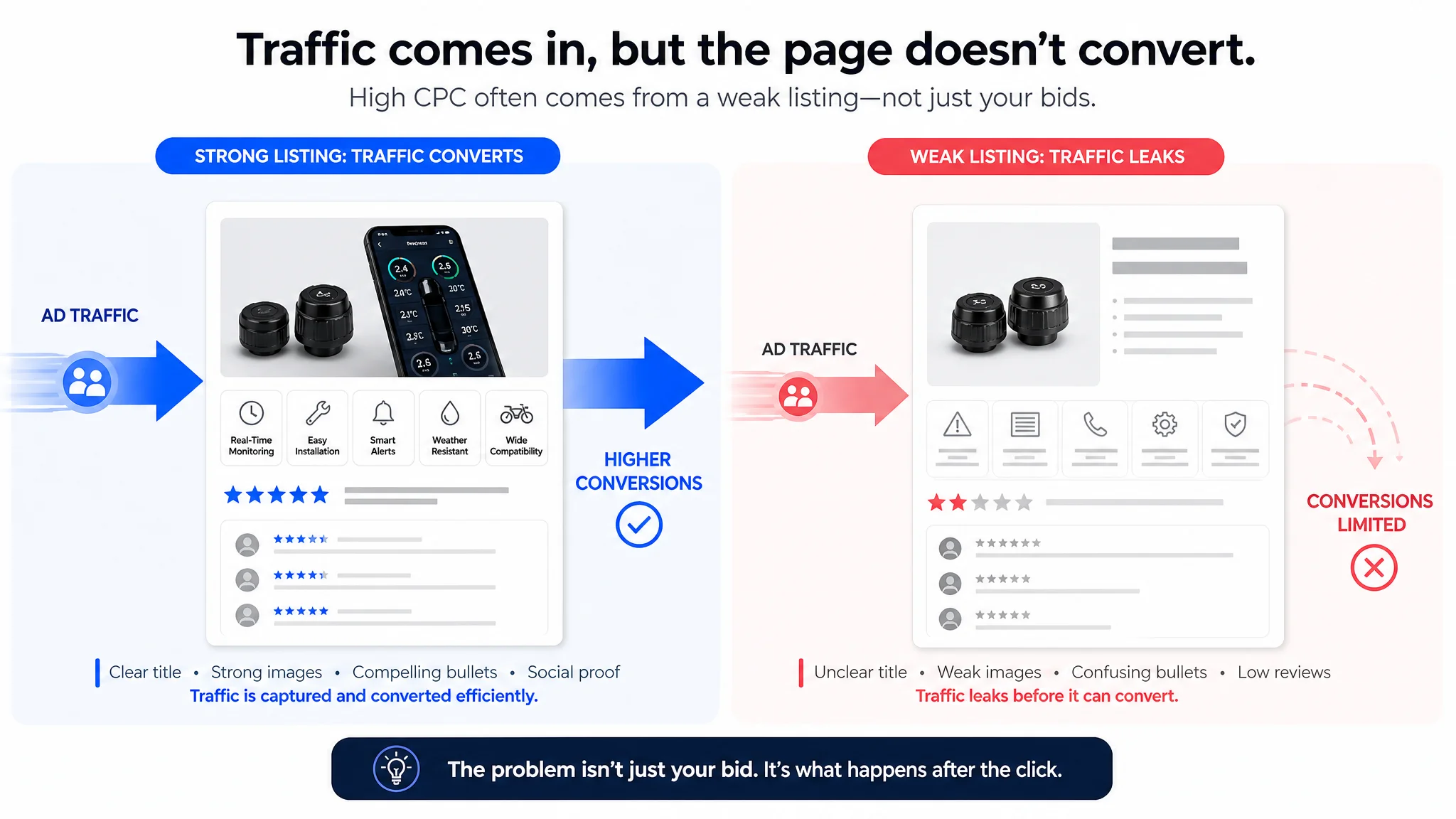
The diagnosis changed the meaning of the advertising data. The ads were generating traffic, but the Listing was not converting that traffic efficiently. This is why profitable PPC management requires both bidding analysis and conversion-path analysis. A lower bid may reduce waste, but it cannot make a vague title clearer, a warning-heavy bullet structure more persuasive, or a low-review page more trustworthy.
Profitable PPC management therefore requires phased, data-driven bidding. Sellers should review CTR, CVR, ACoS, and BSR signals, test changes systematically, and refine bids as reliable conversion evidence accumulates instead of treating a single static bid as a permanent strategy. They should also verify that the product page has the conversion capacity to justify additional traffic.
Dynamic Bids - Down Only: Conservative Cost Control
Dynamic bids—down only is Amazon PPC’s most conservative bidding option. Amazon can lower your bid when its system identifies a click as less likely to convert, but it will never raise the bid above the amount you set. Amazon describes this mode as reducing bids for clicks that may be less likely to convert, making it a practical form of cost protection when conversion signals remain limited.
For example, if a keyword has a set bid of $1.00, Amazon may reduce it to $0.20 for an auction in which performance data indicates a lower conversion probability. This adjustment limits exposure to potentially inefficient clicks and can help sellers control ACoS risk while they gather enough data to assess CTR, CVR, and search-term quality.
Many sellers begin with down-only bidding for new products, early testing phases, campaigns with limited conversion data, or products operating on tight margins. The trade-off is reduced access to some high-intent impression opportunities. Because Amazon can only lower the bid, the campaign may lose auctions in which a higher bid could have secured visibility among shoppers more likely to convert.
Down-only should therefore serve as a starting control rather than a permanent default. Once a campaign accumulates reliable conversion data, review its impression volume, CVR, ACoS, and search-term performance. If stronger conversion evidence has emerged but the campaign remains in down-only mode, reassess the bidding strategy instead of allowing conservative controls to restrict campaign development.
At the same time, sellers should distinguish between controlling inefficient traffic and hiding a Listing problem. The motorcycle TPMS seller initially approached the issue as if more conservative or more precise bidding would solve the unstable conversion. Yet the page was losing potential buyers before deeper content had a chance to work: the title relied heavily on vague “Upgraded Version” wording, the bullets opened with warnings and technical information, and the main images did not quickly communicate motorcycle use or installation simplicity.
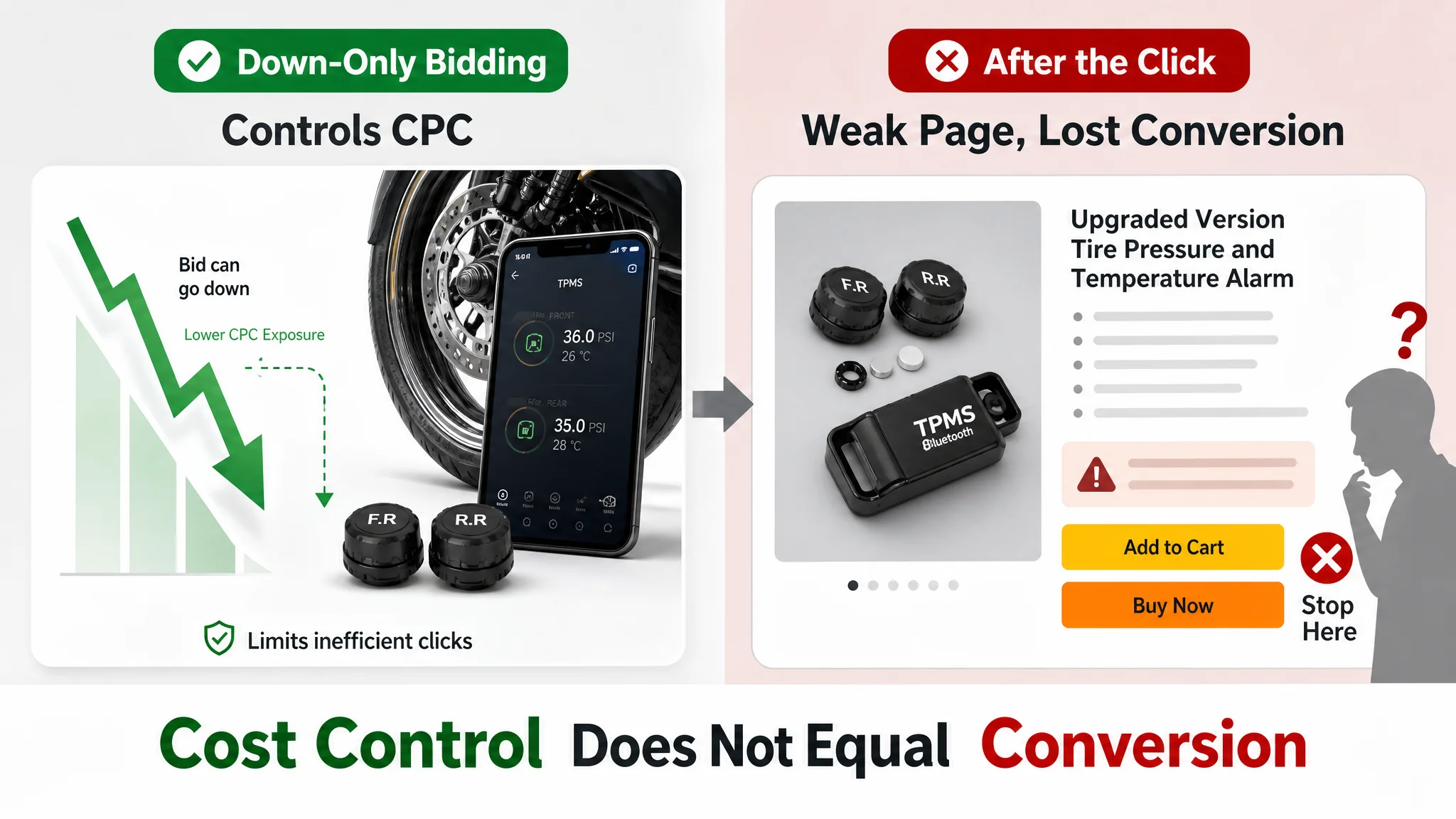
In that situation, down-only bidding could limit CPC exposure, but it would not repair the conversion bottleneck. The relevant question was not only whether Amazon should reduce the bid for a weak opportunity, but also why the opportunity became weak after the click. Conservative bidding is useful for cost control; it is not a substitute for improving the page’s ability to turn qualified visits into orders.
Dynamic Bids - Up & Down: Aggressive Opportunity Capture
Dynamic bids—up and down are designed to capture additional conversion opportunities when the campaign has enough evidence to justify greater spend exposure. Amazon can raise a bid when a sale appears likely and lower it when conversion probability is low. The adjustment can increase a bid by up to 2x or decrease it by up to 100%. For example, a $1.00 bid may rise to $2.00 in a stronger conversion opportunity.
This flexibility differs from rule-based bidding. Rule-based bidding can increase bids by up to 5 times the adjusted bid amount, so sellers must distinguish Amazon’s dynamic adjustment from a manually configured rule multiplier. Placement modifiers and the seesaw technique add further layers to the calculation rather than replacing the base-bid logic. A placement-adjusted bid can be expressed as:
Placement-adjusted bid = base bid × (1 + placement modifier)
For example, a $1.00 base bid with a 450% placement modifier produces a permitted adjusted bid of $5.50 before other bid adjustments are applied.
Because these layers can amplify costs quickly, up-and-down bidding should be reserved for mature campaigns with at least 30 days of conversion data and stable ACoS at or below target. After activation, review spend, CVR, conversion volume, and placement-level ACoS frequently. Without disciplined monitoring, cost spikes may outweigh the additional conversion opportunity. The strategy presents a genuine trade-off: greater access to valuable auctions, but higher financial risk and no guarantee of improved profitability.
There is another risk when aggressive bidding is introduced before the Listing is ready: it can amplify the same conversion weakness at a higher cost. In the TPMS case, the seller’s page had a full A+ experience and a 5.0-star rating, but only five reviews. Compared with the benchmark’s 2,137 reviews, the page presented less accumulated social proof. Its title, image gallery, and bullets also created less immediate trust. Sending more expensive traffic to that structure would not address the reasons users hesitated.
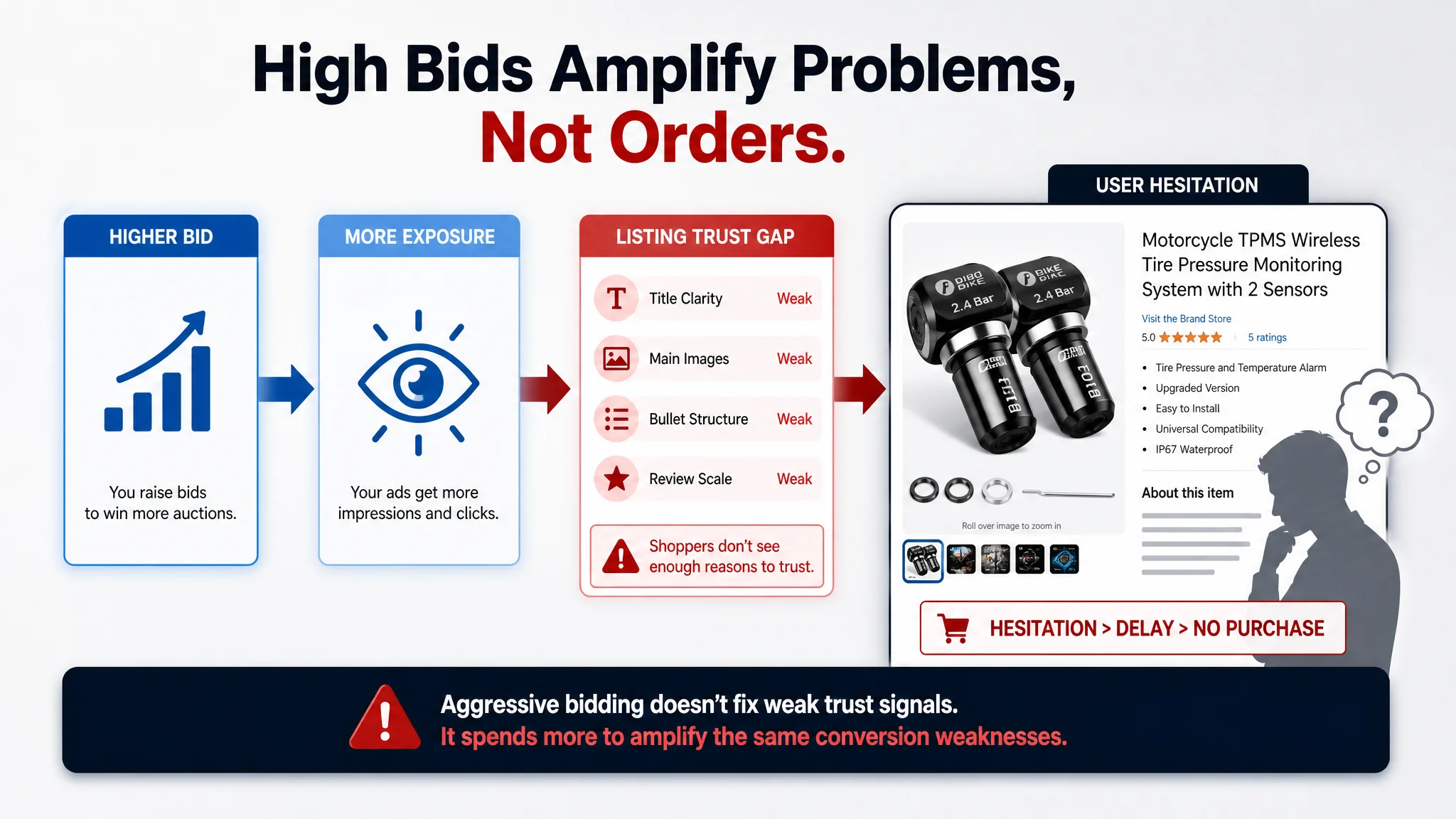
This does not mean up-and-down bidding is inherently wrong. It means the campaign’s conversion signals must be interpreted alongside the page’s conversion logic. If the Listing cannot clearly communicate what the product is, why it matters, how easy it is to use, and why it should be trusted, a higher bid may buy more exposure without creating proportionally more orders.
Fixed Bids: Maximum Control for Granular Management
Fixed bidding gives sellers direct control over the base bid, but it prevents Amazon from adjusting that bid according to the likelihood of conversion. Amazon’s comparative guidance is clear: fixed bids may produce more impressions, but they may also generate fewer conversions. The trade-off is therefore not simply control versus automation; it is control versus the risk of missing conversion opportunities and weakening CVR or ACoS performance.
This approach is most suitable for strict-margin products or campaigns in which spending must remain tightly bounded. Sellers can set a conservative base bid and apply placement modifiers manually. For example, a campaign might use a $0.80 base bid with a higher modifier for top-of-search placement only when that position supports the product’s margin target. Every adjustment remains the seller’s responsibility.
A practical CPC ceiling can be calculated as:
- Average order value: $35
- Target ACoS: 25%
- Conversion rate: 12%
- Maximum CPC: $35 × 25% × 12% = $1.05
This calculation is only a starting point. Changes in CVR, selling price, or target ACoS require the maximum CPC to be recalculated. Sellers must also monitor spend, CTR, CVR, ACoS, and placement performance continuously, then revise bids and modifiers accordingly.
Fixed bids can be valuable when precision matters more than operational convenience. However, as campaign volume and SKU count grow, constant recalculation and monitoring create a substantial management burden, making automation increasingly necessary for scalable PPC operations.
Fixed control is also limited by the quality of the conversion data being controlled. In the TPMS example, the seller could have calculated a CPC ceiling and adjusted bids precisely, but the page-level issue would still have remained. The listing’s first-screen experience did not make the product feel like an easy, trustworthy safety upgrade. Instead, the title emphasized “Upgraded Version,” the bullets prioritized warnings and technical parameters, and the image gallery did not clearly show real motorcycle use, app functionality, or simple installation.
The implication is important: a fixed bid can control how much is paid for a click, but not how effectively the Listing uses that click. Before treating a CPC problem as purely mathematical, sellers should confirm that the Listing gives the resulting traffic a realistic reason to continue toward purchase.
Rule-Based Bidding: Automating Profit-Focused Adjustments
Rule-based bidding turns profitability targets into operating guardrails rather than leaving every bid change to manual judgment. For eligible Sponsored Products campaigns, the seller sets a Target ROAS, and Amazon adjusts bids in real time to pursue more conversions while keeping bid decisions within the defined profitability framework.
Eligibility matters. The Sponsored Products campaign must have been active for at least 15 days and generated at least 30 orders in the last 30 days. Without sufficient conversion history, the system has less evidence for making reliable adjustments, so rule-based bidding should not be treated as a universal campaign feature.
The mechanism can raise bids by up to five times the adjusted bid amount, but that multiplier does not guarantee a specific ROAS, CVR, or sales outcome. Where relevant, sellers should establish bid caps by placement to limit how high bids can rise for placements such as top-of-search or product pages.
Schedule-based rules add another control layer. For example, a campaign’s bids could increase by 30% on Mondays between 9 a.m. and 11 a.m. A second rule might adjust bids during a different defined time window. When multiple rules affect the same campaign, their time-based changes can combine with placement adjustments, increasing the final bid beyond the base setting.
The practical role is semi-automated profit control: Amazon can move base bids up or down to seek additional conversions, while the seller maintains guardrails through Target ROAS settings, schedules, and placement caps. Monitor ACoS, CVR, and placement-level performance to confirm that the rules support profitable growth rather than merely increasing spend.
Automation, however, should not be used to bypass diagnosis. In the TPMS case, the central conclusion was not that the seller needed a more sophisticated bid rule. DeepBI’s Listing analysis showed that the page had a 14-point gap against the benchmark, concentrated in the title, main images, bullet points, and reviews. The A+ content was already relatively strong, but much of the paid traffic was being evaluated through weaker entry-layer content before shoppers reached it.
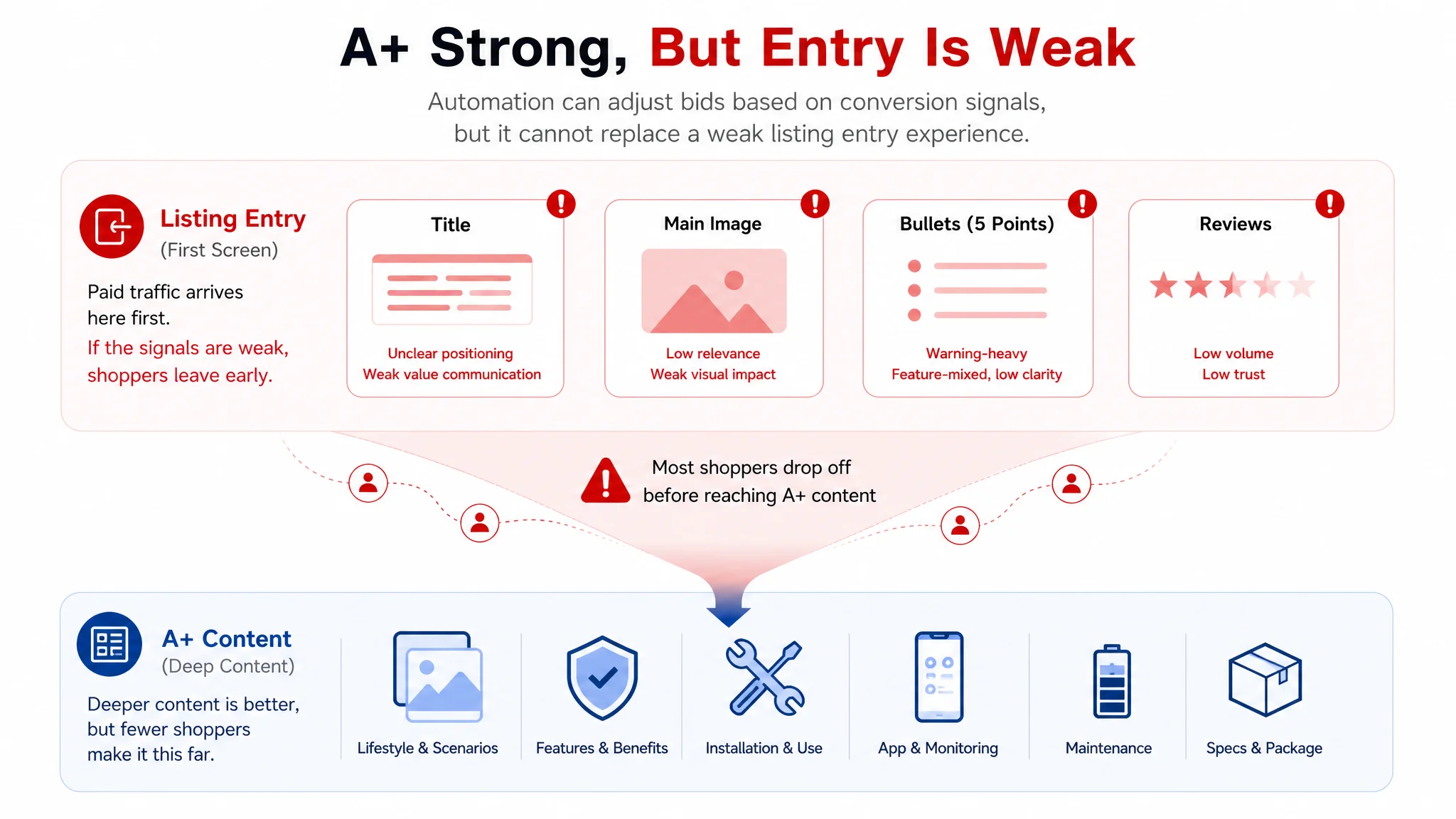
A rule-based system can respond to conversion signals, but it cannot independently rebuild the page’s decision logic. If the title does not clearly communicate the category and outcome, if the images do not answer basic product questions, or if the bullets create anxiety instead of reassurance, automated bidding may simply optimize within a structurally weak funnel. Profit-focused automation works best after the Listing has earned the opportunity to receive more traffic.
How to Choose the Right Bidding Strategy for Each Campaign Phase
There is no universally best Amazon bidding strategy. The right choice depends on the product’s lifecycle stage, contribution margin, and the amount of reliable conversion data available. A launch campaign should not be managed like a mature campaign with stable ROAS.
Launch: prioritize controlled exploration. Start new campaigns with down-only bidding to limit inefficient increases while Amazon gathers impressions, clicks, and conversion signals. Set the initial bid 20% to 25% below the calculated maximum CPC, based on the product’s margin and target economics. This creates room to learn without immediately spending at the ceiling. A common audit mistake is leaving campaigns in down-only mode long after the testing phase, restricting opportunities to capture valuable placements.
Launch-stage analysis should also include a Listing readiness check. A new product may not yet have extensive review volume, but the page can still reduce uncertainty through a clear title, relevant images, benefit-oriented bullets, and a coherent explanation of use. The TPMS seller’s page illustrated the opposite pattern: it contained substantial technical and lifecycle information, yet the top-of-funnel elements did not make the product immediately feel simple, relevant, and trustworthy. Controlled bidding could protect the budget, but it could not compensate for unclear positioning.
Growth: use data to expand selectively. After approximately 30 days of usable conversion data, reassess CTR, CVR, ACoS, and search-term performance. If the campaign has sufficient volume and ACoS is at or below target, switching to up-and-down bidding can support more aggressive traffic capture. The decision should still reflect margin: a high-margin product can tolerate more bidding flexibility than a low-margin product with limited contribution profit.
At this stage, a sudden increase in spend should be matched by a review of the conversion path. In the TPMS diagnosis, the seller had been considering better campaigns, keywords, and structures because advertising costs appeared to be the problem. The comparison instead showed that the page’s title was less precise than the benchmark, its bullets were more warning-oriented, its images were less compelling on mobile, and its review count was much lower. Expanding traffic before addressing those gaps would have increased exposure without necessarily increasing conversion capacity.
Maturity: manage for consistency. When ROAS becomes stable and performance patterns are repeatable, rule-based bidding can help maintain control around defined thresholds. Continue monitoring ACoS, CVR, and BSR rather than treating the rules as permanent. Advertising data should feed a recurring review cycle, not a set-and-forget workflow. Periodic reassessment is essential because campaign conditions, conversion signals, and profitability can change.
Maturity should therefore describe more than campaign age. It should also reflect whether the Listing can consistently convert the traffic being purchased. A strong A+ page alone is not sufficient if the title, images, bullets, and social proof create hesitation before shoppers reach the deeper content. Bidding strategy and Listing quality should progress together.
Integrating DeepBI Ads Quant for Intelligent Bid Optimization
Once a campaign has progressed from initial discovery to structured testing and scaling, the main challenge is executing those decisions consistently without losing control of ACoS or overspending. DeepBI Ads Quant acts as the execution layer, scaling disciplined bidding decisions while leaving strategic direction with the seller.
Its four-layer traffic funnel follows the bidding lifecycle:
- Discovery: Identify promising keywords and ASINs through broad exploration.
- Filtering: Remove or limit traffic that lacks sufficient conversion potential.
- Precision testing: Apply conservative fixed or down-only bids while evaluating clicks, conversions, spend, and emerging CVR signals.
- Scaling: Shift validated traffic toward rule-based bidding when sufficient performance data is available.
Within this workflow, DeepBI adjusts bids and budgets daily using rolling seven-day metrics, including clicks, conversions, spend, and ACoS. Low-converting terms receive tighter control, reducing the risk of consuming budget without proportional sales. Sellers define the operating objective, such as a target ACoS or a growth priority, while DeepBI handles recurring execution.
The TPMS diagnosis demonstrates why this execution layer must be connected to Listing-level analysis. The team initially focused on advertising because clicks were expensive and conversion was unstable. DeepBI’s side-by-side Listing scoring showed that the customer’s page was weaker than the benchmark in the elements that shape first-screen trust: title, main images, bullet points, and review volume. The A+ content was not the primary constraint. This prevented the seller from treating every weak advertising signal as a reason to change bids or keywords.
This workflow also supports campaign progression from fixed or dynamic bidding to rule-based optimization as data becomes reliable. Daily tuning keeps bids aligned with current performance rather than outdated assumptions, supporting improved ACoS, stronger ROI, and more stable scaling. The seller retains responsibility for strategy and goals, while DeepBI serves as the executor, turning those decisions into a continuous, data-informed optimization loop with less manual intervention.
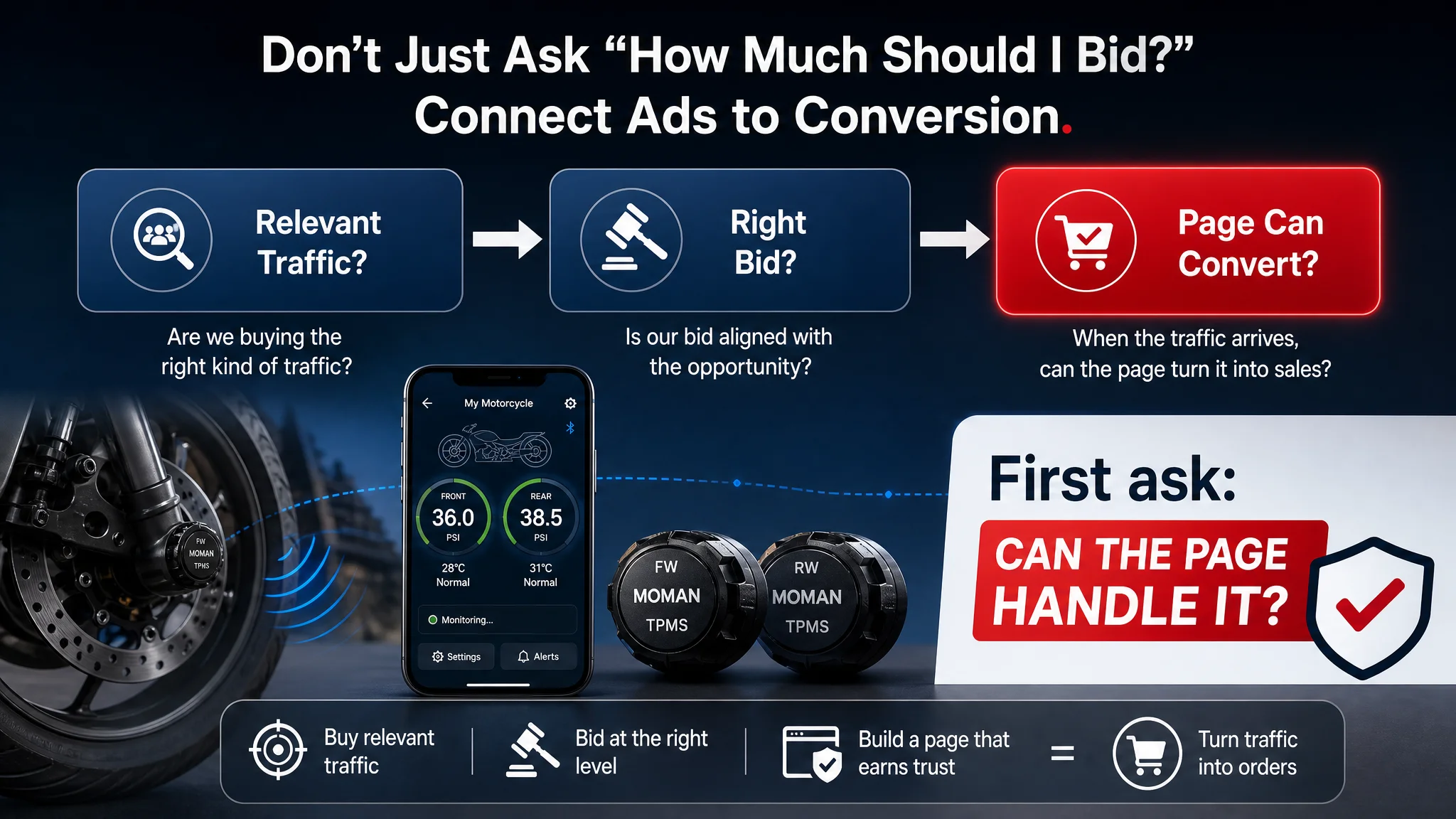
That loop is most valuable when it connects three questions:
1. Is the campaign buying relevant traffic?
2. Is the bid appropriate for the opportunity?
3. Can the Listing convert the traffic once it arrives?
The third question was decisive in the TPMS case. The recommended sequence was to rebuild the title, rewrite the bullets, re-architect the main images, tighten the A+ visuals for motorcycle relevance, and then allow ads to retest the improved page. This is not a replacement for bid optimization. It is the condition that allows bid optimization to create more value.
Common Bidding Pitfalls and How to Avoid Them
- SalesDuo audit evidence — down-only stagnation: Down-only bidding is useful during initial testing because it limits CPC escalation while Amazon collects performance signals. Keeping it in place after that testing phase, however, can restrict impression and conversion growth. Review CTR, CVR, ACoS, and order volume regularly; if the campaign has sufficient evidence, reassess whether more aggressive bidding is justified. Also verify that weak order volume is not being caused by Listing friction. In the TPMS case, the problem was initially interpreted as an advertising issue, but the page’s title, image, bullet, and review gaps were limiting conversion before a different bid strategy could solve anything.
- Campaign-maturity guidance — do not rush up-and-down bidding: Up-and-down bidding can increase bids when conversion potential appears stronger, but it should not be activated without at least 30 days of conversion data. Earlier changes can amplify weak signals, raise CPC, and create an ACoS spike before the campaign has a reliable baseline. Even with sufficient data, aggressive bidding should be reconsidered if the Listing does not clearly communicate the product’s value or reduce purchase friction.
- Amazon rule-based bidding requirements — verify eligibility first: Rule-based Target ROAS bidding requires at least 15 days of campaign activity and at least 30 orders during the last 30 days. The 10-day and 10-conversion interpretation is incorrect. Confirm both thresholds before changing the bidding method. Eligibility alone does not prove that the Listing is ready for scale; conversion quality and page-level trust should also be reviewed.
- Placement settings — account for bid multiplication: Placement modifiers can multiply the effective bid. For example, a $1.00 base bid paired with a 5× maximum placement adjustment can expose the campaign to materially higher CPCs than the base setting suggests. Audit base bids, placement multipliers, CPC, and ACoS together. Then compare those costs with the Listing’s ability to convert the resulting traffic.
- Sponsored Brands collection requirements: Recent policy updates require collection campaigns to include at least 3 ASINs and allow up to 10. Ignoring this prerequisite can prevent campaign activation.
- Emplicit article — policy risk: Non-compliance can freeze campaigns and contribute to campaign rejections. Validate eligibility and policy requirements before launch or structural changes; otherwise, wasted spend may appear alongside disrupted delivery and sudden ACoS spikes.
- Treating every conversion problem as a bidding problem: Expensive clicks, unstable conversion, and difficult ACoS can encourage constant changes to bids, budgets, keywords, and campaign structures. The TPMS seller followed this path until a benchmark comparison showed that the Listing itself was consuming traffic. Its page scored 68/100 against the benchmark’s 82/100, with the largest gaps in bullet points, reviews, title structure, and main images. The correction was not to stop analyzing ads, but to place the ad data in the context of the complete conversion path.
- Ignoring the entry layer because A+ content is strong: A+ content can explain the product well after a shopper has decided to keep reading. It cannot fully compensate for a weak title, unclear main image, anxiety-inducing bullets, or insufficient social proof at the top of the funnel. In the TPMS case, the A+ page was actually stronger than the benchmark, yet the Listing still underperformed because many shoppers were not given enough reason to trust the product before reaching that content.
The Strategic Principle Behind Profitable Bidding
The most effective bidding strategy is not the one that increases or decreases bids most aggressively. It is the one that connects bid decisions to the actual conversion capacity of the Listing.
A campaign may have:
- Relevant keywords but weak page positioning
- Acceptable CTR but poor first-screen trust
- Strong A+ content but weak title and bullets
- A high star rating but too little review volume to create confidence
- Controlled CPC but insufficient reasons for the shopper to buy
The TPMS case made this distinction clear. The product had full A+ content, complete lifecycle information, and a 5.0-star rating. Yet the page still lagged behind a benchmark competitor because the title, main images, bullet-point structure, and review scale did not support the same level of trust. The seller’s original logic emphasized “Upgraded Version,” warnings, and technical parameters. The revised logic was designed around a clearer promise: a smart riding guardian that offers real-time monitoring and easy installation.
That shift shows why advertising efficiency is not created in the advertising console alone. Ads bring the shopper to the decision point. The Listing must then explain the product, reduce uncertainty, establish relevance, and provide enough evidence to continue.
Sellers should therefore review PPC performance through two connected lenses:
1. Auction efficiency: Are bids, placements, budgets, and rules appropriate for the available opportunity?
2. Conversion readiness: Does the Listing make each qualified click more likely to become an order?
When both sides are managed together, bidding automation can support profitable growth rather than simply increasing traffic costs. When the second side is ignored, even precise bidding can become a more efficient way to buy under-converting visits.