

Key Takeaways
AI supports Amazon optimization strategy by connecting advertising signals, listing decisions, and organic growth within a measurable operating system. The following sources provide the foundation for evaluating that approach:
- Data-Driven Closed Loop: How to use ad data to guide optimization and track the impact on CTR post-optimization through event tagging — Supports the use of advertising data to guide listing improvements and measure their effect on CTR through a feedback loop.
- The Dilemma of Traditional Listing Optimization: Disconnected stages of diagnosis, planning, production, and delivery; reliance on subjective aesthetics; low execution efficiency and high risk — Explains why fragmented, judgment-led workflows can slow listing cycle time and weaken the connection between content work and Amazon KPIs.
- Data-Driven Decisions: Supports applying ad data to visual optimization and tracks its impact on business metrics after content updates, creating a data feedback loop that helps lower ACoS — Provides the basis for linking listing changes with measurable advertising outcomes, including CTR, CVR, and ACoS.
- Platform Guidelines: Any content that does not meet Amazon’s mandatory standards, such as main image requirements, pixel dimensions, and title character limits, will be blocked by the system — Establishes platform compliance as a necessary control before AI-generated recommendations or content updates are applied.
- Boutique sellers looking to leverage ad data to enhance visual content, improve conversion rates, and build a healthy growth model — Illustrates how smaller sellers can use evidence-based optimization to connect visual improvements with CVR and sustainable growth.
- DeepBI Listing Product Documentation — Frames AI as a logical executor that helps move sellers from subjective trial and error toward an evidence chain: diagnose a gap, prioritize an action, review the proposed change, measure the result, and refine the strategy.
Smarter Automation with AI Insights
Automation and AI are not interchangeable. Rules-based automation follows instructions created in advance: if CTR falls below a defined threshold, adjust a bid; if inventory reaches a set level, send an alert. These workflows can save time, but they do not determine whether the rule still fits the market or why the signal changed.
An adaptive AI system starts with data and revises its recommendations as new evidence arrives. It can examine relationships among impressions, clicks, orders, CTR, and CVR, then look for patterns across listing structure, visual presentation, customer feedback, and comparable products. When market conditions or account signals shift, the system can re-evaluate which factors deserve more weight and update the next recommendation. Its role is data-informed adaptation, not uncontrolled decision-making: sellers still need to review and confirm changes before implementation.
This distinction matters when evaluating Amazon optimization tools. A tool that turns a fixed checklist into automated actions may support execution, but it does not necessarily support learning. A more capable workflow links a proposed change to measurable inputs, records what changed, and feeds subsequent performance data back into analysis. For example, a visual update should be traceable to later movement in CTR or CVR rather than judged only by appearance.
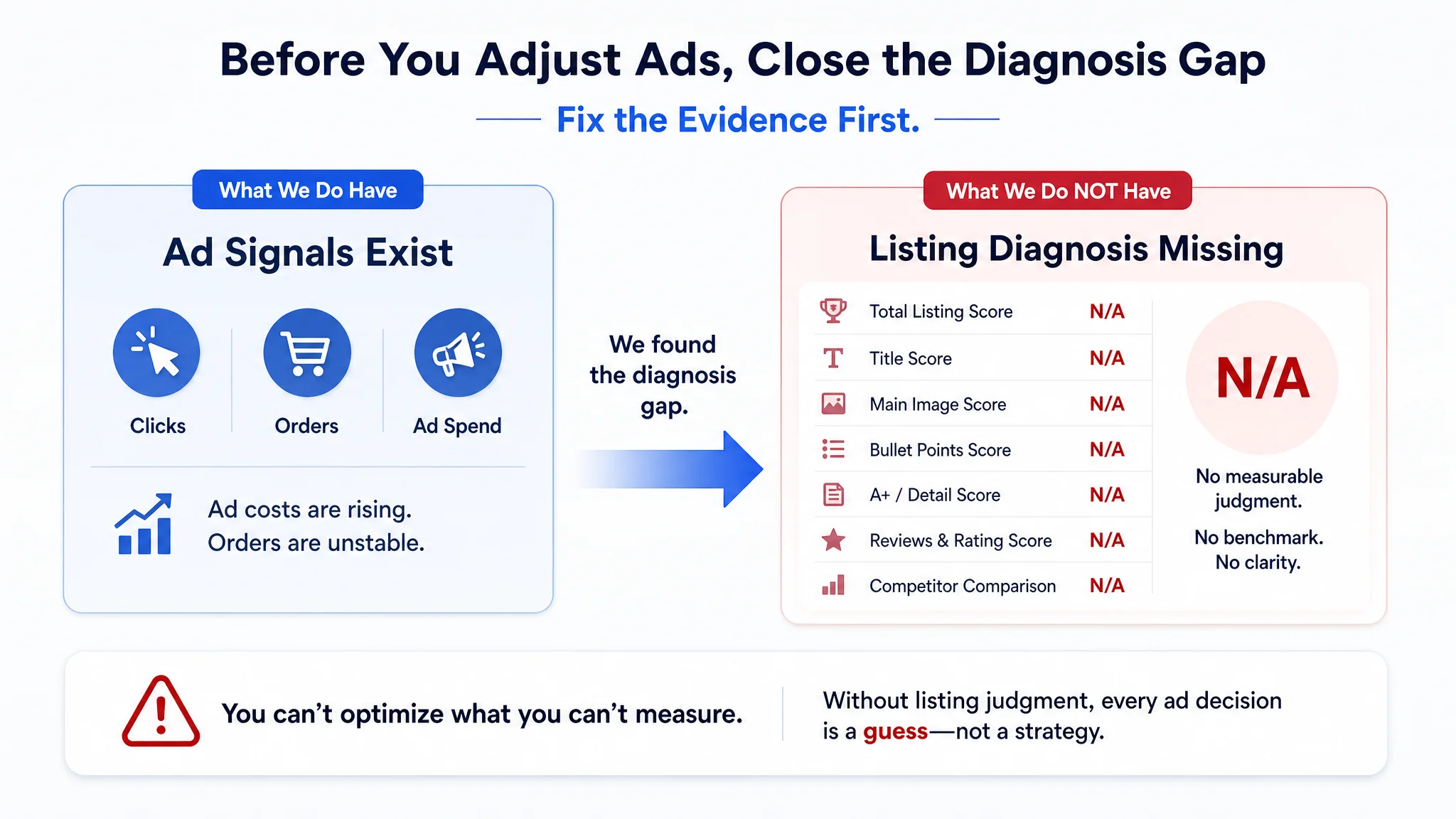
A real operating problem becomes clearer when the usual advertising explanation does not match the available evidence. One US-marketplace seller approached DeepBI because ad costs were climbing and orders were unstable. The team believed the main problem was that the ads were not optimized enough, so the natural response would have been to adjust bids, budgets, match types, or keyword lists. However, the Listing diagnosis contained no usable judgment: the total Listing score, title score, main-image score, bullet-point score, A+ score, review score, and competitor scores were all marked “N/A.”
That absence was not simply a missing report. It meant the seller was making ad-spend decisions without knowing whether the product page was competitive or capable of converting the traffic. In this situation, an adaptive system should not automatically recommend another bid adjustment. It should identify that the evidence chain is incomplete and redirect the analysis toward the Listing. This is the difference between automating actions and improving decisions.
Before adopting a tool, ask:
- What Amazon and market data does it use?
- Does it update recommendations when those signals change?
- Can it explain the evidence behind each decision?
- Does it support feedback after implementation?
- Can it recognize when a missing diagnostic is more important than another automated action?
These questions provide a practical foundation for judging AI optimization beyond the label itself.
Why Use AI Tools for Amazon?
Amazon growth increasingly depends on how quickly and accurately a seller can act on marketplace data. Search-term reports, listing changes, bid decisions, creative updates, and inventory-related signals can all affect CTR, CVR, ACoS, BSR, and listing cycle time. When the number of decisions exceeds available human bandwidth, AI can provide operational leverage through faster analysis, more consistent execution, and the potential to reduce repetitive labor costs.
Consider a hypothetical analyst responsible for 200 advertising campaigns. Reviewing search-term reports for every campaign each day, identifying waste, finding new opportunities, and connecting those findings to listing changes would quickly become impractical. Adding hundreds of SKUs and multiple marketplaces increases the risk of delayed updates, inconsistent judgments, and missed optimization opportunities. Manual workflows may involve downloading reports, renaming files, logging into Seller Central, and uploading assets one by one. Structured automation can compress parts of that process from minutes to seconds, allowing teams to spend more time on prioritization and approval.
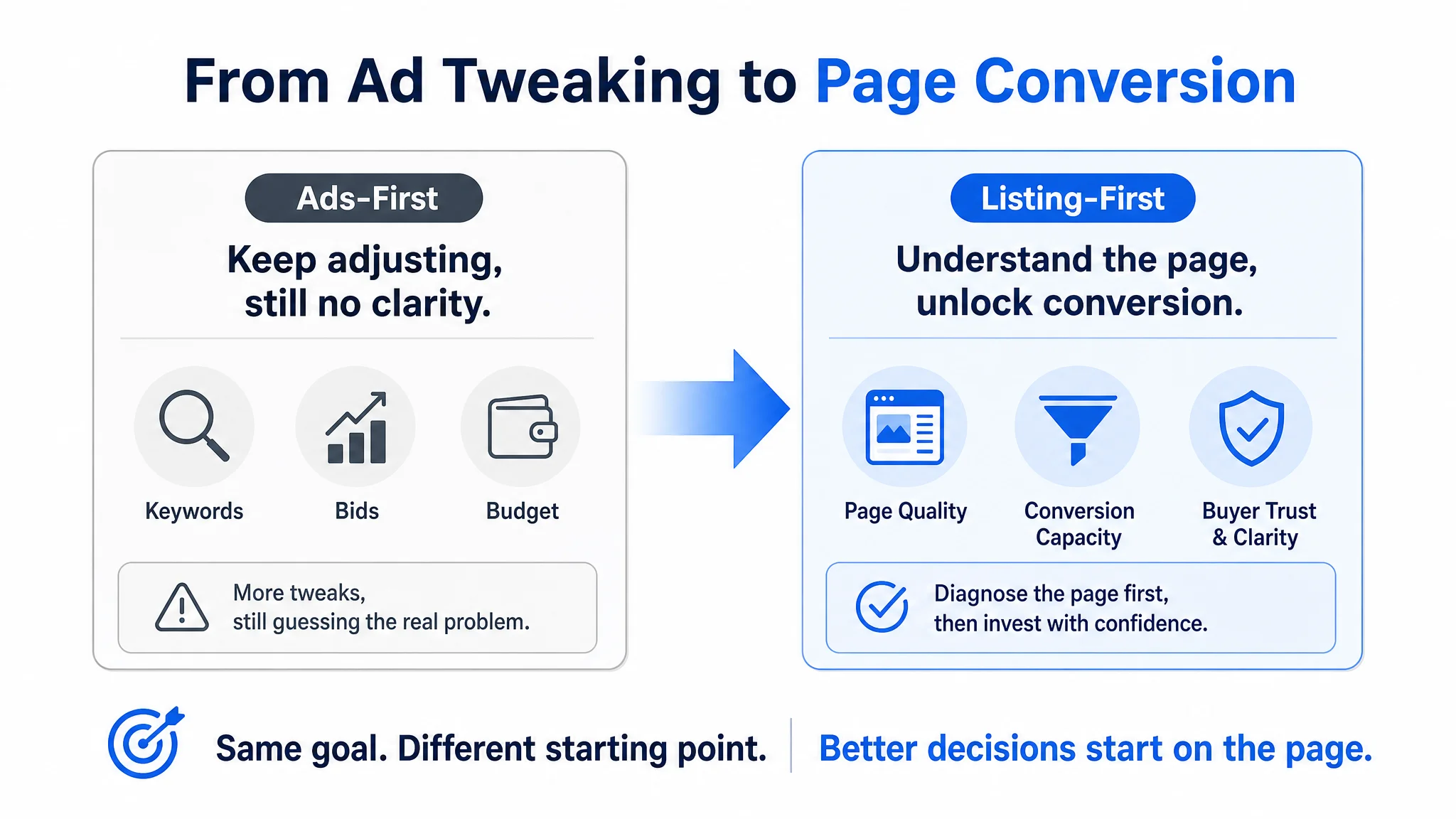
The need for prioritization is especially important when the visible problem appears to be advertising performance. In the DeepBI case, the seller saw rising ad costs, unstable orders, and spending that did not move proportionally with sales. The team cycled through familiar actions such as changing bids and budgets, adjusting match types and keyword lists, shifting budget between campaigns and ad groups, and waiting for the learning phase to improve. Yet none of those actions could answer the more fundamental question: whether the product page was ready to receive more traffic.
Without a Listing benchmark, the team could not determine whether a weak result came from keywords, bids, campaign structure, the main image, the title, the bullet points, A+ content, or social proof. Advertising may have been amplifying an undiagnosed page defect rather than simply underperforming as a traffic channel. AI is valuable here not because it makes more changes per hour, but because it can help establish the correct order of decisions: diagnose the page, identify the relevant gap, and then decide whether further advertising optimization is justified.
AI adoption is also becoming more visible beyond large enterprises. According to a recent PayPal-backed survey, 25% of small businesses surveyed were already using AI, while more than half were exploring it. These figures should be treated as survey findings rather than universal market measurements, but they indicate growing interest in AI-assisted operations.
AI does not guarantee lower ACoS, higher rankings, or greater profitability. Its strategic value is the ability to help sellers process more information and execute more iterations without expanding manual workload at the same rate—a capability that may increasingly separate scalable Amazon businesses from slower competitors.
What AI Actually Does for Sellers
AI is no longer limited to general-purpose writing or image tools. Amazon sellers can apply it to recurring decisions that influence CTR, CVR, ACoS, BSR, inventory availability, and listing cycle time.
- Generate and refine listing content: Use AI to draft titles, bullet points, descriptions, and A+ content from product information, then review every claim for accuracy, compliance, and fit with the intended customer.
- Improve listing structure: Ask AI to identify weak benefit statements, unclear product positioning, or missing connections between customer pain points and product solutions before publishing revisions.
- Support advertising optimization: Use advertising signals such as impressions, clicks, CTR, conversions, CVR, ACoS, and TACoS to distinguish a traffic problem from a conversion problem and guide listing or creative adjustments.
- Forecast inventory needs: Apply AI to historical sales patterns and demand signals to support replenishment planning, reduce stockout risk, and protect sales continuity without treating a forecast as a guaranteed outcome.
- Track Amazon’s expanding use of AI: Amazon introduced its AI Listing Generator in Q2 2025, showing how listing creation is becoming more instruction-based. Amazon launched Dynamic Canvas in March 2026, providing another clear sign that AI is entering practical seller workflows.
- Keep human review in the operating loop: Require sellers to verify product facts, select proposed changes, and approve updates before implementation. AI can accelerate diagnosis and production, but human judgment remains essential for brand accuracy and marketplace compliance.
- Evaluate integrated systems: Look for tools that connect diagnosis, planning, production, and delivery rather than creating another isolated task. This integrated approach provides the foundation for systems such as DeepBI without removing seller control.
The distinction between traffic diagnosis and conversion diagnosis is critical. In the case described above, the seller’s Listing view did not provide a total score, module-level scores, or competitor scores. There was no structured breakdown of the title, main image, bullet points, A+ content, or reviews. As a result, the team could not responsibly conclude that the next action should be a keyword change or bid adjustment.
A stronger workflow would use the available advertising signals as the beginning of an investigation, not as proof that advertising is the root cause. If CTR is weak, the analysis should examine the main image, title, and traffic relevance. If CVR is weak, it should examine the product-page explanation, A+ content, reviews, and trust-building elements. If the Listing has not been benchmarked at all, the first action may be to establish that benchmark. This is how AI can connect ad data to listing decisions instead of treating both as isolated tasks.
Signs You're Ready for AI Tools
AI adoption makes sense when it addresses a measurable operating problem—not simply because a tool offers more features. Use this checklist before committing budget:
- Confirm recurring workload: Track how much time your team spends managing campaigns, reviewing search terms, analyzing listings, producing visual assets, and preparing performance reports across SKUs.
- Measure the performance opportunity: Identify a specific issue, such as weak CTR, low CVR, rising ACoS, declining BSR, or an unnecessarily long listing cycle time, and connect it to an optimization action.
- Calculate the value of reduced waste: Estimate the margin impact of wasted ad spend, missed conversions, delayed listing updates, and repetitive manual uploads. Use realistic internal costs rather than assumed savings.
- Check for sufficient data: Confirm that you have dependable metrics such as impressions, clicks, orders, CTR, CVR, ACoS, and TACoS so changes can be evaluated before and after implementation.
- Assess human bandwidth: Determine whether your team can consistently handle campaign reviews, search-term analysis, listing revisions, and reporting without displacing higher-value commercial decisions.
- Use an ROI test: Compare the tool’s total cost, implementation effort, and review requirements with the value of time recovered, waste reduced, and measurable performance opportunities. A paid tool is not justified by feature count alone.
- Start with a defined workflow: Choose a repeatable process where diagnosis leads to a specific action and measurable feedback, such as linking weak CTR to main-image competitiveness or weak CVR to missing detail-page information.
- Recognize when to wait: Extremely low-volume sellers or niche private-label businesses without direct competitors may not generate enough recurring work or comparable data to justify paid AI tools.
Data sufficiency should be understood as more than having a few performance metrics. In the DeepBI case, the seller had a clear business concern—rising ad costs and unstable orders—but lacked structured Listing evidence. Every major Listing field was marked “N/A,” including the competitor comparison. That meant the account had a performance problem but not yet a reliable diagnosis.
This situation creates a judgment gap. A seller may have enough data to know that advertising feels inefficient, but not enough connected evidence to determine whether the cause is traffic quality, thumbnail competitiveness, page clarity, social proof, or another factor. An AI tool is most useful when it helps close that gap rather than producing confident recommendations from incomplete information.
Before investing in automation, ask whether the tool can show:
- Which Listing or campaign signal triggered the recommendation.
- Which page module may be limiting CTR or CVR.
- Which competitor or category benchmark provides context.
- What change should be tested.
- How the result will be measured after implementation.
If those links are missing, adding more automated actions may increase activity without improving judgment.
The DeepBI Advantage: A Unified AI Optimization System
DeepBI is an Amazon-only optimization system that connects advertising, listing competitiveness, and organic growth. Instead of treating each KPI as a separate task, it creates a feedback loop: ad data reveals traffic and conversion gaps, listing changes address those gaps, and improved performance supports stronger natural visibility.
The value of this connection is clearest when a seller initially frames every problem as an advertising problem. In the US-marketplace case, the seller wanted to address rising ad costs and unstable orders. However, when the product was pulled into the Listing system, there was no total score, no module-level evaluation, and no competitor benchmark. DeepBI therefore did not treat the situation as a straightforward campaign-tuning exercise. It reframed the question as: Is this product page structurally capable of supporting efficient Amazon ads?
That change in question also changed the order of work:
1. Establish a meaningful Listing benchmark.
2. Identify the largest gap across the title, main image, bullet points, A+ content, and reviews.
3. Determine whether the gap is more likely to affect CTR, CVR, or both.
4. Prioritize a measurable Listing action.
5. Revisit advertising decisions after the page’s conversion capacity is understood.
This sequence prevents the system from confusing the existence of advertising controls with evidence that advertising is the primary constraint.
Advertising Quant Engine - Data-Driven Campaign Optimization
Advertising is the primary operating layer. DeepBI organizes campaign traffic into four stages:
- Exploration identifies potential search terms and audiences.
- Screening filters performance using impressions, clicks, CTR, CVR, and ACoS.
- Precision concentrates spend on higher-intent opportunities through automatic keyword targeting.
- Scaling expands validated traffic while controlling waste.
Daily bidding is adjusted against seven-day performance rather than isolated short-term fluctuations. This helps connect budget decisions to actual conversion behavior, with the objective of reducing wasted spend and improving ACoS. The same advertising reports can then identify whether the constraint is visibility, click-through rate, or product-page conversion.
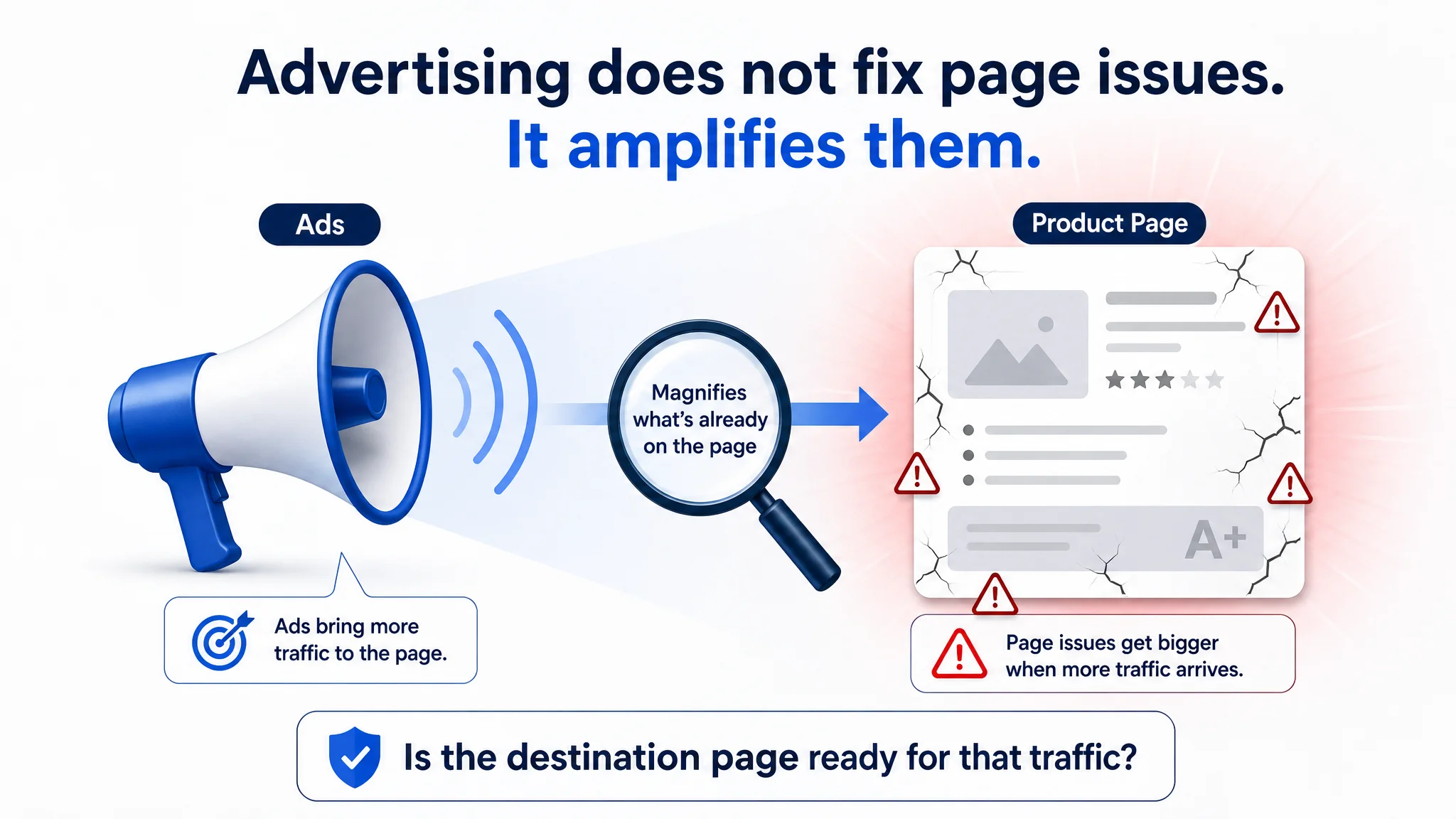
However, advertising data should not be interpreted without the Listing context. In the case with an empty Listing diagnosis, the seller had already tried the usual advertising levers: bids, budgets, match types, keyword lists, and campaign allocation. The problem was that those adjustments were being made without knowing whether the page could convert the traffic being purchased. If conversion capacity is weak, more precise traffic may still produce disappointing results; if the page is strong, advertising optimization can be evaluated with greater confidence.
Advertising does not only amplify advantages. It can also amplify a page’s existing defects. For that reason, the quant engine should help answer not only “Which traffic should receive more budget?” but also “Is the destination page ready for that traffic?”
Listing Optimization Engine - Product Competitiveness at Scale
Listing diagnosis extends across the main image, title, bullet points, A+ content, and customer feedback signals. Competitive benchmarking and multidimensional scoring turn vague advice into precise instructions covering composition, camera angle, lighting, and messaging. Product DNA constrains visual generation so assets remain consistent with the actual product. Approved changes can be synchronized through Amazon SP-API, shortening listing cycle time and creating a clear point for comparing later CTR and CVR data.
A normal diagnosis would also establish a true benchmark competitor based on functional similarity, pricing, and buyer-intent proximity. It could then identify whether the main image has lower information density, whether bullets list features without resolving category-specific concerns, whether A+ content is less developed than the benchmark, or whether reviews and ratings create a trust disadvantage.
Those comparisons matter because a product page can be incomplete in ways that advertising reports cannot reveal. Without module-level scoring, a seller may know that CVR is weak but not whether the problem sits in the page’s explanation, visual presentation, reassurance, or social proof. In the case described above, all of these fields were unavailable, so the first Listing task was not to generate content immediately. It was to create a basis for objective judgment.
Once data exists, the optimization focus can become more specific:
- Large main-image or title gaps may point toward a CTR problem.
- Underdeveloped bullet points or A+ content may point toward a CVR problem.
- Weaker reviews or ratings may indicate a trust deficit that limits how aggressively traffic should be scaled.
This makes Listing optimization a measurable operating process rather than a subjective design exercise.
Organic Traffic Growth - The Fifth Funnel Layer
High-CTR, high-CVR terms from advertising can guide keyword weighting and listing emphasis. Stronger relevance and conversion may support natural ranking and BSR over time, creating a double-growth mechanism: paid campaigns capture demand now while listing improvements build organic traffic for subsequent cycles.
The same logic requires caution when the Listing has not been diagnosed. Organic growth depends not only on bringing relevant shoppers to the page, but also on the page’s ability to explain the product and build enough confidence to generate orders. If the page has not been benchmarked against category leaders, sellers cannot assume that additional paid traffic will create a foundation for organic growth.
The case therefore illustrates an important sequencing principle: paid traffic can provide useful signals, but it should not be used to conceal the absence of Listing judgment. First establish where the page stands; then use advertising and conversion data together to guide the next organic-growth iteration.
How to Choose the Right AI Tools (and When to Upgrade)
The right AI adoption path is incremental. Start with Amazon’s free native capabilities for basic listing checks, reporting, and routine analysis. This gives you a baseline for CTR, CVR, ACoS, BSR, and listing cycle time before you add another subscription.
Next, track the work required to maintain that baseline. Record time spent on competitor research, keyword and content diagnosis, image production, review, publishing, and performance follow-up. If manual work repeatedly consumes substantial capacity—for example, 10 or more hours per week—treat that figure as a signal to investigate, not a universal upgrade rule. The stronger business case appears when task volume is rising, human bandwidth is limited, and delays may affect conversion, advertising efficiency, or listing velocity.
Evaluate paid tools against four questions:
- How many recurring tasks and SKUs does the tool cover?
- How much analyst or operator time can it realistically save?
- Could the workflow improve CTR, CVR, ACoS, BSR, or listing cycle time?
- Does the expected margin impact justify the subscription and implementation effort?
Also ask whether the tool can identify when further ad optimization should be delayed. In the DeepBI case, the seller had a strong reason to seek better advertising performance, but the available Listing report could not show whether the page was competitive. A tool that immediately changes bids without addressing that missing evidence may produce more activity while leaving the central business question unanswered.
For sellers who need more than isolated functions, DeepBI is a natural upgrade path. Its connected workflow spans diagnosis, optimization planning, AI image production, evaluation, and Amazon publishing, while also linking listing analysis with business metrics. Its broader suite can cover most common optimization needs in one subscription and reduce the coordination required among multiple single-purpose workflows. Sellers may still retain specialized tools where necessary, but the decision should follow measured workload and business impact rather than tool accumulation.
Avoiding Common Pitfalls and Misconceptions
- DeepBI Listing Product Documentation (Merged Edition) — Describes an integrated workflow for scoring, recommendations, image generation, and selective application. It supports workflow consolidation, not the claim that one tool replaces every other seller subscription. It also recommends validating listing hypotheses against impressions, clicks, orders, CTR, and CVR rather than treating tool outputs as guaranteed results.
- DeepBI Listing Product Documentation (Merged Edition): Evidence Chain and Validation Materials — Establishes that performance claims require defined listing changes, account-level attribution, and a stated observation period. Broad ACoS savings claims should therefore be qualified by campaign complexity, spend, attribution quality, test design, and timeframe.
- DeepBI Listing Product Documentation (Merged Edition): Product Constraints and Human Oversight — States that Product DNA, original imagery, confirmed specifications, user approval, and structured instructions remain necessary controls. AI should support decision-making, not replace it; adaptive analysis should not be confused with rules-based automation.
- Platform Guidelines — Covers mandatory requirements such as main-image standards, pixel dimensions, and title limits. Claims about optimization must account for compliance boundaries before discussing possible effects on CTR, CVR, ACoS, BSR, or listing cycle time.
- SP-API Permission Limits — Defines least-privilege access limited to image asset management, without access to pricing, inventory, or orders. This boundary prevents unsupported claims about complete business automation.
- Amazon Rufus Guidance — Required source for any claim about Rufus visibility or FAQ-style content. Such content may support discoverability, but no supplied evidence establishes a guaranteed Rufus ranking effect.
- Evidence Attribution Requirements — Adoption, accuracy, revenue-growth, performance, AI coding-tool usage, and “vibe coding” statistics require separate credible sources and timeframes; unrelated figures must not be combined or presented as Amazon optimization evidence.
The “empty” Listing diagnosis also exposes several common misconceptions:
- Misconception: Rising ACoS automatically means the campaign structure is the main problem.
Rising ACoS may reflect traffic decisions, but it can also expose a conversion weakness on the product page. In the case described above, the seller had already been changing bids, budgets, match types, and keywords without a structured view of page quality. The correct response was to test the assumption that ads were the root cause.
- Misconception: If a tool has no Listing score, the issue is only technical.
When total, title, main-image, bullet-point, A+, review, and competitor scores are all unavailable, the business consequence is more serious than an incomplete dashboard. The seller lacks the evidence needed to connect an advertising result to a specific page module.
- Misconception: More traffic will reveal whether a page can convert.
Additional traffic may generate more data, but it may also amplify a page defect and increase wasted spend. Before scaling, sellers should understand whether the main image and title can earn the click and whether the product page can build clarity and trust after the click.
- Misconception: AI recommendations are valuable even without a clear evidence chain.
A recommendation should be tied to a defined signal, a specific Listing gap, an approved change, and a measurable observation period. When every important diagnostic field is “N/A,” the responsible next step is to repair the judgment process rather than manufacture certainty.
- Misconception: Listing optimization is mainly about visual preference.
Visual changes should be assessed against CTR, CVR, and category benchmarks. A page that looks attractive to an internal team may still fail to communicate the product’s value or resolve shopper concerns.
The central lesson is simple: AI should reduce uncertainty, not hide it. If the system cannot explain why a change is being recommended, sellers should be cautious about applying it—especially when the decision involves additional advertising spend.
Conclusion: Use AI to Grow Smarter, Not Faster
AI is most valuable on Amazon when it improves the quality of decisions behind each action. Used carefully, it can help you:
- Review advertising signals such as impressions, clicks, CTR, CVR, ACoS, and TACoS to identify where campaign decisions need closer attention.
- Diagnose weaknesses across listing elements, including the main image, title, bullet points, A+ content, and customer feedback.
- Produce constrained listing improvements grounded in verified product attributes, marketplace requirements, and product limitations.
- Connect listing changes with advertising and conversion data so organic-growth efforts can be measured rather than judged by design preference alone.
- Retain human review before applying changes, especially when recommendations or generated assets could affect product claims and shopper expectations.
- Recognize when the most important optimization task is not another campaign adjustment, but establishing whether the product page is conversion-ready.
The DeepBI case demonstrates why this last point matters. The seller believed the issue was “bad Amazon ads,” but the Listing diagnosis contained no measurable judgment: no total score, no module-level breakdown, and no competitor comparison. Without that foundation, the team could not know whether the problem was the traffic, the page, or the relationship between them. The appropriate response was to stop treating the situation as a pure ad-optimization problem and first examine the Listing’s conversion capacity.
An integrated system such as DeepBI can connect diagnosis, strategy, production, application, and feedback into a measurable operating loop. Its value is not simply reducing listing cycle time; it is helping sellers identify a gap, make a defensible change, review the result, and use subsequent data to guide the next iteration. Results still require validation, and no tool can guarantee stronger CTR, CVR, ACoS, BSR, or profitability.
The sellers best positioned for long-term growth will use AI to build disciplined systems, not chase speed or hype. Before pushing more traffic, they should be able to answer basic questions with evidence:
- How does the Listing compare with a true category benchmark?
- Which module is most likely limiting CTR or CVR?
- Is the page prepared to convert the traffic the seller is paying for?
- What change will be tested, and how will its effect be measured?
As Amazon selling becomes increasingly data-driven, AI will play a larger role in how sellers analyze, improve, and manage their businesses. The strongest operating model is not ads first or content first in isolation. It is a connected process in which advertising reveals signals, Listing diagnosis explains them, human review controls the action, and subsequent performance data guides the next decision.