

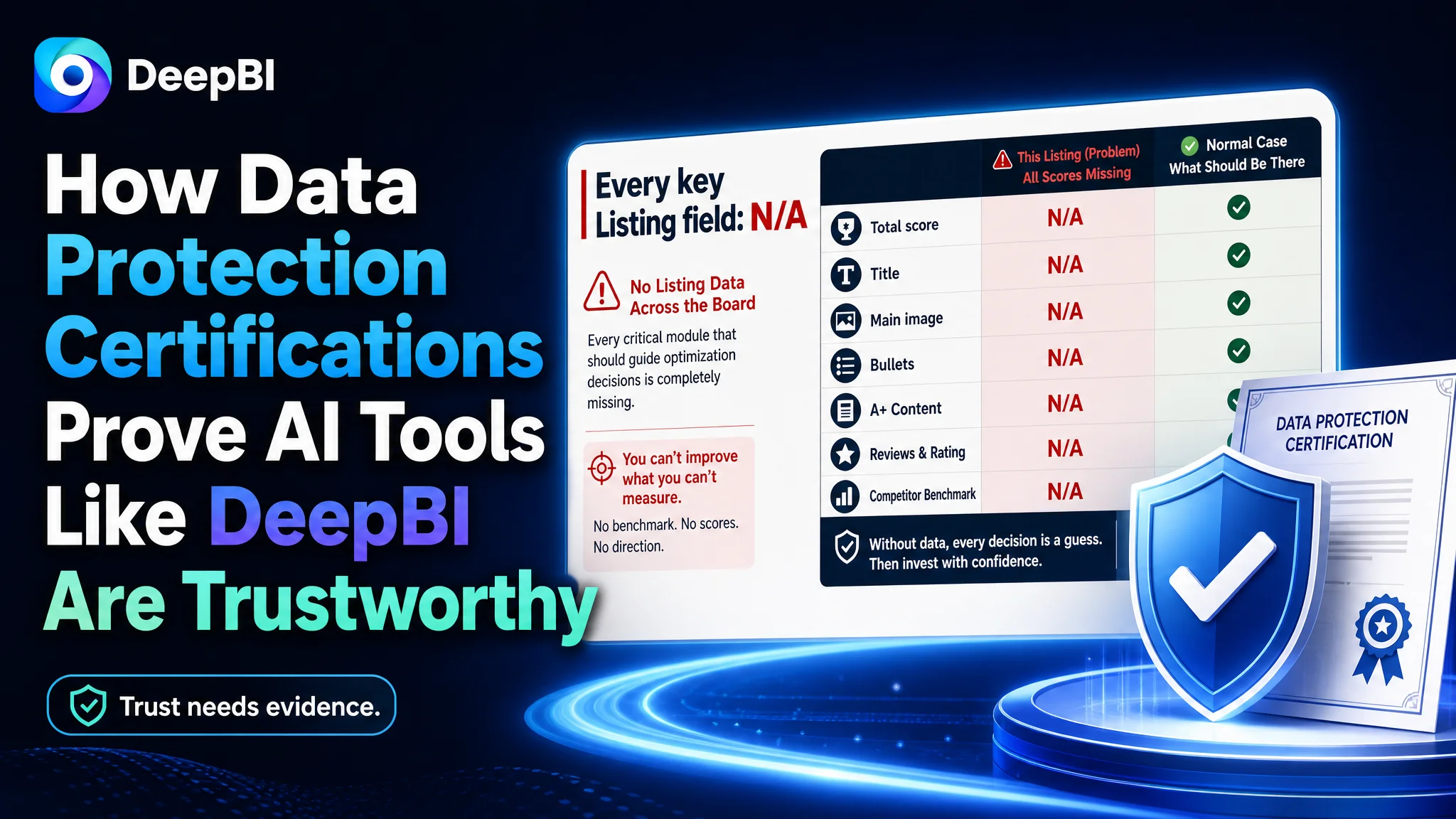
Introduction - The Trust Crisis in AI Tools for E-Commerce
Amazon sellers increasingly rely on AI to move faster and compete more effectively. A platform such as DeepBI can connect diagnosis, planning, content production, and deployment within a single workflow. By converting structured listing data into recommendations and visual assets, this type of system may help operators pursue stronger CTR and CVR, reduce listing cycle time, and make optimization more repeatable. However, the same workflow may involve commercially sensitive information, store authorization, product data, and operational decisions. The question is not simply whether an AI tool can improve a listing, but whether the vendor can protect the data entrusted to it and demonstrate that protection credibly.
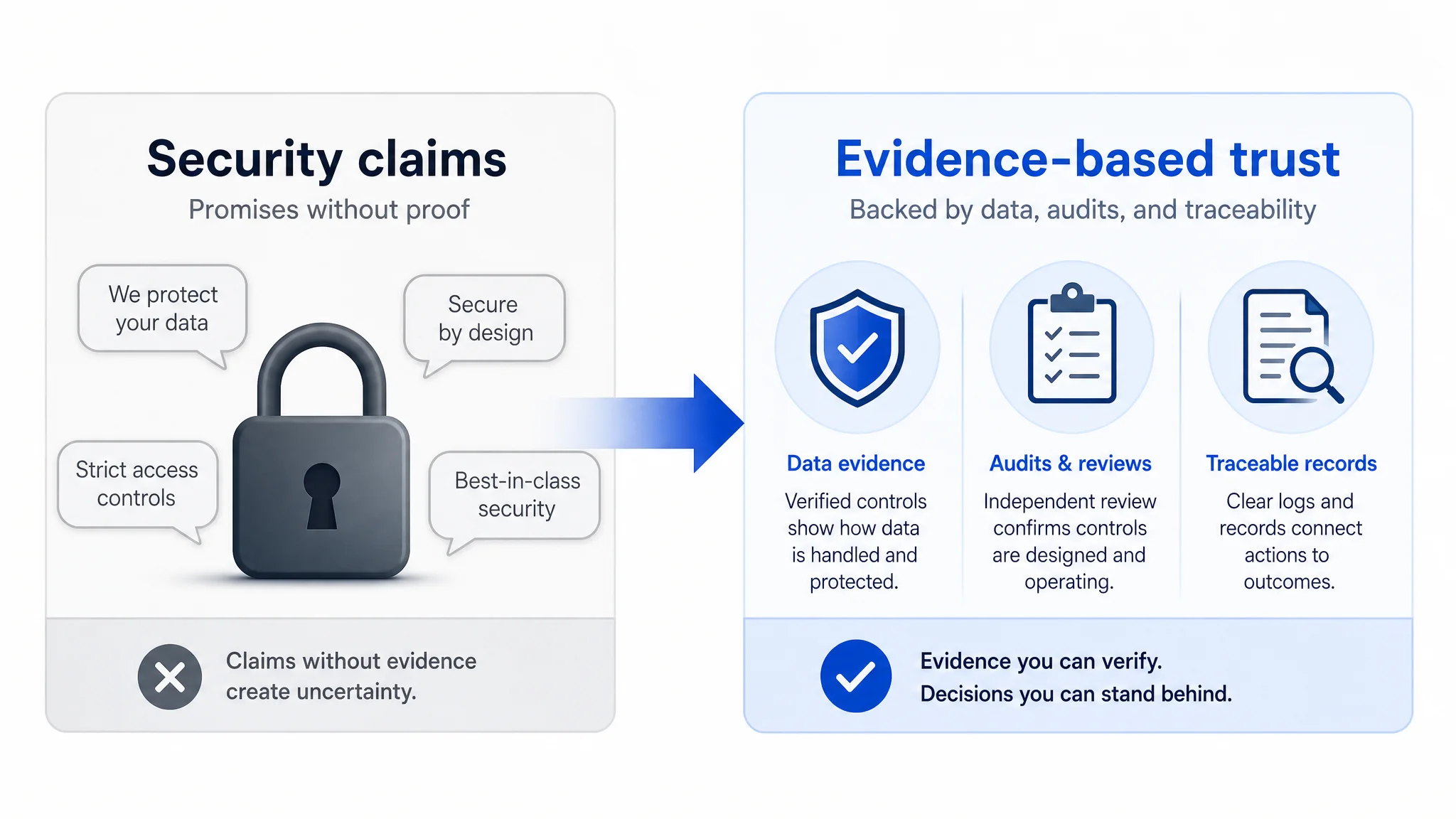
That distinction creates a serious risk for sellers using tools without verifiable data-protection certifications. A vendor may promise secure processing, limited access, or responsible data handling, but marketing language alone does not show how its controls are designed, tested, monitored, or independently assessed. If a tool mishandles personal or business data, the resulting exposure can extend beyond lost trust. Under EU data-protection enforcement, fines can reach €20 million or 4% of global turnover, whichever is higher. In the United Kingdom, Information Commissioner’s Office (ICO) fines can reach £17.5 million. These financial stakes make vendor due diligence a business requirement rather than a technical formality.
The growing need for privacy expertise reinforces this shift. The U.S. Bureau of Labor Statistics projects 33% growth in privacy-related roles from 2023 to 2033, reflecting increasing organizational demand for professionals who can manage data governance and regulatory obligations. Sellers may not have large compliance teams, but they still need a practical way to distinguish documented safeguards from unverified assurances.
Recognized certifications provide that bridge. They do not guarantee that every use of an AI platform is risk-free, nor do they replace a seller’s own access controls and legal review. Instead, they offer objective evidence that a vendor’s information-security or privacy practices have been assessed against defined requirements, creating a more meaningful link between vendor claims and regulatory expectations.
The need for evidence applies not only to security controls, but also to the quality of the operating decisions an AI platform supports. In one US Amazon marketplace product review, the seller believed rising ad costs and unstable orders were primarily an advertising problem. Yet when the product was loaded into DeepBI, the Listing report contained no usable diagnostic evidence: the total score, title score, main-image score, bullet-point score, A+ score, review score, and competitor scores were all marked “N/A.” The immediate temptation would have been to continue adjusting bids, budgets, and keywords. The more responsible conclusion was that the seller was making ad-spend decisions without knowing whether the product page could convert the traffic.
That situation illustrates an important distinction for AI governance. A tool may have structured workflows, permission boundaries, and traceability controls, but its recommendations still need to be based on sufficient evidence. In the case above, the central problem was not proven ad failure. It was the absence of a reliable judgment chain connecting traffic, listing quality, competitor benchmarks, and conversion capacity. Data protection therefore has to be considered alongside data quality, data minimization, access governance, and the accountability of the decisions produced from that data.
DeepBI should therefore be evaluated against recognized data-protection standards rather than accepted on capability claims alone. Its documented workflow includes authorized Amazon SP-API access, structured JSON inputs and outputs, unique report identifiers for traceability, permission boundaries, and human review before proposed image changes are applied. These controls are relevant signals, but they should not be confused with formal certification. The central issue is whether independent, recognized evidence can verify the broader protection framework behind the tool—and whether that evidence is sufficient for the seller’s regulatory and operational risk profile.
Why Data Protection Certifications Are Non-Negotiable for AI Tools
Certification evidence gives Amazon sellers an objective starting point for distinguishing accountable AI vendors from unsupported security claims. It is not, however, proof that every customer deployment is compliant. Evaluate the vendor’s certifications alongside permissions, access controls, review procedures, logs, and your own legal responsibilities.
- Separate vendor compliance from deployment compliance: Ask whether the vendor’s certified management or security processes apply to the specific AI service you will use. A GDPR-compliant vendor does not automatically create a GDPR-compliant deployment; your configuration, data inputs, users, and connected systems still determine the risk.
The same principle applies to the business decisions produced by the tool. A seller may connect an account to an AI platform and assume that the resulting recommendations are evidence-based simply because the platform has access to Amazon data. In the empty Listing review described above, the seller had a live advertising problem but no usable title, main-image, bullet, A+, review, or competitor assessment. The existence of traffic data did not mean the seller had enough evidence to decide whether more traffic was appropriate. A trustworthy deployment must therefore be assessed both for how it protects data and for whether it provides sufficient traceability for important operational judgments.
- Close the DPA gap: Require a Data Processing Agreement that defines roles, purposes, data categories, retention, subprocessors, and security commitments. Then verify what the AI agent can access inside your environment after deployment. A DPA describes contractual responsibilities, but it does not itself restrict excessive permissions or prevent an agent from reaching unrelated data.
- Test Article 5 data minimization: Ask for evidence that the tool processes only data necessary for its stated function, including operation-level access records rather than only session logs. For the documented Amazon SP-API image-asset workflow, DeepBI is described as requesting image-management permissions and avoiding pricing, inventory, and order data unless explicitly authorized. Confirm that this boundary applies to your actual deployment and connectors.
Data minimization should also apply to the information used for diagnosis. In the empty Listing case, the available report did not provide module-level scores or competitor benchmarks. That absence did not justify filling the gaps with assumptions about keywords, bids, or page quality. A controlled system should make clear which fields were available, which were missing, and what conclusions can or cannot be drawn from them. Missing evidence is itself a condition that should be visible to the operator rather than silently replaced by an unsupported recommendation.
- Apply Article 22 safeguards: Determine whether the tool makes or materially supports decisions that produce legal or similarly significant effects, and what human review, explanation, and contestability controls exist. User approval before selected image replacement can support oversight, but it does not by itself resolve automated-decision obligations.
- Verify Article 25 privacy by design: Request documented controls such as fixed data structures, validation checks, restricted scopes, selective approval, and default settings that limit exposure. Treat these as operational evidence, not as substitutes for a privacy certification.
- Maintain Article 30 records: Ask whether the vendor supplies processing details needed for your records of processing activities, including purposes, data categories, recipients, retention, and international transfers. A task identifier and synchronization status can improve traceability, but they do not replace your records.
- Demand Article 32 security evidence: Check for ISO/IEC 27001 or SOC 2 Type II evidence where relevant, along with access governance, audit logging, incident handling, and encryption in transit and at rest. Encryption is a baseline, not a complete regulatory answer; it must be combined with permission controls and monitoring.
- Ask the decisive DeepBI question: Which certifications does DeepBI actually hold, and what specific data-processing guarantees does each provide? Do not infer certification status from documented controls. For an Amazon-focused tool, seek evidence centered on cloud processing, API scope, account security, and access governance—not unsupported multi-platform claims.
The broader decision-order question is equally important: does the platform clearly distinguish what it knows from what it does not know? When a Listing report shows “N/A” across every major field, the appropriate response is not to present a confident diagnosis of low CTR, weak CVR, or poor competitor positioning. The appropriate response is to identify the evidence gap, determine what data is required, and prevent the seller from treating an unverified assumption as a reason to scale advertising. This is part of accountable AI operation, not merely a listing-optimization preference.
Evaluating DeepBI Through a Certification Lens - A Vendor Security Questionnaire
Trust should be tested through verifiable controls, defined scope, and current evidence—not through a general statement that an AI vendor is “compliant.” Use the following questions when reviewing DeepBI or a comparable Amazon-focused tool:
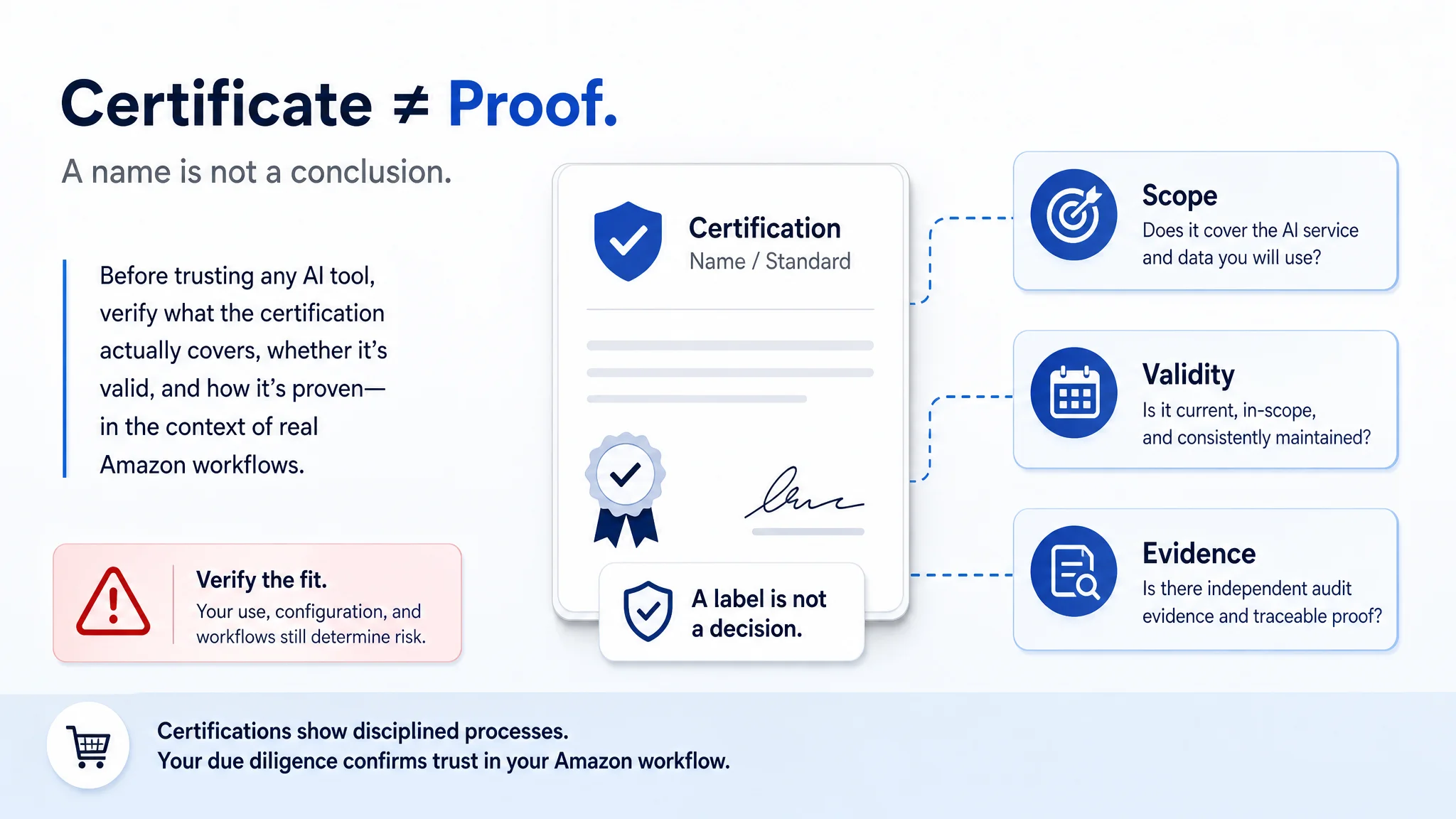
- Does the vendor hold ISO/IEC 42001 for its AI management system? A strong answer should include the certificate, issuing auditor, covered entities and processes, validity dates, and scope of the AI services. No certificate, unclear scope, or an expired document signals that AI governance remains unverified.
- Does the vendor hold SOC 2 Type II or ISO 27001 certification? Request the complete scope statement and, where applicable, the SOC 2 report or current ISO certificate, including exceptions and remediation findings. A logo without independent documentation does not establish that the relevant platform, cloud environment, or processing activity was audited.
- Can the vendor provide operation-level data-minimization logs? Strong evidence should show, for each operation, the data fields accessed, purpose, authorized actor or service, processing location, retention period, deletion status, and relevant report or transaction identifier. A session log, token-consumption record, or generic report ID may support traceability but does not prove that unnecessary data was excluded.
Operation-level evidence should also help explain the basis of a recommendation. In the empty Listing review, all major scoring fields were “N/A,” including the competitor scores that should have established a benchmark. A robust audit trail should make it possible to distinguish between a conclusion supported by listing data, a conclusion supported by advertising data, and a conclusion that cannot yet be made because the required inputs are absent. This does not turn a missing Listing score into a security issue, but it demonstrates why traceability and evidence boundaries matter in an AI-supported operating workflow.
- Does the platform support customer-controlled encryption keys and data-sovereignty controls? Ask about customer-managed key ownership, rotation, tenant isolation, residency options, backup coverage, and key-access records. If the vendor cannot explain who controls the keys or where encrypted data and backups are processed, sovereignty and separation risks remain unresolved.
- How is Amazon-specific access restricted? A strong answer should document SP-API scopes, least-privilege permissions, service accounts, user authorization, privileged-access reviews, MFA, and access revocation. DeepBI’s stated image-asset scope and exclusion of pricing, inventory, and order data should be confirmed through current technical and audit evidence rather than assumed from the Amazon-only label.
- What encryption is applied in transit and at rest? Request the protocols, cryptographic boundaries, key-management procedures, and coverage for stored data, logs, backups, generated assets, and SP-API connections. Encryption in transit and at rest is a baseline; for high-risk processing, it must be combined with access controls, privileged-access monitoring, and audit logging.
- Can the vendor map its controls to GDPR Articles 5, 22, 25, 30, and 32? A credible evidence map should link Article 5 to minimization, purpose, retention, and deletion logs; Article 22 to AI governance and human-review records where applicable; Article 25 to privacy-by-design decisions; Article 30 to processing inventories; and Article 32 to certifications, access controls, encryption protocols, incident controls, and audit logs. Missing links indicate that compliance claims may not cover the actual Amazon data workflow.
A useful questionnaire should therefore test more than whether a vendor can show a certificate. It should ask whether the certificate covers the service being purchased, whether the service records the inputs and outputs relevant to the seller’s workflow, and whether human operators can identify the difference between a supported finding and an evidence gap. In the empty Listing situation, a responsible platform would not claim to know that advertising was the problem when the page had not been objectively diagnosed. That restraint is a practical sign of governed decision support, although it remains separate from formal certification status.
The Growing Demand for Data Privacy Certification (Market Context)
- U.S. Bureau of Labor Statistics (BLS), privacy-related occupational outlook evidence. The BLS projects 33% growth in privacy-related roles from 2023 to 2033. This is a strong market signal: privacy is becoming a specialized business capability rather than an occasional legal task. Organizations increasingly need professionals who can interpret data-protection obligations, assess vendors, and translate policy into operational controls.
- IBM, Cost of a Data Breach Report. IBM’s recent report provides a recognized reference point for the financial and operational consequences of weak data protection. No single report should replace a vendor assessment, but breach-cost research helps explain why companies are investing in privacy expertise, documented controls, and independent assurance before adopting AI systems that process business or customer data.
- Multi-source privacy compensation and workforce evidence from ZipRecruiter, SalaryExpert, and the BLS. Salary and workforce patterns across these sources reinforce the same market direction: privacy skills carry measurable professional value, and employers are competing for people who can manage regulatory, technical, and governance responsibilities. These sources are best used as context for labor-market pressure, not as a substitute for a detailed compensation table or a universal salary benchmark.
- Evidence on certified privacy teams and vulnerability reduction. Organizations with certified privacy teams report significant decreases in critical vulnerabilities in some analyses. The finding should be treated cautiously because results depend on the organization, certification scope, controls, and measurement method. Certification is not a guarantee of security, but it can help establish repeatable competence, accountability, and review practices.
- DeepBI product documentation, DeepBI Listing Product Documentation. The documentation describes controls that support a more verifiable operating model, including fixed JSON data contracts, unique report identifiers, API permission minimization, request tracking, processing-status monitoring, and human confirmation before changes are applied. These mechanisms illustrate the type of traceability organizations may expect from AI vendors as privacy expertise becomes more common. They do not establish that DeepBI holds an independent privacy or security certification.
The empty Listing review also shows why traceability has to cover the decision context. The seller had advertising activity, but the report lacked the structured listing evidence needed to determine whether the page was ready to receive more traffic. A system that records which listing fields were available, which benchmark was used, and which modules were not evaluated can help prevent operators from treating an incomplete diagnosis as a complete one. That is not a substitute for certification, but it is part of the operational discipline buyers should expect from a governed AI workflow.
- Market implication for AI tool providers. As privacy professionals become more prevalent, buyers are likely to ask not only whether an AI vendor claims compliance, but also how that claim is supported. Certification posture, documented data flows, access boundaries, audit records, and vendor agreements increasingly form part of the purchasing decision. For an Amazon seller, that scrutiny protects more than regulatory standing: it supports responsible handling of catalog information, advertising data, and customer-related records while evaluating potential effects on operational continuity and listing cycle time.
The same scrutiny is increasingly relevant to the quality of optimization decisions. A seller that spends heavily on ads while lacking a structured view of title, main image, bullets, A+, reviews, and competitor positioning is operating with a different kind of governance gap. The issue is not that every business decision requires a certification. It is that AI-supported recommendations should reveal their evidence base, limitations, and required human review. Privacy expertise and AI governance are becoming connected because both require organizations to understand what information is being used, for what purpose, and with what degree of confidence.
Benefits of Getting Certified in Data Privacy (For Individuals and Organizations)
Data privacy certification creates value at two levels: it strengthens an individual’s ability to make sound privacy decisions and enhances an organization’s credibility when it handles customer, marketplace, or operational data. These benefits are related, but they should not be conflated. A certified person is not the same as a certified company, platform, or AI product.
For individuals, certification provides professional credibility. A recognized credential can demonstrate structured knowledge of privacy principles, including GDPR requirements, governance responsibilities, data minimization, and vendor oversight. For an Amazon seller, this expertise is practical rather than purely academic. A certified privacy professional can assess whether an AI tool requests only the data necessary for its stated workflow, whether access is properly authorized, and whether the vendor can explain retention, deletion, subprocessors, incident handling, and international transfers.
That professional can also audit how a platform such as DeepBI interacts with the seller’s systems. DeepBI documentation describes connections through Amazon’s Selling Partner API, data connectors that may process metrics such as impressions, clicks, conversions, CTR, and CVR, and user confirmation before selected images are applied. A privacy professional can test these documented boundaries against the vendor’s technical and contractual commitments rather than treating the documentation as proof of compliance. The review can support stronger Data Processing Agreement negotiations covering permitted purposes, API permissions, audit rights, breach notification, data return or deletion, and retention.
The review should also consider whether the platform is making conclusions that the available evidence can support. In one seller’s Listing file, advertising costs were rising and orders were unstable, but the product had no Listing score, module-level breakdown, or competitor benchmark. A privacy or AI governance professional would not need to decide whether the page was commercially strong from that incomplete file. Instead, the professional could identify the missing evidence, document the limitation, and require a Listing-level diagnosis before recommending additional advertising spend. This is an example of disciplined judgment: the system should not expose more data simply to create the appearance of certainty, and it should not create certainty where the necessary data does not exist.
ANSI/ISO accreditation can provide an additional quality signal when evaluating personnel-certification programs. ISO/IEC 17024 addresses requirements for organizations that certify people, including the consistency and impartiality of the certification process. It does not certify the individual’s employer, DeepBI, or any AI product. Instead, it helps buyers distinguish a credential issued through a controlled personnel-certification framework from a course-completion badge with limited independent assurance.
For organizations, certified expertise can improve vendor trust and reduce regulatory risk. AI providers and Amazon businesses that employ qualified privacy personnel are better positioned to document data flows, answer customer and partner questions, and identify contract gaps before deployment. This supports more disciplined vendor selection and can reduce the likelihood that unclear data-access or retention practices become a regulatory problem.
For AI providers, credible privacy competence can also create competitive differentiation. Clear explanations of permissions, processing purposes, traceability, and governance controls may reassure enterprise buyers. The claim must nevertheless remain precise: individual certification demonstrates the holder’s competence, while organizational or product trust requires separate evidence, controls, contracts, and, where applicable, organizational certifications.
A mature review also asks whether the platform can prevent operators from optimizing the wrong layer of the business. In the empty Listing situation, the seller initially framed the problem as “bad Amazon ads” and had already considered changing bids, budgets, match types, and campaign structures. The available evidence did not establish that any of those changes would address the constraint. Once the Listing-level evidence gap was recognized, the priority shifted from campaign execution to diagnosis. Certified expertise can help organizations make that distinction, but the distinction still depends on the platform exposing its data boundaries and limitations clearly.
9 Data Privacy Certifications and How to Get Them
No single credential proves that an AI vendor is safe. Each certification examines a different layer: legal knowledge, privacy operations, engineering controls, security, or organizational governance. When assessing a tool such as DeepBI, match the credential to the risk under review and confirm its issuer, scope, validity, and audit evidence.
Certified Information Privacy Professional (CIPP)
Accreditation: The IAPP administers CIPP credentials, with regional versions such as CIPP/E and CIPP/US; its certification programs are associated with ANAB accreditation under ISO/IEC 17024. Who: Privacy lawyers, compliance staff, and data-protection specialists. AI relevance: Tests whether teams understand the laws governing personal data used by AI tools. Prepare: Choose the relevant jurisdiction, study the IAPP body of knowledge, and document how vendor contracts and data flows are reviewed.
Certified Information Privacy Manager (CIPM)
Accreditation: CIPM is an IAPP privacy-management credential within its professional certification framework. Who: Privacy officers, program managers, and compliance leaders. AI relevance: Helps evaluate whether a provider can operate policies, training, incident response, and vendor oversight consistently. Prepare: Map the privacy-program lifecycle and practice applying governance controls to AI-processing workflows.
Certified Information Privacy Technologist (CIPT)
Accreditation: CIPT is an IAPP technology-focused privacy credential. Who: Product managers, engineers, architects, and privacy technologists. AI relevance: Supports the review of data minimization, access controls, retention, and privacy-by-design decisions in AI systems. Prepare: Study the IAPP curriculum and connect privacy principles to system architecture and data contracts.
Artificial Intelligence Governance Professional (AIGP)
Accreditation: AIGP is an IAPP credential for AI governance professionals, not a certification held automatically by an AI product. Who: AI risk, legal, compliance, and governance practitioners. AI relevance: Helps assess lifecycle governance, accountability, risk controls, and responsible-use processes around tools such as DeepBI. Prepare: Study the AIGP body of knowledge and build documented AI inventories, risk assessments, and oversight procedures.
Certified Information Systems Security Professional (CISSP)
Accreditation: ISC2 administers CISSP; the credential is accredited under ISO/IEC 17024 and recognized in the U.S. DoD Directive 8570.01-M framework. Who: Senior security architects and managers. AI relevance: Covers security governance, identity, operations, and risk controls surrounding an AI stack. Prepare: Meet ISC2 experience requirements and study its eight-domain exam outline. HCISPP is a related ISC2 healthcare-security credential, not a CISSP subtype.
Certified Data Privacy Solutions Engineer (CDPSE)
Accreditation: ISACA administers CDPSE as a professional certification focused on privacy-technology implementation. Who: Privacy engineers, developers, and data architects. AI relevance: Helps examine whether technical controls translate privacy requirements into functioning systems. Prepare: Review ISACA’s published domains and document relevant privacy-engineering experience.
PECB Certified Data Protection Officer (CDPO)
Accreditation: PECB offers CDPO certification through its personnel-certification scheme. Who: Current or prospective DPOs and privacy consultants. AI relevance: Supports independent oversight of an AI provider’s obligations, procedures, and accountability. Prepare: Complete the applicable training or experience route, pass the examination, and assemble evidence of practical competence.
Certified in Data Protection (CDP)
Accreditation: CDP is an issuer-specific data-protection credential, so the issuing body and accreditation status must be verified before relying on it. Who: Professionals seeking foundational privacy knowledge. AI relevance: Can support baseline staff competence when reviewing AI vendors. Prepare: Confirm the scheme’s syllabus, assessment method, renewal rules, and recognized accreditation.
PrivacyTrust
Accreditation: PrivacyTrust is an organizational privacy-framework certification or seal, not an individual qualification; verify the current program owner and assessment scope. Who: Organizations and technology providers. AI relevance: May provide evidence that a vendor’s stated privacy practices underwent structured review. Prepare: Define processing activities, publish accurate notices, document controls, and complete the provider’s assessment. A seal is not a substitute for a contract, security review, or regulatory analysis.
Artificial Intelligence Governance Professional (AIGP) - Deep Dive
An Artificial Intelligence Governance Professional (AIGP) certification is relevant because trustworthy AI depends on more than model performance. It also requires governance frameworks, risk management, accountability, and ethical deployment practices that remain effective throughout the tool’s lifecycle. An AIGP-certified professional can evaluate whether an AI system has defined boundaries, documented decisions, appropriate oversight, and review mechanisms before it affects an Amazon seller’s listings or operational choices.
For DeepBI, the key question is not whether the product itself holds AIGP. It does not. The relevant question is whether a qualified governance professional can examine its architecture and deployment controls against applicable requirements, including GDPR Article 22 on automated decision-making. Article 22 requires careful assessment when a decision is made solely by automated means and produces legal or similarly significant effects. An auditor would first determine whether a particular DeepBI workflow reaches that threshold, then examine safeguards such as human intervention, the ability to challenge an outcome, and documented accountability.
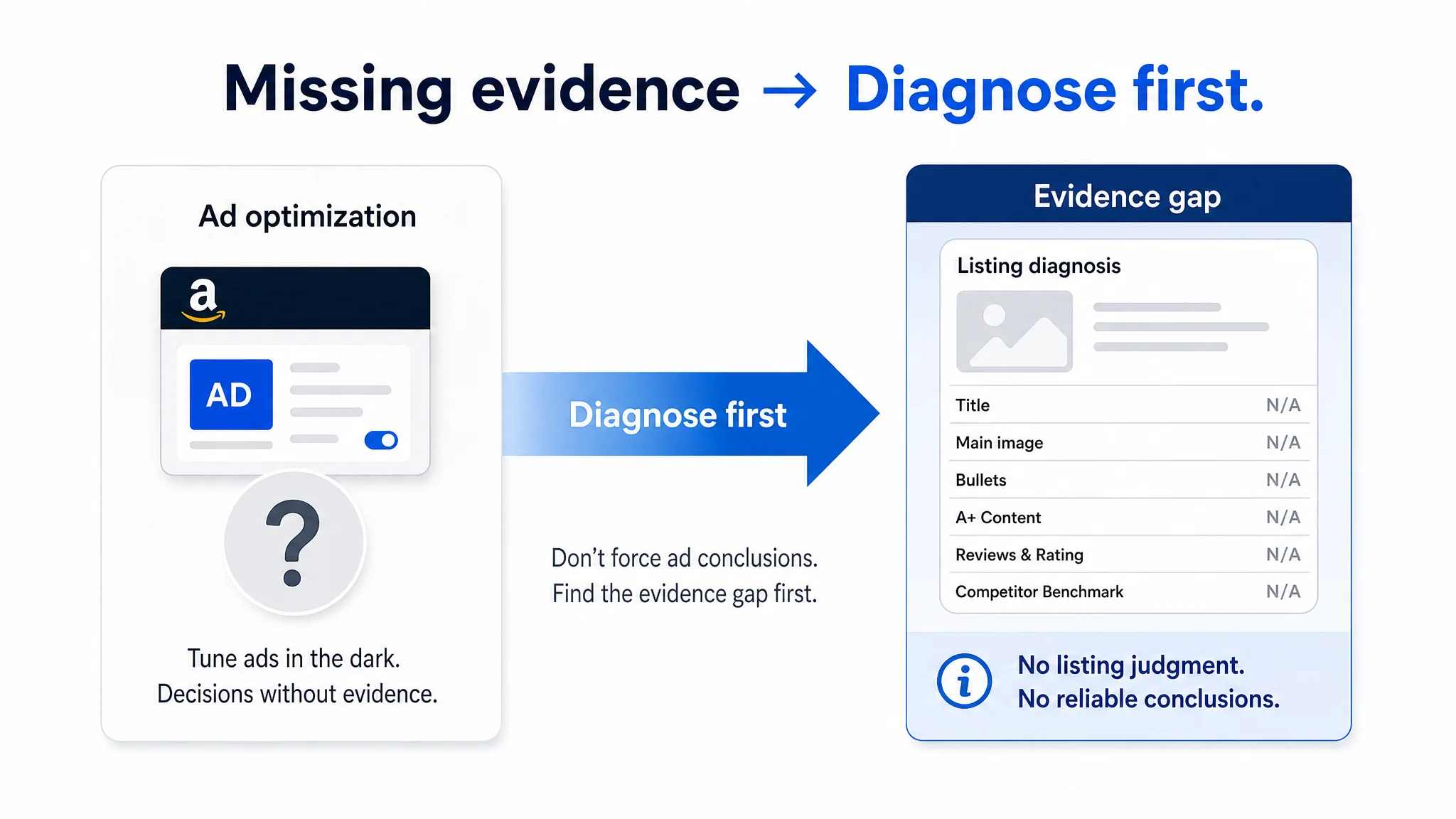
Governance review should include situations in which the platform cannot yet make a reliable recommendation. In the empty Listing case, the seller’s operational team believed that ad optimization was the immediate priority. However, every major Listing diagnostic field was “N/A,” including the title, main image, bullets, A+, reviews, and competitor scores. DeepBI therefore reframed the task from “How do we lower ACOS?” to “Is this product page structurally capable of supporting efficient Amazon ads?” That was not a claim that the page was weak; it was a recognition that the available evidence was insufficient to judge its conversion capacity.
That review could map Article 22 considerations to several DeepBI control points:
- Architecture: Defined data contracts and fixed JSON artifacts, including Product DNA, strategy, scoring, optimization, and evaluation outputs, provide identifiable stages for tracing how an AI recommendation is formed.
- Risk controls: The Product DNA layer establishes a source of truth for product structure, materials, logos, and other immutable attributes. The system prohibits AI instructions from changing the product’s material, color, or industrial design, reducing image-product mismatch and related negative-review or refund risk.
- Documentation: Each scoring task receives a unique report_id, while model-call token records preserve information about inputs and outputs. These records give reviewers a basis for investigating what the system generated and why.
- Evidence-gap handling: A governed workflow should preserve missing or unavailable fields rather than silently replacing them with assumptions. In the empty Listing review, the absence of scores and competitor comparisons became a visible condition that changed the recommended decision order. The system did not have a defensible basis to attribute unstable orders to keywords, bids, or page modules until a proper Listing diagnosis was available.
- Human review: Before an image is applied, users compare the existing and proposed versions and approve selected replacements. A governance professional would assess whether this intervention is informed and meaningful rather than a routine approval step.
- Validation and escalation: The Evaluation Agent checks generated images against the DNA file, while delivery controls validate image format and size and can reject policy-violating outputs before upload.
These controls do not establish legal compliance on their own. They give an AIGP-certified professional evidence to test, document, and improve the deployment. Privacy and accountability should be built into the workflow from day one, enabling organizations to govern AI tools even when the tools themselves do not hold the certification.
Certified Data Privacy Solutions Engineer (CDPSE) - Engineering Trust into AI Stacks
Privacy requirements become meaningful only when translated into architecture, workflows, and evidence. The Certified Data Privacy Solutions Engineer (CDPSE) credential represents expertise in making privacy by design and privacy by default operational within technical systems. It does not simply test whether someone understands privacy principles; it validates the ability to connect those principles with system design, data handling, security controls, and ongoing verification.
For an AI stack, that connection must follow the data pipeline. A CDPSE-qualified professional can help map what information enters the system, why it is needed, which services can use it, how long it should remain available, and which records demonstrate compliant handling. Policy statements such as “use only necessary data” must become concrete controls: minimized inputs, defined permissions, protected transmission, controlled processing, and logs that support investigation and accountability.
The same engineering discipline should be applied to the information used for commercial diagnosis. In the empty Listing case, the seller had advertising activity but no structured scoring for the product page. The system could not responsibly connect a performance symptom to the main image, title, bullets, A+, reviews, or competitor positioning because the relevant evidence was absent. A CDPSE-oriented review would treat this as a data-lineage and decision-quality issue: which fields were received, which were unavailable, which were transformed, and which conclusions were therefore out of scope?
DeepBI’s documented workflow illustrates several engineering patterns relevant to that assessment, without implying that DeepBI engineers hold CDPSE certification. Its layers use fixed JSON data contracts rather than unrestricted free-text transmission, helping keep information movement structured and limited. Scoring tasks receive unique report identifiers for end-to-end traceability, while token logs record AI model calls and token consumption. Its Amazon connection uses the official encrypted SP-API channel, and its stated permission scope is limited to image-asset management rather than pricing, inventory, or order data. These controls support a least-privilege approach to protecting seller information, although they should not be taken as complete privacy protection for every data flow.
A practical review should also distinguish documented controls from assumptions. The available materials do not establish encryption at rest, field-level encryption, retention schedules, deletion workflows, or privacy-specific access reviews. Those areas require separate validation before a seller treats them as part of its risk-control environment.
The empty Listing case demonstrates a parallel distinction between available data and assumed data. The seller’s team assumed that rising ad costs meant campaign settings were the central problem. Yet there was no validated competitor benchmark, no module-level gap breakdown, and no quantified view of the page’s conversion capacity. The correct engineering response was not to manufacture missing scores, but to establish the data and diagnostic path required before further optimization. Privacy by design and decision transparency share this principle: systems should make limits visible instead of hiding them behind confident output.
Regulation can serve as a forcing function for disciplined innovation when it reinforces sound engineering practices, but it does not automatically produce a secure architecture. Frameworks such as ISO 27001, SOC 2, and ISO/IEC 42001 help organizations demonstrate the connection between governance and implementation through security and access controls, evidence of controlled operations, and documented AI lifecycle, oversight, and evaluation practices. For Amazon operators, that evidence is more valuable than a generic trust claim because it clarifies how seller data is constrained, monitored, and governed within the AI workflow.
How to Prepare and Get Certified - A Practical Roadmap
Certification readiness starts with identifying an evidence gap, not with completing an application form. Individuals should first select a relevant privacy or AI governance credential, review its syllabus, and map the required knowledge to their current responsibilities. Preparation commonly combines a course from an accredited training partner, structured self-study, practice exams, and documented professional experience where the credential requires it. Practice exams are useful not only for testing terminology but also for identifying weak areas such as lawful processing, risk assessment, governance responsibilities, and control testing. Candidates should retain records of completed training and relevant work because experience requirements must be demonstrated rather than assumed.
Organizations preparing for frameworks such as PrivacyTrust or ISO/IEC 42001 should conduct an internal audit and gap analysis before seeking external assessment. A practical comparison asks three questions:
- What may an auditor request? Policies, lawful-basis records, data inventories, minimization rules, encryption controls, access reviews, retention decisions, incident records, tamper-evident log design, test results, named control owners, and evidence that controls operate consistently.
- What might an uncertified AI tool provide? Product claims, informal permissions, basic activity logs, undocumented model outputs, or a general security statement without proof of operational testing.
- What does preparation add? Approved procedures, accountable owners, repeatable tests, exception handling, review records, and an evidence trail connecting requirements to daily operations.
For an AI tool provider or an organization operating integrations similar to DeepBI’s ecosystem, the review should follow the data and decision path. Confirm the lawful basis and purpose for each input, minimize data to what the workflow requires, and document where encryption applies rather than assuming that API access alone proves complete protection. Assess logs for integrity and tamper evidence; ordinary usage records should not automatically be presented as immutable audit evidence.
The review should also ask whether the platform has enough information to support the action being considered. In the empty Listing situation, the seller’s team had already cycled through bids, budgets, match types, keyword lists, campaign structures, and learning-phase assumptions. But the Listing report had no total score, module scores, or competitor benchmark. A practical readiness process would record this as a decision gap: before scaling or further refining advertising, obtain a market-aligned Listing diagnosis and identify whether the main image, title, bullets, A+, reviews, or another page element is limiting conversion. This sequence reduces the risk of using a technically available tool to automate poorly supported decisions.
A structured workflow can make this assessment more practical. Separate stages, fixed data contracts, unique report identifiers, validation reports, user confirmation, and least-privilege permissions create useful evidence points. However, each control still needs documented ownership, testing, retention, and review. For example, limiting an integration to image-asset management while excluding pricing, inventory, and order data demonstrates a permission boundary, but certification preparation must also show that the boundary is reviewed and enforced over time.
Regulatory history reinforces the value of preparation. In 2020, the Dutch DPA fined the tax authority €525,000 for GDPR violations related to unlawful data processing, while a broader biased-profiling scandal also drew regulatory scrutiny. A documented lawful basis, minimization process, and audit trail help organizations identify such risks before an external regulator or certification auditor does.
The same preparation mindset applies to commercial workflows. Before concluding that advertisements are inefficient, a seller should be able to show what Listing data was reviewed, what benchmark was selected, how the page was scored, and which evidence supports the proposed intervention. If those records do not exist, the next step should be diagnosis rather than more aggressive execution. Certification readiness and Listing readiness are different activities, but both depend on a clear evidence chain.
Building a Certified AI Stack for Amazon Operations with DeepBI
A trustworthy AI stack is not defined by a logo or a general privacy statement. Evaluate whether governance, technical safeguards, and certification evidence actually cover the Amazon data flows your business uses.
- Check organizational governance through AIGP and CIPM principles: verify who is accountable for privacy decisions, how processing purposes are documented, how retention is managed, and how regulatory obligations are translated into operating procedures.
- Check technical implementation through CDPSE and CIPT principles: require evidence that privacy controls are designed into systems, permissions are limited to business need, data movement is traceable, and privacy requirements are reflected in the product’s engineering and deployment processes.
- Review framework certifications separately: ISO 27001 and SOC 2 can provide evidence of information-security controls and operational control testing; ISO/IEC 42001 addresses management of artificial-intelligence risks; PrivacyTrust can add privacy-focused assurance. Confirm the covered entity, scope, assessment type, validity dates, and exclusions rather than accepting certification names alone.
- Map certification scope to Amazon catalog data: examine how listing text, images, product attributes, diagnostic reports, and optimization plans are received, transformed, stored, and delivered. DeepBI’s documented workflow includes structured artifacts such as Product_DNA.json, Score_Report.json, and Optimization_Plan.json, making these handoffs suitable for control and traceability review.
- Validate the SP-API integration specifically: confirm the requested scopes, authorization model, asset destinations, status tracking, and publication controls. DeepBI’s documented One-Click Apply workflow is designed around listing asset management, while price, inventory, and order data are not accessed by default without explicit authorization. Sellers should verify that the live configuration matches this stated boundary.
- Audit advertising-data processing: identify whether impressions, clicks, conversions, CTR, CVR, ACoS, or TACoS are used in diagnosis and optimization, who can access those records, and how long they remain available. A traceable report identifier and event tagging can support review of the relationship between listing changes, CTR movement, CVR, and listing cycle time.
Advertising data should not automatically be treated as a sufficient explanation for advertising outcomes. In the empty Listing case, the seller had rising ad costs and unstable orders, but the product page had not been objectively compared with a true category benchmark. Without title, main-image, bullet, A+, review, and competitor evidence, the team could not determine whether low CTR, low CVR, or inefficient spend was caused by the campaign or by the page receiving the traffic. A properly governed workflow should preserve that uncertainty until the Listing diagnosis is complete.
- Treat customer data as a separate verification issue: available DeepBI materials support review of catalog, advertising, and listing workflows, but do not establish customer-data retention, processing, or certification scope. Do not infer protection for customer data from controls covering listing assets.
- Distinguish a GDPR-compliant vendor from a GDPR-compliant deployment: a vendor may maintain suitable policies while a seller’s permissions, retention settings, processing purpose, or integration scope create a different risk profile. Demand deployment-specific evidence before connecting Amazon accounts.
- Require transparent evidence from every AI tool, including DeepBI: use the multi-certification framework to evaluate its security posture without assuming that DeepBI currently holds any listed certification. Trust should rest on disclosed scope, verifiable controls, and evidence tied to actual Amazon workflows—not on product claims or future certification promises.
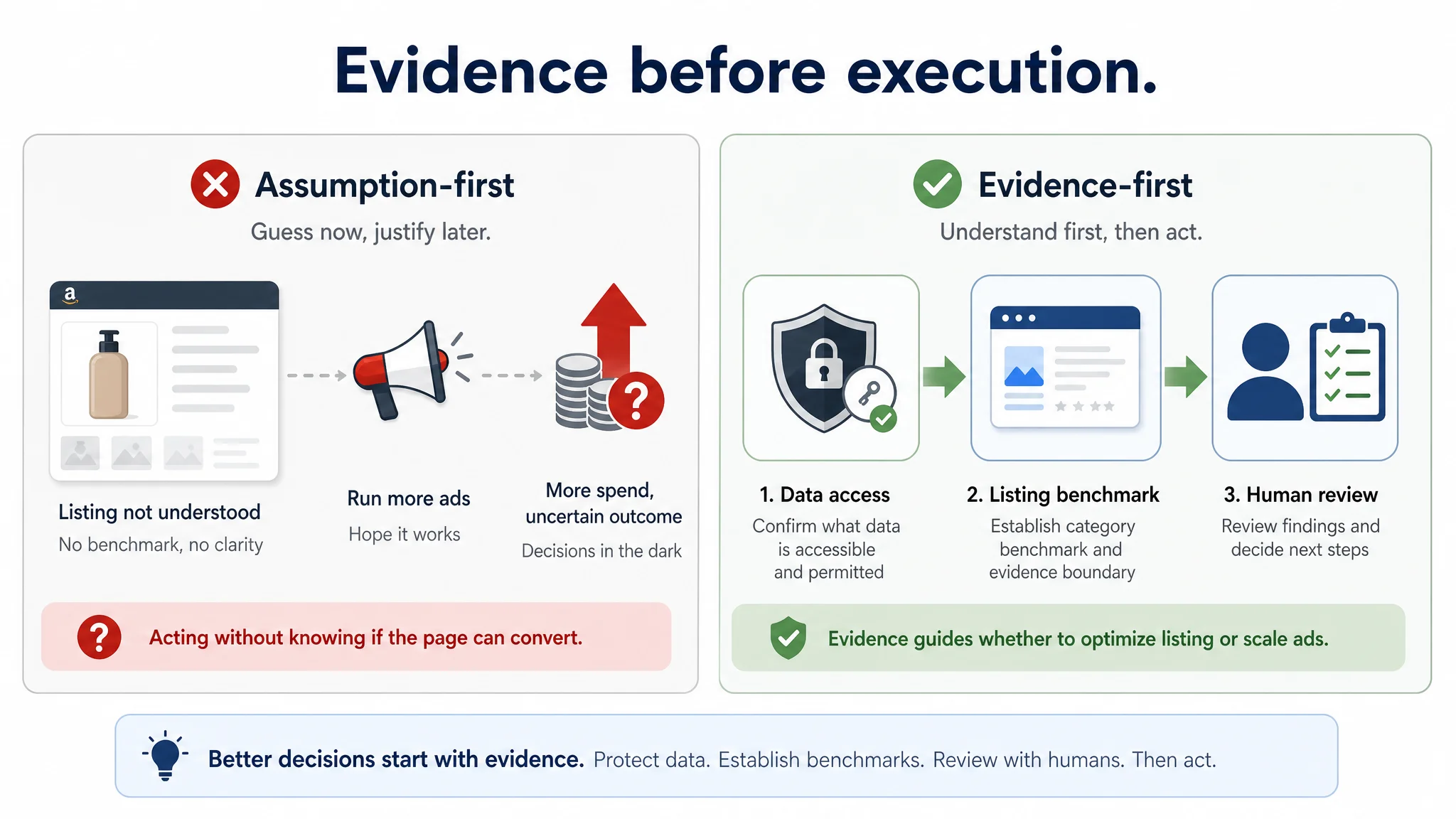
For Amazon sellers, the practical sequence is straightforward:
1. Confirm what data the platform can access and why.
2. Verify the relevant security, privacy, and AI-governance evidence.
3. Check whether the system records inputs, outputs, permissions, and processing status.
4. Establish a reliable Listing benchmark before treating advertising performance as an isolated campaign problem.
5. Require human review where generated assets or recommendations affect the seller’s page or operating decisions.
6. Preserve evidence of what was known, what was missing, and why a particular action was approved.
The empty Listing review makes the final point especially clear. The seller initially believed the answer was another round of ad adjustments. But with every major Listing field marked “N/A,” the responsible first step was to determine whether the page had the conversion capacity to support more traffic. No certification can guarantee that an optimization recommendation will be commercially correct. What certification and governance can do is provide a more reliable basis for assessing how data is handled, how decisions are formed, where human judgment is required, and whether the system is honest about its limitations.
That is the standard Amazon sellers should apply when evaluating DeepBI or any comparable AI tool: not whether it makes the strongest claim, but whether it can demonstrate controlled data flows, appropriate permissions, verifiable safeguards, traceable reasoning, and a clear distinction between evidence and assumption.
第二部分:配图定义表
IMG_01
- 插入位置:Introduction - The Trust Crisis in AI Tools for E-Commerce 中,Recognized certifications provide that bridge. 段落后。
- 图片类型:页面承接图
- 核心视觉任务:让读者一眼理解:AI 工具可信度不仅取决于能力,也取决于数据证据和决策证据是否完整。
- 图片内容:极简左右对比。左侧为“Security claims”与锁形图标,右侧为“Evidence-based trust”与认证、审计和可追溯记录图标,中间用箭头连接。不要加入复杂的合规框架或额外指标。
- 图片文案:Security claims → Evidence-based trust
- 推荐参考依据:融合后文章指出,营销语言不能证明控制措施如何设计、测试、监控或独立评估;认可的认证能够在供应商声明与监管期待之间建立更有意义的证据连接。图片仅基于文章观点生成,不引入 CASE 的未写入细节。
- 素材方式:建议 AI 重新生成
IMG_02
- 插入位置:Evaluating DeepBI Through a Certification Lens - A Vendor Security Questionnaire 标题后的首段之后、问题清单之前。
- 图片类型:逻辑解释图
- 核心视觉任务:让读者 3 秒理解:认证名称本身不是可信度结论,必须核对服务范围、有效性、审计证据和实际 Amazon 工作流。
- 图片内容:中心为一张简化认证文件卡片,左侧只显示“Certificate”,右侧显示“Scope / Validity / Evidence”三个极简标签;右侧区域高亮,表示真正需要验证的是认证是否覆盖实际服务。
- 图片文案:Certificate ≠ Proof
- 推荐参考依据:融合后文章强调,信任应通过可验证控制、明确定义的范围和当前证据进行测试,而不是通过“compliant”的概括性声明;证书范围、发证机构、有效日期和服务覆盖范围都需要核实。
- 素材方式:建议 AI 重新生成
IMG_03
- 插入位置:Artificial Intelligence Governance Professional (AIGP) - Deep Dive 中,DeepBI therefore reframed the task from “How do we lower ACOS?” to “Is this product page structurally capable of supporting efficient Amazon ads?” 段落后。
- 图片类型:用户决策图
- 核心视觉任务:让读者一眼理解:当 Listing 的关键诊断字段都是 “N/A” 时,负责任的 AI 不应强行给出广告结论,而应先标记证据缺口。
- 图片内容:左右对比。左侧是“Ad optimization”按钮和问号,右侧是“Evidence gap”空白 Listing 卡片;中间箭头指向“Diagnose first”。只保留两个核心视觉元素:广告问题与空白诊断。
- 图片文案:Missing evidence → Diagnose first
- 推荐参考依据:融合后文章明确写出,案例中标题、主图、五点、A+、评论和竞品评分均为 “N/A”,因此 DeepBI 将问题从“如何降低 ACOS”重新定义为“产品页面是否有能力支持高效广告”。图片不添加 PDF 中未进入融合文章的数字或评分。
- 素材方式:真实素材 + AI 简化重绘
IMG_04
- 插入位置:Building a Certified AI Stack for Amazon Operations with DeepBI 中,Require transparent evidence from every AI tool, including DeepBI 段落后。
- 图片类型:前后对比图
- 核心视觉任务:让读者快速理解:治理良好的 AI 工作流,应先确认数据权限和证据边界,再决定是否优化 Listing 或扩大广告。
- 图片内容:左右两栏。左侧为“Assumption-first”:广告箭头直接指向预算图标,底部为问号;右侧为“Evidence-first”:Data access → Listing benchmark → Human review,使用三个简洁图标和单向箭头。右侧不得增加认证清单或复杂流程。
- 图片文案:Evidence before execution
- 推荐参考依据:融合后文章最后部分要求卖家确认平台能访问什么数据、验证安全与治理证据、检查输入输出和处理状态、建立 Listing benchmark、保留人工审核,并记录已知与未知信息。图片将这一段压缩为一个决策顺序,不新增文章之外的操作建议。
- 素材方式:建议 AI 重新生成
IMG_05
- 插入位置:Building a Certified AI Stack for Amazon Operations with DeepBI 的结尾段落后,作为全文收束图。
- 图片类型:页面承接图
- 核心视觉任务:让读者记住全文核心结论:可信 AI 不是最强的承诺,而是能够展示受控数据流、适当权限、可验证防护、可追溯推理,以及证据与假设之间的边界。
- 图片内容:一个简洁的“Trust”盾牌作为中心视觉主体,周围只放两个短标签:“Controlled data”与“Traceable reasoning”;底部用一条细线连接到 Amazon Listing 页面图标。避免堆叠 ISO、SOC 2、GDPR 等多个标志。
- 图片文案:Trust needs evidence
- 推荐参考依据:融合后文章结尾明确要求评估 AI 工具是否能够证明受控数据流、适当权限、可验证防护、可追溯推理,并清晰区分证据与假设。图片用于强化全文结论,不展示客户案例或独立客户成果。
- 素材方式:建议 AI 重新生成
COVER_BRIEF
- 封面核心任务:聚焦文章标题 How Data Protection Certifications Prove AI Tools Like DeepBI Are Trustworthy,让读者首屏理解文章讨论的是 AI 工具的可信度、数据保护认证与可验证证据,而不是单纯的 Amazon 广告优化。
- 画面内容:使用 CASE 中已经在融合文章内出现的 Amazon Listing / DeepBI 诊断场景作为核心视觉主体。画面主体应是一个简化的真实 Listing 诊断界面或产品页面卡片,旁边叠加一个清晰的安全盾牌、认证文件或审计标记,表现“AI 工具 + 受控数据 + 可验证证据”的关系。完整文章标题必须原样出现在封面中。整体风格采用清晰、可信、轻量 SaaS 视觉,但应保留 Amazon seller growth 缩略图的视觉冲击力。
- 文案限制:文章标题必须完整原样出现,不得缩写为 “AI Trust” 或 “Data Privacy”。除完整标题外,最多增加一个极短辅助标签:Trust needs evidence。不得加入文章正文未出现的认证结论、分数、百分比或时间信息。
- 禁用元素:不得使用纯抽象锁形图作为唯一主体;不得制作成客户案例成果展示;不得加入 PDF 中未被融合文章明确写出的具体评分、排名、增长数字或认证 Logo;不得暗示 DeepBI 已经获得文章列出的任何认证;不得使用与 CASE 产品或诊断素材视觉气质冲突的固定蓝白商务模板。
- 推荐素材:优先使用 CASE PDF 中与融合文章一致的空白 Listing 诊断视觉素材,尤其是展示关键 Listing 字段为 “N/A” 的原始主图或其 AI 简化重绘版本;若需产品主体,使用 CASE 原始主图或优化后主图中最能代表 Amazon Listing 场景的一张,并将其与认证文件和安全盾牌组合呈现。