

Conversion Rate as a Growth Engine
What Makes Amazon Conversion Rate Optimization So Critical
Amazon search is transactional. Shoppers often arrive with a defined product need and are evaluating whether a specific listing deserves their purchase. That makes conversion rate—the percentage of sessions that end in an order—a fundamental growth lever, not a secondary reporting metric.
Every listing decision should therefore serve the same commercial objective: turn more qualified sessions into purchases. The main image must earn the click, the title and bullets must reinforce relevance, and the product page must resolve concerns about benefits, fit, quality, and value. Reviews, A+ Content, and visual assets should strengthen that decision rather than simply make the page look more polished.
A higher CVR can support healthier profitability because more of the traffic reaching the listing produces revenue. It can also reduce the need to compensate for weak page performance with additional advertising spend, helping sellers evaluate progress through CVR, CTR, ACoS, and sales contribution instead of impressions alone.
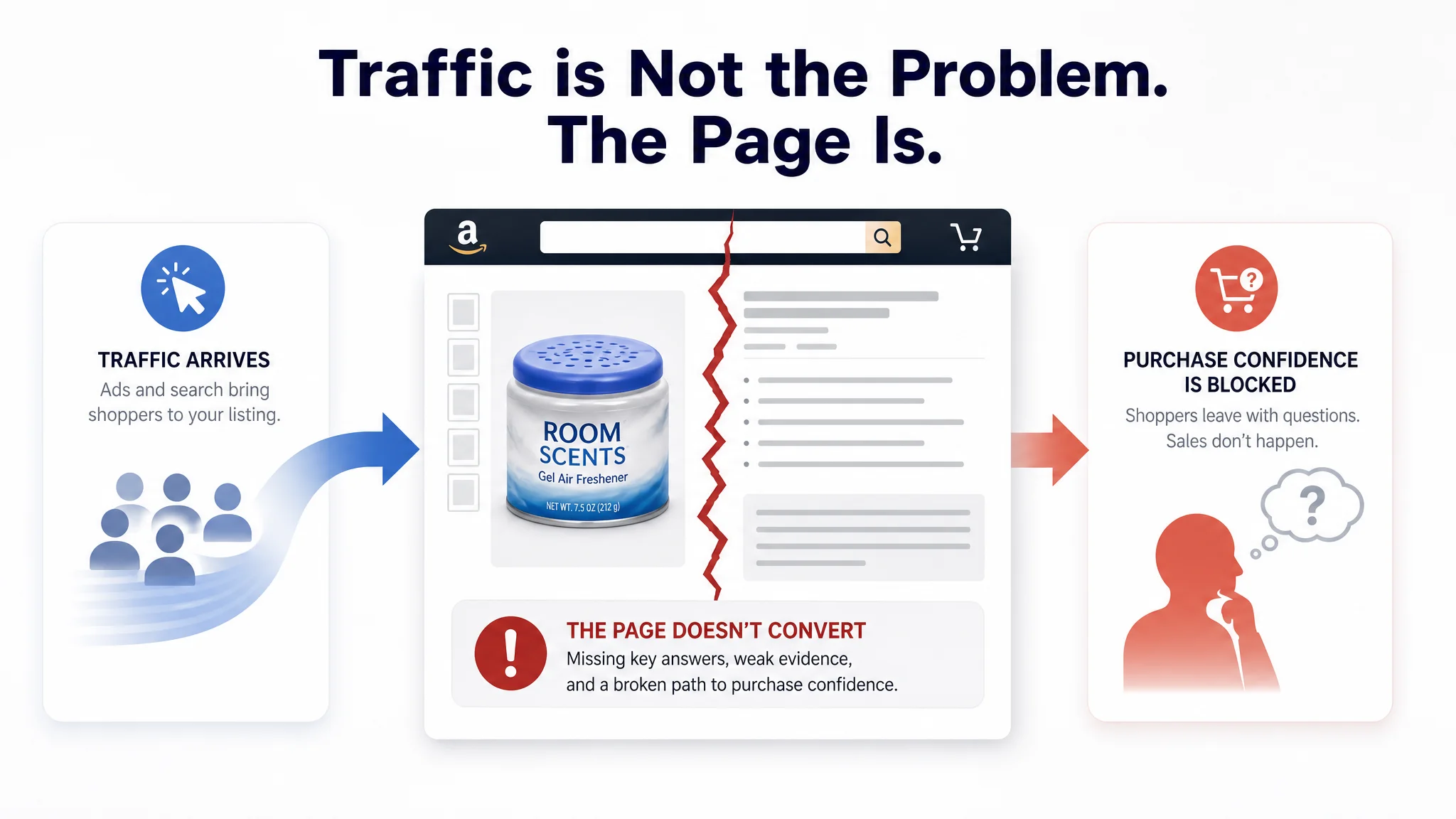
This distinction becomes clearer when a listing appears to have a copywriting problem but is actually failing across several decision points. In one US marketplace example involving a gel air freshener, the product could be identified, but the page did not give shoppers enough reasons to click, understand, trust, and purchase. The customer initially leaned toward reinforcing freshness claims, multi-room use, and brand history. A deeper diagnosis found a more fundamental issue: the page lacked a connected path from product recognition to purchase confidence.
The listing was not empty. It had a title, images, bullets, descriptive content, and reviews. However, the title did not clearly establish the product category, the main image did not answer practical questions about size or use, the bullets made broad promises without explaining the mechanism, and the A+ content repeated information instead of developing a visual explanation. This is why conversion optimization must evaluate the complete buying experience rather than isolated claims.
How CVR Impacts Visibility, Ranking, and Sales Velocity
Amazon’s A9 ranking system is commonly understood to weigh relevance, conversion performance, and sales velocity. The practical growth loop is straightforward:
- Stronger relevance attracts more qualified traffic.
- Better listing communication increases CVR.
- More completed purchases strengthen sales velocity.
- Improved performance can support greater organic visibility and ranking.
- Greater visibility creates additional opportunities for qualified sessions and sales.
Treat this as a relationship to monitor and validate, not an automatic ranking guarantee. Tools such as DeepBI can connect listing changes with later business data, helping sellers assess whether improved organic rank is translating into conversion momentum and feeding those insights back into the next listing adjustment.
The gel air freshener diagnosis illustrates why this loop can break before sales velocity becomes the visible problem. The listing’s missing core phrase, weak visual explanation, limited trust signals, and incomplete A+ structure all reduced its ability to convert the traffic it might attract. The issue was not simply that the product needed more exposure. The page first needed to make that exposure commercially useful.
Understanding Your Baseline: How to Track and Benchmark Amazon CVR
Before changing images, titles, A+ Content, or other listing elements, record a reliable baseline. Without a starting point, you cannot tell whether an update improved CVR, reduced ACoS, or simply coincided with a change in traffic quality.
A useful baseline should include more than one conversion metric. Record sessions, page views, units ordered, order items, sales, traffic source, CTR, CVR, ACoS, review signals, and the timing of each major listing change. This allows you to distinguish a content problem from a traffic-mix problem or an offer problem.
Where to Track Your Amazon CVR in Seller Central
In Seller Central, open Business Reports, then go to Detail Page Sales and Traffic. Select the relevant marketplace, ASIN, and reporting period. Record sessions, page views, units ordered, order items, sales, and traffic sources where available. Save the date of any listing change so performance can be compared against a clear intervention point.
Pay attention to the metric definition:
- Unit Session Percentage measures units ordered divided by sessions. It can exceed 100% when customers purchase multiple units per session.
- Order Item Session Percentage measures order items divided by sessions. It reflects the number of order items generated from visiting sessions.
Use the same definition and date range when comparing periods or ASINs.
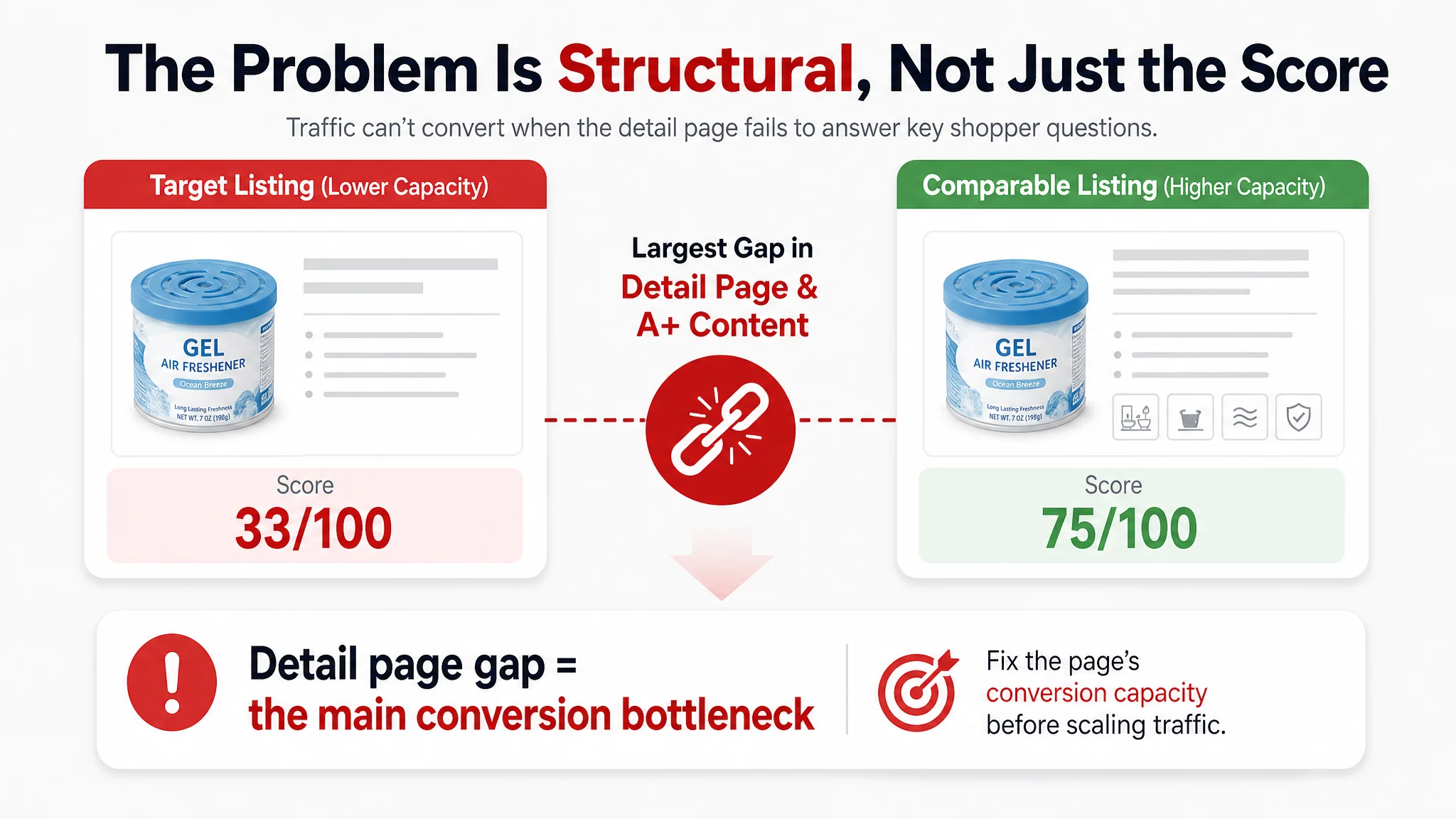
A baseline also helps prevent teams from optimizing against assumptions. In the gel air freshener example, the initial direction focused on improving individual product claims. The diagnosis instead showed that the largest weakness was structural: the listing scored 33 out of 100 against 75 for a comparable high-performing listing, with the largest gap in the detail-page and A+ content dimension. The score did not prove a future performance result, but it did identify where the page was losing its ability to support conversion.
CVR Benchmarks by Product Category (2026)
Category benchmarks are directional, not official Amazon standards. Aggregated industry observations place supplements around 25%–40% or higher, while documented benchmarks for less-covered niches are limited. Categories differ substantially in buying intent, price, repeat-purchase behavior, and traffic mix, so avoid treating one range as universal.
A benchmark should be used to prompt investigation, not to replace it. A listing with a lower CVR may be attracting broader or less-qualified traffic, while a higher CVR may reflect focused organic demand. Compare the ASIN with similar products, similar traffic sources, comparable pricing, and equivalent fulfillment conditions.
Interpreting Different Performance Levels
Compare CVR with comparable products, not merely the category leader. Review traffic breadth, organic sessions, advertising reach, CTR, and the share of branded or highly targeted traffic. A CVR of 16% or more may reflect focused organic demand rather than an automatic advertising problem. Conversely, low CVR alongside strong traffic and weak detail-page trust signals may point to content, review, or offer issues. Diagnose the whole funnel before changing the listing.
The same principle applies when a listing seems to have an advertising problem. The gel air freshener page had identifiable gaps in several areas:
- The title did not clearly include the core phrase “Gel Air Freshener.”
- The main image did not resolve questions about size, placement, or operation.
- The bullet points lacked a clear action-to-result sequence.
- The A+ content did not visually explain the product or its use cases.
- The listing had a 3.9-star rating and 26 total reviews, compared with 4.3 stars and 207 reviews for the comparable listing.
These findings did not establish that every weak session came from the page. They did show why traffic should not be judged separately from the page’s ability to explain and reassure. A listing can have identifiable traffic and still lack enough connected evidence for a shopper to make a confident decision.
Crafting Amazon Listings That Drive Conversion
A listing converts when every element answers a buyer question, reduces uncertainty, and moves the shopper toward purchase. Treat titles, bullets, descriptions, visuals, video, and A+ Content as one system: stronger clarity can lift CVR, while stronger visual relevance can improve CTR and reduce wasted ACoS.
Product Titles: Mobile-First and Keyword-Rich
Use the 200-character limit strategically, placing the brand, product type, and primary differentiator within the first 80 characters for mobile shoppers. A practical structure is: Brand + Model + Key Feature + Material/Size + Color. Remove redundant modifiers, avoid all-caps, and follow applicable 2025 rules for special-character use. Include relevant search terms naturally, but keep the title readable enough to support clicks and accurate expectations.
The title should not force the shopper to infer what the product is. In the gel air freshener example, the existing title did not clearly include the core category phrase “Gel Air Freshener.” It also used “Adjustables” without explaining what was adjustable. A proposed direction—“Adjustables Gel Air Freshener, After the Rain Scent, 7 Ounce”—made the product type, scent, and size more explicit.
The value of this change was not keyword insertion alone. A shopper should be able to distinguish a gel, spray, plug-in, or other air-care format at the search-result stage. Clear category language supports both discoverability and click confidence, while the rest of the page can then explain how the product works.
Bullet Points: Lead With Benefits, Not Specs
Convert each feature into a buyer outcome: explain what the product does, which problem it solves, and why the evidence matters. Put the most persuasive benefits first, use scannable formatting, and place primary keywords naturally within the first 1,000 characters as a best practice—not as an indexing cutoff.
A strong bullet sequence should help the shopper move from action to result. The gel air freshener’s existing bullet structure moved between longevity, room use, and brand history. The comparable listing created a clearer sequence:
1. Adjust the product.
2. Control the amount of fragrance released.
3. Address unwanted odors.
4. Leave behind a clean, refreshing scent.
This was more useful than simply adding more claims. “Nonstop freshness” does not explain how fragrance is released, whether intensity can be adjusted, how long the product lasts, or where the product can be placed. “Multi-room usage” describes breadth but does not show how the product fits into a bathroom, kitchen, closet, or other small space.
The broader lesson is that bullets should connect a physical product feature with a practical customer outcome. When the structure answers the buyer’s next question, the page becomes easier to understand and more persuasive without relying on exaggerated language.
Product Description: Combine SEO With Storytelling
Use long-tail keywords and buyer-intent terms in natural sentences. Build a concise story around the customer’s situation, product solution, proof, and usage context. Extend that logic into A+ Content with comparison tables, trust credentials, scenarios, and deeper benefit explanations.
Product descriptions should not repeat the title and bullets without adding decision support. They can clarify how the product is used, where it fits, what the shopper can expect, and which limitations or specifications matter. The objective is not to make the page longer for its own sake. It is to create a coherent explanation that reduces uncertainty.
Visuals: Images and Videos That Convert
Use a high-resolution main image, clear infographics, lifestyle scenes, dimensional views, and at least one video demonstrating use and function. On mobile, the gallery can determine whether shoppers understand the offer before reading. Alt text supports accessibility, not search ranking.
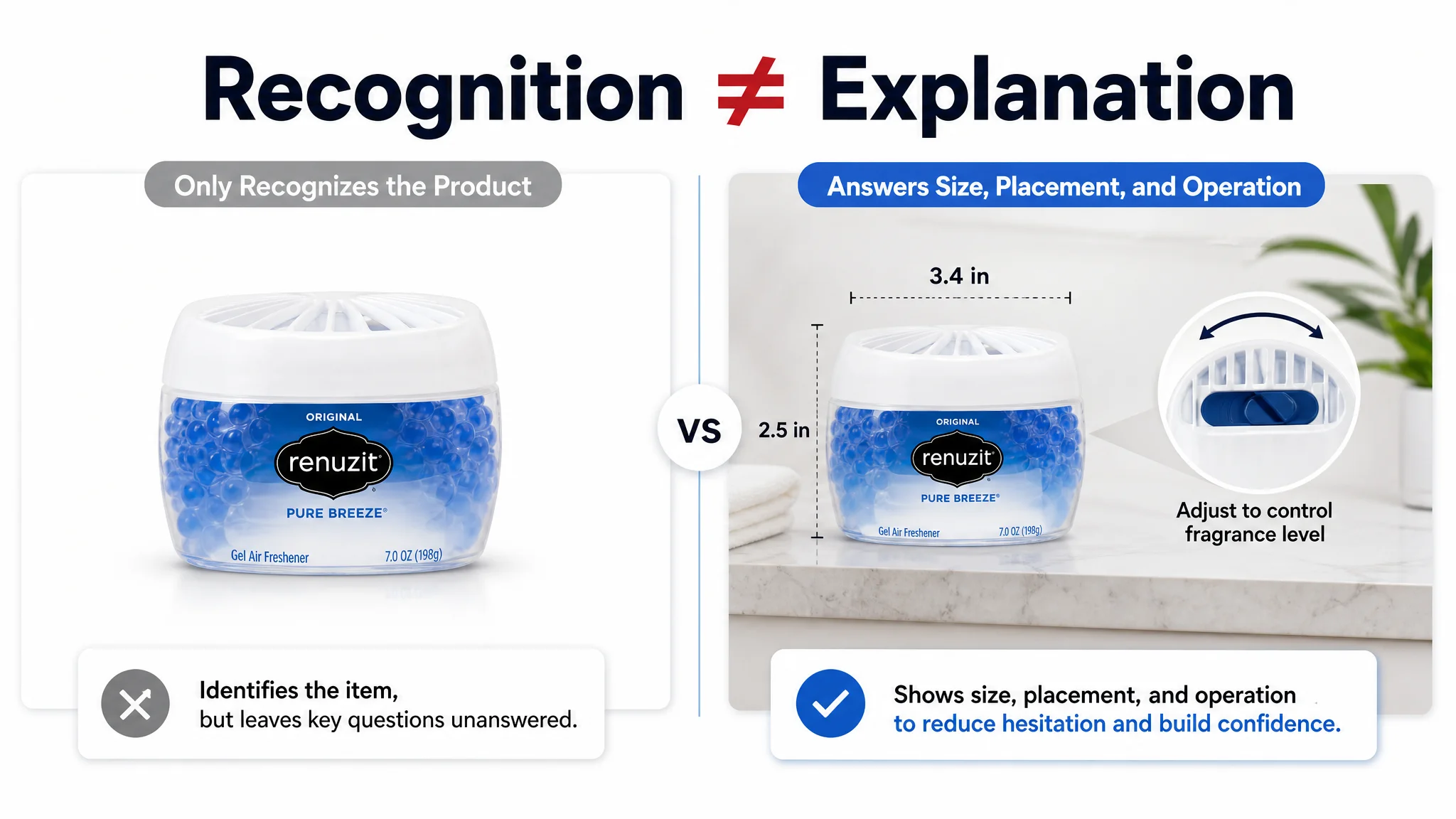
A technically clear image can still be commercially weak. The gel air freshener’s main image identified the item, but it did not answer how large it was, where it could fit, how the adjustable mechanism worked, or what the gel format meant for use and longevity. Its main-image score was 14 out of 30 against 23 out of 30 for the comparable listing.
A more purposeful image sequence assigned each asset a specific job:
1. Product identification: Make the scent, 7-ounce size, and gel air freshener format easy to recognize.
2. Size and placement: Provide physical scale and show suitability for small spaces.
3. Operation: Show how twisting or adjusting the cone controls fragrance intensity.
4. Gel format and longevity: Visually support the continuous-release concept and the stated duration of up to three weeks.
5. Use-case confirmation: Place the product in a relevant home environment to connect it with a clean, refreshing experience.
This is not a request to make images more decorative. Each asset should answer a buyer question and reduce the amount of inference required before purchase.
DeepBI benchmarks comparable high-performing listings through multidimensional semantic diagnostics, scoring titles, bullets, images, detail pages, A+ Content, and related signals. It identifies weak points and prioritizes fixes by likely CTR or CVR impact. AI-powered one-click generation turns recommendations into executable copy or visual instructions, while SP-API synchronization reduces manual uploads from lengthy handling to seconds.
The Role of A+ Content and Enhanced Brand Storytelling
A+ Content Versus Premium A+
A+ Content is a conversion layer, not a replacement for the core listing. Standard A+ is a practical choice for explaining benefits, resolving objections, and adding trust elements such as verified certifications or usage scenarios. Premium A+ fits products with more complex buying decisions or stronger visual storytelling needs, where richer modules can clarify differences and demonstrate value.
Amazon reports sales-lift ranges rather than guaranteed outcomes: standard A+ is associated with approximately 3–10% improvement in reported sales, with basic A+ figures often cited at up to 5–8%; Premium A+ is reported at approximately 5–20%. Treat these as directional benchmarks and validate impact through CVR, revenue, and listing-level performance rather than assuming a fixed return.
Strategic Use of Videos and Interactive Modules
Build A+ around the buyer’s decision path: introduce the product, explain core benefits, resolve pain points, reinforce trust, and guide the purchase decision. Product videos can show usage and remove uncertainty that static copy leaves unresolved. Comparison charts help buyers understand differences between models, packages, or use cases without relying on vague quality claims. Interactive modules and scenario-based visuals can add clarity where product function or technical benefits are difficult to explain.
The gel air freshener diagnosis showed how much can be lost when A+ content is treated as repeated text rather than a visual progression. The target listing had no meaningful image-based A+ structure, while the comparable listing used product presentation, room scenes, and modules related to use context and trust. The right response was not to copy every competitor module or introduce unrelated scents and formats. It was to build the A+ story around the specific After the Rain gel cone.
That structure could:
- Confirm the exact 7-ounce gel air freshener at the beginning.
- Show the product in a relevant household setting.
- Demonstrate how the adjustable cone controls fragrance intensity.
- Explain use in bathrooms, kitchens, closets, and other small spaces.
- Connect use with the intended clean, refreshing scent and odor-control outcome.
- Place the family-owned-since-1908 message after the product case had been established.
Brand history can support trust, but it should not replace product evidence. A shopper who has not yet understood the format, mechanism, placement, or expected result is unlikely to be reassured by brand background alone.
Audit the page for missing decision support. If CVR is weak, strengthen usage explanations, comparison content, and verified trust signals before adding decorative design.
A+ Content and Search Indexation Reality
A+ Content can improve product understanding and CVR, but do not treat its text as a direct organic-ranking lever. Keep critical search terms in the title and bullet points, where they support discoverability and relevance. Use A+ to persuade the traffic those fields attract, then monitor CVR, ACoS, and BSR to judge whether the content is converting that demand.
The case demonstrates why search clarity and conversion content need to work together. Adding “Gel Air Freshener” to the title could make the product category clearer, but it would not explain the adjustable mechanism or show where the product belongs. A+ content could provide that explanation, but it could not fully compensate for a title that leaves the product type ambiguous. Each layer has a distinct role in the conversion system.
Keyword Strategy for Higher Conversion
Keyword optimization should bring qualified traffic, not inflate sessions with shoppers who are unlikely to buy. High-traffic terms can improve visibility and potentially support CTR, but high-intent terms are more closely tied to a specific need, use case, or product attribute. They are often more valuable for CVR, ACoS, and sustainable BSR growth.
Matching Buyer Intent With Long-Tail Terms
Long-tail keywords usually contain more detail, such as a product type combined with a size, application, compatibility requirement, or buyer preference. Although their individual search volume may be lower, they can attract shoppers who have narrowed their choice and are closer to purchase.
Start by mapping the product’s genuine features and use cases, then compare how relevant competitors express those benefits. DeepBI Listing can analyze competitor keyword profiles and surface gaps in keyword coverage, helping identify high-converting search signals without copying unrelated listings. Compare against products with similar functions, audiences, and positioning so the resulting terms remain commercially relevant.
The missing phrase “Gel Air Freshener” in the case listing was important because it described the product category directly. However, keyword coverage alone was not the complete solution. Once a shopper searched for and clicked the product, the page still needed to explain its size, operation, scent, placement, and expected experience. A relevant keyword can attract attention, but the listing must provide enough evidence to convert that attention.
Keyword Placement for CVR Impact
Place the strongest, most relevant terms naturally in the title and bullet points, where shoppers quickly evaluate fit and value. Use descriptions to add context, clarify benefits, and address purchase concerns. Readability remains essential: keyword stuffing can make the offer harder to understand and weaken conversion even when impressions increase.
The gel air freshener example also shows why keywords should be connected to product meaning. “Adjustables” was not sufficiently clear without an explanation of what the shopper could adjust. A keyword or feature phrase becomes more valuable when the page immediately translates it into an action and outcome.
Backend Keywords and Hidden Opportunities
Use the 249-byte backend search-term field to capture relevant misspellings, synonyms, and alternate product names that do not fit naturally in visible copy. Prioritize unique, product-relevant terms rather than repeating words already covered. Review the field as part of each listing update so unused search opportunities do not consume limited space.
Backend terms should expand discoverability, not compensate for unclear visible content. Search relevance may bring the shopper to the listing, but the title, images, bullets, and A+ content must still make the offer understandable.
Smart Pricing Strategies to Boost Conversion
Balancing Competitive Pricing and Perceived Value
A competitive price can reduce purchase hesitation, but the lowest price is not automatically the best conversion strategy. Buyers also assess product benefits, quality signals, audience fit, reviews, and listing clarity. Pricing should therefore support the product’s perceived value while protecting margin, ACoS targets, and broader growth objectives.
Start by comparing your offer with genuinely similar products—not simply the category bestseller. Competitors should match your product form, use case, target audience, and approximate price band. A mismatch can lead to weak positioning, misleading benchmarks, and unnecessary margin pressure. DeepBI competitor benchmarking can help filter for commercially relevant alternatives and support the identification of competitive price bands. Use those findings alongside your own CTR, CVR, ACoS, and sales data rather than treating price as an isolated variable.
A weak page can also make a reasonable price appear difficult to justify. In the gel air freshener comparison, the competing listing did more to explain the product’s function, use context, and value. That difference did not prove that price alone caused the conversion gap. It did show that perceived value depends on whether the page makes the product’s benefits and use understandable.
Psychological Pricing Tactics and Dynamic Repricing
Price presentation can influence how an offer is perceived. For example, $19.99 may feel meaningfully different from $20 to some shoppers, but the effect depends on perceived benefits, category norms, traffic quality, and the strength of the listing. Test pricing presentation as part of a broader value proposition—not as a guaranteed conversion lever.
Dynamic repricing can help sellers respond to competitor movement, demand changes, and Buy Box conditions. For example, one seller observed increased Buy Box ownership and CVR after adjusting prices dynamically. That result is illustrative, not guaranteed: inventory, fulfillment, seller performance, traffic mix, listing quality, and competing offers may also affect Buy Box ownership or CVR. Review KPI changes over a defined period before retaining a pricing rule, and ensure the strategy remains consistent with profit and ACoS goals.
Reviews, Trust, and Conversion Momentum
Review quantity, rating, and recency shape the reassurance buyers need before purchasing. A strong rating supported by a meaningful volume of reviews can reduce perceived risk, while recent feedback helps shoppers judge whether the product experience remains consistent. When trust is weak, paid traffic may still produce clicks, but CVR and ACoS can suffer because the listing does not adequately resolve buyer hesitation.
The gel air freshener listing had a 3.9-star rating and 26 total reviews, while the comparable listing had 4.3 stars and 207 reviews. This difference did not explain the entire performance gap: the title, image sequence, bullets, and A+ content were also weaker. It did, however, reduce the amount of social proof available when shoppers were already uncertain about the product.
Ethical Review Generation and Its CVR Effect
Build review momentum through permitted methods rather than incentives or manipulation. Amazon Vine can help eligible products obtain early, verified feedback. Compliant product inserts may explain how customers can access support or share an honest experience, and permitted post-purchase emails can request feedback without pressuring customers toward a positive rating. Always verify the applicable Amazon rules before deploying these tactics.
Some brand studies report that early verified reviews can substantially narrow the conversion gap between new and mature listings, in some cases by 30–50%. Treat that as directional evidence, not a guaranteed result. Track review growth alongside CVR, CTR, ACoS, and listing cycle time.
Managing Negative Feedback as a Conversion Signal
Negative reviews are diagnostic data. Group recurring objections by product performance, unclear claims, missing information, packaging, or expectations created by the listing. Then make only evidence-based changes: clarify bullets, add supporting visuals, correct inaccurate wording, or improve the product when the criticism is valid.
A review and reputation audit should examine rating distribution, review-count gaps, and useful image reviews alongside the title, main image, bullets, and A+ content. Responsive sellers can address permitted concerns professionally and show that recurring issues are being taken seriously. This feedback loop strengthens buyer confidence while guiding measurable improvements to CVR and organic sales momentum.
Reviews should support the product explanation, not substitute for it. More reviews cannot fully resolve a page that does not explain how the product works. In the gel air freshener case, the weaker review base was one part of the trust gap, but the detail-page gap was larger. This is why review generation should be paired with improvements to product clarity and evidence.
Prime Eligibility, Inventory, and Their Influence on CVR
The Prime Effect on Buyer Behavior
A strong listing can earn the click yet lose the order when delivery expectations feel uncertain. Prime eligibility, a visible Prime badge, and fast delivery reduce purchase friction by reassuring shoppers that the product is available and likely to arrive within an acceptable timeframe. That confidence can support a higher CVR without changing the listing copy or images.
A 2025 Marketplace Pulse study found that Prime members convert approximately 2–3x more often, although the exact multiplier depends on the category. Treat this as a directional benchmark, not a universal performance guarantee. Review your own CVR by fulfillment method, customer segment, and product category before assigning a fixed value to Prime eligibility. If a non-Prime offer has weaker delivery terms, its lower conversion can also increase wasted ad spend and pressure ACoS, even when CTR remains healthy.
Stock Management to Protect Conversion Momentum
Availability is part of the conversion experience. A stock-out removes the offer from active purchase consideration, interrupts sales velocity, and can weaken ranking momentum. When the product returns, it may need to rebuild the traffic and conversion signals that supported its previous BSR. Repeated availability gaps also make advertising and listing optimization harder to evaluate because performance data no longer reflects stable operating conditions.
Maintain healthy FBA inventory levels rather than waiting until units are nearly depleted. Monitor inventory against expected sales, replenishment timing, and promotional demand, then schedule restocks early enough to protect continuity. Pair this review with CVR, BSR, and sales-velocity tracking so fulfillment decisions support the listing’s ability to convert. A persuasive page performs best when the offer behind it is consistently purchasable.
Aligning PPC Campaigns With Conversion Rate Optimization
Targeting High-Intent Search Terms
PPC and listing CRO should operate as one optimization system. High-intent campaigns bring qualified shoppers to the detail page, creating a practical test of whether the title, bullets, images, and A+ content can convert demand. If relevant clicks produce weak CVR, the issue may be product-detail communication rather than traffic quality.
Build this test around bottom-of-funnel search terms. Use phrase match to discover closely related buying queries, then use exact match to control spend and measure core terms more precisely. Monitor CTR, CVR, and ACoS together: strong CTR with weak CVR often signals a listing gap, while weak CTR may point to a mismatch between the query and the main image or title.
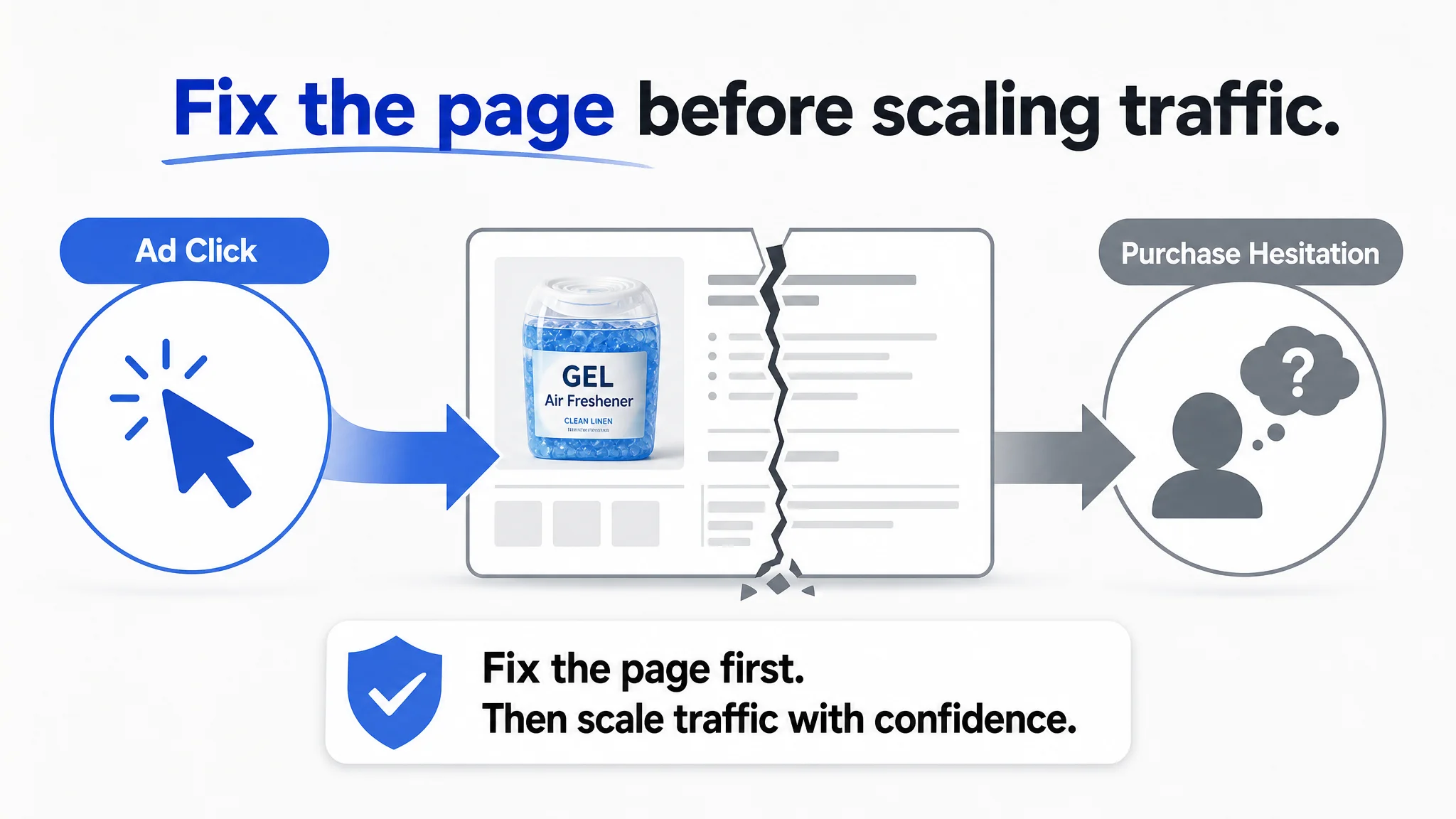
The gel air freshener case illustrates why more traffic should not automatically be the first response. The page’s product category was not sufficiently clear, the image did not explain the product’s operation, and the A+ content did not provide a connected use story. Increasing ad pressure before addressing those gaps could have generated more visits without resolving the reasons shoppers hesitated.
The correct judgment was not necessarily to stop advertising. It was to stop treating advertising as the only lever. The listing needed to become more capable of receiving traffic before campaign performance could be evaluated fairly.
Using PPC Data to Inform Listing CRO
Review the Search Term Report regularly to identify queries that generate conversions, not merely impressions or clicks. Map high-CVR terms to genuine product attributes, then incorporate them naturally into the title, bullets, and supporting visuals. Do not add a term if the product cannot substantiate it.
DeepBI’s advertising quantitative layer supports this feedback loop through a four-stage funnel: diagnose the listing, translate advertising signals into optimization recommendations, produce revised assets, and deploy them for measurement. It can surface high-converting search terms and correlation data across impressions, clicks, conversions, CTR, CVR, TACoS, and ACoS. Feed those signals back into title and bullet optimization, then compare subsequent listing and advertising performance. This process can strengthen paid conversion efficiency and improve the listing’s relevance for organic shoppers without treating ad results as automatic proof of higher organic ranking.
A useful diagnostic rule is simple:
- Strong CTR with weak CVR may indicate a detail-page, offer, or trust problem.
- Weak CTR may indicate a mismatch between the query and the title or main image.
- Weak CTR and weak CVR may indicate that both the traffic promise and the page experience need attention.
Avoiding Common CVR Killers: Mistakes That Undermine Your Listing
Qualified traffic can still fail to convert when small presentation, compliance, or credibility problems create hesitation. Audit these common CVR killers:
- Ignoring mobile presentation: Check the first image, title opening, bullets, and A+ modules on a phone. If the value proposition is buried or text is difficult to scan, mobile shoppers may leave before understanding the product.
- Keyword stuffing: Repeated terms and awkward modifiers reduce readability and can weaken purchase confidence. Use relevant search terms naturally, while connecting each feature to a customer need and clear benefit.
- Using slow-loading images: Oversized or poorly prepared assets can delay product information and interrupt the shopping experience. Compress images appropriately without sacrificing essential detail, then review the listing on mobile and desktop.
- Leaving A+ Content incomplete: A thin detail page creates trust gaps. Where relevant, use comparison tables, credible certifications, deeper use-case explanations, and clear product education rather than decorative modules alone.
- Setting an unrealistic price: A price that is difficult to reconcile with the product’s visible benefits can increase hesitation and reduce CVR. Compare the offer with competing value, included features, and supporting evidence.
- Neglecting negative reviews: Do not examine only positive feedback. Negative reviews often reveal unclear claims, missing information, or recurring product concerns that should be addressed in images, bullets, A+, or product quality decisions.
The gel air freshener listing contained several of these risks at the same time. The title did not clearly identify the category, the main image stopped at product recognition, the bullets did not explain the action-to-result sequence, and the A+ content was not structured around specific decision questions. The issue was not one isolated mistake. It was the accumulation of small gaps across the buying journey.
Myth: Amazon requires every title to stay under 60 characters. Fact: The applicable limit may be 200 characters under the relevant listing constraint, but verify category rules and front-load the strongest information for mobile readability.
Also confirm that images represent the actual product. Unsupported changes to material, color, structure, or performance can create distrust, returns, and refunds. Each revision should be evidence-based and checked across the title, images, bullets, A+, and reviews.
Amazon CVR Changes in 2025-2026: What Sellers Must Know
Amazon CRO is no longer a one-time copywriting task. Changes to shopping interfaces, content systems, customer feedback programs, and testing tools require sellers to review how shoppers discover, evaluate, and compare products.
Rufus AI and Its Impact on Product Evaluation
Rufus AI is changing product evaluation toward more question-led shopping. Shoppers may seek direct answers about product fit, features, use cases, and differences between options. Sellers should therefore make the listing easy to interpret without relying on vague claims or unsupported specifications.
Use:
- Clear, factual bullet points organized around buyer concerns, product benefits, supporting evidence, and the problem solved.
- Verified measurements, materials, features, and compatibility details.
- A+ Content that adds information density through usage scenarios, comparison tables, authority signals, core benefits, and pain-point explanations.
The gel air freshener example follows the same question-led logic. A shopper may want to know what the product is, whether it fits a small space, how the adjustment works, what type of freshness to expect, and how long it lasts. A title built around isolated claims cannot answer all of those questions. The images, bullets, and A+ modules must each provide a relevant part of the answer.
Amazon Vine expansion adds further importance to accurate product communication and authentic customer feedback. Review emerging feedback alongside CTR and CVR to identify whether the listing is attracting the right shoppers but failing to answer their questions.
New Testing Capabilities (Bullet Point A/B Testing)
Manage Your Experiments now supports bullet-point testing in addition to other listing elements. Sellers can test whether a different selling-point order, clearer benefit statement, or stronger pain-point explanation improves CVR.
Treat each change as a measurable iteration:
- Record the original and revised version.
- Test one meaningful variable at a time.
- Compare performance using CTR, CVR, ACoS, and, where relevant, BSR.
- Retain wording that improves customer understanding without altering the product’s actual attributes.
A practical CRO process must now combine question-focused content, authentic evidence, and continuous platform-based testing.
Tools and Mindset for Continuous CRO
Experimentation With "Manage Your Experiments"
Conversion rate optimization should rely on controlled learning, not personal preference. Amazon’s Manage Your Experiments allows eligible sellers to compare alternative versions of listing content, including titles, images, and bullet points. Use it to isolate one meaningful change at a time and evaluate results against business metrics such as CTR, CVR, orders, and, where relevant, ACoS.
A strong test begins with a specific diagnosis. If CTR is weak, prioritize the title or main image. If clicks are healthy but CVR lags, investigate whether bullets, supporting images, or trust-building information are failing to answer purchase objections. Record the hypothesis, test period, variant, and outcome so future decisions build on evidence rather than memory.
The case diagnosis demonstrates why this sequence matters. The listing did not need a vague instruction to “make the content more persuasive.” It needed specific hypotheses: clarify “Gel Air Freshener” in the title, assign the image sequence jobs related to size and operation, restructure the bullets around action and result, and replace repetitive A+ text with product-specific visual support. Tests are more useful when they are tied to a diagnosed constraint.
CRO as a Continuous Process, Not a One-Off Task
A listing rewrite is only one step in a recurring loop: diagnose performance, define the change, deploy it, measure the result, and refine the next iteration. Without this process, sellers often make several changes at once, lose the ability to identify what influenced CTR or CVR, and spend additional time repeating manual research and uploads.
DeepBI supports this loop within an Amazon-focused workflow. It can connect listing diagnosis with inputs such as Score_Report.json and Product_DNA.json, turn identified gaps into structured strategy and production instructions, and apply approved image assets through a one-click workflow using Amazon’s SP-API. Deployment can also establish a measurement point for reviewing subsequent advertising data, including CTR changes over the following 7–14 days. By linking diagnosis, strategy generation, and one-click deployment, DeepBI reduces manual guesswork and helps sellers maintain continuous listing improvement.
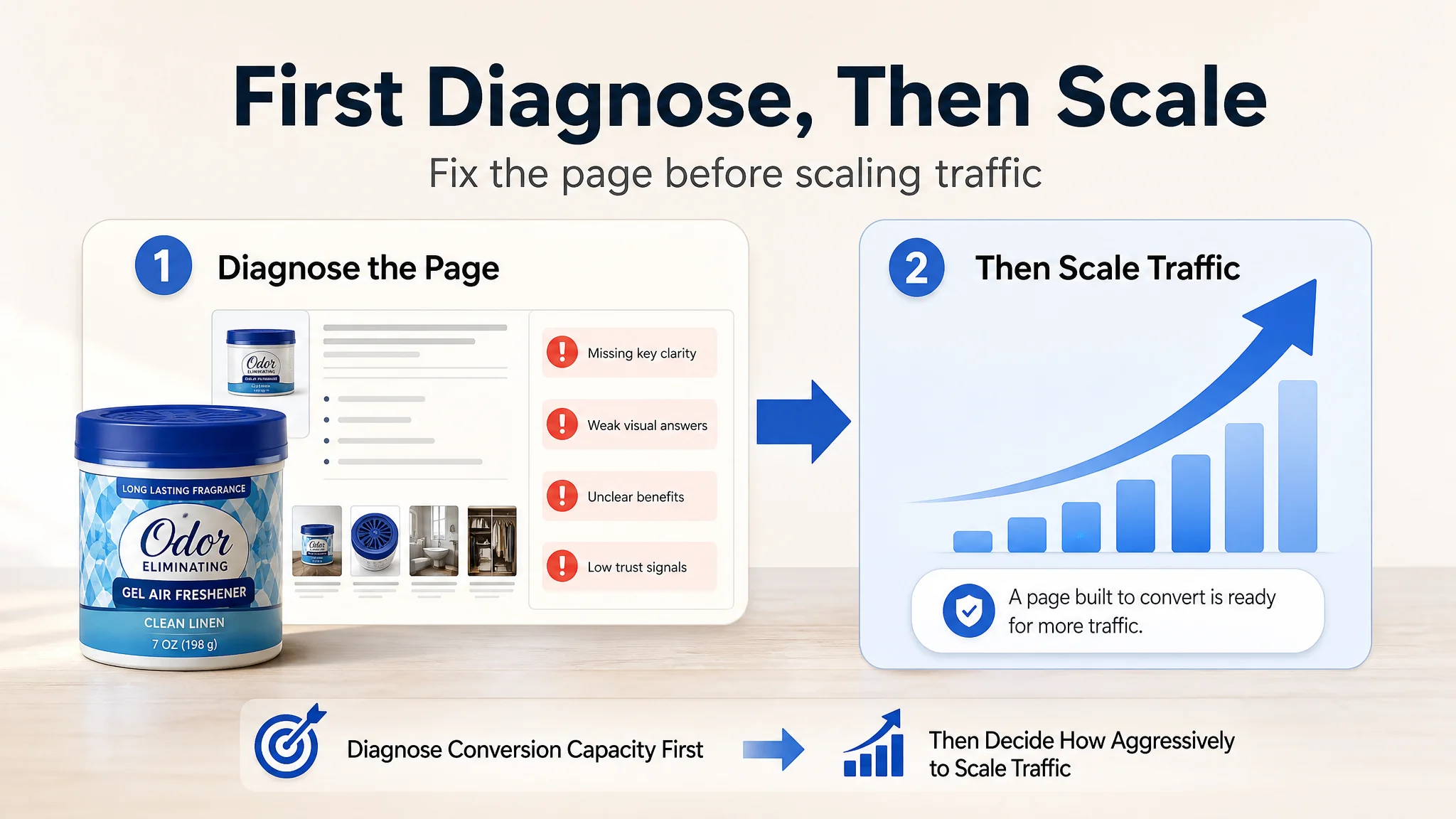
The operating mindset is to diagnose conversion capacity before scaling traffic. In the gel air freshener listing, the most important finding was not an unsupported claim about future growth. It was that the page was under-structured: the title, images, bullets, A+ content, and reviews each carried part of the conversion burden, but they were not working together.
That insight applies beyond one product format. A high ACoS signal should not automatically be treated as a bidding problem. A low-conversion page can make otherwise relevant traffic look inefficient. Before increasing ad pressure, determine whether the listing can explain the product, demonstrate its use, support its claims, and build enough confidence to justify the purchase.
FAQ: Amazon Conversion Rate Optimization
What is a good CVR in 2026? There is no universal threshold. Benchmark CVR by category, price, traffic source, device mix, and attribution window. Compare your ASIN with its own historical trend and relevant competitors.
How do I find CVR in Seller Central? Open Business Reports, select Detail Page Sales and Traffic by Child Item, choose a date range, and review Unit Session Percentage. Treat it as your listing conversion metric and track it alongside sessions, orders, CTR, and ACoS.
Does A+ Content really help? It can, when it reduces decision friction with clearer benefits, usage scenarios, certifications, comparison tables, and stronger trust information. It cannot compensate for irrelevant traffic or a weak offer. It also should not be used as a substitute for clear titles, bullets, and core product information.
How does Prime affect CVR? Prime may improve conversion, but the effect varies by category, price, delivery expectations, and competitive alternatives. Do not apply one fixed uplift.
How long do CRO changes take to show results? Allow enough relevant traffic for a meaningful comparison. Monitor CTR and CVR trends rather than relying on a guaranteed timeframe.
How are CVR and ACoS related? Higher CVR can help paid traffic produce more orders from the same clicks, potentially improving ACoS, but CPC, pricing, refunds, and traffic quality also matter. If clicks are arriving but the page cannot explain the product or build trust, increasing ad spend may amplify the conversion problem rather than solve it.
Can negative reviews permanently damage CVR? They can reduce trust, but damage is not necessarily permanent. Improve the product and listing, address recurring concerns, and build authentic positive feedback over time.
Should I prioritize CVR or traffic first? Fix the bottleneck. Low CTR calls for traffic-entry improvements; adequate traffic with weak CVR calls for detail-page, offer, or trust improvements. Before scaling paid traffic, judge whether the listing is capable of converting the traffic it already receives.
A listing does not need more information in every place. It needs the right evidence at each decision point. Diagnose the page first, then determine how aggressively to scale the traffic that page receives.
IMG_01
- 插入位置:
## Conversion Rate as a Growth Engine 小节 What Makes Amazon Conversion Rate Optimization So Critical 末段后。
- 图片类型:
页面承接图
- 核心视觉任务:
让读者一眼理解:流量本身不是转化结果,Listing 必须把流量引导至购买信心。
- 图片内容:
极简三段横向结构:左侧为搜索或广告带来的流量,中间为信息不完整的 Listing 页面,右侧为被阻断的购买信心。中间作为唯一视觉断点,弱化 CASE 展示感。
- 图片文案:
流量来了,页面没接住
- 推荐参考依据:
使用融合文章中“the page lacked a connected path from product recognition to purchase confidence”以及“the issue was not simply that the product needed more exposure”这一观点。可参考 B010OVNCZE.pdf 第 1 页的流量—Listing—购买信心构图,但应简化为单一断点,不使用 PDF 中未在正文对应段落出现的额外信息。
IMG_02
- 插入位置:
## Understanding Your Baseline: How to Track and Benchmark Amazon CVR 小节 Where to Track Your Amazon CVR in Seller Central 末段后。
- 图片类型:
数据对比图
- 核心视觉任务:
让读者一眼看出:诊断重点不只是总分低,而是页面在不同决策维度上的损失集中在详情页承接。
- 图片内容:
左右对比两个简化 Listing 评分卡,仅保留正文已经明确出现的总分:Target Listing 33/100,Comparable Listing 75/100。下方用一个明显较大的“Detail page gap”视觉强调详情页是主要约束。避免放完整评分表,避免形成报告式密集信息。
- 图片文案:
问题不只在流量
- 推荐参考依据:
使用融合文章中“the largest weakness was structural”“the listing scored 33 out of 100 against 75”以及“the largest gap in the detail-page and A+ content dimension”的表述。可参考 B010OVNCZE.pdf 第 3 页评分对比,但图片只保留正文已出现且服务当前观点的定性与必要数字。
IMG_03
- 插入位置:
## Crafting Amazon Listings That Drive Conversion 小节 Visuals: Images and Videos That Convert 末段后。
- 图片类型:
前后对比图
- 核心视觉任务:
让读者 3 秒理解:产品图不能只完成识别,还要回答尺寸、摆放和操作问题。
- 图片内容:
左侧为仅能识别产品的单一凝胶空气清新剂产品图;右侧为同一 CASE 产品的极简“信息补足”场景,突出尺寸/小空间摆放或旋钮调节中的一个视觉动作。不得同时制作五张图的完整序列。
- 图片文案:
识别产品 ≠ 解释产品
- 推荐参考依据:
使用融合文章中“a technically clear image can still be commercially weak”以及“each asset should answer a buyer question and reduce the amount of inference required before purchase”。产品主体可参考 B010OVNCZE.pdf 中的 gel air freshener 素材,但画面结论必须聚焦视觉资产承担决策解释,而不是展示客户案例。
IMG_04
- 插入位置:
## Aligning PPC Campaigns With Conversion Rate Optimization 小节 Targeting High-Intent Search Terms 中,段落“The correct judgment was not necessarily to stop advertising...”后。
- 图片类型:
流量漏斗图
- 核心视觉任务:
让读者一眼理解:强行增加广告流量,可能只是放大 Listing 尚未解决的转化问题。
- 图片内容:
极简单向结构:广告点击 进入一个有明显缺口的 Listing 页面,再指向 购买犹豫。只保留两个核心元素和一个断层,不展示 CTR、CVR、ACoS 等多个指标。
- 图片文案:
先修页面,再放大流量
- 推荐参考依据:
使用融合文章中“more traffic should not automatically be the first response”“the listing needed to become more capable of receiving traffic”以及“stop treating advertising as the only lever”。可参考 B010OVNCZE.pdf 第 6 页相关论证,但不得加入文章未提供的广告优化结果或效果数字。
IMG_05
- 插入位置:
## Tools and Mindset for Continuous CRO 小节 CRO as a Continuous Process, Not a One-Off Task 中,段落“The operating mindset is to diagnose conversion capacity before scaling traffic.”之后。
- 图片类型:
逻辑解释图
- 核心视觉任务:
让读者一眼记住 CRO 的正确顺序:先诊断页面转化能力,再决定是否扩大流量。
- 图片内容:
仅保留两步横向箭头:左侧 诊断页面,右侧 再扩流量。左侧可用凝胶空气清新剂 Listing 的产品图作为小型场景载体,右侧用上升箭头表示流量放大;两者之间突出“先后顺序”,不制作完整运营流程图。
- 图片文案:
先诊断,再扩量
- 推荐参考依据:
使用融合文章中“diagnose conversion capacity before scaling traffic”以及“A listing rewrite is only one step in a recurring loop”的观点。可参考 B010OVNCZE.pdf 第 8 页关于“Diagnose the conversion capacity ... Then decide how aggressively to scale traffic”的结论;CASE 产品仅作为视觉主体,不作为案例展示。
COVER_BRIEF
封面核心任务 聚焦文章标题所表达的核心问题:Amazon 流量并不等于转化,Listing 必须具备承接流量、解释产品并建立购买信心的能力。首屏应让读者同时看到真实的凝胶空气清新剂产品和“先修转化能力,再扩大流量”的判断。
画面内容 以 B010OVNCZE.pdf 中的 gel air freshener 原始主图或优化后主图作为最大视觉主体,产品放在封面中央或偏右位置,确保缩略图状态下仍能一眼识别。左侧或上方放置文章完整标题:How to Optimize Your Amazon Listing for Higher Conversion Rates in 2025–2026,标题必须原样出现。可增加一个简洁的流量箭头指向 Listing 页面,并在产品周围加入一个轻量的“purchase confidence”视觉标记。整体构图采用产品图 + 标题 + 一个转化承接辅助元素,风格接近 Amazon seller growth 缩略图。
文案限制 必须完整保留文章标题,不得缩写、改写或省略年份。除完整标题外,最多增加一条极短辅助文案:Fix the page before scaling traffic。封面不放评分、百分比、ACoS、CVR 或其他额外指标。
禁用元素 禁用纯抽象流量概念图、纯文字封面、与 CASE 产品无关的产品图、客户案例截图拼贴、复杂漏斗、完整评分表、广告后台界面、密集运营指标,以及蓝白固定商务模板。不得使用与产品图主色调冲突的配色。
推荐素材 优先使用 B010OVNCZE.pdf 中与 gel air freshener 对应的优化后主图;若优化后主图无法单独确认,则使用该 PDF 第 1 页或第 4–5 页中出现的真实 gel air freshener 产品视觉素材作为核心产品图。封面颜色跟随产品本身及其主图的色调,不额外指定固定配色。