

Introduction: The Amazon Organic Traffic Opportunity
Amazon offers access to one of the largest online shopping audiences in the world, with more than 300 million active customer accounts. Yet access to that audience does not automatically produce visibility. Sellers compete for attention in search results, and the products that earn clicks and conversions are better positioned to attract additional shoppers without paying for every visit.
Organic search traffic is free in the sense that sellers do not pay a fee for each organic click. It can also become more sustainable than traffic generated entirely through advertising. However, organic growth still requires investment in research, content, inventory, customer experience, and ongoing optimization. Search visibility is influenced by the quality and relevance of a Listing, as well as its sales history and conversion performance. A product with a compelling offer but weak images, unclear copy, or low conversion signals may struggle to retain or improve its position, even when advertising generates impressions.
The business impact extends beyond traffic volume. Higher organic visibility can create more opportunities to improve click-through rate (CTR), while stronger Listing relevance and persuasive content can support conversion rate (CVR). As organic sales become a larger part of the traffic mix, sellers may also reduce dependence on expensive paid acquisition and manage ACoS more effectively. Advertising remains useful for discovery and data collection, but a business that relies on ads for every sale is exposed to rising costs, changing bids, and unstable acquisition economics.
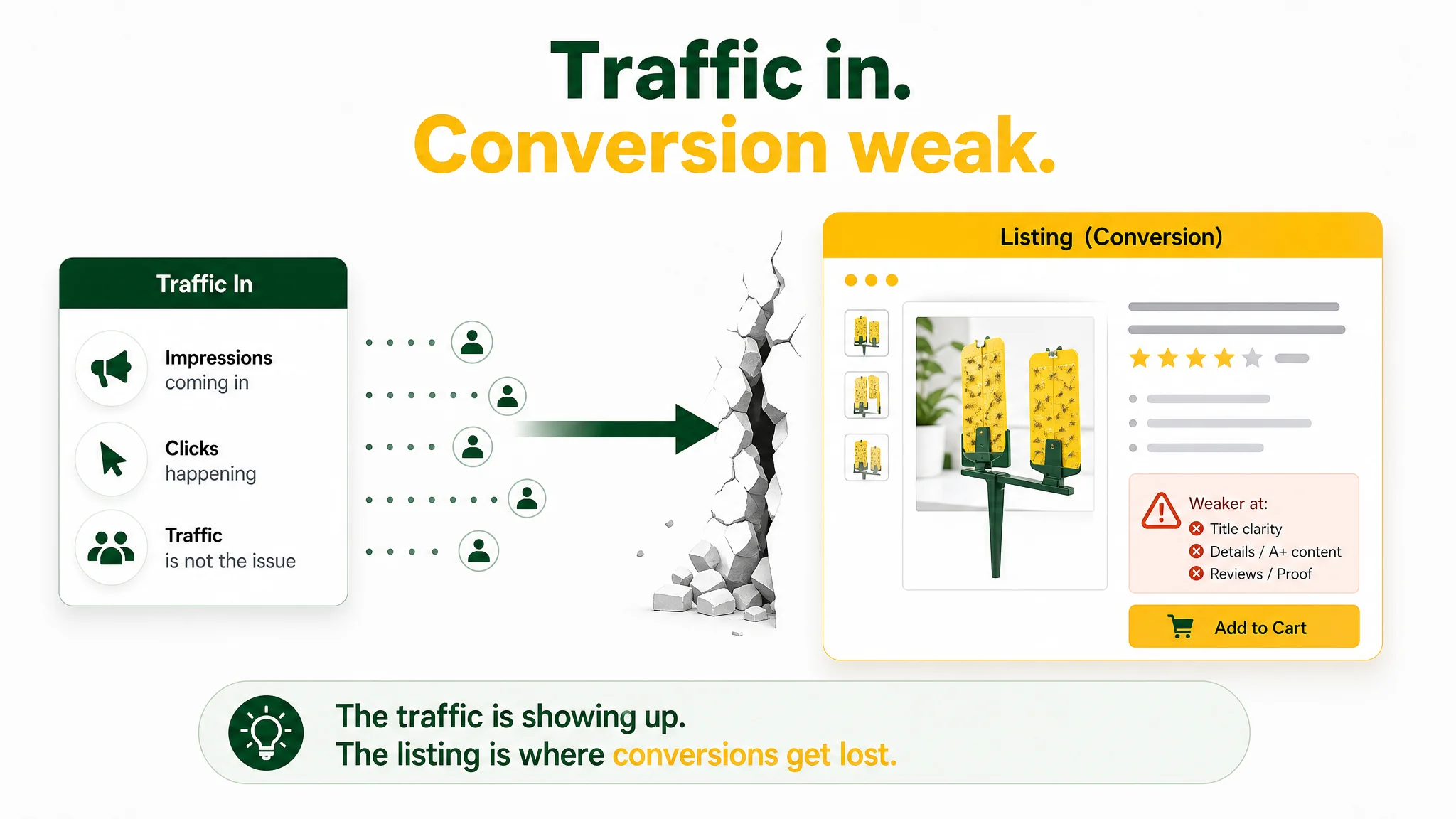
A gnat-trap seller in the US marketplace illustrates why this distinction matters. The Listing had a complete image set, A+ content, reasonable reviews, and a DeepBI score of 70/100. It did not look broken. Yet advertising was generating impressions and clicks without orders growing in line with spend, while ACoS became increasingly difficult to control. The team initially believed that the answer was more aggressive advertising: additional keywords, higher bids, or a larger budget.
A benchmark comparison revealed a different constraint. Against a closely matched Listing in the same sticky gnat-trap subcategory, the competitor scored 77/100. The largest gaps were concentrated in the title, details and A+ content, and reviews—not in traffic acquisition. The seller’s page was receiving visitors, but it was less capable of turning those visitors into buyers. This is an important distinction for organic growth: paid traffic can create opportunities, but the Listing still has to earn the click, establish trust, and complete the decision.
The practical challenge is turning these relationships into a repeatable operating process. Sellers must identify the search terms and competitor standards that matter, improve titles and images, strengthen bullet points and A+ content, and connect advertising data with Listing decisions. They also need to monitor whether changes affect CTR, CVR, ACoS, BSR, and listing cycle time rather than judging performance by subjective design preferences alone.
This article follows that progression. It begins with foundational Listing tactics that improve relevance and conversion, then moves toward more advanced approaches involving competitor benchmarking, keyword weighting, advertising-data integration, feedback loops, and streamlined execution. The goal is not to treat organic ranking as a single optimization task, but as the outcome of connected decisions across traffic, content, and sales performance.
DeepBI makes this data-driven approach more accessible by connecting diagnosis, planning, content production, application, and performance feedback within an end-to-end optimization system. Its workflow can quantify gaps across Listing components, translate business findings into parameterized optimization instructions, support visual content generation within product-consistency and compliance boundaries, and apply approved results through Amazon store operations. By turning operational judgment into a clearer evidence chain, DeepBI helps sellers move from isolated Listing edits toward a systematic path for building stronger organic traffic and healthier long-term growth.
Keyword Optimization: The Foundation of Organic Visibility
Amazon organic visibility begins with relevance. When a shopper enters a search term, Amazon must determine which products best match the query and are most likely to satisfy the shopper. Relevant keywords help establish that connection, but keyword volume alone is not enough. The terms must describe the actual product, reflect shopper intent, and appear in a listing structure that supports both search interpretation and human decision-making.
Keyword Research Methods
Effective research combines product understanding, competitor analysis, and performance data. Start by reverse-engineering the product title and bullet points to identify the core terms that already describe the product, its form, primary benefit, and use case. Then simulate realistic Amazon searches rather than collecting isolated phrases. The goal is to understand how shoppers may express the same need in different ways.
Competitor listings provide a second source of insight. Comparing high-frequency search terms, title structures, and recurring product attributes can reveal opportunities that a seller’s current listing misses. This process should identify relevant gaps, not encourage imitation. A competitor keyword is useful only when it accurately represents the product being optimized.
The gnat-trap example shows why competitor analysis must go beyond counting repeated words. The benchmark Listing opened with “96PCS,” immediately communicating a strong quantity anchor. The seller’s title began with “30PCS” and repeated terms such as “Gnat Traps” and “Indoors/Indoor.” It contained keywords, but the structure did not communicate value and use case as efficiently. The benchmark followed a clearer sequence: quantity, core product, core function, and core scenario. It also referenced kitchen, indoor, and outdoor use, while the seller’s wording focused more narrowly on indoor use.
That difference was not simply a matter of keyword density. It affected how quickly a shopper could understand the offer in search results. The seller initially focused on the possibility of missing high-intent terms and considered pushing advertising harder. The diagnosis showed that the page needed a more coherent search-result message before additional traffic could be expected to perform efficiently.
DeepBI supports this workflow by analyzing listing content, comparing competitor keyword layouts, and organizing the findings into optimization instructions. Its scoring service functions as an automated market health check system rather than a simple scoring tool. It applies structured data collection, similarity constraints, and multimodal analysis to evaluate listing quality. Sellers can use the resulting diagnosis to prioritize terms that deserve attention instead of making disconnected copy edits.
How Keyword Placement Affected Sales
Placement determines whether keyword research becomes usable listing strategy. The title should communicate the product clearly while incorporating the most important relevant terms. A practical structure can combine the brand, core benefit or result, product form, and a supplementary modifier. This creates a readable path for both Amazon’s indexing systems and shoppers scanning search results.
Bullet points should extend that relevance into a pain point-to-solution structure. Rather than inserting unrelated terms or listing specifications without context, each bullet can connect a selling point, verified product detail, and shopper problem. This approach gives keywords semantic support, helping the listing explain why the product fits the search intent.
The gnat-trap Listing contained relevant information, but its original bullets did not guide the buyer through a clear decision path. They mentioned operation, safety, durability, design, and multiple use scenarios, yet the most important entry points were not prioritized in the same way as the benchmark. DeepBI reorganized the logic around pain point, solution, and proof:
- Strong adhesion, UV resistance, and waterproof properties addressed durability concerns.
- Simple safety language clarified that the product was non-toxic, odor-free, and suitable around people, pets, and plants.
- The green adjustable stake was presented as an ease-of-use and design advantage rather than left as a technical detail.
- The yellow visual attraction mechanism was explained through a clear benefit and simple mechanism.
- Indoor plants, kitchens, greenhouses, and gardens expanded the use-case story.
Keyword placement can influence the chain from discoverability to conversion. Better alignment may help the product appear for more relevant searches, while clearer messaging can support CTR and CVR after the impression occurs. Conversion signals can then inform further optimization and, over time, contribute to stronger BSR. The relationship is not created by repetition; keyword stuffing can damage readability, violate constraints, and attract traffic that does not convert. Every term must remain product-specific and supported by the actual offer.
Case Insight: Niche Brand Growth Through Targeted Keywords
A niche brand does not need to compete for every broad category term. A more disciplined path is to identify the search language most closely connected to its product advantage, then build the listing around that intent. For example, if advertising data shows that a specific product attribute generates stronger conversion signals, that attribute can receive greater strategic weight in the title, bullets, and related optimization decisions.
The gnat-trap seller’s revised title followed this principle. Rather than continuing to repeat “Gnat Traps” and “Indoor,” the proposed structure led with “Fruit Fly Sticky Traps,” connected the product to house plants, included relevant pest coverage such as fungus gnats, whiteflies, and thrips, and surfaced “Stake Holders Included” as a tangible differentiator. The objective was not to add more words. It was to make the search-result message answer four questions quickly: what the product is, who it is for, what problem it addresses, and why this version is worth considering.
This is the difference between keyword presence and keyword strategy. DeepBI can connect advertising reports with listing optimization, identify winning terms, and translate those signals into prioritized recommendations. The terms should then be evaluated against the actual product, its verified attributes, and the way shoppers make decisions. Relevant keywords are most valuable when they strengthen both discoverability and commercial clarity.
Image Optimization for Higher Click-Through and Conversion Rates
Images influence two critical stages of the Amazon buying journey. The main image earns attention in search results, while secondary images and A+ content answer questions after the shopper opens the listing. If the visual hierarchy is weak, the ASIN can lose clicks before the shopper reads the title. If the detail images fail to explain size, use, features, or product benefits, the listing may attract traffic without converting it.
Higher CTR and CVR can strengthen the behavioral signals associated with healthier organic visibility, although image changes should not be treated as a guaranteed ranking lever. The practical objective is to make each visual asset perform a defined job and then connect the change to measurable Amazon KPIs.
Mobile-Optimized Image Tactics
On smaller screens, shoppers often encounter a product image before they can absorb the title or bullets. The product should therefore remain prominent at thumbnail size, with a clear silhouette, strong contrast, and minimal visual clutter. A centered or symmetrical composition can help shoppers identify the item quickly, while a carefully selected close-up can clarify material, construction, or functional details.
Use the image sequence to reduce uncertainty in stages:
- The main image should create a strong visual hook and present the product clearly within Amazon’s white-background requirements.
- Secondary images should explain dimensions, important components, use environments, and practical selling points.
- Technical or size graphics should make key information readable without forcing shoppers to interpret dense decoration.
- Lifestyle images should show a realistic context while preserving the product’s actual design, proportions, materials, colors, logo, and functional features.
The gnat-trap Listing demonstrates how a complete image set can still underperform if the assets do not make value and proof obvious. The seller already had scenes, features, detail shots, and human-use images. However, the benchmark communicated pack size, real-world effectiveness, and multiple usage environments more forcefully. DeepBI therefore recommended making the 30-piece quantity visible at a glance, showing target pests in a cleaner visual system, and using realistic scenes to demonstrate waterproof and sunlight-resistant properties.
Amazon compliance remains part of optimization. Check image proportions, RGB color mode, and the required minimum edge length before publication. AI-generated assets also require strict controls: the system must not add accessories, specifications, effects, or attributes that the physical product does not have.
DeepBI addresses vague creative direction by converting it into parameterized instructions covering composition, camera angle, lighting, scene elements, and color tone. Instead of asking a designer or model to “improve texture,” the workflow can specify the product scale, viewing angle, background treatment, and location of an infographic. That level of precision makes visual execution more consistent and reviewable.

Measuring Image Impact on Rankings
Visual optimization is difficult to evaluate when sellers cannot identify when an image changed. DeepBI marks a visual-iteration event in its advertising reports after an approved image is applied. Sellers can then compare exposure, clicks, CTR, conversions, CVR, and TACoS with the prior period, using the following 7–14 days to observe the CTR slope.
This does not create a controlled ranking study, so changes should be interpreted cautiously. Review other variables, including pricing, promotions, inventory, advertising activity, and listing edits. If CTR rises but CVR remains weak, the main image may be attracting attention while the detail-page content still leaves shopper objections unresolved. If CVR improves without stronger traffic, the next action may focus on discoverability rather than further visual changes.
The same distinction appeared in the gnat-trap diagnosis. The page was receiving advertising traffic, but the problem was not solved by assuming that more impressions would automatically produce more orders. A main image that makes pack size clear may improve search-result comprehension, but it still needs supporting assets that establish effectiveness, safety, durability, and ease of use. Measurement should therefore connect the visual change to both CTR and downstream CVR rather than treating a higher click rate as the complete objective.
Case Insight: Leveraging Visual Content to Boost CTR
Consider an ASIN whose main-image diagnostic score is weak and whose CTR falls below the internal 0.35% example threshold. The appropriate response is not a generic instruction to “make the image more attractive.” DeepBI can compare the asset with a similarity-matched benchmark, identify gaps in visual prominence or information structure, generate compliant variations, and evaluate visual attractiveness, CTR prediction, information density, and product identity.
In the gnat-trap case, the recommended primary composition placed the box on one side and multiple traps in a fan-like arrangement on the other, making the 30-piece value pack readable at thumbnail size. Other proposed images used a clearer pest-attraction visual, a split scene for waterproof and sunlight-resistant performance, and a dedicated dimension graphic. Lifestyle imagery placed the traps in plant and home environments to raise category-level visual quality without changing the product’s real characteristics.
These recommendations addressed more than aesthetics. The competitor’s page made quantity, use cases, and results easier to understand, while the seller’s page relied more heavily on symbolic or conceptual graphics. By reorganizing the image sequence around value, proof, and clarity, the Listing could give shoppers stronger reasons to continue from impression to click and from click to consideration.
Before generation, its Product DNA map constrains the output so the proposed image remains faithful to the actual item. After approval, One-Click Apply uses the official SP-API delivery workflow to synchronize the asset quickly, while the report event preserves the link between execution and KPI review. Sellers can then refine the next image decision from observed CTR and CVR evidence rather than subjective preference. Over time, stronger engagement and conversion signals may support more stable organic visibility, but the measurement discipline remains the essential operating advantage.
External Traffic Sources: Fueling Organic Growth from Outside Amazon
Bringing External Traffic to Amazon
- DeepBI Listing Product Documentation (Merged Edition) — External traffic should be evaluated by the quality of the shoppers it brings, not by visitor volume alone. The useful signals are impressions, clicks, CTR, conversions, CVR, and sales performance. A smaller stream of relevant visitors who understand the product and complete a purchase can provide stronger commercial feedback than a larger stream that produces clicks without orders. Sellers should therefore connect each traffic initiative to Amazon listing performance and review whether the resulting sessions contribute to CVR, sales velocity, and sustainable ACoS.
- DeepBI Listing Product Documentation (Merged Edition) — The commercial mechanism is sequential: relevant traffic creates opportunities for clicks, a persuasive listing converts qualified visitors, and resulting sales data provides feedback for further optimization. External traffic does not guarantee a ranking increase, and it should not be treated as a substitute for listing quality. Its value comes from bringing shoppers whose intent matches the product, then measuring whether the listing can turn that intent into purchases.
The gnat-trap seller’s experience makes this sequence concrete. Advertising was already bringing impressions and clicks, but the page was not converting at the expected pace. The team initially treated traffic acquisition as the main lever and considered increasing budgets to catch up with a better-performing competitor. The diagnosis showed that the page needed stronger title logic, proof, and trust-building content before additional traffic could be expected to perform efficiently.
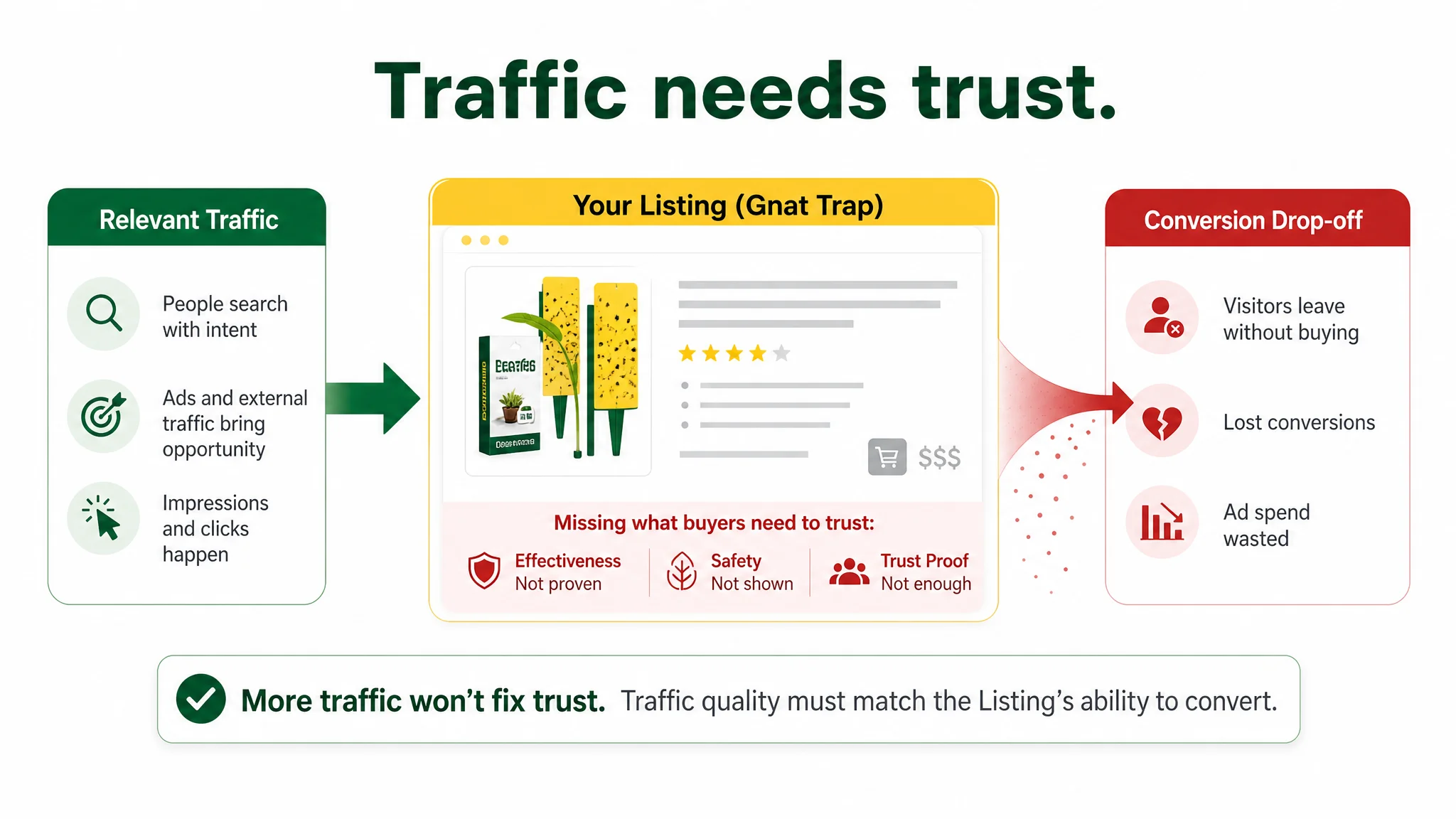
External or paid traffic can expose a Listing’s weaknesses as clearly as it exposes its strengths. If visitors arrive but cannot understand the offer, verify effectiveness, or resolve safety concerns, more traffic may simply create more opportunities for the same conversion gap. Traffic quality and Listing capacity must therefore be evaluated together.
How External Traffic Affects Amazon Rankings
- DeepBI Listing Product Documentation (Merged Edition) — Amazon organic growth is supported by the interaction between traffic relevance, listing conversion, and sales performance. When external or paid visitors click and convert, sellers can examine whether the product is gaining stronger commercial signals around relevant searches. The material supports potential natural-ranking gains, not an automatic ranking boost. BSR, CTR, CVR, conversion volume, and sales trends should be monitored together rather than interpreted from traffic volume in isolation.
- Data-Driven Closed Loop: How to use ad data to guide optimization and track the impact on CTR post-optimization through event tagging — Advertising data can help identify search terms that deserve attention in the organic listing. The operating sequence is to identify effective search signals, improve the listing’s ability to attract and convert relevant shoppers, measure the response, and feed the findings into the next optimization cycle. Event tagging creates a time anchor for comparing CTR trends after a listing change, helping sellers distinguish a real response from an untracked fluctuation.
The case also shows why advertising should not be treated as a replacement for trust. The benchmark Listing used real captured-insect imagery, multiple room scenarios, food-adjacent safety imagery, and image-rich review content to support its claims. The seller’s page had information and illustrations, but less visual evidence that the traps worked at scale. Until the page could communicate that proof more effectively, increasing traffic would not necessarily improve the underlying commercial signal.
Using DeepBI to Identify Synergies Between Ads and Organic [Organic/Ads bridge]
- DeepBI Listing Product Documentation (Merged Edition) — DeepBI mines high-converting search terms, or “winning terms,” and converts those signals into optimization weight for listing titles and visual assets. If an advertising term aligns with a verified product attribute and produces strong conversion behavior, that signal can guide more precise messaging. The objective is not to insert unsupported claims, but to strengthen the listing’s relevance and commercial clarity so paid and organic traffic encounter a more capable conversion path.
- DeepBI elevates the function of visual assets from “aesthetic display” to a “core commercial engine” that drives clicks (CTR) and conversions (CVR) — Visual optimization connects advertising insight with organic execution. After a new image is applied, DeepBI can mark the visual-iteration event in the advertising report, allowing sellers to compare CTR movement during the following 7–14 days. This creates a measurable bridge between ad discovery, listing refinement, and market feedback, while keeping decisions tied to CTR, CVR, sales performance, and the potential to reduce dependence on paid traffic.
The gnat-trap Listing shows what this bridge looks like in practice. Advertising signals indicated that traffic was entering the page, while the Listing comparison showed weaknesses in the modules responsible for closing the sale. The solution was not to disconnect advertising from organic work, but to use advertising as evidence for improving the title, bullets, images, and A+ content. Once the page became better aligned with shopper intent, subsequent ad decisions could be made against a stronger conversion foundation.
DeepBI Organic Traffic Engine: Turning Data into Rankings
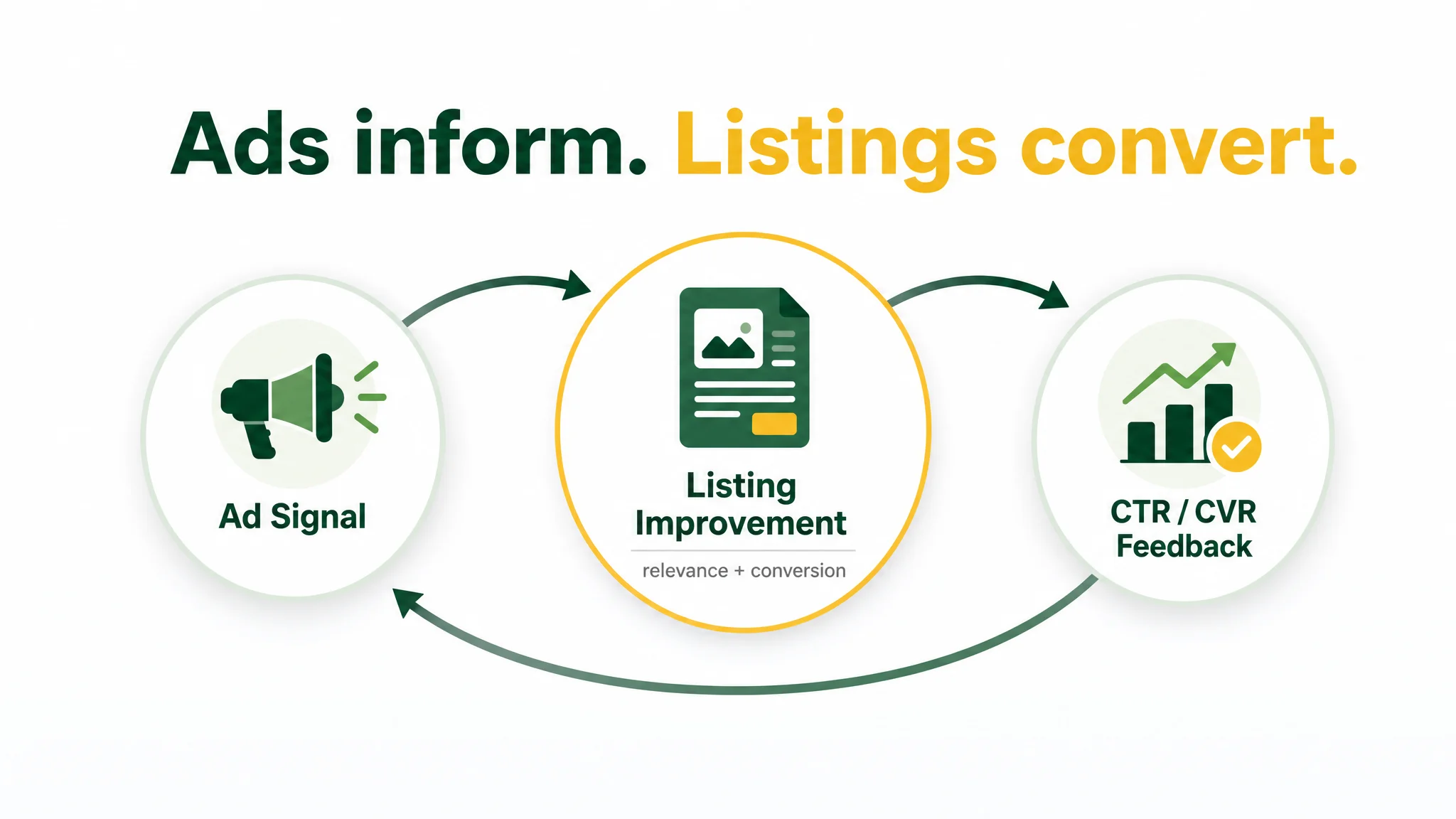
Paid traffic and organic growth should not be managed as separate systems. Advertising data reveals which search terms attract impressions, clicks, and conversions; organic optimization determines whether those terms become stronger signals across the Listing. Without a feedback loop, sellers often increase bids or add keywords without knowing which terms deserve greater relevance, which can raise ACoS without improving BSR or long-term traffic.
The gnat-trap seller’s first response to stagnant orders was to adjust bids, keywords, match types, and budgets. These actions addressed traffic acquisition, but they did not resolve the Listing’s weaker conversion capacity. DeepBI connected the advertising situation with Listing scores and benchmark gaps, showing that the page was not broken but underpowered. The 70/100 score compared with the competitor’s 77/100 was especially meaningful because the difference clustered in title, A+ and details, and reviews—the parts of the page that help visitors decide.
DeepBI connects these activities through a keyword-to-rank pipeline. It analyzes Listing advertising reports, including impressions, clicks, conversions, ACoS, and TACoS, then identifies the search terms and product attributes associated with stronger commercial intent. These findings can guide title, image, and Listing optimization so paid traffic produces learning that supports organic expansion.
The Fifth Funnel: From Ad Keywords to Top of Search
The fifth funnel is the movement from a proven advertising keyword to stronger organic visibility. A term that generates clicks but few conversions may indicate weak relevance, unclear product presentation, or a mismatch between shopper intent and the Listing. A term with stronger conversion signals deserves closer examination before receiving more strategic emphasis.
DeepBI extracts high-conversion “Winning terms” and uses them as weighted inputs for optimization. If the data indicates that a genuine product attribute, such as fast charging, is associated with conversion, that attribute can receive greater emphasis in relevant visual and Listing decisions. The process is not simple keyword insertion. It connects search behavior with the product information shoppers need to understand before purchasing.
The gnat-trap title revision followed the same logic. It brought “Fruit Fly Sticky Traps” closer to the front, connected the product to house plants, clarified its relevance to several pest types, and surfaced the included stake holders. The revised bullet structure then translated those terms into buyer-facing benefits such as durability, safety, easy setup, visual attraction, and multi-scenario use. Search relevance was treated as part of a decision script rather than as a list of repeated phrases.
The execution cycle is structured:
- Diagnose advertising and sales performance.
- Identify high-value search terms or product attributes.
- Apply grounded Listing or visual improvements.
- Mark the optimization event.
- Compare subsequent CTR and conversion data.
After a new Listing asset is applied, sellers can observe how CTR changes over the following 7–14 days. Repeated iterations can improve the precision of traffic entering the Listing and support a path toward stronger organic visibility, including greater Top of Search activity when relevance and conversion performance strengthen. The workflow should be treated as measured progression, not a guaranteed ranking shortcut.
Continuous TACOS Optimization with DeepBI
TACoS optimization is not achieved by cutting advertising blindly. It requires increasing the share of sales generated by stronger Listing relevance and organic demand while preserving the paid traffic needed for discovery and testing. DeepBI helps sellers evaluate that balance by turning advertising signals into optimization priorities rather than leaving reports as isolated performance records.
A practical loop is to review which terms contribute to impressions, CTR, CVR, and sales, then determine whether the Listing reflects the strongest validated attributes. Once an update is applied, the seller can monitor the next performance window and compare changes in CTR, conversion behavior, ACoS, TACoS, and BSR. High-value terms can be retained and reinforced; weak or unsupported terms should not be given additional emphasis.
In the gnat-trap case, the operational priority was to strengthen the Listing before attempting to scale advertising further. The team rebuilt the page around real capture evidence, weather durability, kitchen-safe positioning, ease of use, multi-location scenarios, and the green adjustable stake. The page began to provide clearer reasons to trust the product, rather than relying mainly on claims and conceptual illustrations. According to the case, CVR became more responsive to ad changes, ACoS began to show downward movement, and the seller saw early signs that organic rankings and orders had a better chance to recover. These observations were treated as early operational signals, not as proof of a guaranteed ranking outcome.
The strategic objective is progressive substitution: paid orders generate evidence, evidence guides Listing improvements, improved relevance supports organic discovery, and organic orders can gradually reduce dependence on paid acquisition. DeepBI does not remove the need for judgment. Keyword emphasis must remain tied to the actual product, and results must be validated through iteration. That discipline protects both conversion quality and sustainable organic growth while shortening the distance between advertising insight and ranking action.
Actionable Strategies to Sustain Organic Growth
Organic growth is not maintained by a single listing rewrite or campaign adjustment. Treat it as a recurring operating cycle: measure the funnel, identify the constraint, make a controlled improvement, and review the resulting data before deciding what to change next.
- Refresh keyword research on a fixed review cadence and whenever performance changes. Reassess search terms as shopper behavior, competitive positioning, and product results evolve. Use listing content and advertising data to identify high-value and high-converting terms, then adjust keyword priorities across the title, bullets, backend fields, A+ content, and relevant visual messaging. Connect each update to changes in impressions, CTR, CVR, orders, and BSR rather than adding keywords without a performance hypothesis.
- Use image iteration as a measurement discipline, not a one-time redesign. Generate or prepare alternative visual treatments for the main image and supporting assets, compare them with the current versions, and select changes that improve product clarity, hierarchy, and shopper appeal. DeepBI does not provide native image A/B testing, so use sequential iteration: approve a specific version, publish it, record the change, and review its effect on CTR and downstream CVR. Keep Product DNA as the constraint so composition, lighting, or setting can improve without changing the product’s inherent attributes.
- Monitor the complete performance funnel and the economics behind it. Track impressions, clicks, CTR, orders, CVR, organic ranking, BSR, advertising performance, ACoS, and TACOS continuously. Use the pattern of results to choose the next action: weak CTR can indicate that the main image is not competitive enough, while weak CVR can point to insufficient detail, trust signals, or value communication on the product page. Also monitor listing cycle time so repeated updates remain operationally manageable rather than becoming an unstructured manual workload.
- Benchmark the Listing before increasing traffic. A page can look complete and still be the main constraint. Compare the title, image system, bullet hierarchy, A+ proof, and review presentation with a genuinely comparable competitor. In the gnat-trap example, a 70/100 Listing appeared “good enough,” but the seven-point benchmark gap was concentrated in the exact areas that influence buyer confidence. Use this type of diagnosis to determine whether the next dollar should go toward more traffic or toward improving the page’s ability to convert existing traffic.
- Make proof visible rather than relying on claims alone. Where the category depends on effectiveness, safety, durability, or visible results, use images and page structure to answer the buyer’s main objections. For the gnat traps, real captured insects, multi-room usage, a food-adjacent safety scene, weather-resistance visuals, and a close-up of the installation process all served different decision needs. The broader principle is to give each asset a defined job in the conversion path.

- Run DeepBI’s full-loop workflow to connect diagnosis, execution, and feedback. Begin with listing diagnostics and competitor benchmarking, translate identified gaps into specific textual or visual optimization instructions, and refine the approved assets. DeepBI can use advertising signals, including CTR and CVR, to guide optimization priorities, then apply selected listing changes through its Amazon connection with user confirmation. After publication, the visual iteration event creates a time anchor in ad reports, allowing sellers to review CTR movement over the following 7–14 days and feed the findings into the next evaluation. This coordination prevents listing quality, advertising insight, and organic optimization from operating as separate tasks.
Conclusion
Amazon organic search traffic is not a reward that appears by chance. It is the result of a listing that communicates relevance clearly, earns clicks from the right shoppers, converts those visits into orders, and improves through disciplined feedback. When sellers treat organic growth as a guessing game, they often change titles, images, keywords, or pricing without knowing which variable caused a change in CTR, CVR, ACoS, or BSR. That creates wasted listing cycle time and makes profitable decisions harder to repeat.
The gnat-trap seller’s experience shows how easily this guessing game can begin. The Listing had a complete image set, A+ content, reasonable reviews, and a score that did not appear alarming. Because ads were generating impressions and clicks, the team initially assumed that more aggressive campaign optimization would close the gap with a stronger competitor. The diagnosis instead showed that the page was consuming traffic: its title was less decision-oriented, its A+ content offered less concrete proof, and its trust signals were weaker than the benchmark.
A more durable approach begins with listing excellence. Your main image, title, bullet points, A+ content, and supporting visuals should work as one system. They need to present the product accurately, make its value understandable, and address the customer problems that matter for the category. Optimization cannot alter the product’s actual material, color, structure, features, branding, or verified specifications. Data authenticity is not a limitation to work around; it is the foundation for sustainable conversion and customer trust. Content that violates Amazon requirements, such as image standards or title limits, can also be blocked before it contributes to traffic or sales.
The next step is strategic optimization. Rather than copying a broad competitor or pursuing isolated keywords, compare your listing with genuinely comparable products across form, price range, functionality, and audience. Identify where shoppers may lose confidence or fail to understand the offer. Then convert those gaps into specific actions: clarify keyword structure, strengthen visual hierarchy, improve information flow, and connect customer pain points with credible product solutions.
For the gnat-trap page, this meant moving from conceptual presentation to a more complete proof system. The title clarified the product, use cases, pest coverage, and stake-holder differentiator. The bullets followed a pain-point-to-solution path. The image set made pack size, weather resistance, dimensions, and target pests easier to understand. A+ content added visible capture evidence, kitchen and household scenarios, installation details, and the adjustable stake. These changes did not represent a generic redesign; they addressed the precise reasons the existing page was less capable of converting traffic than its benchmark.
DeepBI supports this process by connecting diagnosis, recommendation, production, deployment, and measurement into a structured workflow. It can evaluate listing elements against relevant competitors, translate measured weaknesses into executable text and visual improvements, and organize the resulting assets for seller review. After a visual update is published, marking the launch as an iteration event creates a clear time anchor for examining subsequent advertising and marketplace data. Sellers can then compare performance before and after the change instead of relying on memory or design preference.
The strongest operating model is a feedback loop: inspect impressions and clicks, study CTR and CVR, monitor ACoS and TACoS alongside orders, and observe whether improved relevance supports healthier BSR over time. No single score or one-time change proves that an optimization worked. Continued marketplace data, human confirmation, and controlled iteration provide stronger evidence.
Better listings combined with more precise traffic can reduce dependence on paid acquisition and support healthier long-term growth. The practical objective is not a guaranteed ranking or a temporary traffic spike. It is a repeatable system that helps you make accurate improvements, protect profitability, and turn organic search into a measurable business discipline.