

Introduction: The AI Revolution in Amazon Selling
An AI repricer that raises Buy Box ownership can create more commercial value than a costly tool that produces attractive but irrelevant listing suggestions. The distinction is not the novelty of the technology; it is whether the tool addresses a specific constraint and produces a measurable change in Amazon performance.
Amazon’s native AI portfolio has expanded through launches such as AI Listing Generator, Enhance My Listing, Dynamic Canvas, and Project Amelia. At the same time, many third-party tools now include AI agent features for listing analysis, repricing, advertising, inventory, and review intelligence. This wider choice creates opportunity, but it also makes selection harder. Not all AI tools are built for the same workflow, data input, or decision problem, and a higher subscription price does not guarantee stronger returns.
A practical evaluation starts with the pain point. A listing optimization system should help connect changes to metrics such as CTR, CVR, ACoS, BSR, or listing cycle time—not simply produce polished copy or images. Visual assets also require commercial and operational controls: a generic image generator may alter product details, creating mismatch risks that can contribute to negative reviews and refunds. A business-oriented system instead needs product constraints, executable recommendations, and a way to mark when changes go live so sellers can evaluate subsequent performance.
A gel air freshener listing illustrates why this distinction matters. The product page was not completely empty: it had a title, images, bullet points, descriptive content, and reviews. Yet the page did not give shoppers a connected path from recognizing the product to understanding how it worked, trusting its claims, and deciding to purchase. The initial direction focused on reinforcing freshness claims, multi-room use, and brand history. A deeper diagnosis found that the more fundamental issue was the page’s conversion logic. It was not enough to add persuasive language if the title, images, bullets, A+ content, and trust signals were not answering the buyer’s questions in sequence.
The right question is therefore not, “Which AI tool has the most features?” It is, “Which capability can solve the bottleneck affecting this ASIN, and how will the return be measured?” Cost becomes meaningful only after that connection is established.
When AI Tools Justify Their Cost (And When They Don't)
AI earns its place when measurable gains in CTR, CVR, ACoS, BSR, or listing cycle time exceed subscription cost. Compare the monthly fee with incremental gross profit, labor saved, and avoidable losses before committing.
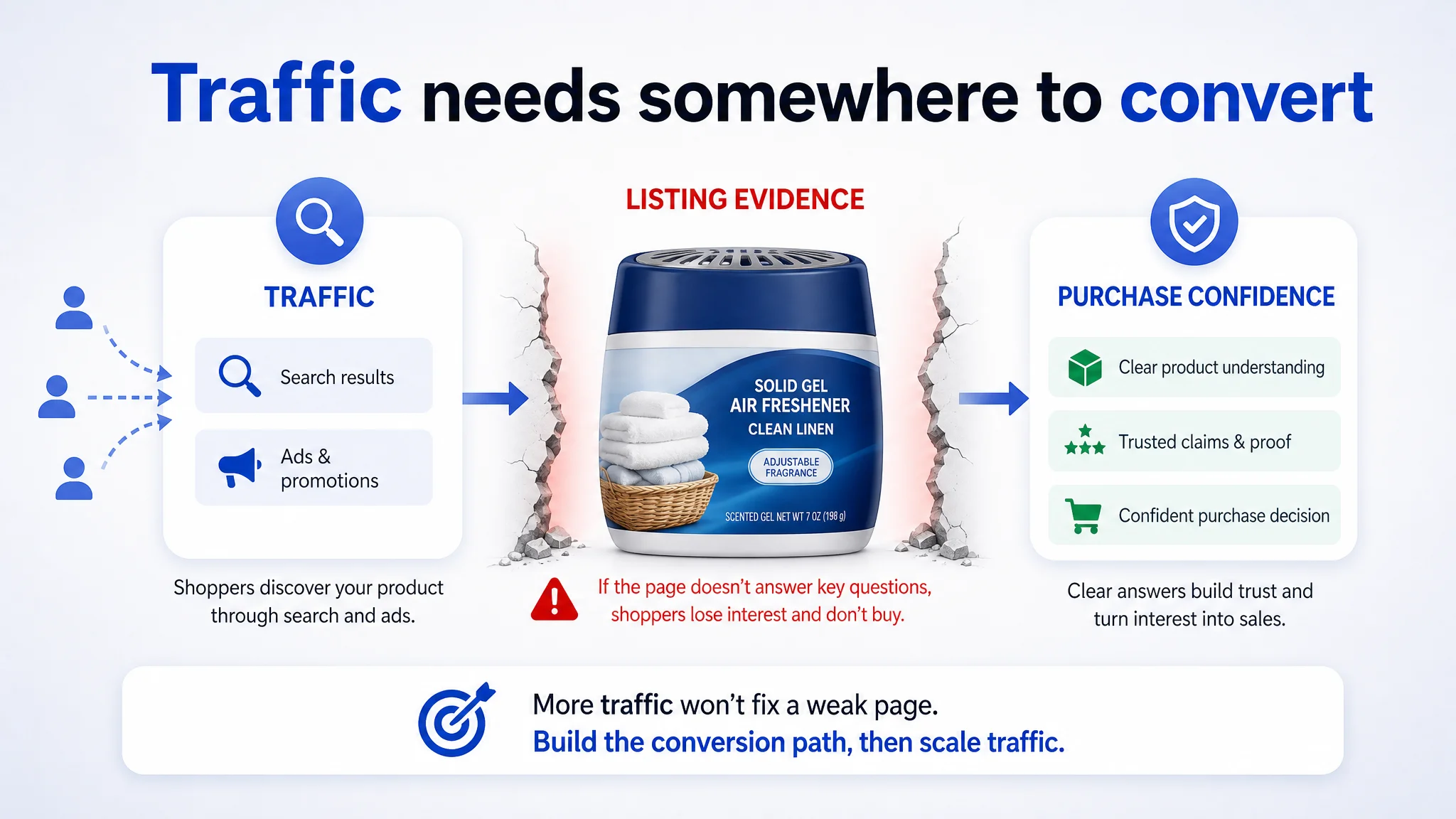
The first step is to determine what kind of constraint the ASIN actually has. A seller may see weak advertising efficiency and assume that bids, keywords, or budgets are the main problem. But if the product page does not communicate the offer clearly, additional traffic may only make the conversion weakness more expensive.
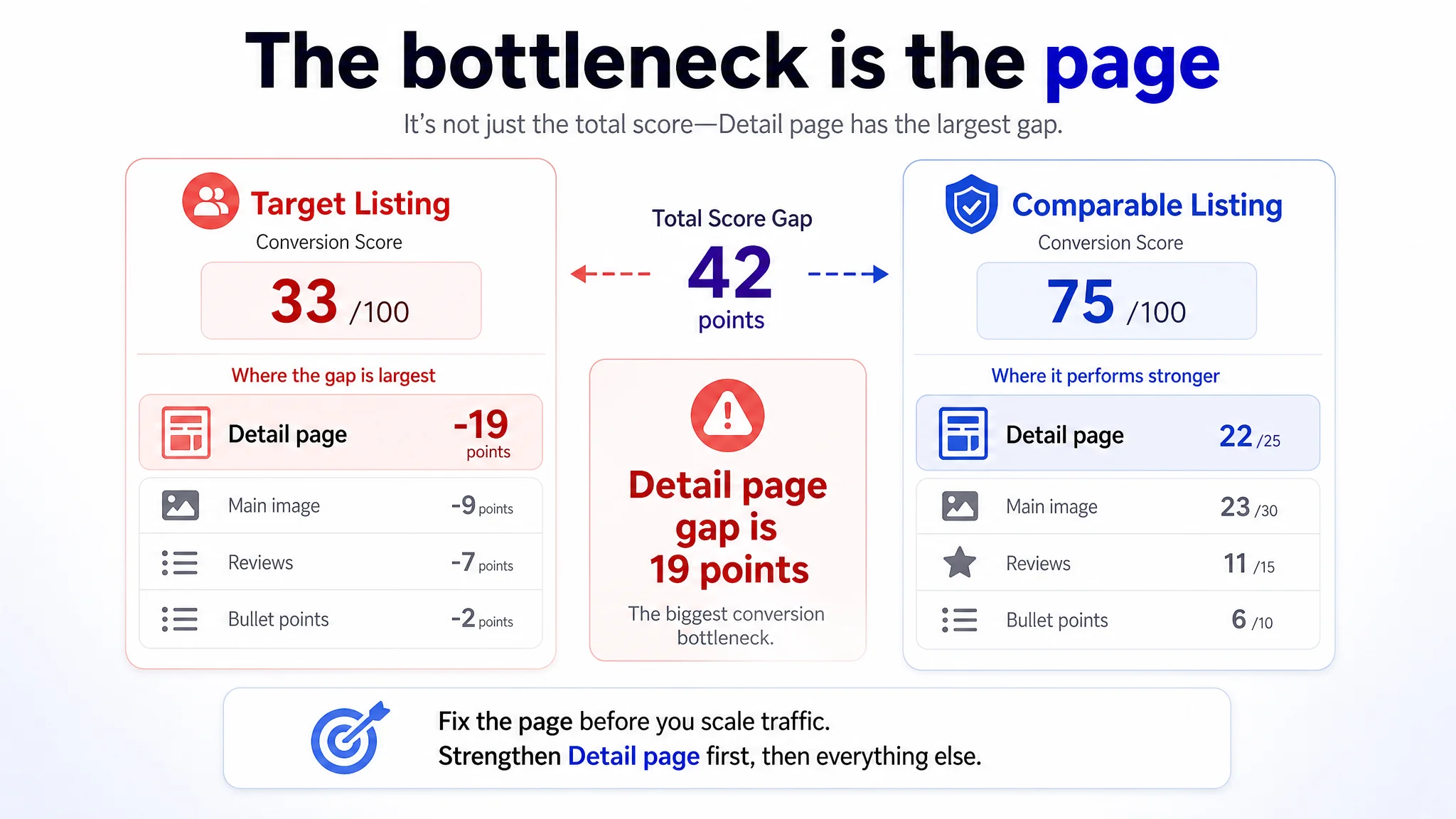
A listing diagnosis for the gel air freshener showed a score of 33 out of 100 against 75 for a comparable high-performing listing. The largest gap was in the detail page and A+ content dimension, followed by the main image and review profile. This did not prove a future advertising outcome, but it did identify a clear operating risk: scaling traffic before repairing the page could make it difficult to distinguish an advertising problem from a conversion problem.
The return from an AI tool should therefore be evaluated against the constraint it is designed to address. A listing tool may be worthwhile when it reduces diagnosis and production time or improves conversion capacity. A PPC platform may be worthwhile when campaign inefficiency is the primary bottleneck. Neither tool should be purchased simply because it offers more automation.
Listing Optimization ($0-99/month)
Use listing tools for competitor research, keyword discovery, content scoring, and asset production. Surfacing 200 competitor keywords in minutes can justify a low-cost plan when it replaces several hours of research or supports multiple SKU updates. Measure saved labor, CTR, CVR, and listing cycle time. Small catalogs should avoid workflow automation they will rarely use.
The value becomes clearer when the tool can identify why a page is underperforming rather than merely generate alternative copy. In the gel air freshener example, the missing core phrase “Gel Air Freshener” in the title was relevant, but it was only one part of the problem. The main image did not answer basic questions about size, placement, or operation. The bullet points presented broad claims without a clear action-to-result sequence, and the A+ content repeated information rather than explaining the product visually.
A low-cost listing tool may be sufficient for simple keyword discovery. A more advanced system becomes easier to justify when it connects search clarity, image communication, product detail, and post-application measurement. The commercial question is not whether the generated title sounds better. It is whether the complete page gives shoppers stronger reasons to continue toward purchase.
Repricing ($99-500/month)
Repricers protect Buy Box position by adjusting prices against market conditions. In a reported example, a 12–18% increase in Buy Box ownership corresponded with an 8–12% sales lift. Break-even requires contribution profit from that lift to exceed the subscription fee. Avoid the investment when Buy Box competition is limited or margins cannot absorb price movement.
A repricer should not be used to solve a problem that originates elsewhere in the funnel. If shoppers understand the offer but the price is uncompetitive, repricing may address a genuine constraint. If shoppers are uncertain about the product itself, a lower or more responsive price may not repair the missing product explanation. The same principle applies across AI categories: the tool must be matched to the business problem.
PPC Automation ($250-695/month)
PPC automation manages bids, budgets, and campaign structure, with value measured through incremental profit and ACoS control. It can pay off when ad spend is large enough for small efficiency gains to cover the fee. Sellers with modest spend should avoid paying more than the profit recovered.
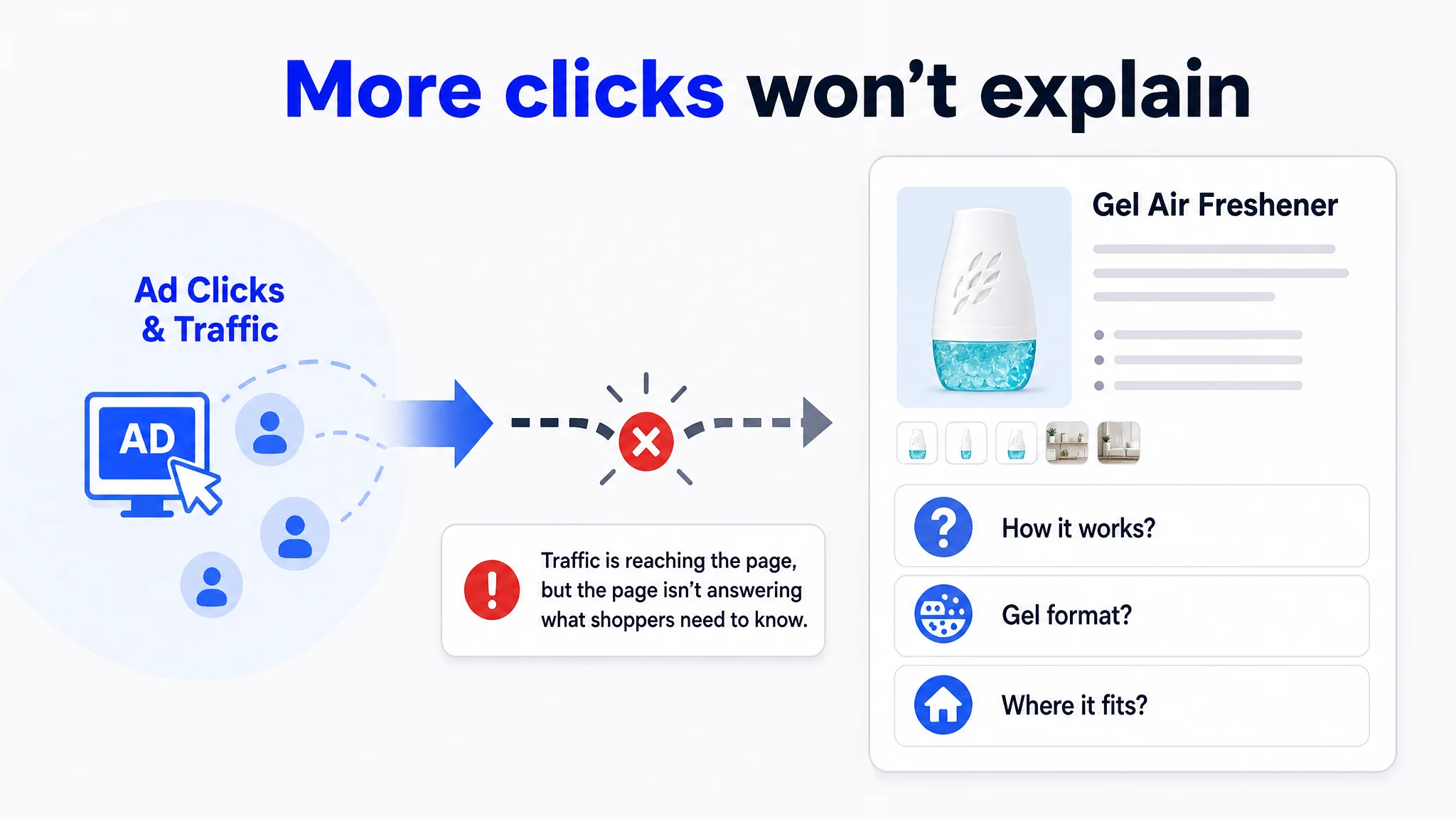
Before increasing PPC automation, sellers should verify that the listing can convert relevant traffic. In the gel air freshener diagnosis, the page’s low detail-page score and weak visual explanation suggested that continuing to push traffic without repairing the content could produce misleading signals. More clicks would not explain how the adjustable cone worked, clarify the gel format, or establish why the product fit a shopper’s intended space.
This does not mean advertising should automatically stop. It means campaign performance should be interpreted alongside page readiness. Otherwise, a seller may repeatedly change bids or keywords while leaving the actual conversion bottleneck untouched.
Inventory Forecasting ($49-250/month)
Forecasting tools reduce stockout and excess-inventory risk. Calculate the fee against contribution profit protected, storage costs avoided, and BSR disruption prevented. Low-volume sellers with stable demand may not generate enough risk reduction to justify automation.
Inventory automation is most useful when its forecasts can be connected to commercial decisions. A seller should consider whether demand signals are being interpreted alongside advertising activity, organic ranking, seasonality, and listing changes. If a page is being rebuilt, demand expectations may also need to be viewed in the context of its conversion capacity. Forecasting cannot eliminate uncertainty, but better-connected data can reduce the risk of scaling inventory based on incomplete assumptions.
Review Analysis ($34-140/month)
Review analysis identifies recurring product or content issues that may affect CVR and returns. Invest when review volume supports reliable patterns and fixes can protect profit. Avoid it for new or low-volume listings where manual review is sufficient.
Review data is one part of the trust system, not a substitute for product clarity. The gel air freshener listing had a 3.9-star rating and 26 total reviews, compared with 4.3 stars and 207 reviews for the comparable listing. That difference weakened the trust base, but the diagnosis did not treat reviews as the only explanation for the performance gap. A stronger review profile could support confidence, yet it could not compensate for a title that was difficult to interpret, images that did not demonstrate use, or A+ content that failed to explain the product.
Review analysis is therefore most valuable when recurring feedback can be linked to specific improvements in the product, content, or customer experience.
5 Categories of AI Tools Every Amazon Seller Should Know
AI tool value depends on data quality, measurable functionality, and operational fit—not the sophistication of the label. Fresh, hourly-refreshed data can matter more than the underlying AI model, particularly when decisions affect CTR, CVR, ACoS, BSR, or inventory availability. Advanced analytics platforms may track more than 200 metrics and 40 fee types; verify those claims before buying.
The right tool should also help distinguish symptoms from causes. A low CVR may result from irrelevant traffic, weak pricing, limited reviews, unclear product information, poor visual communication, or a combination of these factors. An AI system that only reports the metric without diagnosing the decision bottleneck may increase activity without improving judgment.
1. Listing Optimization Tools
What it does: DeepBI audits titles, bullets, images, A+ content, and feedback against a similarity-filtered benchmark ASIN. Key AI features: semantic matching, multimodal analysis, scoring, structured recommendations, product-constrained image generation, and SP-API publishing. Pricing: custom pricing; no public tiers are provided. Best for: teams reducing manual diagnosis, asset production, and listing cycle time while protecting product accuracy.
A useful listing optimization tool should connect the elements of the page rather than score them in isolation. In the gel air freshener diagnosis, the total score of 33 out of 100 was important, but the distribution of the gaps was more informative:
- Title: Target Listing: 8/20, Comparable Listing: 13/20, Gap: -5
- Main image: Target Listing: 14/30, Comparable Listing: 23/30, Gap: -9
- Bullet points: Target Listing: 4/10, Comparable Listing: 6/10, Gap: -2
- Detail page: Target Listing: 3/25, Comparable Listing: 22/25, Gap: -19
- Reviews: Target Listing: 4/15, Comparable Listing: 11/15, Gap: -7
- Total: Target Listing: 33/100, Comparable Listing: 75/100, Gap: -42
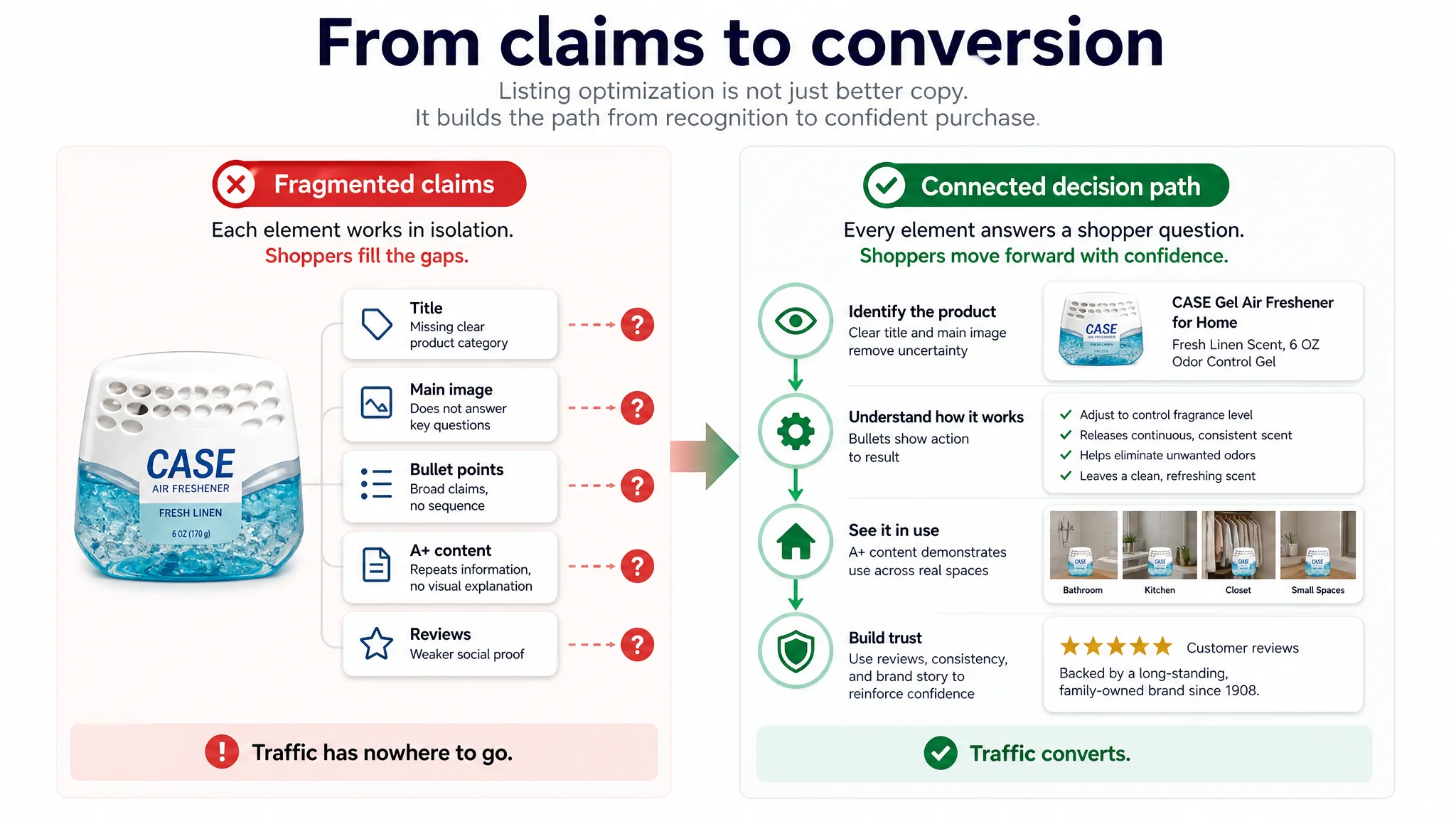
The detail-page gap accounted for 19 points, far more than any other individual dimension. That shifted the priority away from treating the problem as a simple copywriting or keyword task. The title needed clearer product identification, the images needed defined jobs, the bullets needed a functional sequence, and the A+ content needed to support product understanding and trust.
This is where structured diagnosis can create more value than generic content generation. The objective is not to make every element sound more polished. It is to determine which missing evidence is preventing the shopper from moving forward.
2. Repricing Tools
What it does: Adjusts prices against defined competitive and margin rules. Key AI features: verify demand signals, competitor monitoring, and guardrails. Pricing: vendor quote where unpublished. Best for: sellers managing price-sensitive catalogs without sacrificing contribution margin.
Repricing tools should preserve defined margin rules and respond to relevant market conditions. Their recommendations are most useful when sellers understand whether price is actually limiting conversion. If a listing’s product type, usage, or benefits are unclear, price changes may address only a secondary issue.
3. PPC and Advertising Management Tools
What it does: Consolidates campaign data and supports bid or budget decisions. Key AI features: confirm query analysis, pacing, and attribution inputs. Pricing: verify subscription or custom pricing. Best for: teams seeking lower ACoS with accountable campaign workflows.
PPC tools become more useful when their data can inform listing decisions. Advertising may reveal which search terms and product attributes attract qualified demand, but those signals still need to be reflected in the page. Otherwise, the seller can optimize campaigns around traffic that the listing is not prepared to convert.
4. Inventory Management and Forecasting Tools
What it does: Converts sales and supply data into replenishment decisions. Key AI features: validate hourly refresh rates, forecast logic, and stockout alerts. Pricing: vendor-specific. Best for: reducing stockout risk and excess inventory.
Forecasting tools should be evaluated according to how their data supports replenishment decisions. Validate the refresh rate, forecast logic, and alert quality rather than assuming that an AI label guarantees accuracy.
5. Review Analysis and Customer Sentiment Tools
What it does: Groups recurring feedback themes. Key AI features: confirm sentiment classification and exportable insights. Pricing: custom if unpublished. Best for: linking customer issues to CVR and product improvements.
Review analysis can reveal whether shoppers repeatedly mention unclear instructions, fragrance expectations, size, product performance, or other issues. Those patterns can help determine whether a weak CVR reflects a content problem, a product problem, or both. The output becomes more actionable when it can be connected to specific listing changes and later performance checks.
DeepBI: A Unified Approach to Listing, Ads, and Organic Growth
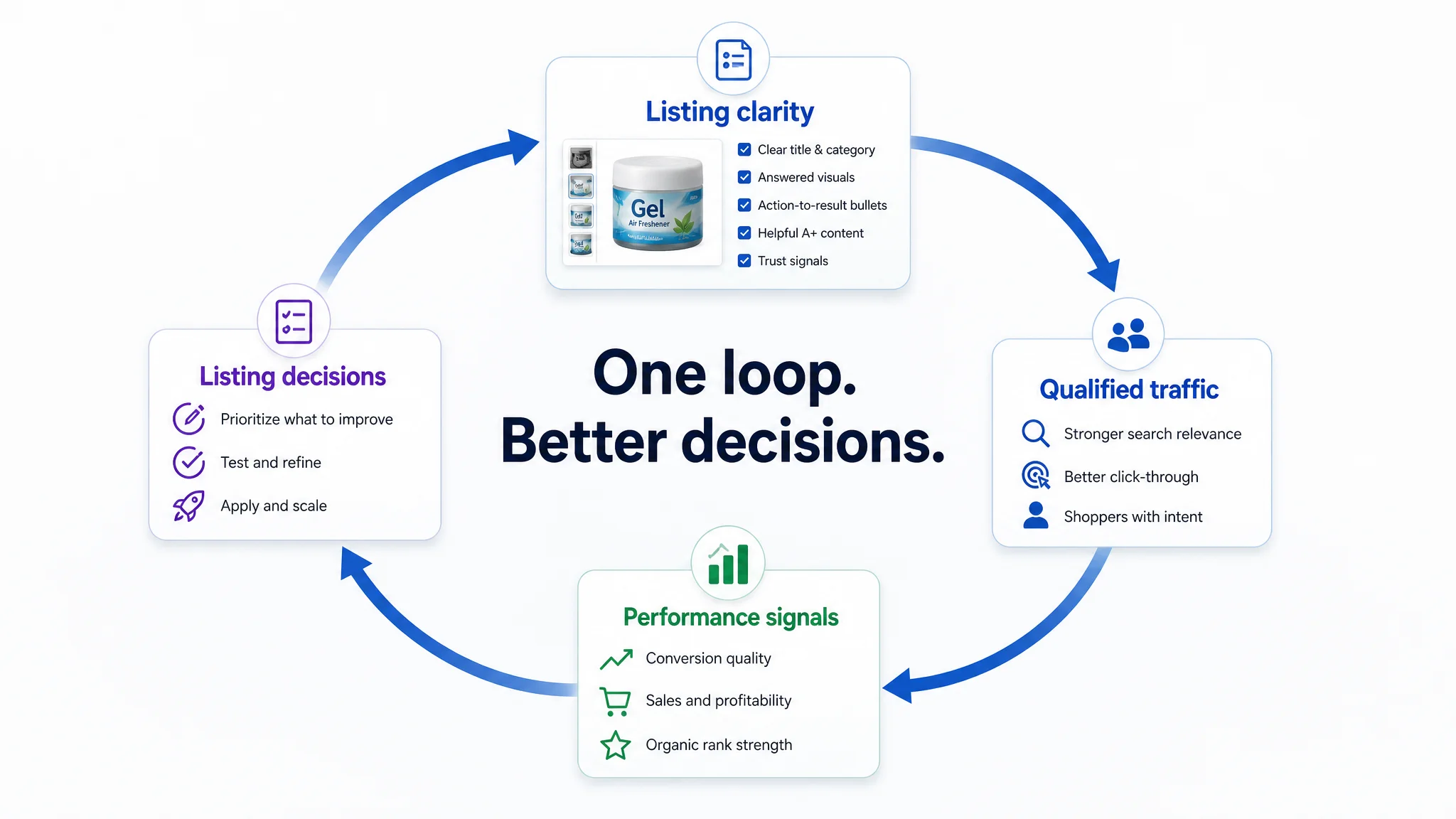
Isolated tools often optimize one Amazon function while obscuring its effect on the others. DeepBI takes an Amazon-only, AI-driven approach that connects listing optimization, advertising management, and organic traffic growth in one data loop. Its advantage is not simply model sophistication. The quality of decisions depends on the depth and freshness of seller data: more than 200 metrics, over 40 fee types, coverage across 21 Amazon marketplaces, and hourly data refreshes create a broader operating view.
This connected approach matters because Amazon performance is rarely determined by a single page element or campaign setting. A listing can receive impressions but lose clicks because the title or main image is unclear. It can receive clicks but lose orders because the detail page does not demonstrate the product or resolve buyer concerns. It can generate orders but fail to scale because advertising costs, inventory constraints, or organic visibility are not being evaluated together.
Listing Optimization with DeepBI
DeepBI treats listing work as an automated market health check rather than a subjective scoring exercise. Diagnosis identifies gaps against relevant benchmarks, then structured product information and advertising signals guide executable improvements across text and visual assets. The workflow connects diagnosis, planning, production, and delivery, helping sellers target CTR, CVR, and listing cycle time instead of relying on aesthetics alone. Product constraints and authorized Amazon data remain essential inputs to reliable recommendations.
The gel air freshener diagnosis demonstrates why this workflow needs to be broader than title rewriting. The title did not clearly include the core category phrase “Gel Air Freshener,” and “Adjustables” did not explain what function could be adjusted. A clearer direction—“Adjustables Gel Air Freshener, After the Rain Scent, 7 Ounce”—made the product type, scent, and size more explicit.
However, the title was not treated as a complete solution. The main image still needed to communicate size and placement. The image sequence needed to show the adjustable mechanism and gel format. The bullet points needed to connect user action with fragrance release, odor control, and the resulting experience. The A+ content needed to support the same explanation rather than repeat disconnected claims.
The diagnosis therefore converted a general request to “strengthen the claims” into a structured set of page decisions. That is the difference between producing content and improving the commercial logic of a listing.
PPC Automation with DeepBI
Advertising data becomes more valuable when it informs the listing rather than remaining inside a PPC silo. DeepBI connects reports containing impressions, clicks, conversions, ACoS, and TACoS with optimization decisions. High-converting search terms and product attributes can receive greater weight in listing text and visual priorities. Better relevance and stronger conversion can improve advertising efficiency, while post-application performance feeds the next round of diagnosis. The result is a management loop focused on profitable traffic, not isolated campaign activity.
The connection also helps prevent a common misdiagnosis. When a listing receives traffic but conversion remains weak, a team may first adjust keywords, bids, or budgets. The gel air freshener example showed why that sequence can be incomplete. The page’s content and trust gaps meant that traffic could arrive without receiving enough evidence to continue toward purchase. The issue was not proven to be an advertising failure; the page’s limited conversion capacity needed to be addressed before advertising performance could be judged fairly.
This does not make PPC data less important. It makes the data more useful. Search terms and campaign signals can help identify demand, but the listing must translate that demand into clear product understanding. Advertising can bring the shopper to the page; it cannot demonstrate how an adjustable gel cone works or replace a missing A+ explanation.
Organic Traffic Growth with DeepBI
The flywheel continues when winning paid keywords support organic visibility and ranking. Stronger listings can raise CVR, advertising can reveal valuable search demand, and those signals can reinforce the content most likely to support BSR growth. DeepBI therefore links paid and organic decisions through shared seller data, helping reduce dependence on paid traffic over time. The strategic question is not which tool has the cleverest model, but which system has the deepest, freshest, and most actionable Amazon data.
A stronger organic strategy also requires more than adding keywords. If the title includes the correct product category but the page does not explain the format, use, or value, improved search visibility may increase exposure without creating equivalent purchase confidence. In the air freshener listing, the missing category phrase was a search clarity issue, but the low detail-page and main-image scores showed that visibility needed to be matched by better page communication.
Organic growth should therefore be evaluated as a combined outcome of discoverability, relevance, product understanding, and conversion. The page must earn the traffic it receives before sellers can expect paid and organic signals to reinforce each other.
Building Your AI Tool Stack: A Practical Framework
The strongest Amazon AI stack is rarely the largest one. A small set of connected tools can produce clearer signals for CTR, CVR, ACoS, BSR, and listing cycle time than several isolated applications that duplicate work or use inconsistent data.
Use the seller’s growth stage as the starting point:
- New sellers: Begin with one ads-aware agent, such as Amazon’s Ads Agent, and one profit-aware agent, such as DeepBI. The first helps interpret advertising activity; the second connects listing decisions with exposure, clicks, orders, CTR, CVR, TACoS, and ACoS. This two-tool structure can reveal demand and conversion issues before committing to larger inventory positions.
- Growing sellers: Add workflow depth only where a measurable bottleneck exists. DeepBI can connect diagnosis, recommendations, image generation, and controlled application through structured handoffs, helping teams move from identifying a listing problem to testing a specific change without repeatedly transferring data between systems.
- Established sellers: Prioritize scale, governance, and consistency across many SKUs. Batch application, status tracking, selective replacement, compliance checks, and post-application performance tracking can support a more controlled operating process. Add a third tool only when it fills a defined gap, such as market intelligence or specialized creative production.
The growth-stage framework should be applied to actual operating constraints, not assumed tool requirements. A seller with a small catalog may not need extensive automation, while a growing team may lose time transferring inconsistent information between listing, advertising, and analytics systems. The question is whether the next tool closes a measurable gap.
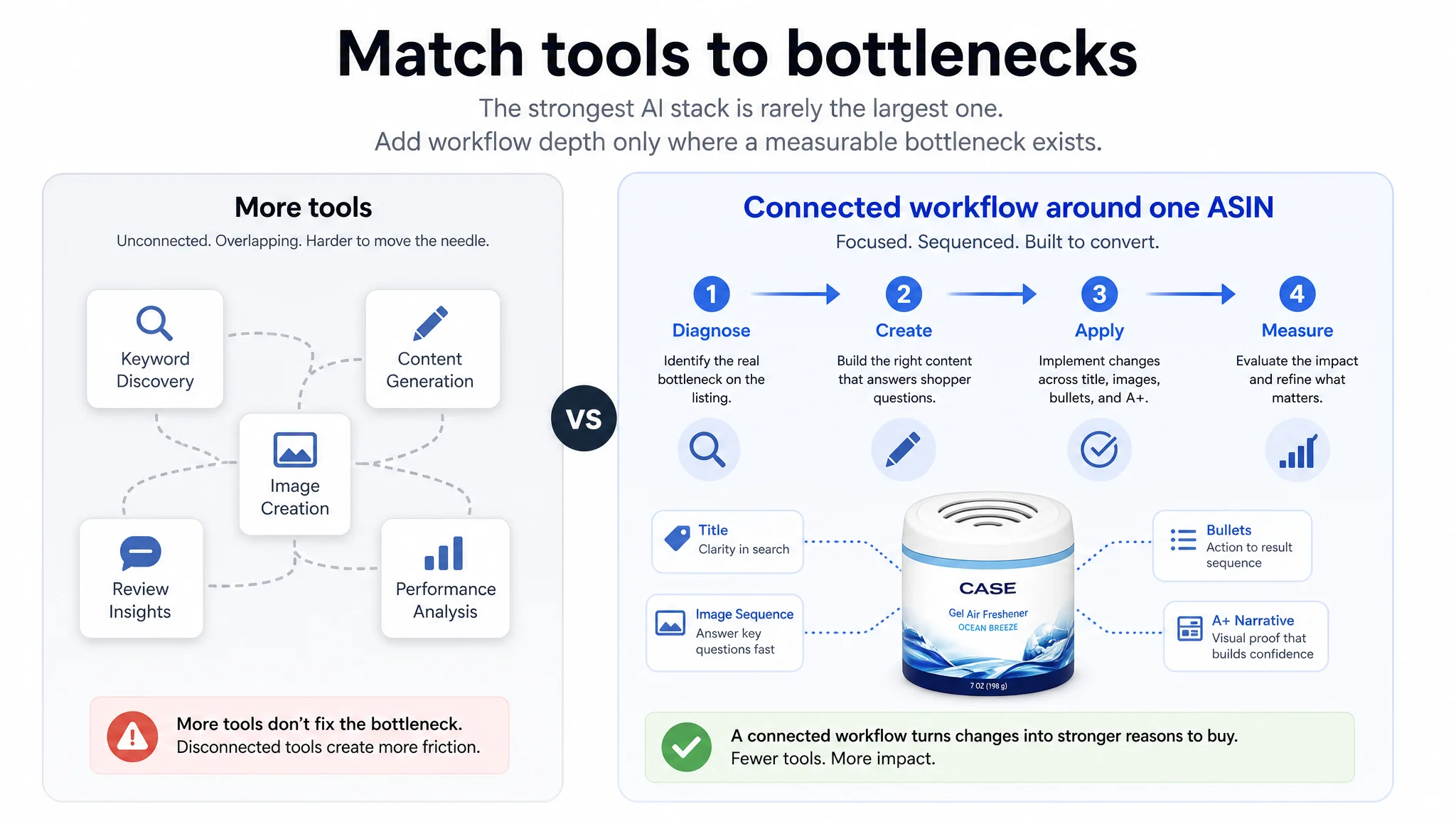
The gel air freshener listing also shows why a connected workflow matters. The work did not consist of a single copy change. It involved clarifying the product type in the title, designing a complete image sequence, restructuring the bullets around action and result, and replacing repetitive A+ text with focused content. These changes needed to remain consistent with the same product entity and commercial narrative. A disconnected stack could produce a keyword-focused title, decorative images, and generic A+ copy without resolving the underlying decision gaps.
Risk reduction should be part of the purchase decision. A connected stack can support demand testing before broader inventory scaling and help limit upfront inventory exposure, but these outcomes depend on execution and should not be treated as guaranteed. Select tools that preserve product-entity consistency, prevent fabricated parameters, and allow comparison before changes go live. Clear data structures are more valuable than a long list of disconnected features.
Conclusion: The Future of AI in Amazon Selling
AI tools are becoming increasingly important in Amazon selling, but adoption alone is not a strategy. The stronger decision standard is whether a tool provides sufficient data depth, integrates with existing workflows, and produces measurable movement in CTR, CVR, ACoS, BSR, or listing cycle time. Evidence such as Buy Box ownership changes, analysis of 200 competitor keywords, and platforms tracking more than 200 metrics across 40-plus fee types reinforces one practical principle: the data model matters more than the AI model.
The gel air freshener diagnosis adds another part to that principle. The page was not simply missing more copy. It was missing a connected path between product recognition, product understanding, trust, and purchase. The largest gap appeared in the detail page and A+ content, while the main image, title, bullets, and reviews created additional friction. The initial direction focused on stronger claims, but the deeper diagnosis showed that the page needed better conversion logic.
Amazon’s native capabilities are advancing. Announced developments such as Dynamic Canvas and shoppable A+ Content point toward richer, more interactive merchandising within the marketplace itself. Yet native tools may not answer every profitability or cross-functional question. Third-party systems such as DeepBI can help connect listing diagnosis, content production, Amazon delivery, and performance signals, while keeping seller approval in the workflow. Its value is strongest when recommendations remain grounded in product consistency, compliance requirements, and observed KPI movement rather than unsupported automation.
This also explains why sellers should not automatically use advertising as the first response to weak performance. A high ACoS signal may reflect campaign inefficiency, but it may also reveal that the listing cannot yet convert the traffic it receives. More impressions cannot repair an unclear product category. More clicks cannot replace a missing product demonstration. More sessions cannot compensate for A+ content that repeats information instead of building confidence.
The future advantage will therefore belong to sellers who combine Amazon’s improving capabilities with integrated systems and disciplined ROI evaluation. The practical sequence is straightforward:
1. Diagnose the ASIN’s actual bottleneck.
2. Determine whether the page can convert relevant traffic.
3. Match the AI capability to that constraint.
4. Apply controlled changes that preserve product accuracy.
5. Measure the resulting movement in the relevant business metrics.
Used this way, AI is not a substitute for commercial judgment. It is an execution layer that can shorten the path from concept to customer favorite.