

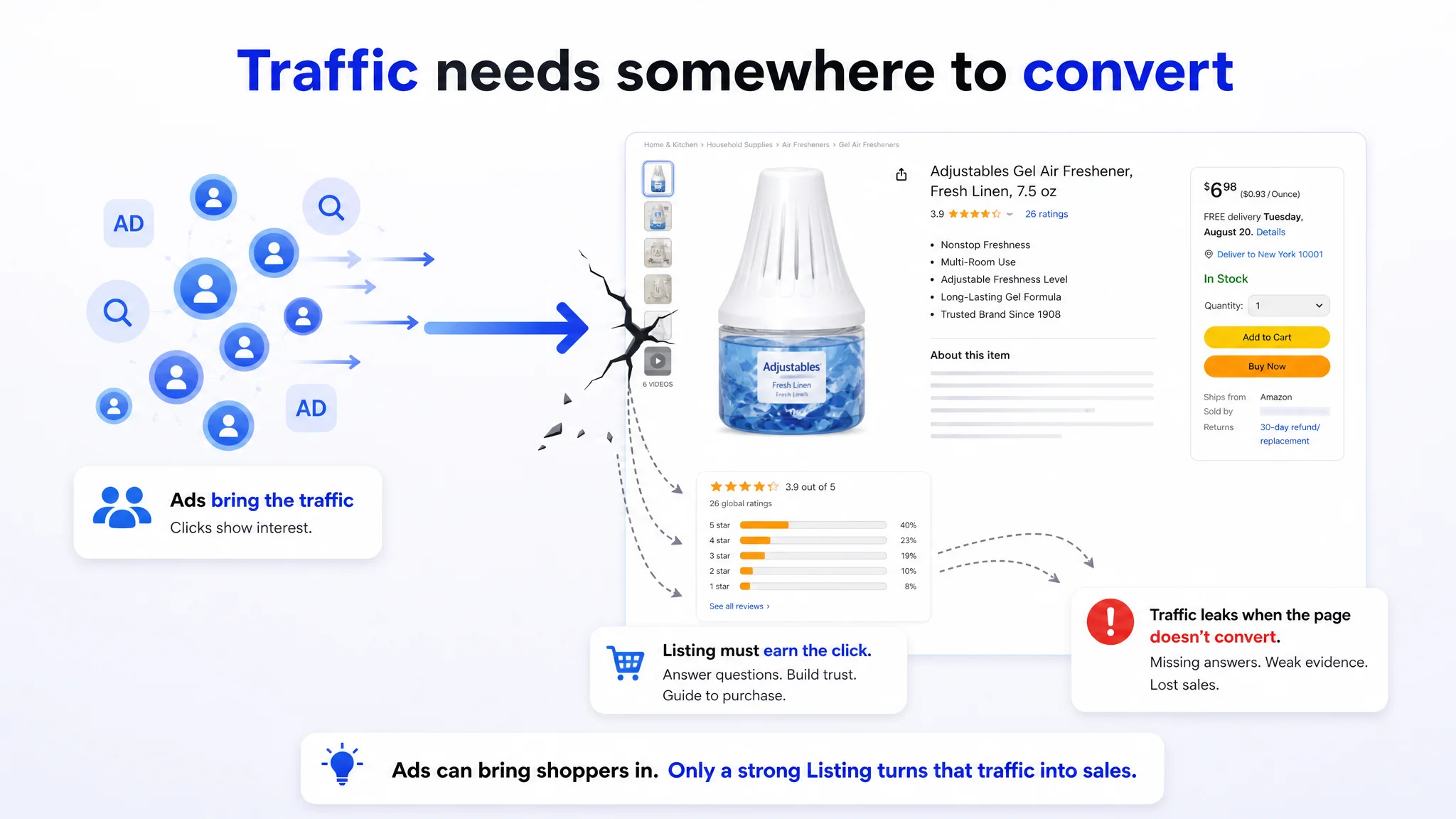
Many Amazon sellers see their ACOS climbing higher and higher. Their first instinct is usually to lower the bids, swap out keywords, or restructure the campaigns entirely. But there is one question that often gets overlooked: just because ads bring in clicks doesn't mean the Listing is actually converting that traffic.
More often than not, the problem may not lie with the ads at all. It lies with what happens after buyers click in—why don't they go on to purchase? A Listing can receive traffic and still fail to give shoppers enough information, confidence, or reasons to continue toward checkout.
What does ACOS really measure?
ACOS, at its core, reflects how much advertising spend is required to generate ad-attributed sales. If ACOS remains elevated over time, advertising is consuming a larger share of the revenue it generates. But ACOS is still an outcome. The more important question is: what is causing advertising efficiency to deteriorate? Why is the order cost increasing?
Let's use an example: a seller offering a rechargeable blender cup who is running ads on the keyword “portable blender for travel.” This keyword brings in a fair number of clicks. But when buyers land on the Listing, the main image they see is just a blender cup sitting on a kitchen counter. The title only lists capacity, wattage, and blade count, without highlighting that it fits into a backpack or a car cup holder, nor does it mention the unit weight, charging method, or battery life. The subsequent images likewise show no usage scenarios—no travel, no gym, no office settings.
When users search for that keyword, what they most want to confirm is: is this really convenient to take on the go? But the entire page emphasizes blending performance without answering the “portability” question. So clicks happen, but purchases do not. In this situation, continuing to increase the ad budget may only generate more traffic that never converts.
A similar pattern appeared in the diagnosis of a gel air freshener Listing. The page contained the expected basic elements—an image, title, bullet points, descriptive content, and reviews—but those elements did not work together as a connected buying path. The title did not clearly establish the product category, the main image did not answer practical questions about size or placement, and the bullet points made broad claims without explaining how the product delivered them.
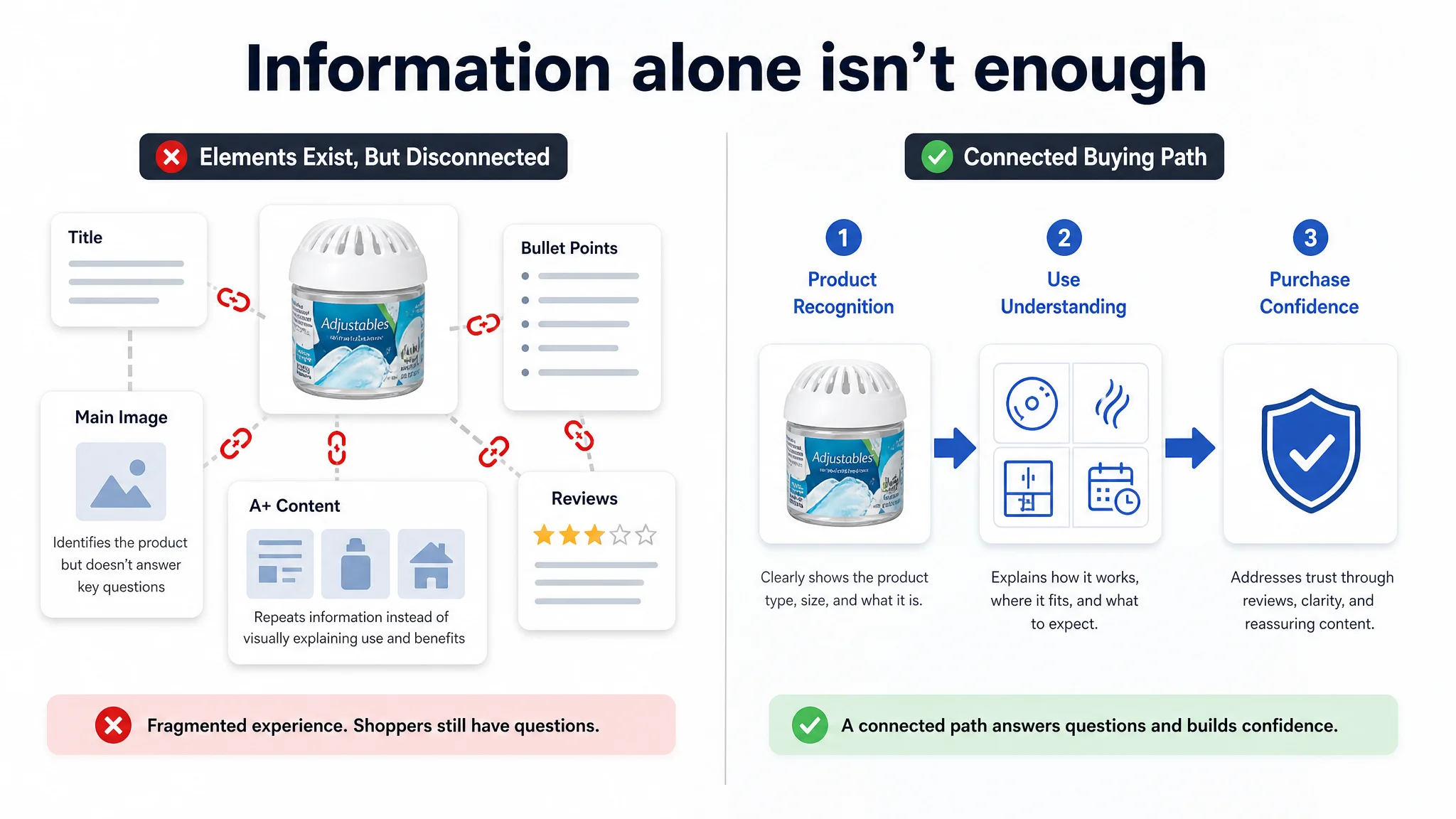
The Listing scored 33 out of 100 against 75 for a comparable high-performing Listing. The largest gap was in the detail page and A+ Content dimension, where the page repeated information instead of visually explaining the product, its use cases, and its adjustable fragrance mechanism. The issue was therefore not simply a lack of traffic or a lack of information in isolation. It was a lack of connected evidence for the shopper to make a confident decision.
Diagnose traffic and page together, not just the ads
In this situation, what is more important is to first determine: why is the traffic not converting? DeepBI's diagnostic approach does not look only at ad data. Instead, it starts by analyzing ad traffic together with the Listing's messaging. For example:
- What is the search keyword actually expressing?
- Does the title respond to that intent?
- Does the main image quickly convey the core value?
- Do the bullet points and A+ Content supplement the purchase rationale?
- Do the reviews and ratings build enough trust?
- Does each section answer a different buyer question, or does the page simply repeat the same claim?
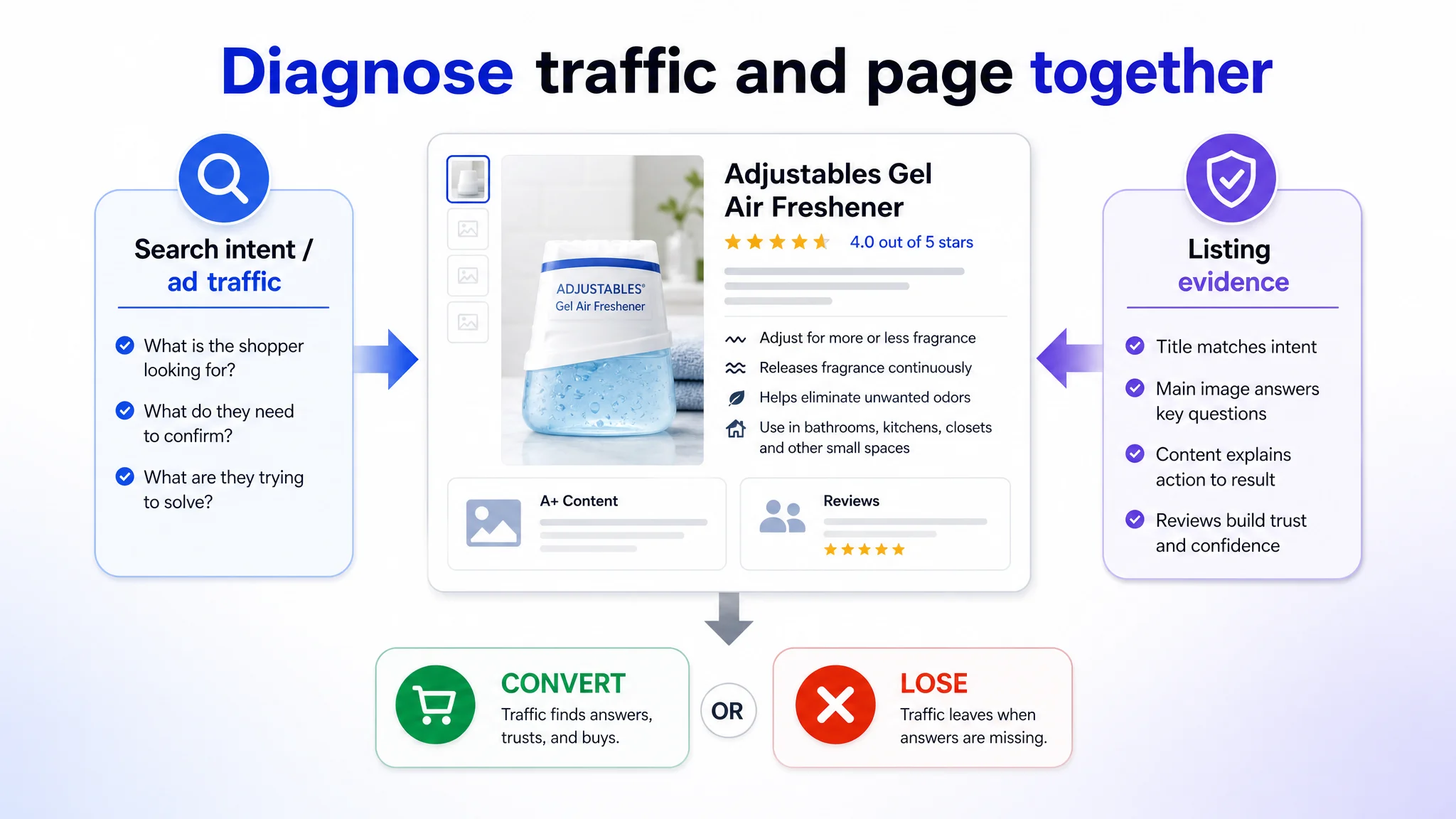
The gel air freshener diagnosis illustrates why these questions need to be considered together. The customer’s initial direction focused on reinforcing lasting freshness, multi-room use, and brand history. Those messages were not irrelevant, but they were presented as isolated claims rather than answers to specific shopper questions.
The title did not clearly include the core phrase “Gel Air Freshener,” while “Adjustables” did not explain what could actually be adjusted. The main image identified the product but did not show its scale, placement, or operation. The A+ Content also lacked a focused visual explanation of how the gel cone worked in a bathroom, kitchen, closet, or other small space.
This meant the page was difficult to search, difficult to interpret, and difficult to trust. A shopper still needed to determine what the product was, how it worked, where it could be used, how long it might last, and why it was relevant to a particular space. The problem was not that the page needed more claims. It needed a clearer sequence from product recognition to purchase confidence.
That sequence also appeared in the comparison with the stronger Listing. Instead of moving between general statements about longevity, room usage, and brand history, the comparable page connected the user’s action to the product outcome: adjust the product, control the amount of fragrance released, address unwanted odors, and leave behind a clean, refreshing scent.
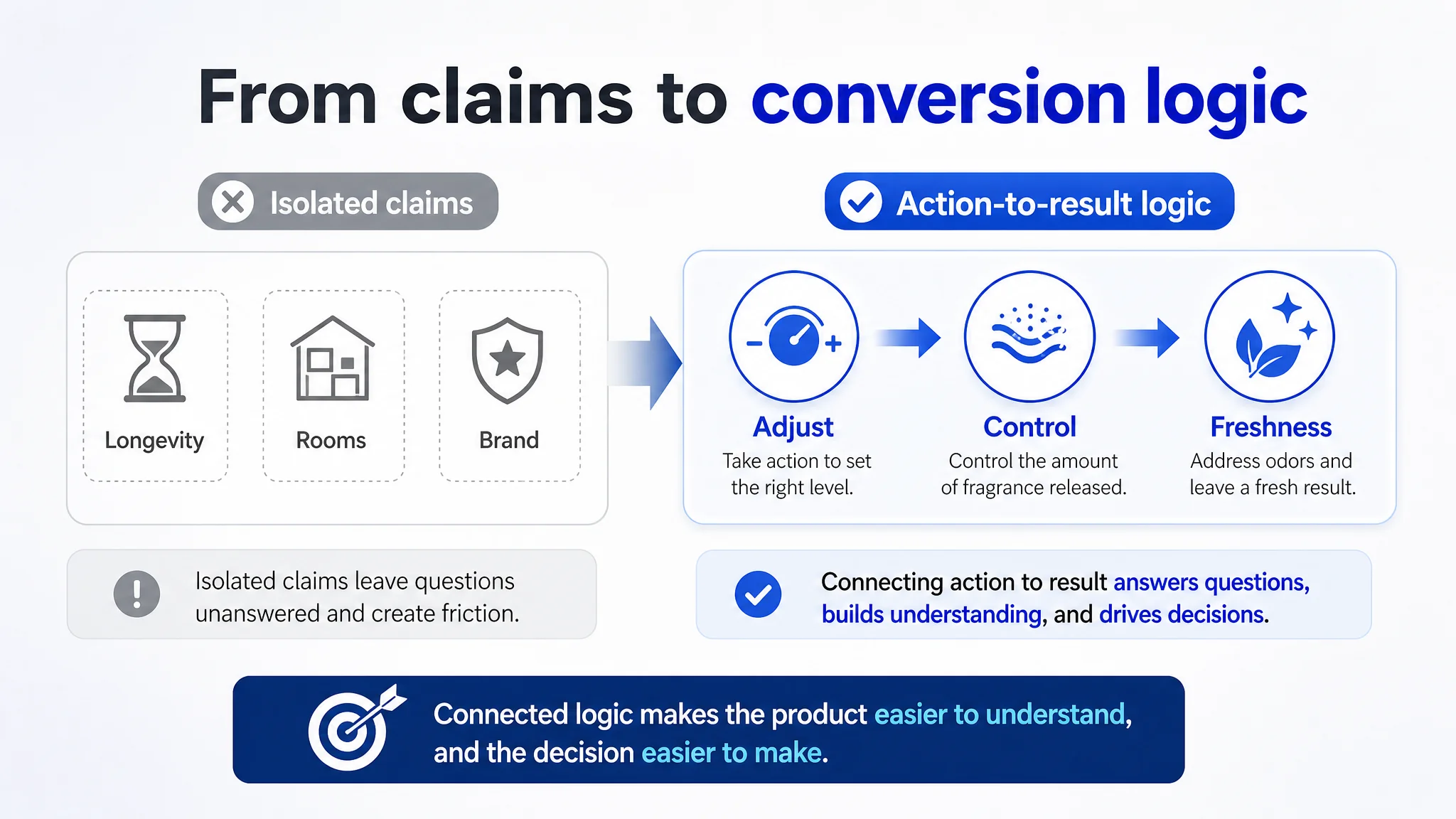
This distinction matters when evaluating advertising performance. If the page does not explain the offer clearly, ad data can make a content problem look like a targeting or bidding problem.
Once these questions are broken down, then we return to the ads themselves: which search terms are driving valid orders, which keywords are seeing rising spend but no conversions, which traffic deserves to be scaled further, and which traffic needs to be reduced. Advertising data is still important, but it becomes more useful after the Listing’s ability to receive and convert that traffic has been evaluated.
The right first question
So when ACOS is high, do not just ask “should I lower my bids?” You should first ask “why is the traffic the ads bring in not converting?” Because ads only bring buyers to the door. What truly determines whether an order is placed is the content buyers see after they enter the page—and the trust it builds.
The air freshener Listing showed how quickly this can become a structural problem. The main image was technically capable of identifying the item, but it did not explain why the item deserved a click or what shoppers could expect after purchase. The bullet points did not create a clear action-to-result story, and the A+ Content did not provide the visual reassurance needed to understand the product in a real setting.
The diagnosis therefore did not recommend treating advertising as the first and only lever. The page needed to become more capable of receiving traffic first: the title had to clarify the product category, the image sequence had to explain size and operation, the bullet points had to connect product features with outcomes, and the A+ Content had to focus on the specific product rather than repeat information or introduce unrelated formats.
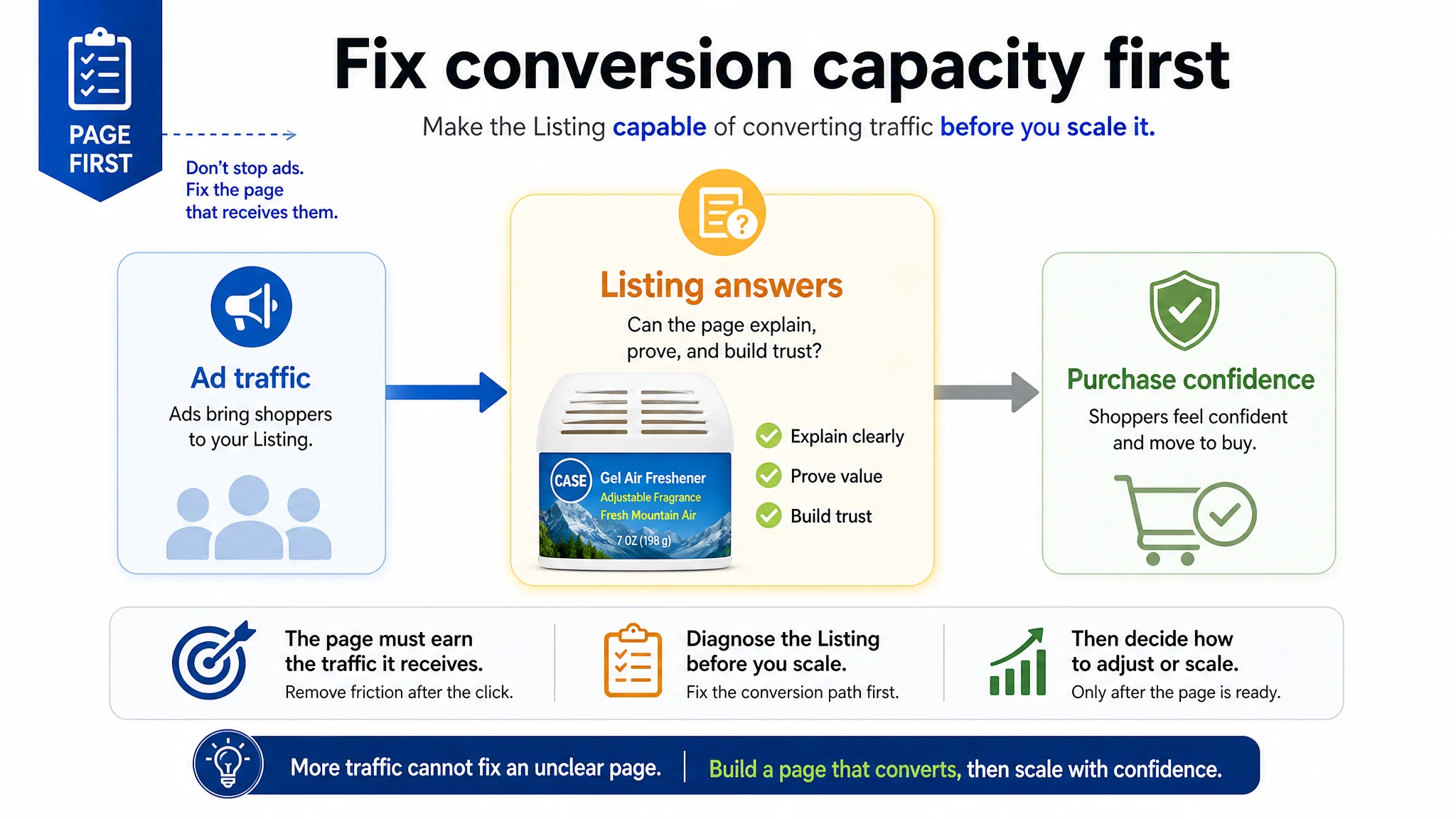
This does not mean advertising should simply be stopped. It means that traffic should not be used to amplify a Listing that has not yet established how the product works and why it fits the shopper’s need. More impressions cannot resolve an unclear product category. More clicks cannot compensate for an unexplained feature. More sessions cannot replace missing trust or product logic.
DeepBI's value lies in helping sellers analyze ads, Listing content, and traffic performance together, to pinpoint the factors that truly affect conversion—rather than assuming a high ACOS is purely an advertising problem.
The practical decision order is straightforward:
1. Diagnose whether the Listing can explain the product clearly.
2. Check whether the images, bullet points, A+ Content, and reviews support the buyer’s decision.
3. Identify where the conversion path breaks after the click.
4. Only then decide how aggressively to adjust or scale the traffic.
When the page can answer the shopper’s questions, demonstrate the use, support the claims, and build confidence, Amazon ads have a better chance to perform their intended role. Until then, advertising may only make the Listing’s existing weaknesses more visible.