

A lot of Amazon sellers face the same problem: the product price is low, margins are already thin, and every ad click costs another one or two dollars. Before you have generated more than a few orders, advertising has already eaten into the profit.
At that point, the first reaction is usually to lower the bids, cut the budget, and if that still doesn't work, turn the ads off. But the problem is, once the ads stop, the traffic often stops with them. Keep advertising, and the margins cannot support it; stop advertising, and the orders disappear. So what is the way out?
The answer is not simply to find cheaper clicks. For low-priced products, the advertising sequence has to begin with the product page itself. If the Listing cannot convert the traffic it already receives, increasing traffic will usually make the underlying problem more expensive.
Step 1: Ask whether the listing is actually worth scaling
When DeepBI handles this type of product, it does not start by pushing all bids down. It first looks at one thing: is this Listing actually worth scaling? Because low-priced products have limited margin to begin with.
If the title does not clearly communicate the selling points, the main image is not compelling, and the review profile is significantly weaker than competing products, then increasing ad spend will only magnify those weaknesses faster. So the first step is to compare your own Listing directly with competing products in the same category: title, bullet points, main images, detail page, and reviews. Where exactly is the gap? Are important keywords missing? Are the selling points unclear? Or do shoppers click into the page but still lack a strong enough reason to buy?
A Listing does not have to look obviously broken to be a poor candidate for scaling. One gnat-trap Listing analyzed by DeepBI looked reasonably complete: it had a full image set, A+ content, and a generally acceptable review profile. Its total Listing score was 70/100, so the page was not a disaster. Yet its orders were not growing in line with ad spend, and ACOS was becoming increasingly difficult to control.
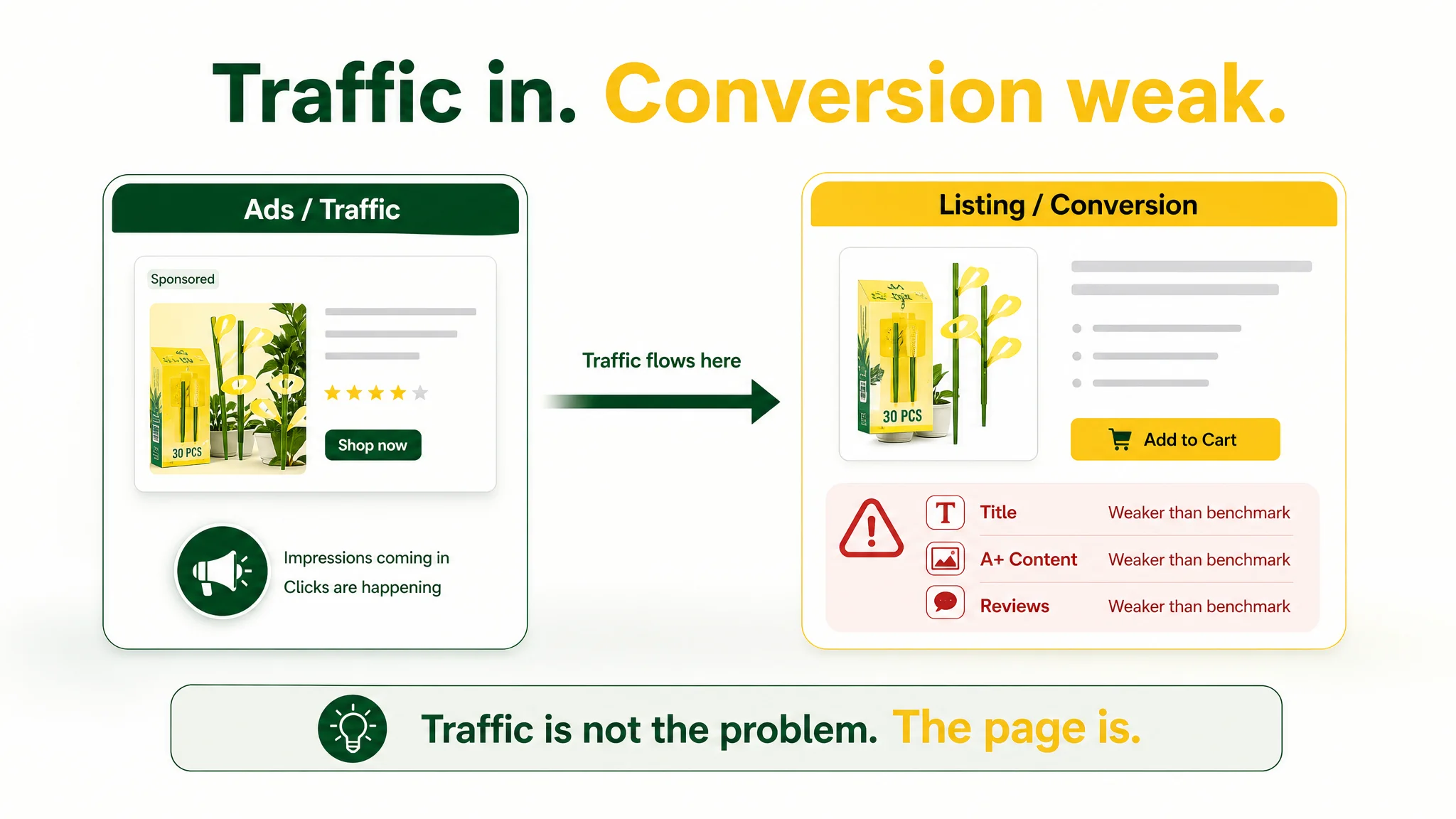
The seller initially believed the main problem was advertising. They suspected that the account needed more high-intent keywords, more aggressive bids, or a larger budget to catch up with a benchmark competitor that appeared to offer a similar product. But when the Listing was compared with a closely matched competitor in the same use case, the gap was concentrated in the modules responsible for conversion: the title was five points behind, the details and A+ content were four points behind, and reviews were three points behind. The competitor scored 77/100.
That comparison changed the question from “How can we buy more traffic?” to “Why is the current page not converting the traffic it already receives?” The page was not lacking information in a general sense. It was lacking enough decision logic and proof to turn visits into purchases.
Fix the most obvious weaknesses on the page first. Only then does the advertising strategy begin.
Check whether the Listing communicates value quickly
For low-priced products, shoppers often make a fast comparison between quantity, use case, perceived effectiveness, and trust. A title that contains many keywords can still fail if the information is difficult to scan or does not explain why the product is worth choosing.
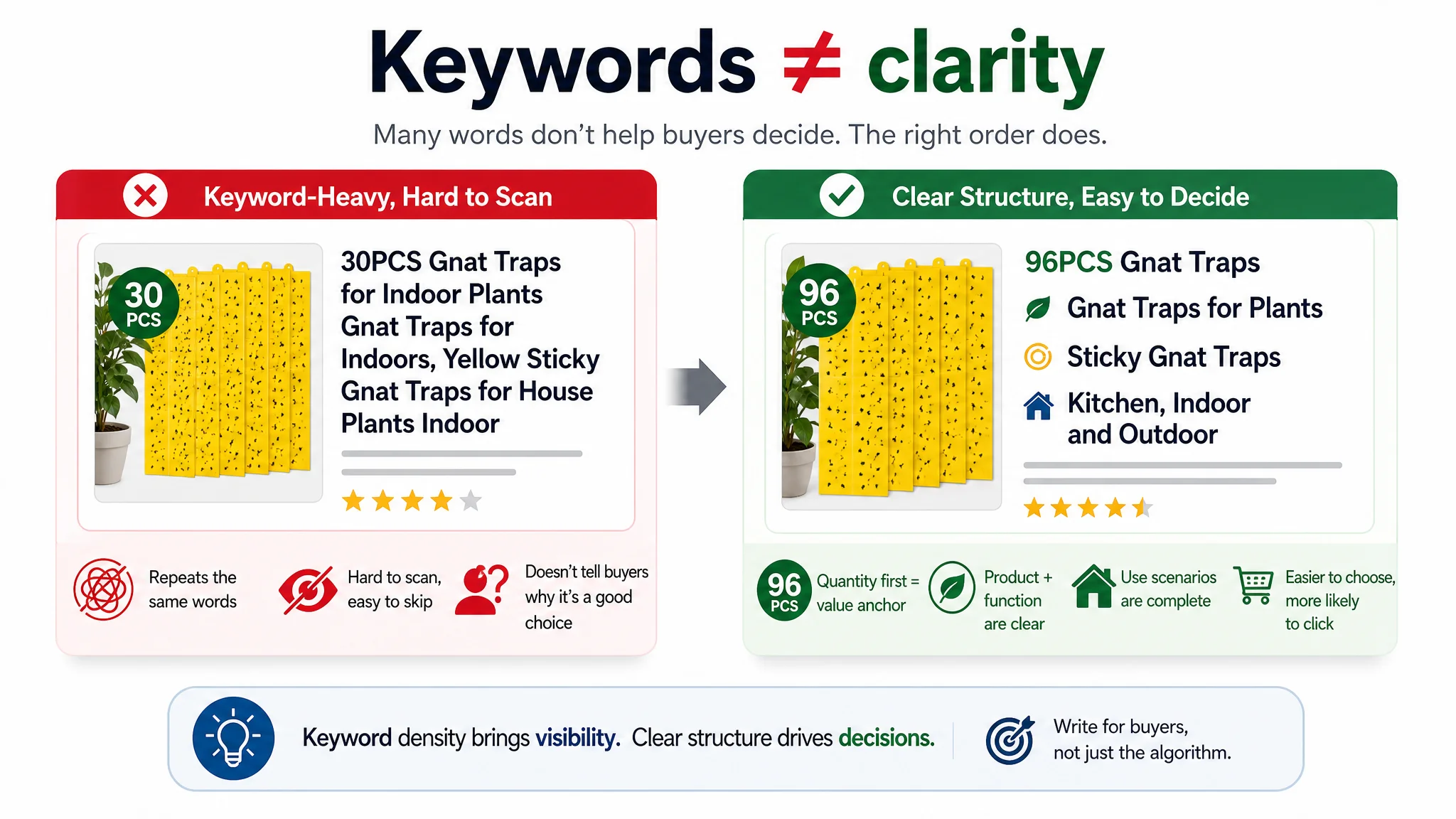
In the gnat-trap comparison, the benchmark competitor opened with “96PCS,” creating an immediate quantity and value anchor. The customer Listing opened with “30PCS” and repeated terms such as “Gnat Traps” and “Indoors/Indoor.” The title contained relevant words, but the sequence was loose and less decision-oriented. It also emphasized indoor use more narrowly, while the benchmark clearly communicated kitchen, indoor, and outdoor applications.
This is an important distinction for any low-priced product: keyword density is not the same as persuasive clarity. The title has to help shoppers understand what the product is, who it is for, what problem it addresses, and what makes the offer worth considering.
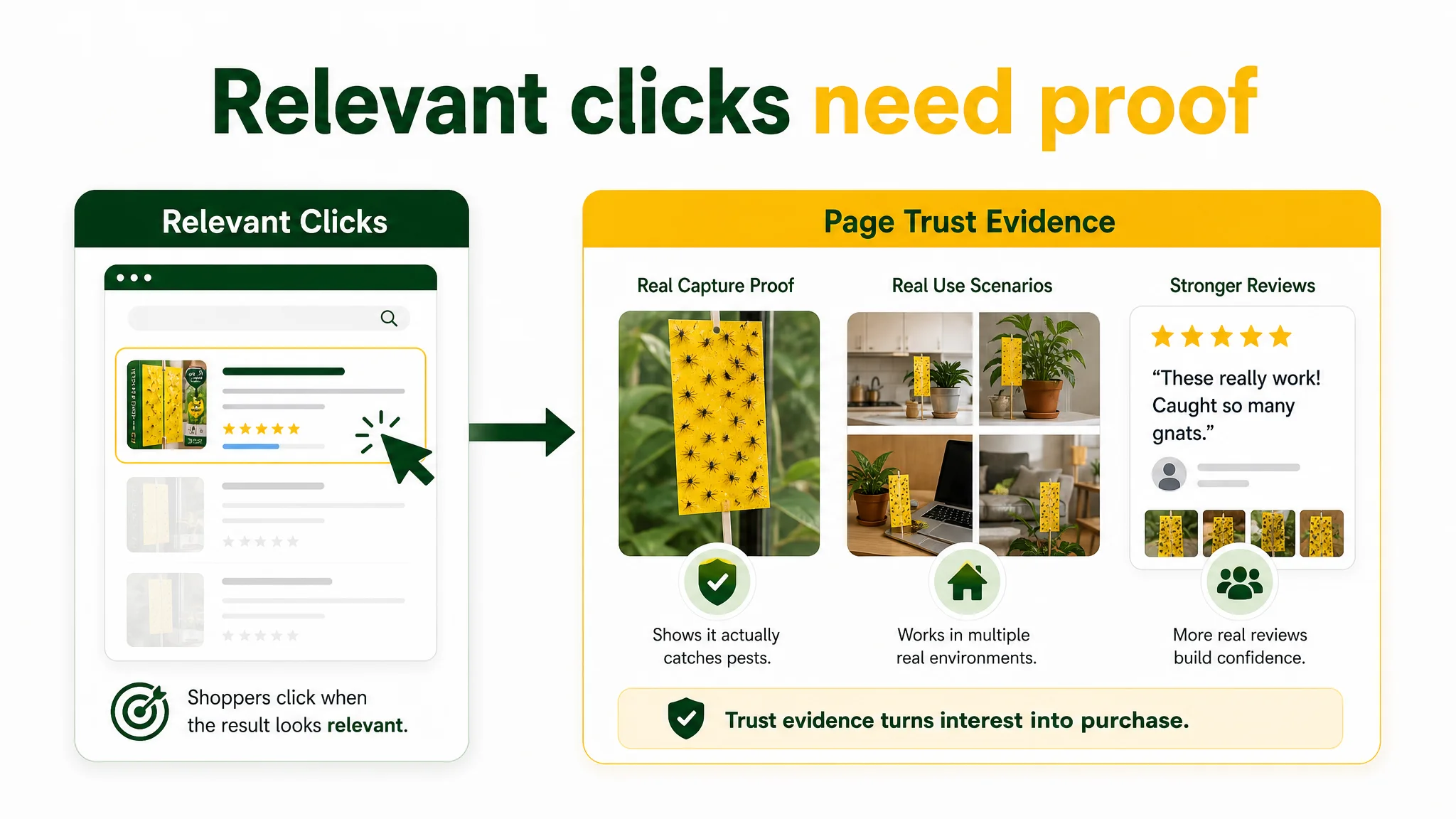
The same principle applies to visual content. The customer’s A+ page included scene images, feature icons, usage steps, and conceptual illustrations. However, the benchmark used more concrete evidence: actual insects caught on the traps, multiple room settings, product structure visuals, and a food-adjacent safety scene. Both pages contained information, but only one built a stronger visual argument for effectiveness and safety.
This is why Listing evaluation should happen before budget expansion. The objective is not to make every module look complete. It is to determine whether the page can perform the selling work that paid traffic requires.
Step 2: Avoid head-on competition on the most expensive words
DeepBI's advertising logic is not to concentrate the entire budget on a few broad, high-volume keywords. For low-priced products, one of the biggest risks is competing head-on with category leaders for the most expensive core keywords. Everyone is fighting for the same placements, bids keep rising, and you end up in a bind: bid too low and you get no traffic; bid too high and your profit disappears.
That is why DeepBI starts with an exploration layer. On one side, automatic campaigns are used to discover new search terms that can generate orders. On the other, competitor ASIN targeting is used to reach shoppers browsing competing product detail pages.
But when it comes to competitors, stronger is not always better. If a competing product has tens of thousands of reviews, a lower price, and a much stronger brand, winning the click does not necessarily mean you can win the order. DeepBI therefore keeps two types of competitors in the targeting pool:
- Top-ranking products in the category with stable traffic—these provide traffic opportunities.
- Products closer in price, rating, features, and use cases that you realistically have a chance of outperforming—these improve the probability of conversion.
The second group is especially important when the Listing itself is still building trust. In the gnat-trap example, the benchmark competitor had a significantly larger review base: approximately 5,460 reviews compared with approximately 746 for the customer Listing. Its rating was also higher, at 4.6 versus 4.3. Although the negative-review ratio on the front page was similar, the competitor had much more visual proof through image-rich reviews.
That does not mean a lower-review Listing cannot compete. It does mean that competitor targeting has to account for the full conversion environment. A click from a shopper who has just viewed a product with stronger reviews, clearer proof, and a more persuasive page may be difficult to convert, even if the advertised product is relevant.
This is why competitor targeting should not be treated as a simple traffic acquisition tactic. It is a test of whether your price, product presentation, trust signals, and use-case communication give shoppers a realistic reason to switch. When the competitive gap is too large, the resulting clicks may produce expensive data without creating a sustainable acquisition channel.
Step 3: Filter before scaling
Once traffic starts coming in, it is not immediately scaled across the board. The second layer is filtering: search terms and competitor ASINs that generate a lot of clicks but repeatedly fail to convert gradually receive lower bids and less exposure. Traffic sources that have generated orders and show stronger relevance are kept.
The third layer is to separate these higher-potential traffic sources and test them independently through exact-match keyword campaigns and precise ASIN targeting. Because getting one accidental order does not mean a traffic source deserves long-term investment.
Only traffic that continues to convert consistently after repeated testing moves into the fourth layer: scaling. At this point, budget is no longer distributed evenly across all campaigns; it is concentrated on a relatively small number of keywords and competitor ASINs that have already been validated by actual performance data. According to the product methodology, after several rounds of exploration and filtering, the traffic sources genuinely suitable for sustained scaling usually account for only a small portion of the total.
So for low-priced products, reducing wasted ad spend is not about lowering every bid at the same time. It is about gradually moving budget away from “uncertain traffic” and toward “traffic that has already proven it can convert.”
However, filtering traffic only works when the Listing is capable of converting a reasonable share of relevant visitors. This was the central issue in the gnat-trap case. The seller had impressions and clicks, but orders and CVR did not follow at the expected pace. The team kept looking for more precise keywords and better bid settings, while the page continued to underperform against the category benchmark.
DeepBI’s diagnosis showed that the page was consuming traffic more than converting it. The title did not present the value proposition tightly enough. The A+ content explained features but relied heavily on conceptual graphics rather than direct proof. The review layer did not provide the same scale of social evidence as the benchmark. As a result, an ad could deliver a relevant shopper to the page without giving that shopper enough confidence to complete the purchase.
This is where a common interpretation of “high-click, low-conversion traffic” can go wrong. Some traffic sources may indeed be irrelevant. But if multiple relevant sources show the same conversion weakness, the issue may not be the traffic source alone. It may be that the page has reached its current conversion ceiling.
Filtering should therefore ask two questions:
1. Is this traffic relevant enough to deserve another test?
2. Is the Listing strong enough to give that relevant traffic a fair chance to convert?
If the answer to the second question is no, continuously lowering bids can hide the symptom without repairing the constraint.
Step 4: Push organic growth to lower TACOS
Even then, the goal is only to make advertising more stable. What really determines profitability is the next layer: organic traffic. DeepBI takes the keywords that have already performed well and identifies the strongest ones based on clicks, conversion rates, and order value. Dedicated campaigns are then created around these high-performing keywords, and limited budget is concentrated on important placements near the top of Amazon search results.
The goal is not only to continue generating ad-attributed orders. It is also to improve the organic ranking of those keywords. As organic orders gradually increase, the store becomes less dependent on paid traffic. That is when TACOS has a real chance to decline. And for low-priced products, TACOS is an especially important metric, because a reasonable advertising ACOS does not necessarily mean the product is profitable. Profit margins only begin to improve meaningfully when the share of organic sales increases and total advertising spend represents a smaller percentage of overall revenue.
But organic growth cannot be separated from Listing quality. Paid traffic may help create sales velocity, but the page still has to convert that traffic effectively enough to support the next stage of growth. If the Listing remains weak, additional traffic may produce higher spend without creating a stronger organic base.
In the gnat-trap case, DeepBI therefore prioritized repairing the page’s sales logic before further ad tuning. The proposed changes were not limited to adding more keywords. The title was reorganized around the core product, house-plant use case, pest coverage, and included stake holders. The bullet points were structured around a clearer pain-point, solution, and result path. The main-image set was redesigned to communicate the 30-piece value pack, target pests, waterproof and sunlight-resistant features, dimensions, and overall product quality.
The A+ content was also shifted from conceptual explanation toward outcome-based proof. Instead of relying mainly on symbolic yellow boards and feature graphics, the revised direction emphasized real caught insects, multiple usage environments, food-adjacent safety, simple installation, and the adjustable green stake as a visible differentiator.
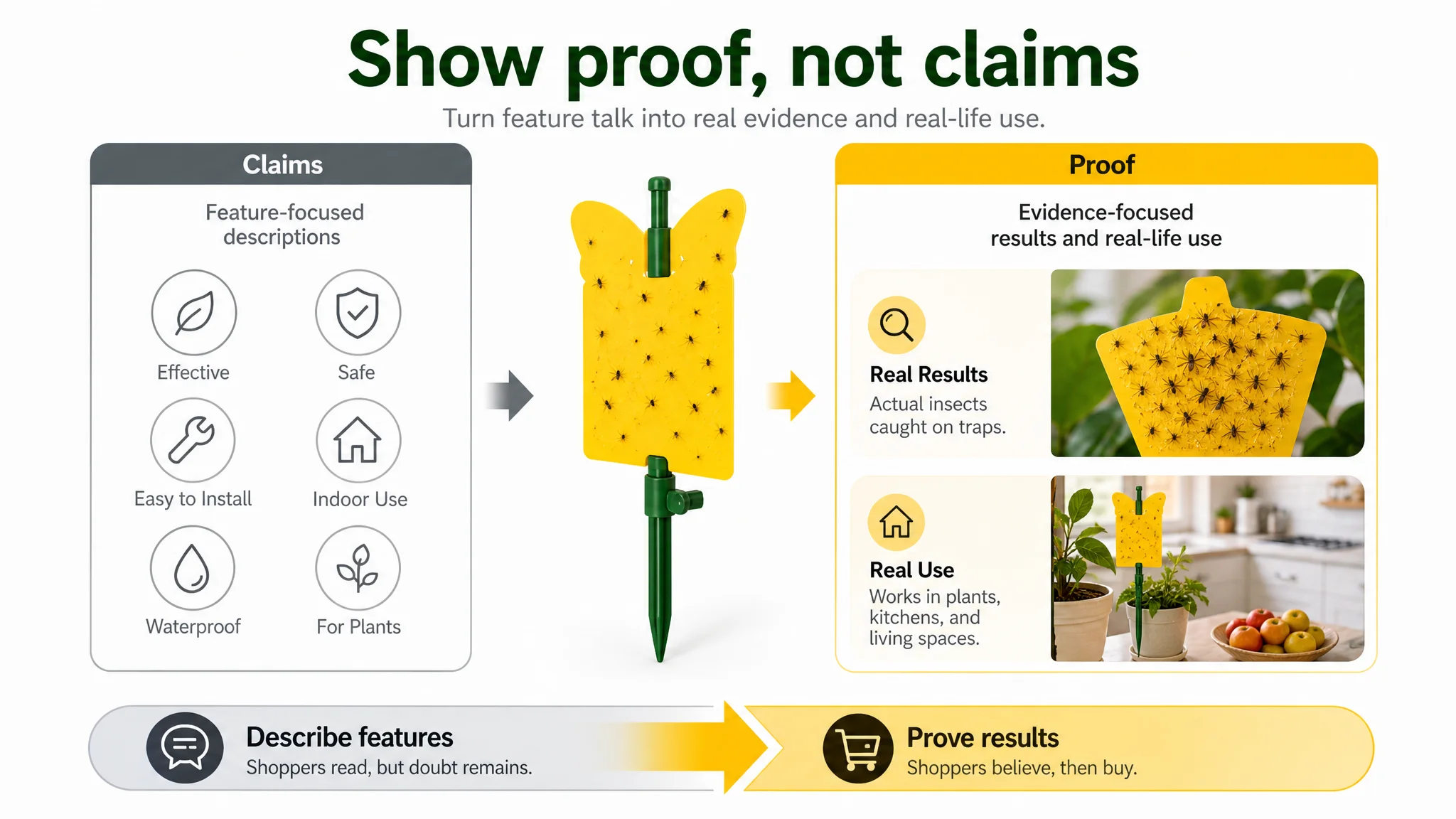
These changes matter to organic growth because they improve the page’s ability to convert the demand generated by search. A keyword may bring a shopper to the Listing, but the Listing determines whether that shopper sees enough value, proof, and relevance to buy. When the page becomes more effective at closing the decision, advertising and organic visibility have a stronger foundation to build on.
This is also why TACOS should be read as a business metric rather than an isolated advertising metric. If ad-attributed sales rise while the Listing remains dependent on paid traffic, profitability may not improve. A healthier sequence is to validate traffic, strengthen conversion, and then use the best-performing keywords to support a growing share of organic sales.
The Listing Has to Earn the Right to Receive More Traffic
The advertising sequence above can be summarized as:
1. Audit the Listing against a realistic benchmark.
2. Repair the weaknesses that limit conversion.
3. Explore a broad but controlled set of traffic sources.
4. Filter out traffic that repeatedly fails to convert.
5. Test promising keywords and competitor ASINs more precisely.
6. Scale only the sources that demonstrate consistent conversion.
7. Use the strongest validated keywords to support organic growth.
The gnat-trap example illustrates why the first step cannot be skipped. The seller’s Listing looked “good enough” on the surface, but a 70/100 score versus a benchmark score of 77/100 revealed a structural disadvantage. The problem was not concentrated in one obviously broken element. It appeared across title logic, A+ proof, and trust-building visuals—the exact areas that influence whether a shopper moves from interest to purchase.
That is why DeepBI framed the central question as whether the page had earned the right to receive more traffic. Before increasing bids or budgets, sellers need to know whether the Listing can communicate value quickly, answer the main objections, and provide sufficient evidence that the product works.
Advertising does not only amplify strengths. It can also amplify weaknesses. A page with unclear positioning, weak proof, or insufficient trust may turn every additional click into another opportunity to expose the same conversion gap.
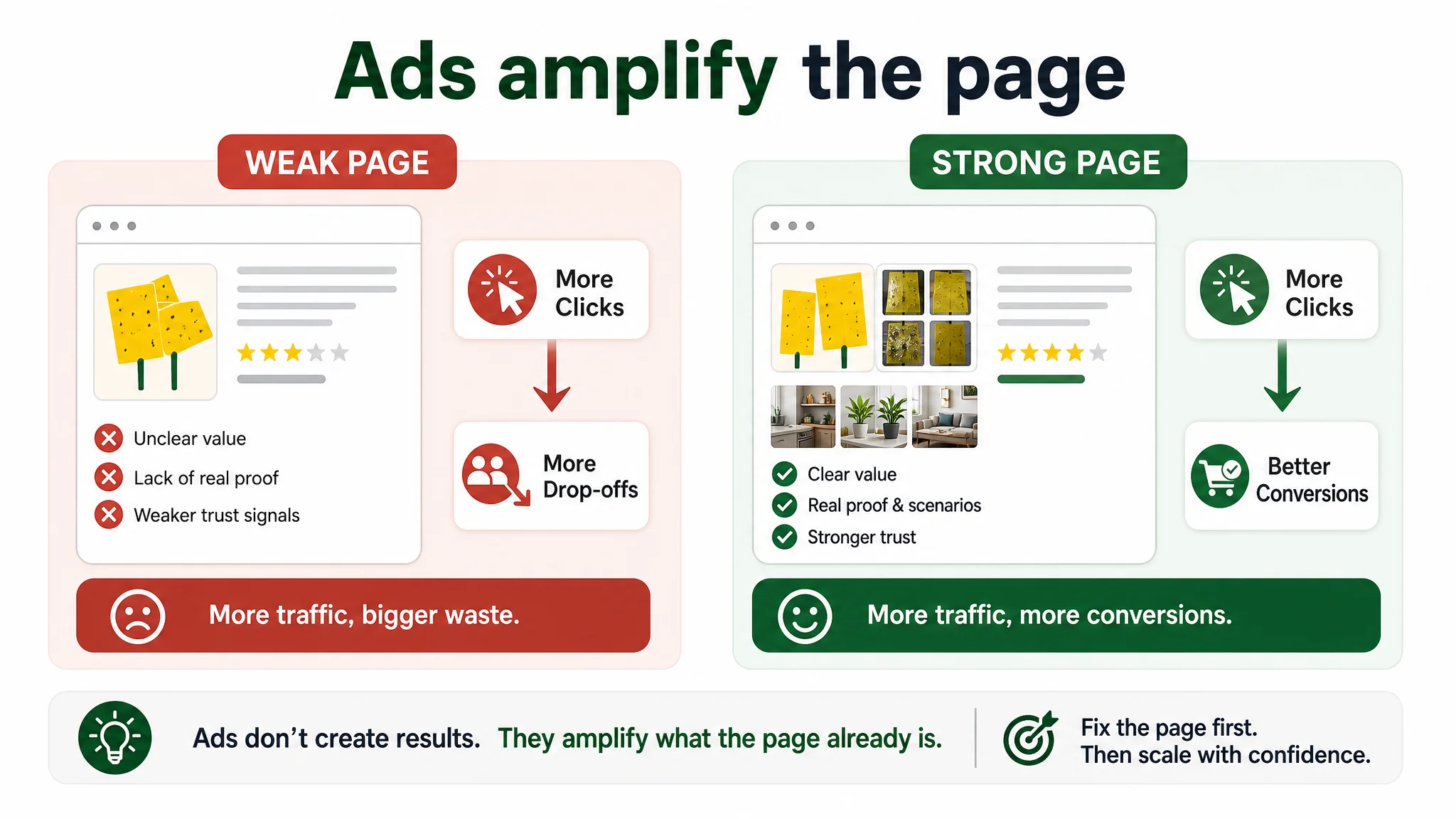
A word of caution
Of course, not every low-priced product can be rescued through advertising. If the price is not competitive, the page is not persuasive, and the product itself is significantly weaker than competing alternatives, scaling the ads will only continue to generate losses.
A Listing can also be technically complete and still be commercially underpowered. The gnat-trap page had images, A+ content, and reasonable reviews, but its visual language mainly described the product rather than proving the outcome. The benchmark page showed actual insects caught, multiple real-life scenarios, and stronger social proof. That difference helps explain why two pages that appear similar at a glance can have very different conversion capacity.
So for low-price, high-CPC products, the right sequence is not simply to turn advertising off. It is to make sure the Listing can actually convert the traffic it receives, identify the keywords and competitor ASINs you realistically have a chance of winning against, use exploration, filtering, and precise testing to isolate the traffic that can convert consistently, and scale only that portion. Finally, use the strongest keywords you have discovered to push organic traffic growth.
For low-margin products, the biggest danger is not that advertising is expensive. It is spending every dollar without knowing exactly why you are spending it.
Before adjusting another bid, ask:
- Is the traffic relevant?
- Is the title communicating the right value?
- Does the main image create a reason to click?
- Do the bullets follow a clear buying logic?
- Does the A+ content provide proof rather than only claims?
- Are the reviews strong enough for the category?
- Can the page answer the shopper’s doubts before the next click becomes a lost order?
If the answers are not clear, the next optimization may not belong in the advertising console. It may belong on the Listing.