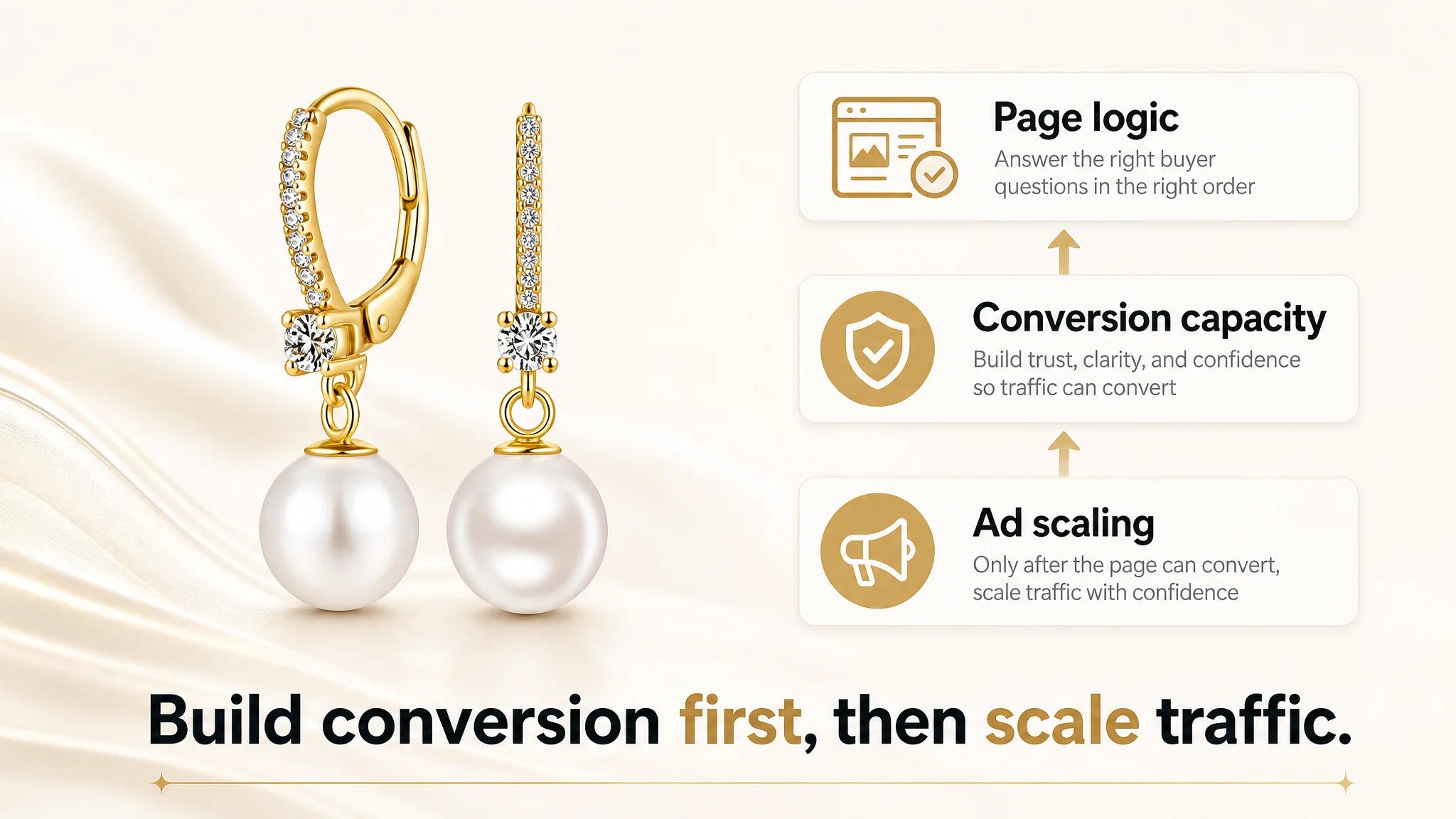
Should Amazon advertising strategies really vary by category? Many sellers will tell you: apparel has its own strategy, jewelry has its own strategy, and gifts require an entirely different approach. But that statement is only half-true.
Different categories certainly influence keyword selection, competitor choices, and campaign structures. But those are closer to tactical execution. What truly determines how a listing should be managed isn't its category, but four core conditions.
Four conditions that actually drive your strategy
Before choosing any campaign structure, answer these four questions about the listing itself:
- What are the profit margins?
- How is the conversion rate?
- Is inventory sufficient?
- Do you currently prioritize profitability or growth?
Take dresses as an example. One listing has stable conversions and ample inventory, making it ready to scale traffic. Another listing gets plenty of clicks but zero orders. Continuing to pump budget into the second one will only amplify the problem. So ad strategies cannot be set in stone right from the start.
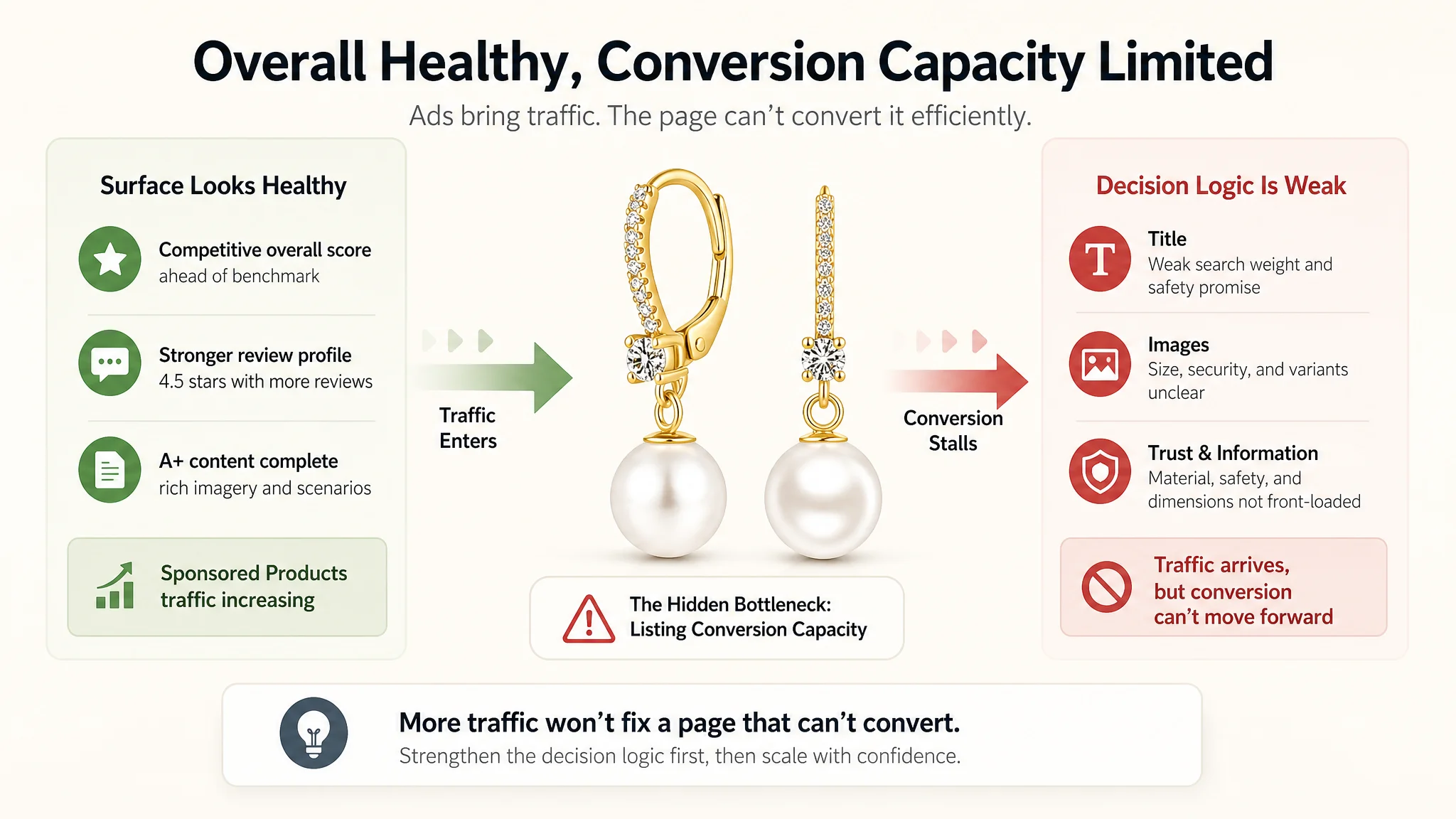
The same issue appears even when a listing looks healthy by conventional standards. A pearl drop earrings listing on Amazon US had a competitive score of 76/100, slightly ahead of a benchmark competitor at 74/100. It also had a stronger review profile—4.5 stars with 368 reviews compared with the competitor’s 4.0 stars and 106 reviews—and complete A+ content. Yet as Sponsored Products traffic increased, conversion did not improve in step, and ACOS remained difficult to reduce.
The seller initially assumed that the problem was either ad refinement or a lack of reviews. The team continued adding campaigns, adjusting match types, testing keyword branches, and considering more traffic. A deeper diagnosis found that the listing already had enough visitors; the constraint was its ability to convert them. That distinction matters because profit margin, conversion capacity, inventory, and business priorities must be evaluated together before deciding whether more traffic is actually desirable.
Diagnose the page before touching traffic
You must first answer two questions: Is the traffic precise? And can the listing convert that traffic? Poor ad performance often isn't the result of bad keywords. It's because once shoppers click onto the page, they still can't grasp the style features, size differences, or use cases.
DeepBI benchmarks the seller's listing against top competitors, auditing the title, main images, bullet points, A+ content, and reviews. It first diagnoses whether the bottleneck lies on the page or in the traffic. Once the listing has basic market competitiveness, ad testing begins.
The jewelry listing above illustrates why an overall score is not enough. Although the seller ranked slightly higher overall, its title score was 9 compared with the competitor’s 14. Its main image set scored better, at 25 versus 22, while bullets, A+ content, and reviews were roughly comparable or stronger. On the surface, this looked like a visually polished page with solid trust signals. But the visible strengths were not aligned with the buyer’s actual decision path.
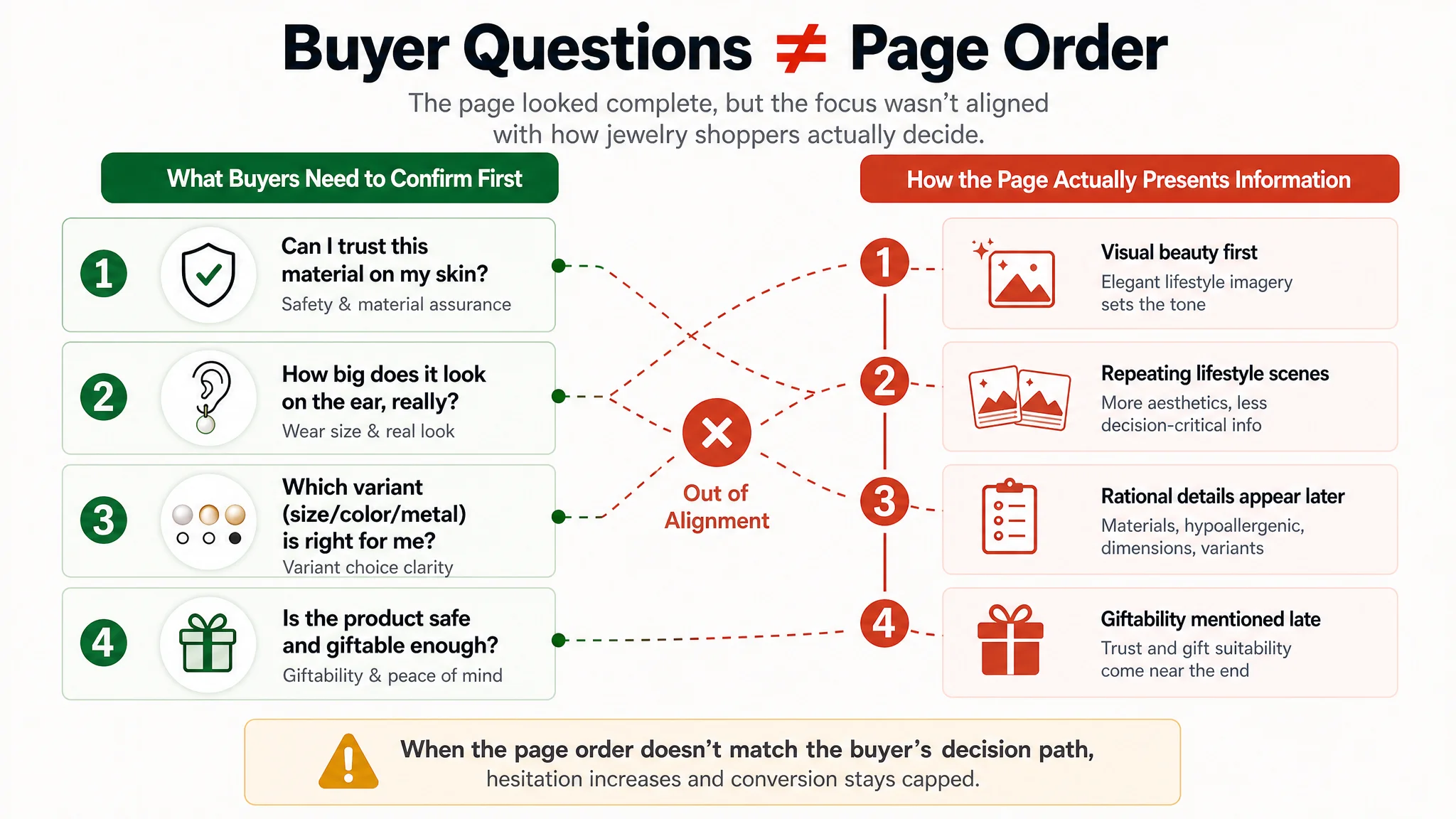
Jewelry shoppers still needed quick answers to questions such as:
1. Can I trust this material on my skin?
2. How large will the earrings look when worn?
3. Which size, color, or metal variant is right for me?
4. Is the product safe and giftable enough?
The seller’s title placed repeated material terms ahead of the core keyword and did not make “hypoallergenic” or size information sufficiently visible. The main image sequence showed elegant lifestyle scenes, but did not clearly communicate the secure lever-back design, exact dimensions, or available variants. A+ content created a premium emotional impression, yet material and safety information appeared later in the scroll.
This is why page diagnosis must precede traffic expansion. The problem was not that the listing lacked content. It was that the content did not answer the right questions in the right order.
For products with clear functional attributes, traffic can be targeted around core product terms, feature terms, and scenario terms. For more fragmented categories like apparel or jewelry, beyond keywords, you need to target competitor ASINs with closer styles, price points, and target audiences. But those tactics work best only after the listing can explain its value clearly once shoppers arrive.
Traffic discovery: from exploration to scaling
Stronger competitors aren't always better. Category leaders provide traffic benchmarks, but the ones worth heavily testing against are usually competitors your product actually stands a chance against. In the past, this meant manually researching keywords, auditing competitors, building campaigns, and adjusting bids. Within DeepBI, these processes are continuously automated through a data-driven system:
- Traffic enters the discovery phase, then gets filtered based on clicks, conversions, and ad spend.
- High-potential keywords and competitor ASINs move into validation.
- Consistently underperforming targets are gradually throttled.
- Stable-converting traffic is awarded higher budgets.
- Core terms are distilled from high-quality traffic sources to drive organic ranking.
Simply put: find traffic, filter traffic, scale traffic. Only after these performance data points are established do you truly enter the strategy selection phase.
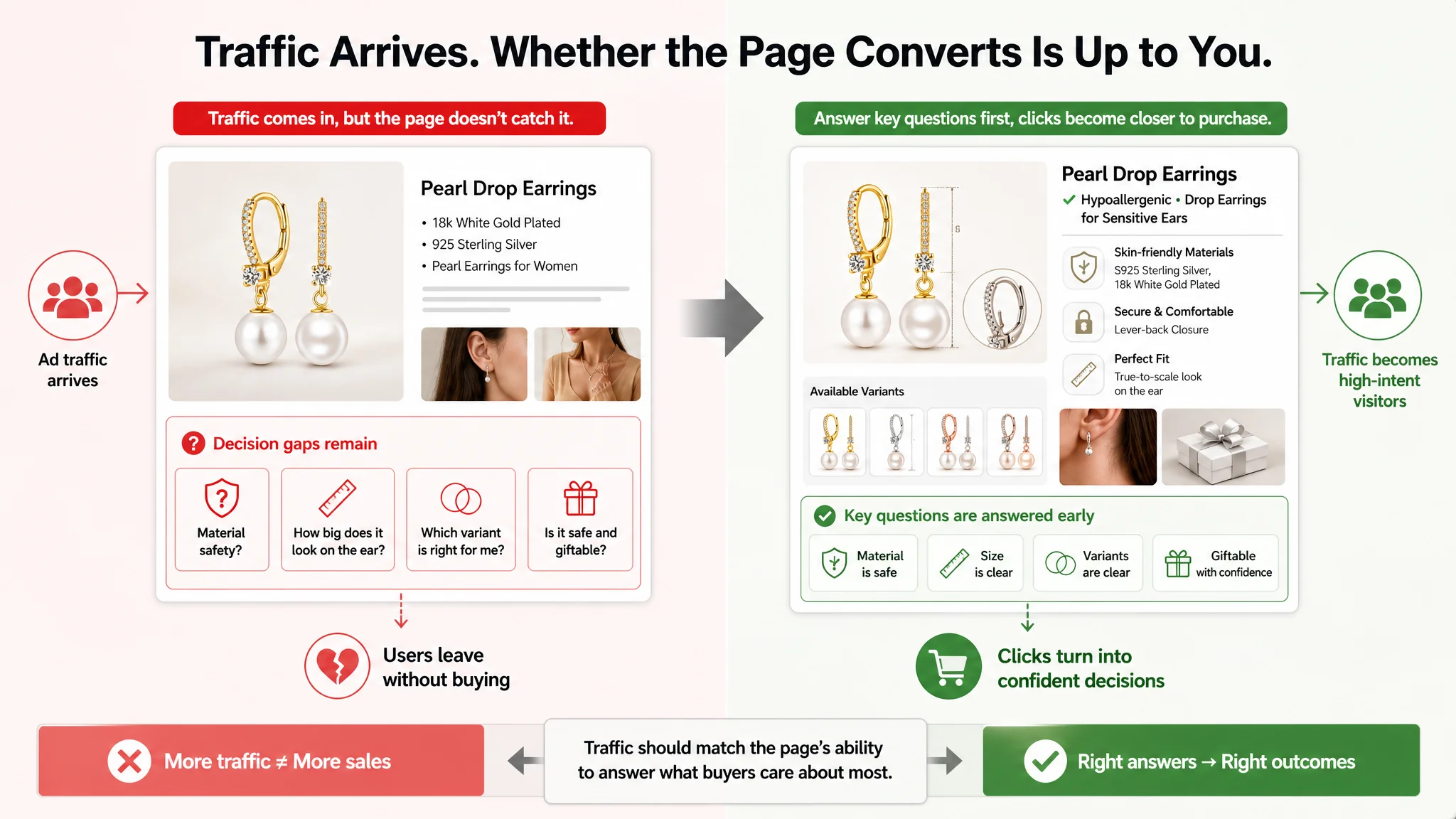
However, traffic discovery should not be confused with sending more visitors to the page regardless of its condition. In the pearl earrings example, the seller had sufficient ad traffic, but the page was not converting that traffic efficiently. The team’s first instinct was to keep refining keywords and bids, while the actual diagnostic work showed that visitors were still uncertain about size, safety, security, and variants.
The distinction between traffic quality and page capacity is critical. A listing can receive relevant clicks and still fail to convert because the title sets incomplete expectations, the image sequence repeats attractive scenes instead of answering practical questions, or the A+ content asks shoppers to process emotional storytelling before providing basic trust information. In that situation, more traffic produces more data, but not necessarily more profitable learning.
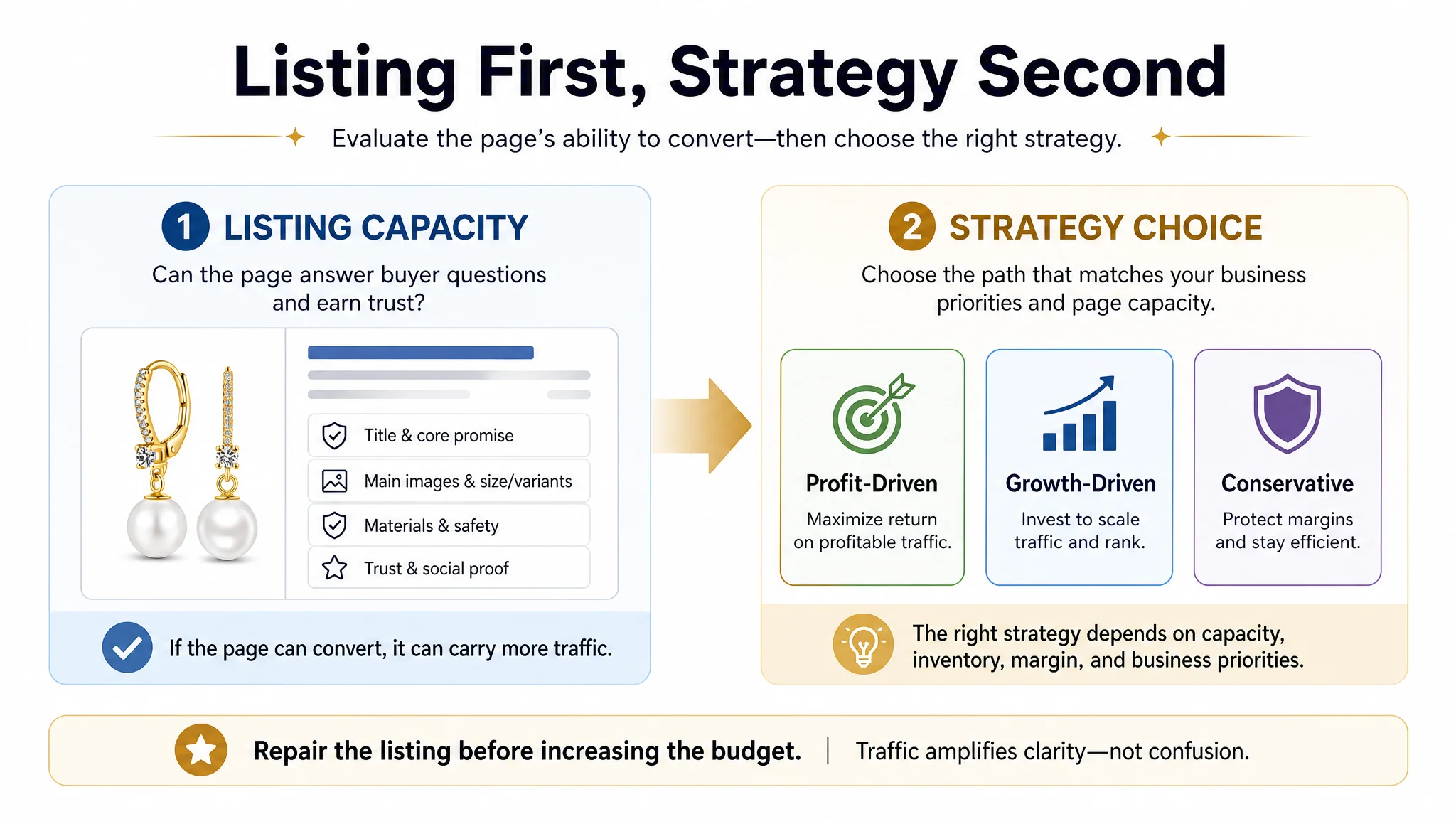
Traffic should therefore be filtered not only by the performance of the advertising target, but also by what happens after the click. If a target consistently brings relevant shoppers but the page cannot address their decision barriers, the right response may be to repair the listing before increasing the budget. This keeps traffic discovery connected to actual conversion capacity.
Three strategy profiles based on real data
1. Profit-driven strategy. For instance, if your net profit per order is $8, with an average of 10 clicks per order at $0.40 per click, the ad cost per order is roughly $4. When the modeled profit margin is sufficient to cover ad spend, effective traffic may support additional orders while maintaining a healthy bottom line.
This strategy depends on more than the nominal margin. If the page leaves important buying questions unanswered, the effective cost per order can rise even when the traffic is relevant. In the jewelry listing, the product had stronger reviews and appealing visuals, but unclear size communication, delayed safety proof, and redundant lifestyle images created additional friction. Before treating ad spend as a margin problem, sellers should check whether the listing is wasting paid clicks through avoidable uncertainty.
2. Growth-driven strategy. Ideal for products with proven conversion rates, ample inventory, and remaining market share. Budget is concentrated onto top-performing traffic sources. The goal isn't just incremental ad orders, but pushing core terms up the organic search ranks.
Proven conversion is the key condition here. A listing should demonstrate that it can turn additional traffic into orders before budget is concentrated aggressively. In the pearl earrings case, the seller had already invested in advertising, but conversion remained flatter than expected. Scaling first would have increased the number of shoppers entering the same decision gaps. The more appropriate sequence was to clarify the title, restructure the image set, and move material and safety proof earlier in the A+ content before asking ads to support further growth.
3. Conservative strategy. For low-margin, mediocre-conversion products that lack the capacity for mass scaling. Here, inefficient traffic should be cut back, retaining only low-cost, highly relevant opportunities. If validation fails long-term, re-evaluate the listing and product competitiveness rather than letting ads bleed budget indefinitely.
Conservative does not mean stopping all advertising. It means refusing to use budget to hide a structural problem. In the jewelry example, the team could have concluded that the category was saturated or that the product simply needed more reviews. The diagnosis pointed elsewhere: the listing’s title and content structure were not aligned with the buyer’s decision process. When conversion is capped by page logic, cutting inefficient traffic while repairing the page is more rational than endlessly expanding campaigns.
The takeaway
Ad optimization and ad strategy are two different things. Ad optimization is about finding and filtering the right traffic. Ad strategy is deciding—based on real performance data—whether a listing should run on a profit, growth, or conservative footing.
The pearl earrings listing shows why this distinction matters. The seller initially viewed the problem as an advertising refinement issue because traffic was increasing while ACOS remained stubborn and conversion showed no clear breakthrough. Yet the page itself had unresolved gaps: the title did not prioritize the strongest buyer-facing promise, the image sequence did not clearly communicate security, size, and variants, and A+ content placed rational trust behind emotional storytelling.
Once the page logic was examined, the recommended changes were not simply “add more content.” They included consolidating repetitive title wording, bringing “hypoallergenic” into the core promise, turning redundant lifestyle images into dedicated size and variant visuals, and presenting materials, safety claims, dimensions, and giftability earlier. The purpose was to ensure that each part of the listing answered a distinct decision question.
That is also why a strong review profile or a high overall listing score should not automatically justify more traffic. A page can appear complete while still quietly limiting conversion. Advertising amplifies what is already present: it can amplify a competitive advantage, but it can also amplify unclear messaging and unresolved buyer hesitation.
All the seller needs to provide to DeepBI are targets and boundaries: margin priority or growth priority, how much runway is left in inventory, and what the acceptable ad cost is. The rest—traffic discovery, competitor ASIN filtering, and bid/budget adjustments—is continuously executed by the system. But those decisions should be made alongside a clear assessment of whether the listing can carry the traffic it receives.
Amazon advertising techniques can be adjusted by category. But your true strategy should always be dictated by product data and business goals—and by the listing’s actual capacity to convert the traffic those decisions generate.