


The core of the Amazon semi-lean catalog model isn't turning every single product into a blockbuster. It's finding each product's unique profit equilibrium.
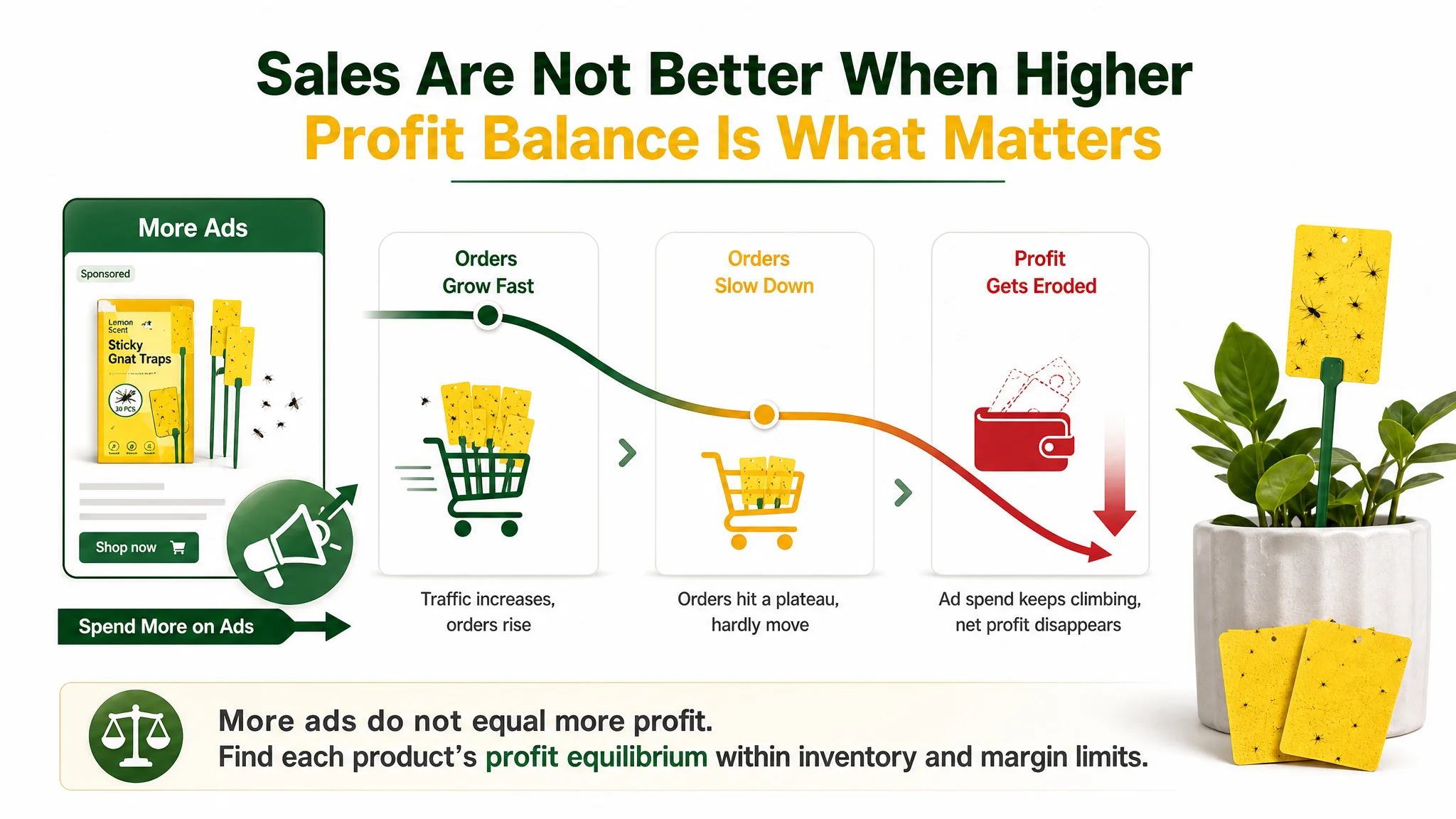
Take a $20 bath pillow as an example. When ad spend accounts for 10% of sales, it might generate 100 orders a month. Push that to 20%, and orders might reach 150. Push it further to 30%, and orders might barely budge—while your net profit gets completely devoured by ad spend.
This model doesn't chase maximum sales volume at all costs. Instead, it aims to capture as many orders as possible strictly within the bounds of sustainable inventory and healthy profit margins. No blind rank-chasing, and no endlessly pouring money into ads just to squeeze out a few extra units.
Inventory planning matters more than scaling
With a diverse catalog, you cannot afford to overstock every new launch. The safer route is benchmarking against competitors at a similar lifecycle stage. Using the bath pillow example again: prioritize listings with similar designs, price points, and features that carry moderate review counts and modest ad spend.
A top-tier listing with tens of thousands of reviews—no matter its sales velocity—offers little benchmark value for a new release. If it's currently January and your product won't go live until March, analyze how comparable established listings performed between January and March in prior years, and factor in seasonal swings before finalizing purchase orders. Overstock, and capital gets tied up in dead inventory; understock, and the listing risks stocking out just as it gains momentum.
The same benchmarking discipline applies after launch, not only before placing a purchase order. A competitor should be comparable in lifecycle, price, features, use case, and conversion conditions. Otherwise, its sales volume can create an unrealistic target and encourage a seller to buy more inventory or spend more on ads than the product can rationally support.
A page that sells more units is not automatically the right benchmark. The more useful question is whether the product has a comparable ability to convert traffic profitably. Without that distinction, inventory planning and advertising decisions can both become distorted by an inflated view of the product's potential.
Listing readiness comes before traffic
Once the product goes live, the advertising phase begins. Tedious tasks once done manually—keyword research, competitor auditing, campaign setup, and bid adjustments—are now fully automated by DeepBI. However, DeepBI never blindly scales traffic out of the gate. The first step is always checking whether the listing can convert the incoming traffic.
If a title only mentions "comfort" and "relaxation" without specifying non-slip suction cups, dimensions, or tub compatibility, or if the main image looks decent but fails to show how the pillow stays in place, then no matter how precise your keywords are, incoming clicks won't convert into orders.
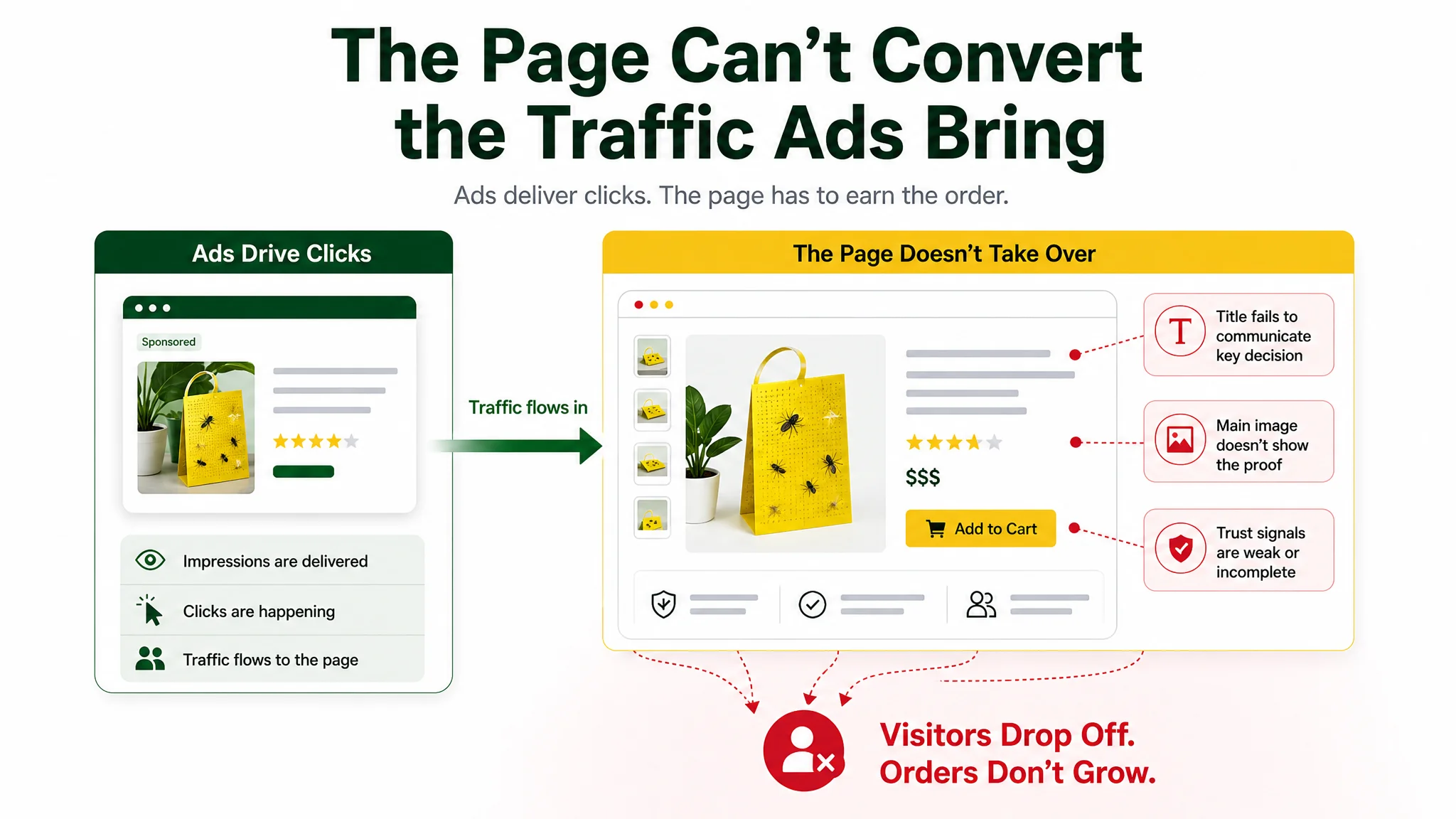
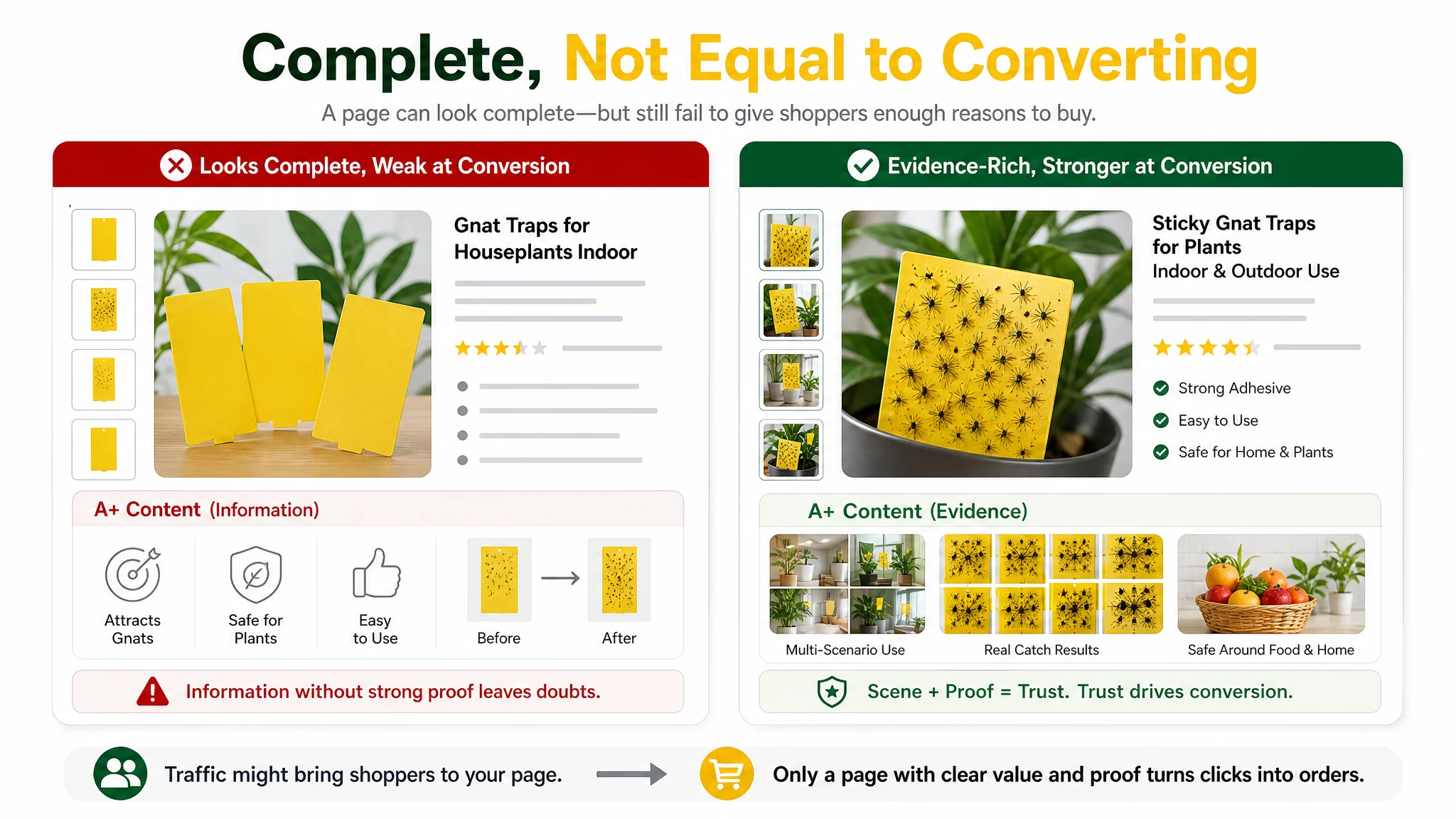
This distinction became clear with a US marketplace seller of yellow sticky gnat traps for houseplants and home use. The listing did not look broken: it had a complete image set, A+ content, reasonable reviews, and a DeepBI Listing score of 70/100. Yet ad traffic was arriving while orders failed to grow in line with spend, and ACOS was becoming increasingly difficult to control.
The team initially treated the problem as an advertising issue. They suspected that keywords and bids needed to be pushed harder, or that additional traffic was needed to catch up with a benchmark competitor. But when DeepBI compared the listing with a closely matched competitor in the same gnat-trap subcategory, the competitor scored 77/100. The gap was concentrated in the modules most directly tied to conversion: title, details/A+, and reviews.
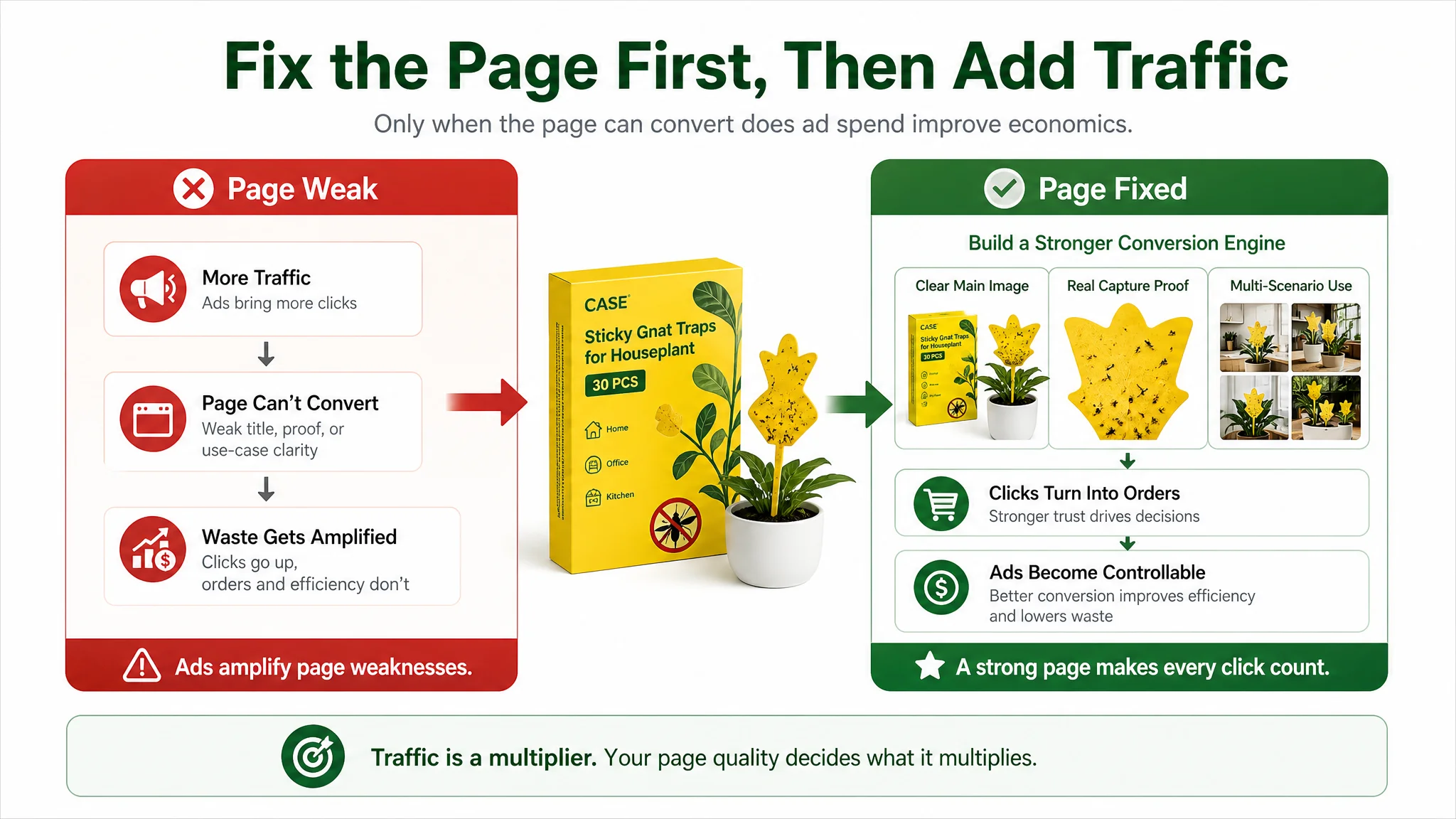
The listing was not receiving no traffic. It was consuming traffic without giving visitors enough reasons to trust the product and complete the decision. That is why listing readiness has to precede aggressive traffic acquisition: advertising can bring shoppers to the page, but it cannot make an unclear title, weak proof, or incomplete decision logic disappear.
DeepBI benchmarks the seller's listing against direct peers across five dimensions: title, main image, bullet points, product description/A+, and reviews. It flags the critical bottlenecks dragging down conversion and provides actionable copy and visual optimization directions.
Precision over volume through a filtering funnel
Once listing readiness is established, DeepBI begins acquiring traffic. Because inventory is tight in this catalog model, precision matters far more than volume early on. The system uses Auto campaigns and competitor ASIN targeting to map the landscape. Targeted competitors aren't limited to category leaders; the system targets listings with closer price points, review parity, feature parity, and matching use cases—where the product actually has a competitive edge.
The gnat-trap listing illustrates why this filtering step matters. The seller was comparing itself with a competitor that appeared similar but had stronger sales. The initial response was to buy more traffic and search for additional high-intent keywords. However, the benchmark analysis showed that the competitor's advantage was not simply traffic volume. Its page had a stronger internal trust engine, including clearer value communication, more visual evidence, and more developed use-case coverage.
This means competitor targeting cannot be separated from listing diagnosis. If the benchmark listing is stronger in the exact elements that close the sale, sending more traffic toward the weaker page may only make the performance gap more expensive. A comparable ASIN is useful not just as an advertising target, but as evidence of what the category expects a converting page to communicate.
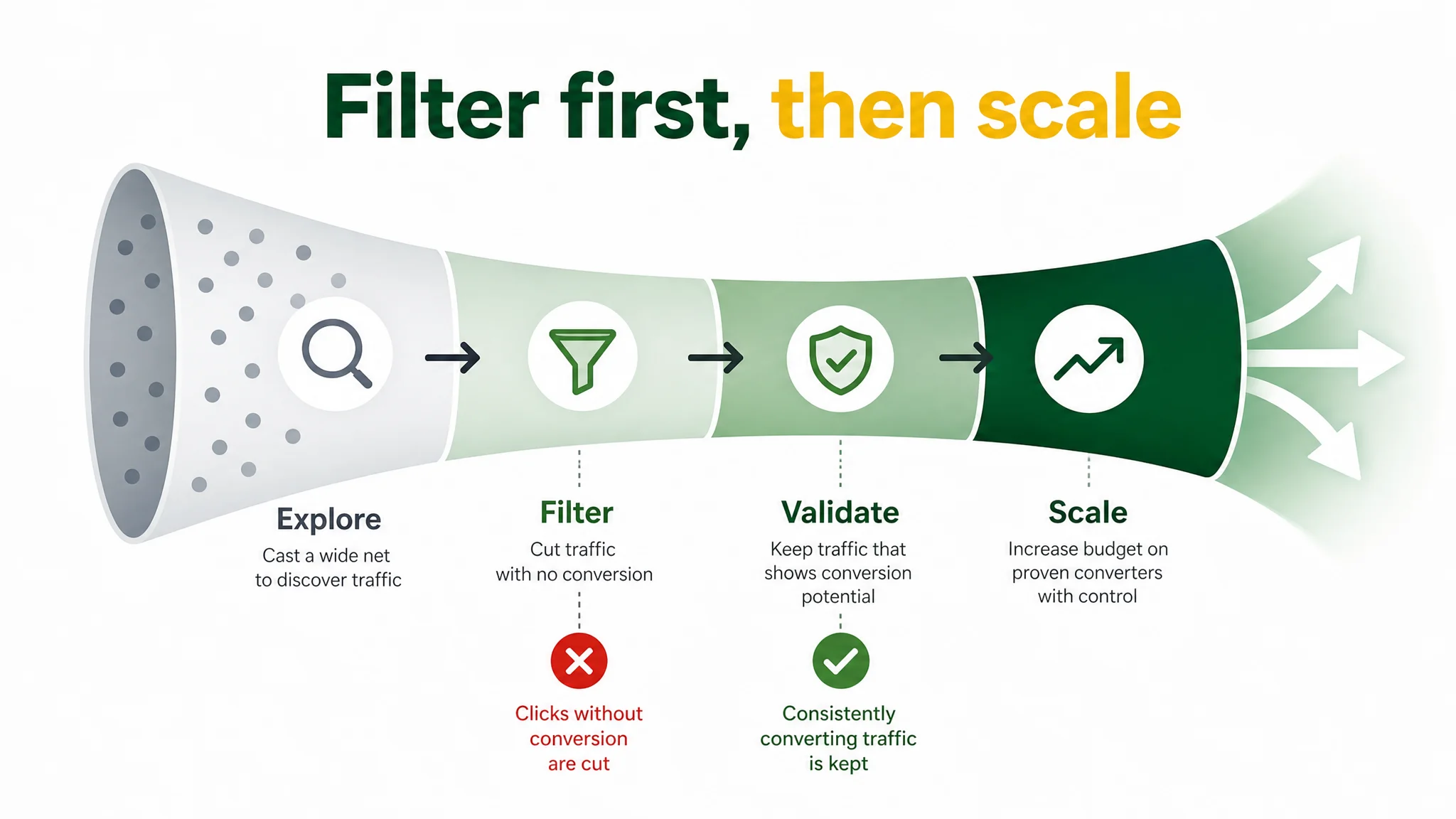
As traffic enters, DeepBI runs continuous multi-stage filtering:
- High clicks with zero conversions: bids and budgets on these keywords and target ASINs are progressively cut.
- Proven converters with test value: funneled into exact-match validation.
- Consistently converting traffic: awarded scaled ad budgets.
- Top performers: promoted into core driver keywords to boost both paid sales and organic rank.
The funnel sequence is clear: explore → filter → validate → scale and drive organic rank. Not every keyword warrants long-term spend. In practice, after passing through these filtering stages, only a small fraction of search terms qualify for ongoing scale.
But a zero-conversion signal should not always be interpreted as a pure traffic-quality problem. If several relevant targets generate clicks without orders, the listing itself may be limiting the result. In the gnat-trap example, the customer page had traffic but weaker title logic, less persuasive A+ proof, and fewer visual trust signals than the benchmark. Before cutting every target or expanding into more keywords, sellers need to determine whether the traffic is unqualified—or whether the page is failing to convert qualified interest.
The filtering funnel therefore works best as a feedback loop. It identifies weak traffic, but it can also reveal a conversion bottleneck that needs to be repaired before additional traffic is scaled.
Dynamic pacing tied to margins and inventory
As orders roll in, the system dynamically calibrates pacing based on target margins, live inventory, and replenishment lead times:
- Ample inventory and steady conversion: continue expanding discovery.
- Approaching stockout: scale back ad delivery proportionally.
- Chronic ad spend without orders: avoid endless price drops; re-evaluate whether the bottleneck lies in ads, the listing, or the product itself.
The third situation is where many sellers lose control. When ad spend continues without enough orders, the instinct is often to lower price, broaden targeting, or increase budgets in the hope that more volume will eventually solve the problem. But if the product page lacks the information or proof needed to close the decision, these actions can simply increase the cost of the same unresolved weakness.
That was the pattern behind the gnat-trap seller's rising ACOS. The team had been considering more keyword and bid adjustments because advertising appeared to be underperforming. DeepBI's diagnosis instead found that the page's conversion capacity was below the matched benchmark. The title was less structured, the A+ content relied more on conceptual graphics than direct evidence, and the review layer provided less visual persuasion.
The recommended sequence was therefore to strengthen the conversion engine first: clarify the title, reorganize the bullets around buyer pain points and solutions, make the main image communicate pack value and product function more clearly, and rebuild A+ content around real capture evidence, safety, weather resistance, and multiple use scenarios. Only after the page was better prepared should further ad tuning become the priority.
This is what margin- and inventory-aware pacing looks like in practice. It is not simply a matter of reducing spend when ACOS rises. It means identifying whether additional spend has a reasonable chance of producing profitable orders. A listing that is not ready to convert should not receive unlimited traffic merely because inventory is available.
All the seller needs to set in DeepBI are target margins, stock depth, lead times, and the current strategic focus (growth vs. profitability). AI continuously handles keyword selection, competitor ASIN exploration, traffic filtering, bid optimization, and budget reallocation.
The system can manage these variables, but the underlying operating principle remains humanly important: traffic should be scaled in proportion to the product's ability to convert it. Otherwise, advertising may amplify the listing's weaknesses instead of improving its economics.
The takeaway
The semi-lean catalog model is never about selling the absolute most units per listing. It's about ensuring every product sells at its most rational, profitable velocity within the limits of stock and margin.
That requires looking beyond surface-level advertising metrics. A listing can have a complete image set, A+ content, acceptable reviews, and a score that appears “good enough” while still acting as the primary constraint on growth. In the gnat-trap example, the seller initially believed that more keywords, higher bids, and additional budget would help close the gap with a stronger competitor. The diagnosis showed that the more fundamental issue was the page's ability to build trust and convert the traffic it already received.
The lesson is not that advertising is unimportant. It is that advertising and listing quality have to be evaluated as one operating system. If the title does not communicate the product clearly, if the main image does not create a reason to click, or if A+ content describes benefits without providing convincing proof, additional traffic may only make inefficient conversion more visible.
A semi-lean catalog therefore needs two forms of discipline:
1. Inventory and margin discipline: determine how much demand the product can profitably and sustainably support.
2. Conversion discipline: confirm that the listing can turn relevant traffic into orders before increasing acquisition pressure.
The right question is not simply, “How much more traffic can this product buy?” It is:
“At its current inventory and margin limits, is this listing ready to convert the traffic we are paying for?”
When the answer is yes, the filtering funnel can identify profitable opportunities and scale them with control. When the answer is no, the most rational growth move may be to repair the listing before spending more on ads.