

Why Competitors Bidding on Your Brand Name Happens (and What It Means)
A branded search is not ordinary traffic. When shoppers enter your brand or product name, they often arrive with a defined preference, prior awareness, or intent to purchase. These searches therefore often convert at higher rates than generic category terms. In some categories, branded-search conversion can reach two to three times the generic-term rate, but that is not a universal benchmark. Each brand should validate the difference through its own exposure, click, order, CTR, and CVR data.
That high intent creates an attractive target for competitors. A rival does not need to win every branded-search auction to create damage. By appearing beside or above your listing, the competitor can divert a portion of shoppers who were already close to purchasing from you. The resulting cost is broader than incremental PPC spend: your brand may pay for traffic that previously arrived efficiently, lose orders at a high-CVR stage of the funnel, and absorb pressure on ACoS, contribution margin, and potentially BSR.
This is best treated as a profit leak, not merely an advertising problem. Increasing bids may defend visibility, but it can also raise CPC without fixing the reason shoppers are willing to consider an alternative. If the listing is strong, the additional defense may be economically justified. If the listing is vulnerable, buying more impressions can protect a weak conversion experience while allowing the underlying loss to continue.
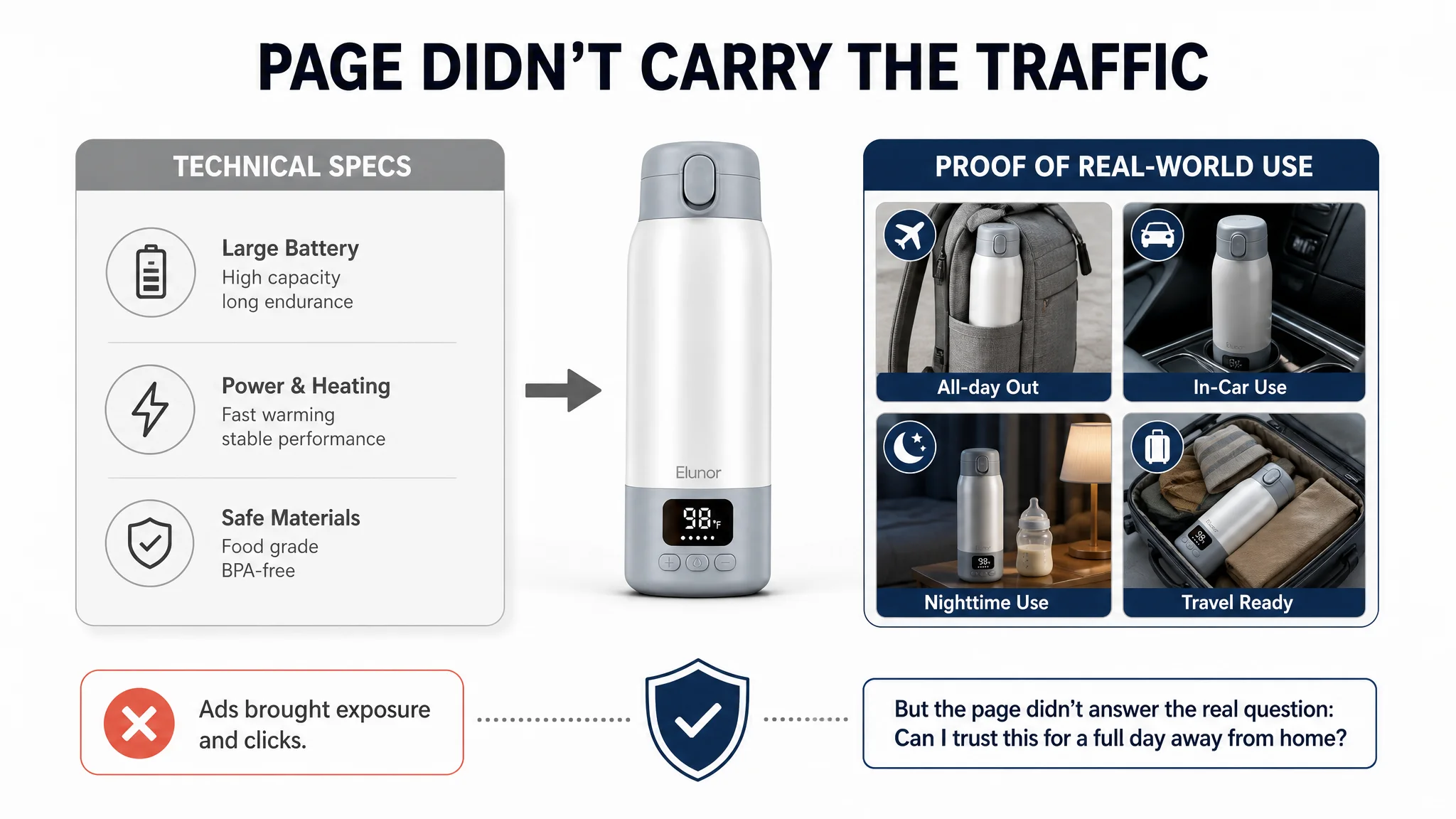
A portable bottle warmer seller in the US marketplace illustrates this distinction. The product was receiving advertising exposure and clicks, but it continued to lose ground to leading competitors in the category. The team initially suspected that the keywords were not precise enough or that bids were too high. They continued testing search terms, adjusting bids, and adding technical specifications such as battery capacity and heating wattage to the title.
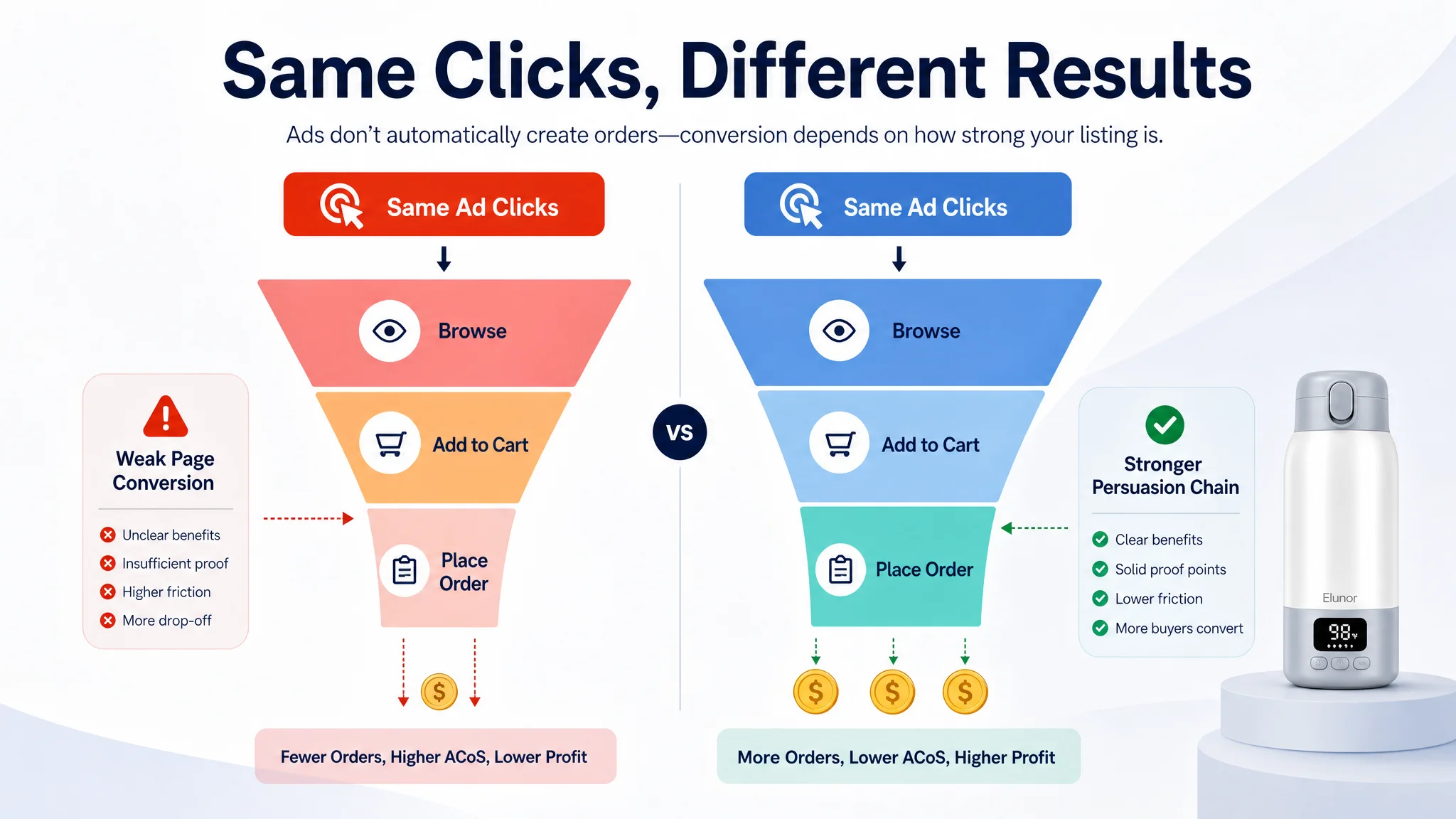
A deeper listing comparison showed that the central problem was not simply traffic acquisition. The page had not clearly answered the shopper’s practical question: could this device be trusted for a full day away from home? The title and bullet points emphasized power and materials, while the images and A+ Content displayed numerous figures without building a complete chain of evidence around outdoor, in-car, nighttime, and travel use. Advertising was bringing opportunities to the listing, but the page was not completing the persuasion process.
The key diagnostic is the competitor_layout_gap: competitors are more likely to target brand terms when the comparison shown to shoppers makes poaching profitable. Three questions provide a practical starting framework:
- Price: Is the competing offer materially more attractive after discounts, shipping, or other purchase costs?
- Reviews: Does the competitor present stronger ratings, review volume, or trust signals that reduce perceived purchase risk?
- Shipping speed: Can the alternative arrive sooner or offer a more convenient delivery promise?
These factors should be treated as hypotheses to validate, not automatic explanations. Compare branded-search CTR and CVR with the listing’s overall funnel, then examine whether changes in price, review strength, or delivery promise align with performance gaps. A low CVR alongside weaker detail-page or review signals suggests that the listing is failing to reassure high-intent traffic. The appropriate response may involve targeted listing or offer improvements before expanding defensive bids.
The operating principle is simple: diagnose the leakage first, quantify its effect on CVR and ACoS, and only then decide how much brand-defense spend the recovered profit can support.
The 3 Mistakes Brands Make When Defending Their Name
Brand-defense advertising often becomes emotional precisely when the stakes are highest. A competitor appears on branded searches, impressions shift, and the immediate response is either to raise bids or to stop spending altogether. Both reactions can damage profitability. Effective defense requires three controls working together: protect high-intent traffic, manage bids in the correct sequence, and ensure the listing can convert the traffic being purchased.
Matching Spend Blindly (The Bidding War Trap)
Matching a competitor’s bid without checking incremental sales, ACoS, placement performance, and CVR turns brand defense into a margin auction. A higher bid may win more Top of Search impressions, but it can also raise CPC faster than it raises orders. If the branded listing already converts well, the additional spend may simply buy sales that would have arrived through organic visibility or a lower-cost campaign.
The calculation sequence also matters. Apply placement modifiers first, then apply dynamic bidding adjustments. A base bid combined with a Top of Search modifier can already produce a substantially higher effective bid before Dynamic Up and Down changes it again. Treating these controls as independent can compound the increase without revealing the true CPC exposure.
Use a seesaw approach instead: when increasing the base bid, consider reducing the placement modifier; when prioritizing Top of Search, test whether the base bid can be lowered while preserving impression share. Review the effect on branded CTR, CVR, ACoS, and order volume rather than reacting to a competitor’s visible position. Dynamic Bids Up and Down should be reserved for campaigns with sufficient conversion evidence, including at least 30 days of reliable conversion data, rather than used as an emotional response to a single placement change. Set a daily budget that reflects the value of protected traffic and monitor spend against profitable branded sales.
The portable bottle warmer seller experienced the less obvious version of this trap. Because advertising exposure and clicks were not severely weak, the team kept searching for a better keyword mix and continued adjusting bids. At the same time, the title was loaded with figures such as 100W, 45W, and 10400mAh in the hope that stronger technical information would close the gap with leading products. The additional advertising work did not resolve the fact that the listing was asking parents to interpret specifications instead of immediately showing how the product solved a travel problem.
That distinction matters because bid changes cannot compensate for a page whose value is difficult to understand. Before entering a bidding war, determine whether shoppers are leaving because the competitor is more visible or because the competitor makes the purchase decision easier.
Ignoring It Completely (The Silent Revenue Drain)
The opposite error is assuming that branded traffic will remain yours without active protection. When competitors occupy high-intent searches for the brand name, shoppers may encounter alternative products before reaching the official listing. Lost clicks can become lost orders, while repeated exposure to competing offers can weaken brand equity and reduce the share of demand your brand captures.
Doing nothing does not create a neutral baseline. Track branded impressions, CTR, CVR, ACoS, and the resulting sales contribution. If competitor activity coincides with declining branded visibility or click share, controlled defense may be justified. The objective is not to dominate every auction. It is to protect commercially important traffic at a bid level supported by conversion and margin data.
A useful distinction is whether the listing is losing only visibility or also losing persuasion. In the bottle warmer example, the product was not simply absent from the search results. It was visible, received advertising traffic, and appeared to contain extensive product information. Yet its CTR and CVR remained below those of leading competitors. The problem therefore could not be evaluated through impression share alone. Even when traffic reached the page, shoppers still had unresolved concerns about battery life, heating reliability, cleaning, leakage, and safe use outside the home.
Controlled defense is still relevant in this situation, but it should not be mistaken for a complete solution. Protecting a listing that has not earned trust can preserve exposure without preserving orders.
Defending a Broken Listing (You're Protecting a Leaky Bucket)
Advertising cannot repair a listing that fails to convert. Buying branded clicks while reviews are weak, A+ Content is unconvincing, trust signals are missing, or key variations are out of stock is like filling a leaky bucket: traffic enters, but orders drain away. The result can be higher spend, weaker CVR, and rising ACoS while competitors benefit from the demand you generated.
Diagnose the handoff from click to purchase before expanding defense. Low CTR can indicate that the main image or other click-generation assets are not compelling. Low CVR can point to weak bullets, unclear selling points, poor A+ details, review concerns, or unavailable variations. Cross-check advertising metrics with listing-level scores rather than treating ad data alone as proof of a defect.
The bottle warmer listing demonstrates why this handoff must be examined in detail. Its overall DeepBI score was 73 compared with 86 for the benchmark competitor. The gap was distributed across the page rather than concentrated in one catastrophic defect: the title scored 13 versus 16, the main image 25 versus 26, the bullet points 8 versus 9, A+ Content 21 versus 23, and reviews 6 versus 12. The page was not completely broken, but it consistently gave shoppers slightly fewer reasons to proceed at each stage.
The main image gap was small, yet the image sequence still mattered. The seller used product views, capacity graphics, technology labels, heating data, and material claims. The competitor used more direct actions and settings, such as pouring, feeding, and showing the product in a vehicle or outdoor environment. The seller’s images looked informative, but they did not provide the same immediate proof that the product would be practical in real situations.
The deeper weakness appeared in the bullets and A+ Content. The page explained wattage, battery capacity, and stainless steel, but it did not sufficiently explain how the product addressed a parent’s travel concerns. It lacked a clear cleaning explanation, a visual reason to trust its temperature precision, and a strong closing layer of testing or certification evidence where genuine documentation was available. With a weaker review profile than the benchmark competitor, those missing signals made hesitation more likely.
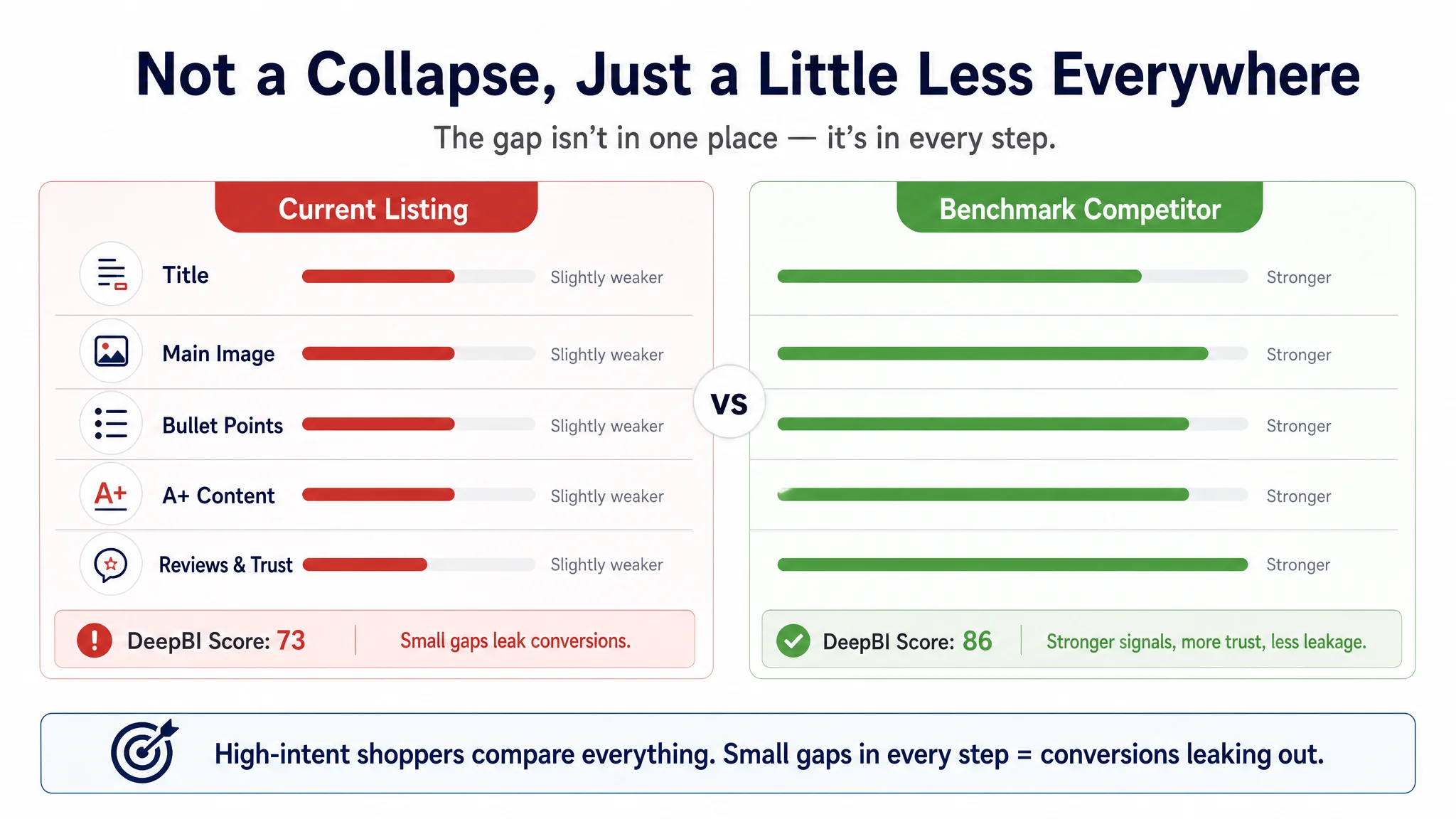
Visual assets, especially the main image and A+ pages, function as commercial conversion tools, not decoration. Fix the listing leak, then evaluate whether protected traffic produces stronger CVR and more sustainable ACoS. A stronger listing paired with more precise traffic creates a healthier defense than either aggressive bidding or neglect alone.
The Brand Defense Playbook That Actually Works
Brand defense is not a bidding contest. It is a controlled system for protecting branded traffic, identifying why shoppers leave, and removing the conversion weaknesses that make competitor ads effective. Track CTR, CVR, ACoS, and listing cycle time at each step so defensive spending remains tied to profit.
First, Build a Defensive PPC Moat
- Create a dedicated brand-defense campaign: Separate exact-match brand keywords from broader discovery and competitor campaigns so branded traffic, spend, CTR, CVR, and ACoS can be evaluated without blended reporting.
- Protect the highest-intent searches first: Use exact-match brand keywords for proven branded queries, then review search-term performance regularly to keep the campaign focused on shoppers already seeking your brand.
- Apply negative keywords deliberately: Exclude irrelevant queries, weak-intent variants, and terms that generate clicks without commercially acceptable CVR. Negative targeting should prevent budget leakage rather than simply reduce impressions.
- Set ROI guardrails before raising bids: Define acceptable ACoS, minimum conversion performance, and contribution-margin limits for each defensive segment. If competitor bidding forces costs beyond those limits, reduce exposure or change the targeting instead of automatically outspending the rival.
- Judge defense by retained economics: A defensive campaign is working when it protects valuable branded traffic while preserving profitable ACoS and supporting CVR—not when it wins every auction.
The order of operations is important. The bottle warmer seller had already invested in search-term changes and bid adjustments, but the page’s conversion structure remained weak. In that situation, a dedicated defense campaign may improve visibility while still leaving the main economic leak untouched. PPC should first secure the traffic that matters, but the listing must then give that traffic a clear reason to stay and buy.
Then, Diagnose the Real Reason for the Drain
- Separate traffic loss from conversion loss: Review impression share, branded CTR, CVR, spend, and sales together. Falling traffic may indicate visibility pressure, while stable traffic with declining CVR points toward a listing or offer problem.
- Test the commercial basics with evidence: Ask whether price is less competitive, shipping is slower, or reviews provide weaker trust signals. Compare the relevant data before changing bids, because a PPC adjustment cannot repair an offer that shoppers reject.
- Map symptoms to likely causes: Low CTR alongside weak main-image performance suggests that the search result is failing to attract attention. Low CVR alongside weaker detail-page and review signals suggests that the listing is not effectively converting the traffic.
- Use a diagnosis log before acting: Record the symptom, supporting KPI, suspected cause, and proposed intervention. This prevents teams from treating every decline as a bidding problem and creates a clean basis for measuring changes in CTR, CVR, and ACoS.
- Prioritize the largest economic leak: If branded clicks remain available but sales fall, investigate conversion weaknesses before increasing bids. If visibility collapses while the listing remains competitive, adjust PPC coverage within the ROI guardrails.
A practical diagnosis should look beyond the number of features on the page. In the bottle warmer comparison, the seller’s title, images, bullets, and A+ Content appeared information-rich. The problem was that the information did not follow the shopper’s decision path. The seller led with technical specifications, while the benchmark competitor led with practical outcomes such as extended use, fast heating, and recognizable travel situations.
The same issue appeared in the supporting content. The seller described capacity, materials, and charging, but the page did not fully answer whether the device could work reliably outdoors, in a car, at night, or during a long trip. It also did not provide enough visible evidence around cleaning, temperature control, and leakage. These were not isolated copy issues; together, they formed a trust gap that explained why traffic could arrive without producing comparable CVR.
This is why the diagnostic question should be more specific than “Is the ad working?” Ask which decision the page fails to complete. If the shopper already clicked, the next problem may be less about relevance and more about confidence.
Finally, Turn Defense into Offense by Fixing Your Listing
- Run the listing through DeepBI’s Amazon-only Listing module: Use its intelligent scoring across the main image, title, bullet points, A+ Content, and review signals, then compare the result with a similarity-qualified benchmark competitor.
- Connect listing scores to funnel symptoms: Use a weak main-image score with low CTR to investigate visual appeal; use weaker A+ Content or review signals with low CVR to locate trust and information gaps.
- Turn benchmark gaps into executable changes: DeepBI can generate AI-driven improvements for titles, bullet points, A+ Content, and main images, helping close the competitor layout gap that makes branded shoppers easier to divert.
- Preserve product consistency during optimization: Improve composition, lighting, background, scene, angle, and content clarity without inventing features, materials, accessories, parameters, or product structures.
- Feed the revised priorities back into PPC management: Once listing weaknesses are addressed, monitor CTR, CVR, and ACoS again. Stronger conversion can make competitor bidding less attractive while allowing defensive coverage to support profitable brand growth.
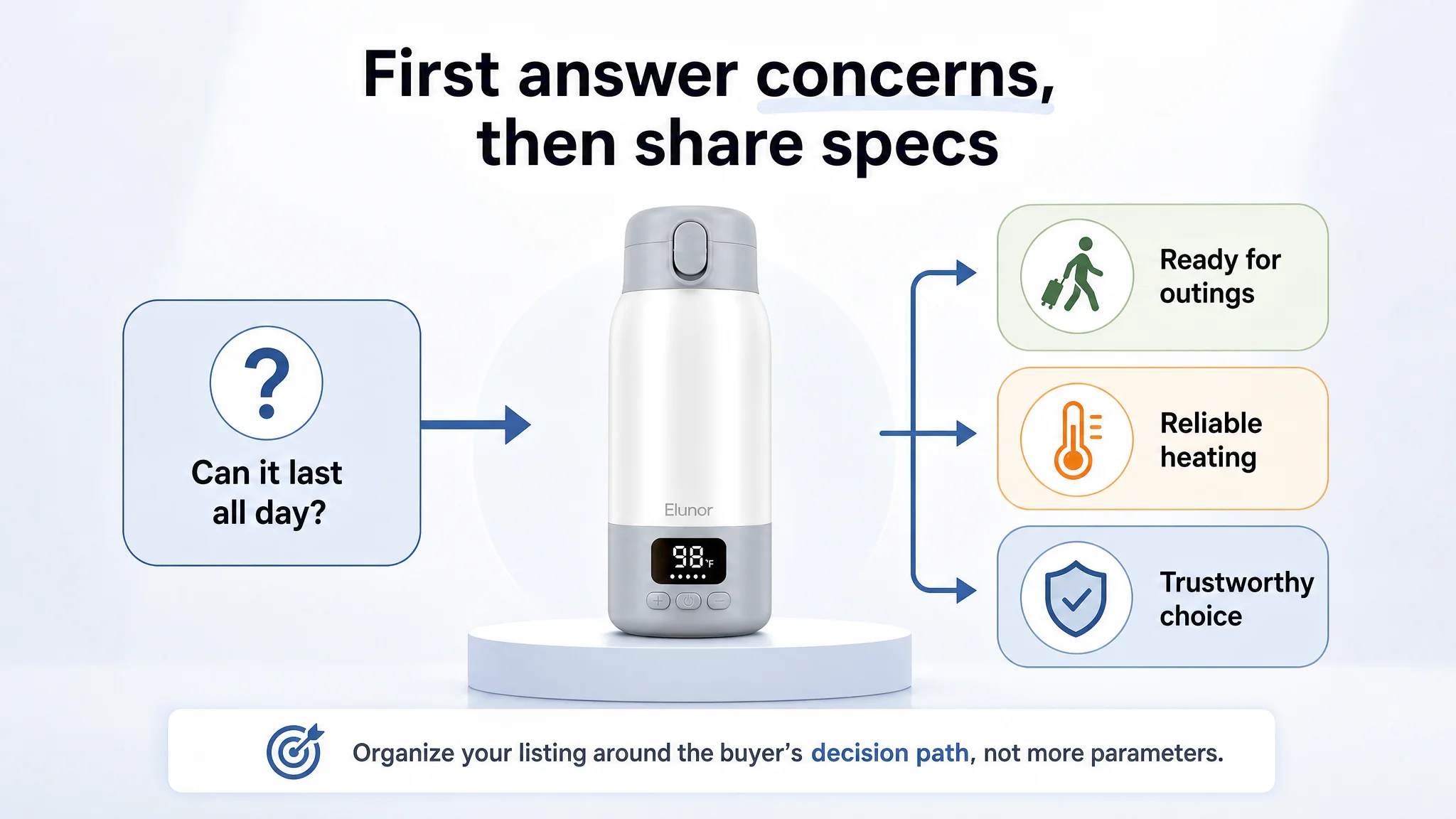
The objective is not to add more claims. It is to organize existing product strengths into a sequence that helps shoppers make a decision. For the bottle warmer, that meant moving from a specification-heavy page toward a travel-oriented decision path:
- Lead with battery life, capacity, fast heating, and travel relevance.
- Explain how fast heating and temperature control address practical feeding concerns.
- Show how materials, insulation, and capacity support nighttime and extended use.
- Use outdoor, vehicle, and feeding scenes to demonstrate real-world usability.
- Add clear evidence around cleaning, temperature precision, leakage protection, and testing where genuine supporting material exists.
The listing therefore becomes an asset that supports PPC rather than a destination that merely receives PPC traffic.
DeepBI Ads Quant: Automating Bid Optimization for Profit
The Four-Layer Traffic Funnel Explained
Profitable bidding is not a single campaign setting. It is a staged traffic system in which each keyword or product target earns a different level of investment according to its evidence. DeepBI Ads Quant is an Amazon-only engine designed to make that progression scalable and data-driven.
- Exploration: Expand keyword and ASIN coverage to discover new demand. At this stage, the objective is not maximum ACoS efficiency; it is collecting enough impressions, clicks, and conversion signals to identify viable opportunities.
- Initial Filtering: Use 30-day conversion data to remove targets that consume spend without producing acceptable results. A short burst of weak performance should not automatically eliminate a target, but persistent low conversion or excessive ACoS should reduce its priority.
- Precision: Concentrate bids on high-conversion keywords and targets. These campaigns should be managed against profitability, CVR, ACoS, and ROAS rather than exposure alone.
- Scaling: Increase budgets on proven flows while preserving the bid discipline established in the precision stage. Scaling a target with stable conversions is materially different from increasing spend simply because impressions are available.
This structure also creates a feedback loop. Advertising signals such as impressions, clicks, conversions, and ACoS can reveal which traffic produces stronger CVR and which listing or targeting decisions require review. Over time, sustained top-of-search placement for high-converting keywords can strengthen organic ranking, lowering TACOS.
The feedback loop works only when advertising data is interpreted alongside listing evidence. In the bottle warmer situation, advertising generated exposure but did not overcome the page’s weaker decision structure. A target might therefore appear inefficient because the keyword is poor, but it might also be sending qualified shoppers to a page that does not clearly communicate its value. Filtering and scaling should follow that distinction rather than treating every low-conversion signal as a targeting failure.
Dynamic Daily Bid Adjustments That Protect Margins
Daily optimization should respond to a trend, not to one unusually expensive click or one delayed conversion. DeepBI Ads Quant adjusts bids and budgets using rolling seven-day click, conversion, spend, and ACoS patterns. That window helps reduce short-term noise while still allowing a meaningful deterioration or improvement to influence execution.
The adjustment sequence matters. Placement modifiers should be calculated first; dynamic bidding adjustments should be applied afterward. Consider a base bid of $0.75 with a +900% Top of Search modifier. The placement-adjusted bid becomes:
$0.75 × (1 + 900%) = $7.50
If Dynamic Bids Up and Down then raises that amount by 50%, the final bid becomes:
$7.50 × 1.50 = $11.25
Applying both adjustments without checking the compounded result can push ACoS beyond the target, even when each setting appears reasonable in isolation. Dynamic Bids Up and Down should also be evaluated only where the campaign has the required 30-day conversion data. For newer or low-volume targets, use the available evidence conservatively rather than allowing an aggressive adjustment to amplify uncertainty.
Even a mathematically disciplined bid can be economically weak when the listing is not ready to convert. If a campaign sends qualified shoppers to a page that explains specifications but not practical outcomes, daily bid optimization may improve the efficiency of traffic acquisition without solving the conversion bottleneck. Bid automation should therefore be paired with a recurring review of the listing elements most closely connected to CVR.
How to Calculate Your Own Starting Bid (and Why Amazon's Suggested Bid Isn't Enough)
Amazon’s suggested bid is a marketplace estimate, not a guaranteed profit threshold. A seller should begin with the economics of the offer:
Starting Bid = Target ACoS × Average Order Value × Conversion Rate
Suppose a supplement sells for $32, the target ACoS is 25%, and the conversion rate is 12.5%:
0.25 × $32 × 0.125 = $1.00
The initial bid is therefore $1.00 before placement modifiers or later performance adjustments. For a home-goods product with a $48 average order value, a 20% target ACoS, and an 8% conversion rate:
0.20 × $48 × 0.08 = $0.77
The two products require different bids because their order values, conversion behavior, and profitability targets differ. Calculate the base bid first, apply placement modifiers second, and assess dynamic adjustments last. Then monitor seven-day clicks, conversions, spend, ACoS, and ROAS to determine whether the target deserves filtering, precision management, or additional budget.
The formula also exposes why a listing problem can distort bidding decisions. If observed CVR is depressed because the page does not answer important purchase concerns, the calculated starting bid will be more conservative. Raising the bid to compensate may simply increase the cost of acquiring shoppers who remain unconvinced. Before concluding that the marketplace requires a higher bid, confirm that the product page is capable of converting the traffic represented by the calculation.
When to Escalate vs. When to Let the Listing Win
Bid aggression should be a business decision, not a reflex to every competitor impression. The right level of defense depends on contribution margin, competitive impact, seasonality, listing strength, organic position, and measured incrementality. A higher bid can protect profitable demand, but it can also raise ACoS without creating additional orders. Use profit guardrails and controlled testing to determine which situation applies.
When to Go on the Offensive
Escalate when the expected value of additional visibility clearly supports the cost. This is most defensible in four situations:
- High-margin opportunities: Products with sufficient contribution margin can absorb a higher CPC while remaining within the target ACoS and profit limit. Set a maximum bid from allowable acquisition cost, not from competitor behavior alone.
- Peak shopping events: Prime Day, Black Friday, and comparable high-intent periods can justify temporary bid increases when conversion potential and traffic value rise. Define the event budget, target CVR, and acceptable ACoS before the event, then reduce bids when the opportunity closes.
- Seasonal demand windows: Seasonal bid adjustments should follow expected demand, inventory coverage, and conversion performance. Escalating too early can purchase low-value traffic; waiting too long can miss the period when shoppers are most ready to buy.
- Measured competitor-driven losses: Defend more actively when comparable competitors are capturing branded or high-intent searches and the impact appears in declining impressions, clicks, CVR, orders, or BSR. Compare against genuinely similar products, price bands, audiences, and shipping propositions rather than reacting to every visible rival.
Owning prominent ad and organic positions can make the brand substantially more visible in top search slots and significantly reduce competitor visibility there. It does not mean every competitor advertisement is physically pushed down. The practical question is whether the added prominence produces incremental orders or protects valuable demand at an acceptable profit level.
A listing with a clear offer can justify more assertive defense because additional visibility has a reasonable chance of producing orders. A listing that still leaves major concerns unanswered should not be given an unlimited budget simply because a competitor is visible. In the bottle warmer example, the more defensible offensive move was not to keep increasing bids against the leading products. It was first to make the page more competitive on the points that influenced the comparison: travel practicality, battery life, heating reliability, cleaning, safety, and trust.
When to Stand Down and Trust Your Offer
Restraint is often more profitable when the listing already converts efficiently. High ratings, credible review volume, competitive pricing, fast shipping, strong detail-page content, and a dominant organic rank reduce the need to buy every branded impression aggressively. A listing that earns strong CTR and CVR may retain demand through organic placement, allowing the seller to protect ACoS and contribution margin with a lower defensive bid.
Listing strength should be validated through performance data rather than visual confidence. Cross-check listing quality against impressions, clicks, orders, CTR, and CVR. If the page converts well while organic visibility remains strong, aggressive branded defense may shift some sales from organic placement without producing enough incremental value to justify its cost.
While many brands fear cannibalization, studies show own-brand ads often add incremental clicks, but results vary. Run an incrementality test before treating branded advertising as either essential defense or wasted spend. Compare paid and organic outcomes under controlled conditions, using orders, total sales, ACoS, TACoS, and BSR as decision inputs. Maintain the lower bid only when the test and profit guardrails show that reduced paid support does not create a material loss in total demand or competitive visibility.
The same principle applies when a competitor appears stronger. A seller should not automatically escalate simply because a rival has more reviews or a more polished page. First identify whether the difference is actually affecting branded CTR, CVR, or total profitable sales. If it is, the solution may involve both measured defense and targeted listing work. If the listing already converts efficiently and the competitor is not creating a meaningful economic loss, restraint may protect more profit than a permanent bidding increase.
Frequently Asked Questions
Is it legal for competitors to bid on my brand name?
On Amazon, competitors can generally target a branded keyword in sponsored advertising, provided they do not misuse the trademark in the ad copy or otherwise violate applicable policy. The fact that another seller’s ad appears when shoppers search for your brand name does not, by itself, establish infringement.
Treat this as a strategic challenge first: strengthen branded CTR and CVR, monitor impression share and ACoS, and assess whether the competing offer is diverting profitable traffic. Because trademark treatment can depend on the wording, marketplace, and surrounding facts, review Amazon’s current policies and consult qualified legal counsel before taking action.
How much should I budget for a brand defense campaign?
There is no universal percentage of revenue or fixed daily budget. The appropriate budget depends on product margin, average order value, conversion rate, existing branded demand, and competitive intensity. A profitable defense campaign should protect valuable traffic without allowing bids to consume contribution margin.
A practical starting-bid formula is:
Starting bid = Target ACoS × Selling price × Expected CVR
For example, with a $40 selling price, a 30% target ACoS, and a 10% CVR, the starting bid is approximately $1.20. Use this as a controlled baseline, then adjust based on actual clicks, orders, ACoS, and impression performance. Set the daily budget according to the volume of branded traffic you can profitably capture, rather than matching a competitor’s spend automatically.
Before expanding the budget, also ask whether the listing can convert the traffic being purchased. A page with weak trust signals, unclear use cases, or incomplete A+ Content may consume a larger budget without producing a proportional increase in orders. The budget decision should therefore reflect both advertising economics and listing readiness.
Won’t bidding on my own brand cannibalize organic sales?
It can in some cases, but the outcome is not predictable enough to support a blanket rule. Some shoppers who click a sponsored brand-defense ad may have purchased organically anyway. Others may have clicked a competitor’s placement or left the search results without a prominent branded offer. Paid visibility can therefore represent partial cannibalization, partial incrementality, or a combination of both.
Measure the result at the account and ASIN level. Compare branded paid orders, organic orders, total sales, TACoS, ACoS, CTR, and CVR against a clearly marked pre-change baseline or controlled test period. A rise in paid orders alone does not prove incremental revenue; the stronger question is whether total profitable sales increase after accounting for advertising cost.
Can I report competitors for bidding on my brand?
Generally, reporting is most appropriate when the competitor misuses your trademark in advertising text or engages in conduct that violates Amazon policy. Merely bidding on your brand keyword, without improper use in the visible ad copy, is typically a competitive bidding issue rather than sufficient grounds for a complaint.
Document the keyword, ad text, product detail page, marketplace, and relevant evidence before escalating. Then check Amazon’s current reporting requirements and seek legal advice where trademark rights are unclear. If no policy violation exists, focus on defensive keyword coverage, offer strength, listing CVR, and profitable bid control instead of treating every competitor appearance as a compliance case.
The broader lesson is that competitor activity should trigger diagnosis, not panic. A competitor may be taking advantage of weak visibility, a more attractive offer, stronger reviews, or a page that explains the product more convincingly. Once the actual leakage is identified, the response can combine appropriate PPC protection with the listing improvements needed to make that protection profitable.