


What "AI-Generated Listing Content" Means on Amazon
AI-generated listing content refers to the machine-assisted creation or optimization of assets used on an Amazon detail page. Its scope may include:
- Product titles and five-point bullet points
- Product descriptions and A+ content
- Backend keyword recommendations
- Main and secondary image copy concepts
- Visual layout, scene, or positioning concepts for product assets
The term does not mean that a system independently understands the product, selects the right positioning, or produces publish-ready content without oversight. On Amazon, output quality depends first on the quality of the information provided: verified product facts, physical specifications, existing listing data, relevant competitor context, and the product’s defined attributes. If these inputs are incomplete or inaccurate, the generated copy may target the wrong audience or introduce unsupported claims.
Amazon requirements add another layer of control. Titles, bullets, descriptions, images, and A+ assets must comply with applicable format and policy requirements. Product identity, dimensions, materials, functions, and other factual attributes should remain fixed rather than being invented to make the copy sound stronger or the visuals appear more attractive. A useful AI workflow therefore treats Amazon rules and product facts as boundaries, not as checks performed only after generation.
Human review remains part of the operating model. AI can analyze a listing, extract search-relevant themes, compare structure and selling points, and turn identified gaps into specific production instructions. It can also help reorganize bullets into a pain-point-and-solution sequence or arrange A+ content into logical modules. People must still decide which recommendations are commercially appropriate, which claims are supportable, and which assets should be used. Selective adoption is more defensible than replacing every existing element with generated content.
The practical value of AI is best understood as a lever for productivity and consistency. It can reduce manual research, drafting, comparison, and revision while shortening listing cycle time. It does not guarantee higher CTR or CVR, lower ACoS, stronger BSR, or increased sales. Those outcomes must be established through measurement.
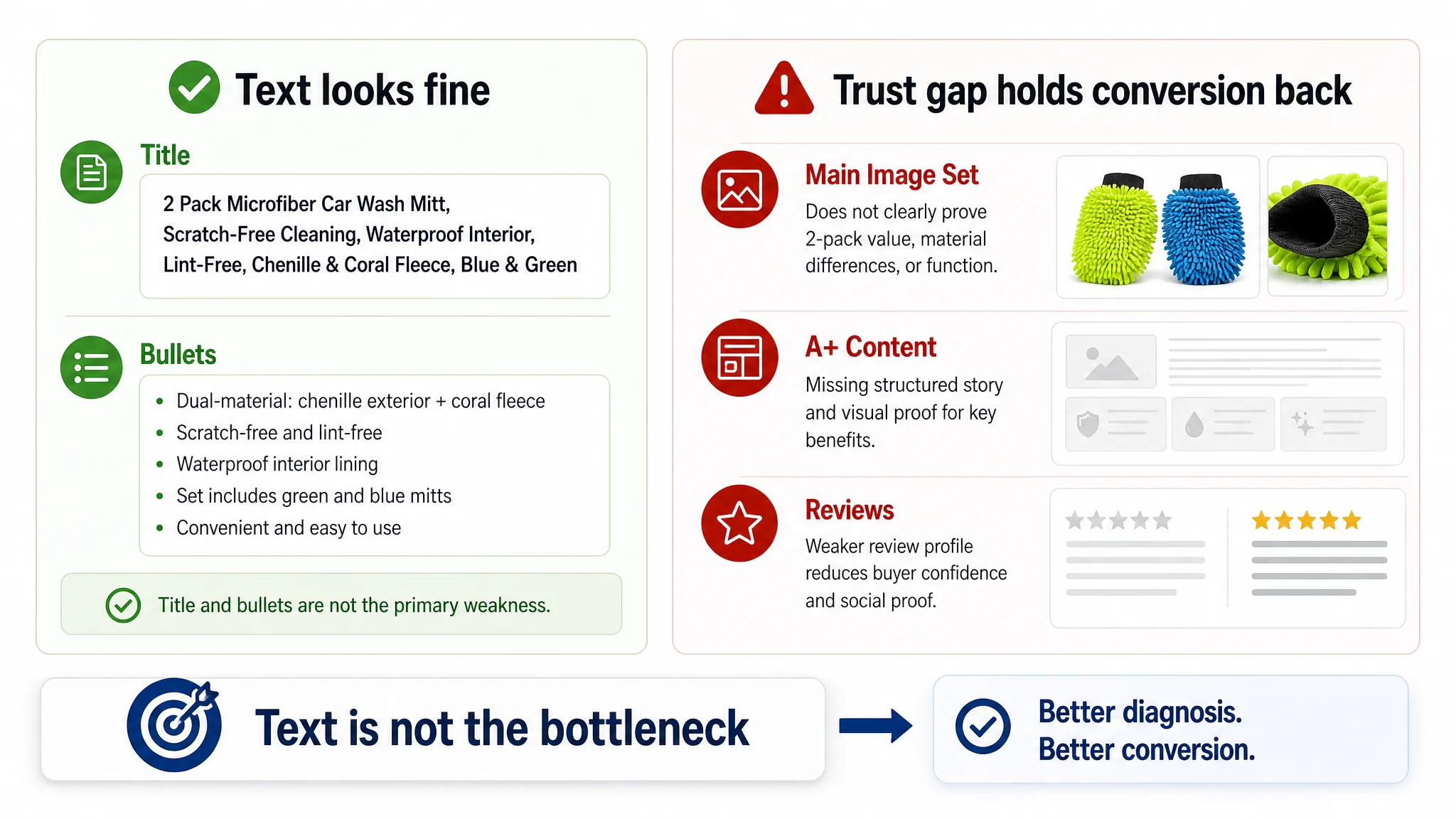
A real listing audit shows why this distinction matters. One car-care accessories seller had a double-sided microfiber car wash mitt listing that appeared “good enough” at first glance. The title was structured, the bullets covered the main product features, and advertising was bringing traffic. The team initially treated the problem as one of bids, keywords, or campaign structure. A competitive diagnosis, however, found that the title and bullets were not the primary weakness. The larger gaps were in the main-image set, the absence of A+ content, and the review profile. AI was most useful here not because it generated more polished wording, but because it helped connect listing elements, competitor differences, and commercial symptoms into a more accurate diagnosis.
Conversion measurement provides the evidence layer. A revised title, bullet set, or visual asset should be evaluated against relevant Amazon signals, including impressions, clicks, CTR, orders, CVR, and advertising performance. For visual changes, linking a published update to a recorded iteration point can help sellers observe how CTR changes after the asset is applied. AI-generated content is effective only when constrained by reliable inputs, reviewed against Amazon requirements, selected by an accountable operator, and evaluated through measurable listing outcomes.
The Core Proof Point: Conversion Rate, Sessions, and Category Reality
The effectiveness of AI-generated listing content should be judged by its impact on commercial outcomes, not by whether the copy sounds polished or the images look more attractive. For listing changes, conversion rate (CVR) is the primary proof point because it shows how effectively the page turns buyer interest into orders. A stronger title, bullet structure, or visual asset has business value only when visitors to the listing become more likely to purchase.
The measurement hierarchy is straightforward:
- Traffic enters the listing through search, advertising, or other acquisition sources.
- Sessions represent distinct buyer opportunities to evaluate the product.
- CVR filters those opportunities by showing how many result in orders.
Sessions are therefore more useful than page views for evaluating listing performance. Page views can include repeated visits from the same shopper and may increase without creating an equivalent number of new purchase opportunities. Sessions provide a closer connection to the number of shopping occasions available for conversion. When comparing content versions, sellers should examine sessions alongside orders and CVR rather than treating an increase in page views as evidence of stronger demand.
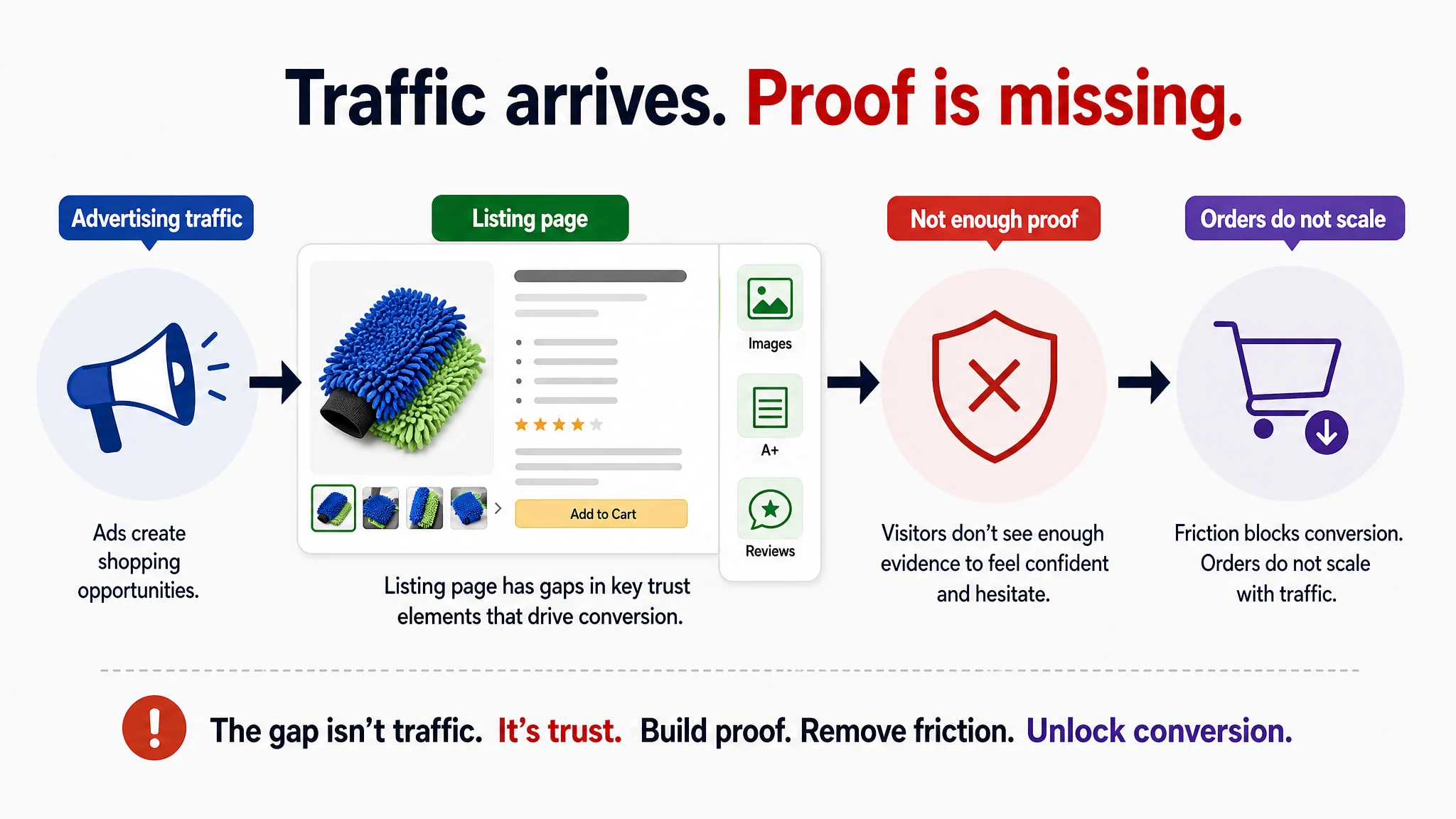
A car-wash mitt listing illustrates the difference between traffic activity and conversion capacity. The seller was receiving advertising traffic, but orders did not scale with spend and ACoS was difficult to control. The team naturally suspected bid precision, negative keywords, or campaign allocation. Yet a competitive audit scored the target listing at 55/100 against 79/100 for a benchmark listing in the same niche. The title and bullet dimensions were not the bottleneck: the target scored slightly ahead on title and bullet structure. The largest gap was in detail and A+ content, which scored 3 compared with the competitor’s 21, followed by differences in the main-image set and reviews. The page was creating shopping opportunities, but it was not giving those visitors enough evidence to continue toward purchase.
The revenue impact of a CVR improvement is conditional. If a listing moves from 5% CVR to 10% CVR while session volume and average order value remain constant, the number of orders generated from the same traffic can double. Revenue may consequently increase without additional ad spend. If sessions decline, traffic quality changes, or order value falls, the same CVR movement may not produce the expected revenue result. Traffic volume, traffic source, and order value must remain part of the analysis.
This is why advertising should not be evaluated in isolation. In the car-wash mitt case, the issue was not that advertising failed to bring people to the page. The page was consuming the traffic because the main images did not clearly prove the two-pack and dual-material value, the detail area had no visual trust layer, and the review profile was weaker than the benchmark. Additional ad optimization would have increased the number of visitors arriving at the same conversion bottlenecks. The broader lesson is that advertising can amplify a listing’s strengths, but it can also amplify its defects.
Category context helps prevent misleading conclusions. Amazon’s average CVR across categories is around 10%, but that figure is not a universal target. Category-specific averages can vary widely, from approximately 3–6% for apparel to 25–40% or more for supplements. A 7% CVR may indicate weak conversion in one category yet represent a materially different position in another. Benchmarking should therefore use comparable products, traffic conditions, and purchase-consideration patterns.
A reliable review also requires a defined measurement window and a clear change point. Record the listing version, launch time, sessions, orders, CVR, CTR, and relevant ad conditions before and after publication. DeepBI’s workflow illustrates this evidence-chain approach by linking listing diagnosis to business metrics and marking when a visual iteration goes live. Its documented 7–14-day window applies to observing post-launch CTR movement, not to universal CVR attribution. A CVR change should be treated as evidence of effectiveness only after traffic conditions and competing variables have been examined.
What Makes AI-Generated Titles, Bullets, and Descriptions Effective
AI-generated listing copy is effective only when it improves a defined part of the Amazon funnel without violating field constraints or product truth. A polished paragraph is not evidence of value. The relevant questions are whether the title earns more qualified clicks, whether the detail page converts those clicks, and whether the change can be evaluated through CTR and CVR rather than subjective quality alone.
A title should be written for mobile scanning first. It should be keyword-rich without becoming a sequence of disconnected terms, with the most important buyer phrase placed early enough to remain visible and meaningful on a small screen. Keep the title within the 75-character title limit where that limit applies, remove redundant wording, and ensure that every feature or benefit reflects confirmed product information. A title that attracts impressions but fails to communicate the product clearly may not improve CTR; keyword inclusion alone is not a performance strategy.
In the car-wash mitt case, the title already communicated the product category, material, benefits, size, and color in a relatively mature structure. A recommended formulation such as “2-Pack Microfiber Car Wash Mitt, Chenille & Coral Fleece Double Sided, Scratch-Free & Lint-Free…” could make the two-pack value and dual-material design more explicit. But this did not change the diagnosis: improving the title alone would not repair the larger trust gap created by weak visuals and missing A+ content. A keyword or title improvement should therefore be judged by the part of the funnel it is expected to influence, rather than treated as a solution to every listing problem.
Bullets should lead with buyer benefits rather than technical specifications. A specification becomes more useful when connected to a customer concern, factual support for the claim, and the problem it resolves. For example, capacity or dimensions should explain their practical value instead of appearing as isolated numbers. Keep each bullet under 255 characters and use a structure that can be scanned quickly on mobile. Overloaded bullets can obscure the reason to buy, even when their information is accurate.
The same principle applied to the mitt’s bullets. The product had real differentiators—chenille and coral fleece on opposite sides, a waterproof interior, a two-pack configuration, and lint-free positioning—but the strongest version of the content needed to connect those facts to buyer concerns. A dual-material bullet could explain how the two surfaces support different cleaning tasks. A waterproof-lining bullet could address wet hands and secure fit. A two-pack bullet could explain why buyers might use one mitt for paint and another for wheels, reducing cross-contamination. These changes make the information more useful, but they still work best when the images visibly prove the same claims.
Descriptions serve a different purpose. They can combine relevant search language with a coherent product story, explain use scenarios, address objections, and reinforce trust through concrete product evidence or verified support. The description should not mechanically repeat the bullets. Instead, it should answer the questions a cautious buyer may still have after scanning the title and bullets, helping protect CVR after the listing earns the click.
Backend search terms provide space for relevant search intent that does not belong in visible copy. Use the 250-byte backend search-term field to capture appropriate variations and customer language without forcing awkward phrases into the title or bullets. Relevance and accuracy remain essential; unused space is less harmful than unsupported or misleading terms.
These limits should serve as verification criteria for every AI output:
- Title: confirm the applicable character limit, early buyer phrase placement, relevance, and factual accuracy.
- Bullets: confirm that each stays under 255 characters and communicates a clear benefit.
- Backend terms: confirm that the field stays within 250 bytes and reflects relevant search intent.
- Listing impact: compare CTR and CVR after the change, with the intervention clearly identified.
A single bullet rewrite may produce a smaller measured CVR lift because it changes one conversion element. A full listing refresh may produce a larger measured lift by changing several parts of the buyer journey. Neither effect should be assumed in advance. Treat each as a finite, testable intervention, and use the resulting movement in CTR, CVR, ACoS, or BSR to determine whether the copy merits publication and further iteration.
AI-Generated Visual and A+ Content as Conversion Levers
A product detail page can lose a sale even when the product itself is competitive. Shoppers may understand the headline benefit yet still hesitate because they cannot quickly verify the product’s fit, specifications, use context, or reliability. Visual and A+ content can address this gap by making the offer easier to understand and trust. Their role is not to guarantee conversion, but to reduce uncertainty when purchase hesitation affects CVR.
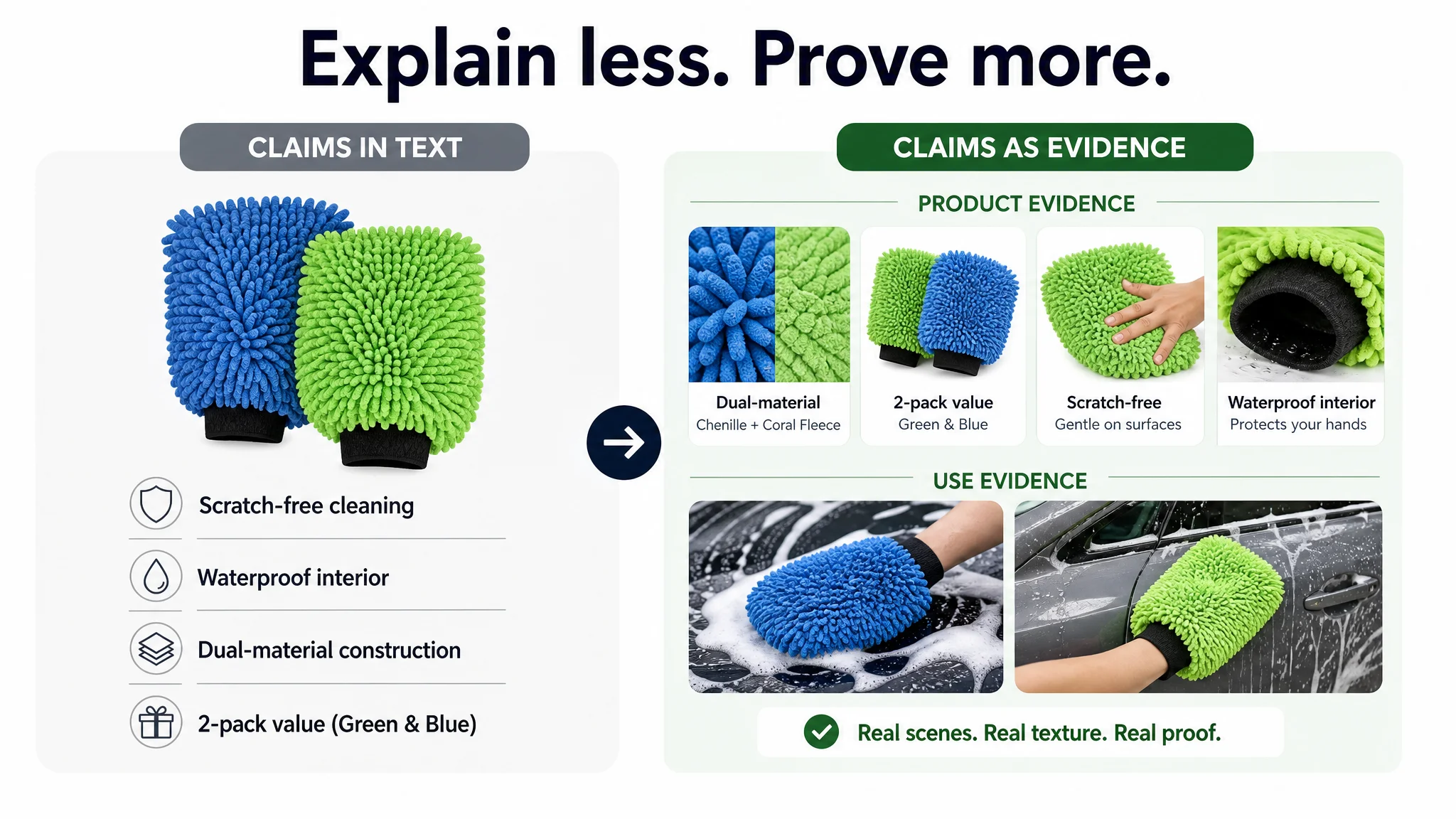
The car-wash mitt listing made this principle visible. Its title and bullets described scratch-free cleaning, a waterproof interior, a two-pack configuration, and dual-material construction. However, the main images did not make the two-pack value unmistakable at thumbnail level, did not clearly distinguish the chenille and coral-fleece sides, and did not visually demonstrate the functional claims. The competitor used lifestyle scenes, texture close-ups, and cleaning demonstrations to prove what the target listing mostly stated in words. The target page therefore had to explain its value, while the competitor’s page showed it.
A+ Content and A+ Premium provide a structured framework for presenting brand information beyond the standard title, bullets, and product description. Comparison modules can clarify differences among products or configurations. Modular visual stories can introduce the product, explain core benefits, address customer pain points, provide trust signals, and guide shoppers toward action. When these modules are designed for mobile reading, the message must remain clear as shoppers scroll through compact screens rather than requiring them to study dense blocks of text.
In the same case, the target listing had no A+ images and relied on repetitive text, while the benchmark listing used five structured A+ modules covering value proposition, usage scenes, feature close-ups, and maintenance guidance. This difference was not merely aesthetic. After the bullets, shoppers on the target page encountered little visual explanation of how the mitt worked, why the materials differed, or how the product addressed concerns about scratching paint and keeping hands dry. The competitor’s A+ content created a sequence from value to usage, function, maintenance, and reassurance. That is what page “承接” means in practical terms: the page continues answering questions after the initial click instead of leaving the buyer to infer the answers.
The same discipline applies to SEO relevance. Visual storytelling should reinforce the search terms and product attributes that matter to the listing, while titles, bullet points, module copy, and visual emphasis should remain consistent. A visually attractive page with weak keyword relevance may fail to earn sufficient traffic; a keyword-rich page with unclear visual communication may receive visits without converting them. The objective is alignment among search visibility, comprehension, and purchase confidence.
For the mitt, useful visual modules could establish the dual-material, two-pack value, show scratch-free cleaning on a vehicle surface, demonstrate the waterproof interior with a wet exterior and dry interior, distinguish chenille-side and coral-fleece-side use cases, and clarify maintenance. Each module would serve a specific decision question rather than simply filling space. The core principle is that AI-generated imagery should turn a claim into evidence wherever the claim is central to conversion.
DeepBI’s AI image-and-copy generation treats these outputs as one connected listing system rather than as isolated creative tasks. Using a product DNA graph as the source of truth, it can produce product images, detail-page visuals, A+ content, titles, and bullet points. Multiple versions can be generated, previewed, and compared before a seller selects assets for application. This workflow helps translate product facts and strategy into concrete visual and textual execution while maintaining consistency across the detail page.
Control remains essential. General-purpose image generation can introduce altered materials, colors, proportions, product structures, accessories, or unsupported claims. DeepBI’s Product DNA constraint is intended to preserve product authenticity, but every proposed asset still requires human review for factual accuracy, Amazon policy requirements, and brand compliance. A visual that overpromises may increase initial appeal while creating a product-image mismatch, negative reviews, refunds, or weaker long-term trust.
The commercial test begins after publication. Sellers should evaluate whether the revised visual and A+ content contribute to CVR movement, alongside CTR, ACoS, and other relevant listing outcomes. Without measurable improvement or a defensible diagnostic explanation, aesthetic quality alone is not evidence that the content works.
Keyword Strategy for AI-Generated Listing Content
AI-generated listing copy becomes commercially useful only when its keyword strategy reflects how buyers search and decide. A listing may contain many relevant terms yet still perform poorly if those terms attract the wrong traffic or fail to address buyer concerns. Keyword inclusion supports search relevance; CVR shows whether the content persuades shoppers after they click.
Start by mapping buyer intent to relevant long-tail search terms. These phrases often express a more specific need, use case, product form, or feature combination than broad category terms. The goal is not to collect every possible variation, but to identify terms that match the product’s verified attributes and the customer’s likely search language. Those terms can then be assigned to visible and backend fields according to their roles.
Priority keywords should appear naturally in the title, bullet points, and description. The title should establish the product category and core value clearly. Bullets should connect important features with customer problems or desired outcomes rather than present an unstructured list of specifications. The description can provide additional context and reinforce relevant use cases. Excessive repetition can reduce readability and weaken the persuasive path from search result to purchase.
The car-wash mitt example shows why keyword coverage should not be treated as the entire listing strategy. The target listing’s title and bullets were already at least comparable to the benchmark in structure and keyword coverage, yet the overall listing score remained substantially lower. The major weaknesses were the main-image set, A+ content, and reviews. This means a listing can be semantically relevant enough to attract traffic while still failing to convert that traffic because it does not provide sufficient trust or decision support.
Backend keywords serve a different purpose. They can capture relevant search opportunities that would make visible copy awkward, repetitive, or overly broad. They should still remain accurate to the product and aligned with buyer intent. Backend fields are not a substitute for clear visible copy: shoppers need to understand the offer quickly once they reach the detail page.
Every AI-generated draft also requires a field-compliance check before publication. Verify the following limits:
- Title: no more than 75 characters where that limit applies.
- Each bullet: no more than 255 characters.
- Backend search terms: no more than 250 bytes.
The distinction between characters and bytes matters, so a simple visual count may not be sufficient for backend fields. Content that violates mandatory platform requirements can be blocked, regardless of how strong its keyword selection appears.
A practical review process therefore has two stages. First, assess relevance: do the title, bullets, description, and backend terms align with the intended search queries? Second, assess conversion: do the visible claims communicate benefits, resolve buyer concerns, and support CVR? AI analysis can reverse-engineer existing titles and bullets, compare keyword placement and readability, and replace keyword accumulation with a clearer structure. The final standard is not keyword density, but qualified traffic, understandable content, and measurable movement in CTR and CVR without sacrificing listing compliance.
How to Evaluate AI Listing Tools Without Inflated Claims
An AI listing tool has not proven its effectiveness simply because it generates copy quickly. The relevant question is whether its output passes Amazon-specific checks and whether its claimed impact can be compared with a defined baseline. Generation speed is a workflow metric; it is not evidence of higher CTR, CVR, lower ACoS, stronger BSR, or a shorter listing cycle that produces better commercial results.
Start with hard constraints. Check the title against the applicable character limit, including the 200-character limit where it applies, and verify that the output contains no exaggerated claims, invented attributes, or unsupported product functions. Product measurements and specifications must remain authentic and verifiable. A tool that produces persuasive language by altering product facts creates compliance and conversion risk rather than operational value.
Then review the listing structure. Bullets should lead with the customer benefit or category concern, support that benefit with a relevant product capability or specification, and clarify the problem being solved. Specification-heavy bullets may appear complete while giving shoppers little reason to continue reading. The review should also confirm that core keywords appear naturally in the title and bullets. Keyword stuffing can damage readability and does not demonstrate useful search optimization.
A competitive audit is one way to test whether a tool is identifying the right problem rather than merely generating more content. In the car-wash mitt case, DeepBI compared the target listing with a benchmark in the same niche and found a 55/100 score against 79/100. The dimension breakdown showed that title and bullets were not the main constraint, while detail/A+ content lagged by 18 points and the main-image and review dimensions also trailed. This kind of diagnosis is more useful than a generic recommendation to “optimize the listing,” because it indicates where further work is likely to matter.
Field coverage matters as well. Confirm that all required listing fields and backend search terms are populated appropriately instead of judging only the visible title and bullets. A credible tool should make it possible to identify missing fields, unsupported wording, and inconsistencies between the product data and the generated content.
Cost claims require an explicit baseline. The defensible formulation is that AI handles 80–90 percent of the mechanical listing work at 10–20 percent of human freelancer cost. If an agency comparison is used, it must remain separate: the relevant baseline is 5–10 percent of agency cost. Neither formulation proves a performance gain, and neither should be presented as a guarantee of CVR uplift or ranking improvement.
Finally, require version comparison and measurement discipline. Compare the original and revised listing across the title, five bullets, images, A+ content, and other relevant fields, while ensuring that the benchmark uses genuinely comparable products. Record the differences before publication, then define an observation window, such as 7–14 days, and monitor impressions, clicks, CTR, conversions, CVR, ACoS, TACoS, and BSR where applicable.
If a tool cannot respect field limits, preserve verified product facts, show clear version differences, or support a predeclared measurement process, its effectiveness remains unproven—regardless of how quickly it generates content.
A DeepBI Listing Workflow for AI-Generated Content That Actually Improves CVR
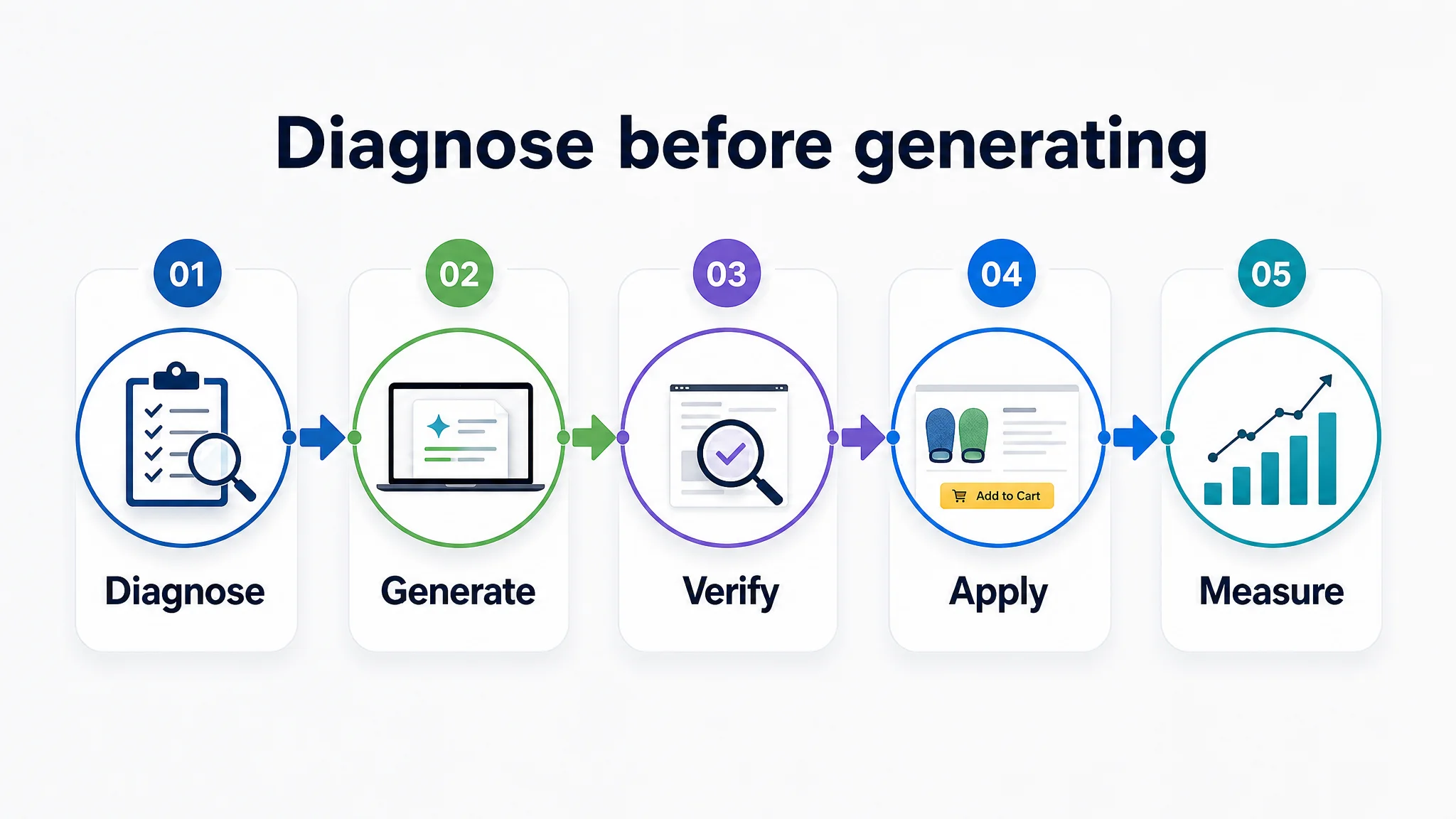
AI-generated listing content should not be judged by how polished it sounds or looks. Its effectiveness must be established through a documented chain: diagnose the baseline, generate a controlled version, verify the output, apply the change, and measure the resulting Amazon KPIs.
1. Diagnose the listing. DeepBI uses multidimensional semantic analysis to score the listing and identify relevant competitor benchmarks. It examines the title, bullets, A+ content, visual elements, and review structure as listing-quality inputs. The review structure helps identify communication gaps and conversion friction; it is not handled as a review-management system. The diagnostic output connects module-level weaknesses to potential CTR and CVR problems, creating a quantified baseline for later comparison.
The car-wash mitt audit demonstrates why this first step matters. The seller initially interpreted weak conversion and difficult ACoS as an advertising problem. The benchmark comparison showed a different distribution: the target listing scored 16 versus 13 on title, and 7 versus 6 on bullets, but only 3 versus 21 on detail/A+ content. The diagnosis therefore shifted the priority from keyword and bid adjustments to visual proof, structured page content, and trust reinforcement. The value of the audit was not simply the score; it was the connection between the score pattern and the observed business constraint.
2. Generate an execution plan. Based on the diagnosis and product constraints, multiple AI agents produce structured, execution-ready optimization strategies. These may include revised copy and AI-generated image content, with guidance tied to search terms, customer benefits, pain-point resolution, visual hierarchy, composition, and other production requirements. Actions are ranked by expected impact, producing a prioritized execution list instead of an undifferentiated set of creative suggestions. Product facts and specifications must remain the controlling constraints so that generated content does not introduce unsupported features or create product-image mismatch.
For the mitt listing, the plan focused first on clarifying the “2-pack” and dual-material value in the main images, then replacing the text-only detail area with a structured A+ story. The proposed content was tied to specific buyer concerns: whether the mitt could clean without scratching paint, whether the waterproof interior would keep hands dry, how the two surfaces differed, and how the product should be maintained. This is more actionable than asking AI to make the listing “more persuasive,” because each recommendation is connected to a diagnosed conversion gap.
3. Verify before publishing. Every proposed asset requires human review. Check copy against Amazon field limits, keyword relevance, benefit-led messaging, and mobile readability. Check images for product-truth consistency, placement suitability, and clear communication at small-screen sizes. This step filters compliance, relevance, and usability errors; the workflow is not fully autonomous, and generated output should not move directly to the listing without approval.
Visual verification is particularly important when the content is intended to prove a product claim. A generated image for the mitt should preserve the actual chenille and coral-fleece sides, the two-pack configuration, the waterproof interior, and the product’s proportions. It should not invent a cross-section, accessory, or performance demonstration that the product cannot support. The more a visual asset is used as evidence, the more carefully its factual accuracy must be reviewed.
4. Apply and compare versions. DeepBI can synchronize listing content through Amazon SP-API, reducing the operational friction of manually downloading, renaming, and uploading assets. After application, sellers can compare original and replacement versions and filter the comparison to selected content, including a single image or element. This creates a clear application time anchor without turning the comparison into an automated A/B test.
5. Measure the outcome. Track CTR, CVR, sessions, and sales velocity over a defined period, such as 90 days, while recording the exact content version and application date. A full listing refresh changes several inputs simultaneously, so it provides broad directional evidence but limited attribution to any one asset. A single-element change supports narrower old-versus-new analysis. Both evidence levels are useful, but they should not be presented as equivalent proof.
Improved listing relevance and CVR can make existing ad traffic more efficient and support organic-rank momentum because Amazon rewards relevance and conversion. This workflow narrows the gap between subjective optimization and measurable performance by preserving the link between diagnosis and post-application results.
Common Mistakes and Correction Rules
Use the following self-audit before publishing AI-generated listing content or making a tool-performance claim. If a statement cannot pass these checks, qualify it, verify it, or remove it.
- Mistake 1: Presenting one universal Amazon CVR range. Do not treat a broad benchmark as a dependable result for every category, product, or price band. Use category-aware language instead: an overall Amazon CVR average of around 10% may provide context, but actual conversion rates can vary widely by category and competitive set. Define the relevant end-node category, then compare products with similar form, price band, audience, usage scenario, and function. When evaluating impact, connect the benchmark to the listing’s CTR, CVR, ACoS, or BSR rather than presenting the benchmark as a forecast.
- Mistake 2: Quoting inconsistent cost-saving figures. Standardize the comparison before claiming that AI reduces content costs. Use 10–20 percent of human freelancer cost as the stated benchmark, and identify agency cost separately if it is part of the comparison. Do not switch between freelancer, agency, internal labor, and total operating cost while retaining the same percentage. Also separate content-production savings from listing-cycle-time savings: reducing a manual upload operation from approximately 30 minutes to seconds supports an operational-efficiency claim, but it does not by itself prove higher CTR, CVR, or lower ACoS.
- Mistake 3: Turning one dataset or case study into a universal promise. State the evidence scope, observation window, and operating conditions. Identify which ASINs, categories, traffic sources, or listing changes were included, where that information is available, and describe the result as an observed or bounded outcome. A post-application window such as 7–14 days can support tracking of CTR movement, but it should not be presented as proof that every product will produce the same result. Keep competitor comparisons within genuinely similar product and audience groups.
The car-wash mitt comparison is useful precisely because it is bounded. It describes one seller in the car-care accessories category and one benchmark listing in the same niche. The findings—55/100 versus 79/100, a large detail/A+ gap, weaker image communication, and a weaker review profile—support a diagnosis of conversion constraints for that listing. They do not prove that every listing with difficult ACoS has the same problem, nor that adding A+ content will produce a fixed CVR improvement.
- Mistake 4: Claiming certainty about causation. A higher CTR or CVR after a content change does not, on its own, establish that the AI copy caused the movement. Build an evidence chain by checking impressions, clicks, orders, CTR, and CVR against separate listing-dimension scores, then identify the specific text or visual module associated with the weakness. Where controlled verification is unavailable, use qualified language such as “associated with,” “observed after,” or “requires further measurement.”
- Mistake 5: Ignoring Amazon field limits and mobile behavior. Test every AI draft against the applicable character and byte limits before publication, including the strict 200-character title requirement where it applies. Review how the opening title and bullets communicate benefits on mobile, where visible space is limited. Validate image requirements as well, including white-background rules, RGB color mode, and minimum pixel dimensions. Do not publish content that changes confirmed product attributes, brand identity, or product-entity consistency merely to fit a formula.
FAQ: AI-Generated Listing Content Effectiveness
What makes AI-generated listing content effective on Amazon?
Effective AI-generated content is not defined by how polished it sounds. It must fit Amazon’s field constraints, preserve verified product attributes, address customer needs, and strengthen the connection among search intent, product benefits, and purchase decisions. Strong output typically organizes keywords naturally, clarifies selling points, improves readability, and covers relevant pain points without unsupported claims.
The output should be treated as a constrained draft or recommendation. Product specifications, competitor context, compliance, and human approval remain necessary before publication.
How should I measure whether AI listing content is working?
Use a defined pre-change period and post-change period, then compare Amazon-specific outcomes rather than judging the text in isolation. Relevant measures include:
- CTR, to assess whether the listing earns more engagement from available exposure
- CVR, to assess whether sessions are converting into orders
- Sessions and sales velocity, to identify changes in traffic and commercial momentum
- ACoS and advertising activity, to separate listing effects from traffic acquisition changes
- BSR, where useful as a directional category signal rather than standalone proof
The comparison should account for category conditions, price, seasonality, traffic sources, advertising changes, and version differences. A genuinely similar benchmark should match the product form, use case, audience, price band, and category context.
Do AI-generated titles and bullets actually improve conversion?
They can, but generation alone does not establish a CVR improvement. Titles and bullets may support conversion when they make the product easier to understand, organize relevant search terms, connect features with customer needs, and reduce ambiguity. The result should be tested against the prior version using defined metrics and a meaningful comparison period.
A listing can have a competent title and bullet set yet still convert poorly if the main images, A+ content, or reviews fail to support the same promise. In one car-care accessories listing, those text elements were not the main competitive weakness; the larger issue was that the page did not visually prove its two-pack value, material differences, and functional claims. Copy should therefore be evaluated as one part of the complete conversion path.
What Amazon field limits should AI output respect?
At minimum, the workflow should verify the applicable limits before upload:
- Titles: 75 characters where that limit applies
- Bullet points: 255 characters
- Backend search terms: 250 bytes
These limits do not replace factual and policy checks. Content must also preserve confirmed product attributes and satisfy Amazon’s applicable compliance requirements.
How long should I measure a listing content change?
Measure over a defined period appropriate to the product, category, traffic volume, seasonality, and comparison design. A 90-day period can be appropriate when the business needs a broader view of sales velocity, CVR, ACoS, or BSR, but it is not a universal rule. An initial 7–14-day observation window may help identify early CTR movement after implementation, followed by a longer evaluation when sufficient traffic supports it.
Can AI-generated listing content guarantee ranking or CVR?
No. AI-generated content cannot guarantee ranking, CTR, CVR, sales velocity, or profitability. Market demand, competition, traffic quality, price, reviews, advertising, and product-market fit also influence outcomes. Effectiveness is demonstrated through measured Amazon performance, not through the use of AI itself.
What should I avoid when evaluating AI listing tools?
Avoid tools that promise guaranteed ranking or conversion, make inconsistent cost or impact claims, omit old-versus-new version comparisons, or fail to verify field limits and compliance. A credible evaluation should show the input assumptions, constraints, implementation point, and KPI comparison. The central test is simple: does the workflow produce compliant content that can be linked to measured changes in CTR, CVR, sessions, and sales velocity?