

Free Amazon Seller Tools: entry points to organic traffic
Free or low-cost Amazon seller tools can reduce the barrier to data-based decision-making. They may offer an initial view of keyword opportunities, advertising signals, or page-level listing issues without requiring a substantial investment. For organic search traffic, the most useful entry points generally include:
- Discovering search terms already reflected in titles and bullet points
- Reviewing ad impressions, clicks, CTR, CVR, and ACoS for relevance or efficiency signals
- Checking page elements such as the main image, title, bullets, A+ content, and customer feedback
These signals are useful, but they do not constitute a complete organic-growth strategy. A weak CTR may point to a visual or relevance issue, while a promising keyword may still require competitor validation and listing integration. Sustained progress depends on linking diagnosis, prioritization, execution, and measurement rather than responding to a single isolated metric.
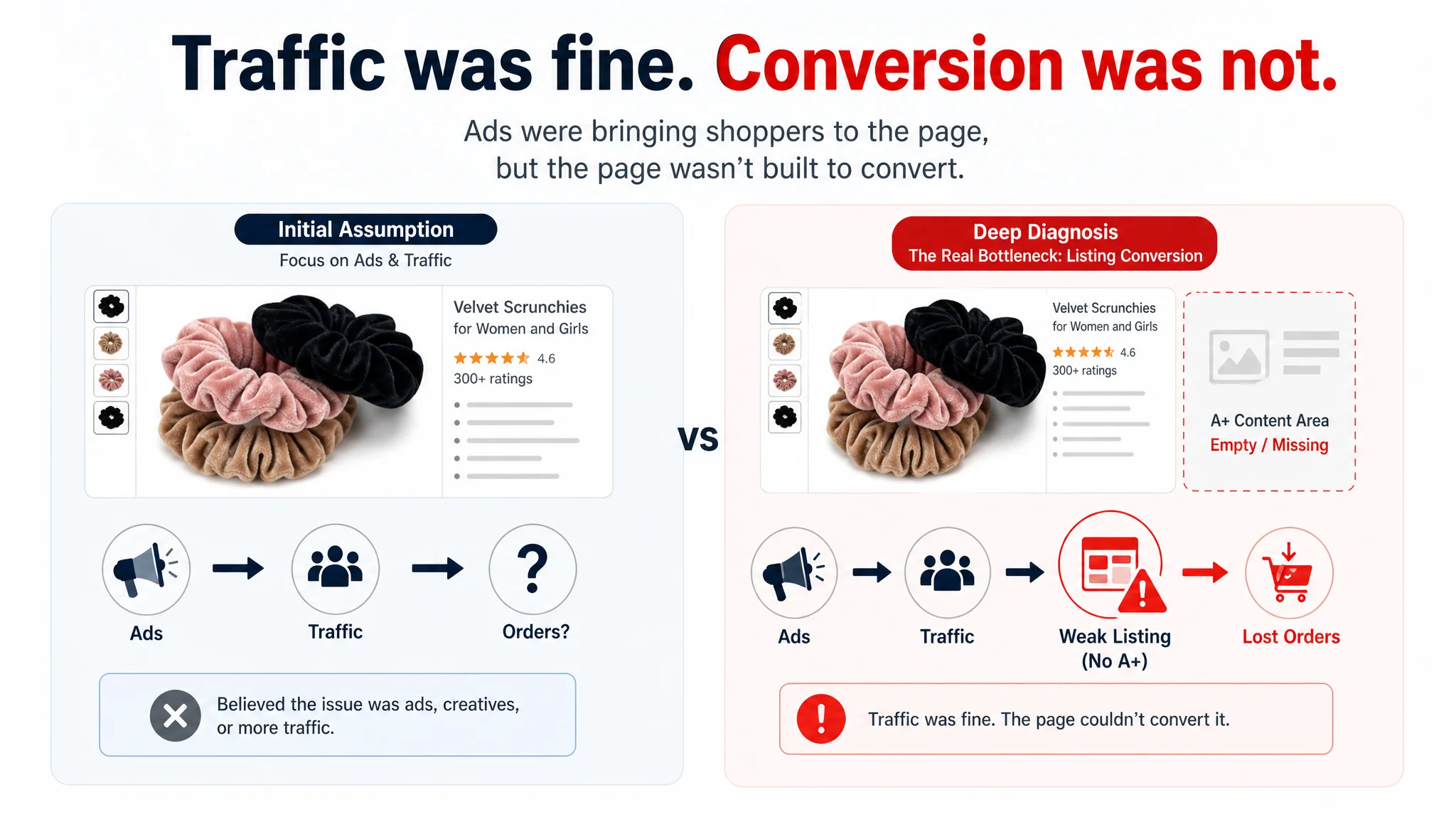
A hair accessories seller provided a useful example of why isolated signals can be misleading. The listing had category-appropriate main images, a 4.6-star rating, and more than 300 reviews, so the team initially believed the page was fundamentally healthy. Because advertising costs were becoming harder to justify, they focused on increasing traffic, refining creatives, and adjusting campaigns. However, clicks still did not produce enough orders.
A full listing diagnosis changed the interpretation. The page received a total DeepBI score of 53/100, compared with 87/100 for a benchmark competitor. The largest gap was not in the main image or star rating, but in the detail and A+ dimension, where the listing scored 0/25 against the competitor’s 23/25. Ads were bringing shoppers to the page, but the page was not providing enough information or confidence to complete the decision. This is why free tools should be treated as starting points: the useful question is not only where traffic is coming from, but whether the listing can convert that traffic.
 DeepBI is neither a free tool nor a free-tool vendor. It is a data-driven workflow platform for Amazon listing diagnosis and optimization. Its diagnostic process can score key listing dimensions, compare observable competitor attributes, and connect search-term and advertising signals with listing recommendations. Once an approved change is applied, a visual iteration event can be linked to ad reporting so sellers can examine subsequent CTR movement. This establishes a feedback loop between listing decisions and performance data, helping operators evaluate changes more systematically while keeping free tools in their proper role: useful starting points rather than substitutes for an integrated workflow.
Free Amazon Keyword Tool: turning seed terms into an opportunity map
A seed keyword or ASIN is a starting point, not a complete organic-search strategy. From a seed term, sellers can expand into related phrases, use-case variations, and more specific queries. An ASIN can support a broader market workflow: identify its leaf category, review leading products, and apply semantic and product-similarity filters to find comparable search language and competing offers.
The practical advantage lies in separating broad visibility from actionable shopper intent. A term such as “wireless headphones” may show substantial demand, but it can also encompass many use cases and levels of purchase readiness. More specific phrases can reveal clearer needs, including a feature, audience, compatibility requirement, or usage context. These long-tail terms may provide more useful direction for title, bullet-point, and advertising decisions because the relationship between the query and the product is easier to assess.
Search-demand signals still require careful interpretation. Impressions, clicks, CTR, conversions, CVR, and order value can help prioritize opportunities, but they do not guarantee additional traffic, a higher BSR, or profitable sales. A high-volume term with weak CVR may be less valuable than a narrower query with stronger product fit. Sellers should assess each opportunity against relevance, conversion evidence, and ACoS rather than treating demand as a forecast.
A listing diagnosis in the hair accessories category shows why keyword selection and page execution cannot be separated. The customer’s title began with “12 Pcs,” while the core product phrase “Hair Scrunchies” appeared later. It also used “Suitable for Various Occasions,” which occupied title space without adding a clear search or purchase reason. The benchmark competitor emphasized the product type and variety more directly through language such as “12 Colors.” The issue was not simply that the customer lacked relevant words; the title was not organizing them around search relevance and shopper scanning behavior.
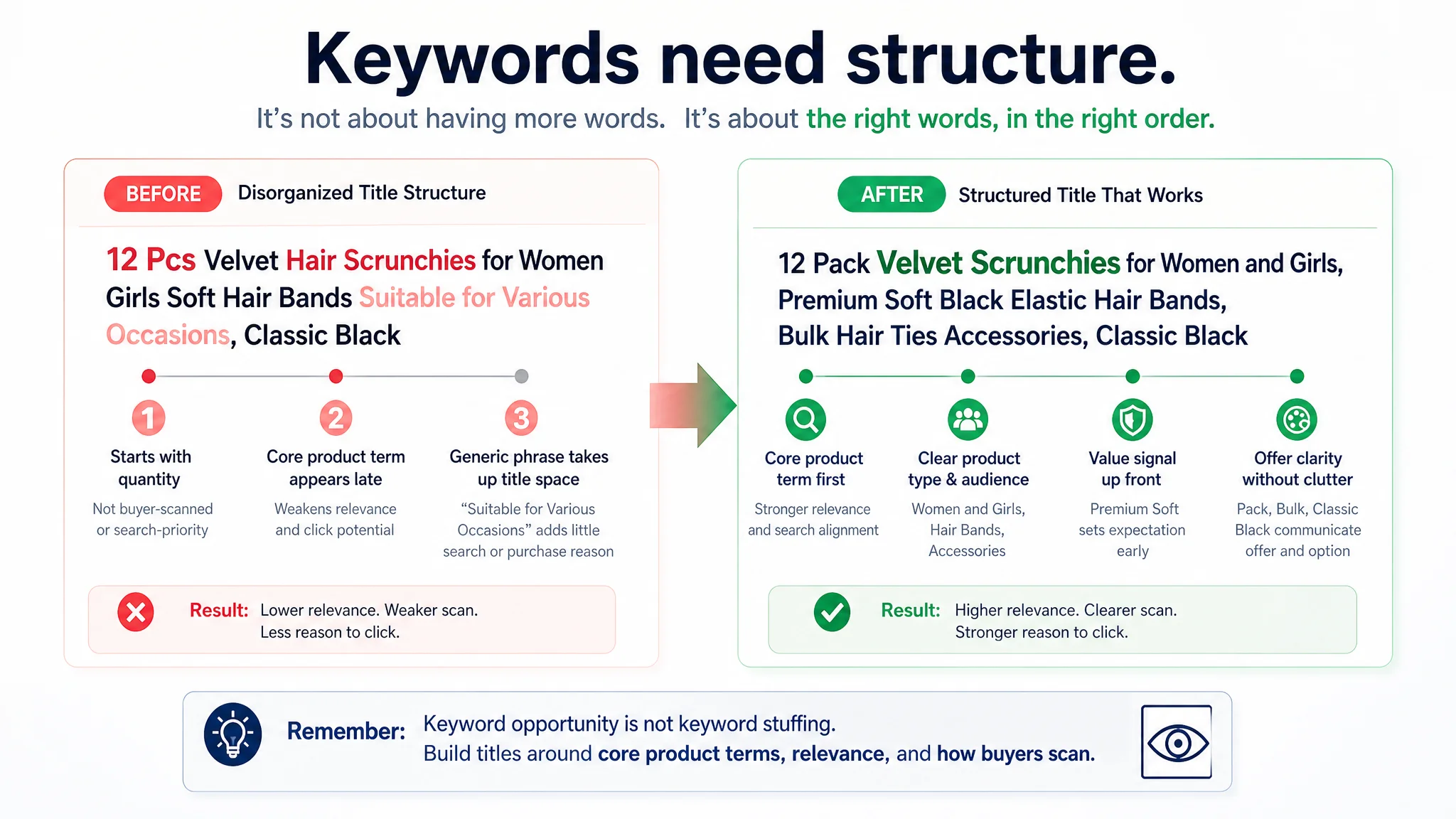 The proposed direction placed “Velvet Scrunchies” earlier and removed less productive wording. Terms such as “Pack,” “Hair Bands,” and “Accessories” were aligned more closely with the category, while “Premium Soft” established a clearer quality expectation. This illustrates the difference between collecting keywords and building an opportunity map: a keyword becomes useful only when its intent, product fit, and position within the listing are understood.
DeepBI can support this screening step by analyzing search, click, conversion, and order-value data as inputs to an organic workflow. It can help weight high-conversion terms and connect keyword findings with listing priorities. However, DeepBI’s keyword-screening capability is part of its broader data-driven workflow, not a claim that it provides a free Amazon keyword-tool feature. The execution step is to use the resulting opportunity map to guide keyword selection, listing refinement, and subsequent KPI review.
Find Keyword Opportunities: relevance, specificity, and competitor layout gaps
Keyword opportunity discovery should begin with shopper intent and category context rather than search volume alone. A broad term may define the product category, but it can also combine several use cases, audiences, and expectations that do not match the product. A more specific phrase may have a clearer functional purpose and greater potential to improve CTR and CVR when the listing addresses that purpose directly.
Use a two-stage comparison:
- Broad keyword: Confirm the category relationship and the type of shopper need represented.
- Specific keyword: Check whether a use case, feature, audience, or product parameter more precisely matches the product’s verified function.
The strongest candidates are specific terms that fit the product and reveal a gap in Amazon listing presentation. Review comparable Amazon listings—not unrelated products or listings from other marketplaces—and assess how well they serve the intent through their titles, five-point descriptions, images, and A+ content. A competitor may rank for a relevant search concept while using a weak title, omitting a key use case, applying poorly matched search terms, or failing to explain an important pain point. These observable gaps provide practical direction for keyword placement and listing refinement.
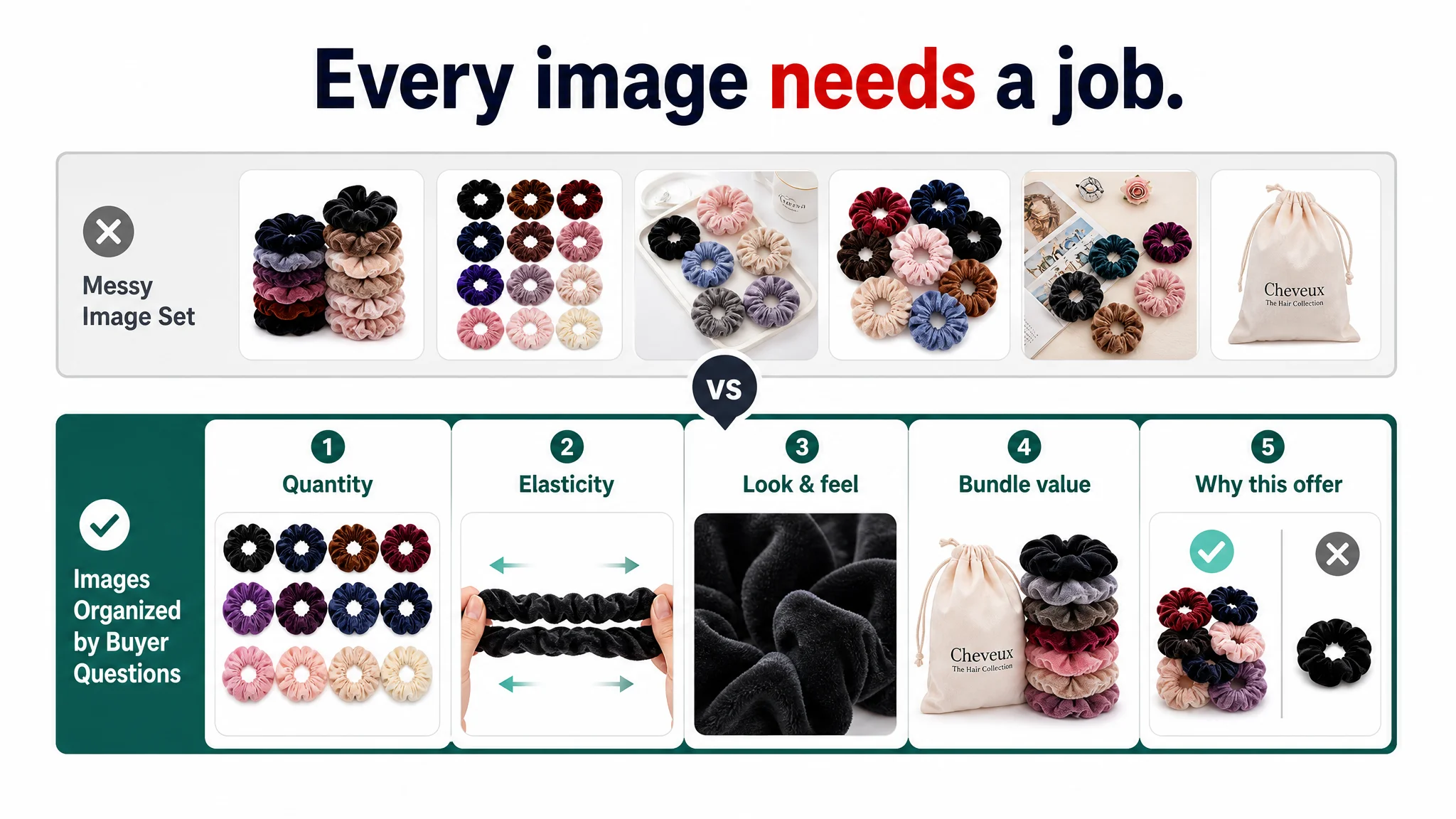
The same hair scrunchies listing demonstrated this through competitor layout analysis. Its main-image score was 24/25, almost equal to the benchmark competitor’s 25/25, which could have suggested that the visual content was already sufficient. A closer review showed a different problem: the customer had several images, but they were not organized around a decision sequence. The images included product-only views, scene shots, a parameter diagram, and a bag image, yet their composition and lighting were inconsistent and the scenes did not always feel realistic.
The competitor used cleaner quantity layouts, a simple elasticity diagram, close-up material details, lifestyle images, and a direct comparison block. The difference was not merely aesthetic. The competitor’s image set answered questions such as “How many pieces are included?”, “Will the product stretch?”, “Will it work in daily life?”, and “Why should I choose this offer?” in a more structured way. This is a competitor-layout gap that keyword data alone cannot reveal.
 DeepBI Organic keyword screening helps turn this review into a prioritized opportunity set. It can connect extracted search terms with seller-side signals such as impressions, clicks, orders, CTR, and CVR, while also considering order-value signals where available. Treat these metrics as screening evidence, not confirmed Amazon ranking weights. A candidate with strong click and conversion signals may warrant attention before a higher-volume term that attracts poorly matched traffic.
The execution step is to document each opportunity by intent, category fit, supporting CTR/CVR or order evidence, and the exact competitor-layout gap. This keeps keyword selection tied to listing actions that can strengthen relevance, improve conversion, and support more disciplined organic growth.
Free Amazon PPC Audit Tool: reading ad diagnostics for organic insight
A free Amazon PPC audit can do more than identify wasted spend. By reviewing campaign structure, search-term performance, CTR, CVR, ACoS, and conversion patterns, sellers can extract evidence for organic keyword research. Search terms that generate qualified clicks and conversions are useful candidates for further relevance testing, particularly when they align with the product’s actual features and customer intent.
The key distinction is between visibility and ranking. A sponsored placement may put a product in front of shoppers, but it does not guarantee a higher organic position. PPC performance should therefore be treated as supporting evidence, not proof that Amazon has rewarded a keyword with a stronger organic rank. Any expected impact should be assessed through organic impressions, keyword placement, BSR movement, CVR, and the listing cycle time needed to implement and evaluate changes.
This distinction also helps explain why the hair scrunchies seller’s initial diagnosis was incomplete. The team saw clicks that were not turning into enough orders and believed that campaigns, bids, or creative quality needed more attention. Standard keyword and bid adjustments did not change the underlying trajectory because the main constraint was further down the funnel. The page had an empty A+ section, a title that did not surface its strongest search and offer logic, unstructured images, and bullets that lacked sufficient specifications and reassurance.
In this situation, more traffic would not have solved the central problem. It would have sent additional shoppers into the same information gap. The case therefore supports a practical PPC principle: when clicks are available but conversion remains weak, audit the page that receives the traffic before assuming the traffic source is the primary failure point.
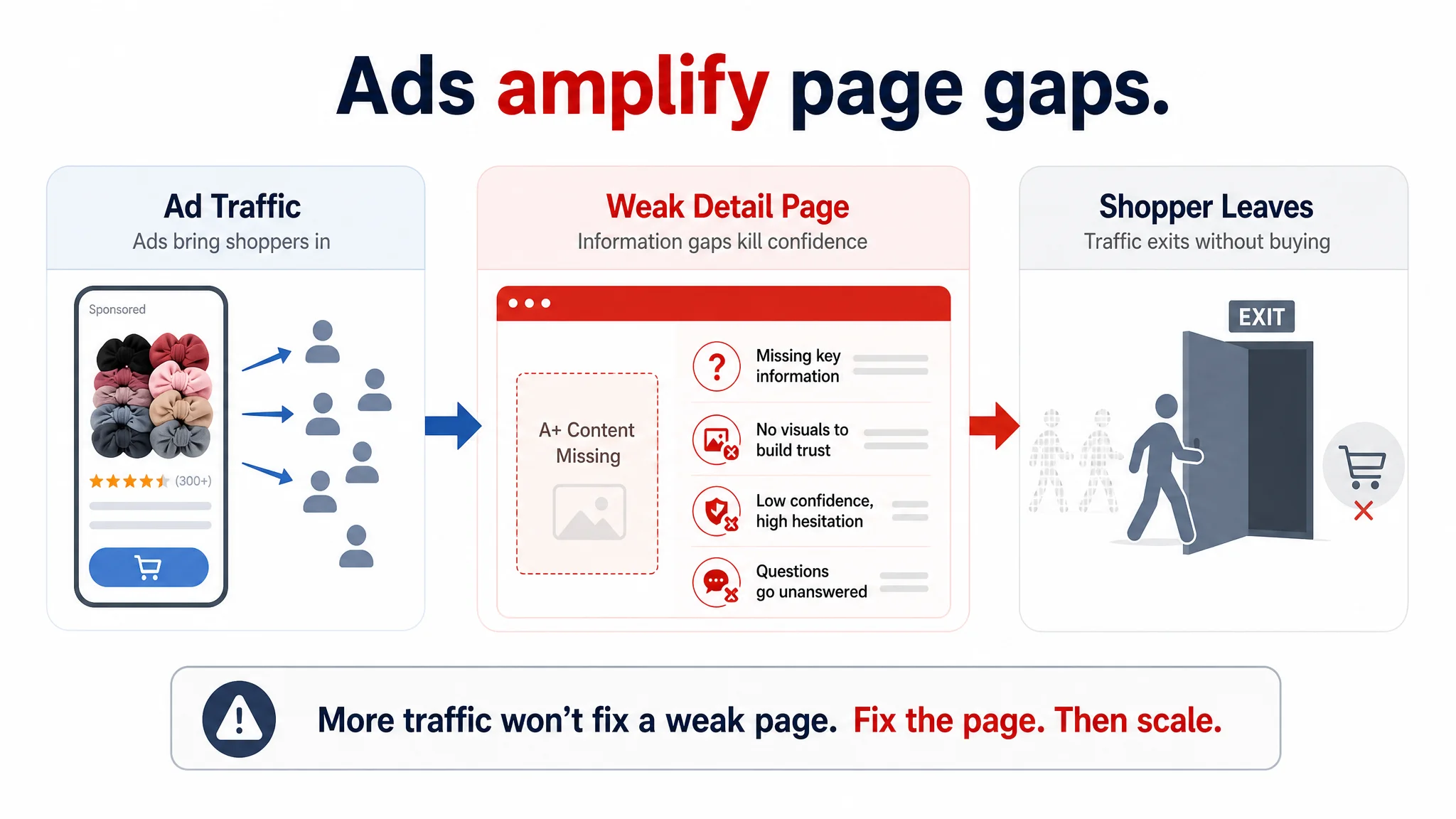 DeepBI Ads Quant supports this diagnostic process by quantifying ad traffic through its funnel and supplying ad data as an input for organic keyword discovery. Stable advertising signals can help identify search terms or product attributes associated with stronger conversion performance. Those candidates can then be compared with the product’s listing content, search intent, and organic visibility before being prioritized for title, bullet, backend keyword, or visual optimization.
Many sellers also believe that CTR influences rankings because it reflects how attractive a product appears in search results. Amazon does not confirm the exact weight of CTR in organic ranking, so it should not be presented as a confirmed direct ranking factor. Optimizing CTR remains sound practice because stronger click appeal can improve traffic quality and create better conditions for evaluating CVR and ACoS. Use PPC data to develop testable organic hypotheses, not ranking guarantees.
Free Chrome Extension for Amazon FBA Sellers: on-page listing signals
A browser extension can turn an Amazon product page into a practical diagnostic snapshot. Rather than reviewing a listing solely by intuition, sellers can examine page-level signals that indicate whether the offer is clear, credible, and easy to evaluate. These observations matter because organic traffic creates business value only when shoppers understand the product, continue to the detail page, and convert.
Start with the title. Check whether its keyword structure is readable and whether the primary selling point is immediately clear. Review the bullet points for logical order, coverage of shopper pain points, and ease of scanning. Then assess the image information hierarchy: does the sequence explain the product, show relevant use context, and communicate useful size or feature information without overwhelming the shopper? Conversion-oriented content should connect product benefits with evidence rather than merely repeat specifications.
The hair scrunchies listing illustrates how these page-level signals can expose a problem that surface inspection misses. Its bullets focused on gifting, party scenes, and emotional appeal, including themed-party use, but they provided less concrete information about material, comfort, elasticity, and hair protection than the benchmark. The competitor led with functional reassurance and supporting details before adding lifestyle use cases.
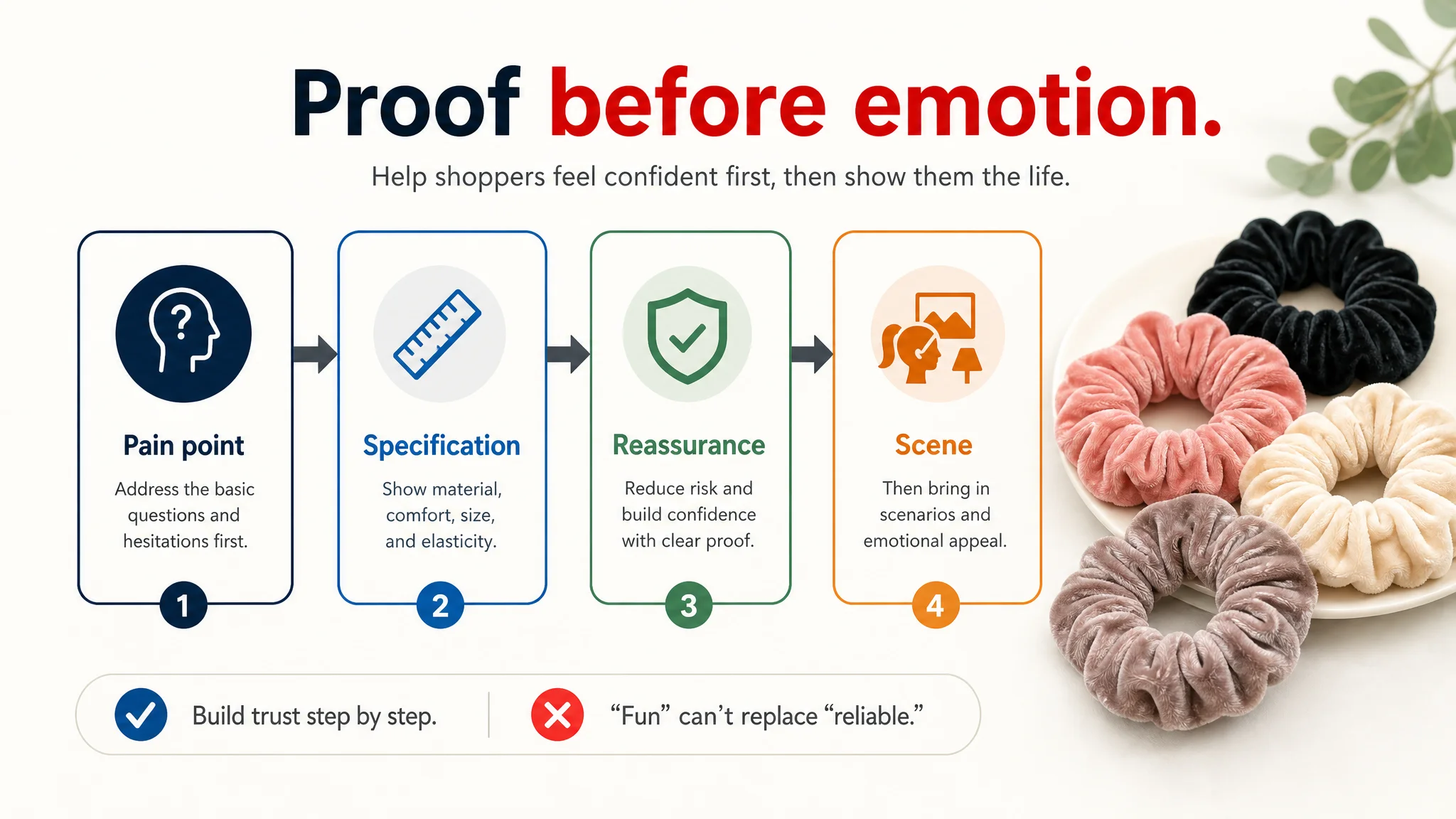 DeepBI’s recommended structure followed a “pain point → specification → reassurance → scene” sequence:
1. Material and hair protection
2. Dimensions and elasticity
3. Use occasions and styling value
4. Color variety and outfit flexibility
5. Gift-set logic, including the included storage bag
Scenes and emotion were not discarded. They were moved behind the information shoppers needed to assess reliability. A listing can be visually attractive and still leave basic purchase questions unanswered. In this case, the page sounded engaging in places, but it did not consistently sound dependable.
These checks help distinguish a traffic problem from a listing problem. Weak CTR may indicate that the search-page presentation lacks sufficient appeal, while weak CVR may suggest that the detail page does not explain the offer or build enough trust. DeepBI can extend these page-level observations by comparing relevant benchmark listings, diagnosing likely CTR and CVR weaknesses, and generating strategies for title, bullet, visual, and detail-page optimization. Sellers can then connect published changes with advertising reports, creating a measurable feedback loop while treating organic improvement as a supported hypothesis rather than a guaranteed ranking outcome.
What Actually Moves Amazon Organic Search Traffic: relevance, performance, and uncertainty
Amazon organic search traffic is best understood as the result of several interacting conditions, not a simple two-signal formula. Relevance and performance provide useful high-level categories, but they do not fully describe how search visibility is determined.
Relevance concerns how closely an ASIN matches a shopper’s query and intent. Title keyword layout, bullet-point coverage, detail-page content, and the product’s semantic fit with comparable listings can all be examined within this category. Performance concerns what shoppers do after exposure: impressions, clicks, orders, CTR, and CVR help show whether a listing attracts attention and converts demand.
Other commonly observed contributors may include fulfillment speed, Prime eligibility, conversion behavior, and listing relevance. These should be treated as areas for investigation rather than confirmed ranking weights. Amazon does not provide a public basis for presenting any single factor—such as CTR, title structure, image quality, or conversion rate—as a confirmed direct ranking driver.
The hair scrunchies case shows how these dimensions interact. The listing had a healthy-looking star rating and a defined product use, but it still scored 53/100 against a benchmark score of 87/100. The review dimension was weaker than the competitor’s, but the most significant deficit was the 23-point gap in detail and A+ content. This meant that relevance and initial credibility were not enough to compensate for weak conversion capacity. The page was not completing the product explanation after the shopper arrived.
It is also important to distinguish between two measures that are often confused:
- BSR reflects an ASIN’s sales performance within a category.
- Keyword search position reflects where that ASIN appears for a specific shopper query.
A stronger BSR does not automatically explain visibility for every keyword, and a higher keyword position does not establish a universal ranking rule.
For operators, the practical response is to test rather than guess. Use relevance diagnostics to identify possible query-matching gaps, then use funnel metrics to locate weaknesses in CTR or CVR without treating those metrics as proven ranking causes. DeepBI supports this workflow by connecting listing analysis with advertising and business data, enabling a benchmarked change-and-measure loop. The objective is a clearer path from evidence to action, with effects assessed through CTR, CVR, ACoS, BSR, and listing cycle time.
DeepBI Organic Workflow: keyword screening from click, conversion, and order-value data
Advertising data can show which search terms attract attention and which generate commercially meaningful engagement. Rather than treating every ad-derived term as an organic target, sellers can use DeepBI to connect search-term performance with listing diagnostics and make more selective keyword decisions.
The workflow begins with search-term data from advertising reports. DeepBI can connect signals such as impressions, clicks, orders, CTR, and CVR, then identify terms showing high CTR and high CVR. These terms are stronger candidates for organic reinforcement because they have demonstrated both shopper interest and conversion potential in the seller’s own account data. High order value can serve as an additional operating criterion when prioritizing terms, although it should be assessed using the seller’s available business data rather than treated as a universal built-in threshold.
The next step is to remove terms with low conversion, weak CTR, or limited order-value contribution. Qualitative screening is safer than applying unsupported numeric cutoffs: retain high-intent terms, review borderline terms, and exclude search terms that consume spend without producing sufficient commercial value. This helps protect ACoS while concentrating organic effort on keywords more likely to support CVR and sustainable BSR improvement.
However, a strong advertising term still needs a page capable of receiving and converting that demand. In the hair scrunchies case, the team could have continued searching for better keywords, but the listing’s content gap would have remained. The competitor’s page used its A+ area to explain color variety, material, elasticity, durability, and everyday use, while the customer’s A+ section contained no images or structured trust-building modules. Keyword selection without corresponding content execution would therefore have produced more opportunities to send traffic into the same conversion constraint.
This is the Fifth Layer Organic Traffic strategy: convert paid-search evidence into organic keyword decisions rather than managing advertising and listing optimization as separate workflows. The retained terms can then be prepared for later Top of Search reinforcement and listing optimization, including title, bullet, image, and attribute emphasis. DeepBI supports the analysis and weighting process; sellers still need to validate relevance and determine how each selected term should be incorporated into the listing.
DeepBI Organic Workflow: Top of Search reinforcement, TACOS, and natural-order-share monitoring
Keyword screening should lead to a focused reinforcement plan, not simply broader ad coverage. Create dedicated campaigns for high-value, high-conversion search terms, then concentrate budget where relevance and CVR justify stronger Top of Search exposure. This structure helps isolate keyword performance and provides cleaner signals for deciding whether a term warrants further Listing or visual optimization.
Top of Search reinforcement can generate short-term visibility, clicks, and conversion data that support a longer organic-growth process. It does not directly purchase organic rank, and concentrated spend cannot guarantee a ranking increase. The useful mechanism is indirect: relevant traffic may produce stronger conversion signals, while those signals help identify which terms and product attributes should receive greater weight in the Listing.
The case provides a practical reason to sequence these actions carefully. DeepBI did not recommend continuing to force more traffic through the hair scrunchies page first. The listing had a 34-point total gap to the benchmark, including a 23-point A+ deficit. Increasing bids or expanding keyword coverage before addressing that gap would have increased the number of shoppers exposed to an incomplete product story without resolving their concerns about comfort, durability, quantity, material, or daily use.
The appropriate order was to strengthen the listing’s conversion capacity: clarify the title, structure the bullets, assign each image a decision role, and build an A+ flow that connected variety and style with functional proof and trust. Only after the page became more capable of converting traffic could advertising data provide a cleaner basis for evaluating keyword reinforcement.
DeepBI can feed stable advertising signals and winning search terms into Listing and visual optimization priorities. After implementation, operators can compare CTR, CVR, ACoS, sales, and BSR indicators with the pre-change period rather than judging the campaign by ad clicks alone. This closes the loop between keyword screening, advertising reinforcement, and Listing execution.
TACOS should remain a central efficiency check. Calculate it as total advertising cost relative to total sales, and interpret its movement alongside sales and organic-order trends rather than pursuing an isolated target. A campaign may deliver traffic while weakening overall economics if total sales do not support the advertising investment.
Track natural-order share as a monitoring indicator to observe whether organic orders increase as relevance and conversion improve. Reviewing Top of Search reinforcement, healthier Listing signals, TACOS, and natural-order share together helps operators distinguish temporary paid visibility from a more durable organic-growth pattern without overstating the evidence.
Weekly DeepBI Organic Growth Loop: a repeatable operating cadence
Organic search growth is easier to manage when it becomes a weekly decision loop rather than a series of isolated listing edits. Begin by reviewing ad-derived keyword data and identifying terms with strong intent, stable conversion signals, or meaningful sales relevance. These terms can become candidates for organic testing and reinforcement because they provide observed customer-response evidence rather than assumptions based solely on keyword volume.
For priority terms, apply Top of Search reinforcement as a paid-support action while testing their role in the listing. The objective is not to claim that advertising directly creates organic ranking. Instead, stronger exposure can provide additional performance signals that may help determine whether a keyword deserves greater emphasis in the title, images, bullets, or A+ content.
The next step is to evaluate the listing funnel. Weak CTR points toward a search-result presentation issue, such as the main image or title. Weak CVR points more toward detail-page information, trust, or selling-point communication. DeepBI diagnostics and multidimensional scoring can connect these observed patterns with testable listing changes. After an edit, compare subsequent advertising and listing performance with the pre-change period, treating the edit as a measurable event point rather than proof of algorithmic causality.
A practical weekly review should also track:
- CTR and CVR for priority keyword and listing tests.
- ACoS and TACOS to assess whether paid support remains commercially sustainable.
- BSR alongside sales and advertising movement.
- Natural-order share as a seller-side monitoring field, not as a documented DeepBI metric.
- Listing cycle time, so testing does not become stalled in manual review.
The hair scrunchies listing shows why this cadence should include page diagnosis, not just campaign review. If the team had looked only at clicks, bids, and ACoS, it could have continued to treat the problem as an advertising issue. A weekly comparison of listing dimensions would have highlighted the empty A+ section, the title-structure gap, the under-specified bullets, and the lack of decision logic in the image sequence. These findings would have redirected the next action from “buy more traffic” to “improve the asset receiving the traffic.”
Over successive cycles, these comparisons can reveal how ad signals inform listing priorities, how listing changes generate new evidence, and how the next review refines the organic-growth hypothesis. A pattern may support a test and may lead to improved organic traffic, but the conclusion should remain evidence-based rather than being presented as a confirmed Amazon effect.
FAQ: free tools, keyword priorities, PPC-to-organic, and DeepBI scope
Are there any free Amazon tools available to sellers?
Yes. Free tools may provide useful starting signals for keyword discovery, ad diagnostics, and page-level listing review. A free Amazon keyword tool, free Amazon PPC audit tool, or free Chrome extension for Amazon FBA sellers can reduce research barriers. These tools should be treated as entry points rather than complete growth systems because their outputs still require validation against product relevance, shopper intent, CTR, CVR, and listing quality.
A page-level review is especially important when a listing appears healthy at first glance. One hair accessories listing had a strong star rating and acceptable main images, but a full comparison revealed a 0/25 A+ score and a 34-point overall gap to the benchmark. A free tool might help identify individual signals, but the operator still needs to connect them and determine whether the actual constraint is traffic, relevance, or conversion capacity.
What is the best way to use free keyword tools for organic traffic?
Start with a seed term or ASIN, then expand into related searches. Prioritize specific, intent-driven phrases that match the product’s actual features and use cases instead of selecting broad terms based solely on potential volume. Next, compare those candidates with click, conversion, and order-value signals where available. This process helps identify keyword opportunities more likely to support relevant traffic and stronger CVR.
The selected terms should then be checked against the listing itself. If the title places the core product phrase too late, the bullets do not explain functional benefits, or the A+ section is empty, keyword research alone will not complete the organic-growth process. The opportunity map should therefore connect each term with a specific listing action and a later measurement plan.
Does PPC directly increase organic search rank?
No direct or guaranteed increase should be assumed. Sponsored placements do not buy organic rank. Ad data can still show which search terms attract clicks and conversions, making PPC a useful research signal. Many sellers believe CTR influences rankings because it reflects product attractiveness; Amazon does not confirm the exact signal weights, but improving CTR remains sound listing practice.
When clicks do not produce orders, do not automatically conclude that the campaign is the only problem. In the hair scrunchies case, the team initially focused on ads and creatives, but the deeper issue was that the product page lacked the A+ content and structured proof needed to convert visitors. PPC can reveal demand and traffic behavior, but the listing still has to complete the sale.
How does DeepBI help increase Amazon organic search traffic?
DeepBI can screen keywords using CTR, CVR, and order-value signals, analyze ad-funnel performance, diagnose listing weaknesses, support Top of Search reinforcement, and monitor TACOS alongside natural-order share. It can help connect ad evidence with listing improvements without guaranteeing ranking outcomes.
Its listing workflow can also make differences between a customer page and a benchmark more visible. In the hair scrunchies case, the diagnosis connected the advertising problem with specific page issues: a title that did not prioritize the strongest product phrase, bullets that lacked sufficient proof, images without a clear decision sequence, and an empty A+ section. This type of diagnosis helps sellers prioritize the bottleneck rather than repeatedly adjusting the most visible metric.