

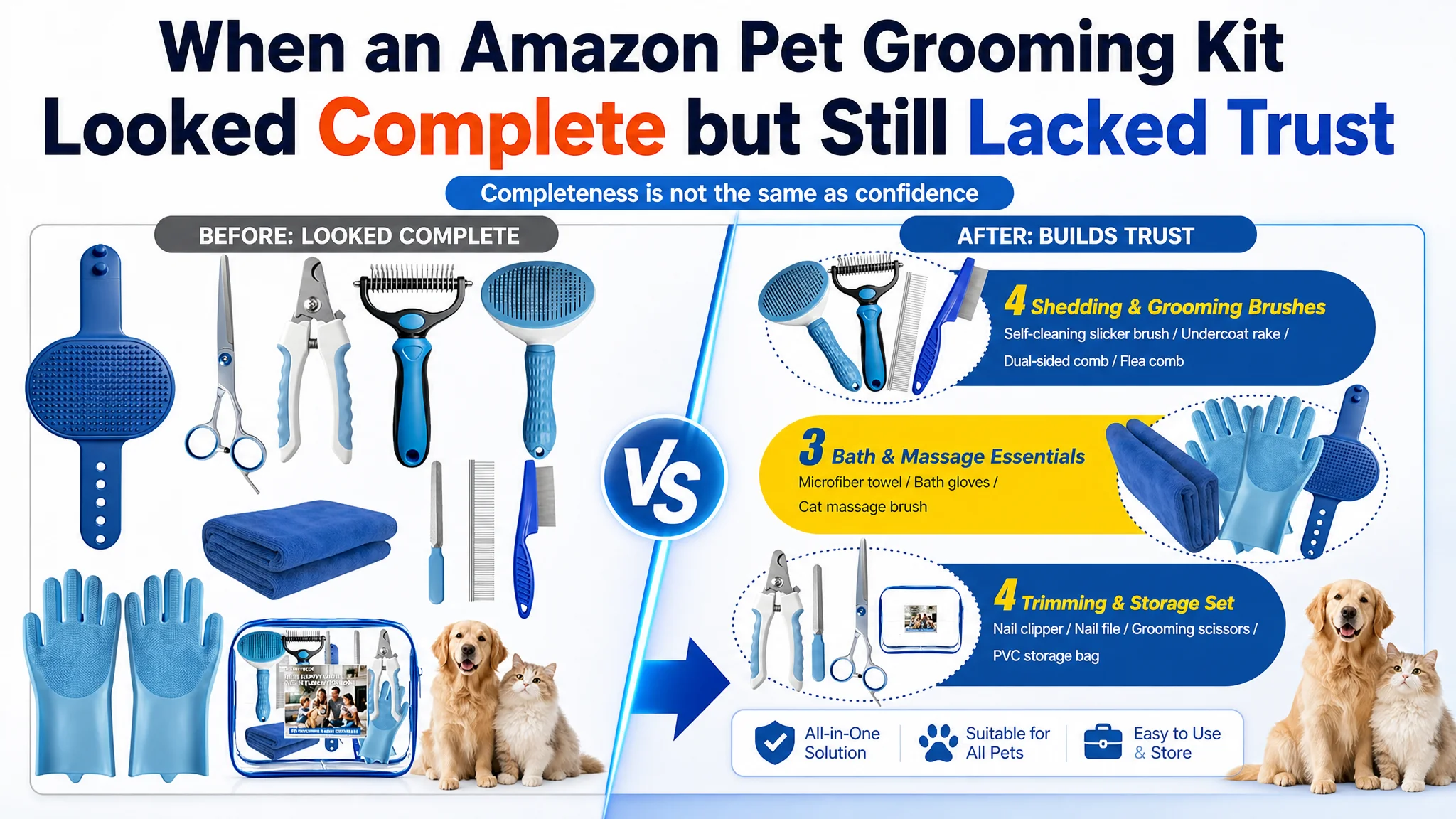
This case follows an Amazon seller in the US pet-care category whose 11-piece dog and cat grooming kit appeared comprehensive, but whose Listing still carried a clear competitive disadvantage. The customer’s first instinct was to make the product look more complete and improve the way its many tools were presented. Yet the real product-page problem was not a lack of components. It was the lack of a convincing path from “this kit includes everything” to “I feel confident using it for my pet.”
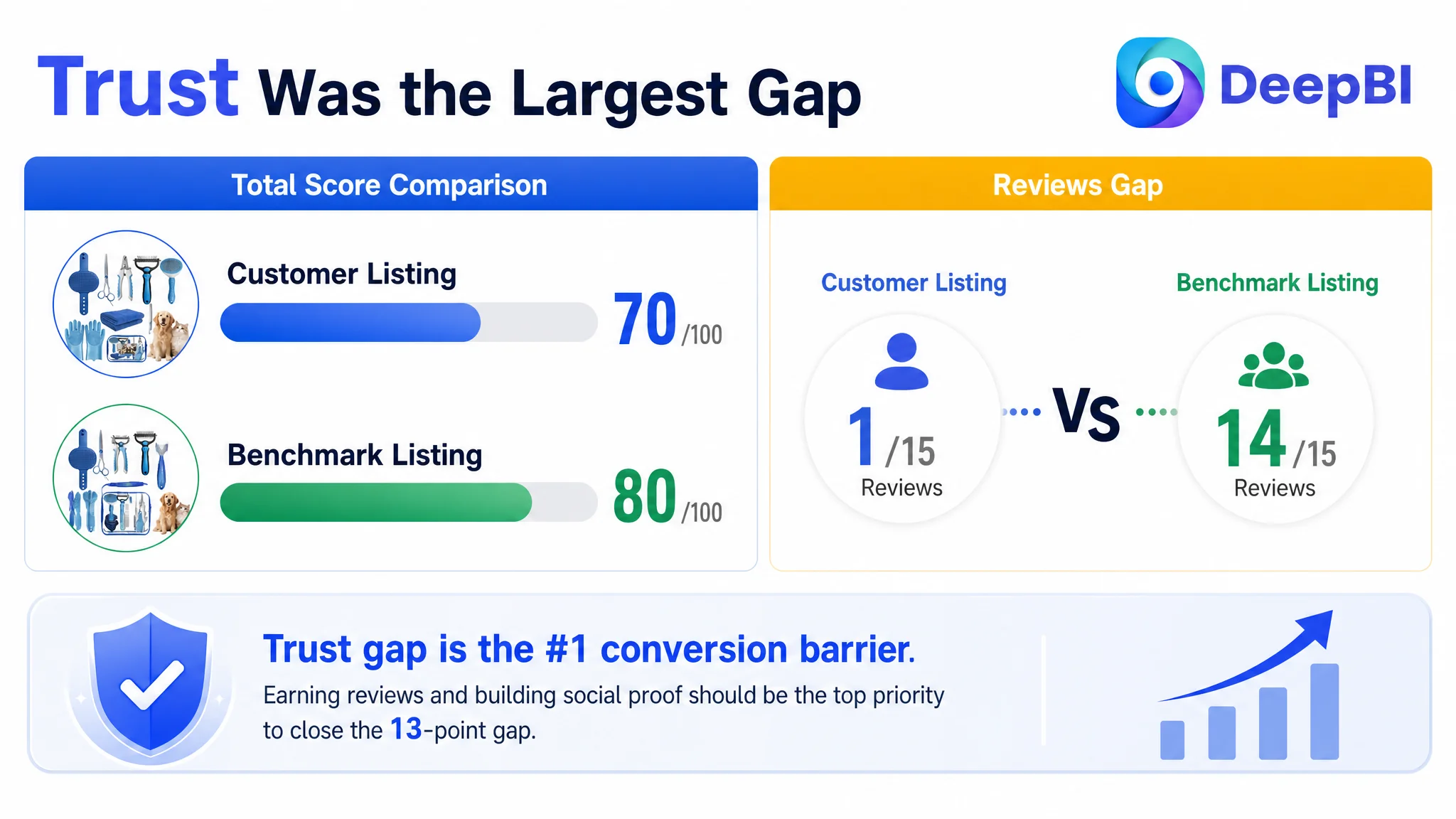
DeepBI’s diagnosis compared the Amazon Listing with a closely matched high-performing competitor. The customer’s Listing scored 70 out of 100 against the benchmark’s 80. The largest gap was not in the number of tools, the A+ content, or even the overall main-image score. It was trust: the Listing had no valid reviews, while the benchmark had 915 reviews and a 4.6-star rating.
The later optimization therefore focused on decision logic rather than cosmetic expansion. The title needed stronger keyword and value prioritization, the main images needed clearer proof for the self-cleaning brush and double-sided undercoat rake, and the A+ page needed to turn a long tool list into a sequence of safety, suitability, and use-case evidence. For other Amazon sellers, the case is a reminder that a complete product does not automatically create a complete buying argument.
The Listing Did Not Lack Features. It Lacked a Strong Reason to Believe
An 11-piece grooming kit has an obvious selling point: it appears to cover a large share of daily pet-care needs in one purchase.
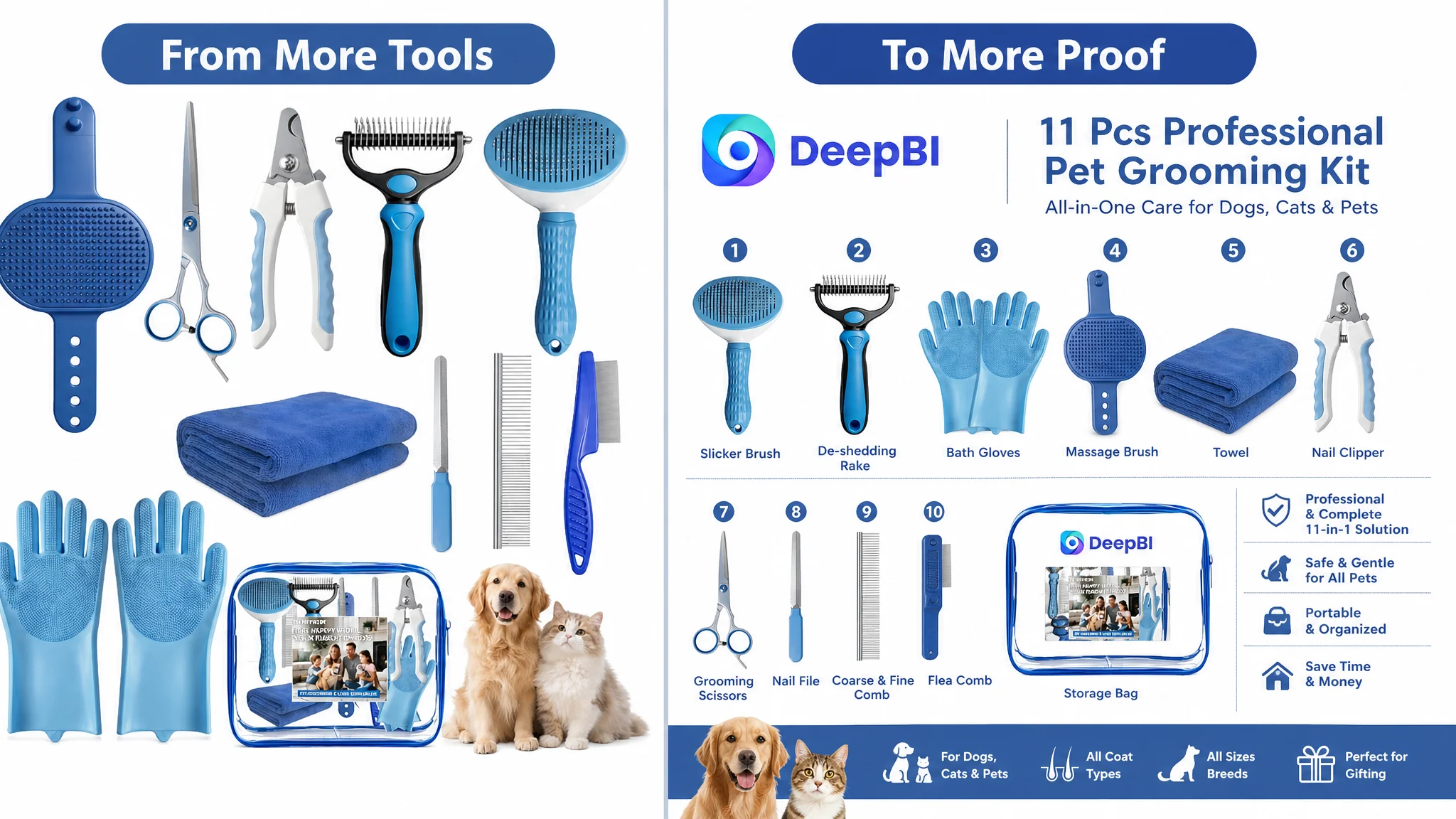
The Listing included a self-cleaning slicker brush, a double-sided deshedding undercoat rake, grooming scissors, nail clippers, a nail file, coarse and fine combs, a flea comb, bath gloves, a massage brush, a microfiber towel, and a portable storage bag. It also addressed dogs, cats, and rabbits, with suitability claims covering different sizes and coat types.
On paper, the offer was broad.
The problem was that breadth alone does not settle the buyer’s main concerns:
- Will the brushes work for this pet’s coat?
- Can the rake remove tangles without scratching sensitive skin?
- Is the nail clipper safe to use at home?
- Does the self-cleaning brush actually release collected hair easily?
- Will the kit make grooming more manageable, or simply add more tools to store?
These are product-page conversion questions. They sit between the click and the purchase decision.
The Listing had enough components to support a strong offer. It did not yet organize those components into enough proof.
That distinction shaped the diagnosis. The page did not need every element replaced. It needed its strongest tools to carry more of the decision-making burden.
The Initial Direction Was Too Close to “Show More”
The customer’s Listing already presented a large amount of information. The main images displayed the kit and its accessories. The A+ content explained individual tools, suitability, and use scenarios. The bullet points connected grooming problems with practical solutions, including shedding, tangling, bathing, trimming, and nail care.
This created a natural but incomplete optimization direction: if the kit contains more pieces and more use cases, then showing more of them should make the value clearer.
That logic is understandable. It is also where many Amazon sellers become trapped.
A multi-function product can easily turn its own completeness into visual noise. When every tool receives equal attention, the buyer may understand that the kit is full without understanding which tools matter most, which risks have been addressed, or how the set fits into a real grooming routine.
The customer’s page was therefore not suffering from a simple information shortage. It was suffering from priority dilution.
The original main-image score was actually higher than the benchmark’s: 26 versus 23 out of 30. That made the issue more difficult to see. A low score would have suggested a straightforward image problem. Instead, the deeper gap appeared inside the way the images performed their individual roles.
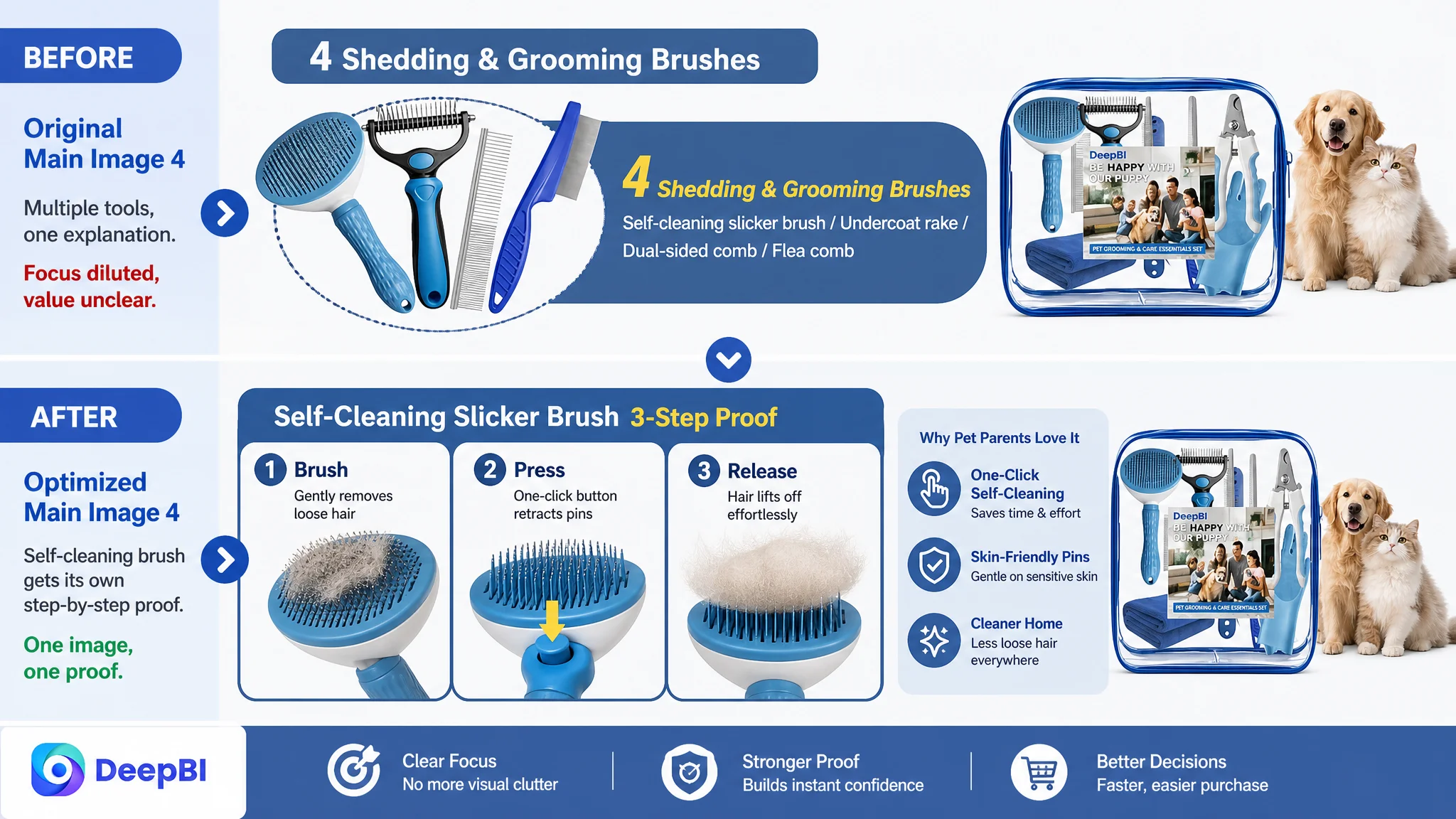
The first image communicated an all-in-one kit, but the multi-product layout was somewhat crowded. Smaller tools were harder to identify, and the presence of pet figures competed with the product pieces for attention. The fourth and fifth images also combined multiple tools instead of proving one high-value function in depth.
The page was showing more. It was not always proving more.
The Competitive Gap Was Not Where the Team Expected
DeepBI’s five-dimension comparison produced a more precise picture:
- Title: Customer Listing: 14/20, Benchmark Listing: 17/20
- Main image: Customer Listing: 26/30, Benchmark Listing: 23/30
- Bullet points: Customer Listing: 8/10, Benchmark Listing: 7/10
- A+ content: Customer Listing: 21/25, Benchmark Listing: 19/25
- Reviews: Customer Listing: 1/15, Benchmark Listing: 14/15
- Total: Customer Listing: 70/100, Benchmark Listing: 80/100
The result changed the optimization priority.
The customer’s bullet points and A+ content were not broadly weaker than the benchmark. In several respects, they were stronger. The bullet points connected pain points with solutions more effectively, using scenarios such as shedding, mat removal, bathing, and nail care. The A+ page covered more tools and included more pet-interaction scenes.
But the reviews dimension created a 13-point disadvantage. The customer Listing had no rating data, no review count, and no customer comments on the first page. The benchmark had 915 reviews, a 4.6-star average, and visible customer experiences supported by images and detailed feedback.
This did not mean that adding reviews could solve the entire Listing problem. It meant that every other element had to work harder because the page lacked the trust layer that a mature competitor already possessed.
The customer was not competing only against another 9-piece or 11-piece kit. It was competing against the certainty created by hundreds of verified customer experiences.
That is why visual and textual changes had to be judged by a stricter standard. The page needed to reduce uncertainty wherever possible without inventing proof it did not have.
The Title Was Losing Search and Conversion Priority
The title score was 14 against the benchmark’s 17.
The issue was not the absence of relevant keywords. The customer’s title included terms such as “Dog Grooming Kit,” “Dog Brush for Shedding,” and references to multiple tools. The weakness was their order and structure.
The core phrase “Dog Grooming Kit” appeared too late. The high-intent shedding problem was not given enough priority near the beginning. The title also became more list-like toward the end, while the benchmark followed a clearer structure:
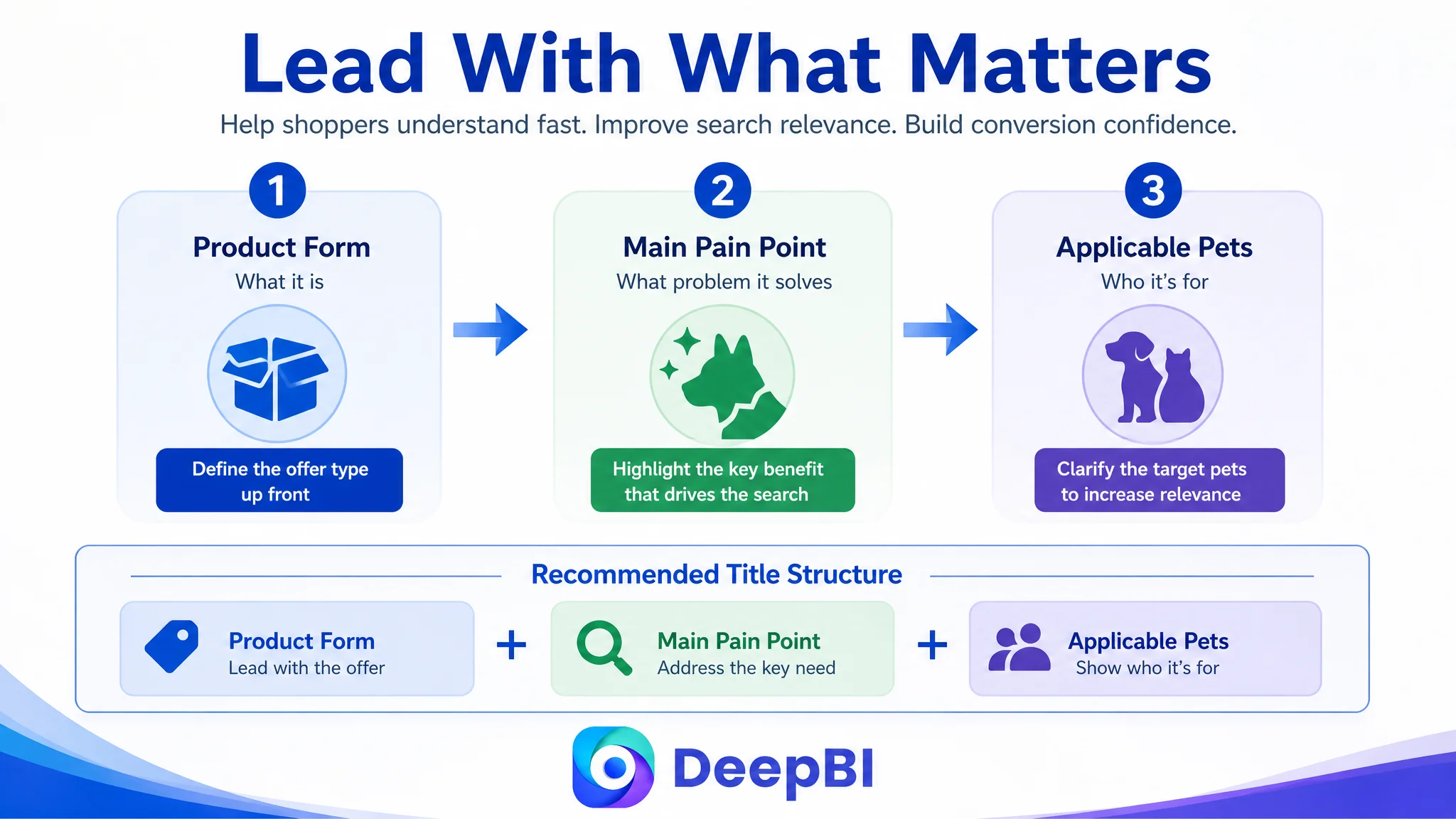
core keyword → primary pain point → product form → key value → applicable pets
The recommended direction brought “11 Piece Dog Grooming Kit” and “Dog Brush for Shedding” forward, then organized the undercoat rake, nail clipper, slicker brush, pet compatibility, and deshedding use case into a more readable sequence.
This was not keyword stuffing. It was a decision about what the shopper should understand first.
The title needed to answer three questions quickly:
1. What is the product?
2. What major grooming problem does it address?
3. Is it suitable for my dog or cat?
The original title contained the ingredients, but not the same level of front-loaded clarity.
The Main Image Score Hid Two Important Proof Gaps
The main image dimension did not require a complete redesign. In fact, image two and image three already performed their intended roles well.
Image two provided a detailed breakdown of the kit’s contents. Image three addressed suitability across small puppies, large dogs, cats, rabbits, and different coat types. Those images helped rational buyers confirm completeness and compatibility.
The more important issue was the allocation of image space.
The first image needed a cleaner value proposition
The first image was intended to confirm the all-in-one promise. However, the product arrangement was crowded enough that some smaller pieces were difficult to identify at a glance.
The recommended change was not to add more elements. It was to make the existing 11 pieces more individually recognizable, reduce the visual space occupied by pet figures, and make “11 Piece Professional Pet Grooming Kit” immediately legible.
The objective was simple: let the shopper understand the offer before asking them to inspect the details.
Image four needed to prove the self-cleaning function
The fourth image combined the slicker brush with another tool. That created a logical gap because the self-cleaning function was one of the brush’s most useful differentiators.
A better image role was to show a clear sequence:
1. Hair is collected during grooming.
2. The button is pressed.
3. The brush releases the collected hair.
The image should focus on this one function rather than splitting attention across several products. It is a small interaction, but it directly answers a practical concern: whether cleaning the brush after grooming will be difficult.
Image five needed to explain the two sides of the undercoat rake
The fifth image also covered too many products. It missed the opportunity to explain the rake’s specialized structure.
The proposed structure separated the two sides:
- The 9-tooth side for dematting and untangling
- The 17-tooth side for thinning and deshedding
This kind of explanation matters because a buyer may otherwise see a double-sided tool without understanding why both sides exist.
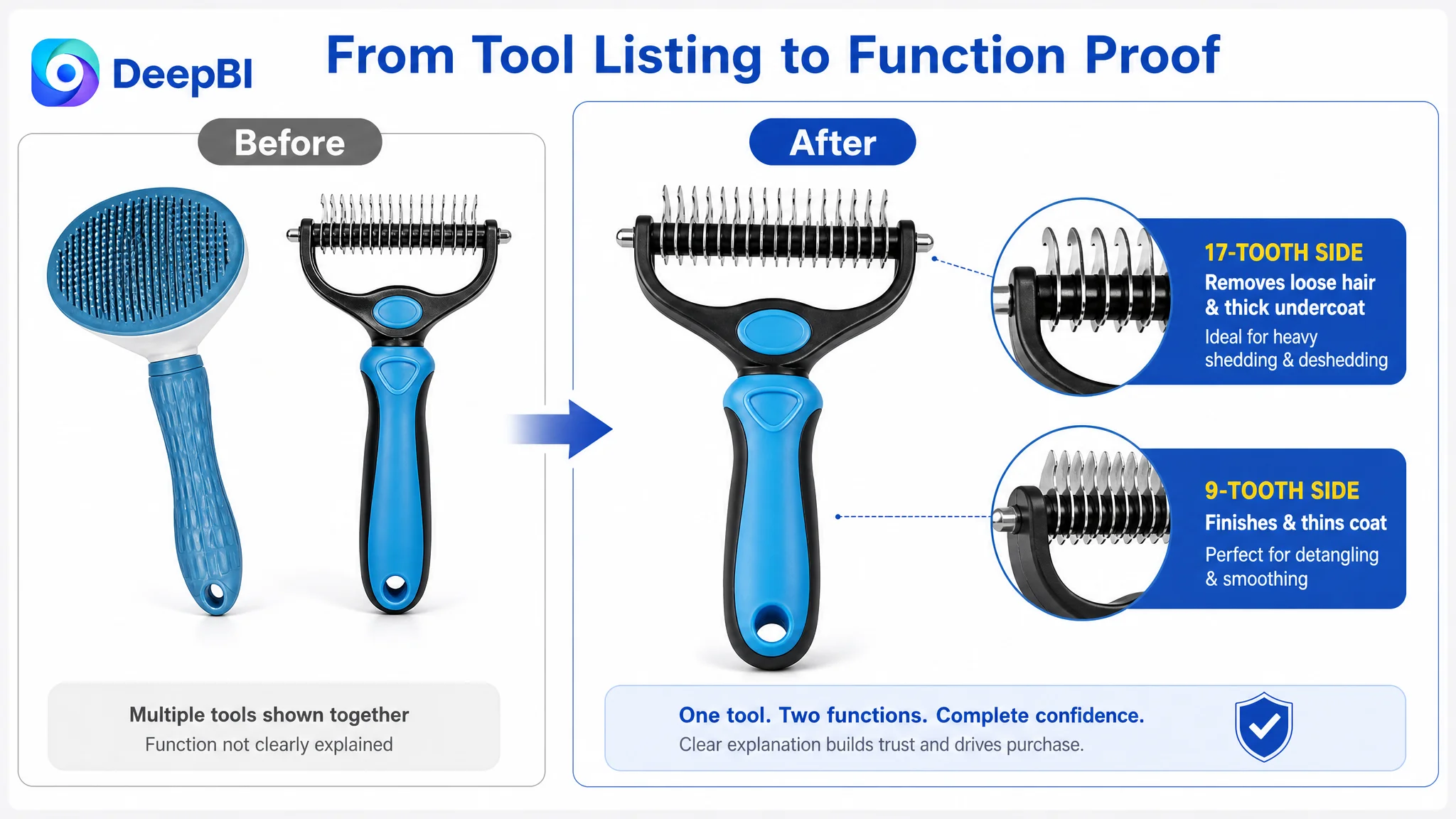
The image sequence had to move from completeness to proof, not from one product collage to another.
The A+ Page Had Coverage but Not Enough Decision Progression
The customer’s A+ content scored 21 out of 25, higher than the benchmark’s 19.
This was an important finding. It ruled out the assumption that the A+ page was simply underdeveloped.
The customer’s page included more independent tool modules, more detailed coverage of grooming accessories, and stronger real-use scenes. It showed dogs and cats interacting with the brushes, included a bath-and-storage combination, and made the kit feel relevant to multi-pet households.
The weakness was structural.
The A+ page treated many tools as separate subjects, but did not always establish a clear progression through the buyer’s concerns. A stronger sequence would be:
1. Preview the kit’s core capabilities.
2. Validate completeness and pet compatibility.
3. Explain the undercoat rake in depth.
4. Prove the self-cleaning slicker brush.
5. Make home trimming feel manageable.
6. Resolve the safety concern around nail clipping.
7. Close with bathing, stress reduction, and storage.
That sequence follows the buyer’s internal questions more naturally than a catalog-style tour of every component.
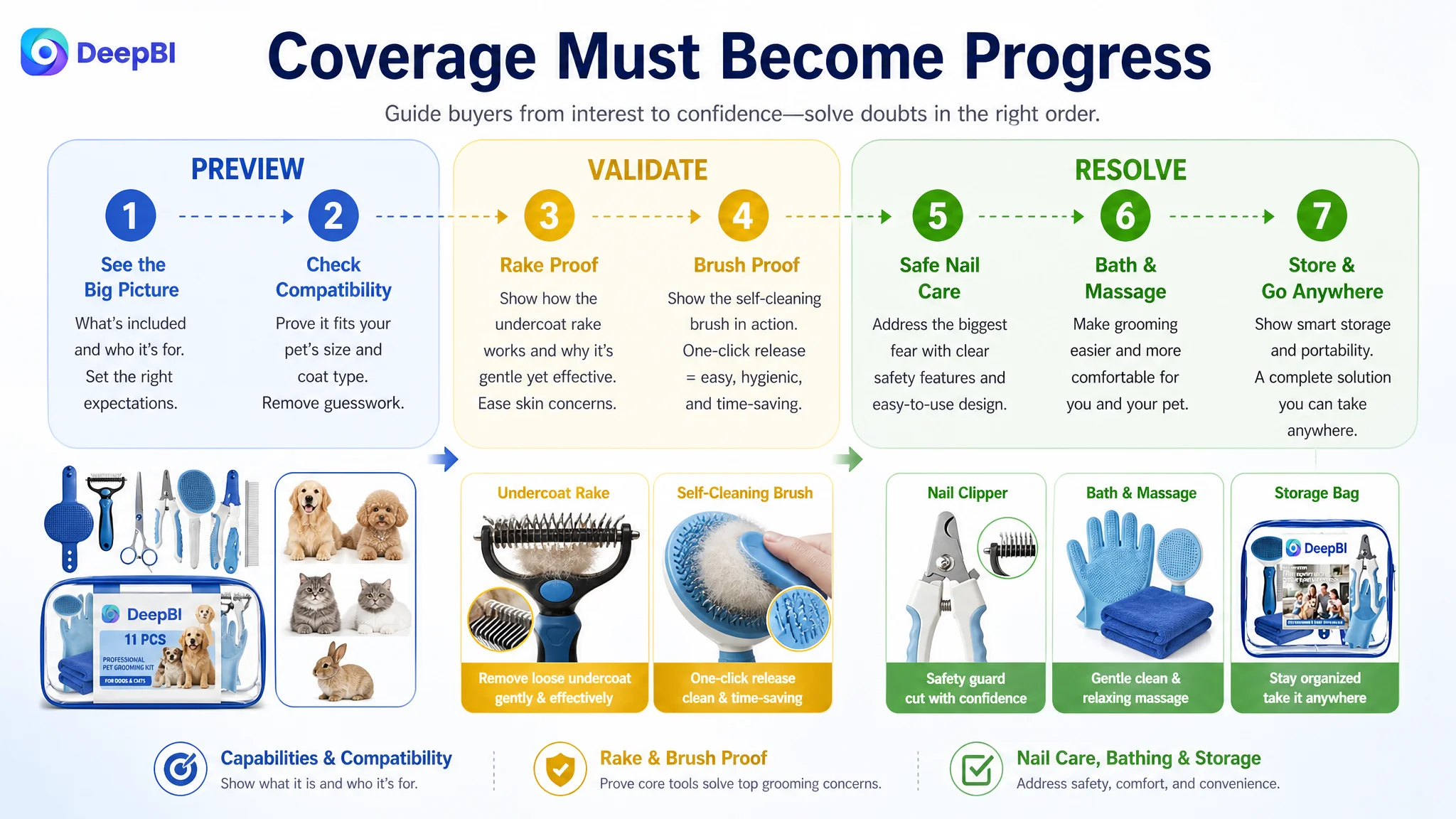
The undercoat rake needed a dedicated explanation
The rake was not just another accessory. It addressed a high-frequency concern: loose undercoat, tangles, and mats.
The module needed close-up views of the rounded tips, the two tooth configurations, and the way the tool works through thick coats. The goal was not to make an unsupported performance promise. It was to make the intended use and safety logic visible.
The slicker brush needed suitability validation
The slicker brush was a high-use tool, but its value was diluted when combined with the massage brush and flea comb.
A dedicated module could connect the self-cleaning mechanism with coat and pet suitability. The shopper should be able to see which types of pets and coats the brush is intended for, while also understanding how the one-click release works.
Nail care needed its own trust module
Nail clipping is a higher-fear activity than ordinary brushing. The customer’s page mentioned the nail clipper and file, but their importance was reduced by grouping them with several other tools.
The proposed change was to create a dedicated safety section featuring:
- The clipper as the main subject
- A close-up of the safety stop guard
- The file as the finishing step
- A clear explanation of how the tools support controlled, comfortable grooming
This did not eliminate the need for the owner to use the tool properly. It did address the page’s responsibility to show that the safety concern had been considered seriously.
A+ content is strongest when each module removes one specific reason to hesitate.
Why DeepBI Did Not Recommend Tuning Ads First
The case material does not include post-optimization ad metrics such as CTR, CVR, ACOS, or TACOS. It would therefore be inaccurate to claim that ad efficiency improved or that advertising spend declined after the changes.
The decision logic was instead based on the Listing evidence.
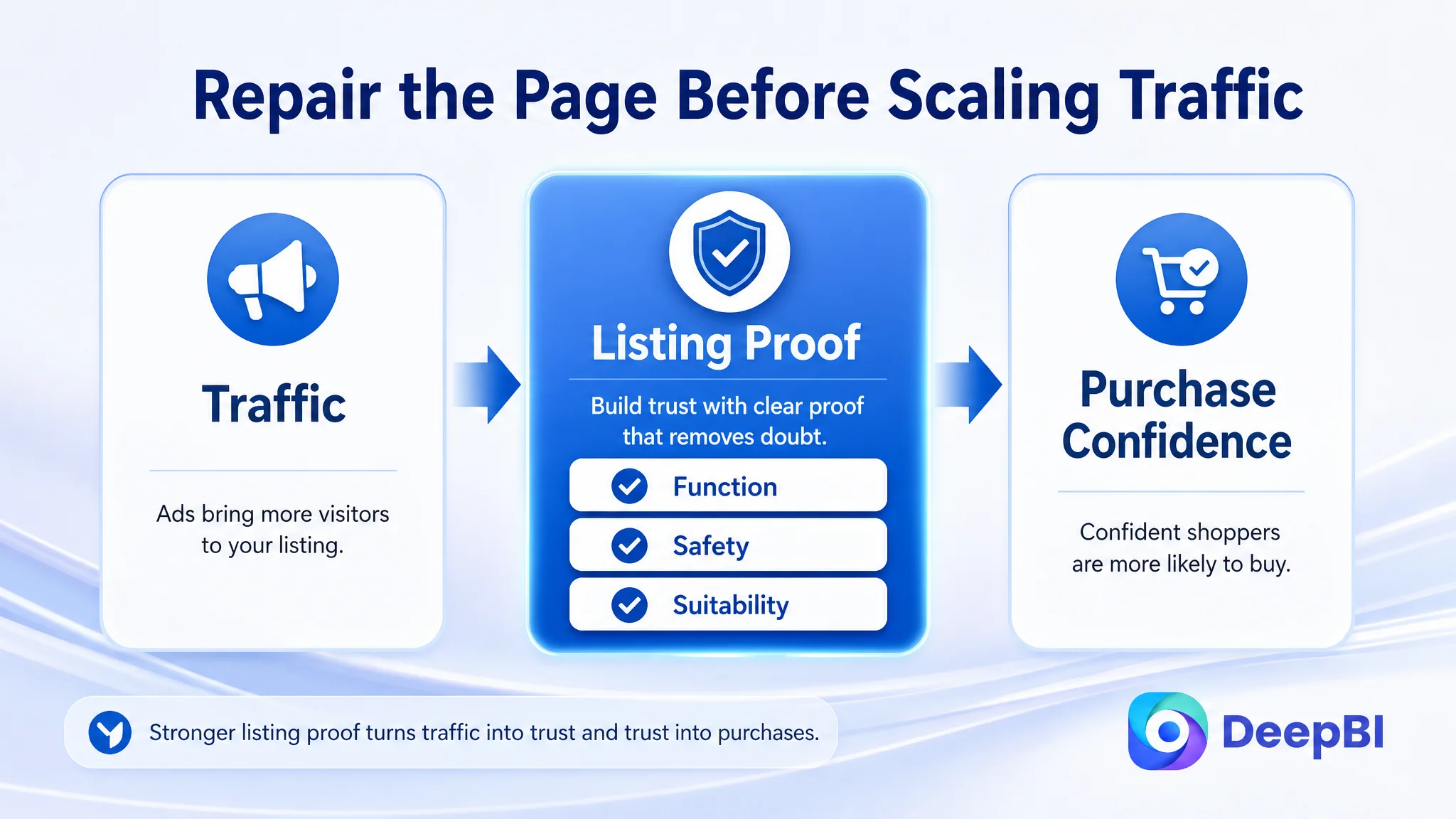
If paid traffic is sent to a page with no review foundation, unclear priority among its tools, and insufficient visual proof for high-concern functions, more traffic does not automatically create more useful demand. It can simply expose the same conversion friction to a larger audience.
That is the operating risk.
Advertising can bring a shopper to the product page. It cannot, by itself, explain why the nail clipper is safe, why the rake has two sides, why the slicker brush is easier to clean, or whether the kit suits a particular coat type.
Those are Listing responsibilities.
DeepBI therefore treated the page as the current constraint and recommended repairing the conversion logic before making traffic expansion the center of the next decision. The priority was not to stop advertising permanently. It was to avoid using ads to amplify a page whose trust and proof structure still had visible gaps.
The Optimization Became More Focused, Not More Complicated
The later direction did not require the customer to add more claims or create a completely different product story.
It required sharper roles for the assets already available.
Title
Lead with the product form and core shedding-related search intent. Reduce loose tool listing. Make the target pets and coat-care use case easier to recognize.
Main images
Keep the images that already explain completeness and suitability. Rework the crowded opening layout. Give the self-cleaning brush and undercoat rake dedicated proof instead of combining them with several secondary tools.
Bullet points
Retain the stronger pain-point structure, but make each bullet more direct:
- Complete kit coverage
- Shedding and dematting
- Trimming and bathing
- Nail-care safety
- Portability and storage
Each point should connect a tool to a recognizable grooming task rather than merely repeat the component list.
A+ content
Change the page from a tool inventory into a confidence-building sequence. Show what the kit contains, then explain how the most important tools solve the highest-concern tasks.
This is where the page could use its existing strengths—real pet interaction, broad compatibility, and multi-tool coverage—without letting those strengths become scattered.
What Changed in the Business Understanding
The case did not end with a reported CVR or ACOS result, so the responsible conclusion is about operating logic rather than unsupported performance claims.
The customer’s understanding shifted in several ways.
First, a higher component count was not enough to create a stronger Listing. The value of an 11-piece kit depended on whether shoppers could quickly understand the role of each important tool.
Second, a strong A+ score did not mean every module was working in the right order. Coverage and conversion logic are related, but they are not identical. A page can contain substantial information and still leave key doubts unresolved.
Third, a competitive main-image score can hide weak individual image roles. The question is not only whether the gallery looks complete. It is whether each image advances the decision.
Finally, review disadvantage changes the burden placed on every other page element. When a competitor has hundreds of reviews and a stable rating, the customer Listing cannot rely on completeness alone. It must make compatibility, safety, use, and product logic especially easy to verify.
Before asking Amazon ads to scale a product page, sellers need to judge whether that page has earned the next visit.
For this pet grooming Listing, the most important next step was not adding more traffic to a broader collection of claims. It was turning the existing offer into a clearer chain of reasons to trust, understand, and buy.