

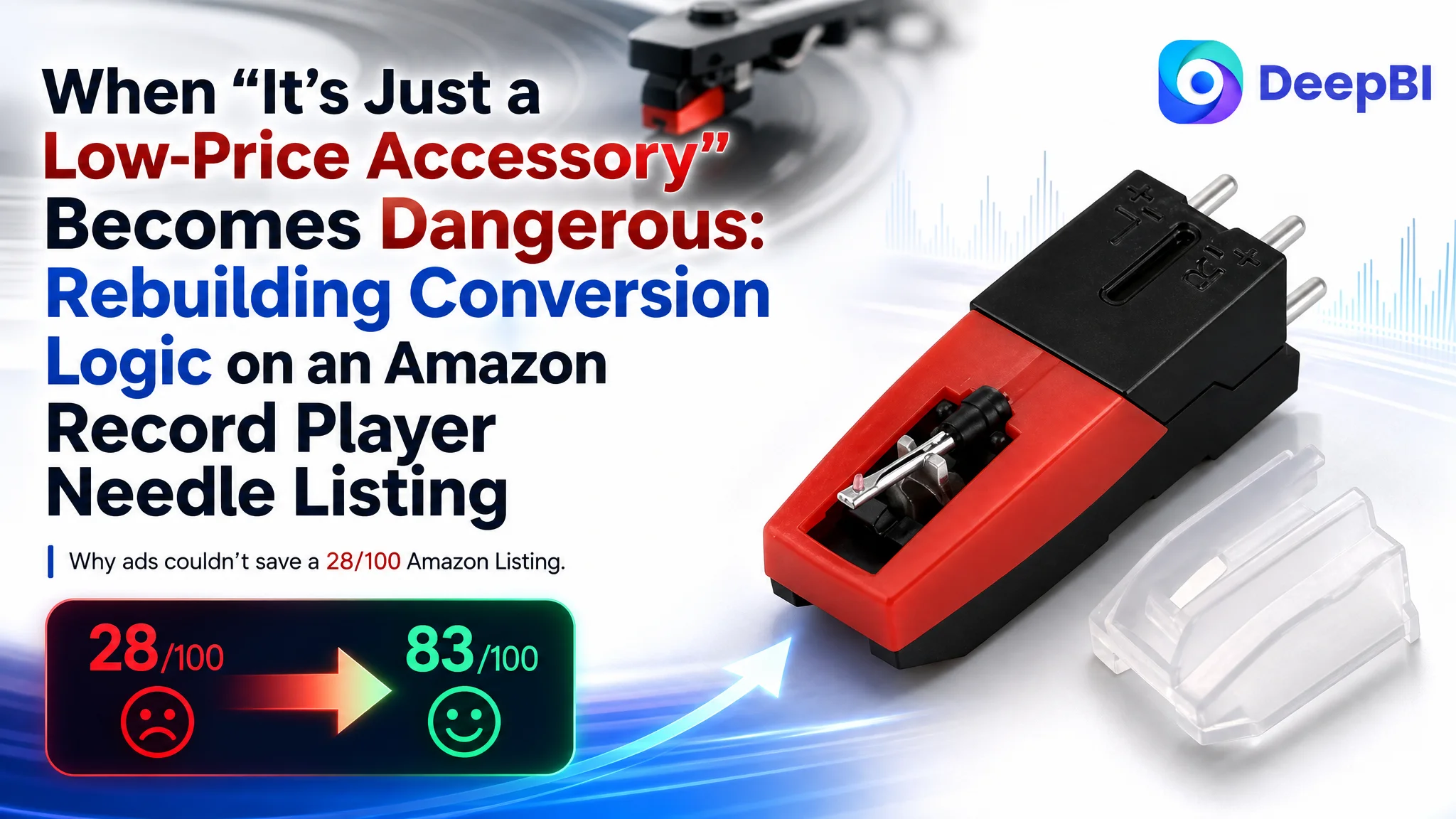
This case comes from an Amazon seller in the vinyl accessories niche who thought they had a simple problem: “It’s a small replacement part; as long as the price is okay, ads will eventually pull orders through.” They focused on basic presence—having a Listing, a few white-background images, some technical wording—and expected Amazon ads to do the heavy lifting.
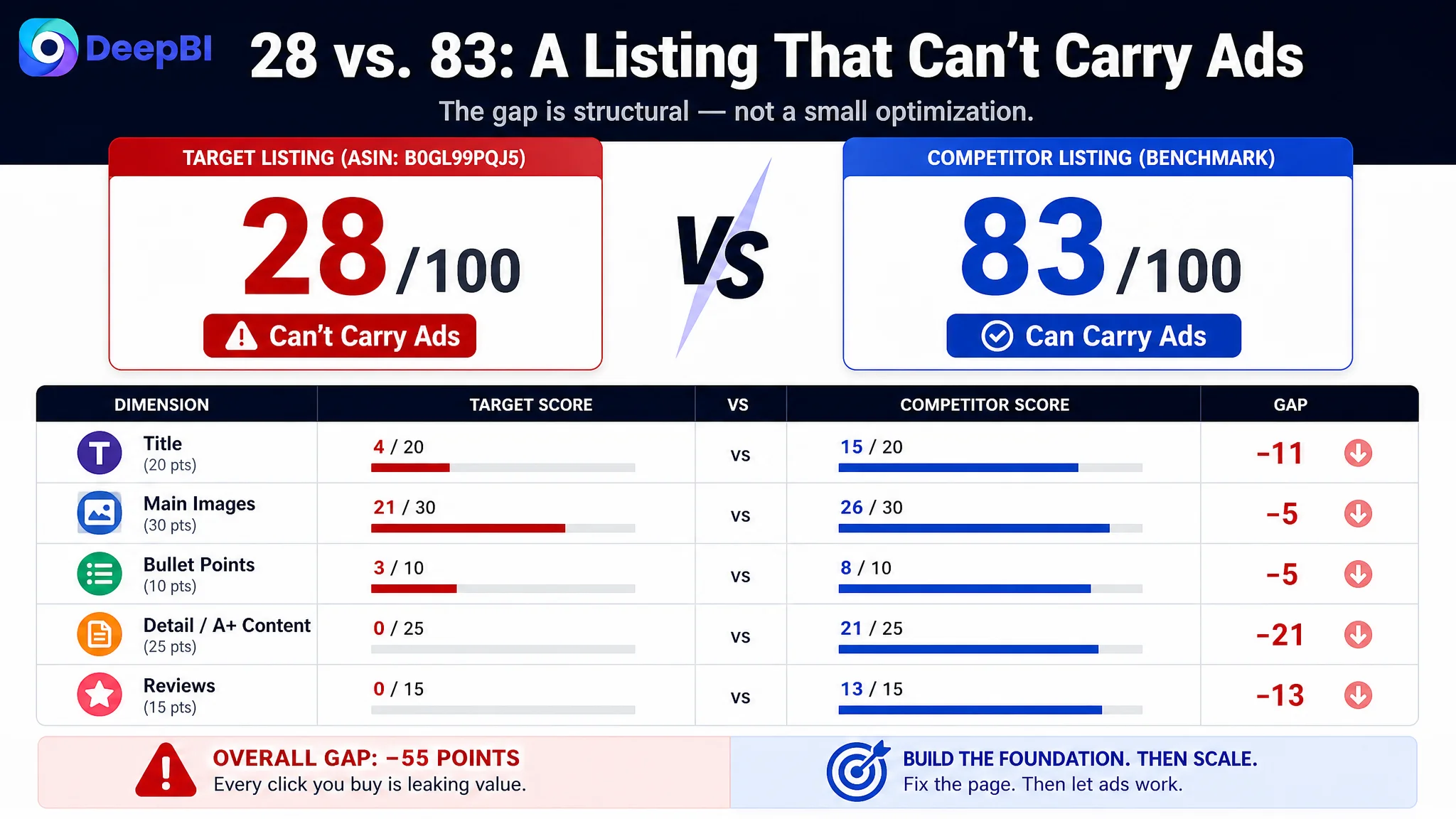
When DeepBI compared this Listing against a leading competing Amazon Listing for record player needles, the gap was not “a few points of optimization.” It was structural. The target Listing scored 28/100 versus the competitor’s 83/100. There was no A+ content, no reviews, a weak title, and scattered imagery—meaning every click the seller bought with Amazon ads would land on a page almost unable to convert.
After reframing the issue as a product-page conversion problem rather than an advertising problem, the focus shifted: clarify compatibility in the title and bullets, re-architect the image set around click and trust, and build an A+ story that walks vinyl users from “Will this fit?” to “Will this protect my records?” This article walks through how that judgment was made and what other Amazon sellers can learn before they pump more budget into ads that their Listing cannot yet deserve.
What the Seller Saw: “A Simple Replacement Part That Should Sell”
This Amazon seller operates in the US marketplace with a record player needle and cartridge replacement set.
From their perspective:
- The product is low-ticket and universal in concept.
- The Listing had a basic structure: a title mentioning “Universal,” several white-background images, and technical bullet points about material and sound quality.
- The category is not glamorous; expectations were that price and basic presence, plus some Amazon ads, should be enough to “get the flywheel moving.”
They felt the main constraints were:
- Not enough exposure yet.
- Not enough time for reviews to accumulate.
- Ads might need more time or bid adjustments.
In other words, they saw this as an advertising and “early-stage” problem, not a Listing conversion problem.
The First Misdiagnosis: Treating Ads as the Missing Ingredient
Before the diagnosis, the seller’s default logic was:
“If we keep pushing Amazon ads, clicks will eventually translate into reviews and orders. It’s just a matter of driving enough traffic.”
That led to typical “fixes”:
- Considering bid and keyword adjustments.
- Thinking about adding more search terms around “record player needles,” “cartridge,” etc.
- Assuming conversion would naturally improve once the Listing had more traffic and some initial feedback.
What they did not see:
- How far behind their Amazon Listing quality was versus the real benchmark in the same niche.
- That they were planning to send ad traffic into a page that, on multiple dimensions, gave buyers reasons to hesitate or leave.
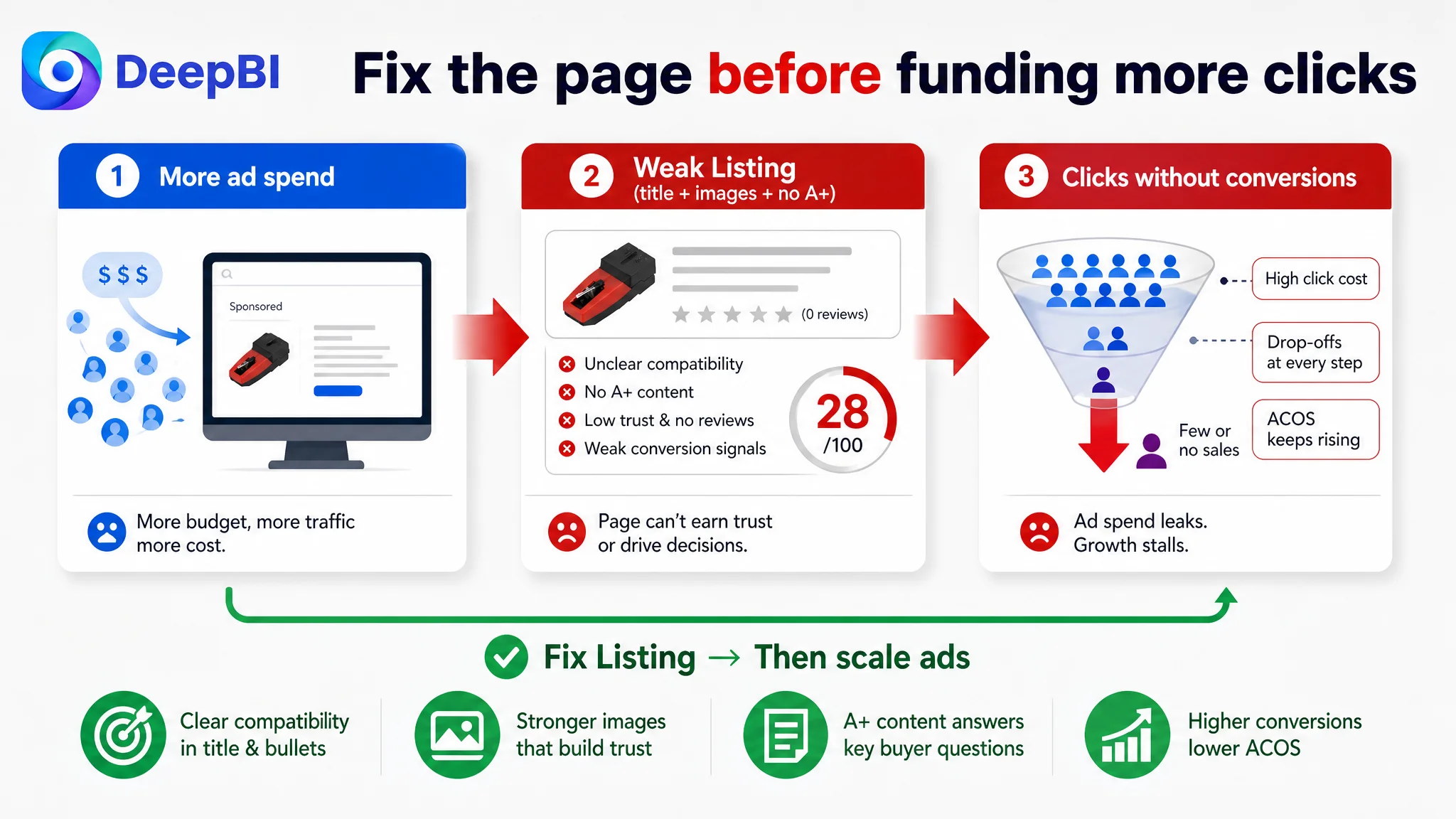
The risk was clear: every extra dollar in ads would mostly fund data that proved the page couldn’t convert.
The Reality Check: 28 vs. 83 – A Listing That Could Not Carry Its Own Weight
DeepBI’s Listing scoring put numbers to what buyers were actually experiencing on the Amazon product page.
Overall competitive score:
- Target Listing: 28 / 100
- Benchmark competitor: 83 / 100
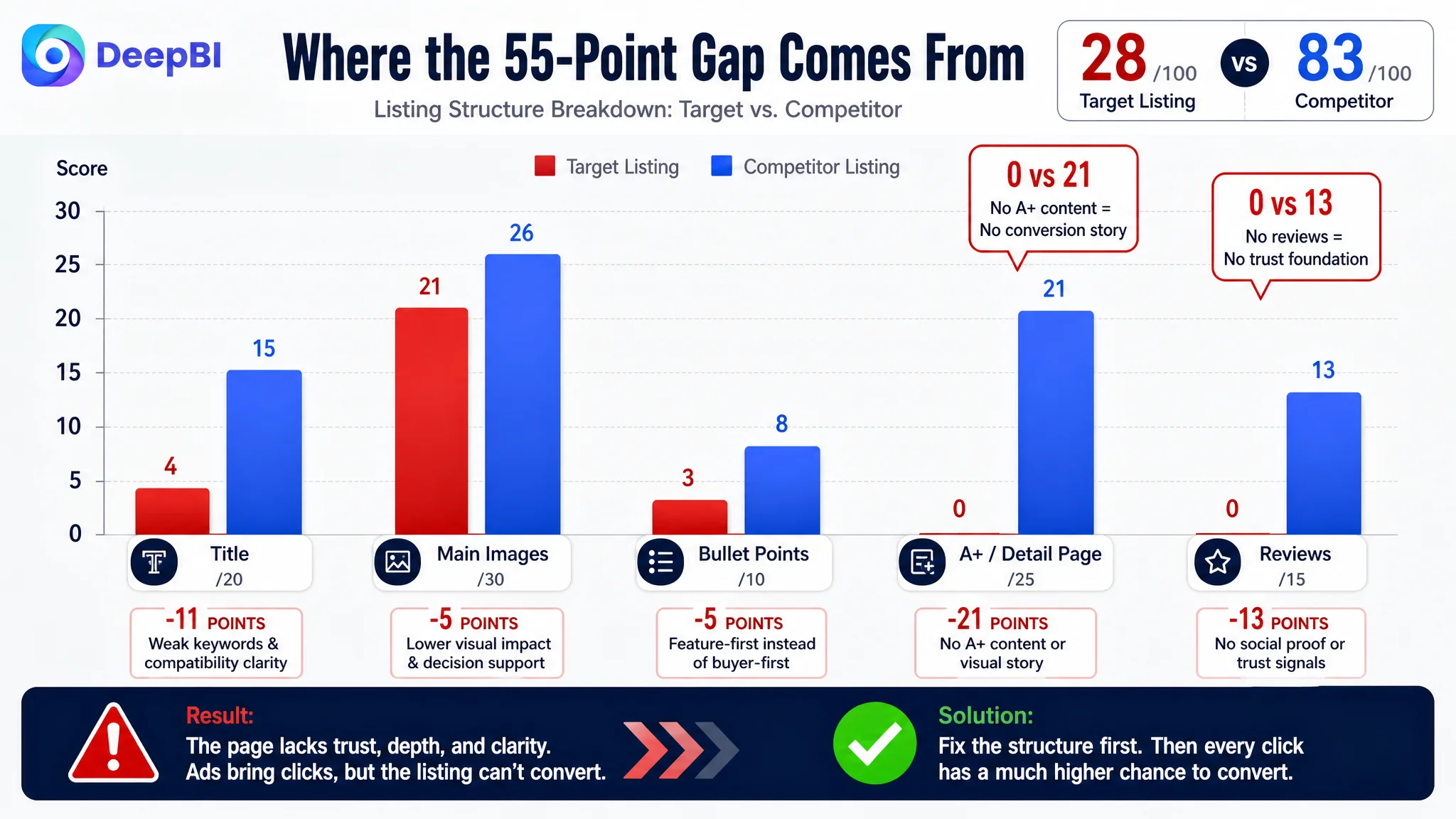
- Gap: –55 points
Broken down by core Amazon Listing dimensions:
- Title: Target: 4, Competitor: 15, Full Score: 20, Gap: -11
- Main Images: Target: 21, Competitor: 26, Full Score: 30, Gap: -5
- Bullet Points: Target: 3, Competitor: 8, Full Score: 10, Gap: -5
- Detail / A+: Target: 0, Competitor: 21, Full Score: 25, Gap: -21
- Reviews: Target: 0, Competitor: 13, Full Score: 15, Gap: -13
This was not a matter of “tweaking a word here and there.” It was a page that:
- Had no A+ content at all while the competitor had a fully built visual story.
- Had no reviews versus a competitor with 4.6 stars and 300+ reviews.
- Used a title and bullets that never fully answered the category’s core questions: “Will this fit my turntable?” and “Will it protect my vinyl?”
“The real problem was not that ads failed to bring traffic. It was that the page could not convert the traffic.”
At this stage, turning up Amazon ads would only accelerate wasted spend.
Title: A “Universal” Promise Without Decision Logic
How the competitor’s Amazon title worked
The leading competitor’s title followed a clear Amazon Listing logic:
- Opened with the core search and purchase term: “4 Pack Record Player Needles Replacement”
- Immediately answered compatibility, which is the biggest risk in this niche: “Compatible with Crosley, Victrola & More Turntable”
- Added value and quality: “Premium Ruby Stylus with Clear Storage Box”
- Closed with a category context to widen search coverage: “Vinyl Records Accessories”
In one line, a buyer could see:
- What it is
- How many they get
- What it fits
- Why it feels “premium”
- Where it fits in their vinyl setup
What the target title did instead
The target Listing title:
- Repeated similar words (e.g., “Record Player,” “Cartridge”) unnecessarily.
- Used a vague “Universal” promise rather than specific brand compatibility.
- Lacked strong value or quality language (e.g., no “Premium stylus,” no clear mention of protective or long-life benefits).
- Ended with a narrow term (“Record Player”) instead of wider category cues.
From search and decision perspective on Amazon:
- It weakened keyword clarity (“universal” vs. concrete brand names).
- It weakened conversion logic by not stating what matters most to vinyl owners: will this fit my turntable, and is it safe for my records?
The reframed title direction
DeepBI’s recommended title direction:
“Universal Record Player Needle with Cartridge, Replacement Stylus Needles for Vinyl Records, Compatible with Crosley, Victrola, ION Turntable, Premium Phonograph Stylus Replacement”
Key shifts in decision logic:
- Compress repetition to free characters for what matters.
- Front-load “replacement stylus needles” + “universal” to anchor core search intent.
- Name compatibility brands (Crosley, Victrola, ION) to capture high-intent branded searches.
- Add a “premium” angle to support a higher perceived value and lower return risk.
This is not wordsmithing for its own sake; it is shifting the page from “generic replacement part” to “clear, trusted fit for specific, named devices.”
Main Images: White Background vs. a Structured Conversion Funnel
On Amazon, click-through rate is heavily influenced by the main image set. Here, the seller was not “missing images”—they were missing image-level decision logic.
The competitor’s image set built a conversion funnel:
1. High-impact hero with soundwave metaphor and strong color contrast for click.
2. Compatibility and “Before You Buy” guidance to prevent misorders.
3. Material and performance visuals (e.g., ruby stylus, aluminum cantilever).
4. Installation and fit visuals.
5. Multi-pack and storage to underline value.
The target Listing instead had:
- Basic white-background product shots.
- A simple dimensions view.
- Some close-ups that did not clearly tell a story of sound quality, protection, or easy installation.
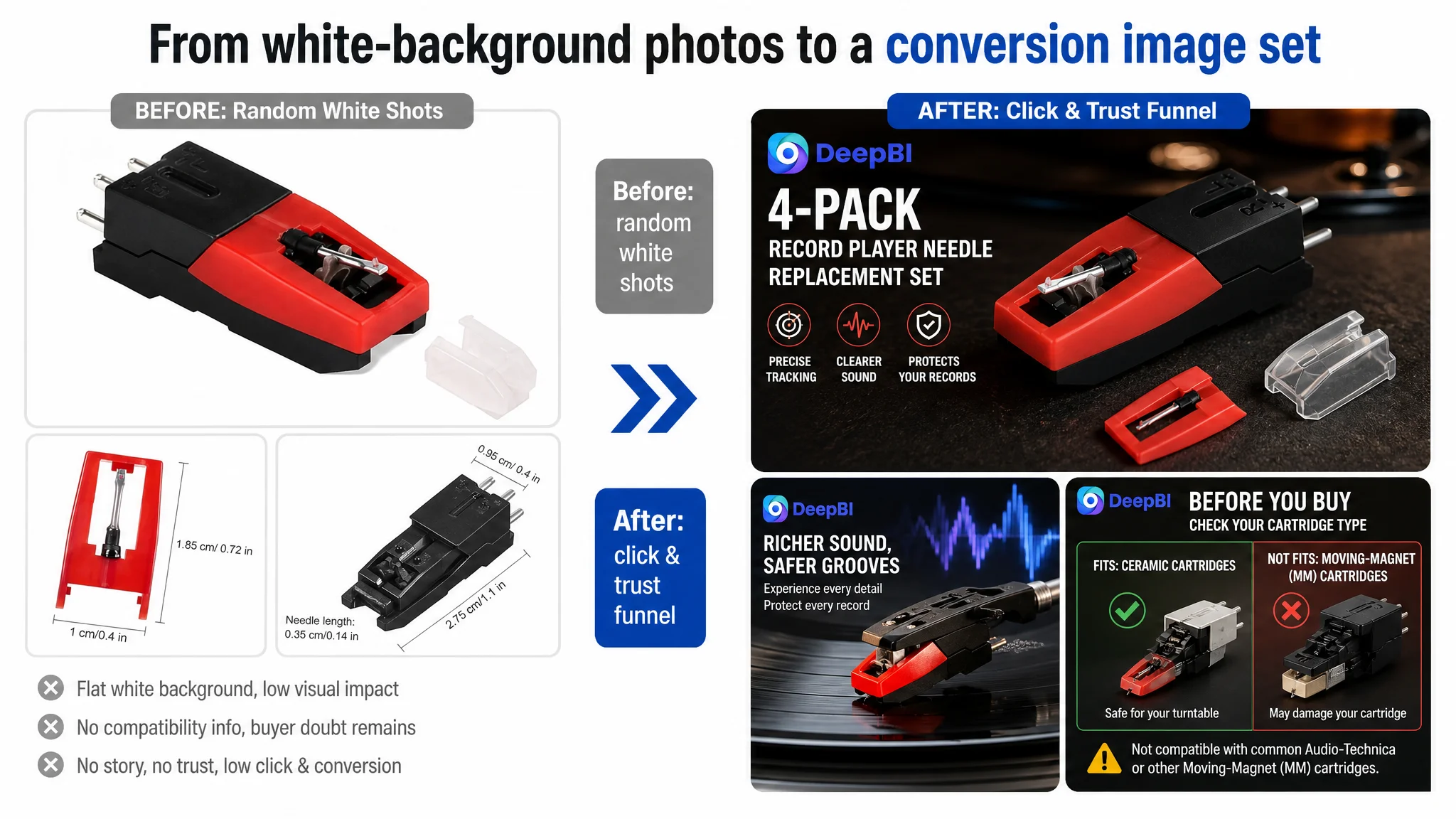
What DeepBI saw in the Amazon image gap
1. Click loss at search-page level
- Competitor used high-saturation soundwave visual metaphors and bold color contrasts.
- Target Listing’s lead image was a flat, white-background laydown with low information density.
- Outcome: weaker initial CTR, so even strong bids would not maximize impressions-to-clicks.
2. Trust loss on compatibility and safety
- Competitor used a dedicated “Before You Buy” comparison visual and clear compatibility checklist.
- Target Listing had no proactive compatibility check visuals, increasing the perceived risk of buying the wrong needle.
3. No funnel from material → performance → assurance
- Competitor’s later images tightly connected material → performance → installation reassurance.
- Target images showed product fragments but no cohesive logic that answers: “Is it easy to install, and will it protect my records over time?”
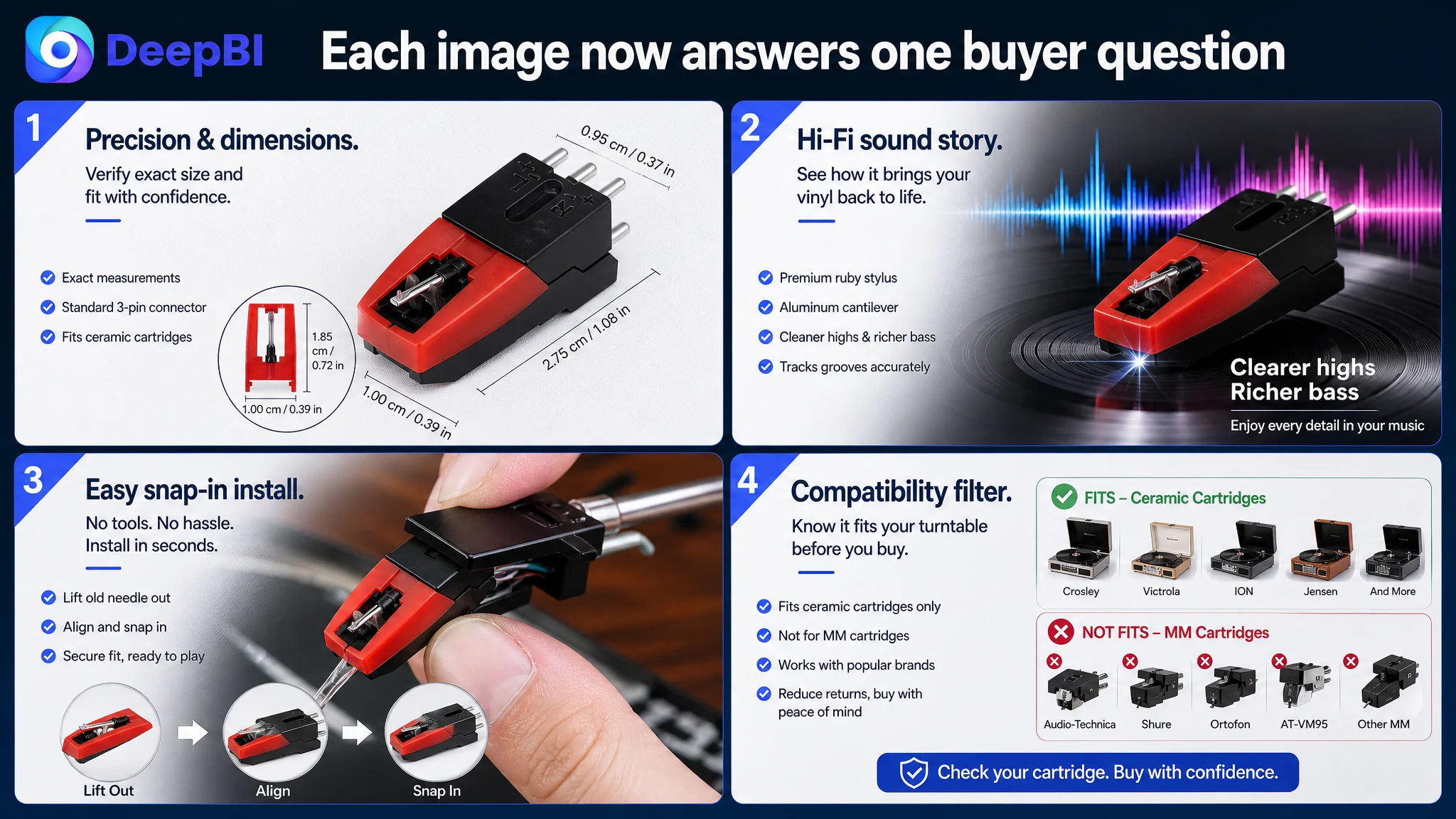
The new image logic: from “just showing the product” to “walking through decisions”
DeepBI’s recommendations restructured the entire Amazon image set into a deliberate decision path:
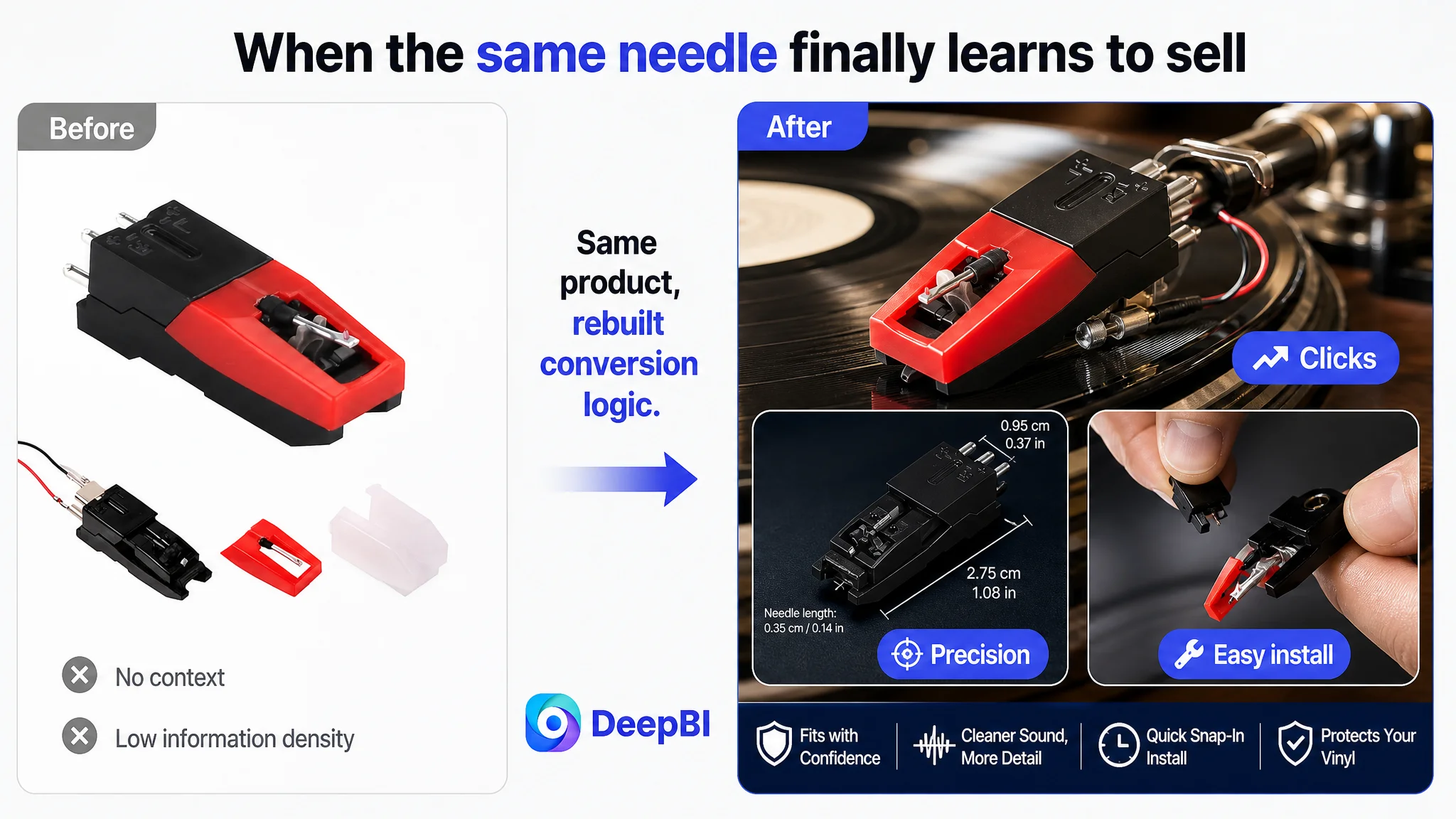
- Hero image: show the full set (needle, cartridge, protective cover) centered, 3/4 view, white background but with stronger depth, contrast, and “complete kit” messaging to drive clicks.
- Precision and trust image: dark gradient background, clean measurements overlaid with clear, technical marking—shifting perception from cheap accessory to precision component.
- Sound quality image: installed on a tonearm with a blurred vinyl background, adding soundwave effects and “Hi-Fi Sound Quality” copy to visually represent what is otherwise abstract.
- Installation image: macro shot of fingers snapping the needle into place, labeled “Snap-In Swap” to reduce fear about mechanical installation.
- Compatibility filter image: side-by-side comparison with “correct” vs. “wrong” needle shapes, “BEFORE YOU BUY” heading, and checkmark/cross icons to prevent misorders.
- Application and micro-detail images: multiple turntable types in background, macro of stylus touching grooves, emphasizing precision tracking and record protection.
“Advertising does not only amplify advantages. It can also amplify a page’s existing defects.”
If a page does not visually prove compatibility, ease of installation, and record safety, every extra click from ads simply exposes more buyers to those doubts.
Bullet Points: From Parameter Dump to “Decision Script”
The bullet points were another area where the Listing looked “complete” at a surface level, but structurally could not support conversion.
Competing logic: decision-first, not feature-first
The competitor’s bullet sequence followed this logic:
1. “Check compatibility before you buy” – reduce risk first.
2. Universal fit & snap-in install – answer ease-of-use.
3. Value of multi-pack & storage – address cost per use.
4. Sound improvement & vinyl protection – link specs to outcomes.
5. Technical advantage (aluminum cantilever) – justify performance claims.
6. Protective design – confirm long-term and travel/storage safety.
Meanwhile, the target Listing’s bullets followed:
- Material → generic quality claims → specs → sound effect → compatibility.
This was information without a buying path.
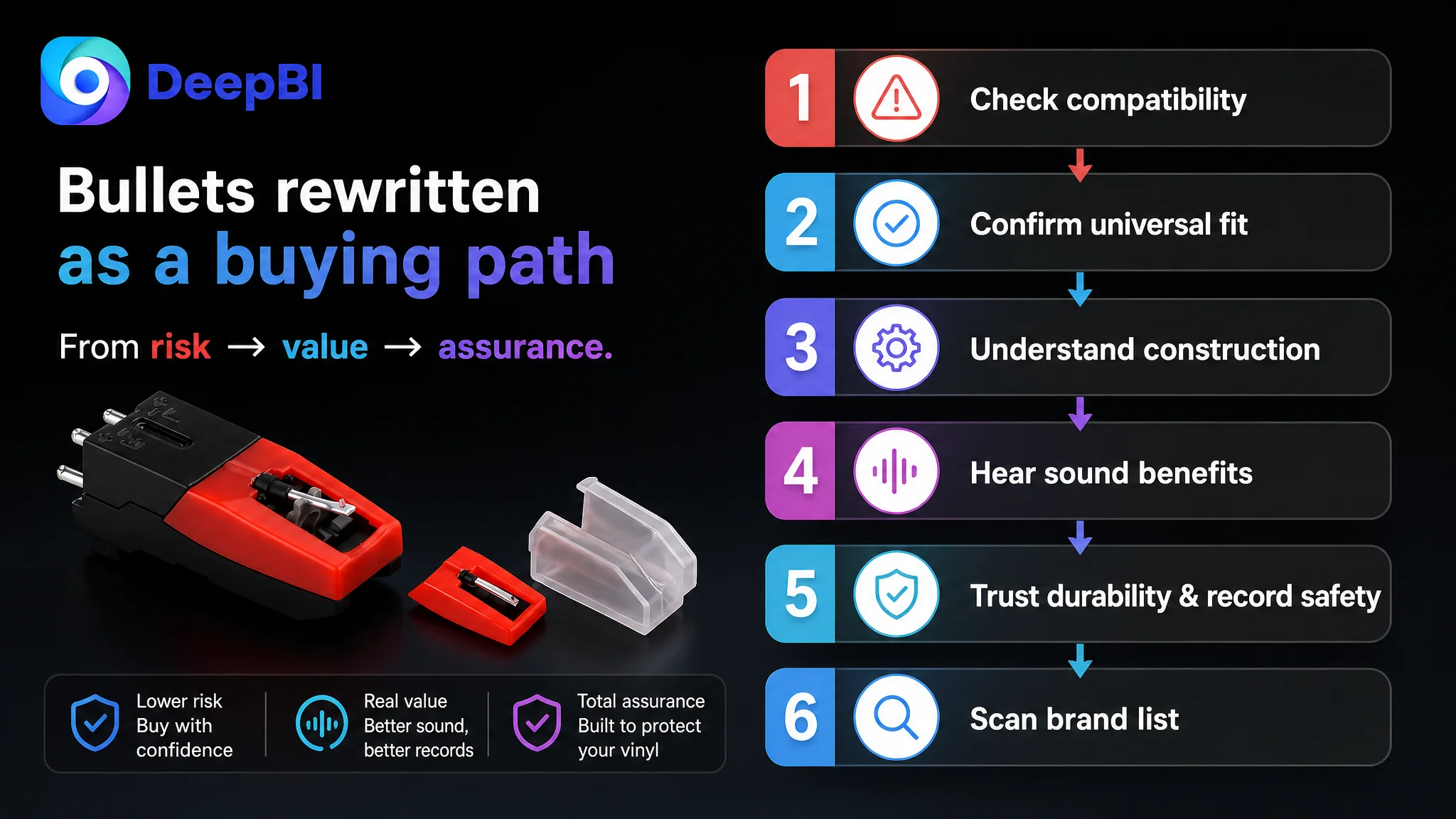
How DeepBI re-ordered the conversation
DeepBI’s optimization moved from “what the product is” to “what the buyer needs to decide”:
1. Compatibility warning first
【CHECK COMPATIBILITY BEFORE BUYING】Please match your current cartridge to our product images. This replacement needle is designed specifically for Ceramic Cartridges and is NOT compatible with Moving-Magnet (MM) cartridges like Audio-Technica or others.
- Reduces returns.
- Signals professionalism and honesty—critical for trust in low-ticket but high-risk parts.
2. Universal fit and installation
【Universal Fit & Quick Installation】Engineered to be compatible with Crosley, Victrola, and most turntable brands. The user-friendly design allows for a secure snap-in installation within seconds, requiring no extra tools for a hassle-free setup.
- Speaks to everyday use, not just tech specs.
- Aligns with the installation images to form a coherent story.
3. Technical construction for sound accuracy
【Precision Aluminum Cantilever】Featuring a high-quality aluminum needle bar and diamond stylus, this construction provides stronger tracking and better balance. It tracks record grooves accurately to reduce skips and deliver cleaner, more realistic highs for every vinyl.
- Connects physical build to performance outcome: fewer skips, cleaner sound.
4. Sound performance in user language
【Superior Sound Performance】Revive your dull records with enhanced clarity. With a frequency response of 80-10000 Hz and ≥15 dB channel separation, our stylus provides better bass effects and smooth, clean music reproduction for an immersive listening experience.
- Keeps core specs but interprets them as a listening experience, not just numbers.
5. Durability and record safety
【Durable & Records-Safe Design】Made of eco-friendly ABS and anti-oxidation materials, our wear-resistant stylus is built to last. The precise tracking force (4-6 grams) ensures the needle stays in the groove without harming your precious vinyl record collection.
- Addresses the emotional core of the category: protecting irreplaceable vinyl.
6. Structured compatibility list
【Wide Application List】An essential replacement for reproducing high-quality sound waves. Perfectly fits brands such as ION, Jensen, Boytone, Capehart, CROWN, EANOS, Fisher, GPO, GRACE DIGITAL AUDIO, Innovative-Technology, Leetac, MAGNAVOX, and more.
- Reduces buyers’ search cost and uncertainty.
- Functions as both SEO and trust anchor.
This was not just “better copy.” It turned bullets into a linear decision guide that supports what the Amazon images and A+ would show.
Detail Page / A+ Content: The Missing Trust Layer
The most severe structural gap was in the Amazon detail page and A+ content:
- Target Listing: no A+ at all (score: 0/25).
- Competitor: full A+ layout, scoring 21/25.
For a vinyl accessory, A+ is where the page needs to:
- Build a sense of professional audio equipment, not a random low-end replacement part.
- Show installation steps clearly.
- Explain value (multi-pack, storage) and precision (dimensions) in a calm, confident way.
What the competitor’s A+ did that this Listing could not
1. Atmospheric hero
- Dark background, smoke/light effects, strong tagline (“Play Safe, Play Long”).
- Immediately positions the product as protective and premium.
2. Technical clarity
- Stylus force, frequency response, and other parameters displayed in clear blocks.
- Serves both audio hobbyists and casual users.
3. Value and practicality
- “4-Pack = 4X the playtime” concept.
- Clear storage box visuals.
- Visualized dimensions and multi-pack layout.
Without any A+, the target Listing:
- Missed the first impression of professionalism.
- Left compatibility and installation anxiety unaddressed.
- Provided no extended explanation of value.
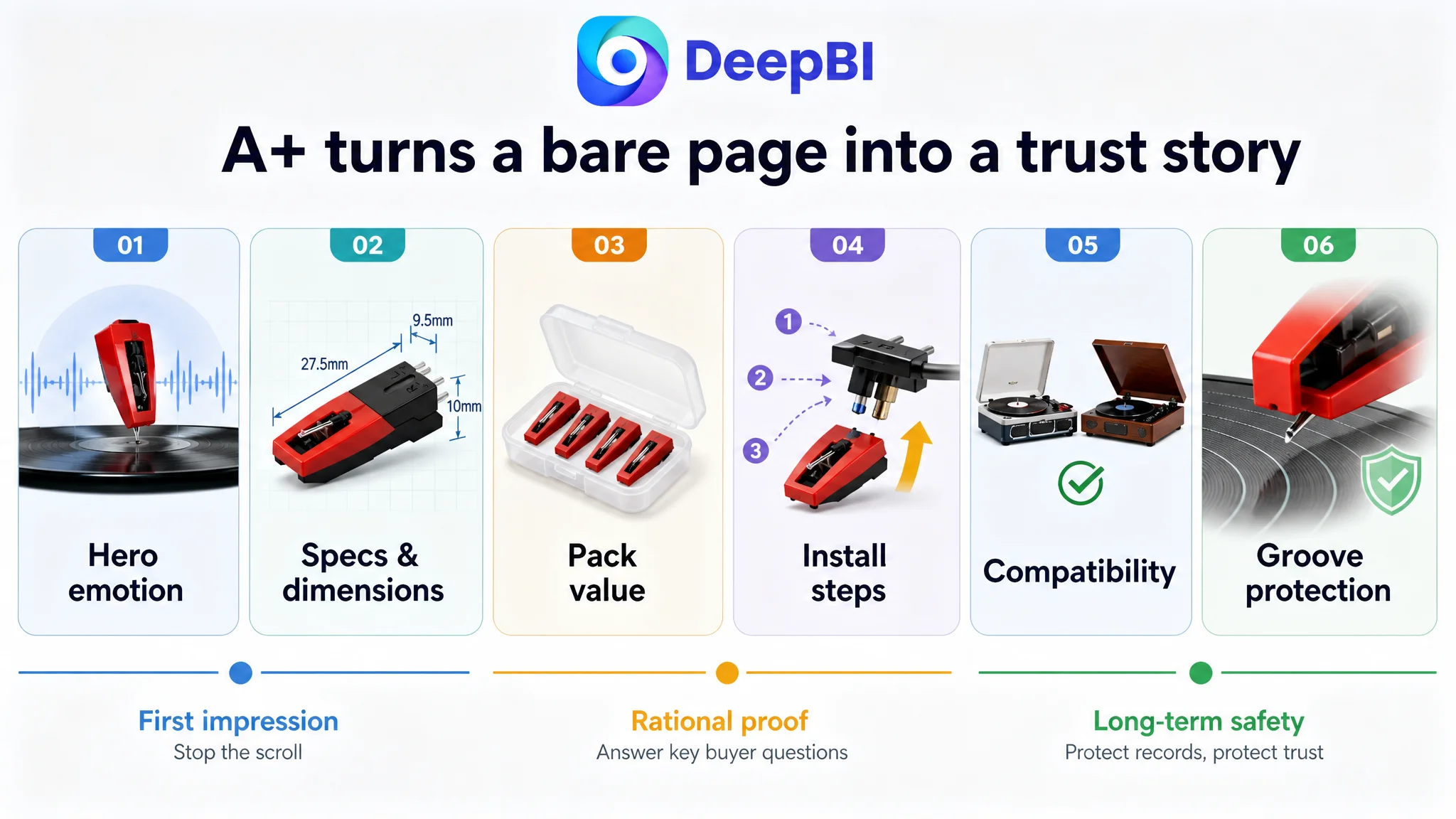
The A+ direction DeepBI defined
DeepBI’s recommendations reimagined A+ as a structured narrative specific to Amazon behavior in this niche:
1. Hero / brand impression module
- Needle installed on the tonearm, over a slowly spinning vinyl record.
- Dark, warm, listening-room atmosphere with a single warm spotlight.
- Emphasis on the emotional side: ritual of playing vinyl + trust in the stylus that touches the grooves.
2. Precision specs module
- Clean white background.
- 45° product view with length/width/height labels.
- Clear typography for specs to remove “wrong model” fear.
3. Value & storage module
- Show all units in a 4-pack with transparent storage case.
- Light, neutral background.
- Visual impression of “organized, safe, and good value over time.”
4. Step-by-step installation
- Step 1: remove old cartridge using a screwdriver; arrows showing motion.
- Step 2: align and push in new stylus until a “click”; highlighted alignment point.
- Text overlays with short, clear step headlines.
5. Compatibility & use-case module
- Product in front, two different styles of turntables slightly blurred in background.
- Visual cue: works across styles and brands, matching the compatibility bullet.
6. Protection & precision module
- Extreme close-up of stylus tip touching vinyl grooves.
- High contrast and sharpness around contact point.
- Visual message: precision, not aggression—protects record grooves.
This is the layer that allows the page to convert both paid and organic traffic, not just “look more complete.”
Reviews: A Zero-Trust Starting Point
Review dimension:
- Target Listing: 0 reviews, 0 rating.
- Competitor: 4.6 stars, 300+ reviews, with front-page reviews emphasizing “easy to install” and “perfect fit.”
This is a reality many Amazon sellers face early on.
What matters is the sequence of actions:
- If you increase Amazon ad spend before fixing title, images, bullets, and A+, you will:
- Pay for traffic that is not yet ready to convert.
- Accumulate fewer orders per impression, which slows review accumulation.
- Potentially trigger more refunds if compatibility is unclear.
- If you raise Listing quality first, you:
- Increase the chance that each ad click becomes a successful order and later review.
- Decrease the risk of compatibility-based returns.
- Improve the odds that organic traffic can stand on its own over time.
DeepBI’s judgment was clear: Listing conversion capacity had to be repaired before scaling ads or review initiatives.
Why Ads Could Not Be the First Lever
From a purely Amazon-ads standpoint, the seller could have:
- Expanded keyword coverage (more turntable brands, record-player terms).
- Fine-tuned bids and match types.
- Tested different campaign structures.
But the scoring evidence showed:
- A 28/100 Listing competing against an 83/100 benchmark.
- Missing A+.
- Weak decision logic in images and bullets.
- Zero social proof.
Under those conditions, ads mainly serve to magnify the structural weaknesses of the product page.
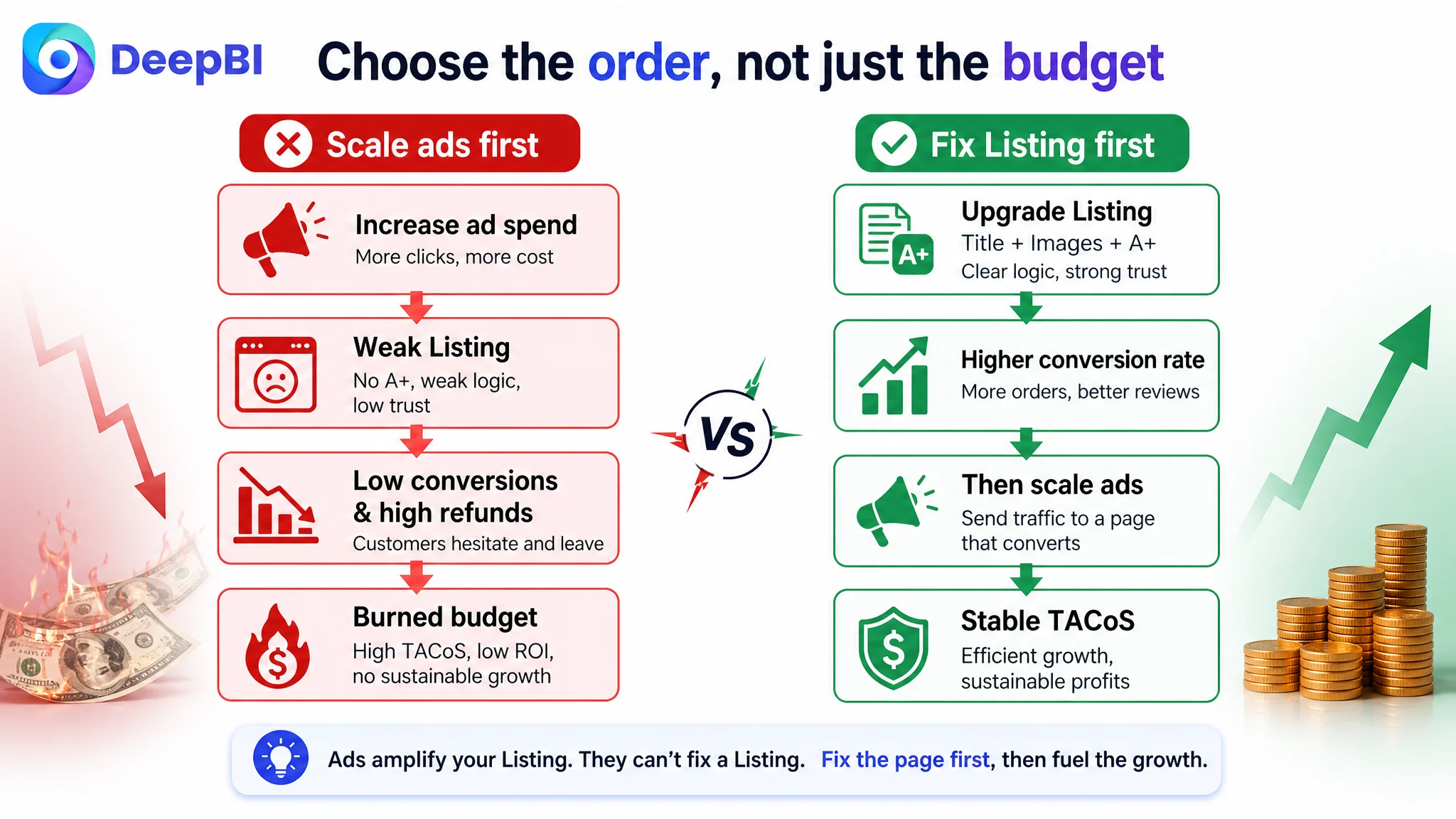
The most important business decision:
Before sending more traffic, decide whether the page deserves more traffic.
In this case, DeepBI advised not to keep tuning ads first, because:
- The risk of wasted ad spend was very high.
- The review and refund risk, due to compatibility and installation ambiguity, was material.
- The long-term TACoS would be unmanageable if the Listing could not convert at a healthy baseline.
After the Rebuild: How the Page’s Sales Logic Starts to Work Again
While this case does not include post-optimization numerical results, the operating state changes are clear once the Listing is rebuilt along these lines:
- Click-through potential recovers:
- Main images now compete visually on Amazon search results instead of fading as a generic white-background thumbnail.
- Conversion funnel becomes coherent:
- Title, images, bullets, and A+ all talk about the same things: compatibility, installation, sound performance, and record safety.
- Trust foundation is in place:
- When first buyers arrive (via ads or organic), they see a professional, complete page—not a bare product listing.
- Ad traffic becomes useful again:
- Each paid click has a higher probability of becoming an order and eventually a review.
- Over time, this reduces reliance on constant ad escalation and supports healthier organic ranking.
The business pressure doesn’t disappear, but it stops being purely about “ACOS is too high; we must fix the ads,” and becomes:
- “Is our Listing worthy of the traffic we’re paying for?”
- “Are we resolving the real decision risks for this category on the Amazon product page?”
What Other Amazon Sellers Can Take from This Case
For many Amazon sellers, especially in “small accessory” categories, this case will feel familiar:
- Ads look like the obvious lever because they’re controllable and measurable.
- Listing content looks “good enough” at a glance: it has a title, a few images, bullet points.
This case shows the opposite:
- A Listing scoring 28/100 is not just “slightly under-optimized”; it is structurally unable to convert at the level needed to support efficient ads.
- Amazon ads cannot compensate for missing compatibility logic, missing A+, and no trust story.
- Title, images, bullets, and A+ must be designed as a single decision flow, not as separate checkboxes.
The core shift DeepBI enabled here was not a feature tweak. It was a judgment shift:
- From “our Amazon ads are not strong enough”
- To “our Amazon product page cannot yet convert the traffic ads bring.”
For sellers, the practical question becomes:
- Before raising bids or budgets, can you explain—in your title, main images, bullets, and A+—why a skeptical buyer should trust this product enough to buy it now?
If not, this case suggests where to look first.