

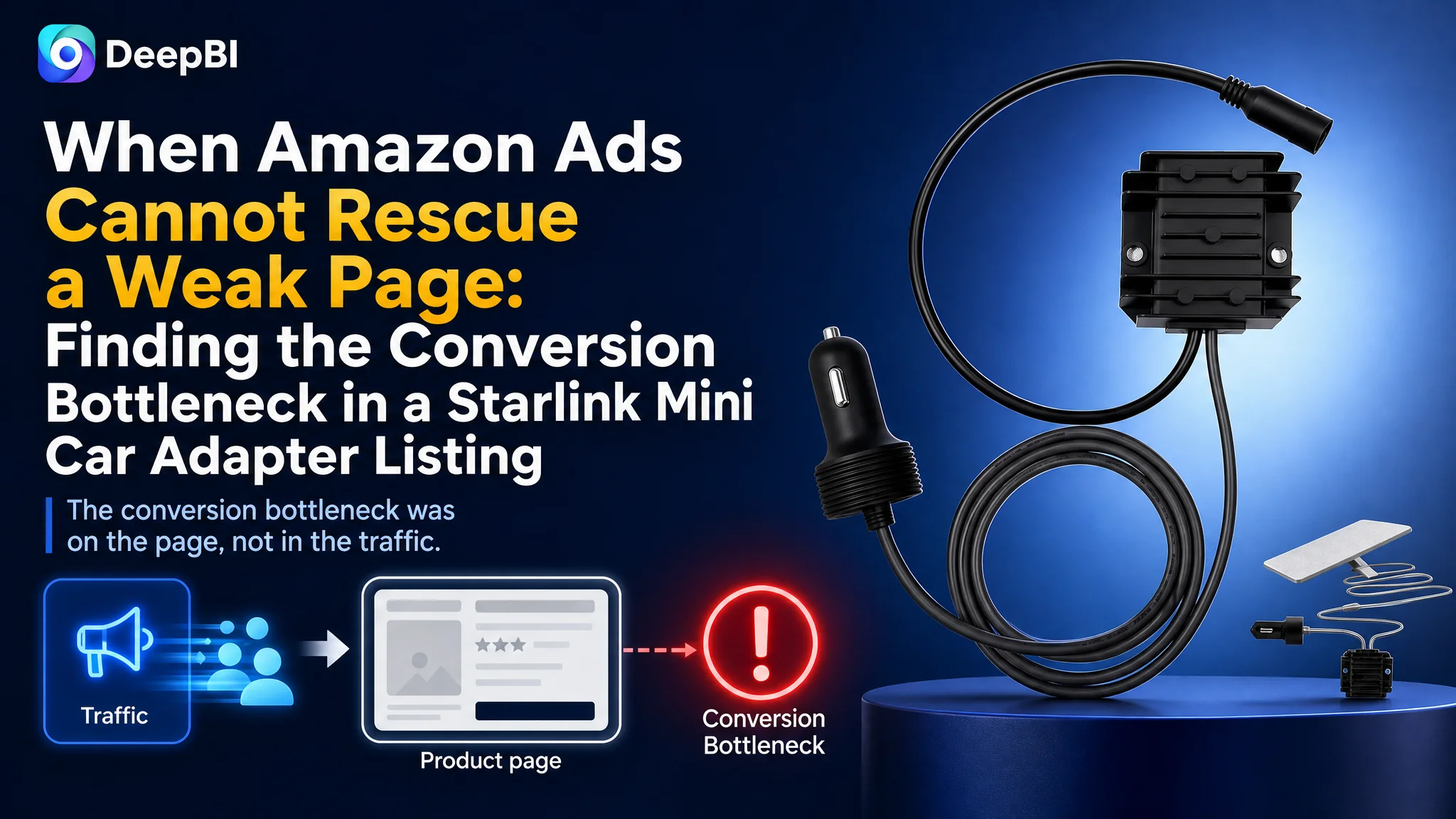
An Amazon seller in the vehicle power accessory category was trying to make a Starlink Mini car adapter listing more competitive in the US marketplace. The product had relevant keywords, clear voltage specifications, and a broad set of claimed use scenarios, but the Listing still lacked the level of trust and persuasion needed to convert shoppers arriving from Amazon search and paid traffic.
The initial direction was easy to understand: improve the title, refine the bullet points, and make the product images look more professional. The deeper assumption was that better keyword coverage and more attractive creatives would solve the performance problem. DeepBI’s diagnosis showed that this was incomplete. The title and bullet points were not the main constraint. The largest gap was on the product page itself: the Listing had no A+ content and no review history, while a comparable high-performing listing used both to explain the product, demonstrate its use, and reduce purchase risk.
This case is therefore less about generating new Amazon Listing assets and more about deciding what needed to be fixed first. The later optimization focused on restoring the page’s sales logic through stronger visual hierarchy, clearer installation guidance, real-world vehicle and RV scenarios, integrated-design comparisons, and more precise title and bullet-point messaging. For other Amazon sellers, the lesson is direct: before increasing traffic or repeatedly adjusting ads, determine whether the product page is ready to convert the traffic it receives.
The Listing Looked Technically Complete, but Commercially Underdeveloped
The product was a Starlink Mini car adapter and step-up converter designed for use in vehicles, RVs, trucks, boats, and other mobile or off-grid environments. Its core value proposition was not difficult to describe:
- Convert vehicle power to the required output for Starlink Mini
- Support mobile use in 12V and 24V environments
- Provide a more integrated alternative to loose DIY wiring
- Offer protection and durability for outdoor travel conditions
On paper, the Listing contained many of the expected ingredients. The title included “Starlink Mini,” “12V Car Adapter,” voltage information, output specifications, and several application scenarios. The bullet points covered power conversion, integrated construction, environmental protection, safety features, and installation.
Yet these elements were not working together as a persuasive buying path.
The Listing’s overall score was 48 out of 100, compared with 82 out of 100 for a comparable high-performing listing. That 34-point gap was not spread evenly across every part of the page.
- Title: Target Listing: 16/20, Comparable listing: 17/20, Key difference: Small gap
- Main images: Target Listing: 25/30, Comparable listing: 24/30, Key difference: No major scoring disadvantage
- Bullet points: Target Listing: 7/10, Comparable listing: 6/10, Key difference: Slight advantage
- Product-page content: Target Listing: 0/25, Comparable listing: 21/25, Key difference: Critical gap
- Reviews: Target Listing: 0/15, Comparable listing: 14/15, Key difference: Critical trust gap
- Total: Target Listing: 48/100, Comparable listing: 82/100, Key difference: 34-point gap
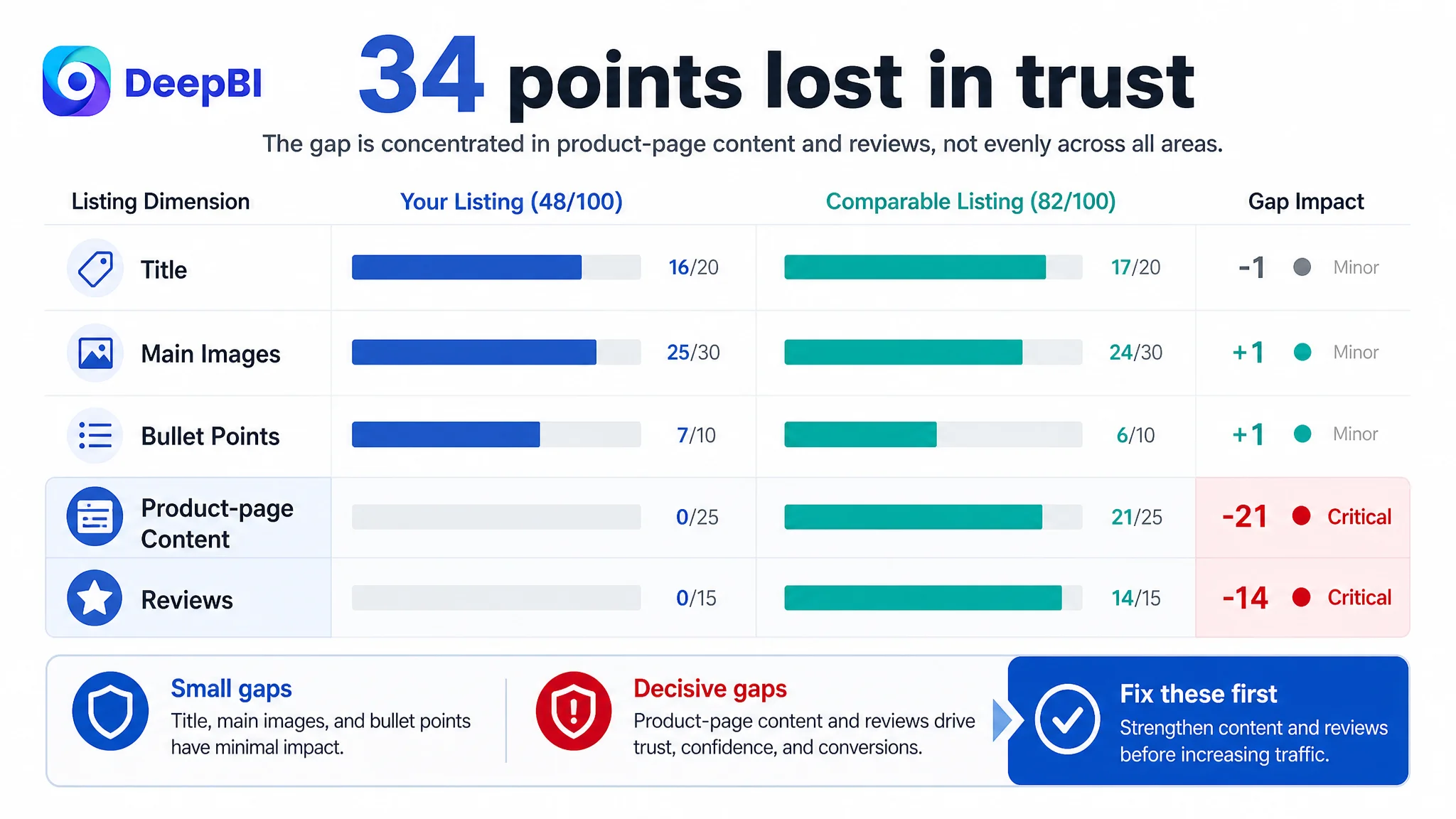
The score distribution changed the diagnosis.
The page was not primarily failing because the title lacked keywords. It was not primarily failing because the bullet points were unusable. The largest weakness was that the Listing had almost no supporting conversion architecture beyond the basic product information.
The most important finding was not that the Listing needed more content. It was that the page lacked the content responsible for turning technical information into purchase confidence.
The Original Optimization Direction Was Too Close to the Surface
For a technical accessory, it is natural to begin with specifications.
The customer’s title placed the core keyword “Starlink Mini” early and clearly identified the product as a “12V Car Adapter.” It also included the conversion specifications: 105W, 12V/24V input, 30V output, and 3.5A. From an Amazon search relevance perspective, this was a solid foundation.
The bullet points followed a similarly rational structure:
1. Core function and specifications
2. Integrated design
3. Durability and environmental resistance
4. Safety protection
5. Installation and compatibility
The problem was not a lack of technical information. The problem was how that information supported the decision.
A shopper considering a vehicle power adapter is not only asking, “What is the voltage output?” They are also asking:
- Will this work with my vehicle or RV?
- Do I need additional connectors?
- Is the installation straightforward?
- What happens if voltage fluctuates?
- Can I trust it in rain, dust, heat, or long road trips?
- Does the product look like a finished solution or a DIY electrical assembly?
- Is the product genuinely compatible with my Starlink Mini setup?
The target Listing answered some of these questions in text, but it did not provide enough visual or structural evidence. The customer was optimizing the parts that could state the product’s capabilities while leaving the parts that could demonstrate those capabilities largely empty.
That created a misleading sense of completeness. The Listing had information, but it did not yet have a convincing sequence from recognition to understanding to trust to purchase.
The Data Pointed to a Page-Level Conversion Constraint
DeepBI’s diagnosis compared the Listing with a relevant benchmark across five dimensions: title, main images, bullet points, product-page content, and reviews.
The comparison showed that the title and bullet points were relatively close. The main-image score was also slightly higher than the benchmark. But the detail-page and review dimensions revealed a much more serious issue.
The A+ content gap was too large to treat as a cosmetic issue
The target Listing had no A+ content. The comparable listing had a structured page containing:
- A core selling-point module
- Functional icon explanations
- Application scenarios
- A comparison section
- Actual installation and usage visuals
This difference mattered because the product’s value is not immediately obvious from its physical form. A power adapter and step-up converter can look like a small industrial component. The buyer needs help understanding what problem it solves, how it fits into a vehicle power chain, and why an integrated design may be preferable to loose connectors and improvised wiring.
Without A+ content, the page had no dedicated space to make that argument visually.
The shopper could see a product. They could read specifications. But they could not easily see the complete usage logic.
The review gap removed an important layer of trust
The target Listing had no rating data and no customer reviews. The comparable listing had a 4.7-star rating, 41 total reviews, and nine reviews visible on the first page.
For a technical accessory used with an expensive communication device, this difference is commercially significant. Buyers are likely to look for evidence from other vehicle, RV, solar-power, or outdoor users before committing. Reviews containing actual installation and usage scenarios can answer questions that technical copy cannot fully resolve.
This did not mean that reviews alone were the solution. Reviews cannot compensate for an unclear page. But the absence of reviews meant the Listing had to work harder through its own product communication. Instead, the page also lacked A+ content and scenario-based explanation.
The trust gap and content gap reinforced each other.
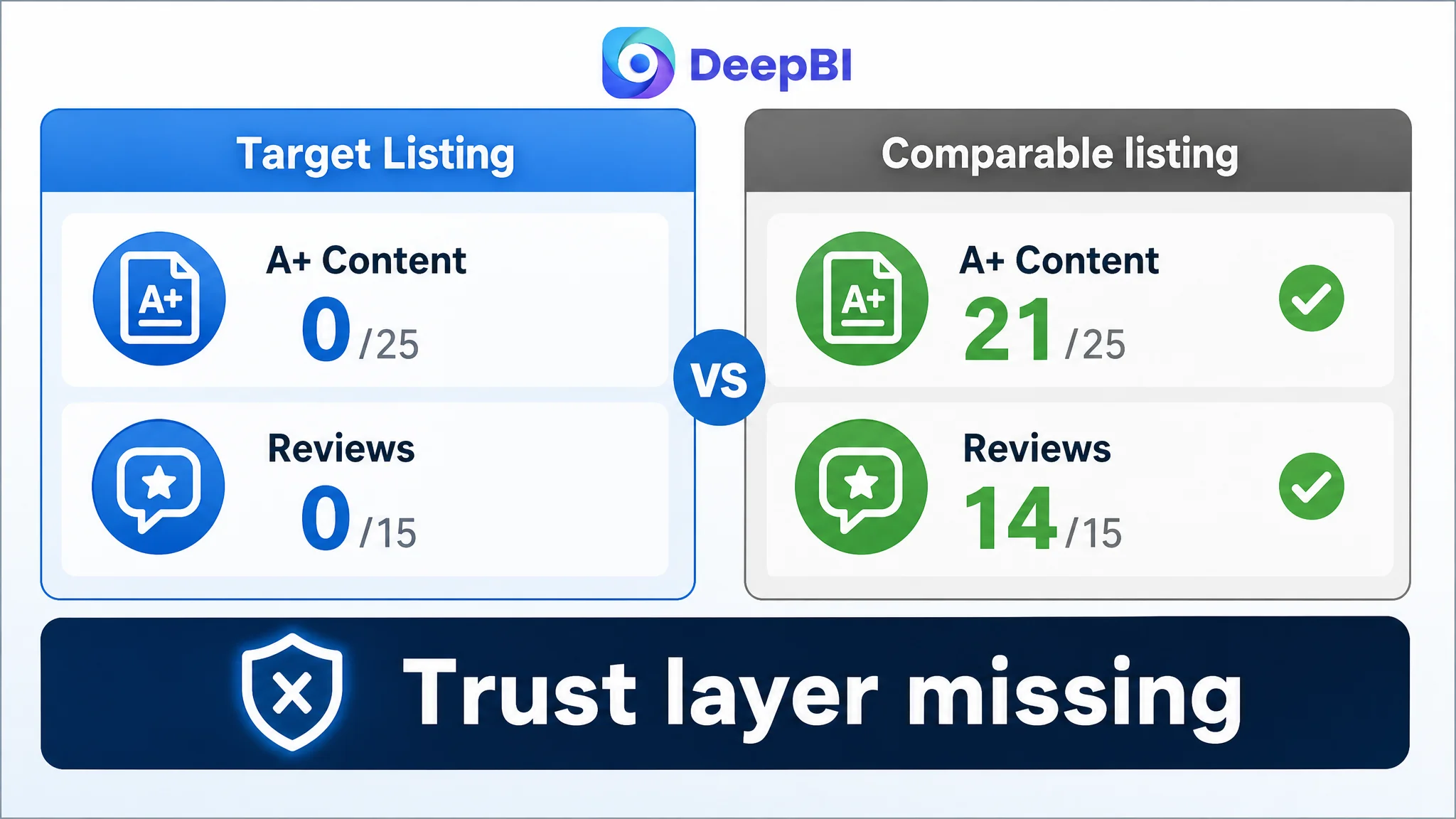
When social proof is limited, the product page must carry more of the explanation burden. This Listing had neither enough proof nor enough structured explanation.
The Title Was Functional, but It Did Not Lead With the Buyer’s Outcome
The title was not the largest weakness, but DeepBI still identified a meaningful opportunity.
The existing title prioritized keyword coverage and technical completeness. It included the core product term, input and output specifications, the cigarette lighter plug, and application categories such as RV, truck, and marine accessories.
That made it search-friendly. But compared with the benchmark, it was less persuasive.
The benchmark title used a direct outcome-oriented phrase around avoiding voltage drop or rise. It also described the product as a conversion kit for truck and RV use, giving the shopper a clearer picture of where the product belongs.
The difference was subtle but important:
- Technical description: what the product is and what its specifications are
- Conversion-oriented description: what problem the product helps the buyer avoid
The recommended direction kept the important search terms and specifications while making the usage context more explicit:
“Starlink Mini Car Adapter, 105W 12V/24V to 30V 3.5A DC Step-Up Converter, Power Cable with Cigarette Lighter Plug, Stable Power Supply Kit for RV, Truck, Marine Accessories”
The strategic priority was not to replace every technical term with emotional language. It was to create a better balance between:
- Core keyword relevance
- Product form
- Electrical specifications
- Vehicle and outdoor use cases
- The stability benefit the buyer actually cares about
The title therefore needed refinement, but it did not justify treating the title as the central business problem.
The Bullet Points Needed a Buying Logic, Not a Complete Rewrite
The bullet points were another area where the target Listing was not at a severe disadvantage. In fact, the score was slightly higher than the benchmark: 7 out of 10 compared with 6 out of 10.
That did not mean the bullet points were already optimal. It meant they were not where the largest conversion leak was located.
The existing structure moved through technical specification, design, durability, safety, and ease of use. The optimization opportunity was to make each point answer a concrete buyer concern.
The product needed to be framed as a mobile power solution
The first bullet could connect the product more directly to on-the-go use. Instead of presenting only the conversion specification, it could explain how the output supports Starlink Mini in trucks, RVs, boats, and off-grid environments.
The integrated design needed to be tied to risk reduction
The second bullet should not merely say that the product is integrated. It should clarify why the lack of additional connectors matters: fewer connection points, a cleaner installation path, and less dependence on improvised wiring.
Environmental protection needed a visible use context
Waterproofing, dust protection, UV resistance, and temperature tolerance are more persuasive when connected to rain, snow, dust, and outdoor travel. They should not appear as isolated technical claims.
Safety protection needed to answer an underlying fear
Over-current, overload, overheating, and short-circuit protection matter because buyers worry about damaging equipment or creating an unsafe installation. The copy should connect the protection system to extended use and mobile environments.
Compatibility and installation needed to be unambiguous
The final bullet should make the connection sequence clear and state what is and is not included. The source material specifically identified the need to clarify that the dual-head DC cable was not included. That detail helps prevent post-purchase misunderstanding and avoidable customer-service friction.
The key was not simply to add more adjectives. It was to turn each bullet into a short concern–solution–evidence sequence.
The Main Image Problem Was Not Just “Make It More Attractive”
The main-image analysis did not support a simplistic conclusion that the product looked unattractive. The score was 25 out of 30, slightly above the comparable listing’s 24.
The more precise issue was that several images did not communicate the product’s value efficiently enough.
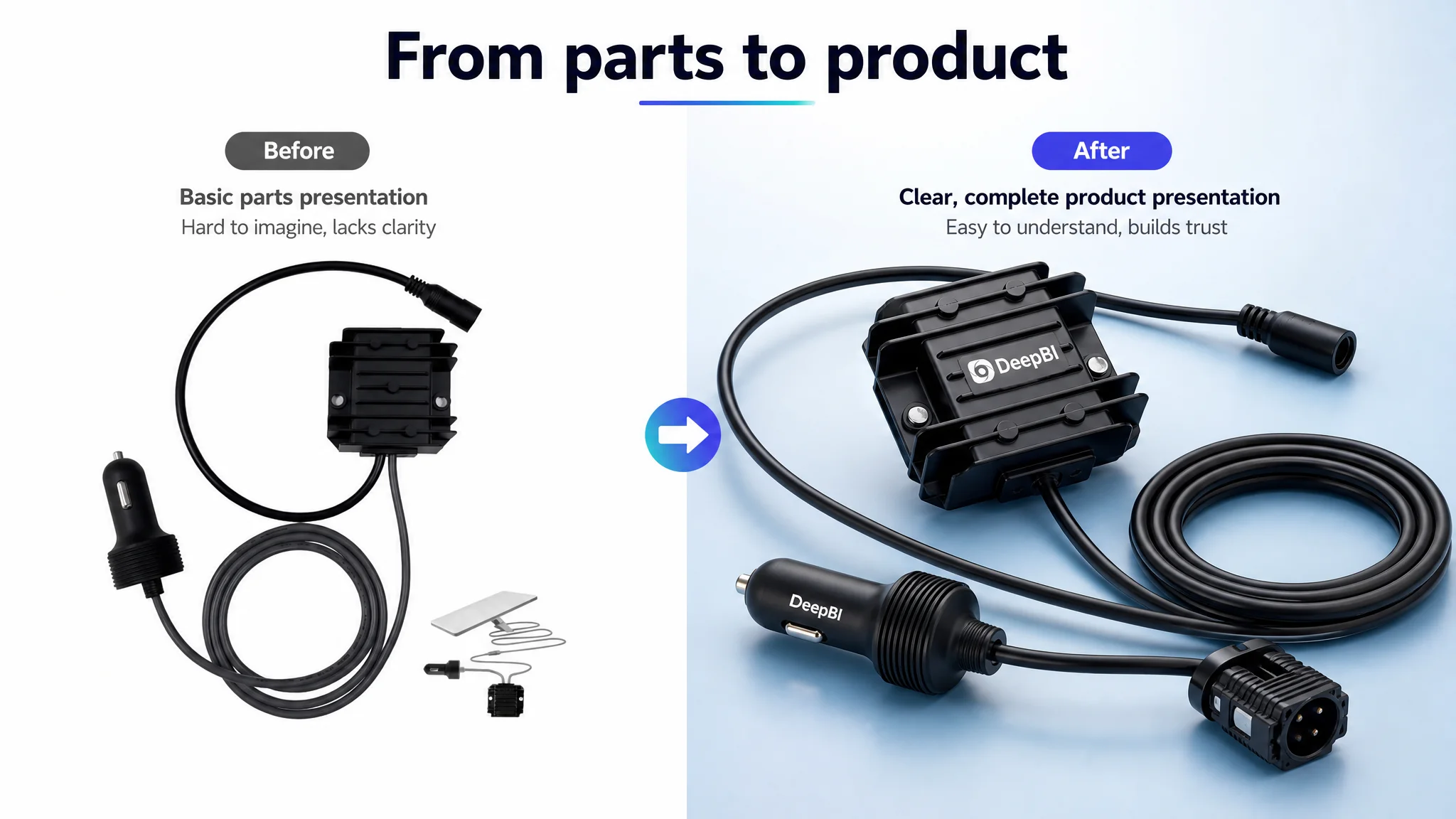
Some visuals leaned toward an industrial parts presentation. Others used dense parameter layouts or assembled vehicle素材 without creating a convincing use context. The result was a page that could look like a collection of product assets rather than a guided explanation.
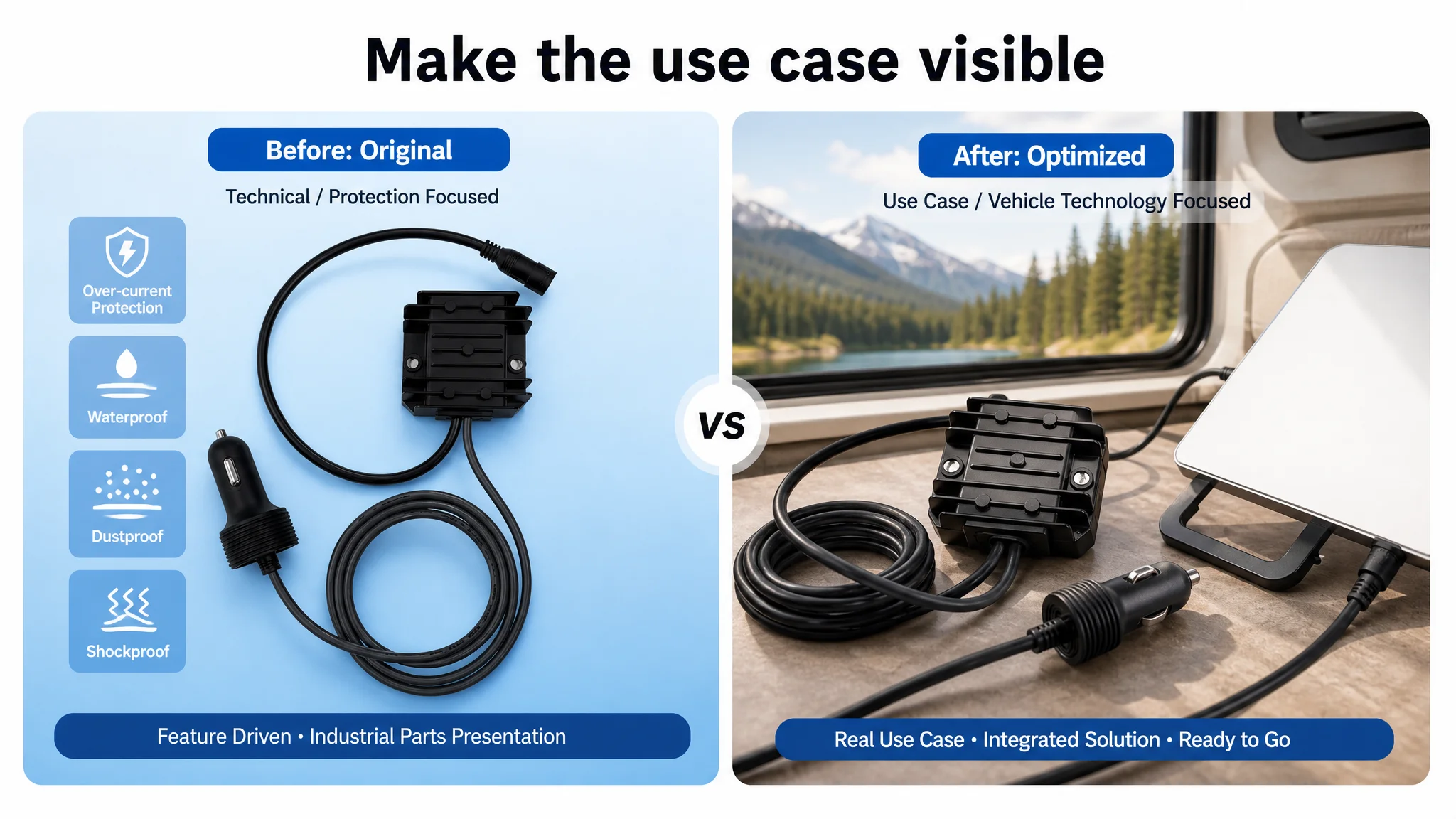
The recommended visual direction was to move from an undifferentiated industrial-parts appearance toward a more refined vehicle-technology presentation while keeping the product physically accurate.
That meant:
- A clean, centered product presentation
- A clear 45-degree angle where appropriate
- Better control of light and shadow
- Neatly arranged cabling
- Realistic RV, SUV, truck, boat, or outdoor environments in supporting images
- Clear installation and connection logic
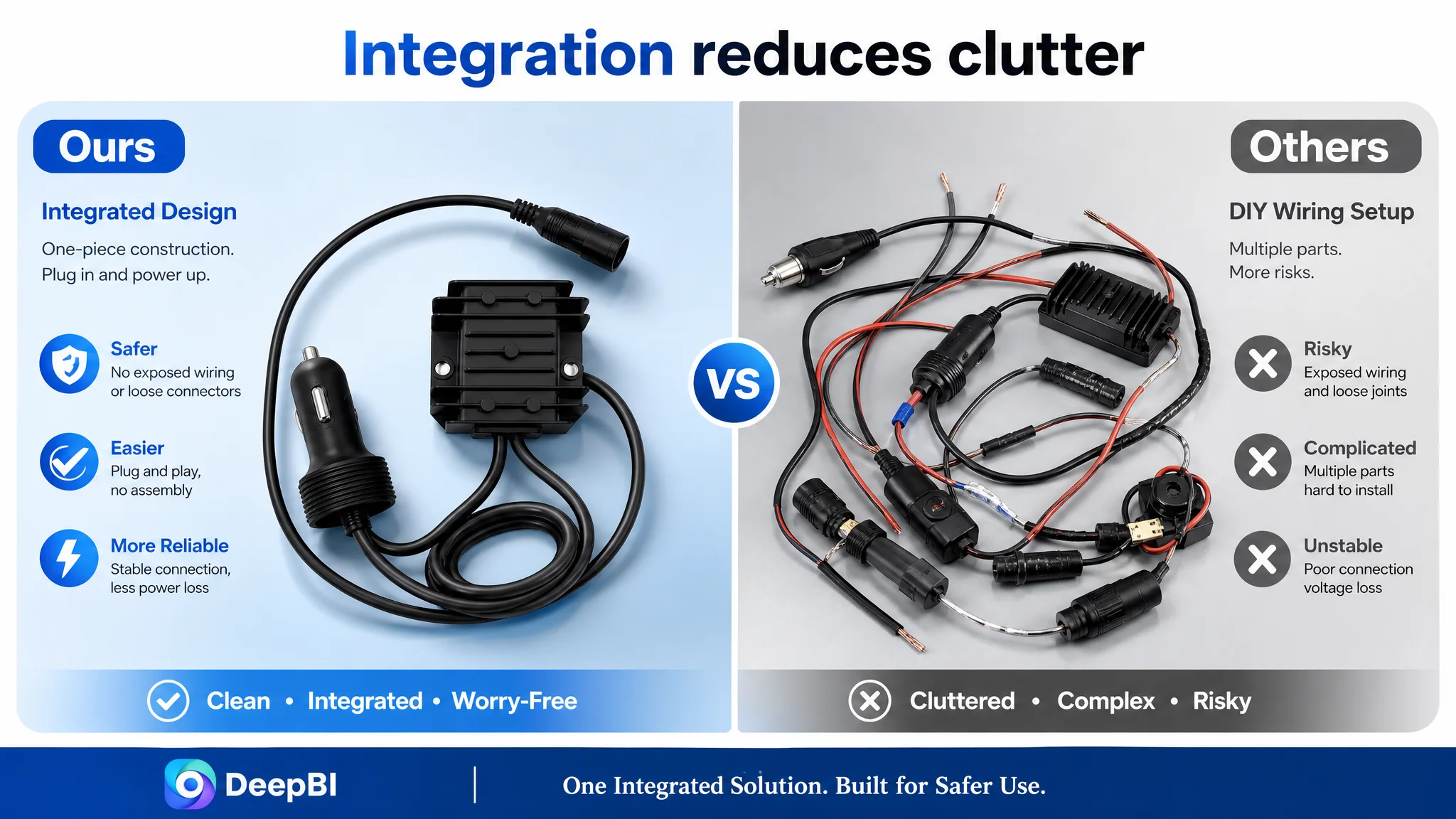
- Visual comparison between integrated construction and loose DIY assemblies
The purpose was not to make the adapter appear more expensive than it is. The purpose was to help the shopper understand that it is a finished solution for a specific mobile-power problem.
The first screen needed to establish product identity
The primary image should remain compliant with Amazon’s main-image requirements and show the actual product clearly on a clean background. Its job is to win recognition and establish what the shopper is buying.
The supporting images could then add:
- A closer product angle
- Technical specifications
- Connector details
- Realistic vehicle or RV use
- Product-to-Starlink Mini connection flow
- Environmental and protection features
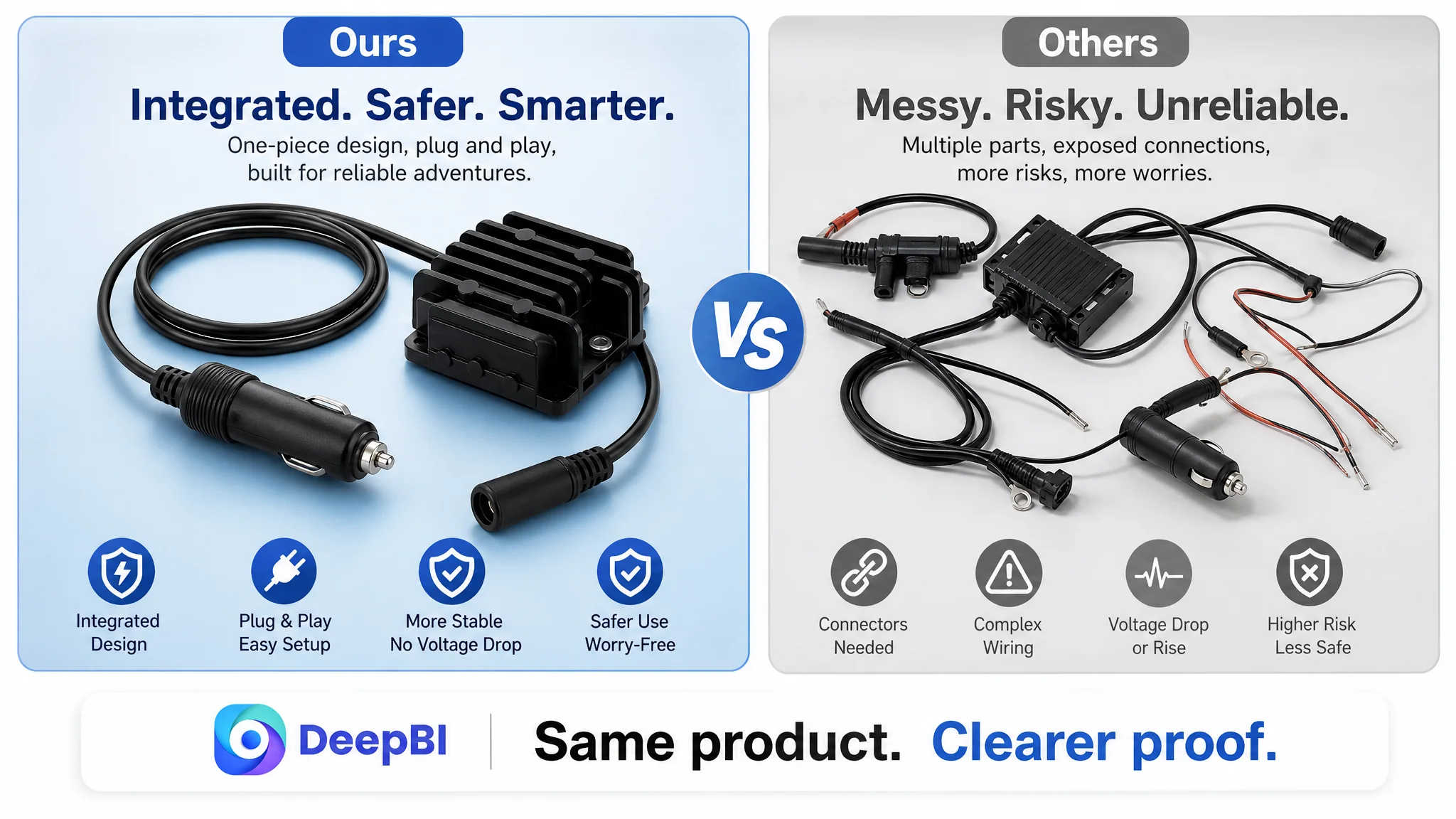
- Integrated-design comparison
Each image needed a distinct role. Repeating the product from slightly different angles would not solve the information problem.
The connection path needed to become immediately understandable
For this product, installation uncertainty was one of the most important purchase barriers.
A useful supporting image would show the sequence:
Vehicle cigarette-lighter outlet → adapter and step-up converter → DC connection → Starlink Mini equipment
The visual should make clear which parts belong to the product and which cable is not included. This is more valuable than a generic lifestyle image because it addresses the buyer’s most practical question: “How exactly will I use this?”
Comparison had to explain the integrated value
The proposed “Ours vs Others” concept was commercially useful because the product’s differentiation was not obvious from its shape alone.
One side could show the integrated cable and converter in an orderly configuration. The other could represent loose modules, multiple connectors, and complicated wiring. The objective was not to attack a named competitor or make unsupported safety claims. It was to clarify the tradeoff between an integrated design and a more complex DIY setup.
Missing A+ Content Was the Central Conversion Leak
The absence of A+ content was the clearest reason not to keep tuning the ads or polishing isolated Listing elements first.
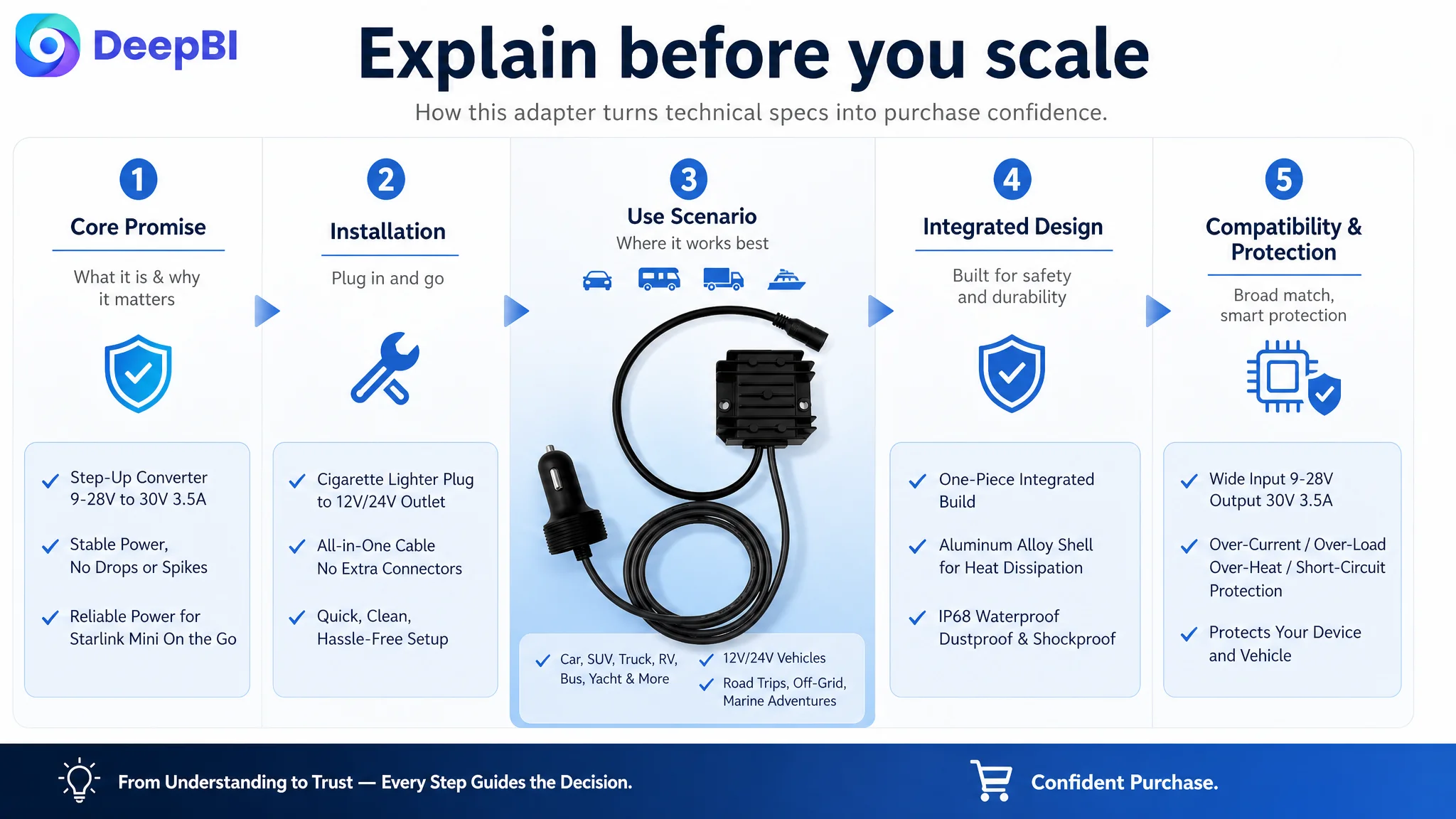
A+ content could provide the page with the missing narrative structure.
The opening module should establish the core promise
The first module should position the product around stable mobile power for Starlink Mini. It should show the product accurately, use a restrained technical visual style, and make the primary benefit legible without forcing the shopper to decode a dense specification chart.
The installation module should remove uncertainty
A step-by-step connection diagram should show the product’s role in the power chain. This module should prioritize clarity over visual drama.
The buyer should be able to answer:
- Where does the cigarette-lighter plug connect?
- Where does the converter sit in the chain?
- How does the output connect to Starlink Mini?
- Is an additional cable required?
The scenario module should make the use case tangible
A realistic RV interior, truck cabin, boat deck, or SUV outdoor setup can help the shopper picture the product in use. The purpose is not lifestyle decoration. It is to connect the technical product to the situations in which stable mobile internet matters.
The comparison module should make integration visible
A structured comparison can show the difference between a single integrated solution and a collection of loose connectors or DIY wiring components. This supports the product’s design argument in a way that a short bullet point cannot.
The compatibility module should address 12V and 24V concerns
Vehicle-power shoppers may hesitate because they are unsure whether their vehicle system is compatible. A clear, accurate input-range display and multi-vehicle scenario module can reduce that uncertainty.
The protection module should communicate reliability without overclaiming
The page can show the actual protection features, casing, sealing, and heat-dissipation structure supported by the product information. It should not invent tests, certifications, or performance results that are not present in the source material.
This distinction is important. A stronger visual does not justify unsupported technical claims.
Why DeepBI Did Not Prioritize Ads First
The most important decision in this case was the order of operations.
There was no evidence in the supplied material that the title or bullet points represented a catastrophic search-relevance problem. There was also no evidence that changing bids, campaign structures, or keyword targeting would repair the page’s missing trust layer.
If paid traffic were directed to the Listing before the page could explain and support the product, that traffic would arrive at the same unresolved problems:
- No A+ narrative
- No review foundation
- Weak installation explanation
- Limited visual proof of use
- Insufficient differentiation from DIY alternatives
- A technical product presentation without enough purchase confidence
This is why ad optimization could not be treated as the first solution.
Advertising can increase exposure, but it cannot substitute for product-page proof. When the page lacks explanation and trust, more traffic may only expose the weakness at greater scale.
The correct decision path was therefore:
1. Confirm the largest competitive gap through Listing-level evidence
2. Repair the page’s ability to explain the product and reduce risk
3. Align the title and bullet points with the clearer product story
4. Reassess how paid and organic traffic perform against the improved page
5. Only then consider more aggressive traffic scaling
This is not an argument against Amazon ads. It is an argument for using ads after the page has enough conversion capacity to make the traffic useful.
The Optimization Focus Shifted From “More Assets” to “Better Decision Support”
The later direction was not simply to produce more images or rewrite more copy. It was to assign each page element a specific commercial responsibility.
- Title: Decision role: Capture relevant searches and state the product’s practical value
- Main image: Decision role: Establish product identity and earn attention
- Supporting images: Decision role: Show specifications, compatibility, connection, and usage
- Bullet points: Decision role: Convert features into buyer-relevant solutions
- A+ content: Decision role: Build a complete explanation and trust sequence
- Reviews: Decision role: Provide independent evidence and real installation context
This structure also changed how image production needed to be handled.
The product itself could not be altered during visual optimization. Its connector layout, casing, cable structure, and actual specifications had to remain consistent with the source product. The improvements belonged in the presentation layer:
- Composition
- Lighting
- Background
- Scene selection
- Visual hierarchy
- Information grouping
- Comparison structure
That constraint matters for Amazon sellers using AI-generated creative assets. A visually impressive image that changes the product’s structure can create a new problem: customer confusion, negative reviews, returns, and loss of trust.
DeepBI’s role in this case was not to produce a more dramatic image for its own sake. It was to translate the identified business gap into a visual and textual direction that remained grounded in the real product.
What Changed in the Business Understanding
The supplied case material does not include post-optimization CTR, CVR, ACOS, TACOS, ranking, or order data. It would therefore be inappropriate to claim a specific performance improvement.
The important change documented here is the change in operating judgment.
The customer’s Listing was no longer viewed as a collection of separate tasks:
- Rewrite the title
- Improve the bullets
- Generate better images
- Add more lifestyle scenes
Instead, it was understood as a conversion system with a clear constraint.
The page needed to answer the buyer’s questions in the order they arose:
1. What is this product?
2. Is it relevant to my Starlink Mini setup?
3. Will it work in my vehicle, RV, truck, or boat?
4. How does it connect?
5. Why is the integrated design useful?
6. Can I trust it in outdoor conditions?
7. What evidence supports the purchase?
The missing A+ content and review foundation made that sequence incomplete. The revised optimization direction focused on rebuilding it through page structure, not just surface-level polishing.
The Lesson for Amazon Sellers
A low-converting Amazon Listing does not always need more traffic, more keywords, or more creative volume.
Sometimes the page already contains enough technical information to be relevant in search, but not enough structured evidence to make the buyer comfortable purchasing.
That was the central issue in this Starlink Mini car adapter case. The title was relatively strong. The bullet points were serviceable. The main-image score was not the weakest area. But the Listing had no A+ content, no review history, and no complete visual explanation of installation, compatibility, use scenarios, or integrated design.
The most useful question was therefore not:
“Which ad setting should be adjusted next?”
It was:
“If the Listing receives more qualified traffic tomorrow, does the page give shoppers enough reason to buy?”
For Amazon sellers, that question helps separate a traffic problem from a conversion problem. It also clarifies the proper role of Amazon ads: ads should bring relevant shoppers to a page that can convert them, while Listing content provides the explanation, trust, and decision support that advertising alone cannot create.