

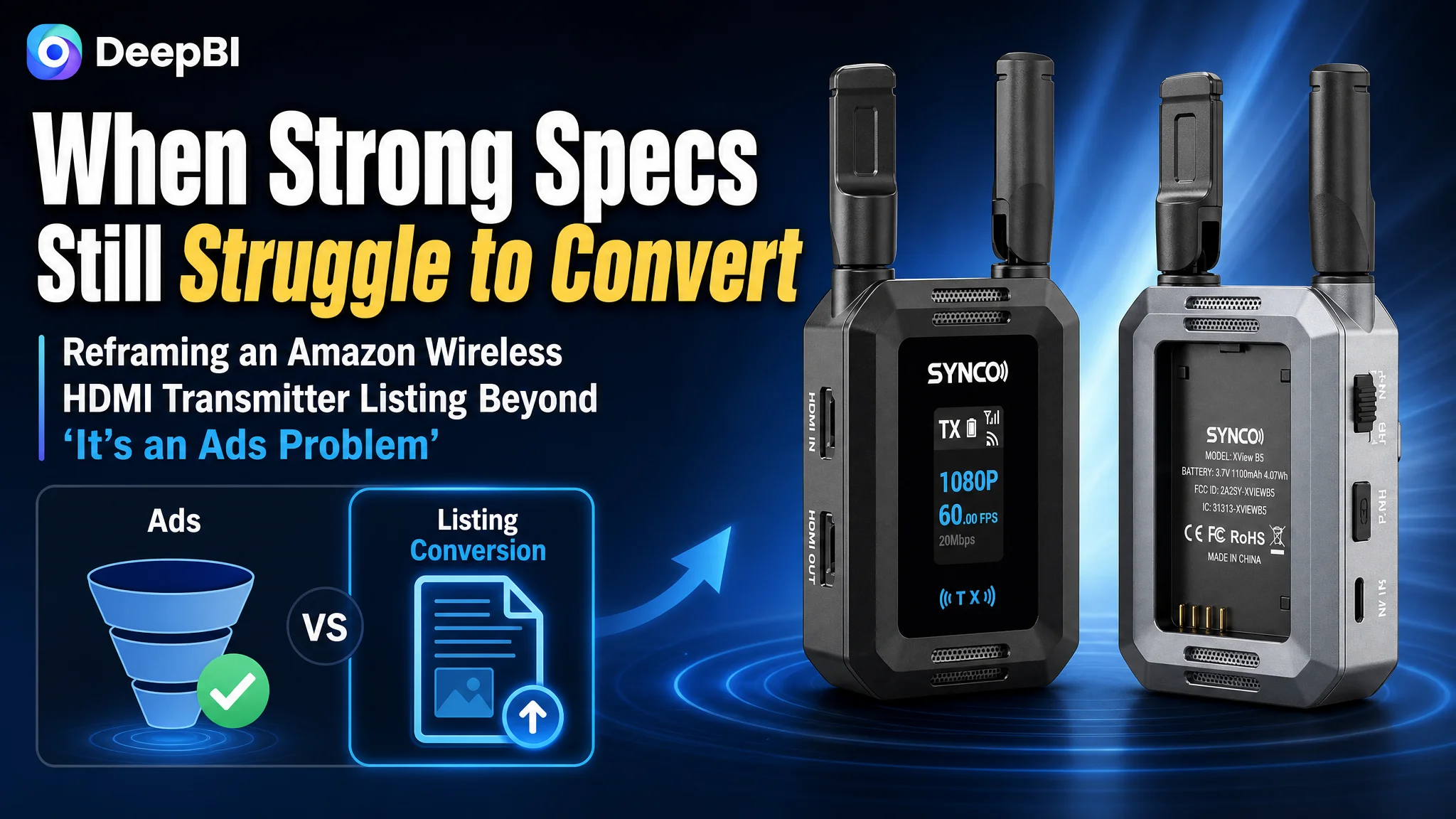
This Amazon seller in the wireless HDMI video-transmission niche came to DeepBI with a familiar complaint: traffic from Amazon ads was not turning into enough orders. On paper, the product looked competitive—300m range, ultra‑low latency, dual HDMI, NP‑F and USB‑C power—but the Listing was not winning the click or the final decision often enough against a leading competitor on Amazon.it.
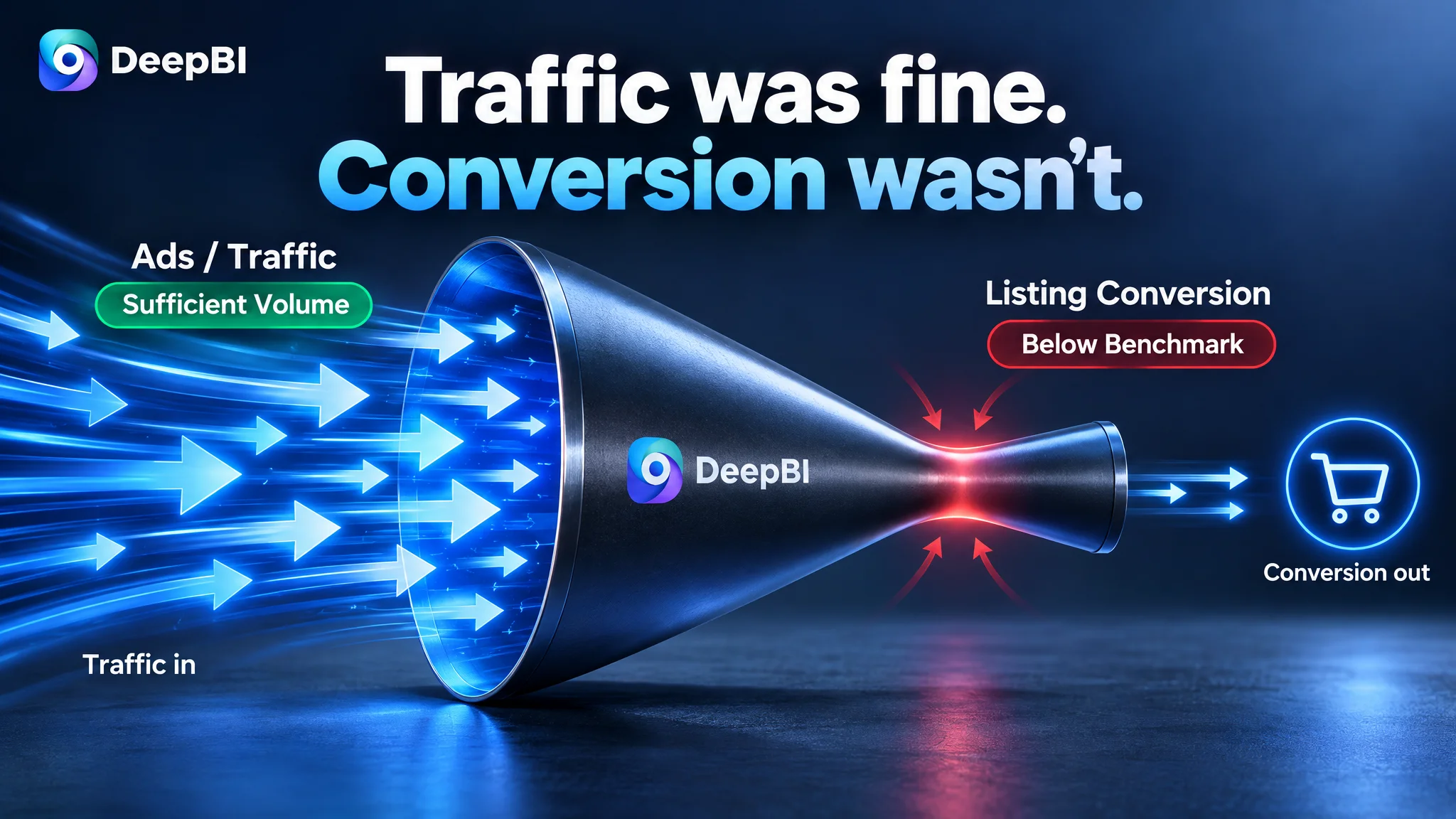
The seller’s internal diagnosis focused on advertising: maybe keywords were not precise enough, maybe bids were wrong, maybe the campaign structure needed refinement. When ACOS refused to move in the right direction, the team tried to “push harder” on ads instead of questioning the product page itself. DeepBI’s Listing scoring and benchmark comparison showed a different picture: the core constraint was not traffic acquisition, but the Listing’s ability to convert the traffic it already had.
By dissecting title structure, main-image logic, A+ content depth, and review signals against a benchmark Amazon Listing in the same category, DeepBI reframed the issue as a product-page conversion problem. The later optimization focused on tightening the title around a clear promise, rebuilding main images around professional use cases and power reliability, and enhancing the A+ story and FAQ to close trust gaps. For other Amazon sellers, this case is a reminder: when a technically superior product underperforms, it is often the Listing’s decision logic—not the ad console—that is silently capping performance.
Amazon Ads Were Not Failing. The Page Was Consuming the Traffic.
From the seller’s perspective, the symptoms looked like a typical ads problem on Amazon:
- Ad spend was climbing, but orders did not increase proportionally.
- ACOS stayed stubbornly high.
- A category competitor on Amazon.it consistently outran them on sales despite weaker specs on paper (shorter range, higher latency).
The immediate reaction inside the team was to iterate on advertising levers:
- Add and refine keywords around “wireless HDMI”, “1080P 60Hz”, “live streaming”.
- Adjust bids to chase more placements.
- Split campaigns by device type and scenario (projectors, cameras, streaming).
Each cycle produced more traffic and more cost, but not a clear improvement in conversion efficiency. At this point, the working assumption was still: “Our ads are not optimized enough.”
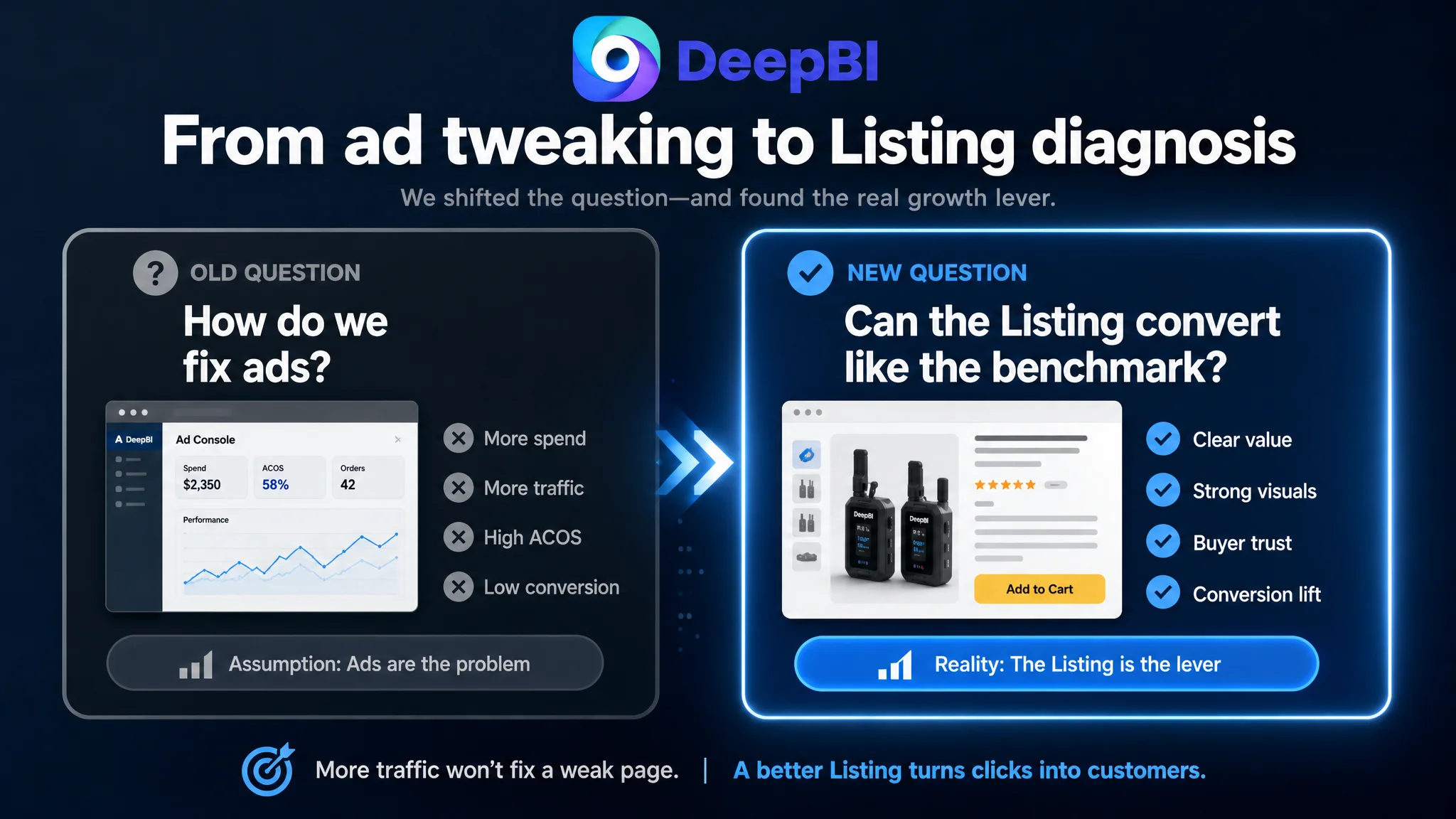
DeepBI’s approach started from a different question:
“If we temporarily assume the ads are good enough to bring relevant traffic, can this Amazon Listing actually convert that traffic as well as the benchmark?”
Once we framed it this way, the problem moved out of the ad console and into the product page itself.
The Real Constraint Was Listing Conversion Capacity
DeepBI’s Listing scoring report compared the target Listing with a clear benchmark competitor on Amazon.it in the same wireless HDMI system niche.
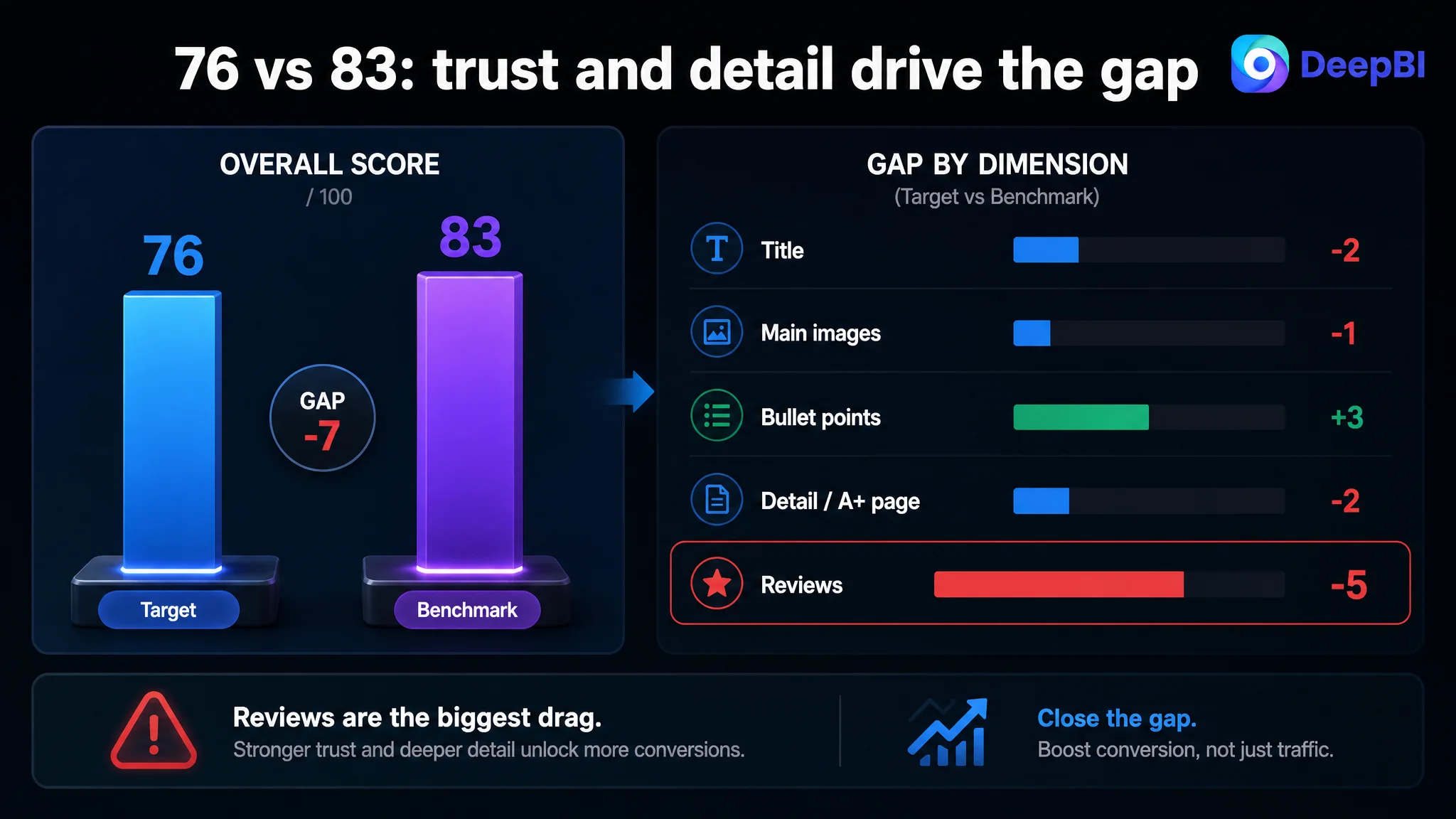
Overall score:
- Target Listing: 76 / 100
- Benchmark Listing: 83 / 100
- Gap: –7 points
On the surface, a 7‑point difference does not sound catastrophic. But where that gap came from was critical:
- Title: Target: 15, Benchmark: 17, Full Score: 20, Gap: -2
- Main image set: Target: 25, Benchmark: 26, Full Score: 30, Gap: -1
- Bullet points: Target: 8, Benchmark: 5, Full Score: 10, Gap: +3 (outperform)
- Detail / A+ page: Target: 21, Benchmark: 23, Full Score: 25, Gap: -2
- Reviews: Target: 7, Benchmark: 12, Full Score: 15, Gap: -5
Two things stand out:
1. The target Listing actually outperformed on bullet-point depth (8 vs 5). This seller did not lack content or technical clarity in text.
2. The real weaknesses were trust and decision support: title clarity, A+ depth, and especially reviews.
In other words, the Listing was not empty—it was misaligned with how buyers make decisions in this category.
“The real problem was not that ads failed to bring traffic. It was that the page could not convert the traffic.”
What the Seller Originally Misdiagnosed
Internally, the seller’s narrative looked like this:
- “Our specs are stronger than the competitor’s—300m vs 200m, 40ms vs 50ms. If ads get enough exposure on ‘wireless HDMI’ words, we should win.”
- “If conversion is weak, it must be that we’re not buying the right traffic yet. Let’s keep optimizing ads.”
There were three implicit assumptions:
1. More technical details automatically translate into higher conversion if traffic is relevant.
2. Text-heavy titles and bullet points are a net positive because they fully describe the product.
3. Visuals just need to be ‘good enough’; the specs will do the real selling.
DeepBI’s data contradicted this. When we overlaid the Listing score with the benchmark’s visual and review structure, it became clear:
- The benchmark Listing did less with words and more with visual decision shortcuts (scenario images, distance visualization, power-supply reassurance).
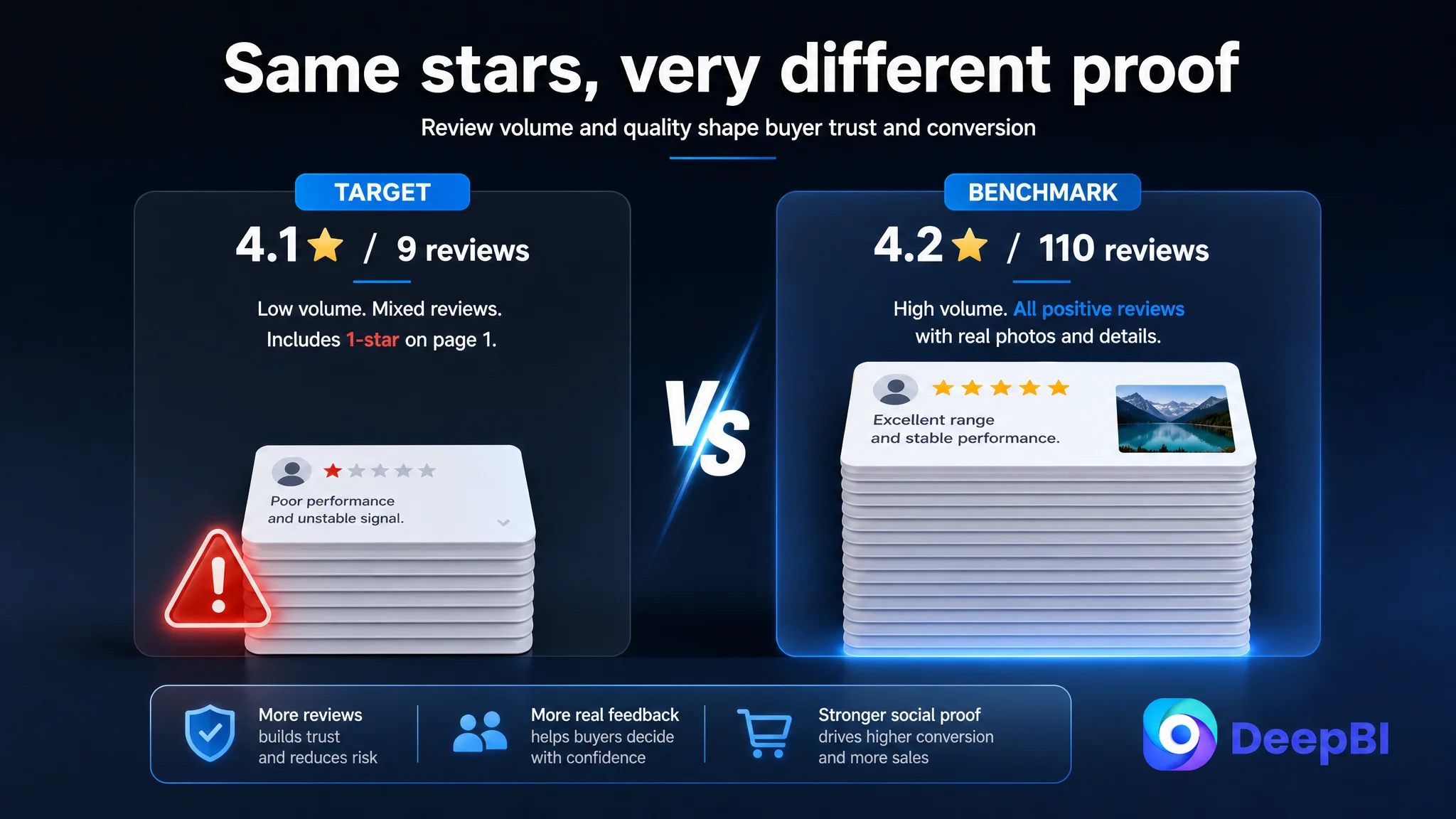
- The benchmark had far stronger social proof:
- Target: 4.1 stars, 9 reviews (including a 1‑star on the first page)
- Benchmark: 4.2 stars, 110 reviews, all front-page reviews positive and often long with images
The seller was trapped in a typical performance-ads mindset: keep tuning campaigns while ignoring that the product page looked less “proven” and less professionally framed than the competitor’s, despite better specs.
This Product Page Did Not Lack Information. It Lacked a Buying Logic.
A dense, technically strong, but hard-to-scan title
The original title put the core keyword forward—“wireless video transmitter system”—which is good for search. It then chained multiple parameters and scenarios into one heavy string:
- Brand + “Sistema di Trasmettitore Video Wireless HDMI 1080P 60FPS”
- Followed by “Doppia Uscita HDMI e Loop Out Latenza 0.04s 300m”
- Plus scene tags like “Live Streaming Fotoripresa”
In contrast, the benchmark title followed a more buyer-friendly logic:
- Brand + core product type
- Clear, compact performance claims: range, resolution, latency, “Plug & Play”
- Concrete device scenarios: projectors, cameras, laptops
Both titles contained similar ingredients. The difference:
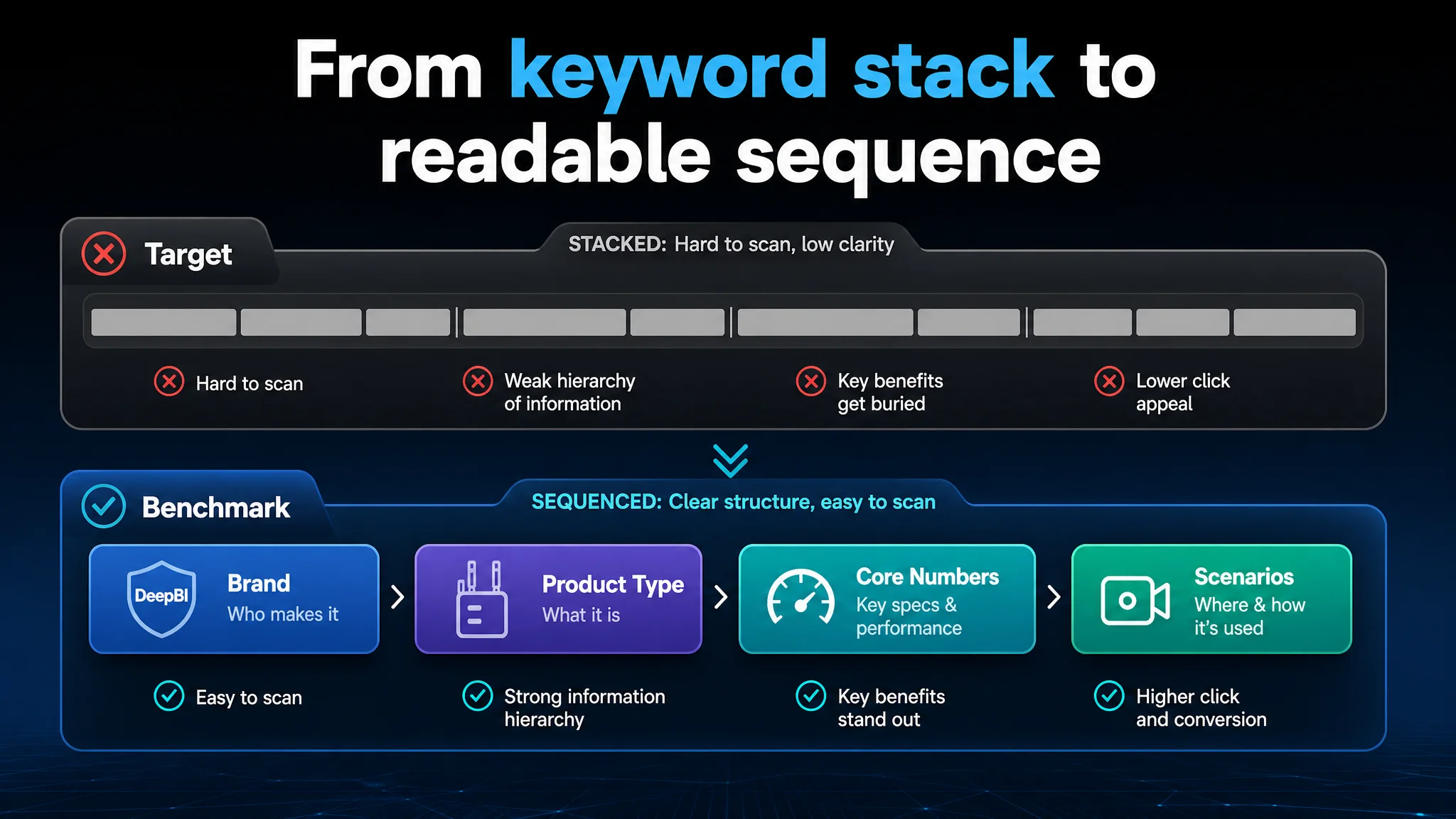
- The target Listing stacked everything—hard to scan, looks like keyword stuffing.
- The benchmark sequenced information—brand → what it is → core numbers → where you use it.
In a search result full of similar devices, that structure matters for CTR and for immediate trust.
Main images focused on text, not on real workflows
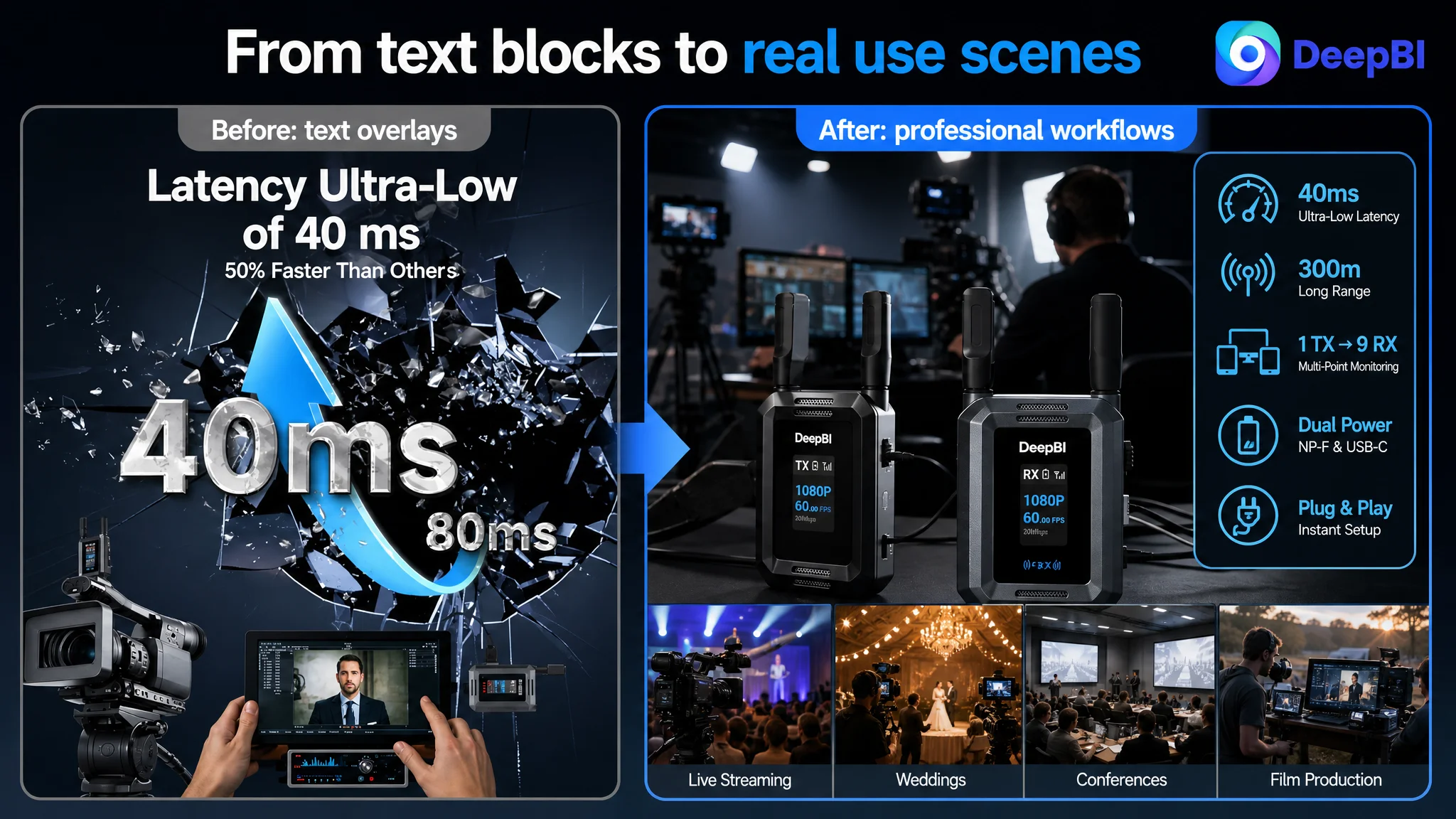
The target image set worked, but not as a professional buyer would expect:
- Technical parameters were delivered via large text overlays, instead of visualized flows or diagrams that show the device in a live production environment.
- There was no strong “user at work” scene—no clean control room, broadcast studio, multi-monitor setup under pressure.
- Accessories were presented without structured explanation, increasing the risk of post-purchase confusion and pre‑purchase hesitation.
The benchmark Listing:
- Visually demonstrated front and back of the devices, including a clear view of the battery compartment and display.
- Used large venue scenes (stadium, church multi-screen, large hall) to make “200m” and stability feel real.
- Showed dual power options (battery and cable) in close-up, speaking directly to concerns about uptime.
The result: buyers scrolling Amazon search results implicitly see one Listing as a serious, field‑tested tool, and the other as a technically detailed product still seeking validation.
A+ content: strong modules, but weaker trust and application framing
On the detail page, the target Listing had:
- Core parameters, multi‑receiver connection diagrams, structural details, outdoor scenes, power diagrams, HDMI extension visuals, packaging.
The benchmark had all of that plus:
- Large‑venue use cases: stadium tests, church multi-screen deployments.
- High-detail interface explanations: LCD, IO ports, status lights.
- APP monitoring visuals.
- An explicit FAQ section with five high-frequency questions addressed upfront.
Again, the target seller did not lack content volume. What it lacked was depth in trust-building and application proof:
- “Mountain 300m” scenes looked like a range demo, but not like a real production workflow.
- There was no dedicated FAQ or buyer‑objection handling module.
- Technical visuals (like chip diagrams) were present but not tied to what operators actually see and feel (UI, signal stability, multi‑point monitoring).
For professional users, this gap is not cosmetic; it is decisive.
Why DeepBI Did Not Keep Tuning the Ads First
From an ad-operations perspective, there were two big commercial risks:
1. Every extra euro of ad spend was feeding a page that converted worse than the benchmark.
2. Improving CTR slightly without fixing the page would likely push ACOS up, not down.
DeepBI’s diagnosis therefore treated ad optimization as premature scaling. Before sending even more paid traffic, we needed to answer:
- Can this Listing hold its own when compared head‑to‑head with the top competitor?
- Where exactly in the buyer’s mental funnel does it lose them—at click, at trust, or at final justification?
The Listing score data, review gap, and visual-comparison analysis led to a clear judgment:
“At this stage, optimizing ads first would amplify the wrong outcome. The priority is to rebuild the page’s sales logic to the benchmark level.”
So the recommendation path was:
1. Stabilize and observe ads, but avoid aggressive scaling or big structural changes.
2. Rebuild Listing conversion capacity—title clarity, main-image logic, A+ modules, objection handling.
3. Only after the page could demonstrably convert better should the seller consider a new round of ad scaling and keyword expansion.
How DeepBI Read the Listing Data and Visual Gaps
DeepBI’s benchmark analysis broke down the gap into clear, actionable patterns rather than vague “improve visuals” advice.
1. Title: from dense description to competitive, scan-friendly structure
DeepBI recommended a revised Italian title aligned with benchmark logic but leveraging the target’s superior specs:
“Brand + XVision HDMI Wireless Transmitter 1080P 60Hz, 300m Range, 0.04s Latency, Dual HDMI & Loop Out, Plug & Play per Fotocamere, Laptop e Live Streaming (1 TX + 1 RX)”
Key shifts in logic:
- Core keyword “trasmettitore HDMI wireless” moved forward to keep search weight.
- Core competitive parameters clearly surfaced: 300m and 40ms as explicit, easy-to-grasp advantages over the 200m / 50ms competitor.
- “Plug & Play” and concrete device types (“Fotocamere, Laptop”) make the use case read like a solution, not a spec list.
This is not cosmetics; it is what the buyer can decode in 1–2 seconds on the search results page.
2. Bullet points: keep depth, reorganize around buyer concerns
The target Listing already did a good job of covering many angles: performance, multi‑monitoring, power options, operation, silence, portability.
DeepBI’s input was not “write more,” but reframe each bullet around clear benefits and proof:
- Bullet 1: 300m HD transmission & 40ms latency, positioned as a concrete edge over typical 50ms systems, tied to “real‑time feedback for drones and professional shoots.”
- Bullet 2: Multi-endpoint collaborative monitoring (1–9 endpoints) plus Plug & Play and automatic pairing, framed as team-efficiency and setup-time savings.
- Bullet 3: Signal stability and silent 2W operation, emphasizing interference resistance and fanless, noise-free design.
- Bullet 4: Power reliability as a critical topic, explaining why dual power (NP‑F and USB‑C 5V2A) prevents disconnections and slowdowns.
- Bullet 5: 119g ultra-compact design with intuitive display, linking portability and color screen directly to faster, safer operation on set.
The goal: make bullets read as risk reduction and workflow improvement, not just technologies.
3. Main images: from parameter overlays to professional workflows and risk removal
DeepBI’s competitive visual analysis showed that the benchmark’s image set did three things the target did not:
1. Show the hardware in a way that immediately explains front/back and power.
2. Make the abstract “distance” and “multi-receiver” claims tangible.
3. Anchor the product in real, high-stakes environments.
The optimization plan translated that into concrete, production-level directions, for example:
- Primary hero image: TX and RX side by side, front and back visible, 70% of the frame; cold, industrial white background; screen lit with 1080P info; strong but controlled lighting to signal professional hardware.
- Feature summary image: product centered in a dark‑gray tech background, surrounded by icons for “300m Range”, “40ms Latency”, “Dual HDMI”, etc.—essentially a visual spec sheet that can be read at a glance.
- Distance visualization image: night football stadium, products floating at sides with a glowing blue line and large “300M”—making range visceral, not just numeric.
- Dual power close‑up: back of the RX with NP‑F battery and USB‑C cable highlighted, and a clear “Dual Power Supply” label.
- Multi-receiver studio scene: one camera with TX in foreground, four monitors with RX units in the background, labeled “RX1–RX4” to show real 1‑to‑4 collaboration.
These are not merely “nicer images”; they address specific doubts professional buyers have:
- Will this really reach across a venue like mine?
- Is power management flexible enough for long shoots?
- How does multi‑monitoring actually look in practice?
4. A+ content: reordering the story around professional trust
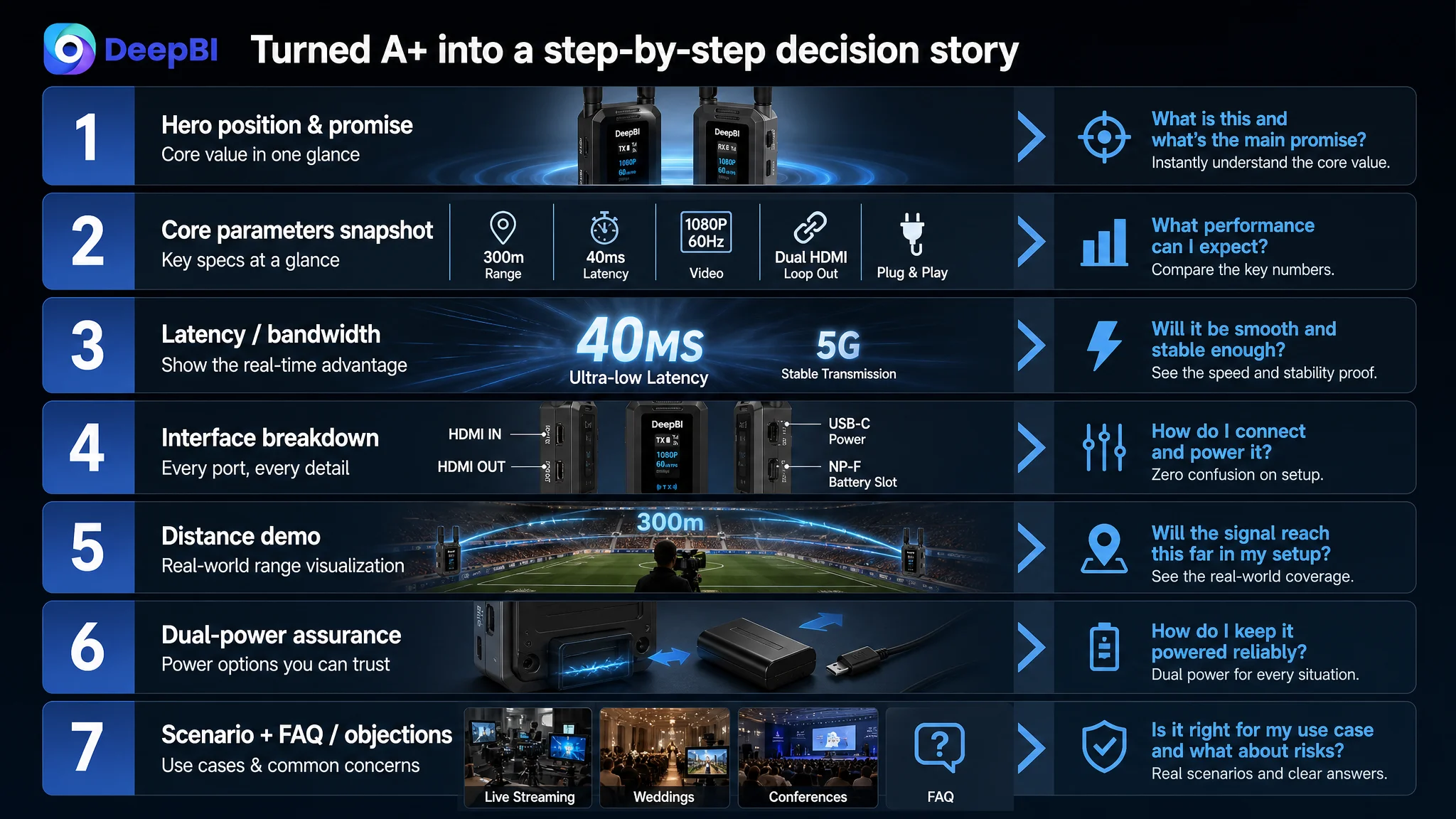
The original detail page modules were partially effective but underleveraged. DeepBI’s A+ suggestions followed a clear narrative sequence:
1. Hero module: high-end, deep-blue tech visual with product in a 3/4 view, brand and main promise on the left. Objective: establish professional positioning immediately when scrolling.
2. Core-parameters module: nine-grid layout around the product with icons for “40ms”, “300m”, “1080P 60fps”, etc. Objective: reduce cognitive load and unify scattered specs into one snapshot.
3. Latency and bandwidth module: real control-room background with dynamic light rings around the product, textual emphasis on “14 Mbps” and “40ms”. Objective: make low latency and throughput feel operational, not marketing.
4. Interface breakdown module: 45° top view with callouts to every port, screen, and mounting point. Objective: remove uncertainty about physical setup and compatibility.
5. Professional distance demo module: sports arena or similar; clearly marked start/end points and “300M” path. Objective: anchor range claims in realistic use.
6. Dual-power trust module: close-up of NP‑F battery installation and USB‑C cable. Objective: answer the “what if power fails mid‑event?” fear.
7. Scenario module: large indoor event (wedding or conference) with “1 TX to 4 RX” logic illustratively mapped. Objective: help buyers imagine their own complex setups.
Finally, DeepBI highlighted the absence of an FAQ / objection-handling section, which the benchmark used effectively. Adding such a module would proactively address issues like:
- What happens if power is insufficient?
- How many receivers can realistically be used at different distances?
- How to troubleshoot pairing or signal issues?
This is exactly where many pre‑purchase chats and returns originate; moving those answers into the Listing shortens the decision chain and reduces support friction.
Making Review Reality Visible Without Overreacting
The review comparison was stark:
- Target: 4.1 stars, 9 total reviews, including a visible 1‑star.
- Benchmark: 4.2 stars, 110 reviews, no negative review on the front page.
DeepBI’s judgment here was nuanced:
- The star rating alone was not the problem (4.1 vs 4.2 is close).
- The volume and quality of reviews created a massive trust gap.
- The single 1‑star review on the front page disproportionately shaped perception.
This is not something a Listing rewrite can fix overnight. Instead, DeepBI’s role was to:
- Ensure the Listing content and visuals reduce the likelihood of further negative reviews by clarifying expectations and use cases.
- Make the page robust enough that once the seller’s review base grows (through legitimate means), those positive signals can work harder.
In other words, the Listing needed to be worthy of more reviews before it could benefit from them.
How the Page’s Sales Logic Started to Recover
After reframing the core problem from “ads underperform” to “Listing under-converts,” the seller’s optimization work became more focused and less reactive.
The sequence looked like this:
1. Title and bullet logic adjusted to surface the real competitive edges (300m, 40ms, dual HDMI, dual power) in a way that is easy to scan and clearly beneficial.
2. Main image set restructured from text overlays to a narrative arc:
- What it is and what it looks like (front/back)
- What it can do (range, latency, multi‑receiver)
- Where and how it is used (stadium, studio, events)
- Why it can be trusted (power options, signal stability)
3. A+ storyline deepened, converting scattered details into modules that each answered a specific question: “Is it professional enough?”, “Will it work with my setup?”, “Will it hold up in my environment?”, “How do I power and mount it?”
4. Objection handling moved into the page via FAQ‑style content, reducing reliance on pre‑purchase support.
The immediate outcome was not a dramatic, invented number jump, but a shift in operating risk and leverage:
- The Listing’s conversion capacity improved, putting it closer to the benchmark’s level of professionalism and trust.
- Each incremental ad click now had a higher chance of turning into a paying customer.
- The seller could start thinking about scaling ads again with more confidence that budget would not be wasted on a structurally weaker page.
Ads did not become magically “better”; they became more useful because the destination they were funding was no longer the main bottleneck.
What This Changed in the Seller’s Understanding
Before working with DeepBI, the seller’s mental model was:
- “We have better specs → ads should be enough to win. If we’re losing, ads must be the problem.”
After going through the Listing scoring, benchmark analysis, and structured optimization, that model shifted to:
- “Specs are only one part of the decision. The Amazon Listing is what turns specs into a believable, low‑risk choice.”
- “Ads amplify whatever the Listing already is—strong or weak.”
- “Title, main images, bullets, A+, and reviews are not separate checkboxes; they must work together as a decision flow.”
The practical takeaways for this seller—and for other Amazon brands in technical categories—were:
- Do not scale ads into a page that has not been benchmarked.
- Use Listing scores and competitor comparisons to identify the real conversion leak—is it trust, clarity, proof, or application fit?
- Treat visual storytelling as a professional buyer conversation, not as decoration.
- Recognize that review volume and content shape your ceiling, and that a clearer, more honest page reduces the risk of damaging negative reviews.
In the end, DeepBI’s value in this case was not about “generating better pictures” or “rewriting bullets.” It was about correcting the seller’s diagnosis:
The problem was never just in the ads. It was in a technically strong Amazon Listing that, until it was rebuilt, could not fully convert the traffic it was already paying to acquire.