

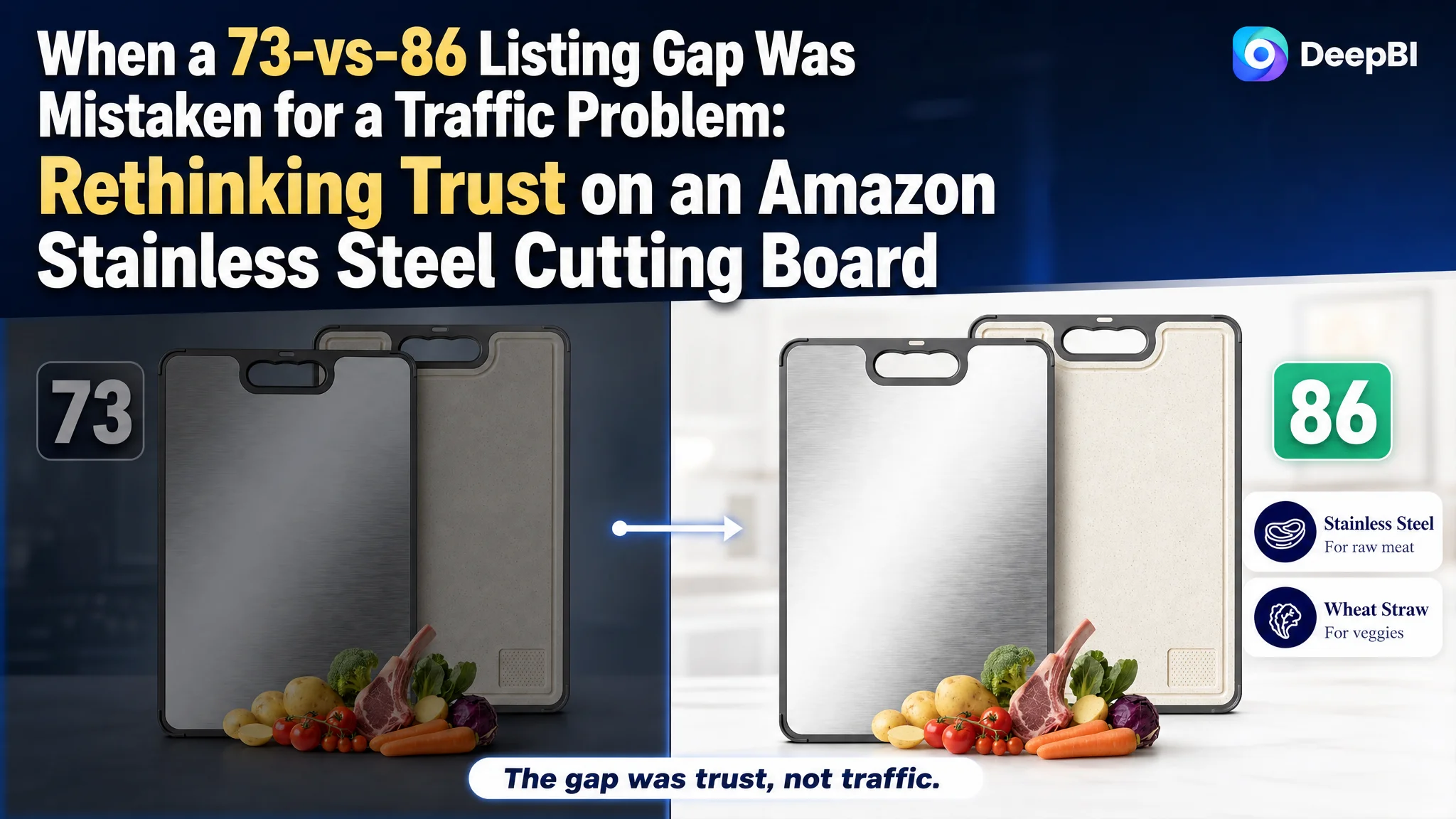
A kitchen prep seller on Amazon US had a two-sided cutting board — stainless steel on one side, wheat straw PP on the other — and ads that were bringing in traffic. Orders were not following at a rate the ad spend could justify. The team's first instinct was the usual one: campaign structure, bid levels, keyword precision. If ACOS was uncomfortable, something in the ad account had to be wrong.
DeepBI's scoring against a category-leading benchmark told a different story. The Listing scored 73 out of 100. The benchmark scored 86. The gap was not concentrated in traffic acquisition — it was concentrated in the two dimensions that decide whether a shopper who has already clicked believes the product is safe enough to buy.
The two weakest dimensions were the A+ page and the review footprint. The main image, title, and bullet points trailed as well, but by smaller margins. What DeepBI identified was a page that could attract a click but could not close a hygiene decision — and no amount of bid tuning changes that.
The optimization direction shifted accordingly: lead the page with material safety and raw/cooked separation, put the proof before the features, and rebuild the bullets around the frustrations buyers were actually trying to avoid. For other Amazon sellers, the case is a reminder that a rising ACOS is often a page-level signal wearing an advertising costume.
The campaign was not where the money was leaking
High ACOS usually gets treated as a bidding problem, because bidding is the lever the ad console puts in front of you.
But the seller's own numbers did not support that reading. Traffic was arriving. The keyword set was not obviously wrong. What was happening after the click was the problem — and the team had no structured view of that part of the funnel.
"Advertising does not only amplify advantages. It amplifies whatever the page already does."
At 73 against an 86-point benchmark, the target Listing was not catastrophically broken. It was consistently slightly behind in every dimension, with two dimensions falling far enough behind that the total gap became structural.
The score did not spread evenly
This is where the diagnosis became useful rather than merely discouraging.
- Title: 15 against 17 out of 20
- Main image: 24 against 26 out of 30
- Bullet points: 6 against 7 out of 10
- A+ page: 19 against 23 out of 25
- Reviews: 9 against 13 out of 15
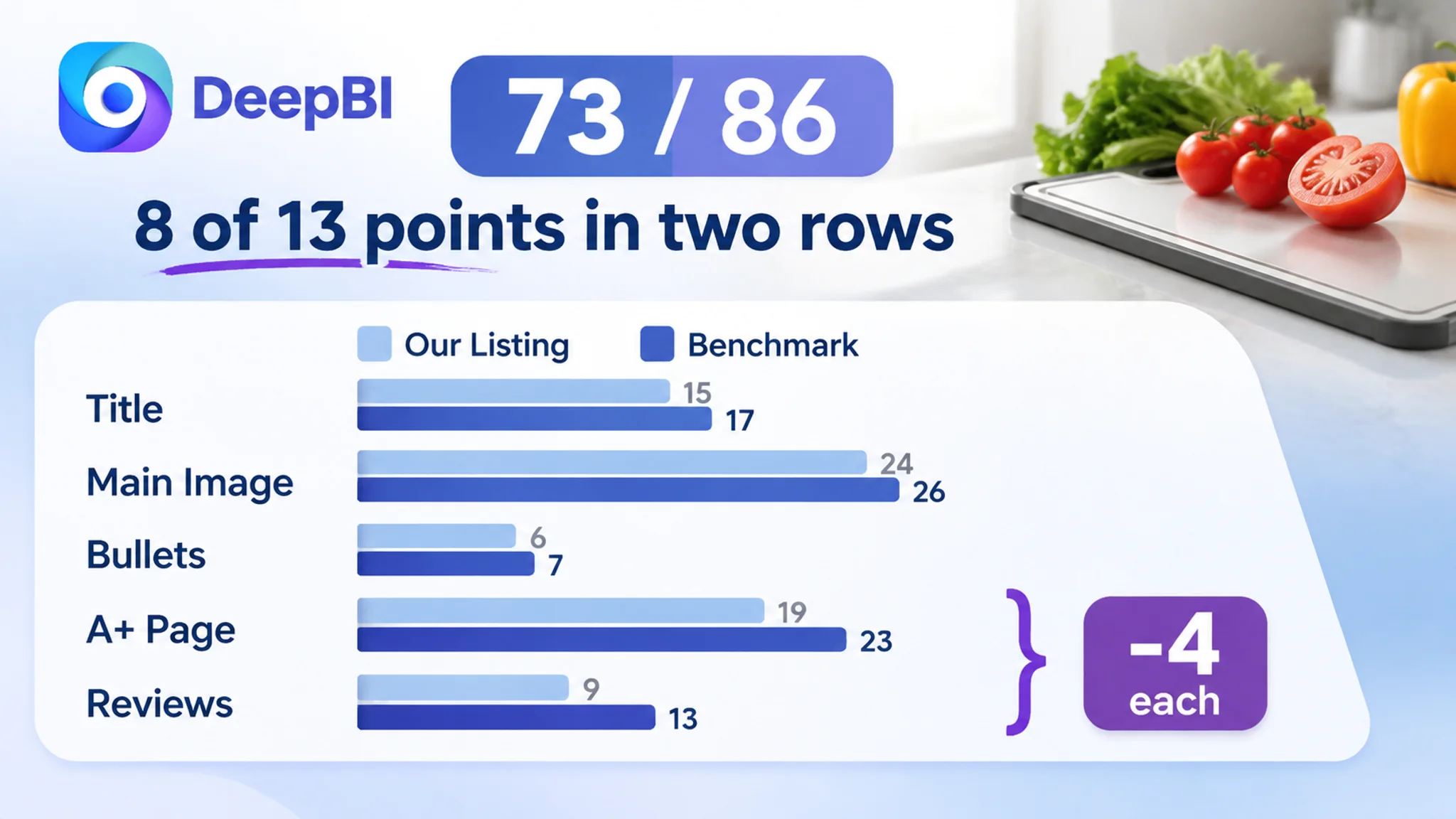
The title, main image, and bullets were each within two points. Those are real gaps, but they are refinements. The A+ page and the review footprint were four points behind each — and together they accounted for the majority of the total 13-point spread.
That distribution changed the order of operations completely. Fixing the title would have been visible work. Fixing the A+ page was the work that mattered.
This product did not lack traffic. It lacked a reason to trust.
The benchmark Listing opened with family safety: a household image, a hygiene promise, then verification.
The target Listing opened with a couple in a modern kitchen, then moved into a benefits summary that introduced "safer prep," "less mess," and "more stable" simultaneously — three claims at the same volume, none of them proven.
Then it moved straight to dual-side usage. Then to convenience features. Then to lifestyle scenarios.
Nowhere in that sequence did the page stop and answer the question that decides this category: is this really safe to cut raw meat on, and how do I know?
The benchmark proved safety. The target Listing described it.
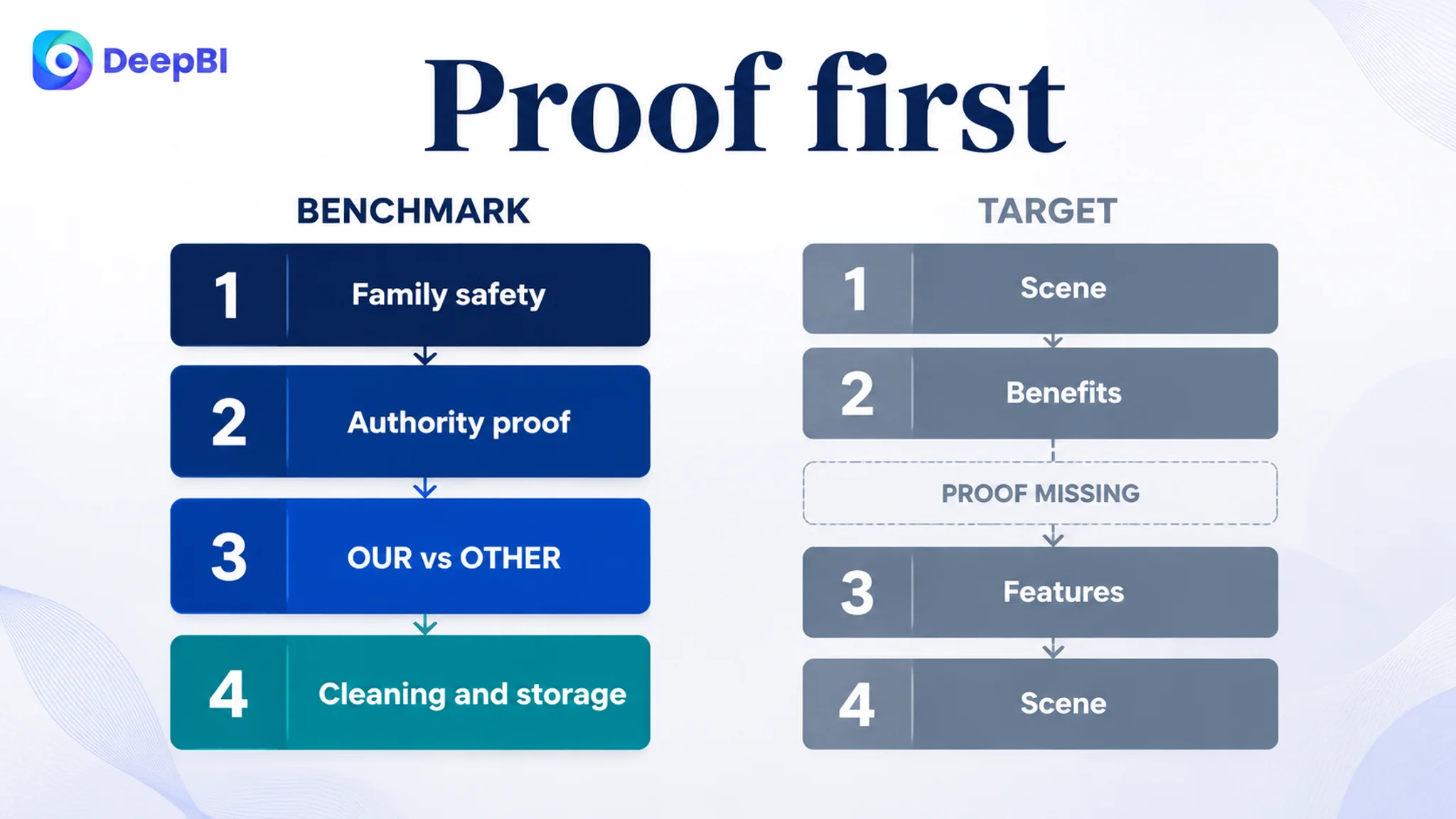
The benchmark's A+ flow ran emotional connection, then authority, then expert endorsement, then a direct OUR-versus-OTHER comparison, then cleaning and storage.
The target Listing ran scene, then benefits, then features, then scene again.
Both are coherent. Only one of them is a persuasion funnel.
The most important decision was what not to copy
Here is where the case becomes a decision problem rather than an execution problem.
The benchmark's A+ strength came substantially from third-party certification visuals, a professional endorsement, and a comparison module. Copying that structure would have been the obvious move — and the wrong one.
The seller did not hold those certifications, and had no credentialed expert to attach to the brand. Reproducing those modules would have meant manufacturing trust the product could not substantiate — the kind of shortcut that produces a short-term lift and a long-term compliance and returns problem.
DeepBI's judgment was to compete on the same anxiety with different evidence.
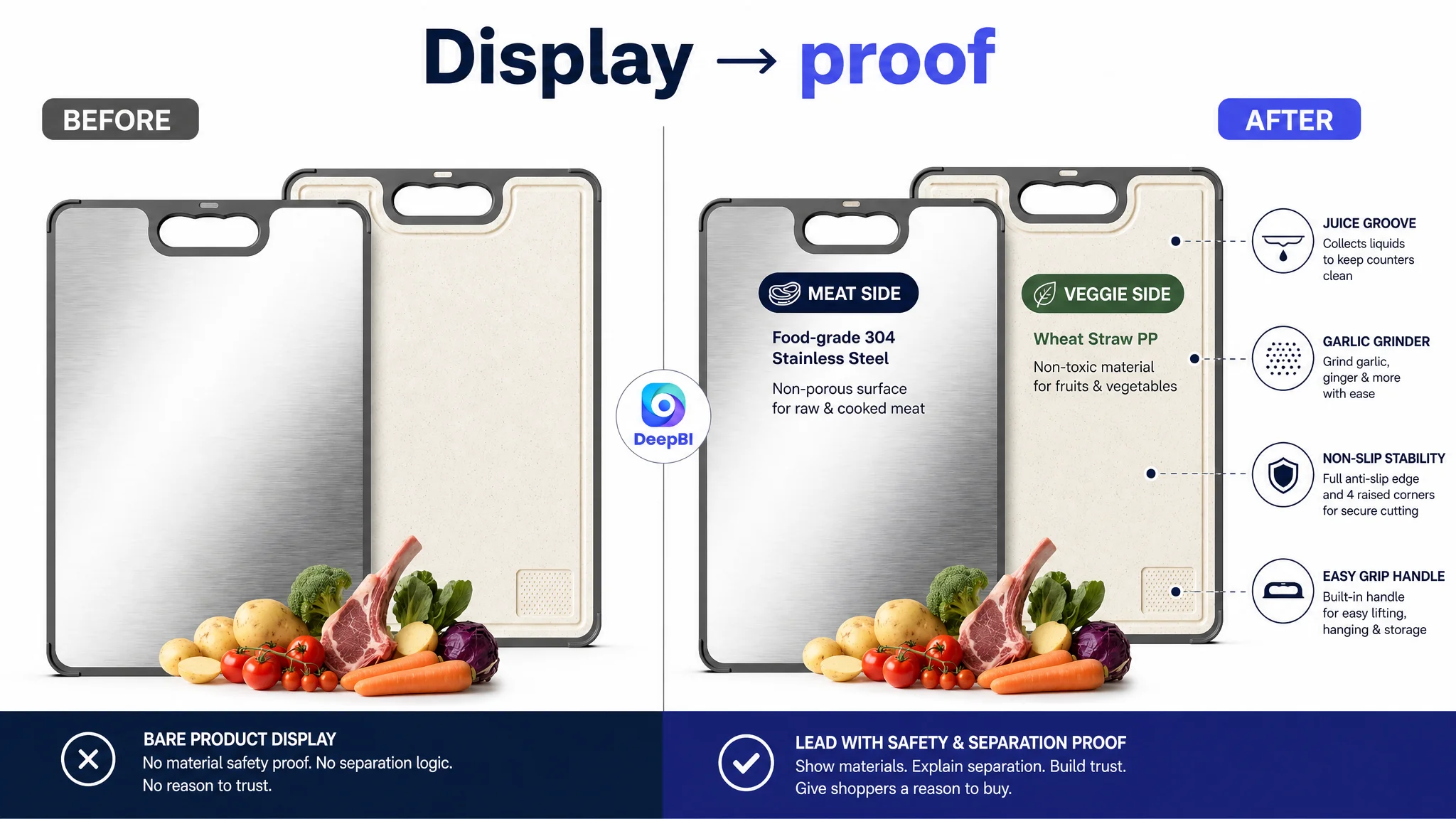
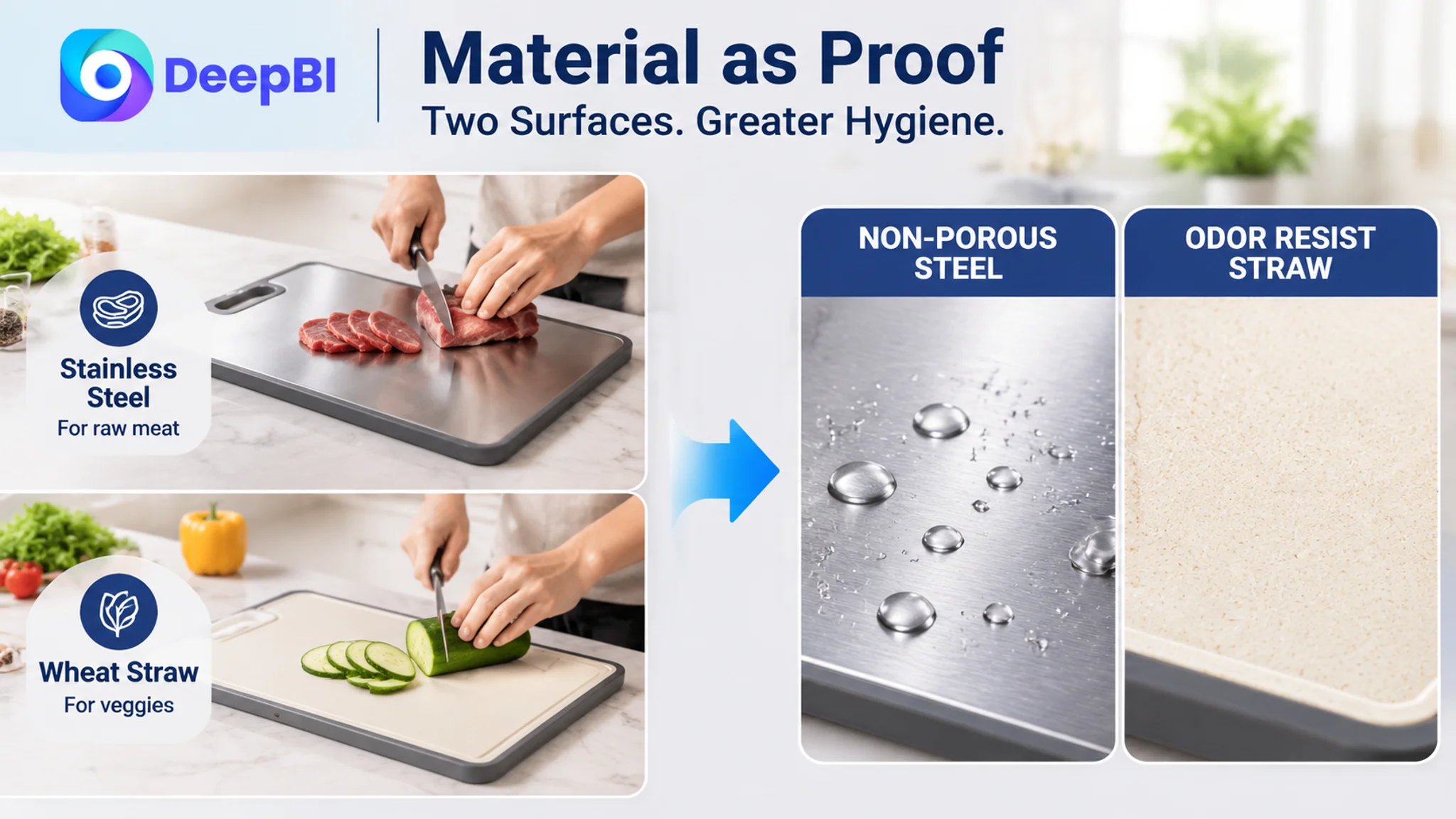
Instead of certification badges, the A+ page would visualize what was actually verifiable: the 304 food-grade stainless steel designation, the non-toxic wheat straw side, the non-porous surface, the reasons the two sides exist as a separation system rather than a gimmick.
"If you cannot show the certificate, show the material. If you cannot show the material, show the mechanism."
That is a weaker proof than a lab report. It is also honest, and it answers the question the buyer is actually asking.
The main image was selling portability to buyers worried about bacteria
The image sequence revealed the same misalignment in a different form.
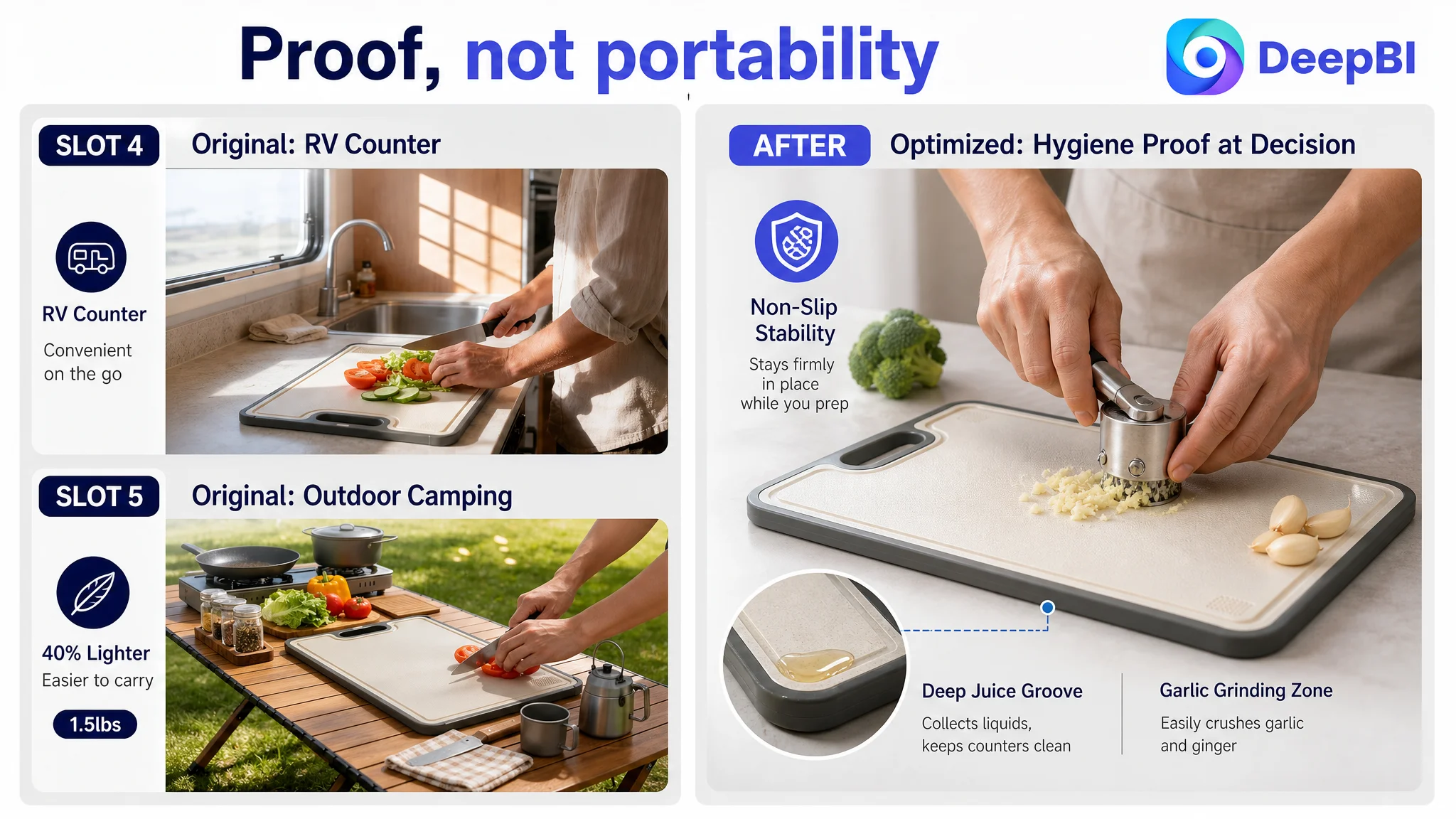
The fourth and fifth image slots — the point where a shopper is looking for a final reason to commit — were spent on RV use, outdoor cooking, and weight.
Portability is a real benefit. It is not the benefit this buyer is anxious about. Someone comparing a stainless steel board against a wooden one is thinking about cross-contamination, odor retention, and whether the surface will stay hygienic after months of use.
The benchmark used those slots for material confirmation and hygiene proof, with close-ups and technical callouts.
The target Listing used them for a camper.
The bullet points had information, but no buying logic
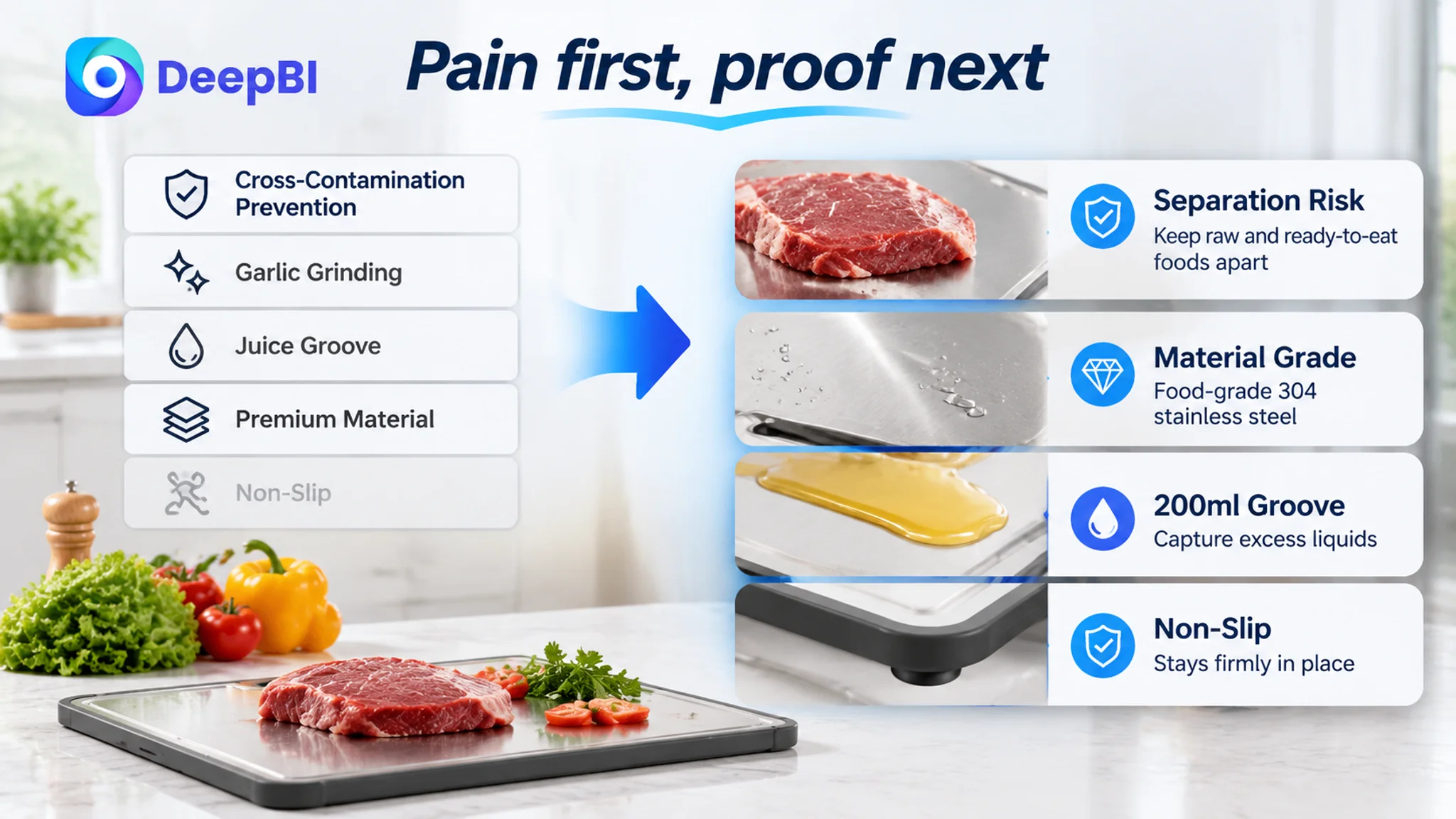
The bullets contained almost everything the page needed: dual-sided separation, stainless steel plus wheat straw, juice groove, garlic grinding zone, non-slip edge, hanging handle, hand-wash guidance.
What they lacked was hierarchy. Grinding garlic was presented at the same weight as preventing cross-contamination. The non-slip design — a genuine structural advantage the benchmark did not emphasize — was buried.
The benchmark quantified where it could: groove capacity, groove depth, material grade. The target Listing stayed qualitative. In a category where the buyer is looking for evidence, "collects excess liquids" is a description, and "captures up to 200ml" is a proof.
The title was written for the brand, not for the search
The benchmark led with the core keyword and the material grade, then the two-in-one design, then the use scenarios, then the size.
The target Listing led with the brand name, then spread "double-sided" and "wheat straw side" across separate phrases, then listed long-tail functions like the juice groove and garlic grinder.
The functional coverage was arguably richer. The search weight and the first-three-words clarity were weaker. On a results page, the shopper reads the front of the title, not the whole of it.
Why DeepBI would not touch the ads first
Every one of these gaps has the same property: they are pre-click and post-click conversion problems, not traffic problems.
Scaling ad spend against this page would have bought more of the same outcome — more clicks arriving at a page that answers the wrong question first. The spend would have looked like a bidding failure while the actual leak was happening inside the Listing.
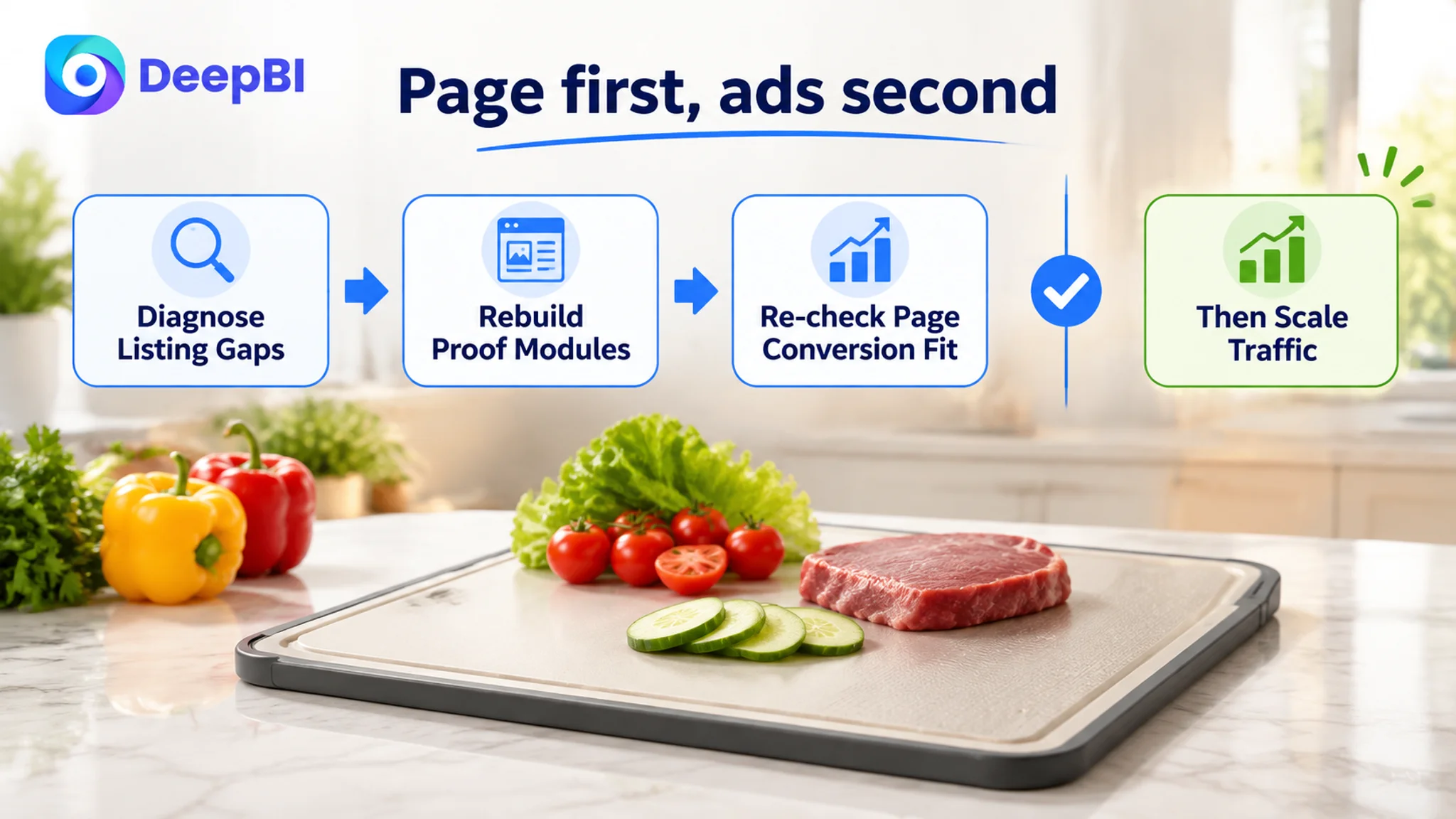
The sequence DeepBI set was:
1. Move material safety and raw/cooked separation to the front of the page.
2. Rebuild the A+ modules so proof precedes convenience.
3. Reassign the later image slots from lifestyle to hygiene and feature verification.
4. Rewrite the bullets as pain-then-proof, keeping the non-slip structure as a differentiated point.
5. Reposition the title so the core keyword and material grade lead.
6. Only then decide whether the traffic deserved to be scaled.
"Before you buy more traffic, decide whether the page deserves it."
That order is not about discipline for its own sake. It is about not paying Amazon to distribute a page defect at scale.
What changed in how the team operated
The visible change was structural: the page stopped opening with lifestyle and started opening with safety. Material grade, separation logic, and non-porous surface behavior became the entry point instead of a mid-page detail.
The operational change was larger.
ACOS stopped being read as a verdict on the ad account. The team began treating it as an output of page conversion capacity, and started asking a different question before increasing budget: what is the page doing with the traffic it already has.
Ad dependence loosened in a specific, non-dramatic way. Traffic structure became something the team could reason about rather than react to. The listing moved from a state where spend was compensating for a trust gap to a state where the page could carry more of its own conversion weight.
The review gap was not solved by this work, and could not be. A footprint of roughly 122 ratings against a benchmark's 4,652 is a time problem, not a copywriting problem. But once the page stopped underselling its own materials, the reviews the product did have were no longer fighting a page that failed to support them.
What other Amazon sellers can take from this
The pattern is common and easy to misread.
A stainless steel cutting board is a hygiene purchase. The buyer is not comparing features — they are managing a risk. Every module on the page either reduces that risk or wastes a slot.
When a Listing scores 73 against an 86-point benchmark and the two largest gaps sit in A+ content and reviews, the ad account is not the constraint. Advertising is simply making the constraint more expensive.
Three things held true here, and they tend to hold true elsewhere:
Read the score distribution, not the total. A 13-point gap concentrated in two dimensions is a different problem from a 13-point gap spread evenly. The first tells you where to work. The second tells you the product is not ready.
Do not copy proof you cannot produce. A competitor's certification module is not a design pattern. It is an asset. If you do not have it, competing on the same anxiety with verifiable material facts is slower and safer than imitating authority you cannot defend.
Fix the page before you fund it. Every dollar of ad spend multiplies whatever the Listing already does. If the page cannot convert a shopper who is already interested, more traffic only makes the inefficiency larger and better documented.