

An Amazon seller of collapsible trekking poles initially believed the problem was mainly related to traffic and advertising efficiency. The product was receiving exposure, but orders were not following consistently, so the natural response was to look toward keywords, bids, and campaign structure.
The deeper issue was not that Amazon ads failed to bring shoppers to the product page. It was that the Amazon Listing was not prepared to convert that traffic. Compared with a closely matched high-performing trekking pole listing, the product page scored 53 out of 100 versus 90, with the largest gap concentrated in the detail page and customer reviews.
DeepBI reframed the optimization around product-page conversion: prove reliability earlier, make size selection easier, connect features to hiking-related concerns, and replace repeated text with visual guidance through the main images and A+ content. The case shows why Amazon sellers should judge whether a Listing can convert additional traffic before continuing to scale or fine-tune ads.
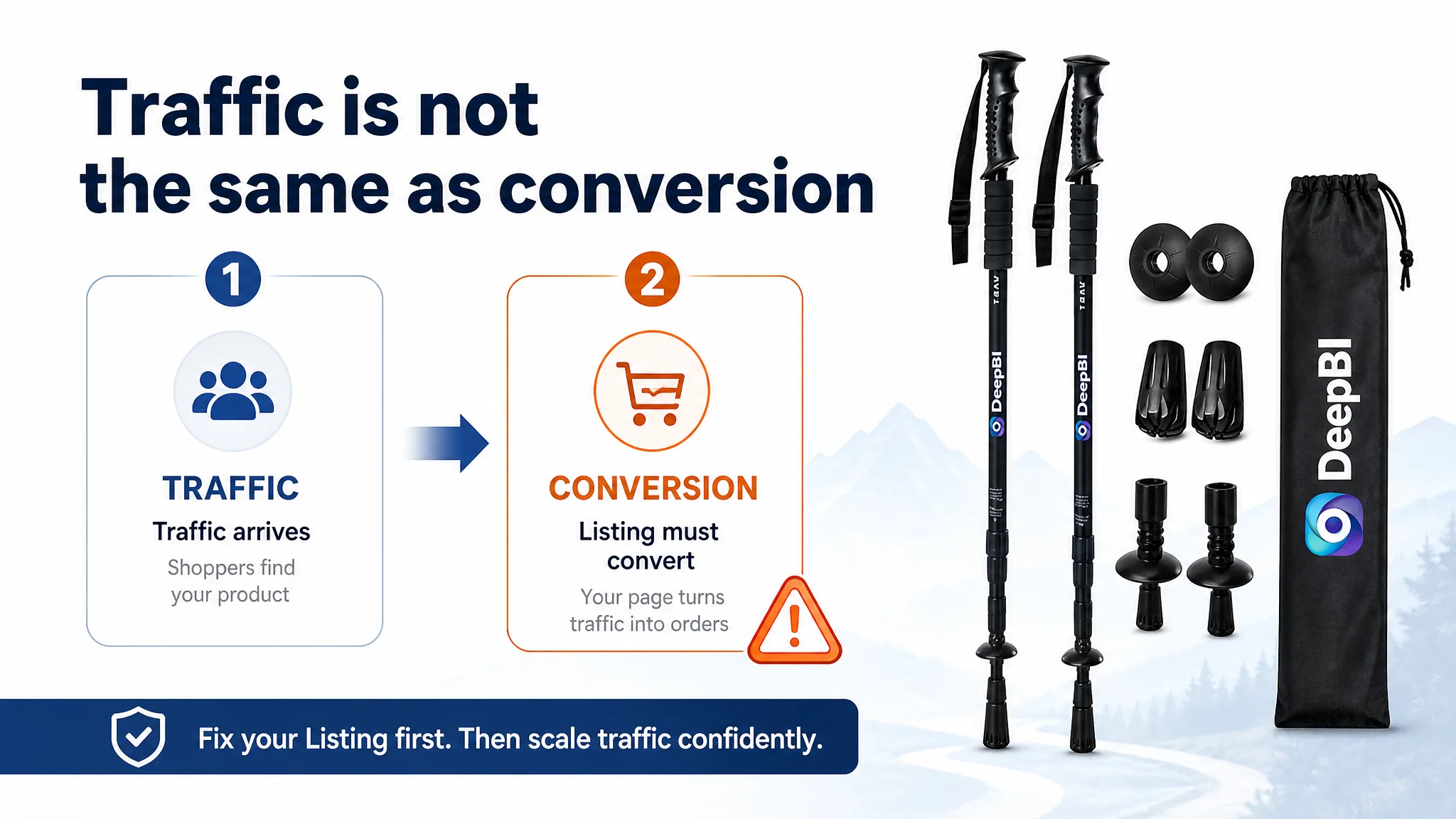
The Store Had Traffic Pressure, but the First Diagnosis Pointed Toward Ads
The customer team was operating in the US Amazon marketplace with a collapsible trekking pole Listing. The product offered several useful selling points: adjustable height, durable aluminum poles, tungsten tips, built-in springs, ergonomic handles, and suitability for different outdoor environments.
On paper, the Listing had enough features to support a competitive offer.
The operating pressure came from a familiar Amazon problem: traffic could be generated, but the page did not consistently turn that traffic into orders. When advertising costs become harder to justify, sellers often begin by examining search terms, bids, campaign structures, or keyword coverage.
That was also the direction this team was inclined to take.
The assumption was that the product needed better traffic efficiency. Perhaps the keywords were not precise enough. Perhaps the campaigns were not reaching enough high-intent shoppers. Perhaps more advertising adjustments could improve ACOS and restore order volume.
But that diagnosis treated the symptom as an advertising problem before checking whether the product page could support the traffic it was already receiving.
Advertising does not only amplify a product’s strengths. It can also amplify the weaknesses of an Amazon product page.
The Listing Score Revealed Where the Conversion Capacity Was Being Lost
DeepBI’s comparison placed the customer Listing against a closely matched, high-performing trekking pole Listing rather than against an unrelated category leader.
The result was clear:
- Title: Customer Listing: 15/20, Benchmark Listing: 18/20, Gap: -3
- Main image: Customer Listing: 24/30, Benchmark Listing: 27/30, Gap: -3
- Bullet points: Customer Listing: 6/10, Benchmark Listing: 8/10, Gap: -2
- Detail page: Customer Listing: 3/25, Benchmark Listing: 24/25, Gap: -21
- Reviews: Customer Listing: 5/15, Benchmark Listing: 13/15, Gap: -8
- Total: Customer Listing: 53/100, Benchmark Listing: 90/100, Gap: -37
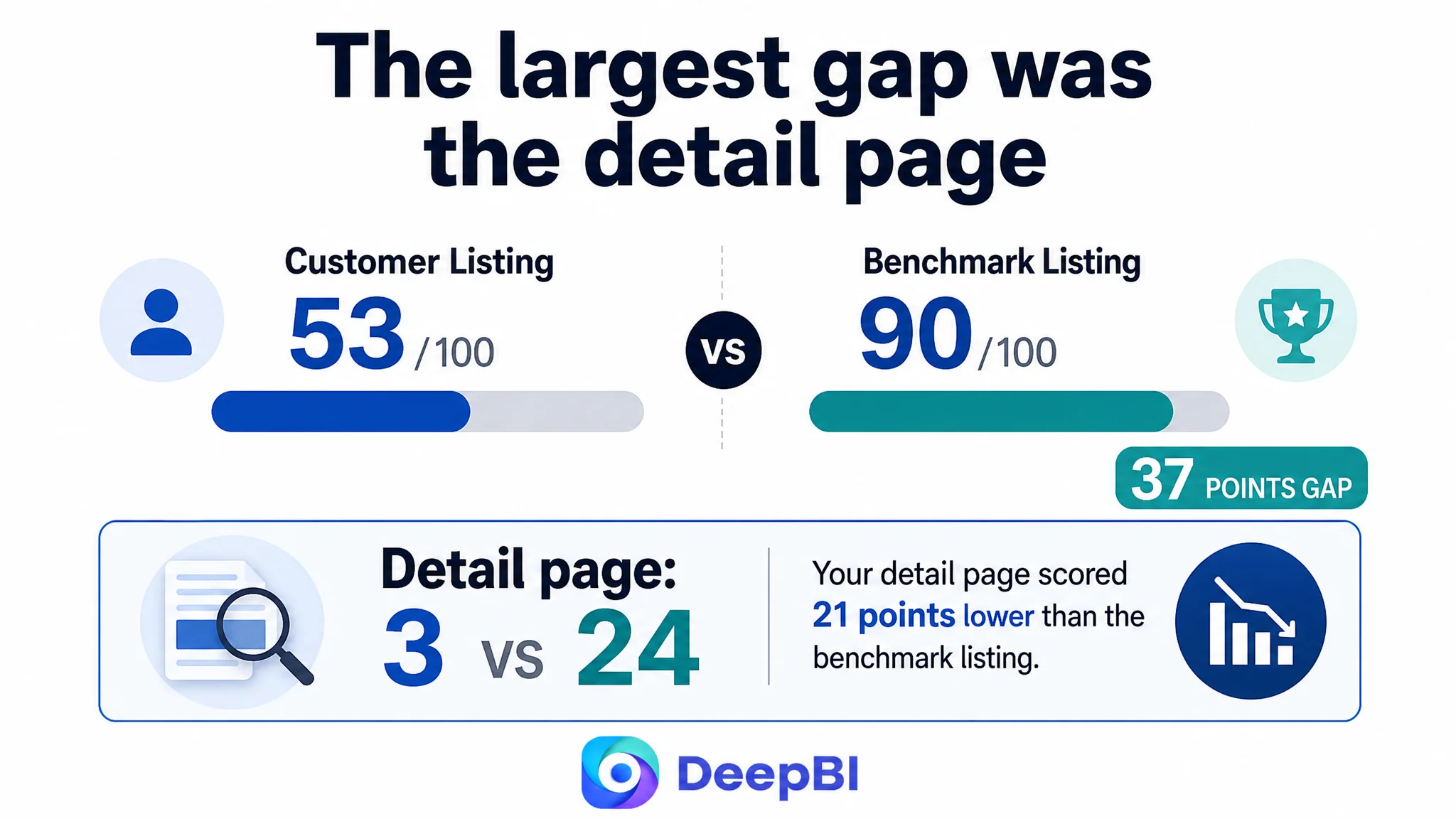
The most important finding was not that every dimension was weaker. It was that the gaps were heavily concentrated.
The title, main image, and bullet points were behind, but only by a few points each. The detail page, however, was separated by 21 points. Reviews created another substantial trust gap.
That changed the business question.
The issue was no longer, “How can the ads bring in more qualified traffic?”
It became:
“Can this product page give shoppers enough evidence to feel confident buying trekking poles from this Listing?”
The Detail Page Was the Largest Constraint
The customer’s detail page relied primarily on text. It did not provide the visual structure needed to explain the product’s reliability, comfort, setup, or use across different terrains.
The benchmark Listing used a much fuller A+ content structure, including:
- A clear opening product banner
- Feature explanation modules
- Outdoor use scenarios
- Component breakdowns
- Step-by-step setup guidance
- Material and durability evidence
- User-oriented lifestyle scenes
- Multi-terrain applications
- Travel and storage context
This difference mattered because trekking poles are not purchased only as physical objects. Shoppers are also evaluating several risks:
- Will the poles remain stable on uneven ground?
- Are they suitable for the shopper’s height?
- Will the grips become uncomfortable during longer hikes?
- Is the adjustment mechanism easy to understand?
- Can the poles be packed for travel?
- What accessories are included?
- Will the product feel reliable across different terrains?
The customer Listing mentioned product functions, but the page did not consistently resolve these concerns in a visual or sequential way.
The benchmark Listing followed a clearer persuasion path:
Problem → solution → evidence
For example, it connected rocky terrain and stability concerns to material and structural explanations. It connected travel use to compact storage. It connected setup concerns to visual operating steps.
The customer page largely stopped at feature description.
That created a conversion problem that additional ad traffic could not solve.
The Main Image Sequence Was Not Building Trust in the Right Order
The main images contained useful information, but their sequence did not match how a new shopper evaluates an unfamiliar trekking pole.
The first image established basic product recognition and showed included components, but it did not clearly communicate the complete package or establish technical confidence immediately.
The second image used a broad emotional message about pushing further. That type of message can support an established brand, but here it appeared before the page had answered a more fundamental question:
Are these trekking poles dependable enough for demanding use?
The material claim, “Premium Aluminum,” appeared later as a text statement rather than as an early piece of technical proof. As a result, the image sequence delayed one of the most important trust-building points.
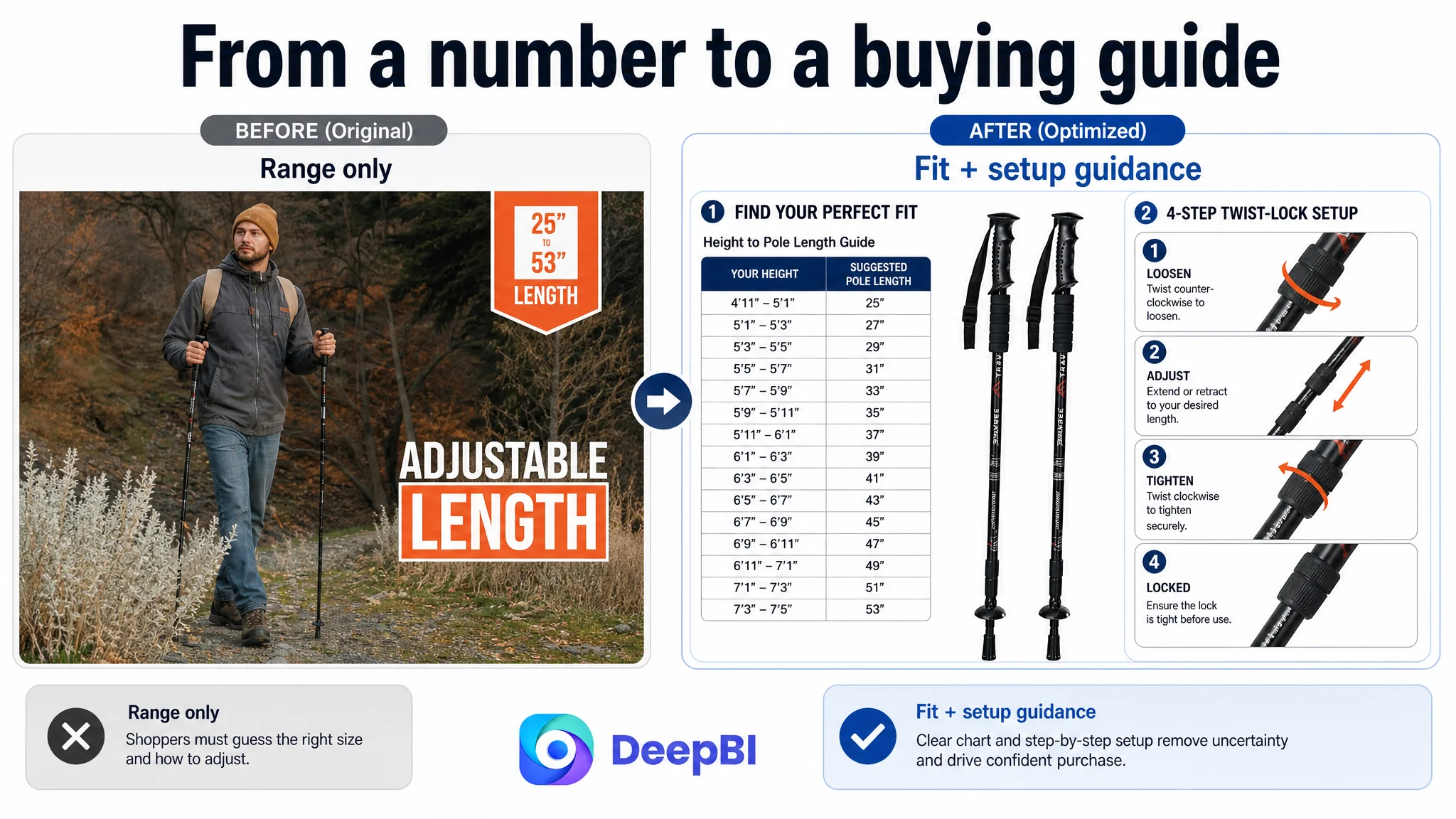
The third image showed an adjustment range of 25 to 53 inches, but left shoppers to determine whether that range suited them. A range by itself is not the same as a selection guide.
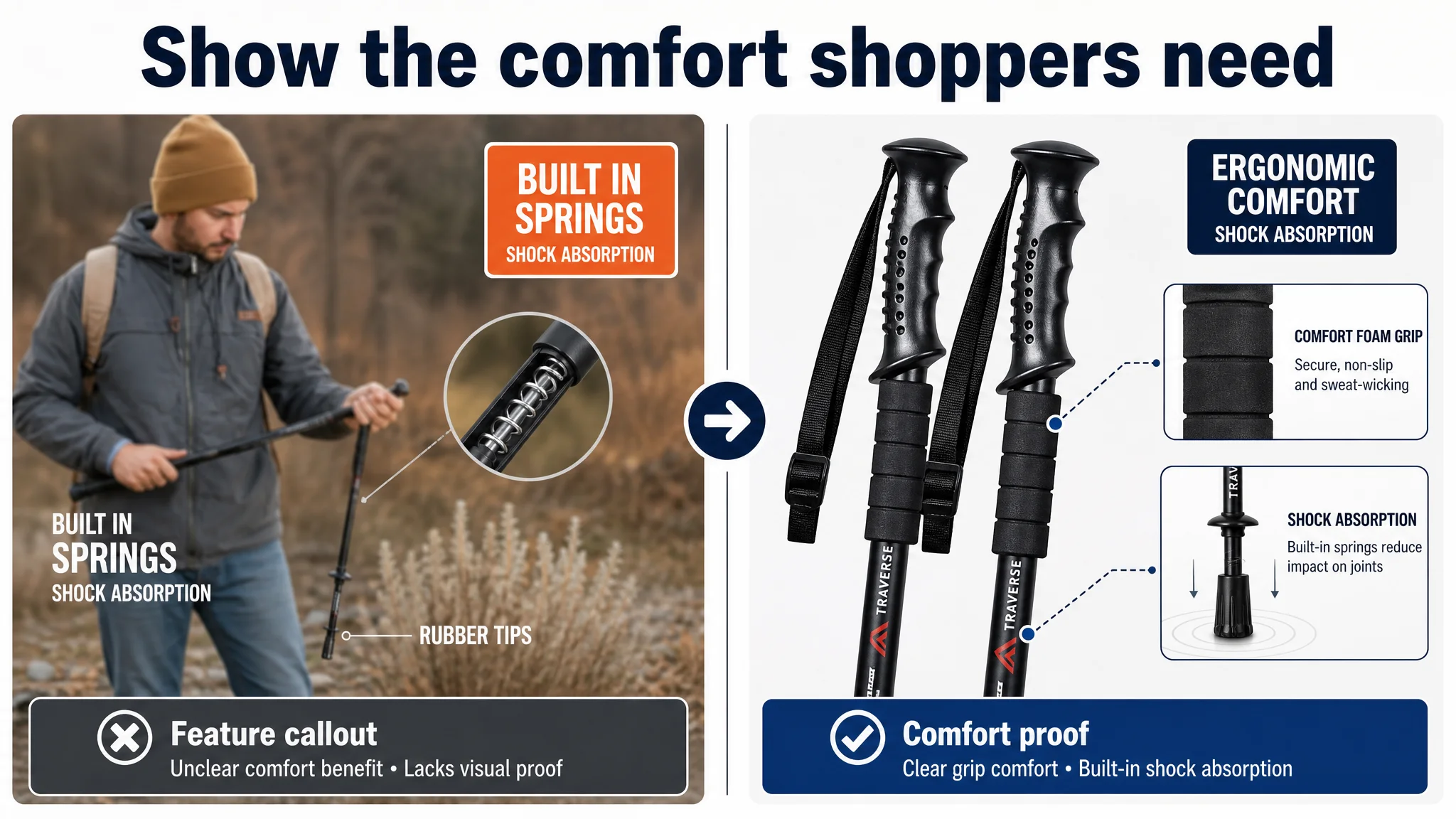
The fourth image emphasized built-in springs and shock absorption. Those are relevant product features, but the sequence gave less attention to grip comfort, sweat management, and long-duration hand comfort—concerns that may matter greatly during extended hikes.
The fifth image again returned to material and general versatility, even though the material message should have appeared earlier.
DeepBI’s judgment was not simply that the images needed to look more attractive. The issue was that each image had been assigned the wrong commercial role.
The first image needed to confirm the offer
The opening image should make the product type and package immediately clear, including the two-pole set where applicable, while presenting the product in a credible outdoor context.
The second image needed to prove robustness
Rather than repeating a general benefit, the next image should focus on the confirmed durability story around the poles, including the aluminum construction and tungsten tip without adding unverified specifications.
The third image needed to remove the sizing question
The 25-to-53-inch adjustment range should be translated into a practical height-to-pole-length guide, using only validated product specifications.
The fourth image needed to address comfort
The ergonomic grips, grip comfort, and shock-absorption features should be connected to actual hiking concerns rather than displayed as isolated components.
The fifth image needed to simplify the usage decision
The simple telescoping adjustment mechanism could be positioned as a straightforward, travel-ready operation, provided the visual accurately reflects the product’s real structure and setup.
This was a change in information architecture, not merely a change in styling.
The Title Had Search Coverage, but Its Selling Logic Was Scattered
The title scored 15 out of 20. The gap was modest compared with the detail page, but it still showed how search relevance and shopper clarity were not fully aligned.
The benchmark title placed “Trekking Poles for Hiking” near the beginning and followed it with concrete product attributes, dimensions, structure, grip details, and intended users.
The customer title began with “Collapsible Trekking Poles,” while some of the more commercially useful terms appeared later. It also leaned more heavily on general descriptions such as durable aluminum rather than building a clear sequence around product type, use, structure, and audience.
The recommended direction was to bring the core trekking pole search intent forward and organize the title around:
- Product type
- Hiking use
- Collapsible or telescoping structure
- Confirmed material and construction details
- Tungsten tip
- Adjustable height
- Intended users
However, the comparison also exposed an important boundary.
The benchmark used specific claims such as 7075 aluminum, 43-to-53-inch adjustment, and 14.5-inch folded length. Those details should not be copied into the customer Listing unless they are confirmed for the customer’s product.
A stronger Amazon title is not one that borrows every competitor specification. It is one that makes the customer’s own verified value easier to find and understand.
The Bullet Points Listed Features, but Did Not Complete the Buying Argument
The bullet points scored 6 out of 10. Their weakness was not a total lack of information. It was the lack of connection between product features and shopper concerns.
The customer copy used broad terms such as premium and high-strength, but the benchmark Listing more often connected a concrete attribute to a specific use situation.
That difference can be seen in the structure:
- General material description versus material linked to stability
- Portable design versus a clear travel and storage benefit
- Comfortable grip versus reduced sweat and hand discomfort
- Adjustable height versus different guidance for uphill and downhill use
- Safety information omitted versus setup instructions shown clearly
- General versatility versus a defined accessory and terrain system
DeepBI therefore focused the rewrite around a stronger sequence:
Reliability before general enthusiasm
The first bullet should explain how the confirmed aluminum construction and product design support stability on uneven outdoor surfaces.
Compact storage as a practical outcome
The second bullet should describe the actual telescoping or collapsible mechanism and its travel value without inventing a folded measurement.
Grip comfort tied to hiking duration
The third bullet should connect the ergonomic grip and available comfort features to hand fatigue, sweat, or blister concerns only where the product’s verified properties support those claims.
Adjustment linked to posture
The fourth bullet should explain the 25-to-53-inch range and how users can adjust the poles for different heights or terrain conditions.
Setup guidance as a trust signal
A clear notice before use can reduce uncertainty and communicate that stability depends on properly locking the telescoping sections.
The goal was not to make the bullets longer. It was to make them answer the questions that prevent purchase.
Reviews Added a Trust Problem That Content Alone Could Not Fully Replace
The review dimension scored 5 out of 15.
The customer Listing showed:
- 3.2-star average rating
- 11 total reviews
- 8 reviews visible on the first page
- One one-star review and one two-star review among those visible reviews
- A lower proportion of image or video reviews
The benchmark showed:
- 4.8-star average rating
- 31 total reviews
- 8 reviews visible on the first page
- No low-star review visible on that page
- More detailed and positive review content
The difference was not a minor social-proof issue. For an outdoor product associated with stability, comfort, and physical support, shoppers may place considerable weight on other buyers’ experiences.
A better title or more polished image can improve the first impression. A stronger A+ page can explain the product more clearly. But neither can erase a visible rating gap on its own.
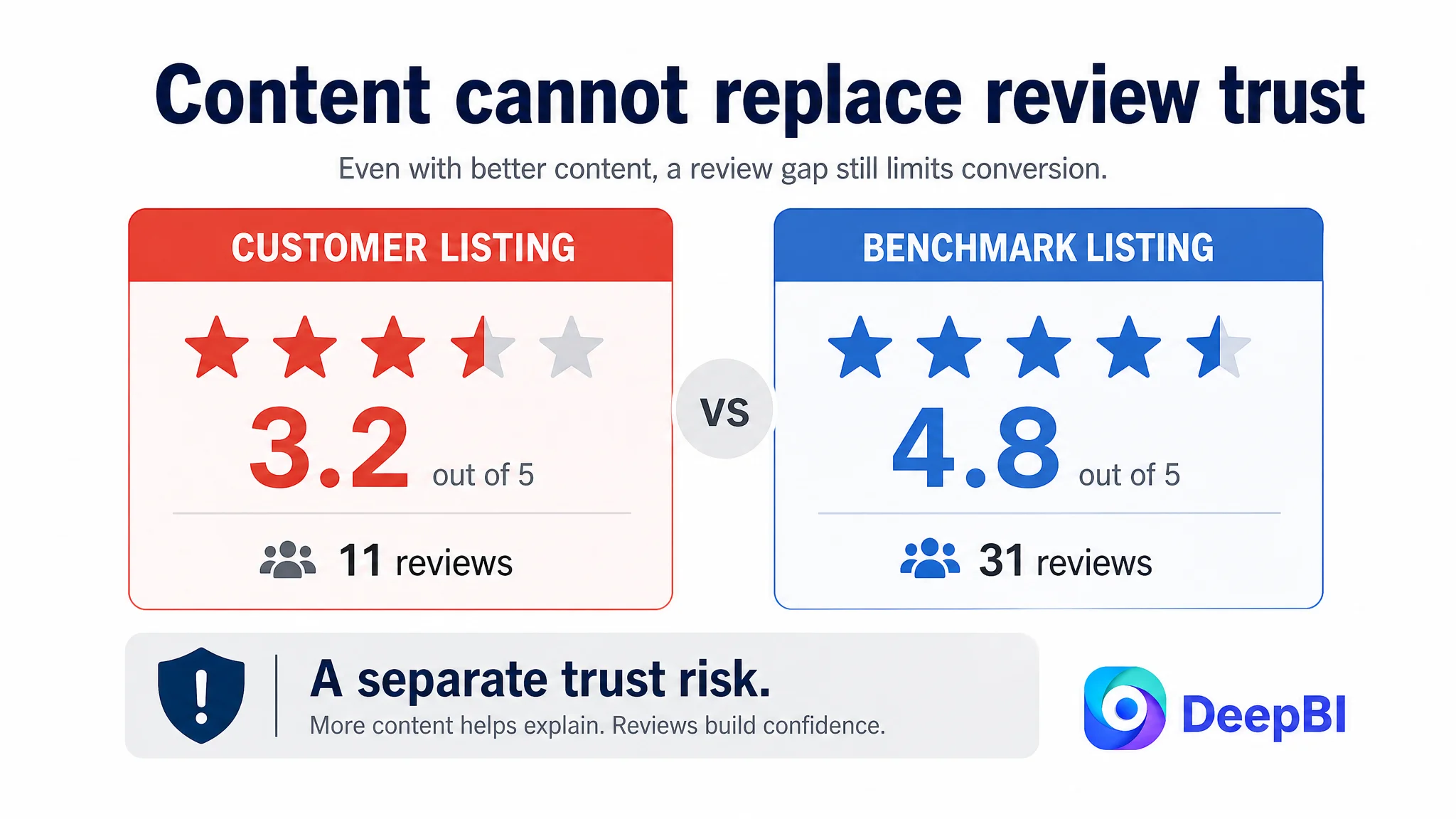
This was one reason DeepBI did not frame the solution as “improve the images and the problem is solved.” The Listing had several layers of conversion friction, and each needed to be understood according to its role.
The page content could begin to rebuild confidence by showing real product details, clear setup instructions, and practical use cases. But review quality and review volume remained a separate business risk that required genuine customer experience improvements over time.
Why DeepBI Did Not Recommend Tuning Ads First
At this stage, continuing to adjust Amazon ads first would have created a measurement problem.
If the team changed bids or keywords while leaving the product page substantially weaker than the benchmark, any additional traffic would still arrive at a Listing with:
- A 21-point detail-page deficit
- A substantial review trust gap
- Incomplete visual proof of material reliability
- Limited guidance for height selection
- Weak explanation of setup
- Bullet points that described functions without fully addressing use concerns
Under those conditions, ad optimization could make the traffic numbers look more active without resolving the order-generation constraint.
The more responsible decision was to repair the page’s conversion capacity first, then evaluate whether the traffic being purchased could produce a better commercial outcome.
Before scaling Amazon ads, the team needed to determine whether the Listing deserved more traffic.
This decision also reduced the risk of misreading later results. If page content, campaign structure, and bidding were all changed simultaneously, it would be difficult to know what actually affected CTR, CVR, or ACOS.
By prioritizing the Listing, the team created a clearer operating sequence:
1. Establish the largest conversion gaps.
2. Rebuild the page’s trust and information logic.
3. Ensure the visual and textual claims match the real product.
4. Allow paid traffic to test the improved page.
5. Use later advertising data to judge the next optimization priority.
That is a different approach from treating every weak result as a campaign-management problem.
The A+ Direction Shifted From Atmosphere to Proof
The revised A+ structure was designed to make the product easier to evaluate, not simply more visually polished.
The proposed modules followed a deliberate progression.
Confirm the product and package
The opening module should make clear that the product is a set of collapsible trekking poles for hiking and walking, with the correct quantity shown directly.
Establish grip comfort early
An ergonomic handle module should address how the product feels in use before moving into more abstract lifestyle messaging.
Show component-level evidence
The tungsten tip, aluminum construction, built-in springs, and other confirmed components should be presented as part of a coherent durability and terrain-use story.
Demonstrate the setup process
A visual four-step assembly guide should show the transition from compact travel mode to locked hiking mode. This directly addresses the complexity concern associated with collapsible poles.
Define material claims
Terms such as premium or high-strength should be supported by precise, verified information rather than left as unsupported adjectives.
Show adjustable height in real use
The page should connect adjustment to different trekkers and terrain conditions, using accurate height information and practical scenes.
Confirm the complete all-terrain kit
Accessories such as tips and baskets should be shown and mapped to appropriate environments only when they are actually included in the package.
The result would be a more complete decision path:
What is it? Why should I trust it? How does it feel? How do I use it? Will it fit my needs? What comes with it?
That sequence was missing from the original text-heavy page.
The Optimization Was Designed Around the Real Product, Not a Competitor’s Appearance
The benchmark Listing provided a useful reference because it showed a stronger way to organize information. It did not justify copying its claims, structure, or visual details without validation.
This distinction mattered throughout the case.
The customer product had its own confirmed selling points:
- Collapsible trekking pole design
- Durable aluminum poles
- Tungsten tip
- Adjustable height from 25 to 53 inches
- Ergonomic handles
- Built-in springs
- Outdoor and all-terrain use
- Telescoping operation
- Relevant included accessories where verified
DeepBI’s role was to identify how those attributes should work together in the Amazon Listing.
That meant moving the material proof earlier, turning the height range into a clearer selection aid, presenting comfort as a user benefit, and making the setup process visible. It did not mean adding unverified material grades, folded dimensions, weight claims, or performance promises simply because a benchmark Listing used them.
This product-preservation boundary was commercially important. A visually improved page that promises something the product cannot deliver may increase short-term clicks while creating returns, negative reviews, and further trust damage.
The Business Understanding Changed Before the Metrics Did
The case material does not provide confirmed post-optimization figures for CVR, ACOS, CTR, or organic-order growth. The responsible conclusion is therefore not a numerical performance claim.
The meaningful change was in the operating diagnosis.
The team could now distinguish between:
- Traffic acquisition and traffic conversion
- A weak advertising signal and a weak product page
- A missing keyword and a missing buying argument
- An unattractive image and an image sequence that fails to build trust
- A lack of information and a lack of decision logic
- A review problem and a content problem
The expected business direction was also clearer. Once the Listing’s sales logic was repaired, Amazon ads would have a more credible page to support. Paid traffic could be evaluated against a page that better explained reliability, comfort, adjustability, setup, and use cases. Over time, that could make traffic structure and advertising dependence more controllable—but the case does not claim that those outcomes had already been measured.
The central lesson is more durable than a single performance snapshot:
Amazon ads cannot compensate indefinitely for a product page that does not convert trust into action.
What Amazon Sellers Can Take From This Case
A low-converting Amazon Listing often creates pressure in the ad console first. That does not mean the ad console contains the root cause.
For this trekking pole seller, the most important gap was not a small keyword adjustment or a single creative defect. It was the missing connection between product features and shopper confidence.
The Listing needed to:
- Prove reliability before making broad lifestyle claims
- Use verified specifications instead of generic adjectives
- Explain adjustment and setup visually
- Connect grips and springs to actual comfort concerns
- Present accessories and terrain use clearly
- Use A+ content to complete the product story
- Treat reviews as a separate trust and product-experience risk
- Reassess advertising only after the page was capable of converting more effectively
The broader Amazon operating principle is straightforward:
Do not ask whether more traffic can be purchased until you have judged whether the Listing can convert the traffic it already receives.
DeepBI’s value in this case was not a list of image edits or copy changes. It was the ability to locate the largest commercial constraint, separate the page problem from the advertising problem, and establish the right order of decisions.
For Amazon sellers facing rising ad pressure, that order may be the difference between continually optimizing symptoms and finally addressing the reason orders are not following traffic.