

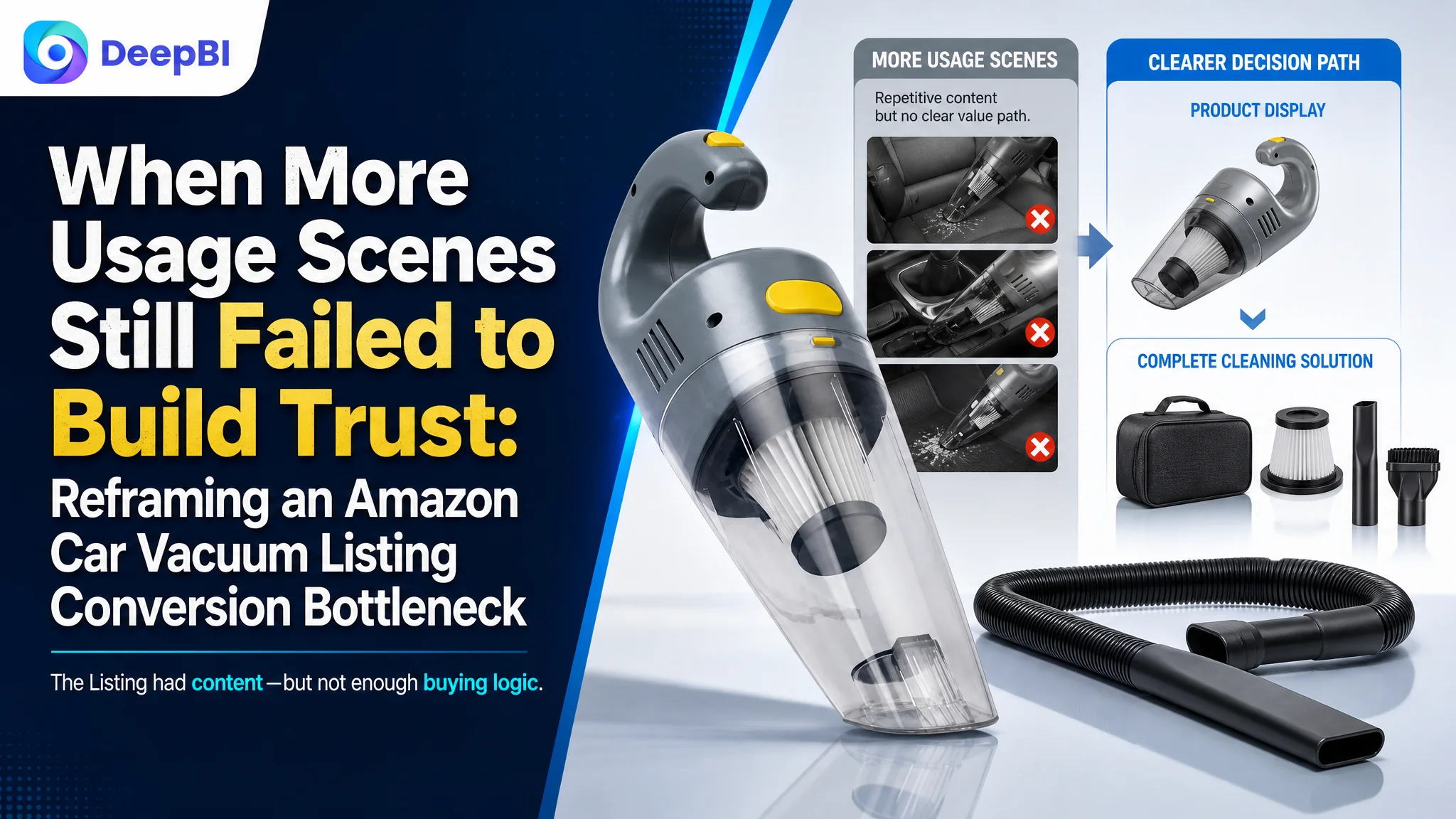
This case involved an Amazon seller in the automotive accessories category whose handheld car vacuum Listing was competing in the US marketplace. The page was not empty: it had product photography, usage scenes, brand content, related-product recommendations, and a video. Yet its overall Listing score was 70, compared with 87 for a closely matched high-performing competitor.
The initial optimization direction treated the problem as one of product explanation. More usage scenes, more functional descriptions, and more maintenance guidance seemed like logical next steps. But the deeper issue was not a lack of content. It was that the content did not create a clear buying decision.
DeepBI ultimately identified a more important constraint: the Amazon product page was presenting the vacuum as a product, while the stronger Listing was presenting it as a complete, credible cleaning solution. The later direction therefore focused on decision order—making the kit value visible earlier, clarifying the power and reach specifications, connecting each attachment to a specific problem, and using A+ content to close trust gaps.
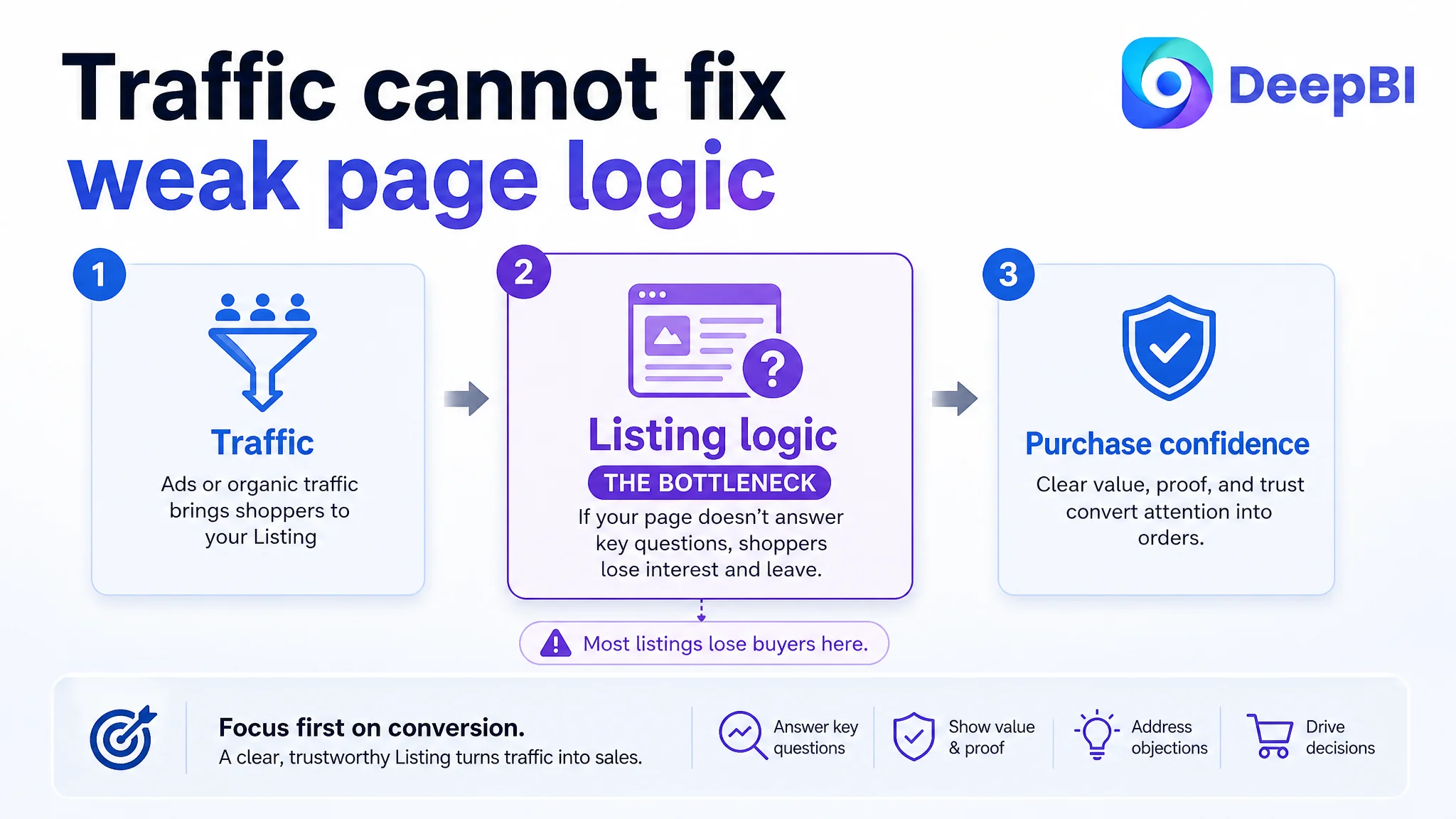
For other Amazon sellers, the lesson is practical: before increasing Amazon ad traffic or repeatedly adjusting bids, examine whether the Listing can convert that traffic. A page with weak decision logic can make advertising appear inefficient when the deeper leak is on the product page.
The Page Had Content. It Did Not Yet Have a Strong Sales Logic.
The customer’s Listing scored 17 points below the comparable high-performing Listing:
- Title: Customer Listing: 15/20, Comparable Listing: 18/20, Gap: -3
- Main image: Customer Listing: 24/30, Comparable Listing: 26/30, Gap: -2
- Bullet points: Customer Listing: 6/10, Comparable Listing: 7/10, Gap: -1
- A+ and detail content: Customer Listing: 21/25, Comparable Listing: 23/25, Gap: -2
- Reviews: Customer Listing: 4/15, Comparable Listing: 13/15, Gap: -9
- Total: Customer Listing: 70/100, Comparable Listing: 87/100, Gap: -17
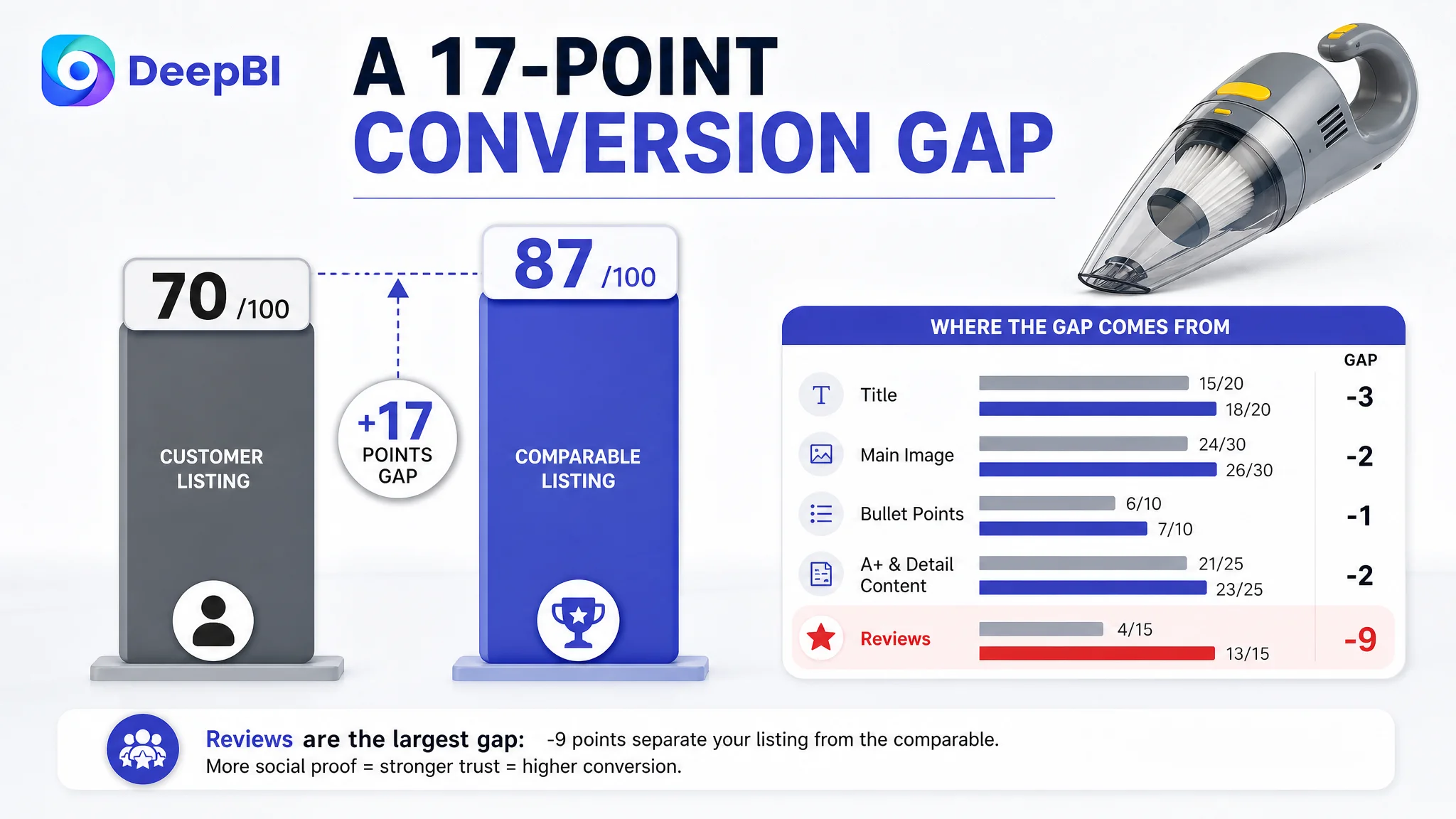
At first glance, the gaps in the title, images, bullet points, and A+ content appeared relatively small. The most dramatic difference was in reviews: the customer Listing had a 3.7-star rating and 65 reviews, while the comparable Listing had 4.0 stars and 248,432 reviews.
That review gap was real, but it was not the only issue—and it was not the first issue the seller could directly repair through Listing optimization.
The more important question was:
What did the page communicate before the shopper had enough confidence to care about the product’s specifications?
The answer was incomplete.
The page showed the vacuum being used in a car, but it did not consistently explain why this particular kit was worth choosing. It showed cleaning scenarios, but several images performed similar roles. It mentioned attachments, but did not visually make their combined value obvious. It described features, but did not always connect them to the problems shoppers were trying to avoid.
This distinction matters for Amazon sellers. A Listing can contain all the expected modules and still fail to move a shopper from attention to confidence.
The Original Diagnosis Focused on More Explanation
The customer’s existing content leaned heavily toward usage scenes and general product description. The page included multiple real-life images, brand content, related products, and video guidance. The bullet points also covered portability, maintenance, cleaning habits, and different use environments.
That direction was not unreasonable. A car vacuum should demonstrate how it works.
The problem was that the page was explaining the product in a broad way instead of organizing the information around the shopper’s highest-risk questions:
- Will it have enough power for crumbs, sand, and pet hair?
- Can it reach the back seats and trunk?
- Does it require a battery that may run out?
- What exactly comes in the kit?
- Can the attachments handle narrow spaces, upholstery, and floor mats?
- How difficult is filter maintenance?
- Is the product dependable enough to justify the purchase?
The working assumption was effectively that more scenes and more general usage information would improve conversion. But repeating usage scenes could not solve a missing decision path.
The Listing did not primarily need more demonstrations. It needed clearer proof.
The Advertising Risk Was a Page-Level Risk
The case material did not include post-optimization advertising results, so it would be premature to claim a specific ACOS or CVR improvement. But the business risk was clear.
If Amazon ads send shoppers to a page that does not establish value quickly, the seller may interpret the outcome as an advertising problem:
- bids are too high;
- keyword targeting is too broad;
- campaign structure needs to be rebuilt;
- traffic quality is not strong enough;
- budgets should be reduced or shifted.
Those actions may be necessary in some situations. They were not the first priority here.
The page already had a substantial content base. The issue was that paid or organic traffic could encounter the same unresolved questions. Advertising could bring the shopper to the Listing, but it could not explain the kit’s value more clearly than the page itself.
Advertising does not only amplify a product’s strengths. It can also amplify the weaknesses of the page receiving the traffic.
That is why DeepBI did not treat the case as a simple bid-management exercise. The first task was to determine whether the product page had enough conversion capacity to make additional traffic useful.
The Title Was Losing Relevance Before the Shopper Reached the Images
The title gap was not simply a keyword-density problem.
The comparable Listing placed “Car Vacuum Cleaner” near the beginning, while the customer title gave early space to the brand name. This delayed the clearest category signal and made the title less direct for shoppers scanning Amazon search results.
The competitor also used concrete specifications such as “16 Ft Cord” and “12v.” These details did more than add information. They answered practical concerns immediately:
- Does it rely on a battery?
- Can it reach the rear of a vehicle?
- Is the product designed for interior detailing?
- What kind of use case does it serve?
The customer title included specifications and many application scenarios, but the structure became longer and less focused. References to home, pets, office, children, and other settings diluted the stronger automotive use case.
The recommended direction was to bring the core category and meaningful specifications forward:
Chemical Guys EQP410 DetailVac Handheld Portable Car Vacuum - 12V 110W High Power Motor, Interior Detailing Kit with Crevice Tool & Brush - For Cars, Trucks, SUVs, RVs, Pets and Home - Gray
The strategic point was not to imitate a competitor’s wording. It was to make the title work harder at the entrance to the Listing:
- identify the product category earlier;
- surface the 12V and 110W specifications;
- include “Interior Detailing” as a relevant use-case phrase;
- reduce repetitive scenario language;
- make the included tools more visible.
A stronger title would not solve every conversion issue. But it would reduce ambiguity before the shopper reached the image gallery.
The Main Image Was Showing the Product, Not the Full Value
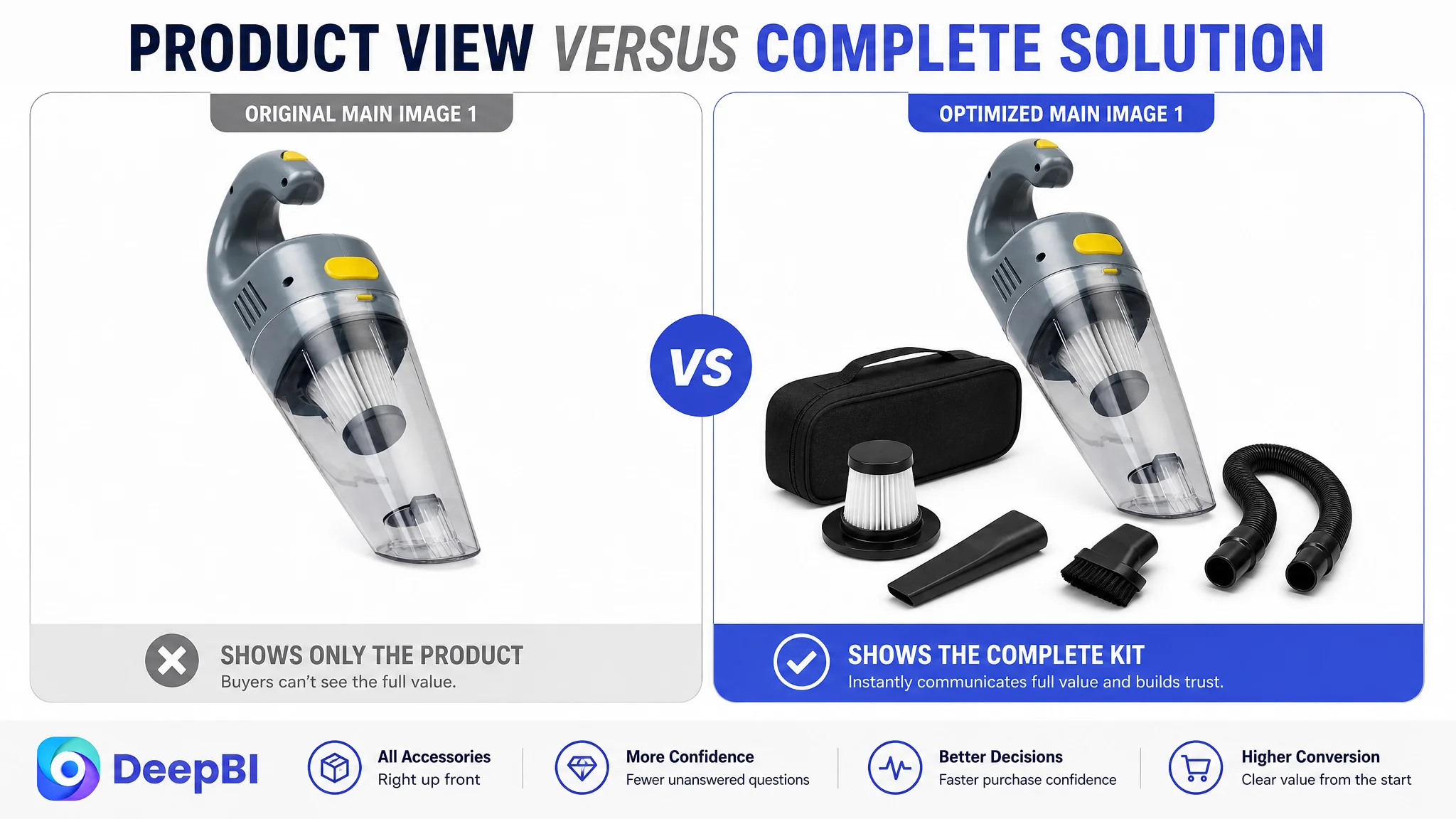
The first image had a basic product-identification role. It made the vacuum visible, but it did not immediately communicate the scope of the solution.
The comparable Listing used a stronger bundle presentation. The customer’s kit included an extra filter, storage bag, cleaning brush, crevice tool, and flexible hose, but those elements were not given enough visual importance at the beginning of the browsing journey.
This created a value-perception gap.
For a compact car vacuum, the shopper is not only buying a motor. They are evaluating whether the package can handle different cleaning situations without requiring additional purchases. If the accessory value appears late or only in text, the shopper must do more interpretation.
The recommended image sequence therefore changed roles:
First: establish the complete kit
The opening image should make the product and its included solution easy to understand, subject to Amazon image requirements. The shopper should quickly see that the offer includes more than the handheld vacuum itself.
Next: show a specific cleaning problem
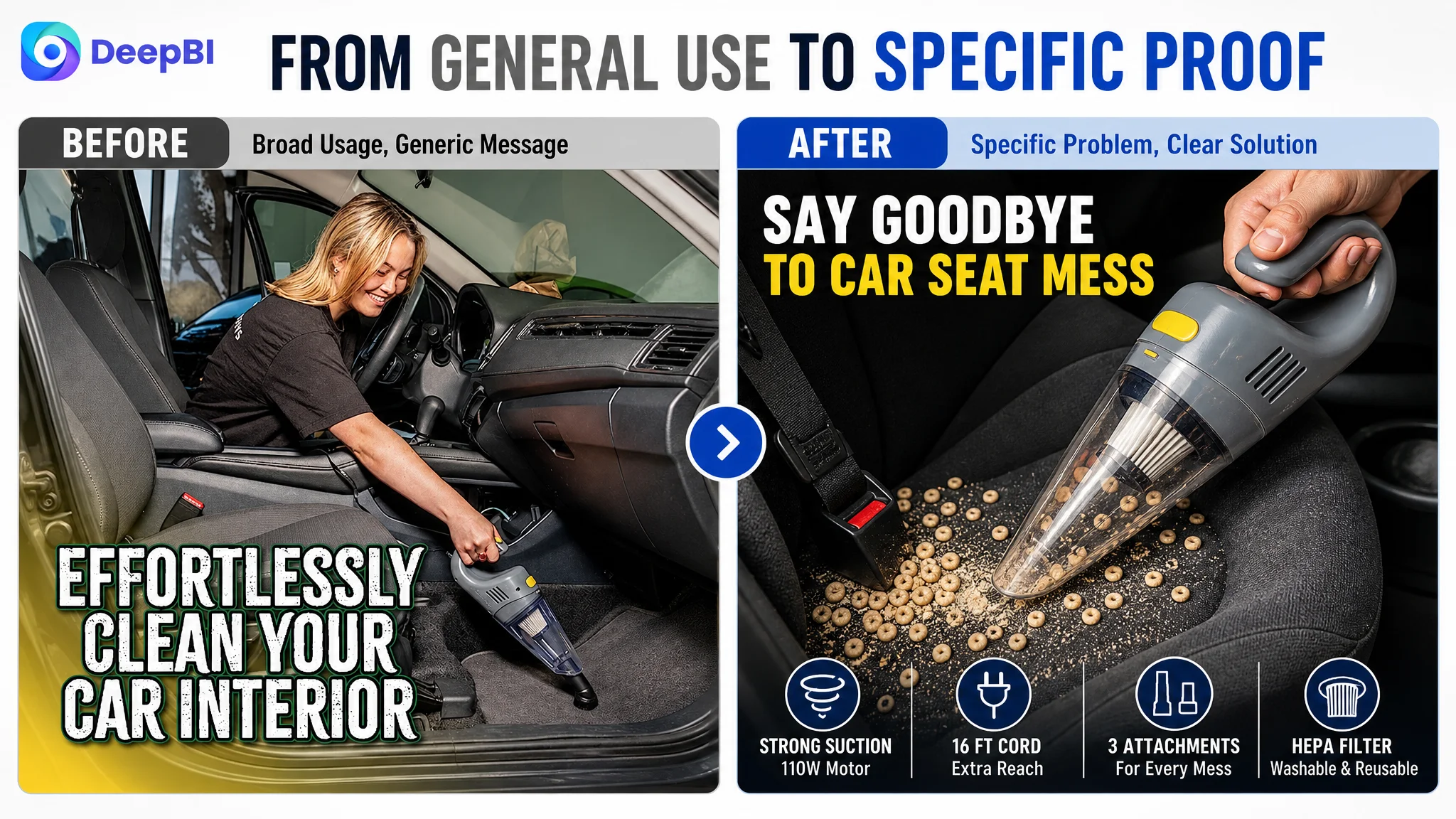
Generic “cleaning in a car” imagery was not enough. A more useful image would focus on recognizable problems such as pet hair, sand, cereal, crumbs, or debris in difficult areas.
Then: prove reach
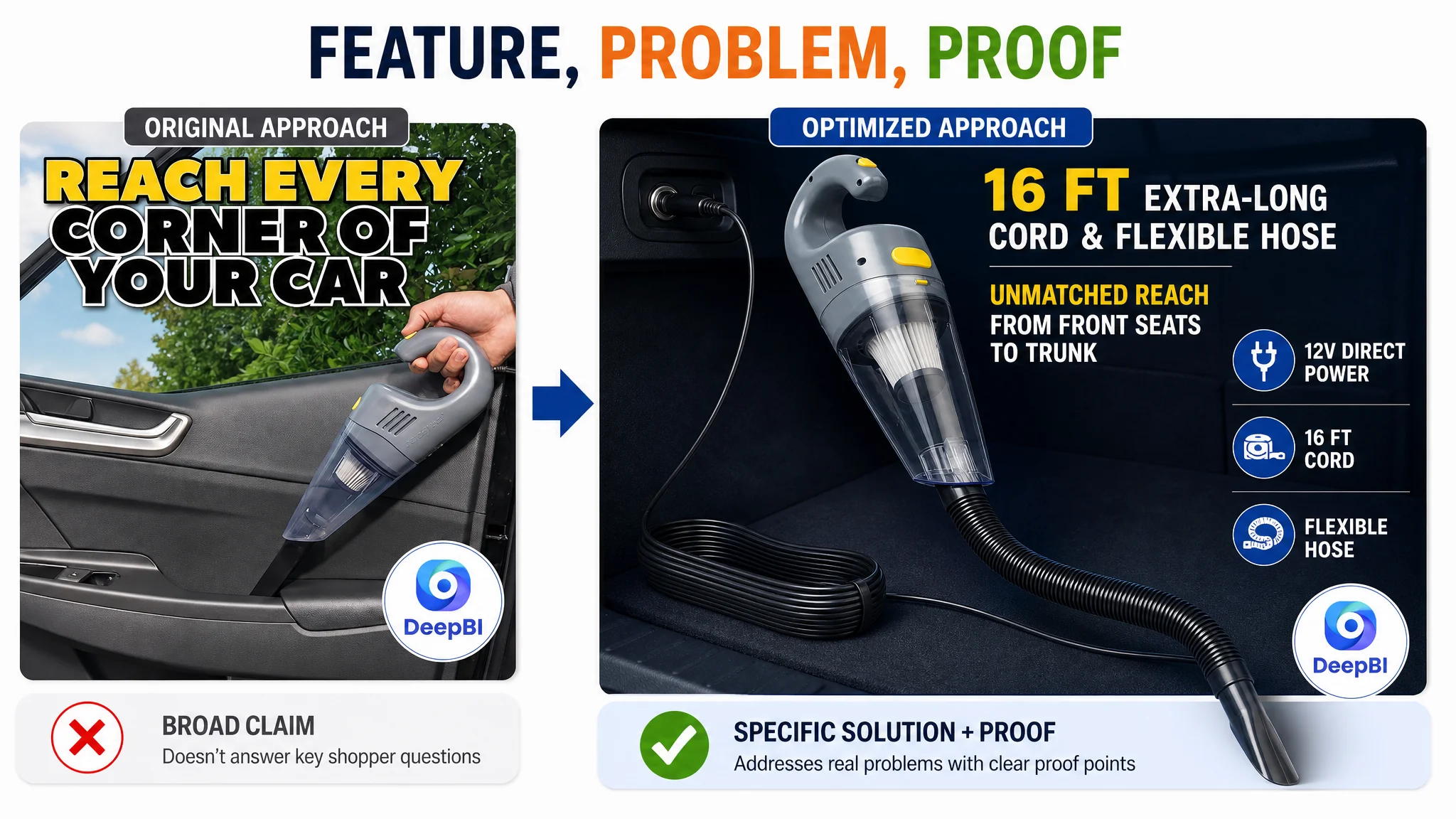
The flexible hose and 16-foot cord should answer the reach question with precision. A larger vehicle context, such as an SUV interior, would make the benefit more credible than a generic hose demonstration.
Later: show surface and attachment specialization
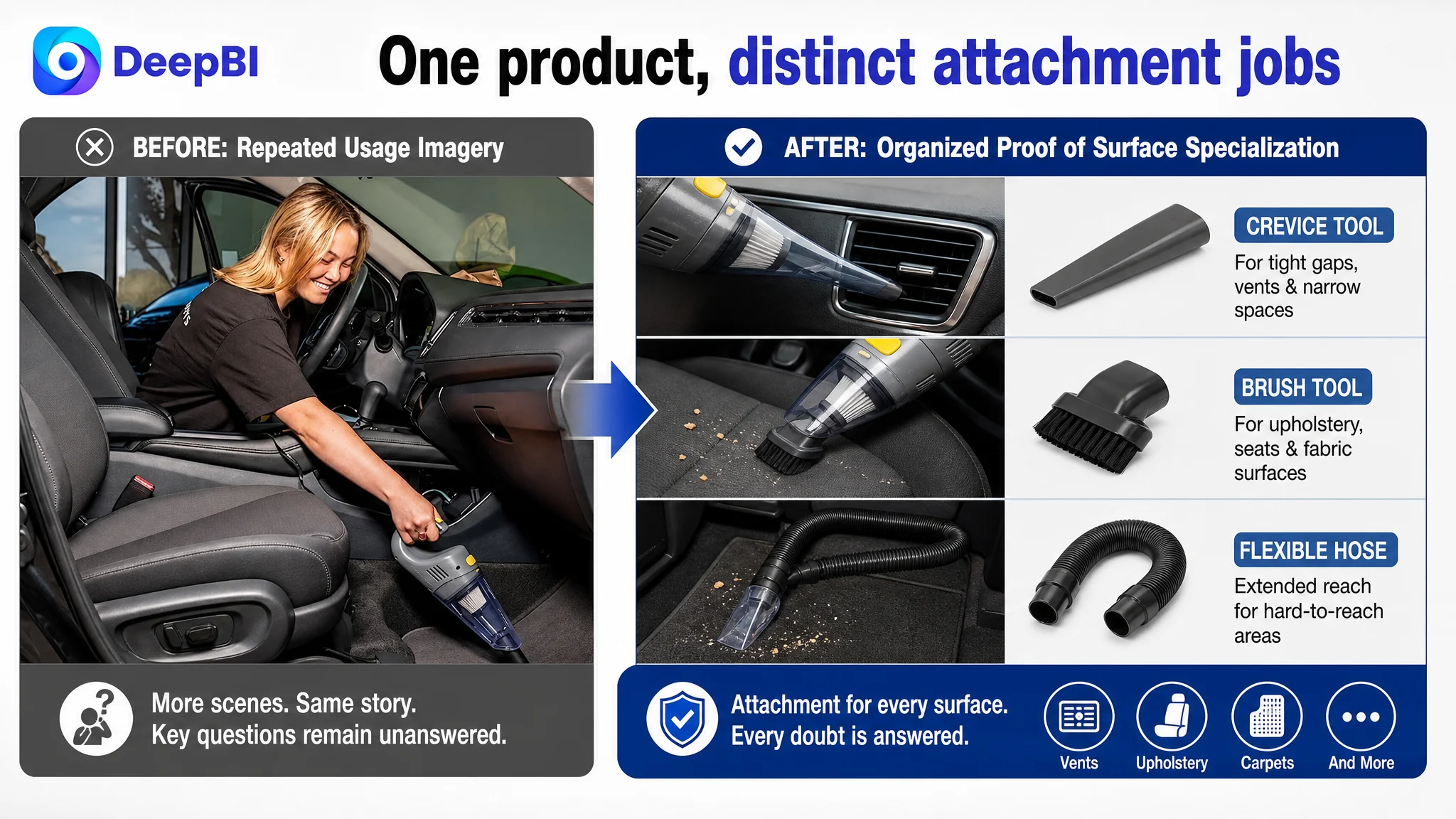
The image sequence should distinguish between vents, upholstery, carpets, floor mats, and narrow gaps rather than repeating similar food-mess scenes.
Finally: reduce maintenance uncertainty
Filter cleaning, the extra filter, and the cleaning brush should appear before the shopper leaves the gallery with doubts about reliability or upkeep.
The central change was not “make the images more attractive.” It was to assign each image a distinct decision-making job.
The Bullet Points Had Information, but Not Enough Buying Logic
The customer’s bullet points contained several useful facts, including portability, a 110W motor, a 12V power connection, a 16-foot cord, and multiple attachments.
The weakness was structural.
Several points repeated convenience and lightness, while the strongest specifications were not always connected to the shopper’s actual concerns. The copy described features and scenarios, but it did not consistently follow a clear sequence:
Shopper problem → product response → credible proof
The revised bullet-point direction made that sequence more explicit.
Compact handling should answer the usability concern
Instead of describing portability in general terms, the copy should connect the lightweight, ergonomic form to regular use in cars, trucks, and SUVs.
Power should answer performance concerns
The 110W, 8.8-amp motor and washable filter should be tied to specific debris such as crumbs, ash, sand, and pet hair. A specification becomes more persuasive when the shopper can understand what problem it is meant to solve.
The 12V connection and 16-foot cord should answer battery and reach concerns
The direct vehicle power connection addresses the risk of a dying battery. The long cord addresses the practical problem of reaching rear seats and the trunk.
The accessory set should answer completeness concerns
The crevice tool, brush tool, flexible hose, extra filter, cleaning brush, and storage bag should be presented as one coherent detailing kit, not scattered across multiple descriptions.
Quick upkeep should define the product’s role
The product was better positioned as a convenient maintenance tool for regular five- or ten-minute cleanups, especially after commuting, beach trips, or daily use—not necessarily as a replacement for every heavy-duty vacuum.
This final point was particularly important. Clear positioning can be more credible than broad claims. The product’s role was to help maintain the interior between deeper cleanings, making the use case easier to understand.
The A+ Content Needed to Resolve Doubt, Not Repeat the Gallery
The customer’s A+ content relied heavily on real product-use images and brand presentation. That supported authenticity, but several modules repeated the same general idea: the vacuum is being used inside a vehicle.
The comparable Listing used its detail content more aggressively as a proof system. It combined:
- a strong benefit headline;
- multiple use cases;
- an accessory overview;
- cleaning-result comparisons;
- filter-maintenance information;
- visual icons and specification callouts.
The issue was not that the customer needed a longer A+ page. It needed a more deliberate progression.
Start with power and reach
The first meaningful module should clarify that the vacuum plugs into a vehicle’s 12V outlet and uses a 16-foot cord. These are foundational use questions and should not be left for late-stage discovery.
Make the kit transparent
A complete accessory layout should show the crevice tool, brush tool, flexible hose, extra filter, cleaning brush, and storage bag. The goal is to let shoppers understand the value of the package without searching through paragraphs.
Explain the product’s maintenance role
The page should show how the vacuum supports regular upkeep of carpets and upholstery after a deeper clean or car wash. This gives the product a practical, believable position in the customer’s routine.
Give each attachment its own job
The crevice tool should be connected to narrow spaces and trapped debris.
The brush tool should be connected to upholstery, carpets, and dust removal.
The flexible hose should be connected to awkward angles, under-seat areas, and extended reach.
Add maintenance reassurance
The extra filter and cleaning brush should be shown clearly. Filter care was one of the areas where the current page left a trust gap, even though the product had useful maintenance-related components.
The A+ page was not missing more decoration. It was missing a final layer of reassurance.
Reviews Were a Serious Constraint, but Not the Only First Move
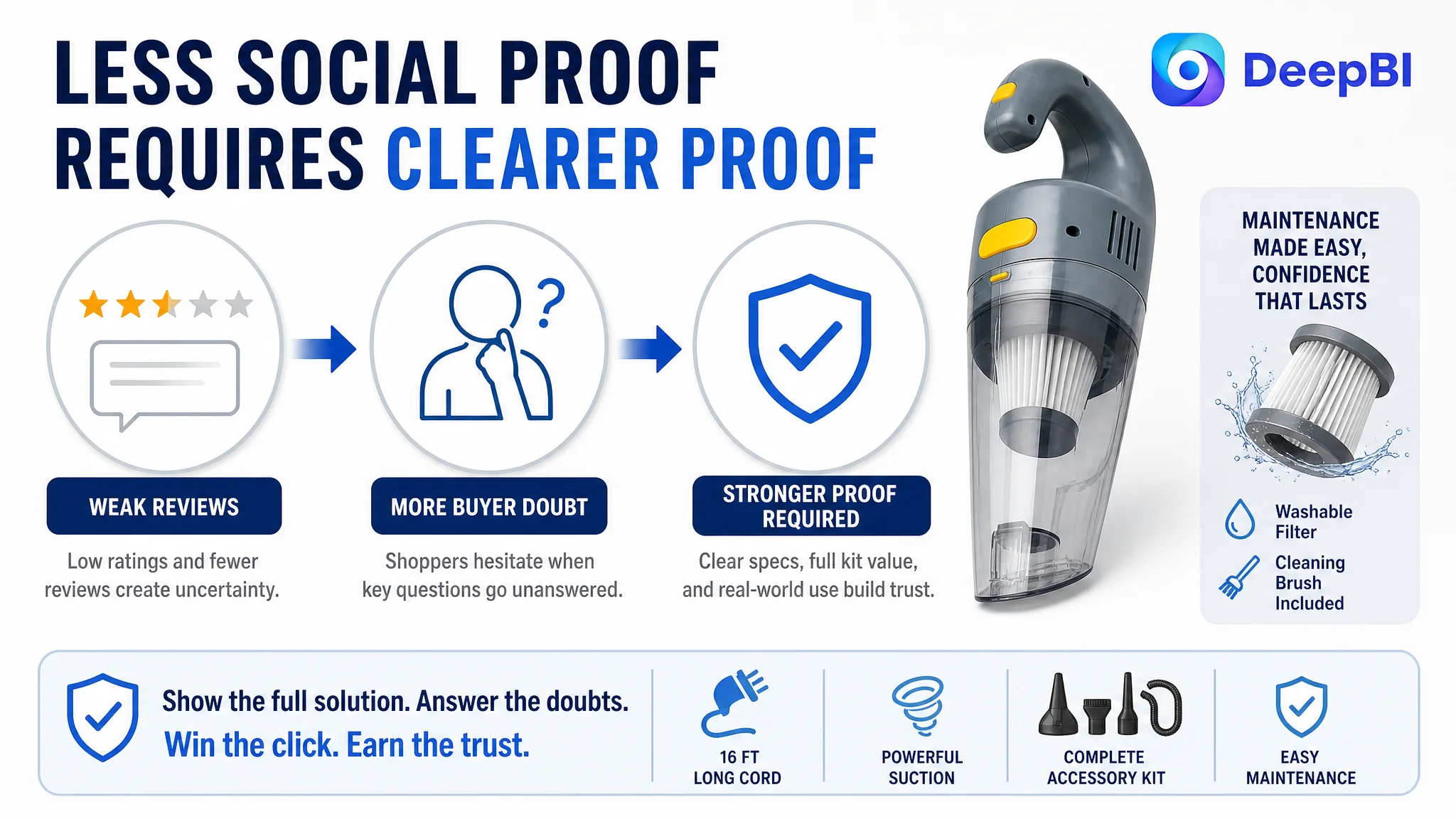
The review comparison exposed a major trust disadvantage:
- Customer Listing: 3.7 stars, 65 total reviews, no meaningful review content visible at the top.
- Comparable Listing: 4.0 stars, 248,432 total reviews, with high-quality reviews visible near the top.
- Customer Listing low-star share: 22%.
- Comparable Listing low-star share: 20%.
The customer’s negative feedback also concentrated around suction strength and reliability. Those concerns directly overlapped with the Listing’s weak proof structure.
This does not mean that content optimization can erase a review gap. It cannot create years of social proof or change historical customer experience.
But it can prevent the page from making the review problem worse.
When ratings are weaker, the product page has less room for vague claims. It must be more precise about:
- what the motor is designed to handle;
- how the power source works;
- what the attachments do;
- how the filter is maintained;
- where the product is most useful;
- what the product should and should not replace.
That is why the review dimension was treated as a trust risk, while the title, image sequence, bullets, and A+ content represented the controllable conversion levers.
Why DeepBI Did Not Keep Tuning Ads First
The decision order came from the relationship between the gaps.
The Listing was not suffering from one isolated image defect. Its title, image sequence, bullet points, and A+ content were all weakening the same underlying outcome: the shopper could not quickly understand the product’s complete value or feel sufficiently reassured about performance and maintenance.
The right sequence was therefore:
1. Repair the entrance to the Listing with a clearer title.
2. Make the complete kit and major specifications visible earlier.
3. Replace repetitive usage scenes with problem-specific proof.
4. Rebuild the bullet points around shopper concerns.
5. Give each attachment a distinct function in the A+ story.
6. Add filter-maintenance and upkeep reassurance.
7. Only then evaluate whether additional Amazon ad traffic is being converted efficiently.
This was not an argument against advertising. It was an argument against using advertising to compensate for unresolved page logic.
DeepBI’s judgment came from comparing the Listing across multiple dimensions rather than reacting to one visible symptom. The 70-point score showed that the page had a broad competitiveness gap, while the dimension-level analysis showed where the shopper’s decision was breaking down.
The Later Optimization Focused on Recovering Conversion Capacity
Because the source material does not include post-optimization performance data, the case does not support claiming a specific increase in CVR, a decline in ACOS, or a recovery in organic orders.
What can be stated clearly is the intended operating change.
The Listing was being moved from a product-display structure toward a decision-support structure:
- The title would communicate category, power, use case, and included tools more efficiently.
- The first images would establish the complete solution before moving into detailed demonstrations.
- The gallery would cover pet hair, crumbs, sand, reach, surfaces, and filter care without repeating the same scene.
- The bullet points would connect specifications to real problems.
- The A+ content would clarify power, kit contents, attachment roles, upkeep, and maintenance.
- The review disadvantage would be acknowledged rather than hidden behind broad claims.
If implemented and validated with Amazon traffic data, this direction would give the seller a more credible basis for evaluating advertising efficiency. Ads would be judged against a page with clearer conversion logic, rather than against a Listing that left key questions unanswered.
The Business Lesson Was Larger Than a Car Vacuum
The case was not fundamentally about whether one car vacuum needed better images.
It was about how Amazon sellers diagnose conversion problems.
A seller may see traffic but not enough orders and immediately revisit keywords, bids, budgets, or campaign structure. Those levers matter, but they do not replace the product page’s responsibility to make the decision easier.
The deeper lesson is:
Before scaling traffic, determine whether the Amazon Listing deserves more traffic.
In this case, the page did not need to become louder. It needed to become more coherent.
The title had to identify the product and its useful specifications earlier. The images had to show the full kit and answer concrete cleaning problems. The bullets had to turn technical details into solutions. The A+ content had to close the trust gap around attachments, reach, performance, and filter maintenance.
That is the kind of judgment DeepBI brought to the case: not a list of isolated edits, but a decision about which constraint had to be addressed first.
For Amazon sellers, the practical takeaway is straightforward. When advertising becomes harder to control, do not assume the answer is always better campaign tuning. Review the Listing as a conversion system. If the page receives traffic but does not build clarity, relevance, and trust in the right order, the real inefficiency may be occurring after the click.