

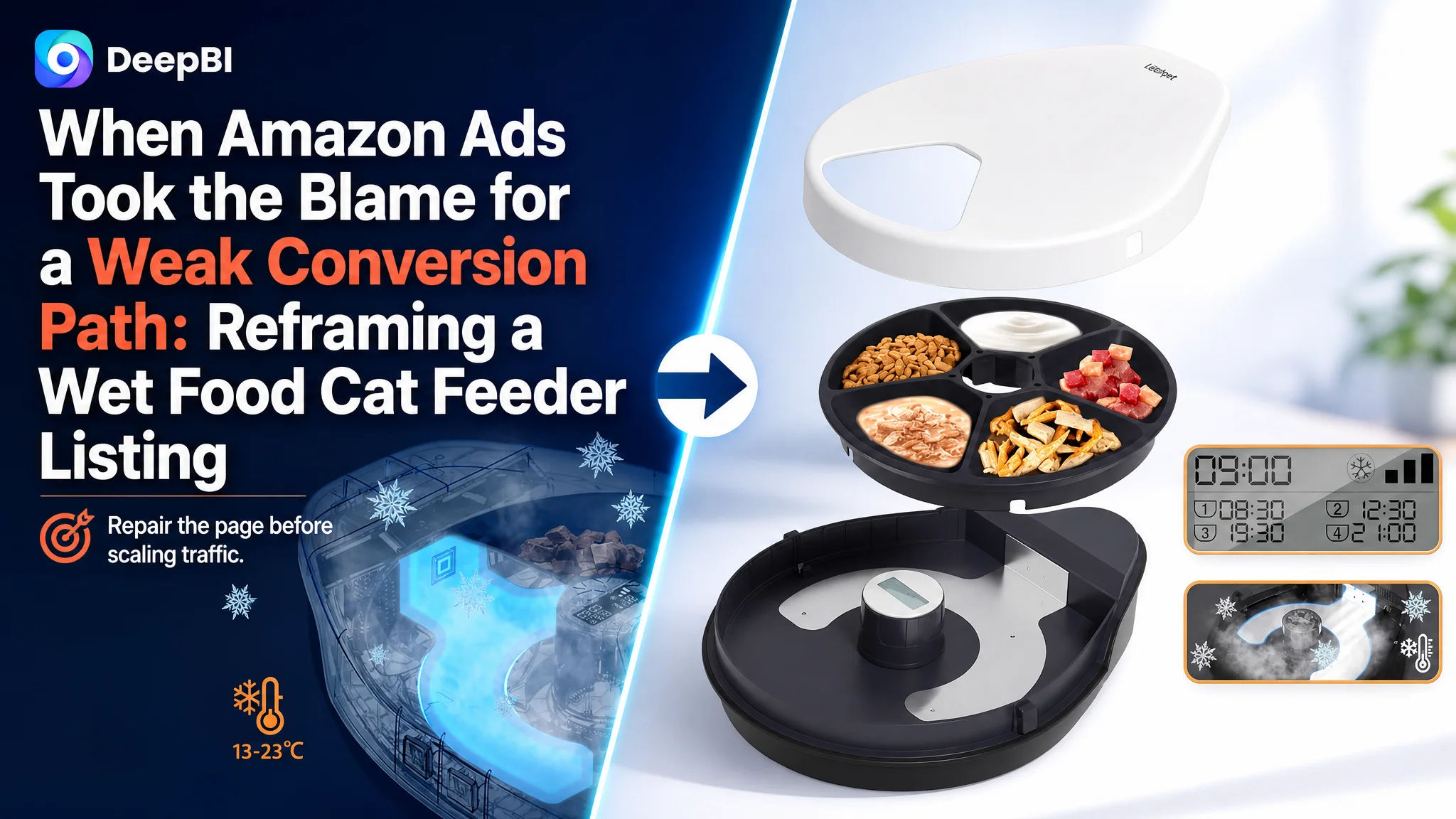
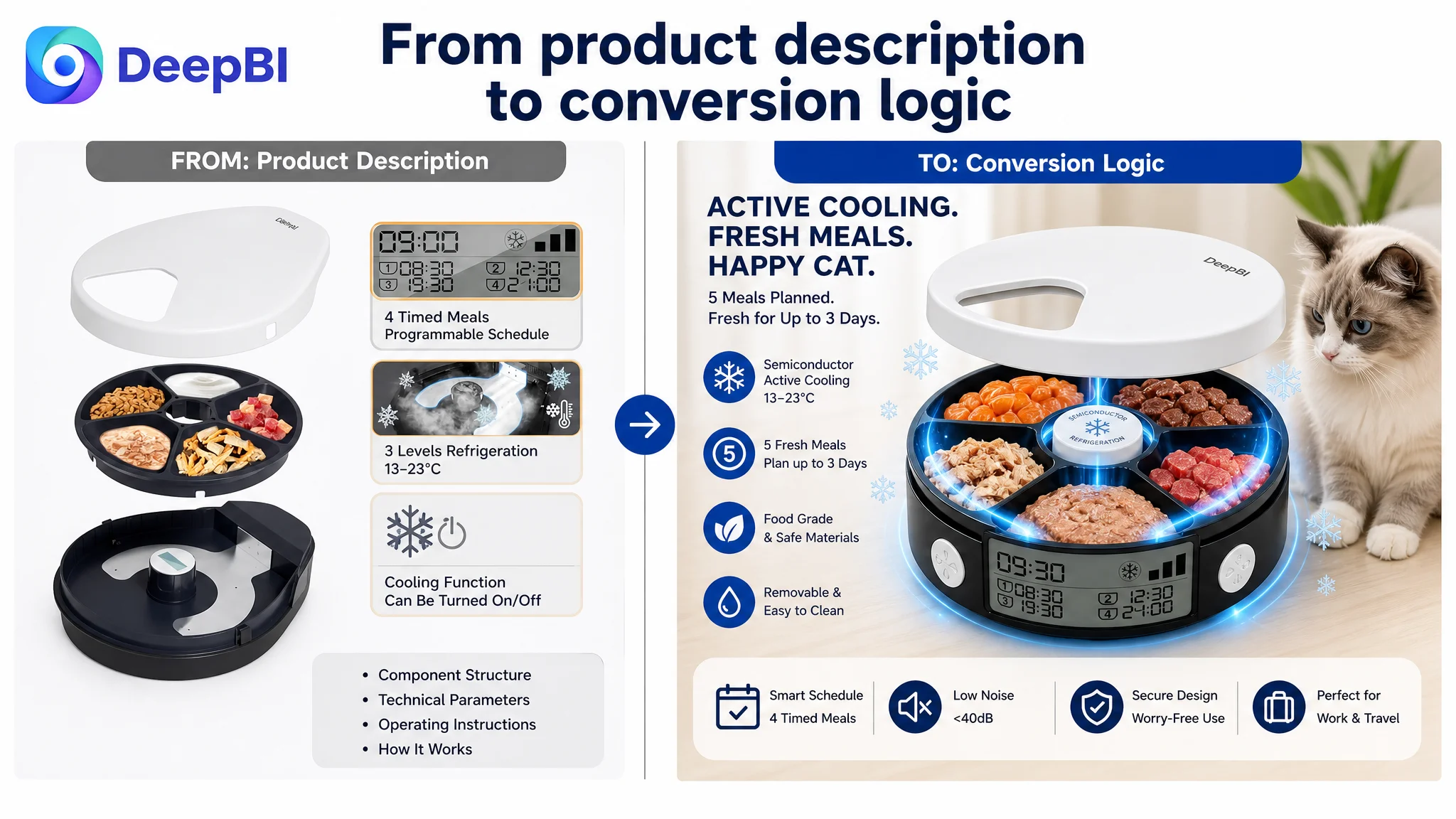
This case involved an Amazon seller in the US marketplace whose wet food cat feeder Listing was under pressure from a clear competitive gap. The customer initially viewed the situation mainly through an advertising and traffic lens: improve keyword coverage, adjust the title, and continue refining the product presentation to make the ads work harder.
DeepBI found a different constraint. The Listing scored 72 out of 100, compared with 88 for a closely comparable high-performing Listing. The largest gaps were not concentrated in one keyword or one image. They appeared across the product page's sales logic, especially in the five bullet points and A+ content. The page explained how the feeder worked, but did not build enough confidence in why the product solved the buyer's most important concerns.
The later direction therefore focused on Amazon Listing conversion before further ad tuning: make active refrigeration the first message, clarify the multi-day feeding benefit, replace parameter-heavy copy with pain-point-led bullets, and rebuild the A+ sequence around freshness, health, safety, cleaning, and real-life use. For other Amazon sellers, the lesson is straightforward but easy to miss: when paid traffic becomes less efficient, the first question should be whether the product page deserves more traffic—not only whether the campaigns need more adjustments.
The Amazon Seller Saw an Advertising Problem. The Listing Was Showing a Conversion Problem.
The product was an automatic wet food feeder designed for cats and dogs, with semiconductor cooling, scheduled feeding, multiple food compartments, and removable parts.
On the Amazon product page, the basic capabilities were present. The title mentioned cooling, timed feeding, washable plates, and multi-day use. The images showed the product structure, temperature information, food compartments, and cleaning-related details. The A+ content included operating instructions, cooling explanations, comparison content, and product details.
Yet the page did not communicate those capabilities in the order buyers needed.
The customer team had enough material to describe the product, but the product page did not create a strong enough reason to click, trust, and purchase. That distinction matters because advertising can bring a shopper to a Listing, but it cannot repair a weak decision path after the click.
Advertising does not only amplify a product's strengths. It can also amplify the weaknesses of the page receiving the traffic.
The initial optimization direction was understandable. The team looked at keyword placement, title structure, image quality, and feature coverage as separate improvements. But treating each element independently made it difficult to see the larger issue: the Listing lacked a coherent conversion narrative.
The Score Gap Was Not Distributed Evenly
DeepBI's comparison produced a total score of 72 for the target Listing and 88 for the benchmark Listing, a 16-point difference.
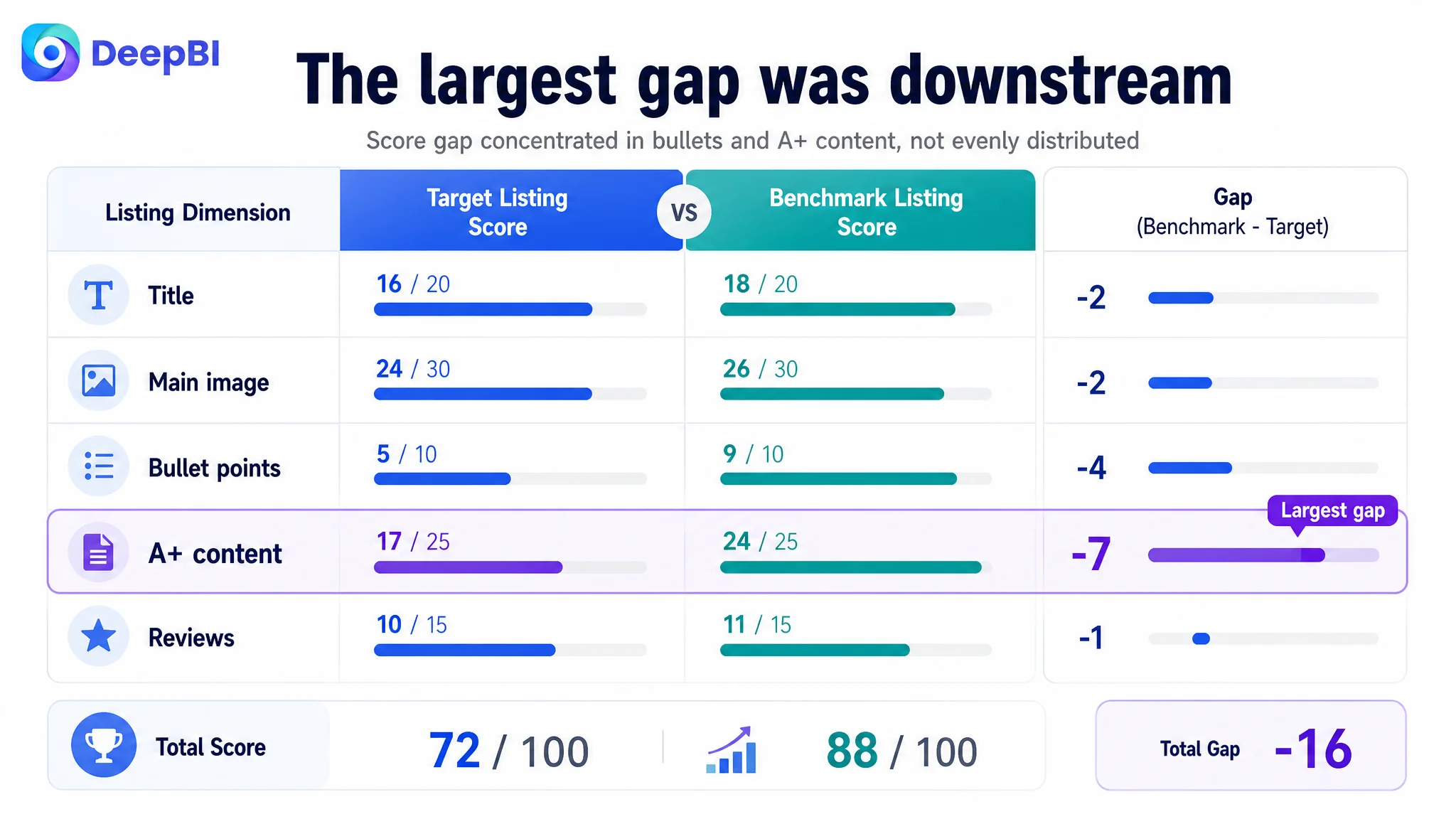
- Title: Target Listing: 16/20, Benchmark Listing: 18/20, Gap: -2
- Main image: Target Listing: 24/30, Benchmark Listing: 26/30, Gap: -2
- Bullet points: Target Listing: 5/10, Benchmark Listing: 9/10, Gap: -4
- A+ content: Target Listing: 17/25, Benchmark Listing: 24/25, Gap: -7
- Reviews: Target Listing: 10/15, Benchmark Listing: 11/15, Gap: -1
- Total: Target Listing: 72/100, Benchmark Listing: 88/100, Gap: -16
The numbers changed the order of priorities.
The title and main image had visible weaknesses, but their gaps were relatively limited. The largest losses were in the five bullet points and A+ content—the parts of the Amazon product page responsible for turning initial interest into purchase confidence.
That meant the issue was not simply “the product needs better images” or “the title needs more keywords.” The page needed to communicate value more effectively after the shopper arrived.
The Title Had Keywords, but Not the Strongest Search and Buying Sequence
The benchmark Listing placed the core phrase “Automatic Cat Feeder Wet Food” near the beginning of the title. It also led with “Semiconductor Cooling & Heating,” followed by clear numbers such as five fresh meals and three days.
The target Listing began with the brand name and emphasized cooling, but did not make the heating function equally visible. Its numerical information was distributed further into the title, and “Premium Meal Plates” was less specific than a material-based phrase such as “Stainless Steel Bowl.”
These differences were not merely stylistic.
On Amazon, the opening section of a title must perform two jobs quickly:
1. Help the search system understand the product's primary category and use case.
2. Help the shopper understand the main outcome before deciding whether to continue reading.
The target title led with identity. The benchmark title led with product type, food format, and core function.
DeepBI's suggested direction was to bring the core product phrase and refrigeration benefit forward, then connect them with the most commercially relevant proof points: five meals, multi-day scheduling, washable components, and easier cleaning.
The judgment was not to add every available keyword. It was to reorder the title around the buyer's actual decision:
wet food feeder → active cooling → multi-meal planning → easier maintenance.
The Main Image Explained the Product, but Did Not Create Enough Urgency
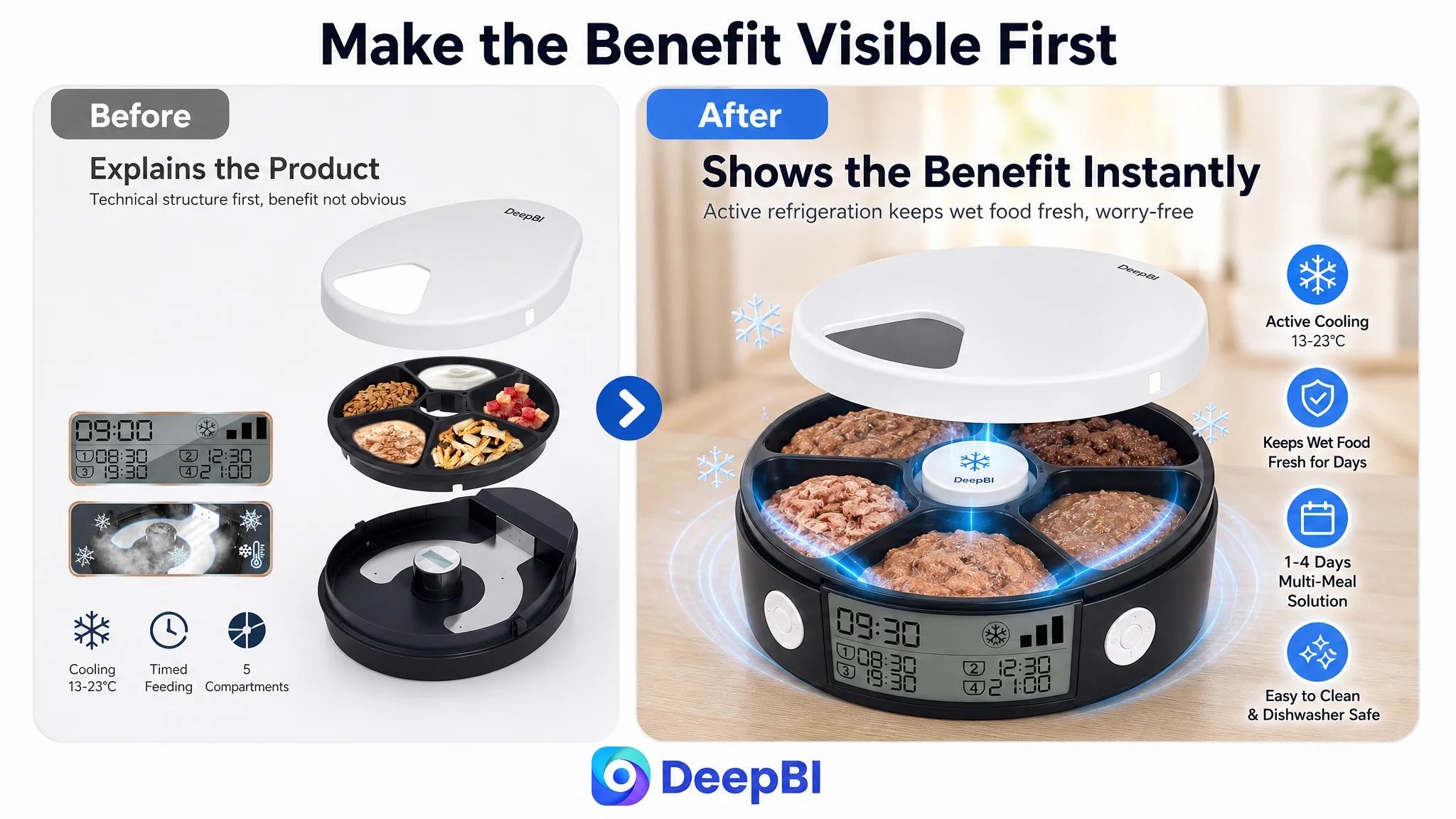
The main image set showed product structure and technical information, but the visual role of each image was not clear enough.
The first image was expected to establish product awareness and hint at freshness technology. Instead, it did not immediately communicate the most important benefit: active, ice-free cooling for wet food. The technical treatment also felt closer to an instruction manual than a high-confidence product presentation.
Several visual issues weakened the page:
- The cooling benefit was not expressed with enough immediate impact.
- Technical diagrams did not sufficiently connect the semiconductor system to food freshness.
- Product structure and usage scenes felt disconnected.
- Cat and dog imagery appeared together, weakening the focus on the primary cat audience.
- The set lacked a consistent visual language across composition, color, and typography.
- Cleaning and material safety were not demonstrated strongly enough.
The correction was not to make the images more decorative. It was to assign each image a clear decision-making job.
The first image needed to lead with active cooling
The opening visual should make the product's core solution obvious: fresh wet food stored across multiple compartments without the daily inconvenience of ice packs.
The page could then use the available product claims—such as keeping canned food fresh for one to four days, cooked meat fresh for one to two days, and raw meat fresh for one day—only where those claims are factually supported and presented clearly.
Another image needed to prove multi-meal capacity
The second image should combine the temperature range of 13 to 23°C with the practical feeding structure: one immediate meal and four scheduled meals, with capacity information shown accurately.
This is more useful than repeating cooling information in two separate images without explaining the buyer outcome.
A scenario image needed to show time away from home
The product supports different scheduling patterns, including running once a day for four days or twice a day for two days, within the stated operating boundaries.
Showing these as simple lifestyle scenarios would communicate the benefit more effectively than asking shoppers to decode dense timing instructions.
Cleaning needed its own reassurance
The product's removable lid and bowl, along with the dishwasher-safe cleaning claim where applicable, should be shown as a simple maintenance process. Buyers should not have to infer whether a complex feeder will become difficult to clean after repeated wet food use.
The Five Bullet Points Were Carrying Information, Not a Buying Logic
The five-point section was the clearest copywriting weakness, scoring 5 compared with the benchmark's 9.
The target Listing leaned heavily on specifications, operating instructions, and product attributes. The benchmark Listing organized its bullets around a buyer's concerns:
- Keep wet food fresh.
- Warm food gently when needed.
- Plan meals around work or travel.
- Use safer, easier-to-clean bowls.
- Maintain a sealed, quiet, user-friendly feeding environment.
This difference explains why a page can contain accurate information and still convert poorly.
A shopper does not first ask, “What are all the operating rules?” The shopper is more likely to ask:
- Will the food stay fresh while I am away?
- Can my cat receive meals on a regular schedule?
- Is the feeder suitable for wet food and other feeding needs?
- Will it be difficult to clean?
- Will the machine create noise or safety concerns?
DeepBI therefore recommended restructuring the bullets around problem, solution, and evidence.
Freshness should come before operation
The first bullet should establish the core value of semiconductor cooling and explain the practical freshness benefit without ice packs. The technical temperature range should support the claim rather than dominate it.
Scheduling should be expressed as freedom
The second bullet should frame five-meal scheduling as a way to manage workdays, sleep, and short trips. The operating rules still need to remain accurate, but they should not be the opening message.
Food compatibility should reduce uncertainty
The Listing can clarify compatibility with wet food, dry food, medication, milk, and other supported items where those claims are accurate. This helps shoppers understand whether the feeder fits their existing feeding routine.
Material and hygiene claims must remain factual
The case material identifies food-grade PP for the target product, while the benchmark emphasizes 304 stainless steel. These should not be treated as interchangeable claims. The target Listing should communicate its actual food-grade PP construction accurately rather than borrowing a competitor's material positioning.
If future product versions include different bowl materials, those claims must be updated only after verification.
Cleaning should replace lower-priority after-sales messaging
A cleaning benefit is more relevant to the purchase decision than a generic service promise. Removable parts and dishwasher-safe components, if supported by the actual product specifications, should be presented as a practical answer to wet food residue and maintenance anxiety.
The Largest Gap Was in A+ Content
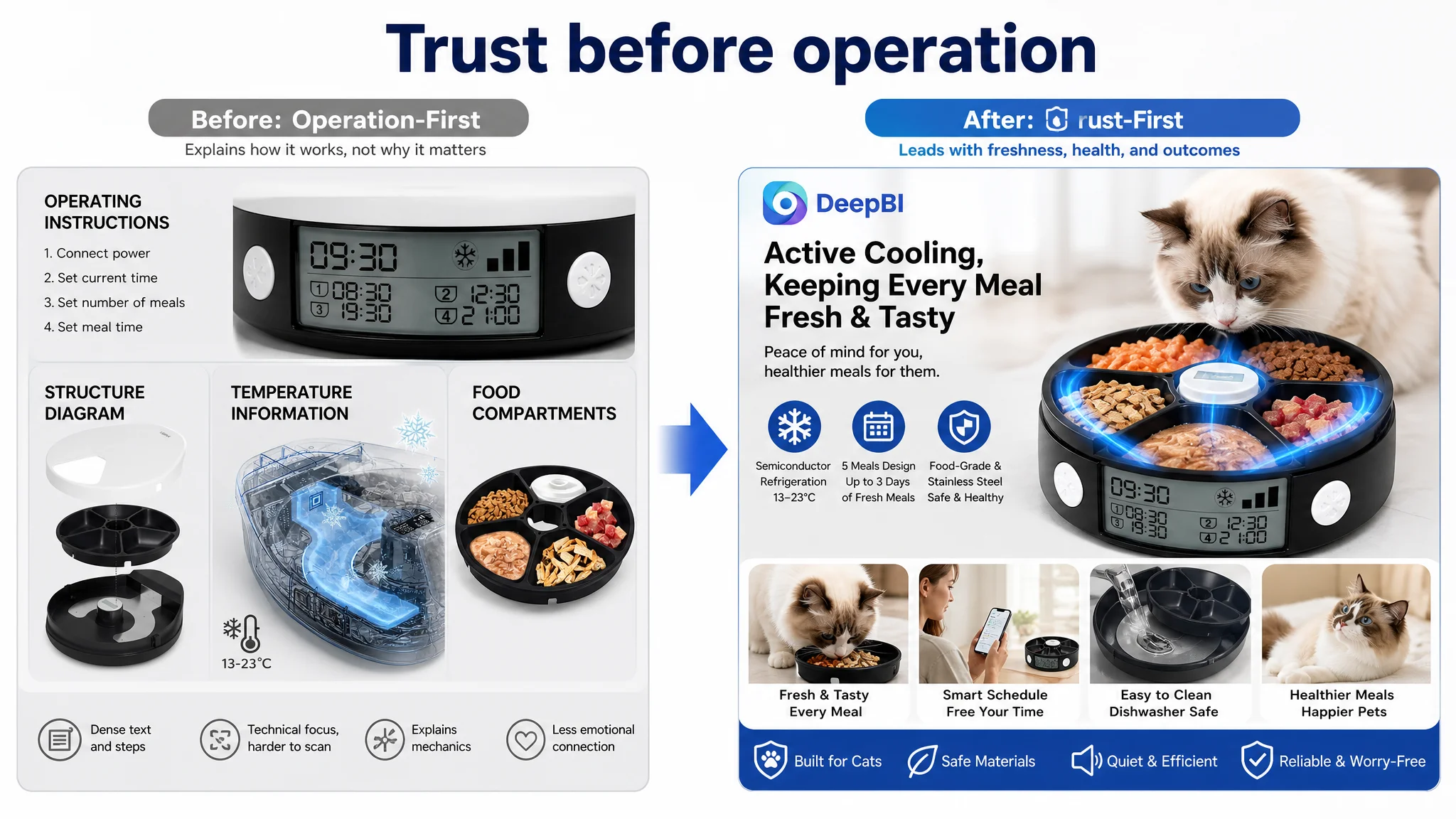
The A+ content gap was seven points, the largest difference in the comparison.
The target A+ sequence contained useful material, including:
- Operating instructions
- Product images
- Scheduled feeding explanations
- Cooling-mode diagrams
- Comparison tables
- Temperature curves
- Bowl details
- Anti-slip features
- Lifestyle images
The problem was not a complete lack of content. The problem was the order and role of that content.
The page introduced operation too early, before establishing why the cooling system mattered. It used valuable visual space to explain button presses and scheduling logic before giving shoppers enough confidence in food freshness, health, safety, and ease of use.
The benchmark Listing created a more complete persuasion path:
technology → proof of freshness → usage scenario → safety and materials → cleaning → operation → compatibility
The target Listing was closer to:
operation → product structure → timing rules → cooling explanation → comparison
That sequence asks the buyer to understand the product before believing in its value.
The first A+ module needed to validate the use case
The opening should show the feeder in a solved-state scenario: an open tray, fresh food, and a cat eating in a normal home environment.
The first question it answers is not “How do I press the button?”
It is:
Does this product actually provide automatic wet food feeding in a way that fits my life?
Refrigeration technology needed to become a trust node
The cooling explanation should come before complex scheduling instructions. A visual comparison between semiconductor refrigeration and ice-pack-based cooling can help explain why the system is convenient, provided the comparison stays within verifiable product capabilities.
The timeline should show consistent cooling and the absence of daily pre-freezing or replacement steps, rather than presenting technical components without a clear buyer benefit.
Health and maintenance needed dedicated space
The page should separately address the actual bowl material, removability, washing, and dishwasher-safe claims. It should not imply stainless steel benefits if the target product uses food-grade PP.
This is a critical example of why competitive analysis must not become competitive imitation. DeepBI's role is to identify the buyer concern behind a competitor's advantage while preserving the target product's factual boundaries.
Scheduling should be shown as a benefit, not a puzzle
The difference between “one meal per day for four days” and “four meals per day for one day” is useful only when translated into a real situation.
A simple schedule visual can make the flexibility clear without forcing shoppers to read a long operating manual in the middle of the page.
Operation should appear after confidence has been built
Once the product's value is established, a later module can show the display and controls, including time settings, cooling levels, meal settings, and lock functions where supported.
At that point, the interface becomes reassurance rather than friction.
Why DeepBI Did Not Recommend More Ad Tuning First
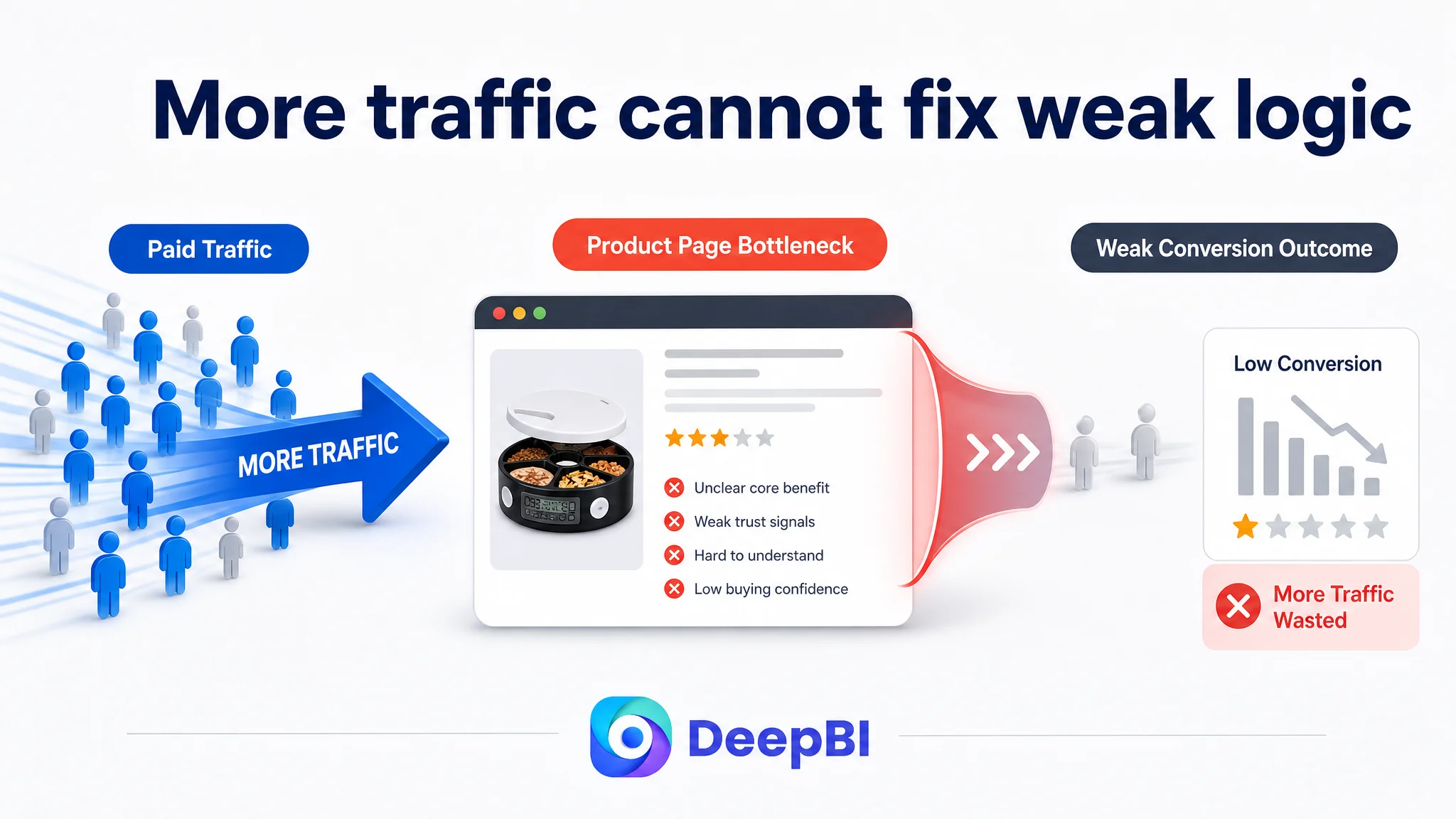
The Listing score did not justify treating advertising as the first and only lever.
The main image had a click problem, but the larger issue was downstream. Even if a revised image improved traffic quality, the bullet points and A+ content still lacked enough persuasive depth to convert that traffic consistently.
That creates a familiar Amazon operating trap:
1. Ads generate impressions.
2. The shopper clicks.
3. The product page explains features but does not resolve purchase concerns.
4. Orders remain weaker than expected.
5. The team interprets the result as a keyword, bid, or campaign problem.
6. More ad adjustments send more traffic into the same conversion bottleneck.
DeepBI's judgment was therefore based on the order of constraints.
Before scaling traffic, the page needed stronger conversion capacity.
This did not mean ads were irrelevant. It meant ad optimization should follow the Listing repair, not substitute for it.
The page needed to become better at receiving both paid and organic traffic:
- Paid traffic should encounter a clearer reason to buy.
- Organic traffic should encounter stronger relevance and trust.
- The seller should be able to distinguish traffic quality from page weakness.
- Future advertising decisions should be based on a more reliable conversion signal.
The Review Gap Was Smaller, but Still Reinforced the Trust Problem
The review dimension was not the main bottleneck, but it contributed to the page's trust environment.
The target product had:
- A 3.8-star rating
- 86 total reviews
- 12 reviews visible on the first page
The benchmark had:
- A 4.0-star rating
- 81 total reviews
- 15 reviews visible on the first page
The target Listing had slightly more total reviews, but the lower rating and higher share of negative feedback created a more serious concern. Negative feedback reportedly centered on product malfunctions, mechanical noise, and cooling limitations involving only four bowls. The benchmark's negative feedback was more concentrated on setup complexity and appeared less damaging to the core product promise.
The target first-page reviews also lacked image or video content, while the benchmark included customer media and positive service-related feedback.
This did not mean the seller could solve the Listing problem through review collection alone. It meant the page needed to avoid overpromising and should address known concerns directly:
- Make the cooling scope precise.
- Explain operation more simply.
- Show noise and safety claims only when substantiated.
- Use clearer cleaning and maintenance visuals.
- Ensure the product experience matches the expectations created by the images and copy.
The Optimization Direction Changed From “More Information” to “More Confidence”
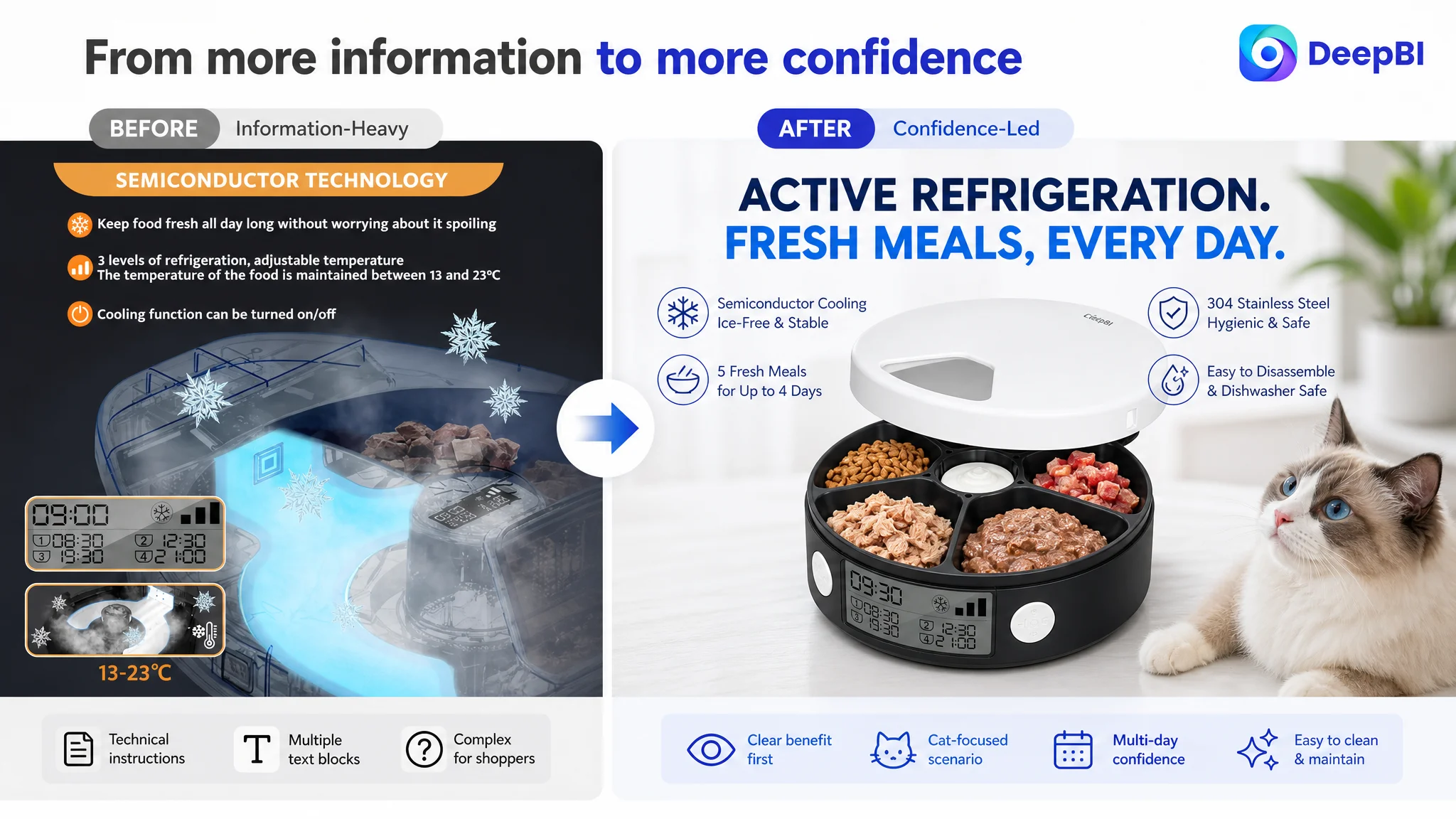
The case did not call for adding information indiscriminately.
It called for deciding which information should appear first, which concerns required proof, and which instructions should be moved later.
The revised Amazon Listing direction centered on five decisions:
1. Lead with active refrigeration and wet food freshness.
2. Focus the visual language on cats instead of mixing cat and dog scenarios.
3. Translate specifications into outcomes such as multi-day feeding and easier planning.
4. Build the A+ sequence around trust before operation.
5. Preserve factual product boundaries rather than copying competitor claims.
This is where DeepBI's role becomes more than content generation. The value lies in connecting the score difference to a decision path: identify the largest business constraint, explain why it matters, and define what should not be optimized first.
The Seller's Understanding Had to Change Before the Listing Could
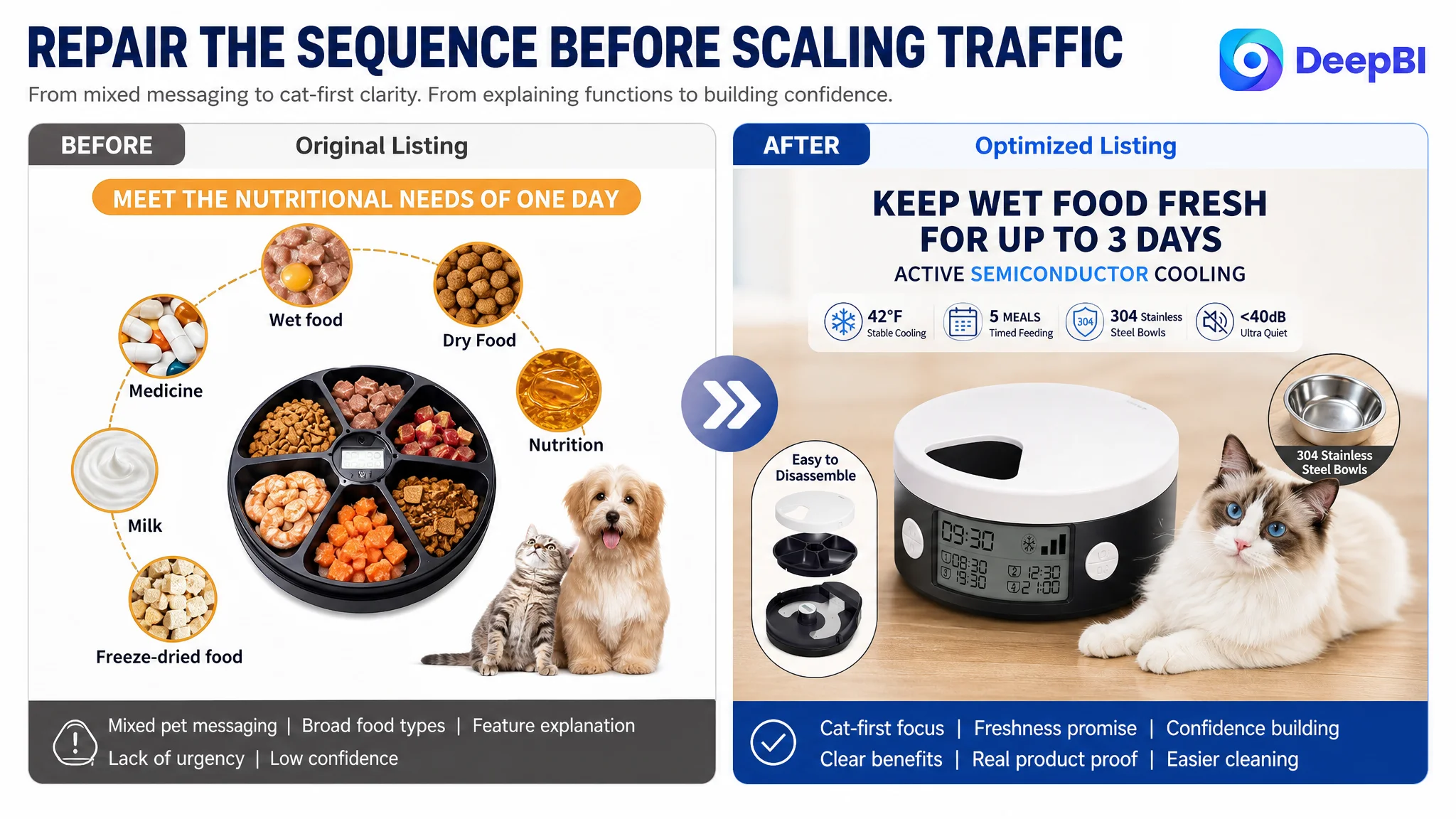
The most important shift was not a new title or a different image concept.
It was a change in diagnosis.
The seller had been looking at the Listing as a collection of assets that needed improvement. DeepBI reframed it as a conversion system with a broken sequence:
- The title did not lead strongly enough with the product's primary search and use case.
- The main image did not create an immediate freshness hook.
- The bullets described functions without forming a pain-point-led argument.
- The A+ content explained operation before establishing trust.
- The review environment made precision and expectation management more important.
The resulting lesson applies beyond automatic pet feeders.
When Amazon ad efficiency becomes difficult to control, do not ask only whether the campaigns need more tuning. Ask whether the product page has enough conversion capacity to make the traffic valuable.
For this Amazon wet food feeder Listing, the next rational step was not to keep amplifying an unfinished page. It was to repair the page's sales logic first—then give advertising a stronger destination.