

This case involved an Amazon US seller whose cat scratching pad and ball-track toy Listing was competing against a much stronger product page. The customer initially viewed the challenge mainly through the lens of product presentation and marketplace competition: improve the images, adjust the copy, and make the Listing look more attractive.
DeepBI’s diagnosis showed that the issue was broader than visual appeal. The Listing scored 69 out of 100, compared with 87 for a closely matched category competitor. The largest gaps were not isolated to one image or one keyword. The product page lacked a complete path from product understanding to trust, use-case confirmation, and purchase confidence.
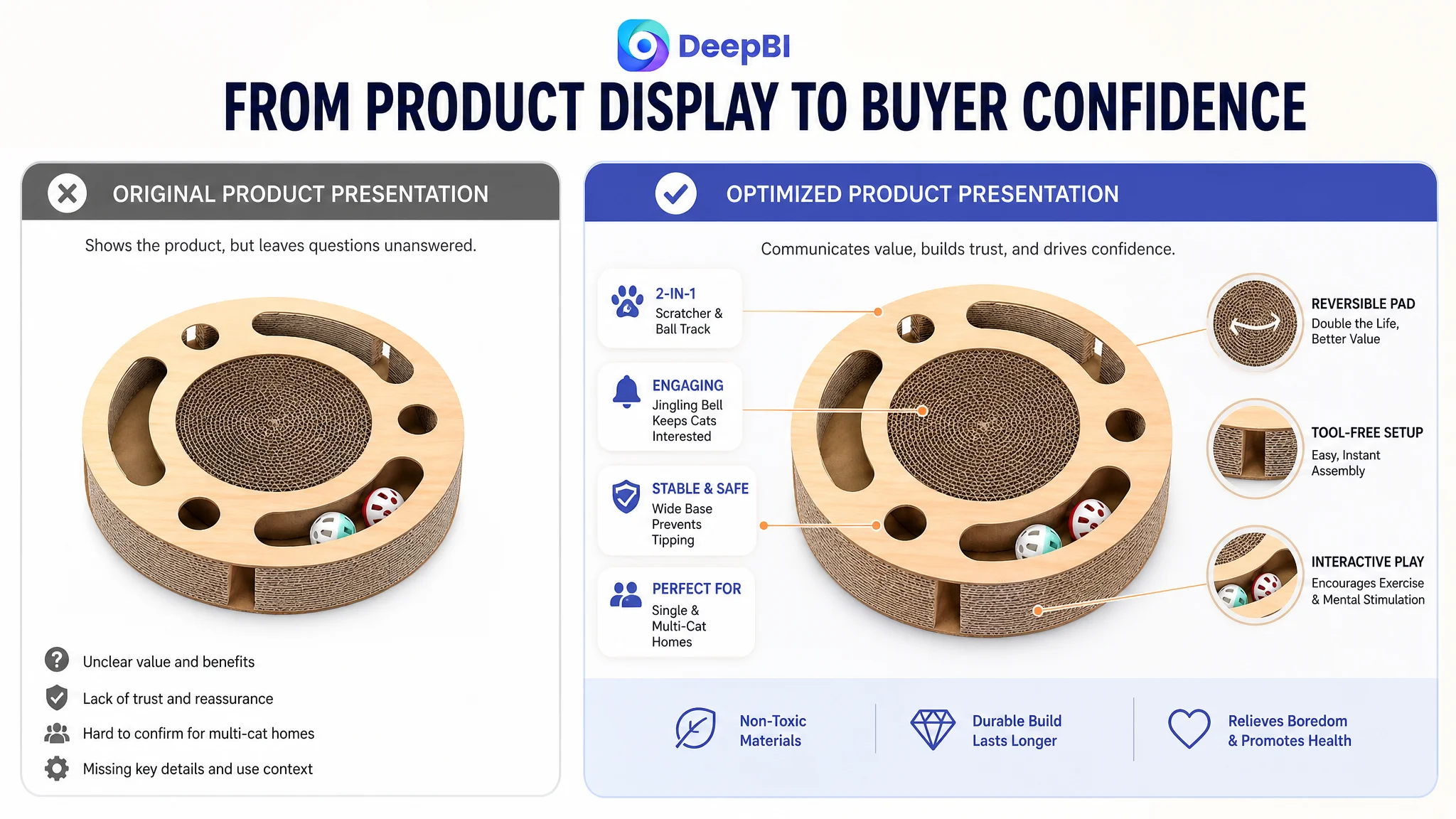
The later optimization therefore focused on rebuilding the Amazon Listing as a two-in-one activity center for indoor cats. The direction covered the title, image sequence, bullet-point logic, and A+ content, with particular attention to engagement, durability, stability, ease of setup, and suitability for single- and multi-cat homes. For other Amazon sellers, the lesson is direct: before trying to push more traffic through Amazon ads, determine whether the product page has enough conversion capacity to receive it.
The Listing Had a Product. The Competitor Had a Buying Story.
The product itself combined a scratching pad with a circular ball track and bell ball. On paper, it offered more than a basic scratching accessory.
But the Amazon product page did not communicate that value as a coherent buying story.
The competitor presented its product as a broader play system. Its content moved through a clear sequence:
- What the product is
- Why the cat would engage with it
- What makes the experience different
- How stable and usable it is
- How it can fit into a wider play ecosystem
- What mental and physical benefits it may provide
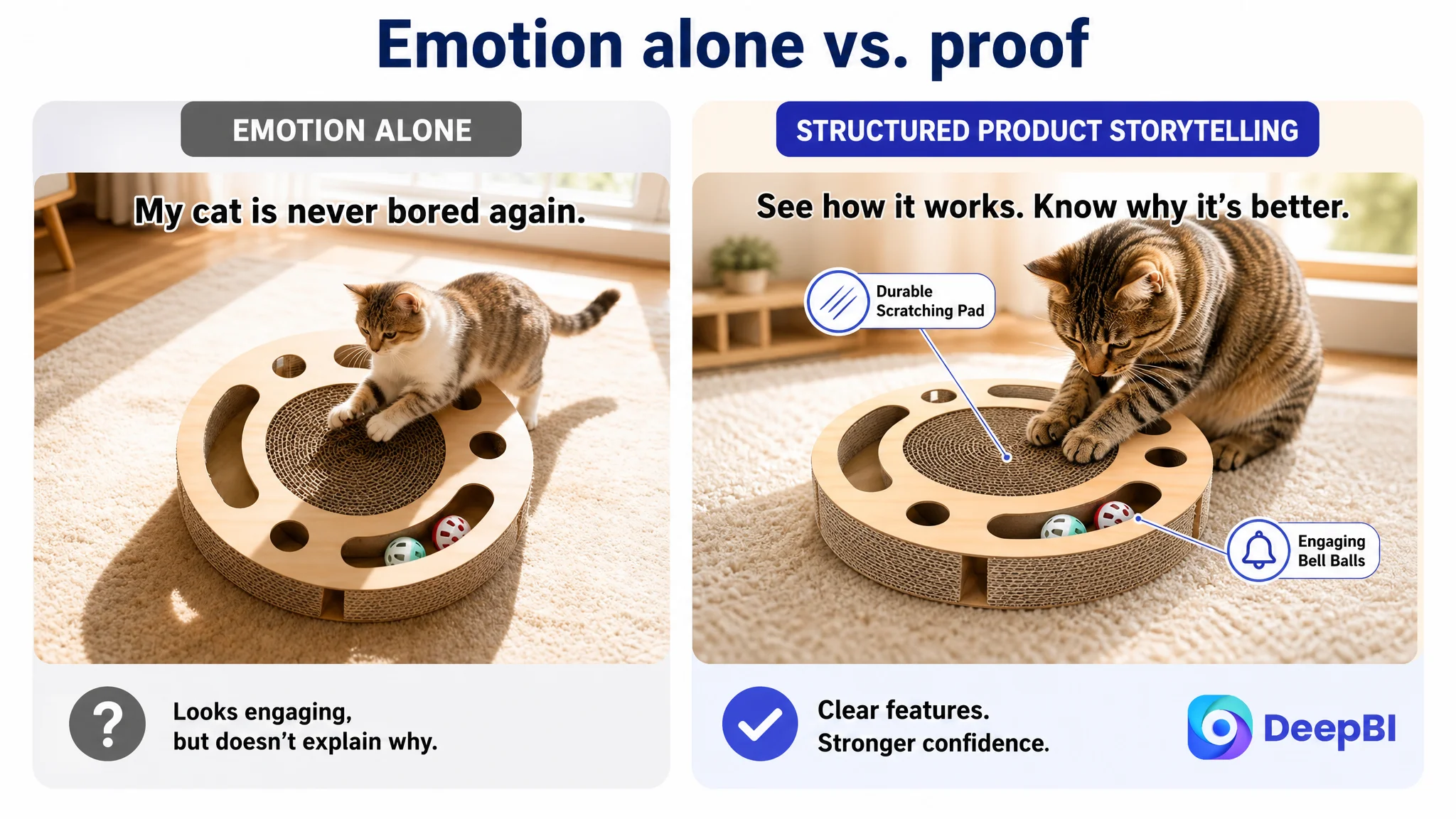
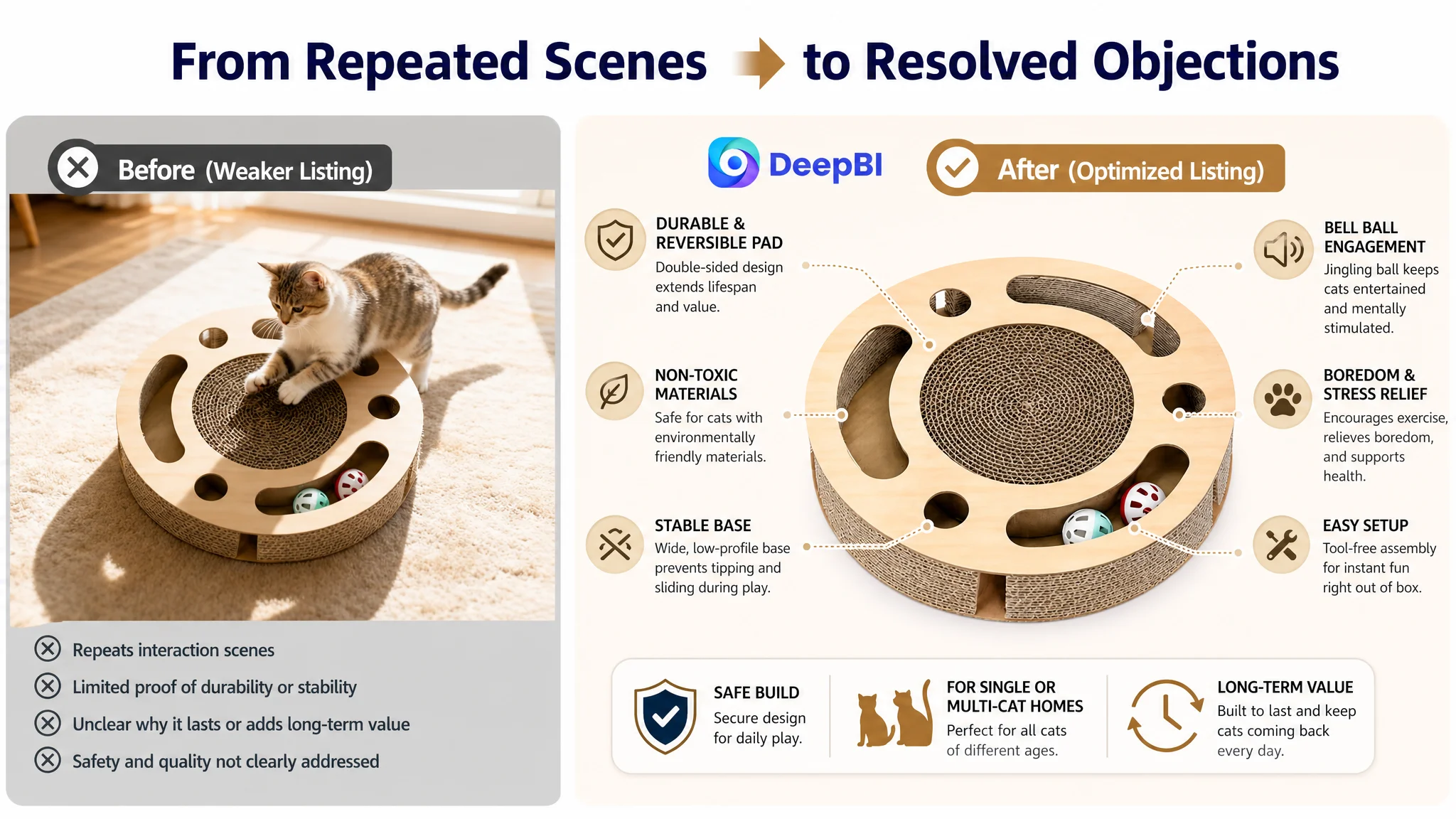
The customer’s Listing showed many of the right components, but the sequence was weaker. Several images repeated cat-interaction scenes without adding a new reason to believe. The A+ content described the product and its benefits, but did not fully explain why the combination of scratching and ball-track play created more value than either function alone.
That distinction matters on Amazon.
A product page does not convert because it contains enough information. It converts when each section answers the next question in the buyer’s decision process.
The First Signal Was Not a Single Bad Image
DeepBI’s score comparison made the gap visible across five Listing dimensions:
- Title: Customer Listing: 14/20, Comparable competitor: 16/20, Difference: -2
- Main image and image set: Customer Listing: 24/30, Comparable competitor: 26/30, Difference: -2
- Bullet points: Customer Listing: 7/10, Comparable competitor: 8/10, Difference: -1
- Detail page and A+ content: Customer Listing: 19/25, Comparable competitor: 23/25, Difference: -4
- Reviews: Customer Listing: 5/15, Comparable competitor: 14/15, Difference: -9
- Total: Customer Listing: 69/100, Comparable competitor: 87/100, Difference: -18
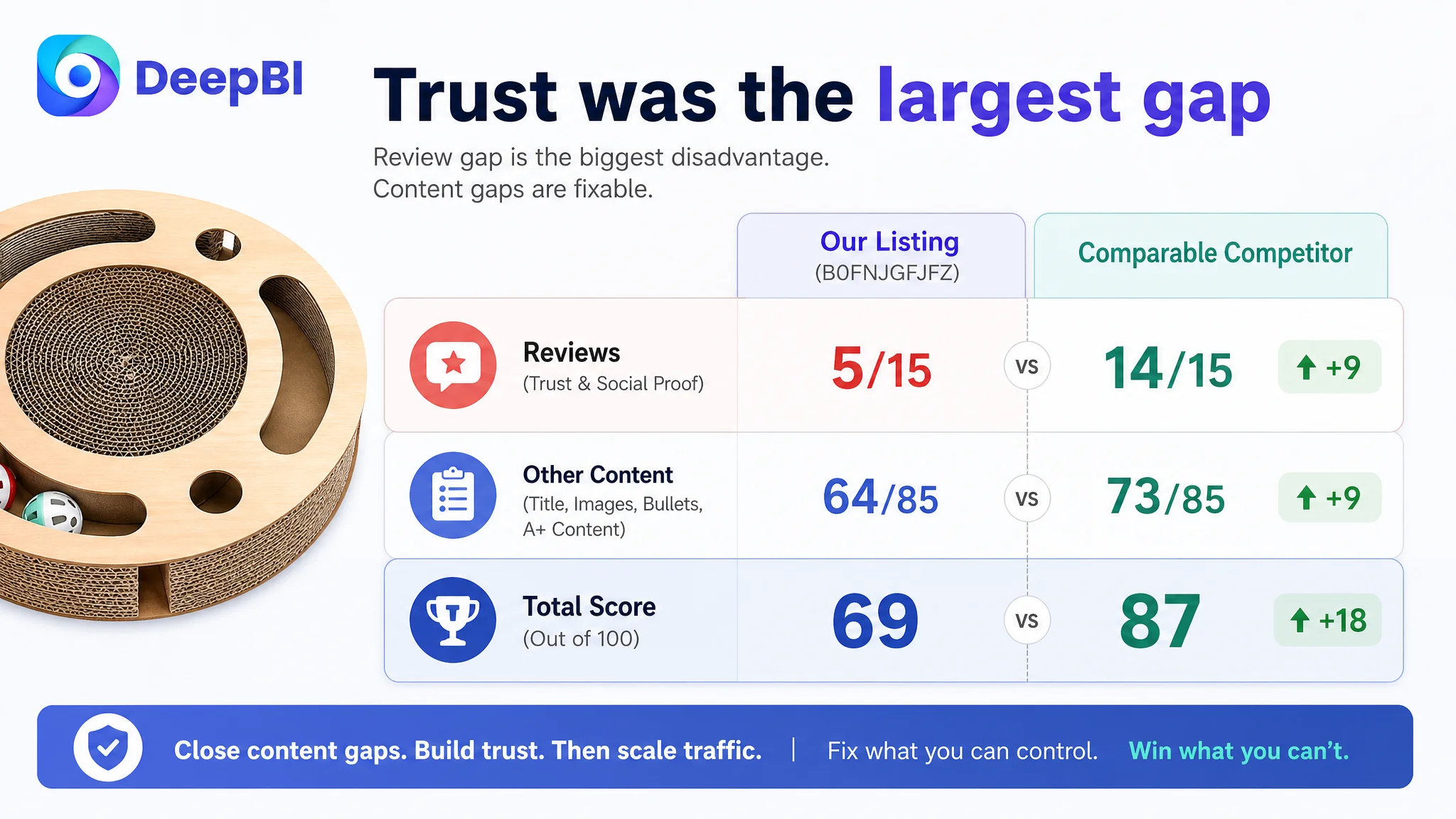
The review gap was the largest numerical disadvantage. The Listing had a 3.6-star rating with 34 total reviews, while the comparable competitor had a 4.6-star rating and a much larger review base.
That gap could not be repaired through copywriting alone.
However, the score also showed that the page had meaningful weaknesses within the areas the customer could control: content structure, image sequencing, differentiation, and trust-building. The question was not whether the Listing had weaknesses. The question was which weakness should be addressed first.
The Original Direction Focused on Assets, Not Decision Order
The customer’s page already included product images, lifestyle scenes, material descriptions, health-related benefits, and problem-solution comparisons. This created a familiar Amazon optimization trap.
When a Listing contains visible assets, teams often assume that the next step is to make each asset more polished:
- Add more lifestyle scenes
- Improve the visual background
- Repeat the product benefits more clearly
- Add more dimensions and specifications
- Rewrite the title around additional keywords
These actions can produce activity without resolving the conversion bottleneck.
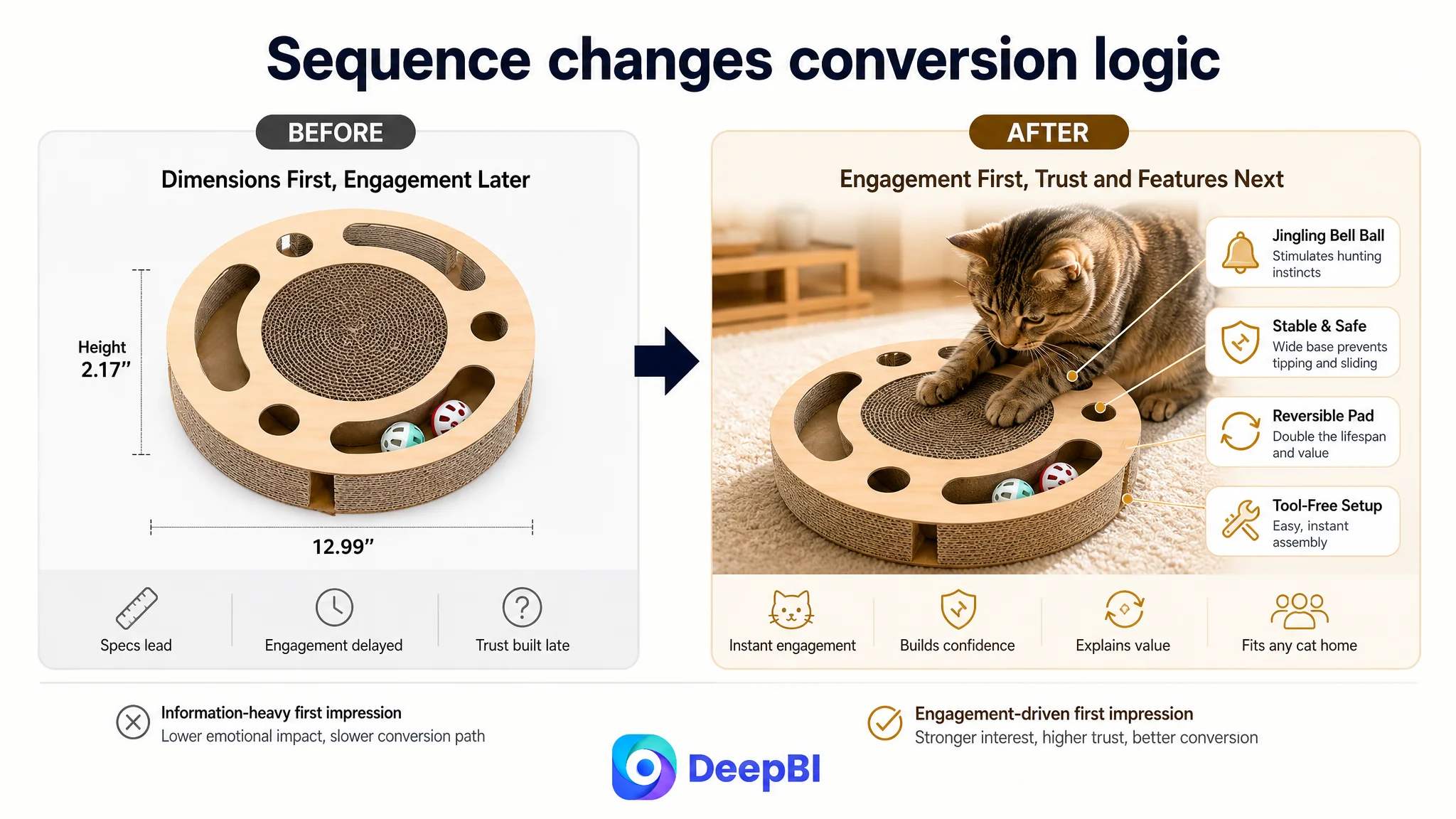
In this case, the image set gave considerable space to cat interaction. Yet the image order introduced dimensions and functional details before fully establishing desire and engagement. Later images repeated similar interaction information instead of resolving new concerns such as durability, stability, or long-term value.
The A+ content had a related problem. It introduced the two-in-one idea, but several modules repeated the same concept without deepening the explanation. It showed the product as a scratching pad plus toy, but did not sufficiently explain how those functions worked together to address boredom, furniture scratching, exercise, and mental stimulation.
This is where the original diagnosis was incomplete.
The page did not simply need “better images.” It needed a better decision path.
“The problem was not the absence of content. It was the absence of progression.”
DeepBI Found the Real Constraint: Listing Conversion Capacity
The 18-point gap was not evenly distributed. Reviews created a serious trust disadvantage, but the content dimensions showed that the page was also underperforming in how it translated product features into purchase reasons.
The real constraint was the Listing’s conversion capacity: its ability to turn a shopper’s first impression into confidence that the product would solve a relevant problem in a suitable household.
For this cat toy, that meant answering several practical questions:
- Will my cat actually engage with it?
- Does the scratching pad provide value beyond a basic toy?
- Will the product stay stable during energetic play?
- Will it remain useful after the initial novelty fades?
- Is it easy to assemble?
- Is it suitable for one cat or multiple cats?
- Does it help with boredom and indoor activity?
- Why should I choose this two-in-one design over a simpler alternative?
The competitor answered these questions through a coordinated system of language and visuals. The customer’s Listing addressed some of them, but not in a clear enough order.
DeepBI therefore did not treat the title, images, bullets, and A+ content as separate creative tasks. It treated them as connected stages in the same Amazon product-page argument.
Why More Ad Tuning Would Not Have Solved the Page
Advertising can increase exposure, but it cannot automatically create trust that the Listing has failed to establish.
If a shopper arrives through an Amazon ad and sees a page with unclear differentiation, repeated images, limited social proof, and incomplete use-case reassurance, additional traffic may only expose more shoppers to the same conversion friction.
That is the central operating risk:
Advertising does not only amplify a product’s strengths. It can also amplify the page’s existing weaknesses.
For this reason, the priority was not to keep expanding the advertising problem before clarifying the product-page problem. The page needed to become more capable of converting both paid and organic traffic before additional traffic could be evaluated fairly.
This did not mean that advertising was irrelevant. It meant that Amazon ads should not be used as the first answer to a Listing-level persuasion gap.
The Title Needed to Define the Product Faster
The original title included important terms such as “Scratching Pad Ball Track Cat Toy,” but its structure was relatively loose. The brand name occupied early space, while the product’s two-in-one value and bell-ball interaction were not expressed with enough clarity.
A stronger title direction was:
YUNIQUE Round Cat Scratching Pad with Bell Ball Track, 2-in-1 Interactive Busy Box Scratcher Toy for Indoor Cats, Exercise and Play Center with Jingling Bell Ball
The point was not to imitate the competitor’s wording. It was to make the customer’s own product easier to understand and easier to distinguish.
The revised logic placed the core product form immediately after the brand, then clarified:
- The scratching-pad and ball-track combination
- The two-in-one structure
- The indoor-cat use case
- The exercise and play value
- The bell-ball interaction
This supports both search relevance and shopper comprehension. The title should not merely collect keywords. It should allow a shopper to identify the product’s role within seconds.
The Image Set Needed to Move From Attraction to Proof
The existing image set leaned heavily on emotional interaction scenes. Those scenes were useful, but they did not create enough progression.
The recommended sequence followed a more deliberate path.
Start with product recognition
The first image should remain the clean product anchor. Shoppers need to recognize the product form immediately.
The product should be understood as a round scratching pad and ball-track toy, not as an indistinct pet accessory.
Build engagement before introducing specifications
The image showing cat interaction should move earlier in the sequence. Its role is to answer the shopper’s first emotional question:
Will this create meaningful play?
The scene should retain the real product and cat interaction while using concise visual callouts to reinforce the bell ball, scratching surface, and natural play behavior.
Use functional proof after interest is established
Dimensions and structural details are important, but they should follow the engagement proof rather than interrupt it.
The next image can then introduce the durable scratching pad and stable base, connecting specifications to actual use instead of presenting them as isolated facts.
Introduce long-term value
The product’s reversible scratching pad was an underused differentiator. It could support a stronger value argument by showing extended use and reduced replacement pressure.
This was particularly important because the competitor used an expandable product-system narrative. The customer did not necessarily need to copy that system. It needed to show why its own product could remain useful over time.
Close unresolved trust questions
The later image should address stability and safety concerns with visible evidence of the wide base, non-toxic materials, and resistance to tipping or sliding during energetic play.
The final image should not repeat another general interaction scene. It should help the shopper make the last rational judgment.
The Bullet Points Had Features, but Not Enough Consequences
The customer’s bullet points described the product accurately, but they often stayed at the level of function. The revised direction connected each feature to a specific buyer concern.
From bell ball to sustained engagement
Instead of merely naming the bell ball, the first bullet should explain how the circular track and sound encourage batting, swatting, and independent play.
From two functions to one household problem
The second bullet should position the scratching pad and track as a combined activity center. This connects natural scratching behavior with furniture protection and solo play.
From “stable” to a visible use condition
The stability bullet should explain how the wide base and construction help prevent tipping or sliding during energetic sessions.
From assembly to reduced effort risk
The reversible scratching pad and tool-free setup should be presented together, showing both extended use and ease of adoption.
From general pet benefit to clear household fit
The final bullet should define the intended context: indoor cats, physical activity, mental stimulation, and both single- and multi-cat homes.
This follows a simple but important Amazon copy principle:
A feature becomes persuasive when the shopper understands what problem it removes.
A+ Content Needed to Explain the System Behind the Product
The largest controllable content gap appeared in the detail page and A+ content, where the customer scored 19 out of 25 compared with the competitor’s 23.
The competitor used a more structured narrative built around a play system, product extensions, and a memorable brand personality. The customer’s A+ content remained closer to a single-product explanation.
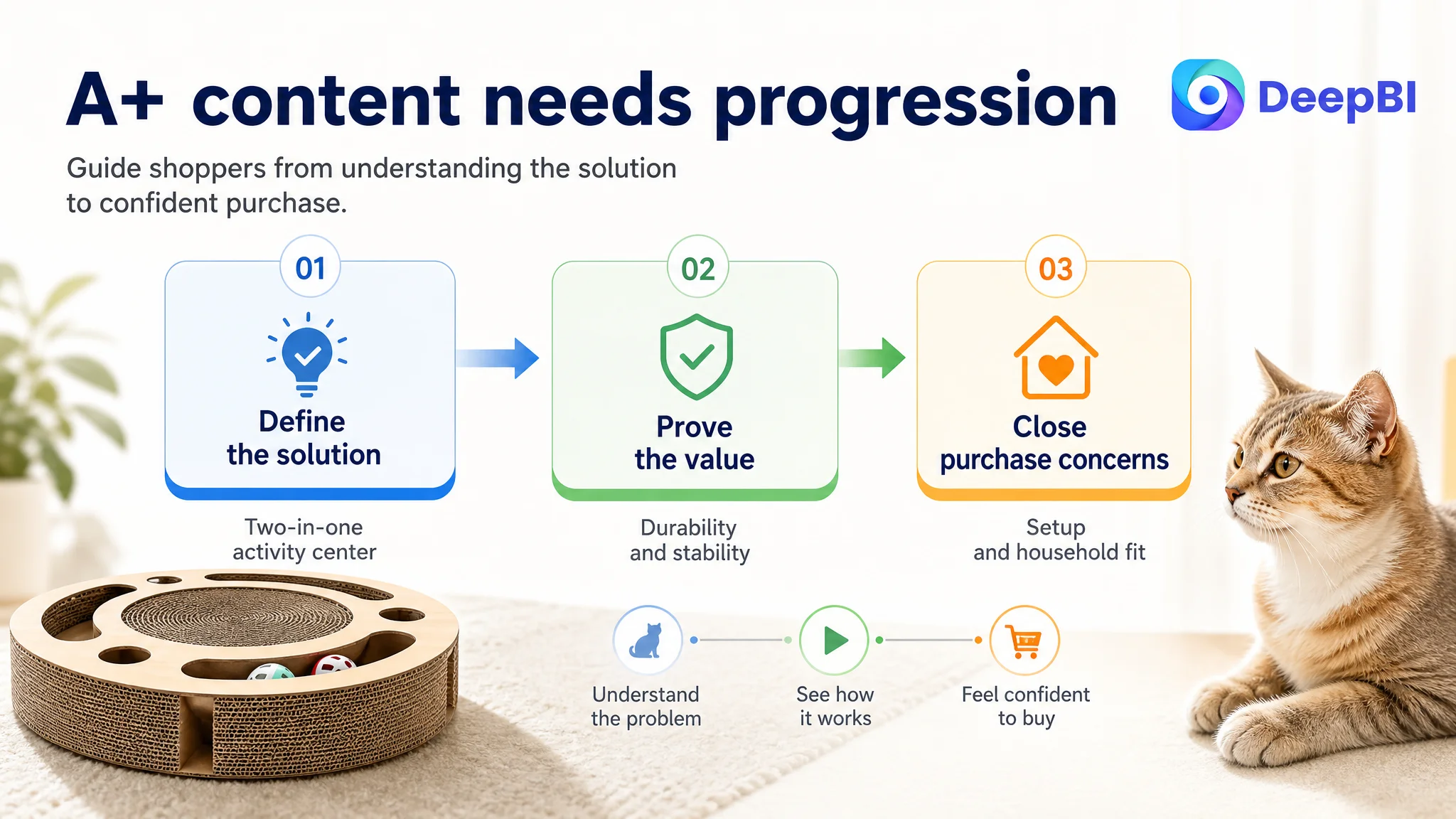
The recommended change was not to add decorative modules. It was to rebuild the logic of the page.
Define the solution immediately
The opening module should present the product as a two-in-one activity center for indoor cats. It should connect boredom and furniture scratching directly to the product’s combined scratching and play functions.
Explain how the two functions work together
A two-in-one label is not enough. The content should show how scratching satisfies one natural behavior while the circular track and bell ball support active engagement and mental stimulation.
Make long-term value visible
The reversible scratching pad should become a dedicated value point. It helps address the concern that a cat toy may lose usefulness quickly.
Establish minimum rational trust
The page should provide more concrete reassurance around the stable base, non-toxic materials, and resistance to tipping during energetic play.
Connect features to outcomes
The content should link the ball track and bell ball to active play, boredom relief, exercise, and mental stimulation rather than repeating a general “fun” message.
Close the setup objection
A dedicated module should communicate easy, tool-free assembly. This addresses a practical hesitation that was previously under-expressed.
Confirm who the product is for
A final applicability module should clarify that the product is designed for indoor cats and can fit both single- and multi-cat households.
Together, these modules create a stronger route from recognition to confidence.
Reviews Were a Constraint, Not a Copy Problem
The review score of 5 out of 15 required separate treatment.
The customer’s 3.6-star rating, limited review count, and visible low-star reviews created a trust deficit that better wording could not erase. The competitor’s larger review base and higher rating gave it a major advantage before shoppers even reached the A+ section.
That did not make Listing optimization pointless. It changed the role of the content.
The page could not pretend to have stronger social proof than it did. It needed to reduce avoidable uncertainty through clarity:
- Make the product’s value easier to understand
- Show how it is used
- Explain stability and setup
- Clarify the target household
- Demonstrate the reversible pad and two-in-one structure
- Avoid claims that could create expectations the product cannot meet
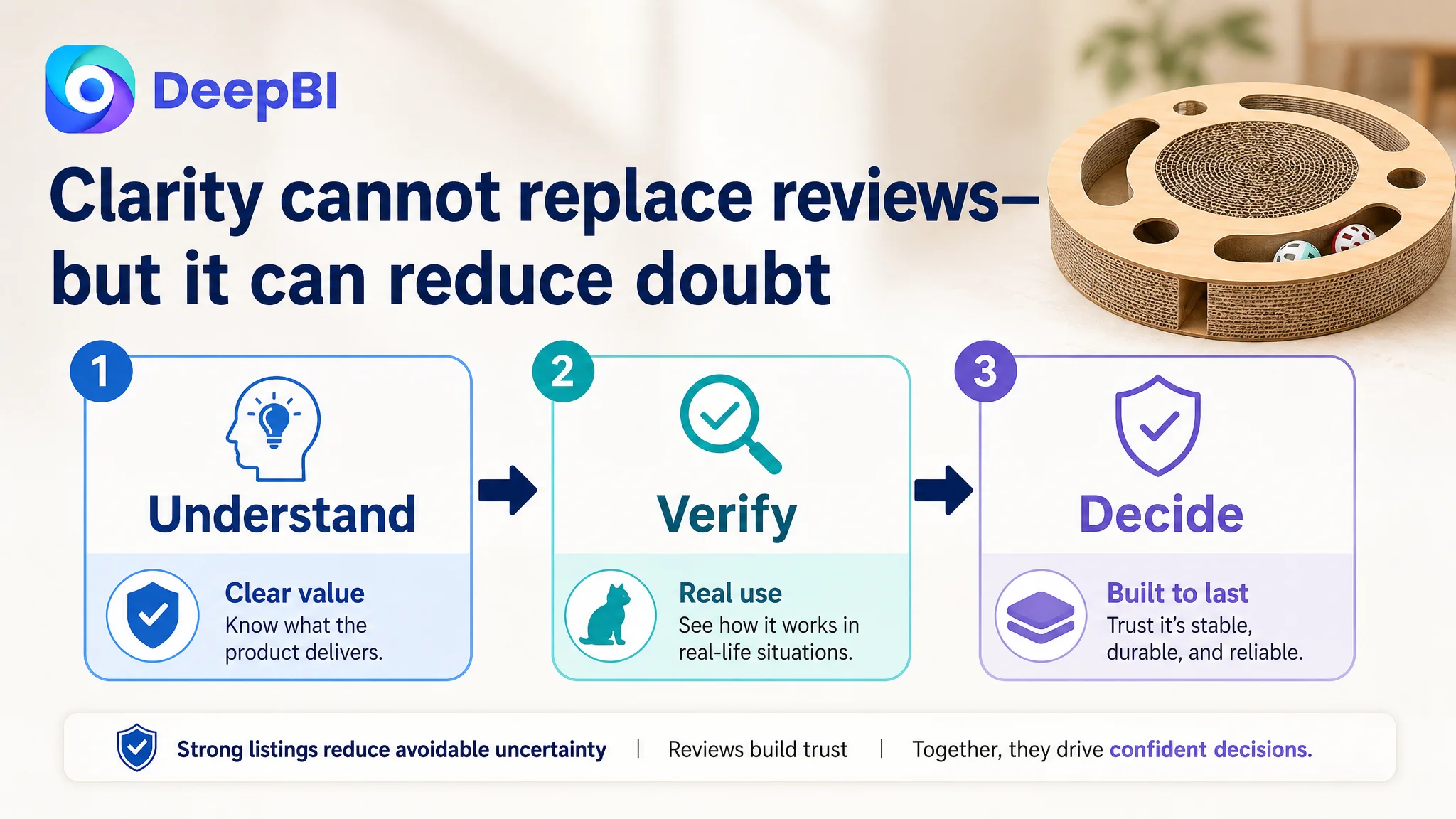
The goal was not to conceal the review gap. It was to ensure that every controllable part of the Listing was doing its job while the seller addressed product and customer-experience issues separately.
The Optimization Direction Changed From “Make It Better” to “Make It Decidable”
This case did not call for indiscriminate changes across every Listing element.
It called for a change in operating judgment.
The customer’s product page needed to move from:
- A collection of product features
- Repeated cat-interaction scenes
- General benefit language
- A basic two-in-one description
- Limited reassurance about setup and household fit
Toward:
- A clearly defined indoor-cat activity center
- An image sequence with deliberate decision stages
- Bullet points that connect features to problems
- A+ content that explains the product system
- Visible proof of durability, stability, and ease of use
- Stronger confirmation for single- and multi-cat households
This was why DeepBI prioritized Listing conversion logic before treating more traffic as the solution. The diagnosis was based on the relationship between the page’s score gaps, the competitor’s persuasion structure, and the specific objections the customer’s content left unresolved.
What Amazon Sellers Can Take From This Case
The most important lesson is not that one cat-toy Listing needed a better title or more effective images.
It is that Amazon Listing optimization is a decision-order problem.
When a page underperforms, sellers may immediately look at bids, keywords, or campaign structure. Those areas matter, but they should not automatically receive priority. The first question is whether the product page can convert the traffic already being sent to it.
In this case, the critical constraint was not simply visibility. It was the Listing’s ability to explain, persuade, and reassure.
A stronger Amazon operating sequence is:
1. Identify the largest competitive gap.
2. Separate uncontrollable constraints, such as review history, from controllable content problems.
3. Judge whether the title, image set, bullets, and A+ content form one coherent sales argument.
4. Repair the page’s conversion logic.
5. Then evaluate whether advertising traffic is being converted efficiently.
The customer did not need more isolated optimization activity. It needed a clearer diagnosis of why the page was losing confidence at different stages of the buyer journey.
That is the difference between changing an Amazon Listing and understanding what the Listing is preventing the business from achieving.