

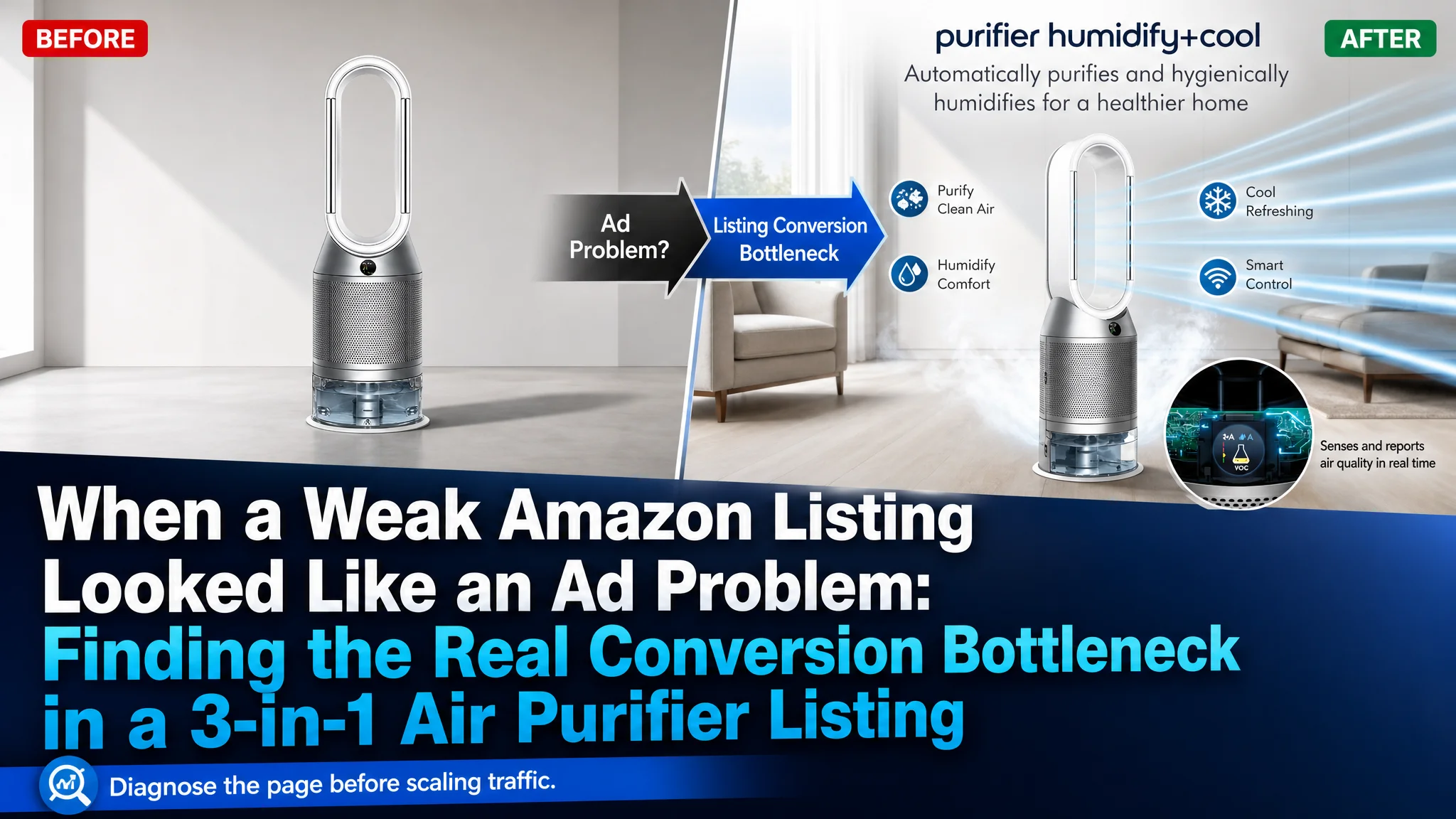
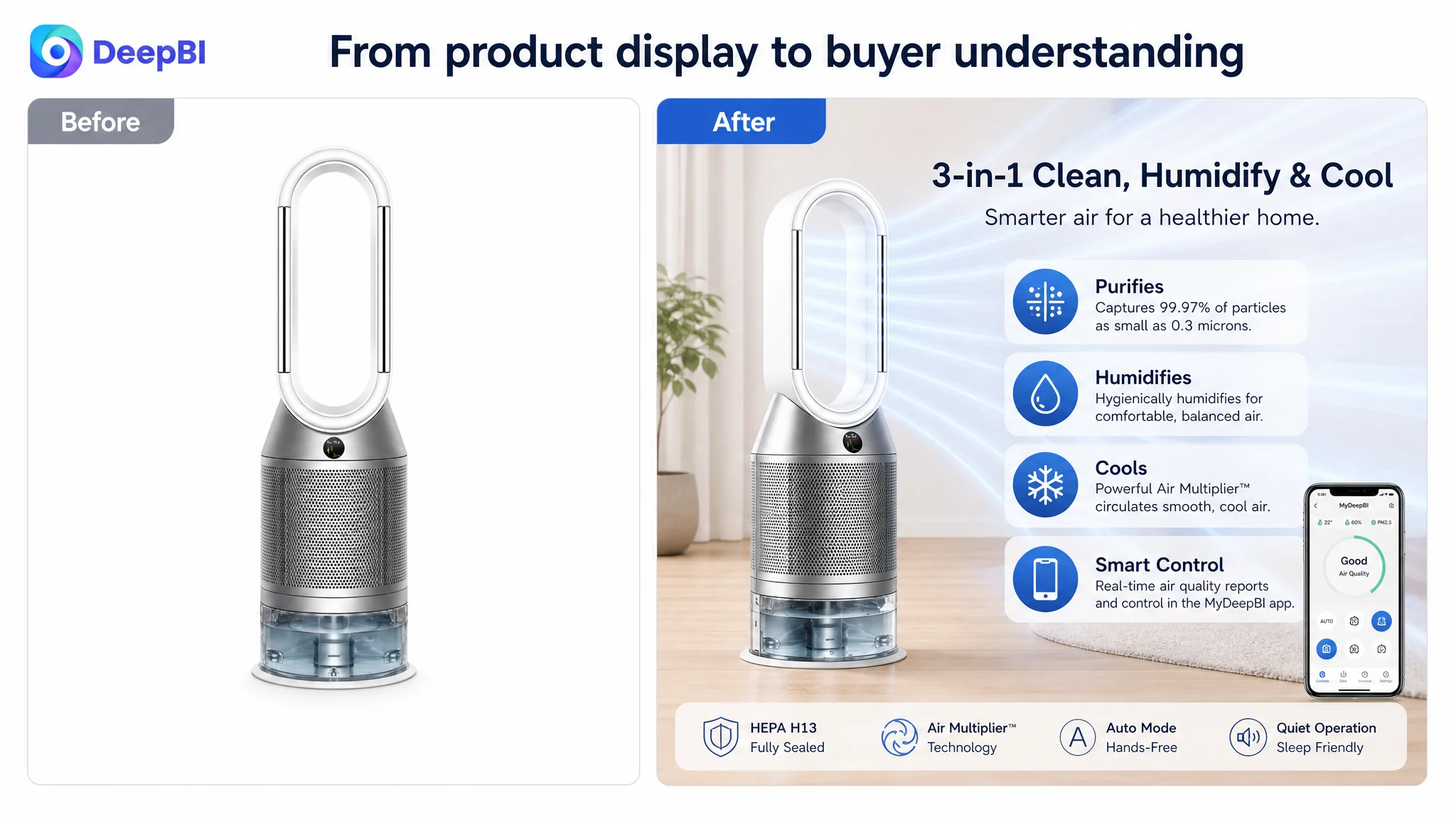
An Amazon seller in the US marketplace was facing a familiar pressure point: the product had substantial technical content, but its Amazon Listing was not creating enough search visibility or purchase confidence. The team initially leaned toward improving the creative presentation and continuing to refine the advertising direction, assuming the main issue was that the product's features were not being shown strongly enough.
DeepBI's comparison showed a more fundamental problem. The Listing scored 67 out of 100, compared with 87 for a closely matched high-performing competitor. The largest gaps were not in the depth of the A+ content, but in the title, review credibility, and the way the main image and bullet points converted technical specifications into clear buyer value.
The later optimization therefore focused on rebuilding the Listing's conversion foundation: placing high-value Amazon search terms in the title, making the product's 3-in-1 value easier to understand, bringing verified performance claims and use cases forward, and strengthening the trust path around air purification, hygienic humidification, smart control, and quiet operation.
For other Amazon sellers, the lesson is commercially important: when advertising becomes harder to control, the answer is not always more campaign adjustments. Before sending more paid traffic to a product page, sellers need to determine whether the Amazon Listing can earn the click, explain the value, and overcome the buyer's final hesitation.
The Listing Had Technical Depth, but the Sales Path Was Weak
The product was a premium appliance combining air purification, humidification, and cooling. That created a potentially strong positioning advantage, but it also created a communication challenge.
A product with several functions must help shoppers understand three things quickly:
- What problem it solves
- Why its technology is credible
- Why the combined solution is worth considering over a simpler alternative
The customer's Amazon product page contained substantial technical information. Its A+ content included product cutaways, sensor explanations, airflow visualizations, app interactions, maintenance guidance, and lifestyle scenes.
On paper, the page was not empty. It was not missing effort.
The problem was that the strongest information was not arranged in the order shoppers needed to make a decision.
The Listing did not primarily suffer from a lack of information. It suffered from a weak conversion sequence.
The product page introduced technology before fully establishing the product's core outcome. It explained how the appliance worked, but did not always make the buyer's reason for choosing it immediately obvious.
That distinction mattered because Amazon traffic does not arrive in a neutral state. Shoppers compare several listings within seconds. The title, main image, rating, review volume, and first few bullets determine whether the page deserves deeper attention.
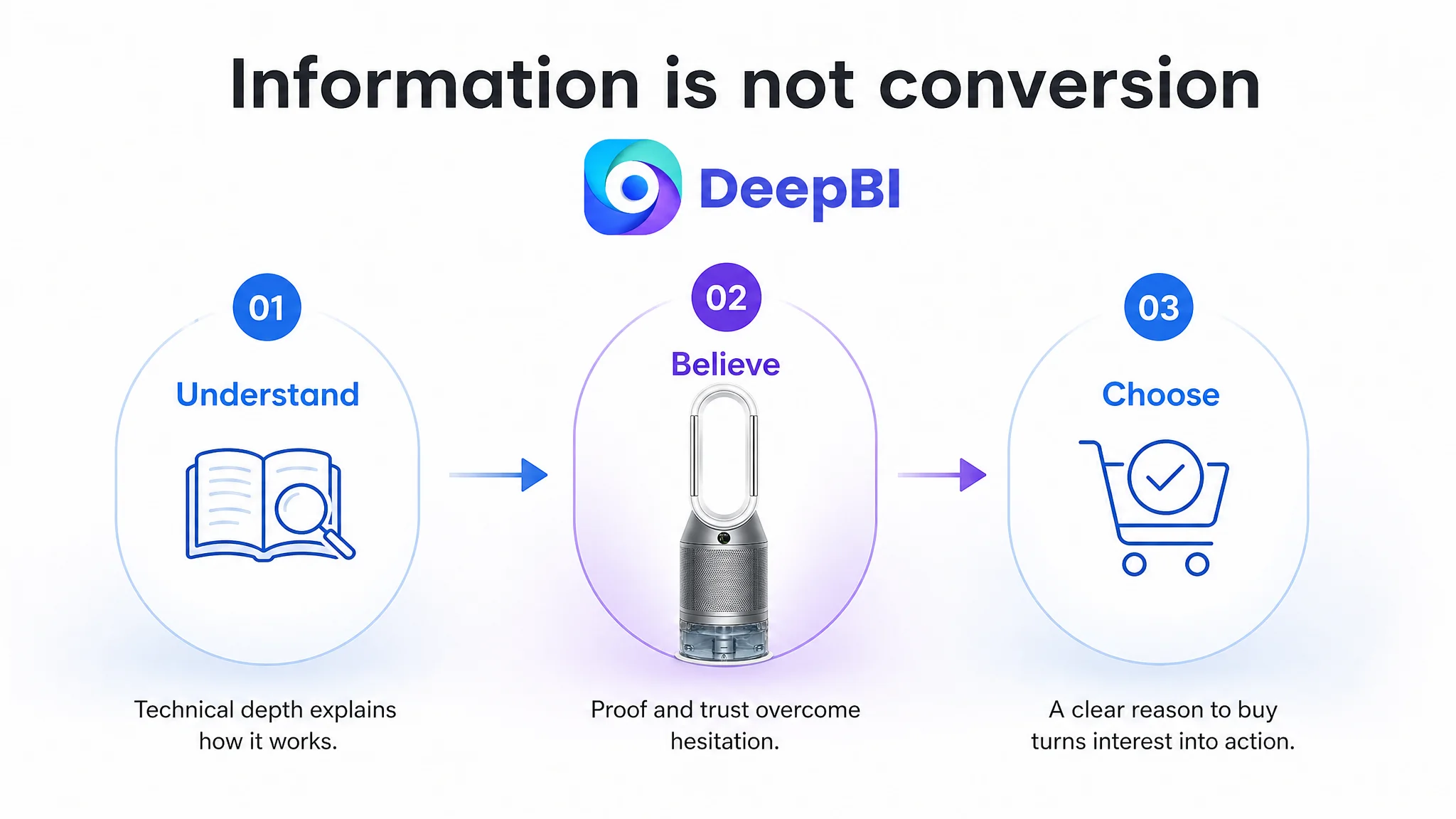
The Initial Instinct Was to Improve the Presentation
The first optimization instinct was understandable: make the product look more compelling.
The appliance had distinctive functions, advanced internal mechanisms, smart controls, airflow modes, and maintenance features. It seemed logical to emphasize more of these advantages through imagery and technical explanation.
That direction could produce better-looking assets, but it did not answer the more important commercial question:
Which weakness was actually limiting the Listing's ability to convert Amazon traffic?
When a page contains impressive technology, teams can easily mistake information density for persuasion. They may continue adding diagrams, feature descriptions, and functional demonstrations while overlooking the elements that establish basic buyer confidence.
In this case, the comparison data revealed that the Listing was not simply losing because it lacked sophisticated content. It was losing because the most important trust and discovery signals were underdeveloped.
The score gap made the misdiagnosis visible
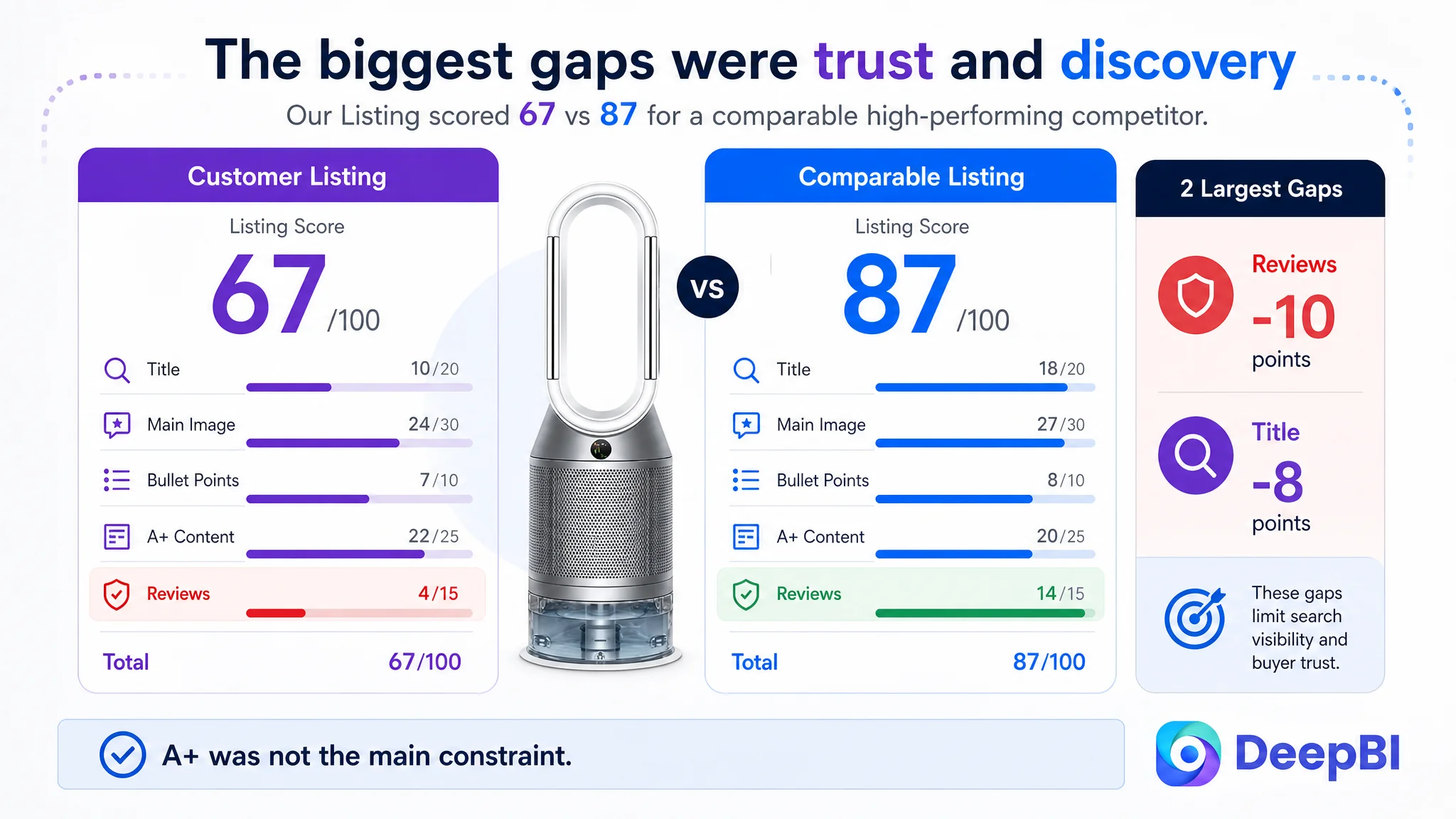
- Title: Customer Listing: 10/20, Comparable high-performing Listing: 18/20, Gap: -8
- Main image: Customer Listing: 24/30, Comparable high-performing Listing: 27/30, Gap: -3
- Bullet points: Customer Listing: 7/10, Comparable high-performing Listing: 8/10, Gap: -1
- A+ content: Customer Listing: 22/25, Comparable high-performing Listing: 20/25, Gap: +2
- Reviews: Customer Listing: 4/15, Comparable high-performing Listing: 14/15, Gap: -10
- Total: Customer Listing: 67/100, Comparable high-performing Listing: 87/100, Gap: -20
The result changed the order of priorities.
The A+ content was already stronger than the comparison listing in several areas. Continuing to add technical detail there would not address the largest business constraint. The more urgent issue was the Listing's ability to win attention and trust before the shopper reached the deeper content.
Amazon Ads Were Not the Only Suspect
High advertising pressure often leads sellers to investigate bids, keywords, campaign structure, and placement strategy first. Those areas matter, but they cannot compensate for a product page that fails to convert the traffic it receives.
In this case, the Listing had several weaknesses that could make paid traffic less productive:
- The title contained mainly the brand and model information.
- Core search terms such as air purifier and humidifier were missing or underused.
- The main value proposition was not clear at the first scan.
- The main image sequence did not lead with the strongest buyer concerns.
- The bullet points described several functions but lacked a clear pain-point-to-solution progression.
- The review profile created a major trust barrier.
These issues affect different stages of the Amazon funnel, but they point to one central constraint:
The Listing lacked sufficient conversion capacity for the traffic it was expected to handle.
That is why continuing to tune ads first would have been risky. More traffic could simply amplify the same weak outcomes. If shoppers arrive through paid search but do not immediately understand the product, trust its performance, or see credible proof from other buyers, advertising spend becomes a multiplier for page-level friction.
Advertising does not only amplify strengths. It can also amplify defects in the product page.
The Biggest Gap Was Trust, Not Technical Capability
The review dimension was the most severe weakness.
The customer Listing had a 3.1-star rating from 50 reviews. The comparison listing had a 4.4-star rating from 3,477 reviews. The customer Listing also showed a high proportion of negative feedback, while the comparison listing had a much lower negative-review share and substantially stronger review content.
This was not a cosmetic difference.
For a higher-priced home appliance that combines purification, humidification, and cooling, shoppers are evaluating more than appearance. They are asking:
- Does the purifier work as claimed?
- Is the humidification system hygienic?
- Is the appliance difficult to maintain?
- Is it quiet enough for a bedroom or nursery?
- Will the smart functions be practical?
- Is the product worth the premium?
A weak review profile leaves those questions unanswered. Even excellent A+ visuals cannot fully replace real customer validation.
The review gap also changed how other Listing elements needed to work. When review proof is weak, the page must be especially disciplined about presenting objective, verifiable reasons to believe:
- 99.97% particle capture for particles as small as 0.3 microns, where applicable to the confirmed product claim
- Fully sealed HEPA H13 filtration
- Whole-room air circulation
- Up to 36 hours of humidification with the specified water tank
- Quiet airflow modes for different room settings
- Real-time air-quality reporting through the display and app
- Hygienic humidification and maintenance guidance
These claims should not be presented as a pile of specifications. They need to answer the concerns exposed by the category and by customer feedback.
The Title Was Losing Both Search Coverage and Click Intent
The title score was 10 out of 20, eight points behind the comparison Listing.
The customer's original title was too close to a model identifier. It did not give Amazon search systems enough relevant language, and it did not give shoppers a fast explanation of the product's role.
The proposed direction added the terms and contexts that buyers may use when searching:
- Air purifier
- Humidifier
- Large rooms
- HEPA
- Allergies
- Pets
- Smoke and dust
- WiFi-connected
- Quiet
- Auto mode
The purpose was not to imitate the competitor's wording. It was to make the product legible within Amazon's search and comparison environment.
The product's 3-in-1 positioning also needed to appear earlier. A combined purifier, humidifier, and cooling appliance has a meaningful distinction from a single-function air purifier, but that distinction only helps if shoppers understand it before leaving the search results or moving to another listing.
The title needed to connect category, use case, and value
A stronger title structure would establish:
1. The core product category
2. The combined function
3. The intended room or user context
4. The key filtration and smart-control benefits
5. The main problem areas addressed
This is more useful than simply adding more keywords. Amazon title optimization is not a word-count exercise. It is a way to connect search intent with buyer understanding.
The Main Image Sequence Was Not Following Buyer Priorities
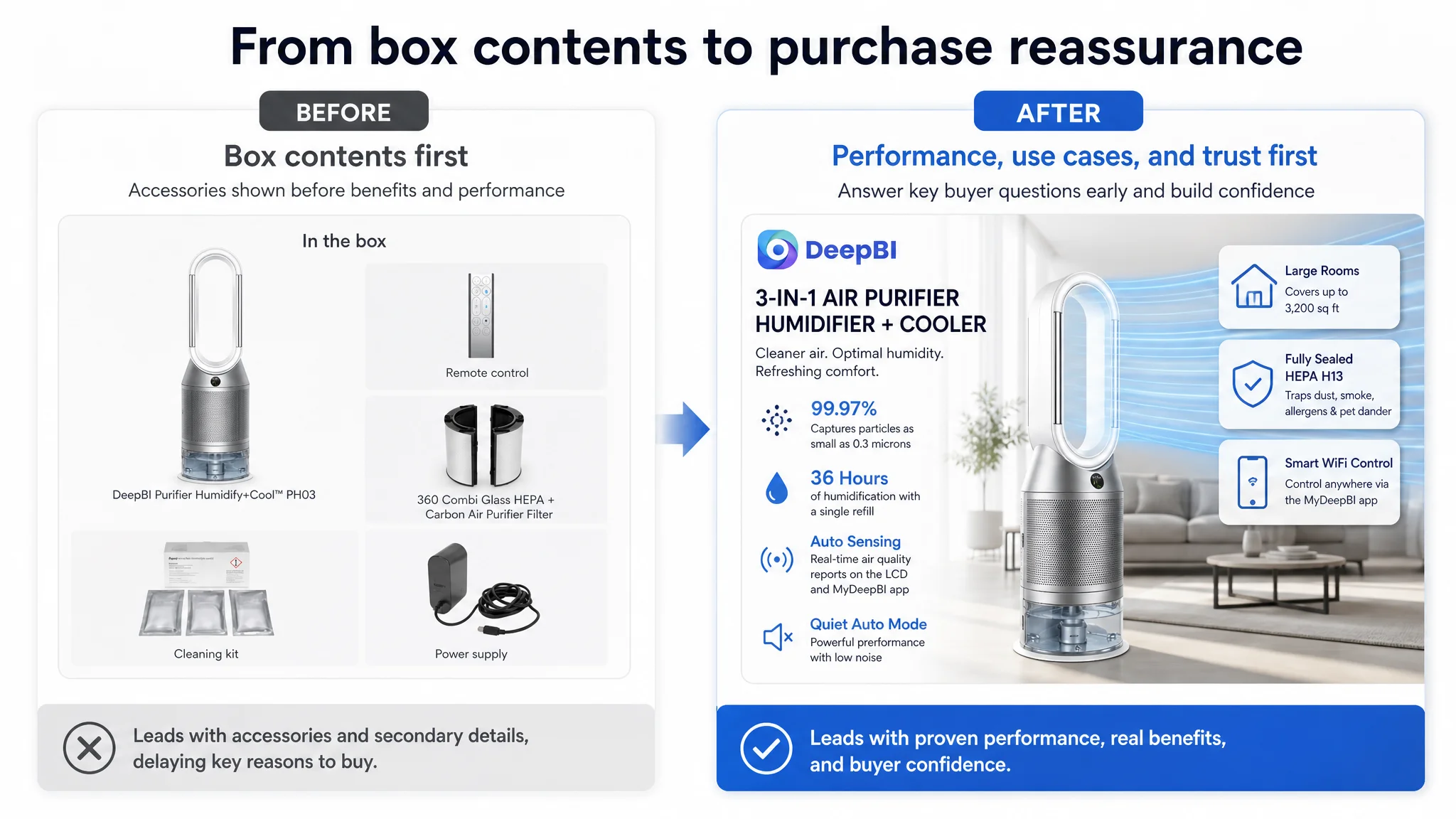
The main-image score was closer to the comparison Listing, but the difference in sequence was commercially meaningful.
The customer's image set contained product views, technical visualizations, sensor information, app interaction, airflow explanations, and box contents. However, several early images were not answering the most urgent questions in the buyer's decision path.
The first image emphasized the product form and visible water tank. It did not immediately signal the 3-in-1 proposition or smart control.
The fourth image focused on what was included in the box. That information may be accurate, but it is a low-priority reassurance compared with performance, pollution removal, room coverage, or hygienic humidification.
The fifth image summarized features but repeated information already introduced instead of resolving a final concern.
DeepBI's judgment was to reorder the narrative around buyer priorities rather than production convenience.
The first visual should establish the product's role
The opening image sequence should make the product understandable at a glance:
- A smart appliance that purifies, humidifies, and cools
- A solution for whole-room comfort
- A product intended for concerns such as allergens, pets, smoke, and dust
The key is not to add unsupported claims or non-existent visual elements. The product must remain physically accurate. The change should come from hierarchy, composition, and the order in which confirmed benefits are presented.
The next image should prove capability
After initial interest, shoppers need evidence that the appliance can perform its intended job.
This is where verified filtration, whole-room circulation, and relevant quantitative claims should be presented. Technical language such as Air Multiplier or HEPA H13 becomes more persuasive when connected to a practical outcome.
Technology should appear as proof of a benefit, not as a substitute for explaining the benefit.
Later images should reduce practical risk
The remaining image sequence should address concerns that can block purchase:
- What pollutants the system is designed to capture
- How the water system is maintained
- How long humidification can operate under the stated conditions
- How the product behaves in a bedroom, nursery, office, or living room
- How different airflow modes affect comfort
- How the app and voice controls simplify operation
This creates a more coherent path from attention to confidence.
The Bullet Points Had Features, but Not a Buying Logic
The bullet-point score was only one point behind the comparison Listing, but the structure was weaker.
The customer's bullets covered many functions:
- Purification
- Humidification
- Cooling
- Airflow technology
- Smart sensing
- App control
- Multiple modes
- Maintenance
- Water capacity
The issue was not that these points were irrelevant. The issue was that they were presented more like a technical inventory than a sequence of buying reasons.
The comparison Listing followed a clearer progression:
1. Coverage area and cleaning speed
2. Pollutant removal
3. Smart control
4. Quiet operation
5. Design and daily use
For the customer's product, the revised logic needed to preserve its broader functionality while making the hierarchy easier to follow.
The first bullet should answer the largest use-case question
The first bullet should establish whole-room air management and explain how purification, humidification, and cooling work together.
The second should make filtration concrete
The filtration bullet should connect the sealed HEPA structure with specific concerns such as dust, smoke, pet dander, and allergens, using only confirmed product claims.
The third should explain smart control as convenience
Sensors, LCD reporting, app control, and compatible voice services should be framed around reducing the effort required to manage indoor air quality.
The fourth should connect airflow modes to real rooms
Fan, Breeze, and Backward airflow modes become more useful when linked to bedrooms, nurseries, home offices, and situations where the customer wants purification and humidification without a cooling draft.
The fifth should reduce maintenance anxiety
Water capacity, hygienic humidification, deep-clean cycles, filter replacement, and filter-life notifications should explain why the product can fit into everyday use without constant attention.
This sequence gives the bullets a role in the sales conversation. Each point answers a different objection instead of adding another disconnected feature.
A+ Content Was Not the First Place to Invest More
The A+ content was the strongest scored dimension, reaching 22 out of 25 and exceeding the comparison Listing's score of 20.
That finding was important because it prevented the team from optimizing the most visible content simply because it looked sophisticated.
The customer's A+ content already had several strengths:
- Technical product visualizations
- Internal sensor and airflow explanations
- Lifestyle scenes with different household members
- App interaction
- Filter replacement guidance
- Product maintenance information
The opportunity was not to add more complexity. It was to change the order and purpose of the modules.
Credibility should come before technical depth
The opening A+ module relied heavily on lifestyle presentation. That could create desire, but it did not provide the authoritative validation that a high-priced appliance needs.
A stronger opening should establish credibility through confirmed awards, certifications, or quantitative performance evidence where available. The principle is simple: first give shoppers a reason to believe, then explain how the product works.
Filtration should precede sensing
The existing structure emphasized sensors and real-time reporting early. That explains how the product detects pollution, but shoppers first need to know whether the product can effectively address the pollution.
The sequence should move from:
What problem does it solve?
to:
How does it detect the problem?
and then:
How does it respond?
Purification and humidification should be presented as one distinct system
Air circulation was explained in isolation. The stronger commercial story is the combined experience of purified and hygienically humidified air throughout the room.
That connection gives the product a distinct reason to exist beyond being another purifier with an app.
UV-C and water hygiene deserved earlier placement
The UV-C and hygienic humidification story addressed a specific concern that a pure air purifier does not face: the cleanliness of the humidification system.
Because this is both a differentiator and a risk reducer, it should appear shortly after the combined purification-and-humidification explanation rather than being delayed deep in the page.
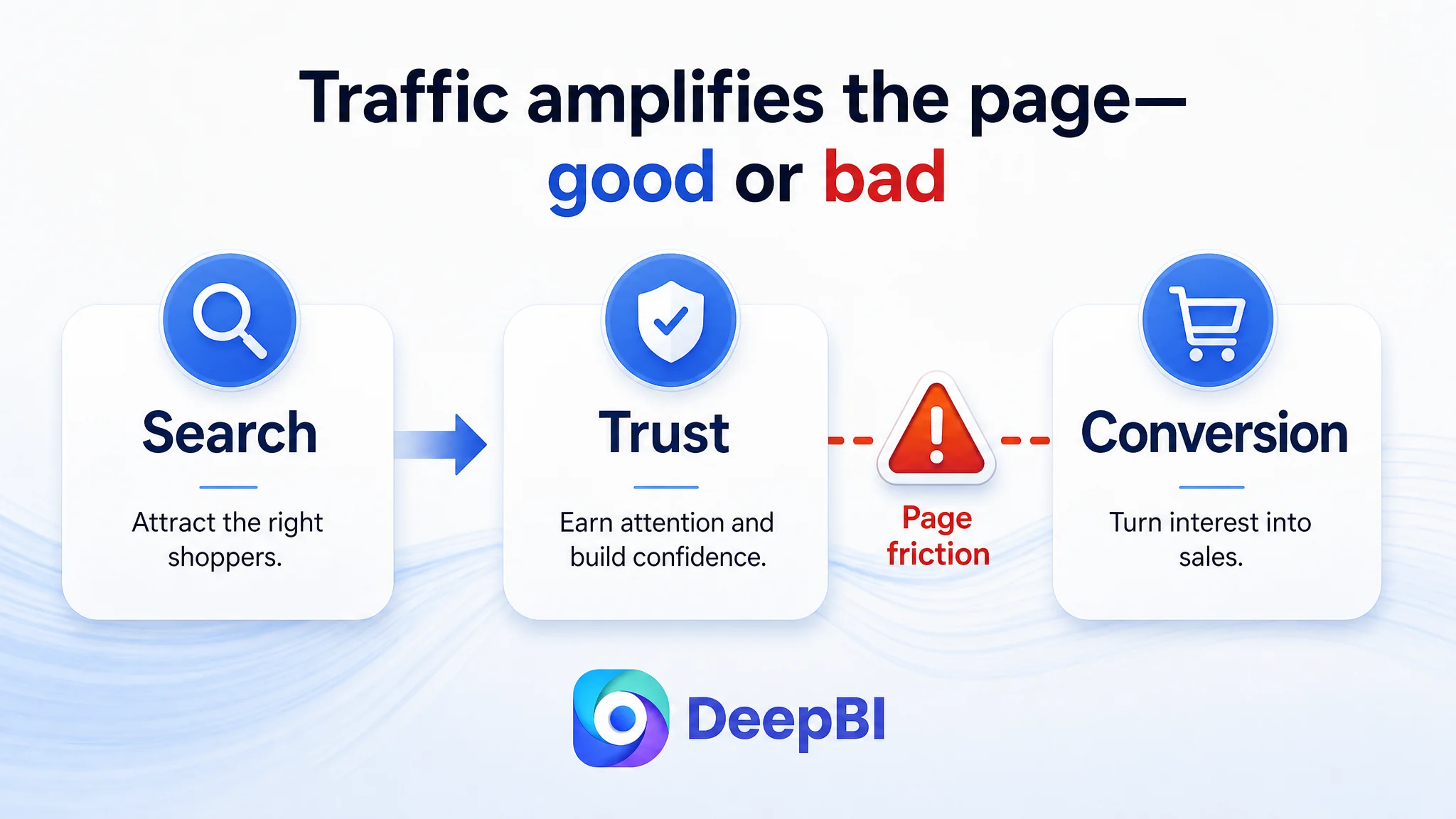
Why DeepBI Stopped the Team from Tuning Ads First
The decision was not to abandon advertising. It was to repair the page before expecting ads to deliver more efficiently.
DeepBI's role in this case was to connect the Listing evidence into a decision order:
- The title was too weak to capture relevant Amazon search intent.
- The main image sequence did not lead with the strongest reasons to stop and evaluate.
- The bullets contained information but did not form a persuasive path.
- The review profile created a significant trust deficit.
- The A+ content was relatively strong, so more technical expansion there was not the first priority.
That evidence supported a clear operating judgment:
Do not scale traffic into a page whose basic discovery and trust signals are still underperforming.
The risk was not merely high ACOS. The deeper risk was spending more to test a page that had not yet earned the opportunity to convert.
This is where a Listing score becomes useful. Its value is not the number by itself. Its value is showing where the business is losing persuasive power and which problem should be addressed first.
The Optimization Direction Became More Controlled
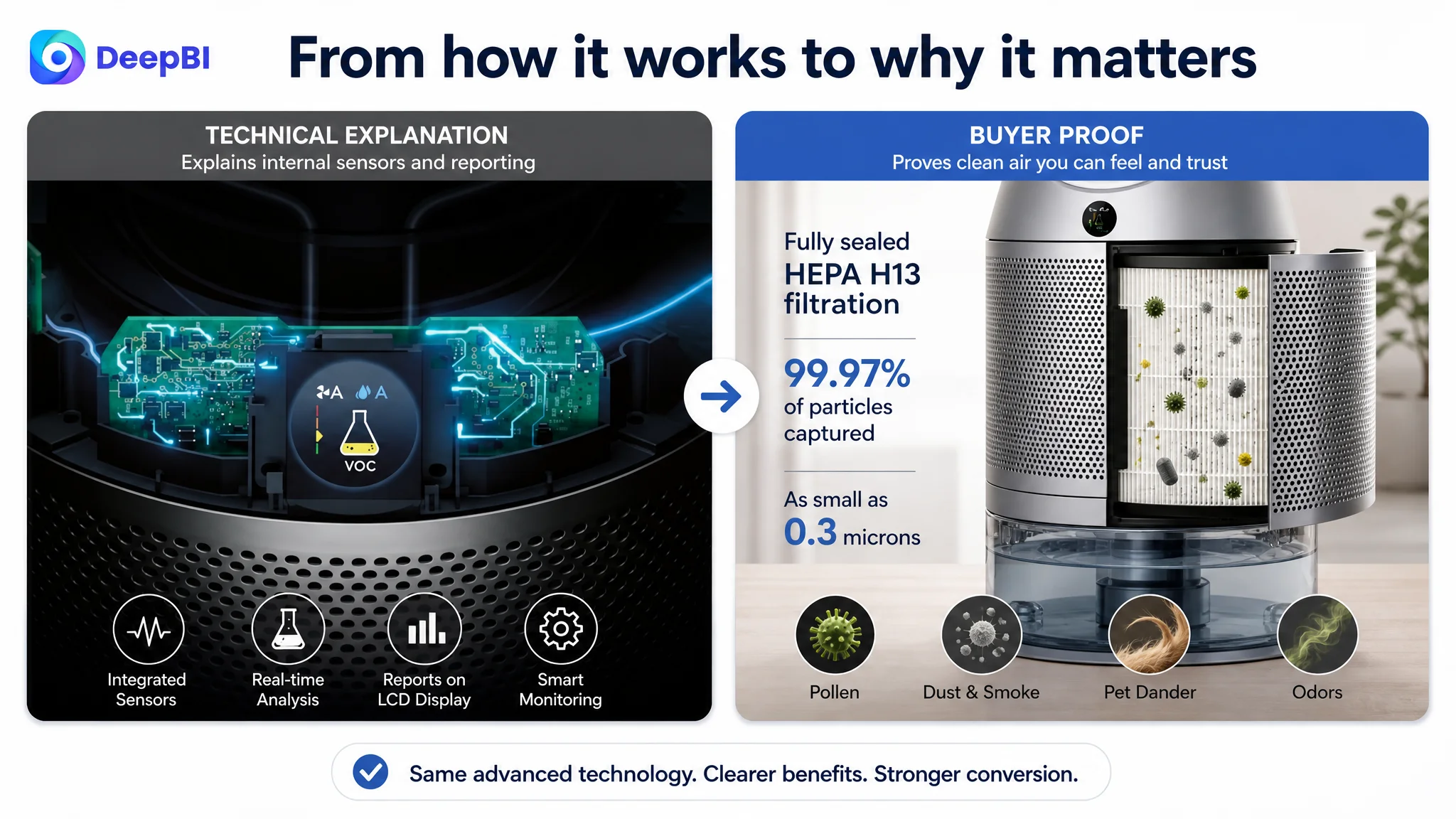
The later direction focused on a coordinated rebuild rather than isolated edits.
The title was repositioned around the product category, 3-in-1 functionality, room context, filtration, smart control, and user concerns.
The main-image sequence was reorganized around:
- Immediate understanding of the product's role
- Whole-room capability
- Pollutant and allergen concerns
- Hygienic humidification
- Quiet, comfortable use
- Practical maintenance
The bullet points were rewritten to move from category-level value to technical proof, smart operation, comfort, and upkeep.
The A+ content was restructured so that credibility, filtration capability, combined purification and humidification, water hygiene, performance evidence, airflow personalization, and app simplicity appeared in a more persuasive order.
Throughout the process, the product itself remained the fixed reference point. Visual improvements could change composition, scene, information hierarchy, and presentation, but not the appliance's physical design or unverified specifications.
That boundary matters for Amazon sellers. A visually impressive image that changes the product, invents a feature, or exaggerates performance may create a short-term impression while producing long-term returns, negative reviews, and trust damage.
The Business Understanding Changed
The case did not establish a simple conclusion such as “better images solve high ACOS.” It produced a more useful operating principle.
The customer began with a product that had meaningful technical advantages and relatively strong A+ depth, yet still carried a 20-point Listing disadvantage. The comparison showed that technical sophistication alone was not enough.
The page needed to:
- Be discoverable through relevant Amazon search language
- Communicate its main value before the shopper studied the details
- Convert features into direct buyer outcomes
- Address the practical risks of humidification and maintenance
- Present objective proof where review strength was limited
- Give paid traffic a page capable of receiving and converting it
No post-optimization performance data was provided for this case, so the result should not be described as a confirmed numerical improvement in CVR, ACOS, or organic orders.
What can be stated clearly is the change in operating logic: optimization moved away from adding more technical content or continuing to tune ads in isolation. It focused first on restoring the Listing's ability to attract the right searcher, explain the product, and build enough confidence to support both paid and organic traffic.
Before More Amazon Traffic, Check Whether the Page Can Convert It
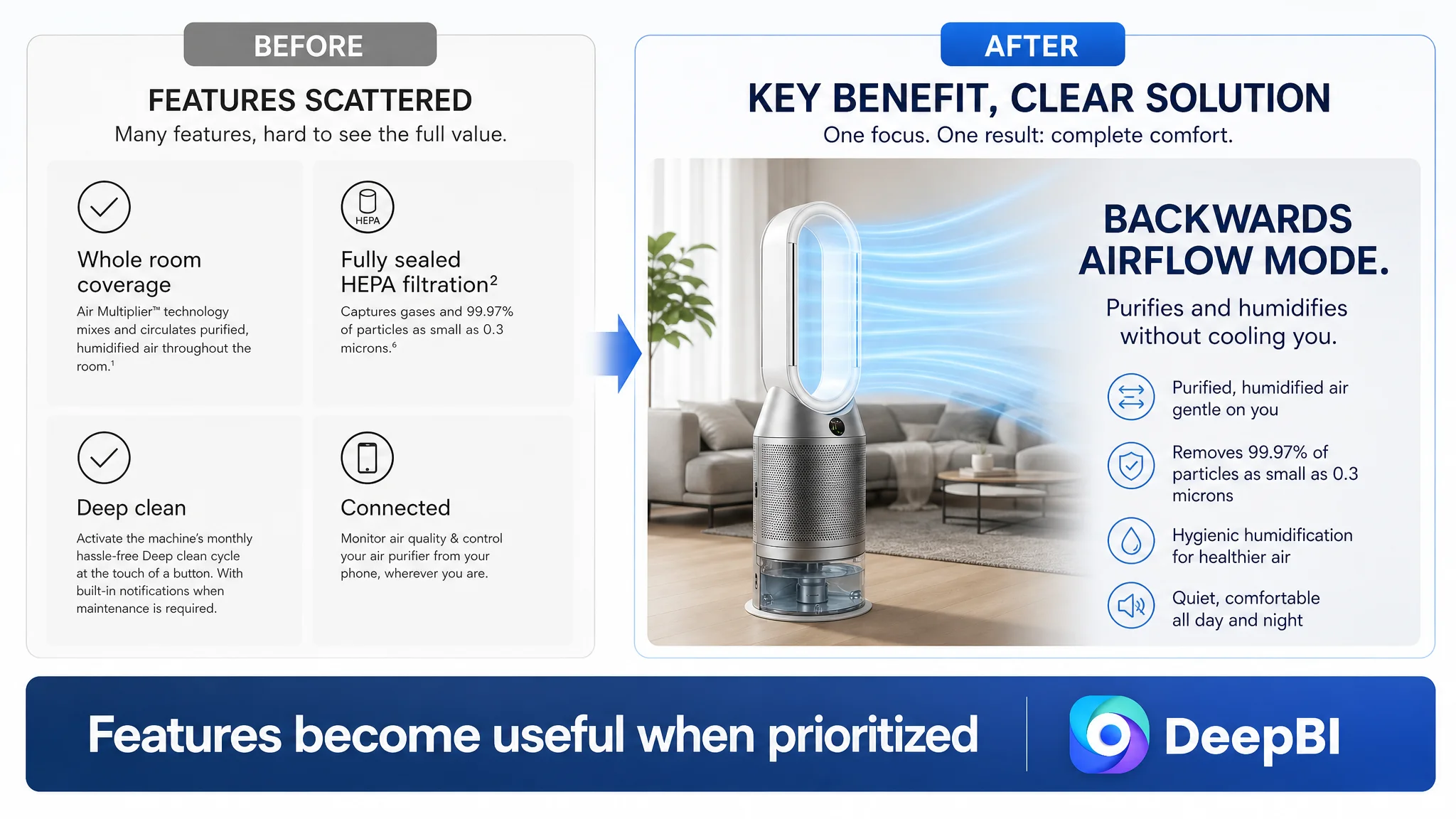
For sellers of complex appliances, the most expensive mistake is often not choosing the wrong keyword or bid.
It is sending more traffic to a Listing that has not resolved its basic conversion barriers.
This Amazon air purifier and humidifier case showed why diagnosis must come before production and why production must follow decision logic. The customer did not need more random creative changes. The team needed to identify which parts of the page were carrying the greatest commercial risk.
The answer was not hidden in one isolated module. It was visible in the relationship between the score gaps:
- A weak title limited search relevance.
- A weak review profile limited trust.
- A partially underpowered image sequence delayed understanding.
- Scattered bullet points made the value harder to process.
- Strong A+ content could not fully compensate for those early-funnel weaknesses.
A high-converting Amazon Listing is not the sum of its features. It is the order in which the page earns attention, explains value, proves credibility, and removes hesitation.
That was the judgment DeepBI brought to this case—and the reason the next optimization step had to begin with Listing conversion capacity, not another round of ad adjustments.