

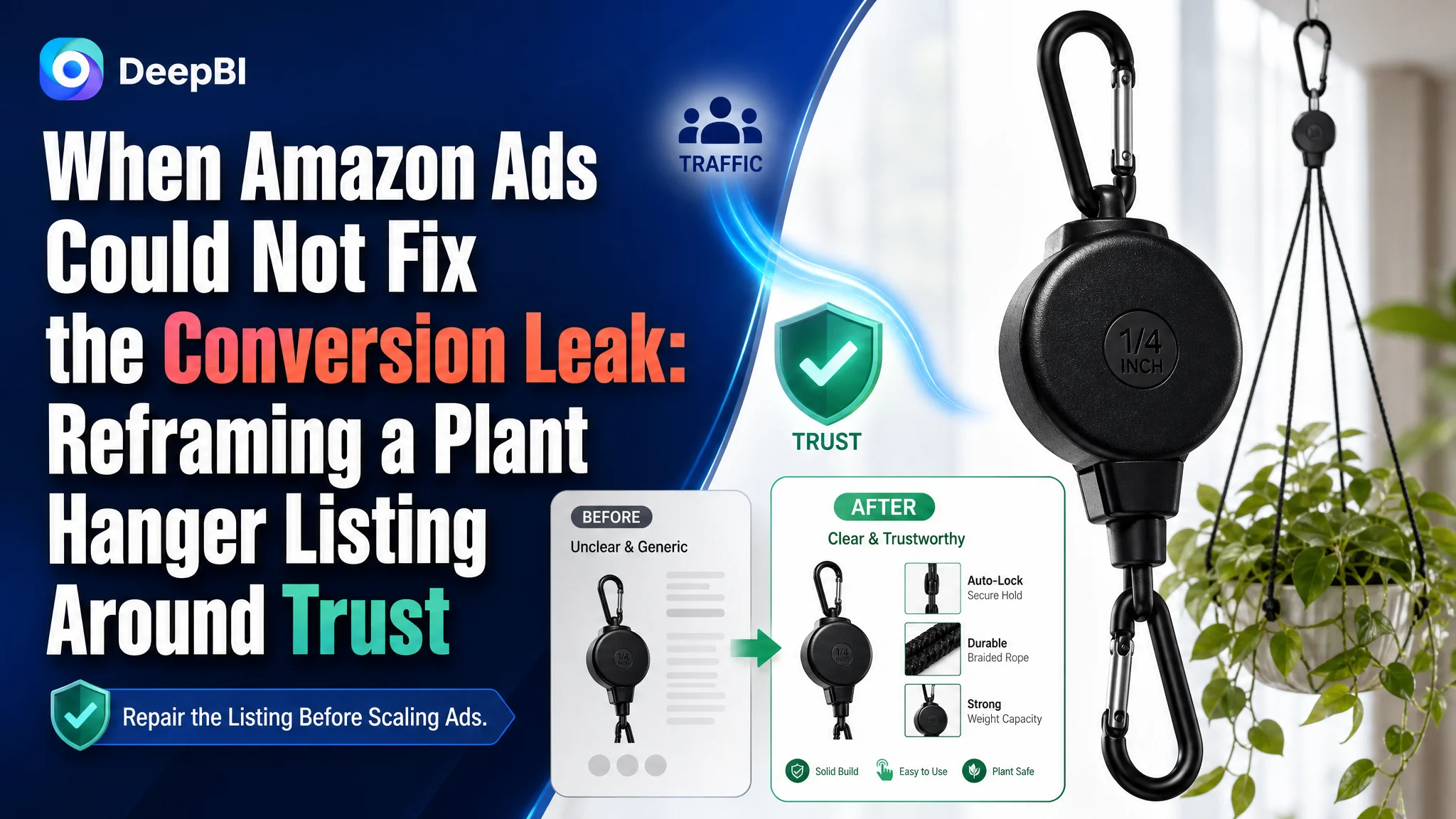
An Amazon seller of retractable plant hangers believed the main problem was competitive pressure: the product needed a stronger title, more persuasive images, and better advertising support. The team had treated the Amazon Listing as a collection of content elements rather than as a complete buying decision.
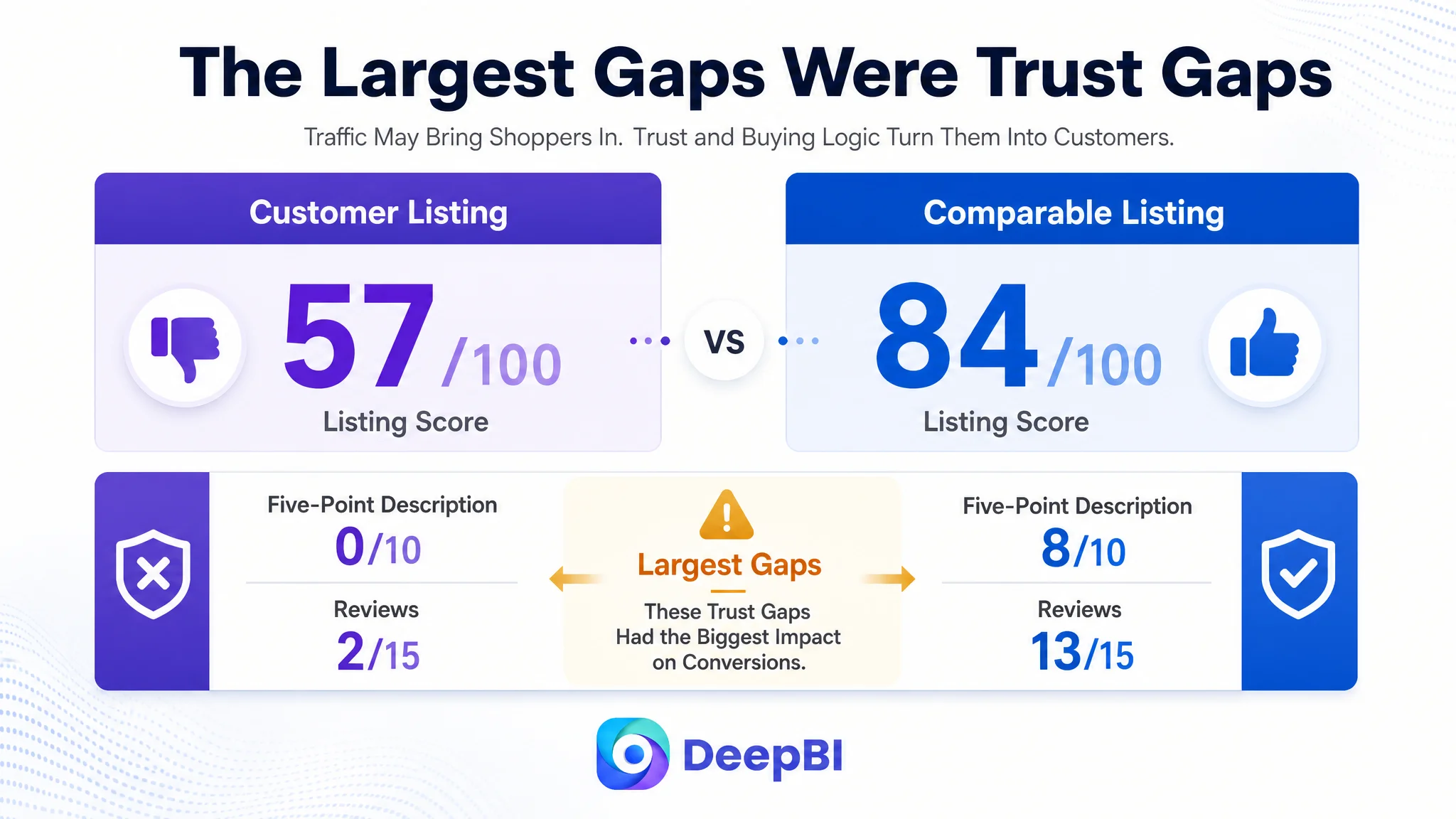
DeepBI’s diagnosis showed a more serious issue. The Listing scored 57 out of 100 against a comparable high-performing listing at 84, but the largest gaps were not in the title or main image. The five-point section was empty, the A+ content included unrelated product imagery, and the review profile created a major trust barrier.
The later optimization therefore focused on restoring the product page’s sales logic before asking Amazon ads to do more work: clarify how the auto-lock hanger operates, show the material and safety details earlier, rebuild the bullet points around buyer pain points, remove irrelevant A+ images, and make the page easier to trust.
For other Amazon sellers, the lesson is direct: when ad traffic does not produce enough orders, the next move is not always another bid adjustment. The product page may be consuming the traffic because it has not answered the buyer’s most important questions.
The Store Saw a Traffic Problem. The Listing Was Carrying a Conversion Problem.
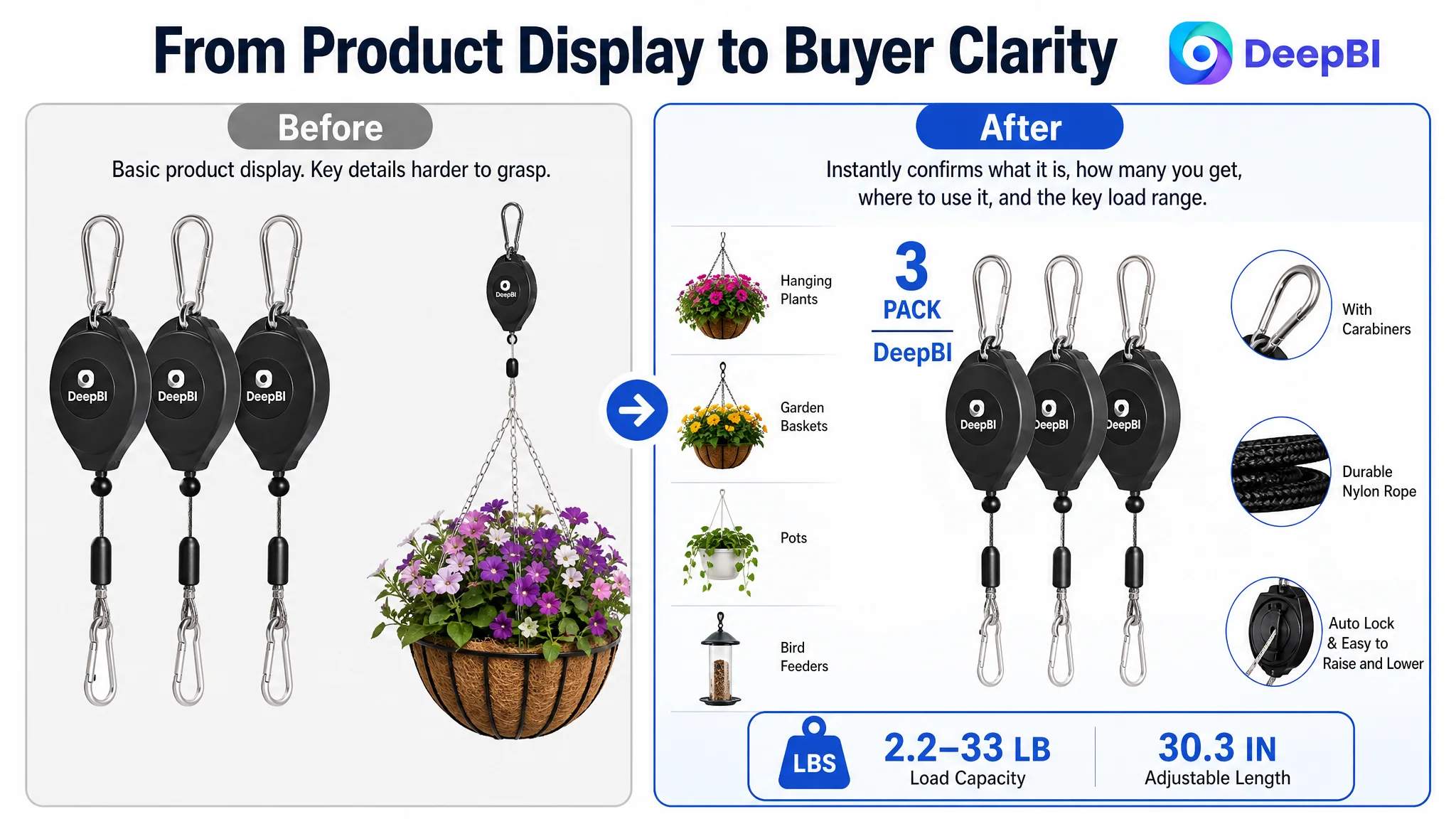
The product was a retractable plant hanger designed for hanging plants, garden baskets, pots, and bird feeders. Its key selling points included adjustable height, an auto-lock mechanism, carabiners, and a stated load range of 2.2 to 33 pounds.
On the surface, this looked like a familiar Amazon ads problem. The category contained comparable products with stronger presentation, more reviews, and clearer selling points. The natural response was to improve the title, refresh the images, and continue adjusting traffic.
But the Listing’s competitive position suggested that the problem was deeper than advertising exposure.
- Overall score: Customer Listing: 57/100, Comparable high-performing Listing: 84/100
- Title: Customer Listing: 14/20, Comparable high-performing Listing: 16/20
- Main image: Customer Listing: 24/30, Comparable high-performing Listing: 26/30
- Five-point description: Customer Listing: 0/10, Comparable high-performing Listing: 8/10
- Detail page: Customer Listing: 17/25, Comparable high-performing Listing: 21/25
- Reviews: Customer Listing: 2/15, Comparable high-performing Listing: 13/15
The title and main image were behind, but only moderately. The most serious weaknesses were the empty five-point section, the damaged detail-page logic, and the review profile.
The problem was not simply that the Listing needed more traffic. It was that too many visitors had insufficient reason to trust the product once they arrived.
The Original Diagnosis Focused on Clicks and Surface-Level Content
The customer team initially viewed the situation through the usual Amazon advertising lens:
- The product needed stronger keyword placement.
- The title needed to compete more directly in search results.
- The images needed to look more attractive.
- More advertising could help the Listing collect additional traffic and sales.
Those assumptions were not entirely wrong. The title did have structural weaknesses, and the imagery did not communicate the product’s operating logic quickly enough. But they did not explain the full business risk.
A better title alone could not compensate for an empty five-point section. A more attractive lifestyle image could not resolve uncertainty about whether the hanger would lock securely. More ad traffic could not repair a page that introduced unrelated products inside its A+ content.
Traditional Amazon optimization often fails at this point because each asset is reviewed separately. The title is treated as an SEO task, the images as a design task, the bullets as a copywriting task, and the ads as a traffic task.
The customer’s Listing needed to be judged as one conversion system.
The Largest Gap Was Not the Title. It Was the Missing Buying Logic.
The five-point section scored zero.
That was not a minor content omission. It meant the Listing had no structured space to explain why the product was different, how it solved the buyer’s problem, what materials supported its safety, or where it could be used.
The comparable Listing used a clear progression:
1. Product upgrade and locking mechanism
2. Easier operation
3. Material strength and safety
4. Load range and stability
5. Use cases and support expectations
Each point connected a buyer concern with a specific response. The customer Listing had no equivalent structure.
Buyers had practical questions that remained unanswered
A shopper considering a retractable plant hanger is not only looking for the keyword “plant hanger.” They may also be asking:
- Will the hanger stay at the selected height?
- Does it require slow pulling or manual locking?
- Can it support the intended pot or basket?
- What happens with a lightweight pot?
- Will wind cause the hanger to retract?
- Are the rope and hooks strong enough?
- Can the product be used without repeatedly climbing a ladder?
The existing page did not form a clear path through those questions.
This is why DeepBI did not treat the five-point gap as a copy polish issue. It was a missing layer of conversion reasoning.
The Review Profile Made Every Other Weakness More Expensive
The Listing’s review profile created an additional trust problem:
- 2.7-star average rating
- 40 total reviews
- No valid review displayed on the first page
- Approximately 45% negative review share
The comparable Listing showed:
- 4.2-star average rating
- 107 total reviews
- Nine valid, rated reviews visible on the first page
- Approximately 22% negative review share
The difference was not only the number of reviews. It was the quality of the first impression. The customer Listing’s visible review area did not provide useful reassurance, while the comparable Listing presented valid, detailed feedback that helped reduce perceived risk.
This matters especially for a functional product whose value depends on reliability. Buyers are not only purchasing a decorative accessory. They are placing a plant pot or feeder above the ground and expecting the mechanism to hold.
A weak review profile therefore amplified every unclear explanation in the images and A+ content.
When trust is already low, vague product communication becomes a direct conversion cost.
The Main Image Was Not Just a Visual Issue
The main image score was 24 out of 30, only two points behind the comparable Listing. That result could easily lead a team to dismiss the image gap as unimportant.
DeepBI’s analysis reached a different conclusion: the images were not fundamentally poor, but they were assigned the wrong job.
The current visual sequence leaned toward general lifestyle presentation and abstract use scenes. That created several problems.
The product type was not confirmed quickly enough
The usage inset was too small to answer basic questions about the product’s application. On a mobile screen, shoppers could not immediately determine what type of plant hanger they were looking at or whether it suited the pot or basket they intended to use.
The first image needed to establish product identity, pack quantity, carabiner inclusion, and the relevant load range with greater clarity.
The operating principle was not demonstrated
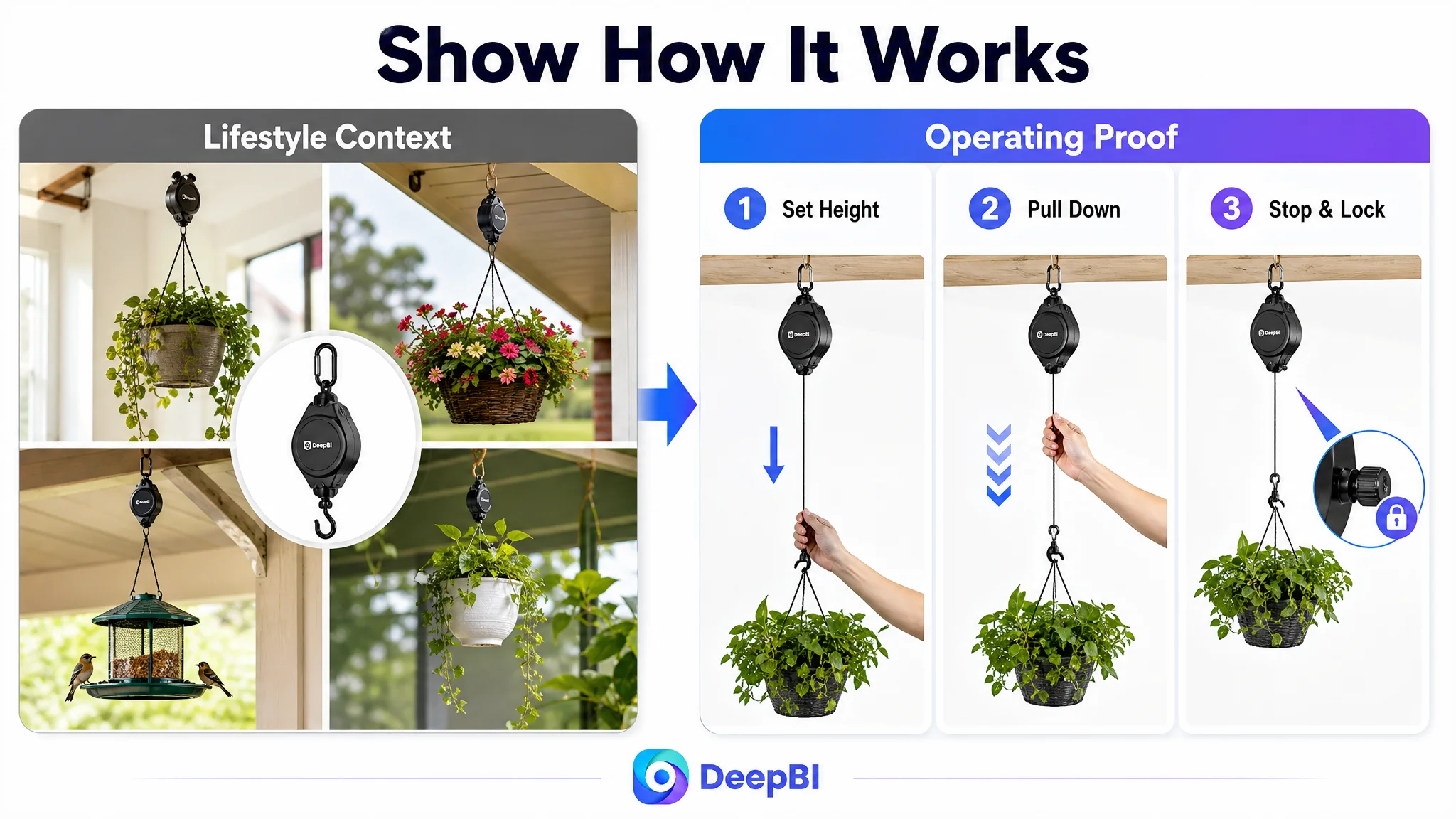
The product’s auto-lock function was a central selling point, but the page did not show the operating sequence clearly enough.
A buyer could still wonder:
- How does the hanger extend?
- When does it lock?
- How is it released?
- Does it require a button?
- Will it hold at different speeds and weights?
A general lifestyle image could confirm that the product exists in a gardening environment. It could not resolve those functional doubts.
Material claims appeared too late
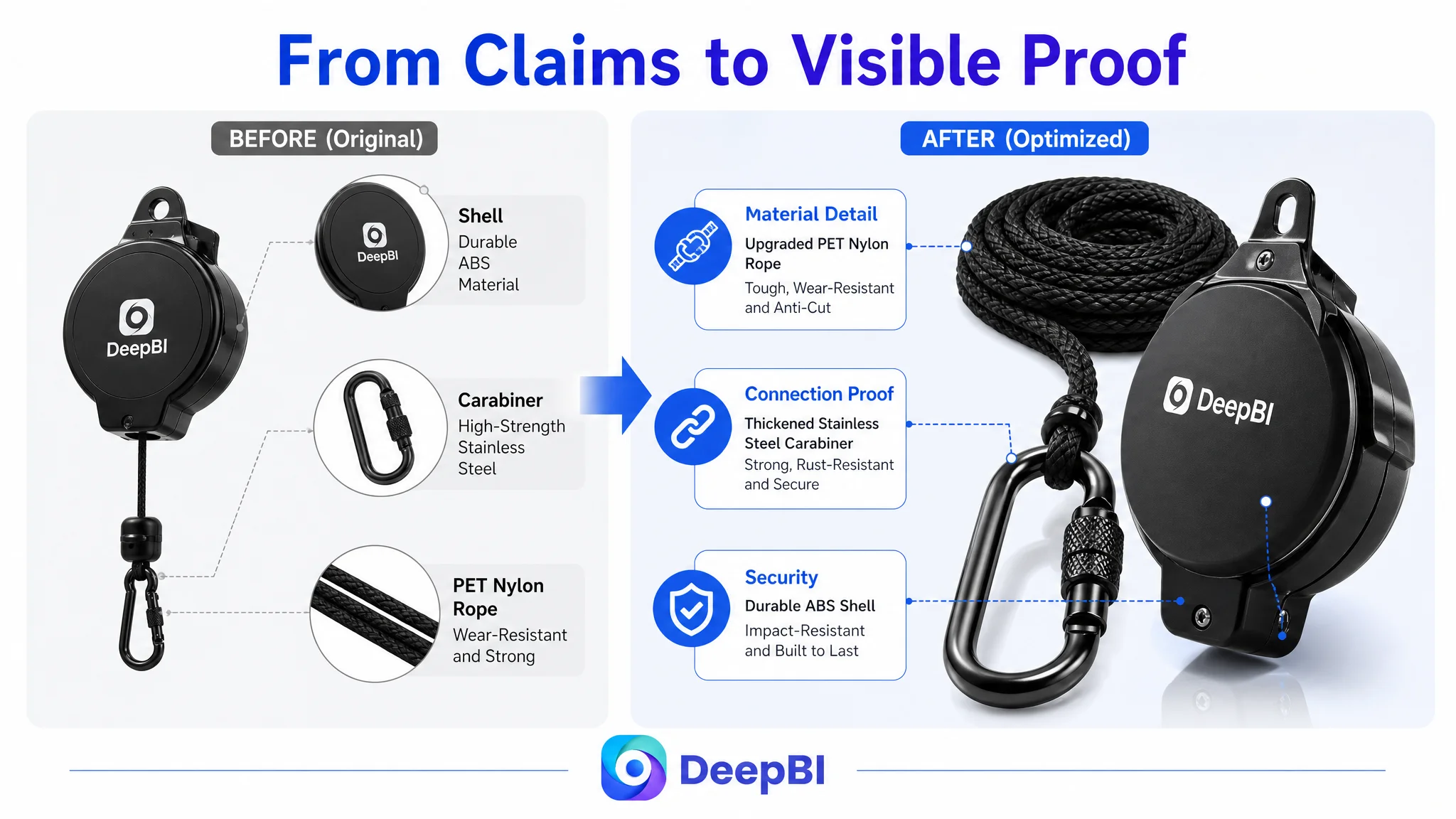
The rope, hook, and connection structure were important to buyers concerned about falling pots. Yet the relevant material details were not introduced early enough.
DeepBI therefore recommended shifting the visual strategy from atmosphere to explanation:
- Show a clear operating sequence for extending, locking, and releasing.
- Bring rope and hook details forward.
- Use a focused material-security image.
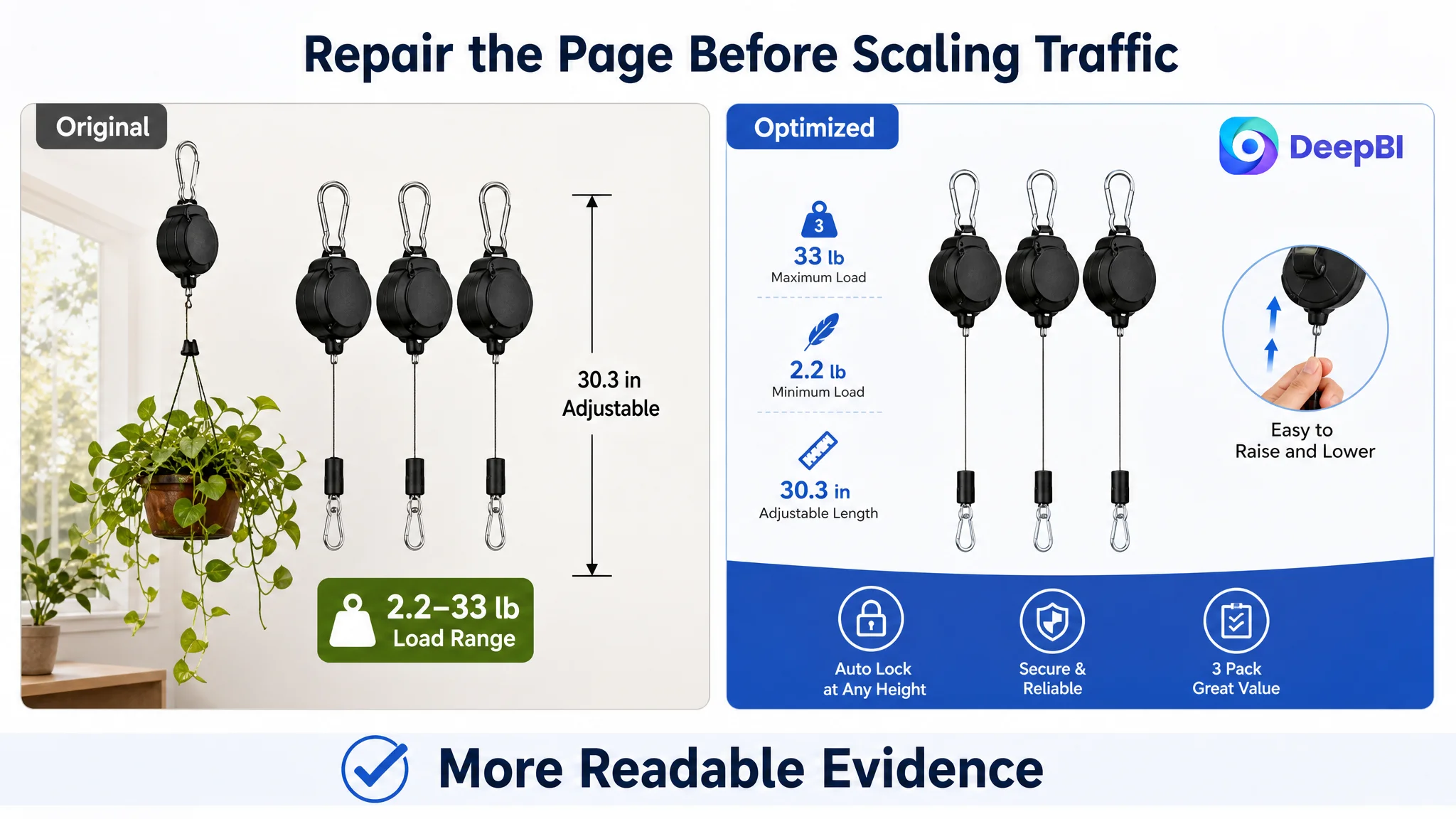
- Present load and adjustable-length information in a mobile-readable format.
- Keep the existing dimensional image where it already communicated useful facts.
The principle was not “make the images more beautiful.” It was “make the images answer the questions that block purchase.”
The A+ Content Was Creating a Serious Relevance Problem
The detail-page score was 17 out of 25, but the most damaging issue was not a lack of visual variety. It was content pollution.
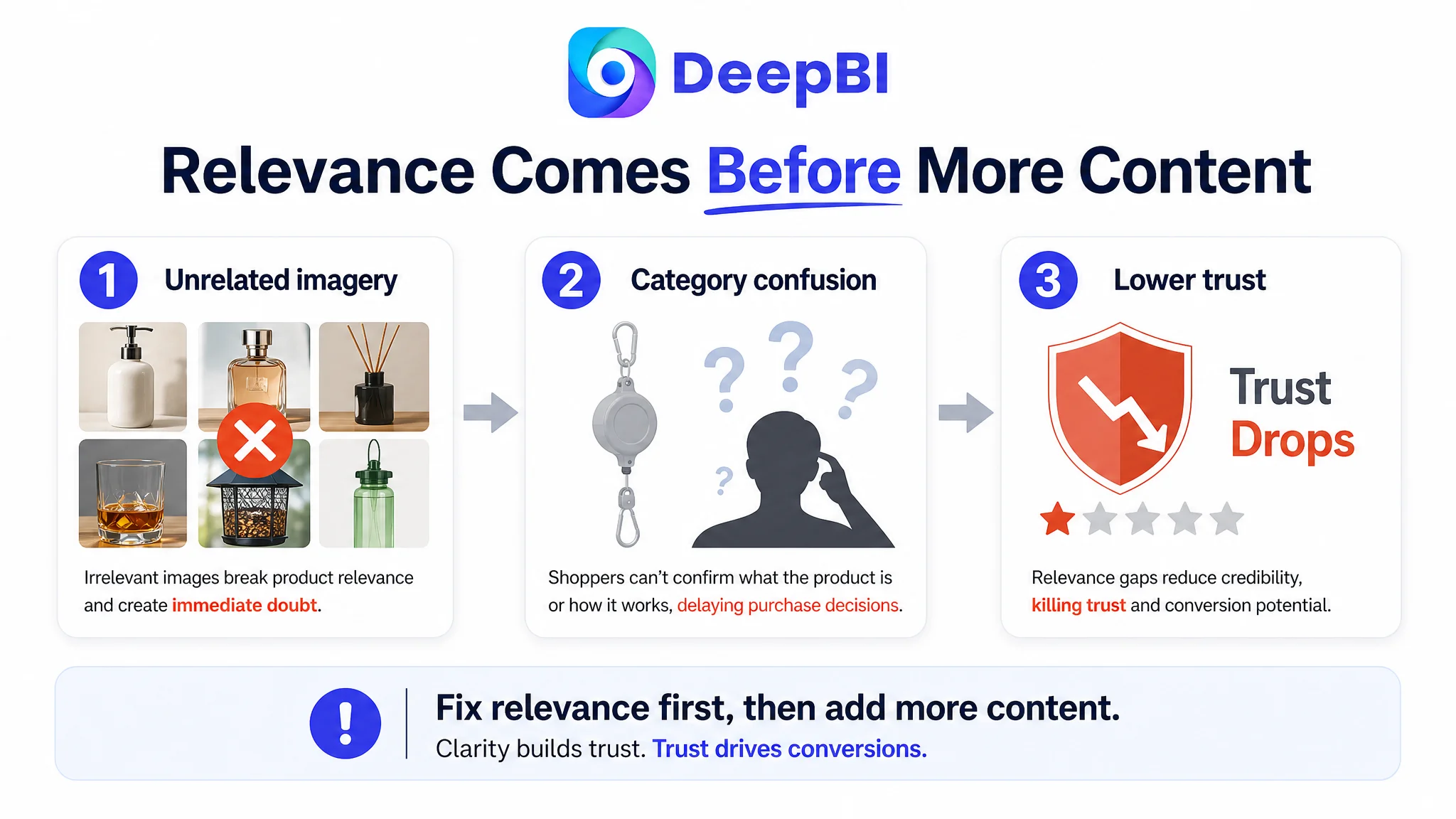
Several A+ images displayed products unrelated to retractable plant hangers, including items such as dispensers and bottles. Those images weakened the page in three ways.
They reduced category clarity
A buyer entering an Amazon product page expects every module to reinforce the product under consideration. Unrelated images made the page feel less specialized and raised doubt about whether the content had been assembled for this product at all.
They weakened professional trust
The product belongs to a function-oriented category. Buyers want to see real usage, operation, load boundaries, component details, and relevant applications.
Unrelated imagery replaced that evidence with visual noise.
They created regret risk
The further a shopper moved down the page, the less certain the product’s intended use became. Instead of reinforcing the decision, the A+ section could cause the buyer to question whether the product was suitable for their plant, pot, or feeder.
DeepBI’s first recommendation for the A+ content was therefore immediate and specific:
Remove the unrelated product images before adding more content.
This decision came before any attempt to create a more elaborate visual story. Relevance had to be restored first.
DeepBI Reframed the A+ Page as a Sequence of Risk Reduction
Once the irrelevant modules were removed, the remaining page needed a new order.
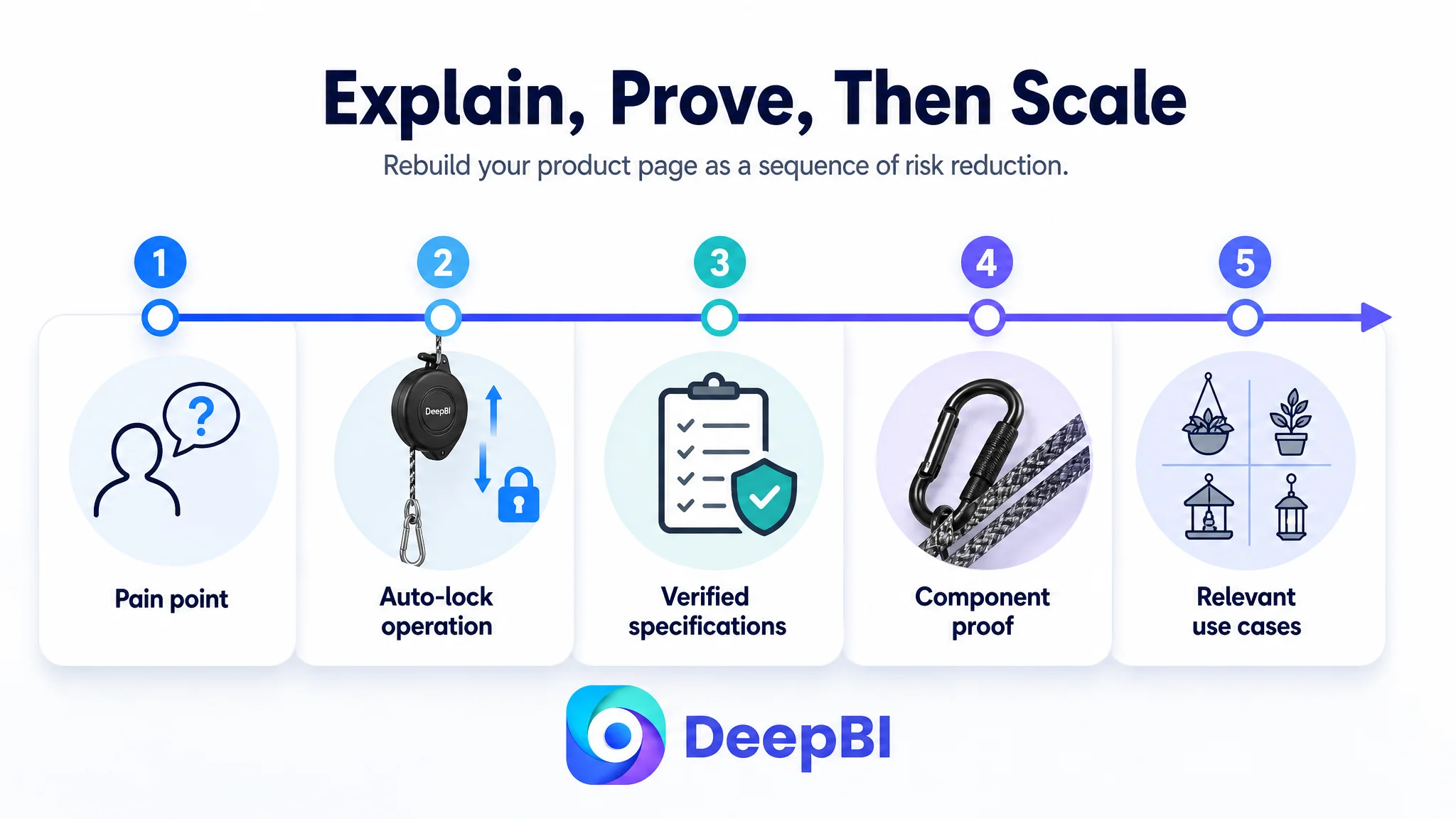
The recommended structure followed the buyer’s decision process rather than the order of the existing assets.
Start with the problem the product solves
The opening module should show a real person lowering a high hanging basket for watering, with particular emphasis on the practical benefit of avoiding ladders.
This gives the product an immediate role. It is not merely a pulley or hanger; it is a tool for making plant care easier and safer.
Explain the auto-lock function before presenting specifications
The existing specification module appeared too early. Buyers first needed reassurance that the product would behave as expected.
The auto-lock explanation should show:
- Pulling the rope down to lower the basket
- Stopping at the desired height
- Locking in place
- Pulling or lifting to release the mechanism
This sequence addresses the core functional fear before asking the buyer to evaluate measurements.
Use the mechanism explanation to manage expectations
The product page also needed to explain possible operating misunderstandings, such as why a pot might drop to the bottom or how an unsuitable load could affect the mechanism.
This is not an admission of weakness. It is a way to reduce the gap between the buyer’s expectation and the product’s actual operating conditions.
A page that explains use boundaries can prevent the same concern from appearing later as a negative review.
Follow with quantified information
Only after the operating logic was clear should the page present capacity, extension length, pack count, and other confirmed specifications.
The case material contains several different length and load references across the existing assets and recommendations. That creates an important operational requirement: the final Listing must use one verified set of specifications consistently across the title, bullets, images, and A+ content.
A number that appears differently in different modules does not create trust. It creates another reason to hesitate.
Consolidate component proof
The rope texture, stainless steel carabiners, connection points, and outer housing should be presented together rather than scattered among general scene images.
The goal is to turn abstract durability claims into visible evidence without inventing test data or unsupported material performance.
End with relevant use cases and pack contents
The closing modules should show only confirmed applications, such as hanging plants, garden baskets, and suitable bird feeders where supported by the product information.
The final decision point should clarify what is included in the pack and how the product is used. Ending on an unrelated product image should be replaced by a clear, relevant overview.
The Title Needed Structure, Not Keyword Accumulation
The original title began with “Retractable Plant Hanger,” which was useful for product identification but did not quickly communicate the strongest functional advantages.
Its selling points were also distributed across the title rather than organized into a clear hierarchy. The load range appeared late, the color cue was absent, and the relationship between the product form, auto-lock function, and use cases was not immediately obvious.
The recommended title direction was:
Retractable Plant Hanger with Carabiners, Auto Lock Plant Pulleys for Hanging Plants, Heavy Duty Adjustable Hook for Garden Baskets Pots & Bird Feeders, Easy to Raise & Lower, 2.2-33lbs, 3 Pack
The value of this structure is not that it contains more words. It is that it creates a more readable sequence:
- Core product and included component
- Auto-lock function
- Product strength and adjustment
- Relevant use cases
- Confirmed load range and pack count
The title was therefore treated as both a search entry point and a pre-click expectation setter.
The Five Points Had to Restore the Page’s Sales Argument
The recommended bullet structure followed the same logic as the A+ page, but in a more compact form.
Product upgrade and mechanism
Lead with the confirmed design improvement and internal locking mechanism, without relying on unsupported claims.
Easier operation
Explain that the user can lower the hanging item to the desired height and use the locking mechanism without the operating complexity associated with older designs.
Materials and connection security
Describe the confirmed rope and hook construction clearly, avoiding exaggerated performance claims or unverified certifications.
Capacity and stability
Present the verified load range and extension length consistently. If lightweight loads or wind-related concerns are important, explain them only within the limits supported by the actual product specifications.
Applications
Show how the hanger can be used for suitable plants, baskets, feeders, or other confirmed applications, while reinforcing the benefit of easier watering and height adjustment.
This is the difference between listing features and building a buying argument. Each bullet should answer a practical concern, not merely repeat a noun phrase.
Why DeepBI Did Not Recommend Tuning Ads First
The central decision was not to continue treating advertising as the first lever.
That did not mean Amazon ads were irrelevant. Ads still determine how much traffic reaches the product page, which search terms are tested, and how quickly the Listing can collect performance signals.
The issue was sequencing.
If the page has:
- No five-point explanation
- A low review signal
- Unrelated A+ images
- Unclear operating instructions
- Scattered material evidence
- Inconsistent specification presentation
then additional traffic can amplify the page’s weaknesses before it amplifies its strengths.
Advertising can increase exposure. It cannot independently create confidence in an auto-lock mechanism, explain the correct use of a pulley, or make unrelated A+ content look relevant.
The immediate business risk was not insufficient traffic alone. It was paying to send more shoppers into a page that had not earned their trust.
The rational order was therefore:
1. Remove content that creates confusion.
2. Clarify the product’s operating logic.
3. Rebuild the title and five-point structure.
4. Strengthen relevant image and A+ evidence.
5. Ensure all specifications are consistent and verified.
6. Then use Amazon ads to test and scale the repaired Listing.
This order reduced the risk of using paid traffic to validate a page that was still structurally weak.
The Business Understanding Changed
The case did not end with a list of image replacements or rewritten bullets. Its most important change was in how the seller understood the problem.
The team began with a familiar assumption: if the product was not producing enough orders, the ads and creative assets needed to work harder.
The diagnosis showed a more precise reality:
- The title was not the largest conversion constraint.
- The main image needed clearer functional communication, not only better styling.
- The empty five-point section removed the product’s sales argument.
- The review profile weakened trust before the buyer evaluated the features.
- Irrelevant A+ images damaged product relevance and professionalism.
- The page needed to explain operation and risk before emphasizing specifications.
- Advertising should follow Listing repair, not substitute for it.
No unsupported post-optimization performance figures are available in the case material, so the outcome should not be described as a confirmed percentage increase in CVR or a specific decline in ACOS.
What can be stated clearly is the change in operating direction: the seller moved from broad traffic and surface-level content adjustments toward a structured Amazon Listing diagnosis centered on conversion capacity.
Before Scaling Amazon Ads, Ask Whether the Page Deserves More Traffic
This plant hanger case illustrates a broader Amazon operating principle.
A Listing can have a usable product, relevant keywords, and paid visibility, yet still underperform because the page does not answer the buyer’s real questions in the right order.
For a functional product, conversion depends on more than keyword coverage. The page must establish:
- What the product is
- How it works
- Why it is easier to use
- Whether it can support the intended load
- Which materials provide security
- Where it can be used
- What other buyers experienced
- What the customer will receive
DeepBI’s contribution in this case was not simply to suggest more content. It was to identify which missing logic was limiting the value of existing and future traffic.
The practical lesson for Amazon sellers is straightforward:
Before increasing bids, adding campaigns, or sending more shoppers to a product page, determine whether the Listing can convert the traffic it already receives.
When the page can explain the product, reduce uncertainty, and build trust, Amazon ads become more useful. When it cannot, advertising may only make the underlying conversion leak more expensive.