

Introduction
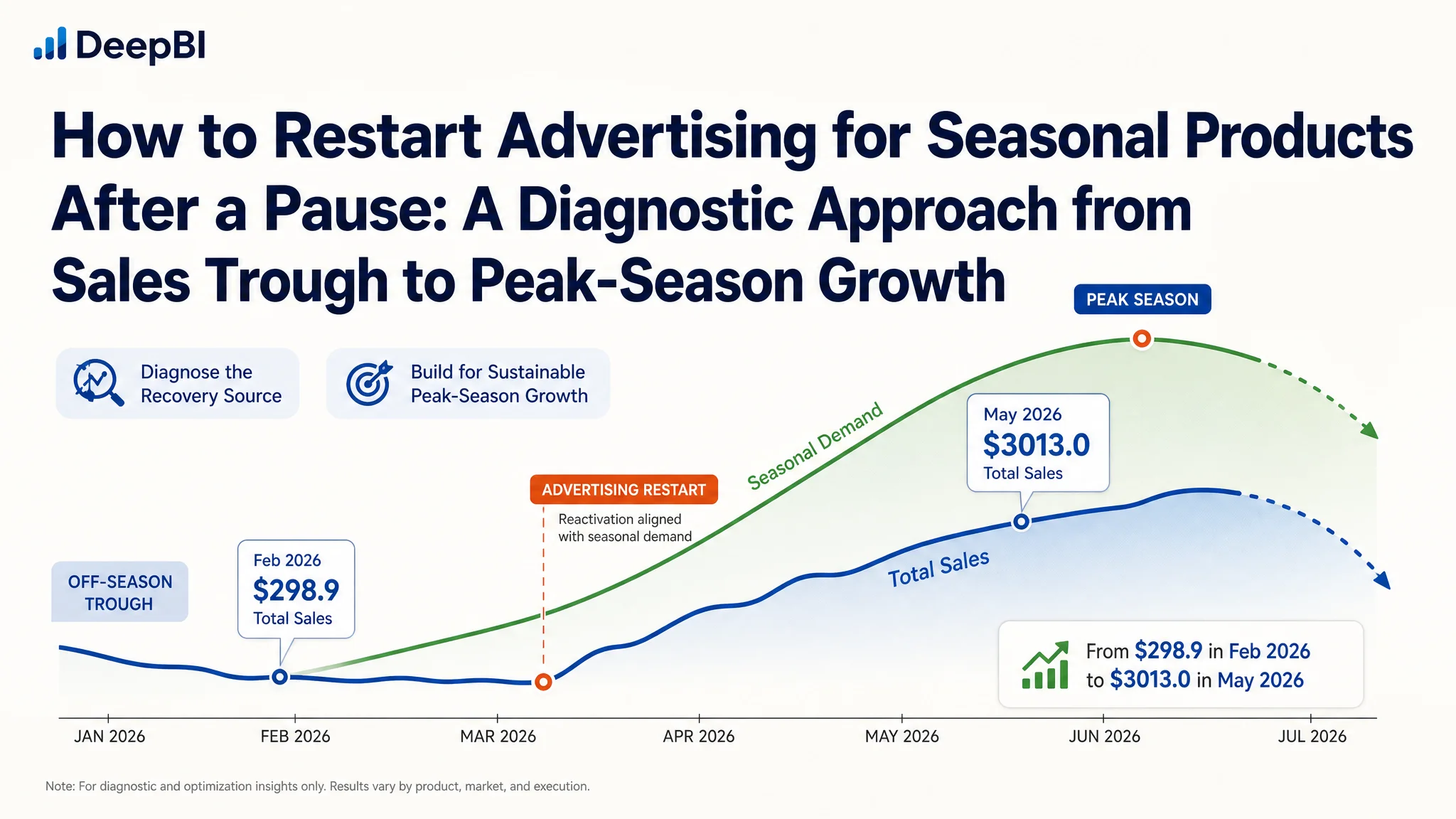
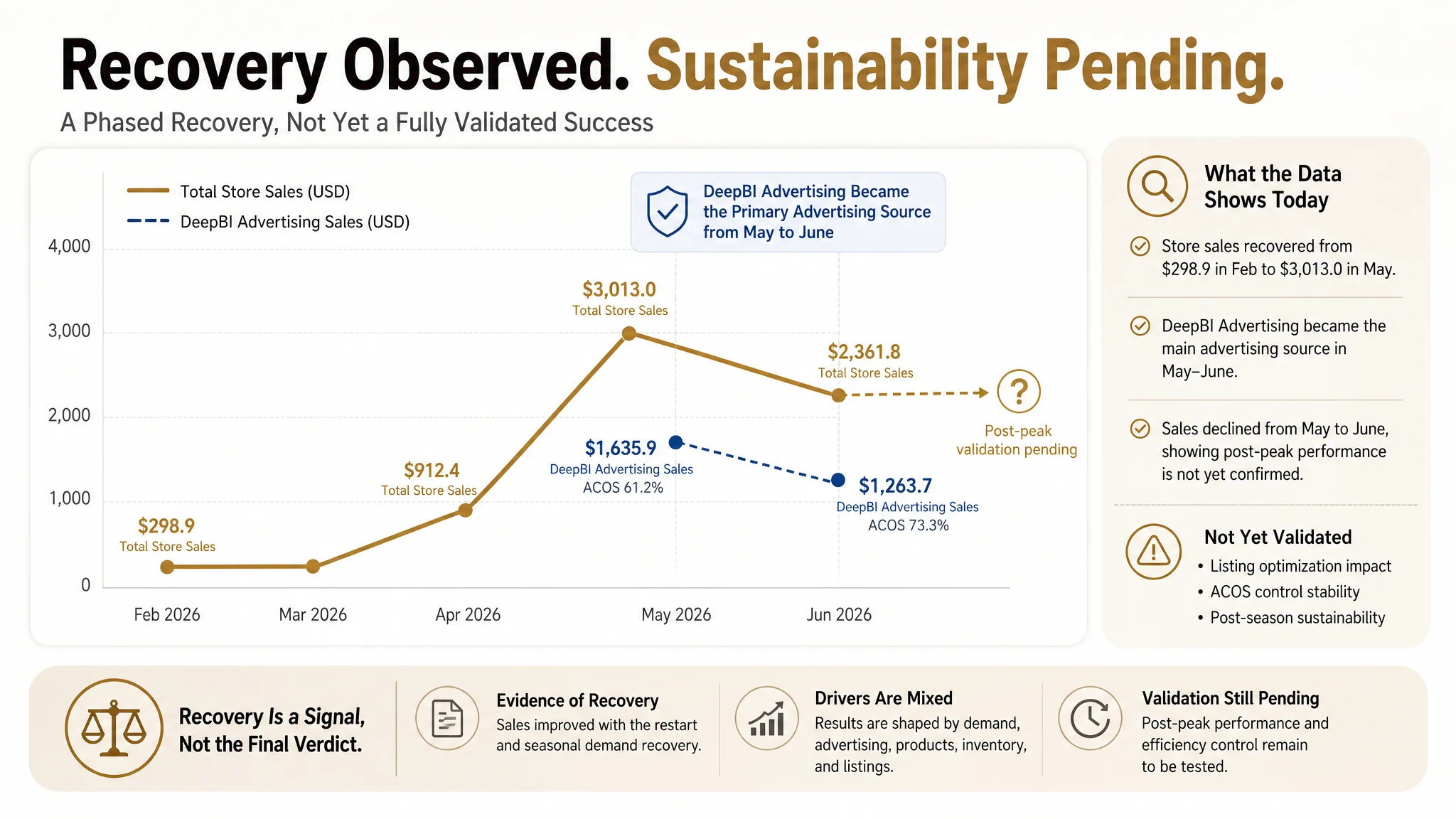
Can pausing advertising for seasonal products during the off-season and restarting ads after peak season begins necessarily drive growth? An Amazon seller specializing in barbecue supplies and managing approximately 14 products experienced largely stagnant advertising from November 2025 to March 2026, while the store's total sales fell to $298.9 in February 2026. After the products entered their peak season, the customer tried AI advertising again. Total store sales recovered to $912.4 in April 2026, reached $3013.0 in May, and were $2361.8 in June.
However, these changes cannot simply be attributed to the advertising tool. The recovery of seasonal demand, the restart of advertising, product status, inventory, and Listing competitiveness may all have affected the final results. Following the path of “problem identification—diagnosis—validation,” this article explains what should be checked after advertising is paused, what still needs to be verified after sales recover, and why peak-season growth does not necessarily mean advertising efficiency has stabilized.
Customer Background
 The customer sells seasonal barbecue supplies, with approximately 14 products in the store. Sales of these products are typically affected by seasonal demand, and there may be a significant difference between the off-season and peak season. Therefore, decisions about whether to continue advertising cannot be based on sales in a single month alone. They must also take into account the product's seasonality, inventory, historical advertising performance, and Listing conversion capability.
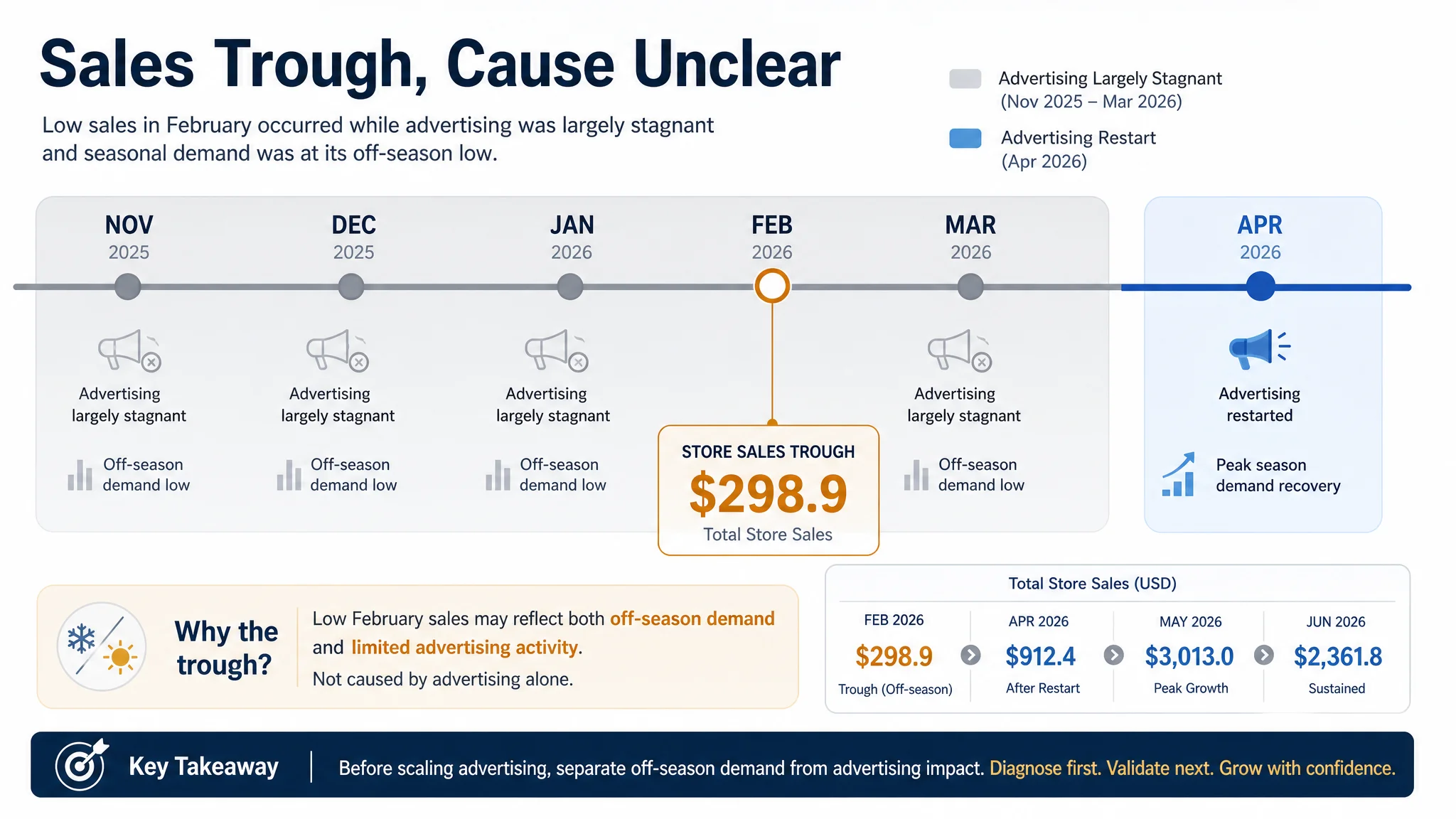
The customer had previously adopted an AI advertising tool, but advertising efficiency was not stable. From November 2025 to March 2026, advertising was largely stagnant, and store sales remained at a low level for an extended period. By February 2026, total store sales were $298.9.
In April 2026, as the products gradually entered their peak season, the customer proactively tried AI advertising again. At this point, the customer's concern was not simply increasing the advertising budget, but determining: Was it worthwhile to resume advertising during the peak season? After advertising resumed, did the increase in sales come from the recovery of seasonal demand or from advertising taking over sales generation again?
The Problem
 What Did the Sales Trough After Advertising Was Paused Really Mean?
For seasonal products, paused advertising and weak sales often occur at the same time. However, the relationship between the two is not necessarily a simple cause-and-effect relationship.
If the product itself is in the off-season, reopening advertising may still fail to generate effective orders because of insufficient search demand, low purchase intent, or unstable inventory planning. Conversely, if the product has already entered a demand recovery period, continuing to pause advertising may cause the seller to miss the window for rebuilding exposure and orders.
In this case, total store sales remained low from November 2025 to March 2026 and were only $298.9 in February 2026. This figure alone cannot directly determine whether the problem was that “advertising was insufficient” or that “the product itself lacked demand during the off-season.” This is a common challenge for seasonal sellers: What should be done after advertising is paused? Should it be restarted during the peak season?
After Advertising Was Restarted, Did the Sales Recovery Mean That Advertising Was Already Effective?
Sales did change after advertising was restarted:
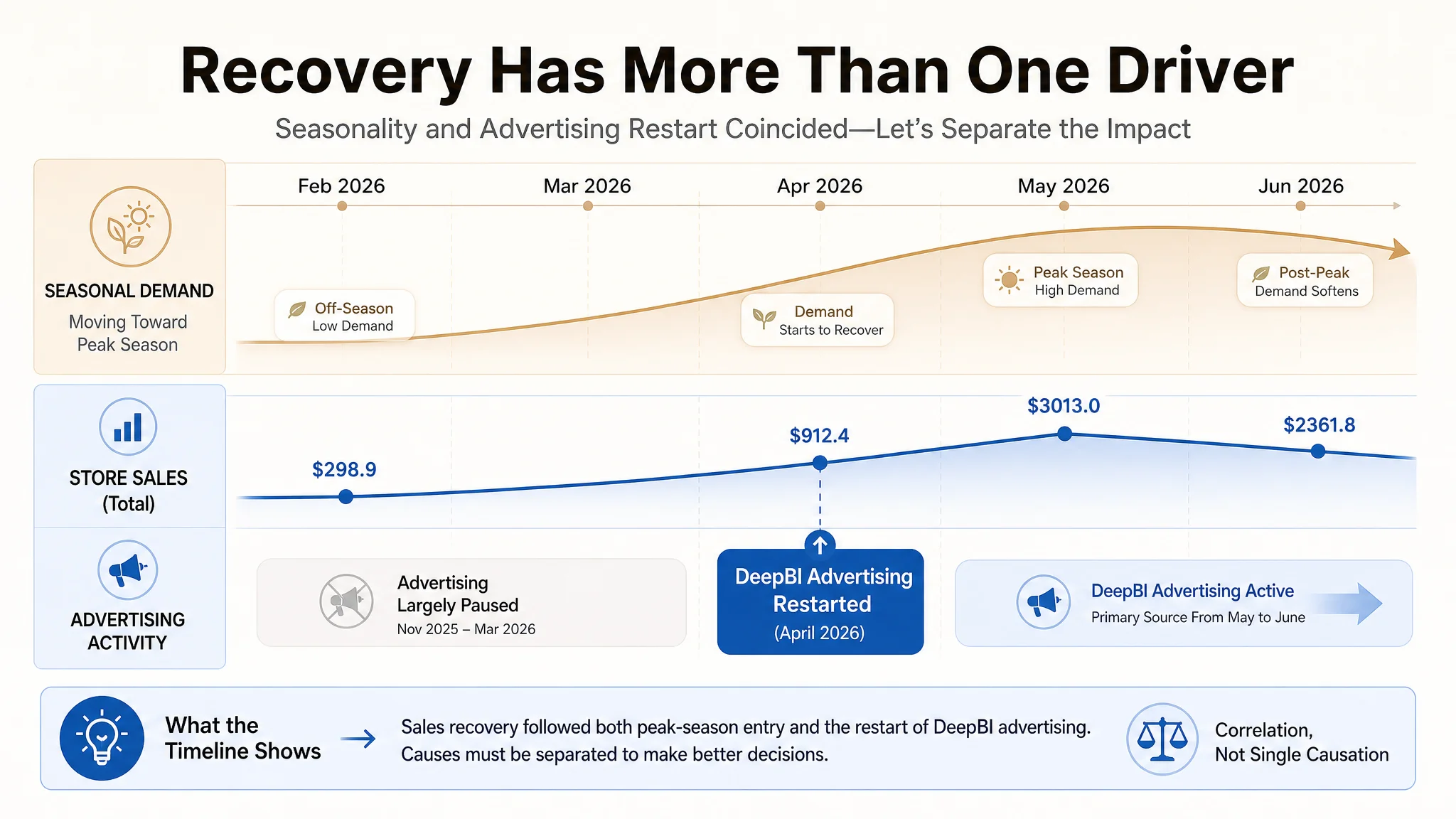
- In April 2026, total store sales were $912.4;
- In May 2026, total store sales reached $3013.0;
- In June 2026, total store sales were $2361.8.
From $298.9 in February to $3013.0 in May, sales increased significantly. However, this period also coincided with the recovery of seasonal demand, so the entire increase cannot be attributed to AI advertising. The recovery in sales only indicates that the store regained certain business opportunities; it does not independently prove that advertising efficiency had stabilized.
For the person responsible for advertising, the key metrics that need to be tracked further are: How did the share of advertising sales change? Was ACOS under control? Which products generated orders? Did organic traffic recover at the same time? If sales were generated only through advertising, while Listing conversion capability and organic traffic did not improve, sales could decline again after the peak season ends.
How DeepBI Diagnosed
 When diagnosing the issue of “restarting advertising for seasonal products after a pause,” DeepBI's focus was not to immediately expand the budget, but first to distinguish the relationship between demand, advertising, and the products' ability to convert traffic into sales.
1. First Examine Changes in Store Sales and Advertising Status Over Time
First, store sales, advertising status, and advertising sales from November 2025 to June 2026 should be placed on the same timeline for observation.
This helps confirm several basic facts:
- Advertising was largely stagnant from November 2025 to March 2026;
- Total store sales were $298.9 in February 2026;
- AI advertising was tried again in April 2026;
- From May to June, the old advertising campaigns were no longer running, and AI advertising became the primary source of advertising sales.
The purpose of this step is to avoid analyzing prolonged low sales, seasonal demand changes, and the advertising restart as if they were a single factor.
2. Then Examine the Advertising Structure Instead of Only Total Sales
Next, it is necessary to examine the relationship among advertising campaigns, products, and parent ASINs to determine which products contributed most of the sales and whether some products continued to consume budget without generating conversions.
The customer manages approximately 14 products, so subsequent diagnosis cannot focus only on overall store data. An increase in total store sales does not mean that all products should continue to receive advertising. Parent ASINs with high ACOS or spending without conversions need to be identified separately rather than continuing with a uniform advertising strategy.
3. Combine Search Terms and ASIN Data to Determine Whether Demand Has Truly Recovered
After advertising is restarted, it is also necessary to further examine the performance relationship among search terms, keywords, and ASINs: Which search demands generated orders? Which terms generated only impressions and clicks without conversions? Which products received advertising sales?
If search-term performance is consistent with seasonal demand for the products, this indicates that advertising may be capturing recovering market demand. If only a small number of terms generate spending without producing orders, the match between the products and traffic needs to be reassessed.
The available materials do not provide specific search-term or keyword-level results, so it is not possible to directly conclude here that certain terms have improved. These should serve as important data for subsequent performance validation.
4. Finally, Examine Listing and Inventory Fulfillment Capability
Whether advertising can continue to generate sales also depends on whether the product page can convert traffic and whether inventory and production capacity are stable. The customer has already recognized that the products are less competitive than competing products and has expressed a need to optimize Listing images and copy.
Therefore, diagnosis cannot stop at the advertising level. Advertising performance must also be evaluated together with Listing content, product competitiveness, inventory, and production capacity. For products with unstable inventory or limited production capacity, advertising should not be expanded directly even if the advertising data appears positive.
The Real Problem
 Problem 1: Advertising Stagnation and the Seasonal Demand Trough Occurred at the Same Time, Making It Impossible to Directly Identify the Primary Cause
Cause: The customer sells seasonal barbecue supplies. Advertising was largely stagnant from November 2025 to March 2026, a period that may also have had weak demand. Without continuous advertising, the store lacked new advertising-driven sales opportunities. However, low sales do not prove that advertising itself was the only problem.
Impact: If low off-season sales are mistakenly interpreted as insufficient advertising capability, the seller may blindly increase the budget when demand is inadequate. If all low sales are attributed to seasonality, the seller may miss the opportunity to rebuild advertising before the peak season.
Evidence: Total store sales were $298.9 in February 2026, and advertising was largely stagnant from November 2025 to March 2026. The available data only proves that sales and advertising were both at low levels; it cannot prove that either one alone caused all of the changes.
Problem 2: After Advertising Began Generating Sales Again, the Source of Growth Still Needed to Be Disaggregated and Validated
Cause: After AI advertising was tried again in April 2026, store sales recovered from a low level, but this period also marked the beginning of the products' peak season. Seasonal demand, renewed advertising support, and organic product sales may all have contributed.
Impact: If the increase in store sales from $298.9 to $3013.0 is attributed entirely to the advertising tool, subsequent advertising performance may be overestimated, while organic traffic and seasonal changes are overlooked. Once the peak season ends, sales may decline, and advertising efficiency will need to be reassessed.
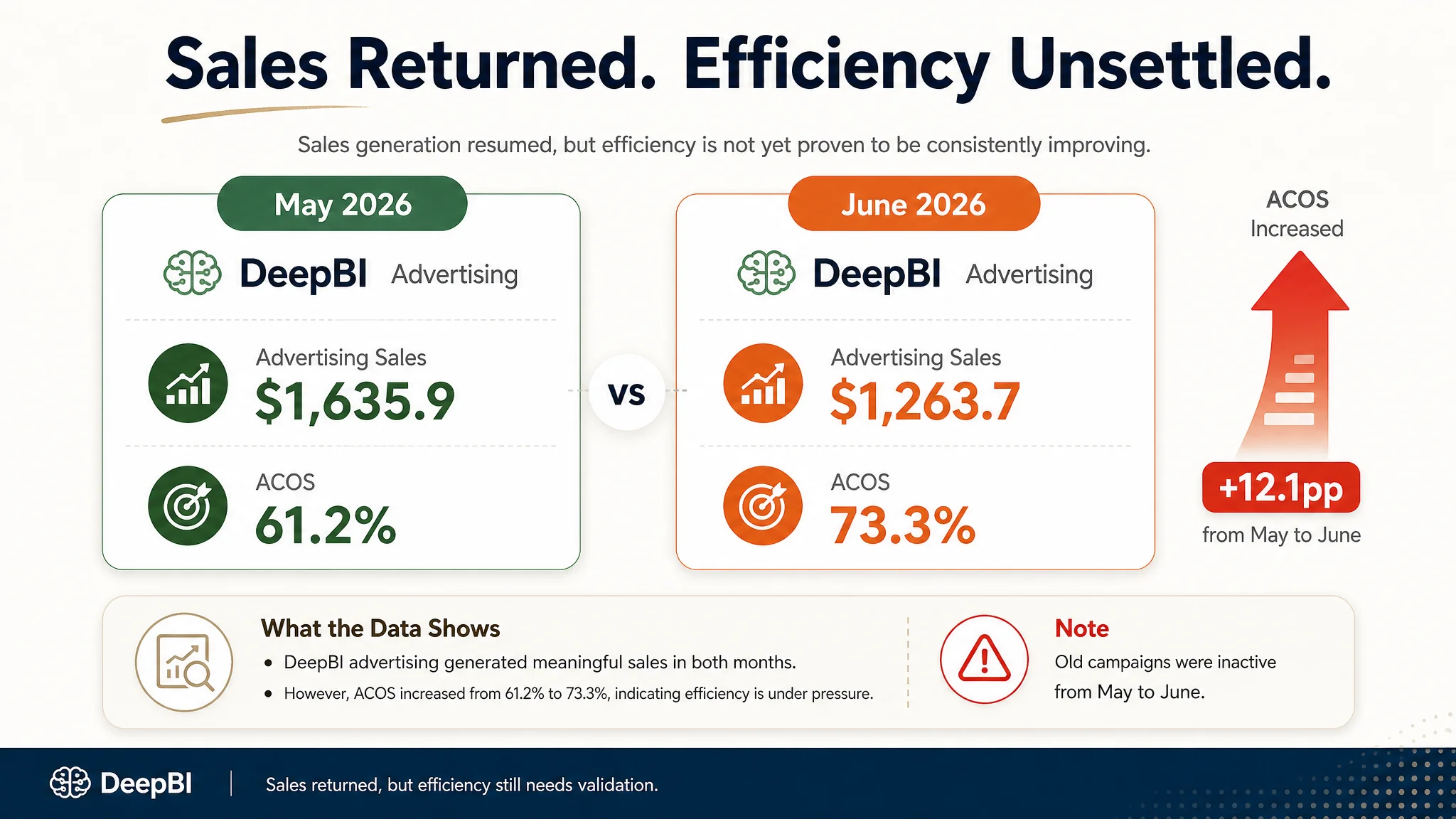
Evidence: Total store sales were $912.4 in April 2026, $3013.0 in May 2026, and $2361.8 in June 2026. AI advertising generated $1635.9 in sales in May and $1263.7 in June, but the available materials are not sufficient to determine how much of the growth came from seasonal demand versus the advertising restart.
Problem 3: After Advertising Took Over Again, Product and Listing Conversion Capability Were Still Insufficient to Support Broad Expansion
Cause: The customer recognized that the products were less competitive than competing products and wanted to optimize Listing images and copy. At the same time, some parent ASINs had high ACOS or spending without conversions, while inventory and production capacity also required priority consideration.
Impact: If product quality, page conversion, and inventory status are not distinguished, continuing to expand the advertising scope may generate more wasted spending. Advertising can bring traffic, but it cannot replace product competitiveness or Listing conversion capability.
Evidence: AI advertising generated $1635.9 in sales in May, with an ACOS of 61.2%; in June, AI advertising generated $1263.7 in sales, while ACOS increased to 73.3%. This indicates that advertising had begun generating sales, but ACOS had not been proven to decline consistently, and some products still needed to go through screening and optimization.
Optimization Plan
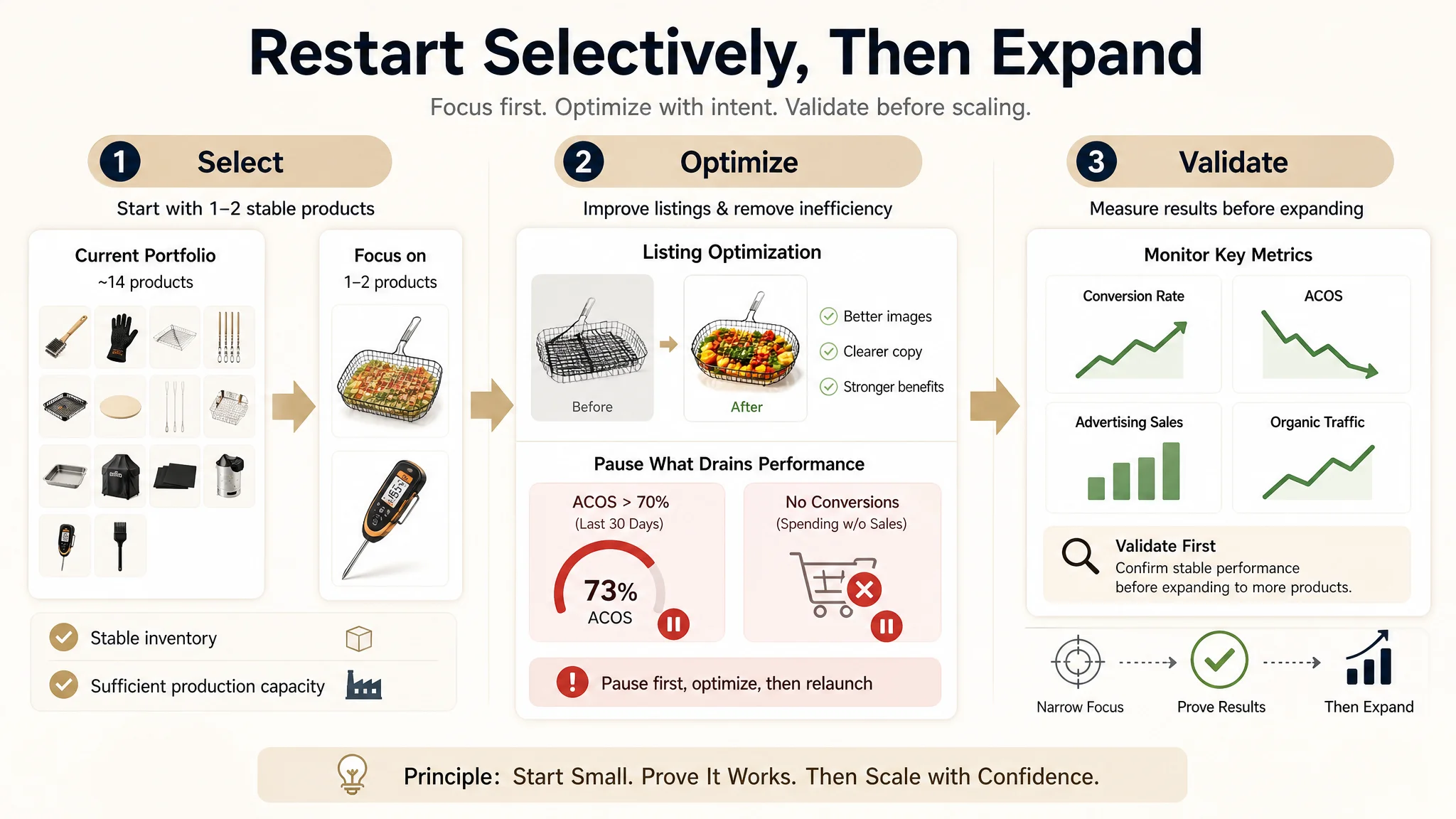
 Decide Whether to Restart Based on Seasonality and Product Status
For seasonal products, it is not advisable to increase the budget immediately simply because sales are low during the off-season. Before restarting, sellers should first confirm whether the product has entered a demand recovery stage and check inventory, production capacity, historical advertising performance, and the basic condition of the Listing.
In this case, the customer tried AI advertising again in April 2026 because the products had entered their peak season. The rationale for this action was the return of the seasonal opportunity, not simply the tool's promise of growth.
Let Advertising First Support Products with Higher Certainty
After restarting, sellers should retain products that have already demonstrated sales conversion and have relatively stable inventory, then gradually expand the advertising scope. The customer manages approximately 14 products, so it is not appropriate for all products to take on growth targets simultaneously without segmentation.
For parent ASINs with an ACOS above 70% over the past 30 days or spending without conversions, DeepBI recommends pausing them first to prevent inefficient advertising from continuing to consume the budget. Pausing does not mean abandoning them permanently. Instead, sellers should first return to the product, Listing, and traffic-matching levels for inspection, then validate the products again after optimization.
Treat Listing Optimization as Part of Advertising Diagnosis
If advertising can generate clicks but cannot consistently produce orders, the problem may not exist only on the advertising side. The customer planned to optimize Listing images and copy. DeepBI recommends prioritizing 1 to 2 products with regular inventory for testing, observing first whether page optimization improves conversion, and then deciding whether to expand the optimization scope.
This sequence reduces the difficulty of evaluating results when many products are modified simultaneously. It also prevents the advertising budget from being concentrated on products that cannot be supplied continuously when inventory and production capacity are uncertain.
Use Phased Data to Validate Advertising Performance
After advertising is restarted, at least the following data should be monitored continuously:
- Whether total store sales and advertising sales change in tandem;
- Whether ACOS remains within an acceptable range over time, rather than looking at only one month;
- Which parent ASINs generate conversions and which parent ASINs only generate spending;
- Whether advertising-generated sales are accompanied by changes in organic traffic;
- Whether sales and advertising efficiency can be maintained after the peak season ends.
At this stage, DeepBI's role is to help sellers examine sales changes, advertising performance, and product structure within the same framework, rather than simply continuing to increase advertising based on sales growth.
Results
After advertising was restarted, store sales changed from $298.9 in February 2026 to:
- April 2026: $912.4;
- May 2026: $3013.0;
- June 2026: $2361.8.
In May, AI advertising generated $1635.9 in sales, with an ACOS of 61.2%; in June, AI advertising generated $1263.7 in sales, with an ACOS of 73.3%. At the same time, the old advertising campaigns were no longer running from May to June, and AI advertising became the primary source of advertising sales.
These data indicate that advertising did begin to generate sales after being restarted, and the store also entered a peak-season growth phase after a prolonged period of low sales. However, the data also show that ACOS was higher in June than in May. At this stage, it is not possible to conclude that “ACOS has consistently declined” or that “advertising efficiency has stabilized.”
Therefore, the more accurate description of the current results is that sales and advertising sales have shown a phased recovery, and advertising has taken over as the primary advertising source again. However, the customer remains in the stage of validating performance and optimizing the structure after peak-season growth began. The changes in conversion after Listing optimization, sales performance after the peak season, and the results of adjusting high-ACOS products have not yet been validated.
Case Summary
The real issue in this case was not whether advertising should be restarted immediately after being paused, but how to determine the right time to restart and how to distinguish seasonal demand, advertising-driven growth, and the products' own ability to convert traffic into sales.
An effective diagnostic path includes first reviewing the seasonality and sales timeline, then examining the advertising structure and parent ASIN performance, followed by checking search terms, Listings, inventory, and production capacity. After sales recover, sellers should not focus only on total store sales. They should continue monitoring advertising sales, ACOS, conversion, and sustainability after the peak season.
After the customer tried AI advertising again in April 2026, total store sales increased from $298.9 in February to $3013.0 in May, and AI advertising became the primary source of advertising sales from May to June. However, these changes were also affected by the recovery of seasonal demand, renewed advertising support, and product status. At present, this should not be presented as a continuously growing case that has already been fully validated.
Key Takeaways for Sellers
Takeaway 1: Advertising Budgets for Seasonal Products Should First Follow the Demand Cycle
Low off-season sales do not necessarily mean that advertising must be increased. Restarting advertising during the peak season also does not mean that all products should be expanded simultaneously. Sellers should first assess the demand cycle, then determine the restart scope based on inventory and historical advertising data.
Takeaway 2: Sales Growth Does Not Equal Improved Advertising Efficiency
When evaluating growth in Amazon advertising sales, sellers should not look only at how sales changed from one figure to another. They should also break down advertising sales, organic sales, ACOS, and product-level performance. Only when sales growth occurs together with controllable advertising efficiency does it more closely reflect sustainable growth.
Takeaway 3: Whether the Problem Is Advertising or Listing Requires Layer-by-Layer Data Analysis
If advertising receives no impressions, the issue may be related to the advertising structure. If there are clicks but no orders, sellers may need to check search-term matching, product competitiveness, and Listing conversion. If orders increase but ACOS is too high, they need to further screen products and control the advertising scope.
Whether or not they use DeepBI, seasonal sellers can troubleshoot in the following order: “demand cycle—advertising structure—search terms and ASINs—Listing conversion—inventory capability.” Identifying the actual constraint on growth before increasing the budget is generally more prudent than simply pursuing greater exposure.