

1. Introduction
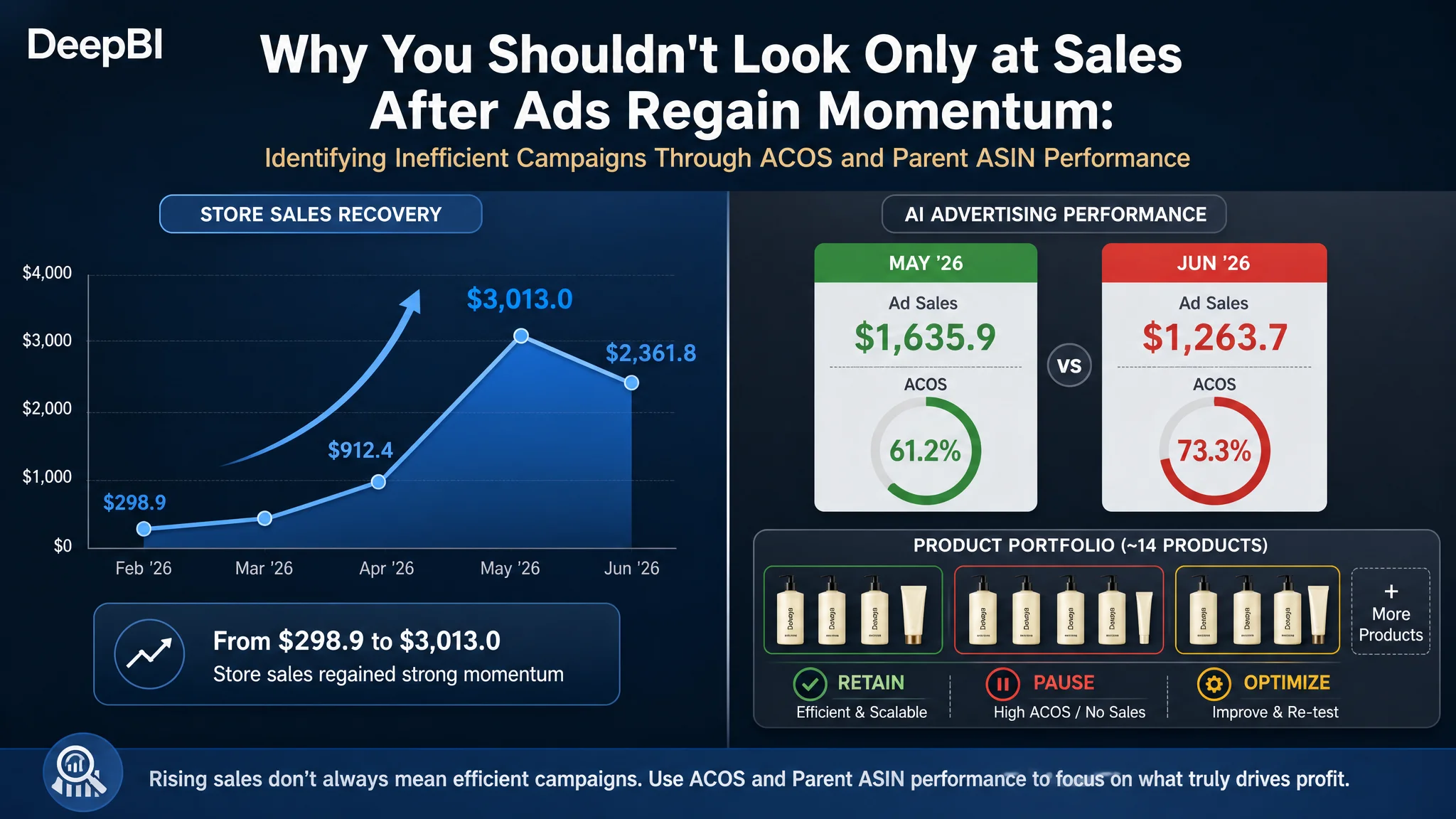
After ads are restarted, an increase in sales does not mean that all advertising is effective. For seasonal product sellers, the recovery of peak-season demand, renewed ad traffic capture, and the product's own competitiveness often affect sales results at the same time. After a long period of stagnant advertising, an Amazon seller of barbecue supplies reintroduced AI advertising. Total store sales increased from 298.9 dollars in February 2026 to 912.4 dollars in April, reaching 3013.0 dollars in May; however, AI advertising ACOS was 61.2% during the same period and rose further to 73.3% in June. This indicates that advertising generated sales, but its efficiency had not yet been validated. This article breaks down how DeepBI identified inefficient advertising from the perspectives of ad sales, ACOS, parent ASIN performance, conversion, and inventory priorities, helping sellers determine which products should continue advertising, which should be paused, and which require Listing optimization before being tested again.
2. Customer Background
 This Amazon seller operates a seasonal barbecue supplies business and manages approximately 14 products in the store. Demand for these products has clear seasonal characteristics. When the peak season arrives, search demand and purchase intent may increase simultaneously; after entering the off-season, advertising investment and sales performance can also contract rapidly.
In June 2025, the customer began using an AI advertising tool. Advertising efficiency was unstable in the early stage, and advertising was essentially stagnant from November 2025 through March 2026. By February 2026, total store sales had fallen to 298.9 dollars.
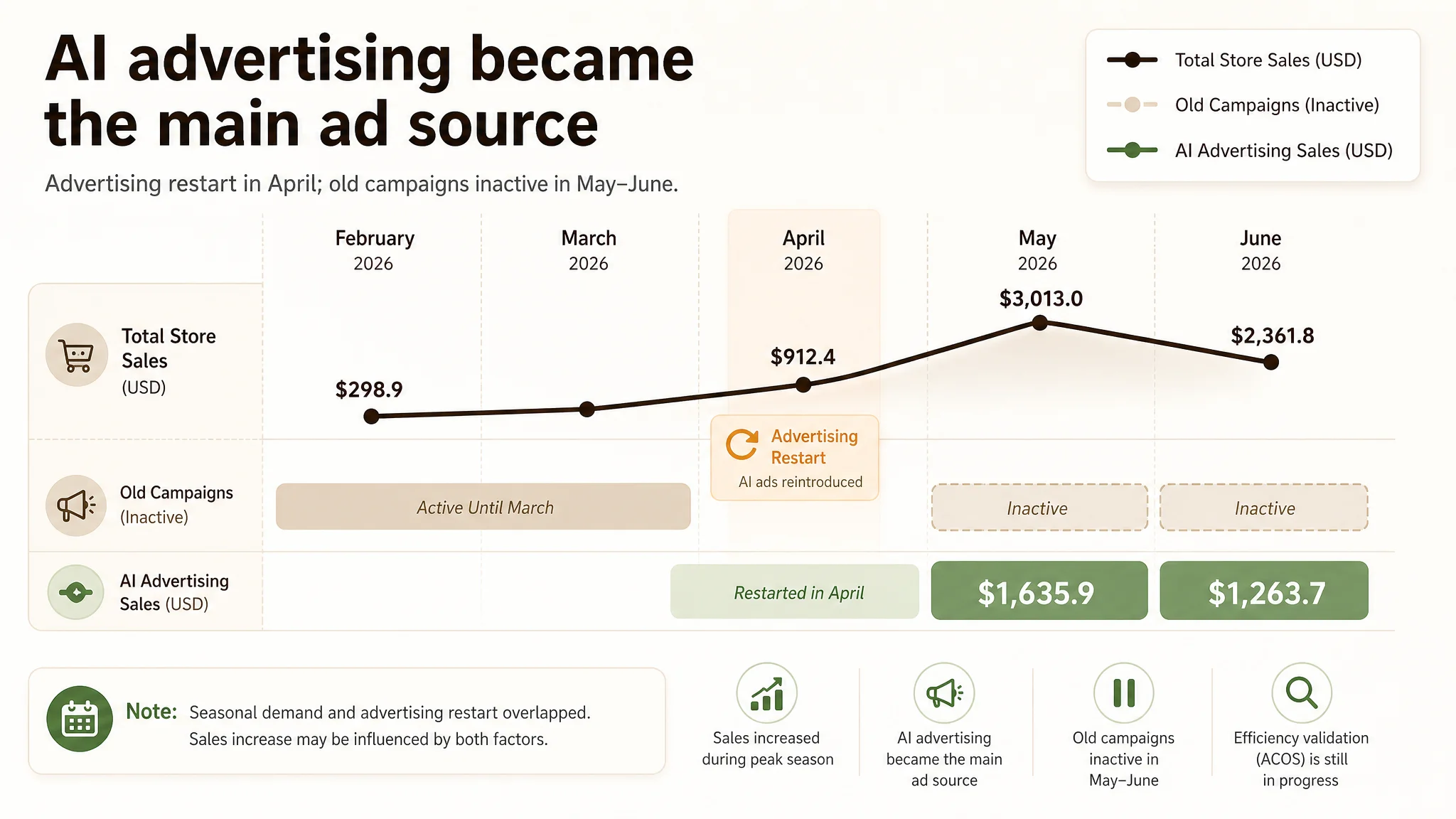
After the product category entered its peak season, the customer reintroduced AI advertising. After the restart, total store sales reached 912.4 dollars in April 2026, 3013.0 dollars in May, and 2361.8 dollars in June. In May and June, the old ad campaigns had no active advertising, making AI advertising the primary source of advertising sales.
After sales regained momentum, the customer's focus also changed. The question was no longer simply whether advertising was worth restarting during the peak season, but rather how to control efficiency after sales began to grow. For a store with approximately 14 products, continuing to expand advertising for every product is not necessarily the best choice. Different parent ASINs may be in different situations: some products may already be generating sales, some may have high ACOS, some may have spending but no conversions, and others may be constrained by Listing competitiveness, inventory, or production capacity.
3. The Problem
 3.1 Sales increased, but ACOS was not validated at the same time
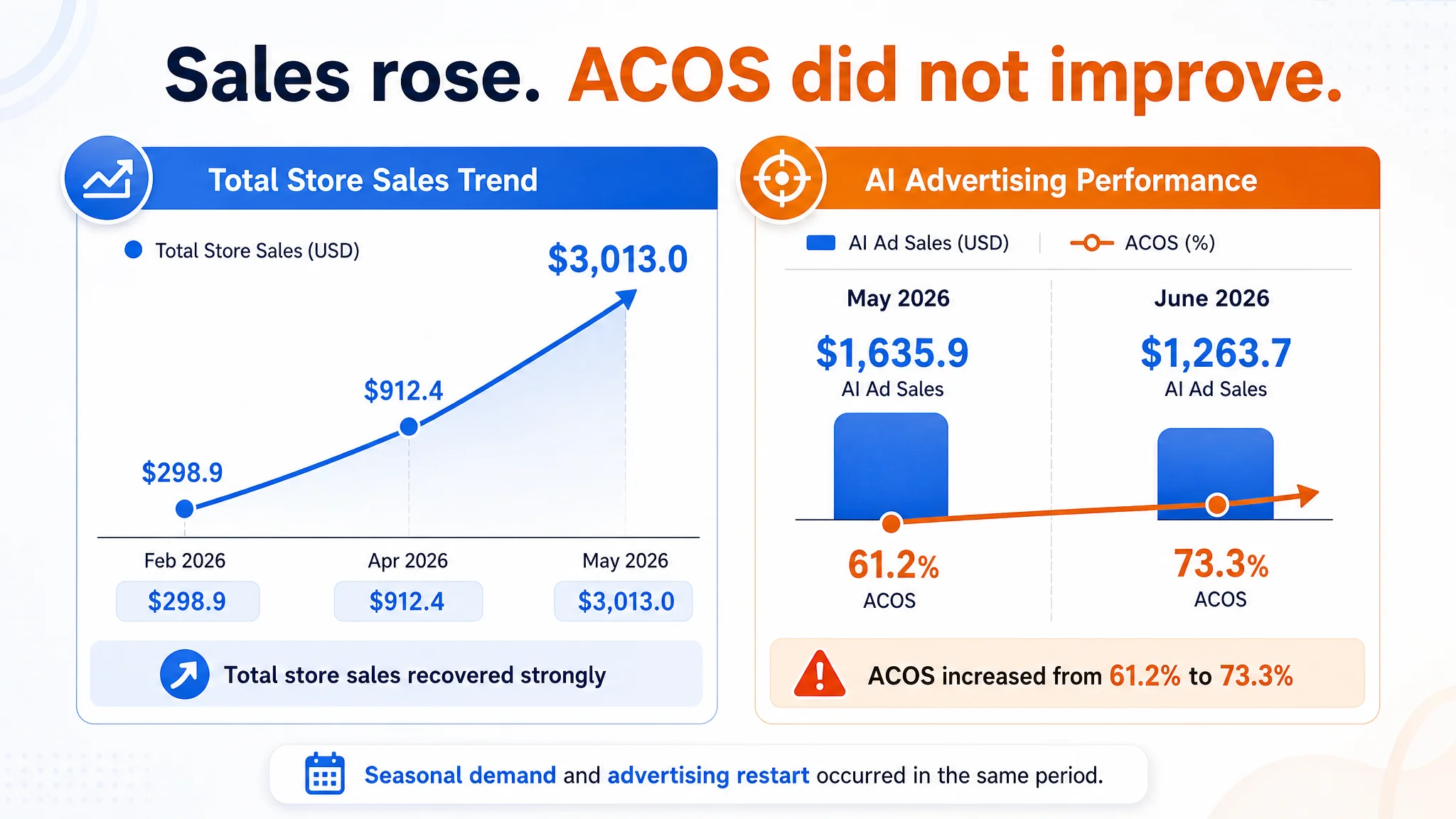
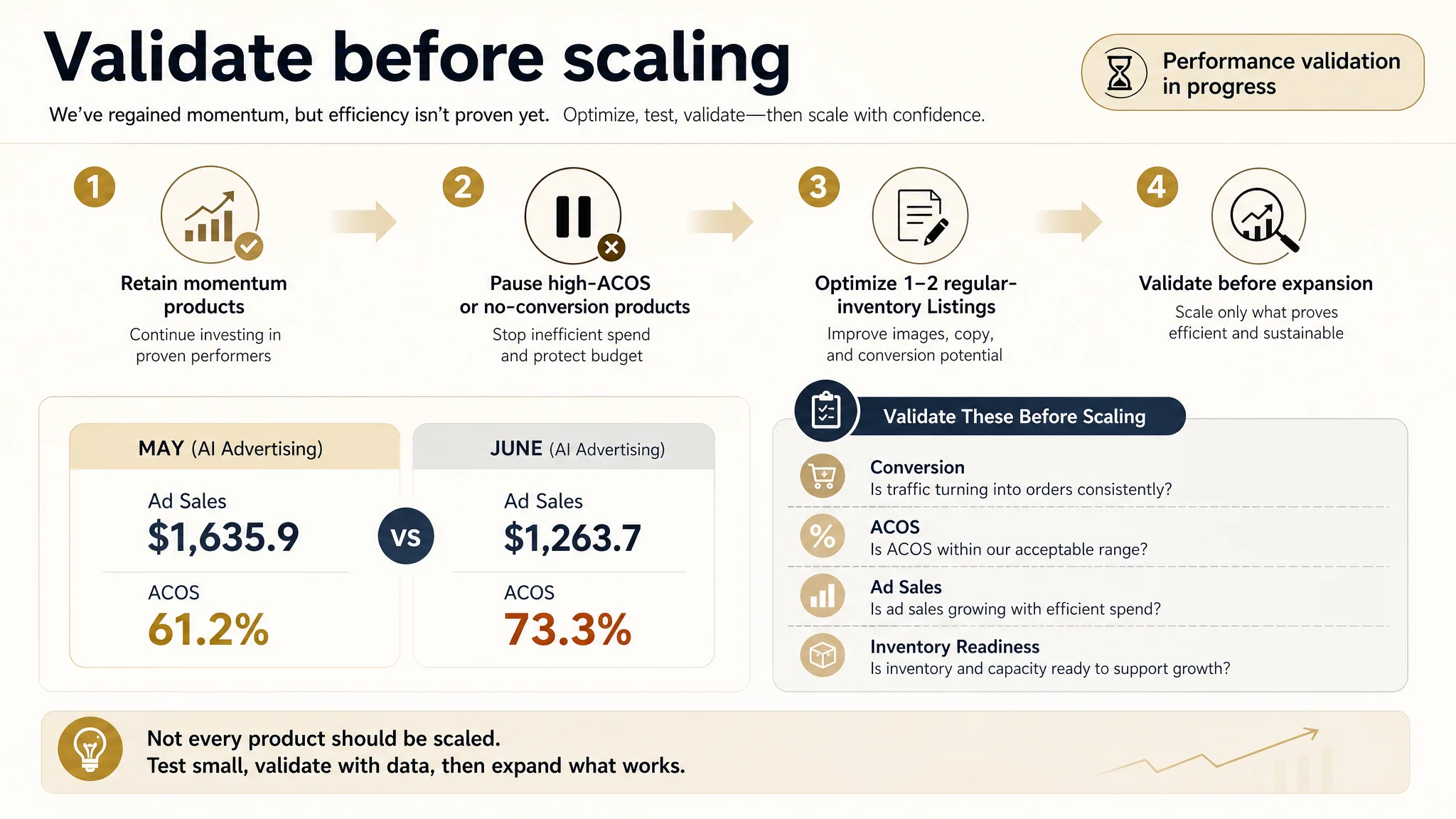
In May, AI advertising generated 1635.9 dollars in sales, with an ACOS of 61.2%. From a sales perspective, the ads captured part of the renewed peak-season demand; however, an ACOS of 61.2% still means that ad-generated sales cannot be directly equated with healthy advertising efficiency.
In June, AI advertising generated 1263.7 dollars in sales, with an ACOS of 73.3%. Compared with May, AI advertising sales decreased while ACOS increased. This change shows that after advertising regains momentum, sellers cannot look only at whether ads are generating sales. They must continue observing whether sales, spend, and ACOS are aligned.
If a seller sees only that May sales reached 1635.9 dollars and continues increasing budgets for every product, high-ACOS products, low-conversion products, and products with genuine growth potential may be managed together. This can easily lead to a situation where ads generate sales but become increasingly unprofitable, while making it impossible to determine whether sales growth came from seasonal demand, ad traffic capture, or the concentrated contribution of a small number of products.
3.2 Performance may vary across parent ASINs
When a store manages approximately 14 products, total store sales and overall advertising ACOS provide only an aggregate result. They cannot show whether every parent ASIN is worth continuing to advertise.
One parent ASIN may already have stable conversions and be suitable for continued advertising. Another may continue generating spend without orders. Some products may have sales but an ACOS above the acceptable range. If budgets are increased uniformly based on total store sales, inefficient products will continue consuming the budget.
Therefore, the second problem after advertising regains momentum is determining which parent ASINs are contributing sales and which are merely consuming advertising spend. This question must be analyzed at the product and parent ASIN levels rather than remaining at the store overview level.
3.3 The advertising problem may not be solely a campaign-structure problem
The customer also expressed concern that the products were less competitive than competing products. This feedback means that even if some products receive impressions and clicks, they may still be unable to convert effectively because of weaknesses in the main image, image information, title, selling-point communication, or overall Listing presentation.
Therefore, when a product has spending but no conversions or has excessively high ACOS, sellers should not immediately conclude that the problem lies in keywords, bids, or budget settings. Advertising can bring traffic to a Listing, but it cannot replace the product page's role in persuading customers.
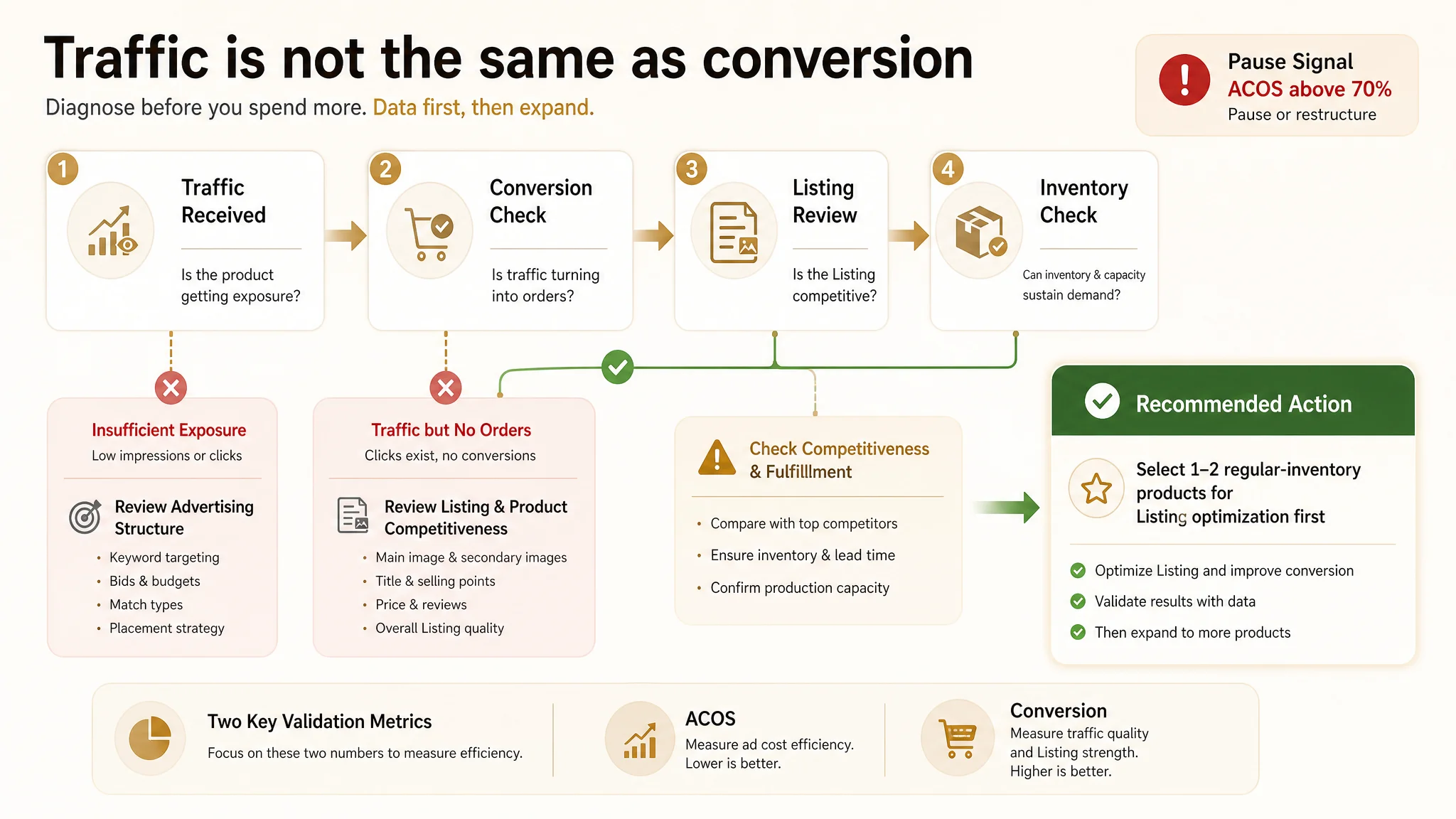
This is the core judgment in determining whether a problem is an advertising issue or a Listing issue: if a product does not receive enough exposure, its advertising traffic capture should be reviewed; if it has already received traffic but continues to generate no orders, Listing competitiveness, product differentiation from competitors, and whether inventory and production capacity support ongoing promotion should also be reviewed.
4. How DeepBI Diagnosed
 After advertising regained momentum, DeepBI did not immediately focus on expanding the budget. Instead, it first broke down the store's overall results by advertising source, parent ASIN, and product operating status to identify which products contributed to sales growth and which campaigns remained inefficient.
1. First, review changes in advertising sources
The first step was to confirm the advertising status of the old campaigns and AI advertising and distinguish which advertising sources generated sales. From May through June, the old ad campaigns had no active advertising, while AI advertising became the primary advertising source. Therefore, AI advertising sales, ACOS, and monthly changes needed to be observed separately.
The purpose of this step was to avoid attributing all changes in total store sales to a single advertising method. From April through June 2026, store sales were 912.4 dollars, 3013.0 dollars, and 2361.8 dollars, respectively. Seasonal demand changes and the advertising restart occurred during the same period, so both factors had to be evaluated within the same operating context.
2. Then, assess whether AI advertising sales and ACOS were aligned
The next step was to compare AI advertising sales and ACOS. In May, AI advertising sales were 1635.9 dollars, with an ACOS of 61.2%; in June, AI advertising sales were 1263.7 dollars, with an ACOS of 73.3%.
These figures cannot be interpreted simply as evidence that advertising performance had stabilized, because sales declined while ACOS increased in June. A more reasonable conclusion is that the ads had regained the ability to capture sales, but efficiency still required further validation. In particular, it was necessary to identify which parent ASINs were responsible for the high ACOS and which products had spending without conversions.
3. Drill down to the parent ASIN level to classify advertising status
With approximately 14 products in the store, the diagnosis needed to review sales, ad spend, conversions, and ACOS for each parent ASIN rather than relying only on account-level averages.
The key groups were as follows:
- Parent ASINs with sales and an acceptable ACOS: Prioritize retaining them and continue monitoring whether their inventory and production capacity remain stable.
- Parent ASINs with high ACOS: Check whether the high ACOS is persistent and whether the Listing has sufficient competitiveness to support continued advertising.
- Parent ASINs with spending but no conversions: Avoid continuing to consume the budget and place them into a pause-and-optimize process first.
4. Combine advertising data with Listing, inventory, and production capacity
If a parent ASIN has clicks and spend but no orders, the cause should not be sought only on the advertising side. The diagnosis should also consider the product's competitiveness against competitors, Listing images and copy, and inventory and production capacity.
The customer was specifically focused on optimizing Listing images and copy and wanted to prioritize products with stable inventory and production capacity. Therefore, the diagnosis needed to answer more than whether to advertise. It also needed to determine whether each product was currently worth sending more traffic to.
5. The Real Problem
 Problem 1: Sales were treated as the only evaluation standard after advertising regained momentum
Cause: The recovery of peak-season demand and the advertising restart occurred almost simultaneously. Total store sales increased from 298.9 dollars in February 2026 to 912.4 dollars in April, reaching 3013.0 dollars in May. Although the change in sales was significant, this result alone could not prove that advertising efficiency had stabilized.
Impact: If advertising is expanded solely because sales increased, issues such as high ACOS, ad spend without conversions, and insufficient product competitiveness may be overlooked, causing the budget to continue flowing to inefficient products.
Evidence: In May, AI advertising sales were 1635.9 dollars, with an ACOS of 61.2%; in June, AI advertising sales decreased to 1263.7 dollars, while ACOS increased to 73.3%. Advertising generated sales, but ACOS had not yet demonstrated a consistently controllable trend.
Problem 2: Store-level data obscured differences between parent ASINs
Cause: The store managed approximately 14 products, and different parent ASINs varied in demand, conversion capability, inventory, and ability to capture advertising traffic. Using total store sales or overall ACOS to make unified decisions made it impossible to identify specific inefficient products.
Impact: Products with potential might not receive sufficient resources, while parent ASINs with high ACOS or spending without conversions could continue consuming the budget, making it difficult to optimize the advertising structure.
Evidence: The customer had already proposed pausing parent ASINs with high ACOS or spending without conversions while retaining products that had gained momentum. This shows that after advertising was restarted, the focus had shifted from whether to advertise to how to manage campaigns by parent ASIN segment.
Problem 3: Inefficient advertising may have been related to Listing and product competitiveness
Cause: The customer reported that the products were less competitive than competing products and requested optimization of Listing images and copy. For products that had already received traffic but had no conversions, advertising settings were not necessarily the only cause. Page presentation and product competitiveness could also limit conversion.
Impact: If the page responsible for capturing traffic is not improved before increasing the budget or expanding keyword advertising, the campaigns may generate more clicks and spend without producing corresponding orders, ultimately resulting in Amazon advertising spend without conversions or excessively high Amazon ACOS.
Evidence: The current records only document the Listing optimization requirements and recommendations. They do not yet include before-and-after data comparing conversion rate, sales, or ACOS. Therefore, whether Listing optimization has improved performance remains to be validated.
6. Optimization Plan
 6.1 Segment advertising by parent ASIN
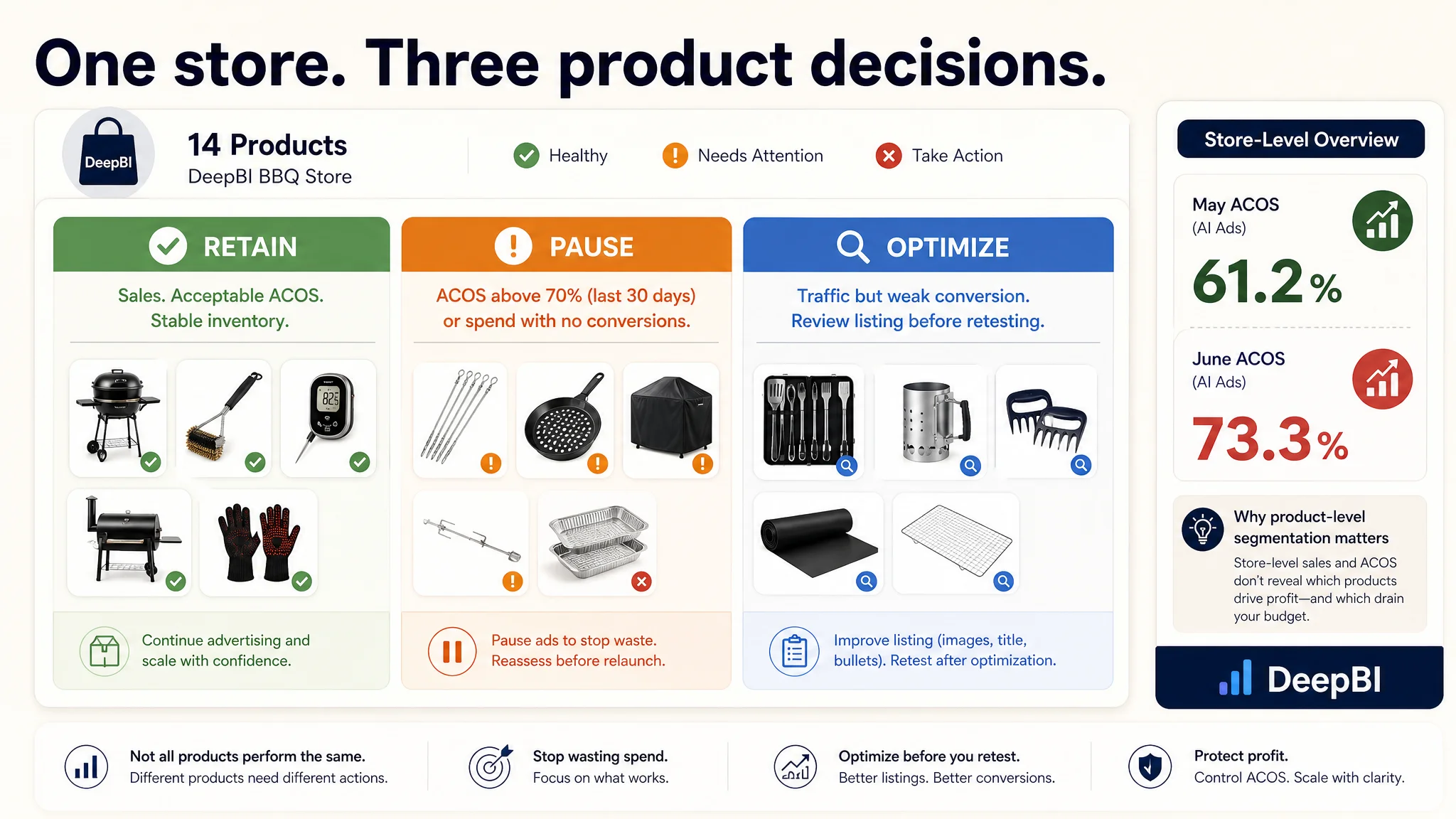
DeepBI recommended dividing parent ASINs into three categories—retain, pause, and optimize—instead of applying a uniform advertising strategy to approximately 14 products.
- Retain advertising for products that have gained momentum and have stable inventory and production capacity, while continuing to monitor ACOS and conversion.
- For parent ASINs with an ACOS above 70% over the past 30 days, pause them or lower their advertising priority to avoid continued budget consumption before efficiency is clear.
- For parent ASINs with spending but no conversions, pause advertising first and then review the Listing, product competitiveness, and inventory situation.
- For products with potential but insufficient page-level traffic capture, enter them into a Listing optimization process and resume advertising after validation is complete.
6.2 Do not simply attribute high ACOS to advertising settings
For parent ASINs with high ACOS, ad spend, sales, conversions, and product page performance should be reviewed together. If a product has no orders, first determine whether the issue is insufficient traffic, mismatched traffic, or an inability of the page to convert traffic.
Before completing a specific diagnosis, the problem should not be addressed only by increasing the budget, raising bids, or expanding the advertising scope. Otherwise, the ads may receive more traffic without changing the product's underlying conversion capability.
6.3 Prioritize Listing optimization for 1 to 2 products with regular inventory
Considering inventory and production capacity constraints, DeepBI recommended prioritizing 1 to 2 products with regular inventory for Listing optimization rather than modifying all products simultaneously.
The optimization should focus on Listing images and copy, with the goal of first validating whether the page's ability to capture traffic improves. During the validation process, sellers should monitor changes in conversion, ad sales, ACOS, and product sales before and after optimization. Expansion to more products should take place only when the data supports it.
6.4 Establish an ongoing validation mechanism after restarting advertising
The May and June data showed that advertising had become the primary advertising source, but they still did not support the conclusion that ACOS was continuously declining or that advertising efficiency had stabilized. The following metrics should be monitored on an ongoing basis:
- Whether AI advertising sales continue to contribute consistently rather than growing only in a single month.
- Whether ACOS returns to a more controllable level, especially whether parent ASINs with ACOS above 70% improve.
- Whether the number of products with spending but no conversions decreases.
- Whether the inventory and production capacity of prioritized products can support continued advertising.
- Whether conversion and advertising traffic capture change in measurable ways after Listing optimization.
7. Results
After advertising was restarted, the store's operating data did change. However, these changes were also affected by the recovery of seasonal demand, renewed advertising traffic capture, and product status, so they cannot be attributed simply to growth generated by DeepBI alone.
- Total store sales increased from 298.9 dollars in February 2026 to 912.4 dollars in April 2026.
- Total store sales reached 3013.0 dollars in May 2026.
- Total store sales were 2361.8 dollars in June 2026.
- AI advertising generated 1635.9 dollars in sales in May, with an ACOS of 61.2%.
- AI advertising generated 1263.7 dollars in sales in June, with an ACOS of 73.3%.
- From May to June 2026, the old ad campaigns had no active advertising, making AI advertising the primary advertising source.
These figures demonstrate that advertising generated a certain level of sales after being restarted, but they do not prove that ACOS had continuously declined or that Listing optimization had improved conversion. The more accurate conclusion at this stage is that the store had moved from a period of advertising stagnation into a phase of performance validation and structural optimization after gaining momentum during the peak season.
8. Case Summary
The real issue in this case was not whether advertising generated sales, but which campaigns were genuinely effective behind the sales growth and which products were still consuming the budget.
After advertising was restarted, total store sales increased from 298.9 dollars to 3013.0 dollars in May, and AI advertising became the primary advertising source. However, ACOS was 61.2% in May and rose to 73.3% in June. This shows that gaining momentum does not mean efficiency has stabilized, much less that every parent ASIN is worth continuing to advertise.
A more reasonable approach is to first break down performance by parent ASIN and then determine advertising priorities based on ACOS, conversion, Listing competitiveness, inventory, and production capacity. Parent ASINs with high ACOS or spending without conversions should be paused first. Products with stable inventory that have already gained momentum should retain advertising. At the same time, 1 to 2 regular products should be selected for Listing optimization, with the scope expanded only after data validation is complete.
The customer has not yet completed performance validation after Listing optimization, and continued performance after the peak season remains to be observed. Therefore, this case is not a success case that has already proven stable growth or continuously declining ACOS. Instead, it represents a real operating scenario involving secondary diagnosis and structural optimization after advertising regained momentum.
9. Key Takeaways for Sellers
Takeaway 1: Advertising sales do not mean advertising efficiency is healthy
Whether advertising is worth continuing should not be judged solely by ad sales. ACOS, conversion, and spend structure must also be considered. During the peak season in particular, naturally recovering demand may amplify sales. Sellers need to distinguish seasonal growth from improvements in advertising efficiency.
Takeaway 2: Overall store ACOS cannot replace parent ASIN diagnosis
When a store has multiple products, advertising decisions must be made at the parent ASIN level. Products with high ACOS, spending without conversions, and those that have already gained momentum should follow different strategies. Only through product segmentation can sellers avoid distributing the budget evenly among inefficient products.
Takeaway 3: To determine whether it is an advertising issue or a Listing issue, examine what happens after traffic arrives
If a product has no exposure, first review the advertising structure and traffic acquisition. If it has already received traffic but continues to generate no orders, also review Listing images, copy, product competitiveness, and inventory status. Advertising optimization and Listing optimization are not mutually exclusive. Their sequence should be determined based on the data.
For seasonal sellers, restarting advertising is only the first step. What truly matters is continuing to validate performance after sales gain momentum: which products can consistently capture demand, which campaigns should be paused, which Listings are worth optimizing, and whether sales and ACOS remain controllable after the peak season ends.