

1. Introduction
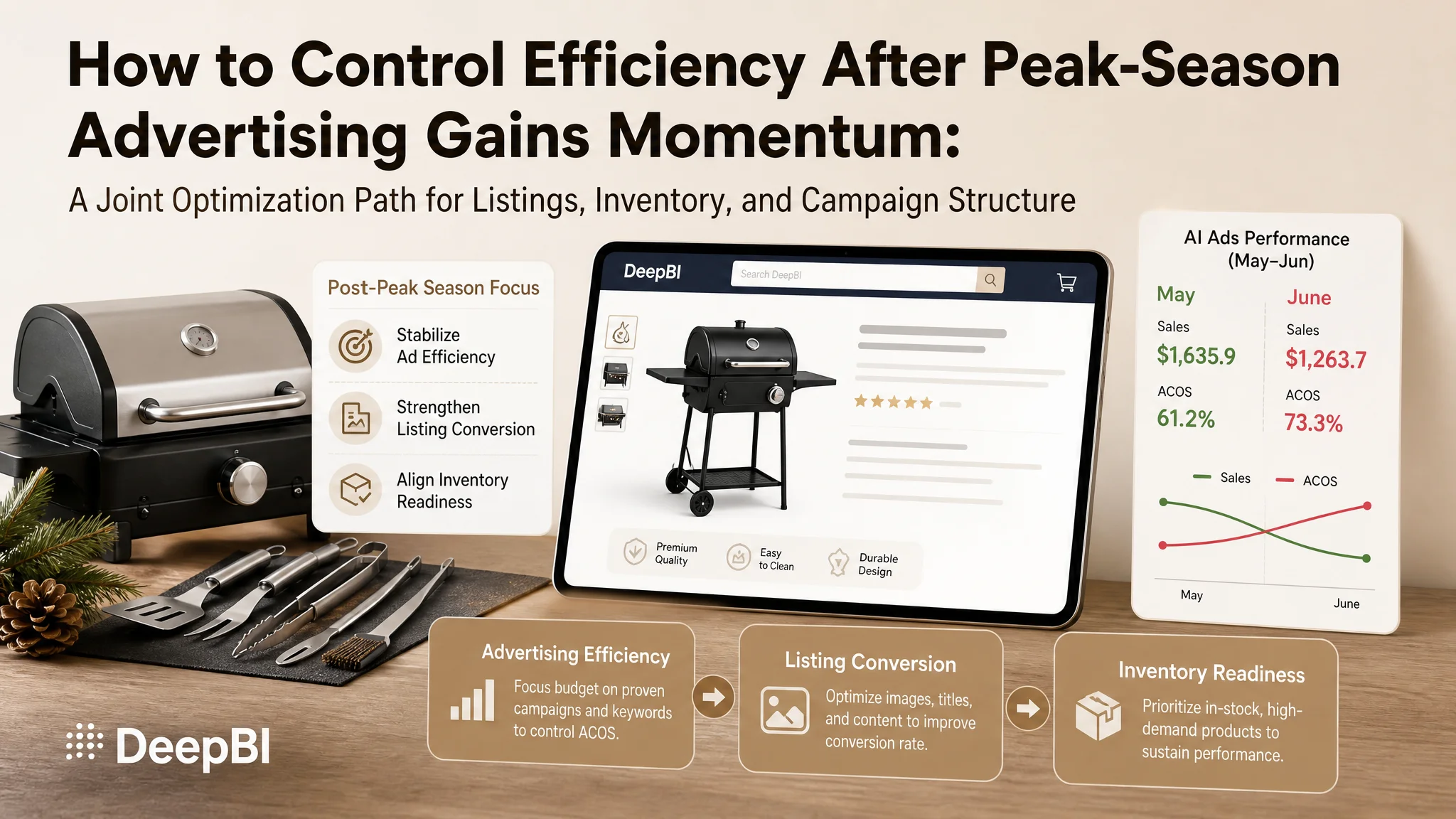
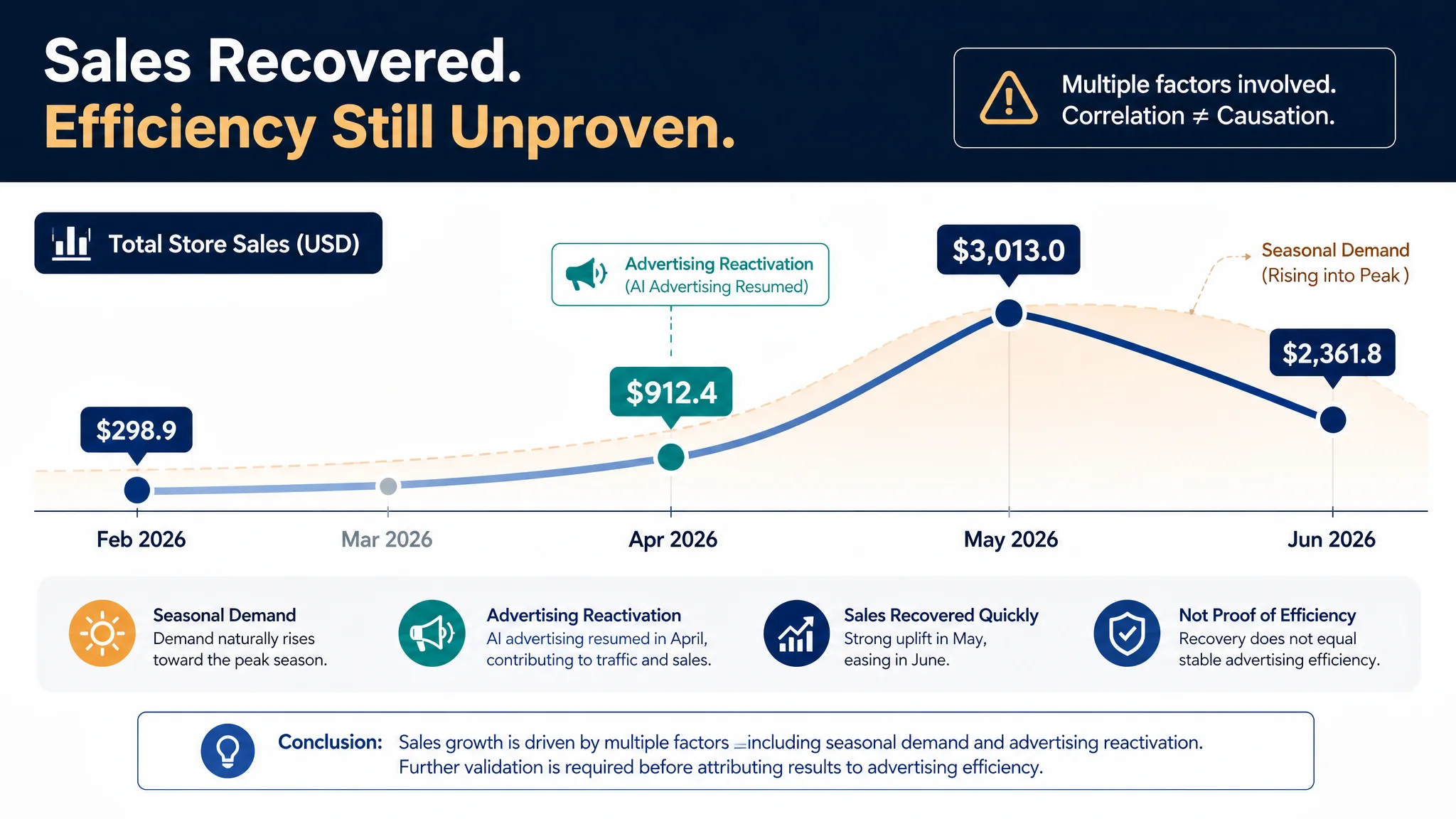
After seasonal products resume advertising during the peak season, sales may recover quickly. However, this does not mean the advertising structure is healthy, nor does it indicate that the Listing is capable of consistently converting incoming traffic. After a long period of stagnant advertising, an Amazon seller of barbecue supplies attempted AI advertising again during the peak season. The store's total sales increased from $298.9 in February 2026 to $912.4 in April and reached $3013.0 in May. At the same time, AI advertising ACOS was 61.2% in May and rose to 73.3% in June. Some products also faced insufficient inventory, production capacity, and competitiveness.
These figures show that gaining momentum during the peak season is only the first stage. The more important questions that follow are: Which products are worth continuing to advertise? Should products with high ACOS be paused immediately, or should their Listings be optimized first? Should products with limited inventory receive advertising budget? Based on this operating scenario, this article breaks down how advertising, Listings, and inventory can be diagnosed together, while clarifying which changes have already occurred and which optimizations remain in the planning and validation stages.
2. Customer Background
 The seller operates a seasonal barbecue supplies business with approximately 14 products. Demand for these products has clear seasonal characteristics. The peak season may bring concentrated purchasing and rapid sales growth, while sales and advertising demand typically decline significantly during the off-season. Therefore, the store cannot focus only on sales for a single month. It must also evaluate seasonal demand, product inventory, advertising traffic-conversion capability, and Listing conversion capability at the same time.
In June 2025, the customer began using an AI advertising tool. Advertising efficiency was unstable in the early stage, and advertising was essentially stagnant from November 2025 through March 2026. By February 2026, the store's total sales had fallen to $298.9. After the product peak season began, the customer tried AI advertising again. Advertising resumed delivery, and store sales began to recover accordingly.
However, the customer's focus soon changed from “Is it worthwhile to try advertising again during the peak season?” to “How can efficiency be controlled after advertising gains momentum?” In addition to wanting to retain products that had already gained traction, the customer was also concerned about high ACOS, parent ASINs that had spending but no conversions, and insufficient competitiveness compared with competing products. At the same time, the inventory and production capacity of some products were not suitable for further expansion of promotion.
3. The Problem
 After advertising resumes, the easiest misjudgment is to continue expanding campaigns as long as sales are growing. For seasonal products, this approach involves several risks.
First, sales growth does not necessarily result entirely from advertising optimization. The recovery of peak-season demand, the restoration of organic traffic, the resumption of advertising, and the product's own inventory status may all affect the outcome. If the sales recovery is simply attributed to the advertising tool, it becomes impossible to determine whether advertising has genuinely improved operating efficiency.
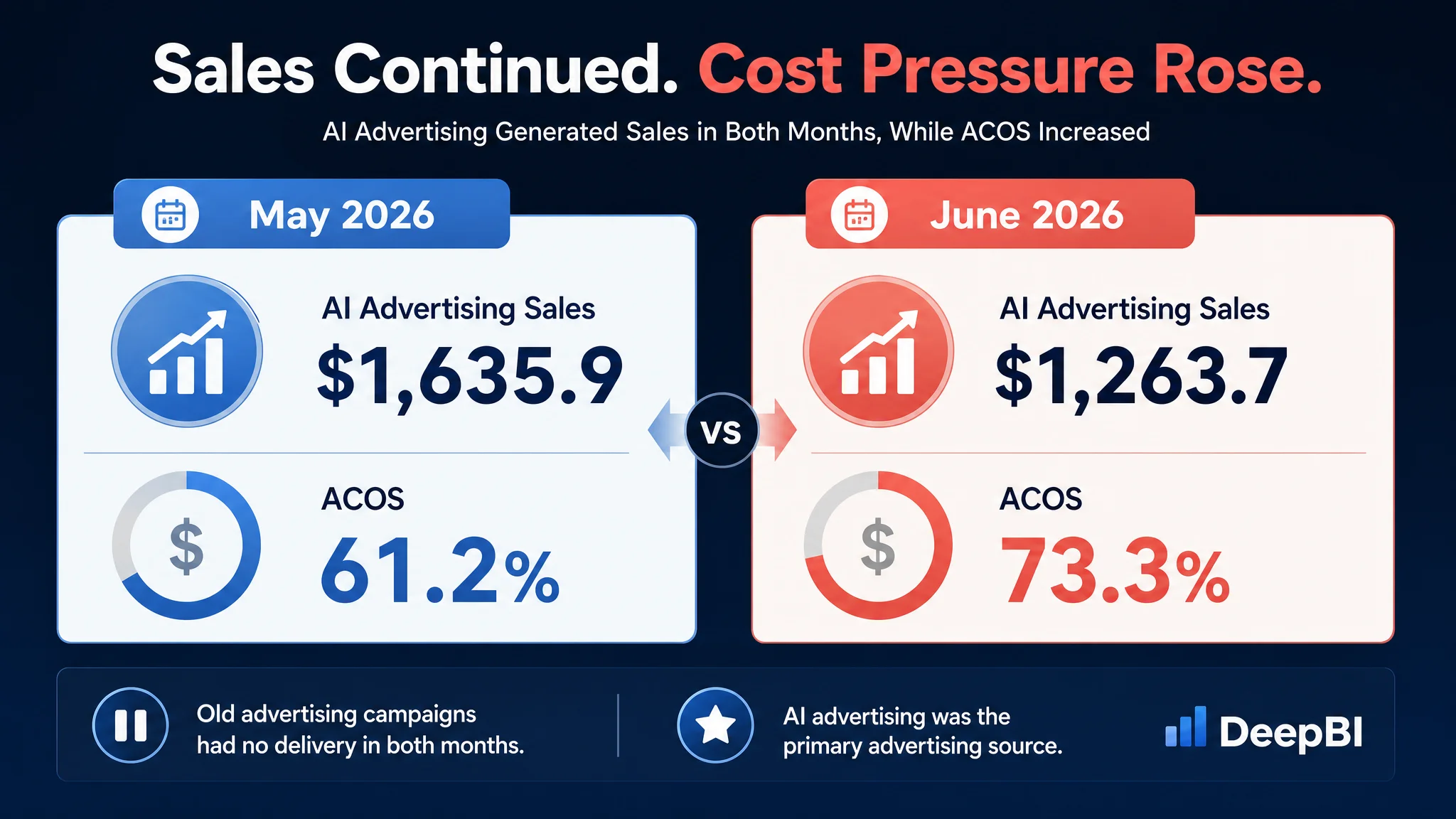
Second, advertising may generate sales while also creating relatively high costs. In May 2026, AI advertising generated $1635.9 in sales, with an ACOS of 61.2%; in June, AI advertising generated $1263.7 in sales, with an ACOS of 73.3%. This means that advertising continued to generate sales, but cost pressure had not been consistently validated. For sellers seeking to control profit and cash flow, “generating sales” and “delivering effective advertising” are not the same judgment.
Third, different products cannot use the same advertising strategy. Some parent ASINs may have spending but no conversions, some products may have high ACOS, and others may perform well in advertising but be constrained by inventory or production capacity. Without distinguishing between product statuses, continuing to increase budgets may produce two outcomes: inefficient products continue consuming budget, while products that are genuinely worth promoting cannot maintain stable supply.
Fourth, advertising and Listing problems may exist at the same time. When a product lacks competitiveness compared with its competitors, advertising can generate exposure, but traffic entering the detail page may not convert. In this situation, simply adjusting keywords, budgets, or bids may not solve the root problem. Sellers need to determine whether the current issue is that advertising has not found effective traffic or that the Listing has failed to convert the traffic already acquired.
4. How DeepBI Diagnosed
 These issues cannot be resolved by looking directly at total store sales. DeepBI's diagnostic focus is to break down sales changes by traffic source, product, cost, and operational conversion capability.
1. First, check whether advertising has genuinely resumed its role as the primary traffic source. Compare store sales, AI advertising sales, and the status of old advertising campaigns during the advertising stagnation period and after the restart. Confirm which advertising sources contributed most during the sales growth period. Existing data shows that old advertising campaigns had no delivery from May to June 2026, while AI advertising became the primary advertising source. However, this only indicates a change in advertising sources and does not independently prove that the growth was entirely generated by AI advertising.
2. Next, review changes in sales and ACOS across months. Total store sales were $298.9 in February 2026, $912.4 in April, $3013.0 in May, and $2361.8 in June. At the same time, AI advertising ACOS increased from 61.2% in May to 73.3% in June. Observing sales and ACOS together helps prevent the business from focusing only on peak-season growth while overlooking declining efficiency.
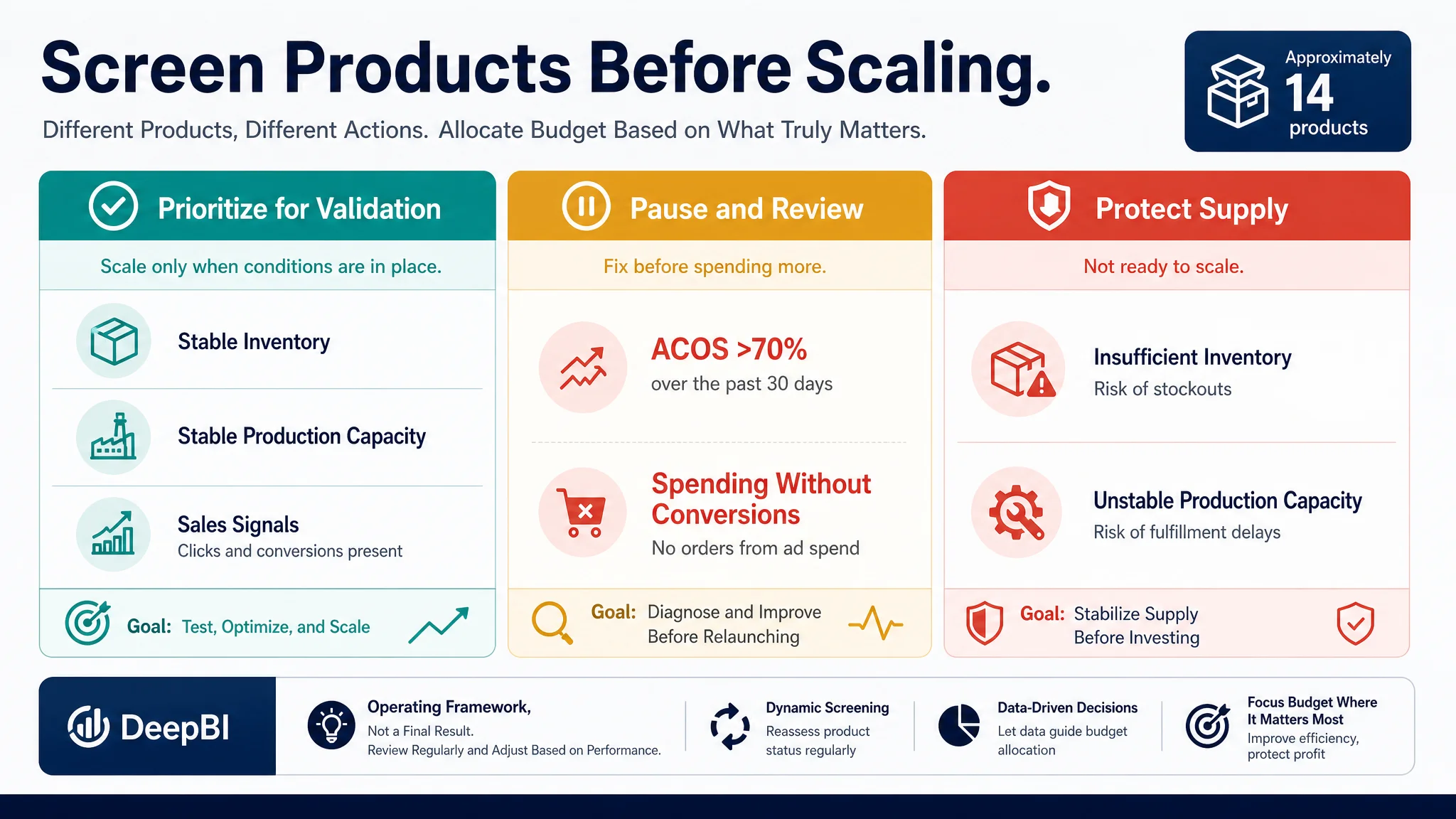
3. Break down advertising performance by parent ASIN. Focus on identifying parent ASINs with high ACOS, parent ASINs with spending but no conversions, and products that have generated sales but have unstable inventory or production capacity. For parent ASINs with an ACOS above 70% over the past 30 days or with no conversions, first place them into the pause-and-review group instead of continuing to allocate budget evenly.
4. Combine product inventory and production capacity to determine advertising priorities. Orders generated by advertising must be supported by inventory and fulfillment capabilities. If inventory is insufficient, continuing to increase exposure may result in stockouts or an inability to sustain sales. If inventory is stable but conversion is low, the Listing content and product competitiveness should be examined more closely.
5. Finally, distinguish between advertising problems and Listing problems. If a product receives clicks and incurs spending but has no conversions over an extended period, check search-term relevance, detail-page images, title and selling-point messaging, price competitiveness, reviews, and other information at the same time. The current information only confirms that the customer believes some products lack competitiveness compared with competitors and plans to optimize their Listings. It does not yet include conversion results after Listing optimization.
5. The Real Problem
 Problem 1: Advertising has gained momentum again, but efficiency is not yet stable
Cause: The recovery of peak-season demand occurred at the same time as the advertising restart, so sales growth was affected by multiple factors. AI advertising continued to generate sales in May and June, but ACOS increased from 61.2% to 73.3%, indicating that the relationship between advertising revenue and cost still requires further validation.
Impact: If budgets are expanded based only on sales, seasonal demand or short-term growth may be misjudged as stable advertising capability. This could cause high-ACOS products to continue consuming budget and make it difficult to determine whether reasonable efficiency can be maintained after the peak season ends.
Evidence: Total store sales increased from $298.9 in February 2026 to $912.4 in April, reached $3013.0 in May, and were $2361.8 in June. AI advertising sales were $1635.9 in May, with an ACOS of 61.2%, and $1263.7 in June, with an ACOS of 73.3%. These are actual operating results, but they cannot serve as evidence that Listing optimization or sustained ACOS reduction has already been completed.
Problem 2: Product advertising priorities are not fully aligned with inventory and production capacity
Cause: The store manages approximately 14 products, and different products vary in inventory, production capacity, conversion capability, and advertising performance. If a unified advertising logic is adopted, products with low efficiency or unstable supply may receive inappropriate budgets.
Impact: On the one hand, parent ASINs with high ACOS or spending without conversions may continue to generate waste. On the other hand, products with stable inventory and production capacity that are worth further validation may not receive sufficient optimization resources.
Evidence: The customer explicitly requested that products already gaining momentum be retained, parent ASINs with high ACOS or spending without conversions be paused, and products with stable inventory and production capacity be prioritized for promotion. DeepBI recommended pausing parent ASINs with an ACOS above 70% over the past 30 days or with no conversions, then relaunching them after optimization. This is part of the current structural optimization plan, and subsequent performance data is not yet available.
Problem 3: Insufficient Listing competitiveness may limit advertising traffic conversion
Cause: The customer reported that the products were not competitive enough compared with competing products and requested optimization of Listing images and copy. When advertising can generate exposure and clicks but the detail page does not clearly communicate the product's images, selling points, or value, increasing advertising investment alone may not improve conversion.
Impact: Insufficient Listing conversion capability increases the cost of advertising traffic and makes it difficult to reduce ACOS. It also makes it difficult for sellers to determine whether the problem comes from advertising or the product page. If all products are changed at the same time, validation becomes more difficult.
Evidence: The current account records the need to optimize Listing images and copy, as well as the customer's concern about product competitiveness. However, it does not provide a comparison of conversion rates, order volume, or ACOS before and after optimization. Therefore, the improvement generated by Listing optimization has not yet entered the performance-validation stage.
6. Optimization Plan
 Narrow the validation scope instead of changing all products at the same time
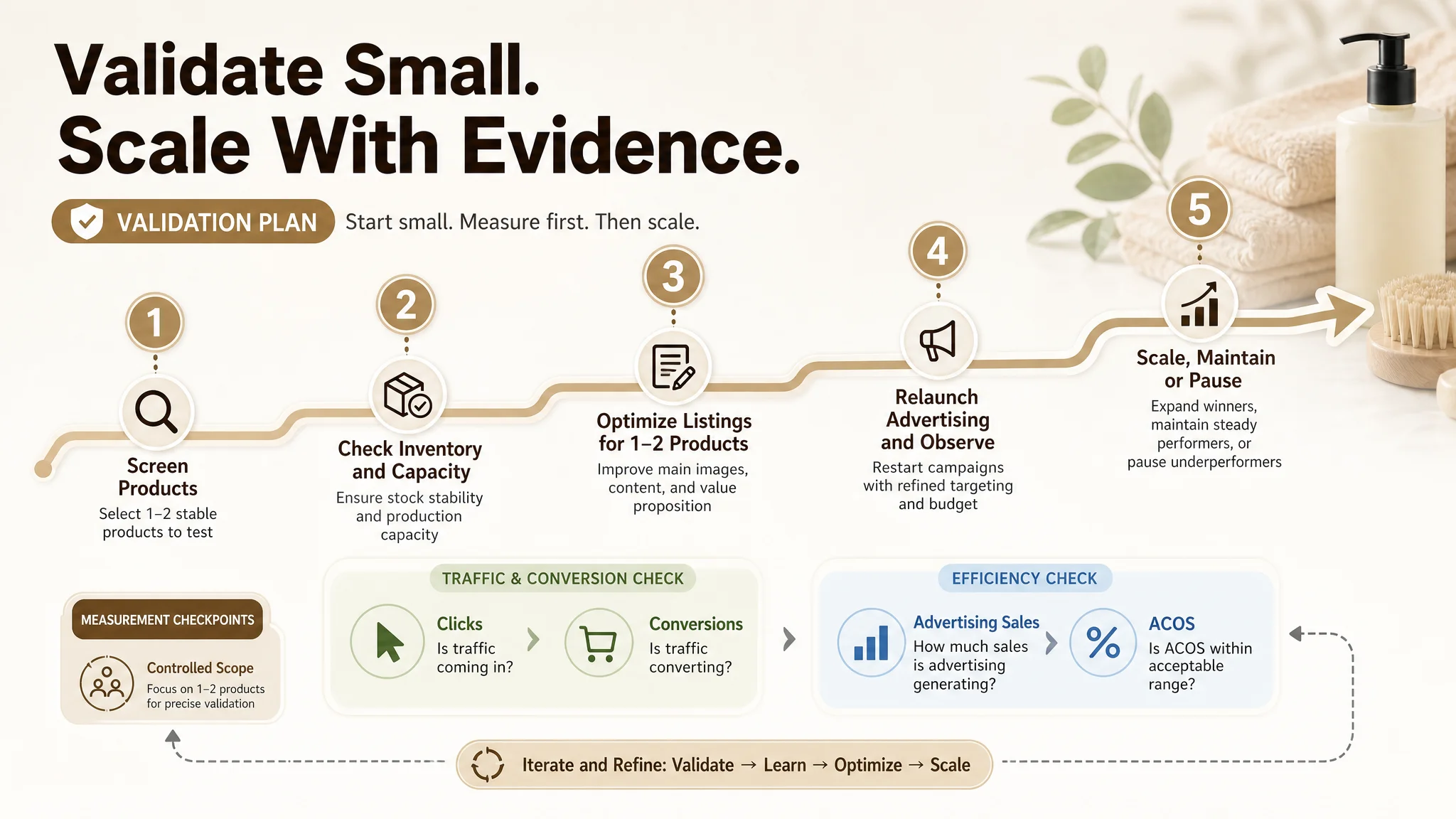
DeepBI recommends prioritizing 1 to 2 products with stable regular inventory and relatively stable production capacity for Listing optimization. The scope should not be too broad, because the goal is to minimize variables and observe whether adjustments to images, copy, and selling points improve the Listing's ability to convert traffic. Only after a small-scale validation should expansion to more products be considered.
Pause and review low-efficiency parent ASINs
For parent ASINs with an ACOS above 70% over the past 30 days or spending without conversions, pause advertising first to prevent inefficient spending from continuing to accumulate. Pausing does not mean permanently abandoning the products. Instead, it moves them into a review process: check whether search terms are relevant, whether advertising is bringing effective visits, whether the Listing has a conversion foundation, and whether inventory supports future promotion.
Include inventory and production capacity in advertising budget decisions
Advertising budgets should be prioritized for products with stable inventory and production capacity, room for Listing optimization, and genuine sales signals. For products with insufficient inventory or unstable supply, even if short-term advertising performance is good, expansion should not be pursued blindly. Seasonal sellers in particular need to balance the remaining peak-season period with replenishment capabilities to avoid advertising-driven demand exceeding actual supply capacity.
Make Listing optimization serve advertising validation
Listing optimization should not be treated as independent page beautification. Instead, it should focus on converting advertising traffic. Priority should be given to checking whether the main image and product images clearly communicate usage scenarios and core selling points, whether the title and copy accurately match customer needs, and whether the page explains how the product differs from competing products.
After optimization, a fixed observation period and evaluation metrics are needed, such as comparing changes in clicks, conversions, advertising sales, and ACOS before and after optimization. However, in the current case, Listing optimization has not yet completed performance validation. Therefore, it cannot be claimed in advance that the conversion rate has increased or ACOS has declined.
Use a “campaign—page—inventory” validation cycle
A relatively prudent execution sequence is: first screen the products, then check inventory and production capacity; next optimize the Listings of 1 to 2 products; relaunch advertising and observe the advertising data; and finally decide whether to scale, maintain, or pause based on conversion and ACOS. The focus of this process is not to find all the answers at once, but to ensure that every adjustment corresponds to a specific product and metric.
7. Results
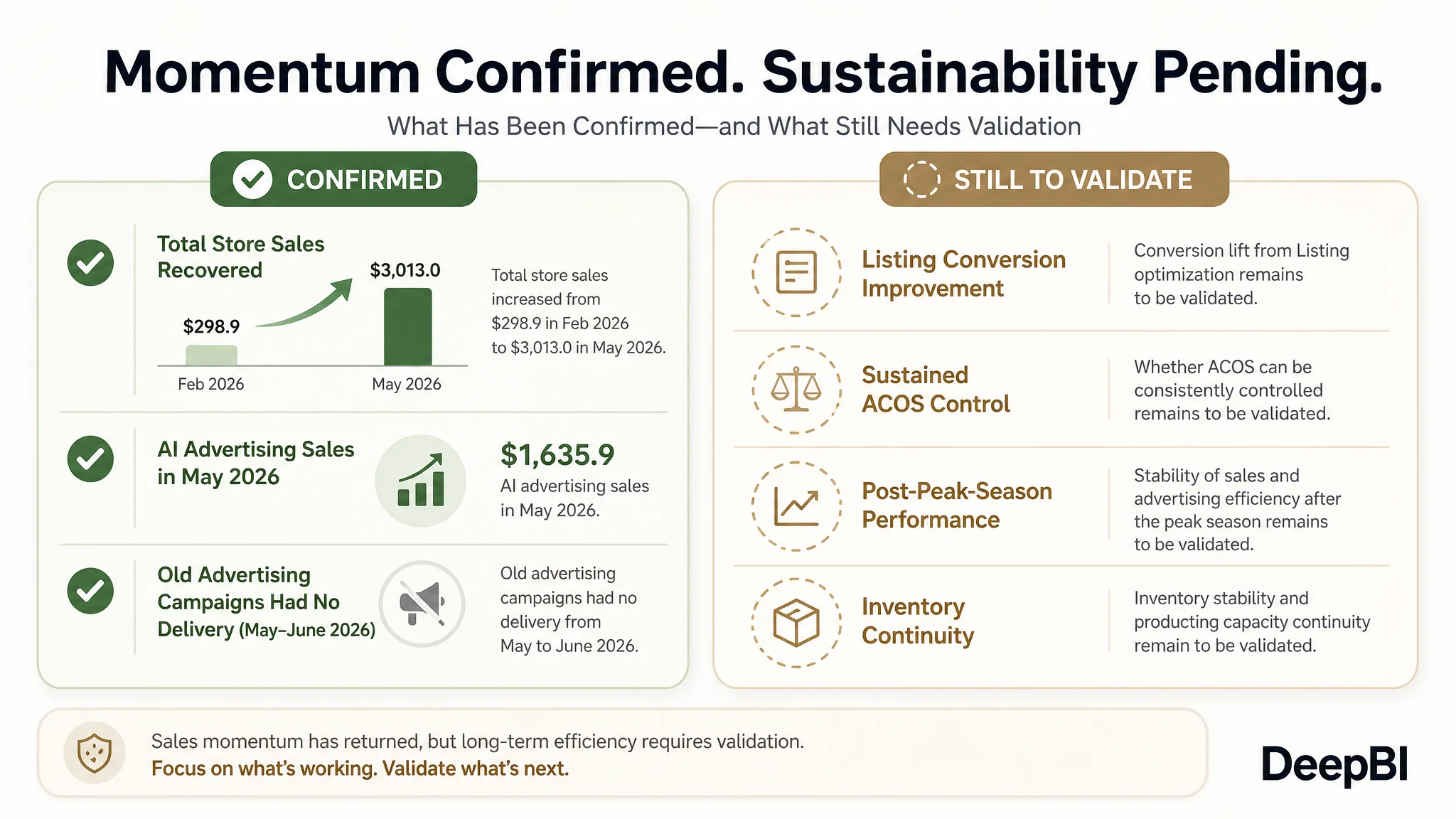
The changes confirmed so far mainly come from the advertising restart and the peak-season demand phase, rather than from completed Listing optimization.
- Total store sales increased from $298.9 in February 2026 to $912.4 in April 2026.
- Total store sales reached $3013.0 in May 2026 and were $2361.8 in June.
- AI advertising generated $1635.9 in sales in May 2026, with an ACOS of 61.2%.
- AI advertising generated $1263.7 in sales in June 2026, with an ACOS of 73.3%.
- From May to June 2026, old advertising campaigns had no delivery, and AI advertising became the primary advertising source.
These data show that the store did experience a sales recovery and a shift in advertising sources after advertising resumed. However, they do not currently support the conclusions that “Listing optimization has improved conversion,” “DeepBI has continuously reduced ACOS,” or “growth can still be maintained after the peak season.” The customer is still in the performance-validation and structural-optimization stage after peak-season growth. Additional data on Listing performance before and after optimization, inventory stability, post-peak-season sales performance, and ongoing ACOS changes is still needed to determine whether the optimization plan is genuinely effective.
8. Case Summary
The real issue in this case is not the isolated question of whether advertising should continue. It is how to establish a controllable advertising structure after gaining momentum during the peak season.
First, the sources of sales recovery need to be broken down. Seasonal demand, advertising reactivation, organic traffic, and product status may all change at the same time, so growth cannot be attributed simply to the advertising tool.
Second, after advertising gains momentum, the focus should shift from scaling to screening. Parent ASINs with high ACOS or spending without conversions should be paused and reviewed. Products with stable inventory and production capacity are the ones suitable for the next round of focused validation.
Third, advertising and Listing issues need to be evaluated together. If advertising can generate traffic but the page cannot clearly communicate the product's value, increasing the budget may only amplify cost pressure. The most prudent path at this stage is to select 1 to 2 stable products for Listing optimization and then use advertising data to validate the page's ability to convert traffic.
This is not a successful case in which the growth loop has already been completed. It is an optimization path that is still being validated. For seasonal sellers, the true criteria for effective evaluation should be whether products can be supplied consistently, whether the Listing improves traffic conversion, whether advertising sales can continue at an acceptable ACOS, and whether the structure remains viable after the peak season ends.
9. Key Takeaways for Sellers
Takeaway 1: Do not look only at advertising sales; also evaluate ACOS and product status
Advertising-generated sales do not necessarily indicate healthy advertising efficiency. Sellers should evaluate advertising sales, ACOS, conversion performance, inventory, and production capacity at the same time. Particularly when ACOS is higher than expected, first determine whether the issue is imprecise traffic, insufficient Listing conversion, or a lack of product competitiveness before deciding whether to increase the budget.
Takeaway 2: Inventory stability is a prerequisite for advertising
Products with insufficient inventory or unstable production capacity are not suitable for direct advertising expansion. Advertising budgets should be prioritized for products that can maintain supply, have room for profit, and have already shown sales signals. Otherwise, even if rankings and orders rise in the short term, stockouts or insufficient fulfillment capabilities may prevent sustainable returns.
Takeaway 3: Validate Listing optimization with advertising data instead of relying on intuition
When sellers ask, “Is this an advertising problem or a Listing problem?”, they can first observe whether the product receives clicks, whether it generates conversions, which search terms or products bring visits, and whether the page clearly communicates product differentiation. It is recommended to adjust 1 to 2 products first, compare conversion rate, advertising sales, and ACOS after a fixed observation period, and then decide whether to expand the scope. This makes it possible to place Amazon advertising optimization, Amazon organic traffic growth, and product page optimization within the same operational validation framework.
For seasonal products, peak-season advertising strategy should not stop at “restarting advertising.” What needs to be established is a continuous mechanism covering product screening, inventory management, Listing optimization, and advertising relaunches, ensuring that every campaign answers a specific operating question.