

Introduction
A seller specializing in lighting products on the US marketplace, with more than 100 SKUs, relied on advertising to generate exposure but had long been burdened by high ACOS. The ACOS of the original advertising campaigns reached as high as 78.8% at one point—almost equivalent to “losing money on every sale.”
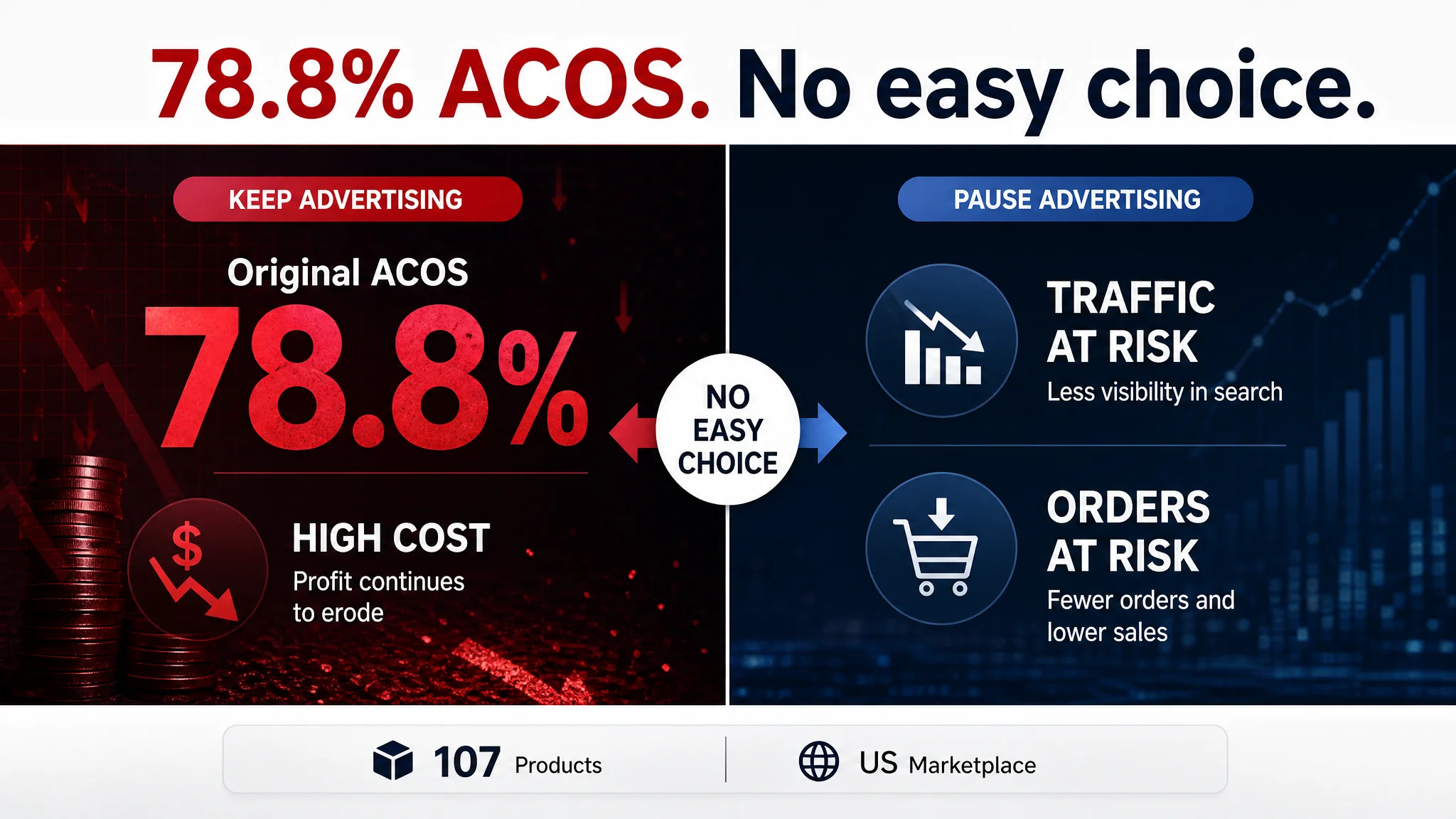
The seller was caught in a typical dilemma faced by many lighting sellers: stopping ads meant risking a drop in orders, while continuing to advertise meant continuing to lose money.
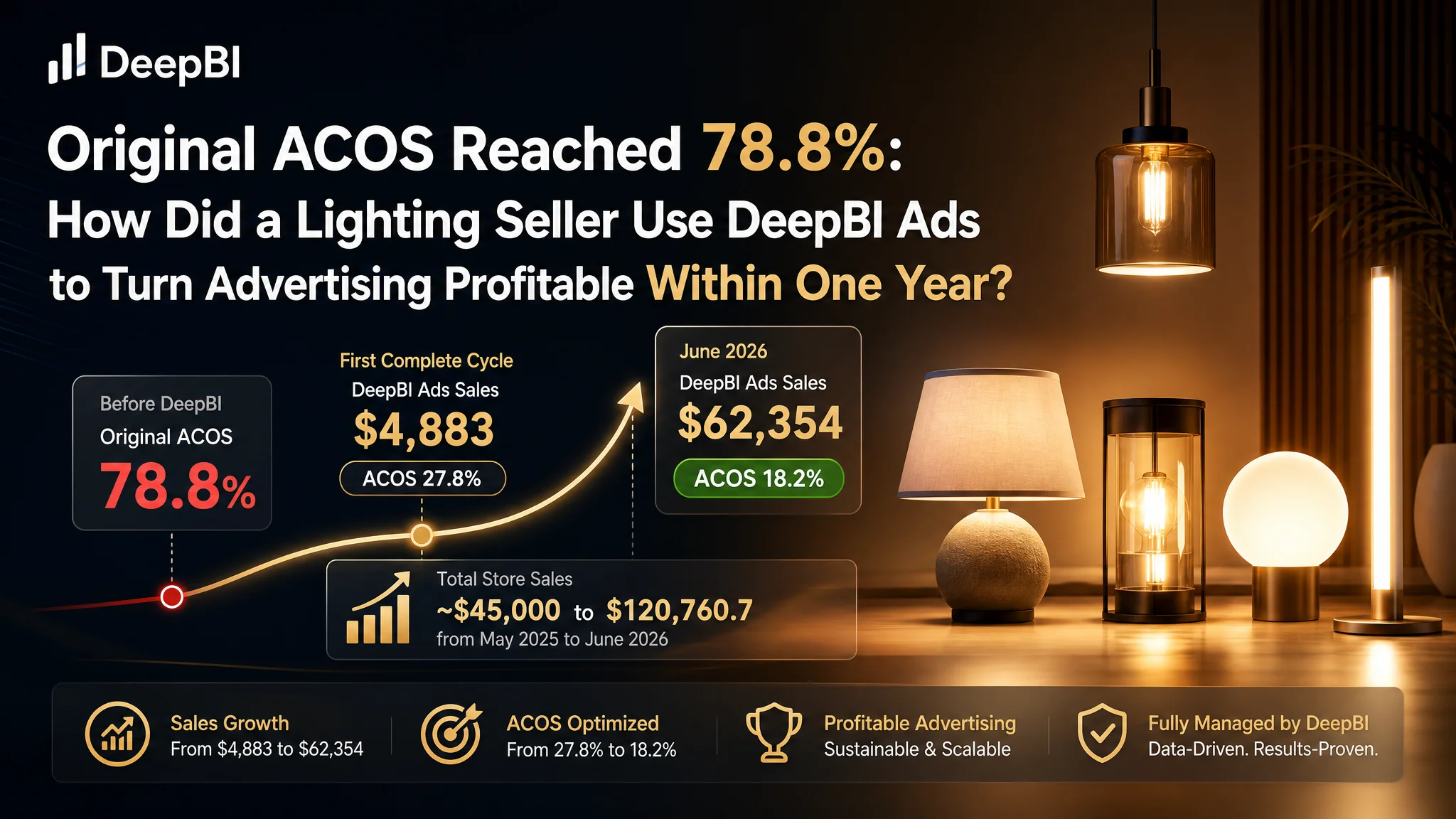
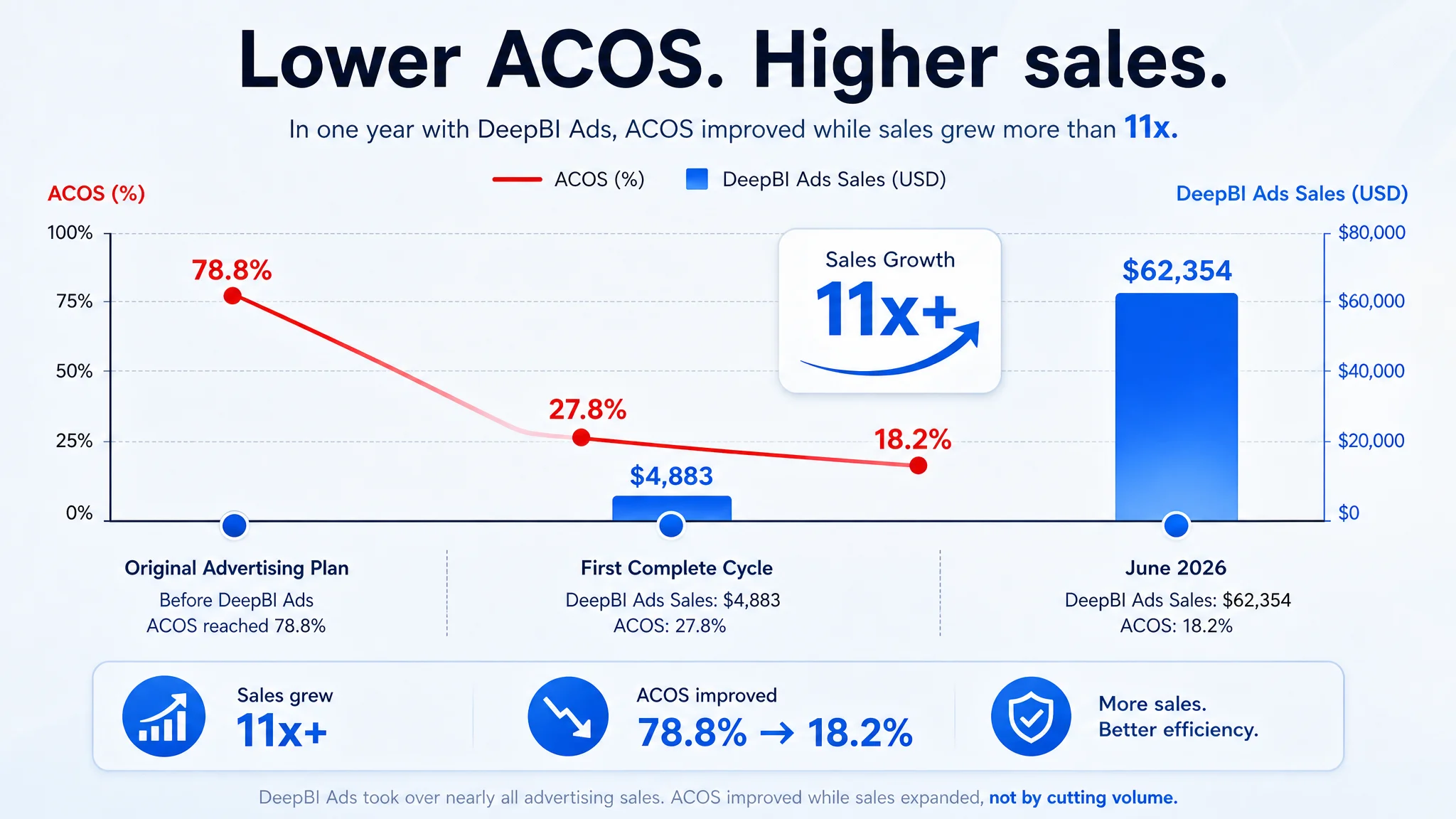
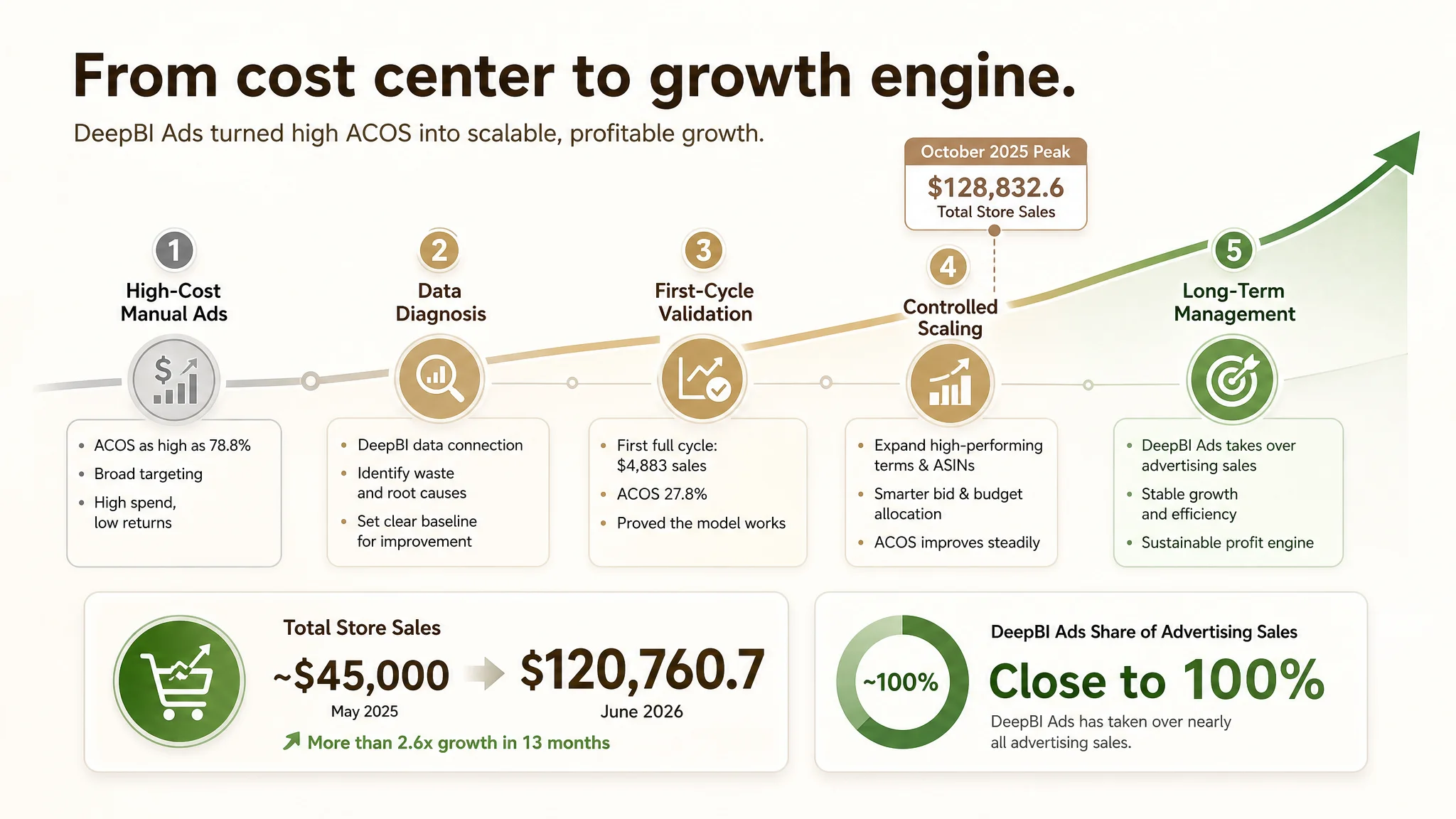
After adopting DeepBI Ads management, DeepBI Ads generated $4,883 in sales during the first complete data cycle, with an ACOS of only 27.8%, immediately bringing advertising back into an acceptable range. Over the following year, DeepBI Ads sales grew further to $62,354 / month, while ACOS continued to improve to 18.2%. DeepBI Ads gradually took over nearly all of the store’s advertising sales, supporting overall sales growth from approximately $45,000 / month to more than $120,000 / month.
This article does not focus on “how advanced DeepBI Ads is.” Instead, it explores a straightforward question: With amazon acos too high and advertising becoming increasingly unprofitable, what exactly changed for this lighting seller so that it could maintain exposure and sales while bringing ACOS down from 78.8% to around 20%?
Customer Background
This was an experienced lighting seller operating on Amazon’s US marketplace for many years. The store’s main characteristics included:
- Category: Lighting, where both average order value and CPC were relatively high;
- Marketplace: US;
- ASIN volume: 107 ASINs participated in advertising during the management period;
- High dependence on advertising: Ongoing advertising was essential for competing for top-page exposure and capturing category traffic;
- Limited operational resources: The team did not have the time to monitor the advertising console and make daily adjustments, but was also reluctant to stop advertising.
Before adopting DeepBI Ads management, the store already had a set of manually managed advertising campaigns. However, several practical problems had persisted for a long time:
- The original advertising ACOS reached as high as 78.8%, making advertising almost like “filling a financial hole”;
- Budget allocation was broad and lacked precise control by SKU and lifecycle stage;
- The operations team spent a great deal of time adjusting bids and budgets but saw no structural improvement.
In a highly competitive category such as lighting, where CPC is high, these problems combined to create a direct consequence: the more the seller advertised, the more money it lost. Yet once advertising was paused, traffic and orders dropped noticeably, leaving the store stuck in a dilemma.
The Problem
If we look only at the single figure “ACOS 78.8%,” it is easy to assume that the bids were simply “a little too high” or that the ads had not been optimized properly. But for this lighting seller, the problem went far beyond that.
Behind the surface issue of “amazon acos too high” were at least three underlying conflicts:
1. Advertising became increasingly unprofitable, but the seller still had to rely on it
The lighting category naturally depends on Sponsored Products and display advertising to compete for first-page placement. Without advertising, the Listing received almost no organic exposure. With continuous advertising, ACOS remained high and steadily eroded profits.
2. The operations team was tied up by advertising but could not genuinely improve the results
The team had to review reports, adjust bids, and screen keywords frequently. However, with 107 ASINs and a complex parent-child structure, it was difficult for manual operations to achieve truly refined control. In many cases, the team could take care of a few SKUs but not the other listings.
3. The seller feared both traffic disruption and continued overspending
With the original ACOS at 78.8%, it was difficult to approve any action to “increase the budget to drive volume”:
- Increasing the budget could result in greater losses;
- Reducing the budget or pausing ads could cause search rankings and organic traffic to decline.
At this stage, many sellers ask two typical questions:
- “How can Amazon advertising losses be solved? Is the only option to cut prices significantly and sacrifice rankings?”
- “Is the problem with the ads, or with the Listing itself?”
This lighting seller’s situation gradually worsened against this backdrop: ACOS remained too high for an extended period, profits were eroded, and the team found it increasingly difficult to determine how to advertise next.
How DeepBI Diagnosed
After deciding to try DeepBI Ads management, the seller did not immediately hand over all advertising operations. Instead, it began with diagnosis and comparison.
The diagnosis process involved roughly three key steps:
1. Connect the data and establish a baseline
- Connect the store’s advertising and sales data to DeepBI;
- Identify the performance of the original advertising campaigns, including ACOS of 78.8%, spend and sales by ad type, and the advertising performance of key ASINs;
- Establish a clear comparison benchmark: all subsequent optimization results would be evaluated against this baseline rather than based solely on short-term fluctuations.
2. Break down the advertising structure and determine where the money was being spent
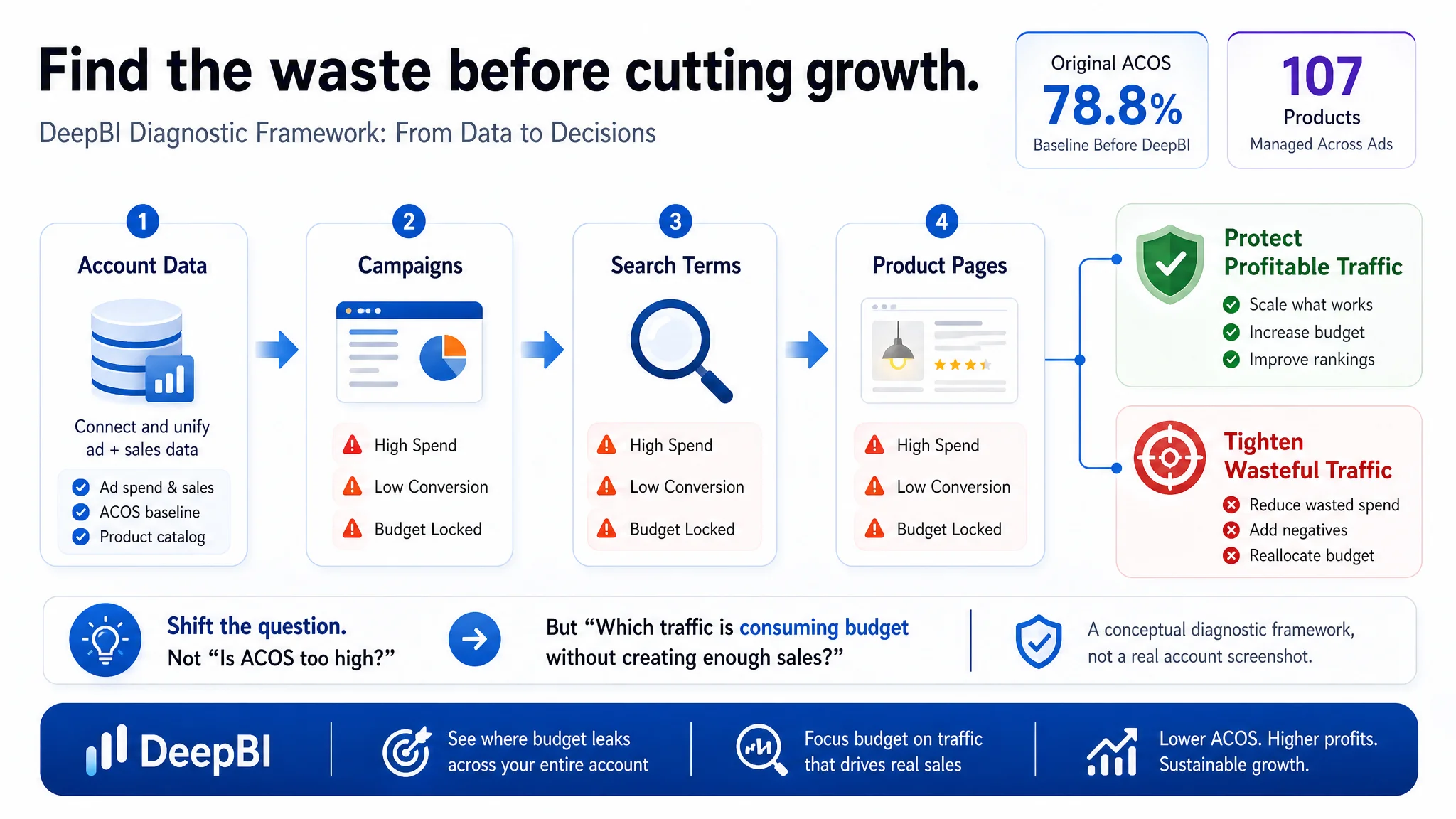
During diagnosis, DeepBI did not stop at saying, “Overall ACOS is too high.” It examined the account layer by layer:
- Which campaigns consumed most of the budget but generated almost no sales returns;
- Which search terms had excessively high CPC and low conversion rates but continued to receive bids;
- Which ASINs had remained in a high-ACOS range for a long time without timely budget limits or bid reductions;
- Whether the budget had been locked up by a small number of “underperforming campaigns,” taking opportunities away from other promising SKUs.
3. Identify traffic that must be funded and traffic that could be cut
In the lighting category, not all high-CPC traffic should be avoided. The key was to distinguish between:
- Traffic that “must maintain exposure,” such as brand defense and core category terms;
- Peripheral long-tail, irrelevant, or weakly relevant terms that only drove ACOS higher;
- Traffic for SKUs with stable performance and strong conversion rates that could absorb more budget.
Through this step-by-step breakdown, DeepBI helped the seller make a critical shift in perspective:
“The problem is not simply that ACOS is 78.8%. Most of the money was being spent on the wrong keywords and within the wrong campaign structure.”
Only after the problem was clearly identified could the subsequent optimization actions have a meaningful direction.
The Real Problem
After the diagnosis was completed, it became clearer that the lighting seller’s core problems involved at least three dimensions:
Problem One: The Budget Was Locked Up by Low-Efficiency Campaigns and Search Terms
- Cause: In the original advertising plan, a large amount of budget was concentrated in a small number of broadly matched and relatively general category-based automatic or manual campaigns. These campaigns:
- Had high CPC and many clicks but relatively low conversion rates;
- Lacked systematic negative keyword management and screening over the long term;
- Had excessive budgets and consumed large amounts of money every day.
- Impact:
- This “low-efficiency spend” directly pushed overall ACOS to 78.8%;
- High-potential SKUs and high-quality long-tail terms could not receive sufficient budget and missed profitable traffic opportunities;
- From the reports, the seller could only see that “overall ACOS was very high,” making it difficult to locate the problem precisely.
- Evidence: During the first stage of DeepBI management, DeepBI Ads achieved an ACOS of 27.8% in the same store and during the same period, using a lower average CPC and a more focused keyword mix. This showed that there was significant room to eliminate wasted budget in the original plan.
Problem Two: There Was No Coordinated Strategy Between Advertising and the Listing
- Cause:
- The original plan was structured primarily by ad placement and campaign type, rather than around individual product and lifecycle strategies;
- For Listings with average performance or low conversion rates, the seller did not use advertising data to optimize the content in return, but simply continued spending on ads;
- For multi-variation lighting listings, there was no clear strategy for the “primary child SKU,” resulting in scattered advertising and insufficient accumulated data.
- Impact:
- Even when certain keywords generated a healthy number of clicks, the Listing itself could not support sufficient conversions, so ACOS naturally remained high;
- The seller struggled to determine whether the problem was with the ads or the Listing, repeatedly going back and forth between price and bid adjustments.
- Evidence: After DeepBI Ads took over, data was used to identify the SKUs and keyword groups better suited for promotion. The budget was gradually concentrated on listings with higher conversion rates. Overall ACOS declined from 27.8% to 18.2%, while advertising sales grew from $4,883 to $62,354. This demonstrated the major impact of “choosing the right listings and the right keywords.”
Problem Three: Complete Dependence on Manual Bid Adjustments Could Not Adapt to a Complex Competitive Environment
- Cause: Competition in the lighting category was intense, and CPC and conversion rates changed constantly with time, seasonality, and competitor behavior:
- The frequency and granularity of manual bid adjustments could not keep up with market changes;
- Many adjustments were based on operational experience and subjective judgment rather than continuous, granular data feedback;
- Once the operations team became busy with other tasks, the ads were effectively left “unattended.”
- Impact:
- ACOS became “stuck” at a high level and was difficult to bring back into a healthy range through short-term manual optimization;
- Because the seller could not establish a stable advertising strategy, it was afraid to increase the budget significantly but also afraid to pause advertising, leaving it “on life support” in a high-cost range.
- Evidence: After adopting DeepBI Ads management, advertising sales grew by more than 11 times within one year without additional manual investment, while ACOS improved from 27.8% to 18.2%. This demonstrated the advantages of automated, data-driven optimization in a complex environment.
Optimization Plan
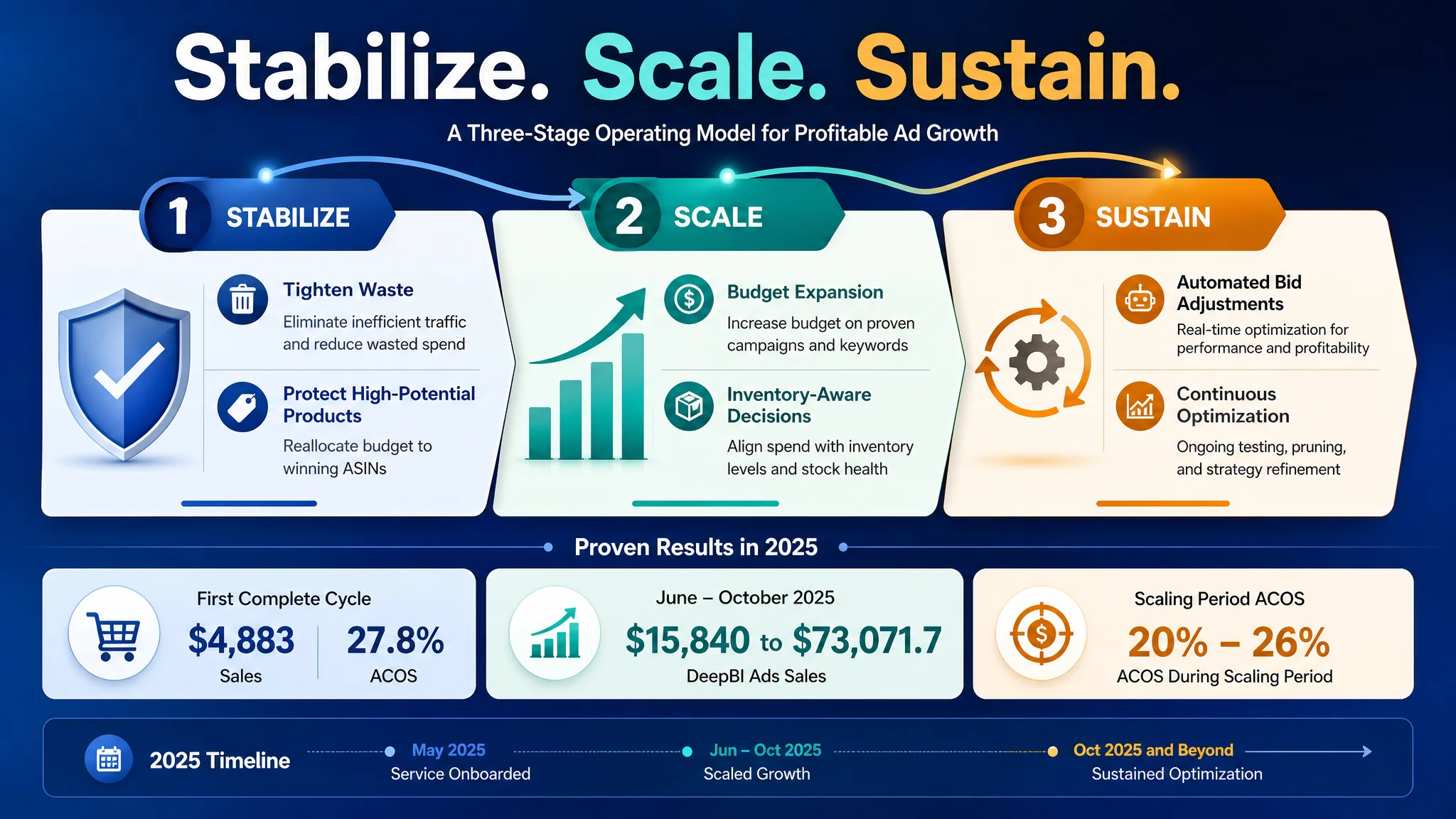
Once the problems were clear, what truly made a difference was an actionable optimization plan rather than a few empty principles. With the goal of both reducing ACOS and maintaining exposure and sales, the lighting seller’s optimization was carried out in three stages:
Stage One: Use DeepBI Ads Management to Quickly Establish a Healthy Foundation
The goal was to first bring ACOS back from the severely loss-making range of 78.8% to an acceptable level.
The main actions included:
1. Tighten low-efficiency traffic
- Identify high-spend, low-conversion keywords and search terms based on historical data;
- Use DeepBI Ads management strategies to reduce bids and exposure opportunities for these terms, preventing continued “bottomless pit” spending.
2. Concentrate the budget on high-potential SKUs and keyword groups
- Select a group of SKUs to receive “priority budget protection” based on conversion rate, clicks, ACOS, and other metrics;
- Moderately increase bids for well-performing keyword groups so they could obtain more exposure and clicks with the same budget;
- Optimize the campaign structure, reduce duplication and internal competition, and consolidate similar types of traffic for management.
3. Automate bid adjustments and conduct continuous, incremental testing
- Use DeepBI Ads bidding logic to continuously fine-tune CPC based on real-time and historical performance;
- Avoid extreme actions such as “sharply increasing bids based on instinct today and cutting them to the minimum tomorrow”;
- Allow the system to continuously test new terms and traffic within a controlled range, managing ACOS without giving up growth opportunities.
As a result, during the first complete data cycle after DeepBI Ads was enabled, DeepBI Ads generated $4,883 in sales with an ACOS of 27.8%. Compared with the original plan’s 78.8%, this represented a major shift from severe losses to controllable performance.
Stage Two: Scale Up While Keeping ACOS Under Control
Once advertising returned to a healthy range, many sellers would ask: “Can we continue increasing volume without causing ACOS to spike?”
This lighting seller’s approach was to gradually increase the budget and management scope after validating DeepBI Ads’ capabilities, allowing DeepBI Ads to take on more sales:
1. Gradually increase the share of advertising sales
- As DeepBI Ads performance stabilized, the budget and bids of the original manual campaigns were gradually reduced;
- A larger proportion of advertising sales was handled by DeepBI Ads campaigns, reducing the uncertainty of manual campaigns;
- From June–October 2025, DeepBI Ads sales grew from $15,840 to $73,071.7, while ACOS remained stable in the 20–26% range, proving that “scaling up does not mean losing control.”
2. Dynamically scale based on inventory status
- When inventory was sufficient, the budget ceiling could be increased moderately, allowing DeepBI Ads to actively capture more sales within an acceptable ACOS range;
- When certain best-selling SKUs were out of stock or understocked, budgets and bids were adjusted to control waste and avoid continuing to spend on unavailable listings;
- Inventory status became one of the important reference dimensions for determining the pace of DeepBI Ads adjustments.
3. Optimize the advertising structure to accommodate SKU complexity
- As advertising sales expanded, budgets and campaigns were planned separately for certain priority SKUs;
- For multi-variation lighting listings, the roles of the “primary child” and “supporting child” were gradually clarified;
- By organizing the advertising structure, DeepBI Ads could more easily make differentiated decisions for different SKUs.
During this stage, driven by DeepBI Ads, the store’s overall sales grew from approximately $45,000 / month in the early service period to nearly $128,000 / month, proving that scaling while keeping ACOS under control was feasible.
Stage Three: Long-Term Management and Continuous Optimization
Once advertising sales and ACOS had both entered an ideal range, the focus of optimization shifted from “Can we survive?” to “How can we operate more steadily and sustainably?”
During the stable service stage, the focus of the collaboration between the lighting seller and DeepBI shifted to:
- Allowing DeepBI Ads to take over nearly all advertising sales, with manual campaigns becoming secondary;
- Achieving DeepBI Ads sales of $62,354, an ACOS of 18.2%, and total store sales of $120,760.7 in June 2026;
- Continuing to carry out refined adjustments and collaborative strategy development around new product promotion, priority listings, budget granularity, and other areas.
Results
The results over the year can be summarized with several sets of data:
1. ACOS: From a severely loss-making range back to a healthy range
- Original manual advertising plan: ACOS as high as 78.8%;
- First stage after enabling DeepBI Ads: ACOS decreased to 27.8%;
- After one year of service, in June 2026: DeepBI Ads ACOS further improved to 18.2%.
2. Advertising sales: Continued scaling while ACOS improved
- Sales during the first stage after enabling DeepBI Ads: $4,883;
- DeepBI Ads sales one year later: $62,354;
- Monthly DeepBI Ads sales grew by more than 11 times within one year.
3. Overall store sales: More than doubled with the support of Ads management
- Overall monthly sales at the beginning of the service period: approximately $45,000;
- Peak in October 2025: $128,832.6;
- June 2026: $120,760.7, remaining within a high and stable range.
4. Advertising structure: A significant increase in DeepBI Ads’ share of advertising sales
- Initial stage: DeepBI Ads served as a “control group” and handled only part of the advertising sales;
- Later service stage: DeepBI Ads sales accounted for nearly 100% of total advertising sales, while the spend and output of the original manual campaigns fell to extremely low levels.
These data points show that:
- “Reducing ACOS” was not achieved by cutting volume or pausing advertising, but gradually accomplished while scaling sales;
- “Scaling up” did not simply mean adding budget. It involved structural optimization and automated bid adjustments that gradually moved advertising from a loss-making range back into positive performance.
Case Summary
The story of this lighting seller was not an overnight turnaround. It steadily moved forward through three stages:
1. Starting from the severely loss-making state of 78.8% ACOS, the seller used DeepBI’s diagnostic capabilities to identify where the money was being spent, which traffic had to be protected, and which traffic could be cut;
2. Through DeepBI Ads management, ACOS was brought down to 27.8% within the first cycle while maintaining $4,883 in advertising sales, proving that “reducing ACOS does not mean killing the ads”;
3. Over the following year, continuous optimization and scaling focused on high-potential SKUs, keyword structure, and inventory status. DeepBI Ads sales grew to $62,354 / month, ACOS declined further to 18.2%, and overall store sales more than doubled.
The real changes behind the shift from “the more we advertise, the more we lose” to “we can confidently increase the budget while keeping ACOS under control” were:
- Advertising shifted from “relying on experience and intuition” to “data-driven automated decision-making”;
- Advertising was no longer merely a cost center, but a growth engine capable of driving overall GMV;
- Instead of monitoring performance and struggling over bids every day, the seller only needed to define goals and constraints, while the system carried out the execution.
Key Takeaways for Sellers
Whether or not they use DeepBI, sellers struggling with amazon acos too high and advertising losses can take away three actionable ideas from this case:
Takeaway One: First understand where the money is going before deciding whether to increase the budget Do not focus only on overall ACOS. This figure is merely the result. At a minimum, break it down to determine:
- Which campaigns and search terms contributed most of the spend;
- Which terms “must maintain exposure” and which can be tightened decisively;
- Which SKUs truly have the potential to “earn more even with a larger budget.”
Takeaway Two: Evaluate the “advertising problem” and the “Listing problem” separately If certain keywords generate many clicks and sufficient traffic but conversion rates remain stagnant, go back and examine:
- Whether the Listing matches search intent, including the main image, title, bullet points, video, and other elements;
- Whether the price, reviews, or delivery speed are significantly worse than those of competitors;
- Whether the correct primary child has been selected within the parent-child variation.
In many cases, high ACOS does not mean that the advertising itself has failed. It may mean that the product page is not ready to convert the traffic it receives.
Takeaway Three: In highly competitive categories, manual bid adjustments are unlikely to outperform automation over the long term In high-CPC, highly competitive categories such as lighting, manually adjusting bids a few times each day makes it difficult to achieve all of the following:
- Precise control by SKU, keyword, and time period;
- Timely responses to competitors’ prices, bidding strategies, and seasonal changes;
- Continuous testing of new terms and traffic, along with rapid error correction.
If you are already trapped in the cycle of “the more we advertise, the more we lose, but we are afraid to stop,” consider:
1. Using a portion of the budget to run a comparison test between the new and existing strategies;
2. Separately comparing quantifiable metrics such as ACOS, advertising sales, and changes in organic traffic;
3. Based on the validation results, deciding whether to place more budget and listings under automated strategy management.
A truly healthy state is not about reducing ACOS to the lowest possible level. It is about keeping ACOS within an acceptable profit range while allowing advertising to continuously drive overall sales and category rankings. This case proves that in a highly competitive category such as lighting, bringing ACOS down from 78.8% to around 20% is not out of reach when the problem is clearly understood and the right method is chosen.