


Introduction
An Amazon seller specializing in lighting once had an ACOS as high as 78.8% under its original advertising plan, with advertising becoming increasingly unprofitable. During the first complete cycle after adopting DeepBI Ads management, DeepBI Ads reduced ACOS to 27.8% and generated $4,883 in advertising sales. Over time, the seller's focus shifted from “Can DeepBI Ads really work?” and “Will it waste money?” to “Can we scale quickly when inventory increases?”, “Can we allocate additional budget to priority SKUs separately?”, and “How should we control CPC during the new-product phase?”
Over nearly one year of use, the store's DeepBI Ads sales grew from $4,883 to $62,354, while ACOS was further optimized to 18.2% as sales scaled. More importantly, the seller was no longer simply reviewing reports passively. Instead, the seller gradually learned to “communicate requirements” to DeepBI Ads in operational language and work with DeepBI Ads on refined advertising through three key levers: budget, SKU priorities, and new-product strategy.
This article does not focus on “how intelligent DeepBI Ads is.” Instead, it follows three key points in time to break down how a typical lighting seller gradually evolved from a “skeptic” into an “active participant”: How did the problems emerge? Which data was reviewed during diagnosis? Was the real issue the advertising, inventory, or Listing? And at different stages, how should the seller communicate with DeepBI Ads to make it more responsive to business needs?
Customer Background
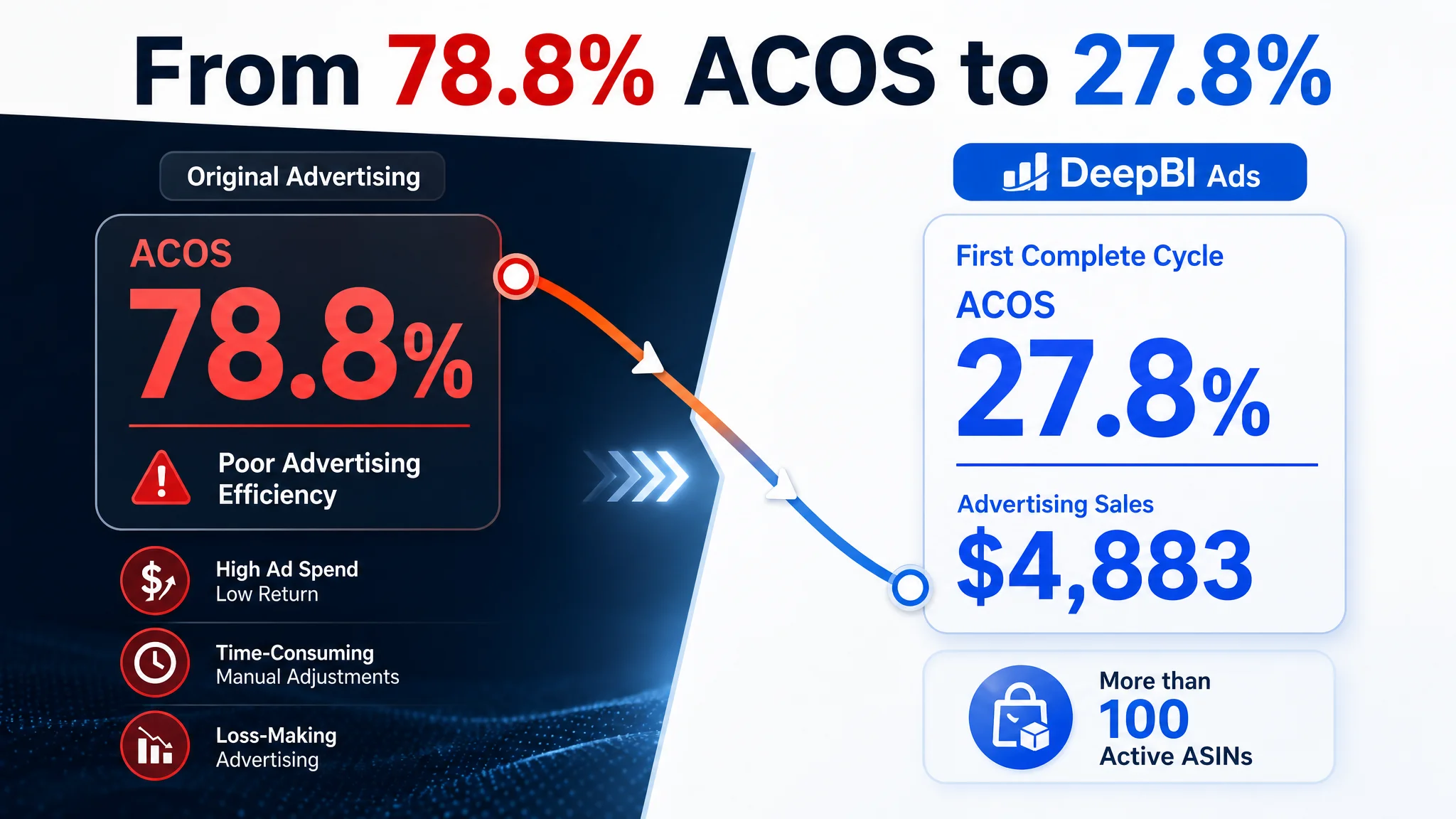
This Amazon seller specializes in lighting products and primarily targets the US marketplace. The store has more than 100 active ASINs, covering multiple parent-child variations as well as color and size variants. The lighting category has several typical characteristics:
- Click prices are relatively high, so spending can accelerate quickly without proper control;
- SKU and parent-child structures are complex, making it easy for advertising budgets to become scattered across numerous long-tail links;
- Core sales are concentrated among a small number of best-selling SKUs, while replenishment cycles are often 50–60 days. Once a stockout occurs, it can significantly affect overall sales and advertising momentum.
Before adopting DeepBI Ads, the seller used a traditional manual advertising structure with broad keyword targeting, relatively high bids, and untimely negative keyword additions. As a result, advertising ACOS once reached as high as 78.8%. This meant:
- Every $1 spent on advertising generated only slightly more than $1 in sales;
- Advertising had practically become a “loss center,” but the seller did not dare to stop advertising because doing so could mean losing traffic and orders;
- The operations team spent substantial time adjusting bids and reviewing reports every day, leaving limited time for products, pricing, and inventory planning.
At this stage, the customer's core needs were:
- Could DeepBI Ads management first bring ACOS back to an acceptable range and stop the cycle of “the more we advertise, the more we lose”;
- Could the frequency of manual bid adjustments be reduced so the operations team could focus on more important tasks;
- Without sacrificing organic traffic and overall sales, could advertising investment become more controllable?
The Problem
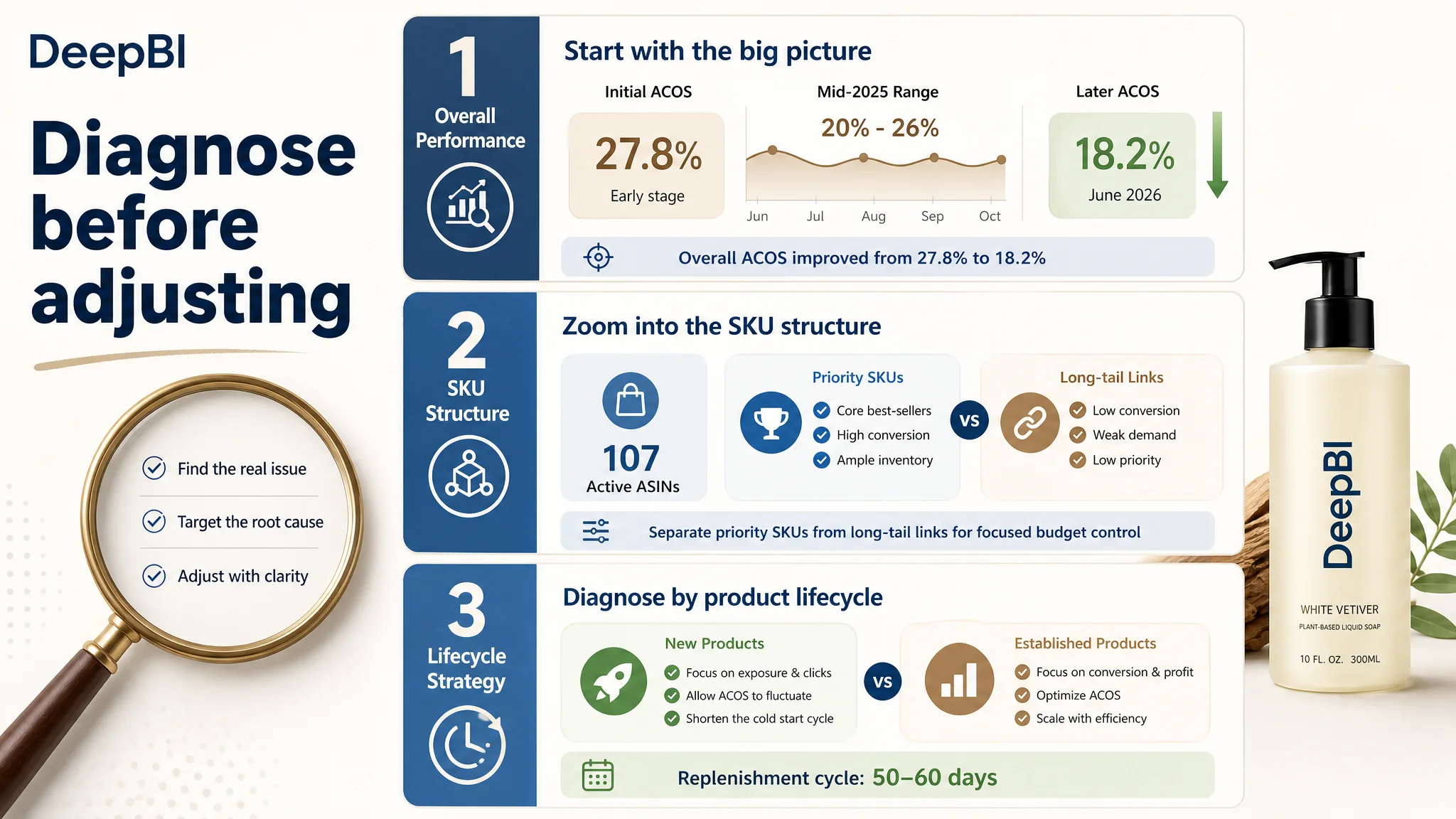
After DeepBI Ads was connected, it reduced ACOS from nearly 80% to 27.8% during the initial period, and advertising sales began to contribute steadily. This gave the seller an initial confirmation that “DeepBI Ads works.” However, as management progressed into the middle and later stages, new problems began to emerge:
1. Budget decision conflicts caused by inventory changes
When inventory was tight, the seller wanted to control the pace. When inventory was sufficient, the seller wanted advertising to scale quickly. However, the seller found it difficult to determine:
- When to proactively increase the budget and allow DeepBI Ads to spend more;
- When to tighten the budget to avoid “burning money” on SKUs that might soon go out of stock;
- Whether adjusting the budget too frequently would interfere with DeepBI Ads' learning process and momentum.
2. Anxiety that priority SKUs and ordinary SKUs were being “treated equally”
As the number of SKUs increased, the seller naturally began to wonder:
- “Will DeepBI Ads spend money on ASINs that are not as important?”
- “Can I allocate additional budget and control ACOS separately for the few lighting products I really want to promote?”
From the seller's perspective, a healthy overall ACOS did not mean that every SKU was healthy. Some links might be profitable, while others could be dragging down performance.
3. Uncertainty about “cost vs. learning” during the new-product promotion phase
When launching new lighting products, the seller wanted to:
- Quickly accumulate impressions and clicks for new products and shorten the cold-start period;
At the same time, the seller was concerned that:
- If bids and budgets were too high, new-product ACOS would become unattractive;
- If bids were too conservative, the new products might never gain momentum.
At this stage, the seller's focus had clearly shifted from “Is DeepBI Ads useful?” to “Is DeepBI Ads spending money in the way I want?” However, several uncertainties remained:
- The seller did not know which data to review to determine whether DeepBI Ads' strategy was reasonable;
- The seller was unclear about which issues DeepBI Ads could adjust independently and which required human intervention;
- The seller did not know how to translate business requirements into executable advertising rules and could only remain at a broad level of reviewing overall ACOS and sales.
How DeepBI Diagnosed
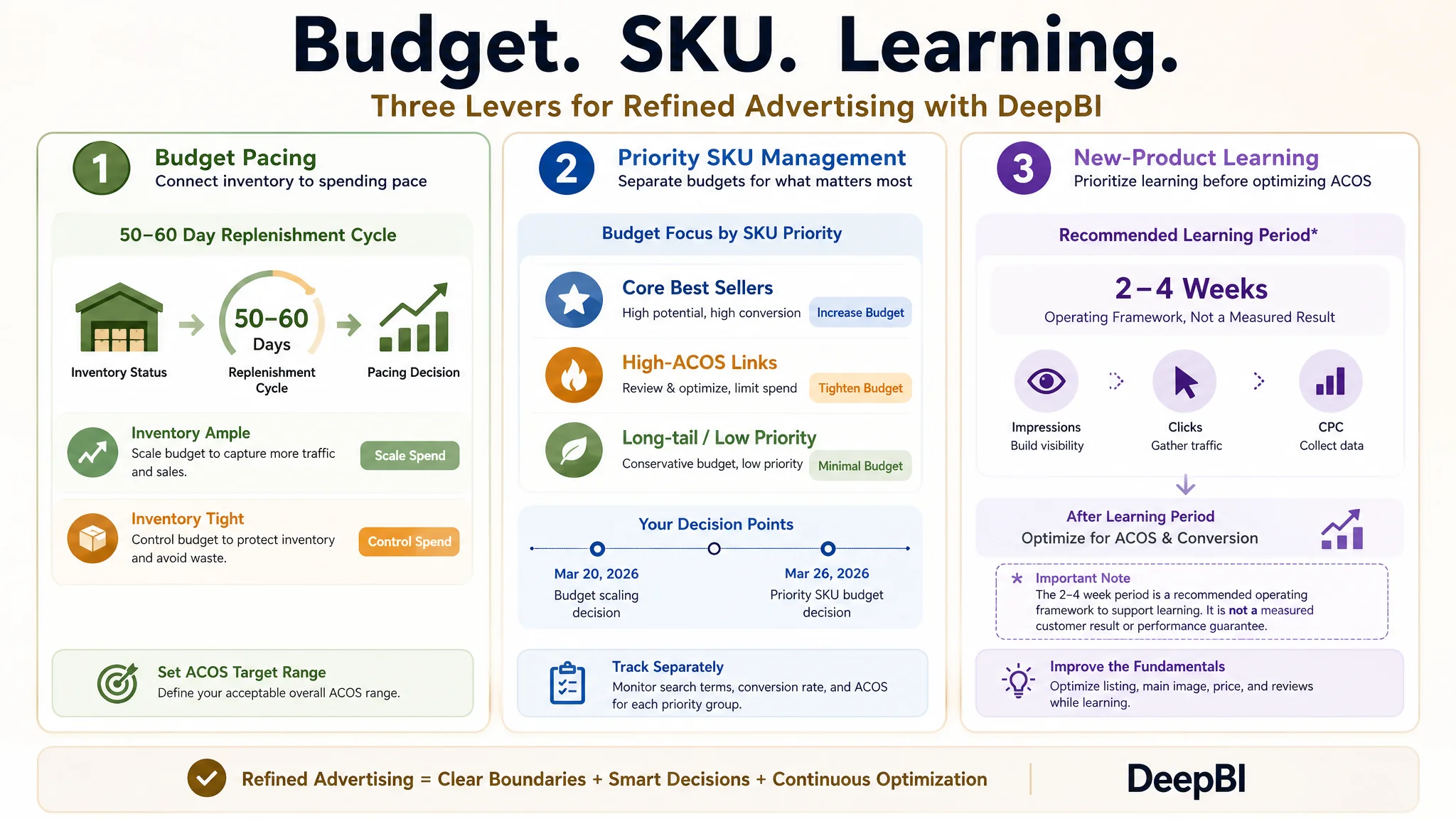
At this stage, the first step was not to directly “adjust parameters,” but to break down the problem and determine whether it was primarily a budget structure issue, an SKU strategy issue, or an inventory and new-product pacing issue. The diagnostic process consisted of three levels:
1. At the overall level: determining whether budget pacing matched the ACOS range
- Compare monthly advertising sales, ACOS, and budget change curves since DeepBI Ads was enabled;
- Mark several key time points: the initial ACOS of 27.8%, the stable range of 20%–26% in the middle of 2025, and the subsequent stage when ACOS was optimized to 18.2%;
- For each stage, review when the seller adjusted the budget and the inventory status at that time—whether inventory was tight or sufficient.
The diagnosis found that during periods when inventory was “relatively high,” the store's overall ACOS was already within the expected range, but the budget remained conservative. DeepBI Ads had not been given sufficient room to scale.
2. At the structural level: examining the distribution of advertising sales among SKUs
- Identify which SKUs contributed most of the advertising sales and which SKUs continued consuming budget with little or no output;
- Analyze the impressions, clicks, conversions, and corresponding ACOS of best-selling parent-child products in advertising;
- Compare ACOS differences among different stores and links to identify sub-stores or SKUs with “temporarily elevated” ACOS.
The diagnosis found that:
- A small number of best-selling SKUs generated most advertising sales, while some long-tail SKUs continued to consume a certain amount of budget;
- The ACOS of certain stores and links had increased temporarily and needed to be separated for structural adjustments rather than continuing to be managed within the overall budget pool.
3. At the lifecycle level: examining the advertising logic for new products versus established products
For new products:
- Check impressions, clicks, and conversion data immediately after launch, and observe DeepBI Ads' adjustment pace for bids and CPC;
- Compare the CPC levels of new products and stable established products to determine whether exposure was insufficient because prices were reduced too early;
- Analyze whether established products were consuming the overall budget during the new-product promotion period, leaving new products without sufficient opportunities for testing.
During this process, DeepBI did not simply review reports. It also combined the store's inventory cycle and category characteristics to infer the seller's actual advertising intentions:
- When inventory was high, the seller wanted DeepBI Ads to scale more aggressively;
- For priority SKUs, the seller wanted them to be “pulled out for special attention”;
- During the new-product phase, the seller was willing to accept a certain degree of ACOS fluctuation in exchange for faster learning.
The Real Problem
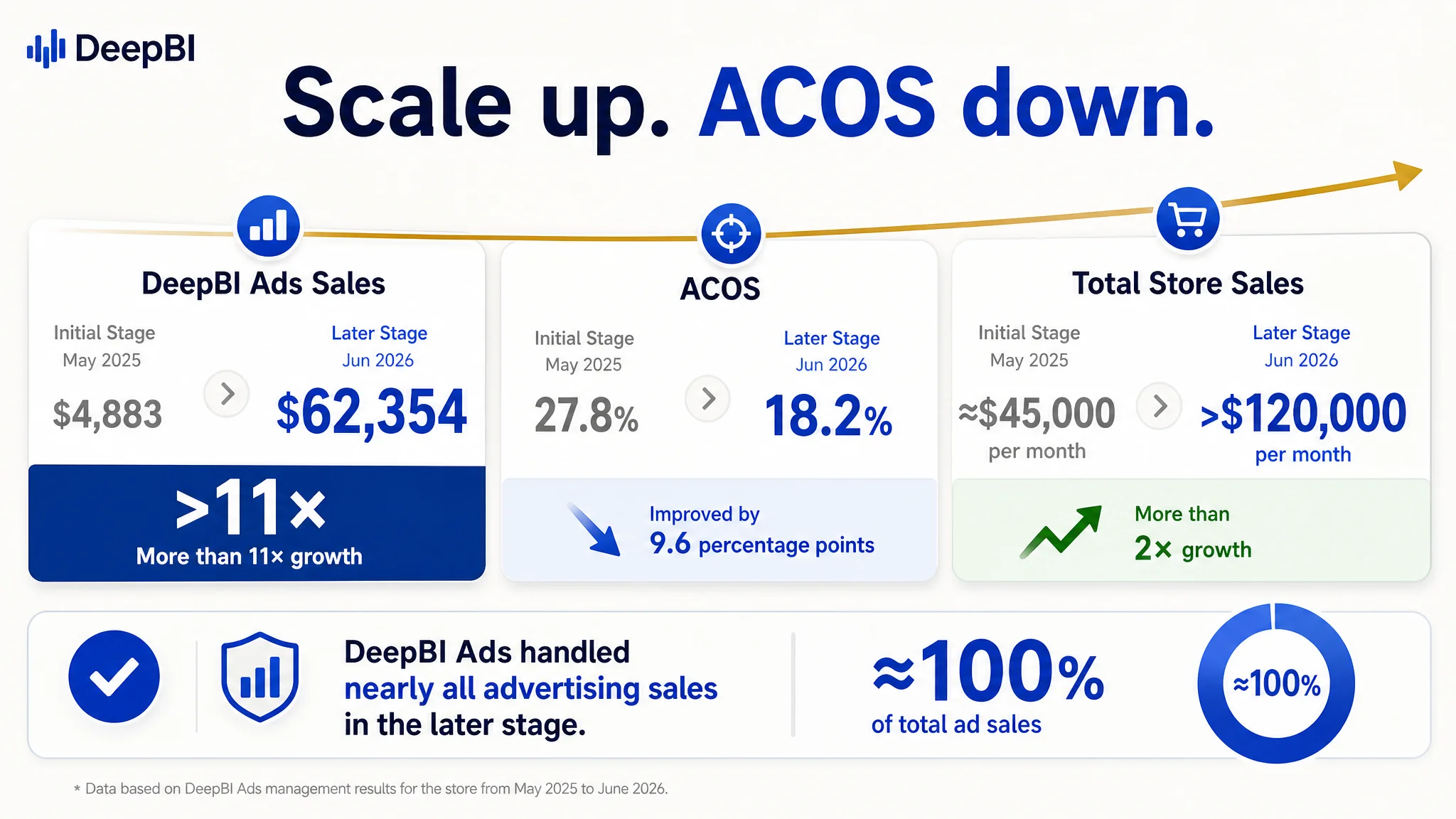
Based on the diagnosis above, the visible issues of “ACOS fluctuations” and “reluctance to scale new products” could be broken down into three more fundamental problems.
Problem 1: The total budget was controllable, but its pacing was not aligned with inventory and objectives
- Cause:
- The seller primarily relied on overall ACOS and current-period sales when adjusting the budget and lacked a framework linking “inventory–budget–ACOS” together;
- When inventory was high, the seller did not dare to proactively increase the budget for fear of raising ACOS. When inventory was tight, the seller could not tighten the budget in advance and could only reduce it passively afterward.
- Impact:
- During periods when inventory was sufficient and ACOS was already around 20%, the seller missed the opportunity to rapidly scale advertising sales by increasing the budget;
- During periods when stockouts were possible, there were no advance warnings or pacing adjustments, causing advertising spending to become disconnected from available inventory.
- Evidence:
- In March 2026, the seller stated that “ACOS is within the expected range, and inventory is relatively high” and only then proposed doubling the advertising budget. This indicated that the previous stage had delivered “good performance but an overly conservative budget”;
- Subsequently, when a best-selling child SKU went out of stock, overall sales fluctuated, but this could easily be misinterpreted as an advertising strategy problem.
Problem 2: The advertising structure did not sufficiently distinguish priority SKUs from high-ACOS links
- Cause:
- During the early stage of DeepBI Ads management, advertising was primarily taken over at the overall level. The structure had not yet sufficiently separated priority SKUs, ordinary SKUs, and links with significant performance deviations;
- The seller had also not created a clear “priority SKU list,” preventing DeepBI Ads from allocating resources differently according to SKU-level objectives.
- Impact:
- The seller felt subjectively that there was traffic, but “the priority links were not being pushed aggressively enough,” and that some stores had high ACOS without a clear way to manage them separately;
- The temporary increase in ACOS for certain stores or links reduced overall confidence, while refined control mechanisms were still lacking.
- Evidence:
- On March 26, 2026, the seller requested additional budget for individual SKUs and the creation of additional automatic advertising campaigns, indicating an awareness that “priority SKUs needed to be pulled out and managed separately”;
- On May 10, 2026, the seller reported that another store had high ACOS and requested focused attention, showing that structural refinement was not yet fully in place.
Problem 3: New-product expectations were misaligned with DeepBI Ads' ACOS control logic
- Cause:
- During the new-product promotion phase, DeepBI Ads adjusted CPC based on real-time data to avoid excessive spending before conversions had been validated;
- The seller, however, cared more about whether new products could gain momentum quickly and had a higher tolerance for short-term ACOS. If this preference was not explicitly communicated, it could conflict with DeepBI Ads' “conservative control logic.”
- Impact:
- When the seller saw DeepBI Ads automatically lower CPC for new-product ads, they worried that exposure and learning speed would be affected, creating doubts about the transparency of DeepBI Ads' decisions;
- New products competed with established products for resources within the budget pool. Without clear “new-product priority” settings, they could be suppressed by the overall ROI objective, slowing their growth.
- Evidence:
- On May 25, 2026, the seller questioned DeepBI Ads' decision to lower CPC for new-product advertising and worried about its impact on exposure and learning speed. This directly exposed the issue that “new-product objectives had not been explicitly incorporated into the strategy.”
Optimization Plan
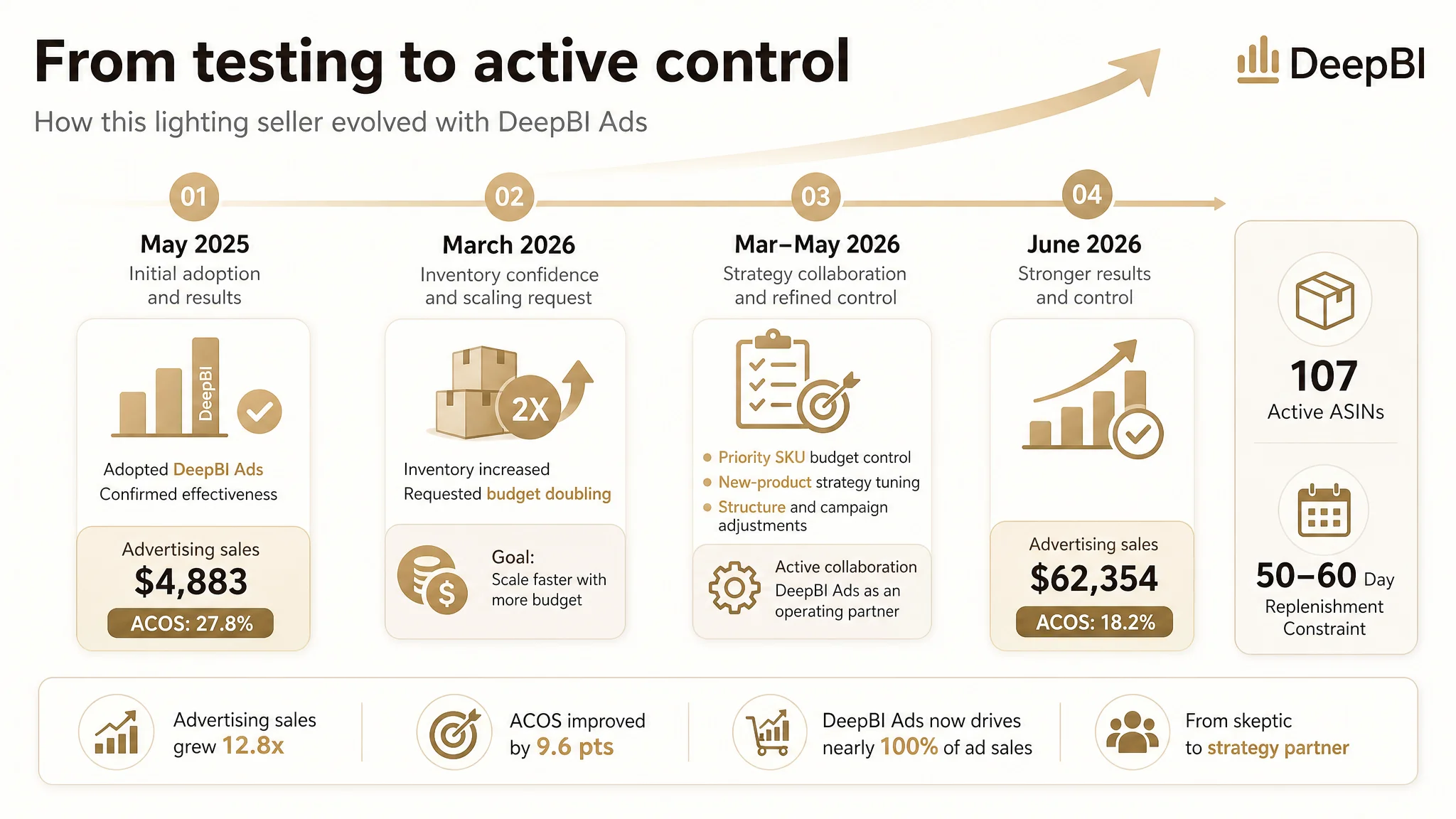
Based on these three real problems, optimization was no longer limited to “adjusting bids.” Instead, it reconstructed the way the store and DeepBI Ads worked together around three dimensions: budget pacing, SKU structure, and new-product strategy.
1. Separate budget pacing according to inventory and objectives
- When inventory was sufficient and overall ACOS was within the expected range—for example, around 20%—clearly define the “acceptable ACOS ceiling” and the “desired increase in advertising sales,” and then work with DeepBI Ads to establish a plan for “temporarily doubling the budget” or “gradually increasing the budget”;
- When core SKUs had long replenishment cycles of 50–60 days and faced stockout risks, identify these SKUs in advance and set a “maintain volume rather than expand volume” advertising objective. Moderately reduce the budget or narrow the targeting scope to avoid excessive spending shortly before a stockout;
- Treat “inventory status” as one of the input variables for budget strategy rather than reacting only afterward.
2. Rebuild the advertising structure and manage priority SKUs and high-ACOS stores separately
- Based on historical store data, create a “priority SKU list” covering high-sales-contribution SKUs, strategic new products, and high-margin products;
- Create separate advertising campaigns or independent budget pools for these priority SKUs, allowing DeepBI Ads to allocate resources against clearer objectives. For example, priority SKUs could be allowed slightly higher CPC and a more aggressive exposure strategy;
- For stores or links with temporarily high ACOS, separate them for review of search terms, traffic sources, and Listing conversion performance. Determine whether the issue is advertising-related or related to the Listing and price before deciding whether to optimize advertising or temporarily reduce investment and observe.
3. Design a separate “learning-period strategy” for new products
- Before launching a new product, clarify three points with DeepBI Ads: the acceptable learning-period duration, the tolerable ACOS range during the learning period, and the desired benchmarks for impressions or clicks;
- During the initial learning stage, allow new-product CPC to be slightly higher than that of established products to ensure sufficient impressions and clicks for validating conversion potential;
- Once data shows that the new product's conversion rate is stable, have DeepBI Ads gradually lower CPC and converge toward an ACOS level similar to or better than that of established products;
- For new ASINs that perform clearly poorly during the learning period, adjust expectations promptly—either optimize the Listing or reduce investment—to avoid dragging down overall ACOS over the long term.
4. Establish a communication mechanism with DeepBI Ads using “operational language”
Rather than simply saying “ACOS is too high/too low,” the seller began collaborating with DeepBI Ads through more actionable statements:
- “This SKU has only enough inventory for a certain number of days. Please prioritize exposure and do not pressure ACOS too much”;
- “We want this store's ACOS to decrease by 5 percentage points from its current level. For now, we are not pursuing scale”;
- “For the first two weeks of the new product, focus on impressions and clicks. Start evaluating ACOS in the third week.”
Under this communication framework, DeepBI's DeepBI Ads management did more than execute bid adjustments and budget allocation. More importantly, it translated the seller's operational intentions into an executable combination of advertising strategies.
Results
After these adjustments were completed, the results for this lighting seller were reflected not only in the numbers but also in a stronger sense of control:
- Advertising sales scale increased:
- DeepBI Ads sales grew from $4,883 during the initial period to $62,354 in the later period, an increase of more than 11 times;
- Advertising efficiency continued to improve:
- DeepBI Ads ACOS improved from 27.8% in the first period to 18.2% in the later period, further reducing customer acquisition costs while scaling sales;
- DeepBI Ads took over a greater share of advertising:
- By the later stage of the service, nearly all of the store's advertising sales were handled by DeepBI Ads. The spend and output of the original manual advertising campaigns fell to extremely low levels, freeing the operations team from high-frequency bid adjustments;
- Overall store sales increased:
- The store's total sales grew from approximately $45,000 per month during the early service period to more than $120,000 in the later period, with an intermediate peak approaching $130,000. Driven by DeepBI Ads, overall sales more than doubled.
More importantly, the seller's approach to understanding fluctuations changed. When a stockout of an individual best-selling SKU caused sales to pull back, the seller could distinguish between a short-term decline caused by inventory and an ineffective advertising strategy. Instead of using a single month's ACOS or sales to reject the entire advertising system, the seller worked with DeepBI Ads to adjust the budget and structure in preparation for the next round of scaling.
Case Summary
The experience of this lighting seller shows that:
1. The real value of DeepBI Ads is not “automatic bid adjustment,” but helping connect your budget, SKU, and new-product strategies. Only when sellers clearly communicate their inventory status and business objectives to DeepBI Ads can automation deliver its full value.
2. The shift from “only reviewing overall ACOS” to “SKU-level and lifecycle-level management” is the dividing line for refined advertising. When priority SKUs, high-ACOS stores, new products, and established products are placed on different strategic tracks, sellers can continuously scale advertising sales while keeping overall ACOS under control.
3. The way you communicate with DeepBI Ads determines the results you can achieve. If you treat DeepBI Ads only as a “black-box tool,” you will remain stuck with subjective impressions such as “it seems pretty good” or “it does not seem to be working.” Only by structuring and communicating business information such as inventory, target ACOS, and scaling requirements can DeepBI Ads become an efficient advertising operator that truly “understands human language.”
In this case, DeepBI primarily handled three tasks: using data to break down the problem, restructuring the advertising strategy, and validating the combined effect of the “budget–SKU–new-product strategy” through results. Ultimately, while helping the seller reduce ACOS from 27.8% to 18.2%, DeepBI also taught the seller how to “train” DeepBI Ads effectively.
Key Takeaways for Sellers
Takeaway 1: Clearly define your business boundaries first so DeepBI Ads can help you “control the whole operation” Do not make emotional judgments based only on overall ACOS. Clearly tell DeepBI Ads:
- Which SKUs have ample inventory and can be scaled confidently;
- Which SKUs are approaching a stockout and require controlled pacing;
- What the acceptable overall ACOS range is.
Once these boundaries are clear, DeepBI Ads' budget and bid decisions become easier to understand and anticipate.
Takeaway 2: Pull priority SKUs, new products, and high-ACOS links out of the “big pool” for separate management Whether or not you use DeepBI, stores in categories such as lighting—with many SKUs and complex parent-child structures—should:
- Establish separate advertising campaigns and budgets for core best-sellers, new products, and key stores;
- Regularly review the search terms, conversion rates, and ACOS of these campaigns to determine whether the issue lies with advertising or with the Listing, price, or reviews;
- Moderately reduce investment in long-tail SKUs and links with significant performance deviations, or place them in a more “conservative” budget pool rather than allowing them to compete for resources with core SKUs.
Takeaway 3: Give new products a “clearly defined learning period” instead of focusing on ACOS from day one During the new-product promotion phase, requiring both “rapid growth” and an “immediately attractive” ACOS often means achieving neither. A more practical approach is to:
- Set a 2–4-week learning period, use impressions and clicks as the primary metrics, and allow ACOS to fluctuate;
- After the learning period, decide whether to continue increasing investment or reduce it based on actual conversion performance;
- During this period, optimize the Listing, main image, price, and reviews rather than placing all the pressure on advertising.
When you collaborate with DeepBI Ads in this way, regardless of which tool you use, advertising is no longer an “incomprehensible black box.” It becomes a business operating system that can be diagnosed, adjusted, and reused over the long term.