

Introduction
An Amazon seller specializing in lighting products had an ACOS as high as 78.8% in its original advertising campaigns before adopting DeepBI Ads management. The more it advertised, the more it lost, yet it did not dare to stop. After adopting DeepBI Ads in May 2025, the store went through a complete cycle over more than a year—from performance validation and rapid scaling to inventory fluctuation adjustments, followed by renewed growth.
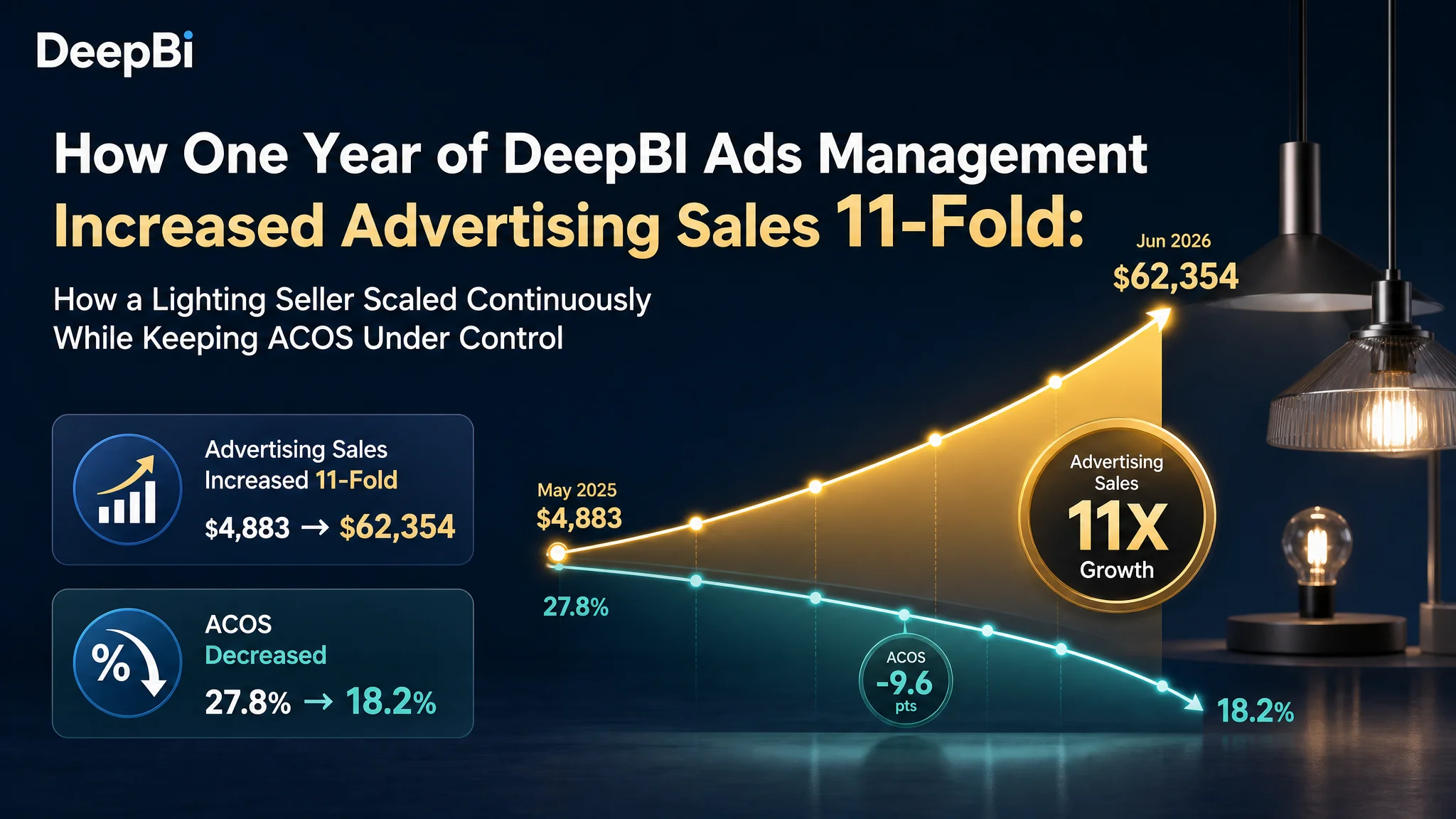
One year later, several key data points are worth a closer look for any seller struggling with “amazon acos过高” or “亚马逊广告亏损怎么解决”:
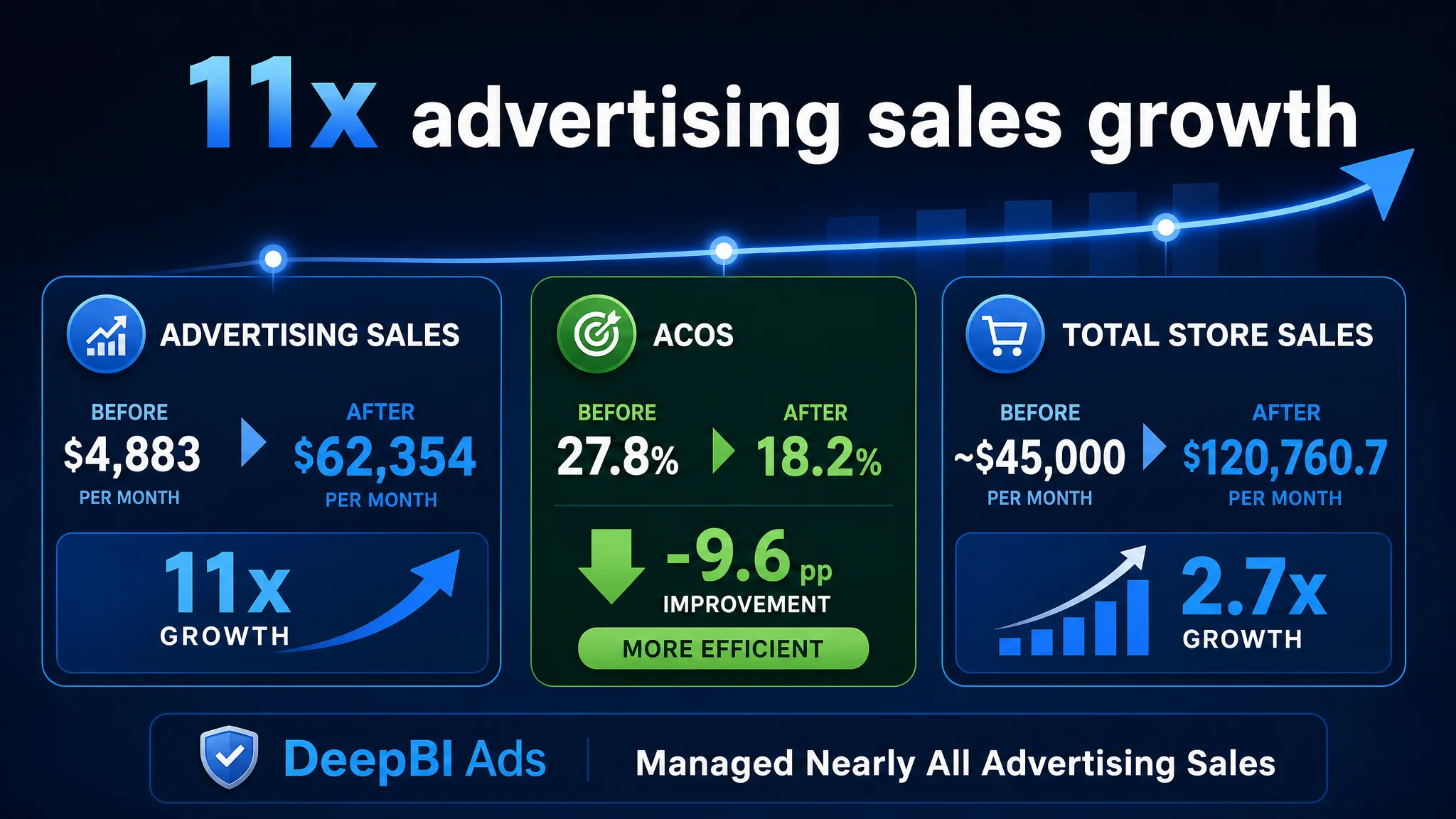
- Monthly sales generated by DeepBI Ads increased from 4,883 USD to 62,354 USD, growing by more than 11 times;
- DeepBI Ads ACOS decreased from 27.8% to 18.2%;
- Total store sales increased from approximately 45,000 USD to more than 120,760.7 USD, more than doubling;
- Almost all advertising sales were managed by DeepBI Ads management, while the spend and output of the original manually operated advertising campaigns dropped to extremely low levels.
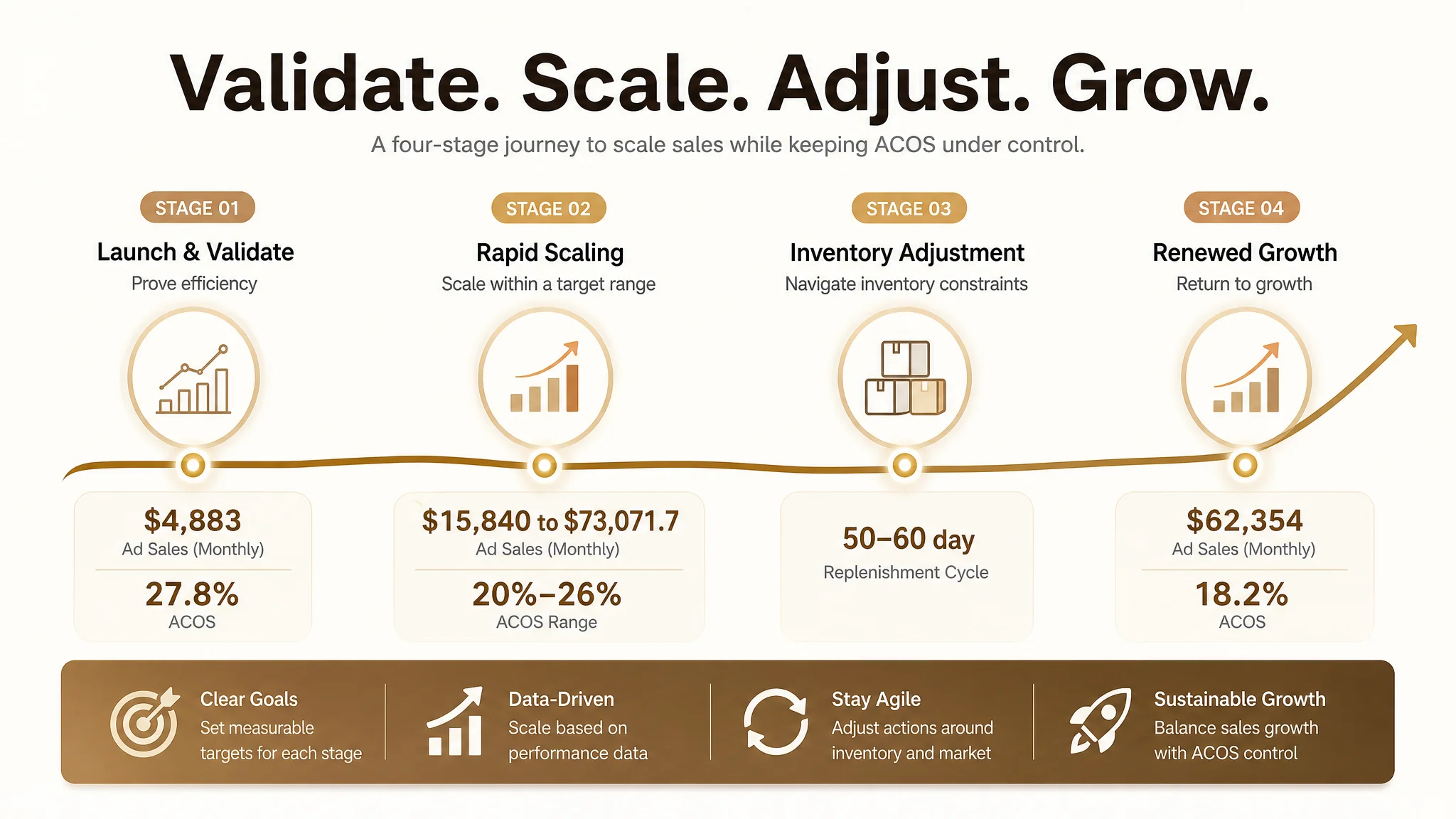
This article does not focus on “how advanced the technology is.” Instead, it follows the timeline and breaks down how this lighting seller continuously scaled advertising sales while keeping ACOS under control, how it determined whether an issue was caused by advertising or inventory, and how it handled the typical conflict of “traffic is growing, but we are worried about losses.” The process is divided into four stages: the launch and validation period, the rapid scaling period, the adjustment and fluctuation period, and the renewed growth and stable management period. The goal is to show that lowering ACOS and scaling sales are not necessarily contradictory.
Customer Background
This is an Amazon seller specializing in lighting products on the US marketplace. The store has more than 100 managed ASINs and a complex parent-child variation structure, including both consistently selling core products and newly launched products under ongoing testing.
Before adopting DeepBI Ads, the store relied on manual advertising management for a long time. Its challenges were typical:
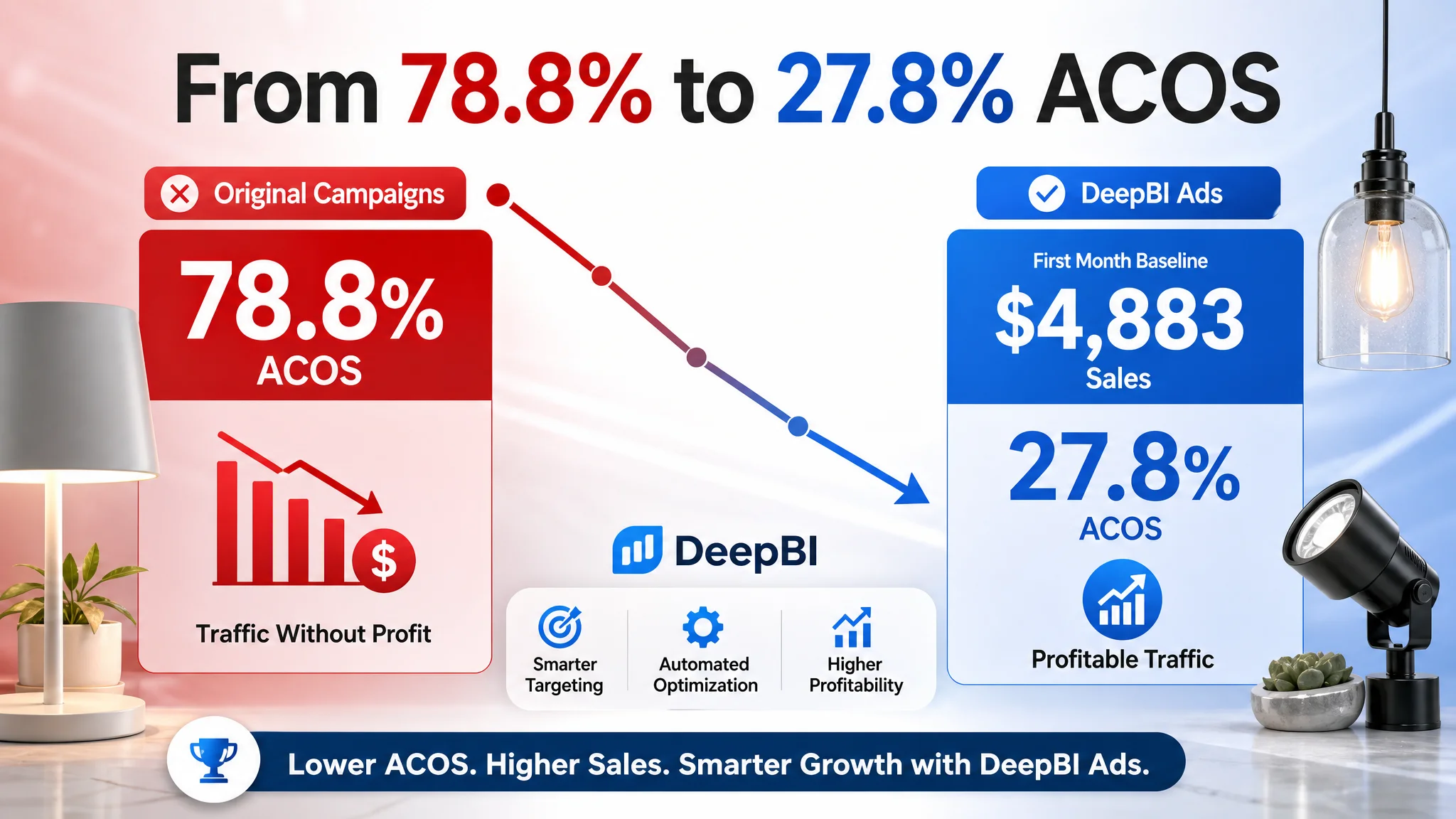
- Competition in the category was intense, CPC was high, and the ACOS of the original advertising campaigns reached as high as 78.8% at one point;
- The operations team did not have enough time to monitor performance daily and adjust bids frequently, making it easy to “cut keywords today and raise bids tomorrow,” resulting in inconsistent strategies;
- The seller did not dare to stop advertising, but continuing to advertise led to ongoing losses. Overall, advertising was in a state of “traffic without profit.”
In addition, the replenishment cycle in the lighting category is relatively long, and core SKUs faced periodic stockout risks. This made the seller even more cautious when making advertising decisions: on the one hand, it worried that insufficient advertising would cause it to miss the peak season; on the other hand, it feared that scaling advertising while products went out of stock would waste the budget during a window when there was “no inventory to sell.”
Against this backdrop, the seller adopted DeepBI Ads management in May 2025, hoping to use automated advertising to:
- Keep ACOS under control and prevent it from becoming unmanageable;
- Maintain and scale advertising sales to drive overall sales growth;
- Reduce the pressure of daily monitoring and bid adjustments.
The Problem
From the store’s perspective, the problem was not “there were no orders,” but rather “the orders generated by advertising were not profitable after calculation, and scaling was too risky.”
The typical operational challenges included:
1. Advertising became increasingly unprofitable, while ACOS remained high
The ACOS of the original advertising campaigns reached as high as 78.8%. In a category such as lighting, where average order values are not low, this level of ACOS practically meant that:
- Either advertising consumed all the profit;
- Or the seller had to rely on extremely high repeat purchases or related sales to make the model “barely justifiable.”
However, in the marketplace environment, most lighting orders are one-time purchases or involve low-frequency repeat purchases. This level of ACOS is difficult to sustain over the long term.
2. The seller worried about losing orders if it stopped advertising, but lost money if it continued
The seller faced a genuine dilemma:
- Stopping some advertising would immediately result in a short-term decline in orders, while organic traffic would not increase noticeably;
- Continuing to advertise meant seeing high daily ad spend, with ad spend accounting for the majority of the report.
3. Organic traffic growth was weak, making it difficult to “break free from advertising”
Many sellers have a similar concern: “If advertising ACOS is this high, should we rely on organic traffic? But organic traffic never picks up, and traffic collapses as soon as advertising stops.” This lighting seller was no exception. Although advertising generated exposure, its fragmented campaign structure and rough search-term management meant that:
- Some of the budget was spent on keywords with low conversion rates;
- Some traffic did not develop into stable rankings and organic search traffic.
4. Internal operational resources were limited, making ongoing manual refinement impossible
The advertising structure included both automatic campaigns and a large number of manual campaigns. The operations team found it difficult to:
- Continuously and carefully filter search terms;
- Adjust bids and budgets for different ASINs;
- Dynamically scale or reduce advertising in line with inventory cycles.
Over time, advertising investment increasingly resembled a “fixed expense” and was rarely treated as an operational lever that could be designed and optimized.
Under these circumstances, even though the seller understood that “amazon acos过高” was the biggest problem, it lacked an executable path to bring ACOS back to an acceptable range without causing sales to collapse.
How DeepBI Diagnosed
After the lighting seller adopted DeepBI Ads management in May 2025, the first step was not to “scale immediately.” Instead, DeepBI conducted a systematic diagnosis around several key questions:
1. Takeover and comparison: first determine whether the foundation was stable after DeepBI Ads took over
In the launch month, DeepBI Ads took over the core advertising campaigns:
- DeepBI Ads sales: 4,883 USD;
- DeepBI Ads ACOS: 27.8%.
Compared with the previous ACOS level of 78.8% under manual management, the main task at this stage was to verify:
- Whether DeepBI Ads could bring advertising efficiency back to a reasonable range with a similar or even lower budget;
- Whether DeepBI Ads’ bidding strategies for different ASINs and keywords could significantly reduce ineffective spend without sacrificing too much sales.
2. Break down the advertising structure: which budgets were “burning into thin air”?
After taking over the existing advertising structure, the diagnosis focused on:
- Which campaigns generated almost no conversions but continued consuming budget;
- Which keywords/search terms had excessively high ACOS but had not been adjusted for a long time;
- Which high-converting ASINs or search terms had not received sufficient budget support.
At this stage, DeepBI Ads began using algorithms to automatically adjust bids, keywords, and budgets, recovering clearly ineffective or low-efficiency spend and creating room for subsequent scaling.
3. Observe the relationship between volume and efficiency: ACOS ranges and sales elasticity
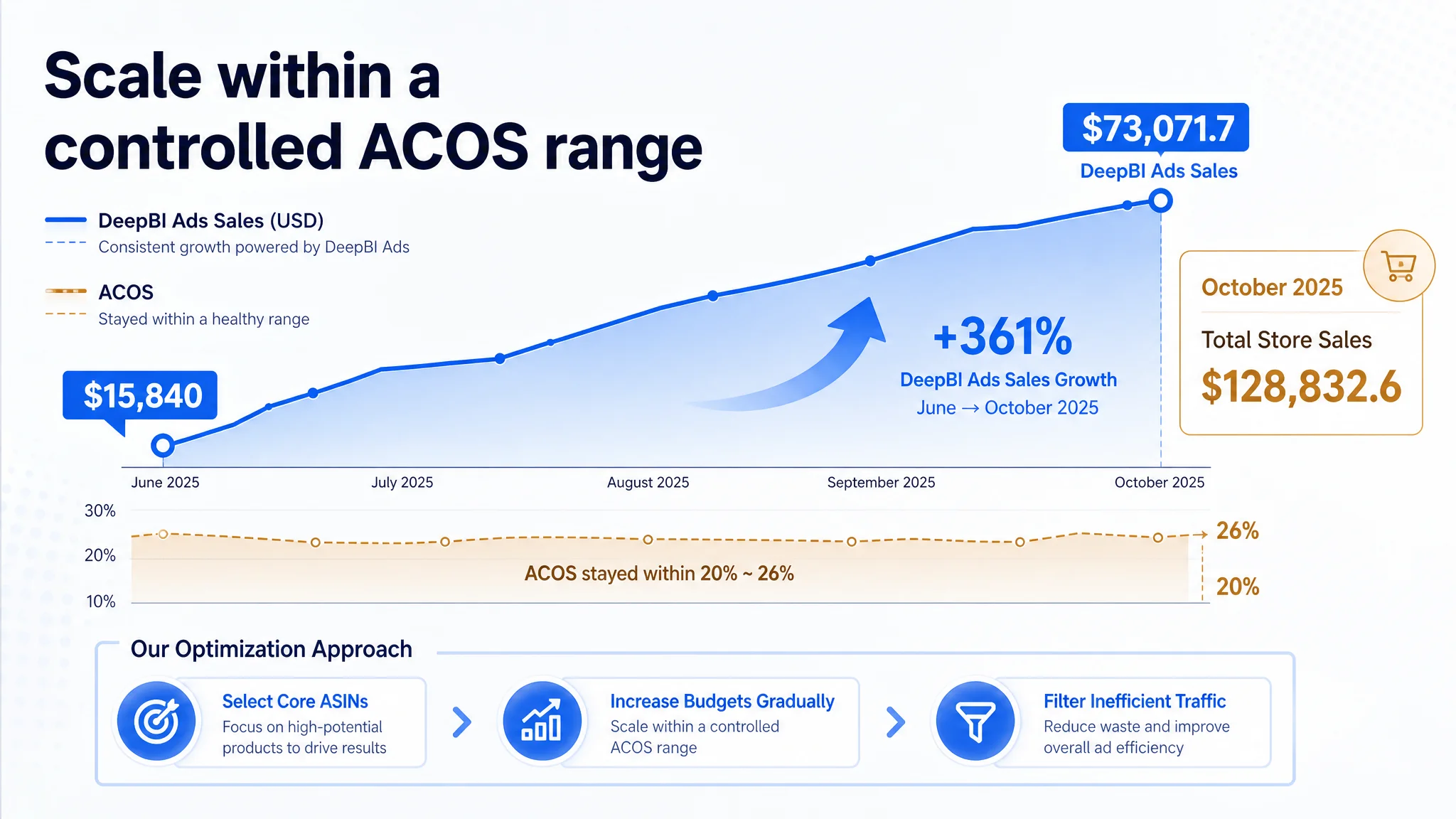
From June to October 2025, DeepBI Ads entered a rapid scaling period:
- DeepBI Ads sales increased from 15,840 USD to 73,071.7 USD;
- Total store sales reached a period peak of approximately 128,832.6 USD in October 2025;
- During this period, DeepBI Ads ACOS remained stable in the 20%~26% range.
By observing the data longitudinally during this period, the team was able to identify:
- The sales growth elasticity of advertising when ACOS was controlled within the 20%~26% range;
- Which ASINs maintained stable conversion when the budget was increased and were therefore suitable as the main scaling products;
- Which ASINs became unprofitable as soon as ACOS was relaxed slightly and therefore required tighter controls.
4. Combine inventory and cycles: when sales fluctuate, should the first check be inventory or advertising?
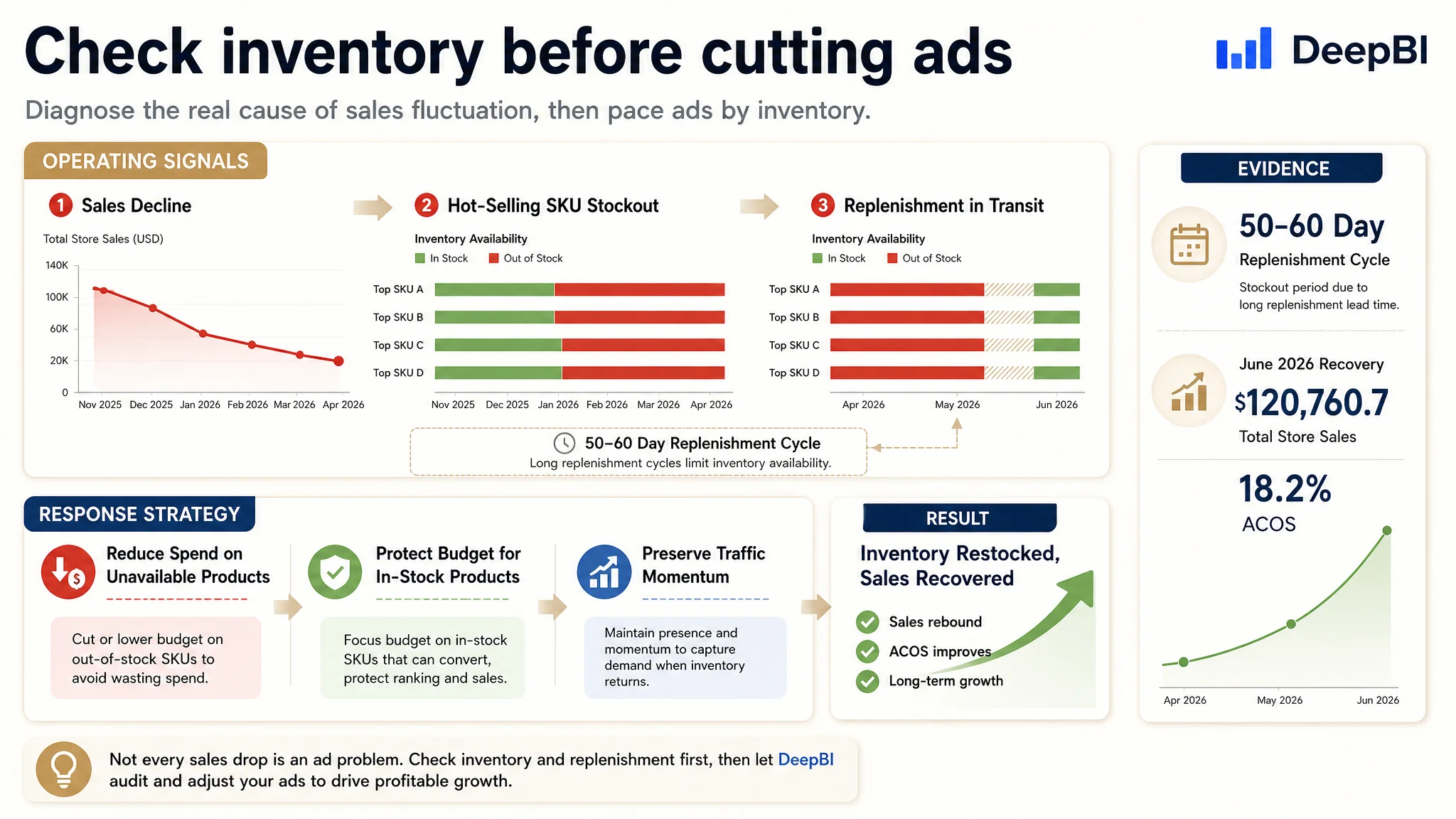
Around April 2026, the service team pointed out in a renewal reminder that the main reason for the store’s recent sales decline was that several hot-selling child SKUs had gone out of stock, rather than advertising becoming ineffective. Subsequently, when the two parties discussed the annual renewal plan on May 22, they also clearly noted that the replenishment cycle was as long as 50–60 days. These two points became key premises for subsequent diagnosis:
- When sales experience a temporary correction, it is essential to first distinguish between an inventory issue and an advertising efficiency issue;
- While replenishment is in transit, the advertising budget strategy should be adjusted in terms of pacing rather than simply cutting the budget across the board.
5. Validate the results: comparison during the renewed growth period
After experiencing inventory fluctuations and adjustments, the operating data for June 2026 provided clear validation:
- DeepBI Ads sales: 62,354 USD;
- Total store sales: 120,760.7 USD;
- DeepBI Ads ACOS: 18.2%;
- DeepBI Ads accounted for nearly all advertising sales.
This showed that, once inventory was able to keep up, DeepBI Ads not only returned sales to a high level but also maintained a high share of advertising sales while ACOS declined further.
The Real Problem
After reviewing the cycle of more than one year, the lighting seller’s core challenges were not that the “advertising tool was difficult to use,” but three more fundamental operational issues.
Problem One: Treating “high ACOS” as a purely advertising issue while overlooking campaign structure and decision-making flexibility
- Cause: Before adopting DeepBI Ads, the ACOS of the original advertising campaigns reached as high as 78.8%. The advertising structure contained significant amounts of:
- Low-converting keywords that consumed budget over long periods;
- Undifferentiated, “broad net” advertising across ASINs;
- A lack of data-based bid tiers and budget allocation.
The seller viewed “amazon acos过高” as a problem with “a few poorly adjusted ads,” rather than an issue with the overall advertising structure.
- Impact:
- No matter how much individual bids were adjusted, it was difficult to significantly improve overall ACOS;
- The seller lost confidence in advertising and did not dare to increase the budget, choosing only to “barely maintain” performance;
- Advertising spend was used more to “maintain exposure” than to serve clear profitability and growth objectives.
- Evidence:
In the month DeepBI Ads was adopted, ACOS fell from 78.8% to 27.8%. This showed that, without an extreme change in budget size, a more reasonable structure and better bid control alone could move advertising from “clearly unprofitable” back into a range that could be discussed and optimized.
Problem Two: Failing to distinguish between “whether to scale” and “whether scaling is feasible” by stage
- Cause:
- Before adoption, the seller had long been caught between “sales or ACOS”;
- It lacked stage-based strategy design. The goals for the validation, scaling, stable, and adjustment periods were not separated, resulting in disorganized actions.
- Impact:
- Once sales showed signs of improvement, the seller tended to immediately lower ACOS, effectively “choking off” advertising before it had time to scale sufficiently;
- Once ACOS increased, the seller immediately cut the budget, causing fluctuations in traffic and rankings and affecting sustained organic traffic growth;
- It was difficult to establish a healthy long-term curve of “validate first, scale next, then stabilize.”
- Evidence:
- From June to October 2025, while DeepBI Ads ACOS remained relatively stable at 20%~26%, advertising sales increased from 15,840 USD to 73,071.7 USD, driving total store sales to 128,832.6 USD in October;
- On March 20, 2026, after confirming that “ACOS was within the expected range and inventory had increased,” the customer proactively requested that the advertising budget be doubled. This showed that, only after understanding the performance at each stage, was the seller willing to make a decision about “whether scaling was feasible.”
Problem Three: When sales fluctuated, the first reaction was to question advertising rather than check inventory and pacing
- Cause:
- The lighting category has a long replenishment cycle, and hot-selling SKUs went out of stock at certain times, but the seller habitually attributed sales corrections to “advertising no longer working”;
- The seller lacked a systematic understanding of the relationship between “advertising sales,” “organic sales,” and “inventory status.”
- Impact:
- During replenishment-in-transit or stockout periods, the seller could emotionally cut the budget or stop advertising, interrupting the accumulation of advertising performance and organic rankings;
- During renewal decisions, inventory-driven fluctuations could be misinterpreted as “tool instability,” affecting the pace of long-term cooperation.
- Evidence:
- In April 2026, the service team clearly stated during renewal discussions that the primary reason for the recent sales correction was hot-selling child SKUs being out of stock, rather than the advertising strategy becoming ineffective;
- On May 22, 2026, when discussing the annual renewal plan, the customer specifically mentioned the “50–60 day replenishment cycle and the hope for more flexible renewal terms,” showing that inventory pacing directly affected its advertising and renewal decisions;
- However, after inventory recovered, both total store sales and DeepBI Ads sales quickly resumed growth in June 2026, while ACOS fell further to 18.2%. This indirectly proved that advertising capability remained stable throughout the period and that inventory, rather than the advertising tool, was the factor truly affecting the curve.
Optimization Plan
After identifying these issues, the lighting seller and the DeepBI team followed a four-stage optimization path centered on DeepBI Ads management.
1. Launch and Validation Period: Stop Losses Through “Structure + Efficiency”
The core objective during the launch period was not immediate growth, but to “stabilize the foundation and understand the true capability of advertising.” Specific actions included:
1. Take over the primary advertising placements, migrate the main advertising budget from manually operated campaigns to DeepBI Ads management, and reduce parallel conflicts;
2. Organize the campaign structure, weaken clearly ineffective or duplicate campaigns, and concentrate the budget on:
- ASINs with a stable conversion history;
- High-quality search terms with existing conversion data;
3. Use DeepBI Ads’ automatic bid adjustment strategy to substantially reduce bids on high-ACOS keywords within a relatively short cycle, prioritizing the recovery of “obvious loss points”;
4. Keep the total budget at a relatively stable level to avoid disrupting the evaluation of ACOS and ROI through a sudden budget increase.
As a result, ACOS fell from 78.8% to 27.8% in the launch month, while advertising generated 4,883 USD in sales, providing a clear baseline for subsequent decisions.
2. Rapid Scaling Period (2025-06 ~ 10): Expand Within a Controllable ACOS Range
After confirming that DeepBI Ads could operate stably in the 20%~30% range, the objective of the second stage shifted to “continuously scale while keeping ACOS acceptable.” Key practices included:
1. Gradually increase the budget rather than doubling it all at once
- First increase the daily budget or per-product budget cap for selected core ASINs with stable performance;
- After observing performance for a period, expand to more SKUs to create “multi-point scaling.”
2. Set different ACOS tolerance levels based on conversion and gross margin tiers
- For core products with high gross margins and high conversion rates, allow slightly higher ACOS in exchange for more exposure and ranking accumulation;
- For products with average gross margins or unstable conversion, tighten ACOS controls to prevent traffic-seeking activity from dragging down overall performance.
3. Use DeepBI Ads’ learning and automatic optimization to continuously filter high-quality traffic
- Retain high-converting search terms and targeting paths, and moderately increase bids and budgets;
- Automatically lower bids or reduce impression frequency for inefficient long-tail traffic, ensuring that more incremental budget flowed toward high-quality traffic pools.
During this period, DeepBI Ads sales increased from 15,840 USD to 73,071.7 USD, while total store sales reached 128,832.6 USD in October 2025. DeepBI Ads ACOS remained within approximately the 20%~26% range, achieving scaling with a relatively balanced relationship between volume and efficiency.
3. Adjustment and Fluctuation Period: Calibrate Expectations Under Inventory Constraints
In 2026, as hot-selling child SKUs went out of stock and replenishment shipments were in transit, total store sales experienced a temporary correction. At this point, the focus of optimization shifted from “advertising alone” to “coordination between advertising and inventory”:
1. Combine advertising data with inventory data to determine whether a sales decline was caused by stockouts;
2. For SKUs that were already out of stock or at critical inventory levels:
- Reduce the advertising budget or pause some high-volume traffic entry points;
- Avoid continuing to consume paid exposure when there was no inventory available;
3. For SKUs with sufficient inventory and further scaling potential:
- Concentrate the budget to maintain continuity in the advertising and organic traffic curves;
4. Incorporate the replenishment cycle (50–60 days) into advertising pacing during renewal discussions and budget negotiations, rather than looking only at monthly ACOS and sales.
During this period, sales appeared to fluctuate, but the advertising strategy did not become disorganized or uncontrolled. Instead, it was deliberately adjusted in moderation to align with the inventory cycle. Because the advertising foundation was not cut across the board, sufficient data and traffic momentum were preserved for the subsequent recovery and growth.
4. Renewed Growth and Stable Management Period: Return to High Sales at a Lower ACOS
As the inventory issue gradually eased, the seller entered another scaling phase. On March 20, 2026, after confirming that “ACOS was within the expected range and inventory had increased,” the customer proactively requested that the advertising budget be doubled. On March 26, the customer further requested additional budget for an individual SKU and the creation of additional automatic campaigns, beginning to participate in more granular advertising decisions.
During this stage, DeepBI Ads focused on:
1. Prioritizing high-ROAS, high-converting advertising units while keeping the overall ACOS floor within a safe range;
2. Creating new automatic campaigns to continuously discover new search terms and traffic entry points for well-performing ASINs;
3. Applying more aggressive bidding and budget strategies to “star SKUs” whose performance had already been validated as stable, with the goal of securing higher positions in the category and search results;
4. Using system data to help the seller identify “which advertising sales were sustainable and which required inventory risk monitoring,” enabling greater confidence in annual renewal and overall budget planning.
Ultimately, in June 2026:
- DeepBI Ads sales reached 62,354 USD;
- Total store sales reached 120,760.7 USD;
- DeepBI Ads ACOS was optimized to 18.2%;
- DeepBI Ads essentially took over all advertising sales, while the spend and output of the original manually operated campaigns fell to extremely low levels.
This meant that the seller had completed the transition from an operating model of “manual advertising as the primary channel and DeepBI Ads as a supplement” to one in which “DeepBI Ads was the primary channel, while manual work focused only on strategy and exception management.”
Results
Along the central theme of “lowering ACOS while scaling advertising sales,” the key results achieved by this lighting seller over more than one year can be summarized across four dimensions:
1. Advertising sales scale: increased by more than 11 times
- First month after adopting DeepBI Ads: 4,883 USD;
- June 2026: 62,354 USD.
After multiple inventory cycles and advertising strategy adjustments, advertising sales still reached more than 11 times the first-month level.
2. ACOS: returned from a severely unprofitable range to a controllable and even optimized range
- ACOS of the original advertising campaigns: 78.8%;
- ACOS in the first month after adopting DeepBI Ads: 27.8%;
- Lowest ACOS during the stable service period: 16.4% (the lowest value during the period);
- ACOS in June 2026: 18.2%.
For a category such as lighting with high CPC, this ACOS range represented a healthy level for sustainable advertising.
3. Overall store sales: more than doubled despite inventory constraints
- Approximate monthly sales during the initial service period: 45,000 USD;
- Peak in October 2025: approximately 128,832.6 USD;
- June 2026: 120,760.7 USD.
Even after experiencing stockouts of core SKUs and replenishment cycles, the store ultimately achieved more than double the overall sales within more than one year.
4. Advertising takeover rate and operating model: from “manual-led” to “DeepBI Ads-led”
- By the later stage of the service, DeepBI Ads had essentially taken over the store’s advertising sales;
- The spend and output of the original manual campaigns fell to extremely low levels;
- The seller shifted from initially asking “Will DeepBI Ads waste money?” to proactively requesting more refined actions, including increasing budgets, locking budgets, raising CPC, migrating advertising for new parent products, and creating dedicated strategies for key ASINs.
For a lighting store operating in a highly competitive category with high CPC, this process demonstrates that DeepBI Ads management can not only significantly reduce ACOS but also scale advertising sales when inventory allows, thereby driving sustained growth in overall GMV.
Case Summary
Returning to the core question many sellers have at the beginning:
“Will scaling advertising necessarily increase ACOS? In a category such as lighting, is it possible to lower ACOS and scale sales at the same time?”
Based on the actual operating curve of this lighting seller, the outcome was not determined by simply “whether to use DeepBI Ads,” but by:
1. Whether the seller was willing to first acknowledge that “amazon acos过高” often originates from overall advertising structure and strategy issues, rather than simply “a few ads not being adjusted properly”;
2. Whether the seller was willing to evaluate advertising by stage: stop losses during the launch period, consciously sacrifice a small amount of ACOS for growth during the scaling period, and then reduce ACOS during the stable period to strengthen ROI;
3. Whether the seller could check inventory and replenishment cycles first when sales fluctuated, rather than immediately rejecting the advertising tool or team.
DeepBI’s role was not to act as an “incredibly intelligent black-box tool.” Instead, through DeepBI Ads management, it:
- First reduced ACOS from 78.8% to 27.8% during the launch period to validate advertising capability;
- During the scaling period, helped the seller increase advertising sales from four-digit to five-digit and six-digit levels while maintaining ACOS in the 20%~26% range;
- During the inventory fluctuation period, analyzed the causes through data and helped avoid incorrect decisions based on short-term declines;
- During the renewed growth period, further reduced ACOS to 18.2% while bringing advertising sales to 62,354 USD and essentially taking over all advertising sales.
For sellers considering whether to switch or upgrade their advertising approach, this case answers three key questions:
- Can ACOS really be reduced? From 78.8% to approximately 20%, with long-term stability;
- Can sales be stabilized and scaled? Advertising sales increased 11-fold, while overall GMV more than doubled;
- Does it require extensive manual monitoring? The focus of advertising operations shifted from “manual bid adjustments” to “communicating requirements, reviewing results, and managing strategy.”
Key Takeaways for Sellers
Whether or not you use DeepBI, the following three points can serve as a reference framework for optimizing your own Amazon advertising and determining whether an issue is an “advertising problem or a Listing problem”:
Takeaway One: Address “structural waste” first, then discuss scaling and ACOS
- Systematically review campaigns and search terms: turn off or reduce bids for clearly non-converting, high-ACOS advertising units;
- Concentrate the budget on ASINs and search terms with conversion records, bringing ACOS from “unacceptable” back to “discussable” first;
- Before this step, discussions about “amazon广告自动化优化” or whether the “DeepBI Ads tool is effective” have limited meaning.
Takeaway Two: Set goals by stage instead of forcing every objective into the same time period
- Launch/validation period: the goal is to understand the true capability of advertising. Accept ACOS slightly above the long-term target; as long as it is significantly better than your current 70%+ or 80%+, it has value;
- Scaling period: gradually increase the budget within a tolerable ACOS range, observe the connection between advertising sales and organic traffic, and make decisions based on data rather than emotion;
- Stable period: once the sales scale is basically established, gradually tighten ACOS and strengthen ROI;
- Adjustment period: when inventory or the competitive environment changes, adjust budget expectations appropriately instead of pursuing “good-looking numbers” at all costs.
Takeaway Three: When sales fluctuate, answer three questions before taking action When you find that “advertising spend is substantial but orders are unstable,” first check:
1. Did any core SKUs go out of stock or become low in inventory during this period?
2. Were there significant changes to pricing or Listing structure, such as variation separation or image and copy updates?
3. Did the store recently experience replenishment in transit, logistics fluctuations, or a major promotion by a competitor?
If the answer to any of these questions is “yes,” the sales fluctuation should not be simply attributed to “advertising not working.”
The truly effective approach is to treat advertising as part of the operating system:
- When inventory is sufficient, scale within a reasonable ACOS range to generate more sustainable organic traffic and ranking improvements;
- When inventory is constrained, deliberately narrow advertising and concentrate resources on protecting exposure for core Listings;
- Over the long term, pursue the combined outcome of “advertising sales growth + controllable ACOS + simultaneous organic traffic improvement,” rather than optimizing for a single “good-looking” number.
When you view advertising from this perspective, whether or not you adopt a DeepBI Ads management tool, you are more likely to find a balance between “lowering ACOS” and “increasing sales,” rather than being forced to choose between the two.