

Introduction
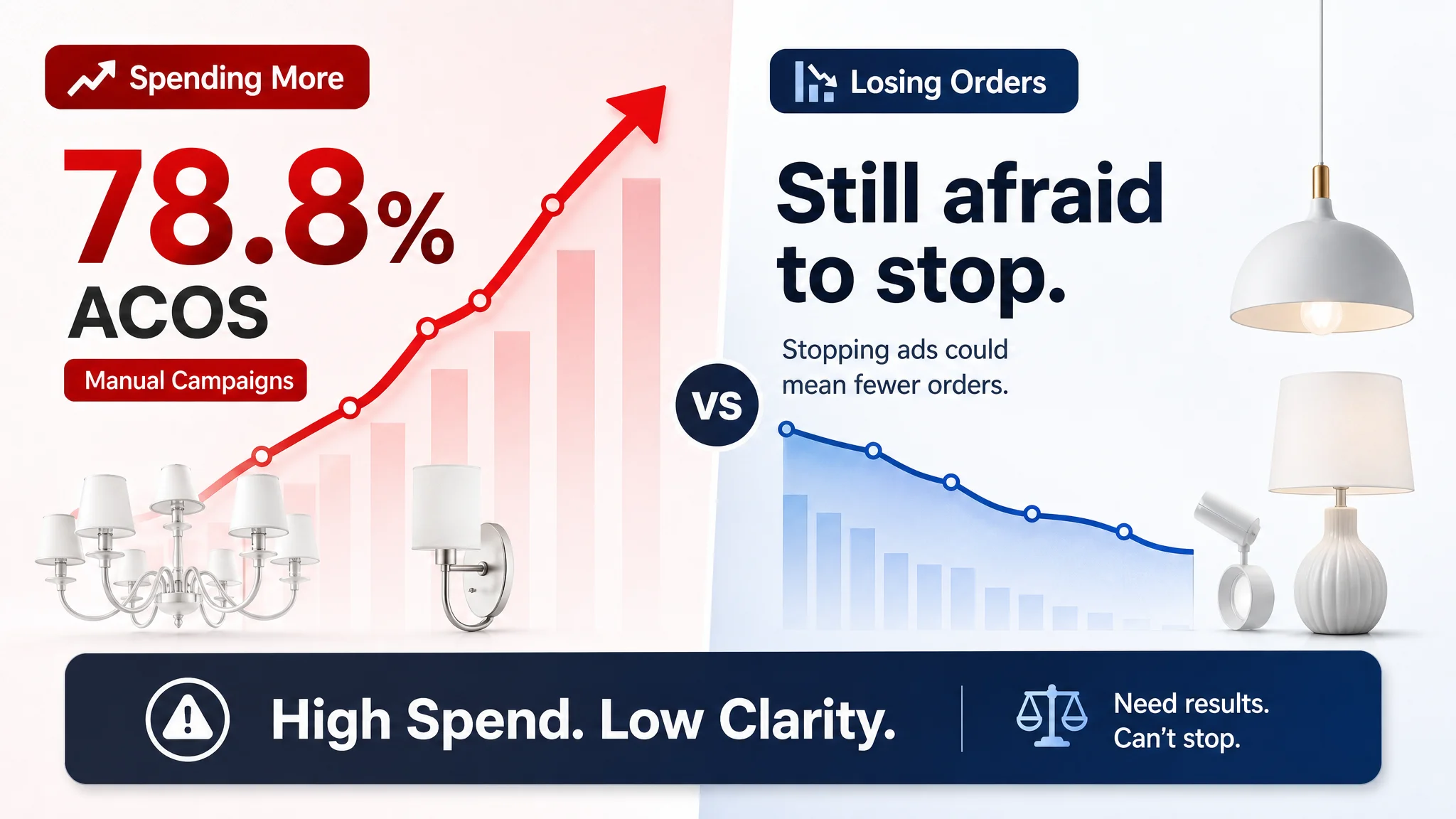
This Amazon seller primarily operates in the lighting category on the US marketplace, with more than 100 SKUs, complex parent-child variation structures, and relatively high CPC. Before adopting DeepBI Ads, the seller relied on manually building campaigns and frequently adjusting bids to maintain exposure. However, the ACOS of the original advertising campaigns once reached as high as 78.8%. The more they invested in advertising, the more they lost, yet they did not dare to stop easily—stopping could mean losing orders, while continuing would keep eating into profits.
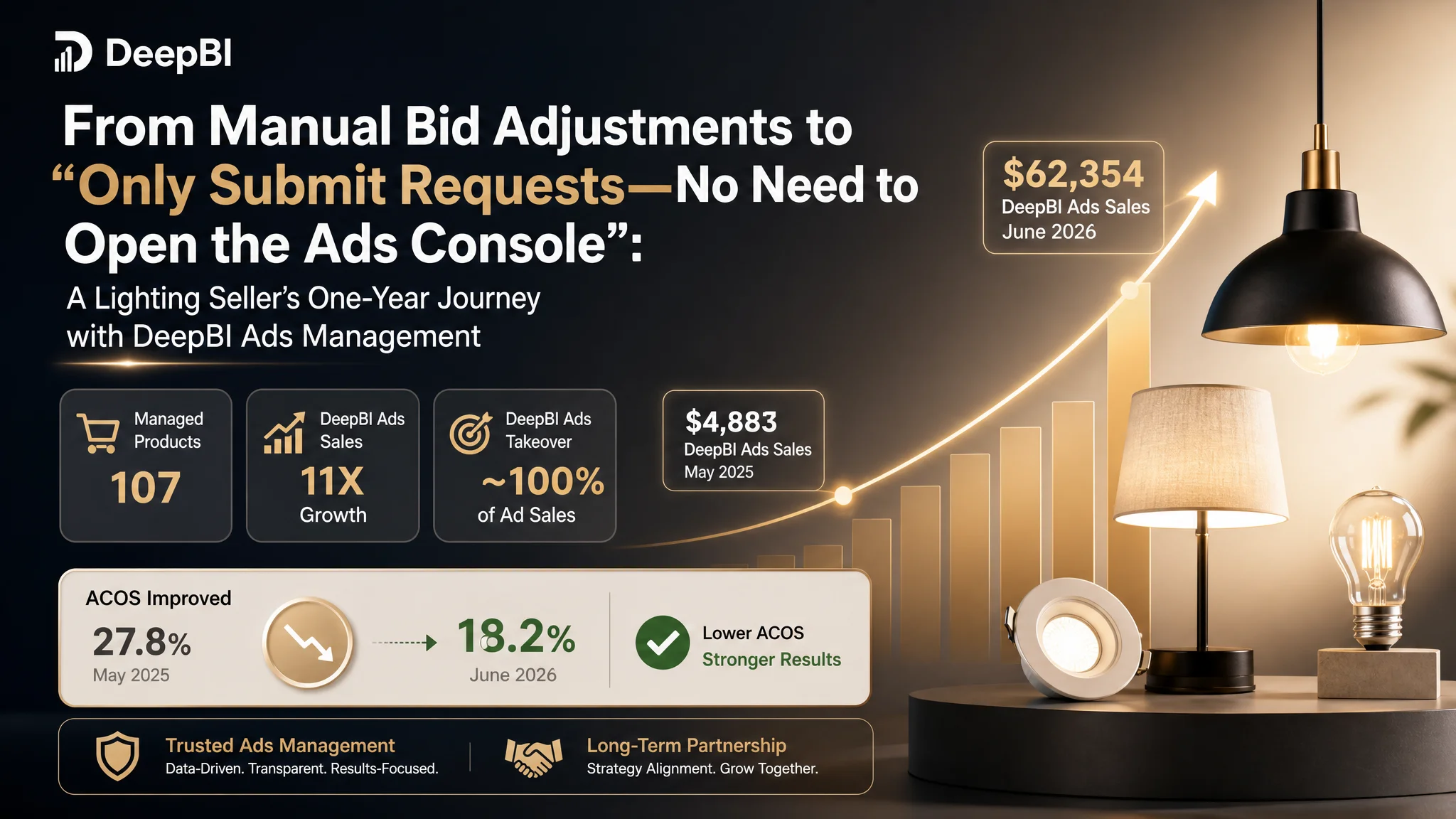
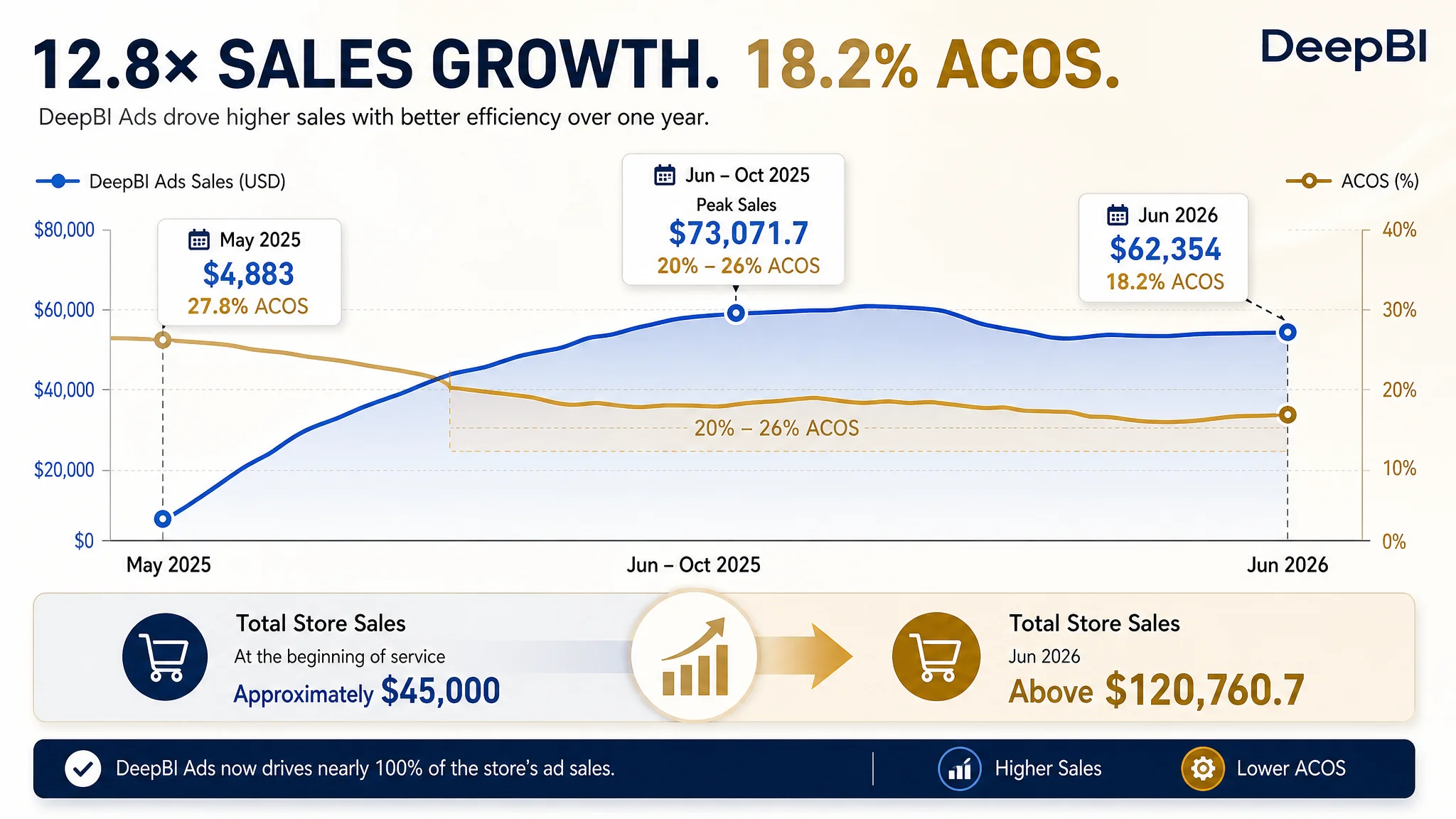
Caught in this dilemma, they decided to hand over part of their budget to DeepBI Ads management for a trial. The results were clear: during the initial period after activation, DeepBI Ads generated $4,883 in sales with an ACOS of 27.8%. One year later, monthly sales generated by DeepBI Ads had increased to $62,354, while ACOS had dropped to 18.2%, and DeepBI Ads had taken over almost all advertising-driven sales for the store. More importantly, the operations team shifted from “watching and adjusting every ad” to “simply submitting requests without having to open the Ads console every day.”
This case does not discuss technical principles. Instead, it follows the real journey of this lighting seller and breaks down the typical concerns they had at each stage:
- Would handing advertising over to DeepBI Ads management lead to wasted spending?
- With unstable inventory and long replenishment cycles, could advertising still be scaled?
- Should new products be pushed aggressively for volume, or should ACOS be controlled first?
- Is renewing the service worthwhile, and how should the decision be evaluated?
For sellers who are currently considering DeepBI Ads management, we hope this case helps them envision their own potential one-year usage journey and lowers the psychological barriers to authorization, management, and renewal.
Customer Background
This seller primarily operates lighting products on the Amazon US marketplace, including chandeliers, wall lights, outdoor lights, and several other subcategories. The number of ASINs managed in the system exceeds 100. Typical characteristics of the lighting category include:
- Relatively high average order values;
- Intense keyword competition and relatively high CPC;
- Complex parent-child and variation relationships, making SKU management difficult;
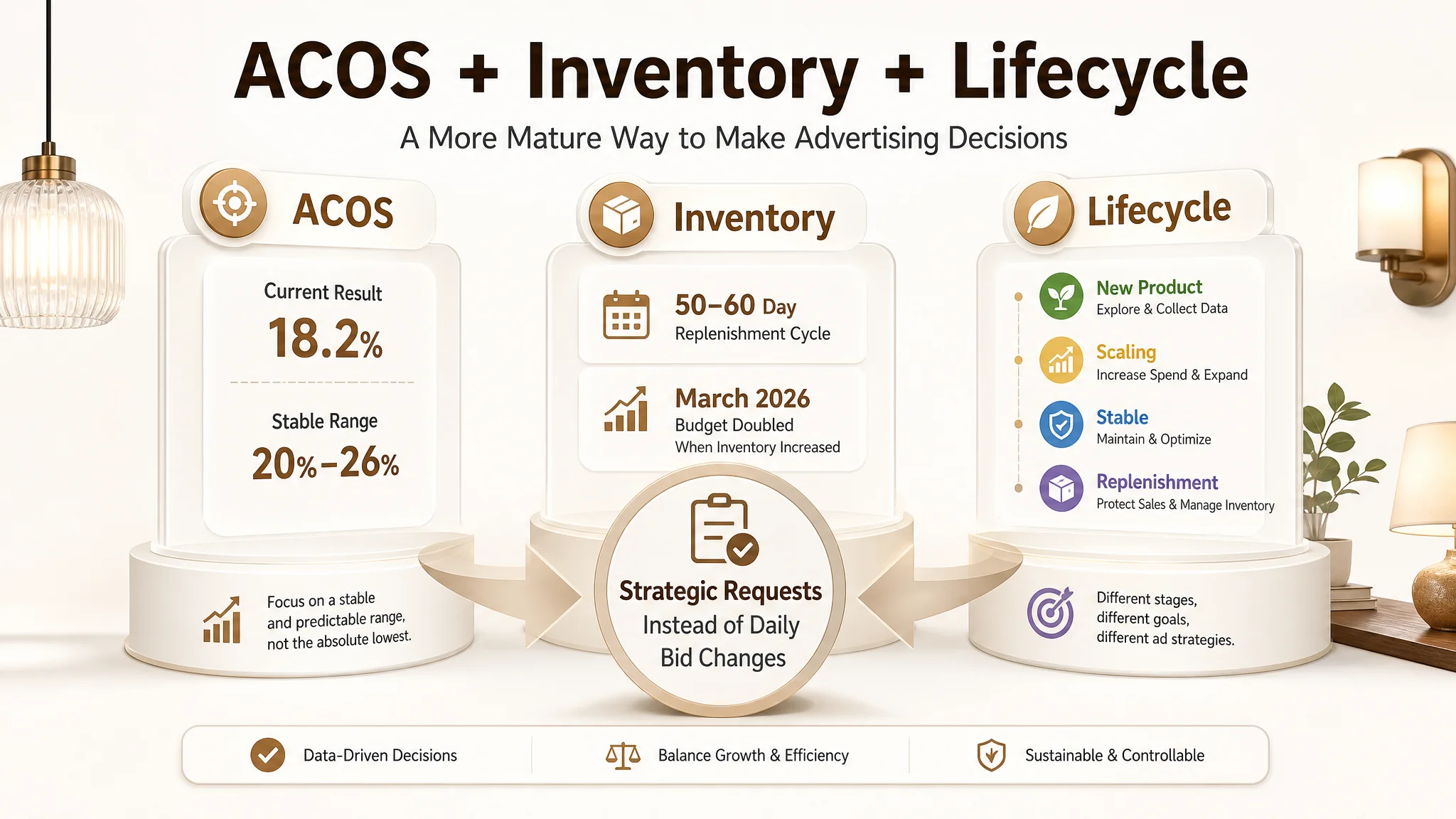
- Long replenishment cycles, with a single restocking shipment potentially taking 50–60 days to arrive at the warehouse.
Before adopting DeepBI Ads, the seller had already been running Amazon advertising for a long time, but relied primarily on manual campaign creation and adjustments. Due to intense category competition and the difficulty of manual control, the ACOS of the original campaigns once rose to 78.8%. Advertising spending became the main source of profit pressure. The team did not have the time to scrutinize every keyword, yet was also worried that “the ads would get out of control as soon as they loosened their grip.”
Against this backdrop, they began looking for an automation tool that could:
- Reduce ineffective spending and bring ACOS back to an acceptable range;
- Maintain exposure and sales without causing traffic to stop because of suspended campaigns;
- Reduce the repetitive workload of frequent bid adjustments and report checking for operations specialists.
The Problem
Before adopting DeepBI Ads, the seller had already encountered many problems that other readers may also be experiencing:
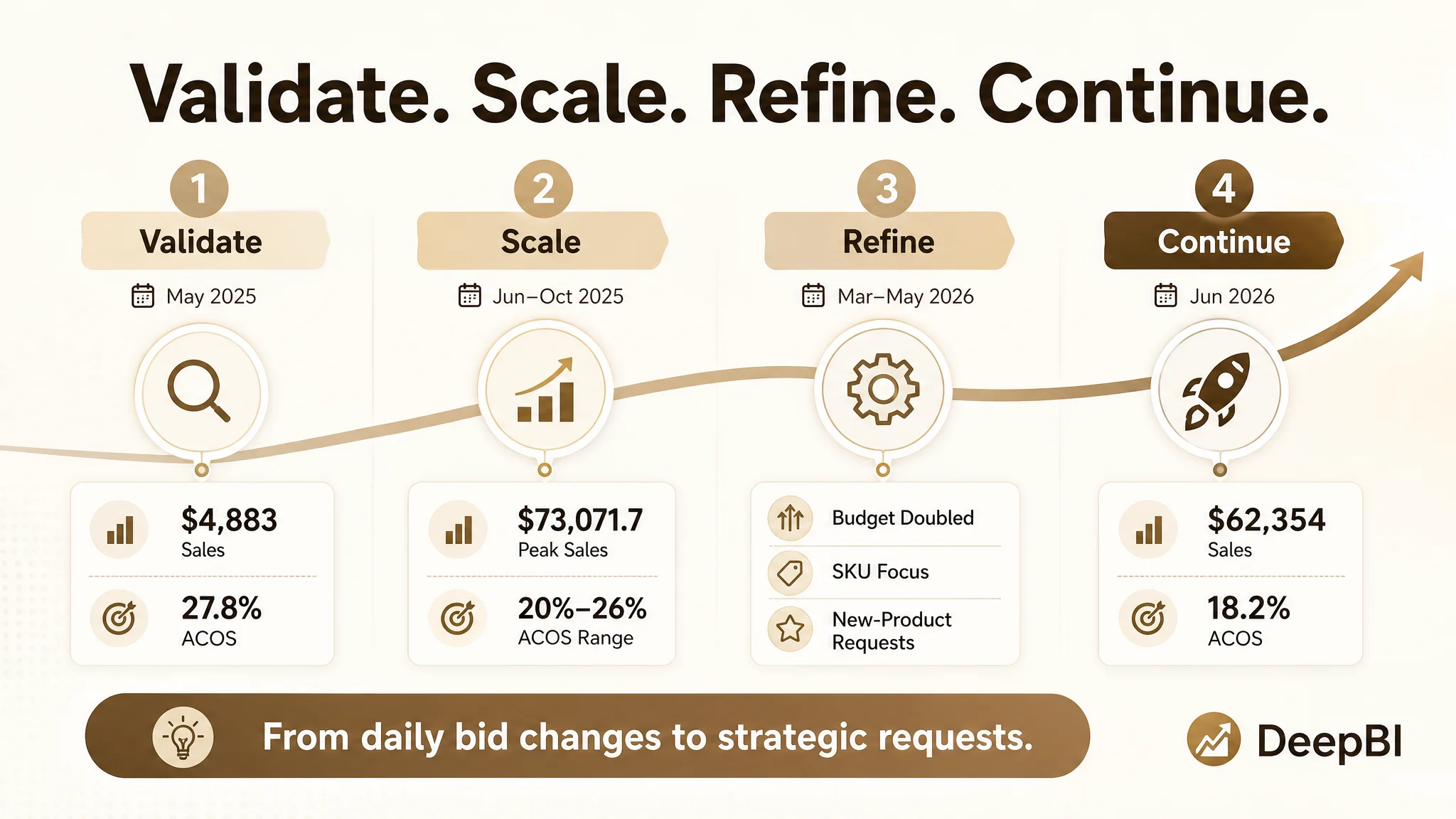
1. The more they advertised, the more they lost, but they did not dare to stop
The ACOS of the original campaigns reached as high as 78.8%. For every $100 spent on advertising, less than $22 in gross profit remained to cover other costs and profit. On the one hand, the owner felt that “continuing like this is not sustainable.” On the other hand, they clearly understood that in the lighting category, stopping advertising completely was almost equivalent to giving up new traffic.
2. With numerous and complex SKUs, it was difficult to keep an eye on everything manually
The store had as many as 107 managed ASINs, along with a large number of parent-child variations. In practice, it was difficult for the operations team to:
- Determine whether each child variation should receive a bid increase or decrease;
- Identify in a timely manner which keywords had poor conversion and should be negated;
- Adjust the budget pace at any time based on inventory and replenishment conditions.
As a result, SKUs with real profit potential were not prioritized for scaling, while some low-efficiency traffic continued consuming the budget.
3. The team was tied down by advertising without a clear validation path
The operations team spent a great deal of time every day on:
- Downloading reports and reviewing spending and conversions for each Campaign;
- Manually adjusting bids in an attempt to lower ACOS;
- Explaining to the owner why advertising spend had increased over the previous few days.
However, with ACOS already having surged to 78.8%, no one was confident that the situation could be recovered. The owner was concerned about two things:
- If they switched to another advertising approach, would it simply be another way to lose money?
- Was there a clear “validation period” that could quickly determine whether the new tool was worth continuing with?
Under this continued state of “high pressure but low clarity,” the lighting seller ultimately decided to try DeepBI Ads management, with one condition: it first had to prove that it would not waste money and that visible changes could be achieved.
How DeepBI Diagnosed
The seller did not hand over all advertising to DeepBI Ads from the outset. Instead, they gradually expanded the management scope and budget according to a process of “validate first, scale next, and then refine control.” The overall diagnostic process consisted of several key steps:
1. Integration and comparison: using the initial-period data to establish the true baseline
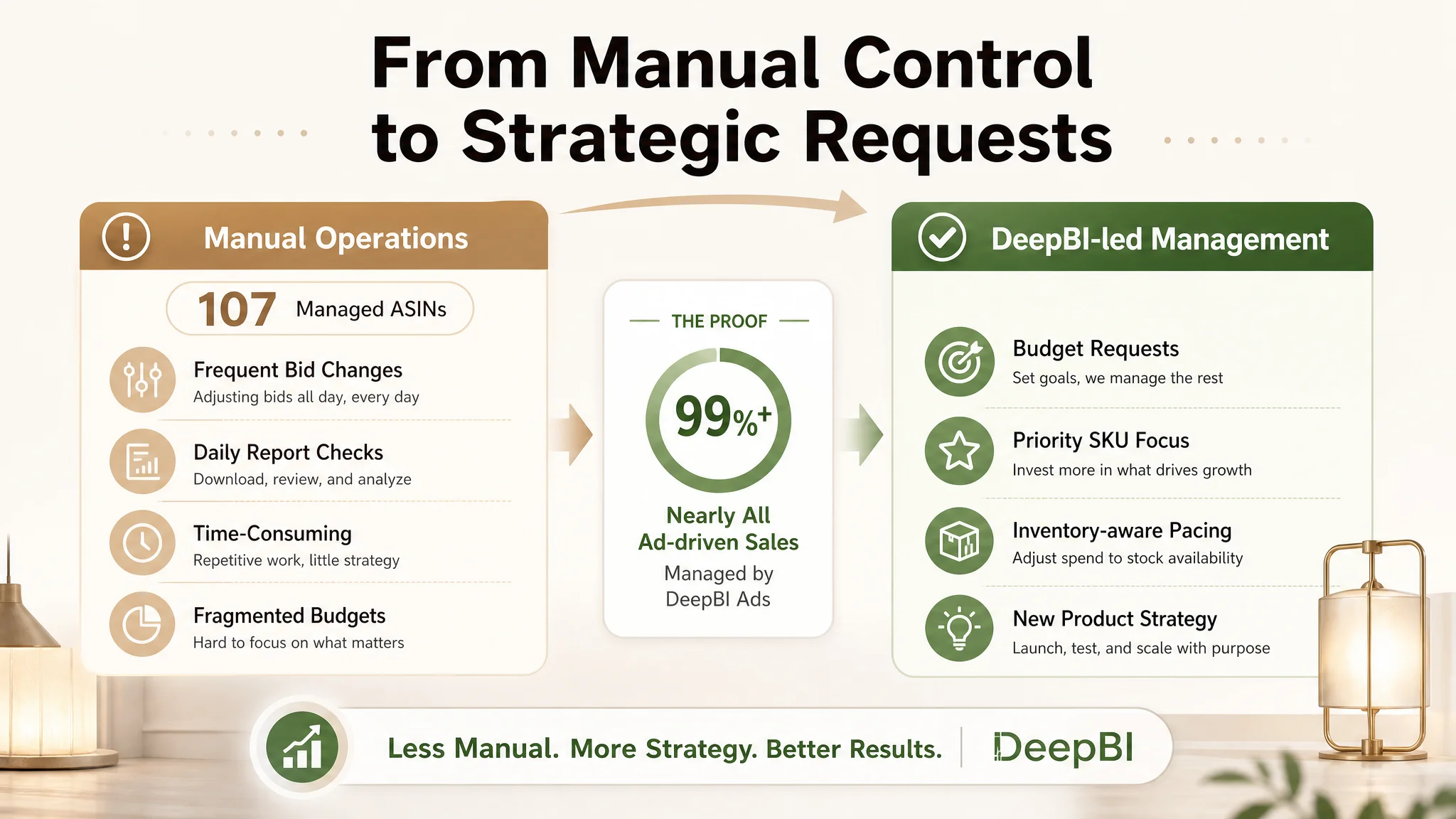
In May 2025, the seller registered for and activated the DeepBI Ads service. During the first data period, DeepBI Ads generated $4,883 in sales, with an ACOS of 27.8%.
These two figures had three important implications for the owner:
- Compared with the original ACOS of 78.8%, 27.8% showed that the system could bring advertising efficiency back to a more controllable range within the same category and store;
- Generating sales immediately after activation showed that DeepBI Ads could identify effective traffic within a relatively short period, rather than “burning through the budget” for a long time;
- The results could be directly compared with the original campaigns, helping determine whether the issue was the advertising approach rather than the category itself.
2. Monitoring over time: confirming that the results were not a short-lived spike
From June to October 2025, DeepBI Ads entered a period of rapid scaling:
- DeepBI Ads sales increased from $15,840 to $73,071.7;
- Total store sales reached a period peak of $128,832.6 in October 2025;
- DeepBI Ads ACOS remained stable within the 20%–26% range.
The key purpose of this period was to help the owner confirm two things:
- Scaling did not mean losing control: Advertising sales increased, but ACOS did not “surge” again;
- Manual bid adjustments could be reduced: Even without manually monitoring every keyword and Campaign, overall advertising continued operating within a reasonable range.
3. Making budget decisions based jointly on inventory and ACOS
By March 2026, the customer contact explicitly noted that “ACOS is within the expected range, and inventory has increased,” and proactively requested that the advertising budget be doubled. This reflected a key diagnostic conclusion:
- ACOS had already been verified to be within an acceptable range;
- Inventory pressure had shifted from “at risk of running out” to “sufficient inventory that needs to be sold.”
These conditions made it possible to move the DeepBI Ads budget from a conservative “trial period” into a “scaling period.” At this stage, scaling was no longer something DeepBI Ads decided independently. Instead, the advertising pace was jointly determined based on data and inventory.
4. Refined diagnosis: analyzing fluctuations by store and by SKU
In May 2026, the customer reported that the ACOS of another store was relatively high and requested focused attention. The diagnosis at this point did not simply involve looking at one “overall ACOS.” It was broken down into several dimensions:
- At the individual-store level, whether certain listings were dragging down overall performance;
- Whether any individual SKU or ASIN had abnormal conversion performance;
- Whether external factors such as stockouts or replenishment in transit were having an impact.
At this stage, DeepBI’s value was reflected more in its ability to quickly show “which layer the problem was occurring at,” providing a basis for subsequent structural optimization and budget migration.
5. Explaining the strategy: especially the bidding logic for new products
On May 25, 2026, the customer noticed that DeepBI Ads had lowered the CPC for new-product advertising and raised several questions:
- Should new products use higher bids to aggressively drive exposure?
- Would the system’s bid reductions affect the learning speed of new products?
At this stage, DeepBI’s key action was no longer simply “changing bids,” but explaining to the seller:
- How DeepBI Ads adjusted the bidding pace for new products based on feedback such as clicks and conversions;
- Under what data conditions it would proactively lower CPC to avoid ineffective spending;
- At which points manual intervention could be introduced to support the new-product promotion goals.
Through this diagnostic and explanation process, the seller gradually moved from “handing over the advertising” to “understanding how DeepBI Ads makes decisions,” laying the foundation for long-term management and multiple renewals.
The Real Problem
Looking back over the one-year service period, the core issues faced by this lighting seller were not simply the lack of an automation tool. Instead, they involved three more fundamental business conflicts.
Problem One: Treating “Structural Losses” as an “Inevitable Consequence of the Category”
- Cause: Before adopting DeepBI Ads, the ACOS of the original campaigns reached as high as 78.8%. It was easy for the seller to reach the following conclusions:
- Lighting is inherently a category with high CPC;
- Competition is intense, so somewhat high ACOS is normal;
- It is difficult to prove whether optimization is actually possible.
- Impact: If this kind of “fatalistic” thinking continues, it can lead to:
- The advertising team continually lowering bids and cutting budgets without truly improving the underlying structure;
- The owner lowering expectations for advertising and relying only on organic traffic to get by;
- Any new tool or approach having difficulty obtaining a genuine testing opportunity.
- Evidence: Once DeepBI Ads took over the same store in the same category, the results showed that:
- ACOS fell from 78.8% to 27.8% during the initial period after activation;
- It was further optimized to 18.2% within one year.
This indicates that the previous losses were primarily caused by advertising structure and bidding strategy issues, rather than by the category itself being “destined to lose money.”
Problem Two: Placing All Anxiety on a Single Number—ACOS
- Cause: During the manual advertising phase, the seller often evaluated advertising performance based only on total ACOS, overlooking that:
- Different stores, SKUs, and lifecycle stages should have different goals;
- Budget strategies should differ depending on whether inventory is abundant or tight;
- The acceptable ACOS level is inherently different during the new-product phase and the stable phase.
- Impact:
- Whenever ACOS fluctuated in the short term, the team became anxious about whether “the advertising had stopped working”;
- The structural impact of stockouts and replenishment cycles on sales and ACOS was overlooked;
- The team could not shift between accepting somewhat higher ACOS in exchange for growth and prioritizing cost control.
- Evidence:
- From June to October 2025, DeepBI Ads ACOS remained stable within the 20%–26% range while advertising sales continued to scale;
- In March 2026, after confirming that “ACOS was within the expected range and inventory had increased,” the customer proactively requested that the budget be doubled.
This shows that only after the customer began evaluating the situation using “ACOS + inventory + sales curve” could they make genuine scaling decisions instead of being driven by a single ACOS figure.
Problem Three: Core Concerns About DeepBI Ads Management Had Not Been Answered in a Structured Way
- Cause: Typical concerns many sellers have about DeepBI Ads include:
- Will it waste money?
- If an item is out of stock or replenishment is in transit, will DeepBI Ads continue spending aggressively?
- If a new product needs to scale quickly, will DeepBI Ads lower bids too early and prevent it from gaining traction?
- If performance fluctuates, how can sellers distinguish an advertising problem from an inventory problem?
However, before making a decision, these questions often lack a clear validation framework.
- Impact:
- Even after activating DeepBI Ads, sellers may not dare to fully let go, treating it only as an “auxiliary tool” while continuing to intervene frequently every day;
- Renewal decisions may depend entirely on short-term ACOS performance, leading to incorrect judgments when inventory fluctuates;
- It becomes difficult to reach a mature stage of “long-term management + jointly refining the strategy.”
- Evidence: During this lighting seller’s one-year journey, several key shifts in mindset centered on these questions:
- Initial validation: confirming that DeepBI Ads would not waste money and could bring ACOS down from 78.8% to 27.8%;
- Scaling decision: proactively doubling the budget after confirming that ACOS was controllable and inventory was sufficient;
- Periodic fluctuation: requesting a focused diagnosis when another store’s ACOS was high, rather than directly rejecting the tool;
- New-product debate: questioning the logic after noticing that DeepBI Ads had lowered the CPC for new products, rather than shutting DeepBI Ads down immediately.
The real issue was that only after these key concerns were repeatedly broken down through actual data, diagnostic processes, and communication could the seller move from “let’s give it a try” to “we are willing to place our advertising under long-term management.”
Optimization Plan
After identifying the issues above, the lighting seller and DeepBI went through an optimization process that evolved from “firefighting adjustments” to “systematic management,” primarily in the following areas.
1. Rebuilding the advertising management structure: from manual control to DeepBI Ads-led management
- The store’s primary advertising budget was gradually migrated to DeepBI Ads management, allowing DeepBI Ads to evaluate efficiency across keywords, ASINs, advertising periods, and other dimensions;
- A small number of the original manual campaigns were retained for comparison but no longer carried the primary sales responsibility;
- Over time, DeepBI Ads took over nearly all advertising-driven sales for the store, creating a model in which “DeepBI Ads leads and the seller submits requests.”
2. Dynamically adjusting the budget pace based on inventory status
- When inventory was abundant, such as in March 2026, the customer proactively requested that the budget be doubled to accelerate inventory turnover, provided that ACOS had stabilized within the expected range;
- When best-selling SKUs were out of stock or had long replenishment cycles, spending on the relevant listings was appropriately tightened to avoid ineffective consumption;
- Through DeepBI’s data views, inventory pacing was linked to advertising scaling rather than being managed independently.
3. Refining the focus on key SKUs: adding budgets and creating campaigns separately
- For high-performing SKUs, the customer proposed the following in late March 2026:
- Increase the budget for individual SKUs;
- Create additional automatic advertising campaigns to expand coverage;
- DeepBI helped organize the advertising structure so that these priority listings could receive clearer budget allocation under DeepBI Ads rules instead of being mixed with other SKUs and sharing one undifferentiated budget pool.
4. New-product advertising strategy: balancing rapid scaling and cost control
- For new products, the customer initially hoped to drive exposure quickly through high CPC. During actual operation, however, they observed that DeepBI Ads would periodically lower bids based on conversion data;
- Based on this, DeepBI took two types of action:
1. Explained the exploration and bidding logic of DeepBI Ads during the new-product phase, helping the customer understand:
- When relatively higher ACOS could be accepted in exchange for data accumulation;
- Under what conditions CPC should be lowered promptly to avoid “burning through data without generating orders.”
2. Provided recommendations for manual intervention, such as:
- Setting clearer target ranges and testing periods for key new products;
- Moderately increasing the budget or placement exposure during specific periods to support algorithmic exploration.
5. Differentiated diagnosis across multiple stores instead of evaluating DeepBI Ads with a one-size-fits-all approach
- When the customer reported that another store had high ACOS, the optimization approach was not simply to “lower bids.” Instead, it involved:
- Comparing differences between the store and the main store in terms of category, price range, and level of competition;
- Analyzing whether specific listings or keywords were driving up overall ACOS;
- Checking for non-advertising factors such as tight inventory or delayed replenishment.
- Based on this analysis, the budget allocation and targets for that store were adjusted accordingly, avoiding the use of one “average ACOS” figure to reject the entire management strategy.
Through these optimization actions, the customer’s focus gradually shifted from “modifying dozens of bids every day” to “submitting requests regularly, reviewing results, and jointly adjusting the rules.”
Results
Over approximately one year of management, the advertising and overall business results for this lighting seller can be clearly quantified:
1. DeepBI Ads sales increased by more than 11 times
- May 2025, the initial activation period: DeepBI Ads sales were $4,883;
- June 2026: DeepBI Ads sales reached $62,354;
- Within one year, monthly sales generated by DeepBI Ads increased by more than 11 times, while DeepBI Ads gradually took over nearly all advertising-driven sales.
2. ACOS was brought back from a severely loss-making range to a healthy level
- Before activation: ACOS for the original manual campaigns reached as high as 78.8%;
- May 2025: ACOS during the initial DeepBI Ads activation period was 27.8%;
- June–October 2025: DeepBI Ads ACOS remained stable within the 20%–26% range;
- June 2026: DeepBI Ads ACOS was further optimized to 18.2%.
3. Total store sales more than doubled
- At the beginning of the service: Monthly store sales were approximately $45,000;
- October 2025: Total sales reached a peak of $128,832.6;
- June 2026: Total sales remained above $120,760.7;
- Overall, store sales more than doubled over a period of more than one year. The fluctuations during this period were primarily related to stockouts of best-selling SKUs and replenishment cycles.
4. The operating model shifted from “manual bid adjustments” to “long-term management”
- Early after activation: The customer focused primarily on validation and cautiously observed whether DeepBI Ads would waste money;
- Scaling period: After confirming that ACOS was controllable and inventory was sufficient, the customer proactively proposed doubling the budget;
- Renewal stage: After experiencing inventory fluctuations, the customer still chose to renew and sought a more flexible arrangement based on inventory cycles during the annual plan negotiations;
- Current stage: DeepBI Ads is operating under stable management, and the customer now participates primarily by “submitting requests,” such as specifying priority listings, budget granularity, and new-product strategies, rather than treating daily manual bid adjustments as the main task.
The key change was not simply that advertising performance improved. More importantly, the seller became accustomed to letting DeepBI Ads serve as the primary advertising operator while they shifted toward setting strategic objectives and operating constraints.
Case Summary
Looking back on this lighting seller’s one-year journey, the changes can be summarized at three levels:
1. From “Is advertising destined to lose money?” to “The problem was structure and methodology”
When the ACOS of the original manual campaigns reached as high as 78.8%, it was easy to attribute the losses to the category itself. After DeepBI Ads took over, ACOS first fell from 78.8% to 27.8% and was then further optimized to 18.2%. This showed that the real issues lay in advertising structure, bidding strategy, and budget allocation—not in the idea that “the lighting category is impossible to operate profitably.”
2. From “watching one ACOS figure” to “balancing ACOS, inventory, and lifecycle”
The seller gradually recognized that:
- During the scaling phase, the budget could be proactively increased while ACOS remained within an acceptable range;
- When inventory was tight or best-selling products were out of stock, expectations for advertising spend and growth needed to be tightened;
- During the new-product phase, temporarily higher ACOS could be accepted in exchange for data, but spending could not continue without limits.
Advertising decisions were no longer based only on total ACOS. Instead, they were evaluated within the broader context of inventory, SKU structure, and sales curves.
3. From “being afraid to lose control” to “only submitting requests without opening the Ads console”
At the beginning, the customer was worried that DeepBI Ads would waste money and be difficult to control;
- Initial validation proved that DeepBI Ads could bring ACOS back to a reasonable range within a short period;
- The subsequent scaling and inventory fluctuation periods further verified the stability of DeepBI Ads at different stages;
- Through explanations and recommendations for manual intervention regarding issues such as new-product CPC adjustments, the customer developed a deeper understanding of and trust in DeepBI Ads’ strategy.
Ultimately, the customer no longer spent time adjusting bids one by one. Instead, they focused more on:
- Telling DeepBI about current inventory conditions and sales objectives;
- Clarifying which SKUs should be aggressively scaled and which only needed to be maintained;
- Making rational decisions about renewals and budget adjustments based on data from the previous year.
For this lighting seller, the real change was that advertising operations shifted from “people watching machines” to “people and DeepBI Ads making decisions together.” This gave the team more time to focus on more important issues such as product selection, supply chain management, and product competitiveness.
Key Takeaways for Sellers
Whether or not they use DeepBI, sellers considering DeepBI Ads management can learn three valuable lessons from this case.
Takeaway One: Identify where the losses are coming from before deciding whether to switch tools
- Do not simply assume that “the category is difficult, so high ACOS is normal”;
- Compare ACOS and sales across different periods and strategies to determine whether the problem is structural or a short-term fluctuation;
- Use a limited trial or store-level test to validate a new approach with data instead of reaching a conclusion based on assumptions.
Takeaway Two: Manage advertising across three dimensions—ACOS, inventory, and lifecycle
- ACOS: Set an acceptable range rather than pursuing the absolute lowest figure;
- Inventory: Scale proactively when inventory is abundant and control expectations when inventory is tight;
- Lifecycle: The requirements for ACOS and budget naturally differ during the new-product, growth, stable, and inventory-clearance stages.
Once these three dimensions are considered together, many debates about whether “the advertising is working” become much clearer.
Takeaway Three: When evaluating DeepBI Ads management, do not look only at the short-term ACOS curve When considering whether to hand advertising over to DeepBI Ads, focus on the following questions:
1. Initial activation: Can the system produce a stable ACOS range within a reasonable period, rather than “burning through the budget” for a long time?
2. Scaling stage: After the budget is increased, does ACOS remain within an acceptable range instead of quickly becoming uncontrolled?
3. Fluctuation stage: When stockouts, replenishment in transit, or slow-moving new products occur, can the system distinguish between an “advertising problem” and an “operational problem” through diagnosis?
4. Communication and understanding: Can sellers understand the basic decision-making logic of DeepBI Ads and perform manual intervention or strategy adjustments when necessary?
When these questions can all be answered systematically, the transition “from manual bid adjustments to simply submitting requests” is no longer just a story. It becomes a path that most mature sellers can replicate.