

Introduction
When many Amazon sellers run ads, they commonly fall into one of three situations:
- During the launch stage, they focus obsessively on maintaining a low ACOS from the start, causing their ads to barely gain traction;
- After finally generating sales, they are afraid to increase the budget during the scaling stage and miss the growth window;
- As soon as sales decline, they immediately cut bids and budgets, leaving the long-term performance curve unstable.
These problems are amplified in the lighting category because of its relatively high average order value, expensive clicks, large number of SKUs, and complex parent-child variation structures. Ads become increasingly unprofitable, organic traffic fails to grow, and ACOS cannot be reduced—these are everyday challenges for many lighting sellers.
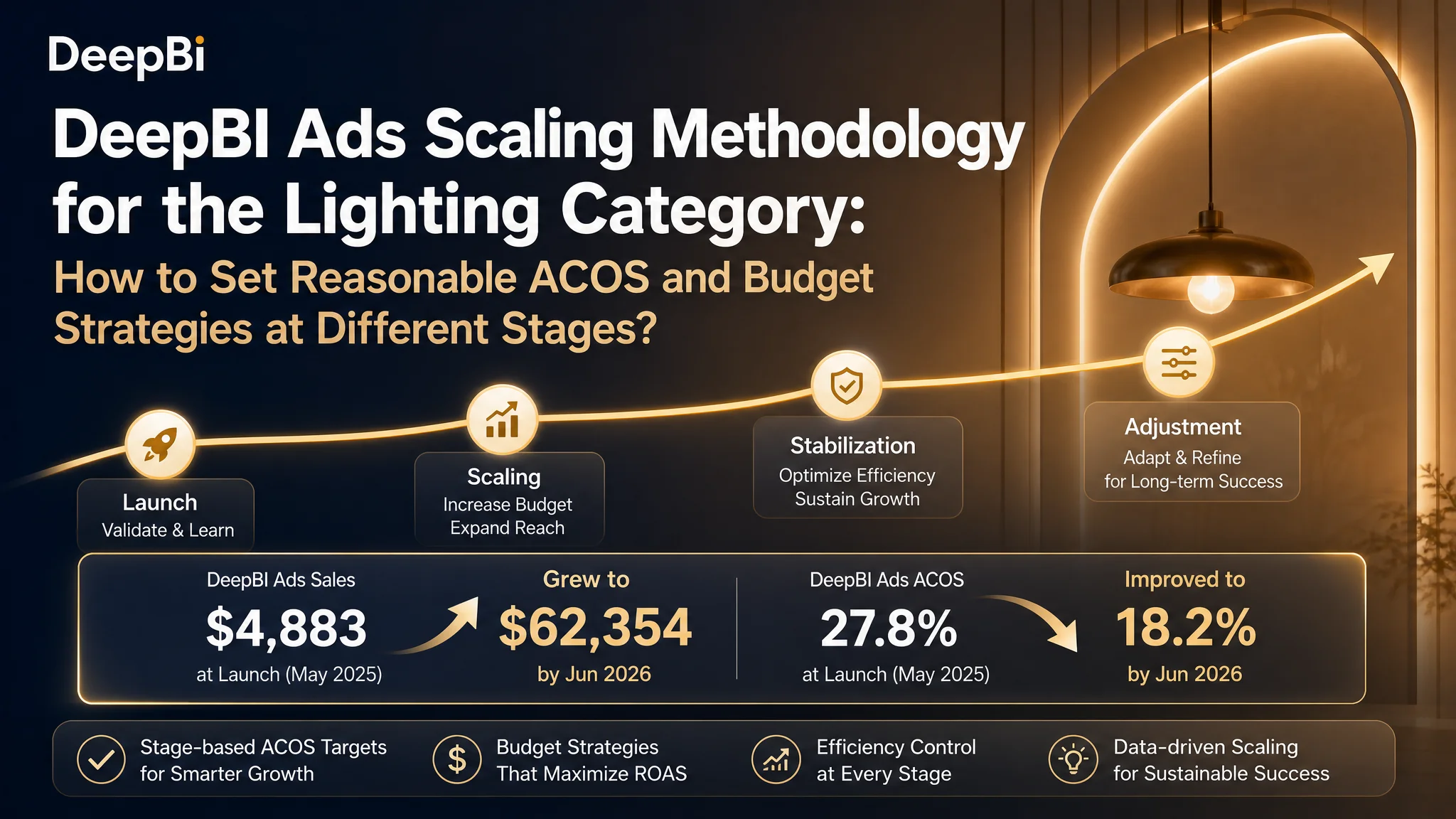
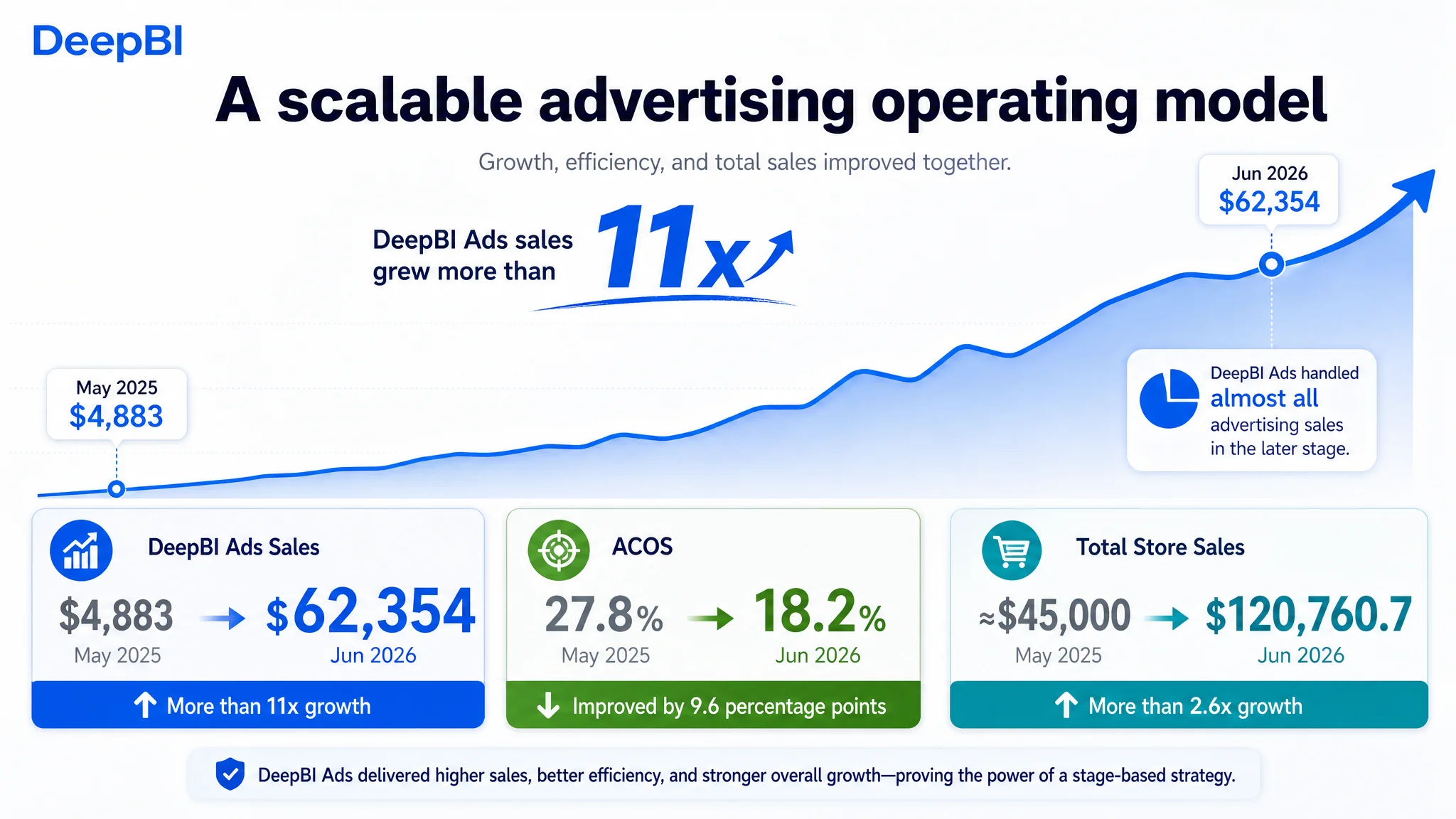
This article is based on the real data of a US-based Amazon seller specializing in lighting products. DeepBI Ads sales grew from 4,883 USD to 62,354 USD, while ACOS improved from 27.8% to 18.2%. Over more than one year, DeepBI Ads came to handle almost all advertising sales. Rather than emphasizing how powerful a particular tool is, we analyze the case from an operational perspective:
1. How should ACOS targets and budget strategies be set for the lighting category at different stages?
2. How can sellers determine whether it is time to control costs or scale up?
3. When sales fluctuate, is the problem related to advertising, or to inventory, the Listing, or another operational factor?
After reading this article, you will have a practical, stage-based DeepBI Ads scaling framework that can be applied directly to your own store. Even if you are not currently using any management tool, you can manage ACOS and budgets more logically.
Customer Background
The seller in this case operates a US-based Amazon store specializing in lighting products:
- Category characteristics: Medium-to-high average order value, relatively high CPC, and intense competition;
- Business scale: More than 100 ASINs with a complex parent-child variation structure;
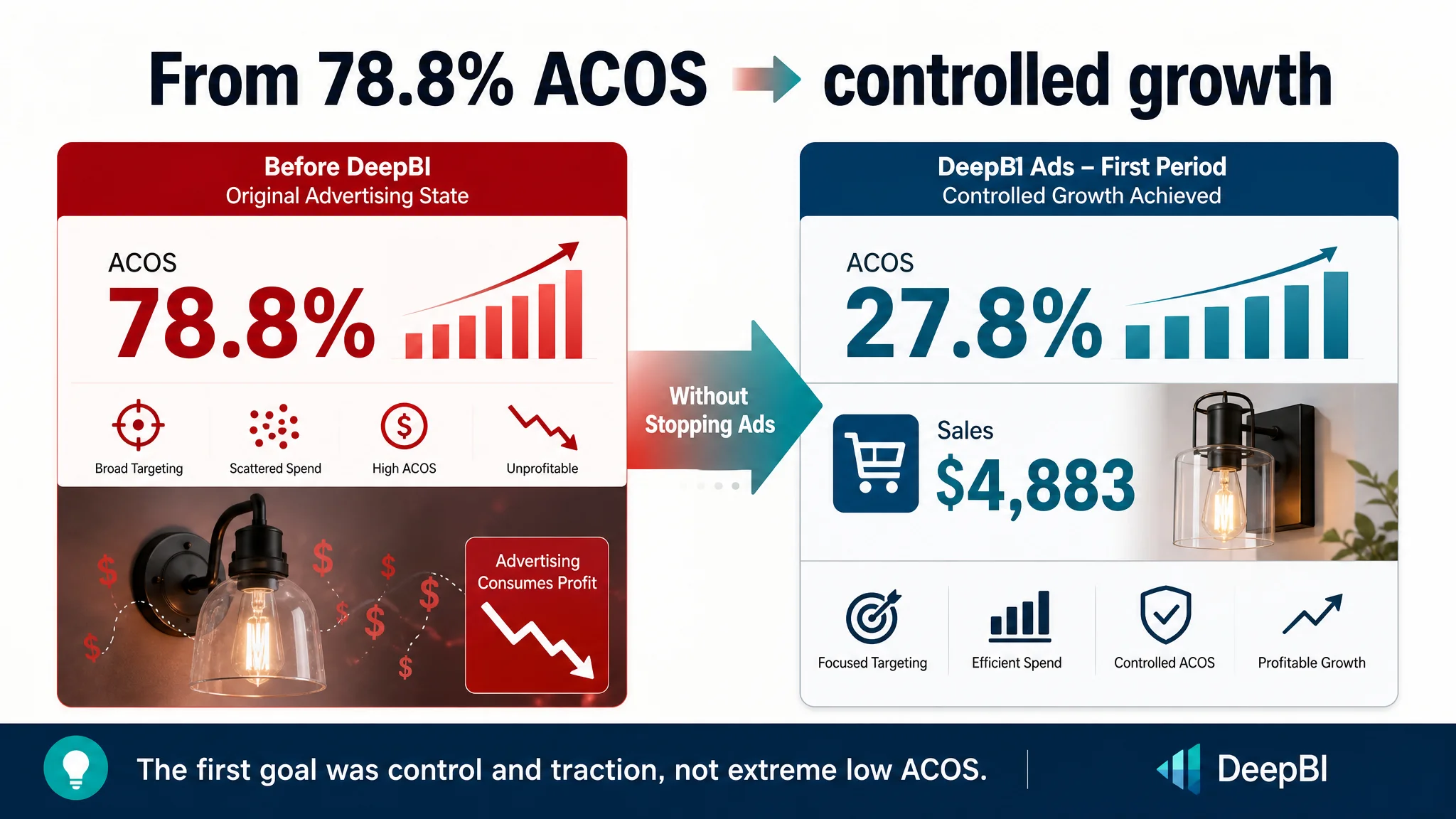
- Advertising starting point: Before using DeepBI Ads, the existing campaigns had an ACOS as high as 78.8%, a typical case of “the more they advertised, the more they lost”;
- Advertising challenge: On the one hand, the seller was afraid to stop advertising because orders might drop sharply. On the other hand, the high ACOS consumed profits, while the team lacked the time to monitor bids, separate keywords, and adjust campaign structures every day.
In May 2025, the seller began using DeepBI Ads management, hoping to bring advertising back from an unprofitable state to a controllable level without significantly increasing manual effort, and then consider scaling for growth.
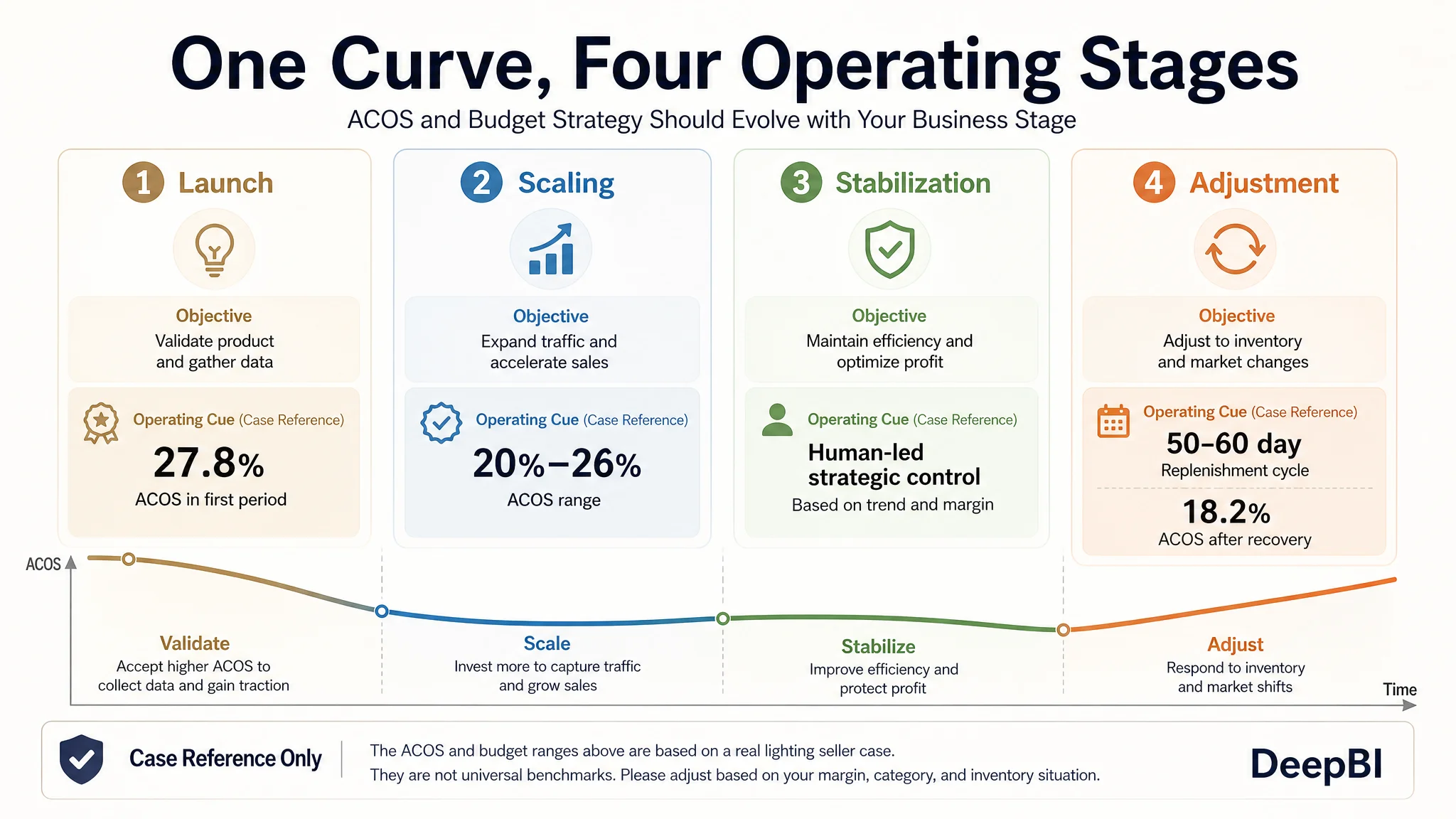
From service activation to entering stable management, the overall process went through approximately four stages:
1. Launch validation stage: DeepBI Ads sales reached 4,883 USD in the first month, with an ACOS of 27.8%;
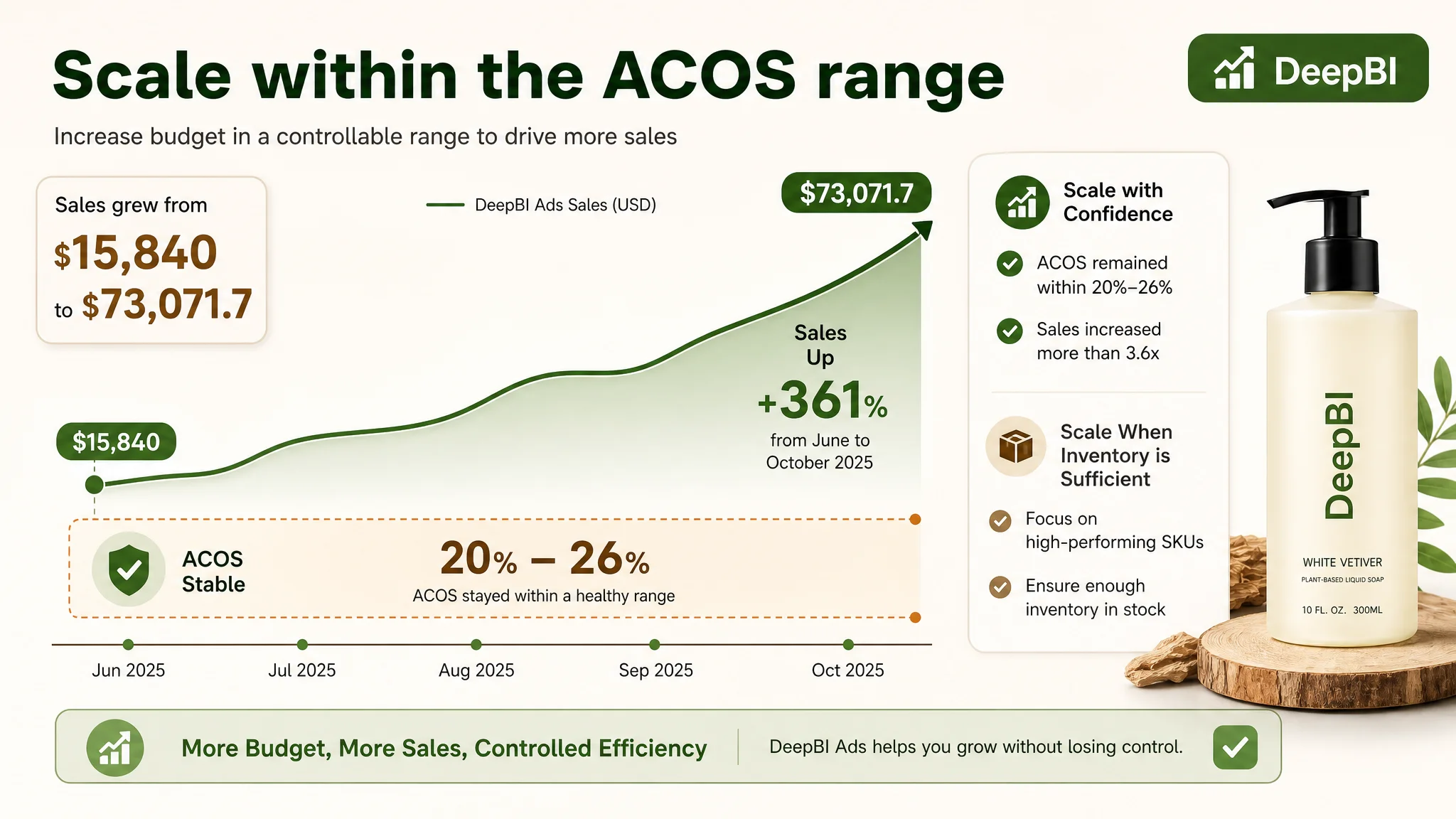
2. Rapid scaling stage: From June to October 2025, DeepBI Ads sales grew from 15,840 USD to 73,071.7 USD, while ACOS remained stable within the 20%–26% range;
3. Fluctuation and adjustment stage: Sales experienced a temporary decline due to stockouts of core child SKUs and the impact of the replenishment cycle;
4. Regrowth and stabilization stage: In June 2026, DeepBI Ads sales reached 62,354 USD, total store sales reached 120,760.7 USD, and ACOS improved to 18.2%. DeepBI Ads handled almost all advertising sales.
The key behind this curve was not reducing ACOS to an extremely low level all at once, but defining what constituted a reasonable ACOS and budget at each stage. This is precisely the methodology that many lighting sellers lack.
The Problem
Before adopting DeepBI, the advertising situation of this lighting seller was similar to that of many other sellers:
- Overall ACOS was as high as 78.8%, putting advertising firmly in the unprofitable zone;
- The advertising structure was relatively broad, with a small number of automatic and manual campaigns supporting a large number of SKUs;
- Bidding lacked a systematic strategy, with popular keywords, irrelevant keywords, and branded keywords mixed together and consuming budget;
- The team’s daily work was filled with “lowering bids–raising bids–adding negative keywords,” leaving no time to examine the issue from an operational perspective.
The specific manifestations were as follows:
1. Advertising became increasingly unprofitable:
- To maintain exposure and rankings, the seller was afraid to reduce the budget significantly;
- However, under a high ACOS, every order compressed profit, resulting in the feeling that “the more we advertise, the more anxious we become.”
2. Organic traffic failed to take off:
- Manual advertising did not have a structured scaling strategy;
- Much of the traffic was obtained by aggressively bidding high prices, making it difficult to establish stable organic ranking momentum.
3. The seller could not determine where the problem actually lay:
- Were the ad bids too high?
- Was the Listing conversion rate too low?
- Or was inventory unable to keep up, with stockouts dragging down overall performance?
In simple terms, the store’s advertising strategy had only two settings: “keep spending” and “hit the brakes immediately.” It lacked a middle setting for setting stage-based goals and controlling the pace of growth.
How DeepBI Diagnosed
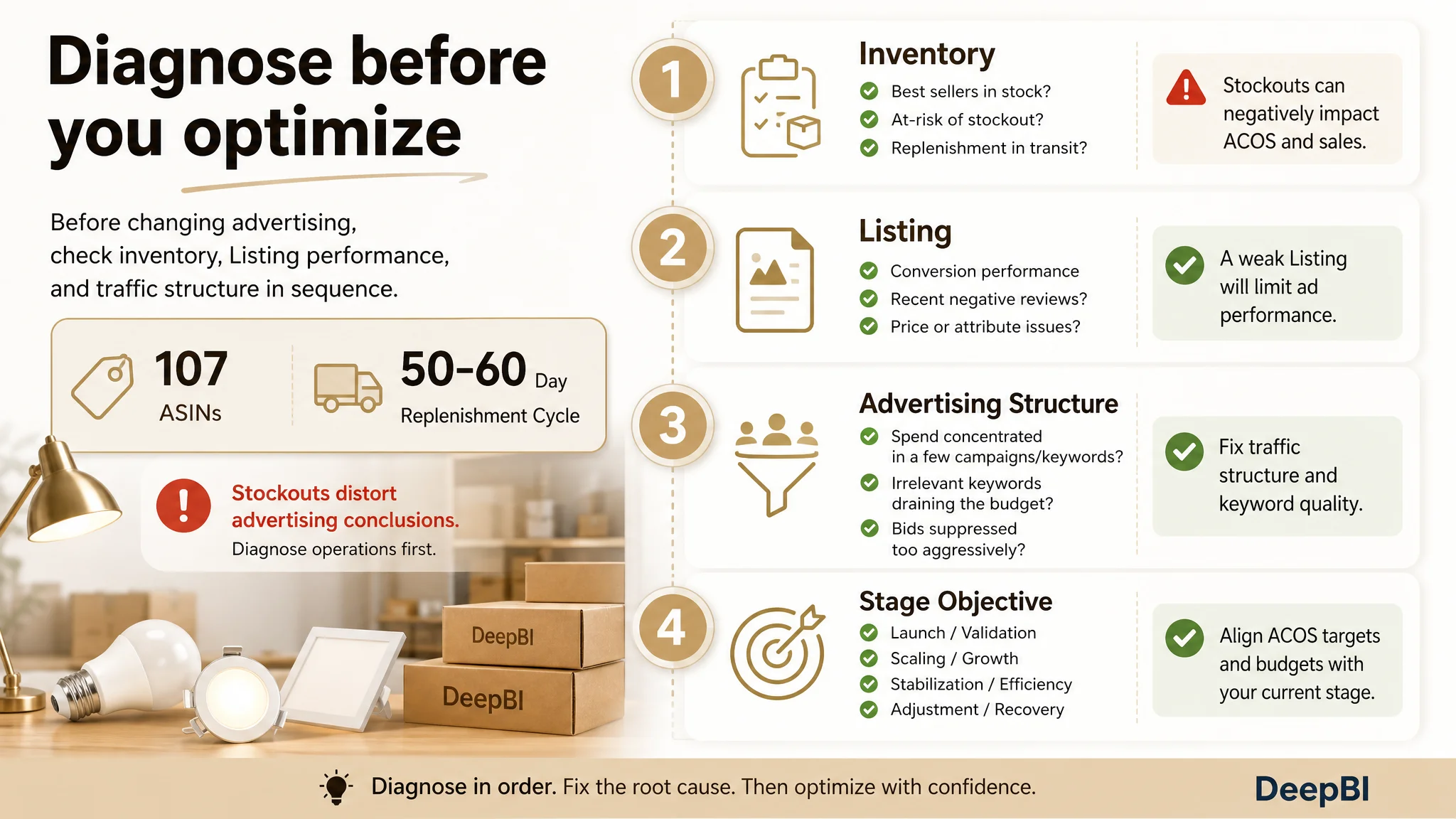
After DeepBI was introduced, the diagnosis did not begin with “adjusting bids.” Instead, the store’s operational issues were first broken down clearly:
1. Break down the advertising structure and identify where the money was spent:
- Analyze the spending distribution of the existing campaigns: which campaigns, ASINs, keywords, and search terms were consuming large amounts of budget;
- Compare the sales contribution of each component to identify areas with “high spending and low output.”
2. Review ASIN and Listing performance:
- Examine the exposure–click–conversion funnel by ASIN:
- Some SKUs had low exposure, indicating insufficient bids or relevance;
- Some had many clicks but poor conversion, indicating issues with the Listing or price;
- Because the lighting category had complex parent-child variations, traffic allocation among variations also had to be monitored.
3. Incorporate inventory and replenishment cycles:
- Identify SKUs with sufficient and limited inventory;
- Record the time required for replenishment in transit. For lighting products, the replenishment cycle can reach 50–60 days. This helped determine which SKUs were unsuitable for aggressive short-term scaling.
4. Establish stage-based objectives:
- First, determine what ACOS range would represent a shift from an unprofitable state to an acceptable and controllable level;
- Then divide the process into the launch, scaling, stabilization, and adjustment stages. Each stage would have different ACOS and budget strategies, rather than requiring all campaigns to immediately reach a single low ACOS.
During management, DeepBI automatically adjusted bids, budgets, and traffic allocation through the DeepBI Ads model. However, its true core value lay in helping the seller understand, based on the diagnostic framework above, the reasonable expectations for each stage and the relationship among ACOS, budget, and inventory, thereby avoiding common decision-making errors.
The Real Problem
Based on the lighting seller’s long-term data, three more fundamental issues became clear.
Problem 1: Excessive focus on low ACOS during the launch stage prevented advertising from gaining traction
- Manifestation: When the seller first moved from an ACOS of 78.8% to DeepBI Ads management, if it had insisted on “immediately reducing ACOS below 15%,” the system could only have significantly lowered bids and reduced the budget. Ads would have struggled to obtain sufficient exposure and clicks, severely extending the learning cycle.
- Cause: The core task during the launch stage was to “bring the business back from an unprofitable state to a controllable level while establishing foundational traffic and data.” If launch-stage advertising was constrained by the ACOS requirements of the stabilization stage from the outset, it would not only extend the exploration period but also suppress growth in volume.
- Impact:
- Sparse advertising data made it difficult for DeepBI Ads to quickly identify high-value traffic;
- Organic rankings rose slowly, leading the seller to feel subjectively that “DeepBI Ads was not effective” and hesitate over whether to continue investing.
- Evidence:
- The store’s original ACOS was 78.8%. In the first month after DeepBI Ads was activated, ACOS had already been reduced to 27.8%. However, maintaining a certain level of budget and bids during this period was still necessary to generate 4,883 USD in sales and lay the foundation for subsequent scaling.
Problem 2: Fear of increasing the budget during the scaling stage caused the seller to miss the growth window
- Manifestation: From June to October 2025, DeepBI Ads ACOS had stabilized within the 20%–26% range, which was an acceptable and healthy level. However, if the seller continued to aggressively suppress ACOS with a “cost first” mindset instead of increasing the budget, it would miss the opportunity to improve rankings and sales during the market window.
- Cause: The seller habitually placed ACOS control above all else, overlooking the opportunity to obtain greater advertising sales and organic traffic by increasing the budget appropriately and accepting “ACOS fluctuations within a controllable range” when gross margin allowed.
- Impact:
- Advertising sales growth was limited, making it difficult for total store sales to achieve a significant breakthrough;
- Advertising generated insufficient momentum for organic traffic, which was unfavorable to improving the store’s long-term category position.
- Evidence:
- When the client clearly stated in March 2026 that “ACOS is within the expected range, and inventory is relatively abundant” and proactively requested that the advertising budget be doubled, subsequent data confirmed that the scaling decision was effective:
- DeepBI Ads sales grew from 4,883 USD to 62,354 USD within one year;
- Total store sales increased from approximately 45,000 USD to more than 120,000 USD.
Problem 3: Attributing all sales fluctuations to advertising
- Manifestation: Whenever sales declined or ACOS increased temporarily, the instinctive reaction was that “the advertising had stopped working” or “the tool was not effective.” The first action was often to cut the budget or turn off campaigns.
- Cause: The seller lacked systematic monitoring of inventory, replenishment cycles, and the performance of key SKUs, and did not know how to distinguish advertising issues from non-advertising issues.
- Impact:
- When a sales decline was actually caused by a stockout, Listing demotion, or another factor, blindly cutting advertising would not solve the problem and could instead slow recovery;
- Frequent interruptions to the advertising curve prevented DeepBI Ads from continuously accumulating effective data and strategies.
- Evidence:
- In April 2026, the service provider explicitly pointed out in a renewal reminder that the recent sales decline was primarily caused by stockouts of certain best-selling child SKUs, rather than the failure of the advertising strategy;
- With a replenishment cycle of 50–60 days, inventory became an important variable affecting the pace of advertising scaling and the client’s renewal decision.
In summary, the initial problem faced by this lighting seller was not an inability to adjust advertising parameters, but the lack of an operational framework for managing ACOS and budgets by stage.
Optimization Plan
Based on the diagnosis above, the seller’s DeepBI Ads optimization was not simply about reducing ACOS from 78.8% to 18.2%. Instead, different objectives and strategies were established for each stage.
1. Launch Stage: From “Stopping the Bleeding” to “Building a Foundation”
Objectives:
- Reduce the original ACOS of 78.8% to a controllable range of 20%–30%;
- Ensure sufficient exposure and clicks so that DeepBI Ads could complete its learning process quickly.
Specific actions:
1. Restructure the advertising structure:
- Gradually reduce the original campaigns with high spending and low output, shifting the primary advertising efforts to DeepBI Ads;
- Establish foundational advertising units for core SKUs to ensure that every priority ASIN had a stable traffic entry point.
2. Control ineffective spending:
- DeepBI identified low-conversion traffic at the search-term level and gradually lowered bids or reduced exposure;
- Clearly irrelevant keyword routes were addressed to prevent continued wasteful spending.
3. Accept a temporarily higher ACOS that was still far below the original level:
- The first-month ACOS was 27.8%, representing a significant improvement from 78.8%;
- Instead of pursuing an extremely low ACOS during the launch stage, the priority was to get the ads running and accumulate data.
2. Scaling Stage: Proactively Increase the Budget Within a Controllable ACOS Range
Objectives:
- Continuously increase advertising sales while keeping ACOS within the 20%–26% range;
- Take advantage of periods of sufficient inventory to improve rankings and increase total store sales.
Specific actions:
1. Set an acceptable ACOS range rather than a single number:
- Based on the gross margin structure, establish an ACOS ceiling at which profits remained acceptable, such as approximately 25%;
- Allow moderate fluctuations within this range and exchange higher exposure and sales for long-term ranking advantages.
2. Conduct budget scaling experiments:
- Gradually increase the overall budget when inventory was sufficient;
- Allocate additional budget to high-performing campaigns and SKUs and observe sales elasticity;
- DeepBI automatically evaluated the marginal output of each advertising unit and, when the budget was doubled, attempted to allocate incremental budget to the most efficient areas.
3. Control key SKUs independently:
- Set separate budget and bidding strategies for SKUs with high sales potential or high margins;
- When ACOS was controllable, moderately loosen the bid ceilings for these SKUs to capture a larger share of traffic.
During this stage, the lighting seller’s DeepBI Ads sales grew from 15,840 USD to 73,071.7 USD from June to October 2025, while total store sales reached a peak of 128,832.6 USD. This demonstrated that proactively increasing the budget within an acceptable ACOS range was effective.
3. Stabilization Stage: Use DeepBI Ads for Refined Control
Objectives:
- Maintain an ACOS level close to the target;
- Allow DeepBI Ads to take over daily bid adjustments and keyword management, while people focus only on strategic and exceptional decisions.
Specific actions:
1. Monitor core metrics rather than microscopic actions:
- Focus on overall advertising sales, DeepBI Ads ACOS, and the performance of key SKUs;
- Delegate daily bid adjustments, search-term optimization, and budget allocation to DeepBI for automatic execution.
2. Guide DeepBI Ads to adjust its pace based on inventory and product lifecycle:
- When inventory was abundant, clearly communicate the acceptable ACOS range and budget ceiling, allowing DeepBI Ads to scale up advertising;
- When inventory was limited, tighten the budget and bids and guide DeepBI Ads to concentrate resources on SKUs with greater profit potential or faster replenishment.
3. Optimize parent-child variations and Listings:
- Use DeepBI Ads data to identify which child SKUs converted well and which ones dragged down overall performance;
- Adjust the variation structure when necessary to direct more traffic toward higher-converting child variations.
At this stage, the store had established a model of “daily DeepBI Ads management with human-led strategic adjustments.” DeepBI Ads gradually took over the majority of advertising sales, while the spending and output of the original campaigns were reduced to a low level.
4. Adjustment Stage: Identify the Root Cause Before Changing Advertising When Sales Fluctuate
Objectives:
- Distinguish advertising problems from operational issues involving inventory, Listings, and other factors;
- When stockouts or replenishment in transit occur, set reasonable ACOS expectations and budgets instead of cutting everything indiscriminately.
Specific actions:
1. Establish a troubleshooting sequence:
2. Check inventory first:
- Are core child SKUs out of stock?
- How long will replenishment in transit take?
2. Check the Listing next:
- Have there been sudden factors such as negative reviews or price changes?
3. Check advertising last:
- Has the traffic structure changed, such as changes in search-term composition or increased competition?
2. Advertising strategy during a stockout:
- For SKUs that were completely out of stock and had no replenishment plan in the short term, tighten or pause advertising to avoid ineffective clicks;
- For SKUs with limited remaining inventory and a replenishment cycle of 50–60 days, moderately reduce bids and budgets to extend the selling period.
3. Advertising strategy during the recovery stage:
- After replenishment arrived at the warehouse, allow DeepBI Ads to moderately increase bids and budgets in the short term to help restore rankings and traffic;
- At the same time, establish an acceptable short-term ACOS flexibility range in exchange for faster recovery.
Through this adjustment logic, after experiencing stockouts of best-selling SKUs and long replenishment cycles, the lighting seller still recovered and increased total store sales to 120,760.7 USD in June 2026. DeepBI Ads sales reached 62,354 USD, and ACOS improved to 18.2%.
Results
Under this stage-based ACOS and budget strategy, the key changes for the lighting seller can be summarized through several groups of data:
1. Advertising sales and ACOS:
- DeepBI Ads sales: Increased from 4,883 USD in the initial period to 62,354 USD, representing growth of more than 11 times;
- DeepBI Ads ACOS: Improved from 27.8% in the initial activation period to 18.2%, an overall improvement of nearly 10 percentage points, with a low of 16.4%.
2. Overall store sales:
- Total store sales: Increased from approximately 45,000 USD/month in the early service period to more than 120,760.7 USD/month, with a peak of nearly 130,000 USD during the period;
- Sales fluctuations were highly correlated with the stockout cycle of core SKUs, rather than being determined solely by the advertising strategy.
3. Advertising structure and operating model:
- Advertising takeover rate: By the later stage of the service, DeepBI Ads had essentially taken over all advertising sales, while the spending and output of the original campaigns had fallen to extremely low levels;
- Operating model: Transformed from “high-frequency manual bid adjustments + a broad campaign structure” to “daily DeepBI Ads management + human-led stage objectives and strategic decisions.”
These results did not come from a single attempt to push ACOS to an extreme low. They came from a complete methodology for defining reasonable ACOS and budgets by stage, together with consistent execution.
Case Summary
The full process of this lighting seller demonstrates the following:
1. The real problem was not whether the advertising system was effective, but rather:
- Using stabilization-stage standards to suppress ACOS during the launch stage prevented advertising from gaining traction;
- Focusing only on ACOS during the scaling stage and hesitating to increase the budget prevented sales from breaking through;
- Blaming advertising whenever sales fluctuated during the adjustment stage while overlooking the impact of inventory and Listings.
2. The truly effective approach was to establish a stage-based framework:
- Launch stage: Accept an ACOS that was relatively high but far below the original level, prioritizing “stopping the bleeding + gaining traction”;
- Scaling stage: Proactively increase the budget within an acceptable ACOS range to obtain greater sales and organic traffic;
- Stabilization stage: Let DeepBI Ads management handle daily bid adjustments, while people manage strategy and inventory pacing;
- Adjustment stage: Check inventory and Listings first, then adjust advertising rather than attributing every fluctuation to advertising.
3. The final changes were measurable and reviewable:
- DeepBI Ads sales grew 11 times, while ACOS fell by nearly 10 percentage points;
- Total store sales increased from approximately 45,000 USD to more than 120,000 USD;
- Advertising management shifted from “manual labor” to “operational decision-making,” allowing the team to focus more on higher-value activities such as product selection, pricing, and inventory management.
DeepBI’s role was not to “optimize the account once.” Instead, at different stages and based on inventory and gross margin conditions, DeepBI converted the seller’s ACOS targets and budget strategies into automatically executable and continuously iterative advertising actions, while validating the results through data.
Key Takeaways for Sellers
Based on the case above, even without using any management tool for the time being, Amazon sellers can apply three practical takeaways:
Takeaway 1: Define the stage first, then set the ACOS target Do not let a single ACOS number govern every stage. At a minimum, distinguish among:
- Launch stage: The goal is to move from an unprofitable state to a controllable level. Allow a slightly higher ACOS to support learning and initial growth;
- Scaling stage: Set an ACOS range that keeps profits healthy, and have the confidence to increase the budget within that range;
- Stabilization stage: Focus on overall ACOS and the share of advertising sales rather than pursuing extremely low ACOS for every campaign;
- Adjustment stage: When fluctuations occur, check inventory and Listings first, then change the advertising.
Takeaway 2: Use “ACOS range + inventory status” to determine the budget instead of looking only at individual data points
- Based on your gross margin structure, first define an acceptable ACOS range with upper and lower limits;
- Then consider inventory:
- When inventory is abundant and replenishment is smooth, moderately loosen ACOS and increase the budget within the range;
- When inventory is limited and the replenishment cycle is long, appropriately tighten the ACOS target and budget to extend the selling period.
Takeaway 3: Distinguish advertising problems from operational problems to avoid mistakenly cutting effective campaigns When you find that “the more you advertise, the more you lose, and ACOS will not come down,” investigate in the following order:
1. Check inventory: Are best-selling SKUs out of stock or about to run out? How long will replenishment in transit take?
2. Check the Listing: Have there recently been concentrated negative reviews, major price changes, category or attribute errors, or other issues?
3. Then check advertising:
- Is spending concentrated in a small number of high-ACOS campaigns or keywords?
- Are large numbers of irrelevant keywords consuming the budget?
- Have bids been suppressed for too long, preventing the campaigns from obtaining effective traffic?
Only after clarifying these issues does it make sense to discuss whether to use DeepBI Ads management, which tool to choose, or how to configure the strategy. Otherwise, whether the work is done manually or through DeepBI Ads, it is merely “blindly adjusting bids” in an environment without clear objectives and boundaries.
For sellers who already use or plan to use DeepBI, the stage-based framework in this article can serve as a communication template:
- First clarify the core objective for your current stage: validation, scaling, stabilization, or adjustment;
- Then, based on your gross margin and inventory, tell the service provider the ACOS range and budget boundaries you can accept;
- Let DeepBI Ads handle the detailed actions while you focus only on whether the trends align with the objectives for the current stage.
When you stop focusing only on daily ACOS fluctuations and instead evaluate advertising through a 3–6 month curve, you will find that advertising is no longer merely a “cost,” but a growth engine that can be designed and scaled at the right pace.