

Introduction
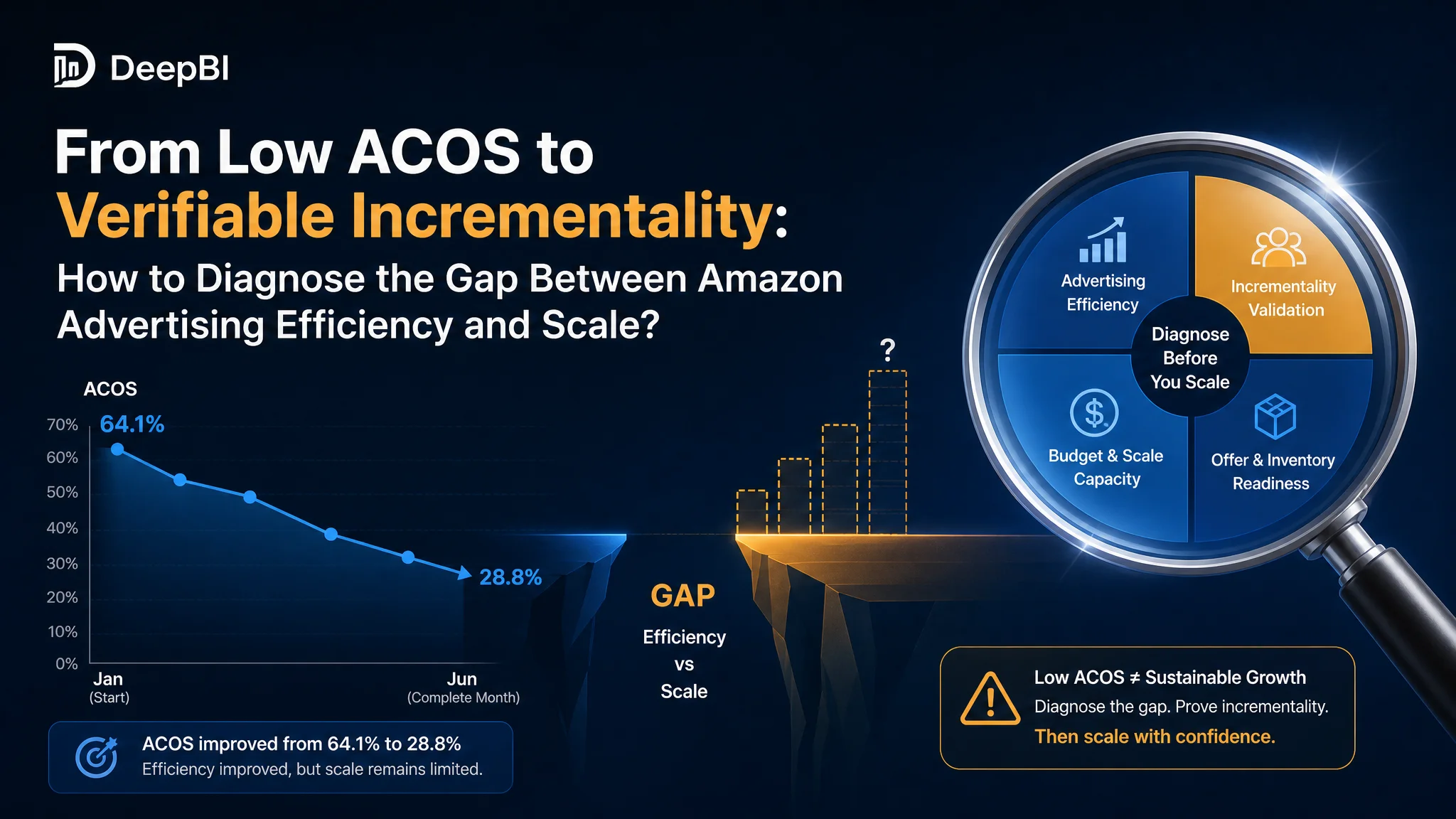
For Amazon sellers, reducing advertising ACOS from 64.1% to 28.8% would typically be viewed as a positive signal. However, in this case involving a US marketplace seller of mobile phone and consumer electronics accessories, advertising efficiency improved after adopting AI advertising, but advertising sales remained relatively small and had not yet become the store’s primary traffic source. As a result, the customer could not confirm whether advertising had generated sufficient incremental sales. Rather than presenting these figures as a successful growth story, this article examines why “low ACOS” and “sales scale growth” can coexist by breaking down the roles of advertising structure, budget and scaling, search traffic capture, product conversion conditions, and coupon support. It also explains how DeepBI conducted the advertising diagnosis across these dimensions.
Customer Background
The customer was an Amazon seller operating on the US marketplace in the mobile phone and consumer electronics accessories category. The store managed approximately 4 products and registered for and began using AI advertising services in 2026年1月.
The customer initially focused on the product’s main image and detail page, hoping to improve conversion by enhancing the Listing’s visual presentation and information structure. The operational focus later shifted to launching a core product at a low price, supporting it with a large coupon, and scaling advertising spend. The goal was to drive more orders by offering more attractive pricing conditions and increasing advertising intensity.
During this process, the customer continued to focus on several questions: Could advertising be launched quickly enough? Could the budget be spent effectively? Would sales show a sufficiently clear increment? And could AI-generated image assets be delivered consistently? Because AI image generation for products with complex or transparent structures was not always stable, some assets could be used directly while others still required manual revision. This affected the customer’s confidence in the visual asset capabilities.
Therefore, this was not simply a problem of “ACOS being too high.” What the customer truly needed to determine was whether improved advertising efficiency had produced sufficient advertising sales scale. If not, where exactly was the gap: in budget, advertising structure, search traffic, product conversion, or promotional conditions?
The Problem
Low ACOS Did Not Automatically Translate into Noticeable Growth
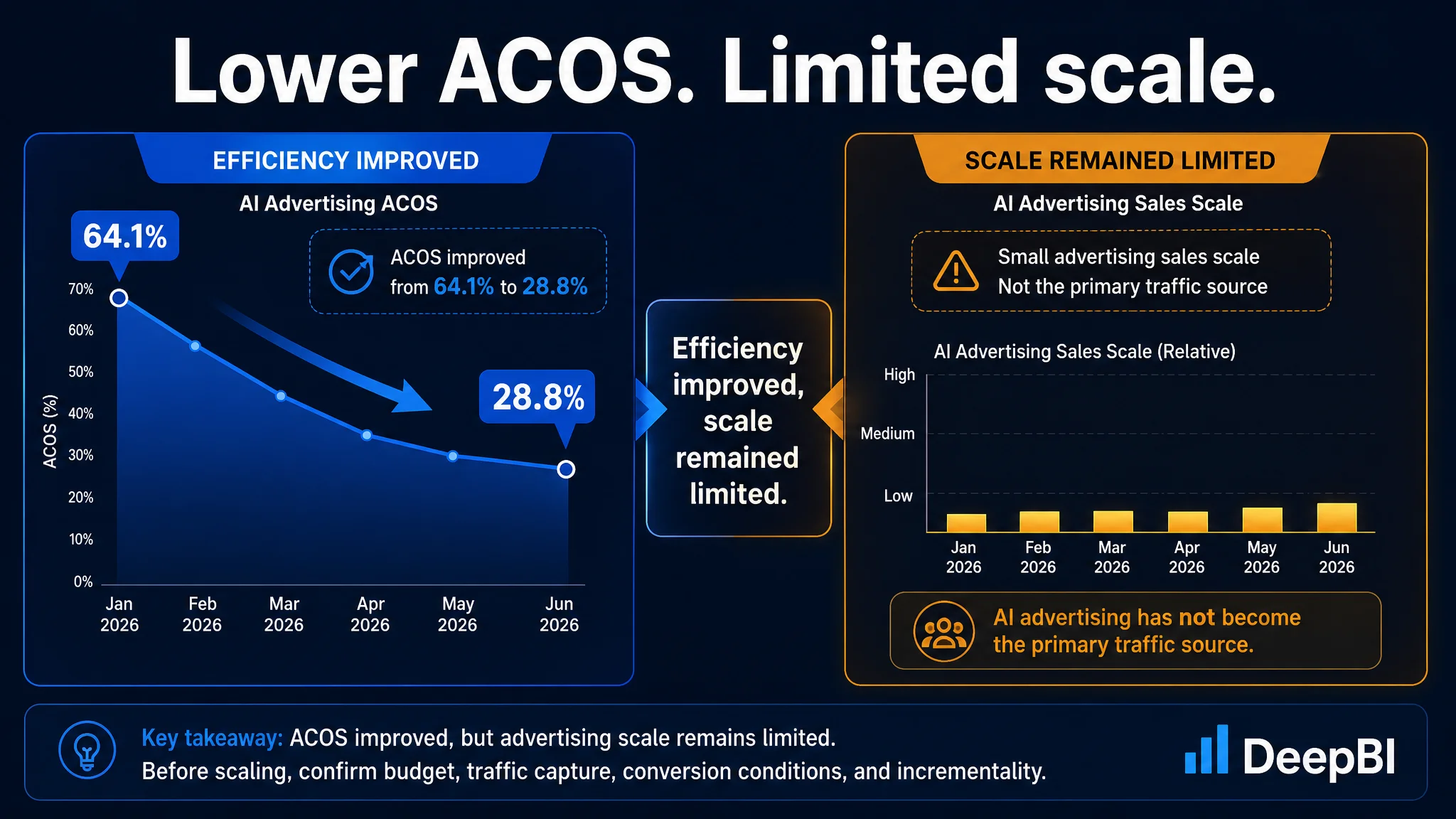
The contradiction faced by the customer was typical: on the one hand, the ACOS of AI advertising continued to improve; on the other hand, sales generated by AI advertising remained relatively small and could not become the store’s primary traffic source.
From the customer’s business perspective, low ACOS alone was not enough to prove that advertising was valuable. If advertising used only a limited budget and generated some sales without producing sufficient order volume, it might simply be a highly efficient but small-scale advertising unit rather than a core channel capable of driving product growth.
This is also an aspect that many sellers overlook when conducting Amazon advertising diagnostics:
- A lower ACOS may indicate a favorable ratio between attributed advertising sales and advertising spend that has already occurred;
- However, a lower ACOS does not mean that the advertising budget has been fully utilized;
- Higher advertising sales do not necessarily mean that all sales were incremental;
- If search traffic capture is insufficient, advertising will struggle to continuously expand impressions and orders;
- If the product Listing’s conversion conditions, price, and coupon are not aligned, increasing the budget may only increase ineffective clicks.
The Customer Still Lacked Certainty About the Improvement in Efficiency
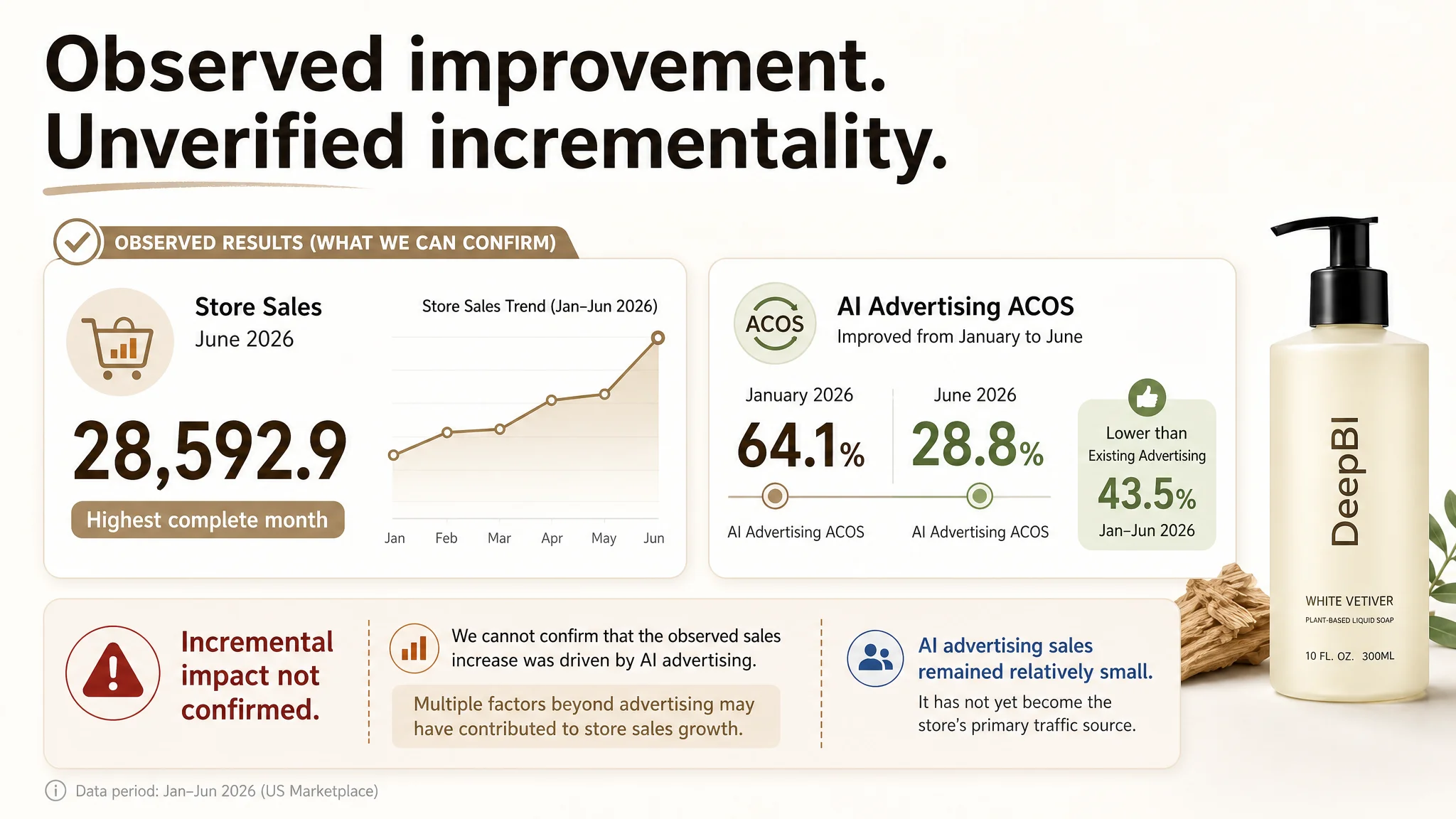
From 2026年1月 to 6月, store sales fluctuated upward, reaching a period high in 6月, the highest complete month, with sales of 28592.9. However, the available materials cannot prove that all of this sales change was generated by AI advertising. Therefore, it would be inappropriate to simply conclude that “AI advertising drove store growth.”
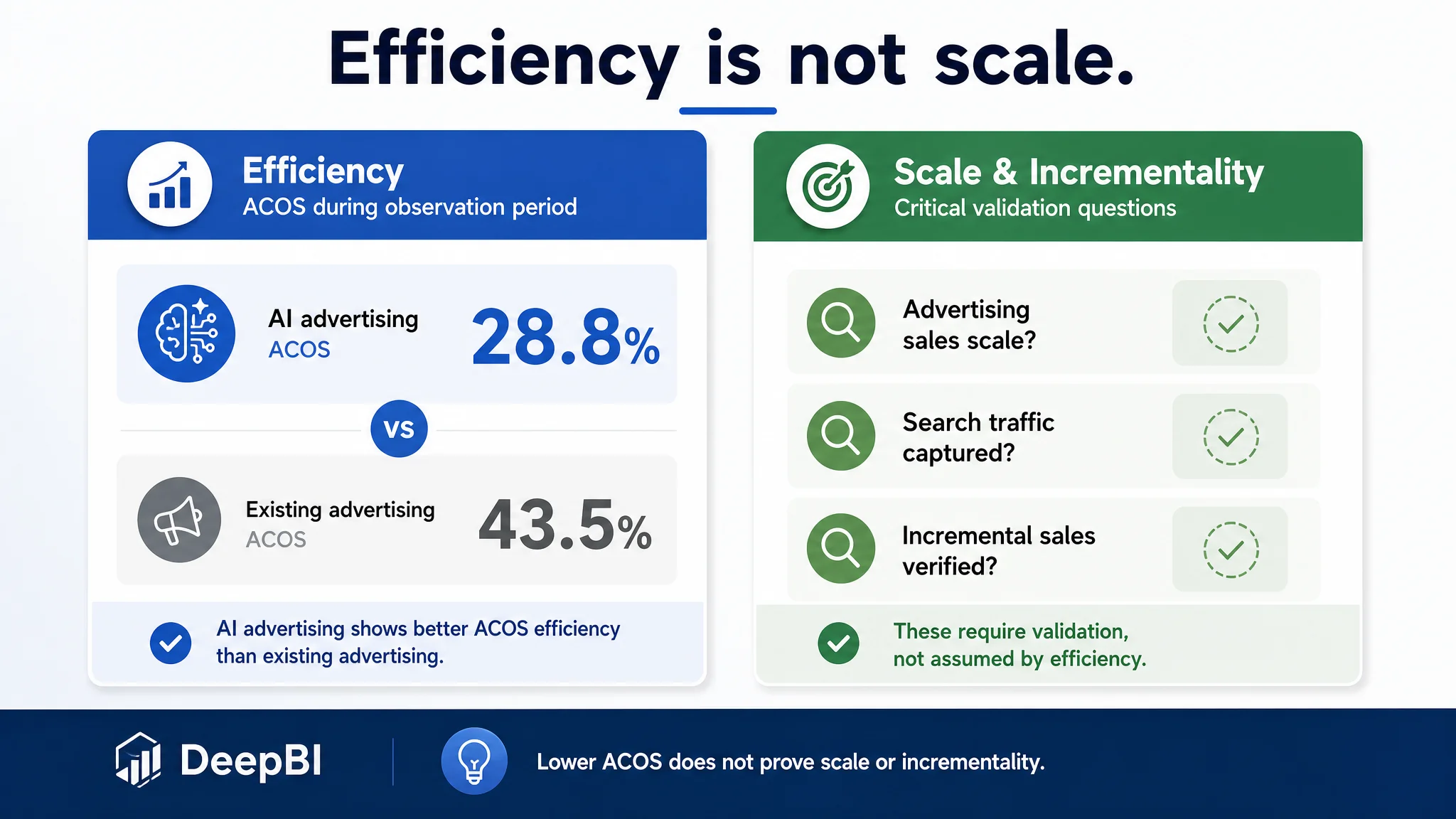
During the same period, AI advertising ACOS improved from 64.1% in 1月 to 28.8% in 6月, while the ACOS of the existing advertising was 43.5% during the same period. This indicates that AI advertising showed relatively strong efficiency improvement during the observation period. However, the customer continued to focus on launch speed, scaling intensity, and incremental sales. In other words, the efficiency metrics improved, but the scale metrics did not reach the customer’s expectations at the same time.
This type of situation usually raises three business questions:
1. Did advertising generate a low volume of conversions, making ACOS appear low?
2. Did the advertising budget truly enter a traffic pool with search demand and order potential?
3. Did the product have the pricing, coupon, Listing, and asset conditions required to capture greater traffic?
If these questions are not separated and validated, sellers will find it difficult to determine whether the issue lies with advertising, the Listing, the product strategy, or the broader operating conditions.
How DeepBI Diagnosed
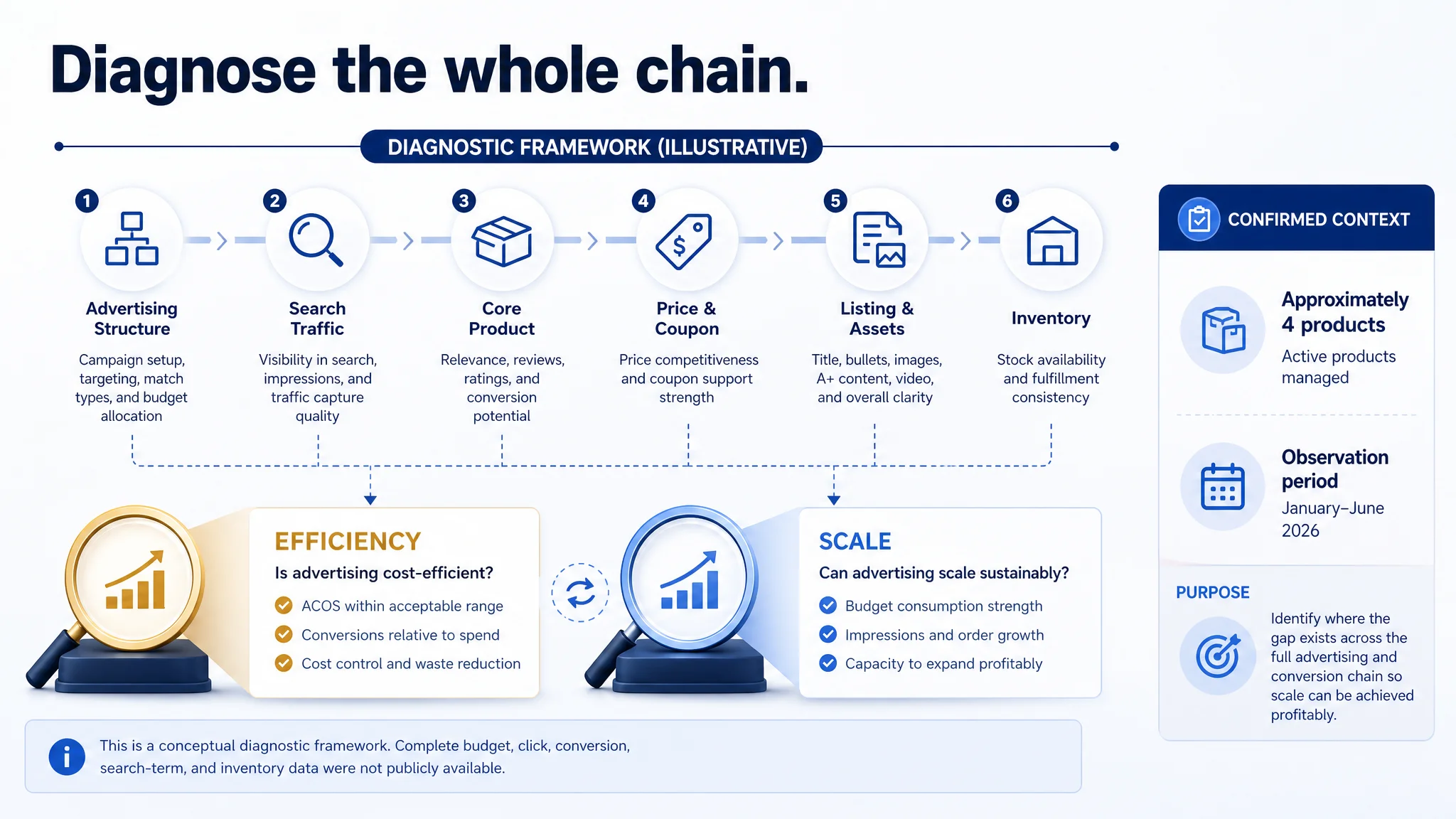
DeepBI’s diagnostic focus was not to immediately increase the budget or optimize only around reducing ACOS. Instead, it first separated “efficiency” and “scale” into different observation dimensions and then assessed whether the advertising had a foundation for scaling.
1. Compare the Efficiency and Scale of AI Advertising with Existing Advertising
The first step was to review the ACOS changes of AI advertising and existing advertising while also examining advertising sales scale, rather than focusing on a single ratio metric.
In this case, AI advertising ACOS improved from 64.1% in 1月 to 28.8% in 6月, while the ACOS of existing advertising was 43.5% during the same period. This comparison shows that AI advertising had a lower efficiency metric during the observation period. However, it does not directly indicate that AI advertising had become the primary sales source, nor does it prove that changes in store sales were entirely attributable to AI advertising.
Therefore, the diagnosis needed to separate two questions:
- Did advertising efficiency improve?
- Did advertising scale reach a level sufficient to influence the store’s operating results?
Only when both had been validated would it be reasonable to discuss further scaling.
2. Examine the Relationship Between Advertising Structure and Traffic Capture
The second step was to review the advertising structure, determine whether different ads were performing testing, conversion, and scaling roles respectively, and observe whether AI advertising was truly capturing sufficient search traffic.
If only a small number of advertising units in the structure generated orders while the remaining units failed to establish stable impressions or clicks, overall ACOS could be lowered by a few conversions even though advertising scale remained insufficient. In this situation, further budget expansion would not necessarily be effective because the budget might not consistently enter highly relevant search terms or high-conversion traffic.
The available information in this case only indicates that AI advertising sales remained relatively small and had not yet become the primary traffic source. The materials do not provide complete, publicly citable data on budget consumption, clicks, search terms, advertising sales, or the share of search traffic. Therefore, the diagnostic conclusion should remain that insufficient scale had been identified and that traffic capture required further validation, rather than inventing specific budget or keyword performance data.
3. Check the Core Product’s Pricing and Coupon Conditions
The third step was to evaluate advertising performance within the broader context of the product’s operating conditions.
The customer had focused on launching the core product at a low price and supporting it with a large coupon. Low pricing and coupons can improve purchase appeal after a click, but whether they generate sustainable incrementality also depends on whether the product has sufficient search demand, whether the Listing can capture traffic, whether the coupon covers the key advertising period, and whether inventory and profit margins allow continued scaling.
Therefore, advertising diagnosis should not ask only, “Should the budget be increased?” It should also ask:
- Are the current pricing and coupon conditions aligned with the launch objective of the core product?
- Are the product’s conversion conditions sufficient to capture additional clicks?
- Are the orders generated by advertising one-time promotional conversions, or do they create a sustainable entry point for search traffic?
The existing records do not provide inventory, click conversion rate, or specific coupon usage data. Therefore, these factors can only serve as part of the diagnostic framework and as items for subsequent validation; they cannot be presented as confirmed causes.
4. Verify Listing and Asset Stability
The fourth step was to check whether the product page and advertising assets were sufficiently stable.
The customer initially hoped to improve Listing conversion by optimizing the main image and detail page. However, AI image generation for products with complex or transparent structures was not stable, and some assets required manual revision. This meant that advertising scaling and Listing optimization were not entirely independent issues: if advertising generated impressions and clicks but the page’s visual communication was unstable, the additional traffic might not convert into sufficient orders. If asset delivery was inconsistent, advertising tests might also be difficult to execute on a fixed schedule.
Therefore, DeepBI’s diagnostic logic was to first identify the situation in which advertising efficiency had improved but scale remained insufficient. It then examined whether advertising structure, search traffic, product conditions, and asset delivery formed a complete chain, rather than attributing every issue to excessively high ACOS.
The Real Problem
Problem 1: Advertising Efficiency Improved, but Advertising Scale Was Insufficient
Cause: AI advertising ACOS had declined, but AI advertising sales remained relatively small, indicating that efficiency and scale had not been established at the same time. Low ACOS may reflect the conversion efficiency of certain advertising units, but it cannot independently prove that advertising had generated sufficient traffic and order contribution.
Impact: The customer could not confirm whether advertising had truly generated noticeable incremental sales and therefore could not determine whether to continue increasing the budget or use the service over the long term.
Evidence: AI advertising ACOS improved from 64.1% in 2026年1月 to 28.8% in 6月, while the records explicitly state that AI advertising sales remained relatively small and had not become the primary traffic source.
Problem 2: Advertising Objectives Were Not Fully Aligned with Scale Validation Objectives
Cause: The customer was simultaneously focused on low-price launch conditions, a large coupon, advertising launch speed, and scaling intensity. Low ACOS is more closely associated with an efficiency objective, while the incremental sales and advertising scale that the customer cared about were growth validation objectives. Without defining the budget, ACOS ceiling, priority products, and validation period in advance, the results could easily produce a situation in which “the metrics look good, but it is impossible to determine whether continuing is worthwhile.”
Impact: Even if advertising efficiency improved, the customer might still believe that advertising had not met the operating objective. Simply continuing to pursue lower ACOS could further restrict budget consumption and traffic scale. Simply increasing the budget could increase the cost of experimentation if the product conditions were not yet ready.
Evidence: The customer repeatedly focused on advertising launch speed, scaling intensity, and incremental sales, and believed that low ACOS without sufficient scale was difficult to use as proof of advertising value.
Problem 3: Uncertainty Remained Around the Conditions for Capturing Advertising Traffic
Cause: The core product’s price, coupon, Listing conversion, and visual assets needed to work together. The customer had hoped to improve the main image and detail page, but AI image generation for some products with complex or transparent structures was unstable, and some assets required manual revision. This affected the stability of asset usage.
Impact: Even if advertising obtained more impressions, the product page and advertising assets might not consistently capture the traffic. At the same time, uncertainty in asset delivery could affect the pace of advertising tests, making it more difficult for the customer to determine whether the issue came from advertising or from the product page and visual presentation.
Evidence: The records show that AI image generation for products with complex or transparent structures was unstable. The customer continued to have concerns about asset delivery stability and advertising performance certainty, and stopped renewing at the end of 2026年6月, entering the churn stage. The available materials do not provide enough data to prove that Listing conversion or asset issues were the sole causes of insufficient advertising scale. Therefore, they can only be regarded as important operating conditions requiring further validation.
Optimization Plan
Advertising Optimization: Set Both Efficiency and Scale Metrics
Amazon advertising optimization should not rely on a single ACOS target. A more reasonable approach is to monitor the following simultaneously:
- Whether AI advertising ACOS is lower than that of existing advertising;
- Whether AI advertising sales continue to increase;
- Whether the advertising budget can be spent consistently;
- Whether advertising gradually captures search traffic;
- Whether advertising sales reach a scale sufficient to influence operating decisions for the store.
In this case, AI advertising ACOS being lower than the ACOS of existing advertising during the same period was an efficiency signal worth continuing to observe. However, because AI advertising sales remained relatively small, subsequent optimization should not stop at further reducing ACOS. Instead, it should shift toward validating whether advertising can expand effective traffic under controlled risk.
Advertising Structure: Assign Different Tasks to Different Campaigns
In terms of advertising structure, testing, conversion, and scaling objectives can be separated:
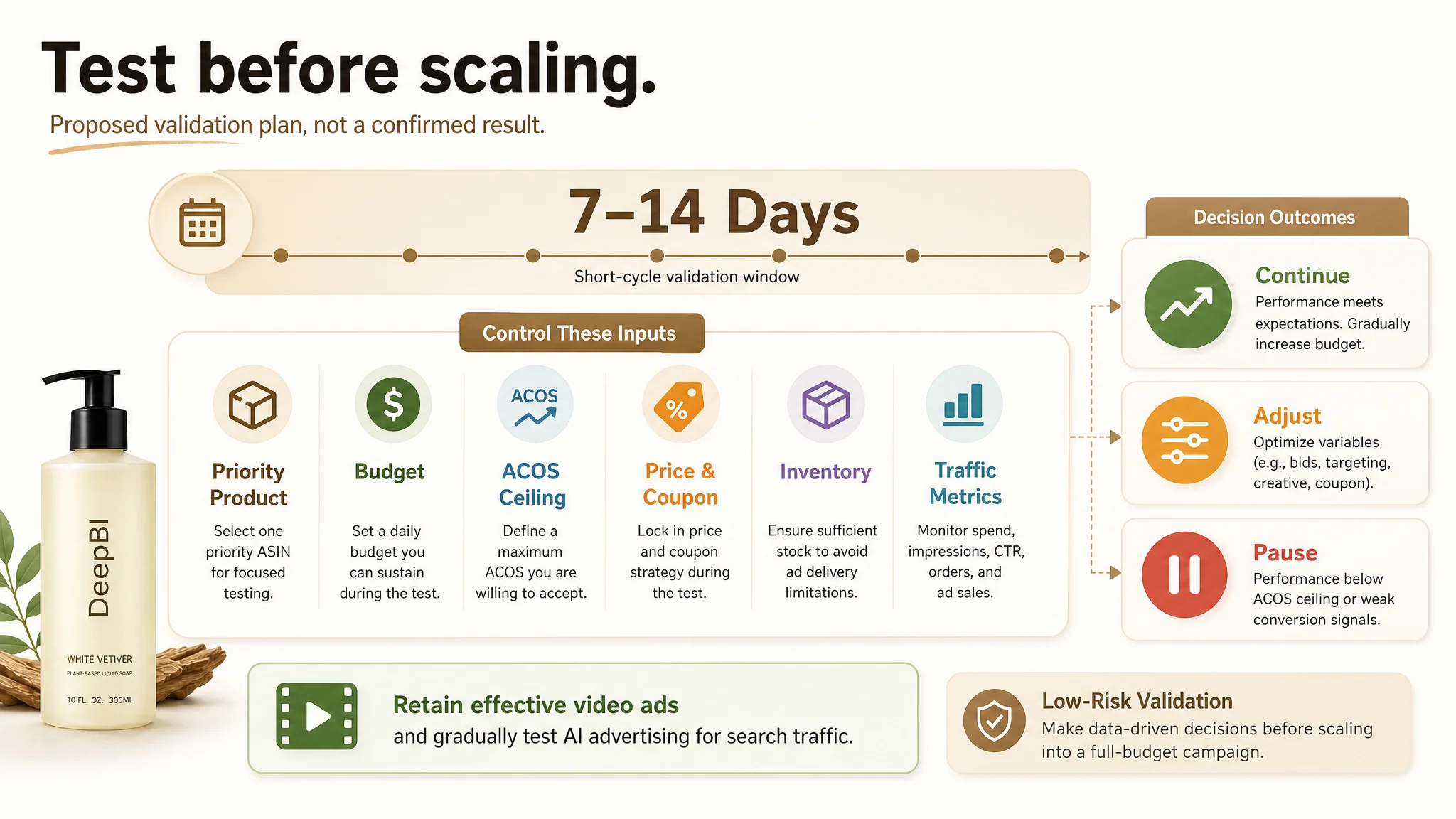
1. Retain video ads that have already produced effective performance, rather than completely replacing available assets before validation is complete.
2. Gradually allow AI advertising to capture search traffic and observe whether it can expand from a small number of conversions into a more stable order source.
3. Set a separate budget and ACOS ceiling for the core product to avoid losing visibility into actual performance when multiple products share a budget.
4. Review advertising sales, budget consumption, and traffic sources on a fixed cycle rather than making frequent adjustments based on daily ACOS.
The goal of these actions is not to guarantee scaling. It is to help sellers identify whether insufficient advertising scale is caused by an insufficient budget, inadequate traffic capture, or insufficient product conversion conditions.
Listing and Assets: Ensure Usability Before Expanding Traffic
For products with complex or transparent structures, AI image generation may fluctuate. During optimization, priority should be given to confirming whether the assets accurately reflect the product’s actual structure, can be delivered consistently, and communicate the product’s selling points accurately through the main image and detail page.
If assets still require manual revision, sellers should not attribute every change in advertising performance directly to the advertising system. Usable assets should be retained first, while assets requiring revision should be included in subsequent page optimization and testing plans to reduce the number of variables during advertising tests.
Low-Risk Validation: Establish Reviewable Conditions Over 7 to 14 Days
When retesting, a 7 to 14-day low-risk validation plan can be designed around priority products. At a minimum, the following should be defined in advance:
- Test product;
- Daily or period budget;
- Acceptable ACOS ceiling;
- Pricing and coupon conditions;
- Whether inventory can support the test;
- Advertising sales and search traffic metrics to be monitored;
- What results indicate continuing the test and what results indicate pausing for adjustment.
The value of this type of plan is that it turns “Should advertising be scaled?” into a question that can be validated, rather than increasing the budget all at once and waiting for the results.
Results
Based on the confirmed data, from 2026年1月 to 6月, store sales fluctuated upward, reaching a period high in 6月, the highest complete month, with sales of 28592.9. During the same period, AI advertising ACOS improved from 64.1% to 28.8%, while the ACOS of existing advertising was 43.5% during the same period.
These data points confirm three things:
- AI advertising ACOS improved significantly during the observation period;
- Store sales reached a period high in 6月, the highest complete month;
- AI advertising sales remained relatively small and had not become the primary traffic source.
However, these data cannot confirm that AI advertising generated definite incremental sales, nor can they prove that the increase in store sales was entirely caused by AI advertising. Because complete public data on advertising sales, budget consumption, click conversion rate, and search traffic share was unavailable, this article does not characterize the case as DeepBI helping the customer achieve definite growth.
Ultimately, the customer continued to have concerns about advertising scaling, asset delivery stability, and performance certainty, and stopped renewing at the end of 2026年6月, entering the churn stage. Therefore, the result of this case is not “low ACOS led to successful renewal.” Instead, it presents a conclusion that is more valuable for review: advertising efficiency can improve, but if scale, incrementality, and a validation mechanism are not established at the same time, the customer may still be unable to recognize the value of advertising.
Case Summary
The real problem in this case was not that AI advertising ACOS was insufficiently low. On the contrary, AI advertising ACOS improved from 64.1% to 28.8%, below the 43.5% ACOS of existing advertising during the same period. The real issue was that improved efficiency did not simultaneously translate into sufficient advertising sales scale and verifiable incrementality.
When diagnosing Amazon advertising, at least three questions should be answered at the same time:
1. Is the advertising efficient? Examine the relationship between ACOS, conversion, and advertising sales.
2. Does the advertising have scale? Examine whether budget consumption, traffic sources, and order volume are sufficient to influence operating results.
3. Is the advertising ready to scale? Examine whether the core product, price, coupon, Listing, assets, and inventory can capture additional traffic.
The value of DeepBI’s diagnosis in this case was not to replace all judgment with a single metric. It was to help the seller observe advertising efficiency, advertising scale, and product operating conditions within the same chain. Only when these links can be validated separately can sellers determine whether to optimize advertising or first correct the Listing, assets, and product strategy.
Key Takeaways for Sellers
Takeaway 1: Low ACOS Does Not Equal Advertising Success
ACOS only reflects the ratio between advertising spend and attributed advertising sales. It cannot independently indicate that advertising sales are sufficiently large, nor can it automatically prove that advertising generated new demand.
If ACOS is very low but budget consumption is limited and advertising sales scale is small, sellers should first determine whether this is “high-efficiency, small-scale advertising” or whether it has already developed into a sustainable growth channel.
Takeaway 2: Evaluate Advertising Value Through Efficiency, Scale, and Incrementality
Amazon advertising optimization should not focus only on “how to reduce ACOS further.” A more complete evaluation framework includes:
- Efficiency: Whether ACOS is within an acceptable range;
- Scale: Whether advertising has achieved sufficient budget consumption, impressions, and orders;
- Incrementality: Whether advertising sales have created incremental contributions that the store would not otherwise have generated.
If sellers focus only on efficiency, they may overlook advertising with potential that is still in the testing stage. If they focus only on scale, they may amplify waste when product conversion conditions are insufficient.
Takeaway 3: Establish a Low-Risk Validation Mechanism Before Scaling Advertising
Before increasing the budget, sellers should define the priority product, price, coupon, inventory, ACOS ceiling, and validation period. Through a 7 to 14-day short-cycle test, they can observe whether advertising sales, traffic sources, and budget consumption improve simultaneously before deciding whether to continue, adjust, or pause.
For products with unstable assets or Listings that are still being optimized, sellers should especially avoid changing too many variables at once. Retain effective assets first, gradually allow advertising to capture search traffic, and then use the data to determine whether the issue comes from advertising or from the product page and conversion conditions.
The ultimate goal of advertising diagnosis is not to pursue a single attractive-looking number. It is to establish an operating decision framework that can answer whether advertising has truly generated verifiable incrementality.