

Introduction
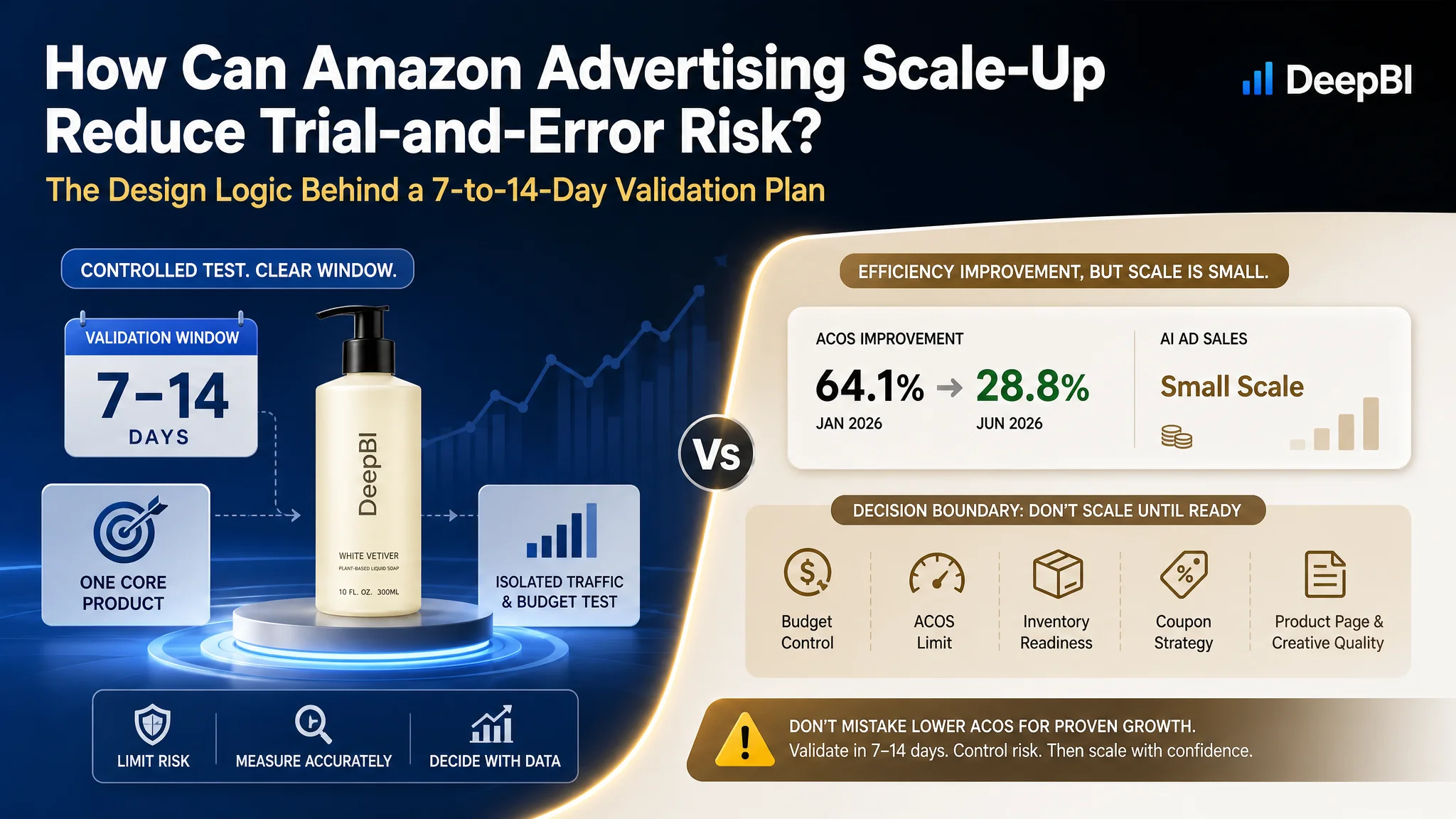
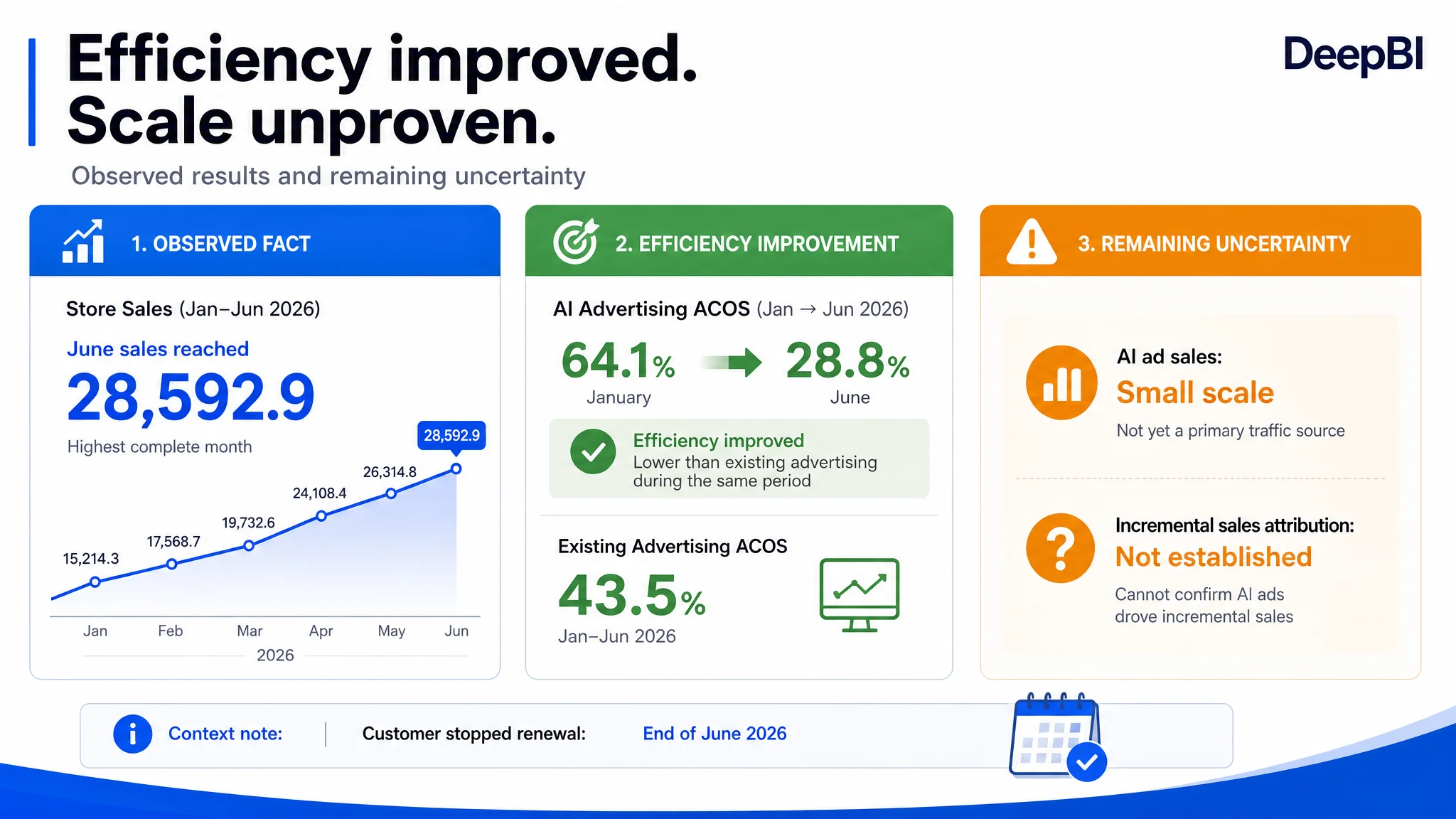
Scaling Amazon advertising does not simply mean increasing the budget. For a US-based seller of mobile phone and consumer electronics accessories with approximately 4 products, the real challenge is whether the relationship between ad launch speed, scaling intensity, creative stability, and incremental sales can be validated within a relatively short cycle. From January to June 2026, the customer's AI advertising ACOS improved from 64.1% to 28.8%, lower than the 43.5% ACOS of the existing advertising during the same period. However, AI advertising sales remained relatively small and had not yet become the primary traffic source. Rather than presenting this experience as a successful growth case, this article breaks down a 7-to-14-day, low-risk validation approach centered on key products, budget, ACOS limits, inventory, and coupons, based on the actual problems encountered. The goal is to help sellers determine whether advertising should continue to scale or whether the conditions needed to support further growth must be strengthened first.
Customer Background
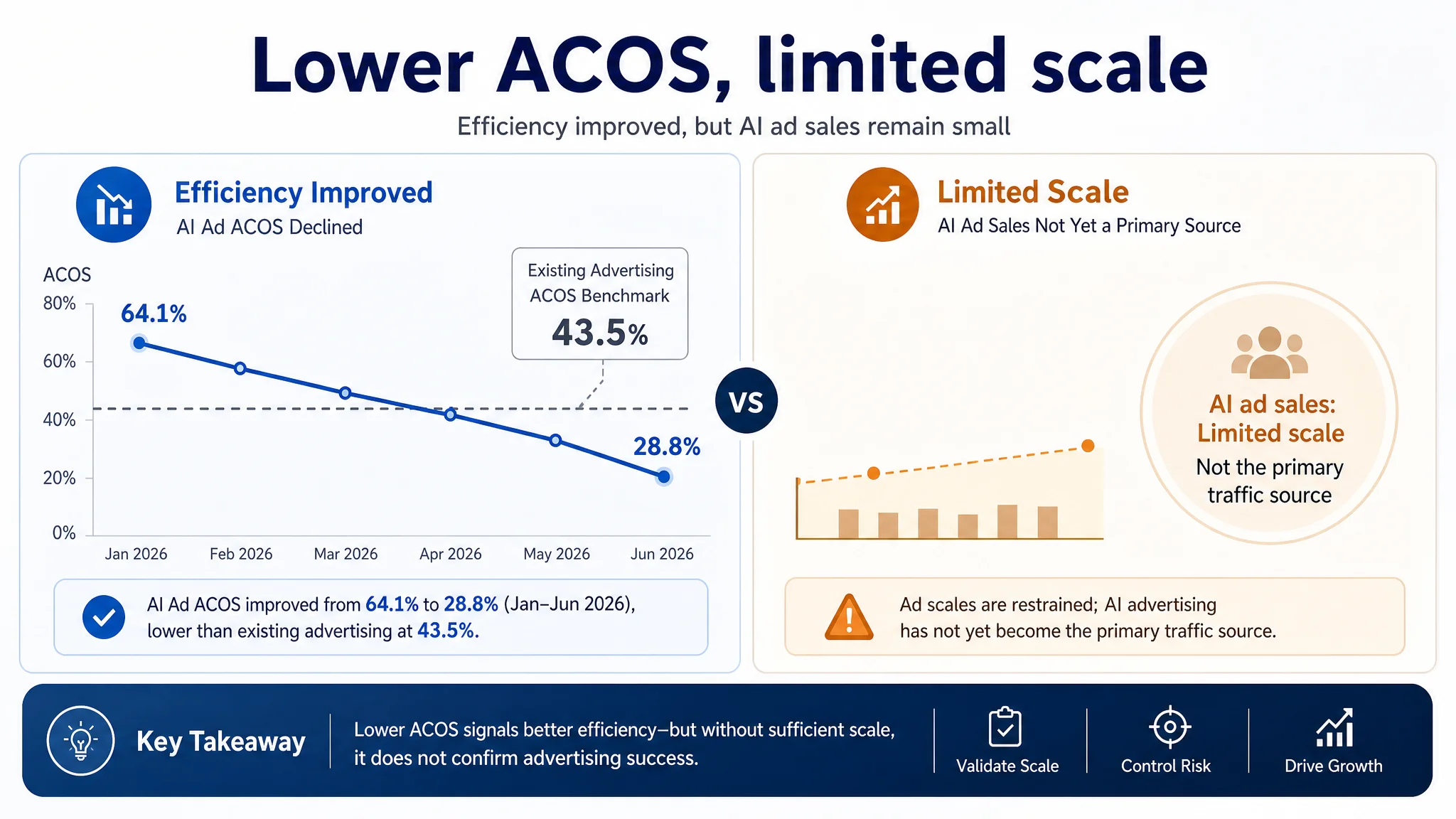
This was a US-based Amazon seller of mobile phone and consumer electronics accessories, managing approximately 4 products in the store. When the customer first began using AI advertising services, the initial goal was to improve the product main images and detail pages, thereby supporting subsequent sales by increasing Listing conversion.
After adjusting its operational priorities, the customer shifted more attention to a core product and hoped to quickly observe incremental sales through a low-price launch, a high-value coupon, and advertising scale-up. At the same time, the customer was also concerned about whether the advertising could launch quickly, whether the budget could be spent effectively, and whether creatives could be delivered consistently.
These operational objectives were not simply about “lowering ACOS.” The customer needed to determine whether advertising could generate sufficient sales volume, support more search traffic, and justify continued investment based on the results.
The Problem
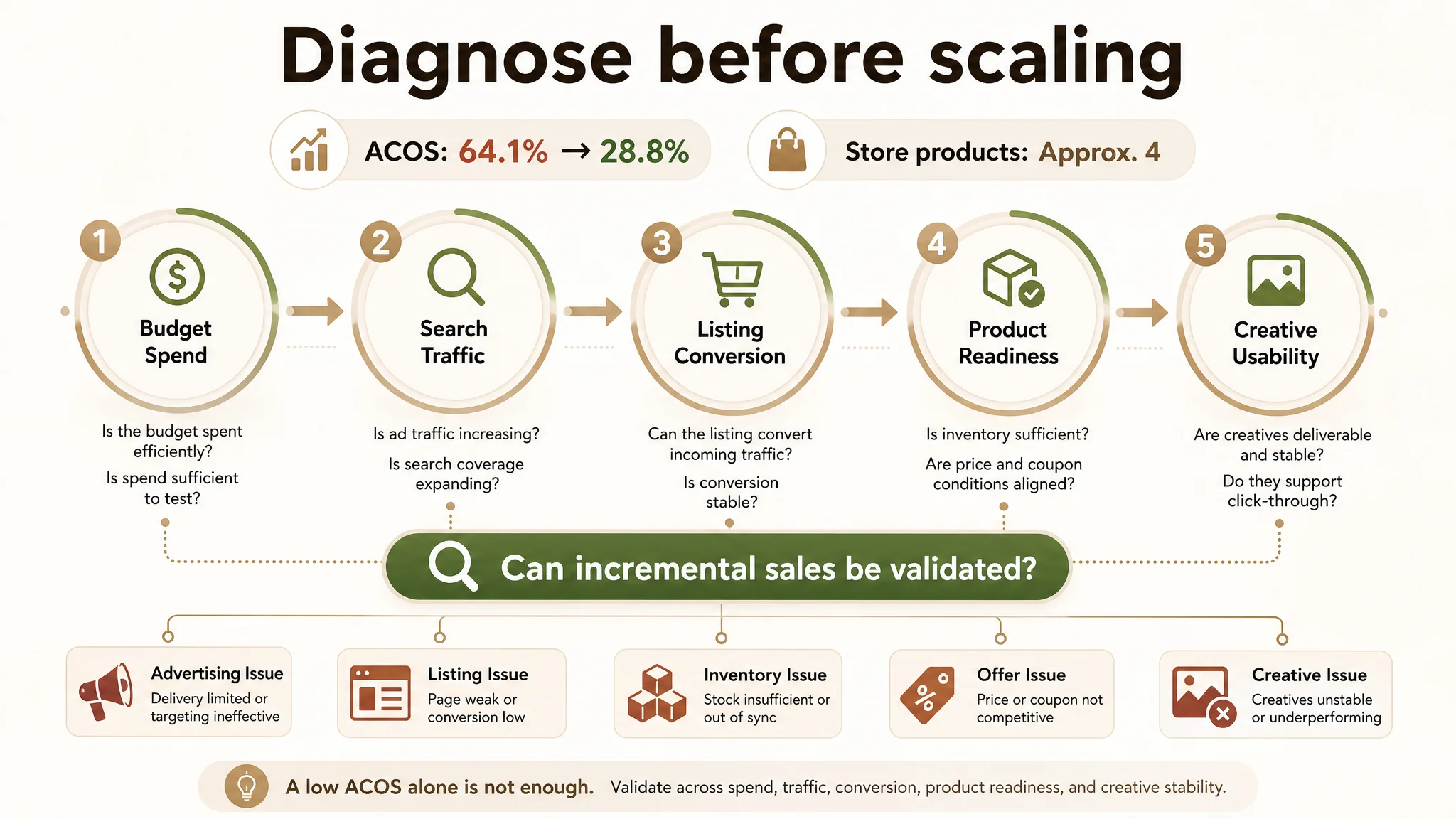
The customer's core conflict was that advertising efficiency had improved, but the scale and incremental value of the advertising remained unclear.
On the one hand, AI advertising ACOS improved from 64.1% in January to 28.8% in June. On the surface, this indicated that ad cost efficiency was better than the 43.5% ACOS of the existing advertising during the same period. If ACOS alone were considered, one might conclude that “the advertising optimization was effective.”
On the other hand, AI advertising sales remained relatively small and had not yet become the store's primary traffic source. For sellers hoping to quickly generate incremental sales through a low price, a coupon, and advertising scale-up for a core product, a low ACOS does not automatically prove that the advertising has achieved growth at scale.
The customer therefore continued to focus on several questions:
- Was the advertising launch speed fast enough?
- After the budget increased, could advertising sales grow accordingly?
- Was the low ACOS the result of strong efficiency, or simply because the spending scale itself was insufficient?
- Could AI advertising support more search traffic?
- For some complex or transparent-structure products, AI image generation was unstable. Would this affect Listing conversion and advertising scale-up?
- If a low price and a high-value coupon were used at the same time, could the sales generated by advertising cover the additional investment?
This is also a situation encountered by many Amazon sellers: advertising is not completely ineffective, but its results are not yet sufficient to support the next budget increase. At this point, directly pursuing an even lower ACOS or increasing the budget all at once may not solve the problem of uncertain results.
How DeepBI Diagnosed
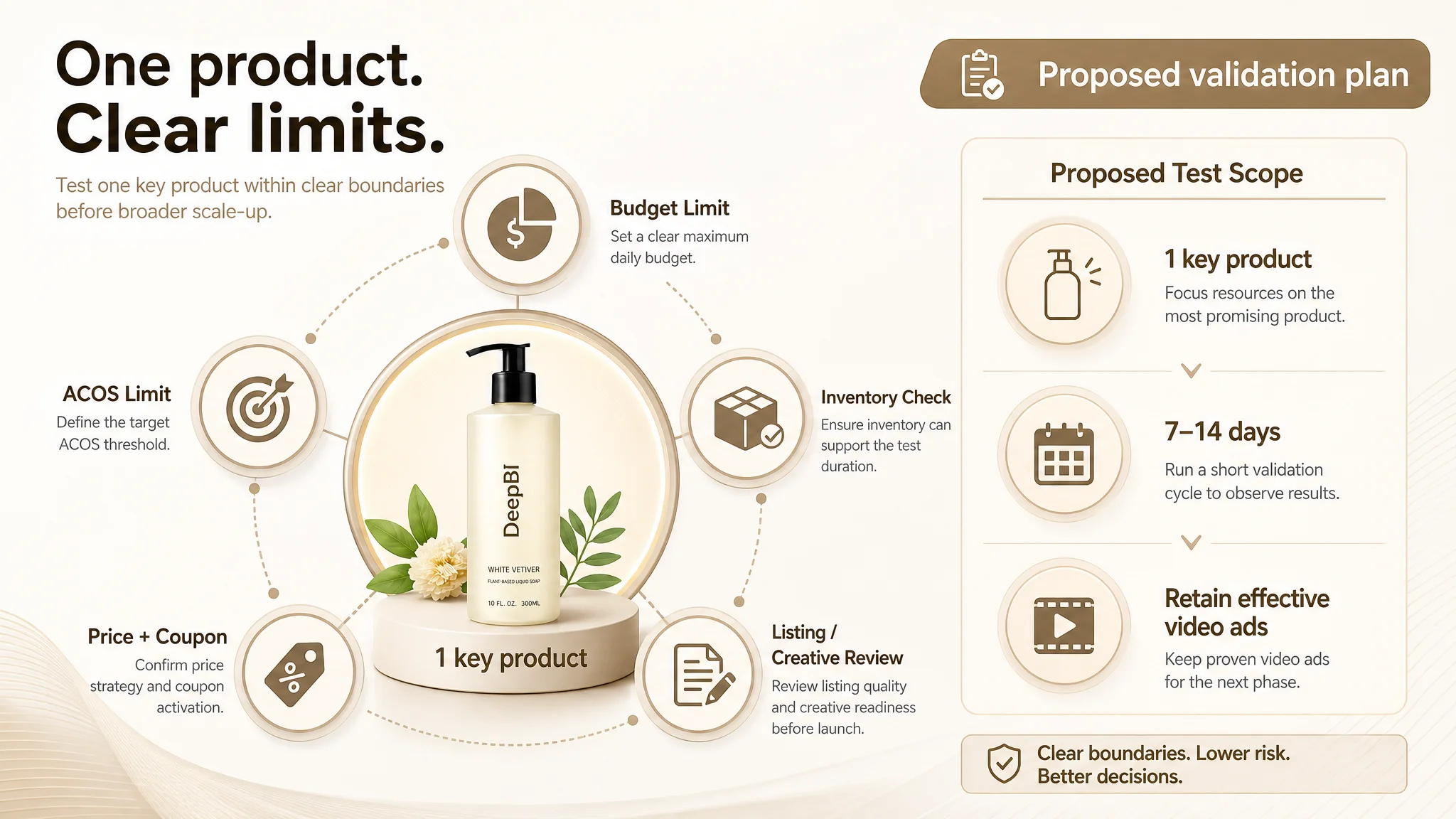
DeepBI did not simply attribute the problem to “high ACOS” or an “insufficient budget.” Instead, it observed advertising efficiency, sales volume, and product readiness conditions together.
1. First, compare the cost efficiency of AI advertising and existing advertising.
By reviewing advertising data from January to June, DeepBI confirmed that AI advertising ACOS improved from 64.1% to 28.8%, while the ACOS of existing advertising during the same period was 43.5%. This indicated that AI advertising had a lower cost ratio within the observed delivery range, but it did not prove that AI advertising had already generated the primary incremental sales.
2. Then, distinguish efficiency metrics from scale metrics.
The diagnosis expanded beyond “Did ACOS decline?” to include “Was advertising sales volume sufficient?” and “Had advertising become the primary traffic source?” If both spending and advertising sales volume were small, a low ACOS might indicate restrained delivery rather than effective scaling that had already been completed.
3. Check the delivery conditions surrounding the core product.
The customer hoped to launch sales through a low price and a high-value coupon for a core product. Therefore, before validating the advertising, it was necessary to confirm that the key product, price, coupon, and inventory could support conversion after traffic arrived. If the product conditions were unstable, simply increasing the advertising budget would make it difficult to determine whether the problem came from the advertising or the product's ability to convert traffic.
4. Check whether creatives could be delivered consistently.
During the service period, AI image generation for complex or transparent-structure products was not stable. Some creatives could be used directly, while others required manual revision. As a result, creative usability needed to be included in the advertising test rather than assuming that all products could receive visual creative support in the same way.
5. Finally, design a short-cycle, pausable validation plan.
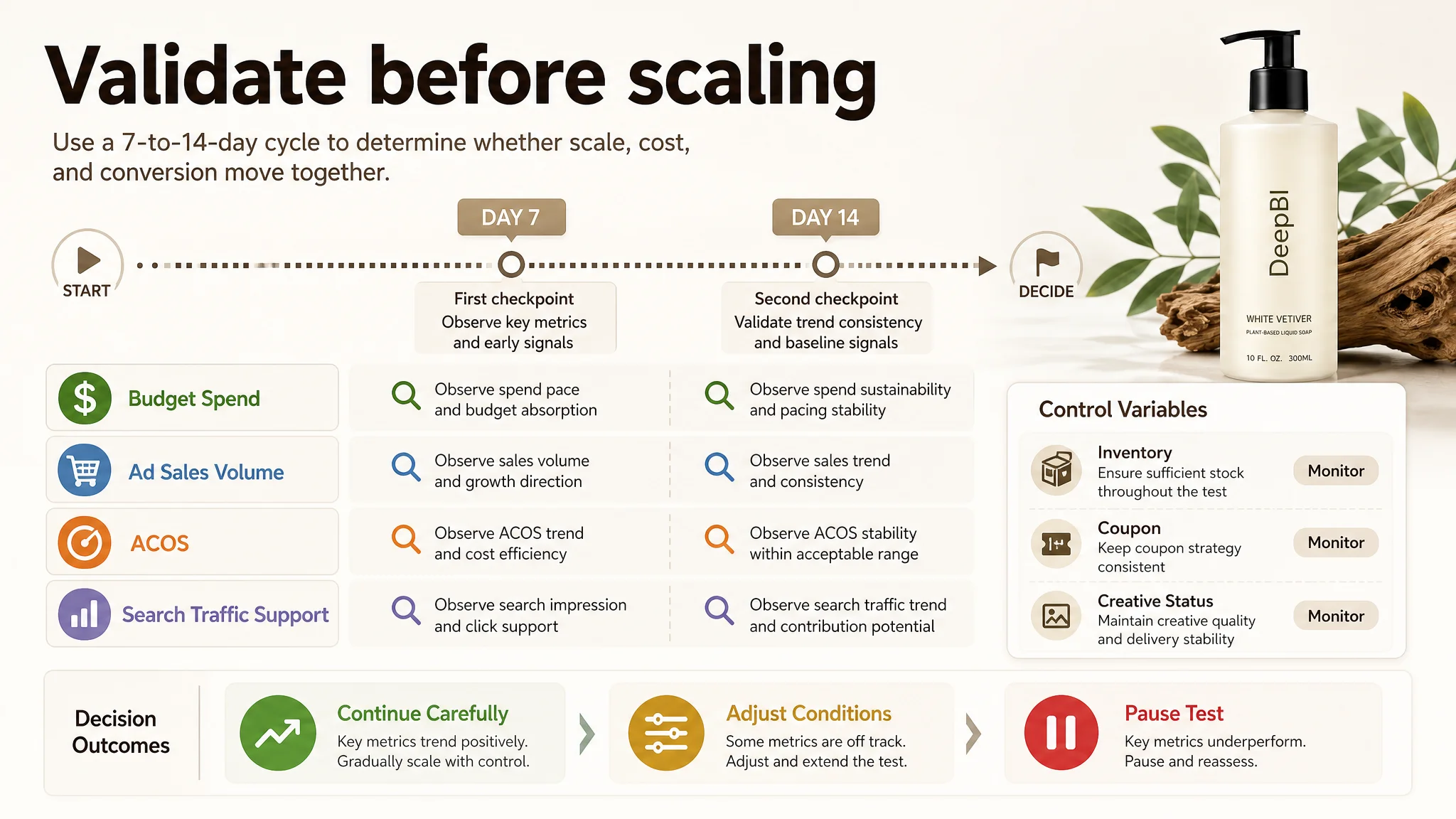
When the customer was concerned about launch speed, scaling intensity, and incremental sales at the same time, a 7-to-14-day low-risk validation cycle was appropriate. By setting the budget, ACOS limit, key product, and observation metrics in advance, the overall investment risk could be avoided before the results became clear.
The Real Problem
Problem 1: Advertising efficiency improved, but advertising scale was insufficient
Cause: AI advertising ACOS had declined, but AI advertising sales volume remained relatively small and had not yet become the primary traffic source. Low ACOS and high sales volume are not the same objective.
Impact: The customer could see an improvement in the cost ratio but could not confirm whether the advertising had truly generated sufficient incremental sales. It was also difficult to determine whether the budget should continue to increase.
Evidence: AI advertising ACOS improved from 64.1% in January to 28.8% in June, lower than the 43.5% ACOS of existing advertising during the same period. However, the account records also showed that AI advertising sales volume remained relatively small and had not yet become the primary traffic source.
Problem 2: The advertising scale-up objective did not match the validation mechanism
Cause: The customer focused on advertising launch speed and scaling intensity and hoped to see incremental sales quickly. However, without defining the budget boundary, ACOS limit, key product, and observation period in advance, it would still be difficult to evaluate the advertising results after increasing the budget.
Impact: Advertising could repeatedly shift between “insufficient spending to validate results” and “increased investment with higher risk.” Even if the customer saw a low ACOS, the value of the advertising might still appear unproven because the scale was insufficient.
Evidence: The customer repeatedly focused on advertising launch speed, scaling intensity, and incremental sales, and believed that low ACOS combined with insufficient scale was not enough to prove the value of the advertising.
Problem 3: Product and creative readiness conditions were uncertain
Cause: Some of the customer's mobile phone and consumer electronics accessories had complex structures or transparent materials, and AI image generation was unstable. Some creatives required manual revision. At the same time, although a low price and a high-value coupon could be used to launch the core product, they needed to be validated together with inventory, Listing, and conversion conditions.
Impact: When advertising traffic increased, if the product page or creatives could not consistently support conversion, weaker advertising performance might not have been caused solely by the advertising. Scaling at that point would increase the cost of diagnosis.
Evidence: During the service period, the usability of AI image creatives for some complex or transparent-structure products was unstable, affecting the customer's confidence in visual generation capabilities. The customer also continued to be concerned about the certainty of advertising scale-up and incremental sales.
Optimization Plan
Based on the problems above, a more prudent approach was not to increase the overall budget all at once, but to design a controllable validation unit around one key product.
1. Select a single key product first
Select one core product from the approximately 4 products with clearly defined price, coupon, and inventory conditions as the test subject. Avoid scaling multiple products at the same time, which could mix advertising sales, creative issues, and product conversion issues together.
The key product should first be checked for the following:
- Whether current inventory could support the 7-to-14-day test;
- Whether the low-price launch plan had been finalized;
- Whether the high-value coupon was available;
- Whether the Listing page had the basic conditions needed to support traffic;
- Whether any main-image or detail-page creatives required manual revision.
2. Retain existing effective video advertising
For video ads that were already usable and performing steadily, replacing all of them at the start of the test was not recommended. Retaining effective creatives could reduce the interference caused by creative changes and provide an existing delivery foundation for the advertising launch.
3. Allow AI advertising to gradually support search traffic
AI advertising should not be used only as a low-budget observation item, nor should it suddenly be expected to take on all traffic without clear boundaries. A more appropriate approach was to gradually increase the proportion of search traffic supported by AI advertising and observe whether ad spending, advertising sales, ACOS, and product conversion changed together.
If AI advertising ACOS remained within an acceptable range but sales volume did not expand, the budget spend, search traffic support, and product page should be examined further rather than continuing to pursue a lower ACOS alone.
4. Set budget and ACOS limits
Before starting the test, clearly define the daily or stage-based budget and set an acceptable ACOS limit. The budget limit controls the maximum cost of trial and error, while the ACOS limit determines when to pause, adjust, or continue observing.
The evaluation can be divided into three situations:
- Both efficiency and scale improve: Continue observing while controlling the rate of budget increases;
- ACOS is low but scale does not expand: Prioritize checking budget spend, traffic support, and the conditions of the key product;
- Scale expands but ACOS exceeds the limit: Stop further scale-up and recheck the price, coupon, Listing, and creatives.
5. Validate creative issues separately from advertising issues
For products with complex or transparent structures, if AI image generation results require manual revision, the creative status should be marked first before deciding whether to include the product in the advertising test. Products with unstable creatives are not suitable as the sole basis for evaluating advertising scale-up capabilities.
This helps prevent “the image is unusable,” “the page conversion is insufficient,” and “the advertising delivery efficiency is problematic” from being combined into a single conclusion.
6. Use a 7-to-14-day observation period
The purpose of the 7-to-14-day validation was not to guarantee short-term growth, but to obtain enough information to answer several operational questions:
1. Could the budget be spent effectively?
2. Had AI advertising begun to support search traffic?
3. Did advertising sales volume expand as delivery increased?
4. Did ACOS remain within the preset limit?
5. Did the low price and coupon improve product conversion?
6. Did creatives, inventory, or Listing become new limiting factors?
After the cycle ended, the next step could be determined: continue scaling, adjust product conditions, optimize the Listing, or stop the test. This was easier to control than increasing the budget all at once and made it easier to determine whether the problem lay with the advertising, Listing, or product strategy.
Results
From January to June 2026, the customer's store sales fluctuated upward, reaching the highest complete month of the period in June, with sales of 28592.9. During the same period, AI advertising ACOS improved from 64.1% in January to 28.8% in June, while the ACOS of existing advertising was 43.5%.
However, these figures only show that advertising efficiency and store sales changed during the observation period. They do not directly prove that all store sales growth was generated by AI advertising. The account records also did not provide sufficient data on advertising sales, budget spend, click-through conversion rate, or the proportion of search traffic. Therefore, the definitive incremental sales generated by AI advertising cannot be calculated from these figures.
More importantly, because the customer still had concerns about advertising scale-up, creative delivery stability, and result certainty, the customer stopped renewing the service at the end of June 2026 and entered the churn stage. The 7-to-14-day validation plan proposed in this article had not yet entered the results-validation stage for this customer. Therefore, it cannot be described as having helped the customer achieve growth, successfully scale advertising, or complete a renewal.
The result of this case was therefore not that “low ACOS had already proven advertising success.” Instead, it clearly presented a state requiring further validation: cost efficiency had improved, but advertising scale, incremental value, and customer confidence had not yet been established together.
Case Summary
The real issue this case needed to address was not simply an excessively high ACOS, but a disconnect between advertising efficiency and advertising scale.
The decline in AI advertising ACOS from 64.1% to 28.8% indicated that the cost ratio had improved during the observation period. However, AI advertising sales volume remained relatively small, showing that a low ACOS did not mean advertising had already achieved scale-up, nor did it enable the customer to confirm the value of incremental sales.
A more effective advertising optimization plan should place the key product, price, coupon, inventory, Listing, creatives, budget, and ACOS limit within the same validation framework. In its diagnosis, DeepBI needed to help the seller distinguish among three types of problems: whether the advertising was effective, whether the product could support the incoming traffic, and whether the delivery scale was sufficient to validate incremental sales.
For advertising whose results have not yet been clearly established, a 7-to-14-day short-cycle validation is more suitable for controlling trial-and-error risk than increasing the budget all at once. It cannot guarantee that advertising will grow, but it can help sellers obtain a clearer basis for decision-making at a lower cost.
Key Takeaways for Sellers
Takeaway 1: Low ACOS does not equal advertising success
When determining whether Amazon advertising is worth continued investment, sellers cannot look only at ACOS. They also need to observe advertising sales volume, budget spend, traffic sources, and product conversion. If advertising scale is very small, a low ACOS may still mean that effective validation has not been completed.
Takeaway 2: Before scaling advertising, confirm that the product can support the traffic
Advertising, Listing, price, coupon, and inventory form an integrated system. If the product page, creatives, or promotional conditions cannot support conversion after ad clicks increase, continuing to increase the budget will only magnify uncertainty. Sellers should first determine whether the problem lies with the advertising or the Listing before deciding whether to scale.
Takeaway 3: Use short cycles and boundary conditions to reduce trial-and-error risk
When conducting an Amazon advertising budget test, sellers can set a 7-to-14-day validation period around one key product while clearly defining the budget limit, ACOS limit, inventory requirements, and coupon conditions. The test should at least answer three questions—whether the product can support traffic, whether sales volume can expand, and whether costs remain within an acceptable range—before the next action is decided.
For sellers who are becoming increasingly cautious with advertising and experiencing a situation where ACOS is not high but sales are not growing, the focus of Amazon advertising optimization should not be blindly pursuing lower costs. Instead, it should be building a delivery mechanism that can validate incremental sales, control risk, and support decision-making.