

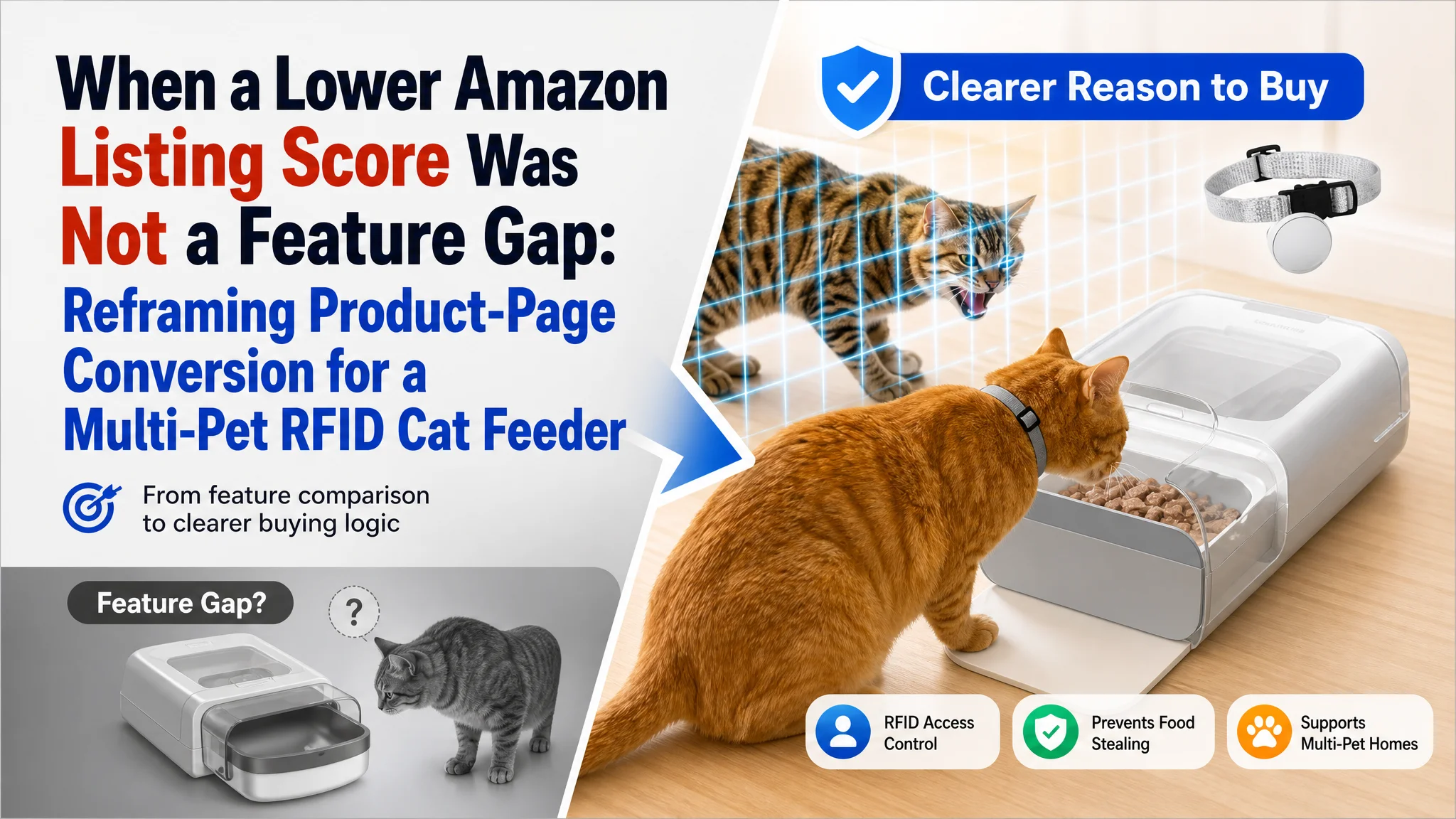
This case began with an Amazon seller facing a familiar product-page problem: the Listing was functional, but it was not as convincing as a comparable high-performing listing in the US marketplace. The customer’s RFID cat feeder addressed food stealing, special diets, and multi-pet feeding, yet its Listing still scored 75 out of 100 against the benchmark’s 87.
The initial instinct was to read the gap as a feature competition problem. The benchmark emphasized Wi-Fi, app controls, diet tracking, and health data, while the customer’s product page focused more heavily on RFID access control, sealed feeding, and physical protection. It was easy to conclude that the Listing needed more intelligent features, more images, or more technical detail.
DeepBI reached a different judgment. The larger issue was not that the product lacked a complex connected system. The Amazon product page was failing to turn its own advantages into a clear buying argument. Its message was spread across functions, while the most valuable differentiation—preventing food stealing without adding unnecessary complexity—was not made prominent enough.
The later optimization therefore focused on rebuilding the page’s decision logic: present the multi-pet conflict earlier, make the prevention mechanism visible, move “ready to use” and “no app required” into the high-impact content area, strengthen the title and bullets around personalized feeding, and use A+ content to provide more rational trust. Other Amazon sellers can take away a practical lesson: before copying a competitor’s features or continuing to refine Amazon ads, determine whether the Listing is clearly communicating why its own product deserves the click and the order.
The Amazon Listing Was Behind, but the Score Alone Did Not Explain Why
The gap was visible in the overall score:
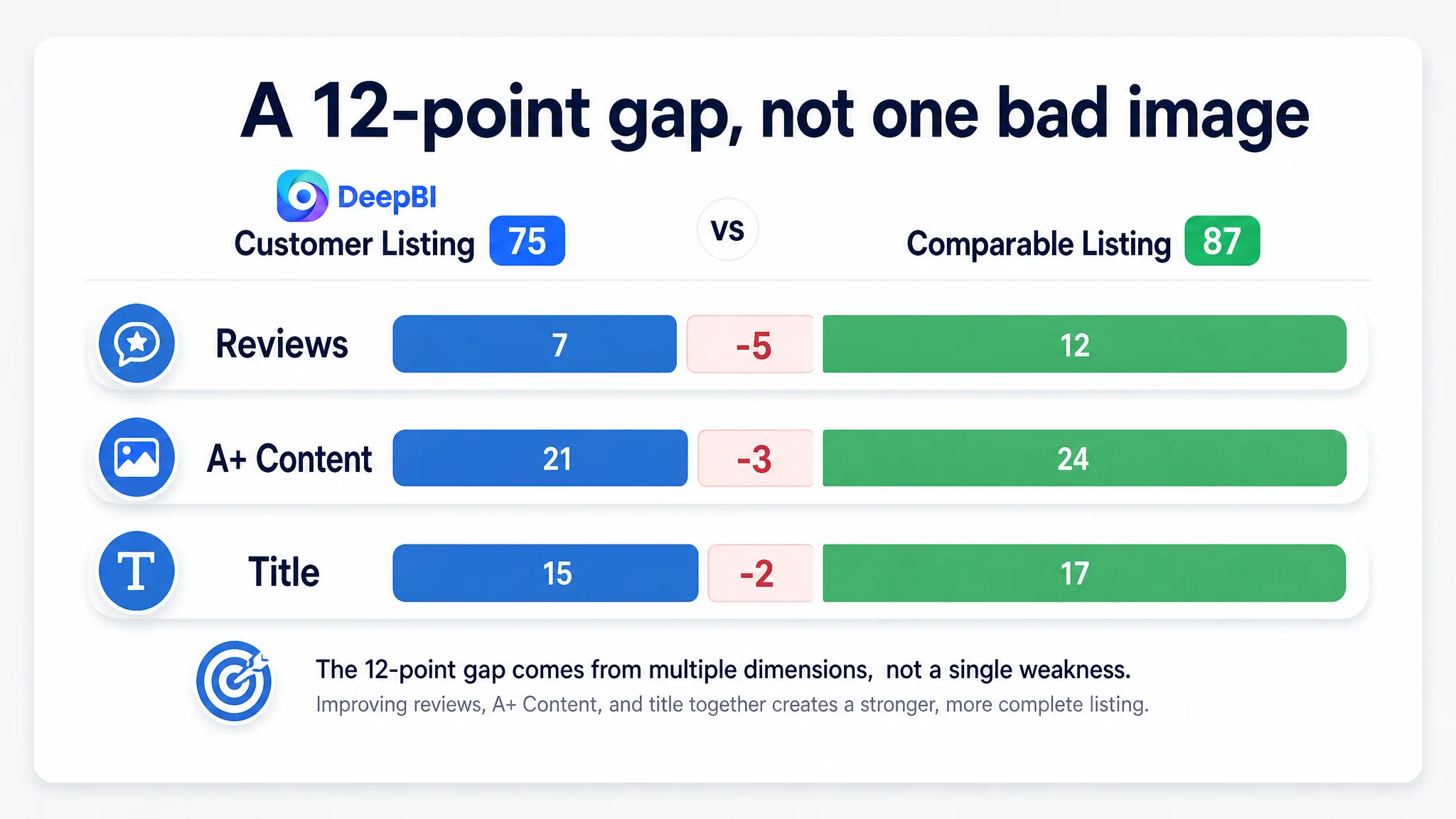
- Title: Customer Listing: 15/20, Comparable Listing: 17/20, Difference: -2
- Main image: Customer Listing: 25/30, Comparable Listing: 26/30, Difference: -1
- Bullet points: Customer Listing: 7/10, Comparable Listing: 8/10, Difference: -1
- A+ content: Customer Listing: 21/25, Comparable Listing: 24/25, Difference: -3
- Reviews: Customer Listing: 7/15, Comparable Listing: 12/15, Difference: -5
- Total: Customer Listing: 75/100, Comparable Listing: 87/100, Difference: -12
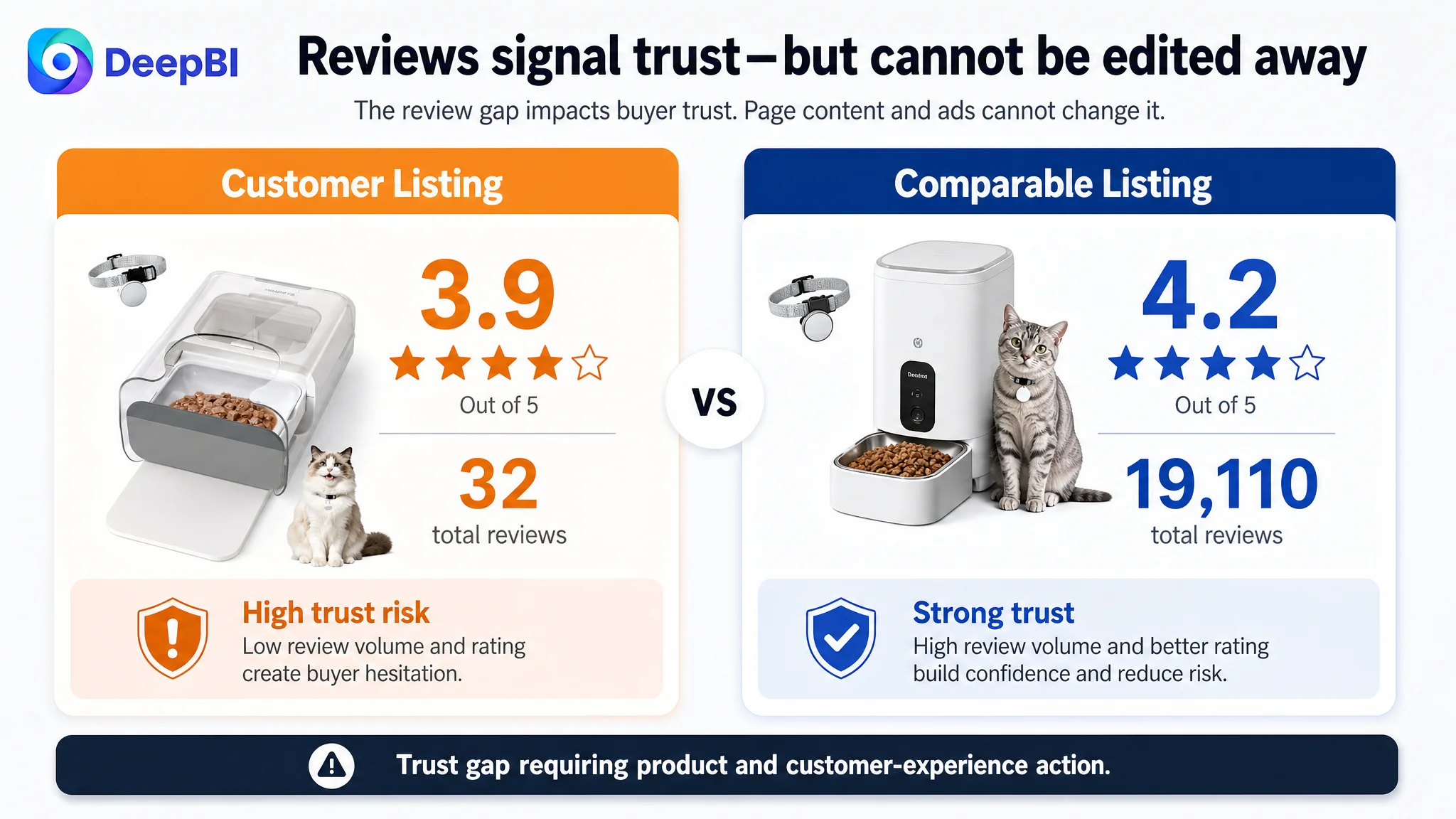
At first glance, the review gap appeared to be the most serious issue. The customer Listing had a 3.9-star rating from 32 reviews, while the comparable Listing had a 4.2-star rating from 19,110 reviews.
That difference mattered. A low review count and lower average rating create a trust disadvantage, especially for a product designed for prescription diets, weight management, and multi-pet households. The customer’s negative feedback also mentioned noise and the size of the collar tag.
But reviews were not the only reason the page underperformed. They explained part of the trust problem, not the full conversion bottleneck.
The more actionable gaps were found in how the Listing presented the product.
The page did not simply have fewer advantages. It made its strongest advantages harder to recognize.
The Original Direction Was to Compete on the Benchmark’s Terms
The comparable Listing presented a more connected product story:
- Collar-based pet recognition
- Personalized meals
- Diet tracking
- Wi-Fi programming
- App control
- Feeding logs
- Health monitoring
- Data dashboards
- Device sharing and alerts
The customer’s Listing presented a different product logic:
- RFID authorization
- Automatic lid opening
- Food-stealing prevention
- Support for wet and dry food
- Sealed storage
- Prescription-diet scenarios
- Manual training mode
- Quiet and anti-pinch design
- Simple physical controls
The customer’s page was not empty. It contained many relevant selling points. The problem was that the benchmark’s story was easier to understand as a complete system, while the customer’s content often appeared as a collection of functions.
That created an implicit misdiagnosis: if the comparable Listing was winning with app-based intelligence and data tracking, the customer might need to add more complexity to keep up.
This direction would have been commercially risky.
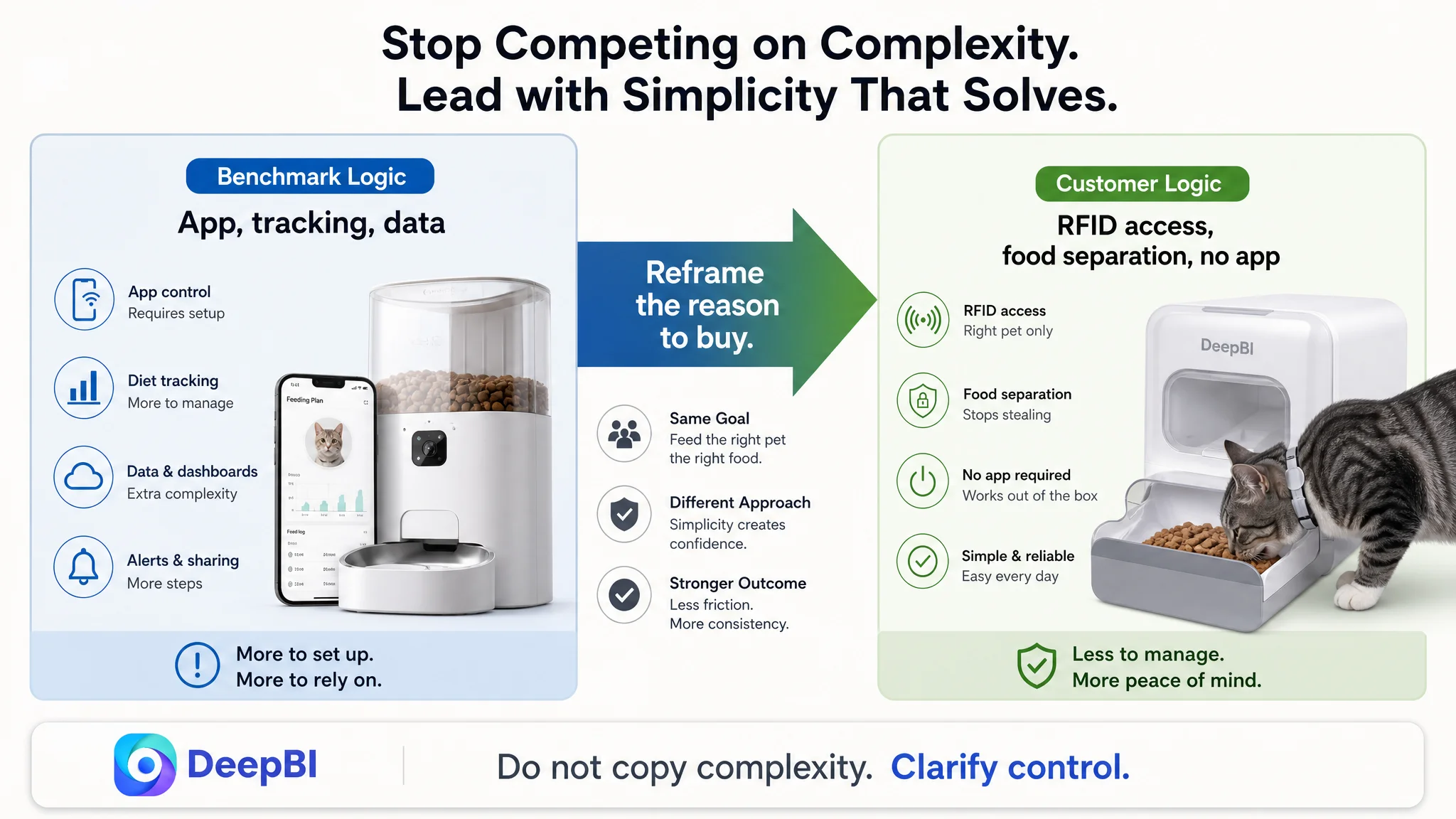
The product’s actual opportunity was not to imitate an app-centered ecosystem. It was to make simplicity a competitive advantage. For buyers who want to stop one cat from stealing another cat’s food, a system that works out of the box and does not require app management can be more persuasive than another layer of setup.
DeepBI therefore reframed the question:
Was the Listing losing because the product was less intelligent, or because the page was not explaining the value of its simpler operating model?
The Real Constraint Was Listing Conversion Capacity
The 12-point score gap showed that the Listing was behind the benchmark, but the dimension pattern showed where the business logic was breaking down.
The main image gap was only one point. The title and bullets were each one point behind. A+ content was three points behind, and reviews were five points behind.
This was not a single bad image problem.
It was a page-level conversion problem involving:
- Weak prioritization of the core multi-pet conflict
- A title that placed important benefits too far back
- Bullet points that described functions without always building a complete pain-point-to-solution path
- A+ content that explained features but did not provide enough proof or structured trust
- A review base too small to compensate for uncertainty
The customer’s page described the feeder. The benchmark more consistently described the outcome of using it.
That distinction is important on Amazon. A buyer does not begin with a technical checklist. They begin with a situation:
- One pet keeps stealing another pet’s food.
- Two cats need different diets.
- A prescription diet is expensive and must not be accessed by the wrong animal.
- The owner wants feeding control without managing a complicated system.
- Wet food needs to remain fresh between meals.
The Listing needed to make those situations immediately recognizable, then connect each one to a visible mechanism.
The Main Image Was Not Just a Product Shot
The customer’s first image established the product category: an RFID feeder. But it did not immediately establish the household problem the feeder was designed to solve.
The comparable image used a warmer home environment and a more complete connected-system presentation. That made it easier for shoppers to imagine the product in their own home.
The issue was not that the customer’s image was visually unusable. It was that the image began with the object instead of the conflict.
For this category, “a feeder” is not the strongest first message. The stronger message is:
One pet can access its own food while another pet is kept out.
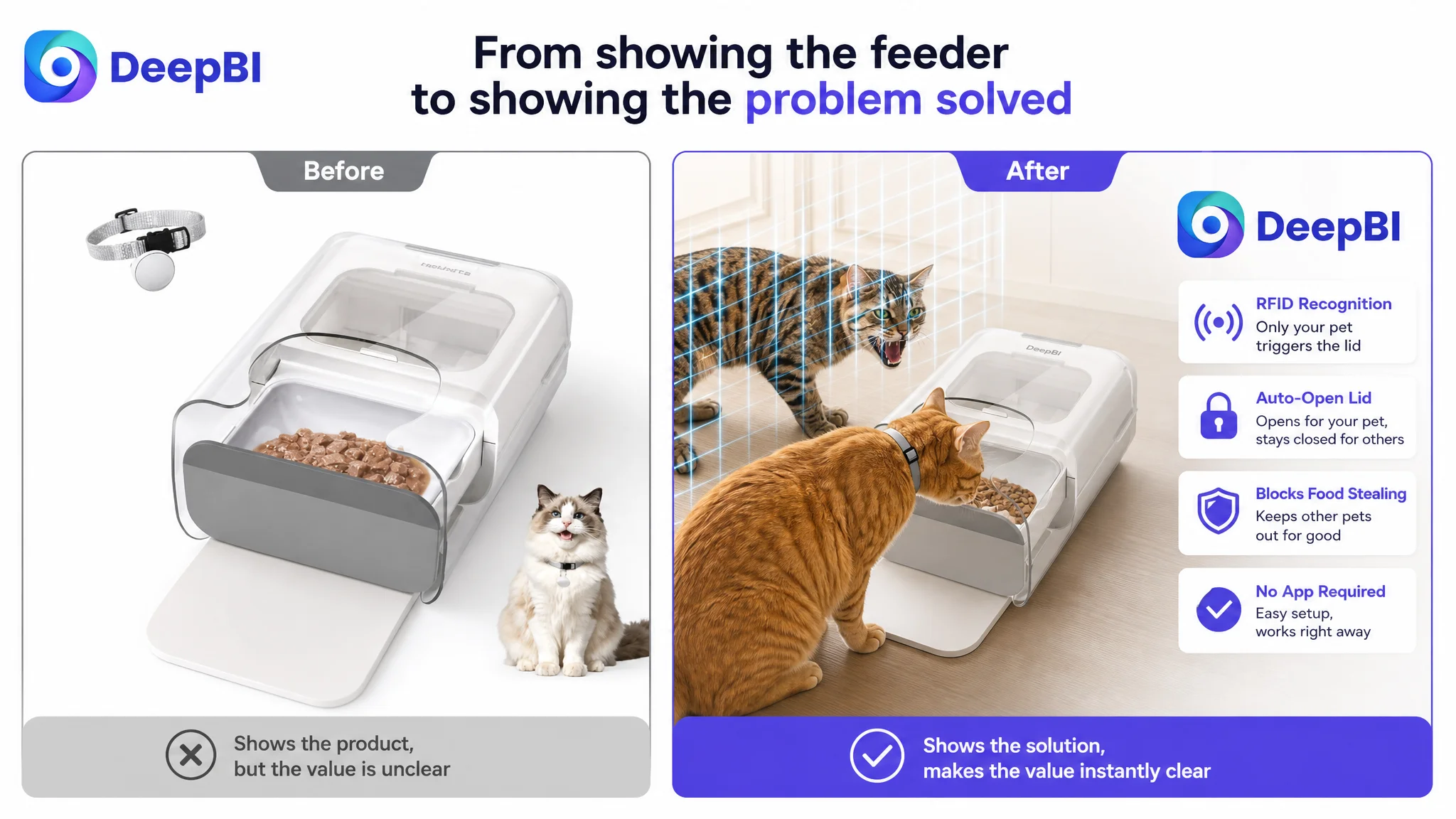
The recommended direction was therefore to shift the visual emphasis from a generic product presentation toward a direct representation of food-stealing prevention, while preserving the product’s actual appearance.
The sequence should make the value clear before explaining the technical details:
1. Show the multi-pet feeding conflict.
2. Show the authorized pet gaining access.
3. Show the unauthorized pet being prevented from reaching the food.
4. Explain the RFID and automatic-lid mechanism.
5. Reinforce the simple setup and everyday usability.
This is a decision-order issue. Buyers first need to know whether the product solves their problem. They can evaluate the mechanism after the problem has become personally relevant.
The missing mechanism weakened trust
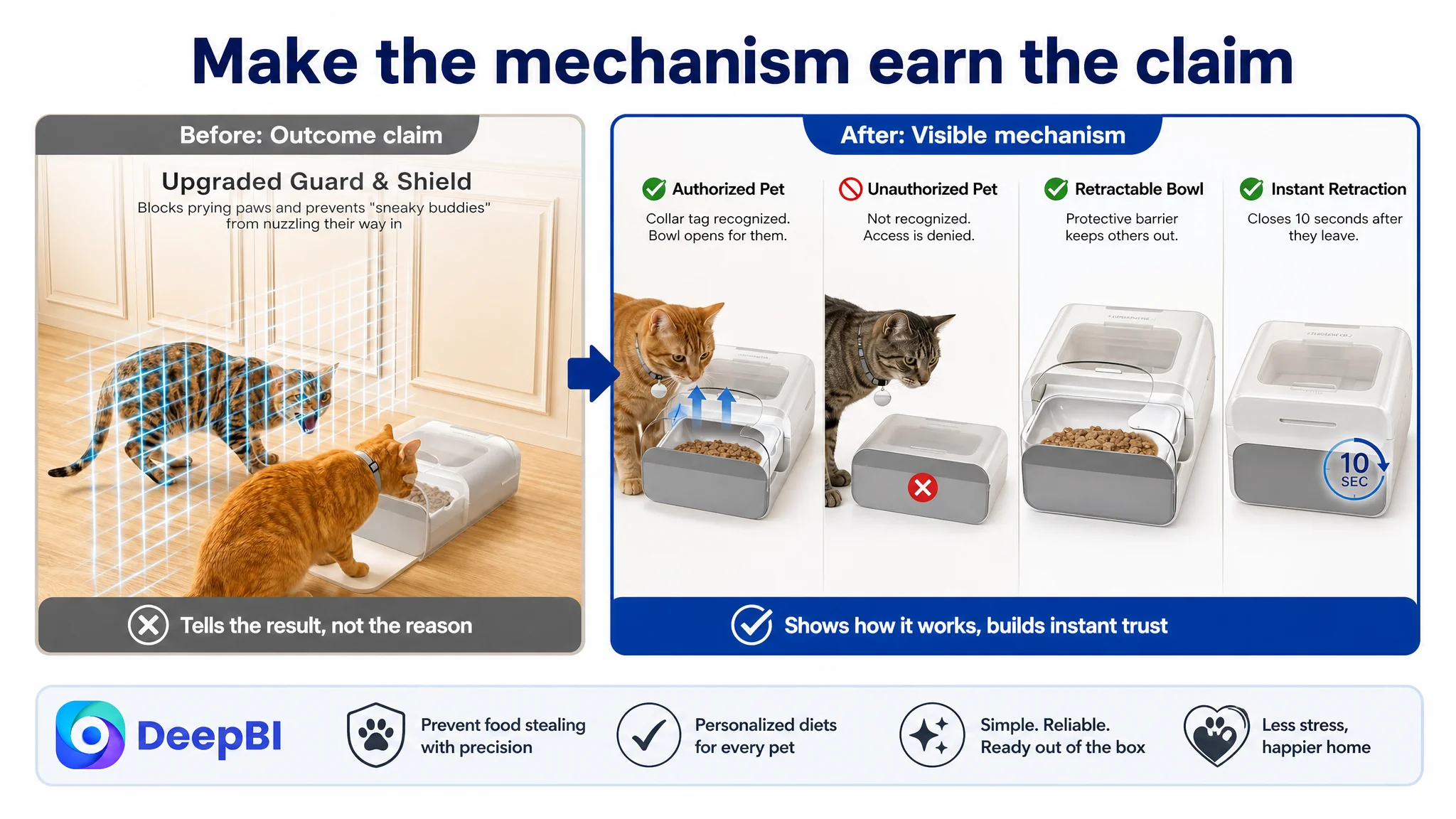
The customer’s “Guard & Shield” presentation communicated protection as an outcome, but it did not always show how that protection worked.
By contrast, the benchmark created a clearer cause-and-effect chain:
- The collar tag identifies the pet.
- The lid activates for the designated pet.
- Other pets are blocked.
- Food stealing is reduced.
For a product involving access control, the mechanism is part of the trust argument. A visual that only says “protected” asks the shopper to accept a claim. A visual that shows authorization and exclusion gives the shopper a reason to believe it.
The Title Had Keywords, but Not Enough Buying Logic
The customer’s original title included several descriptive elements, including automatic feeding, anti-stealing, a sealed lid, and wet and dry food compatibility. However, it leaned toward a long functional list.
The comparable title placed “Collar Sensor for Personalized Meals,” “Cats Recognition,” “Diet Tracking,” and “Wi-Fi Programmable” in a structure that was easier to scan as a smart-feeding solution.
DeepBI did not recommend copying those unsupported features. It recommended rebuilding the customer’s title around the product’s actual strengths:
- RFID cat feeder
- Collar sensor
- Automatic lid
- Anti-stealing
- Multi-pet homes
- Personalized diet control
- Wet and dry food compatibility
The proposed structure made the core product identity and its primary use case visible earlier:
RFID Automatic Cat Feeder with Collar Sensor & Automatic Lid, Anti-Stealing Food Dispenser for Multi-Pet Homes, Personalized Diet Control for Wet & Dry Food, Cats and Small Dogs
The key change was not simply adding more search terms. It was moving the terms that explain the product’s commercial purpose closer to the front.
“RFID cat feeder” identifies the product.
“Collar sensor” explains the mechanism.
“Anti-stealing” identifies the pain point.
“Multi-pet homes” identifies the audience.
“Personalized diet control” states the benefit.
That is more useful than filling the title with repeated product-form terms.
The Bullet Points Needed to Become a Buying Path
The customer’s bullet points covered relevant information, but the structure placed more weight on product functions than on the sequence of concerns a buyer needs resolved.
DeepBI’s recommended order was designed to move from access control to household outcomes, then to food preservation, safety, and maintenance.
1. Personal access instead of technical description
The first bullet should explain that the RFID tag functions as a unique identity key. The paired cat or small dog can access the food, while other pets are prevented from doing so.
This turns “RFID technology” into a meaningful benefit: each pet gets access to the food intended for it.
The source material supports an automatic closing action approximately 10 seconds after the pet leaves. That detail can reinforce the mechanism, provided it remains accurate to the product specification.
2. Food stealing and different diets as one problem
The second bullet should connect multi-pet conflict with nutrition control.
A household may have:
- A cat on a prescription diet
- A kitten needing different food
- A pet on a weight-management plan
- One aggressive eater taking food from a slower eater
These are not separate use cases from the buyer’s perspective. They are variations of the same concern: the right pet must receive the right food.
The Listing therefore needed to combine anti-stealing and specialized feeding instead of presenting them as disconnected features.
3. Wet and dry food as a physical advantage
The benchmark was stronger in app-based tracking, but the customer product had a different point of differentiation: sealed feeding for both wet and dry food.
That advantage needed clearer positioning.
Rather than presenting sealing as a technical attribute, the bullet should connect it with the owner’s concern about freshness, texture, pests, and food quality between meals.
This gives the product page a credible physical benefit that does not depend on competing with the benchmark’s data ecosystem.
4. Quiet and anti-pinch design as risk reduction
The comparable Listing emphasized connected usability. The customer’s Listing had an opportunity to answer a different concern: whether the motorized lid would frighten or pinch the pet.
Quiet operation, soft edges, and anti-pinch design should not be treated as secondary decoration. They reduce the perceived risk of introducing an automatic lid into an animal’s feeding routine.
The bullet should explain the safety outcome, not only list the components.
5. Ready-to-use setup and easy cleaning
“Ready to use out of the box” and “no app required” were identified as high-priority differentiators. They were buried too deeply in the existing content and needed to move into the first five images and prominent bullet content.
The customer’s product also had pre-paired RFID tags, a three-button interface, a removable inner bowl, and cleanable ABS surfaces. Together, these details support a complete usability message:
- Less setup before the first meal
- No need to manage an app
- Simple initial training
- Easier routine cleaning
This was the point where the page could turn a perceived feature gap into a positioning advantage.
The customer did not need to look more complex. It needed to make simplicity feel intentional, capable, and trustworthy.
A+ Content Was the Largest Page-Level Opportunity
The A+ gap was three points, but its importance extended beyond the score.
The customer’s A+ content covered many scenarios:
- Multi-cat feeding
- Prescription diets
- RFID authorization
- Wet and dry food
- Manual training
- Food-level visibility
- Safety features
The weakness was not a lack of modules. It was the order and evidence structure.
The comparable Listing built a more complete “problem, data, solution” narrative through:
- App screens
- Feeding logs
- Health dashboards
- Weight-management examples
- Device connection
- Alerts
- Long-term monitoring
The customer’s A+ content relied more heavily on functional explanation and scenario presentation. That made the product understandable, but it did not create the same level of rational proof.
The problem should appear before the technical explanation
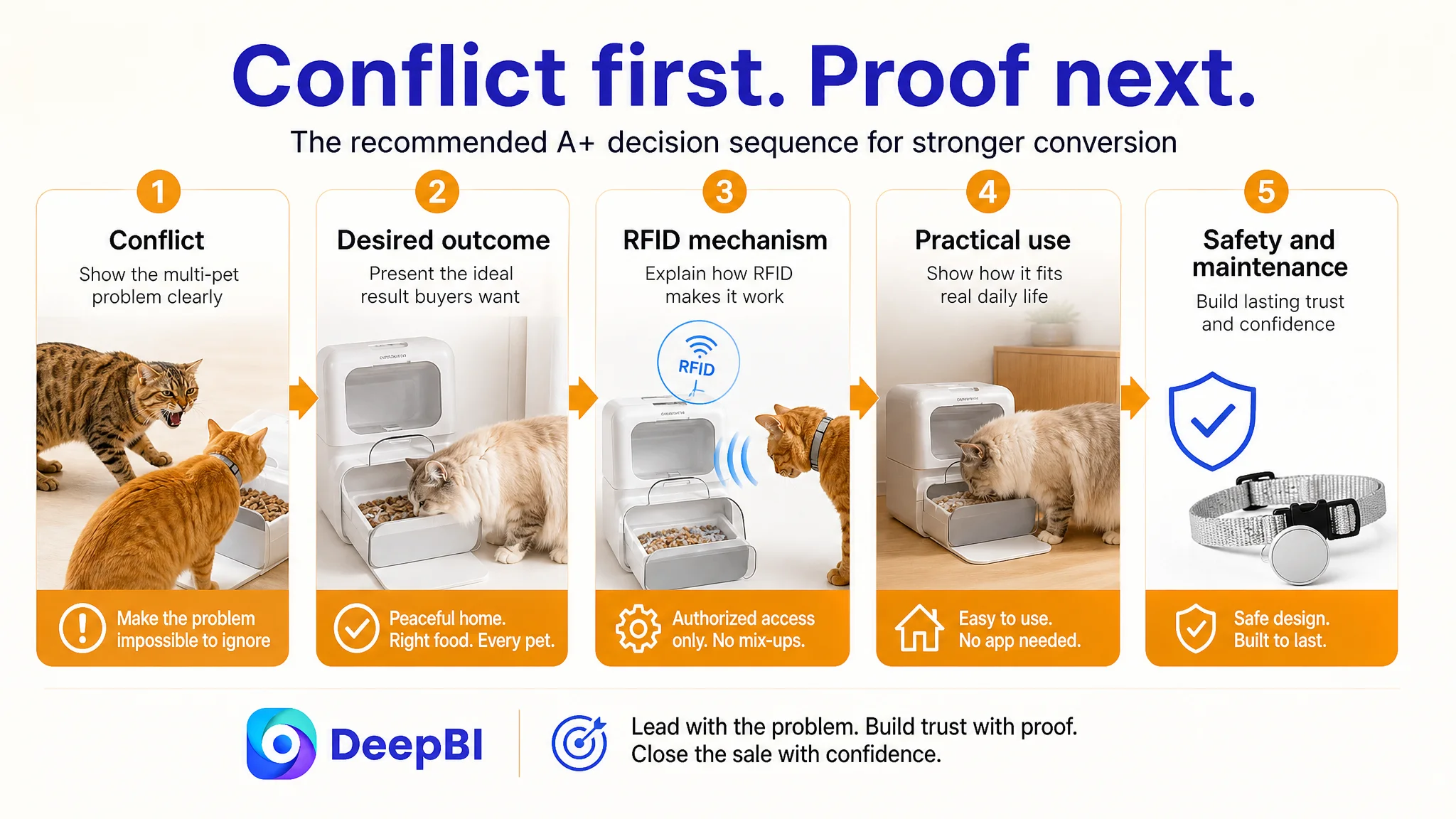
The customer page placed the strongest multi-pet conflict comparison too late. Buyers encountered technical and scenario content before seeing the central problem expressed with enough force.
DeepBI recommended moving the pain-point comparison earlier:
- One pet bullies another away from food.
- One cat steals prescription food.
- A kitten’s food is taken by an adult cat.
- Different diets become difficult to manage.
- The desired result is peaceful, controlled feeding.
Only after that contrast is clear should the page introduce the RFID access mechanism and collar details.
This improves the narrative sequence:
Conflict → desired outcome → access-control mechanism → practical usage → safety and maintenance
Proof should replace broad reassurance
The A+ content also needed stronger visual validation of personalized feeding.
The existing RFID authorization explanation was a valuable proof node. It could be advanced and paired with a clear visualization of:
- The authorized pet approaching
- The lid opening
- The unauthorized pet being excluded
- The lid closing after the authorized pet leaves
That is more persuasive than repeating that the feeder is “smart” or “secure.”
Where actual data exists, the page can also add measurable feeding information, such as portion sizes or feeding frequency. Where such data does not exist, it should not be invented.
The same rule applies to weight-loss charts, medical outcomes, certifications, and awards. They should appear only when the seller has valid evidence. Otherwise, the page should use truthful mechanism-based proof rather than unsupported claims.
The page needed clearer limitations
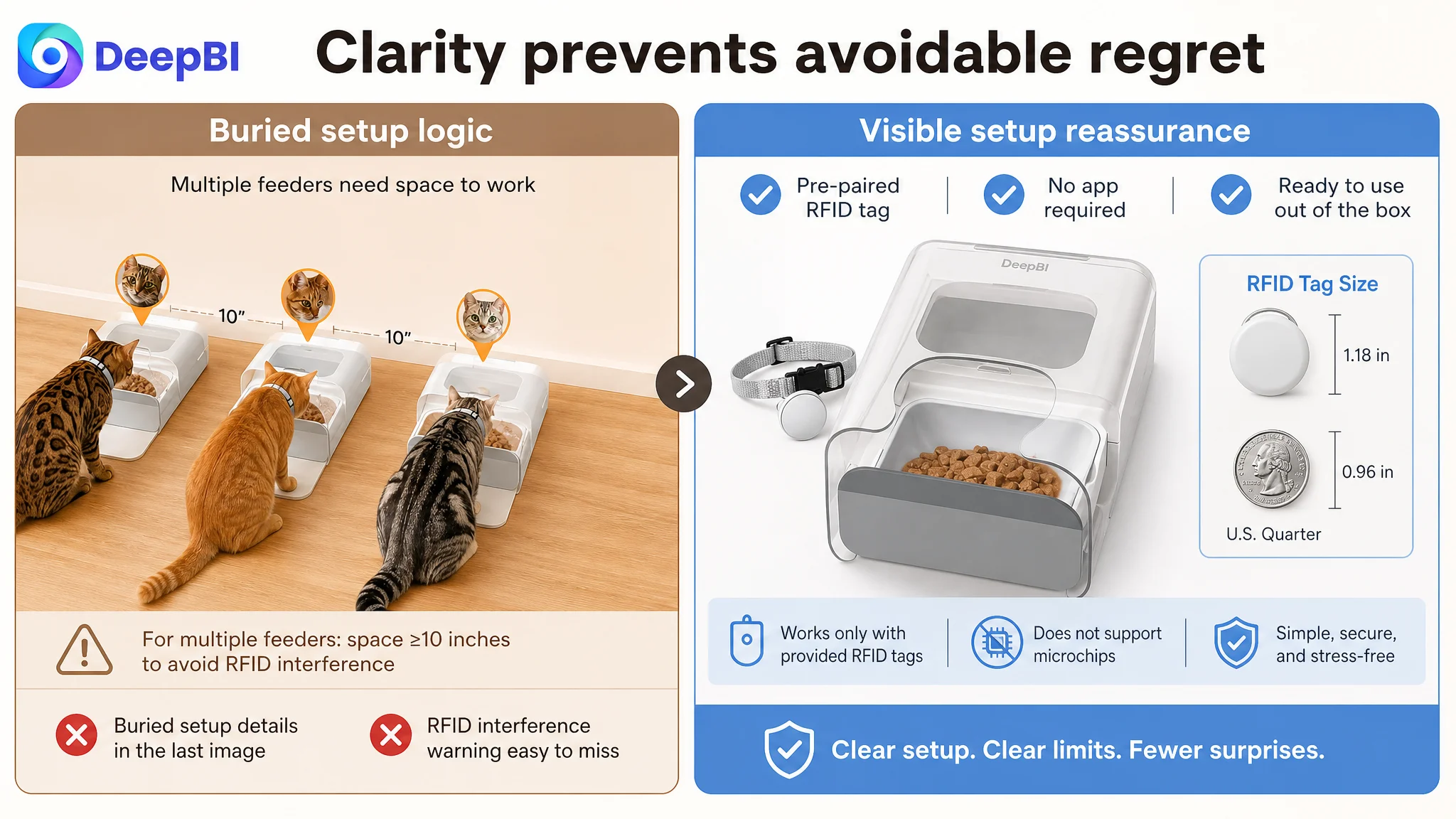
One of the most important trust improvements was not an additional benefit. It was a compatibility clarification.
The system works with the provided RFID tags, and microchips are not supported. That limitation should be stated clearly in the relevant A+ module.
A buyer who assumes microchip compatibility may purchase the product with the wrong expectation. Preventing that misunderstanding protects both conversion quality and post-purchase satisfaction.
Similarly, the collar tag should not be described only as “ultra-light” unless the actual weight is available. A specific measurement can strengthen the claim, but an unsupported number should not be added.
Why DeepBI Did Not Keep Tuning Amazon Ads First
The case material does not include advertising metrics such as CTR, CVR, ACOS, TACOS, or post-optimization performance. It would therefore be inaccurate to claim that Amazon ad campaigns were directly responsible for the Listing’s performance or that a specific ad adjustment produced a measured result.
The business reasoning is still clear.
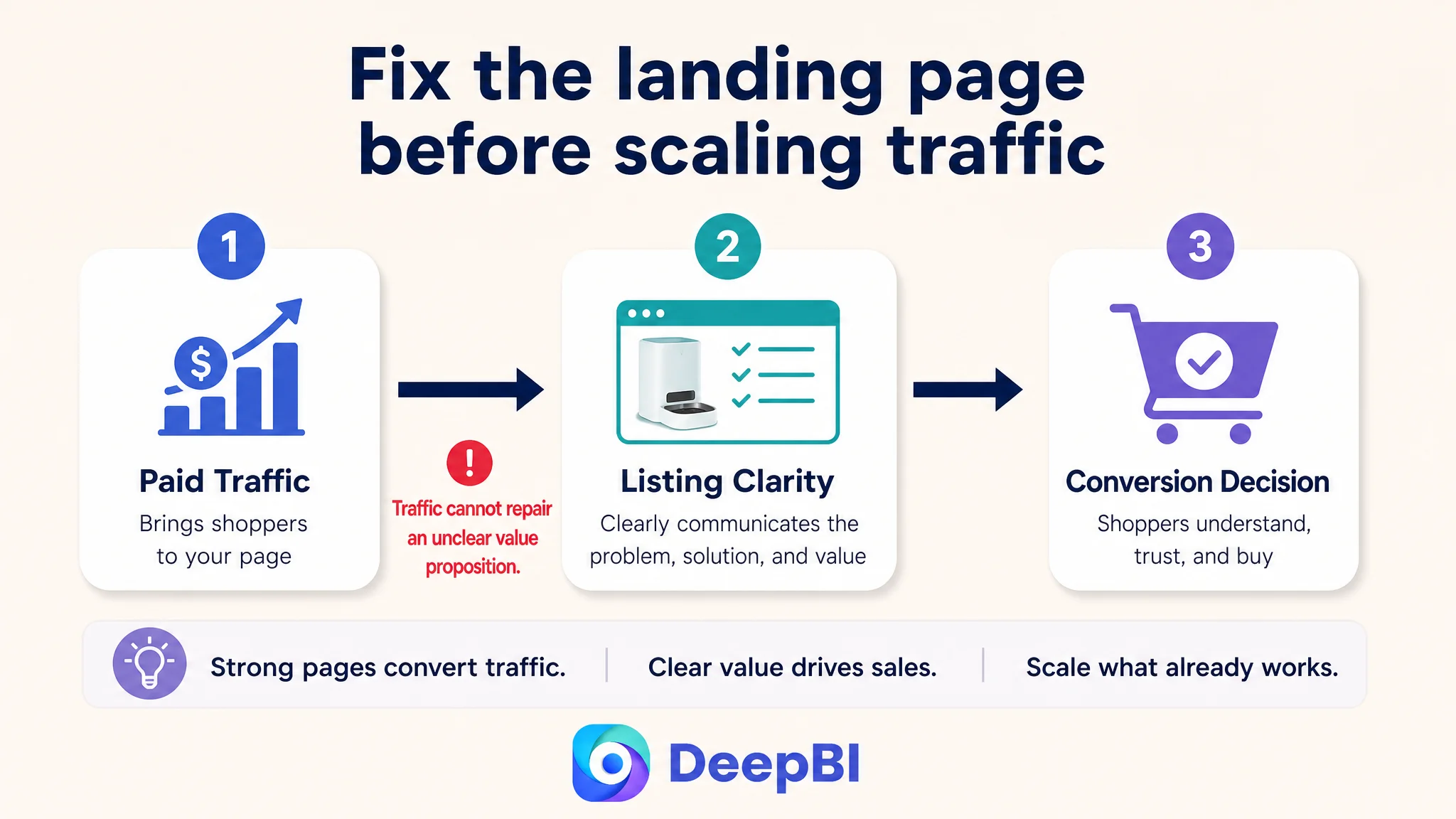
If an Amazon seller is sending paid traffic to a page whose core value is difficult to recognize, more traffic can expose the page’s weaknesses rather than solve them.
For this Listing, the priority was not to make the page claim that it had app tracking or Wi-Fi programming. The priority was to ensure that incoming shoppers could quickly understand:
- Why food stealing is a problem
- How the RFID system prevents unauthorized access
- Why the product supports different diets
- Why its simpler setup may be preferable
- Whether wet and dry food are supported
- What the system does and does not support
- Whether the design is safe and manageable for pets
Only after these questions are answered does further traffic optimization become more meaningful.
Advertising can bring a shopper to the product page. It cannot make an unclear value proposition become clear.
This is the key decision order: repair the Listing’s conversion logic before asking Amazon ads to scale the traffic.
The Review Gap Could Not Be Edited Away
The review dimension was the weakest area by score.
The customer Listing had:
- 3.9 stars
- 32 total reviews
- Eight reviews visible on the first page
The comparable Listing had:
- 4.2 stars
- 19,110 total reviews
- Eight reviews visible on the first page
The customer also had fewer image and video reviews, while negative feedback mentioned noise and an oversized collar tag.
No Listing rewrite can erase that gap immediately. It must be treated as a business risk, not a copywriting problem.
The appropriate response is to make the product page more precise and reduce avoidable expectation gaps:
- Clarify tag compatibility.
- State setup requirements accurately.
- Explain the collar tag’s comfort and safety only with supported information.
- Present the motorized lid’s safety behavior clearly.
- Avoid implying app tracking, microchip support, or health results that the product does not provide.
- Use future customer feedback to identify recurring friction around noise, tag size, training, and cleaning.
This is where a score becomes useful as a decision tool. It does not merely show that reviews are weak. It shows which concerns must be addressed through clearer information and which require product or customer-experience improvements beyond the Listing itself.
The Customer’s Strongest Position Was Simplicity With Control
The benchmark’s advantage was a connected feeding ecosystem. Its page made app tracking and health data central to the buying decision.
The customer’s strongest position was different:
- RFID-controlled access
- Direct prevention of food stealing
- Support for wet and dry food
- Prescription-diet protection
- Quiet and anti-pinch operation
- Ready-to-use setup
- No app required
- Simple manual training
That position is commercially credible because it is based on the product’s real capabilities.
The Listing did not need to win every comparison. It needed to make the right comparison visible.
A buyer who wants feeding data on a phone may prefer the benchmark. A buyer who wants reliable food separation without app management may prefer the customer’s product—but only if the page communicates that advantage early and convincingly.
What Changed in the Operating Understanding
The source material does not provide post-optimization CTR, CVR, ACOS, TACOS, keyword ranking, or organic-order data. The case therefore does not support a numerical performance claim.
What it does support is a clearer operating direction.
The page moved from:
- Feature accumulation toward problem-led communication
- Complex competitor imitation toward differentiated positioning
- Generic product presentation toward visible food-stealing prevention
- Technical explanation toward mechanism-based trust
- Late usability details toward early “ready to use” communication
- Repeated scenarios toward a more deliberate decision sequence
- Broad claims toward clearer compatibility and limitation disclosure
The intended business state is also more controllable:
- Paid traffic has a clearer page to land on.
- Organic shoppers can recognize the product’s core use case faster.
- The Listing has a more coherent reason-to-buy.
- The product’s simplicity becomes a deliberate advantage rather than an apparent lack of intelligence.
- Customer expectations are less likely to be shaped by unsupported assumptions.
- Future testing can isolate whether the main image, title, bullets, or A+ sequence is affecting conversion.
The Larger Amazon Lesson
This case was not ultimately about whether an RFID cat feeder should have an app.
It was about how an Amazon seller interprets a competitive gap.
A lower Listing score can tempt a team to copy the benchmark’s most visible features. But the better question is whether those features are the true reason the benchmark converts—or simply the most obvious content on its page.
DeepBI’s diagnosis identified a more fundamental issue: the customer’s product page contained a real solution, but the solution was not organized around the buyer’s decision.
The customer did not need to claim more intelligence than it had. It needed to show, in the right order, that it could solve a difficult multi-pet feeding problem with less complexity.
For Amazon sellers, the practical sequence is straightforward:
1. Establish what business problem the product page is failing to solve.
2. Separate a genuine product gap from a communication gap.
3. Compare the Listing against a relevant benchmark rather than copying every visible feature.
4. Put the primary pain point before secondary technical details.
5. Make the mechanism visible.
6. Use title, main image, bullets, and A+ content as one connected sales argument.
7. Clarify limitations before they become post-purchase disappointment.
8. Only then decide whether additional Amazon ad traffic should be scaled.
The page did not need more features to become more competitive. It needed a clearer reason for the right buyer to choose it.