

This case involved an Amazon US seller whose car air freshener Listing was being evaluated against a stronger category competitor. The initial direction was to improve individual elements such as the title, images, and bullet points. But the deeper issue was not one isolated copy error or a single weak creative. The product page was asking shoppers to understand too much, trust too little, and resolve important usage concerns on their own.
DeepBI ultimately found that the Listing was not using its traffic efficiently because its conversion logic was incomplete. The main image did not communicate the product variety clearly, the title delayed important search and value signals, the bullet points described features without following the shopper’s problem-solving path, and the A+ content did not address leakage, safe use, or gifting scenarios early enough.
The later optimization therefore focused on rebuilding the Amazon product page in decision order: create a clearer first impression, explain use and safety before complexity, connect scent variety to odor problems, and use the A+ content to establish confidence. The broader lesson for Amazon sellers is straightforward: before pushing harder on Amazon ads, determine whether the Listing is ready to convert the traffic it receives.
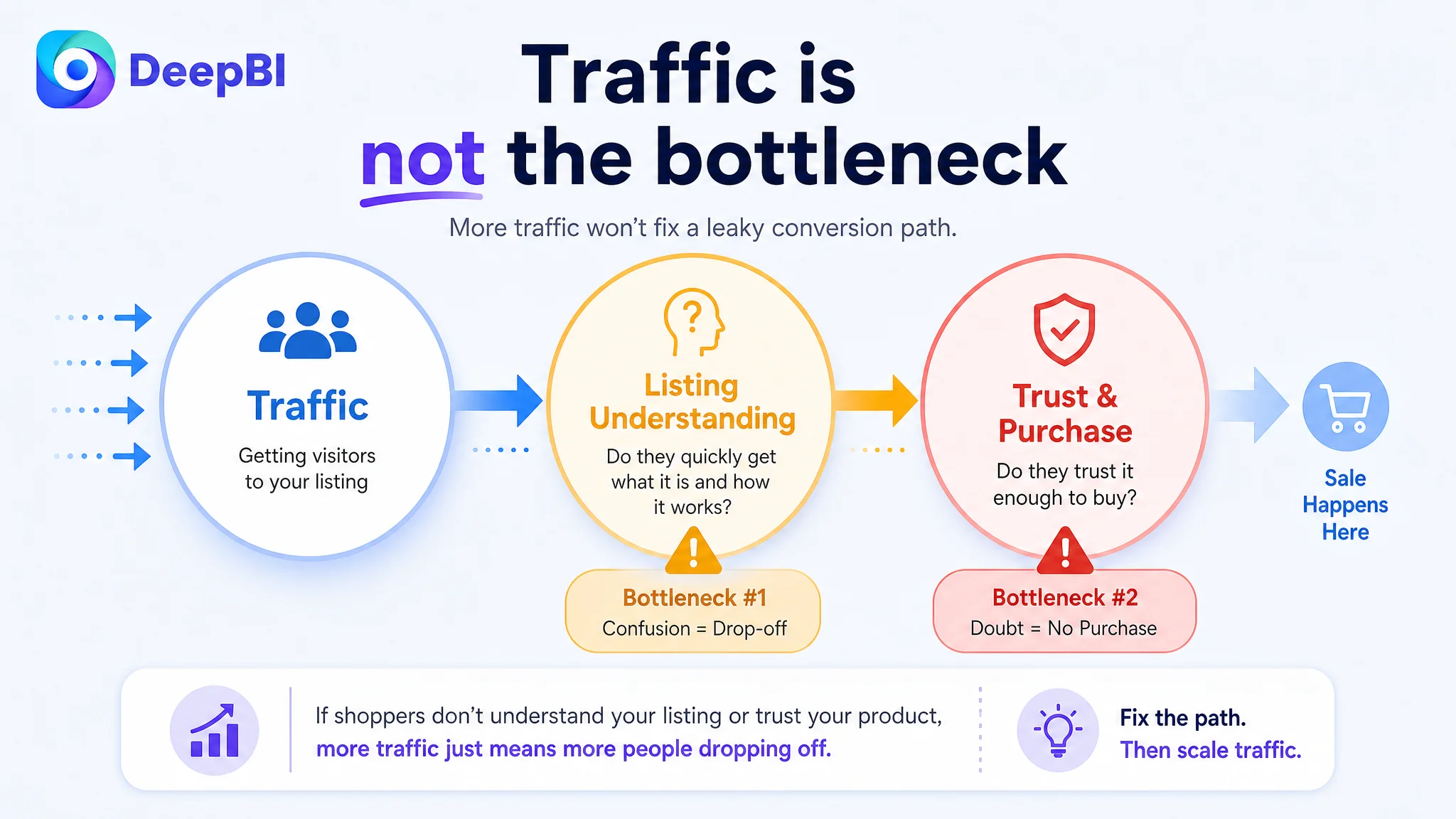
The Listing Had a Content Problem, but Not the One It First Appeared to Have
The customer’s Listing was not empty. It already included product images, a feature grid, usage guidance, structural explanations, scent imagery, customer reviews, and brand elements.
That made the problem easy to misread.
When a page contains all the expected modules, the natural reaction is often to improve each module separately:
- Add more keywords to the title
- Make the product images more attractive
- Rewrite the bullet points
- Add more lifestyle imagery
- Explain the product structure in greater detail
But the Amazon product page was not being held back by a lack of content alone. Its larger weakness was that the content did not form a persuasive sequence.
The shopper still had to answer several questions without enough help:
- What exactly is included?
- What does the scent experience feel like?
- How does the diffuser work?
- Could it leak?
- Is it difficult to use?
- Will it address unpleasant vehicle odors?
- Is it suitable as a gift?
- What happens after the fragrance is used?
The customer’s page addressed some of these questions, but not in the order or visual language that reduced buying hesitation.
The real gap was not the presence of content. It was the absence of a connected buying logic.
A 21-Point Gap Made the Diagnosis Hard to Ignore
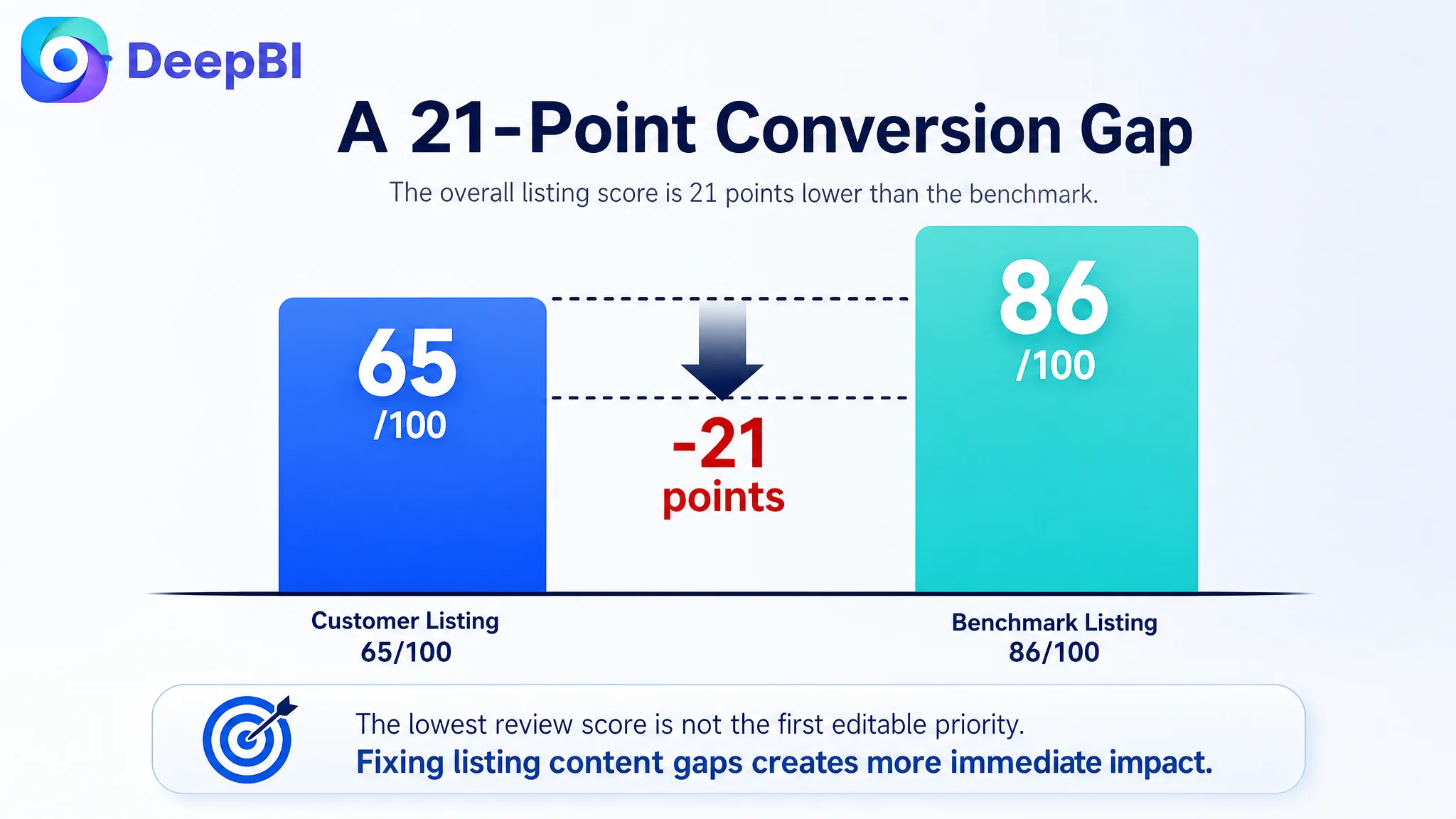
DeepBI’s comparison placed the customer’s Listing at 65/100, compared with 86/100 for the benchmark category Listing.
The gap was distributed across nearly every conversion-relevant dimension:
- Title: Customer Listing: 14/20, Benchmark Listing: 17/20, Gap: -3
- Main image: Customer Listing: 21/30, Benchmark Listing: 26/30, Gap: -5
- Bullet points: Customer Listing: 5/10, Benchmark Listing: 8/10, Gap: -3
- A+ content: Customer Listing: 19/25, Benchmark Listing: 23/25, Gap: -4
- Reviews: Customer Listing: 6/15, Benchmark Listing: 12/15, Gap: -6
- Total: Customer Listing: 65/100, Benchmark Listing: 86/100, Gap: -21
The review dimension showed the largest gap. The customer Listing had a 3.3-star rating and 63 total reviews, while the benchmark Listing had 4.0 stars and 1,491 reviews.
That difference clearly affected trust. Negative feedback on the customer Listing concentrated around weak scent performance and leakage, while the benchmark Listing presented a stronger overall social-proof profile.
But this did not mean that review volume was the first problem to solve.
Reviews accumulate over time and cannot be repaired through page editing alone. More importantly, the Listing already contained visible content defects that could be addressed immediately. If the product page continued to communicate weakly, increasing Amazon ad exposure could simply send more shoppers into the same trust gap.
This is where the diagnosis moved beyond score comparison. The question was not “Which score is lowest?” It was:
Which weakness is currently limiting the value of every additional visitor?
The Main Image Was Showing the Product, but Not Selling the Decision
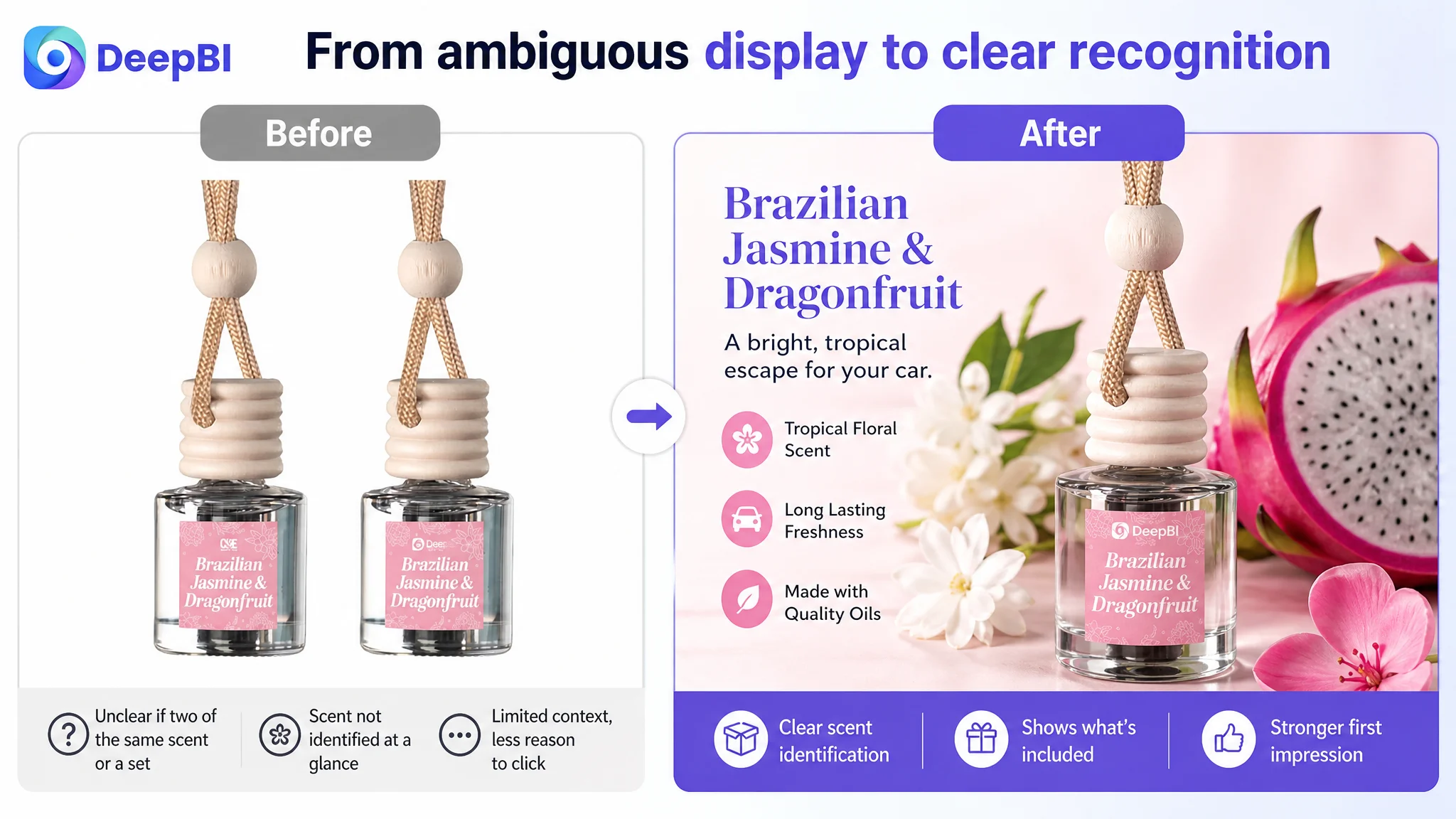
The customer’s first image used a clean, symmetrical presentation of two bottles. It was orderly, but it created ambiguity.
A shopper could not immediately tell whether the image showed:
- Two bottles of the same scent
- A multi-pack
- Repeated product views
- The full range of available scents
The benchmark Listing used a broader product presentation that communicated variety at a glance. That difference mattered because Amazon search pages are fast-scanning environments. The main image has to create recognition before the shopper reads the title or opens the product page.
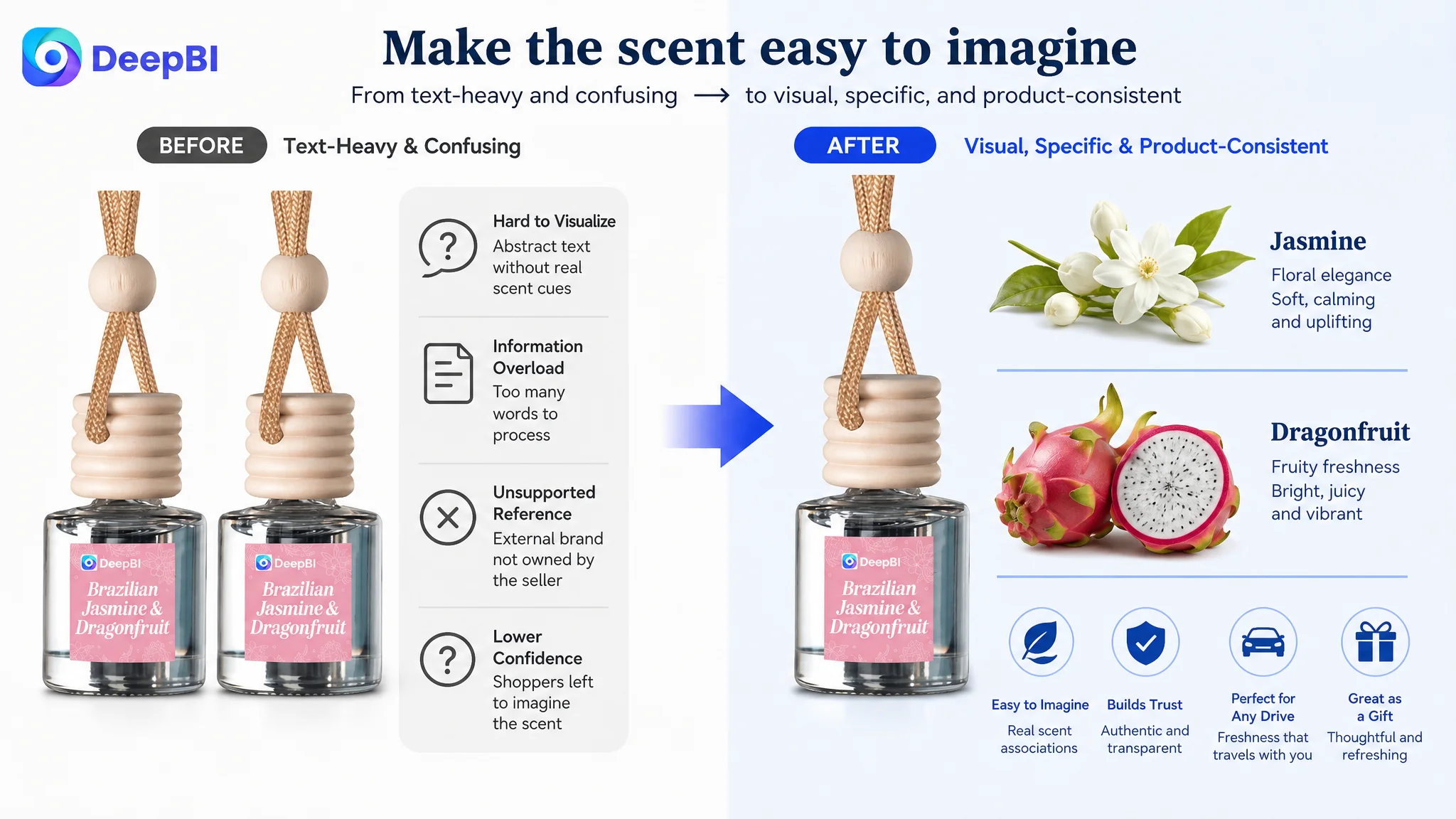
The customer’s image also showed only one scent theme, even though the product’s core positioning involved Brazilian Jasmine and Dragonfruit. The scent composition was discussed through text-heavy notes and an external brand reference that the customer did not own. Instead of helping shoppers imagine the fragrance, the image required them to process abstract information.
DeepBI’s direction was therefore not “make the image prettier.” It was to make the product more immediately legible:
- Clarify what is included
- Make the product variety visually obvious
- Use real scent associations such as jasmine flowers or dragonfruit
- Keep the product itself accurate
- Remove irrelevant or unsupported promotional language
This distinction is important for Amazon main-image optimization. A visual can be clean and technically acceptable while still failing to create a reason to click.
The Image Sequence Ignored the Questions That Created Anxiety
The later images exposed a second problem: sequence.
The Listing showed the product in a vehicle context, but the sequence did not explain how to use it early enough. There was no clear response to the practical concerns that appeared in customer feedback, especially leakage and incorrect inversion.
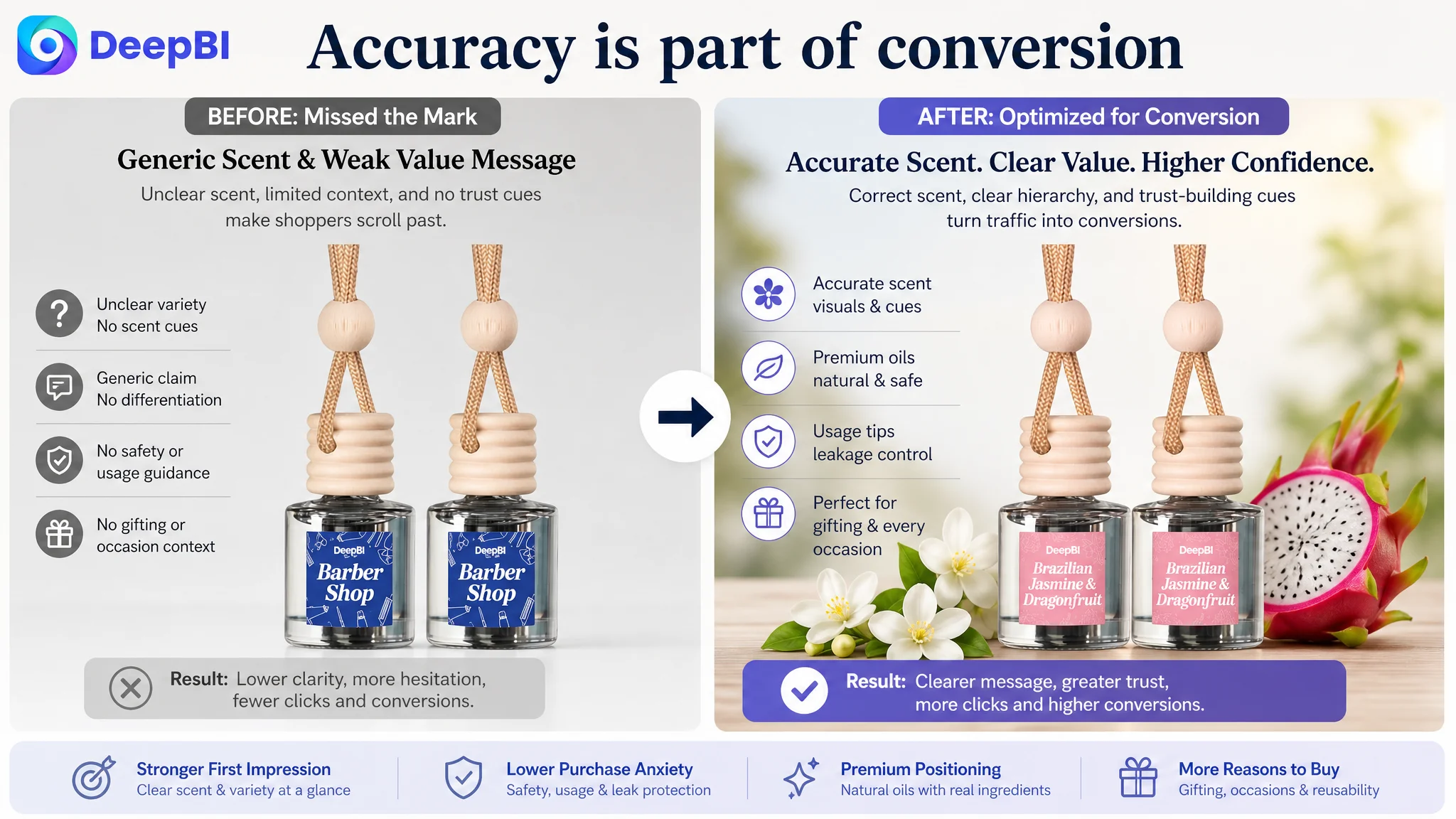
One image also used the wrong scent reference, showing a “Barber Shop” concept even though the product information identified the scent as Brazilian Jasmine and Dragonfruit. That was more than a weak creative choice. It introduced a risk of confusion about what the customer would actually receive.
Another image repeated generic copy such as “Your New Favorite Accessory” without adding meaningful decision support. A phrase like this consumes valuable visual space but does not answer a shopper’s concern.
DeepBI’s recommended order was more commercially grounded:
1. Clarify the product and scent
2. Show how the product is used
3. Address leakage and misuse risk
4. Demonstrate the hanging function
5. Explain scent variety and odor-related use cases
6. Present reuse and refill value
The main image and secondary images were therefore treated as parts of one conversion path rather than as independent promotional posters.
A secondary image should not merely repeat the promise. It should remove the next reason a shopper might hesitate.
The Title Was Losing Both Search Clarity and Click Value
The title scored 14/20, three points below the benchmark.
The benchmark title placed “Car Air Freshener” near the front and used a clear quantity signal, “4 Pack.” It also combined material, scent, vehicle context, and gifting language in a relatively compact structure.
The customer title placed its core search phrase later and repeated “Fragrance” without creating a stronger hierarchy of meaning. It also failed to make the quantity or product configuration immediately clear.
The recommended direction was not to copy the competitor’s wording. It was to rebuild the title around Amazon search intent and shopper comprehension:
- Put the core product phrase earlier
- Clarify the diffuser format
- Include the wooden lid and auto-interior context where accurate
- Remove repeated terms
- Correct the scent spelling
- Preserve the specific Brazilian Jasmine and Dragonfruit positioning
This is a good example of why keyword optimization cannot be separated from conversion analysis. A title is not only an indexing surface. It is also the first explanation of what the shopper is considering.
A title that technically contains relevant words but delays the product’s identity can weaken both discoverability and click confidence.
The Bullet Points Had Features, but No Problem-Solution Path
The bullet-point dimension scored only 5/10, compared with 8/10 for the benchmark Listing.
The customer’s bullets emphasized:
- Long-lasting fragrance
- Style and function
- Ease of use
- Reusability
Those were valid product attributes, but they were arranged as a feature list. The benchmark Listing opened with the shopper’s problem: unpleasant smells in the vehicle. It then connected multiple scents and odor control to that problem before moving into usage, safety, gifting, formula, and reuse.
That structure gave the shopper a reason to keep reading.
DeepBI’s recommended bullet logic followed a similar progression:
Start with the problem
Instead of leading with a general fragrance promise, connect the diffuser to recognizable vehicle odors such as food, smoke, and pets, where supported by the product positioning.
Explain the result
Describe the intended scent experience and odor-control benefit without overstating performance or inventing unsupported claims.
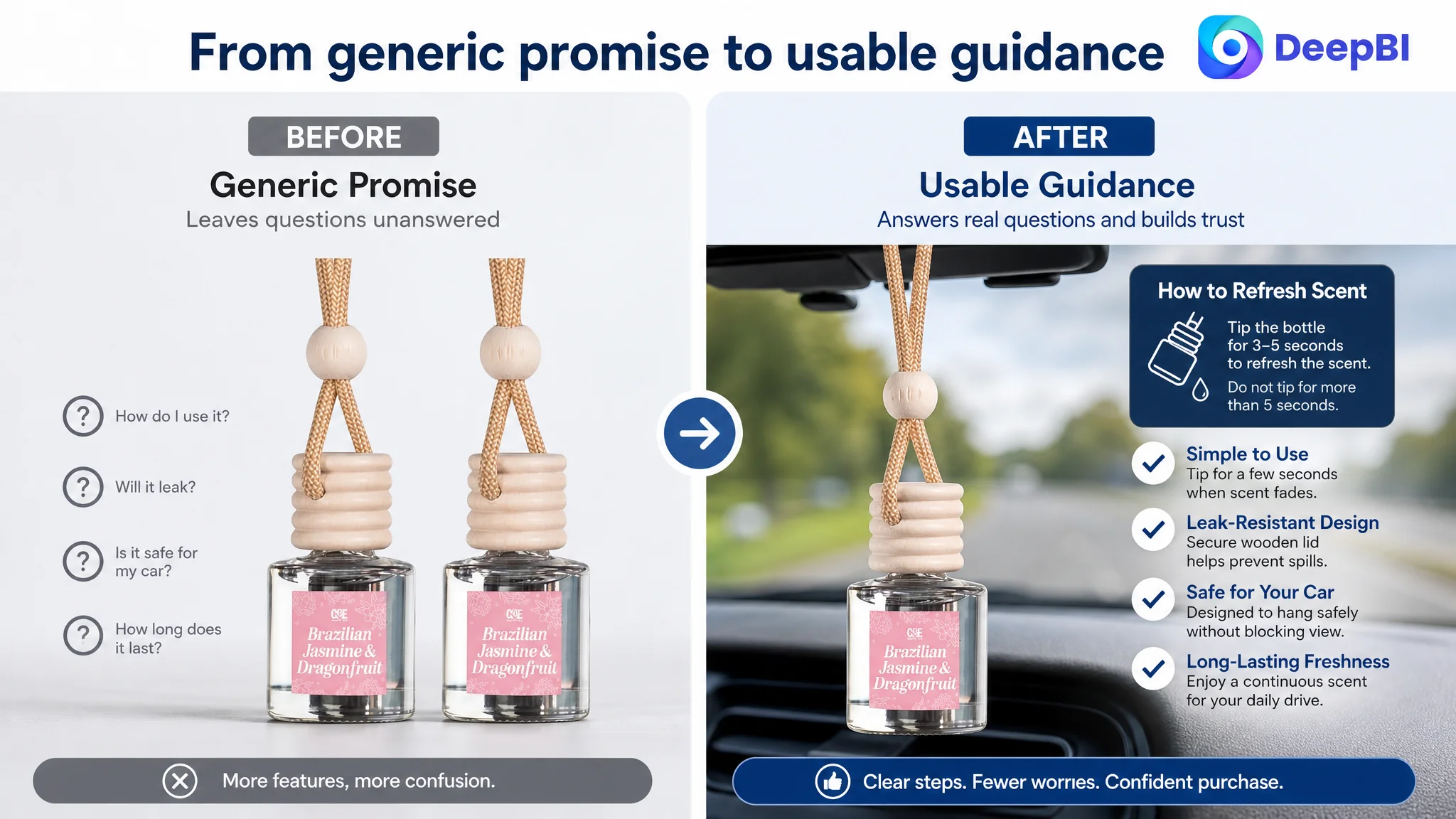
Reduce usage anxiety
Provide clear instructions for first use and refreshing the scent. The suggested inversion times were designed to make the process concrete and reduce leakage caused by over-inversion.
Address safety and fit
Explain the hanging design, adjustable cord, and the importance of maintaining visibility and securing the lid, provided these claims accurately reflect the product.
Expand the use case
Present the product as suitable for different gifting occasions, not only personal commuting or travel.
Close with long-term value
Explain that the glass jar can be reused and refilled after the original fragrance is finished.
This structure changes the role of bullet points. They stop being a list of things the product has and become a sequence of reasons the shopper can feel comfortable buying it.
The A+ Content Was Explaining the Product Before Establishing Trust
The A+ content score was 19/25, four points below the benchmark.
The customer’s A+ page included product displays, a feature grid, usage guidance, structural diagrams, scent scenes, reviews, and branding. The issue was not that these modules were irrelevant. It was that the page opened with general attributes and moved into complexity before fully addressing the strongest concerns.
The benchmark Listing used clearer trust-building devices:
- Do-and-don’t usage guidance
- Odor-related scenarios
- Gift occasions
- Safety reminders
- Lifestyle imagery
- A video reference
DeepBI’s diagnosis reframed the A+ page around three questions.
Can the shopper use it safely?
The usage module needed to become simpler and more direct. Rather than presenting a complex process late in the page, it should emphasize the key action: tip the bottle briefly to refresh the wooden lid.
The “Do” and “Don’t” structure was especially important because leakage was already present in customer feedback. A short, visible warning could prevent uncertainty more effectively than a dense technical explanation.
Does the product solve a recognizable problem?
The scent options were presented mainly as variety and style. The revised direction connected them to different vehicle odor situations and to the experience of entering a fresher car.
This made “many scents” more meaningful. Variety became a way to choose a solution, not just a larger number.
Is the product worth keeping or giving?
The reusable jar was mentioned, but its value was not developed through scenarios. A stronger A+ sequence could connect reuse to commutes, vacations, refills, and gifting.
The product did not need more generic praise. It needed a clearer reason to remain useful after the first bottle of oil was finished.
The A+ page had to move from “Here are the features” to “Here is why the product is safe, useful, and worth choosing.”
Why DeepBI Did Not Recommend Tuning Ads First
The case material did not include a post-optimization advertising dataset, so it would be inaccurate to claim a specific ACOS decline, CVR increase, or organic-order recovery.
But the Listing diagnosis still produced a clear advertising decision.
Amazon ads can create impressions and clicks. They cannot, by themselves, resolve:
- An unclear product configuration
- A weak first impression
- A scent description that is hard to visualize
- Missing usage guidance
- Leakage concerns
- A low review rating
- A page that does not connect product features to shopper problems
In this case, the customer’s page had several of these weaknesses at once. Continuing to optimize bids or campaign structure before addressing the page would risk amplifying a low-conversion destination.
That does not make Amazon ad optimization unimportant. It clarifies its position in the sequence.
Ads should bring qualified traffic to the Listing. The Listing still has to earn the order.
The priority was therefore to repair the page’s conversion capacity first, while recognizing that review quality and volume would require a longer operating horizon.
This was not a decision to ignore advertising. It was a decision not to use advertising as a substitute for product-page trust.
The Optimization Direction Became More Specific, Not More Complicated
Once the core problem was identified, the proposed changes followed a consistent rule: every creative or copy change had to answer a real shopper question.
That meant removing or replacing:
- Generic marketing phrases
- Incorrect scent references
- Abstract fragrance-note lists
- Repetitive feature claims
- Unsupported expressions such as “endless fragrance”
- Complex explanations that made use appear harder than necessary
It also meant preserving the product’s actual characteristics. The proposed visual improvements focused on composition, scent cues, usage context, safety communication, and information order rather than changing the product’s physical design.
This matters when AI-assisted creative production is involved. The goal is not to generate a more attractive object than the customer sells. The goal is to create a more convincing and accurate presentation of the real product.
DeepBI’s role in this case was to connect the diagnosis to that production logic:
- The score gap identified where the Listing was losing competitiveness
- The comparison showed how the benchmark resolved similar shopper concerns
- The optimization direction translated those gaps into concrete image and copy changes
- The product’s actual scent, structure, and reuse characteristics remained the boundary
The result was a more controlled path from judgment to execution.
The Business Lesson Was About Readiness, Not More Activity
This car air freshener Listing did not need more activity for its own sake. It needed a better order of decisions.
The customer had a product page with many components, but the page was not yet strong enough to make every additional visitor valuable. Its content was too passive in places, too generic in others, and occasionally confusing. The main image showed the product without fully communicating its value. The bullets described the product without beginning from the customer’s problem. The A+ content explained features before fully reducing risk.
DeepBI’s diagnosis changed the question from:
“Which individual element should we keep polishing?”
to:
“What must a shopper understand and trust before more traffic can convert?”
That reframing produced a more practical operating sequence:
1. Make the product and scent immediately clear
2. Improve the title’s search and reading structure
3. Rebuild the bullets around pain points and solutions
4. Show safe, simple usage earlier
5. Use A+ content to address leakage, odor scenarios, gifting, and reuse
6. Treat reviews as a longer-term trust constraint
7. Scale Amazon ads only after the product page is better prepared to receive that traffic
No unsupported performance claim is needed to see the value of that change. The Listing moved from scattered optimization toward a coherent conversion strategy.
For Amazon sellers, that is the central takeaway: a page can have traffic, features, and content while still lacking conversion capacity. Before optimizing the next advertising variable, diagnose whether the Amazon Listing is giving shoppers a clear reason to click, a clear reason to trust, and a clear reason to buy.