

1. Introduction
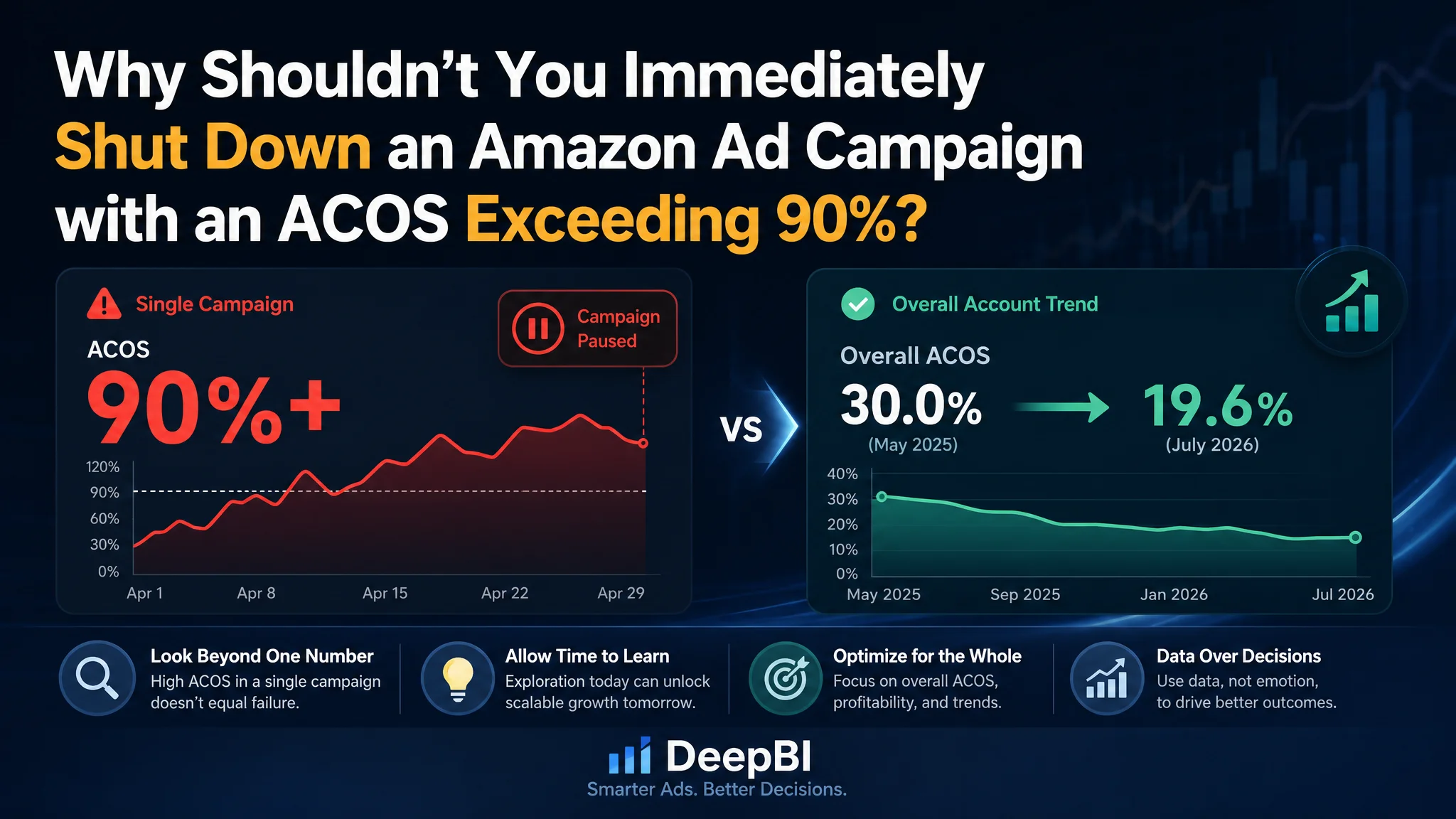
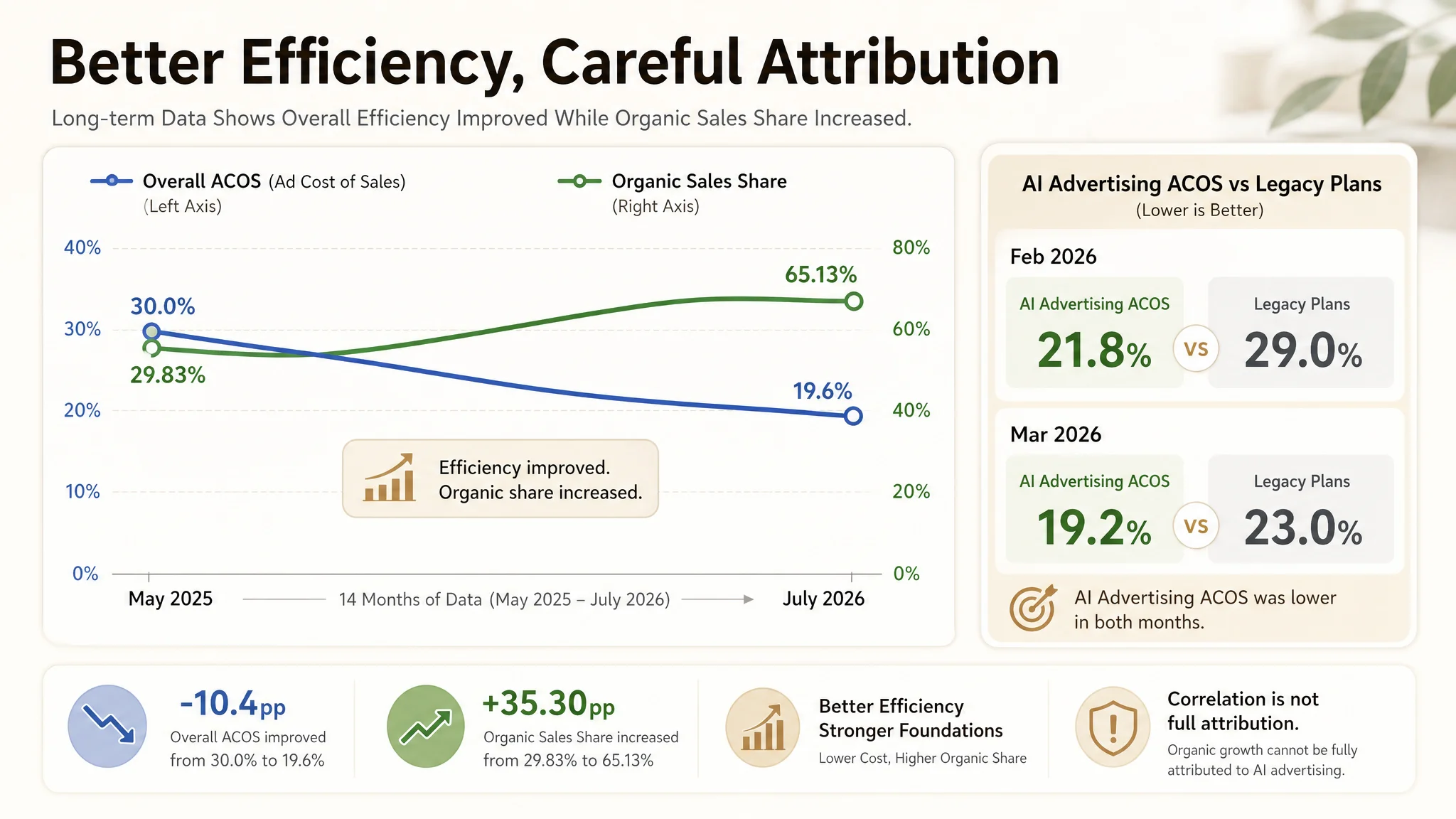
When an Amazon ad campaign’s ACOS, or advertising cost of sales, exceeds 90%, many sellers’ first reaction is to shut it down immediately. However, a high short-term cost from a single campaign does not mean that the entire advertising system is operating at a loss. A Japan-based mobile accessories seller with approximately 78 products once shut down individual campaigns after seeing their advertising cost of sales exceed 90%. This was followed by a decline in the share of sales generated by ads and fluctuations in traffic. By reassessing inventory, ad structure, product conversion fundamentals, and overall business metrics, DeepBI helped the team shift its focus from “Is this individual campaign losing money?” to “Does this campaign still have exploration and scaling value?” In the long-term data, the overall advertising cost of sales improved from 30.0% in May 2025 to 19.6% in July 2026, while the share of organic sales increased from 29.83% to 65.13%. However, these changes cannot all be attributed to AI advertising. The real point worth reviewing is how to avoid shutting down campaigns prematurely based on a single metric.
2. Customer Background
The customer is an Amazon seller of mobile accessories operating on the Japan marketplace, with approximately 78 products in the store. After using an AI advertising platform, the customer experienced an interruption in ad delivery due to insufficient inventory. Once inventory was replenished, the customer restarted advertising and entered the renewal decision stage.
The customer was not facing a single advertising technology issue, but rather a common business decision-making challenge: whether overall advertising costs were acceptable, whether high-cost ad campaigns should be retained, whether AI advertising could maintain orders while controlling costs, and whether sales could continue after inventory was restored.
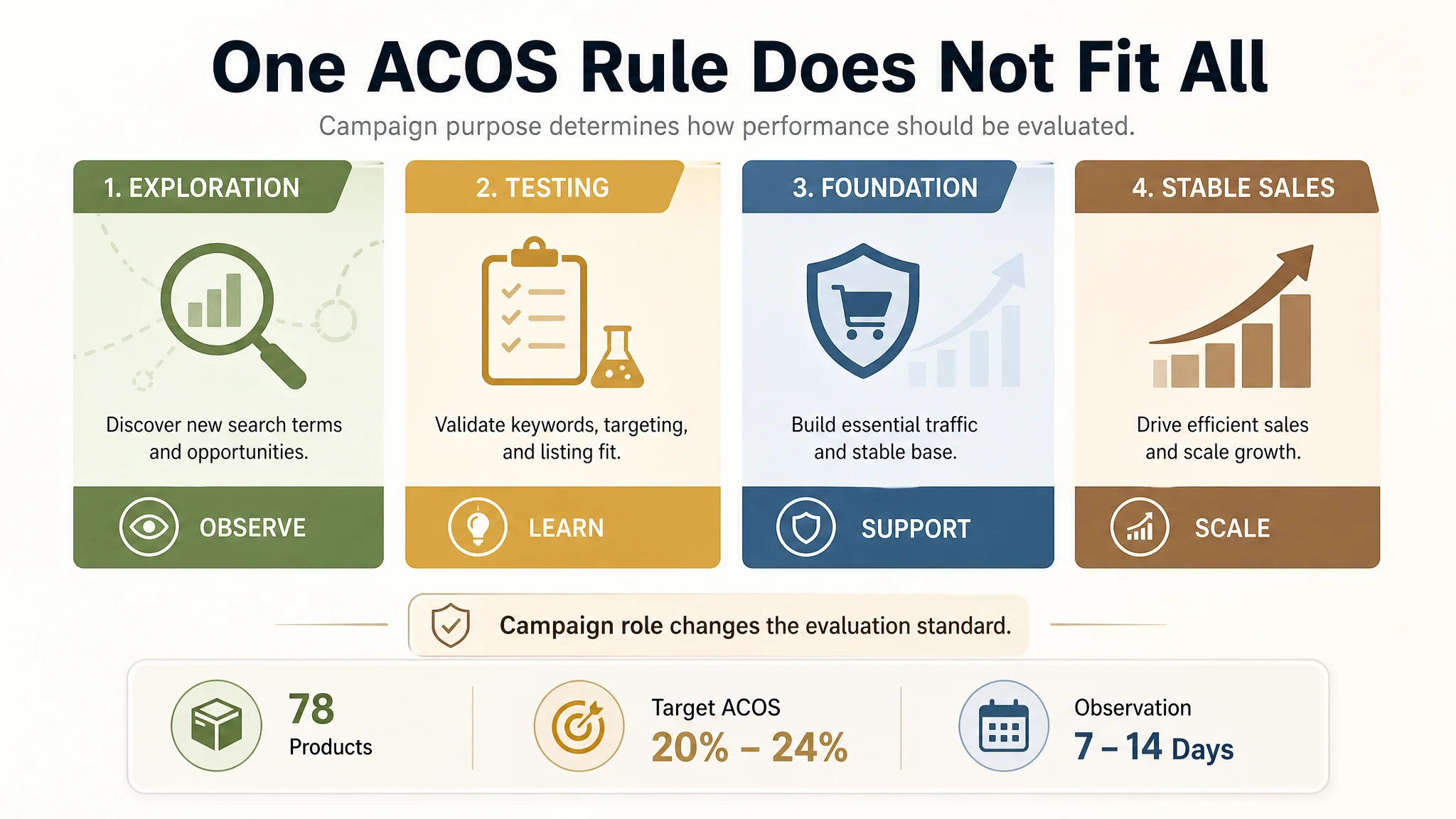
These questions are particularly common in the mobile accessories category. With a large number of products, different ASINs have different inventory levels, conversion fundamentals, search demand, and advertising stages. If sellers look only at the ACOS of one campaign, they may end up evaluating exploratory campaigns, foundational traffic-driving campaigns, and campaigns with stable conversion performance as if they were the same.
3. The Problem
The most direct anomaly observed by the customer was that the advertising cost of sales for certain ad campaigns exceeded 90%. On the surface, this meant that ad spend was close to, or even nearly equal to, ad-attributed sales, seemingly eliminating the reason to continue running those campaigns.
As a result, the customer chose to shut down the high-cost campaigns. This action could reduce some spending in the short term, but two subsequent changes emerged: the share of sales generated by ads declined, and store traffic began to fluctuate. The customer had intended to solve the problems of “Amazon ACOS being too high” and “unprofitable advertising,” but may have simultaneously reduced the system’s opportunities to discover new search terms, test new traffic, and accumulate conversion signals.
The issue is that an ACOS above 90% can result from different situations:
- The campaign is still in the exploration stage, and there are not yet enough clicks or conversion samples;
- The product itself has a conversion foundation, but the current search terms or targeting structure are still being tested;
- The product has insufficient inventory, so advertising and sales performance are constrained by supply;
- The Listing has insufficient conversion capability, so ads generate visits but not orders;
- The campaign is very small, and a single order or a small number of clicks causes ACOS to fluctuate sharply;
- The campaign genuinely lacks efficiency and continues consuming budget without generating effective sales.
If these situations are not distinguished, shutting down a campaign simply because its ACOS exceeds 90% answers an overly simplistic question: Is this campaign expensive right now? What sellers really need to determine is why it is expensive, whether there is room for correction, what may be lost if it is shut down, and how overall advertising and organic sales may change.
This is also one of the root causes behind many sellers’ experiences of “the more I advertise, the more I lose,” “advertising traffic is declining,” or “I can’t get ACOS down”—using the metrics of an individual campaign as the operating conclusion for the entire store.
4. How DeepBI Diagnosed
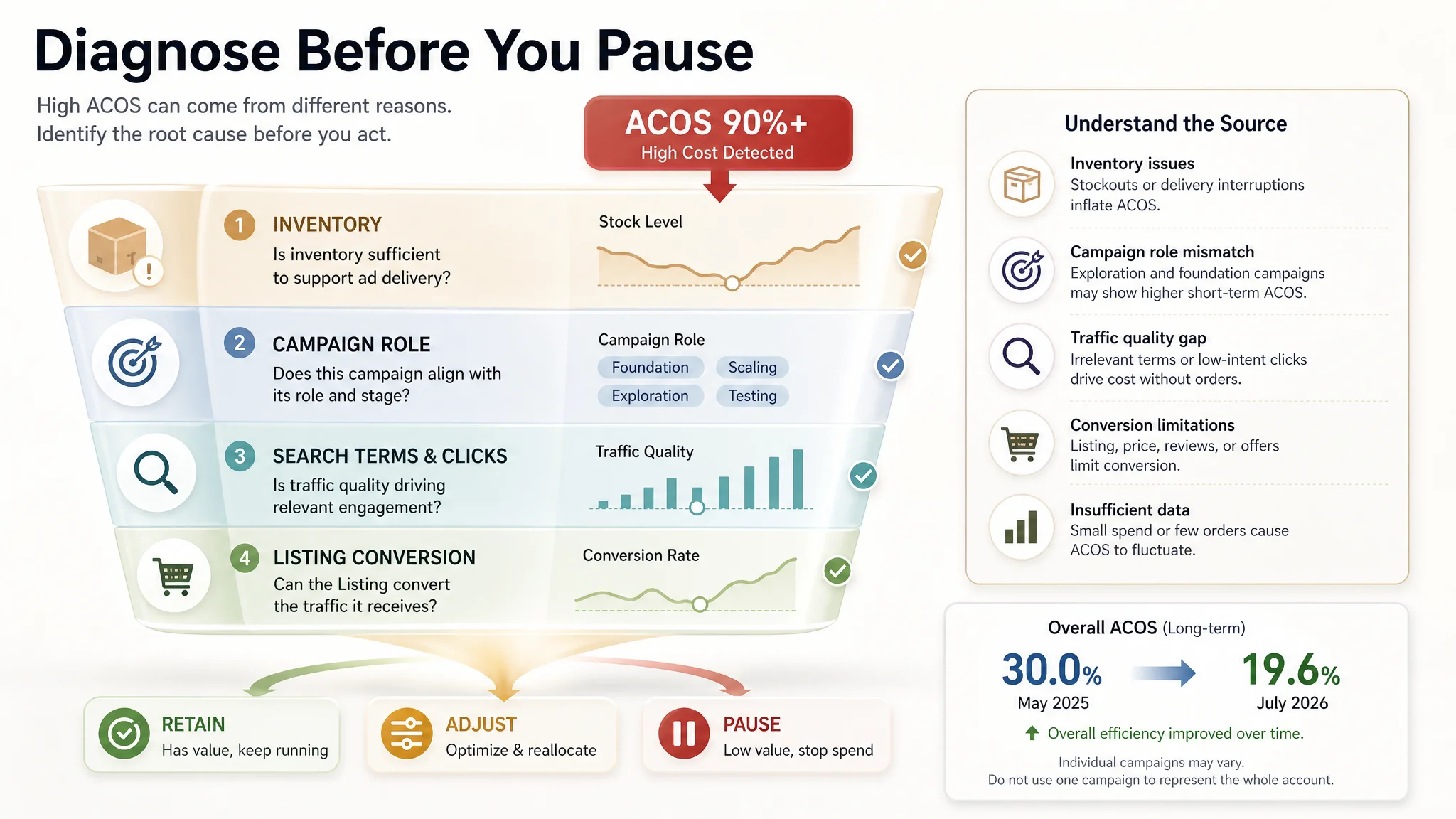
DeepBI did not first make a shutdown recommendation based on an individual campaign’s high ACOS. Instead, it placed the issue back into the store’s overall operating environment. The diagnosis focused on the following areas:
1. First, verify inventory status and delivery continuity. Check whether the relevant products experienced insufficient inventory, interrupted ad delivery, or a restart after delivery resumed. This customer had indeed experienced an advertising pause caused by insufficient inventory, so fluctuations after the restart could not simply be attributed to an ineffective advertising strategy.
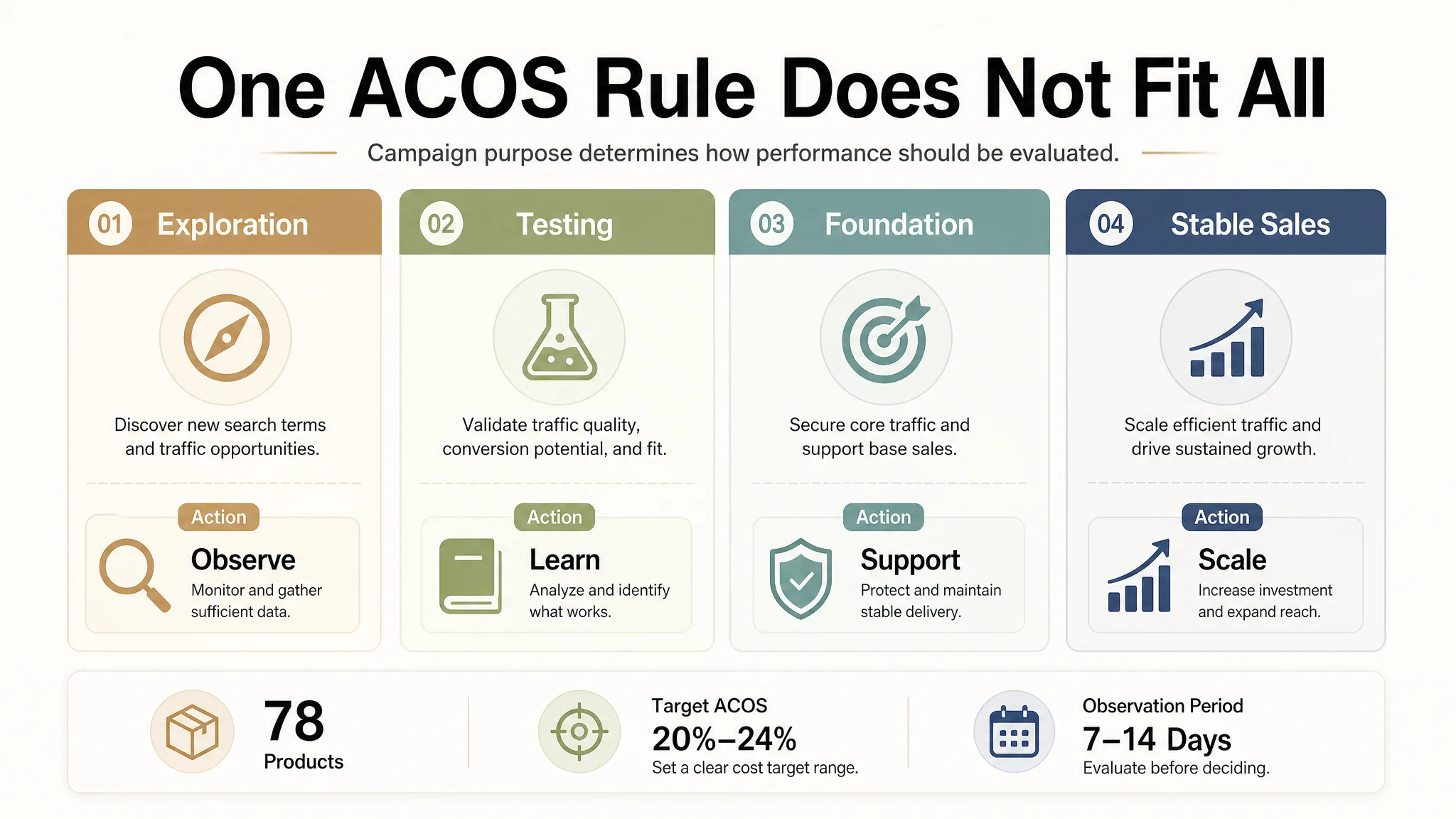
2. Next, review the ad structure and campaign roles. Classify campaigns according to different purposes, such as foundational sales, scaling, exploration, and testing, rather than evaluating all campaigns against the same ACOS target. High-cost campaigns should be assessed in combination with budget size, product stage, and subsequent optimization potential, rather than by looking at a single percentage in isolation.
3. Continue drilling down into search-term and product dimensions. Analyze search terms, ASINs, clicks, orders, and sales together to determine whether high costs are caused by irrelevant traffic, a low-conversion Listing, or exploratory advertising that has not yet accumulated sufficient samples. The available materials do not provide complete search-term details for each campaign, so it is not possible to assert that any specific term was the source of losses. However, search-term performance should be important evidence when deciding whether to retain a campaign.
4. Check the Listing and product conversion fundamentals. If ads generate clicks but insufficient orders, the issue may not be limited to bids or budget. It may also be related to the main image, title, price, reviews, variations, or page experience. In this situation, shutting down ads only reduces visits; it does not solve the conversion problem.
5. Finally, return to overall metrics for validation. Monitor ad-attributed sales, overall advertising cost of sales, the share of organic sales, sales volume, and traffic changes together to determine whether adjustments to an individual campaign affect the store as a whole. The customer’s subsequent data showed that the high cost of an individual campaign did not represent long-term ineffectiveness of the overall advertising effort.
Through this diagnosis, the question changed from “This campaign has an ACOS exceeding 90%—should we shut it down?” to “What stage is this campaign in, what role does it play in overall sales and future traffic, and does it currently have sufficient conditions to continue being observed?”
5. The Real Problem
Problem 1: Treating the short-term high cost of an individual campaign as an overall advertising loss
Cause: The customer directly used an individual campaign’s advertising cost of sales to evaluate its value, without simultaneously considering the campaign’s purpose, sample size, ad-attributed sales, and overall costs.
Impact: After high-cost campaigns were shut down, the share of sales generated by ads declined and store traffic fluctuated. Campaigns that might have been used to discover new search terms and explore traffic also lost the opportunity to continue accumulating data.
Evidence: After seeing that the advertising cost of sales for certain campaigns exceeded 90%, the customer shut them down directly. This was followed by a decline in the share of sales generated by ads and traffic fluctuations. At the same time, the long-term overall advertising cost of sales improved from 30.0% in May 2025 to 19.6% in July 2026, showing that the high cost of individual campaigns cannot directly represent overall advertising efficiency.
Problem 2: Failing to distinguish exploratory campaigns from campaigns with stable conversion
Cause: Different campaigns serve different purposes. Some are intended to discover new search terms, test traffic, or provide data for subsequent scaling, and may not reach the cost level of mature campaigns in the short term.
Impact: If all campaigns are required to immediately meet the same ACOS standard, sellers may shut down exploration before sufficient data has accumulated. This can reduce effective traffic sources in the ad account and limit subsequent scaling.
Evidence: After the customer shut down high-cost campaigns, the share of sales generated by ads declined and traffic fluctuated. During certain periods, the AI advertising cost of sales was better than that of the original manual or legacy plans: 21.8% and 19.2% in February and March 2026, respectively, compared with 29.0% and 23.0% for the legacy plans during the same periods. This indicates that evaluation should shift from individual high-cost campaigns to the overall performance of different advertising structures.
Problem 3: Overlooking the impact of inventory and Listings on advertising results
Cause: The customer had previously experienced an advertising interruption caused by insufficient inventory. Changes in inventory status affect ad delivery continuity, order fulfillment, and traffic performance. In addition, when ads generate clicks but insufficient conversions, the Listing may also be a contributing factor.
Impact: Sales and traffic may naturally fluctuate when inventory is replenished or advertising is restarted. If campaigns are shut down based solely on ACOS at this point, supply issues, page conversion issues, and advertising issues may be mistakenly treated as the same problem.
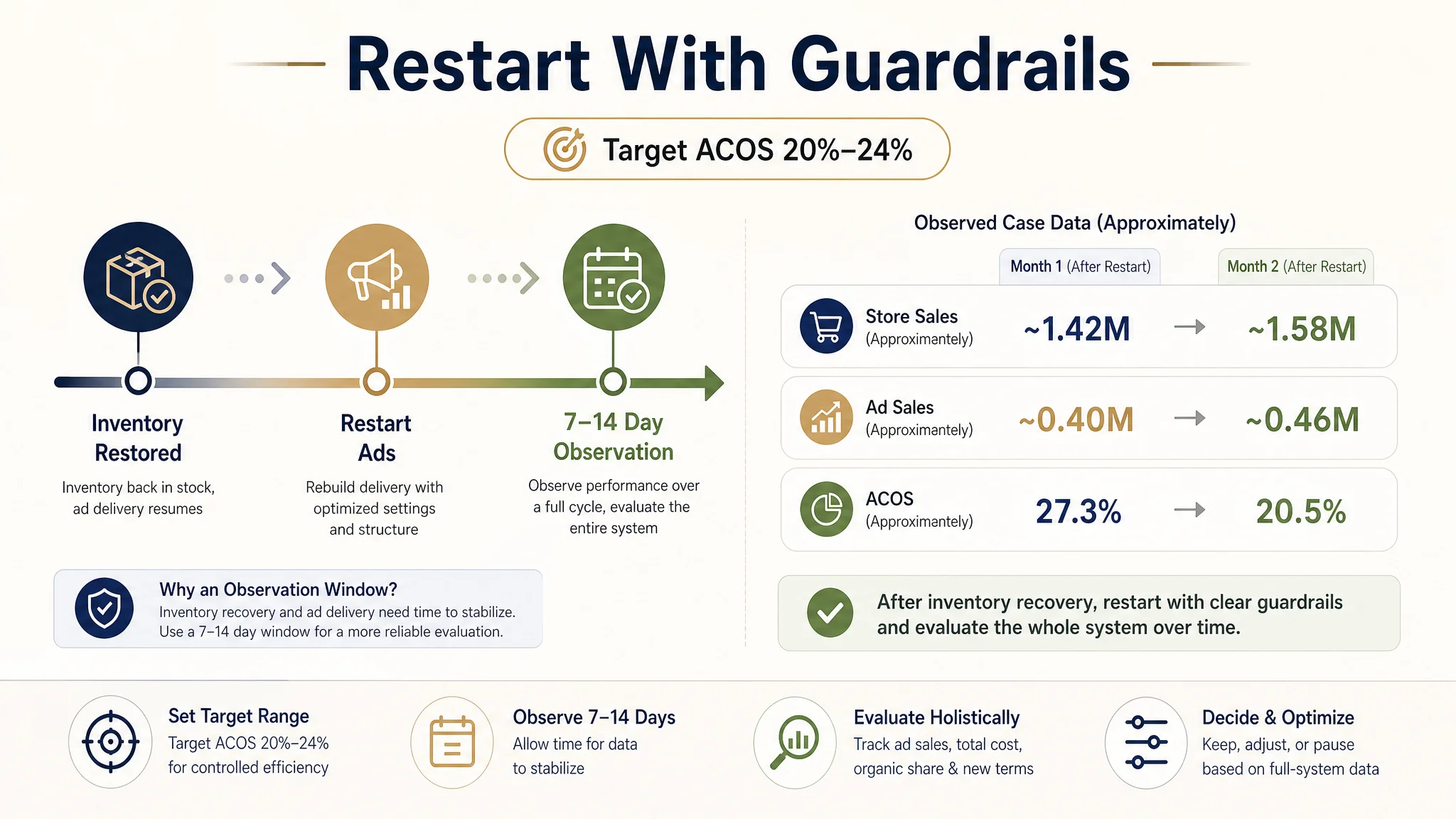
Evidence: After inventory was restored, the customer restarted advertising. During the following two months, store sales recovered to approximately 1.42 million and 1.58 million, respectively, while AI advertising sales were approximately 400,000 and 460,000, respectively. The advertising cost of sales declined from 27.3% to 20.5%. These figures show that advertising after a restart should be monitored continuously in combination with inventory, sales recovery, and overall costs, but they do not support the claim that all growth was generated solely by AI advertising.
6. Optimization Plan
Advertising Optimization
For campaigns with an ACOS exceeding 90%, do not apply a blanket policy of either retaining or shutting them down. Instead, first classify them according to campaign role and product fundamentals:
- Retain products that have inventory, an existing conversion foundation, and search-term performance, while allowing room for observation;
- For products without inventory or that cannot reliably fulfill orders, resolve the supply issue first;
- For campaigns that generate clicks but have no orders over an extended period, investigate search-term relevance and Listing conversion capability;
- For campaigns that consume a significant budget and generate no effective output over the long term, consider reducing the budget, adjusting the structure, or pausing them.
For core products with a conversion foundation, performance can be monitored around a target advertising cost of sales of approximately 20% to 24%. This range is based on the subsequent operating framework used in this case and is not a fixed standard applicable to all products and categories.
Listing Optimization
If ads generate clicks but fail to generate orders, the Listing’s ability to convert those visits should also be checked. This includes whether the product information matches search intent, whether the page clearly communicates the product’s selling points, whether the price and reviews are competitive, and whether variations and inventory are functioning properly. Advertising optimization cannot replace page optimization, and shutting down ads cannot solve a page conversion problem.
Organic Traffic Strategy
Whether an ad campaign should be retained cannot be determined solely by immediate ad-attributed sales. Sellers should also track the share of organic sales and new search-term output. The customer’s long-term share of organic sales increased from 29.83% to 65.13%, but this organic growth cannot be fully attributed to AI advertising. It should therefore be observed as part of the overall change in business results, rather than directly identified as the result of a single advertising tool.
Service Actions
DeepBI’s focus is not to promise that a particular campaign will definitely be profitable, but to help establish operating boundaries: What is the target cost? Which campaigns can continue exploring? Which campaigns need to be adjusted first? How long should they be observed? And which overall metrics should be reviewed at the same time? During the restart phase after inventory is restored, it is recommended to observe performance continuously for at least 7 to 14 days, then make adjustments based on ad-attributed sales, overall costs, the share of organic sales, and new search-term output.
7. Results
After the store began evaluating campaigns based on overall metrics and campaign roles, the following changes occurred in its long-term operating data:
- Overall advertising cost of sales improved from 30.0% in May 2025 to 19.6% in July 2026;
- The share of organic sales increased from 29.83% to 65.13%;
- During the two months after inventory was restored and advertising was restarted, store sales were approximately 1.42 million and 1.58 million, respectively;
- During the same period, AI advertising sales were approximately 400,000 and 460,000, respectively;
- After the restart, advertising cost of sales declined from 27.3% to 20.5%;
- In February and March 2026, AI advertising cost of sales was 21.8% and 19.2%, respectively, lower than the 29.0% and 23.0% recorded by the legacy plans during the same periods.
These results show that when an individual campaign has a high ACOS, shutting it down immediately is not necessarily the optimal choice. A more reasonable approach is to assess it in combination with inventory, product conversion fundamentals, campaign objectives, overall advertising costs, and changes in organic sales.
Two points should also be made clear. First, store sales continued to fluctuate after reaching their peak. Second, the increase in the share of organic sales cannot be fully attributed to AI advertising. The purpose of validating the results is not to prove that a single tool generated all of the growth, but to confirm whether advertising efficiency, organic sales, and overall business metrics are moving in a healthier direction.
8. Case Summary
The real issue in this case was not that “a campaign with an ACOS exceeding 90% must never be shut down,” but that the seller treated a short-term metric from an individual campaign as the final conclusion without sufficient context.
An effective approach consists of three steps: first, confirm that the inventory and product are capable of fulfilling orders; next, distinguish whether the campaign is exploratory, for testing, or focused on stable sales; and finally, monitor ad-attributed sales, overall costs, the share of organic sales, order volume, and new search-term output together.
For the problem of high Amazon ACOS, sellers need to establish a tiered decision-making mechanism rather than rely on a simple shutdown threshold. High-cost campaigns can be adjusted or paused, but before taking action, sellers should first understand why the cost is high, whether the campaign has data value, and which traffic sources may be affected if it is shut down.
9. Key Takeaways for Sellers
Takeaway 1: Do not use the ACOS of an individual campaign as a substitute for an overall store evaluation
An individual campaign with an ACOS exceeding 90% only indicates that the campaign is currently expensive. It does not directly mean that the entire advertising account is losing money. At a minimum, sellers should also review ad-attributed sales, overall advertising cost of sales, order volume, and the share of organic sales.
Takeaway 2: First determine whether the issue is with advertising or the Listing
Clicks without orders do not necessarily mean that bids are too high. They may also indicate mismatched search terms, insufficient product competitiveness, or limited Listing conversion capability. Advertising issues and Listing issues need to be diagnosed separately; shutting down ads should not be used to conceal page conversion problems.
Takeaway 3: Set an observation period and boundaries for exploratory campaigns
Exploratory campaigns should not consume budget without limits, but they should also not be shut down immediately because of a high short-term ACOS. When inventory and conversion fundamentals are in place, sellers can set a clear target cost, observe performance for 7 to 14 days, and track ad-attributed sales, overall costs, the share of organic sales, and new search-term output before deciding whether to retain, adjust, or pause the campaign.
For sellers currently experiencing “the more I advertise, the more I lose,” “organic traffic is not growing,” or “advertising traffic is declining,” the most important question is not whether to shut down the campaign first. It is to determine whether the problem lies in the advertising structure, product page, inventory status, or the evaluation metrics themselves.