

Introduction
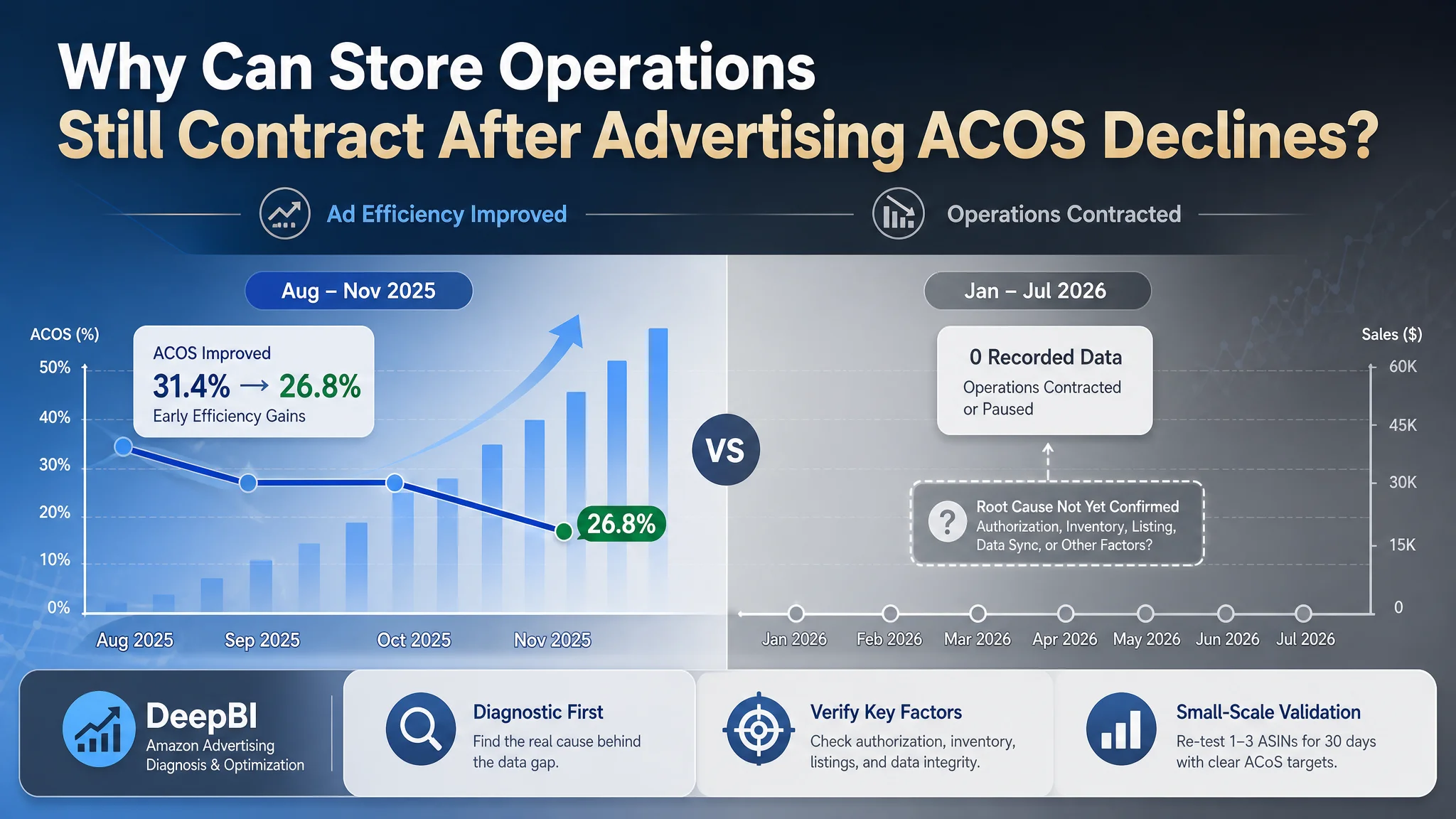
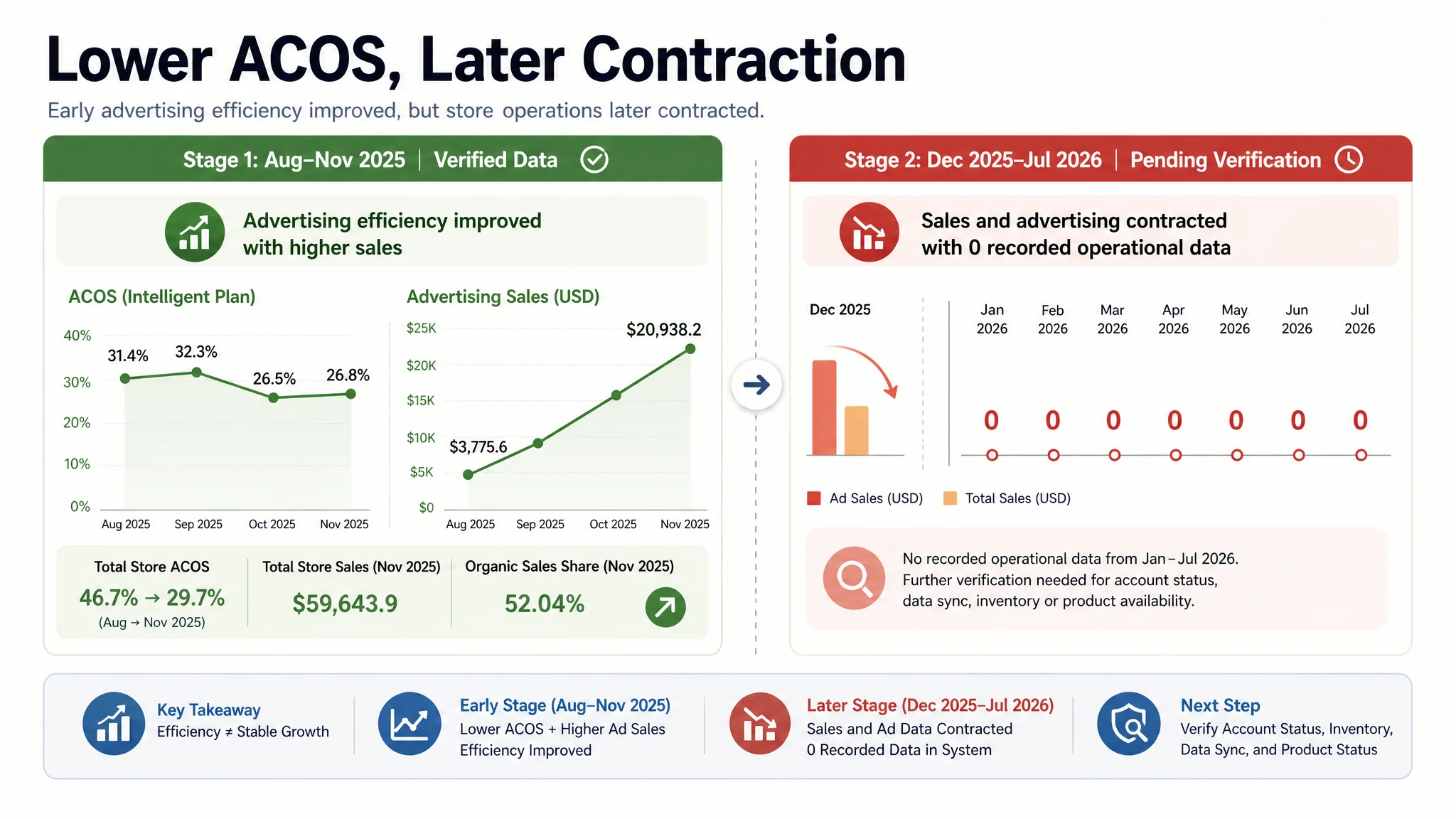
For Amazon sellers, a decline in advertising ACOS is usually a positive signal, but it does not mean that the store has achieved stable growth. One seller operating multiple stores on Amazon US and managing approximately 60 ASINs used an intelligent advertising plan from August to November 2025. During this period, ACOS remained consistently lower than that of the original advertising plan, while intelligent advertising sales increased from $3775.6 to $20938.2. In November, total store sales reached $59643.9, and the share of organic sales reached 52.04%. However, starting in December 2025, advertising and sales contracted significantly, and system-recorded operational data remained at 0 from January through July 2026. This change shows that improvements in advertising efficiency and overall business growth must be evaluated separately. This article breaks down how DeepBI interpreted these conflicting data points and why, beyond advertising optimization, sellers must also verify inventory, product status, authorization, and data continuity.
Customer Background
The customer is a multi-store e-commerce seller operating on Amazon US and managing approximately 60 ASINs. In the early stage, the customer used an advertising optimization system primarily to reduce advertising ACOS, improve campaign efficiency, and reduce the pressure of manually adjusting campaigns.
For sellers managing multiple ASINs and stores, advertising issues are often about more than whether the bid for a particular keyword is too high. Advertising budget allocation, product conversion capability, inventory levels, Listing status, and organic traffic can all affect one another. If sellers look only at advertising reports, they can easily mistake a temporary improvement in advertising efficiency for stable improvement in overall store operations.
The Problem
1. Early Advertising Efficiency Improved, but This Could Not Be Equated Directly with Business Growth
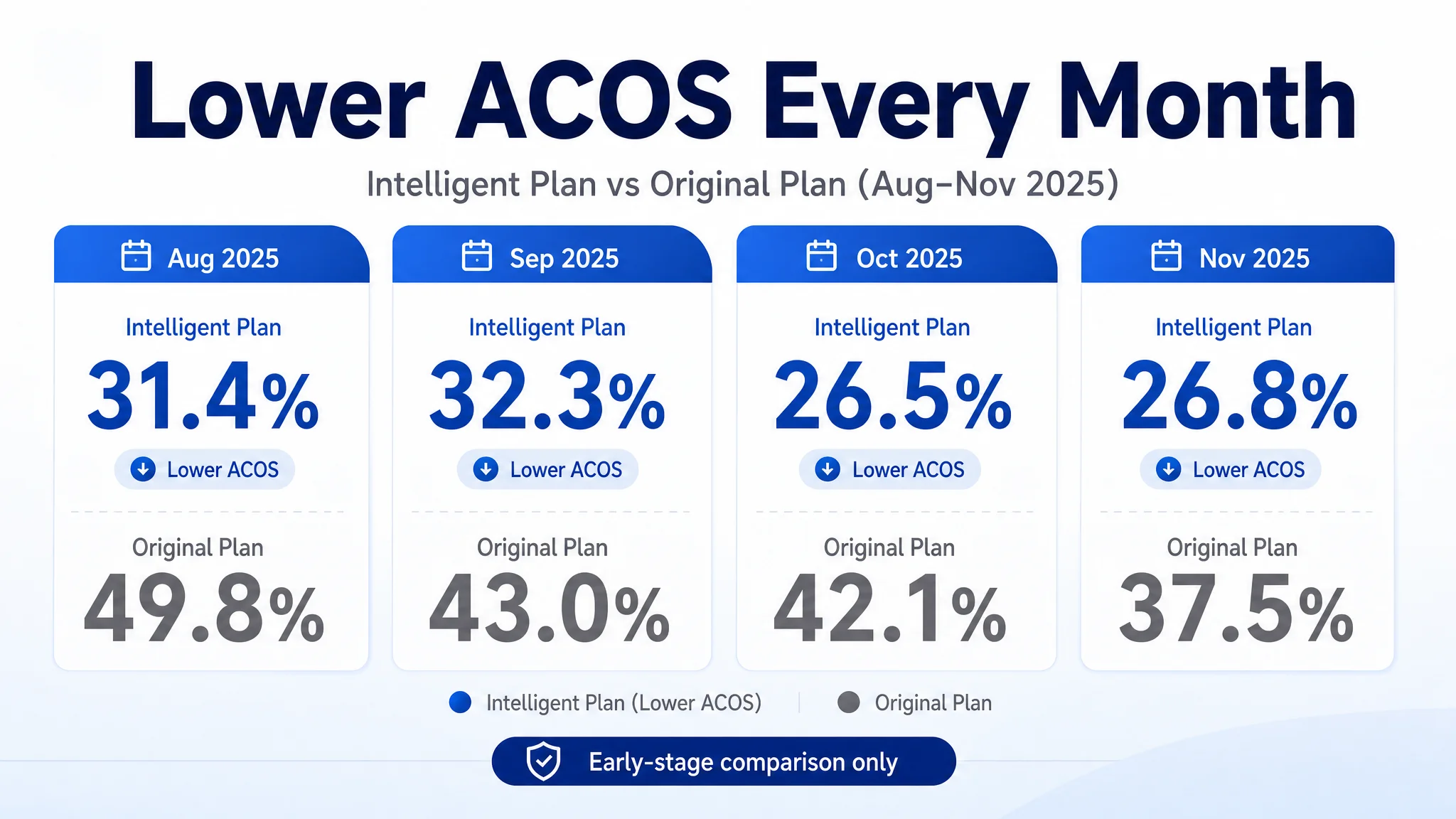
From August to November 2025, the ACOS of the intelligent advertising plan remained consistently lower than that of the original advertising plan:
- August: intelligent advertising ACOS was 31.4%, compared with 49.8% for the original advertising plan;
- September: intelligent advertising ACOS was 32.3%, compared with 43.0% for the original advertising plan;
- October: intelligent advertising ACOS was 26.5%, compared with 42.1% for the original advertising plan;
- November: intelligent advertising ACOS was 26.8%, compared with 37.5% for the original advertising plan.
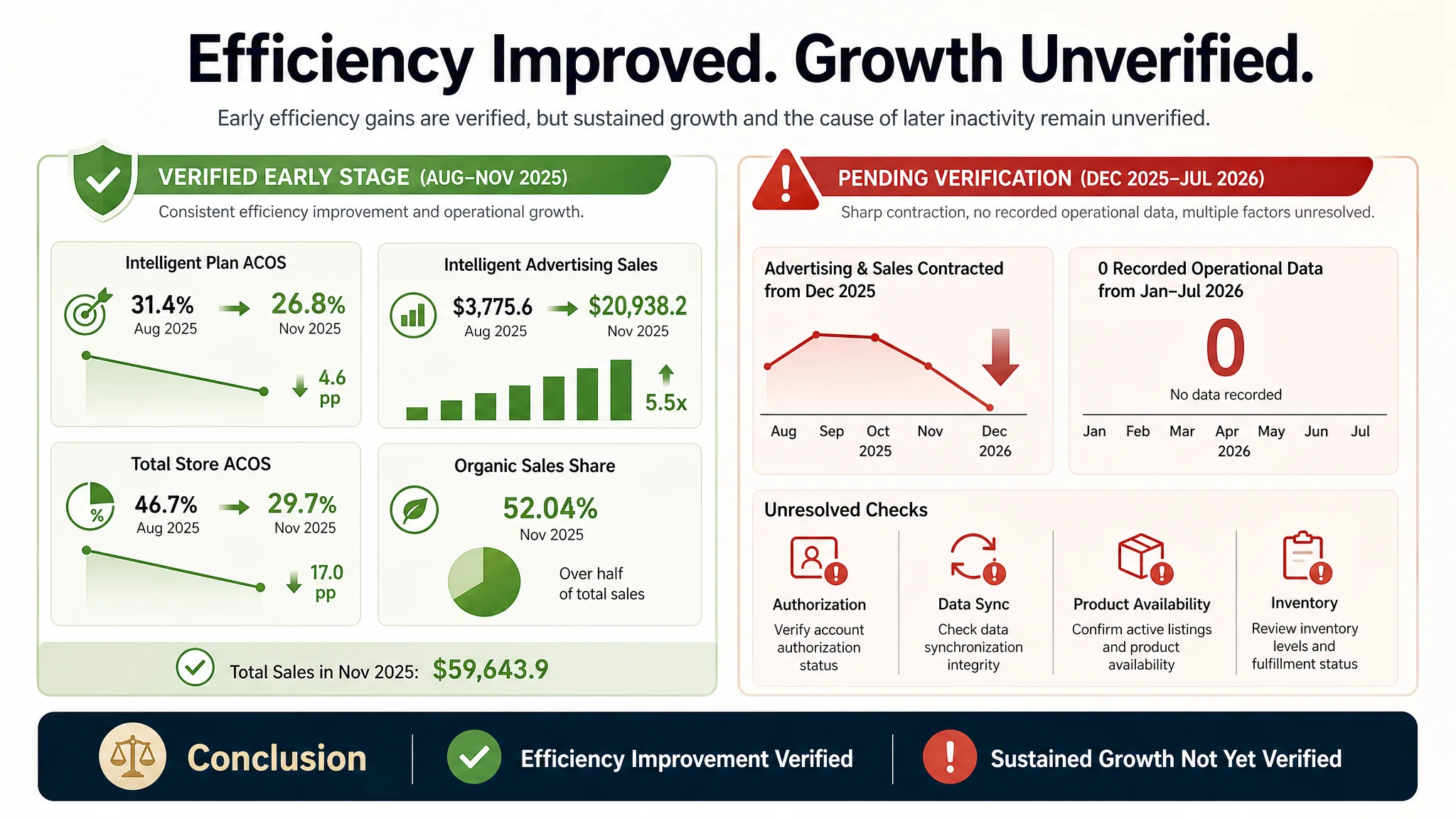
During the same period, intelligent advertising sales increased from $3775.6 to $20938.2, while total store ACOS improved from 46.7% to 29.7%. In November, total sales reached $59643.9, and the share of organic sales reached 52.04%.
These data show that the intelligent advertising plan demonstrated better advertising efficiency during the early stage, but they cannot independently prove that all sales growth was generated by intelligent advertising. Seasonality, product status, inventory, organic traffic, and other operational actions may also have affected the final results.
2. Subsequent Sales and Advertising Data Contracted
Starting in December 2025, the store’s advertising and sales contracted significantly. From January through July 2026, system-recorded operational data remained at 0.
In this situation, sellers commonly raise several immediate questions:
- Did advertising performance suddenly decline?
- Was the ACOS target set too low, causing the budget not to be spent?
- Did the advertising system stop generating orders?
- Or had the store itself become inactive, leaving no sellable products available for advertising?
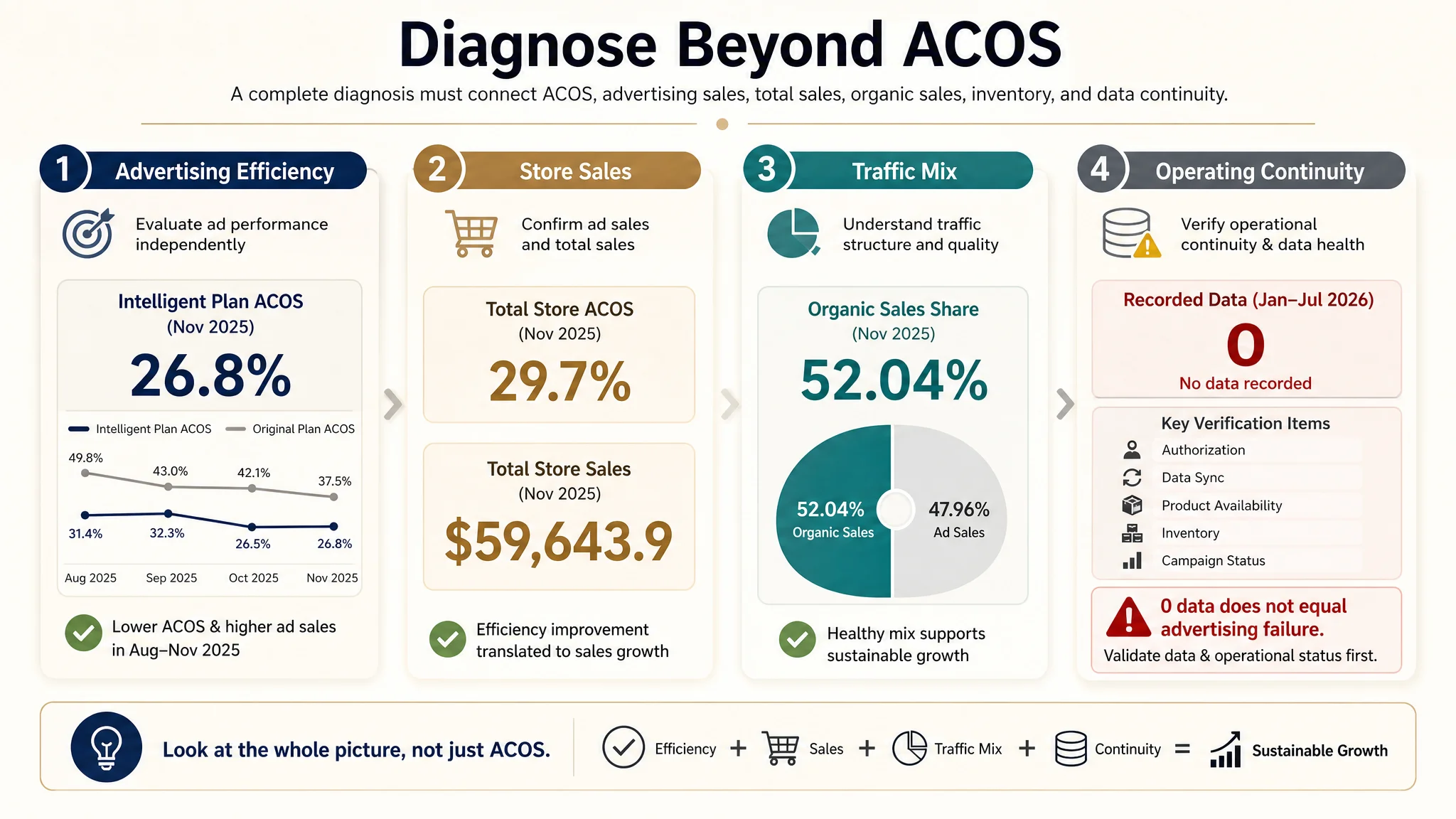
However, “0 data” only means that no operational data was recorded in the current system. It cannot directly indicate advertising failure, nor can it confirm that the store has been shut down. Other possible causes include changes in authorization, data synchronization issues, no products currently available for sale, insufficient inventory, or paused advertising campaigns.
3. Inventory and Budget Pacing May Have Come into Conflict
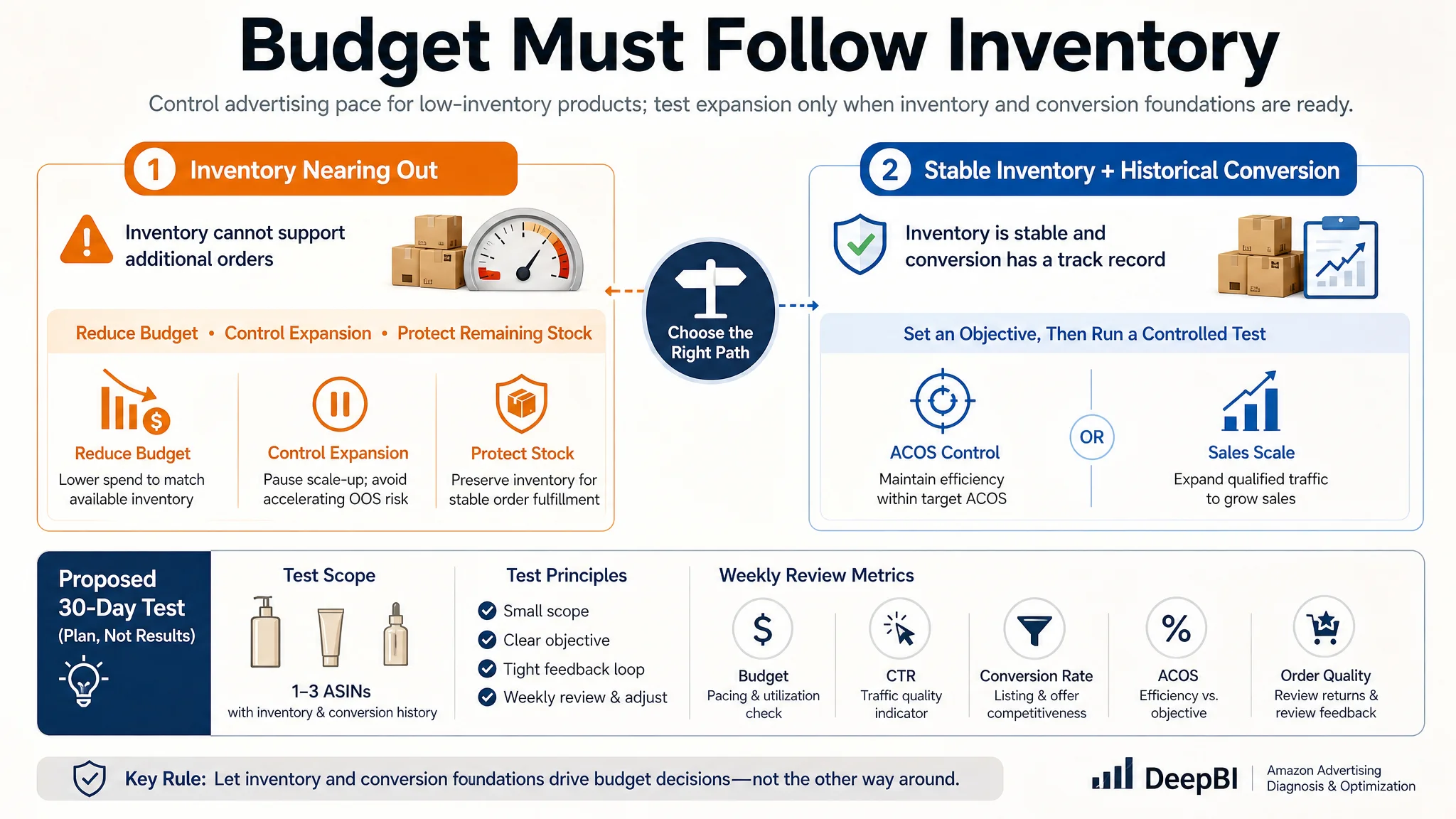
The customer had previously focused on how to reduce the budget when the inventory of an individual product was close to running out, in order to prevent advertising from continuing to consume budget and accelerate inventory pressure. This is an operational issue that is often overlooked in advertising: even if an ASIN has low ACOS, expanding traffic may not be the right choice if inventory cannot support subsequent orders.
Therefore, what sellers really need to determine is not simply whether advertising should continue, but whether the current product has the inventory, conversion, and fulfillment foundation required for continued advertising.
How DeepBI Diagnosed
DeepBI did not treat “declining ACOS” as the final conclusion. Instead, it observed the early improvement in efficiency and the subsequent contraction in operations separately, following the steps below.
1. First, compare the efficiency of different advertising plans. Review the differences between the intelligent advertising plan and the original advertising plan in terms of ACOS, advertising sales, and budget spending to determine whether the improvement in ACOS was consistent. For this customer, intelligent advertising ACOS was lower than that of the original advertising plan throughout the four months from August to November 2025, indicating a relatively clear difference in early-stage advertising efficiency.
2. Next, review advertising sales and total store sales. Do not look only at ACOS. Confirm whether advertising sales increased, whether total sales changed in tandem, and whether advertising sales translated into broader improvements in store operations.
3. Assess the traffic structure together with the share of organic sales. In November, the share of organic sales reached 52.04%, indicating that sales during that period did not rely entirely on advertising. However, this was still only a period-specific data point and could not prove that organic traffic would continue to grow afterward.
4. Check data continuity. For the contraction in sales and advertising after December 2025 and the continuous 0 data from January through July 2026, it was necessary to further verify authorization status, data synchronization, advertising campaigns, products available for sale, and sales records. Advertising failure could not be determined based solely on report results.
5. Return to the ASIN and inventory levels. For key ASINs, check whether they are still available for sale, whether inventory is sufficient, and whether they have a historical conversion foundation. If a product is out of stock, close to running out of inventory, or has experienced a change in Listing status, changes in advertising data may be the result of changed operating conditions rather than a purely algorithmic advertising issue.
The Real Problem
Problem 1: Mistaking Improved Advertising Efficiency for Stable Store Growth
Cause: The ACOS of the intelligent advertising plan remained consistently lower than that of the original advertising plan during the early stage, making it easy for the seller to believe that advertising optimization had been completed. However, ACOS only reflects the relationship between advertising cost and advertising sales. It does not indicate that total sales, organic traffic, and profit have established stable trends.
Impact: If decisions are made solely around ACOS, the seller may overlook whether total sales are sustainable, whether organic sales are stable, and whether orders generated by advertising have established a foundation for long-term growth.
Evidence: From August to November 2025, intelligent advertising ACOS fluctuated between 31.4% and 26.8%, remaining below the original advertising plan’s 37.5% to 49.8%; the share of organic sales was 52.04% in November. These data demonstrate early improvements in efficiency and changes in traffic structure, but they cannot independently prove that all growth was caused by intelligent advertising.
Problem 2: The Cause of the Contraction in Advertising Data Had Not Yet Been Fully Attributed
Cause: Advertising and sales contracted significantly after December 2025, and system data remained at 0 from January through July 2026. However, it was still impossible to confirm whether this was caused by actual inactivity, paused operations, authorization changes, data synchronization issues, no products available for sale, or inventory problems.
Impact: Adjusting bids or increasing the budget before verifying the cause could result in an operational status issue being mistaken for an advertising issue. It could also lead to continued budget consumption without a sufficient product or inventory foundation.
Evidence: System records showed that operational data remained at 0 from January through July 2026. The customer subsequently raised concerns about low store activity and resource usage, but the available materials had not yet produced a complete verification conclusion covering account status, authorization, inventory, and product status.
Problem 3: Advertising Budgets Must Match Inventory and Product Operating Pacing
Cause: The customer manages multiple stores and approximately 60 ASINs, and the inventory, historical conversion, and operational priorities of different products are not the same. When the inventory of an individual product is close to running out, continuing to advertise at the original pace may cause advertising orders to accelerate inventory consumption further.
Impact: Conflicts may arise between budget efficiency, advertising order quality, and sustainable product sales. Continuing to pursue volume for ASINs with insufficient inventory may not produce better overall operational results.
Evidence: The customer explicitly focused on how to reduce the budget when inventory was close to running out, in order to prevent the advertising pace from becoming misaligned with inventory. This shows that budget control cannot be implemented independently of ASIN inventory and sales plans.
Optimization Plan
Advertising Optimization: First Distinguish Between ACOS Control and Volume-Growth Objectives
For ASINs with sufficient inventory and a foundation of historical conversions, first clarify whether the current stage is focused on controlling ACOS or pursuing sales scale, and then set the budget and advertising pace accordingly. A single ACOS target should not be used to manage every product.
For ASINs with inventory close to running out, reduce the budget or control advertising expansion. Only ASINs with stable inventory and a strong conversion foundation should enter more aggressive advertising testing. Advertising reviews should consider budget, click-through rate, conversion rate, ACOS, and order quality at the same time.
Listing Optimization: Verify Product Status Before Assessing Advertising Issues
The available materials do not prove that the customer had completed systematic Listing optimization. Therefore, the subsequent contraction in operations cannot be attributed to the Listing, nor can it be claimed that Listing optimization had already produced results. During reevaluation, first confirm the ASIN’s availability status, whether the detail page can be purchased, and inventory levels. Then review factors affecting conversion, including the title, main image, selling points, price, and reviews.
If the product itself cannot be sold normally, restoring the conditions required for product operations should take priority over continuing to expand advertising traffic.
Organic Traffic Strategy: Observe the Connection Between Advertising and Organic Sales
When the share of organic sales reaches 52.04%, continue tracking whether organic orders, organic traffic, and core keyword rankings can be maintained, rather than drawing conclusions based only on strong data from a single month. Whether exposure and orders generated by advertising lead to sustained improvements in organic traffic must be validated over consecutive periods.
Service Actions: Verify the Status of Low-Activity Stores First
For stores with no data over a continuous period, DeepBI recommends first verifying authorization, data synchronization, products available for sale, inventory, advertising campaigns, and sales records. If the store is reactivated, select 1 to 3 ASINs with sufficient inventory and a foundation of historical conversions for a 30-day small-scale test, and then decide whether to expand advertising.
It should be noted that the 30-day test is a proposed next-step plan. It does not mean that reactivation had already been completed in this case or that new growth results had been achieved.
Results
The results of this case should be understood in two parts: “early-stage data” and “subsequent operational status.”
During the early stage, from August to November 2025:
- Intelligent advertising ACOS declined from 31.4% to 26.8%, while the ACOS of the original advertising plan declined from 49.8% to 37.5% during the same period;
- Intelligent advertising sales increased from $3775.6 to $20938.2;
- Total store ACOS improved from 46.7% to 29.7%;
- Total store sales reached $59643.9 in November 2025;
- The share of organic sales reached 52.04%.
These data indicate that intelligent advertising achieved an improvement in efficiency during the early stage. However, they cannot independently prove that all sales growth came from intelligent advertising, nor can they be extended into a conclusion of sustained growth.
During the subsequent stage, starting in December 2025, advertising and sales contracted significantly, while system-recorded operational data remained at 0 from January through July 2026. The specific cause of the current low activity has not yet been fully verified. Therefore, it cannot be defined as an advertising system failure, nor can this case be presented as a successful case in which a complete growth loop has already been achieved.
Case Summary
The point that deserves the most attention in this case is not how low ACOS reached during a particular period, but that sellers must continue verifying whether store operations are sustainable even after advertising efficiency improves.
The early-stage data show that the intelligent advertising plan achieved lower ACOS and higher advertising sales than the original advertising plan. However, the subsequent contraction in sales and advertising data reminds sellers to further check authorization, data synchronization, product status, and inventory. Advertising issues, Listing issues, inventory issues, and account activity issues cannot be handled with the same set of adjustments.
At present, this case has not completed verification of the cause of low activity or reactivation testing. A more appropriate next step is to first complete an account status check, then conduct a 30-day test with a small number of ASINs, and use consecutive data to determine whether advertising efficiency can translate into stable store operating results.
Key Takeaways for Sellers
Takeaway 1: A Decline in ACOS Does Not Mean the Store Has Already Grown
To determine whether advertising optimization is effective, sellers should review ACOS, advertising sales, total sales, the share of organic sales, and data across consecutive periods at the same time. An improvement in ACOS during a single month or period can only prove that advertising efficiency changed during that period.
Takeaway 2: When Advertising Data Is 0, Check Operational and Data Conditions First
When Amazon advertising data is abnormal and sales data remains at 0 over consecutive periods, do not immediately increase the budget or change the advertising strategy. Instead, verify authorization, data synchronization, advertising campaigns, ASIN availability status, inventory, and sales records in sequence to avoid mistaking an account status issue for declining advertising performance.
Takeaway 3: Budgets Must Serve Inventory and Product Operating Objectives
A larger advertising budget is not always better. Products with insufficient inventory require controlled advertising pacing, while products with stable inventory and historical conversions are more suitable for expanded testing. Multi-store sellers should also regularly assess the activity level and resource usage of each store, prioritizing budget and service resources for stores and ASINs with a solid operating foundation.