

Introduction
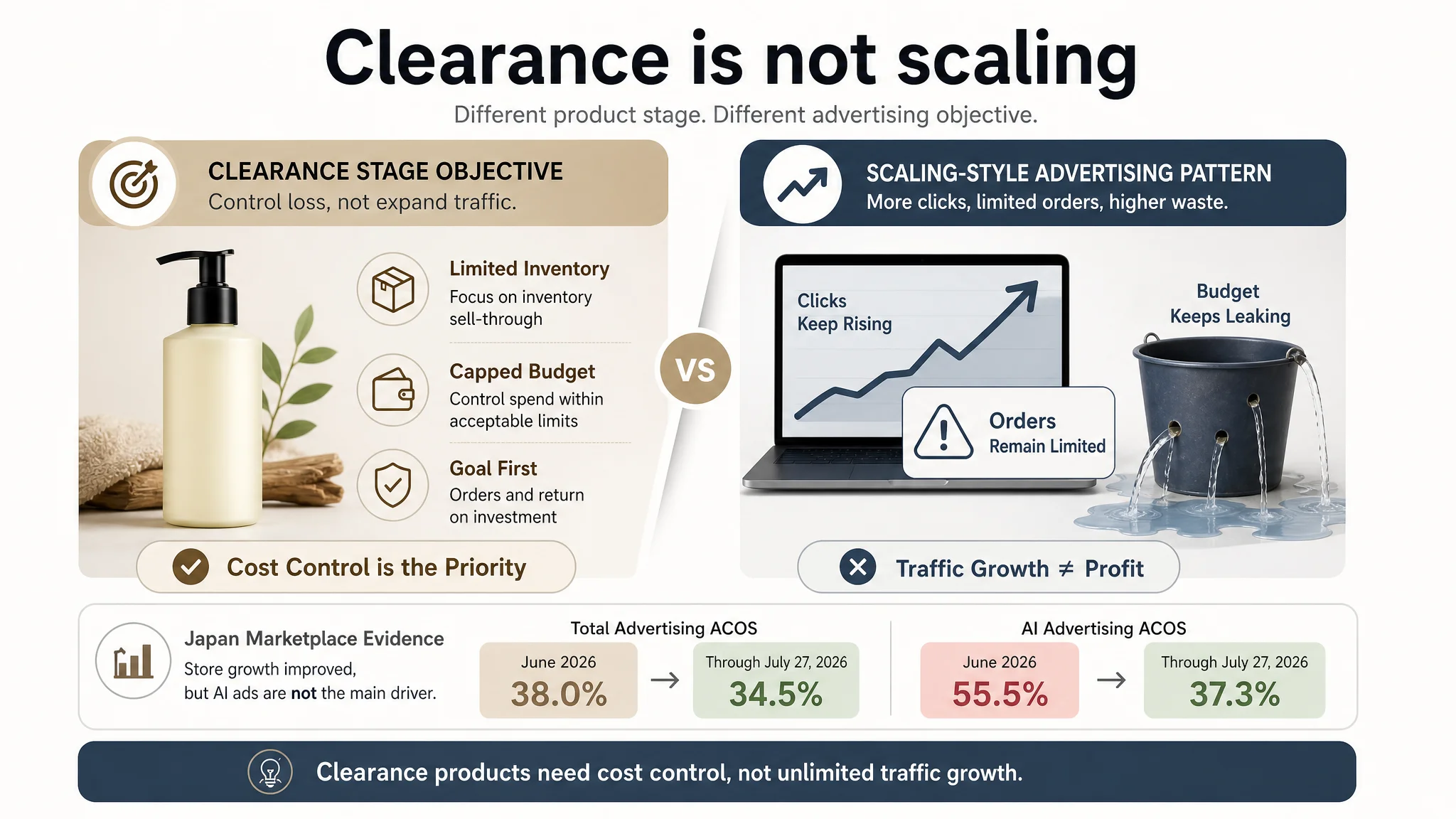
The goals of advertising during the clearance stage are different from those during the new-product scaling stage. New products need advertising to gain impressions, clicks, and conversion data, while clearance products are more focused on inventory sell-through, return on investment, and budget limits. If a scaling-oriented advertising strategy continues to be used, clicks may keep increasing while orders remain limited, resulting in excessively high Amazon ACOS and even increasing advertising losses.
This article examines the business operations of a multi-marketplace seller of consumer electronics accessories. It breaks down the advertising pressure the seller faced while managing multiple product Listings on the Japan marketplace and other marketplaces: some Listings needed to clear inventory, some were still in the testing stage, and others were temporarily unsuitable for continued advertising due to compliance or conversion issues. The case data shows that overall sales and total advertising ACOS on the Japan marketplace improved during certain periods, but AI advertising was not the direct source of overall growth. Therefore, this article does not focus on presenting growth generated by a particular tool. Instead, it explains how to identify irrelevant clicks, distinguish product objectives, and establish actionable ACOS and budget caps during the clearance stage.
Customer Background
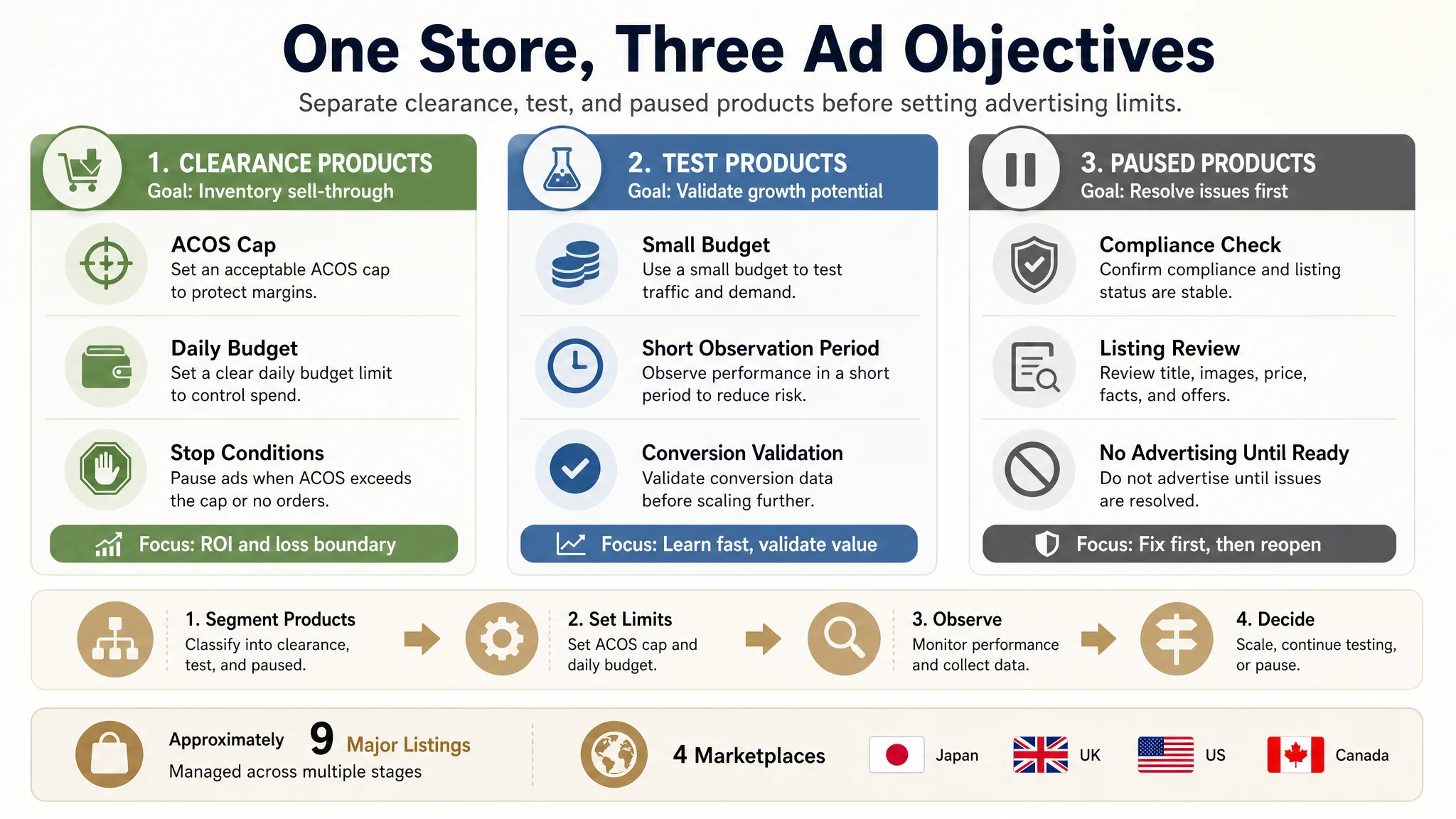
The customer is a seller of consumer electronics accessories, with a primary focus on the Japan marketplace and operations in the UK, US, Canada, and other marketplaces. The seller manages approximately 9 major product Listings. These Listings are at different stages of operation: some are used to clear inventory, some need to validate the growth potential of new products and new marketplaces, and others face issues involving low conversion, compliance stability, or the accuracy of Listing content.
Initially, the customer wanted to trial AI advertising at a relatively low cost to observe whether new products and new marketplaces could acquire effective traffic, while also improving high-ACOS advertising. As operations progressed, the core requirements gradually changed. Rather than simply expanding advertising volume, the customer became more concerned with controlling ACOS during the clearance stage, reducing irrelevant clicks, and using a limited budget to determine whether low-conversion Listings were worth further investment.
The challenge for this type of store is not simply whether to advertise. The operating objectives differ by product, but the products can easily end up being managed under the same scaling logic. If clearance products, test products, and paused products are not distinguished, advertising budgets will have difficulty reflecting the actual objective of each product.
The Problem
1. ACOS pressure remains during the clearance stage
Clearance products have typically entered the inventory sell-through stage. Sellers therefore need to focus more on whether each advertising expense can generate an order and whether advertising investment exceeds the acceptable profit or inventory-handling cost. However, if the seller continues pursuing more impressions and clicks, advertising may consume the budget on search terms, product targets, or traffic sources that have not yet demonstrated conversion potential.
This is a typical scenario in which many sellers experience excessively high Amazon ACOS: the advertising dashboard shows clicks, and the product receives a certain amount of traffic, but orders do not increase accordingly. In this situation, the problem may not be an insufficient budget, but a mismatch between the advertising objective and the product stage.
2. Low-conversion Listings can amplify irrelevant clicks
During operations, this customer encountered issues including clicks without conversions and difficulty evaluating advertising performance. For new products, low-conversion Listings, or products on new marketplaces, advertising can be used for testing, but testing does not mean unlimited scaling.
If the Listing itself has problems with its title, images, selling-point communication, or product facts, advertising can only generate more visits; it cannot automatically resolve conversion barriers. After advertising spend increases, sellers may see click data but still be unable to determine whether those clicks came from an effective audience. The final result may be advertising losses or consistently high ACOS.
3. Improved store-level data does not mean all advertising is effective
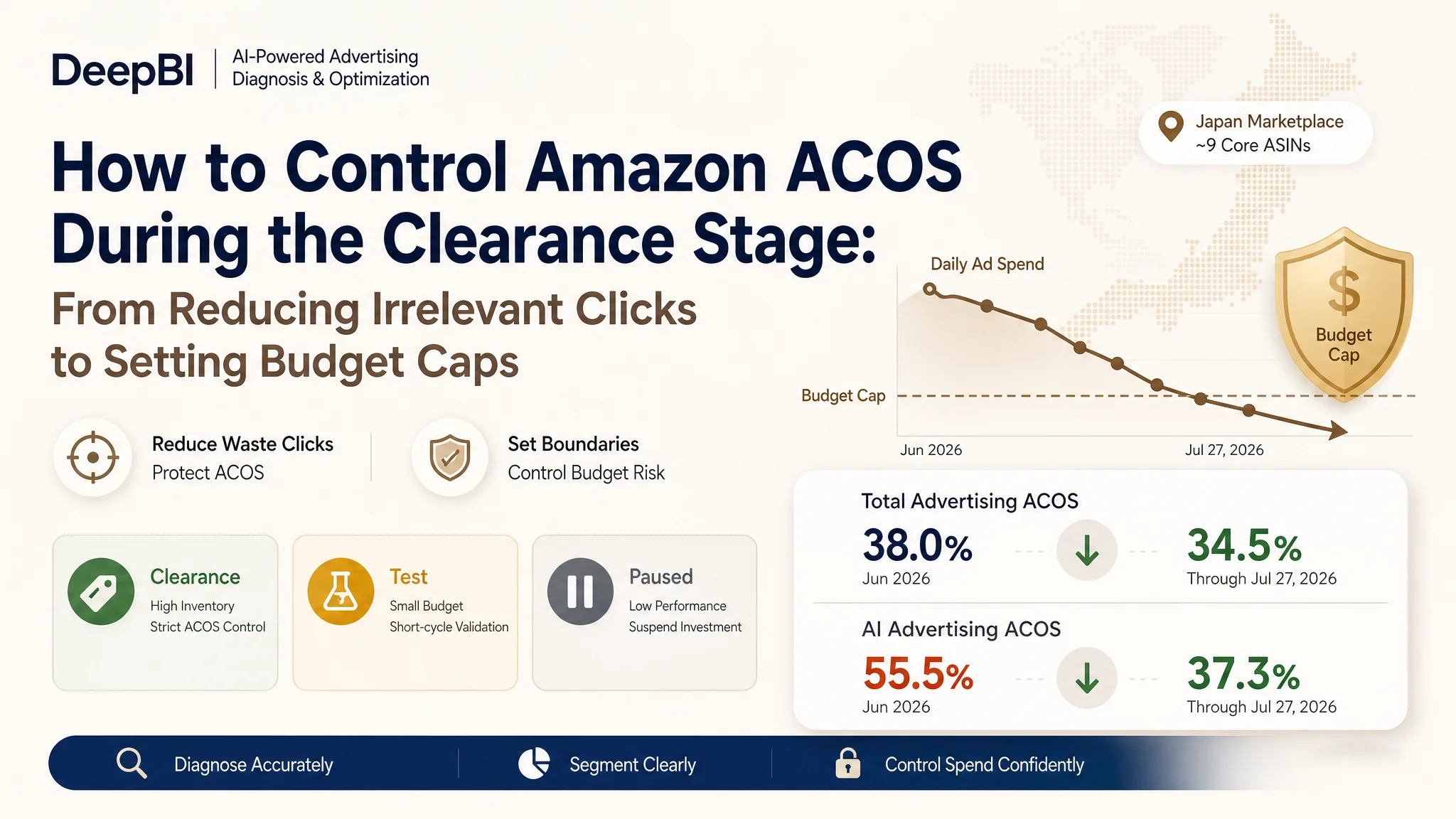
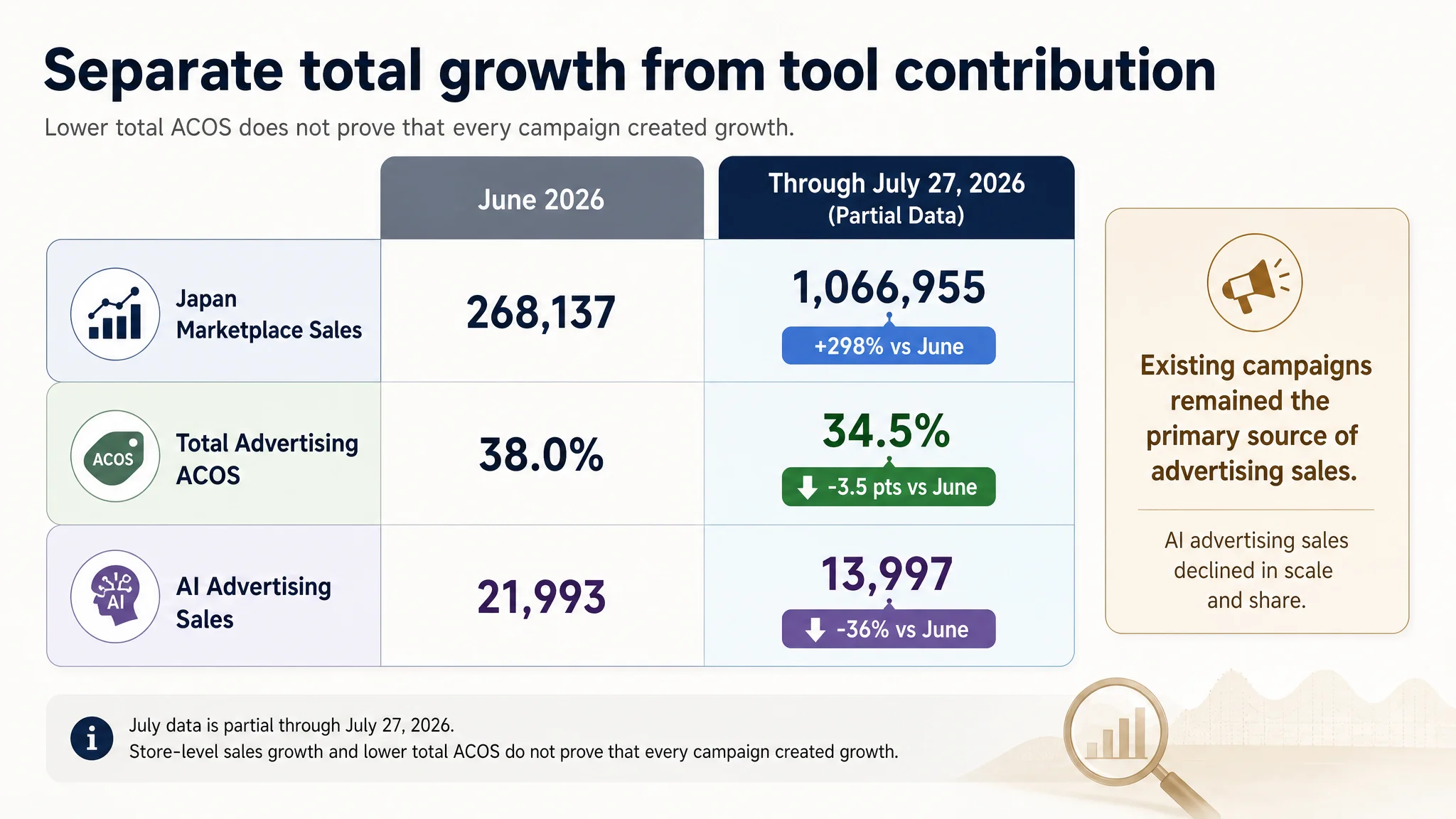
Data from the Japan marketplace shows that total sales were 268,137 in June 2026 and 1,066,955 through July 27; during the same period, total advertising ACOS improved from 38.0% to 34.5%. At the store level, sales and advertising efficiency both changed during this period.
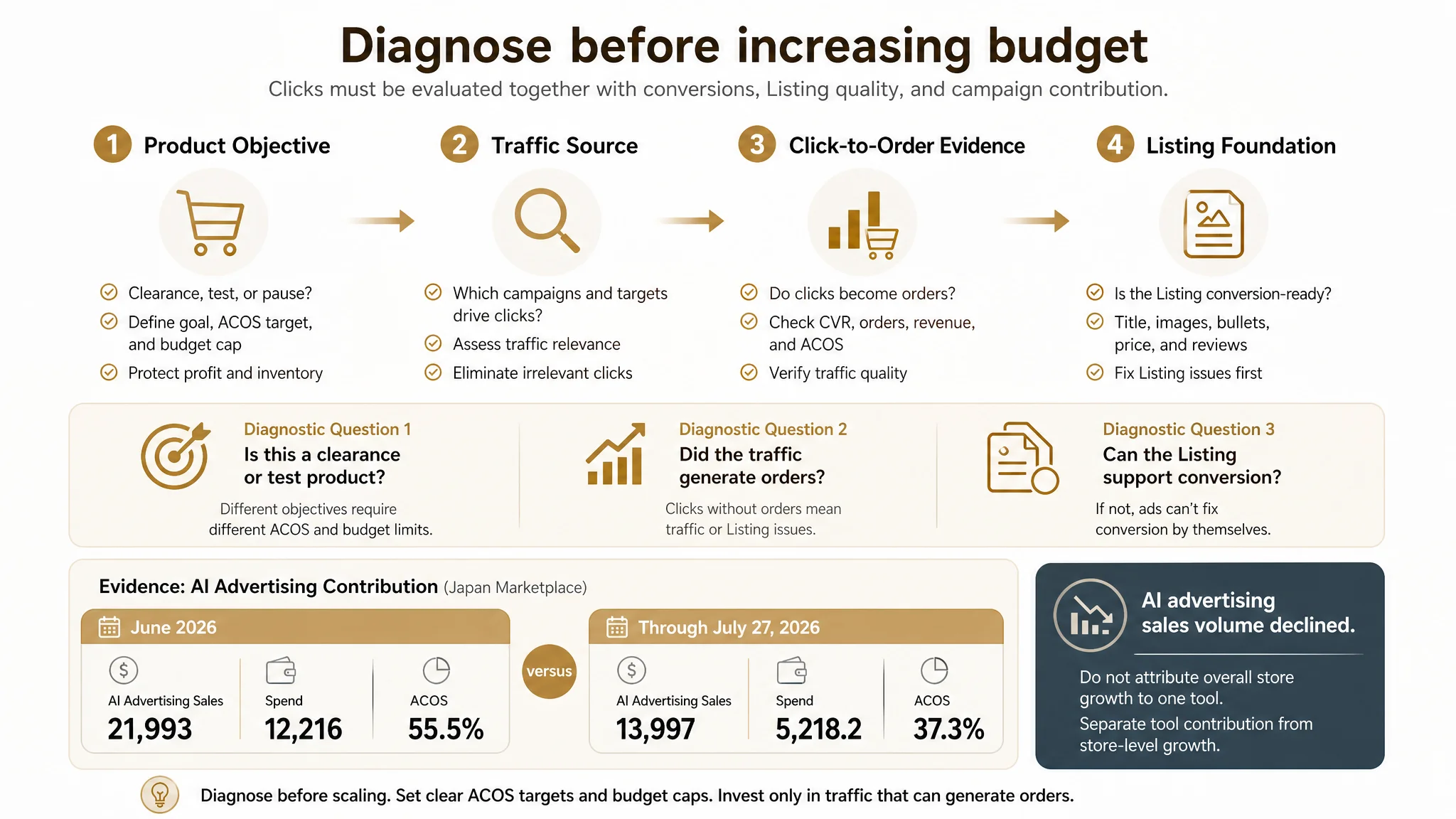
However, after separating AI advertising, the data shows that AI advertising sales were 21,993, spend was 12,216, and ACOS was 55.5% in June. Through July 27, AI advertising sales were 13,997, spend was 5,218.2, and ACOS improved to 37.3%. At the same time, most advertising sales still came from existing advertising campaigns, while the scale and share of AI advertising sales declined.
Therefore, Japan marketplace sales growth cannot simply be attributed to AI advertising. This distinction is particularly important for sellers in the clearance stage: an increase in store sales and a decrease in total ACOS do not mean that every advertising campaign deserves a larger budget.
How DeepBI Diagnosed
When diagnosing this type of advertising issue, DeepBI does not begin by offering a single conclusion such as increasing the budget or lowering bids. Instead, it first confirms the product objective associated with the advertising and the source of the data.
1. First, organize Listings by product stage. Classify the major product Listings as clearance products, test products, or products not currently suitable for advertising. This prevents all products from being evaluated using the same scaling criteria.
2. Next, review the advertising structure and data sources. Compare sales, spend, and ACOS between existing advertising campaigns and AI advertising to determine which campaigns actually drove changes at the store level and avoid misinterpreting overall sales changes as the result of a single advertising tool.
3. Examine the relationship between automatic and manual advertising. Automatic advertising can help discover search terms and traffic sources, but this does not mean that every automatically generated click should be retained over the long term. Manual advertising should be controlled more precisely around validated keywords, competitor traffic, or product targeting.
4. Use clicks and conversions together to identify ineffective traffic. For Listings with clicks but no conversions, click volume alone is not enough. Sellers also need to consider Listing status, product facts, image structure, title wording, and Listing compliance to determine whether the problem comes from the advertising traffic or the conversion foundation.
5. Finally, set budget and ACOS boundaries. Establish budget caps, observation periods, and stop-advertising conditions separately for clearance products, test products, and paused products, rather than waiting until ACOS rises before reactively shutting down advertising.
During the customer engagement, DeepBI provided operational guidance on competitor traffic, the relationship between automatic and manual advertising, test budgets, and ACOS control, while also offering Listing optimization recommendations for new-product Listings. Because the customer had also encountered the compliance-related removal of a core product Listing, the expiration of the trial period, and concerns about the accuracy of AI content and its contribution to advertising performance, subsequent advertising decisions could not be based solely on short-term ACOS. The Listing status and content accuracy also needed to be confirmed first.
The Real Problem
Problem 1: Clearance products were still managed with a scaling mindset
Cause: After a product enters the clearance stage, the operating objective shifts from acquiring more traffic to controlling inventory-handling costs. However, the advertising strategy had not changed accordingly and could still be evaluated around impressions, clicks, and scale growth.
Impact: The budget continued to be invested in traffic that had not demonstrated an order contribution, resulting in excessively high Amazon ACOS and a mismatch between advertising spend and clearance objectives.
Evidence: The customer's core requirement had shifted from scaling new products and new marketplaces to controlling ACOS during the clearance stage, reducing irrelevant clicks, and establishing clearer boundaries for investment and returns.
Problem 2: Test budgets and scaling budgets were not separated
Cause: New products, low-conversion Listings, and mature products are at different stages. Without a separate test budget, advertising validation can turn into ongoing spending. Increasing the budget directly can also amplify problems before the Listing has been properly validated.
Impact: The seller found it difficult to determine whether the advertising had failed to find suitable traffic or whether the Listing itself could not convert. It was also difficult to decide whether to continue testing, optimize the Listing, or pause advertising.
Evidence: The customer had encountered clicks without conversions, concerns about advertising performance, and questions regarding variation identification. Operational discussions covered competitor traffic, the relationship between automatic and manual advertising, and test budgets.
Problem 3: Store-level data concealed the actual contribution of individual advertising campaigns
Cause: Looking only at total store sales or total advertising ACOS can easily overlook changes in sales volume, spend, and share across different advertising campaigns.
Impact: The seller might mistakenly believe that a particular advertising tool or campaign generated overall growth and consequently continue increasing the budget. Alternatively, the seller might shut down a campaign with remaining validation value too early because of short-term fluctuations.
Evidence: Total advertising ACOS on the Japan marketplace improved from 38.0% to 34.5%, but AI advertising sales changed from 21,993 in June to 13,997 through July 27, with both sales volume and share declining. Most advertising sales still came from existing advertising campaigns. This data is insufficient to prove that AI advertising generated overall store growth.
Optimization Plan
1. Manage products by objective
Divide product Listings into three categories:
- Clearance products: The goal is to control investment returns and sell through inventory, with a focus on ACOS caps, daily budgets, and irrelevant clicks.
- Test products: The goal is to validate keywords, competitor traffic, and Listing conversion capability through small budgets and short observation periods.
- Paused products: For Listings with unstable compliance status, unconfirmed Listing facts, or an insufficient conversion foundation, pause advertising first.
2. Set boundaries for each advertising group
Clearance advertising should not have the abstract goal of simply reducing ACOS as much as possible. The acceptable ACOS, daily budget, observation period, and stop-advertising conditions should be defined in advance. Test advertising should also have a limited test budget. Once the observation criteria are met, the seller can decide whether to continue optimizing, adjust the Listing, or stop advertising.
3. Reduce irrelevant clicks rather than simply reducing clicks
Automatic advertising can be used to discover traffic, but search terms, product targets, and traffic sources that generate clicks without conversions must be continuously identified. Elements that contribute no orders while continuously consuming the budget should be controlled through negative targeting, bid reductions, pausing, or transferring them to more clearly defined manual advertising.
4. Synchronize advertising optimization with Listing verification
If the title, images, product description, or variation information contains inaccurate wording, increasing the advertising budget will not solve the conversion problem. The customer found that AI-generated product descriptions and image structures were inconsistent with the product facts. Therefore, AI content could not be published directly. Product parameters, use cases, included accessories, specifications, and image information all required manual verification.
5. Validate performance using segmented data
At each stage, separately record total store sales, sales from existing advertising, AI advertising sales, advertising spend, ACOS, and changes in organic sales. Only after the sales contribution, spend efficiency, and duration of a particular advertising campaign have all been validated should the seller consider whether to expand the budget.
Results
The customer is currently in a risk-warning stage and has not yet achieved stable growth results that can be attributed to DeepBI. The existing data only indicates the following changes between two statistical periods on the Japan marketplace:
- Total Japan marketplace sales: 268,137 in June 2026; 1,066,955 through July 27, 2026.
- Total Japan marketplace advertising ACOS: improved from 38.0% to 34.5%.
- AI advertising ACOS: improved from 55.5% to 37.3%.
- AI advertising spend: decreased from 12,216 to 5,218.2.
- AI advertising sales: changed from 21,993 to 13,997, representing a decline in sales volume.
- Main source of advertising sales: existing advertising campaigns remained the primary source.
Therefore, this case cannot be presented as “DeepBI helped the customer achieve overall sales growth,” nor can it prove that AI advertising has achieved stable incremental growth. The more accurate conclusion is that, after segmenting the data, the improvement in total advertising ACOS was not equivalent to an independent contribution from AI advertising. Going forward, the seller should reduce blind investment during the clearance stage through clearer product segmentation, budget caps, and short-cycle validation.
Case Summary
Poor advertising performance during the clearance stage is usually not caused by an insufficient budget. The real issue is that the advertising objective has not changed with the product stage. Clearance products need to control costs and inventory-handling efficiency, test products need to validate traffic and conversion, and paused products should first address compliance or Listing foundation issues.
For this customer, overall Japan marketplace data and total advertising ACOS improved during certain periods. However, the scale and share of AI advertising sales declined, while most advertising sales continued to come from existing advertising campaigns. Therefore, the most effective evaluation method is not to look at a single ACOS metric or attribute store growth to one tool. Instead, sellers should segment different advertising sources, confirm the actual objective of each product category, and set boundaries for budgets, ACOS, and pausing conditions.
Key Takeaways for Sellers
Takeaway 1: The primary goal of clearance advertising is to control the loss boundary
During the clearance stage, sellers should not automatically pursue more impressions. First define the acceptable ACOS, daily budget, and stop-advertising conditions, then decide which traffic is worth purchasing. Scaling without boundaries often converts inventory pressure into advertising losses.
Takeaway 2: Distinguishing an advertising problem from a Listing problem requires conversion evidence
Clicks without orders do not necessarily mean that the advertising traffic is entirely incorrect. The title, images, product facts, variations, or pricing communication may also be unable to support conversion. Advertising optimization and Listing verification should be carried out simultaneously, especially for new products, low-conversion Listings, and AI-generated content.
Takeaway 3: The independent contribution must be segmented to determine whether an advertising tool is effective
An increase in total store sales or a decrease in total ACOS only indicates that overall operating data has changed. It does not directly prove that a particular advertising campaign generated growth. Sellers should separately review sales and spend from existing advertising, AI advertising, organic traffic, and different product groups before deciding whether to continue advertising or expand the budget.
For stores with excessively high Amazon ACOS, a high volume of irrelevant advertising clicks, or difficulty controlling budgets during the clearance stage, completing product segmentation, data separation, and budget-boundary setting is generally more important than directly increasing the advertising budget.